457284816-abddbe564389a77cdb565ffde8d438dd-Tutorial-12-5

Preview text:
12.5 Non-Ideal Solutions
1. a. i. State Raoult’s law.
ii. 3.94 mol of methanol and 2.22 mol of ethanol miscible to form a solution that obeys Raoult’s law.
The vapour pressures of pure methanol and pure ethanol at 323K are respectively 54.1 kPa and
29.6 kPa. Calculate the vapour pressure of solution produced at that temperature.
b. Sketch and label the vapour pressure – composition curves of a mixture which i. obeys Raoult’s law
ii. shows negative deviation from Raoult’s law
Explain why the solutions show the above behaviour.
2. (a) State Raoult’s law for a mixture of
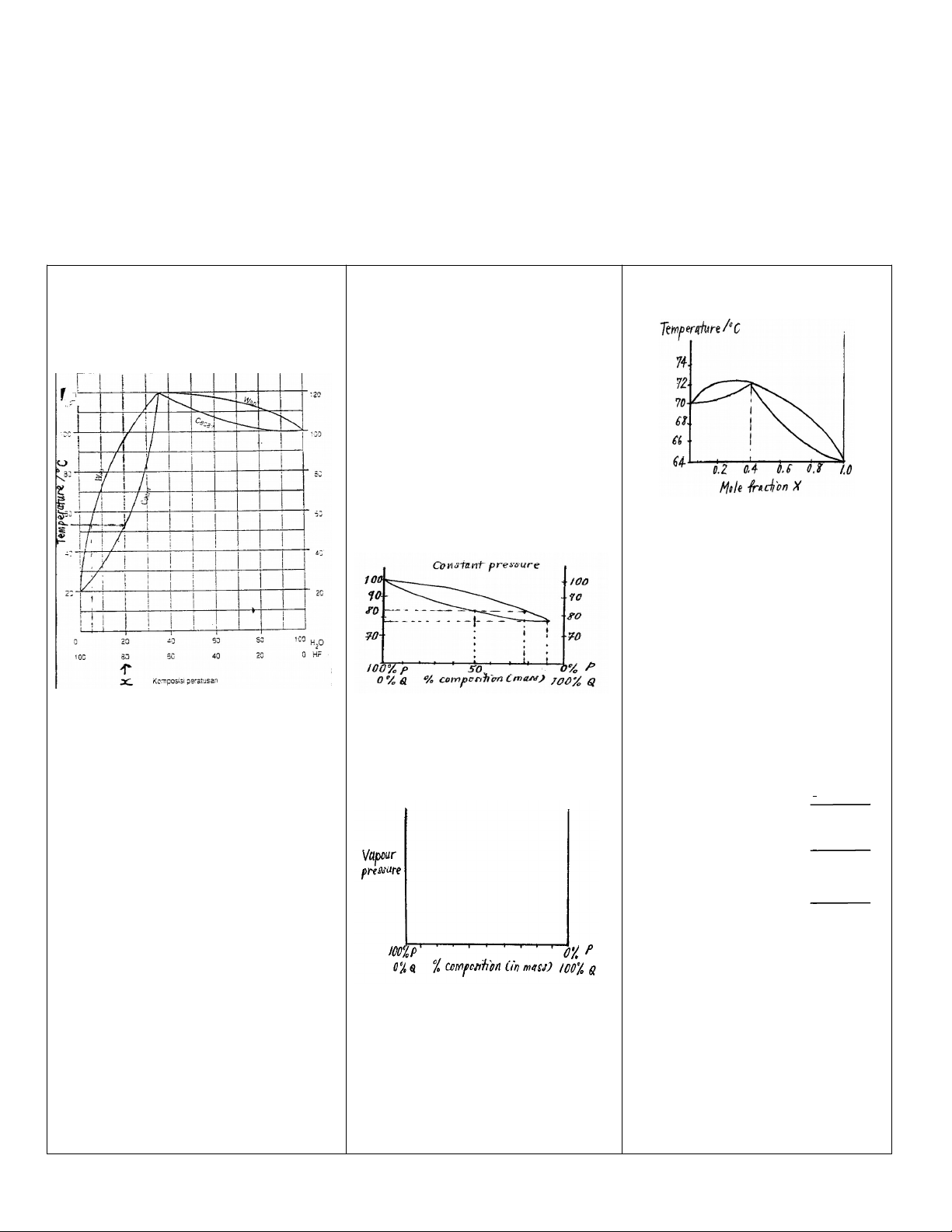
3. The figure below shows a partly
4. The figure below shows the boiling liquids.
completed boiling point-composition
point – composition diagram for the
(b) The figure below shows the
diagram (is obtained at a constant two miscible liquids X and Y.
boiling point – composition
pressure) for the two completely
diagram for hydrogen fluoride and miscible liquids P and Q. water.
(a) Given the boiling point of pure P is
1000C and that pure Q is 900C, complete the diagram.
(b) A liquid mixture consisting of 50% of
P by mass is subjected to fractional distillation. What
(i) is the initial boiling point of the mixture?
(ii) is the composition of the vapour in
(a) Label the liquid – vapour curves on equilibrium with the liquid the diagram above.
mixture at its initial boiling point?
(b)(i) What is the boiling point of the mixture containing 0.6 mole fraction of X?
(ii) What is the composition of
vapour that produced under the boiling of this mixture?
(c) What is the composition of the
(i) A solution of composition X is heated
(c) On the axes below, sketch the vapour distillate that collected
until it reach boiling point. What is
pressure against composition diagram
initially when the mixtures of the
the boiling point of this solution?
you would expected to obtain at
following compositions is heated
constant temperature for mixtures of
under the fractional distillation?
(ii) A mixture of liquid P and Q shows the
P and Q. Label your diagram liquid (i) 0.3 mole fraction of X
ideal behaviour. At a constant
and vapour, where appropriate. Composition of distillate.
temperature T, the vapour pressure of
pure P and Q are 120kPa and 40kPa (ii) 0.7 mole fraction of X
respectively, mole fraction of P in Composition of distillate.
solution is 0.60. Calculate the total
vapour pressure of this liquid (iii) 0.4 mole fraction of X
mixture at temperature T. Calculate Composition of distillate.
also the vapour composition which is
in equilibrium with the liquid mixture
(d) Explain how the interaction at temperature T.
between the molecules X and Y
causes the formation of this boiling point / composition curve.
(d) Explain why a mixture of P and Q
cannot be completely separated by
(e) (i) Describe the changes of simple distillation. enthalpy and volume occurs when X and Y is mixed.
(ii) What is the mole fraction of X
that will produce the biggest variation?
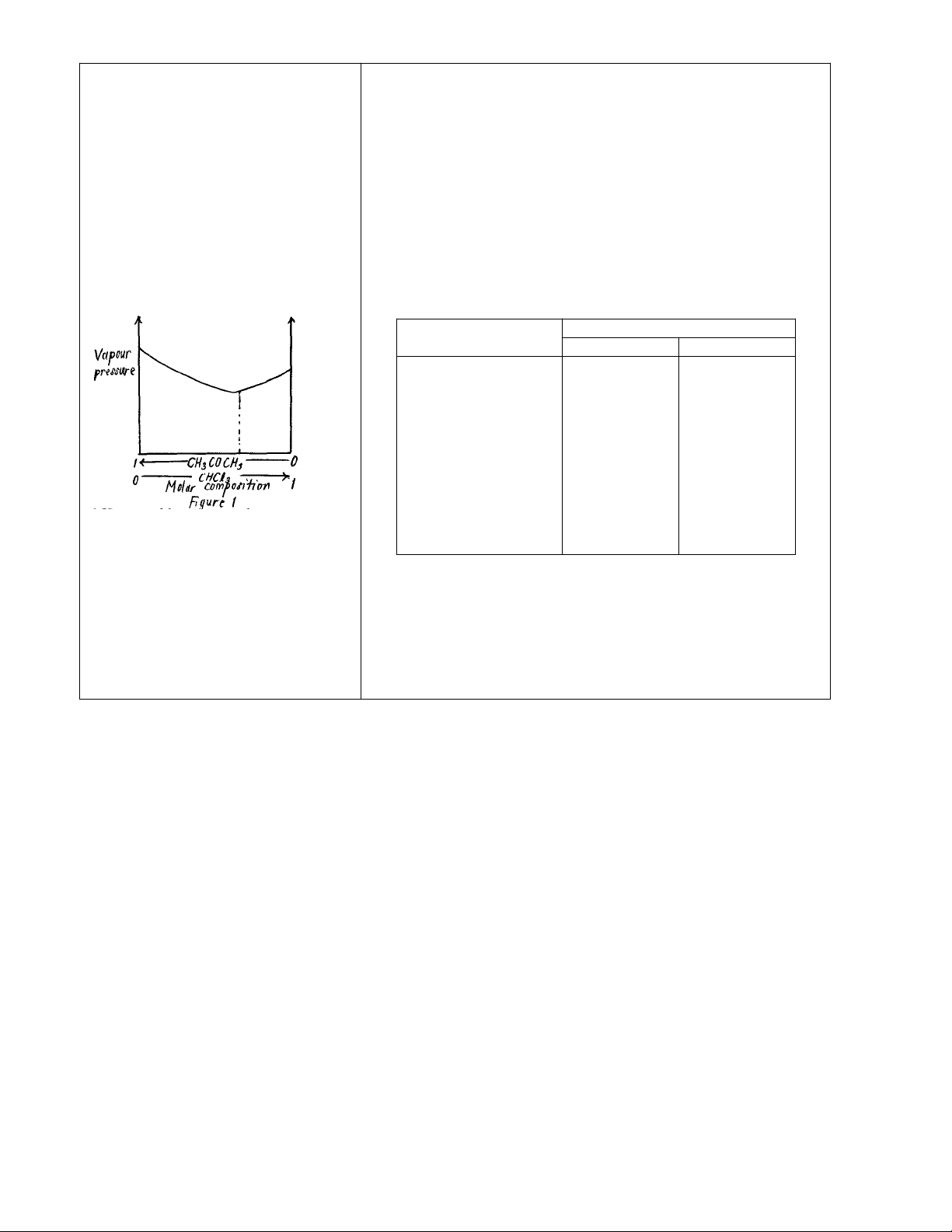
5. The figure 1 shows the vapour
6. i) By using the graph paper, draw the boiling point – composition
pressure / molar composition curve for
diagram for the mixtures of liquid Q and R by following the given a mixture between propanone information below:
(CH3COCH3) and trichloromethane
The boiling point of pure Q = 780C
(CHCl3) at a constant temperature.
The boiling point of pure R = 800C
(a)(i) Explain why the curve has the
The boiling point of azeotrope = 680C shape shown.
Percentage of Q in azeotrope = 35%
(ii) What is the nature of interaction
ii) In fractionally distilling a mixture consisting 70% of Q and 30% of
between the molecules of these two
R, explain the changes of temperature and composition of mixture liquids?
which will be obtained through this distillation. [8]
(b) Sketch the boiling point – molar
7. The table below shows the partial vapour pressure of water and
composition curve for the mixtures of
propan-1-ol in equilibrium with its liquid mixture as a function of these two liquids.
this mixture composition at 250C. Mole fraction of water Partial vapour pressure / kPa Water Propan-1-ol 0.00 0.00 2.91 0.05 0.56 2.77 0.10 1.08 2.59 0.20 1.79 2.37 0.40 2.65 2.07 0.60 2.89 1.89 0.80 2.91 1.81 0.90 2.93 1.76 0.95 3.03 1.44 0.98 3.13 0.67 (c) How would you expect the temperature to change when 1.00 3.17 0.00
equimolar quantities of these two
By using the data above, construct the vapour pressure - composition
liquids are mixed? Suggest a reason
diagram for a mixture of water and propan-1-ol, thus determine for your answer.
(i) the areas where the liquid mixture shows an ideal behaviour.
(ii) the vapour composition in equilibrium with the liquid mixture that
containing 0.9 mole fraction of water.
(iii) the vapour composition in equilibrium with the liquid mixture
which containing 0.9 mole fraction of water if the mixture having
an ideal behaviour for all of the composition.