TÀI LIỆU ÔN TẬP - ĐỀ TIẾNG ANH
TÀI LIỆU ÔN TẬP - ĐỀ TIẾNG ANH . ĐỀ THI HSG QUẬN CẦU GIẤY. Tài liệu được tổng hợp và sưu tầm gồm 15 trang. Mời các bạn tham khảo
Chủ đề: Đề thi Tiếng Anh 10 30 tài liệu
Môn: Tiếng Anh 10 691 tài liệu
Tác giả:















Preview text:
Đề Tiếng Anh (Đề thi gồm 14 trang) | KỲ THI CHỌN HỌC SINH GIỎI LẦN THỨ XVI, NĂM 2025 ĐỀ THI MÔN: TIẾNG ANH - LỚP 10 Thời gian làm bài: 180 phút (không kể thời gian giao đề) |
SECTION A. LISTENING
Part 1.
Listen and complete the form below. Write ONE WORD AND / OR A NUMBER for each answer.
Name of tour | Price | Main activities | Other information |
Cave Explorers | Example: $93 | Go in a small (1) to the other side of the lake Explore the caves | Minimum age of (2) years. |
Silver Fjord | $220 | Travel by coach to the Fjord At Easten go for a (3) Cruise on the fjord see mountains and a large waterfall | Eat a (4) lunch See marine life such as seals and (5) |
Part 2. You will hear a talk about what made the Myanmar earthquake so powerful. For questions 6-10, decide whether the following statements are True (T) or False (F). Write your answers in the corresponding numbered boxes on our answer sheet. (10 points)
- _____ The earthquake in Myanmar had a magnitude of 6.4 on the magnitude scale.
- _____ The city of Mandalay, which has a population of 1.2 million, was affected by the earthquake.
- _____ The earthquake's shallow depth of 10 km contributed to greater damage.
- _____ The Sagaing fault line is located far away from major cities in Myanmar.
- _____ Myanmar has modern earthquake building codes that have prevented structural damage.
Part 3. For questions 11-15, you will hear two teachers, Tim and Jane, discussing a proposal to introduce computer games into the classroom. Choose the answer (А, В, C or D) which fits best according to what you hear. Write your answers in the corresponding numbered boxes on your answer sheet. (10 pts)
11. Tim is of the opinion that
A. The interactive whiteboard can be utilized as a proper gaming device in the classroom.
B. Games need to serve educational requirements if they are to be useful in the classroom.
C. Children should play video games only when their friends are present.
D. Playing video games helps kids to strengthen their social relationships.
12. What is Jane's view on the topic?
A. The impacts of playing video games on children are negligible.
B. The introduction of games into schools may exacerbate an existing problem.
C. Children's screen time has increased significantly over the years.
D. Child obesity is a long-standing phenomenon.
13. Jane is not certain about the idea that
A. Computer games encourage children to play together instead of isolating them.
B. Children's reading habit suffers as a consequence of computer games.
C. Games can be designed to facilitate the teaching of certain subjects.
D. Several criticisms on computer games are overstated.
14. Which of the following is mentioned by Tim as a benefit of introducing game-making features into the classroom?
A. Games can be more easily developed as viable educational tools.
B. Children are more likely to learn the importance of careful planning.
C. Children can be encouraged to partake in discourses.
D. Classmates are more likely to welcome their peers' ideas.
15. What is Tim and Jane's conclusion on the topic?
A. The potential of gaming as an educational tool remains limited.
B. A clear strategy of how games will be used needs to be worked out.
C. Even with careful planning, games can cause education to deviate from its original purposes.
D. Games should not be integrated into the curriculum given the number of setbacks involved in such a process.
Your answers
11. | 12. | 13. | 14. | 15. |
Part 4. For questions 16-25, listen to a talk about salt and pepper and supply the blanks with the missing information. Write NO MORE THAN THREE WORDS taken from the recording for each answer in the spaces provided.
Salt and pepper- a strong and prevalent pair
• Salt: Whether it originates from underground sources, salty lakes, 16. ……………………………….………. or salt has been a life necessity for centuries. Among the 17. ……………………………………….. the Romans had the most remarkable impact on the development of salt production and control. In medieval times, salt was pricey and state-controlled, and together with 18. ……………………………………….. made of precious metals, salt represented people's status on dinner tables. The practice of adding salt to one's meat was common as written guidelines were available to explain 19. ……………………………………….. techniques. or even carving
• Pepper: It used to be a costly spice before the large-scale cultivation of black pepper reduced its costs, leading to the expression 20. "………………………………………. " which denoted a small amount of money in the 16th century. However, real changes to pepper's availability came when 21. ……………………………………….. began to favor French cuisine. French cooks, seeking to combine compatible ingredients found out that pepper was well- suited to savory salt. Accordingly, in the 22. ……………………………………….. the pair was used more than other spices. By the Victorian age, standard ingredients and the former was widely available in 23. ……………………………………….. of the next century, salt and pepper were In 1911, salt shakers flourished thanks to a Chicago company's patenting of an 24. ……………………………………….. , and pepper shakers thrived shortly afterwards. However, salt and pepper are not a favored combination everywhere. Other ingredients, such as the fish sauces, the vinegars, the pickles, the sambals, and the 25. ……………………………………….. are still preferred in other cultures.
SECTION B: LEXICO- GRAMMAR (40 points)
Part 1. For questions 26-55, choose the best option A, B, C, or D to complete the following sentences. Write your answers in the corresponding numbered boxes on your answer sheet. (30 points)
- The old lady was becoming increasingly affected by ______.
- senility B. masculinity C virility D. chivalry
- His ______ excuses invariably exasperated the manager'
- feeble B. frail C robust D. wealthy
- People ______ their spending power when prices rise.
A. boost B. curtail C. prolong D. extend
- He became an outlaw by ______ the law.
- defying B. observing C. sticking to D. abiding by
- Complete the form as ______ in the notes below.
A. insisted B. specified C. inplied D. devised
- The notice on the the villa gate read ______ be prosecuted'-
A. Muggers B. Hijackers C. Stowaways D. Trespassers
- Not only is little Johnny's grammar incoherent and his spelling atrocious but also his punctuation ______.
A. slothful B. sluggish C. hhazard D. haphazard
- As the helicopter descended towards the landing pad, the pilot decided to ______ to ensure a gentle touchdown.
A. ease up B. speed off C. kick in D. jump out
- The director was adamant that the film needed to undergo ______ editing before it could be released to the public.
A. cursory B. perfunctory C. rigorous D. approximate
- Their newest phone might be described as ______ a par with their main competitor’s model that came ______ the market last year.
A. on/in B. under/on C. on/on D. at/on
- After the merger, the company decided to ______ certain departments in order to streamline operations and cut costs.
A. ramp up B. phase out C. double down on D. spin off
- Although his proposal was met with skepticism, he ______, convinced that it would ultimately prove successful.
A. stuck to his guns B. threw in the towel
C. kept a low profile D. went out on a limb
- I know you’re upset about breaking up with Tom, but there are plenty more ______.
A. horses in the stable B. cows in the shed
C. tigers in the jungle D. fish in the sea.
- We’ve had to quit our cooperation with this wholesaler as we could never ______ a bargain. He asked for more than we could offer.
A. strike B. hit C. beat D. knock
- If he was shocked by the news he didn't show it; his expression remained ______
- placid B. teeming C. galore D. impulsive
- My golden rule is not to ______ aspersions on how other people bring up their children.
A. make B. give C. cast D. waste
- The strike began with mass ______ at factories across the country. Workers downed tools and refused to work.
- walkouts B. workouts C. turnover D. rollout
- Police ______ with demonstrators as ten thousand people gathered to protest against government cuts.
- crashed B. clashed C. grasped D. splashed
- We sometimes copy our homework from each other. Our teacher probably knows, but she never ______ that she does.
- let up B. let down C. let on D. let off
- This food is so ______ it's completely tasteless!'
- stodgy B. mild C. bland D. sour
- You ______ your answers thoroughly before you handed in your exam. I may have better result.
- might have worked B. ought to have checked
C. must have worked D. could have worked
- You are not supposed ______ this now.
A. to be doing B. to do C. doing D. do
- ______ to sharing this information, you may inform our company at any time.
- Were you consent B. Should you not consent
C. Had you not consented D. If you will not consent
- They should be spending money on a house ______ than on a car.
- more B. other C. better D. rather
- The charges of fraud ______ the mayor proved to be ______ foundation.
- against – with B. with/ on C. against/ without D. on/ under
- Here ______, all dressed in white, sweetly, serenly in the soft glowing light.
- the bride come B. did the bride come C. comes the bride D. does the bride come
- I'm interested in ______ finance. I heard ______ Euro is losing value, compared to ______ US dollar.
- a - Ø - Ø B. Ø - Ø - Ø C. Ø - the - the D. the - Ø - Ø
- The local authority as well as the local people ______ continuous attempts to stop street littering.
- has made B. have made C. make D. are making
- Henry is a ______ dog that they adopted 1 week ago.
- lovely tiny white British B. tiny lovely white British
C. lovely white tiny British D. lovely tiny British white
- The night before test day ______ when her alarm went off.
- not until she went to bed B. barely had she gone bed
C. no sooner had she gone to bed D. having just gone to bed
Answers:
26. | 27. | 28. | 29. | 30. |
31. | 32. | 33. | 34. | 35. |
36. | 37. | 38. | 39. | 40. |
41. | 42. | 43. | 44. | 45. |
46. | 47. | 48. | 49. | 50. |
51. | 52. | 53. | 54. | 55. |
Part 2. For questions 56-65, fill each gap with the correct form of the word in brackets. Write your answers in the corresponding numbered boxes on your answer sheet. (10 points)
- Some people believe that the government should ban celebrity ______________ or advertising of certain products such as medicine, junk food, off-campus education. (ENDORSE)
- An online campaign – #NotoAIArt – has seen artists sharing concerns about the legality of AI image generators, and about how they have the potential to ______________ the skill of illustration (VALUE)
- The teacher was furious that Emma had again turned in ______________ work. (STANDARD)
- The ______________ of Myanmar-Thailand earthquake was in Mandalay, Myanmar, the country's second-largest city. Even Bangkok, some 600 miles away, felt widespread shaking and saw significant damage from the quake. (CENTER)
- There is an ______________ collection of Egyptian relics at the British Museum in London. (RIVAL)
- So ______________ was she that it was difficult to ever get really angry at her. (CHARISMA)
- The criminal act of numerous factories dumping waste into the area's rivers has led to dangerously high ______________ levels. (TOXIC)
- Caffeine may improve ______________ in the short term, but it has other negative effects too. (ALERT)
- Children under 12 ______________ by an adult can enter for free. (COMPANY)
- New managers can sometimes discipline employees ______________ in an attempt to appear tough. (NECESSITATE)
Your answers:
56. | 61. |
57. | 62. |
58. | 63. |
59. | 64. |
60. | 65. |
SECTION C: READING (60 points)
Part 1. For questions 66-75, read the following passage and decide which option (A, B, C, or D) best fits each gap. Write your answers in corresponding numbered boxes on your answer sheet. (15 points)
There can be no question that online shopping is of huge benefit to the consumer. Far from becoming (66) , online shoppers are very damaging. Overpriced merchants with poor services should (67) . Gone are the days when stores could charge what they liked for goods and get away with it. The same, too, for (68) manufacturer: smarter consumers know which products have a good reputation and which do not, because online they now read not only the sales (69) but also reviews from previous purchasers. And if customers are disappointed, a few (70) of the mouse will take them to places where they can let the world know. Nowadays there is nothing more damning than a (71) of negative comments on the internet.
However, the big boys, as always, are (72) of the game. Some companies are already adjusting their business models to take account of these trends. The stores run by Sony and Apple, for instance, are more like brand showrooms than shops. They are there for people to try out (73) and to ask questions to knowledgeable staff. Whether the products are ultimately bought online or offline is of secondary importance.
Online traders must also adjust. Amazon, for one, is rapidly turning from being primarily a bookseller to becoming a (74) retailer by letting other companies sell products on its site, rather like a marketplace. During America's Thanksgiving weekend last November, Amazon's sales of consumer electronics in the United States (75) its book sales for the first time in its history. Other transformations in the retail business are bound to follow.
66. A. complacent | B. dissatisfied | C. competent | D. compassionate |
67. A. care | B. aware | C. beware | D. wary |
68. A. shabby | B. shady | C. shaded | D. shading |
69. A. bubble | B. message | C. blare | D. blurb |
70. A. taps | B. clucks | C. clicks | D. prods |
71. A. flood | B. downpour | C. flow | D. stream |
72. A. behind | B. ahead | C. in front | D. forward |
73. A. devices | B. tools | C. emblems | D. schemes |
74. A. block | B. lump | C. chunk | D. mass |
75. A. receded | B. excluded | C. repressed | D. exceeded |
Your answers
66. | 67. | 68. | 69. | 70. |
71. | 72. | 73. | 74. | 75. |
Part 2. For questions 76-85, fill each of the blanks with ONE suitable word. Write your answers in the corresponding numbered boxes on your answer sheet. (15 points)
Every anecdote about errors and embedded biases leads to fears that more AI could lead to (76 _________ humanity in how society functions. So how do we make AI more human? How do we ensure that the benefits of AI are delivered as an augmentation and (77) _________ as a replacement?
Artificial intelligence is quickly establishing (78) _________ as a powerful research assistant for legal professionals. But as these AI tools enter the market, how are we managing the ethical and cultural dilemmas that arrive alongside them? (79)________ the broad societal fears and anxieties AI has raised, to the risks of irresponsible usage, it’s essential to approach AI with a clear (80) _________ of what can go wrong.
Carter Cousineau, the vice-president of responsible AI at Thomson Reuters, sees a number of key concerns around AI today. These include fears of privacy loss and digital manipulation, and apprehension around fairness and bias. When it (81) _________ to bringing AI into knowledge resources, Cousineau sees governance work (82) _________ critical to building trusted AI-enabled systems.
“When you’re looking at integrating AI into systems (83) _________ trusted knowledge and content resources are foundational, governance work is essential,” he says.
“Ensuring AI-driven processes are accountable, transparent and aligned (84) _________ ethical standards. Responsible AI frameworks and processes help to mitigate and manage AI risks, while improving the integrity and reliability of products for (85) _________ customers and employees.”
Your answers
76. | 77. | 78. | 79. | 80. |
81. | 82. | 83. | 84. | 85. |
Part 3. For questions 86-95, read the following passage and circle the best answer to each of the following questions. Write your answers in corresponding numbered boxes provided. (15 points)
Monkey Economy
Humans possess exceptional intelligence compared to other species on Earth, enabling remarkable achievements in technology and engineering. However, despite our cognitive abilities, why do we often succumb to making mistakes repeatedly? Primate Psychologist Laurie Santos and her team at Yale University's Comparative Cognition Lab pondered this question, especially in light of recent financial market collapses. Santos proposed two potential explanations: either humans create environments too complex for our full comprehension, or we are inherently predisposed biologically to making poor decisions.
To assess these hypotheses, the research team opted to study a cohort of Brown Capuchin monkeys. These primates were chosen due to their intelligence and aptitude for learning, despite lacking the influence of human technological or cultural environments. The team aimed to investigate whether capuchin monkeys, when exposed to analogous situations as humans, would replicate similar errors in decision-making processes.
[I] The scientists were particularly intrigued by whether monkeys would exhibit similar decision-making errors in financial matters. [II] To investigate this, they needed to familiarize the monkeys with the concept of currency. [III] The monkeys quickly grasped the concept and, besides mastering simple exchange techniques, learned to differentiate between favorable deals. For instance, when one team member offered two grapes in exchange for a metal disc while another offered only one grape, the monkeys consistently chose the two-grape option. [IV] Intriguingly, upon comparing the monkeys' purchasing patterns with data on human economic behavior, the researchers found a perfect alignment.
Having confirmed the efficacy of the monkey market, the team proceeded to introduce scenarios where humans commonly err. One such scenario involves risk assessment. Consider a scenario where you receive $1000, with the option to gain an additional $500 (A) or flip a coin for a chance to gain $1000 if it lands heads or receive nothing if it lands tails (B). Typically, individuals opt for Option A, preferring guaranteed earnings over potential losses. Now, envision a different scenario where you have $2000 and must choose between losing $500 (Option A) or risking a coin flip, where heads entail no loss and tails result in losing $1000 (Option B). Surprisingly, when facing potential losses, individuals tend to opt for the riskier Option B. This inclination contradicts conventional wisdom, as evidenced by the experiences of financial investors and gamblers, highlighting the imprudence of risk-taking during periods of losses.
Would the monkeys demonstrate the same cognitive bias? To assess this, the team devised similar scenarios for the monkeys. In the initial test, the monkeys were presented with two options: exchanging their disc for one grape plus an additional bonus grape or exchanging the disc for one grape with varying chances of receiving either two bonus grapes or none. Interestingly, like humans, the monkeys tended to opt for the less risky choice when resources were abundant. Subsequently, the experiment was reversed: monkeys were offered three grapes, but Option A guaranteed only two grapes, while Option B presented a fifty-fifty chance of receiving either three grapes or just one. The findings revealed that monkeys, akin to humans, exhibit a tendency to take more risks when resources are scarce.
The experiment's implications suggest that since monkeys exhibit similar irrational decision-making as humans, perhaps the human error isn't solely due to the complexity of financial systems but is ingrained in our evolutionary heritage. If this hypothesis holds true, correcting our judgment errors could prove challenging. However, on a positive note, humans possess the capacity to transcend limitations once recognized. By acknowledging these shortcomings, we can develop technologies to aid us in making more informed decisions in the future.
- Based on the passage, what inference can be made about the complexity of human decision-making processes?
- Human intelligence surpasses that of other species.
- Humans often make mistakes due to inherent biological predispositions.
- The financial market collapses were solely due to human error.
- Human decision-making may be influenced by both environmental complexity and biological factors.
- What is the primary purpose of the paragraph?
- To explain the cognitive abilities of humans compared to other species
- To criticize the work of Primate Psychologist Laurie Santos
- To highlight the challenges of understanding human decision-making
- To convince readers of the superiority of human intelligence
- According to Paragraph 3, what is the most appropriate synonym for the word "grasped"?
- Released B. Understood C. Ignored D. Misinterpreted
- Based on the passage, what can be inferred about human behavior in scenarios involving risk assessment?
- Humans consistently choose the option with the highest potential gain.
- Humans tend to avoid risky options regardless of the potential gains.
- Humans display different risk-taking tendencies depending on the circumstances.
- Humans always choose the option with guaranteed earnings to minimize potential losses.
- In the context of the passage, what is the meaning of the word "efficacy"?
- Predictability B. Effectiveness C. Complexity D. Simplicity
- In the initial test, what were the two options presented to the monkeys?
- One grape with varying chances of receiving either two bonus grapes or none, and one grape plus an additional bonus grape
- Two grapes with varying chances of receiving either three bonus grapes or none, and one grape plus an additional bonus grape
- Three grapes guaranteed, and two grapes with varying chances of receiving more or less
- Two grapes guaranteed, and three grapes with varying chances of receiving more or less
- Based on the passage, what can be inferred about the monkeys' behavior when resources are abundant versus when they are scarce?
- Monkeys are more inclined to take risks when they have fewer resources, similar to humans.
- Monkeys prefer to take risks regardless of the abundance of resources, unlike humans.
- Monkeys avoid taking risks when resources are scarce, showing a different cognitive bias than humans.
- Monkeys do not exhibit any clear pattern in risk-taking behavior related to resource availability.
- What can be inferred about the monkeys' understanding of risk and reward from the experiments?
- Monkeys, like humans, understand the concept of risk and prefer guaranteed rewards when resources are abundant.
- Monkeys are unable to comprehend the concept of risk and make random choices regardless of resource availability.
- Monkeys show no preference for risk or reward, indicating a lack of cognitive bias.
- Monkeys prefer risky choices when resources are abundant, unlike humans.
- The team then proceeded to design experiments that mirrored common human economic decisions.
Where would the sentence most appropriately belong?
- [I] B. [II] C. [III] D. [IV]
- The word “it” in paragraph 4 refers to .
- the chance B. the scenario C. the option D. the coin
Your answers
86. | 87. | 88. | 89. | 90. |
91. | 92. | 93. | 94. | 95. |
Part 4. For questions 96-105, read the passage and do the following tasks. Write your answers in the corresponding numbered boxes on your answer sheet. (15 points)
Sports Participation and Retention - How and Why?
There is a growing awareness that starting an active lifestyle when you are young and continuing I into adulthood is beneficial. The government, therefore, needs to understand how and why people take part in sports in order to encourage more participation. Unfortunately, assessing levels of participation is extremely difficult due to a wide range of factors.
A Both governments and individuals have recognized for some time the need to establish an active lifestyle which does not end when people leave school or university. In order to develop a coherent approach to how sports are organized in the future, and to encourage participation from all levels or society, it is necessary to review some of the· issues which affect people's attitudes towards sporting activities.
B It is very difficult to envisage exactly what directions sport will take in the future. In the late seventies, experts predicted that badminton and squash would become hugely popular. In reality, the number of participants has decreased for squash, and remained static in the case of badminton. The current interest in yoga and Pilates was unpredicted. There are a variety of reasons for these erroneous predictions. Thirty years ago, academic research was limited in this area. Furthermore, and more fundamentally, participation in sports is affected by a wide range of factors. Disposable income and health awareness significantly affect different levels of sports participation while socio-economic class, gender, education and age also play a role.
C Traditionally, there ls a significant decline in participation in sports and other physical activities as people get older. Whilst this remains common, there are indications that a new generation of more active older people is emerging. In a recent General Household Survey, participation in at least one sport (excluding walking) in the 60-69 age group increased from 23% in 1980 to 30% in 1996. This tendency can be traced to a number of factors. The generation approaching retirement has had access to a much wider range of sports. This group will carry their sporting experience into their later years. Furthermore, a larger number of the population are retiring at an earlier age, which means more active people are entering retirement.
D A survey conducted in 1994 Indicated that those who continued in tun-time education after the minimum school-leaving age had higher rates of sports participation than school leavers. Furthermore, this group was also more likely to participate as they grew older. Reasons for this include a diverse range of activities available at universities and the establishment of sporting habits and networks which continue into adulthood. It is worth noting that the increase in female sports participation (an increase of 268% between 1975 and 1995 compared to 81% for males) has paralleled a dramatic increase in the number of females in higher education.
E The major investment in school-aged sport at both primary and secondary levels has a dual purpose. First of all, it is designed to improve the physical activity levels of children and young people and assist in addressing the growing concern over child obesity. Secondly, and perhaps more importantly, it helps establish the platform of life-long involvement in sports. Such policies are based on the concept that early variety in sports participation is linked to continuing adult participation. What this means very simply is that the more sports young people take part in, the more likely they are to continue taking part into adulthood.
F Clearly, how sport develops is influenced by a wide range of factors: changing cultural attitudes and attitudes towards health and fitness, in addition to how education policies are formulated. Traditional sports are very likely to continue and, in certain areas, expand. In order to broaden the participation base and contribute to the government's health agenda there is a need to address the issues of ‘life-time sports’. There is a clear need, for instance, to improve our understanding of the processes of participation and retention in order to successfully address the needs of the population for access to a diverse range of sports activities.
Questions 96-100
The reading passage has six paragraphs A-F. Choose me correct heading from the list of headings below.
List of headings
- The future direction of research into sport participation
- The development of more sporting venues
- A more active generation
- Increased diversification in sports
- A re-examination of views on sport
- Advantages of participation from an early age
- The impact of further education
- Inaccurate predictions
- Awareness of health issues
Example Answer
Paragraph A v
- Paragraph B _______
- Paragraph C _______
- Paragraph D _______
- Paragraph E _______
- Paragraph F _______
Questions 101-105
Complete the summary below.
Choose NO MORE THAN THREE WORDS from the passage for each answer.
Encouraging sports in school fulfils a (101)___________________________ In an area which is a (102) ____________________________ to many people. Firstly, if we want to overcome the problem of (103) ____________________________, it is necessary to increase the amount of sport the children do. Secondly, taking part in sports at school can help encourage a child’s (104) _______________________ in sport, so that the child continues to participate as an adult. However, in order to increase the chances of adult participation, research suggests that participating in a(n) (105) __________________________. in sports is a key factor.
Your answers
96. | 97. | 98. | 99. | 100. |
101. | 102. | 103. | 104. | 105. |
Full Name: …………………………………………………….
D. WRITING (50 points)
Part 1. (20 points)
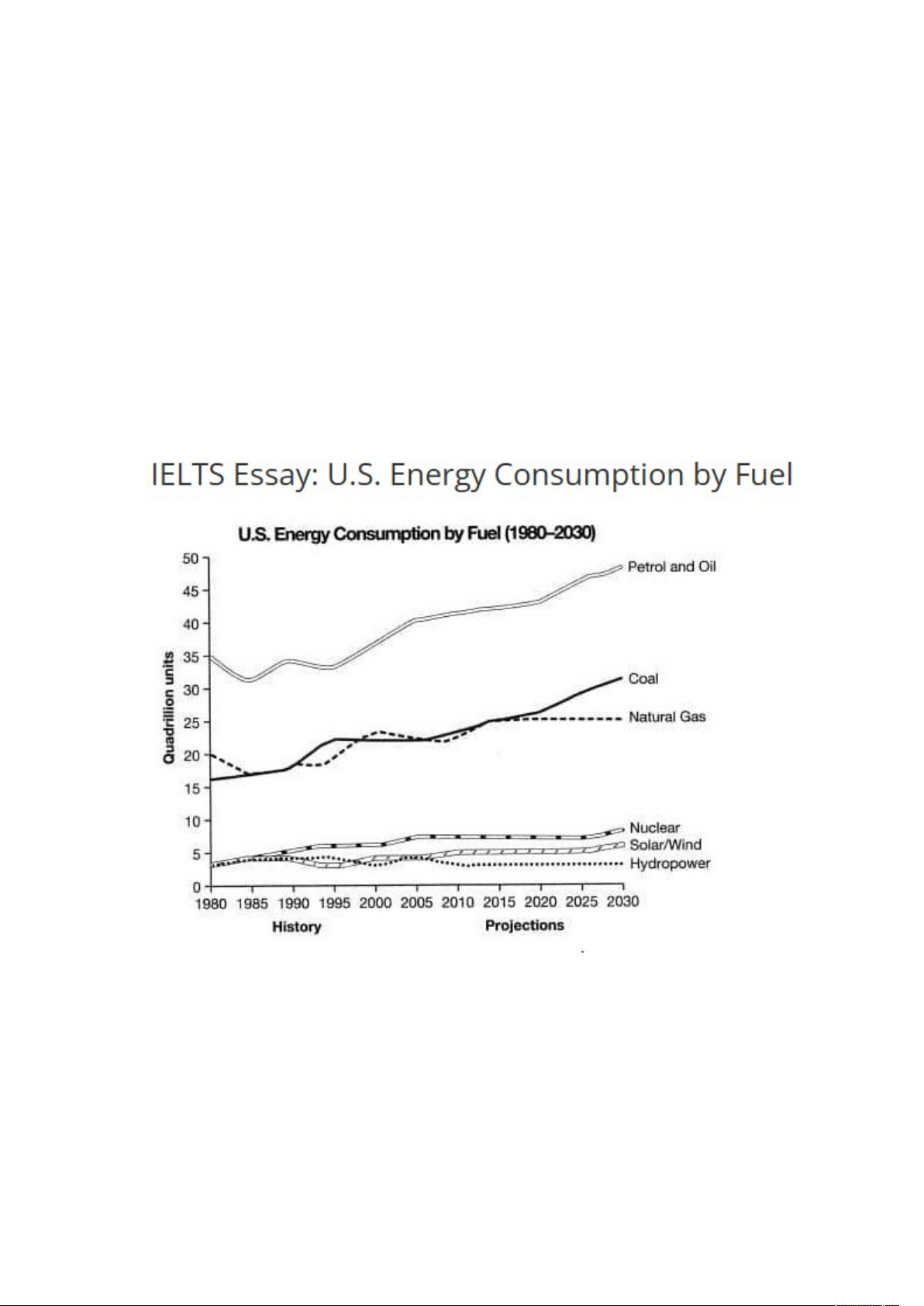
The graph below gives information about fuel consumption from 1980 to 2030 in the United States.
Summarize the information by selecting and reporting the main features, and make comparisons where relevant. Write at least 150 words. Write your answer on the answer sheet.
……………………………………………………………………………………………………………………………………………………………………………………………………………………………………………………………………………………………………………………………………………………………………………………………………………………………………………………………………………………………………………………………………………………………………………………………………………………………………………………………………………………………………………………………………………………………………………………………………………………………………………………………………………………………………………………………………………………………………………………………………………………………………………………………………………………………………………………………………………………………………………………………………………………………………………………………………………………………………………………………………………………………………………………………………………………………………………………………………………
……………………………………………………………………………………………………………………………………………………………………………………………………………………………………………………………………………………………………………………………………………………………………………………………………………………………………………………………………………………………………………………………………………………………………………………………………………………………………………………………………………………………………………………………………………………………………………………………
………………………………………………………………………………………………………………………………………………………………………………………………………………………………………………………………………………………………………………………………………………………………………………………………………………………………………………………………………………………………………………………………………………………………………………………………………………………………………………………………………………………………………………………………………………………………………………………………………………………………………………………………………………………………………….
……………………………………………………………………………………………………………………………………………………………………………………………………………………………………………………………………………………………………………………………………………………………………………………………………………………………………………………………………………………………………………………………………………………………………………………………………………………………………………………………………………………………………………………………………………………………………………………………………………………………………………………………………………………………………………………………………………………………………………………………………………………………………………………………………………………………………………………………………………………………………………………………………………………………………………………………………………………………………………………………………………………………………………………………………………………………………………………………………………
……………………………………………………………………………………………………………
Full Name: …………………………………………………….
Part 2: (30 points)
It is common these days to see celebrities advertising different products. Some people say that the disadvantages of this trend outweigh the advantages? To what extent, do you agree or disagree with this statement?
Write an essay of about 250 words to answer the above question. Give reasons and include any relevant examples and explanations to support your answer. Write your answer on your answer sheet.
……………………………………………………………………………………………………………………………………………………………………………………………………………………………………………………………………………………………………………………………………………………………………………………………………………………………………………………………………………………………………………………………………………………………………………………………………………………………………………………………………………………………………………………………………………………………………………………………………………………………………………………………………………………………………………………………………………………………………………………………………………………………………………………………………………………………………………………………………………………………………………………………………………………………………………………………………………………………………………………………………………………………………………………………………………………………………………………………………………
……………………………………………………………………………………………………………………………………………………………………………………………………………………………………………………………………………………………………………………………………………………………………………………………………………………………………………………………………………………………………………………………………………………………………………………………………………………………………………………………………………………………………………………………………………………………………………………………
………………………………………………………………………………………………………………………………………………………………………………………………………………………………………………………………………………………………………………………………………………………………………………………………………………………………………………………………………………………………………………………………………………………………………………………………………………………………………………………………………………………………………………………………………………………………………………………………………………………………………………………………………………………………………….
……………………………………………………………………………………………………………………………………………………………………………………………………………………………………………………………………………………………………………………………………………………………………………………………………………………………………………………………………………………………………………………………………………………………………………………………………………………………………………………………………………………………………………………………………………………………………………………………………………………………………………………………………………………………………………………………………………………………………………………………………………………………………………………………………………………………………………………………………………………………………………………………………………………………………………………………………………………………………………………………………………………………………………………………………………………………………………………………………………
……………………………………………………………………………………………………………………………………………………………………………………………………………………………………………………………………………………………………………………………………………………………………………………………………………………………………………………………………………………………………………………………………………………………………………………………………………………………………………………………………………………………………………………………………………………………………………………………………………………………………………………………………………………………………………………………………………………………………………………………………………………………………………………………………………………………………………………………………………………………………………………………………………………………………………………………………………………………………………………………………………………………………………………………………………………………………………………………………………
……………………………………………………………………………………………………………
……………………………………………………………………………………………………………
-------------- HẾT --------------
Tài liệu liên quan:
-

Đề truy bài khối 10 – tháng 2-2025 – tuần 4 môn thi: Tiếng anh | Sở GD&ĐT TP. Hồ Chí Minh
35 18 -

Đề thi học sinh giỏi môn Tiếng Anh lớp 10 | Trường THPT Chuyên Bảo Lộc - Lâm Đồng
38 19 -

Đề thi đề nghị môn Tiếng Anh, Khối 10 năm học 2017-2018 | Trường THPT Chuyên Hùng Vương
32 16 -

Đề thi chính thức | Tiếng Anh 10
30 15 -

Đề Thi | Tiếng Anh 10
39 20