Bài giảng môn Thiết kế cơ sở dữ liệu | Trường Đại Học Giao Thông Vận Tải Hồ Chí Minh
Bài giảng môn Thiết kế cơ sở dữ liệu | Trường Đại Học Giao Thông Vận Tải Hồ Chí Minh. Tài liệu được sưu tầm giúp bạn tham khảo, ôn tập và đạt kết quả cao. Mời bạn đọc đón xem.
Môn: Nhập môn công nghệ thông tin (CNTT00)) 9 tài liệu
Trường: Trường Đại học Giao thông vận tải 487 tài liệu
Tác giả:






Preview text:
Database Design Nguyễn Văn Diêu
Ho Chi Minh City University of Transport 2026
Kiến thức - Kỹ năng - Sáng tạo - Hội nhập Sứ mệnh - Tầm nhìn
Triết lý Giáo dục - Giá trị cốt lõi Outline I
1. Overview of the Design Process 2. Conceptual Design 2.1 ER Conceptual Model A Sample Database Application Entity Relationship Constraints of relationships Patterns and Relationships Summary of the notation Database Example 2.2 ER Design Methodology 2.3 Example
2.4 Mapping to Relational Database Mapping Entity Mapping Relationship 2.5 Weak Entity Nguyễn Văn Diêu Table of Contents 2/284 Outline II Strong Entity
Weak entity and Identifying Relationship
Weak Entity connected Weak Entity Update Methodology
Mapping Weak Entity to Rational Database 2.6 Attributes of Relationship 2.7 Change M:N Relationship 2.8 Recursive Relationship Structural Constraints Multiple Relationship
2.9 Mapping Recursive Relationship
2.10 Derived or Redundant Relationship
2.11 Enhanced EntityRelationship (EER)
Generalization & Specialization Subclasses of Subclasses Nguyễn Văn Diêu Table of Contents 3/284 Outline III Mapping rules 2.12 Union Types Mapping rules 3. Logical Design 3.1 Functional Dependencies Definition Notation Satisfaction Integrity Constraint Inference 3.2 Amstrong’s Axioms Amstrong’s Axioms Lemma Proof 3.3 Closure Nguyễn Văn Diêu Table of Contents 4/284 Outline IV Closure of FDs Set Closure of Attribute Set Algorithm Lemma Testing Membership Covers Minimum Covers Algorithm Projected FD Algorithm 3.4 Keys Definition Algorithm Remarkable Algorithm FDs by Keys Nguyễn Văn Diêu Table of Contents 5/284 Outline V 3.5 Normal Form Definition 1NF Fully dependent Prime and nonprime attributes 2NF Transitively Dependent 3NF Classic 3NF Modern Lemma BCNF Classic BCNF Modern 3.6 Database Normalization Overview Preserve Information Tableau Test Nguyễn Văn Diêu Table of Contents 6/284 Outline VI Theorem Preserve Dependencise Testing Preserve Dependencies Decomposition Algorithm Synthesis Algorithm 3.7 Multivalued Dependencies Overview Definition Lemma Trivial MVDs Theorem Test MVDs 3.8 Axioms for MVDs MVDs Alone FDs and MVD Finding X+ by Chase F Nguyễn Văn Diêu Table of Contents 7/284 Outline VII Tableau Chase Test for MVDs Projecting MVDs Minimum Dependency Basis Beeri Algorithm 3.9 4NF Definition Lemma Decomposition into 4NF 3.10 Join Dependency Overview Definition Project Join NF Definition
3.11 Embedded Functional Dependencies Definition Embedded MVDs Nguyễn Văn Diêu Table of Contents 8/284 Outline VIII Embedded JD 4. Physical Design 4.1 Overview 4.2 Conceptual to Physical Problem ERD Relational Model Normal Form Normalization Customize Name Foreign Keys SQL Script 4.3 Denormalization 4.4 Customized data views 4.5 Indexes Nguyễn Văn Diêu Table of Contents 9/284 Outline IX Basic Concepts Common PostgreSQL Index Types Multicolumn Indexes Indexes and ORDER BY Combining Multiple Indexes Indexes on Expressions Partial Indexes Operator Classes Choosing the Right Index Best Practices for Indexing Common Index Summary 4.6 Query Processing Measures of Query Cost 4.7 Query Optimization
Transformation of Relational Expressions Examples of Transformations Nguyễn Văn Diêu Table of Contents 10/284
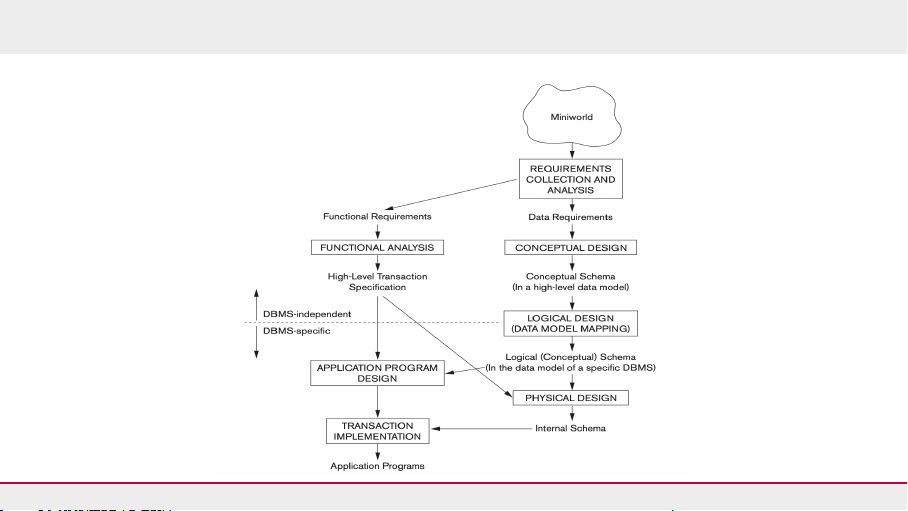
Main phases of Database design Nguyễn Văn Diêu
1. Overview of the Design Process 11/284
Company Database sample
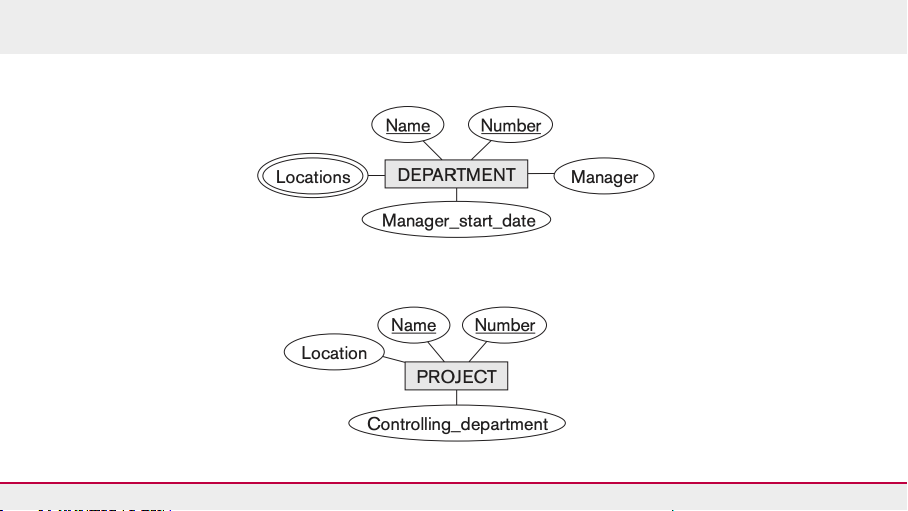
• The company is organized into departments. Each department has a unique
name, a unique number, and a particular employee who manages the department.
We keep track of the start date when that employee began managing the
department. A department may have several locations.
• A department controls a number of projects, each of which has a unique name, a
unique number, and a single location.
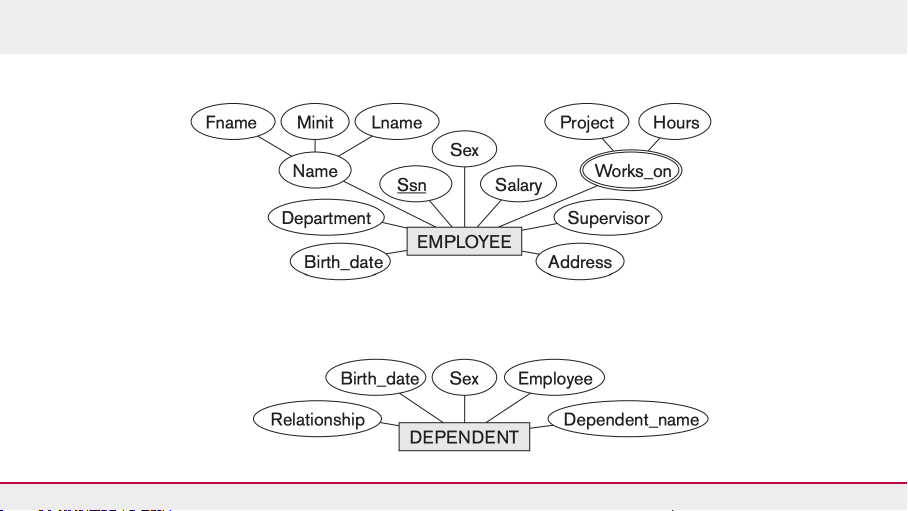
• The database will store each employee’s name, Social Security number, address,
salary, sex (gender), and birth date. An employee is assigned to one department,
but may work on several projects, which are not necessarily controlled by the same
department. It is required to keep track of the current number of hours per week
that an employee works on each project, as well as the direct supervisor of each
employee (who is another employee).
• The database will keep track of the dependents of each employee for insurance
purposes, including each dependent’s first name, sex, birth date, and relationship to the employee. Nguyễn Văn Diêu
2. Conceptual Design :: ER Conceptual Model :: A Sample Database Application 12/284 ER Conceptual Model
• Entity: a thing or object in the real world with an independent existence.
• Attributes: Each entity has attributes — the particular properties that describe it
• Composite versus Simple (Atomic) Attributes
• Single-Valued versus Multivalued Attributes
• Stored versus Derived Attributes • NULL Values
• Complex Attributes
• Key Attributes Nguyễn Văn Diêu
2. Conceptual Design :: ER Conceptual Model :: Entity 13/284 ER Conceptual Model Nguyễn Văn Diêu
2. Conceptual Design :: ER Conceptual Model :: Entity 14/284 ER Conceptual Model Nguyễn Văn Diêu
2. Conceptual Design :: ER Conceptual Model :: Entity 15/284 Relationship
• Relationship: Whenever an attribute of one entity type refers to another entity
type, some relationship exists.
• Degree of a Relationship: is the number of participating entity. binary is degree two,
ternary is a degree three.
• Attributes of Relationship
• Recursive Relationships Nguyễn Văn Diêu
2. Conceptual Design :: ER Conceptual Model :: Relationship 16/284
Cardinality Ratio of a Relationship
• One-to-One (1:1) one entity is associated with one other entity and vice versa
• Many-to-One (M:1) many entity are associated with one another entity
• One-to-Many (1:M)
• Many-to-Many (M:N)
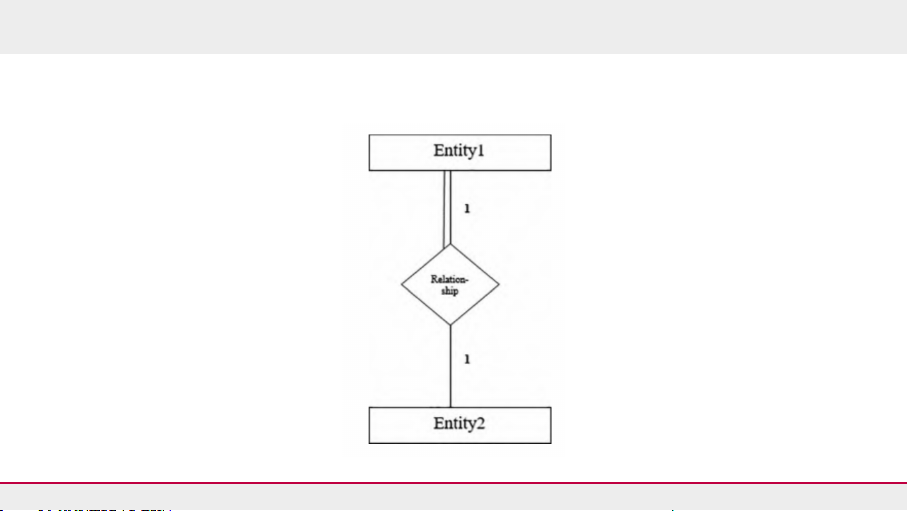
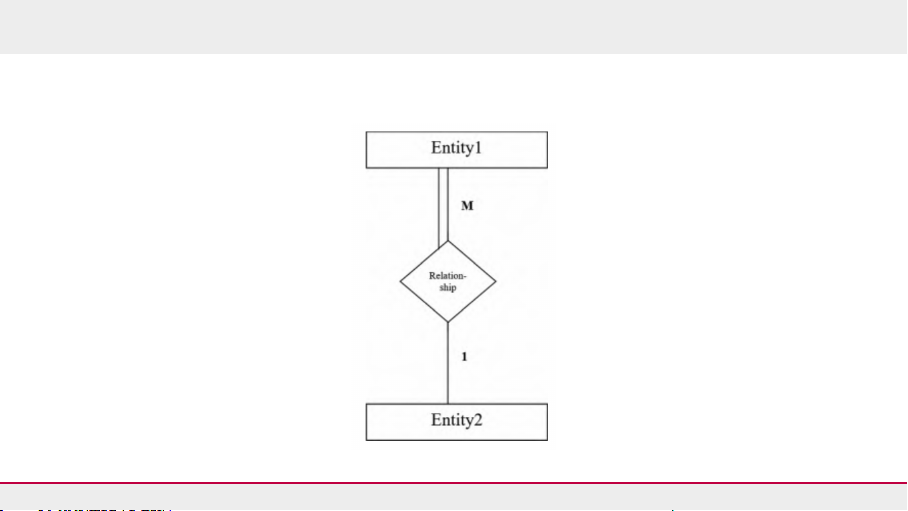
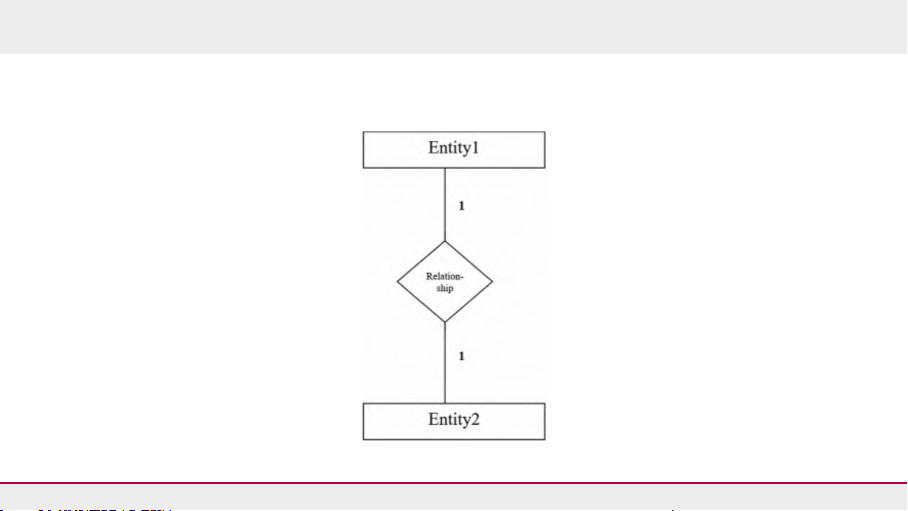
• Participation (Full/Partial)
Full (doube lines): All entity associated with another entity
Partial (single line): Not every entity associated with another entity Nguyễn Văn Diêu
2. Conceptual Design :: ER Conceptual Model :: Constraints of relationships 17/284 Pattern 1 1(full):1 Relationship Nguyễn Văn Diêu
2. Conceptual Design :: ER Conceptual Model :: Patterns and Relationships 18/284 Pattern 1 M(full):1 Relationship Nguyễn Văn Diêu
2. Conceptual Design :: ER Conceptual Model :: Patterns and Relationships 19/284 Pattern 2
1(partial):1 Relationship Nguyễn Văn Diêu
2. Conceptual Design :: ER Conceptual Model :: Patterns and Relationships 20/284
Tài liệu liên quan:
-
Công Nghiệp Hóa và Hiện Đại Hóa ở VN trong Cuộc Cách Mạng 4.0 - STT: 005106
26 13 -
Đề cương chi tiết học phần Phương pháp nghiên cứu | Trường Đại học Giao thông vận tải
51 26 -
Bài tập Thiết kế cơ sở dữ liệu | Trường Đại học Giao thông vận tải
46 23 -
Bài tập Thiết kế cơ sở dữ liệu 2025 | Trường Đại học Giao thông vận tải
67 34