Bai giao an ve tieng anh chuyen nganh
hihi
Môn: Tiếng anh cơ bản(TA) 71 tài liệu
Trường: Trường Đại học Sư Phạm Hà Nội 3.9 K tài liệu
Tác giả:

Preview text:
LESSON PLAN
Subject: MATHEMATICS GRADE 5
TOPIC 1: REVIEW AND SUPPLEMENT
LESSON 4: DECIMAL FRACTIONS
(Math textbook 5, “Connecting knowledge with life” Volume 1, page 14, section 1)
Topic: Decimal Fraction
Grade: 5
Date: 22/1/2026
Time: 35 minutes
I. OBJECTIVES
- Identify decimal fractions.
- Convert some fractions into decimal fractions.
- General competencies of students: communication and cooperation competencies, problem-solving and creative competencies.
- Develop mathematical reasoning, critical thinking, mathematical modeling, problem - solving and effective mathematical communication.
- Love this subject, be active in learning.
II. TEACHING AIDS
- Teachers: Lesson plan, textbook, teacher book, fraction strip, stickers.
- Students: Textbook, notebook.
III. VOCABULARY
- fraction /ˈfræk.ʃən/: A fraction is a way to represent a rational number in the form a/b, where a is the numerator and b is the denominator , with b ≠ 0. It is used to show a part of a whole or the result of a division.
- decimal /ˈdes.ɪ.məl/: A decimal number is a way of writing numbers to represent non-whole values. It consists of a whole number part and a decimal part, separated by a decimal point. Decimal numbers show values less than one, such as tenths, hundredths, and so on.
- denominator /dɪˈnɒm.ɪ.neɪ.tər/: The denominator is the number written below the fraction bar. It shows how many equal parts the whole is divided into and must not be zero.
- numerator /ˈnjuː.mə.reɪ.tər/: The numerator is the number written above the fraction bar.
It shows how many equal parts are taken or considered from the whole that has been divided by the denominator.
- equal /ˈiː.kwəl/: Equal means exactly the same, not more and not less.
IV. LESSON PROGRESS
Content | Teacher’s Activities | Students’ Activities |
|---|---|---|
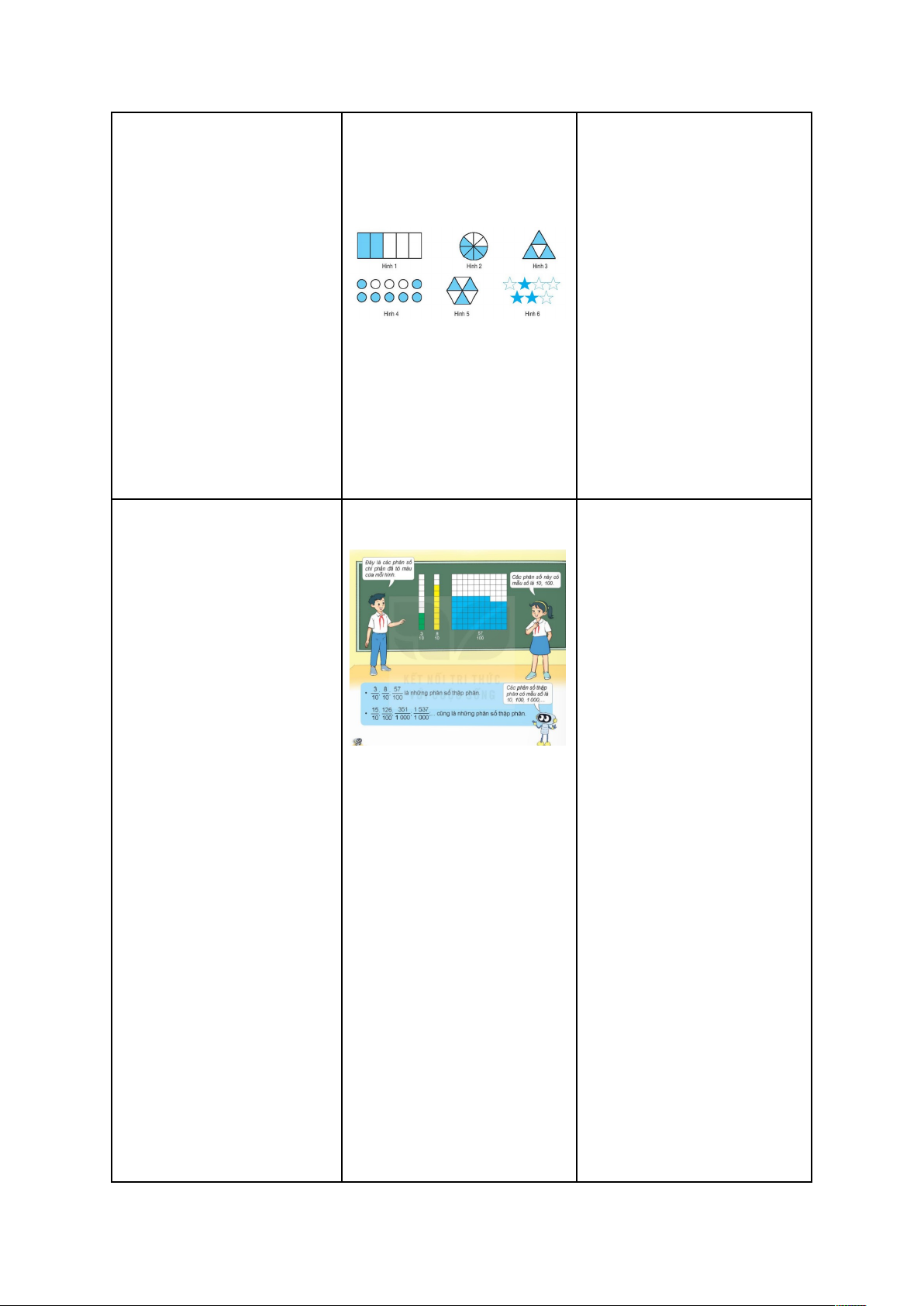
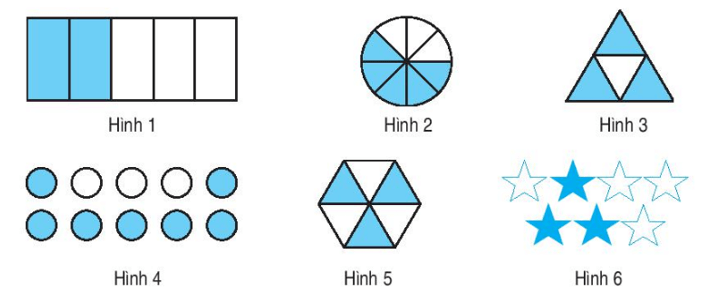
1. Warm-up - Objectives: Stimulate interest in learning and cultivate students’ curiosity and enjoyment before the lesson. - Method: Recognition and acknowledgment - Reward: stars or stickers. - Duration: 5 minutes | - Introduce the game “Who Has Sharp Eyes?” +The teacher shows pictures on the screen. Students observe the pictures and raise their hands quickly to give the answer. The answer is the fraction that represents the shaded part. - Invite students to answer. - Give feedback and lead into the new lesson. - Ask the students to write the lesson title in their notebooks. | - Listen to the game rules. - Answerthe questions. (⅖; ⅝; ¾; 7/10; 3/6; 3/7) - Listen |
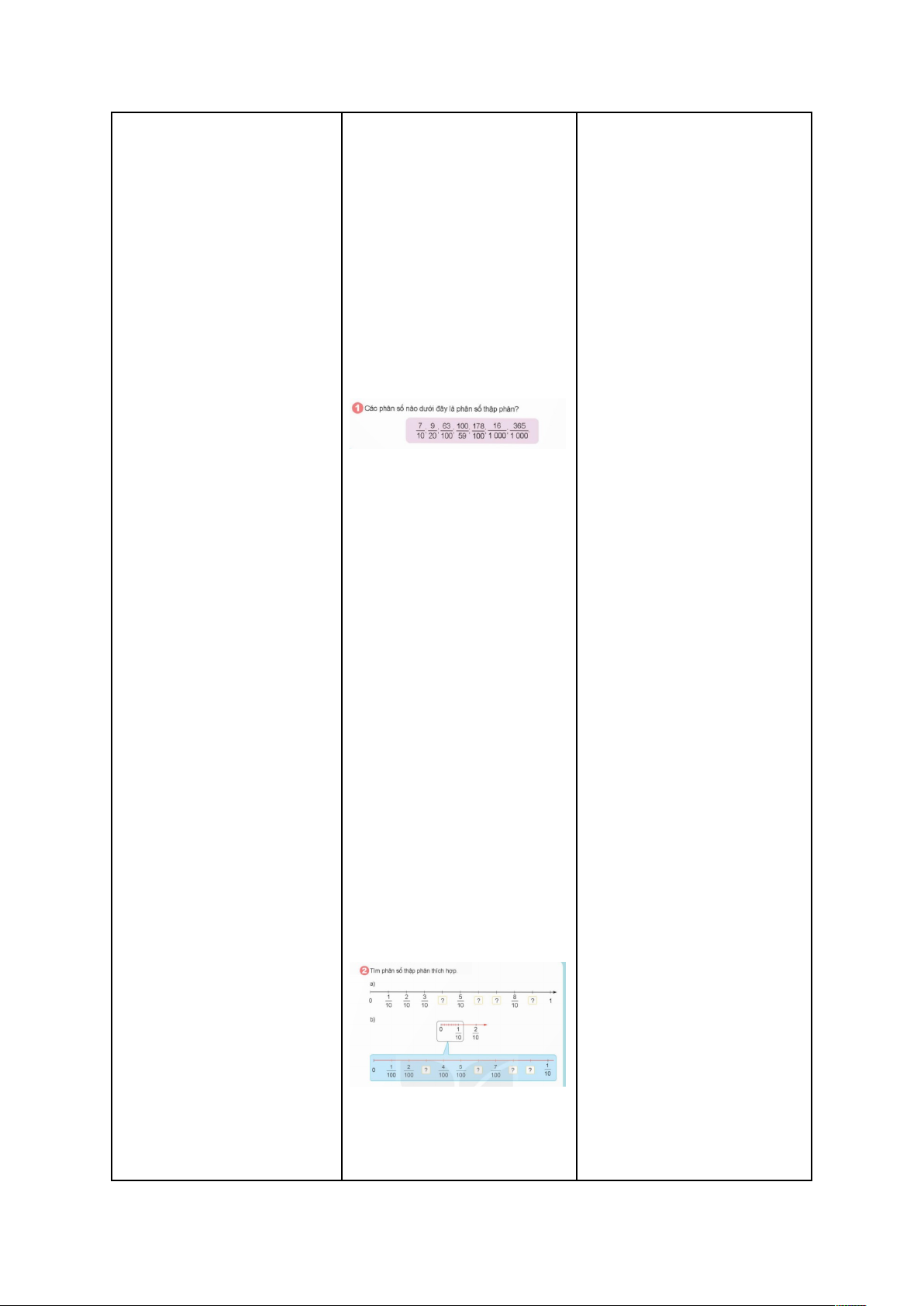
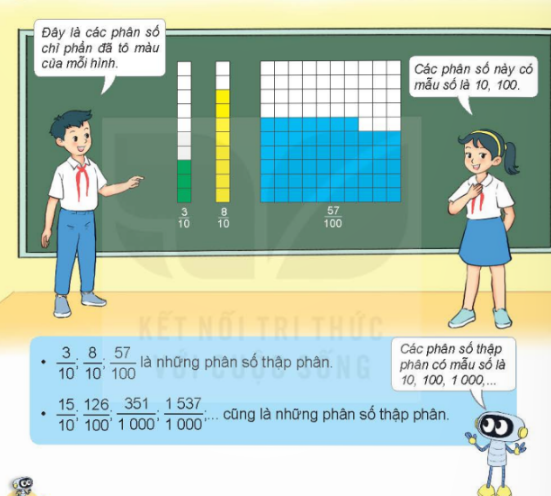
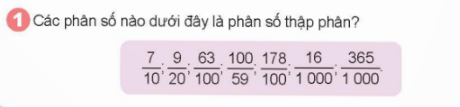
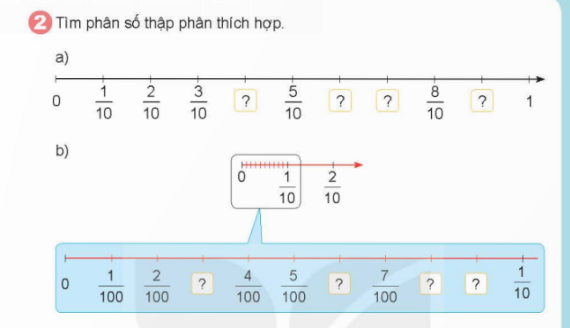
2. New lesson -Objectives: Form new knowledge -Duration: 8 minutes -Methods: observation Activity 1: Which of the fractions below are decimal fractions -Objectives: recognize decimal fractions -Duration: 3 minutes -Evaluation: stars, stickers Activity 2: Find the appropriate decimal fraction -Objectives: Help students recognize the values of decimal fractions on the number line -Duration: 5 minutes -Evaluation: stars, stickers | -Teacher asks the students to observe the picture
-Teacher invites one student read Nam’s dialogue aloud -Teacher asks students to identify the fractions representing the shaded parts of each picture -Teacher invites one student to comment on the denominators of these fractions to lead to Mai’s statement. -Teacher asks 1–2 students to recall. - Teacher gives feedback -Teacher introduces: +3/10, 8/10, 57/100 are decimal fractions +15/10, 126/100, 351/1000, 1537/1000, … are also decimal fractions. -Teacher asks students to comment on the denominators of decimal fractions to lead to Robot’s statement. -Teacher comments and concludes. -Teacher asks students to read the task.
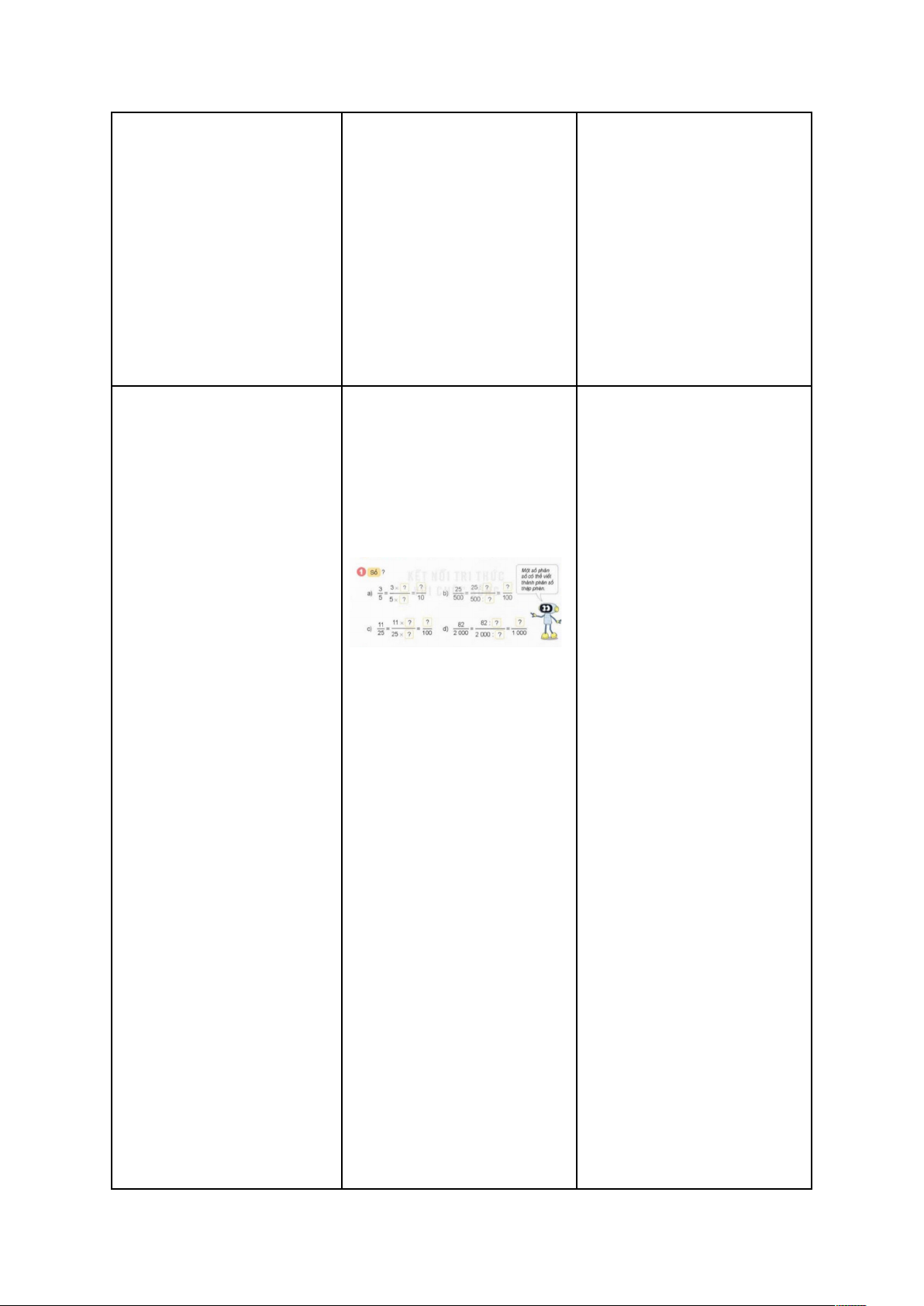
-Teacher asks 1–2 students how to identify decimal fractions. -Teacher asks students to do the exercise individually in their notebooks -Teacher asks students to exchange notebooks to check and correct each other’s work. -Teacher invites 1–2 students to give answers -Teacher asks students to explain their conclusions, especially non-decimal cases. -Teacher gives feedback and confirms the correct answers. -Teacher asks students to read the task.
-Teacher asks students to state 1–2 missing decimal fractions in part a. - Teacher asks students to continue doing part b in their notebooks -Teacher asks students to exchange notebooks and correct each other’s work. -Teacher invites 1–2 students to give comments -Teacher asks students to explain each case -Teacher gives feedback and confirms the correct answers. | -Students observe - Students read. -Students identify -Students comment: These fractions have denominators of 10, 100. -Students recall. - Students listen. - Students listen. -Students comment: Decimal fractions have denominators of 10, 100, 1000 -Students listen. -Students read. - Students answer: Decimal fractions have denominators of 10, 100, 1000 - Students do the exercise: 7/10, 63/100, 178/100, 16/1 000, 365/ 1 000 -Students exchange notebooks. -Students give comments -Students explain. -Students listen. -Students read the task -Students answer: 4/10 -Students do the exercise - Students exchange notebooks -Students give comments. -HS explain -Students listen. |
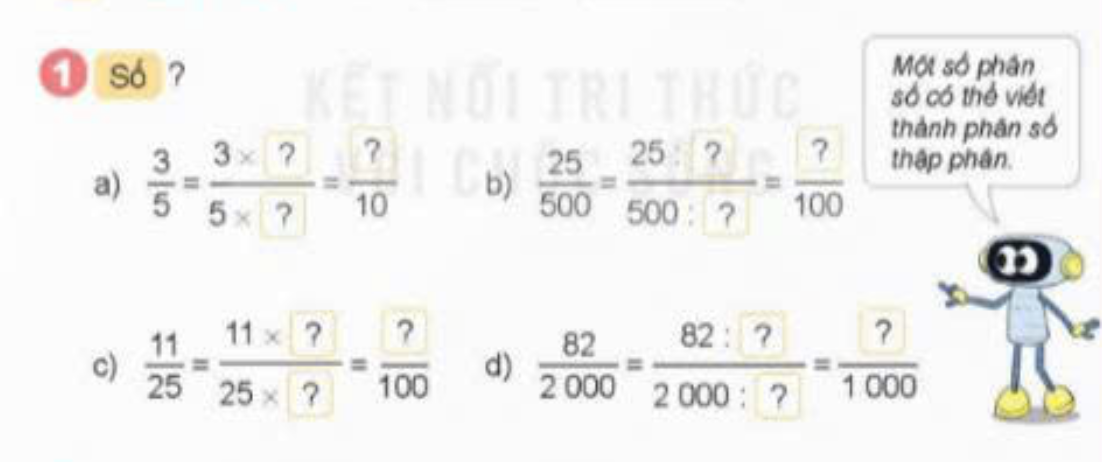
3. Practice Exercise 1: -Objectives: Identify decimal fractions and convert some fractions into decimal fractions. -Competence: Mathematical thinking and reasoning -Duration: 8 minutes -Evaluation: stars, stickers Exercise 2: -Objectives: + Apply the knowledge of identifying decimal fractions + Convert fractions into decimal fractions to solve simple real-life problems. -Duration: 8 minutes -Evaluation: stars, stickers | - Asks students to read the problem aloud. - Asks students to work individually and write the answers in their notebooks
- Explains question (a): + Asks: “What is 5 × 2?” + Explains: “5 × 2 = 10.” + Explains the property of fractions: multiplying both the numerator and the denominator by the same number does not change the value of the fraction. + Writes on the board: 3/5 = (3 × 2)/(5 × 2) = 6/10. - Asks students to do the same for questions b, c and d - Asks three students to go to the board and do the exercises. - Asks the other students to exchange notebooks with their desk mates and check each other’s work. - Checks the answers on the board - Give corrects mistakes. - Gives comments and praises students. - Asks students to read Exercise 2
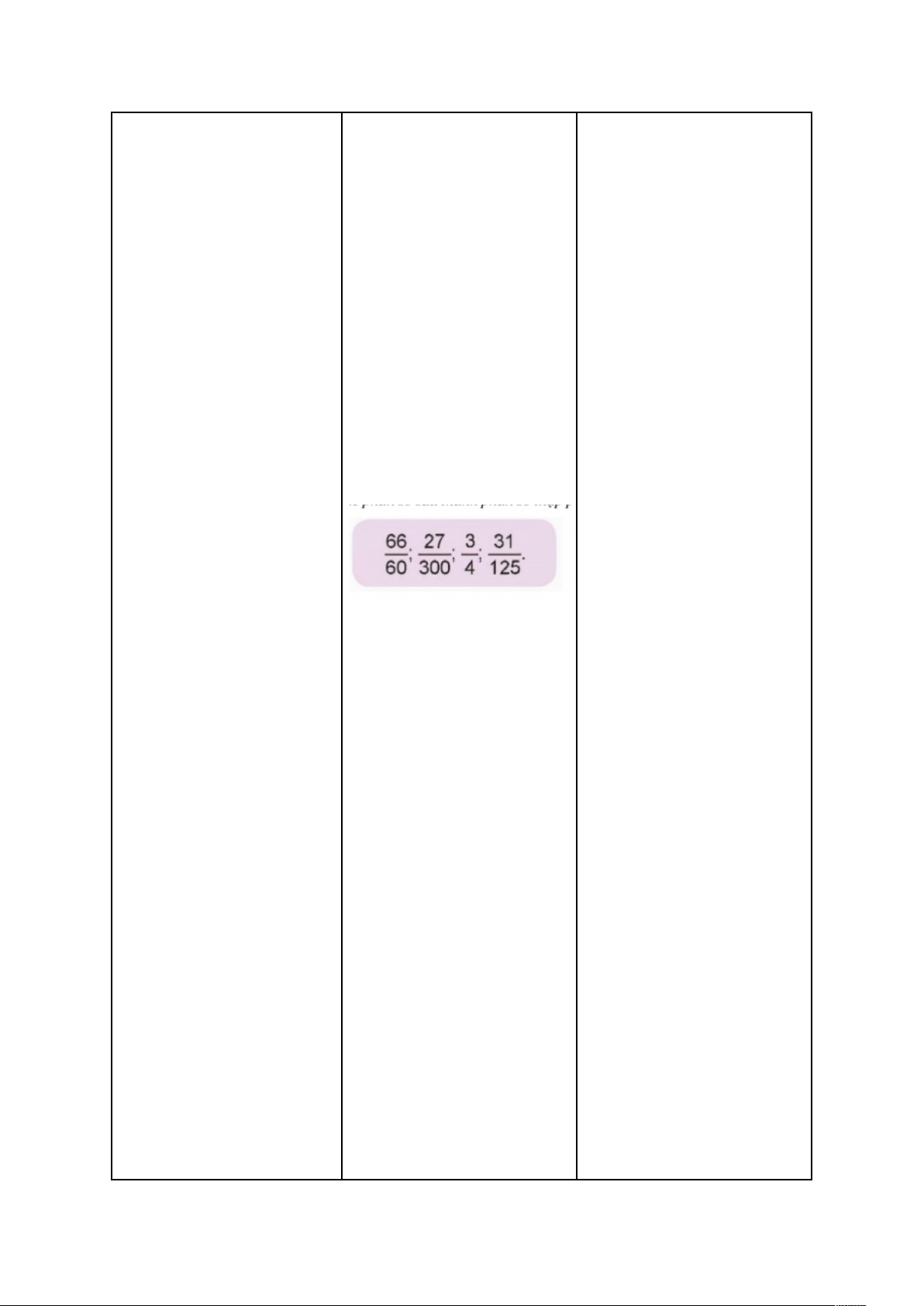
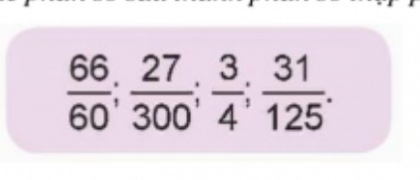
- Asks students to discuss in pairs or groups and do the exercises in their notebooks - Explains the sample: + Asks: “What is 60 ÷ 6?” + Explains: “60 ÷ 6 = 10.” + Writes on the board: 66/60 = (66 ÷ 6)/(60 ÷ 6) = 11/10 - Asks students to do the remaining questions in the same way. - Asks three students to go to the board and present their answers. - Asks students to exchange notebooks and correct each other’s work. - Confirms the correct answers - Gives final feedback and encouragement. | - Read the problem.
- Observe the example - Do the exercises individually. - Do exercise b) 25 25:5 5 —— = ——— = —— 500 500:5 100 c) 11 11 x4 44 —— = ——— = —— 25 25 x 4 100 d) 82 82:2 41 —— = ——— = —— 2000 2000:2 1000 - Read the exercise - Discuss in groups - Listen to the teacher’s explanation. - Answer: 10 -Do exercise -Students go to the board and do the exercises. b) 27 27:3 9 —— = ——— = —— 300 300:3 100 c) 3 3 x 25 75 —— = ——— = —— 4 4 x 25 100 d) 31 31 x 8 248 —— = ——— = ——— 125 125 x 8 1000 - Correct the exercises. - Listen and review their work. |
V. CONSOLIDATION AND ORIENTATION
- Reinforce and review the knowledge about Decimal Fraction
- Learning orientation: Students are encouraged to preview the lesson on “ Review calculations with fractions" in the textbook, specifically pages 16 and 17
VI. POST - LESSON ADJUSTMENTS ( IF ANY)
………………………………………………………………………………………………………………………………………………………………………………………………………………………………………………………………………………………………………