Lesson plan Tiếng anh 10 friends global - Unit introduction - Lesson a: vocabulary Likes and dislikes?
Lesson plan Tiếng anh 10 friends global - Unit introduction - Lesson a: vocabulary Likes and dislikes? . Tài liệu giúp bạn tham khảo, ôn tập và đạt kết quả cao. Mời đọc đón xem!
Chủ đề: Tài liệu chung Tiếng Anh 10 25 tài liệu
Môn: Tiếng Anh 10 697 tài liệu
Tác giả:











Preview text:
LESSON PLAN
TIẾNG ANH 10 FRIENDS GLOBAL
TEACHER: NGUYỄN THỊ THANH HƯƠNG Period LESSON PLAN
TIẾNG ANH 10 FRIENDS GLOBAL UNIT INTRODUCTION LESSON A: VOCABULARY LIKES AND DISLIKES? I. OBJECTIVES:
By the end of the lesson, Ss wil be able to: 1. Knowledge:
- Get some more knowledge to talk about school subjects, sports and hobbies
- Vocabulary: board games, drawing, drama, IT (information technology), basketbal ,
chemistry, geography, gymnastics, chess, ice hockey, volleybal 2. Ability: - main skil s: listening and speaking skil s - sub skil s:
reading and listening for specific information
- Asking and answering about likes and dislikes
- Discussing about school subjects 3. Quality:
- have positive at itude in English language learning so that they can participate
enthusiastical y in al classroom activities, especial y with the topic conducted by the teacher
- know how to talk about likes and dislikes, and discuss about school subjects
II. TEACHER AIDS AND LEARNING MATERIALS:
Lesson plan, PPT slides, student’s book, workbook, notebook, personal computer (if
any), projector/ TV. Speakers, IWB software. III. PROCEDURES: A. Warm-up (5’)
a) Objective: Introduce the new lesson and set the scene for Ss to acquire new
language; get students' at ention at the beginning of the class by means of enjoyable and
short activities as wel as to engage them in the steps that followed.
b) Content: Warm-up game
c) Outcomes: Students can gain more confidence and interest in the lesson d) Competence: guessing
e) Organisation of the activity:
TEACHER’S ACTIVITIES STUDENT’S ACTIVITIES CONTENTS
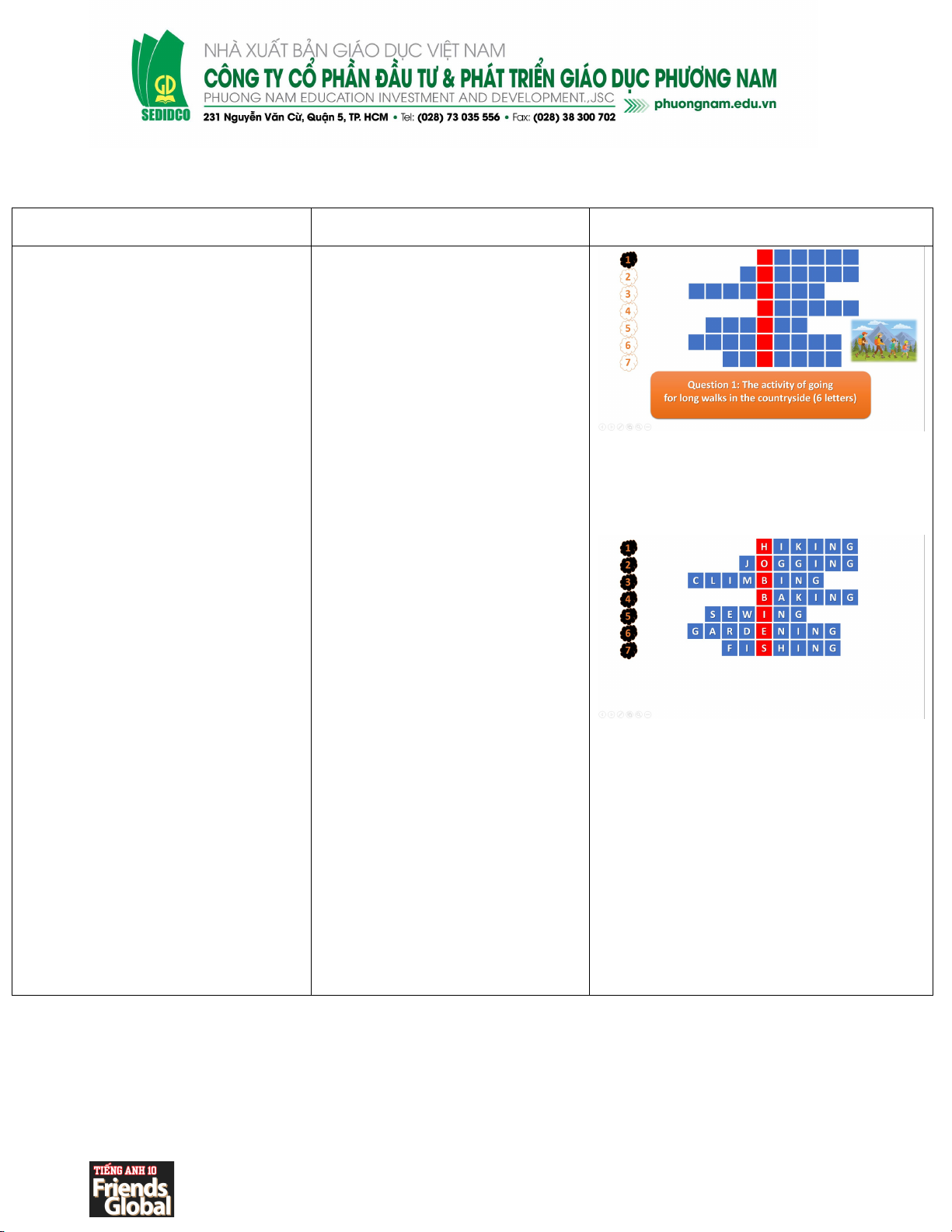
Warm-up T-Ss- T/ Ss – Ss Game “CROSSWORD PUZZLE” - Divides class into 4 - Play game in groups. groups - There are 7 hobbies. - Each group wil choose Each group wil choose a a number. number to answer. With a correct answer, students - With a correct answer, wil get one point. If any students wil get one group can get the word in point. the vertical column - If one group can get fastest, that group can the word in vertical earn three points. column fastest, that group wil get three points. - Tel s students which group has the most correct answers wil be the winner. - Students answer, - After revealing the “HOBBIES” words, teacher asks students a question: “What is the word in the vertical column?” B. New lesson (35’)
▪ Activity 1: Vocabulary (8’)
a) Objective: Ss know more words about subjects, sports, and hobbies b) Content:
Vocabulary: board games, drawing, drama, IT (information technology), basketbal ,
chemistry, geography, gymnastics, chess, ice hockey, volleybal Listening
c) Outcomes: Ss know how to pronounce the new words precisely and use them in appropriate contexts.
d) Competence: communication, collaboration, presentation
e) Organisation of the activity: TEACHER’S ACTIVITIES STUDENT’S CONTENTS ACTIVITIES PRESENTATION. T -Ss- T/ Ss- Ss/ Individual Set context: - Cal s out some students - Some students wil
Question: “What are your hobbies?”, to answer the questions: answer the
“Do you like or dislike “What are your hobbies? questions.
gardening/hiking/sewing/sculpting/coo - Chooses one of the eight - Listen to the
king/jogging/dancing/fishing?” hobbies in the crossword teacher’s questions puzzle, and ask them. For carefully, and have example: “Do you like some time to think gardening?” or “Do you about the answers. like cycling?”, etc. “Why you like gardening” or “Why you dislike gardening?”, etc. - Leads to the topic of the - Pay at ention to the lesson – Likes and teacher dislikes Teach new vocabulary: - Uses pictures and - Look, listen, and explanation to present
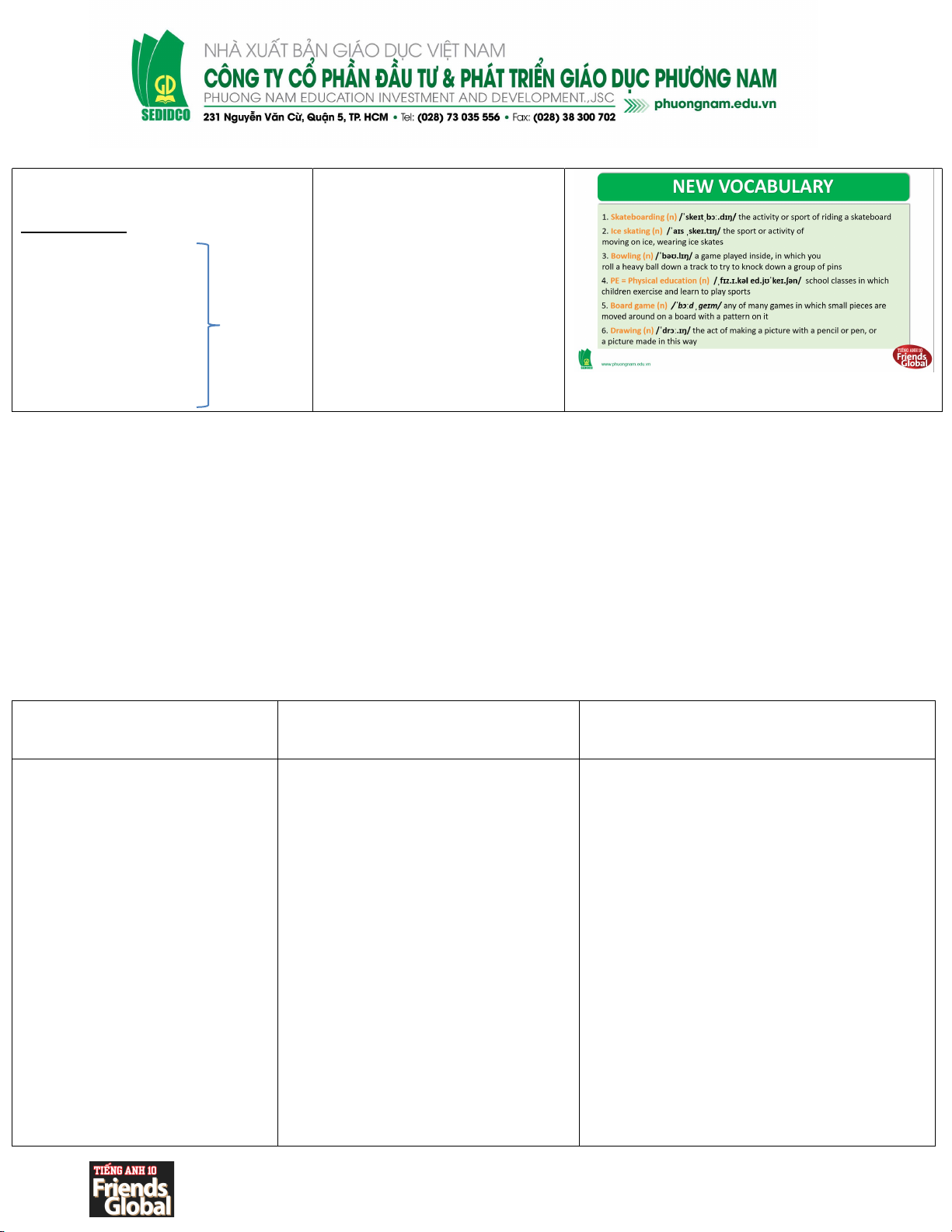
repeat in chorus and New words: new words. individuals - Have students practice their pronunciation dril s. New words: 1. Skateboarding (n) - Copy al the new 2. Ice skating (n) picture + words to the 3. Bowling (n) meaning notebook. 4. PE (n) 5. Board games (n) 6. Drawing (n)
▪ Activity 2 Practice (23’)
a) Objective: Ss can answer the questions to critical thinking, and they can also finish
the tasks in the textbook. Critical thinking skil s (guessing/ reasoning) and
communication can also be practiced.
b) Content: Students answer questions, classify words, choose the correct answer, read
and complete, listen and match.
c) Outcomes: Ss read and listen, and they can apply the useful language in everyday listening and speaking.
d) Competence: collaboration, guessing, matching, communication
e) Organisation of the activity: TEACHER’S STUDENT’S ACTIVITIES CONTENTS ACTIVITIES
PRACTICE. T-Ss- T/ S – S/ Individual
Activity 1 (2’) Describe the
Suggested answers: photo.
1. The people are in a canteen. They - Asks students to look
- Look at the photos and do are having lunch at the photos and the task. answer the questions. - Gives some possible answers.
Activity 2 (4’) Read and listen to the dialogue. Find the names of the people in the photo. - Plays the audio for - Listen and identify the students to listen to names of people in the Answers: the words. photo Izzy, Becky, Ryan - Have the students to - Find out the names of find out the names of people in the photo the people in the photo. - Shows the correct - Copy the correct answers answers of the names to their books of people in the photo
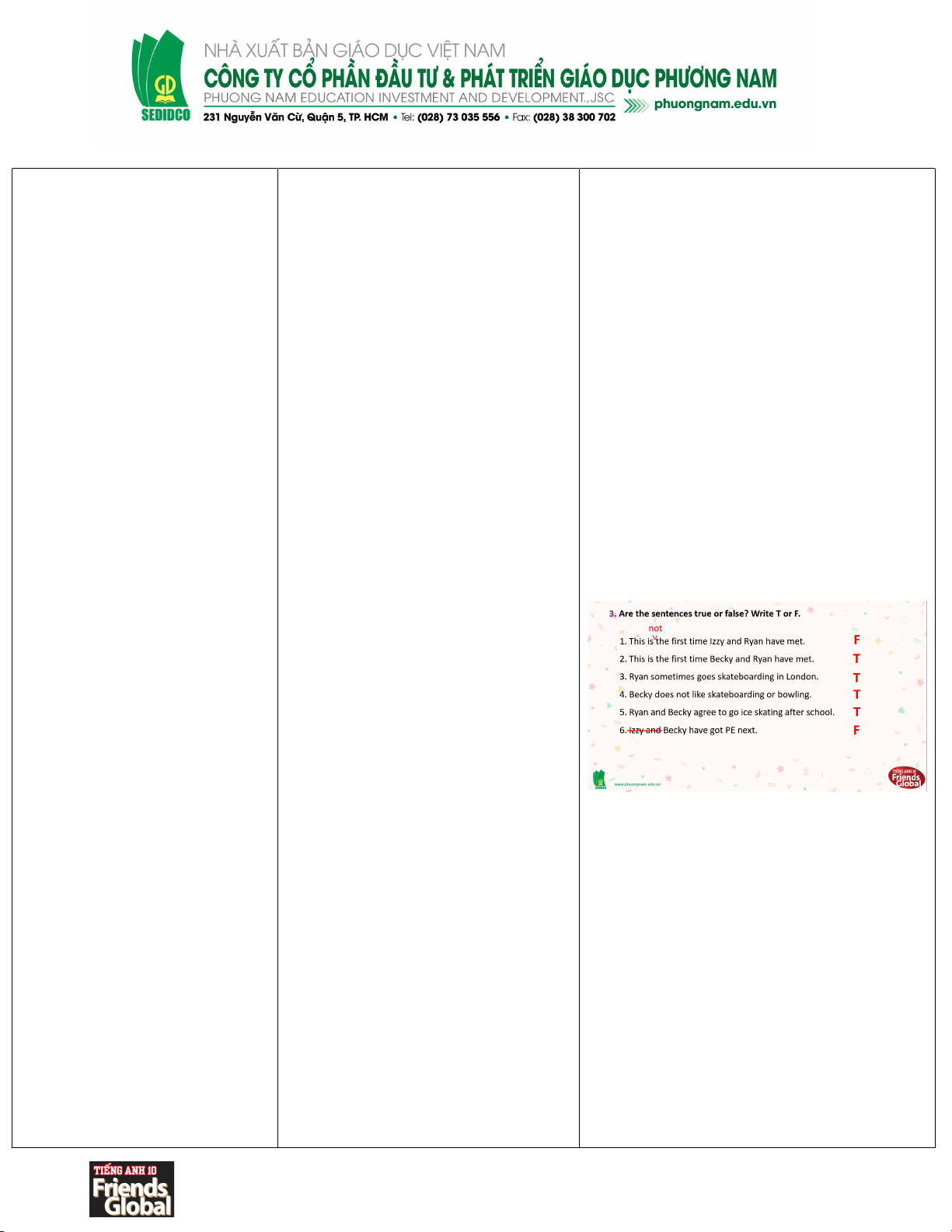
Activity 3 (5’) Are the sentences true or false? Write T or F. - Divides class into 4 - Sit with their teammates Answers: groups - Asks students to - Work in groups and do work in groups and the activity 3 each group has 2 minutes to finish the task - Checks students’ - Write down the correct answers answers - Plays the record again - Listen carefully for the students to check the answers
Activity 4 (1’) Add three words from the dialogue in Answers:
Sport and hobbies: skateboarding, ice exercise 2 to each list skating, bowling - Have students listen - Listen and write the
School subjects: maths, history, PE and repeat the words ending sound of each “board games” and word. “drawing” - Listen and repeat after the teacher - Copy the correct answers - Shows the correct down answers
Suggested answer:
Activity 5 (3’) Work in
Subjects: chemistry, geography,
music, Physics, English, Literature, pairs. How many more etc words can you add to the
Hobbies: gymnastics, chess, dance / lists in exercise 4 in three
dancing, swimming, cycling, etc minutes - Work in pairs. - Asks student to work in pairs and complete the task - Check answers with - Checks students’ teacher. answers. Answer:
Activity 6 (2’) Label the
A (like): I love…; I’m real y keen phrases below A (like), B on…; … is great. (OK), or C (don’t like).
B (OK): I don’t mind…; I (quite) like…; …isn’t bad. Which phrases are in the
C (don’t like): I can’t stand…; I dialogue in exercise 2? - Do the task. hate…; …is terrible. - Have students read
Phrases in the dialogue: I love…; I and complete the
hate…; I don’t mind…; I like…; I’m task. - Check answers with the not very keen on… - Checks students’ teacher answers.
Activity 7 (5’) Work in pairs. Give opinions of school subjects. Use the phrases in exercise 6. - Work in pairs - Ask students to work in pairs and take turns to give their opinions of school subjects - Some pairs talk about - Asks some pairs to their opinions of school stand up and say their subjects. opinions of school subjects
▪ Activity 3: Outcomes (5’)
a) Objective: Ss can answer the question to describe feelings in some situations.
Communication is also be practiced.
b) Content: Students work in pairs, speak and discuss
c) Outcomes: Ss speak and listen mutual y, they can new words they have learnt in their conversation.
d) Competence: Collaboration, communication
e) Organisation of the activity: TEACHER’S ACTIVITIES STUDENT’S ACTIVITIES CONTENTS
PRODUCT. S – S/ T – Ss
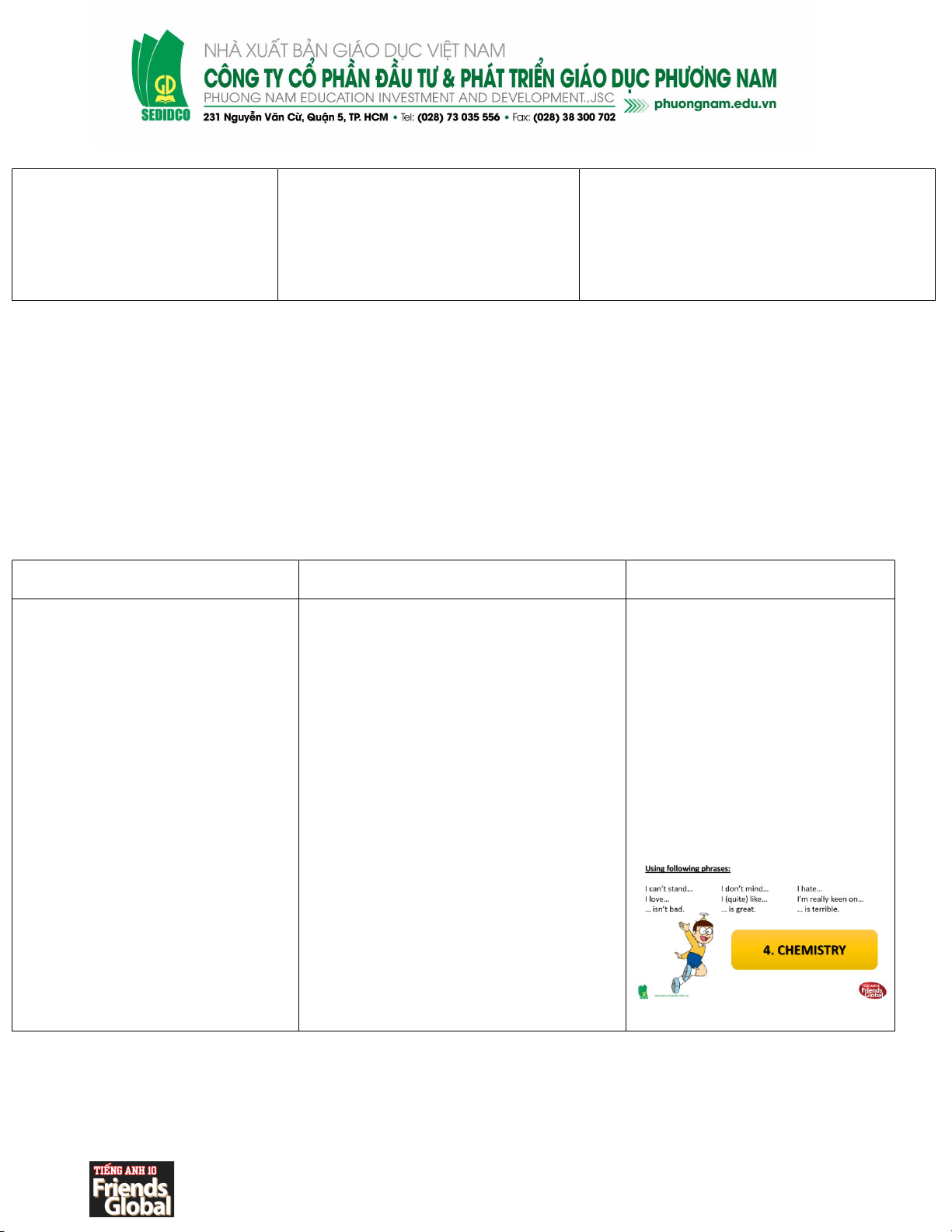
Activity 9 (5’) Play a game Topic: Math, Geography, ‘Learn with Nobita’ PE = Physical Education, - Have the students to - Work in groups Chemistry work in group - Asks them to choose 1 - Choose 1 out of 4 questions out of 4 given questions - Asks them to answer the - Answer the questions and questions and discuss discuss the subject the subject if they like or dislike the school subject - Invites 1 group to talk - Talk about their own opinion about their opinion about the school subject C. Consolidation (2’)
a) Vocabulary: skateboarding, ice skating, bowling, PE = Physical education, board game, drawing
b) Talking about likes and dislikes D. Homework (3’)
- Learn by heart the new vocabulary about subject, sports, and hobbies
- Practice asking and answering about likes and dislikes - Do exercise in the workbook
- Prepare: Unit 0: Introduction – B-Grammar (page 7 – SB) Period LESSON PLAN
TIẾNG ANH 10 FRIENDS GLOBAL UNIT INTRODUCTION LESSON B: GRAMMAR
CONTRAST: PRESENT SIMPLE AND PRESENT CONTINUOUS I. OBJECTIVES:
By the end of the lesson, Ss wil be able to: 1. Knowledge:
- Get some more knowledge to talk about everyday activities
- Vocabulary: everyday activities
- Grammar: Present tense contrast 2. Ability: - main skil s: reading and speaking - sub skil s: listening
- Use present tense contrast to talk about every activity
- Ask and answer about everyday activities 3. Quality:
- have positive at itude in English language learning so that they can participate
enthusiastical y in al classroom activities, especial y with the topic conducted by the teacher
- know how to talk about everyday activities
II. TEACHER AIDS AND LEARNING MATERIALS:
Lesson plan, PPT slides, student’s book, workbook, notebook, personal computer (if
any), projector/TV. Speakers, IWB software. III. PROCEDURES: A. Warm-up (5’)
a) Objective: Introduce the new lesson and set the scene for Ss to acquire new
language; get students' at ention at the beginning of the class by means of enjoyable and
short activities as wel as to engage them in the steps that followed.
b) Content: Warm-up game
c) Outcomes: Students can gain more confidence and interest in the lesson
d) Competence: communication, guessing
e) Organisation of the activity:
TEACHER’S ACTIVITIES STUDENT’S ACTIVITIES CONTENTS
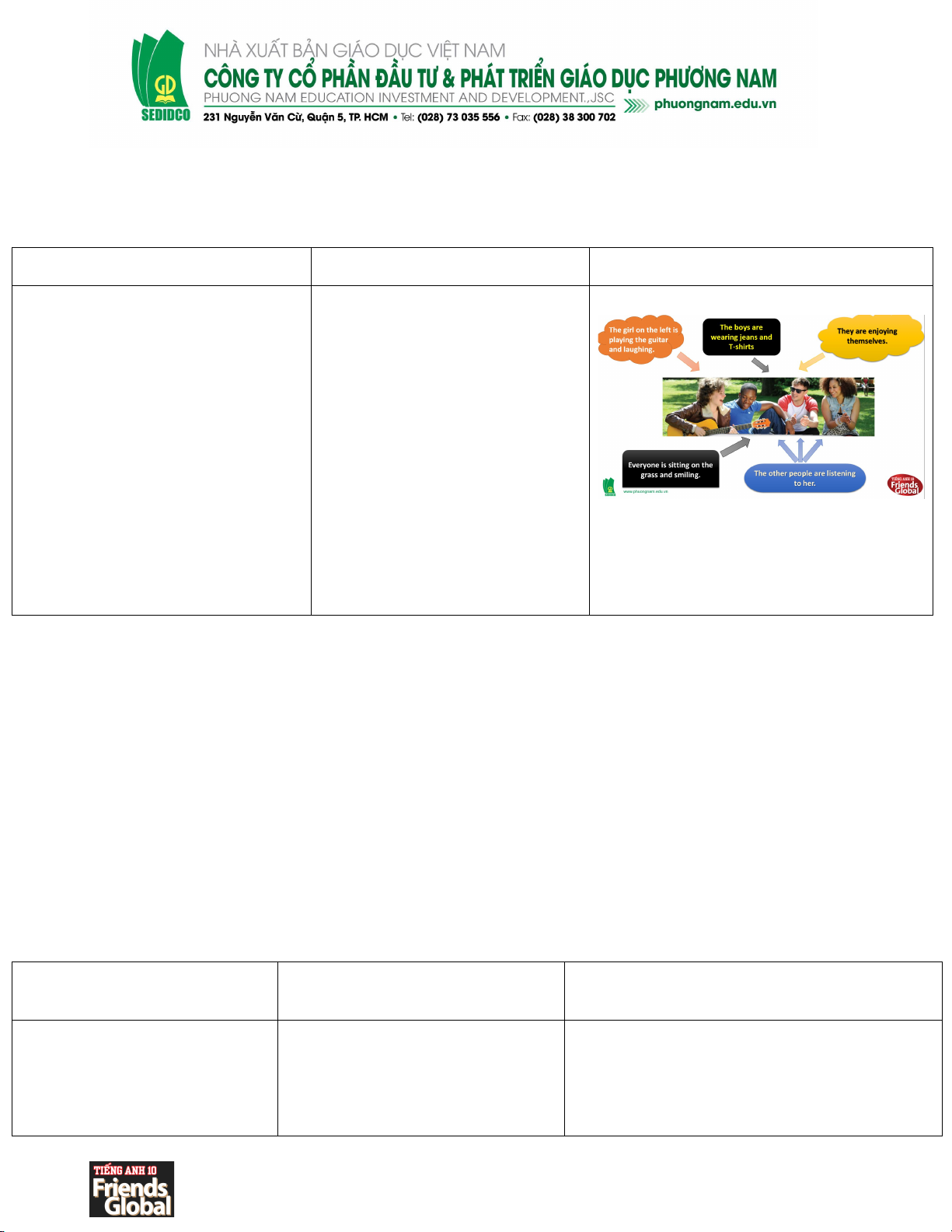
Warm-up (5’) T-Ss- T/ Ss – Ss - Shows students the - Look at the picture and picture and asks them: listens to the teacher’s “What are the people question doing in the picture?” - Invites randomly some - Give out possible students answers - Shows them some - Take notes the possible answers suggested answers on the screen B. New lesson (35’)
▪ Activity 1: New grammar structures (10’)
a) Objective: Ss know more words about everyday activities b) Content: Vocabulary: Listening
c) Outcomes: Ss know how to pronounce the new words precisely and use them in appropriate contexts.
d) Competence: communication, collaboration, presentation
e) Organisation of the activity: TEACHER’S STUDENT’S ACTIVITIES CONTENTS ACTIVITIES PRESENTATION. T -Ss- T/ Ss- Ss/ Individual
Activity 2 (3’) Read the messages above. Why does
Suggested answers: Adam change his mind Because he loves volleybal about going to the park? - Explain the term - Listens to teacher’s “change his mind” explanation about new first term - Asks students to read - Read and answer the and answer the question question - Shows the possible - Check the answers answer with the teacher Teaching Grammar point
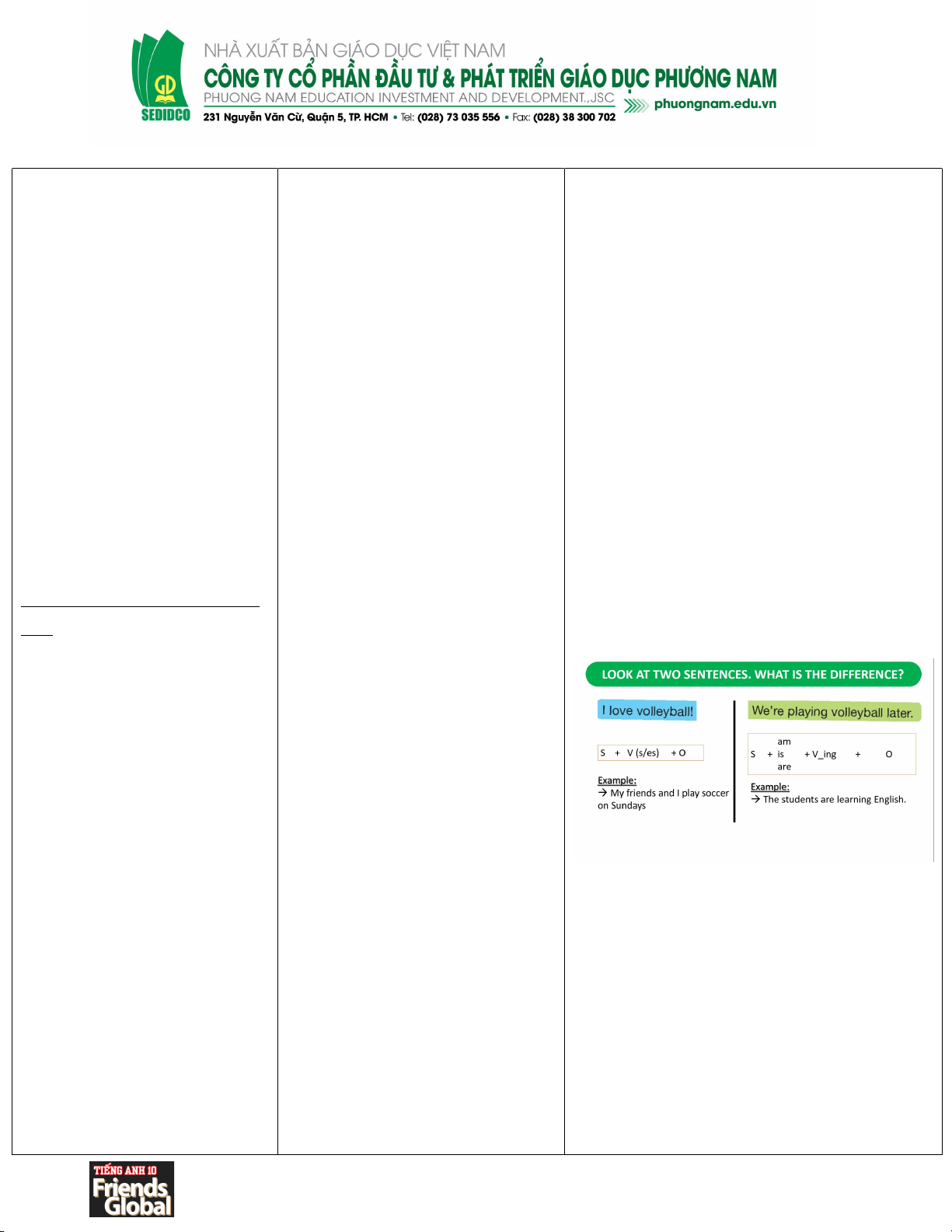
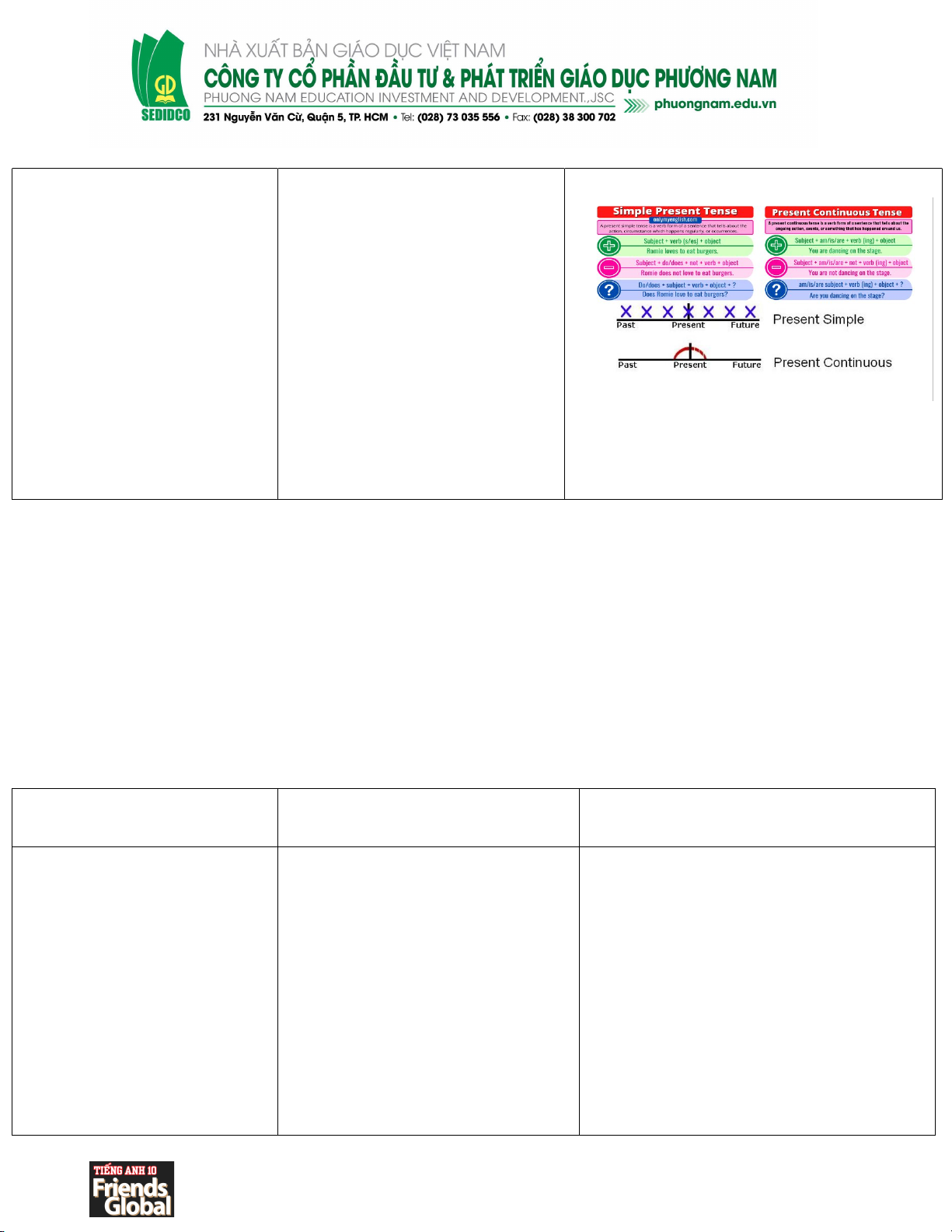
(7’)- Asksstudentstolook - Lookattwosentences at the two sentences on the board on the board. - Asks them what the difference of the two - Answer the questions of sentences the teacher - Shows and explains the structures of the - Listens to explanations two sentences of the teacher and take - Shows students note if needed example for each - Look at the example structure that the teacher shows - After showing slide and take note if needed 5, shows students slide 6 - Use explanation and - Listen to the teacher’s timeline for present explanation and write it simple and present down continuous tenses - Give them the usages of these two tenses - Asks them some - Answer teacher’s concept questions to concept questions check if they understand
▪ Activity 2 Practice (19’)
a) Objective: Ss can answer the questions to critical thinking, and they can also finish
the tasks in the textbook. Critical thinking skil s (guessing/ reasoning) and
communication can also be practiced.
b) Content: Students answer questions, classify words, choose the correct answer, read
and complete, listen and match.
c) Outcomes: Ss read and listen, and they can apply the useful language in everyday listening and speaking.
d) Competence: collaboration, guessing, matching, communication
e) Organisation of the activity: TEACHER’S STUDENT’S ACTIVITIES CONTENTS ACTIVITIES
PRACTICE. T-Ss- T/ S – S/ Indiv. Activity 3 (4’) Find
Suggested answers: examples of the present
Present simple examples: simple and present
I’m in the park with some friends. continuous in the messages Do you want to join us? in exercise 2. Then read the Is she good? Learn this! box and She’s OK. complete the rules.
She has guitar lessons every week. - Asks students to do - Do the task I don’t know. the activity 3 I need to help my parents. - Asks students to - Work in pairs I love volleybal . work in pairs
A game of volleybal doesn’t take - Shows correct - Check answer with long. answers teacher.
Present continuous examples: What are you doing? We’re listening to Sue. She’s playing the guitar. She’s get ing bet er.
We’re moving house next weekend. We’re packing boxes today. Learn Box (2’) - Asks students to read
- Read the LEARN THIS! Answers of Learn box! the LEARN THIS! box and complete the b. present continuous box and complete the rules c. present continuous rules d. present simple - Have the students to - Work in pairs e. present simple work in pairs f. present continuous - Shows them the correct answers
Activity 4 (5’) Match each Answers example you found in the messages with the correct rule (a-f) in the Learn this! box.- Asksstudentsto - Work in pairs work in groups - Goes around to help - Asks teachers for help if needed - Checks answers as a - Check the answers with class the teacher.
Activity 5 (5’) Work in Possible answers: pairs. Explain the difference between sentences a and b in each pair. - Asks students to - Work in pairs work in pairs - Check students’ - Check the answers with answers. teacher
Activity 6 (3’) Complete Answers: the phone dialogue. Use the 1. ‘m waiting 2. Are you going correct present simple or 3. are playing present continuous form of 4. play the verbs in brackets. Then 5. is he doing listen and check. 6. don’t know - Asks students to read - Read the conversation 7. isn’t answering the conversation before completing it 8. ‘m not buying 9. ‘m / looking before they complete - Use only present simple 10. Do you like it. or present continuous 11. Do you want form of the verbs 12. ‘m not wearing - Checks answers as a - Check answers with the 13. Are you wearing class teacher 14. don’t need
▪ Activity 3: Outcomes (6’)
a) Objective: Ss can answer the question to describe their daily activities or their future
arrangements. Communication is also be practiced.
b) Content: Students work in pairs, speak and discuss
c) Outcomes: Ss speak and listen mutual y, they can new words they have learnt in their conversation.
d) Competence: Collaboration, communication
e) Organisation of the activity: TEACHER’S ACTIVITIES STUDENT’S ACTIVITIES CONTENTS
PRODUCT. S – S/ T – Ss SPEAKING (5’) Work in Questions: pairs. Ask and answer questions 1-4. 1. What do you usual y do at - Asks students which - Work in pairs, take turn to the weekend? tense that the question ask and answer. 2. What are you doing this uses. weekend? - Shows students answer 3. What do you usual y do of the question about during the school holidays? tense 4. What are you doing next - Show students example - Some can volunteer to school holiday? of the answer present their ideas. C. Consolidation (3’)
a) Grammar points: Present tense contrast (present simple, and present continuous)
b) Talking about everyday activities D. Homework (2’)
- Practice using present simple and present continuous tenses
- Practice asking and answering about everyday activities - Do exercise in the workbook
- Prepare: Unit 0: Introduction – C-Vocabulary (page 7 – SB) Period LESSON PLAN
TIẾNG ANH 10 FRIENDS GLOBAL UNIT INTRODUCTION LESSON C: VOCABULARY DESCRIBING PEOPLE I. OBJECTIVES:
By the end of the lesson, Ss wil be able to: 1. Knowledge:
- Get some more knowledge to talk about adjectives to describe hair
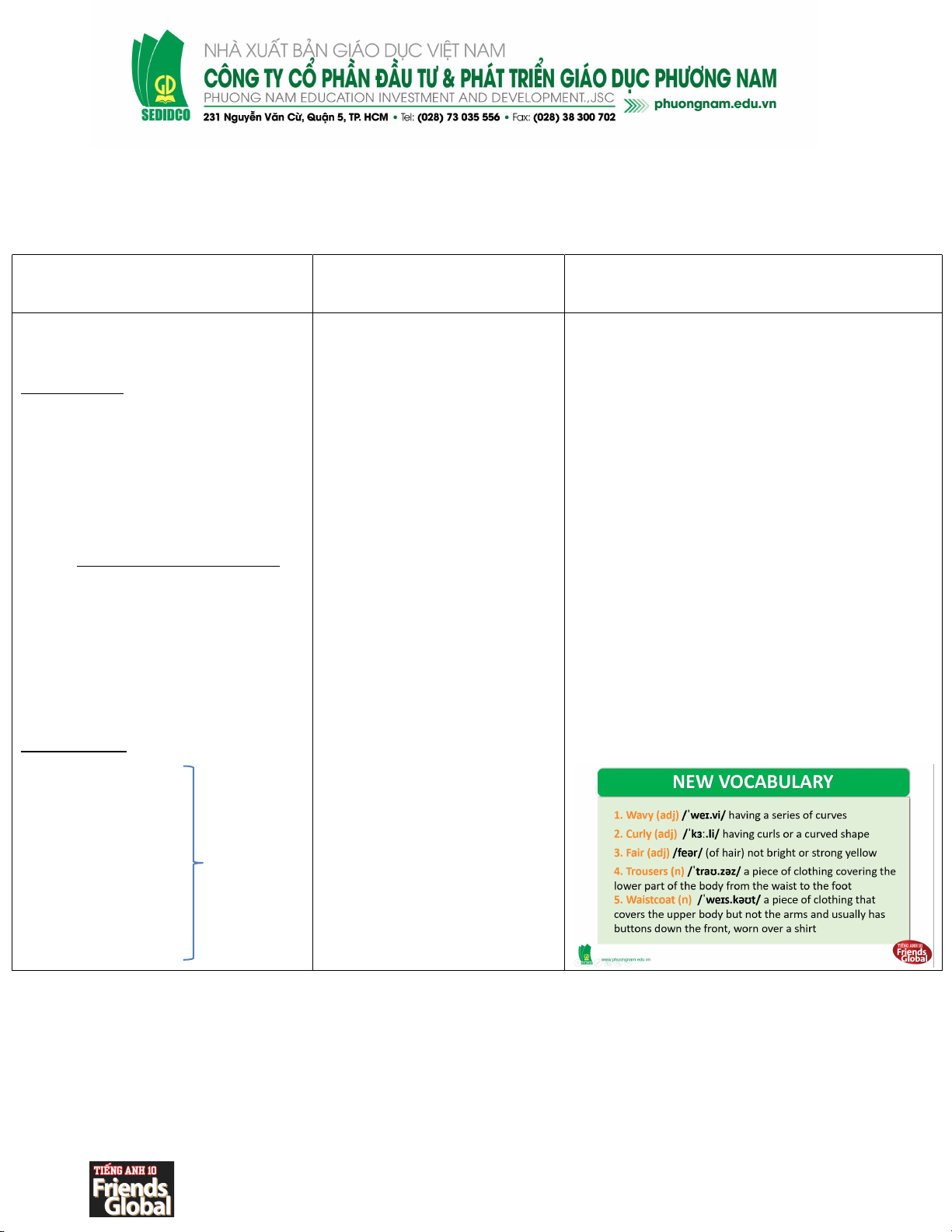
- Vocabulary: wavy, curly, fair, trousers, waistcoat 2. Ability: - main skil s: writing and speaking
- Using adjectives to describe hair
- Ask and answer about people’s appearance 3. Quality:
- have positive at itude in English language learning so that they can participate
enthusiastical y in al classroom activities, especial y with the topic conducted by the teacher
- know how to describe people’s appearance, especial y hair by using adjectives
II. TEACHER AIDS AND LEARNING MATERIALS:
Lesson plan, PPT slides, student’s book, workbook, notebook, personal computer (if
any), projector/TV. Speakers, IWB software. III. PROCEDURES: A. Warm-up (5’)
a) Objective: Introduce the new lesson and set the scene for Ss to acquire new
language; get students' at ention at the beginning of the class by means of enjoyable and
short activities as wel as to engage them in the steps that followed.
b) Content: Warm-up game
c) Outcomes: Students can gain more confidence and interest in the lesson
d) Competence: communication, guessing, collaboration
e) Organisation of the activity:
TEACHER’S ACTIVITIES STUDENT’S ACTIVITIES CONTENTS
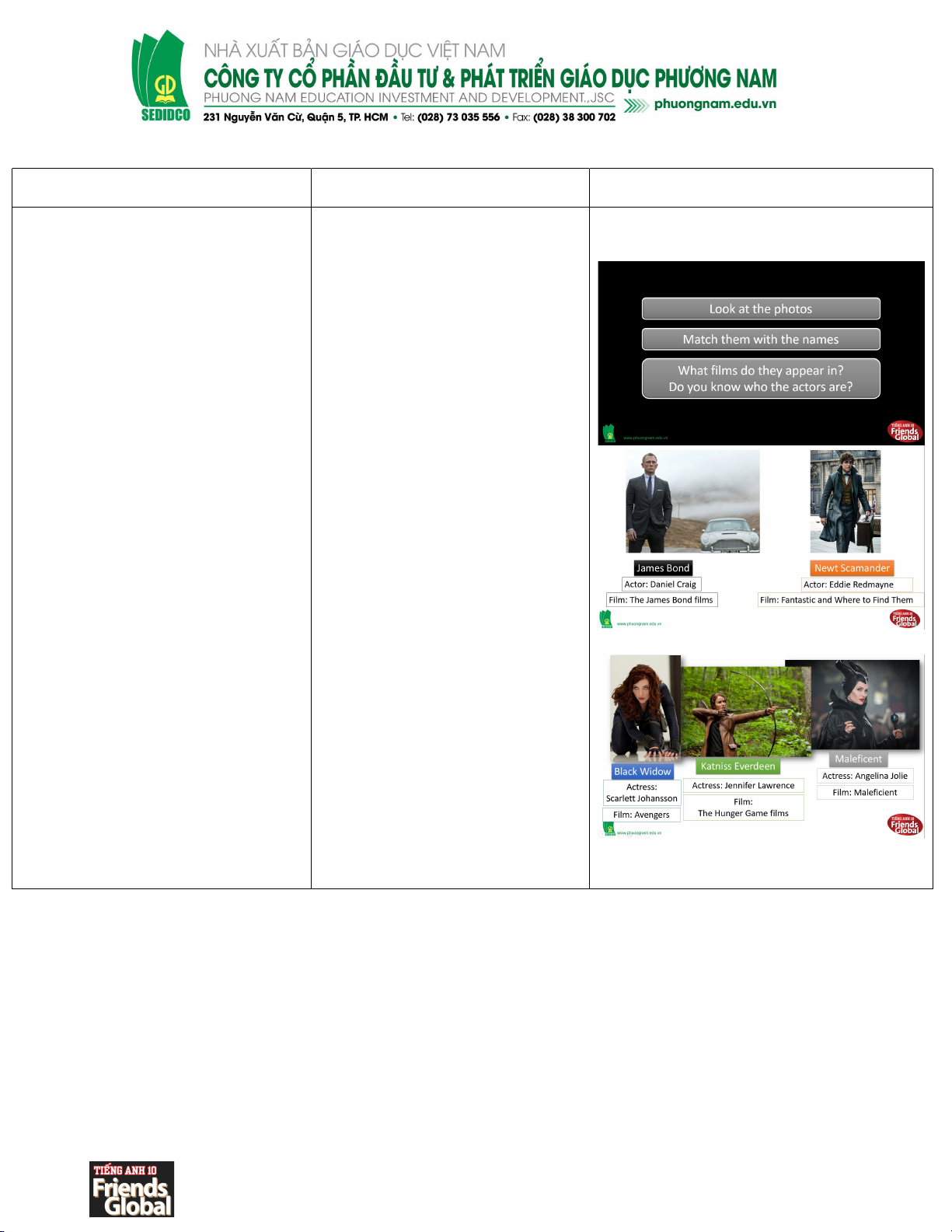
Warm-up T-Ss- T/ Ss – Ss Game “GUESSING NAMES” (5’) - Listen to the teacher - Tel s students what they carefully need to - Look at the three - Tel s students that they questions on the screen have to answer three questions - First, match name with - Work in groups and the character find out the answers of - Second, guess names of the questions the actors or actresses - Third, which films do the actors or actresses appear in - Shows the answers on the - Write down the screen answers B. New lesson (35’)
▪ Activity 1: Vocabulary (8’)
a) Objective: Ss know more words about adjectives to describe hair b) Content:
Vocabulary: wavy, curly, fair, trousers, waistcoat Listening
c) Outcomes: Ss know how to pronounce the new words precisely and use them in appropriate contexts.
d) Competence: communication, dril ing
e) Organisation of the activity: TEACHER’S ACTIVITIES STUDENT’S CONTENTS ACTIVITIES PRESENTATION. T -Ss- T/ Ss- Ss/ Individual Set context: - Cal out some students to - Some students wil Question: answer the question: answer the question.
1. Who is your favourite characters? “What is your favourite 2. Why do you admire them? outfit? “What are you 3. Can you describe them? wearing today?” - Teach new vocabulary: - Use pictures and explanation to present new words. - Listen to the - Have students practice teacher. their pronunciation dril s. New words: New words: wavy (a) curly (a) fair (a) picture + trousers (n) meaning - Look, listen, and waistcoat (n) repeat in chorus and medium-length (a) individuals moustache (n)
▪ Activity 2 Practice (22’)
a) Objective: Ss can answer the questions to critical thinking, and they can also finish
the tasks in the textbook. Critical thinking skil s (guessing/ reasoning) and
communication can also be practiced.
b) Content: Students answer questions, classify words, choose the correct answer, read
and complete, listen and match.
c) Outcomes: Ss read and listen, and they can apply the useful language in everyday listening and speaking.
d) Competence: collaboration, guessing, matching, communication
e) Organisation of the activity: TEACHER’S STUDENT’S ACTIVITIES CONTENTS ACTIVITIES
PRACTICE. T-Ss- T/ S – S/ Indiv.
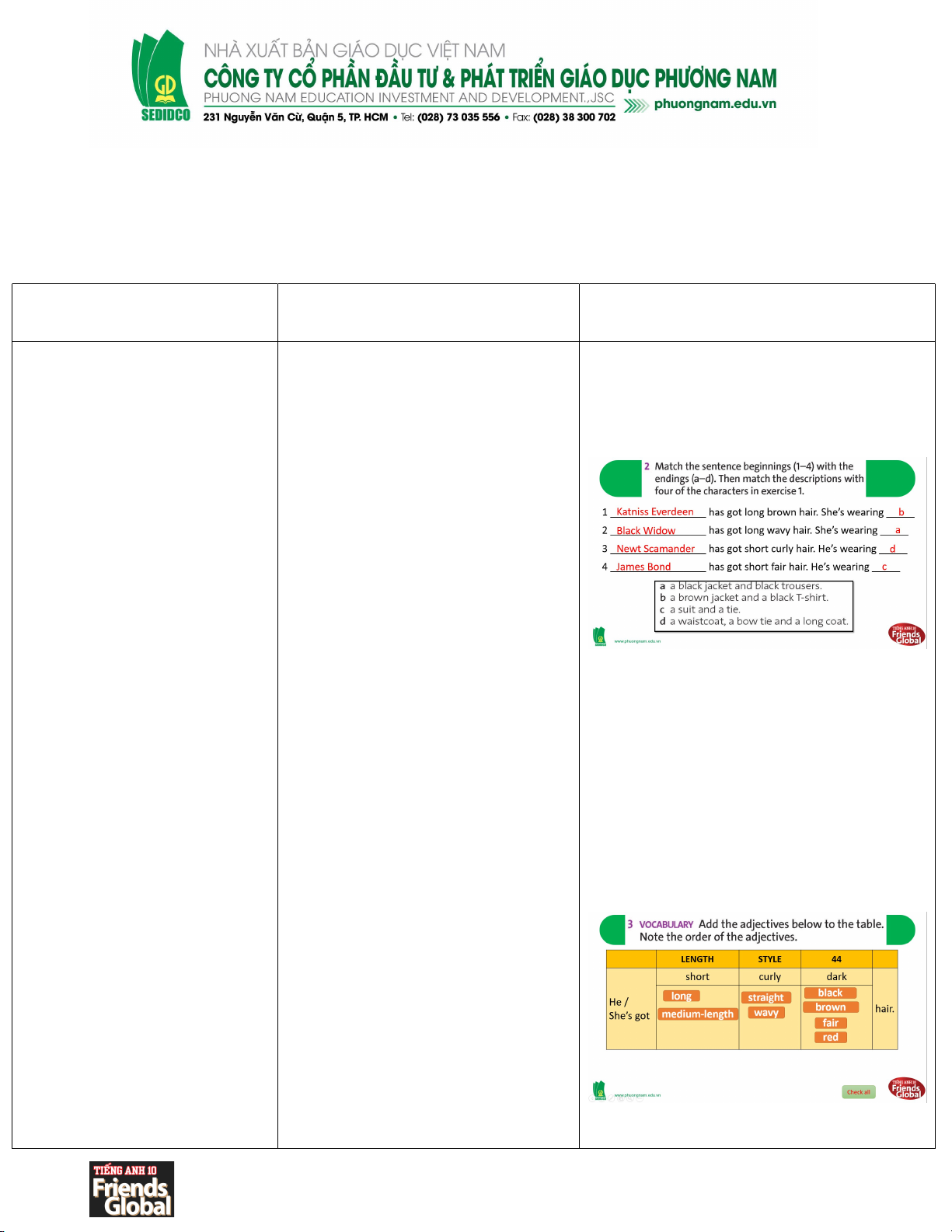
Activity 2 (4’) Match the Answers: sentence beginnings (1-4) with the endings (a-d). Then match the descriptions with four of the characters in exercise 1. - Asks students to - Work in pairs work in pairs - Asks questions to - Do the exercise check if students know how to do the exercise - Shows the correct - Check the answers with answers the teacher - Write down the correct Activity 3 (3’) answers VOCABULARY. Add the Answers: adjectives below to the table. Note the order of the adjectives. - Asks students to work in groups - Work in groups - Explains the exercise to students - Listen to the teacher’s - Shows students the explanations
Tài liệu liên quan:
-

Bài Tập Unit 7 - Lớp 10: Global Success Practice Questions
22 11 -
CHUYÊN ĐỀ NGỮ PHÁP TIẾNG ANH - CÔ MAI PHƯƠNG (ANH VĂN 10-12)
21 11 -

Four Corners 2B-U11 - Expanding on the Shortcomings of Your Work
22 11 -

Tài liệu học tập GLOBAL SUCCESS lớp 10: Tổ chức quốc tế và từ vựng
22 11 -
TN Internet: Các Câu Hỏi Kiến Thức Về IPv4, IPv6 Và Elearning
29 15