420 trang
1 lượt tải
[Book] TOEFL BARRON 3rd Edition
1
Giáo Trình Tâm Lý Học Phát Triển - Trương Thị Khánh Hà - USSH (2)
Tác giả:

Danh sách Quiz
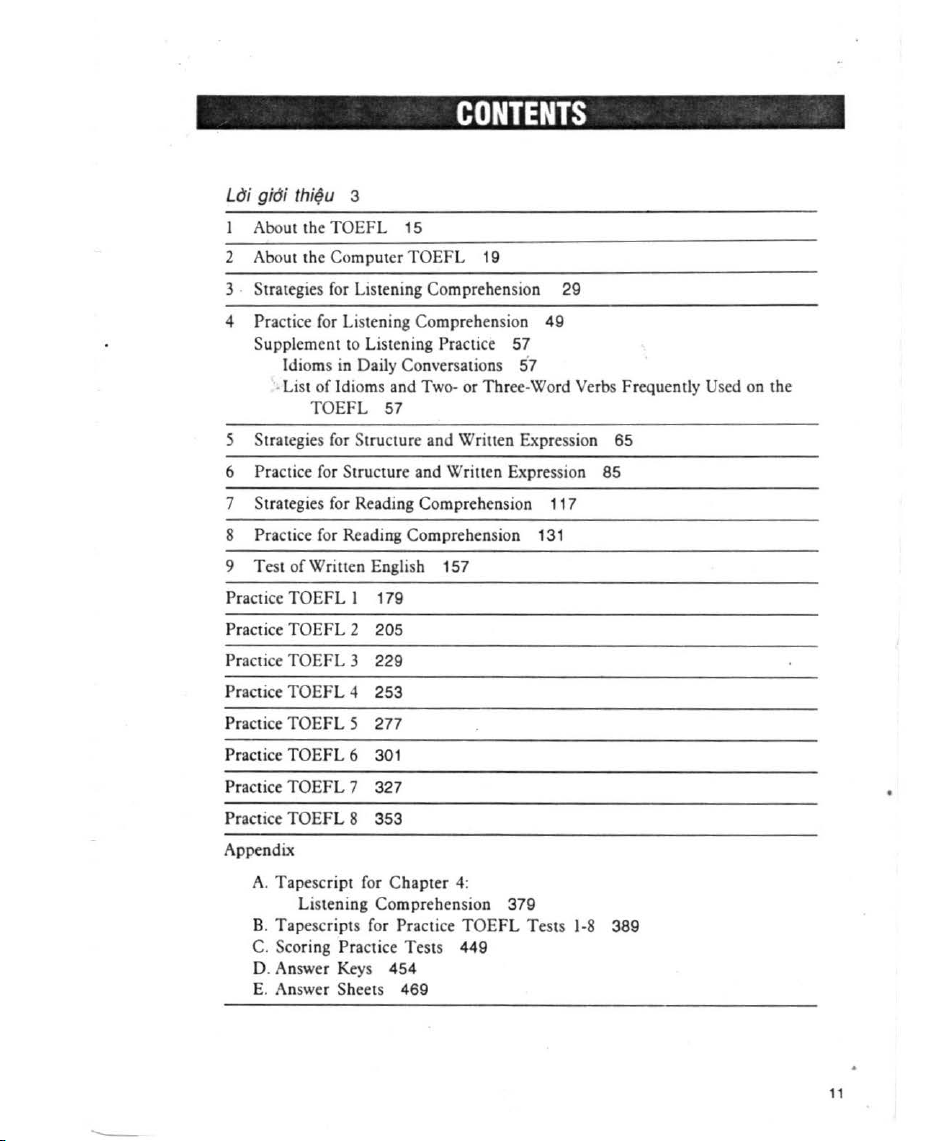
CONTENTS
Loi
gi<Ji
thi1'u
3
I About the
TOEFL
15
2 About the Computer
TOEFL
19
3
Strategies
fo
r Listening Comprehension
29
4
Pr
ac
tice for
Li
steni
ng
Comprehension
49
Supplement to Listening Practice 57
Idioms in Daily
Conversations
S7
-List
of
Idioms and Two- or Three-Word
Ve
rbs Frequently Used on the
TOEFL
57
S Strategies
fo
r
St
ructure and Written Expression
65
6 Practice
fo
r Structure and Written Expression
85
7
St
rategies for Reading Comprehension
11
7
8 Practice
fo
r Reading Comprehension 131
9
Te
st
of
Written English 157
Practice T
OEF
L I 179
Practice TOEFL 2 205
Practice
TOEFL
3
229
Practice
TOEFL
4
253
Practice
TOEFL
S
277
Practice
TOEFL
6 301
Practice
TOEFL
7 327
Practice T
OEF
L 8
353
Appendix
A. Tapescript for Chapter 4:
Listening Co
mpr
ehension 379
B. Tapescripts
fo
r
Pr
ac
tice
TOEF
L
Te
sts
1-
8 389
C. Scoring Practice Tests
449
D. Answer Keys 454
E. Answer Sheets
469
11

12
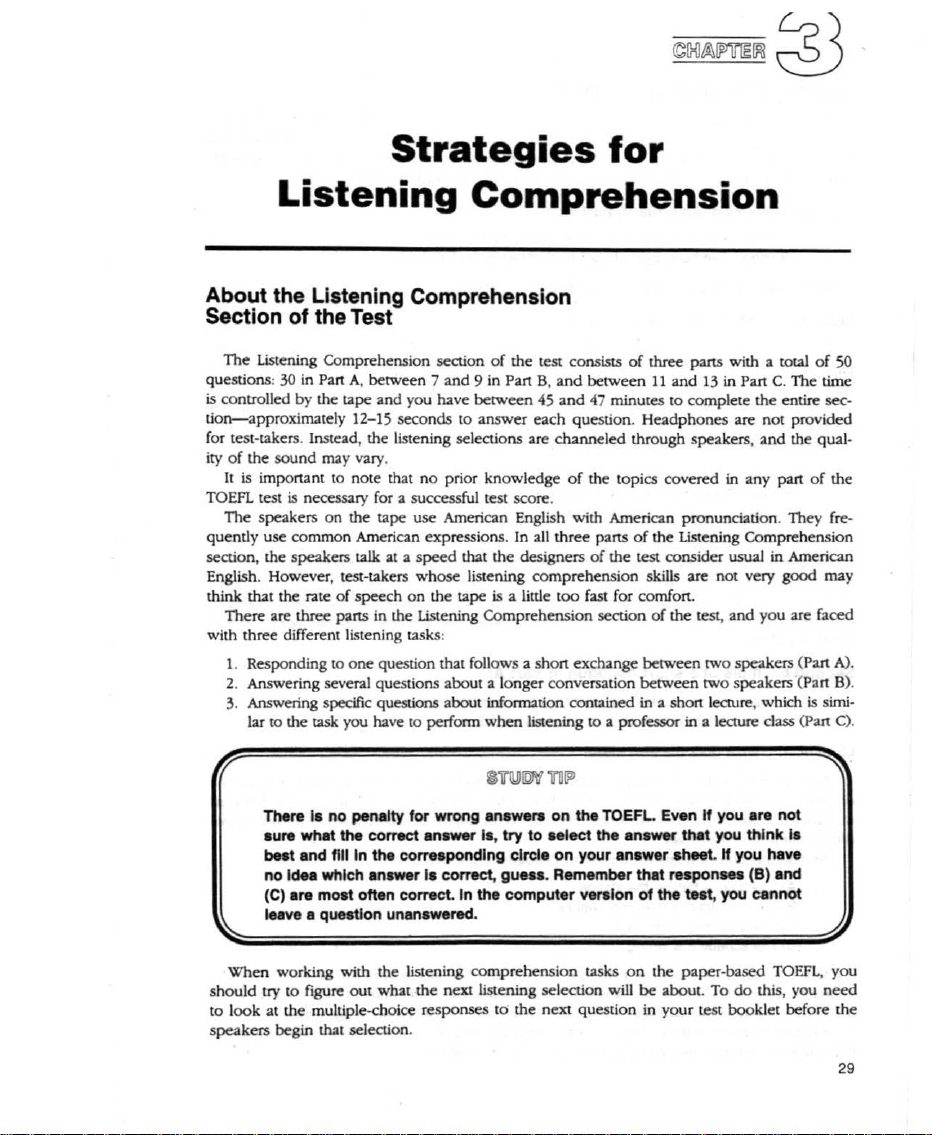
Strategies
for
Listening
Comprehension
About
the Listening Comprehension
Section
of
the Test
The
Listening Comprehension section
of
the test consists
of
three
pans
with a
tOlal
of
SO
questions: 30 in Part
A,
between 7
and
9 in Part B,
and
between
11
and 13
in
Part C. The time
is
controlled by the tape and you have between 45
and
47
minutes
to
complete the entire sec-
tion-approximately
12-15 seconds to answer each question. Headphones arc
not
provided
for test-takers. instead, the listening selections are
channeled through speakers,
and
the qual-
ity
of
lhe
sou
nd
may vary.
It
is important to note that no prior knowledge
of
the topics covered in any part
of
the
TOEFL
test is necessary for a successful test score.
The
speakers
on
the tape use Ameriaan English with Ameriaan pronunciation. They fre-
quently use
co
mmon Ameriaan expressions. In all three parts
of
the Listening Comprehension
section, the speakers talk at a
speed
that the designers
of
the test consider usual in American
English. H
ow
ever, test-takers
whose
listening comprehension skills are
not
very good may
think that the rate
of
speech on the tape
is
a little
too
fast for comfort.
There are
three parts in the Listening Comprehension section
of
the test,
and
you are
faced
with three different listening tasks:
1. Responding to
one
question that follows a short exchange between two speakers (Part
A)
.
2. Answering several questions about a l
ong
er
conversation between
two
speakers (Part B).
3. Answering specific questions about information contained
in
a short lecture, which is simi-
lar to the task you have to perform
when
listening to a professor in a lecture
dass
{P
art
C)
.
There
la
no
penalty for
wrong
answers
on
the
TOEFL
Even
If
you
are
not
sure
what
the
correct
an-
la,
try
to
select
the
an-
that
you
think la
beat
and
flll
In
the
corresponding
circle
on
your
answer
aheel
H
you
have
no
Idea which
answer
la
correct,
gueu
.
Remember
that
reapon-
(B)
and
(C)
are
moat
often
correct
.
In
the
computer
version
of
the
teat,
you
cannot
leave a
question
unan-ered
.
When
working with the listening
co
mprehension tasks
on
the paper-based
TOEFL
, you
shou
ld try to figure
ou
t what the next listening
se
lecti
on
will
be
about. To
do
this, you
need
to
l
oo
k at the multiple-choice responses to the next qu
es
tion in yo
ur
test booklet before
the
speakers begin that selection.
29
30
TO
E
FL
STRATEGIES
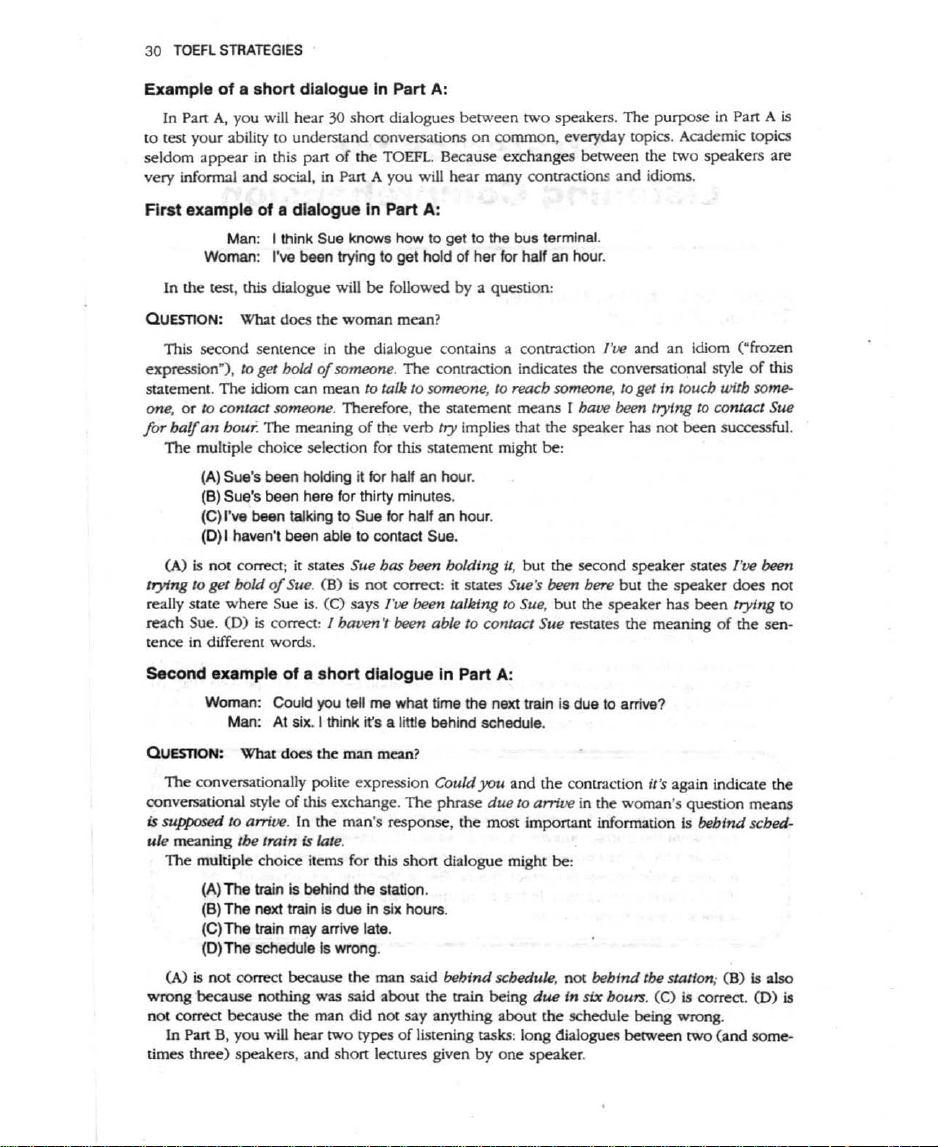
Example
of
a
short
dlalogue In Part A:
In Pa
rt
A,
you will hear
30
short dialogues between two speakers. The purpose
in
Part A is
to t
es
t your ability to understand conversations on common, everyday topics. Academic topics
seldom
appear in this part
of
the TOEFL. Because exchanges between the two speakers a
re
very informal and social, in Part A you will hear many contractions and idioms.
First
example
of
a dialogue In Part A:
Man: I
th
i
nk
Sue
kn
ows how
to
get to
th
e bus termina
l.
Woman:
I'
ve been trying to
ge
t hold of her
fo
r half
an
hour.
In the test,
this
dialogue will
be
followed by a question:
QUESTION:
What
docs
the woman mean?
Th
is
second sentence in the dial
ogue
contains a contraction I've and
an
idiom ("frozen
expression"),
lo get
bold
of
someone.
The
contraction indicates the conversational style
of
this
statement. The
idi
om can mean to talk to someone,
10
reacb someone, to get
In
toucb wttb
so
me-
one, or to
co
nt
act
someon
e.
Therefore, the stacemenc means I have
been
trying to
contac
t Sue
for
balf
an
bou
r. The meaning
of
the verb try implies that the speaker has not
been
successful.
The multiple choice selection for
this statement might be:
(
A)
Sue
's been holding it
for
ha
lf
an
hou
r.
(B)
Sue
's been here
for
thi
rty
minutes.
(C)l've been talking to
Sue
for half
an
hour.
(D) I haven't been able
to
contact
Sue
.
W is n
ot
correct; it s
ta
tes Sue b
as
been bold
tn
g tt, but the second speaker stat
es
I've
been
tryin
g to
ge
t
bold
of
Sue
.
(B)
is not correct: it states Sue's
been
here but the speaker does n
ot
really state
whe
re Sue is.
(C)
says
rve
been talking to
Sue
, but the speaker has been trying to
reach Sue.
(D)
is correct: I
haven
't
been
able to
contac
t
Sue
restates the meaning
of
the
se
n-
tence in
dilT
erent wor
ds
.
Second example
of
a s
hort
dialogue In Part A:
Woman: Could
you
tell
me
wh
at
ti
me the next traln is due to arrive?
M
an
:
At
six. I
th
ink it's a
littl
e behi
nd
schedule.
QUESTION:
Wha
t
docs
the man mean?
The
co
nversat
io
nally polite expression
Could
yo
u and the contraction it's again indicate the
co
nversation
al
style
of
this
exchange. The phrase
due
to arrive in the woman's question means
is supposed to a rri
ve
. In the man
's
response, the most im
po
rtant information
Is
bebtnd
sch
ed
-
ul
e meaning t
be
train
ts late.
The multiple choice ite
ms
for th
is
sho
rt
dial
ogue
mi
ght be:
(A)
The traln is behind the station.
(B) The next
t
rain
is due
in
six hours.
(C)
The train may arrive late.
(D) The schedule
Is wrong.
W
is
n
ot
co
rrect because the man said
be
hi
nd
sch
edule
, n
ot
be
hi
nd
tbe station;
(B)
Is also
wrong
because nothing was said about the train being d
ue
In
stx
hours.
(C)
is correct.
(D)
Is
n
ot
correct because the man did n
ot
say anything
abo
ut the schedule being wron
g.
In P
:1c
rt
B, you w
ill
h
ear
tw
o types of listening
tasks
: long dialogues between two (and
so
me-
tim
es
thre
e)
speakers, and sho
rt
lectures given
by
one
speaker.
STRATEGIES FOR LISTENING COMPREHENSION
31
Example of a longer dialogue In Part B:
Man:
Th
is beach is r
ea
lly
dirty. Look
at
all these pieces of plastlc
and
li
tt
er
everywhere.
Woman:
lrs
terrible. I'm sure some
of
it
has washed up
fr
om
the
oc
ean.
Plastic trash
fr
om
sh
ips has been dumped i
nto
the
oc
ean for years.
Man:
I'm
surpri
sed
that waste
can
just
be
dumped in
to
the
ocea
n.
E
ss
entially,
the
ocea
n has become a receptacle for both industrial
and city garbage.
It
Is a disaster for sea birds
and
all forms of marine
life.
Woman:
Yo
u
can
say
that again. Birds
get
caught
in
the plastic bags and
packing materials that are dumped in the water.
Wtr.J
is
such
pollu-
t
io
n allowed
to
happen?
Man: You should have seen what the sea water looked
like just five
year
s
ago
.
The
pumping of waste water i
nt
o the ocean had
co
ntin
ued
for
decades. Finally,
new
laws prohibit dumping
in
dustr
ial or city waste
in
the
oc
ean
. So, hopefully, ov
er
time, both the
wa
t
er
and the beaches
will become cleaner.
Woman: l
rs
a
good
thing.
Who
knows, the entire marine environment could
have been spoiled
by
garbage.
The dialogue is followed
by
several questions, each spoken only once.
In
your test book-
let
or
co
mputer screen, you will
sec
the multiple-choice selections for each question.
Th
e qu
es
tions a
nd
answer choices for the preceding dialogue might be:
QUESTION
1 : Where does
this
conversation take place?
(A)
At
a garbage
dump
.
(B)
In the city.
(C
)
On
the seashore.
(D) In a
ma
ri
ne
lab
.
The
fi
rst
se
nt
en
ce
in the conversation is "This
bea
ch is really d
irty."
A
beac
h is a
sa
ndy sec-
ti
on
of
the seashore that gently sl
opes
in
to the water.
(A)
is n
ot
co
rrect because
th
e speaker
said "This beach.• This means that
th
e conversation
is
taking place at the beach. For this rea-
son, (B) and
(D)
are also n
ot
co
rr
ect. The correct answer
is
(C).
QUESTION
2: What
is
said about
the
co
ndition of
the
oc
ean waters?
(A) They
are
s
tormy
.
(B) They
are
unpopulated.
(C) Th
ey
a
re
pollut
ed
.
(D) They are
deep
.
(A)
is n
ot
co
rrect because neither speaker mentioned stormy weather
or
waters.
{B)
is
not
correct because "sea bir
ds
and a
ll
forms of marine life" were mentioned. (C) is a possible
answer;
(D)
is clearly incorrect because the dialogue does not discuss the
oce
an
depth.
Therefore,
the correct answer is (C).
QUESTION
3: A
cco
rding to the
dialogue
,
wh
y
is
waste dumping dangerous for sea birds?
(A) They lose their habitats.
(B) They become entangled in waste products.
(C) They
seek
she
lter
on
the shore.
(D) They
are
being
du
mped Into
th
e
ocea
n.
32
TOEFL STRATEGIES
The speakers
in
the dialogue
do
n
ot
mention birds' habilatS; therefore W is incorrect.
(B)
is possible because the woman in the dialogue noted thal birds can become caught in plastic
materials dumped
into
the ocean. (C) is incorrect because no menti
on
is made
of
the birds
seeking
shelter anywhere.
Jn
(0),
they refers
to
birds since birds
is
the o
nl
y plural
noun
in
the
question, but
"trash from ships" (trash
is
not plural) was mentioned
as
being "dumped into the
ocean.• The correct
mswer
is
(B).
QUESTION
4:
H
ow
does
the
l2w
proteet the ocean from pollution?
(A)
The
beaches
are
cleaned
regularly.
(B) Marine life lost to pollution has
to
be
restored.
(C) Disposing
of
waste
In
the ocean is forbidden.
(D) Garbage must
be
retrieved from the ocean.
The
man
in
the dialogue said: "
New
laws prohibit dumping industrial
or
city waste in the
ocean." The
word
dumpin
g is. synonymous
with
tbrowtng
out
or dtspostng
of
Therefo
re
, the
sentence means that
new
law
s no longer allow disposal
of
waste
in
ocean waters. The speak-
er
did
not
mention that the
law
requires cleaning the beaches, so
(I.)
is
incorrect. Similarly, he
did
not
indi
ca
te that the l
aw
is concerned
with
t
he
l
oss
of
sea
animals and birds; (
B)
is also
incorrect.
(C)
is
the correct answer because
it
is
simp
ly
a restatement
of
a sentence
in
the dia-
logue.
Jn
(D), retrieved means taken
out
. The speakers
did
not say thal the
new
laws require
taking
the
garbage out
of
the ocean. (D) is incorrect.
In
Pa
rt
C,
you
will
hear several sh
ort
lectures.
As
in
Part B, they
will
be
followed
by
ques-
tions. Both the
lectures and lhe questions
will
be spoken
only
one time. The multiple choice
selections
will
not
be
heard. Instead, you
will
find them printed in your lest booklet or dis-
played
on
the
co
mput
er screen.
Example
of
a short lecture In Part
C:
If you need to buy a good lock, there are several things you should keep in
mind. Locks
cflffer
in price and qual
ity.
You
can make a decision about which lock
you want to buy If you know how they work. Let me show you what we have here
and quickly explain
how basic locks work. When the correct key
Is
inserted into
the door
lock, the notches on the
key
make metal plates align. Once the plates
are aligned,
the key pushes the bolt Inside the lock between the door and the
frame.
Spring bolts are considered more convenient because you don't need to
use a key to
lock them. When the door closes, they snap Into the door frame and
stay
locked until a key is used to open them. However,
spr
ing locks are not as
secure as dead bolts because they can be easily
picked
or
pried open.
Ifs
not
hard to
do
; you can see for yourself. On the other hand, dead bolts work from
inside the door, and they need a
key
to unlock them. Dead bolts are called "dead"
because they don't move until you move them with a
key. Spring locks and dead
bolts are the
two
types
of
locks we sell most.
QUESTION
1 : Wh2.t is
the
main
topi
c
of
this
ulk?
(A) The uses
of
doors
(B) Why a
lock is essential
(C) How locks operate
(D) How to install a lock
Although doors are mentioned in
the lecture, the u
ses
of
doors
are
not
discussed. W is
incorrect. The
lecture does not discuss
why
locks
are
esse
ntial; therefore,
(B)
is incorrect. The
main topic
of
the ta
lk
is
how
basic locks
work
. (C) is the correct answer. Installing a lock is
also n
ot
discussed, so (
0)
is
a wrong answer.
STRATEGIES
FOR
LISTENING COMP
RE
HENSION
33
QU
ESTI
ON
·2: Why arc
dead
bolts called "dead"?
(A) They
are
no
longer
used
.
(B) They
are
poor1y
designed.
(C)
They
are
difficult to maintain.
(D)
They require a key to open them.
(A) is not correct
because
the
speaker
said that spring locks
and
dead
bolts are
co
mmonly
used
. Nothing was mentioned regarding
the
design
of
dead
bolts
or
their maintenance, so both
(B)
and
(C)
are
wrong
. ( D)
is
the
correct answer.
OU
ESTI
ON
3:
What
arc
t.he disadvantages
of
sp
ring locks?
(A)
They
are
not convenient.
(B)
They
are
not common.
(C)
They
are
not
secure
.
(D)
They
are
not
cheap.
(
A)
is not correct
because
the
speake
r said, "Spring bolts
are
considered more
co
nven-
ient. ...
•
The
last
sentence
in
the
talk states, "Spring locks
and
dead
bo
lts
are
the
two
types
of
locks
we
sell
most
,"
so
(B) is
also
incorrect. (C) is a possible
answer
. Because
the
text
does
nm
mention
the
price
of
locks, (D) is incorrect.
The
co
rre
ct
answer is (C). ·
What the Listening Comprehension
Section Is Designed to Test
The topics in
the
Listening Comprehension section do not require special
knowledge
of
any
specific subject.
They
are
based
on daily activities that
can
occur
in
most public places,
such
as libraries, schools/colleges/universities, banks, offices, shops,
and
parks.
Some
statements or
portions of
co
nversations might
be
made
over
the
telepho
ne
. Many
of
them refer
to
basic cul-
tural aspects
of
life
in
the United States.
The
main
purpose
of
the
Listening Compreh
ens
ion
section of
the
TOEFL is to measure
how
well
you
can function in
the
daily life
and
activities
in
the counLry.
The
Listening Comprehension section tests a
wide
variety
of
grammatical structure
s,
includ-
ing affirmative
and
ne
gative
se
ntences, questions,
and
commands. Almost
all
verb censes
(including conditionals), active
and
passive
voic~.
two-word verbs, prepositions, wor
ds
with
several meanings,
personal names, nicknames, family names, forms
of
address,
co
mparisons,
numerals,
and
simple computations
can
appear
in
conversations
and
lectures
in
this section.
When listening to
the
tape,
you
need
to
notice contractions (I'm,
you
·
~
be's
),
contractions with
negations
(don
't,
tsn
'l),
and
final
sounds
and
combinations
of
sounds
(-ed, -ing. -s).
All
sen
-
tences in
the
Listening Comprehension section
are
grammatical,
and
most
are
complete. They
are
spo
ken
mostly in conversational English
and
only occasionally involve academic t6pics.
Since
mo
sc co
pi
es
in this section
are
not academic,
the
vocabulary tested
in
Section I is sel-
dom very complicated. H
oweve
r,
because
iclioms
are
frequently used in American conversa-
cional
speech
, you will find
many
idioms in the Listening Comprehension section.
Since 1986,
the
three m
ost
frequent listening tasks
on
the
TOEFL have
been
:
(1)
understanding idioms,
co
nversational expressions,
and
two-
or
three-word verbs;
(2) discerning implied meanings;
and
(3)
answering questions
about
the
specific
content
of
a conversation or a
short
talk.

34
TOEFL STRATEGIES
Other frequent test
wks
include:
( 4) interpreting emphasis, stress,
and
tone;
(5)
sound
discrimination;
and
(6) understanding comparisons.
Each
of
these
areas
is explained below, with
enmplcs
.
Eumplea
of
the
frequently
teated llatenlng tasks
On the test,
yo
u will
not
see the
text
that
Is
spoken
on
the
tape
. Only the directions
and
the multiple-choice answers for each short dialogue,
extended
dialogue,
or
sho
rt
lecture will
appear
!n
your test booklet or
on
the computer screen. Directions and
CXllmples
are given
in
the practice
tests
in this book.
TASK
1: Idioms, conversational expressions, and
two-
or
three-word
verbs
An
idi
om
is
a group
of
words, used mostly
in
conversational English, that has a meaning
different from the meanings
of
the individual words included in the group. For example, the
expressions
lo lose one's cool, lo
fly
off
/be handle,
and
to
blow
one's
stack
mean 10 ges
angry
.
If
the words
in
any
of
these expressions are replaced
by
other words,
the
expression loses its
meaning.
A
two-
or
three-word verb usually consists
of
a verb
and
another word, such
as
a particle
(down, off,
up,
after
),
that together have a meaning different from that
of
the main verb. For
example, 10
take
off
means 10 remove (clo
lbtng)
or
lo
depart
(for
an
airplane)
,
and
lo
take
after
means lo look
or
acl
like.
Idioms
or
two-
or
three-word verbs may appear
in
a
sho
rt
dialogue,
as
in
Part A:
You
will hear.
Woman: Was the math test
difficult
?
Man: The teacher put the test
off
because
she
ran
out
of time.
QUESTION: What
did
the
man say about the test?
You will read:
(A)The test Is cancel
ed
.
(B)The test
is
postponed.
(C)The teacher took
off
her coat
(D)The
tea
che
r ran outside.
The
answer is
(B)
.
One
of
the meanings
of
pw
off
is postpone.
Idioms
or
two-
or
three-word
verbs
may also appear in shott dialogues.
You
will hear:
Man: We haven't
seen
Larry
In
a while.
Woman:
wtry
not have
hi
m over this weekend?
OUESTION: What
docs
the
woman mean?
(A)
She
saw
Larry
for
a
wh
ile
during the weekend.
(B)She thinks they should
Invite
Larry
for
a visit.
(C)
Sh
e doesn't
like
It
when Larry comes over.
(D)She
sees
Larry every day during
the
week.
The answer is
(B).
Have
(someone)
over
means
fnvile/ora
vtsf/
.
STRATEGIES
FOR
LISTENING
COMPREHENSION
35
Idioms
or
two-
or
three-word verbs may
appear
in
a long dialogue, as
in
Pan
B:
You
will
hear
:
Man: Hello, Betty. I didn't
know
you come here
for
lunch. Do you mind if I
join you?
Woman:
Hello,
Rick
.
No
, I don't mind
at
all. I li
ke
the
food
here. In fact, I
come
here for lunch
at
least
once
a week.
Man:
I like their salad
bar
. I think
ifs
the best in town. Actually, it's surpris·
Ing
we
haven't met here before.
Woman
:
Oh
, U9ually I
haw
my
lunch
break
betw.en
11
and
12
.
But
today
our
secretary Is out sick, and I had
to
answer
the
office
phone.
Man:
So
, if I
come
here between
11
and 12,
chances
are
we11
have lunch
together more often.
Woman:
In that case, I'm sure
we
'll run Into one another again.
QUESTION
1:
Where docs this
con
versation take place?
You
will
read:
(A) On the street
(B) In a phone booth
(C) In a restaurant
(0) In a bar
The
answer is (C). The
man
said
"l
unch
,"
and
the
woman
said, "I like the food
here
."
OUESTION 2: What docs
the
man say
he
likes?
You will read:
(A)
The
town
(B) The sandwiches
(C)
The
drinks
(0)
The
salad
The
answer
is
(D)
. Y
ou
can
often
get
salads
at
a
salad
bar
.
QUESTION 3: What did
the
woman
do
In
the morning?
You
will
read
:
(A) She performed
her
usual job assignments.
(B)
She
visited the secretary who
was
sick.
(C)
She
did the secretary's
jo
b.
(D)
She interviewed the office manager.
The answer is (C). The w
oman
s
aid
•
...
today
our
secretary
is
ou
t s
iclc
,
and
I
had
to
answe
r
the office
phone
."
QUESTION 4: What do
the
man
and
the
WODl2J1 say
about
meeting again?
You
will
read
:
(A) They agree to meet in another place.
(B) They
decide to
go
out
between
11and12
o'clock.
(C)
They plan to see one another later
In
the
day
.
(0) They hope
to
meet
aga
in In the future.
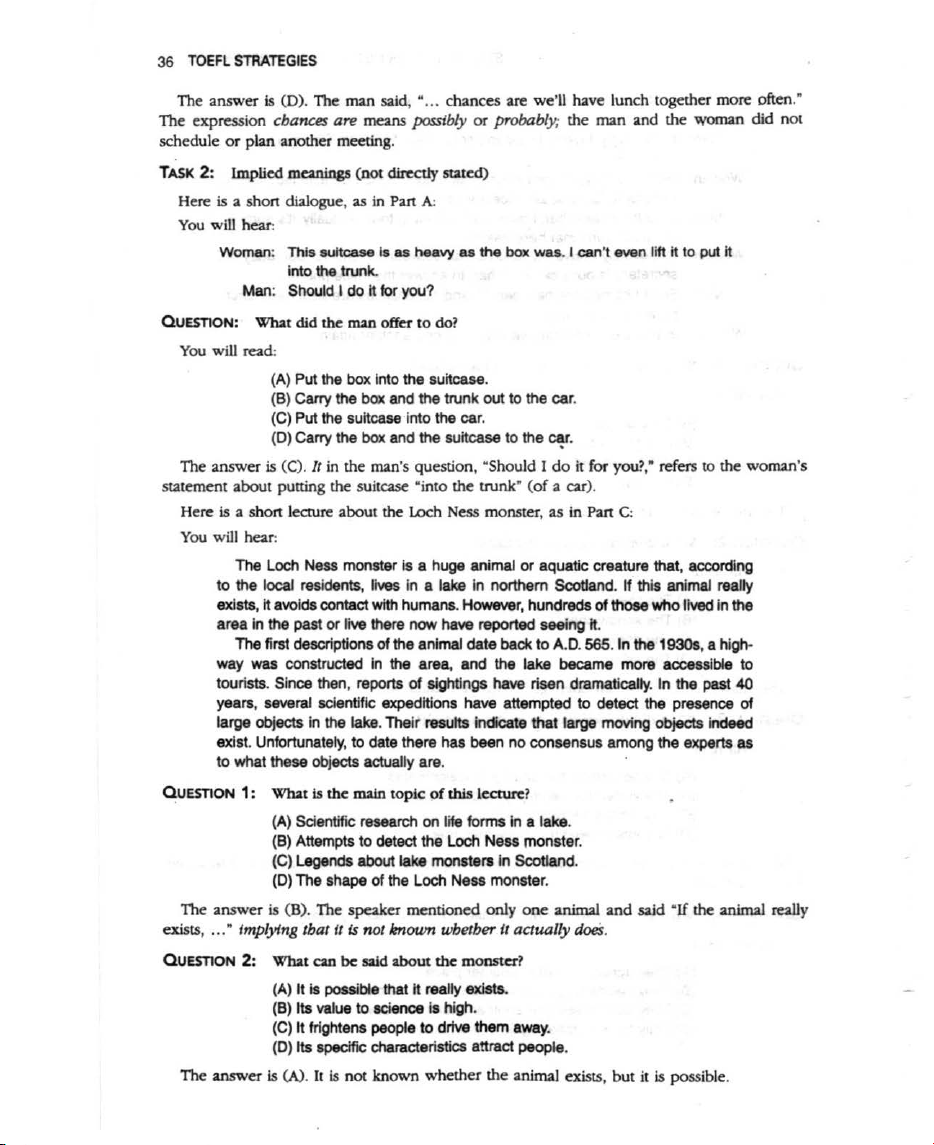
36
TOEFL
STRATEGIES
The answer is
(D).
The
man
said, •
...
chances are
we
'
ll
have
lunch
together more often."
The
expression chances
are
means possibly or probably; the
man
and the
woman
did
n
ot
schedule
or
plan
another meeting.
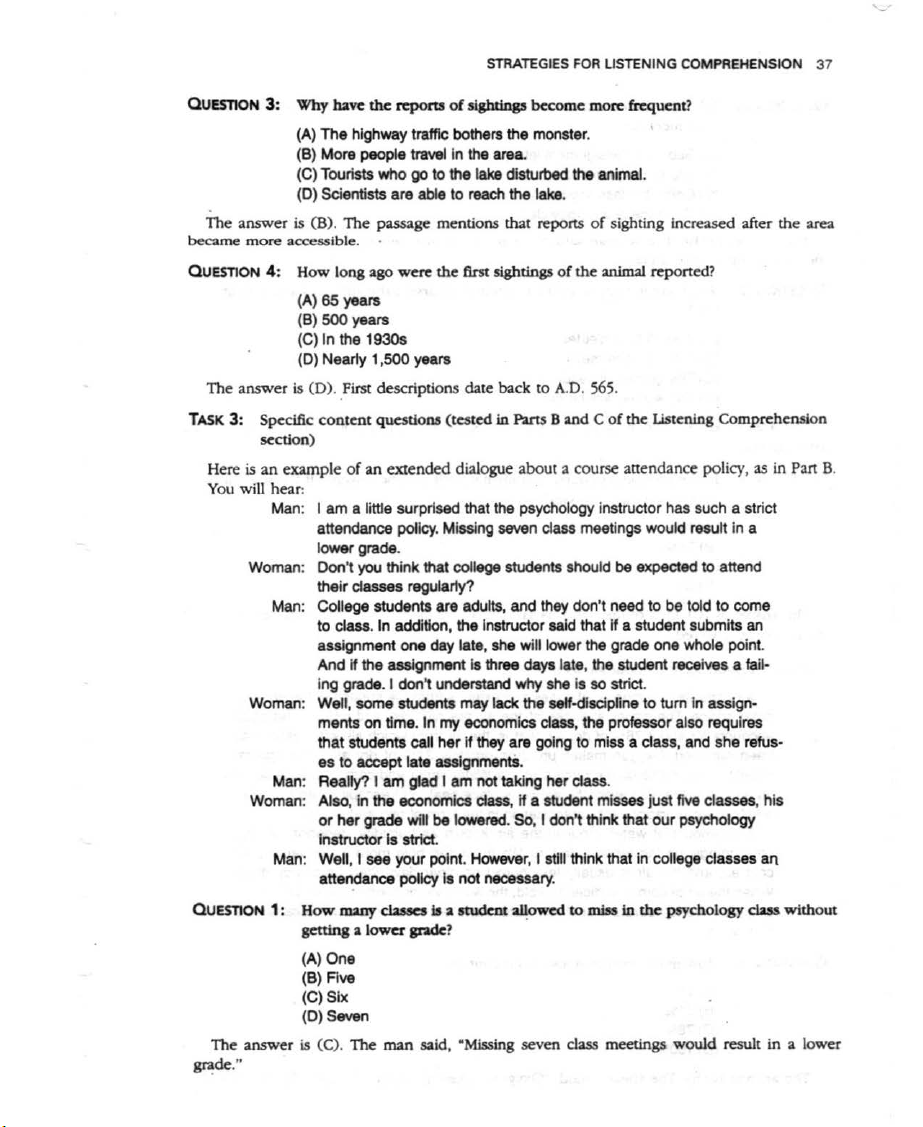
TASK
2:
Implied
meanings
(not
directly
stated)
Here
is a shon dialogue, as
in
Part
A:
You
will hear:
Woman:
This
suitcase Is
as
heavy
aa
the
box
was
. I
can't
91190
lift
it
to
put it
In
to
the trunk.
Man
: Should I do it for you?
QUESTION:
What
did
the
man
offer
to
do?
You will
read
:
(A)
Put
the
box Into
the
suitcase.
(B)
Carry
the
box and
the
trunk
out
to
the
car
.
(C) Put
the
suitcase into
the
car
.
(D) Carry the box and
the
suitcase
to
the
~
·
The
answer
is (C).
It
in
the
man
's
question
,
"S
hould
I
do
it
for
you?," refers
to
the
woman
's
statement
about
putting
the suitcase "
into
the
trunk
"
(o
f a
car)
.
Here
is a
shon
lecture
about
the Loch Ness monster,
as
in
Part
C:
You will
hear
:
The
Loch
Ness monster is a huge animal
or
aquatic creature that, according
to
the
local residents,
llws
in a lake In
northern
Scotland. If this animal really
exists, It al/Olds contact
with
humans
.
HOW9118r,
hundreds of
those
who
lived
In the
area in the past
or
live there
now
haw
reported seeing
It.
The
first descriptions of
the
animal
date
back
to
A.O.
565
. In the
1930s
, a high-
way
was
constructed In the area.
and
the
lake became
more
accessible
to
tourists. Since then, reports
of
sightings
haw
risen dramatically.
In
the
past
40
years, several scientific expeditions
have
attempted to detect the presence of
large
objects
In
the
lake
. Their results Indicate
that
large
moving
objects
indeed
exist.
Unfortunately,
to
date
there
has
been no
consensus
among
the
experts as
to
what
these
objects
actually are.
QUESTION 1 :
What
is
the
main
topic
of
this lecture?
(A) Scientific research
on
life forms In a
lake
.
(B) Attempts to detect the Loch
Ness
monster
.
(C)
Legends
about
lake
rnonster1 In Scotland.
(D)
The
shape
of
the
Loch
Ness
monster
.
The
answer is
(B).
The
speaker
mentioned
only
o
ne
animal
and
said
"If
the
animal
really
exists,
...
• tmplytng tbat
ft
ts
not known wbetber
It
actually
doeS
.
QUESTION
2:
What
can
be
said
about
the
monster?
(A)
It Is possible that
It
really exists.
(B) Its value
to
ICience
ts
high.
(C) It frightens people
to
drive
them
away.
(D)
Its specific characteristics attract
people
.
The
answer
is W .
It
is
not
kn
own
whether
the
animal
exists,
but
it
is possible.
STRATEGIES
FOR
LISTENING COMPREHENSION
37
QUESTION
3:
Why
have
the
reports
of
slghlings
become
more
frequen
t?
(A) The highway traffic bothers the monster.
(B)
More people
travel
In
the
area.
(C)
Tou
rists who
go
to the
lake
disturbed the animal.
(
0)
Scientists are
able
to
reach
the lake.
The
answer
is
(B).
The
p
assage
mentions
that
reports
of
sighting Increased after
the
area
became
m
ore
a
ccc.ss
iblc
. ·
QUESTION 4 :
How
long
ago
were
the
first
sightings
of
the
animal reported?
(A)
65
years
(B)
500
years
(C)
In the
1930s
(0)
Nearly 1,500 years
The
answer
is
(0)
. First descripti
ons
date
back
to A.O.
565.
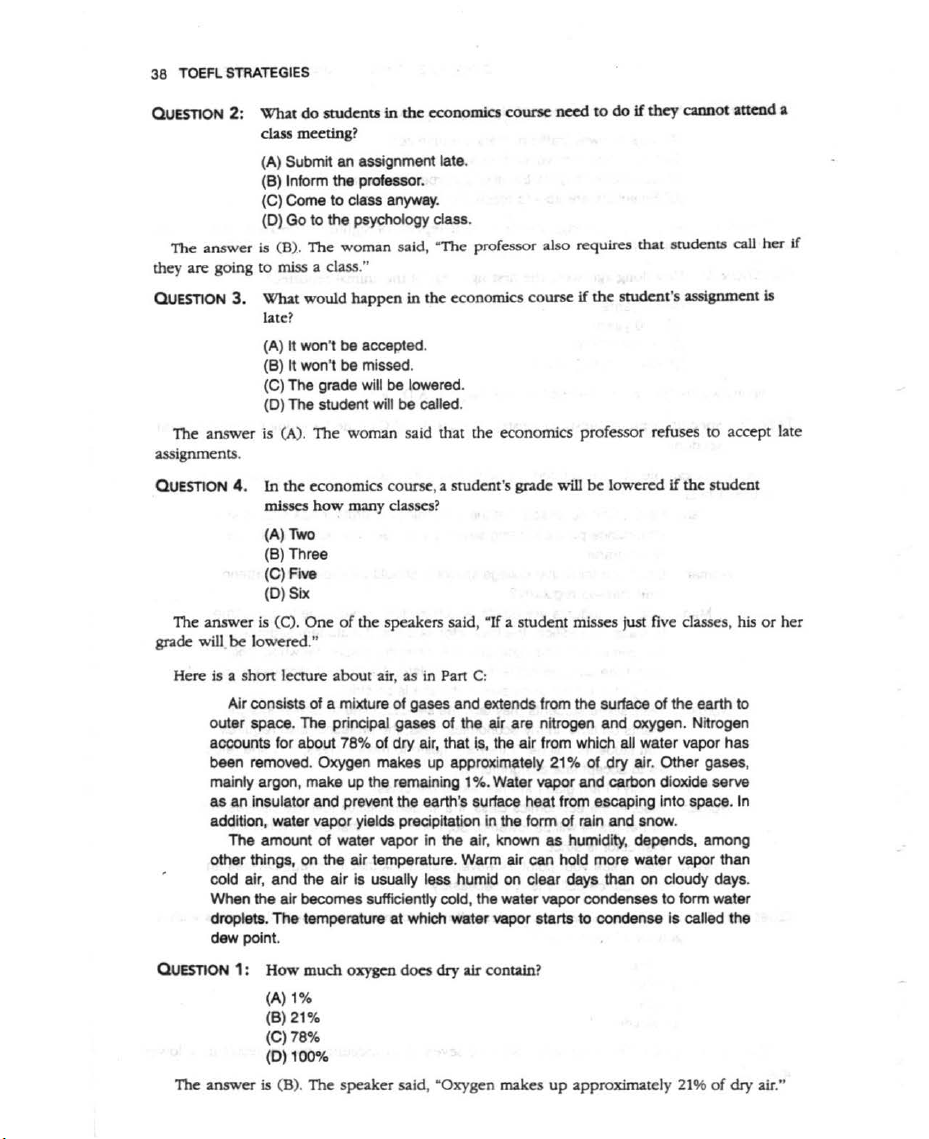
TASK
3:
Specific
content
questi
o
ns
(tes
ted
iJl Parts B
and
C
of
the
Listening
Comp
re
hension
section
)
Here is
an
example of
an
extended dialogue about a course anendance policy, as in
Part
B.
You
w
ill
hear:
Man:
I am a little surprised that
the
psychology instructor has such a
st
rict
attendance policy. Missing seven
cl
ass meetings would
resu
lt
in
a
lower grade.
Woman: Don't
you think that
col
lege students shou
ld
be
expected to attend
their
classes regularty?
Man
: College students are adults, and they don't need
to
be told to come
to
class. In addition, the Instructor
said
that If a student submi
ts
an
assignment one day late, she will lower the grade one whole point.
And
if
the assignment
la
three
days
late,
the
student receives a fail·
I
ng
grade. I don't understand
why
she
is so strict.
Woman: Well, some students may lack the self-discipline to tum In assign-
ments on time. In
my
economics class, the professor also requires
that students call her
If
they are going to miss a class, and she refus-
es to accept late assignments.
Man: Really? I
am
glad I
am
not taking her class.
Woman: Also, In the economics
class
,
if
a student misses just
five
classes, his
or
her grade
wm
be lowered.
So
, I don't think that our psychology
instructor
is
strict.
Man:
Well, I see your point.
HOW9118r
, I
still
think that in college classes an
atten_dance
policy
Is
not
necessary
.
QUESTION 1:
How
many
classes
Is
a studcn1
allowed
to
miss
In
the
psychology class
without
getting
a lower
grade
?
(
A)
One
(
B)
Five
(C)Six
(O) Seven
The
answe
r is (C).
The
man
said, "Missing
seven
class meetings
would
result
in
a
lower
~de
."
38
TO
EFL STRATEG
IES
Q
UESTION
2:
What
do
students
in
the
economics
course
need
to
do
if
they
cannot
attend a
class meeting?
(A) Submit an assignment late.
(B) Inform
the
professor.
(C)
Come
to
class anyway.
(0)
Go
to
the
psychology class.
The
answer
is (
B)
.
The
woman
said,
"
Th
e
professo
r al
so
requires
that
s
tudents
call
her
if
they are going
to
miss a class."
OUESTION
3.
What
would
happen
in
the
economics
course
if
the
student
's assignment is
late?
(A)
It won't
be
accepted.
(B) It
won't
be
missed.
(C) The grade will
be
lowered.
(D)
The
student will
be
called.
The
answer
is
W.
The
woman said that
the
economics
pr
ofes.sor refuses to accept late
assignments.
Q
UESTION
4.
In
the
econ
omics course, a student's grade
will
be
lowered
if
the
student
misses
how
m:iny classes?
(A) Two
(B)
Three
(C)Fiw
(D) Six
The
answe
r is (C).
One
of
the
speakers said, •
If
a
stude
nt misses just
fi
ve
classes, his
or
her
grade will
be
l
owered
."
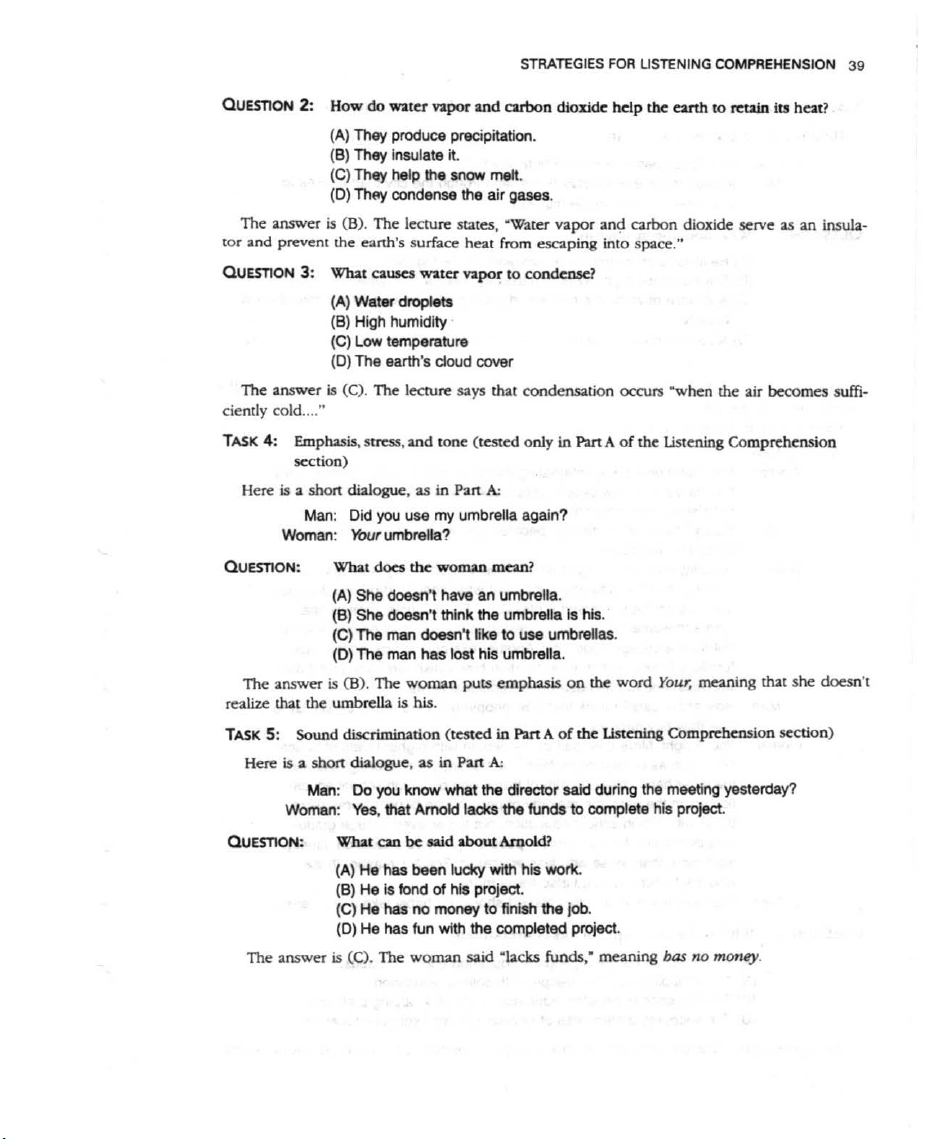
Here
is a
short
lecture
about
air, as in Part C:
Air consists of a mixture
of
gases
and extends from
the
surface
of
the earth to
outer
space.
The
principal
gases
of
the air are nitrogen
and
oxygen. Nitrogen
accounts for
about
78%
of
dry
air,
that
ts, the
air
from which all water vapor
has
been removed. Oxygen makes up approximately
21%
of
dry
al
r.
Othe
r
gases
,
ma
i
nly
argon
, make up the remaining 1 %. Water
vapor
and
carbon dioxi
de
serve
as
an insulator
and
prevent
the
earth's surtace
heat
from escaping Into space. In
additlon, water
vapor
yields precipitation In the form
of
rain
and
snow
.
The
amount
of
water vapor in
the
air, known
as
hum
idity,
depends
,
among
other things, on the
air
temperal\Jre. Warm alr
can
hold
more
water vapor than
cold air,
and
the
air
Is usually less humid
on
clear
days
than
on
cloudy
days
.
When
the
air
becomes sufficiently cold,
the
water vapor condenses
to
form
water
droplets.
The
temperature
at
which
-ter
vapor starts
to
condense Is called the
dew
point.
QU
ESTION
1 :
How
much
oxygen
does
dry
alr
contain?
(A) 1%
(B)
21
%
(C)78%
(D)
100%
The
answer
is (B).
The
speake
r said, "Oxyg
en
makes
up
approximately 21%
of
dry air."
STRATEGIES FOR LISTENING COMPREHENSION
39
QUESTION
2:
How
do
water
vapor
and
carbon
dioxide
help
the
earth
to
retain
Its heat?
(A)
They produce precipitation.
(B)
They insulate it.
(C) Th
ey
help the
snow
melt
.
(
0)
Thf!Y
condense the air gases.
The
answe
r is
(B).
The
lecture states, "Water
vapor
am
;l
carbon
dioxide
serve
as
an
insula-
io r and
prevenl
the
earth's
surface
h
eat
f
ro
m
escap
ing
inlo
s
pace
."
QUESTION
3:
What
ca
uses
water
wpor
to co
ndense
?
(A)
Water droplets
(B) Hi
gh
humi
dity
·
(C) Low temperature
(0)
The
earth's cloud
co
ver
The
answer
is
(C).
The
l
ecture
says
that
condensatio
n occurs
"w
h
en
the
air
beco
m
es
suffi-
ciently
co
ld
..
..
"
TASK 4 :
Em
phasis, stress, and tone (test
ed
o
nl
y
in
Pan
A of
th
e
Lis
tening
Co
mp
reh
ension
section)
Here
is a short dialogue,
as
in
Part
A;
Man: Did you use
my
umbrella again?
Woman:
)t)urumbrella?
QUESTION
:
What
docs
the
wo
man
mean?
(A
) She doesn't have
an
umbrella.
(B)
She doesn't
th
i
nk
the umbrella
Is
his.
(C)
The
man
doesn
't
like to use umbrellas.
(0)
The man
has
lost
his umbrella.
The
answer
is
(B)
.
The
woman
puts
emphasis
on
th
e
wo
rd Your, meaning that
she
does
n't
realize that the
umb
rella is his.
TASK 5: So
un
d discrimination (t
es
ted
in
PanA
of
the
Ust
cnlng
Co
mprehe
nsion section)
Here
is a short dialogue,
as
in
P
art
k
Man: Do
you
know
what
the
director said during the meeting yesterday?
Woman:
Yes, that Arnold lacks
the
funds to complete his project.
QUESTION:
Wha
t
can
be
said
about
Arnold?
(A)
He
has been lucky with his work.
(B)
He
Is fond of his project.
(C)
He
has
no
money
to
finish the
job
.
(D)
He
has f
un
with the completed project.
The
answer is (C).
The
woman
said
"lacks
funds;
meaning
bas no money.
40
TOEFL STRATEGIES
TASK
6:
Comparisom
(tested
in
Parts A and B
of
the
l.islcning
ComprchC115ion
section)
Here is a short dialogue,
as
in
Part A:
Woman: How
long does your commute take you?
0UE
.5TION:
Man: It takes me longer
to
drive five miles through the city than
it
takes
to
drive twenty miles on the highway.
What
docs
the
111211
mean?
(A) He likes to drive both
In
the city and on the highway.
(B)
Driving
on
the highway and In the
city
ta
.kes a long time.
(C) A
20-mile drive on the highway does not take
as
lo
ng as a 5-mile drive in
the
city.
(D) A 25-mile drive in the city takes a shorter time
than
a 5-mlle drive on the
highway.
The answer
is (C). The man
sa
id
that
th
e
drive
on
the
highway doesn't take as
long
as
the
shorter
drive
in
the city.
Here is a
lo
ng dialogue,
as
in Part B.
You
will
hear:
Woman: 1
learned some pretty interesting things in my sociology lecture today.
It turns out that
how
people shop depends not
only
on their incomes,
but also on their education.
Man: Really? I wouldn't think that people's shopping habits are
at
all relat-
ed to their educat
io
n.
Woman: Actually, there are things that
all people
need
to
buy, such
as
food,
clothing, and items for the home. But what specific products they buy
depends on their jobs and professions. For example,
professional
men and women are more interested
in
fashion than people who.
do
not
haw
a college education. Another example is how people buy
furniture. Those with more education buy stylish furniture, and those
with less tend
to
purchase more traditional items. -
Man:
How about cars? I think that how people buy cars would
be
similar
to
how they buy furniture.
Woman:
You
'
re
right.
Mor~
than half
of
the people with higher levels
of
educa-
tion, such as college or professional training,
own
a foreign
car
.
On
the other hand, only one fifth
of
those with only high school educa-
tion
do
. In the past, the majority of people
who
bought trucks were
those with a high school education,
but
today, even college gradu·
ates own them. And, of course, people with more education usually
earn more than those
with
less education. For this reason, those
who are better educated also
trawl
more
.
Man:
You
must learn a lot
in
this class. I should probably take it next term.
O
UESTIO
N 1.
What
is
the
main
to
pic
of
this
conversation?
(A) A connection between people's education and
th
e
ir
habits.
(B) The shoppi
ng
habits
of
people with college education.
(C) The influence
of
people's education on their shopp
in
g preferences.
(0)
The shoppi
ng
preferences
of
people with high school education.
The answer
is (C). 1be conversation describes sh
opping
preferences
of
tw
o
groups
of
peop
le.
STRATEGIES
FOR
LISTENING COMPREHENSION 41
QUESTION
2.
Wlut
rypcs
of
dothing
do
people
with
college educati
on
tend
to
buy,
com-
pared
to
those
with
lower
lcvcls
of
education?
(A)
More
fashionable
(B)
Less
stylish
(C)
More
traditional
(0)
Less
In
ter
esting
The
answer
is
(A).
The
woman
said
that
professional
people
are
more
intettSted
in
f.lshion
.
QUESTION
3. Wllllt
group
of
people
owns
the
larger
proportion
of
foreign cars?
(A)
Those
with high school education.
(
B)
Those
with college
ed~tion
.
(C)
Those
who
work
as professors.
(0)
Those
who
also
own
trucks.
The
answer is
(13
).
The
information
in
the dialogue states that
more
than half
of
the
people
with higher levels of education,
such
as
co
llege
or
professional tr:Uning,
own
a foreign
car
.
QU
ESTION
4 . Why
do
people
with
college education
tend
to
tr.ave!
more?
(A)
Their
jobs
require
more
travel.
(B)
They
own
more
cars
and
trucks.
(C)
They
have higher incomes.
(0)
Their
education is
better
.
The
answer
is (C).
The
woman
said that
people
with more education usually
earn
more
than
those with less
education
.
Strategies for Guessing the Answer
The
skills
and
strategies that you
need
when
working with
the
Listening Comprehension
section
of
the
TOEFL
arc
different from
those
necessary for obtaining a
good
score
on
the
other
sections. In
the
paper
version
of
the
TOEFL test, on the
Struaure
and
Wrinen Expression
and
the
Reading Comprehension sections, you can first
answe
r
the
questions that
are
easy
for
you
and
then
return
10
those
that
you
were
not
sure about. However, you
cannot
use
!his strategy
with the listening casks.
In
the
comp
ut
er
version of
the
TOEFL test,
you
will not
see
any
questions until after you
have heard
the
selection. Instead, you will
see
photographs
of
speakers
or
scenes
of
the
con-
versation. Pay attention
to
what
is said, NOT
the
pictures.
Piaures
have
been
shown
to
dis-
tract test-takers,
and
the
questio
ns
all
have
to
do
with
what
is
said-not
with
what
you
see
on
the
piaure
.
If
you have time,
when
taking
the
paper
version
of
the test, quickly look
ove
r
the
answers
for a
se
lection before it begins. When listening to a selection,
co
ncentrate
on
its meaning, make
your
best choice from the o
ne
s given,
and
then focus
fu
ll
y
on
the
next
selection. Remember
that you have only a few
seconds
to
answer
each
question. There
is
no
connection
between
questions,
even
those
that
are
based
on
the
same
dialogue
or
leaure
. Therefore, thinking
about
the
question
that was
spoken
a few
seconds
ago
while
another
one
is
being
read
will
distract you from choosing the correct answer.
Another faulty
strategy is trying
to
read
the possible
answers while
lislcnlng
to
a selection.
This
approach
will
also
divide
your
attention
and
distract
you
from listening
to
the
speakers
.
In
aauality,
the
Listening Comprehension section is
as
much
a test
of
concentration as
it
is
of
compre
hension. For this reason, you
should
n
ot
allow yourself
to
be
distracted
by
other
stu-
42
TO
EF
L STRATEGIES
dents
taking the test
or
by
·noise
in
the testing
room
. You
need
to
concentrate
on
each ques-
tion
to
the
best
0£.
your
ability.
In Part
A,
word
s
from
the
statement mey
be
uMd
In
the
correct
answer.
Watch
out
for
91
mllar-4ound
l
ng
word•
or
words
conta
i
ning
sound
comblM-
tlona
similar
to
those
In
the
mte
me
nl Slmllar aounda are frequently used
In
I
ncorrect
reapon...
. '
Part A: Short Dialogues
Part A includes
30
very short dialogu
es
between
two
(or
sometimes
three)
speakers. In most
of
these
exchanges,
each
speaker
speaks o
ne
time. ·
on
very rare occasions, you will hear three
turns,
two
for
the
fi.rst
speaker
and
o
ne
for
the
second
.
In
conversations
between
two
speak-
ers,
the
most important information is usually stated
by
the
second
speake
r. For this reason,
you should
pay
more anention·
to
the
second
speaker's
tum
than
to
the
first.
After
the
short dialogue,
you
will
hear
a question. The four possible answers
to
the
ques-
tion are listed
in
your test booklet or
on
the computer
screen
. While all
answers
are gram-
matical
and
each
one
appears
to
be
appropriate,
only
one
of
them
is correct.
You
have approx-
imately
10-12
seconds
to
answer
each
question.·Every
question
begins with a question word,
such
as Wbat, Wben, Wbere,
and
more rarely Wby, Wblcb, Wbo, How.
The
questions most fre-
que
ntly asked are:
What
does
the
man/woman
mean?
Where
does
this conversation take place/occur?
What
can
be
said
about
the
man/woman?
What is
the
man
's/
woman
's occupation/profession?
Idioms
and
two-
and
three-word verbs
are
often included. Because all dialogues are limit-
ed to the
kinds
of
conversations that
people
have daily in
common
places (stores, restaurants,
etc.), academic vocabulary
is rarely found in th.is part.
The
distractors
(tricks)
used
In
Put
A can
be
based on:
1. Similarities
in
the
vocabub.ry used
in
the
sentence
and
in
one
or
more
multiple<hol
ce
Items.
2. Similarities
in
the
sounds
used
in
the
sentence
and
in
the
multiple<hoicc Items.
3. Similarities
in
the
grammatical
structures
of
the
sentence
and
th
e multiplc<hoicc items.
The
multiple-choice aelectlona
can
be
alm
ll
ar
to
the
sent
e
nce
In vocabula
ry
,
grammar
,
and/or
sound
. In
Pert
A, you
need
to
look
only
for
almllartty In
meaning.
On
the
acrual test,
you
will n
ot
be
able
to see
the
sentence.
All
you
will have
to
work with
are
the
multiple~oicc
items given
in
yo
ur
booklet
or
on
the
computer
screen. Contractions
and
co
mpl
ex
grammatical
structures
such
as
questions, negatives,
co
mparisons,
and
conditional
tenses
arc
commo
n
in
Part
A.
STRATEGIES
FOR
LISTENING COMPREHENSION
43
Conversational expressions
are
used
to
communicate cenain special meanings in
Am
erican
English, that
is
, they serve as a signal. For example, Americans can say "Good morning"
or
"
Good
eveni
ng
•
co
signal a greeting or to begin a
co
nversation.
On
the other hand, "Have a
nice
day"
and
"Good day"
mean
Good-bye
and
are used
to
finish a conversation. To
someone
who
does not know the difference between these expressions, those that serve as greetings
and
those that signal good-byes may
appear
similar in meaning,
as
both
are
used
to
wish
someone to have a
good
day
or
a good part of a day.
People who have never been In
the
United States or have never
paid
attenuon
to
how
Americans use their conversational expressions
may
have difficulty with some of the TOEFL
listening selections. Research has
shown
that American conversations contain a great
number
of
patterned expressions that
are
used
as
formulas. For example, "Can I help you?"
spoken
by
a salesperson
is
not a real question. This expression means
Tell
me
wbal
you
want. In
response,
one
might say: "
Do
you
have envelopes? I can't find them,•
or
"I
can
't find post-
cards" (meaning
Tell
me
or show me where the envelopes or tbe postcards are). Simila
rl
y,
the
response to
the
salesperson
could
also
be
"Not yet" or "No, thank you."
In American English, patterned expressions are
used
in many everyday situations. It is fre-
quently impossible
to
tell the meaning
of
a conversational expressi
on
from the meanings
of
the words in the expression. For example, "I'm afraid
we
are
all
out
" does not
mean
that the
speaker
is afraid of something
or
that
the
speaker is outside. I'm afra
id
is a police expression
that usually begins a negative response,
and
to
be
out
is
used
by store clerks to mean that
the
store does not have the item requested. The expression actually means I
am
sorry that
we
don
't
have what you need o
r,
simply,
We
don't have
it
.
To improve your Listening Comprehension score, you must
be
familiar with American con-
versational expressions. Practice tapes, radio shows,
1V
shows,
and
,
best
of
all,
co
nversati
ons
with Americans
can
do
a great deal to improve
your
listening comprehension.
When
you are
watching
1V
or
listening to the radio, pay attention to the expressions that
you
hear. When
talking to Americans,
do
not hesitate to
ask
what a particular
ex
pression means if you
do
not
understand
it.
Most Americans would
be
happy
to
explain
and
will n
ot
be offended at all. Make
note
of
the expressions you
hear
and
of
the explanations.
Sometimes, the information necessary to answer a question
is
not openly stated
in
a dia-
logue
in
Part A.
You
need
to figure it
ou
t from
other
information contained in the conversa-
tion. Such questions are based
on
inference, that is, the ability to make a
co
nclusi
on
based on
information not stated directly. For example:
You will
hear
:
Man: Can l help you?
Woman: I
need
new
soles
and
heels.
QUESTION:
Where docs
this
conversation take place?
The
four possible answers for this question might
be
:
{A) In a church
{B) In a hotel lounge
{C)
In a dining hall
{D)
In a shoe-repair shop
The
ftrst
spea
ker
uses a traditional expression for addressing customers. You already
kn
ow
that the conversation takes place in a business setting,
so
(A)
is probably
wrong
. The
second
speaker
mentions "soles
and
heels; parts
of
a shoe. Therefore, you
can
tell that both
(B
)
and
(C) are wrong because only (D) mentions a place that has anything
co
do
with
shoes
.
44
TOEFL STRATEGIES
In
the short dllilogues
In
Part
A,
you
do
not
need
to
understand the entire
converaatlon
to
ll'W
the
MSW.
You
should
concenbwte
on
NY9t'al
k9y
word....-nouns and/or verbs usuatty
apok9n
by
the MCond
speelwr
.
In
some
other
types
of
questions, you
need
to notice
the
speaker's emphasis
on
a particu-
lar
word
or
phrase. Such emphasis usually implies that
it
Is
not
the
meanin~
of
the
actual
words
that are important
but
other
mcanin~
co
nveyed
In
the
speaker's
tone
. For example:
Man: The children are being so loud today.
Woman
:
You
should have heard them yesterdayt
QUESTION: What docs
the
woman
mean?
1be
four poMi
ble
answers for this
short
dialogue might
be
:
(A)
The children weren't there yesterday.
(B) The children
were
louder yesterday than
they
are today.
(C) The man heard
the
children yesterday
and
today.
(D) The
man
thinks
the
children
were
loud
yesterday.
In
this dialogue, you need to focus
on
the
tone
and/or
the
word
stress
used
by the second
speaker
. Usually, a
word
, phrase,
or
statement
spoken
with a falling
or
a rising to
ne
has a
spe
-
cial m
ea
ning
.
In
the
example above,
the
clue is the tone
the
speaker
uses
when
saying the
word
yesterday
. Th
is
is
the
key
word
in
the
second
statement.
W
is
wrong
because
the children
were
there yesterday, that
is,
the
man
could have heard
them
if
he
had
been
there. The
second
speaker
says, •
...
you
should have heard them yester-
da)I' with a special
stress
on
yesterday implying that
the
children
were
even lo
uder
yesterday
than
they
are
today. Therefore,
(B)
is
co
rrect. Because
we
already
kn
ow that the man
was
n
ot
there yesterday,
(C)
is
not
co
rrect. The
second
speaker's
"you should have heard them yester-
day"
means
that the man wasn't there yesterday; therefore,
(D)
is also incorrect.
Another
purpose
that
an
emphatic
tone
ca
n serve is
to
mean
the op
pos
ite
of
what is said.
For exampl
e,
Woman
: Can
you
have this report written,
typed
, copied, and mailed before
the post
office
closes today?
QUESTION:
Man: Today?
What
does
the
man
mean?
(A)
The
post office
Is
already
closed
.
(B) The report
Is
due tomorrow.
(C)
He
can't
finish
an
these
tasks
today.
(D)
He
will be
able
to mall the report today.
The
answer is
(C)
.
In
this example, the man's emphatic
tone
signals that he cannot
co
m-
plete all
the
tasks
in
the
time mentioned
by
the
woman
.
In
the
man's response, the rising
tone
is higher than it would
be
if
he
were
simp
ly l
ooking
for clarification. What the man's response
means is
Ail
tbls cannot
be
done
today
.
'/
STRATEGIES F
OR
LISTENING COMPREHENSION
45
In
Part
A,
you
should
PllY
apeci.t
attention
to
word
strMa
Md
to
the
rtalng
and falling tone
of
the
autementa
by
the
ucond
apeebr
. Very often, auch
tones Indicate
the
opposite meaning
of
wh8t
la
Aid
or
a
mMnlng
dlffwent
from
the
obvloua one.
Part B: Long Dialogues
P2rt B consists
of
two
types
of
listening selections: long di2logues between two speakers
and
short lectures. Usw.lly
on
the
TOEFL,
you will hear
two
dialogues with three
or
four ques-
tions
each
. On
rare
occasions, you
will
hear
only
one listening selection,
with
seven
or
eight
questions.
Each listening selection usually consists
of
140-i9o
words
and
lasts about
40--80
seconds.
The topics are somewhat more academic than in Part A and
can
include history, science,
or
uni
versity organization. Numerical inforrn2tion is frequently contained in
the
passages. No
knowledge
of
the
subject matter is required
to
understand the material in
the
di2logues.
While
you
are listening to
the
selection,
you
are not allowed to take
n<>leS
.
You
should con-
centrate
on
the information
in
the
selection.
On
the
paper
version
of
the test,
if
you
can
an.o;wer
a question quickly and have a few seconds left before the
next
one
is s
poken
, you
shou
ld l
ook
ove
r the
multipl~oice
answers for
the
next question.
At
the
beginning
of
each selection,
you
will
be
told
the
number
of
questions that will
be
asked
on
that selection, for example: "Questions
42--47
refer to
the
following
co
nversation."
Then
you
will
hear
the long dialogue. After
the
dialogue, each question will be
spoken
only
once, with a 12-second pause for you
to
select
your
answer before the next question is asked.
The questions will usually begin with question
words
:
Wbal
,
How
, Where,
Wby
, Wbo,
and
Wbom. For example:
What is the main topic
of
this conversation?
Where
docs this
co
nversation take place?
What will the man/woman probably
do
next'
In
Part B,
the
quntlona
alwaya follow
the
order
In
which
Information
la
pre-
aented
In
the
long
dialogue
or
the
lecture. To answer
moat
of
the
queatlona
following
the
tut,
you
need
to
understand
the
overall meaning
of
what
the
speakers said.

46
TOEFL STRATEGIES
Frequently, you will
be
asked a question about
the
specific information
in
the
listening
selection. To answer these content questions
you
have
to
concenuate
on
the
facts
contained
in
the selection. For example,
Man:
The other day,
my
son
and
I
went
to
the
store
to
buy
him
a bicycle. I
had
never
imagined
how
many
types of bicycles they
make
today.
Woman
: I
know
what
you
mean. To
begin
with, there are 6
blcyde
wheel
sizes,
then
there
are
8
frame
sizes
for
riders of clffefent heights,
and
finally,
there
are
7 main styles of bicycles.
Man
: Not
just
that-bicycles
also vary In
the
number
of
speeds they can
have. You can
buy
a
bicycle
with 3,
5,
10, 12,
OI'
tMln
18
speeds.
Until yesterday, I
had
never
heard
of
an
18-speed bicycle.
Woman:
Those
are
used
by
touring cyclists
who
travel
great
distances.
Because
they
are
made
from
special alloys,
they
are
very llght,
and
sometimes
weigh
only
20
to
25
pounds.
Man: I'll tell
you
frankly, I
would
have
had
a hard
time
deciding which
bike
would
be
best
tor
my
son
. Fortunately,
he
knew
exactly
what
he
wanted,
so
we were able
to
choose
which
one
to
gel
Otherwise, I'd
probably still
be
standing
there
trying
to
make
up
my
mind
.
QUESTION
1:
How many bicycle wheel sizes arc currently
on
the
marltet?
(A).3
(B)
6
(C) 12
(0)
16
The answer is (B). The
woman
said, • ... there are 6 bicycle wheel sizes."
QUESTION 2: What
type
of
bicycle
is
specially designed for touring cyclists?
(A) 10-speed
(B)
12-speed
(Cl 16-speed
(D) 25-speed
The answer is (C). The man said, "Until yesterday, I
had
never heard
of
an 18-speed bicy-
cle
."
The
woman responded, "Those are
used
by
touring cyclists ... ".
QUESTION
3:
How did
the
man
decide
which
bicycle
to
purchase?
(A)
He
chose
the
lightest
bicycle.
(B) His
son
helped
him
choose
a bicycle.
(C)
He
hasn't
made
up
his
mind
yel
(D)
He
chose
an
18-speed
bicycle.
The answer is
(B
) because
the
man
states that his
so
n "knew exactly what
he
wanted,
so
we
were
able
to
choose which
on
e
to
get."
Bấm Tải xuống để xem toàn bộ.