












Preview text:
Part 1: Innovation
- Why Innovation Matters
Innovation is important for multiple reasons:
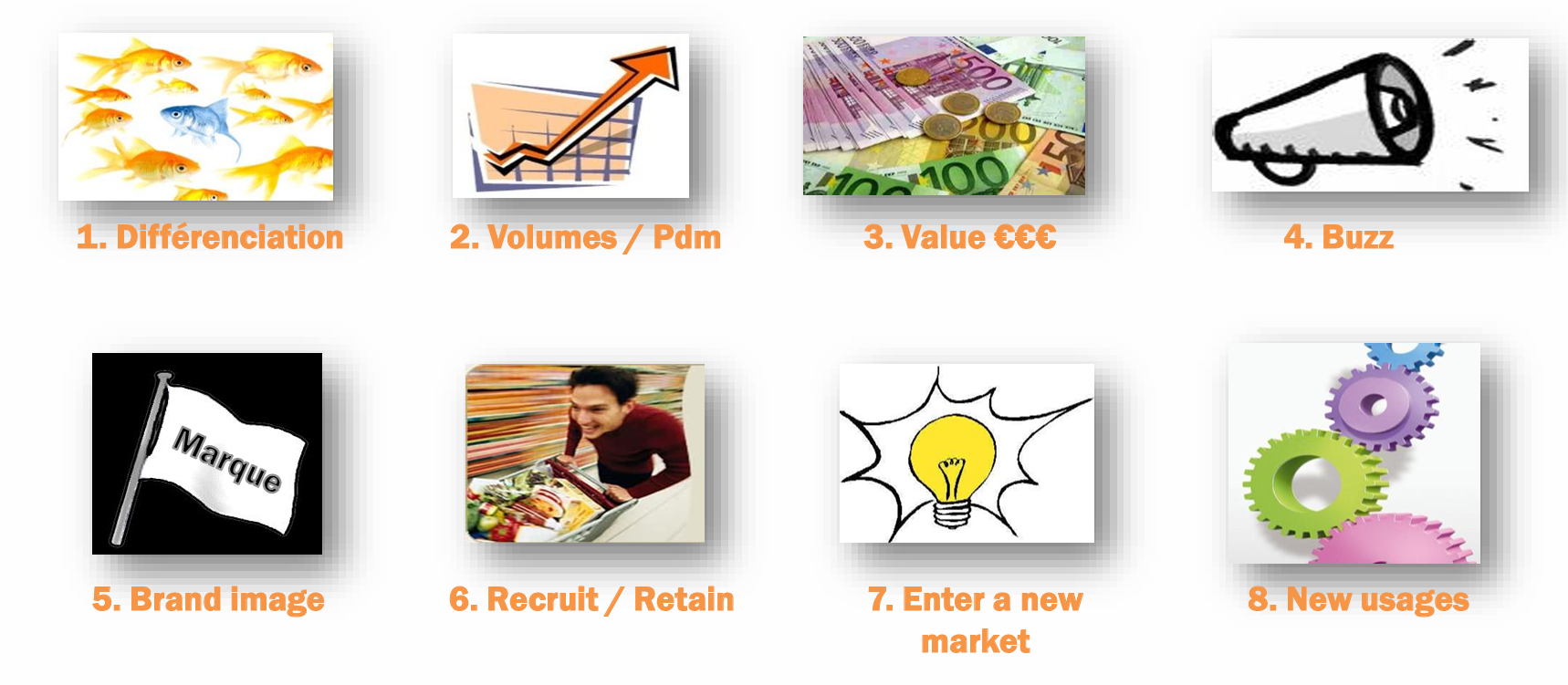
- Differentiation: positioning requires uniqueness; innovation often enables differentiation.
- Volume and value: innovation can target new needs, increase sales volume, and generate more money for the company.
- Buzz and brand equity: innovation can create buzz around the brand and strengthen brand equity and image (illustrated by Apple product launches).
- New segment targeting and loyalty: innovation can recruit new consumers or keep existing consumers loyal.
- New usage and new needs: innovation addresses emerging usage patterns and needs.
- The Innovation Dilemma: Vital but Risky
Innovation is vital to survive and to stay aligned with consumer needs, but it is risky. Failure rates are high in many sectors.
Figures previously covered are reiterated: roughly two products out of three disappear within three years, and high-tech innovation can fail at around 70%. The dilemma is clear: innovation is necessary, yet failure likelihood is significant.
The role of marketing leadership is to take decisions despite the risk; refusing to decide because innovation is risky may endanger the company and its product portfolio.
(*) What the title means: “Dilemma of Innovation”
The word dilemma signals a trade-off.
Innovation is necessary for survival, but it also creates significant risk.
Companies cannot avoid innovation, yet they cannot rely on it blindly either.
(*) Why innovation is described as vital
The first part explains why firms must innovate.
Innovation helps companies to:
- Resist competition
New products, services, or processes make it harder for competitors to copy or replace the firm. - Boost demand
Innovation creates novelty and renewed interest, encouraging consumers to buy. - Improve profitability
Innovative offerings often allow higher margins, cost reductions, or efficiency gains. - Differentiate
Innovation helps a firm stand out in crowded markets instead of competing only on price. - Sustain the business
Without innovation, products become outdated and firms gradually lose relevance.
Key idea:
Innovation is not optional; it is a condition for long-term survival.
(*) Why innovation is described as risky
The second part introduces the downside.
“2/3 of the new products in mass consumption disappear after 3 years.”
This means:
- Most new products fail commercially
- Failure can result from:
- Poor understanding of consumer needs
- Weak positioning
- Wrong pricing
- Inconsistent marketing mix
- Strong competitive reactions
Innovation requires heavy investment (R&D, marketing, production), but returns are uncertain.
Key idea:
Innovation has a high failure rate, especially in mass markets.
(*) The core message of the slide
The slide does not say:
- “Innovation is good” or
- “Innovation is dangerous”
It says:
Innovation is unavoidable, but it must be managed carefully.
Companies must:
- Innovate strategically, not randomly
- Balance creativity with market analysis
- Reduce risk through:
- Consumer insights
- Testing
- Clear positioning
- Coherent marketing execution
Example: The Umbrella Innovation
“Innovation must answer a need” means:
Innovation is valuable only if it solves a real consumer problem, not just because it uses new technology.

An innovation example is presented: an umbrella with a twofold value proposition.
- Connected feature: an app indicates when it will rain; if the umbrella is lost, it can be found because it is connected.
- Material/fabric feature: selected materials reflect light; when the sky is cloudy, this may affect mood; the umbrella reflects light on the skin to make the user feel better.
The price is around $300.
Discussion outcome: the idea is not considered bad and is viewed as new and potentially useful (including the “lose umbrella often” problem). The main issue is that the price is too high relative to the value proposition. It is therefore an innovation that was not successful because the value proposition does not meet a strong enough need at that price point.
The implication: innovation requires market research to avoid overestimating market size and to validate the existence and strength of a real need.
- Innovation as a Process
Innovation is described as a long process with several challenges:
- MM (Mass Market): Phân khúc thị trường đại chúng
- ISV (Independent Software Vendor): Nhà cung cấp phần mềm độc lập
- MME Leadership (Middle Manager Effectiveness): Chương trình/khung năng lực lãnh đạo cho quản lý cấp trung
- MME Reseller (Mobile Management Entity Reseller): Đơn vị phân phối dịch vụ/quản lý di động
- OpCo (Operating Company): Công ty vận hành
- Sources of Innovation (Input Stage)
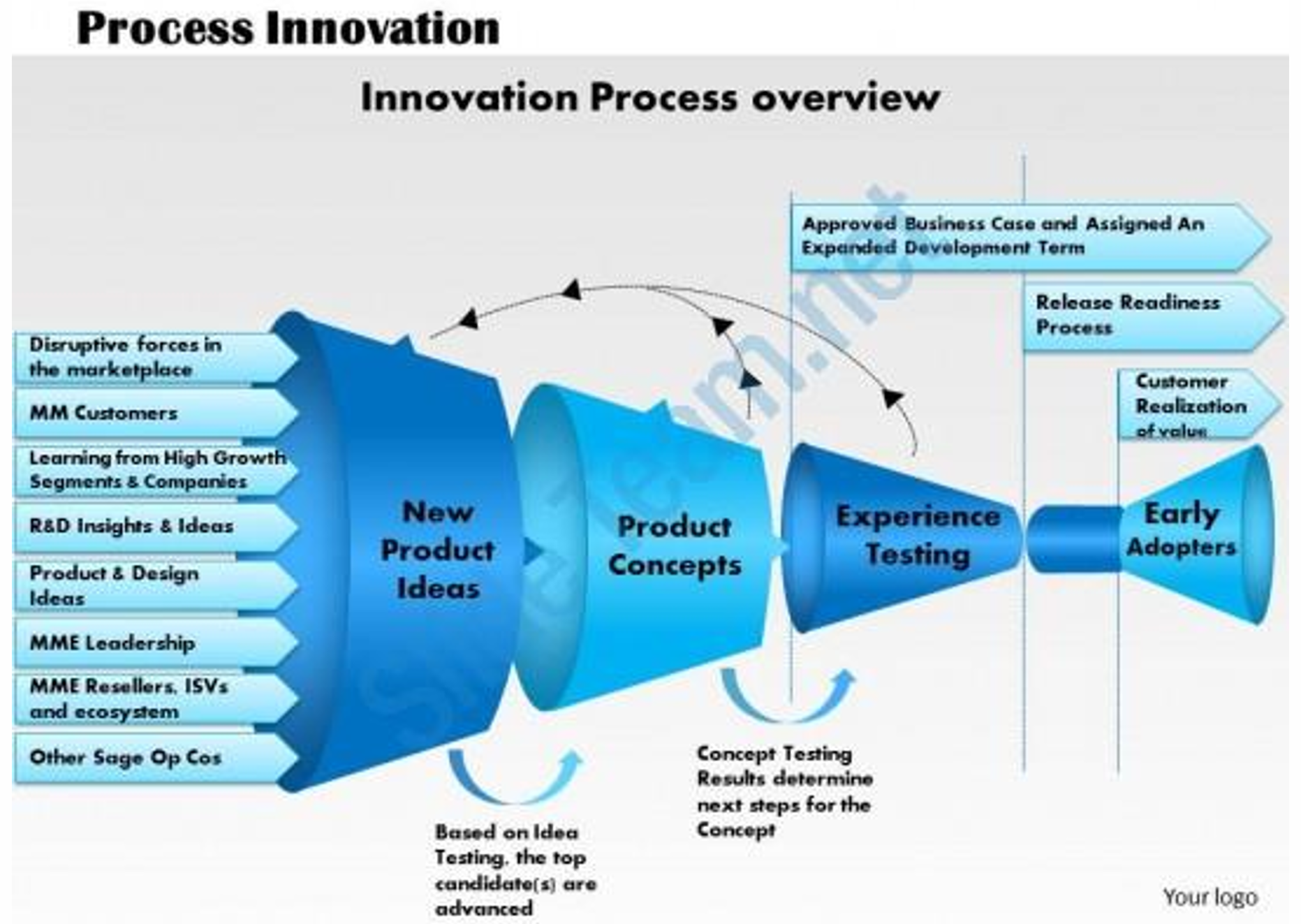
The process begins with many signals and ideas from the environment. These inputs reflect changes, problems, and opportunities in the market.
They include:
- Disruptive forces in the marketplace (new technology, regulation, competitors)
- Customer needs and complaints
- Insights from high-growth markets and successful companies
- R&D discoveries
- Product and design ideas
- Leadership vision
- Partners, resellers, and ecosystem players
Example:
Customers complain that same-day delivery is too slow in remote areas. At the same time, R&D is experimenting with drone technology. These two signals together create an opportunity.
At this stage, quantity matters more than quality. The goal is to collect as many ideas as possible.
- New product ideas
Ways to generate ideas include:
- Internal meetings and brainstorming with colleagues
- Benchmarking domestically and worldwide
- Consumer cooperation / co-creation
Co-creation is reinforced through previous examples (Shell and Lego): online platforms collect consumer ideas and fan input.
Most ideas are eliminated early because they are unrealistic, too costly, or misaligned.
Example:
Out of 100 ideas, only 15 seem technically possible and strategically relevant.
This filtering prevents the company from wasting resources later.
- Product Concepts (Concept Development)
Too many ideas exist; not all can be explored. A selection process is needed:
- Internal discussion and agreement among colleagues
- Consumer voting (as in Lego contests)
The objective is to reduce to 3–4 ideas for development.
Surviving ideas are refined into clear product concepts.
Summary:
A product concept explains:
- What the product is
- Who it is for
- What problem it solves
- Why it is better than existing solutions
At this stage, concept testing happens through surveys, interviews, prototypes, or simulations.
Example:
“Drone delivery for medical supplies in rural areas within 10 minutes.”
Concept testing results determine whether to:
- Continue
- Modify the concept
- Stop development
Only the strongest candidates move forward.
- Experience Testing
Selected concepts are tested and refined to choose one leading innovation for market launch. The process involves back-and-forth between steps.
Now the concept is tested in the real world, not just on paper.
This stage focuses on:
- User experience
- Reliability
- Operational feasibility
- Cost and risk
Companies run pilots, beta tests, or limited launches.
Example:
The company tests drone delivery in one rural region for three months to measure delivery time, safety, and customer satisfaction.
Feedback loops are critical here. Results may send the project back to earlier stages for adjustment.
- Market Launch and Adoption
(*) Approved Business Case & Development
If experience testing is successful, management approves a formal business case.
This includes:
- Investment approval
- Resource allocation
- Development team assignment
- Timeline and KPIs
The project moves from experimentation to full development.
Example:
Management approves a €5 million investment to scale drone delivery nationally.
(*) Release Readiness Process
Before launch, the company ensures the product is ready for the market.
This stage checks:
- Operational readiness
- Legal and regulatory compliance
- Supply chain readiness
- Customer support and training
- Marketing and communication plans
The goal is to avoid failure at launch.
(*) Early Adopters & Customer Value Realization
The product is first adopted by early adopters—customers who are open to innovation and tolerant of small imperfections.
Their usage:
- Validates real customer value
- Provides final learning before mass rollout
- Builds market credibility
Example:
Hospitals in remote areas adopt drone delivery first and report faster emergency response times.
Once customers clearly experience value, innovation becomes impact, not just an idea.
Part 2: Nike Case Exercise: Two Required Outputs
The Nike case is used to illustrate the innovation process and Nike’s extensive market research investment.
Two questions are assigned:
- Develop a flow diagram showing the steps covered to generate ideas, select concepts, and launch new products.
- Identify and explain the types of market research Nike implements to test product fit with consumer needs.
Time guidance: approximately 13–15 minutes. Group seven is confirmed as the leading group.
- Group Presentation Summary: Nike Innovation Process and Market Research
- Flow diagram (10-step logic presented)
- Athlete insights: talking directly with athletes to understand needs and performance challenges
- Biomechanical and physiological analysis
- Use of AI and digital simulation to interpret data and model product performance
- Co-creation with athletes and designers supported by AI tools
- Back-and-forth communication, consumer testing, refinement, and final product development leading to launch
- Nike market research methods (multi-method approach)
Nike combines qualitative and quantitative methods:
- Interviews and focus groups with athletes, coaches, sport journalists
- Long-term field testing and control group studies (example: Nike Free tested over six months)
- Advanced biomechanical analysis (high-speed cameras, motion sensors, pressure platforms) to optimize performance and injury prevention
- Limited test markets via selected specialty stores before full launch, to adjust product/positioning based on real consumer behavior
Conclusion: this combined approach supports three objectives:
- Validate product effectiveness through data
- Understand consumer perception deeply
- Refine products before broader market release
- Product Reviews and Social Listening: Importance and Limitations
A key input for innovation and product management is not only primary research but also product reviews, enabled by digital platforms.
Product management includes monitoring reviews, feedback, and satisfaction. Reviews influence purchasing decisions; 83% of people report being influenced by reviews, especially for high-involvement products. Reviews also impact future purchases and brand equity/reputation.
Social listening tools are referenced (e.g., Sprout Social, Hootsuite; Vietnamese-market tools also exist). A real example is provided from a travel company post-COVID to assess whether negative sentiment about refunds remained strong enough to affect marketing relaunch decisions.
Main limitation discussed: social listening tends to track those active on social media, and may not capture offline sentiment. Another limitation raised: tools may not cover all specific websites/blogs; therefore, manual or custom scraping may be required for niche sources. AI tools can support this.
Khúc này bỏ nhé vì nói toàn tool chắc cũng ko thi, mình coi video để biết cách get data cho biết thôi
1, Automated Scraping With Octoparse: Trustpilot Tesla Example
Octoparse is introduced as an AI tool for automated scraping. A free account can scrape limited pages (example: first 10 pages) due to security/anti-bot constraints; paid versions can better handle protected sites.
The platform Trustpilot is used for illustration. Trustpilot collects consumer comments and ratings; note a negativity bias because people often post when dissatisfied, but it remains valuable for analyzing reasons for dissatisfaction or satisfaction.
Task: scrape Tesla reviews from Trustpilot.
Workflow steps described
- Create a new task
- Copy/paste the Trustpilot Tesla URL into the URL input box
- Accept cookies to remove popup
- Use auto-detection to identify review elements
- Octoparse creates a table with columns such as country, reviewer name, number of reviews, title, comments, date
- Rename unclear column headers (e.g., CDS → country; SDS → comments; ST → date of review)
- Run the task (standard mode)
- Export results (Excel/CSV), remove duplicates
- Output may be limited (example: 10 pages / about 200 comments due to security restrictions)
A slide mismatch issue is identified (slides not visible on Canva for some students). The professor commits to rechecking and updating Canva and shares slides in chat.
2, Transition to Text Analysis and Sentiment Analysis With Orange Data Mining
The objective shifts to processing scraped text using natural language processing.
Sentiment analysis is defined as classifying text into positive/negative/neutral sentiment; it is also used by social listening tools.
Orange Data Mining is introduced as a widget-based tool:
- Each widget performs one action
- Widgets are connected to form workflows
2.1, Load and preview the dataset
- Drag “File” widget onto canvas
- Select the exported Excel file
- Connect to “Data Table” widget to visualize
2.2, Create a corpus from the comments column
- Use the “Corpus” widget to select the text column (comments, not title)
- Connect to “Corpus Viewer” to inspect comments and filter (e.g., by keywords like “experience”)
2.3, Word cloud
Word clouds show word frequency. Initial word clouds may include noise (numbers, punctuation). Text must be cleaned first.
2.4, Text preprocessing (cleaning)
Preprocessing steps include:
- Remove special characters and punctuation
- Lowercase normalization
- Tokenization (split text into words)
- Remove stop words (“to”, “the”, “but”, etc.)
- Remove numbers
- Remove accents
After preprocessing, the word cloud becomes cleaner and more interpretable.
An interpretation example for Tesla: frequent words indicate discussion around “car” and issues around “service”, “experience”, and “delivery”, suggesting problems may be surrounding the product (service/experience) rather than only the product itself.
3, Sentiment Analysis With VADER and Why It’s Used
Sentiment analysis requires dictionaries that map words to sentiment. VADER is used for English.
Workflow:
- Connect corpus to “Sentiment Analysis”
- Select VADER
- Connect to “Data Table” to view outputs
New columns appear:
- Positive
- Negative
- Neutral
- Compound (combined score)
Why it matters:
- Identify pain points for product improvement and innovation
- Community management: prioritize responding to the most negative comments to prevent escalation/crisis
- Real-time triage: respond quickly to high-risk negative content to reduce reputational damage
4, Emotion Classification With SentiArt and Why Anger Matters
Beyond sentiment polarity, emotion classification is introduced (fear, disgust, happiness, anger, etc.) using the SentiArt dictionary.
Why emotion differentiation matters:
- Different emotions drive different behaviors
- Anger is highlighted as especially important because it increases likelihood of high-impact negative behaviors such as complaints and boycott calls, and can be more “action-driving” than other negative emotions
- Practical usage includes customer service scripting and prioritization based on emotional intensity
Implementation:
- In sentiment analysis, switch dictionary from VADER to SentiArt
- Data table then includes emotion-related columns per comment
5, Heat Map Visualization and Filtering Negative Comments
A heat map visualizes sentiment scores at a glance. Interpretation relies on the color scale (blue negative, yellow positive in the example).
Interpretation example:
- The heat map suggests two clusters: highly negative and highly positive comments, indicating polarization and a need to investigate root causes for the negative cluster.
Filtering:
- Select negative cluster in the heat map
- Connect heat map output to corpus viewer
- Review only negative comments to identify themes (example: “terrible communication”, “dreadful company”, reputation concerns, Musk association, service issues)
Saving results:
- Connect data table to “Save Data” to export a new Excel file containing sentiment/emotion columns.
6, Assigned Group Exercise: Withings (Trustpilot) Analysis
A second scraping task is assigned:
- Scrape Trustpilot reviews for the brand Withings (health-oriented tech company producing watches and health tracking products)
- Save the dataset
- Use Orange Data Mining to analyze Withings reviews using:
- Word cloud
- Sentiment analysis
- Heat map
- Produce recommendations: what is good, what is bad, and what should be improved based on the outputs
Group work: split into groups again; group nine is assigned to lead the case discussion. Time guidance: around 30 minutes.