Chuong 4-Qdinh















Preview text:
P A R T 3 CH 9 Managerial Decision Making
E Types of Decisions and Problems
S After studying this chapter, you should be able to: E Programmed and Nonprogrammed
1. Compare and contrast programmed and nonprogrammed IN Decisions IV
decisions, including how they relate to the presence of
TL Facing Uncertainty and Ambiguity T
certainty, uncertainty, and ambiguity. U C Decision-Making Models
2. Compare the ideal, rational model of decision making to the JE O
political model of decision making. The Ideal, Rational Model B How Managers Make Decisions
3. Summarize the six steps used in managerial decision making. O TER The Political Model
4. Describe four personal decision styles used by managers. P Decision-Making Steps A
5. Identify the biases that frequently cause managers to make
Recognition of Decision Requirement H NING bad decisions.
C Diagnosis and Analysis of Causes
R 6. Explain innovative techniques for decision making, including Development of Alternatives A
brainstorming, evidence-based management, and after-action
Selection of the Desired Alternative E L reviews.
Implementation of the Chosen Alternative Evaluation and Feedback Personal Decision Framework Why Do Managers Make Bad Decisions? Innovative Decision Making Start with Brainstorming Use Hard Evidence Engage in Rigorous Debate Avoid Groupthink Know When to Bail Do a Premortem and Postmortem
Copyright 2022 Cengage Learning. All Rights Reserved. May not be copied, scanned, or duplicated, in whole or in part. Due to electronic rights, some third party content may be suppressed from the eBook and/or eChapter(s).
Editorial review has deemed that any suppressed content does not materially affect the overall learning experience. Cengage Learning reserves the right to remove additional content at any time if subsequent rights restrictions require it. 1 How Do You Make Decisions?
INSTRUCTIONS: Most of us make decisions automatically, without realizing that people have diverse decision-making INTRODUCTION
behaviors, which they bring to management positions.1 Think back to how you make decisions in your
personal, student, or work life, especially where other people are involved. Identify whether each of 2
the following items is Mostly True or Mostly False for you. Mostly True Mostly False
1. I like to decide quickly and move on to the next thing. __________ __________
2. I would use my authority to make a decision if I’m certain I am right. __________ __________ 3. I appreciate decisiveness. __________ __________ ENVIRONMENT
4. There is usually one correct solution to a problem. __________ __________
5. I identify everyone who needs to be involved in the decision. __________ __________ 3
6. I explicitly seek conflicting perspectives. __________ __________
7. I use discussion strategies to reach a solution. __________ __________
8. I look for different meanings when faced with a great deal of data. __________ __________
9. I take time to reason things through and use systematic logic. __________ __________ PLANNING
SCORING AND INTERPRETATION: All nine items in the list reflect appropriate decision-making behavior, but
items 1–4 are more typical of new managers. Items 5–8 are typical of successful senior-manager deci-
sion making. Item 9 is considered part of good decision making at all levels. If you checked “Mostly 4
True” for three or four of items 1–4 and 9, consider yourself typical of a new manager. If you checked
“Mostly True” for three or four of items 5–8 and 9, you are using behavior consistent with top man-
agers. If you checked a similar number of both sets of items, your behavior is probably flexible and balanced.
New managers typically use a different decision behavior than seasoned executives. The decision
behavior of a successful CEO may be almost the opposite that of a first-level supervisor. The differ- ng
ence is due partly to the types of decisions faced at each level and partly to learning what works at ORGANIZING
each level. New managers often start out with a more directive, decisive, command-oriented behavior
to establish their standing and decisiveness and gradually move toward more openness, diversity of rganizi O
viewpoints, and interactions with others as they move up the hierarchy. 5
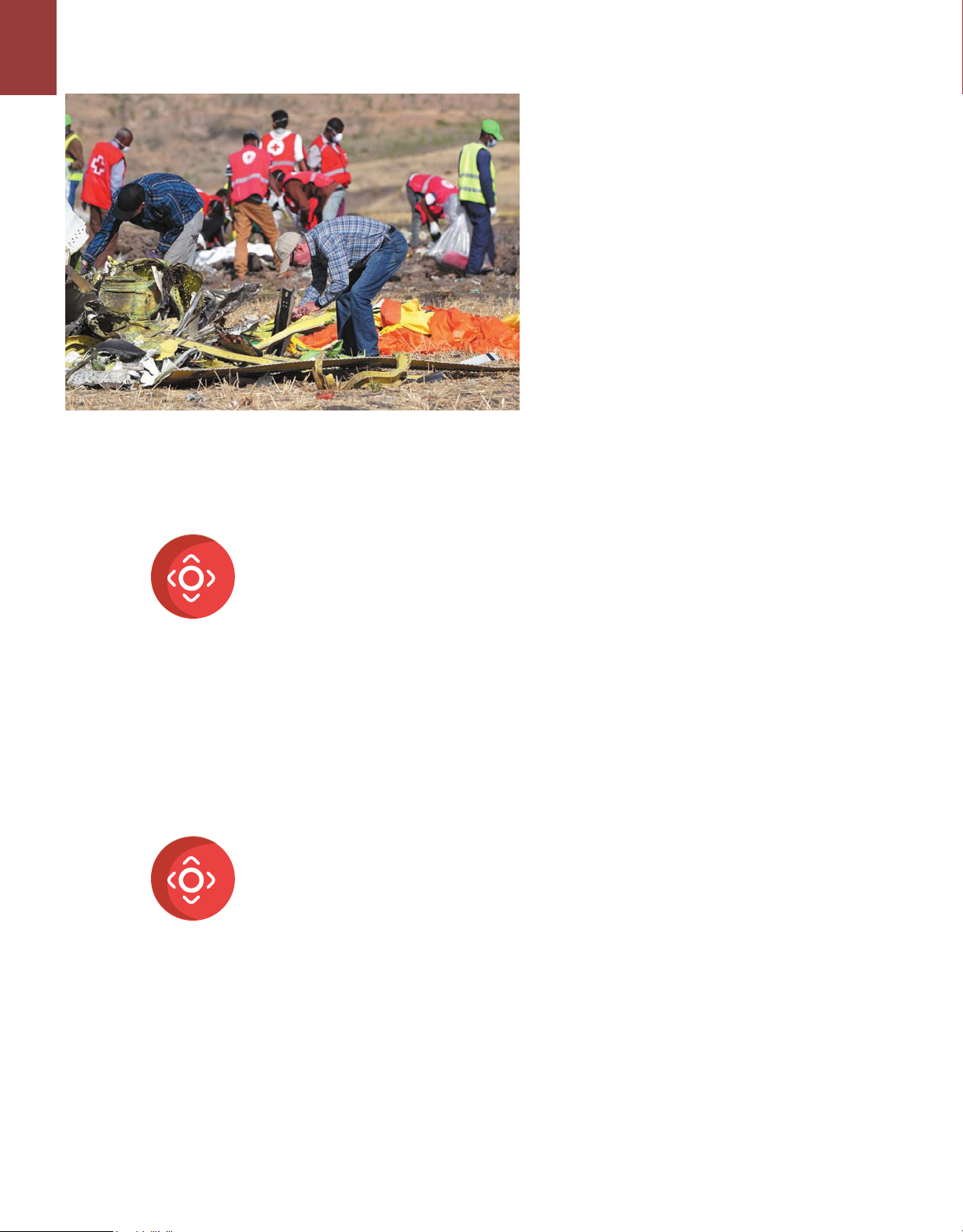
At the start of 2019, Boeing had won more orders for the 737 MAX jetliner than
for any model in the company’s history. Less than three months later, the plane LEADING
was grounded and Boeing was in the middle of a crisis, trying to explain two fatal
crashes that caused 350 deaths. Federal prosecutors, securities regulators, aviation authori-
ties, and U.S. lawmakers have been looking into the managerial decision making that went
into development of the 737 MAX.
Feeling intense competitive pressure owing to the popularity of the emerging fuel- 6
efficient A320neo jets from European rival Airbus, managers and executives at Boeing SNAPSHOT
made a number of fateful decisions, including the following:
• Modify the current 737 model into the competitive fuel-efficient 737 MAX design,
which would be cheaper and faster than building an entirely new aircraft, partly
because the FAA’s approval process is shorter for a modified design. CONTROLLING
Copyright 2022 Cengage Learning. All Rights Reserved. May not be copied, scanned, or duplicated, in whole or in part. Due to electronic rights, some third party content may be suppressed from the eBook and/or eChapter(s).
Editorial review has deemed that any suppressed content does not materially affect the overall learning experience. Cengage Learning reserves the right to remove additional content at any time if subsequent rights restrictions require it. 286 PART 3 PLANNING
• Avoid adding components or systems that
would unnecessarily increase Boeing’s costs
or require additional simulator training for
pilots from airline purchasers worldwide.
• Add MCAS (Maneuvering Characteristic
Augmentation System) to address prob-
lems caused by the larger fuel-efficient
engines being moved forward under the ty Images wings. ws/Get
• Not tell airlines or cockpit crews about
MCAS because pilots of earlier 737 mod- ty Images Ne
els would be able to counteract any MCAS
problems by implementing long-standing ess/Get procedures. ount
Boeing managers would never knowingly Jemal C
sacrifice safety for profits, but the outcome of
these and a multitude of other decisions, as reported in the media, appeared to result in
the crash of Lion Air Flight 610 in Indonesia and, a few months later, the crash of Ethio-
pia Airlines Flight 320. Both crashes killed all aboard. The 737 MAX was grounded worldwide.2
Welcome to the world of managerial decision making. Every organization—whether it
is Boeing, Twitter, the American Red Cross, JPMorgan Chase, or the city of Newark, New
Jersey—grows, prospers, or fails as a result of decisions made by its managers. In Newark, SNAPSHOT
a string of questionable decisions by Mayor Ras Baraka and other city leaders created
a major environmental crisis for the city. After receiving test results showing alarming
levels of lead in the city’s drinking water, city officials initially brushed aside the warn-
ings and allowed the system to continue to deteriorate. At JPMorgan Chase, a decision
to attract younger customers with a new digital-banking app called Finn proved to be
a disappointment and the company closed down Finn to concentrate on strengthening
the extant Chase mobile app.3 Decision making, particularly in relation to complex prob-
lems, is not always easy. It is easy to look back and identify flawed decisions, but managers
frequently make decisions amid ever-changing factors, unclear information, and conflicting
points of view. Managers can sometimes make the wrong decision, even when their inten- tions are right.
The business world is full of evidence of both good and bad decisions. YouTube was
once referred to as “Google’s Folly,” but decisions made by the video platform’s managers
have more than justified the $1.65 billion that Google paid for it and turned YouTube
into a highly admired company that is redefining the entertainment industry.4 In contrast, SNAPSHOT
Caterpillar’s decision to purchase China’s ERA Mining Machinery Ltd. didn’t work out
so well. After paying $700 million for the company, Caterpillar managers said less than
a year later that they would write down ERA’s value by $580 million. The company
blamed deliberate accounting misconduct that was designed to overstate profits at the
firm’s mine-safety equipment unit.5
Good decision making is a vital part of good management because decisions deter-
mine how the organization solves problems, allocates resources, and accomplishes its
goals. This chapter describes decision making in detail. We will look at several decision-
making models and the steps managers should take when making important deci-
sions. The chapter also explores some biases that can cause managers to make bad
decisions and examines some specific techniques for innovative decision making in a fast-changing environment.
Copyright 2022 Cengage Learning. All Rights Reserved. May not be copied, scanned, or duplicated, in whole or in part. Due to electronic rights, some third party content may be suppressed from the eBook and/or eChapter(s).
Editorial review has deemed that any suppressed content does not materially affect the overall learning experience. Cengage Learning reserves the right to remove additional content at any time if subsequent rights restrictions require it.
CHAPTER 9 MANAGERIAL DECISIoN MAKING 287
9-1 Types of Decisions and Problems
A decision is a choice made from available alternatives. For example, an accounting man-
ager’s selection among Colin, Tasha, and Carlos for the position of junior auditor is a deci-
sion. Many people assume that making a choice is the major part of decision making, but it is only a part of it.
Decision making is the process of identifying problems and opportunities and then resolv-
ing them. Decision making involves effort both before and after the actual choice. Thus, the
decision of whether to select Colin, Tasha, or Carlos requires the accounting manager to ascer-
tain whether a new junior auditor is needed, determine the availability of potential job candi-
dates, interview candidates to acquire necessary information, select one candidate, and fol ow up
with the socialization of the new employee into the organization to ensure the decision’s success. Concept Connection
Daily meetings among restaurant managers 3
and staff took on new urgency in 2020 as they
worked to keep customers and employees safe k.com
from COVID-19. Business owners around the oc st
world faced nonprogrammed decisions ter
regarding when and how to reopen their busi- ey/Shut
nesses in the midst of the pandemic. PLANNING o Andr enk Nor
9-1A PROGRAMMED AND NONPROGRAMMED DECISIONS
Management decisions typically fall into one of two categories: programmed and nonpro-
grammed. Programmed decisions involve situations that have occurred often enough to
enable decision rules to be developed and applied in the future.6 Such decisions are made in
response to recurring organizational problems. For example, the decision to reorder paper
and other office supplies when inventories drop to a certain level is a programmed deci-
sion. Other programmed decisions concern the types of skills required to fill certain jobs,
the reorder point for manufacturing inventory, and selection of freight routes for product
deliveries. Once managers formulate decision rules, subordinates and others can make the
decision, thus freeing managers for other tasks. For example, when staffing banquets, many
hotels use a rule that specifies having one server per 30 guests for a sit-down function and
one server per 40 guests for a buffet.7 Today some programmed decisions are handled by
artificial intelligence (AI). For example, Royal Dutch Shell has begun using AI algorithms
in some areas of its business to assign employees with the right skills and expertise to
work on various projects. An algorithm can schedule work more efficiently, freeing up
managers’ time for more complex, nonprogrammed decisions.8
Nonprogrammed decisions are made in response to situations that are unique, are
poorly defined and largely unstructured, and have important consequences for the organiza-
tion. Boeing managers faced numerous nonprogrammed decisions related to the 737 MAX,
described in the chapter’s opening example. Another good example of a nonprogrammed SNAPSHOT
decision comes from Boeing’s rival, Airbus. Airbus executives decided to build a giant
double-decker plane, the Airbus A380, to challenge the dominance of the Boeing 747
Copyright 2022 Cengage Learning. All Rights Reserved. May not be copied, scanned, or duplicated, in whole or in part. Due to electronic rights, some third party content may be suppressed from the eBook and/or eChapter(s).
Editorial review has deemed that any suppressed content does not materially affect the overall learning experience. Cengage Learning reserves the right to remove additional content at any time if subsequent rights restrictions require it. 288 PART 3 PLANNING
as the world’s largest airliner. At the time, a representative said the A380 would “be the
cement of the company for years to come.” But the A380 decision was based on managers’
assumptions that airlines would continue using large hub airports to transfer passengers
between connecting flights and want to fly large four-engine jets on long routes. The
environment changed. Technology advancements enabled Boeing to develop a smaller,
highly efficient twin-engine model, the 787 Dreamliner, which could fly long distances
and bypass giant airports altogether. Airline executives, focused on increasing profits,
wanted these kinds of smaller jets, which were easier to fill with passengers and cheaper
to fly. Airbus eventually developed its own smaller two-engine model. After investing
$17 billion in the A380 project, Airbus got orders for only 251 of the super-jumbo jets
and announced that it would shut down production of the plane at the end of 2021.9
Managers in every industry face nonprogrammed decisions every day. Many nonpro-
grammed decisions, such as the one at Airbus, are related to strategic planning because
uncertainty is great and decisions are complex. Decisions to develop a new product or ser-
vice, acquire a company, create a new division, build a new factory, enter a new geographic
market, or relocate headquarters to another city are all nonprogrammed decisions.
Creating a Greener World
Business Decision, Social Benefits PepsiCo
executives discovered for themselves that sustainability
decisions can be measured in the lives of individuals.
Management’s decision to launch a pilot project cut-
ting the middleman from the supply chain for Sabritas,
its Mexican line of snacks, by initiating direct purchase
of corn from 300 small farmers in Mexico brought unimagined benefits.
The decision resulted in visible, measurable out-
comes, including lower transportation costs and a ty Images
stronger relationship with small farmers, who were
able to develop pride and a businesslike approach to g/Get
farming. The arrangement with PepsiCo gave farmers
a financial edge in securing much-needed credit for Bloomber
purchasing equipment, fertilizer, and other necessities,
which resulted in higher crop yields. New levels of financial security also reduced the once-rampant and highly danger-
ous treks back and forth across the U.S. border that farmers made at great personal risk to support their families. Within
three years, PepsiCo’s pilot program was expanded to 850 farmers.
Sources: Stephanie Strom, “For Pepsi, a Business Decision with Social Benefit,” The New York Times (February 21, 2011), www.nytimes.com/
2011/02/22/business/global/22pepsi.html (accessed May 1, 2020); and Dean Best, “PepsiCo outlines Five-Year Plan for Mexico,” Just-Food
(January 24, 2014), www.just-food.com/news/pepsico-outlines-five-year-plan-for-mexico_id125662.aspx (accessed May 1, 2020).
9-1B FACING UNCERTAINTY AND AMBIGUITY
One primary difference between programmed and nonprogrammed decisions relates to the
degree of uncertainty, risk, or ambiguity that managers deal with in making the decision. In
a perfect world, managers would have all the information necessary for making decisions.
In reality, some things are unknowable; thus, some decisions will fail to solve the problem or
attain the desired outcome. Managers try to obtain information about decision alternatives
Copyright 2022 Cengage Learning. All Rights Reserved. May not be copied, scanned, or duplicated, in whole or in part. Due to electronic rights, some third party content may be suppressed from the eBook and/or eChapter(s).
Editorial review has deemed that any suppressed content does not materially affect the overall learning experience. Cengage Learning reserves the right to remove additional content at any time if subsequent rights restrictions require it.
CHAPTER 9 MANAGERIAL DECISIoN MAKING 289
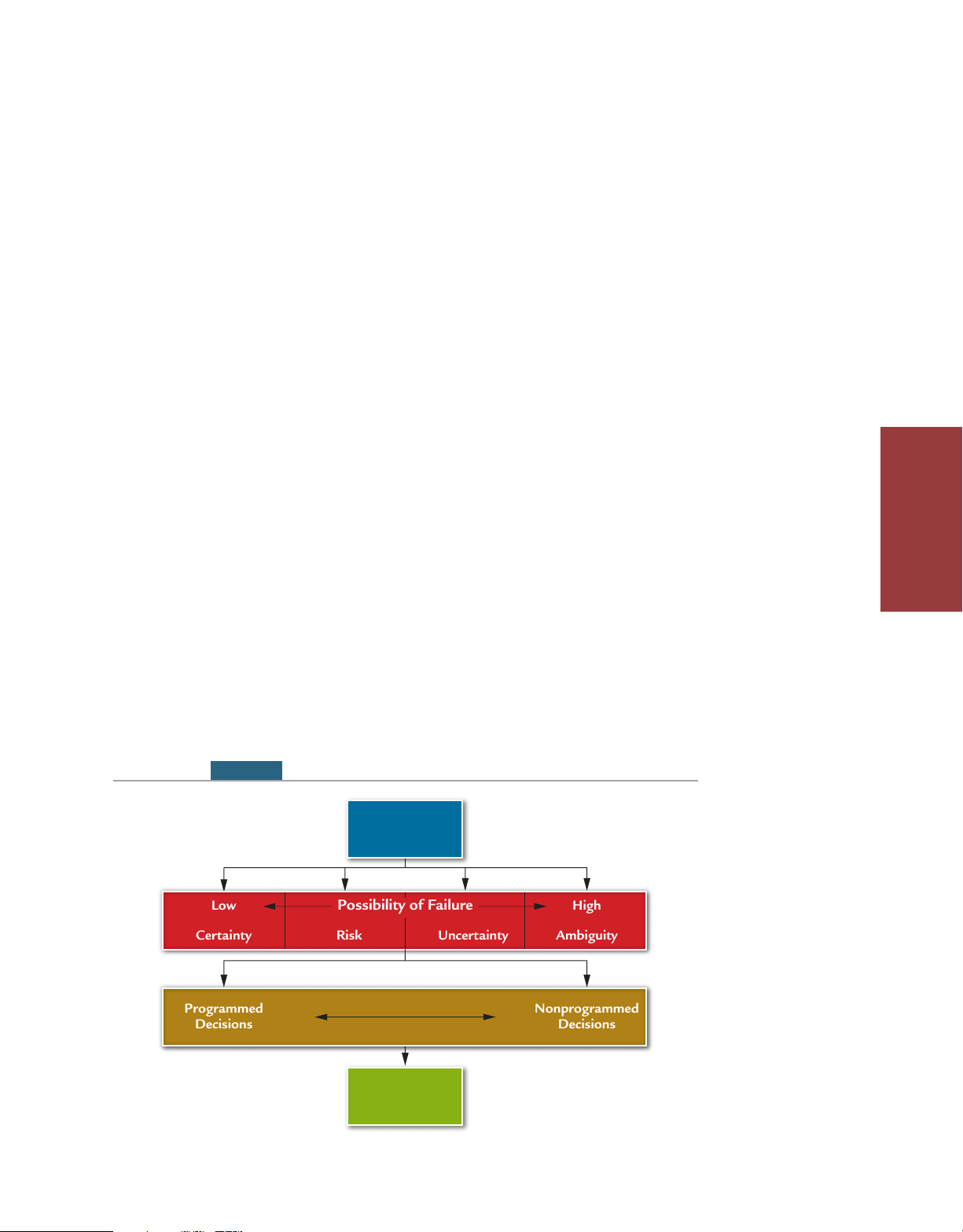
that will reduce decision uncertainty. Every decision situation can be organized on a scale
according to the availability of information and the possibility of failure. The four positions
on the scale are certainty, risk, uncertainty, and ambiguity, as illustrated in Exhibit 9.1.
Whereas programmed decisions can be made in situations involving certainty, many situ-
ations that managers deal with every day involve at least some degree of uncertainty and
require nonprogrammed decision making. Certainty
Certainty means that all the information the decision maker needs is fully available.10 When
certainty is present, managers have information on operating conditions, resource costs,
and constraints and each course of action and possible outcome. For example, if a company
considers a $10,000 investment in new equipment that it knows for certain will yield $4,000
in cost savings per year over the next five years, managers can calculate a before-tax rate of
return of about 40 percent. If managers compare this investment with one that will yield
only $3,000 per year in cost savings, they can confidently select the 40 percent return. Of
course, few decisions are certain in the real world; instead, most contain risk or uncertainty. Risk 3
Risk means that a decision has clear-cut goals and that good information is available, but the
future outcomes associated with each alternative are subject to some chance of loss or failure.
However, when enough information is available, managers can estimate the probability of
a successful outcome versus failure.11 For example, when managers at McDonald’s, Burger
King, or KFC face a decision about opening a new restaurant in the United States, they can PLANNING
analyze local demographics, traffic patterns, prices and availability of real estate, and competi-
tors’ locations in the area. Combining these data with restaurant revenue and cost models,
managers can calculate the risk and make a reasonably good choice for a new location.12
Steve Krupp, a senior managing partner at Decision Strategies International, a consult-
ing firm that helps managers and employees feel more comfortable taking balanced risks,
says, “You can’t just avoid all risk, because it will lead to entropy.”13 For specific decisions,
managers sometimes use computerized statistical analysis to calculate the probabilities of
success or failure for each alternative.14
E X H I B I T 9.1 Conditions That Affect the Possibility of Decision Failure Organizational Problem Low Possibility of Failure High Certainty Risk Uncertainty Ambiguity Programmed Nonprogrammed Decisions Decisions Problem Solution
Copyright 2022 Cengage Learning. All Rights Reserved. May not be copied, scanned, or duplicated, in whole or in part. Due to electronic rights, some third party content may be suppressed from the eBook and/or eChapter(s).
Editorial review has deemed that any suppressed content does not materially affect the overall learning experience. Cengage Learning reserves the right to remove additional content at any time if subsequent rights restrictions require it. 290 PART 3 PLANNING Uncertainty
Uncertainty means that managers know which goals they wish to achieve, but informa-
tion about alternatives and future events is incomplete. Factors that may affect a decision,
such as price, production costs, volume, or future interest rates, are difficult to analyze
and predict. Managers may have to make assumptions from which to forge the decision,
even though it will be wrong if the assumptions are incorrect. As an example, managers SNAPSHOT
at Airstream decided in late 2018 to build a new recreational vehicle factory despite
uncertainty regarding the possibility of increased tariffs and slowing sales. Bob Martin,
CEO of Airstream’s parent company Thor Industries, said the executive’s job is to engage
in longer-term thinking in a business that is always facing uncertainty.15
Former U.S. treasury secretary Robert Rubin defined uncertainty as a situation in which
even a good decision might produce a bad outcome.16 Consider the decisions of U.S. gover-
nors concerning rescinding stay-at-home orders and reopening businesses in their states
during the COVID-19 pandemic in 2020. These leaders faced a tremendous amount
of uncertainty, and no matter how much analysis and thought went into the decision to
reopen or not to reopen, the bad outcome of a COVID-19 rebound was still possible.
Managers face uncertainty every day. Many problems have no clear-cut solution, but manag-
ers rely on creativity, judgment, intuition, and experience to craft a response.
The movie industry provides an illustration. Disney’s Oz the Great and Powerful cost
about $325 million to make and market, but the gamble in putting out a prequel to the SNAPSHOT
beloved 1939 musical The Wizard of Oz paid off, bringing in $150 million in revenues
on its opening weekend and eventually grossing $495 million. Even though Disney man-
agers did a cost–benefit analysis, they faced great uncertainty regarding how viewers
would feel about a new twist on such well-known material.17 Many films made today
don’t even break even, which reflects the tremendous uncertainty in the industry. What do
people want to see this summer? Will comic book heroes, vampires, or aliens be popular?
Will animated films, disaster epics, classics, or romantic comedies attract larger audiences?
The interests and preferences of moviegoers are extremely difficult to predict. Moreover, it
is hard for managers to understand even after the fact what made a particular movie a hit:
Was it because of the storyline, the actors in starring roles, the director, the release date? All
of those things? Or none of them? Despite the uncertainty, managers in the big Hollywood
studios make relatively good decisions overall, and one big hit can pay for a lot of flops.18 Concept Connection
Uncertainty is a standard feature in the life of
any farmer. Changing weather patterns and unexpected o
events, like droughts, floods, or unseasonable storms,
can have devastating effects on crops that no amount of k Phot oc
planning can prevent. Yet, despite these unforeseeable y St
situations, farmers must make decisions and continue to ial/Alam
operate based on assumptions and expectations. . Tor E.D Ambiguity and Conflict
Ambiguity is by far the most difficult decision situation. Ambiguity means that the
goals to be achieved or the problem to be solved is unclear, alternatives are difficult to
define, and information about outcomes is unavailable.19 Ambiguity is what students
would feel if an instructor created student groups and told each group to complete
a project but gave the groups no topic, direction, or guidelines whatsoever. In some
situations, managers involved in a decision create ambiguity because they see things
Copyright 2022 Cengage Learning. All Rights Reserved. May not be copied, scanned, or duplicated, in whole or in part. Due to electronic rights, some third party content may be suppressed from the eBook and/or eChapter(s).
Editorial review has deemed that any suppressed content does not materially affect the overall learning experience. Cengage Learning reserves the right to remove additional content at any time if subsequent rights restrictions require it.
CHAPTER 9 MANAGERIAL DECISIoN MAKING 291
differently and disagree about what they want. Managers in different departments
often have different priorities and goals for the decision, which can lead to conflicts “One thing a person over decision alternatives.
Managers in almost any organization will occasionally encounter ambiguity. cannot do, no matter
As part of their role, managers have to both address current customer needs and how rigorous his
environmental conditions and take risks to pursue innovative products, services,
and technologies that will please customers in the future. In global firms, managers analysis or heroic
must consider whether a global approach or a local approach is more appropriate
for their organization, as described in Chapter 8. In some companies, managers face his imagination, is
conflicts between social or environmental missions and financial pressures.20 All of to draw up a list of
these dilemmas, and more, create ambiguity for managers facing difficult decisions.
A highly ambiguous situation can create what is sometimes called a wicked deci- things that would
sion problem. In such a case, simply defining the problem can turn into a major task. never occur to him.”
A recent situation at Twitter concerning how to make the social media service safer
for users provides an illustration. Twitter has clear rules forbidding direct threats —Thomas schelling, ECONOMIST AND NOBEL LAUREATE
of violence and some forms of hate speech, but there are no rules prohibiting
deception or misinformation. As CEO Jack Dorsey and a team of colleagues
gathered to discuss how to get rid of “dehumanizing speech” even if it doesn’t
violate Twitter’s rules, one team member said during his comments, “Please bear with 3
me. This is incredibly complex.” The policy meeting went on for more than an hour, with SNAPSHOT
participants struggling to simply come up with a definition of what constitutes “dehu-
manizing speech.” Karen Kornbluh, a senior fellow of digital policy at the Council of
Foreign Relations, captured Twitter’s wicked decision problem when she said, “There is
no due process, no transparency, no case law, and no expertise on these very complicated PLANNING
legal and social questions behind these decisions.”21
Twitter’s struggle over what to ban from its site illustrates a wicked problem. Wicked
decisions are associated with conflicts over goals and decision alternatives, rapidly changing
circumstances, fuzzy information, unclear links among decision elements, and the inability
to evaluate whether a proposed solution will work. For wicked problems, there often is no
“right” answer.22 Managers have a difficult time coming to grips with the issues and must
conjure up reasonable scenarios in the absence of clear information. Remember This
• Good decision making is a vital part of good
• Certainty is a situation in which all the information the
management, but decision making is not easy.
decision maker needs is fully available.
• Decision making is the process of identifying problems
• Risk means that a decision has clear-cut goals and
and opportunities and then resolving them.
good information is available, but the future outcomes
• A decision is a choice made from available
associated with each alternative are subject to chance. alternatives.
• Uncertainty occurs when managers know which goals
• A programmed decision is one made in response to
they want to achieve, but information about alternatives
a situation that has occurred often enough to enable
and future events is incomplete.
managers to develop decision rules that can be applied
• U.S. governors faced tremendous uncertainty in in the future.
decisions concerning stay-at-home orders and business
• A nonprogrammed decision is one made in response
shut-downs during the COVID-19 pandemic.
to a situation that is unique, is poorly defined and
• Ambiguity is a condition in which the goals to be
largely unstructured, and has important consequences
achieved or the problem to be solved is unclear, for the organization.
alternatives are difficult to define, and information
• An example of a nonprogrammed decision was the about outcomes is unavailable.
decision to build the Airbus A380.
• Highly ambiguous circumstances can create a wicked
• Decisions differ according to the amount of certainty,
decision problem, the most difficult decision situation
risk, uncertainty, or ambiguity in the situation. that managers face.
Copyright 2022 Cengage Learning. All Rights Reserved. May not be copied, scanned, or duplicated, in whole or in part. Due to electronic rights, some third party content may be suppressed from the eBook and/or eChapter(s).
Editorial review has deemed that any suppressed content does not materially affect the overall learning experience. Cengage Learning reserves the right to remove additional content at any time if subsequent rights restrictions require it. 292 PART 3 PLANNING 9-2 Decision-Making Models
The approach that managers use to make decisions usually follows one of three models:
the classical model, the administrative model, or the political model. The choice of model
depends on the manager’s personal preference, whether the decision is programmed or
nonprogrammed, and the degree of uncertainty associated with the decision.
9-2A THE IDEAL, RATIONAL MODEL
The classical model of decision making is based on rational economic assumptions and
managers’ beliefs about what ideal decision making should be. The management literature
often advocates use of this model because managers are expected to make decisions that are
economically sensible and in the organization’s best economic interests. Four assumptions underlie this model:
• The decision maker operates to accomplish goals that are known and agreed on. Prob-
lems are precisely formulated and defined.
• The decision maker strives for conditions of certainty and tries to gather complete
information. All alternatives and the potential results of each are calculated.
• Criteria for evaluating alternatives are known. The decision maker selects the alternative
that will maximize the economic return to the organization.
• The decision maker is rational and uses logic to assign values, order preferences, evaluate
alternatives, and make the decision that will maximize the attainment of organizational goals.
The classical model of decision making is considered to be normative, which means
that it defines how a decision maker should make decisions. For the most part, managers
want to be as rational as possible and push toward rational decision making. This model
does not describe how managers actually make decisions so much as it provides guidelines
on how to strive for an ideal outcome for the organization. Charles Darwin even tried to
use a rational process to decide whether he should get married. Under “not marry,” he SNAPSHOT
noted benefits of bachelorhood such as enjoying “conversation of clever men at clubs.”
Under “marry,” he included “children (if it please God)” and “charms of music and female
chitchat.”23 Perhaps Darwin felt that by using this rational approach he was “less liable
to make a rash step,” as Benjamin Franklin once commented.24 For managers, too, the
rational approach was developed to guide individual decision making because some man-
agers were observed to be unsystematic and arbitrary in their approach to organizational decisions.
The ideal, rational approach of the classical model is often unattainable by real people
in real organizations, but the model still has value because it helps decision makers be
more rational and not rely entirely on personal preferences or impulses in making deci-
sions. Consider that Amazon’s Jeff Bezos—who once said that all of his “best decisions SNAPSHOT
in business and in life have been made with heart, intuition, guts, not analysis”—is also
a strong proponent of using data and rationality in making decisions.25 Whenever any-
one requests a meeting, Bezos requires that individual to prepare a six-page memo that
includes data, pros and cons of various ideas, and so forth, to force that person to incor-
porate rationality in the process. Indeed, a global survey by McKinsey & Company found
that when managers incorporate thoughtful analysis into their decision making, they get better results.26
The classical model is useful when applied to programmed decisions and to decisions
characterized by certainty or low levels of risk because relevant information is available and
probabilities can be calculated. The growth of AI and big data techniques, as described in
Copyright 2022 Cengage Learning. All Rights Reserved. May not be copied, scanned, or duplicated, in whole or in part. Due to electronic rights, some third party content may be suppressed from the eBook and/or eChapter(s).
Editorial review has deemed that any suppressed content does not materially affect the overall learning experience. Cengage Learning reserves the right to remove additional content at any time if subsequent rights restrictions require it.
CHAPTER 9 MANAGERIAL DECISIoN MAKING 293
Chapter 2, has expanded the use of the classical approach. AI can automate many pro-
grammed decisions, such as freezing the accounts of customers who fail to make payments
or sorting insurance claims so that cases are handled most efficiently. The New York City SNAPSHOT
Police Department uses computerized mapping and analysis of arrest patterns, paydays,
sporting events, concerts, rainfall, holidays, and other variables to predict likely crime
“hot spots” and decide where to assign officers. UPS uses a sophisticated digital platform
to optimize its 66,000 delivery routes for drivers across North America and Europe.
The On Road Integrated Optimization and Navigation (ORION) system uses advanced
algorithms, AI, and machine learning to find the right balance between cost efficiency
for the company and consistency for the customer.27
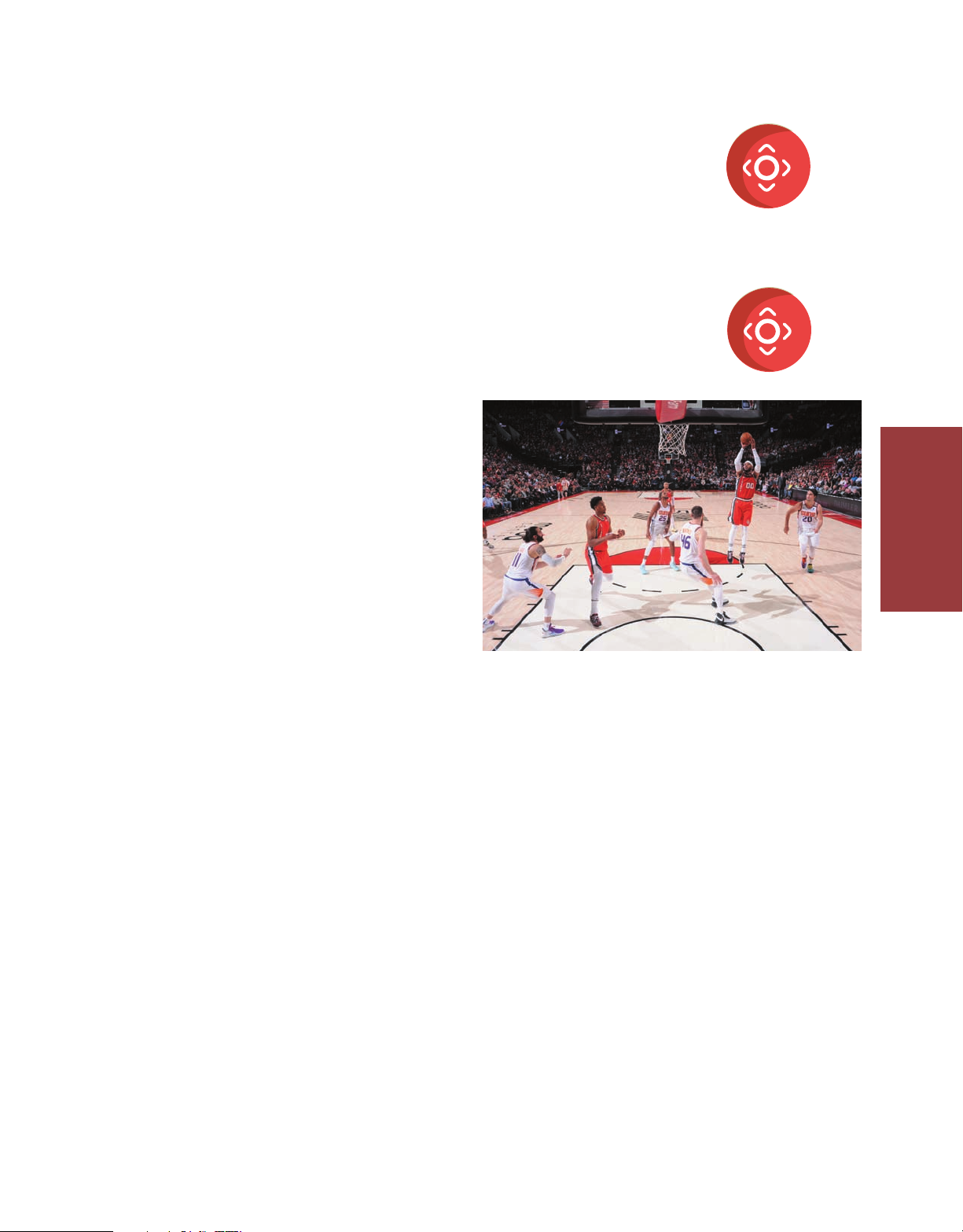
Advances in digital technology have also revolutionized decision making in the world
of sports. Most of today’s major league sports team managers use data analytics more than SNAPSHOT
intuition to make critical decisions. In the 2011 movie Moneyball, Brad Pitt portrays
Billy Beane, the legendary general manager for the Oakland Athletics baseball team,
who in 2002 built one of Major League Baseball’s
winningest teams with one of its smallest budgets.
Rather than rely on the intuition of scouts, who
would sometimes reject a player because he “didn’t
look like a major leaguer,” Beane relied heavily on 3 ty Images
data and statistical analysis. Over the past decade,
most other major league sports teams have adopted
big data statistical techniques for making decisions. Association/Get
The average number of 3-point attempts in National etball
Basketball Association (NBA) games increased every PLANNING
year between 2009 and 2019 based on statistical
analysis that showed that 3-point shots are worth
50 percent more than 2-point shots. The National encich/National Bask or
Football League (NFL) has gone through a similar am F
flood of data gathering and analysis.28 S
9-2B HOW MANAGERS MAKE DECISIONS
Another approach to decision making, called the administrative model, is considered to
be descriptive, meaning that it describes how managers actually make decisions in complex
situations rather than dictating how they should make decisions according to a theoretical
ideal. The administrative model recognizes the human and environmental limitations that
affect the degree to which managers can pursue a rational decision-making process. In dif-
ficult situations, such as those characterized by nonprogrammed decisions, uncertainty,
and ambiguity, managers are typically unable to make economically rational decisions even if they want to.29
Bounded Rationality and Satisficing
The administrative model of decision making is based on the work of Herbert A. Simon.
Simon proposed two concepts that were instrumental in shaping the administrative model:
bounded rationality and satisficing. Bounded rationality means that people have limits, or
boundaries, on how rational they can be. Organizations are incredibly complex, and manag-
ers have the time and ability to process only a limited amount of information with which
to make decisions.30 Because managers do not have the time or cognitive ability to process
complete information about complex decisions, they must satisfice. Satisficing means that
decision makers choose the first solution alternative that satisfies minimal decision criteria.
Rather than pursuing all alternatives to identify the single solution that will maximize eco-
nomic returns, managers opt for the first solution that appears to solve the problem, even
Copyright 2022 Cengage Learning. All Rights Reserved. May not be copied, scanned, or duplicated, in whole or in part. Due to electronic rights, some third party content may be suppressed from the eBook and/or eChapter(s).
Editorial review has deemed that any suppressed content does not materially affect the overall learning experience. Cengage Learning reserves the right to remove additional content at any time if subsequent rights restrictions require it. 294 PART 3 PLANNING
if better solutions are presumed to exist. The decision maker cannot justify the time and
expense of obtaining complete information.31
Managers sometimes continue to generate alternatives for complex problems only until
they find one that they believe will work. For example, Liz Claiborne managers hired SNAPSHOT
designer Isaac Mizrahi and targeted younger consumers in an effort to revive the flagging
brand, but sales and profits continued to decline. Faced with the failure of the new youth-
oriented line, a 90 percent cutback in orders from a large retailer, high unemployment,
a weak economy, and other complex and multifaceted problems, managers weren’t sure
how to stem the years-long tide of losses and get the company back in the black. They
satisficed with a quick decision to form a licensing agreement to have the Liz Claiborne
brand sold exclusively at JC Penney, which handles all manufacturing and marketing.32
The administrative model relies on assumptions that differ from those of the classical
model and focuses on organizational factors that influence individual decisions. According to the administrative model:
• Decision goals often are vague, conflict with one another, and lack consensus among managers.
• Managers often are unaware of problems or opportunities that exist in the organization.
• Rational procedures are not always used, and, when they are, they are confined to a
simplistic view of the problem that does not capture the complexity of real organiza- tional events.
• Managers’ searches for alternatives are limited because of human, information, and resource constraints.
• Most managers settle for a satisficing decision rather than a maximizing solution, partly
because they have limited information and partly because they have only vague criteria
for what constitutes a maximizing solution.
Intuition and Quasirationality
Another aspect of administrative decision making is intuition. Intuition represents a quick
apprehension of a decision situation based on past experience but without deliberate ratio-
nal thought or analysis.33 Intuitive decision making is not arbitrary or irrational because it
is based on years of practice and hands-on experience. One article on intuition cites the SNAPSHOT
classic example of Formula One race car driver Juan Manuel Fangio. Fangio was leading
in the Monaco Grand Prix as he came out of the tunnel on the second lap, yet instead of
maintaining speed for an upcoming straight stretch, he inexplicably braked. It turned out
to be a wise decision, as it allowed him to avoid crashing into a serious accident that had
occurred around the next corner. Fangio said he just had a disturbing feeling as he came
out of the tunnel. Reflecting back on the incident, he reasoned that his intuitive feeling
was caused by a slight signal that he picked up unconsciously based on his racing experi-
ence: a change of color in the spectator stand. Spectators usually face toward the drivers as
they come out of the tunnel, but this time they were facing farther up the track. Although
Fangio was focusing on the road, his peripheral vision was able to notice a shift in the
light pattern from the stands that alerted his subconscious to a potential problem ahead.34
Psychologists and neuroscientists have studied how people make good decisions using
their intuition under extreme time pressure and uncertainty.35 Good intuitive decision mak-
ing is based on an ability to recognize patterns at lightning speed, as in the case of Juan
Manuel Fangio’s insight while racing at the Monaco Grand Prix. When people have a depth
of experience and knowledge in a particular area, the right decision often comes quickly
and effortlessly owing to recognition of information that has been largely forgotten by the
conscious mind. Managers continuously perceive and process information that they may
not consciously be aware of, and their base of knowledge and experience helps them make
decisions that may be characterized by uncertainty and ambiguity.
Copyright 2022 Cengage Learning. All Rights Reserved. May not be copied, scanned, or duplicated, in whole or in part. Due to electronic rights, some third party content may be suppressed from the eBook and/or eChapter(s).
Editorial review has deemed that any suppressed content does not materially affect the overall learning experience. Cengage Learning reserves the right to remove additional content at any time if subsequent rights restrictions require it.
CHAPTER 9 MANAGERIAL DECISIoN MAKING 295
Rational decisions are the ideal, and today’s managers are frequently inundated with
data, but recent research shows that many high-level executives don’t always trust their
organization’s data and may discount data that conflicts with their gut instincts based
on experience with the business. In a recent global survey, two-thirds of CEOs sur-
veyed said they had ignored insights provided by data analysis or computer models
because it contradicted their intuition. The same survey indicated that just 35 percent
of top executives highly trust their organization’s data. Similarly, even as data have been
increasingly applied in the world of sports, Bill Belichick, head coach of the six-time
Super Bowl–winning New England Patriots, says he always prefers to “evaluate what I see” over analytics.36
Studies have found that effective managers typically use a combination of rational
analysis and intuition in making complex decisions under time pressure.37 A new trend
in decision making is referred to as quasirationality, which basically means combining
intuitive and analytical thought.38 In many situations, neither analysis nor intuition is suf-
ficient for making a good decision. However, managers may often walk a fine line between
two extremes: on the one hand, making arbitrary decisions without careful study, and on
the other hand, relying obsessively on rational analysis. One strategy is not better than the
other, and managers need to take a balanced approach by considering both rationality and
intuition as important components of effective decision making. 3 39 9-2C THE POLITICAL MODEL
The third model of decision making is useful for making nonprogrammed decisions when
conditions are uncertain, information is limited, and managers disagree about what goals to PLANNING
pursue or what course of action to take. Most organizational decisions involve many manag-
ers who are pursuing different goals, and they must talk with one another to share informa-
tion and reach an agreement. When making complex organizational decisions, managers
often engage in coalition building.40 A coalition is an informal alliance among managers
who support a specific goal. Coalition building is the process of forming alliances among
managers. In other words, a manager who supports a specific alternative, such as increasing
the corporation’s growth by acquiring another company, talks informally to other executives
and tries to persuade them to support the decision. In situations where no coalition exists, a
powerful individual or group could derail the decision-making process. Coalition building,
however, gives several managers an opportunity to contribute to decision making, enhancing
their commitment to the alternative that is ultimately adopted.
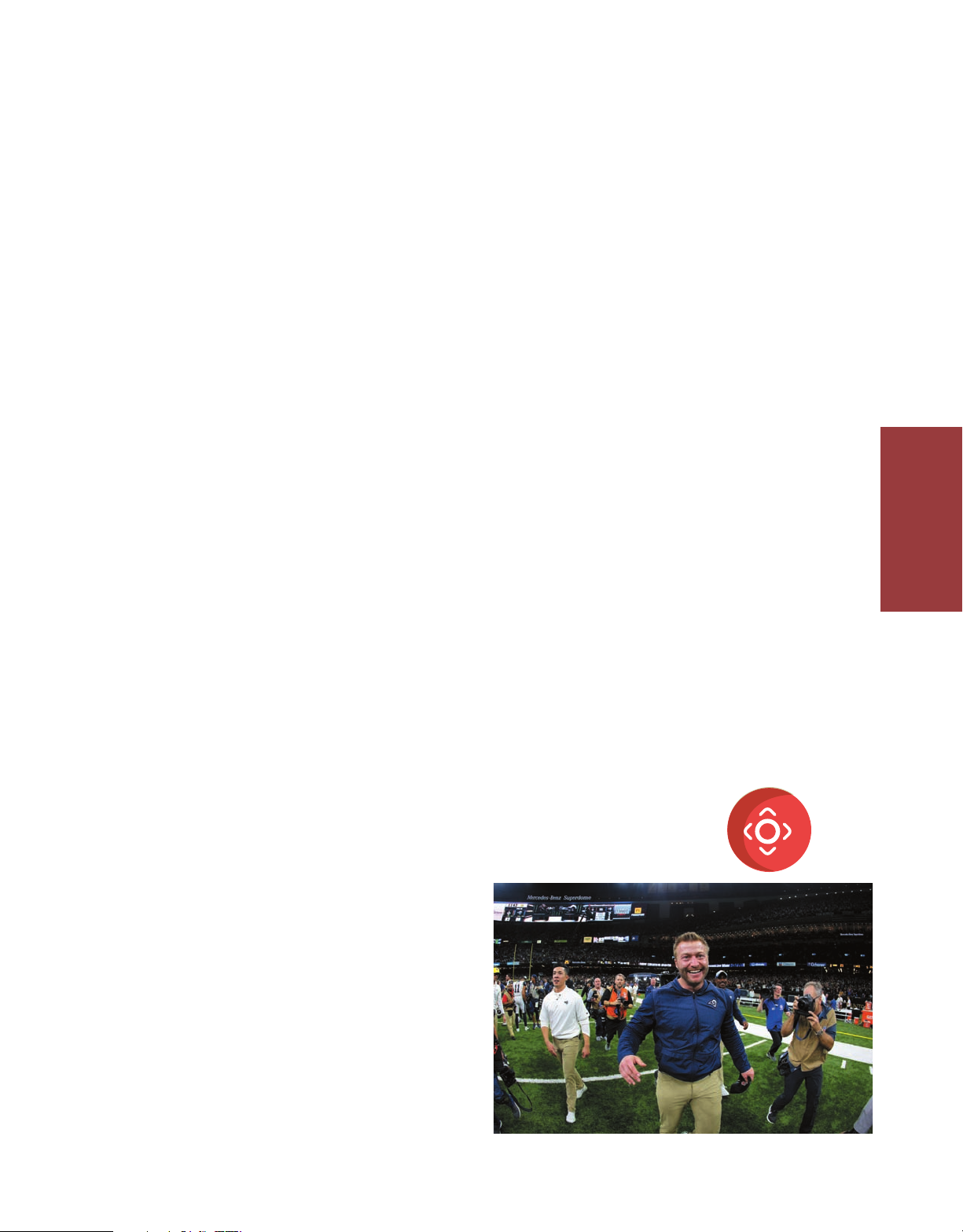
The Los Angeles Rams football franchise used a political model to hire a new coach.
Club owner Stan Kroenke and other Rams leaders, including chief operating officer SNAPSHOT
Kevin Demoff and general manager Les Snead, first came up with a list of about 30
desirable candidates, then involved people throughout the franchise in evaluating them.
One name on the list was 30-year-old Sean McVay.
Some leaders were apprehensive about the possibility
of hiring a head coach who was 38 years younger than
the team’s defensive coordinator. To make sure every-
one would support the final decision, the interviewing
process with McVay took place over a period of eight ty Images
days and involved McVay meeting with players, staff t/Get
members, and managers throughout the organization.
The decision to hire McVay turned out to be a good
one: Two years later, McVay took the Rams to the ty Images Spor
Super Bowl, where he was the youngest head coach
ever to reach the Super Bowl game and was eight years
younger than the quarterback of the opposing team, Tom Brady.41 Jonathan Bachman/Get
Copyright 2022 Cengage Learning. All Rights Reserved. May not be copied, scanned, or duplicated, in whole or in part. Due to electronic rights, some third party content may be suppressed from the eBook and/or eChapter(s).
Editorial review has deemed that any suppressed content does not materially affect the overall learning experience. Cengage Learning reserves the right to remove additional content at any time if subsequent rights restrictions require it. 296 PART 3 PLANNING
Another example of use of the political model comes from the Hallmark Channel.
Recall from Chapter 3 that the airing of a commercial featuring a same-sex marriage cer-
emony led to a flood of angry complaints from conservative viewers; then, when Hallmark
pulled the ad, managers got a flood of complaints from gay-rights advocacy groups. Top
executives spent a weekend talking with one another and building a coalition that decided
to reverse the previous decision.42
The political model closely resembles the real environment in which most managers
and decision makers operate. Interviews with CEOs in high-tech industries indicate that
they strive to use some type of rational decision-making process, but the way they actually
decide things relies on complex interactions with other managers, subordinates, environ-
mental factors, and organizational events.43 Decisions are complex and involve many people,
information is often ambiguous, and disagreement and conflict over problems and solutions
are the norm. The political model begins with four basic assumptions:
• Organizations are made up of groups with diverse interests, goals, and values. Manag-
ers disagree about problem priorities and may not understand or share the goals and interests of other managers.
• Information is ambiguous and incomplete. The attempt to be rational is limited by the
complexity of many problems, as well as personal and organizational constraints.
• Managers do not have the time, resources, or mental capacity to identify all dimensions
of the problem and process all relevant information. Managers talk to each other and
exchange viewpoints to gather information and reduce ambiguity.
• Managers engage in the push and pull of debate to decide goals and discuss alternatives.
Decisions are the result of bargaining and discussion among coalition members.
The key dimensions of the classical, administrative, and political models are listed in
Exhibit 9.2. Research into decision-making procedures has found rational, classical pro-
cedures to be associated with high performance for organizations in stable environments.
However, administrative and political decision-making procedures and intuition have been
associated with high performance in unstable environments in which decisions must be
made rapidly and under more difficult conditions.44
E X H I B I T 9.2 Characteristics of Classical, Administrative, and Political Decision-Making Models Classical Model Administrative Model Political Model Clear-cut problem and goals Vague problem and goals Pluralistic; conflicting goals Condition of certainty Condition of uncertainty
Condition of uncertainty or ambiguity
Full information about alternatives Limited information about
Inconsistent viewpoints; ambiguous and their outcomes
alternatives and their outcomes information
Rational choice by individual for
Satisficing choice for resolving
Bargaining and discussion among maximizing outcomes problem using intuition coalition members Remember This
• The ideal, rational approach to decision making, called
• The classical model is normative, meaning that it
the classical model, is based on the assumption that
defines how a manager should make logical decisions
managers should make logical decisions that are
and provides guidelines for reaching an ideal
economically sensible and in the organization’s best outcome. economic interest.
C O N T I N U E D
Copyright 2022 Cengage Learning. All Rights Reserved. May not be copied, scanned, or duplicated, in whole or in part. Due to electronic rights, some third party content may be suppressed from the eBook and/or eChapter(s).
Editorial review has deemed that any suppressed content does not materially affect the overall learning experience. Cengage Learning reserves the right to remove additional content at any time if subsequent rights restrictions require it.
CHAPTER 9 MANAGERIAL DECISIoN MAKING 297
• Artificial intelligence software programs based on
• Intuition is an aspect of administrative decision making
the classical model are being applied to programmed
that refers to a quick comprehension of a decision
decisions, such as how to schedule airline crews or how
situation based on past experience but without
to process insurance claims most efficiently.
deliberate rational thought or analysis.
• The administrative model includes the concepts
• A global survey found that two-thirds of CEOs said
of bounded rationality and satisficing and describes
they had ignored insights provided by data analysis or
how managers make decisions in situations that are
computer models because it contradicted their intuition.
characterized by uncertainty and ambiguity.
• A new trend in decision making, quasirationality,
• The administrative model is descriptive, meaning that it
combines intuitive and analytical thought.
describes how managers actually make decisions, rather
• The political model takes into consideration that many
than how they should make decisions according to a
decisions require debate, discussion, and coalition theoretical model. building.
• Bounded rationality means that people have the time
• The Los Angeles Rams used a political model to hire a
and cognitive ability to process only a limited amount of new head football coach.
information on which to base decisions.
• A coalition is an informal alliance among managers who
• Satisficing means choosing the first alternative that
support a specific goal or solution.
satisfies minimal decision criteria, regardless of whether 3
better solutions are presumed to exist. 9-3 Decision-Making Steps PLANNING
Whether a decision is programmed or nonprogrammed, and regardless of whether manag-
ers choose the classical, administrative, or political model of decision making, an effective
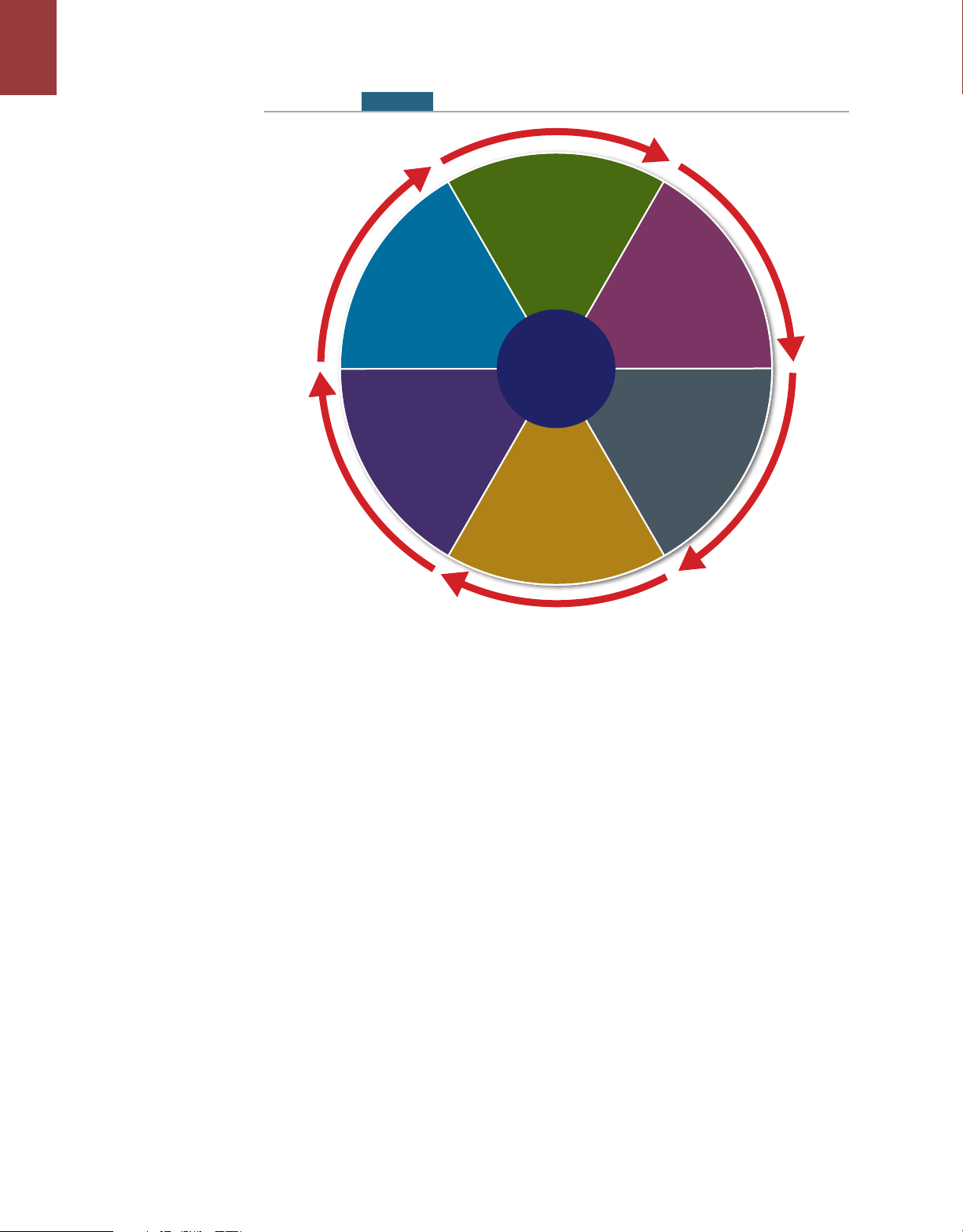
decision-making process usually involves six steps. These steps, summarized in Exhibit 9.3,
reflect the attempt to be as rational as possible when making important decisions.
9-3A RECOGNITION OF DECISION REQUIREMENT
Managers confront a decision requirement in the form of either a problem or an opportu-
nity. A problem occurs when organizational accomplishment is less than established goals;
that is, some aspect of performance is unsatisfactory. An opportunity exists when managers
see potential accomplishment that exceeds specified current goals. In such a case, managers
see the possibility of enhancing performance beyond current levels.
Awareness of a problem or opportunity is the first step in the decision-making sequence,
and it requires surveillance of the internal and external environments for issues that merit
managers’ attention.45 Some information comes from periodic financial reports, perfor-
mance reports, and other sources that are designed to discover problems before they become
too serious. Managers also take advantage of informal sources: They talk to other manag-
ers, gather opinions on how things are going, and seek advice on which problems should be
tackled or which opportunities embraced.46 For example, after spending more than a year
trying to increase sales of products by lowering the products’ prices, managers at Procter SNAPSHOT
& Gamble reviewed data showing that the strategy wasn’t working. They saw a problem
and decided to shift toward increasing prices on some of P&G’s biggest brands.47 Recog-
nizing decision requirements is sometimes difficult because it often means integrating bits
and pieces of information in novel ways.
9-3B DIAGNOSIS AND ANALYSIS OF CAUSES
Once a problem or opportunity comes to a manager’s attention, the understanding of the
situation should be refined. Diagnosis is the step in the decision-making process in which
managers analyze underlying causal factors associated with the decision situation.
Copyright 2022 Cengage Learning. All Rights Reserved. May not be copied, scanned, or duplicated, in whole or in part. Due to electronic rights, some third party content may be suppressed from the eBook and/or eChapter(s).
Editorial review has deemed that any suppressed content does not materially affect the overall learning experience. Cengage Learning reserves the right to remove additional content at any time if subsequent rights restrictions require it. 298 PART 3 PLANNING
E X H I B I T 9.3 Six Steps in the Managerial Decision-Making Process 1. Recognition of Decision Requirement 6. Evaluation Diagnosis 2. and and Analysis Feedback of Causes Decision-Making Process Implementation Development of of Chosen Alternatives Alternative 5. 3. Selection of Desired Alternative 4.
Many times, the real problem lies hidden behind the problem that managers think exists.
By looking at a situation from different angles, managers can identify the true problem. In
addition, they often discover opportunities that they didn’t realize were there.48 Charles
Kepner and Benjamin Tregoe, who conducted extensive studies of manager decision mak-
ing, recommend that managers ask a series of questions to specify underlying causes:
• What is the state of disequilibrium affecting us? • When did it occur? • Where did it occur? • How did it occur?
• To whom did it occur?
• What is the urgency of the problem?
• What is the interconnectedness of events?
• What result came from which activity?49
Such questions help specify what actually happened and why.
Diagnosing a problem can be thought of as peeling an onion layer by layer. Managers
cannot solve problems if they do not know about them or if they are addressing the wrong
issues. Some experts recommend continually asking “Why?” to get to the root of a problem,
a technique sometimes called “the 5 Whys.” The 5 Whys question-asking method allows
managers to explore the root cause underlying a particular problem. The first why gener-
ally produces a superficial explanation for the problem, and each subsequent why probes
deeper into the causes of the problem and potential solutions. In a New York Times article,
author Charles Duhigg explained how his family used the 5 Whys technique to address the
Copyright 2022 Cengage Learning. All Rights Reserved. May not be copied, scanned, or duplicated, in whole or in part. Due to electronic rights, some third party content may be suppressed from the eBook and/or eChapter(s).
Editorial review has deemed that any suppressed content does not materially affect the overall learning experience. Cengage Learning reserves the right to remove additional content at any time if subsequent rights restrictions require it.
CHAPTER 9 MANAGERIAL DECISIoN MAKING 299
problem of not getting to eat dinner as a family often enough. By continually asking why,
the family arrived at the root cause: It took the kids so long to get dressed in the mornings
that everyone was late getting out the door, triggering a cascade of delays throughout the
day and culminating in staggered dinner times rather than family meals. The solution—kids
pick out clothes to wear the night before—allowed family dinners again.50
9-3C DEVELOPMENT OF ALTERNATIVES
The next stage is to generate possible alternative solutions that will respond to the needs of
the situation and correct the underlying causes.
For a programmed decision, feasible alternatives are easy to identify; in fact, they usu-
ally are already available within the organization’s rules and procedures. Nonprogrammed
decisions, however, require developing new courses of action that will meet the company’s
needs. For decisions made under conditions of high uncertainty, managers may develop only
one or two custom solutions that will satisfice for handling the problem. However, limiting
the search for alternatives is a primary cause of decision failure in organizations.51 Scholar
and researcher Paul Nutt has studied decisions extensively. One important insight that
emerged from his research is the importance of generating multiple alternatives to attain 3
a successful decision outcome. In one study, Nutt found that people who considered only
one alternative ultimately judged their decision a failure more than 50 percent of the time,
whereas decisions that involved consideration of at least two alternatives were judged to be
successful two-thirds of the time.52 Even if it seems that only one alternative is available, it
pays to find at least one more.
Decision alternatives can be thought of as tools for reducing the difference between the PLANNING
organization’s current and desired performance. Smart managers tap into the knowledge
of people throughout the organization, and sometimes even outside the organization, to
find more decision alternatives. As an example, several years ago, before Canadian min-
ing group Goldcorp merged with Newmont, managers faced a problem regarding the SNAPSHOT
company’s Red Lake site. A nearby mine was thriving, but no one could seem to pinpoint
where to find the high-grade ore at Red Lake. The company created the Goldcorp Chal-
lenge, putting Red Lake’s closely guarded topographic data online and offering $575,000
in prize money to anyone who could identify rich drill sites. More than 1,400 techni-
cal experts in 50 countries offered alternatives to the problem, and two teams working
together in Australia pinpointed locations that turned Red Lake into one of the world’s richest gold mines.53
9-3D SELECTION OF THE DESIRED ALTERNATIVE
Once feasible alternatives are developed, one must be selected. In this stage, managers try
to select the most promising of several alternative courses of action. The best alternative
is the one that best fits the overall goals and values of the organization and achieves the
desired results using the fewest resources.54 Managers want to select the choice with the
least amount of risk and uncertainty. Because some risk is inherent in most nonprogrammed
decisions, managers try to gauge the alternatives’ prospects for success. They might rely on
their intuition and experience to estimate whether a given course of action is likely to suc-
ceed. Basing choices on overall goals and values can also guide the selection of alternatives.
Choosing among alternatives also depends on managers’ personality factors and willing-
ness to accept risk and uncertainty. Risk propensity is the willingness to undertake risk in
exchange for the opportunity of gaining an increased payoff. For example, Facebook would SNAPSHOT
never have reached more than two billion users without Mark Zuckerberg’s “move fast,
break things” mind-set. Motivational posters with that slogan are papered all around the
company to prevent delay from too much analysis of alternatives. Zuckerberg says, “If
Copyright 2022 Cengage Learning. All Rights Reserved. May not be copied, scanned, or duplicated, in whole or in part. Due to electronic rights, some third party content may be suppressed from the eBook and/or eChapter(s).
Editorial review has deemed that any suppressed content does not materially affect the overall learning experience. Cengage Learning reserves the right to remove additional content at any time if subsequent rights restrictions require it. 300 PART 3 PLANNING
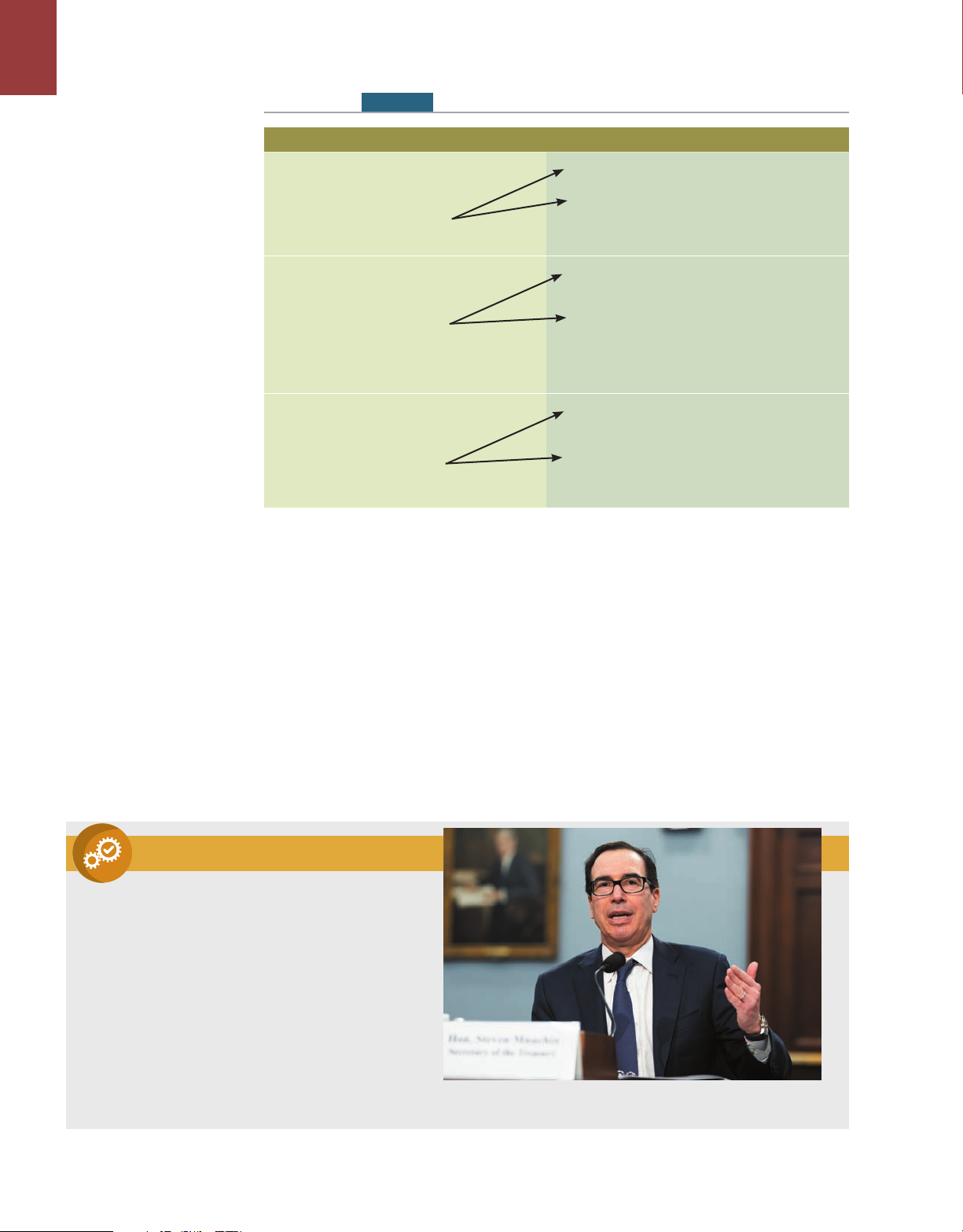
E X H I B I T 9.4 Decision Alternatives with Different Levels of Risk
In each of the following situations, which alternative would you choose? You’re the coach of a
1. Choose a play that has a 95 percent college football team,
chance of producing a tie score; oR and in the final seconds
2. Go for a play that has a 30 percent of a game with the
chance of victory but will lead to team’s archrival, you certain defeat if it fails. face a choice: As president of a
1. Build a plant in Canada that has a Canadian manufacturing
90 percent chance of producing a company, you face a
modest return on investment; oR decision about building a
2. Build a plant in a foreign country that new factory. You can:
has an unstable political history. This
alternative has a 40 percent chance
of failing, but the returns will be enormous if it succeeds. It’s your senior year, and
1. Go to medical school and become a it’s time to decide your
physician, a career in which you are next move. Here are
80 percent likely to succeed; oR the alternatives you’re
2. Follow your dreams and be an actor, considering:
even though the opportunity for
success is only around 20 percent.
you’re successful, most of the things you’ve done were wrong. What ends up mattering
is the stuff you get right.” Facebook runs a never-ending series of on-the-fly experiments
with real users. Even employees who haven’t finished their six-week training program
are encouraged to work on the live site. That risky approach means that the whole site
crashes occasionally, but Zuckerberg says, “The faster we learn, the better we’re going to
get to the model of where we should be.”55
The level of risk a manager is willing to accept will influence the analysis of the costs
and benefits to be derived from any decision. Consider the situations in Exhibit 9.4. In each
situation, which alternative would you choose? A person with a low risk propensity would
tend to take assured moderate returns by going for a tie score, building a domestic plant,
or pursuing a career as a physician. A risk taker would go for the victory, build a plant in a
foreign country, or embark on an acting career. Concept Connection
The decision to offer federally guaranteed loans
to keep small businesses afloat during the COVID-19 o
pandemic in the United States was easy to make,
but implementation of the chosen alternative k Phot oc
was a nightmare. Treasury Secretary Steven Mnuchin y St
announced that loans would flow to small businesses
in days. The rollout, however, was chaotic, with Small ed/Alam
Business Administration (SBA) program glitches and
bank bureaucracies delaying some loans for weeks.
Moreover, much of the money went to larger public A Images Limit companies by mistake. SOP
Copyright 2022 Cengage Learning. All Rights Reserved. May not be copied, scanned, or duplicated, in whole or in part. Due to electronic rights, some third party content may be suppressed from the eBook and/or eChapter(s).
Editorial review has deemed that any suppressed content does not materially affect the overall learning experience. Cengage Learning reserves the right to remove additional content at any time if subsequent rights restrictions require it.
CHAPTER 9 MANAGERIAL DECISIoN MAKING 301
9-3E IMPLEMENTATION OF THE CHOSEN ALTERNATIVE
The implementation stage involves the use of managerial, administrative, and persuasive
abilities to ensure that the chosen alternative is carried out. This step is similar to the
idea of strategy execution described in Chapter 8. The ultimate success of the chosen
alternative depends on whether it can be translated into action. Sometimes an alterna-
tive never becomes reality because managers lack the resources or energy needed to make
things happen, or they have failed to involve people and achieve buy-in for the decision.
Successful implementation may require discussion, trust building, and active engagement
with people affected by the decision. Communication, motivation, and leadership skills
must be used to see that the decision is carried out.56 When employees see that managers
follow up on their decisions by tracking implementation success, they are more commit- ted to positive action.
9-3F EVALUATION AND FEEDBACK
In the evaluation stage of the decision process, decision makers gather information that 3
tells them how well the decision was implemented and whether it was effective in achiev-
ing its goals. The “move fast, break things” approach thrives at Facebook because of rapid
feedback. Researchers have found that immediate and explicit feedback helps people sig-
nificantly improve in activities as diverse as shooting basketball free throws, playing musi-
cal instruments, solving puzzles, and performing surgery.57 Feedback also helps managers PLANNING
make better decisions. Decision making is an ongoing process that is not completed once
and for all when a manager or board of directors votes yes or no. Instead, feedback provides
decision makers with information that can precipitate a new decision cycle. The decision
may fail, thus generating a new analysis of the problem, evaluation of alternatives, and
selection of a new alternative. Many big problems are solved by trying several alternatives
in sequence, each providing modest improvement. Feedback is the part of monitoring that
assesses whether a new decision needs to be made.
To illustrate the overall decision-making process, including evaluation and feedback,
consider the decision at Rose Acre Farms, one of the largest egg producers in the United
States, about whether to shift to cage-free facilities. Companies such as Starbucks, Nestlé
SA, Burger King, and McDonald’s are phasing out the use of eggs that come from caged
hens. Cage-free eggs also command a higher price tag, and the market for cage-free eggs is growing.
Like other egg farmers, Marcus Rust, CEO of Rose Acre Farms, had to decide how
to address the problem of meeting many different state rules and regulations aimed at SNAPSHOT
improving the well-being of egg-laying hens as well as address the growing criticism from
animal rights activists. The two primary alternatives for egg farmers are to build roomier
cages or to invest in cage-free facilities. Building cage-free facilities is much more expen-
sive, but Rust and his managers decided to bet that in the future egg farming will succeed
based on a cage-free strategy. They selected the more expensive
choice—that every facility Rose Acre builds or refurbishes will
lack cages. Implementation of the decision has begun, and at
the new Rose Acre facility in Frankfort, Indiana, 170,000 hens
wander around a 550-foot-long open barn, perch on metal rods, gall
or run up and down ramps. Evaluation and feedback are ongo-
ing and have already revealed a need for some design changes.58 lie Neiber
The decision to shift to cage-free facilities is a risky and
expensive one for Rose Acre Farms, but Rust believes it will
pay off. Strategic decisions always contain some risk, but AP Images/Char
Copyright 2022 Cengage Learning. All Rights Reserved. May not be copied, scanned, or duplicated, in whole or in part. Due to electronic rights, some third party content may be suppressed from the eBook and/or eChapter(s).
Editorial review has deemed that any suppressed content does not materially affect the overall learning experience. Cengage Learning reserves the right to remove additional content at any time if subsequent rights restrictions require it. 302 PART 3 PLANNING
feedback and follow-up can help keep companies on track. When decisions don’t work
out so well, managers can learn from their mistakes—and sometimes turn problems into opportunities. Remember This
• Managers need to make a decision when they either
• Diagnosis is the step during which managers analyze
confront a problem or see an opportunity.
underlying causal factors associated with the decision
• A problem is a situation in which organizational situation.
accomplishments have failed to meet established
• The 5 Whys is a question-asking technique that can help goals.
diagnose the root cause of a specific problem.
• An opportunity is a situation in which managers see the
• Selection of an alternative depends partly on managers’
potential for organizational accomplishments to exceed
risk propensity, or their willingness to undertake risk in current goals.
exchange for the opportunity of gaining an increased payoff.
• The decision-making process typically involves six
• The implementation step involves using managerial,
steps: recognizing the need for a decision, diagnosing
administrative, and persuasive abilities to translate the
causes, developing alternatives, selecting an alternative,
chosen alternative into action.
implementing the alternative, and evaluating decision
• Managers at Rose Acre Farms made and implemented a effectiveness.
decision to shift to cage-free facilities for egg-laying hens.
9-4 Personal Decision Framework
Imagine you are a manager at Instagram, Twitter, The New York Times, an AMC movie
theater, or the local public library. How would you go about making important decisions
that might shape the future of your department or company? So far in this chapter, we
have discussed a number of factors that affect how managers make decisions. For example,
decisions may be programmed or nonprogrammed, situations are characterized by various
levels of uncertainty, and managers may use the classical, administrative, or political model
of decision making. In addition, the decision-making process follows six recognized steps.
What’s Your Personal Decision Style?59
Read each of the following items and circle the answer that best describes you. Think about how you typically act in a
work or school situation and mark the answer that first comes to mind. There are no right or wrong answers.
1. In performing my job or class work, I look for a. practical results. b. the best solution.
c. creative approaches or ideas.
d. good working conditions.
C O N T I N U E D
Copyright 2022 Cengage Learning. All Rights Reserved. May not be copied, scanned, or duplicated, in whole or in part. Due to electronic rights, some third party content may be suppressed from the eBook and/or eChapter(s).
Editorial review has deemed that any suppressed content does not materially affect the overall learning experience. Cengage Learning reserves the right to remove additional content at any time if subsequent rights restrictions require it.
CHAPTER 9 MANAGERIAL DECISIoN MAKING 303 2. I enjoy jobs that
a. are technical and well defined.
b. have a lot of variety.
c. allow me to be independent and creative.
d. involve working closely with others.
3. The people I most enjoy working with are
a. energetic and ambitious.
b. capable and organized. c. open to new ideas.
d. agreeable and trusting.
4. When I have a problem, I usually
a. rely on what has worked in the past.
b. apply careful analysis.
c. consider a variety of creative approaches.
d. seek consensus with others. 3
5. I am especially good at
a. remembering dates and facts.
b. solving complex problems.
c. seeing many possible solutions. PLANNING
d. getting along with others.
6. When I don’t have much time, I
a. make decisions and act quickly.
b. follow established plans or priorities.
c. take my time and refuse to be pressured.
d. ask others for guidance and support.
7. In social situations, I generally a. talk to others.
b. think about what’s being discussed. c. observe.
d. listen to the conversation.
8. Other people consider me a. aggressive. b. disciplined. c. creative. d. supportive.
9. What I dislike most is
a. not being in control. b. doing boring work. c. following rules.
d. being rejected by others.
C O N T I N U E D
Copyright 2022 Cengage Learning. All Rights Reserved. May not be copied, scanned, or duplicated, in whole or in part. Due to electronic rights, some third party content may be suppressed from the eBook and/or eChapter(s).
Editorial review has deemed that any suppressed content does not materially affect the overall learning experience. Cengage Learning reserves the right to remove additional content at any time if subsequent rights restrictions require it.