

 !"!#$!"!%
&'(
UNIT 7:NGỮ PHÁP)*+ +,
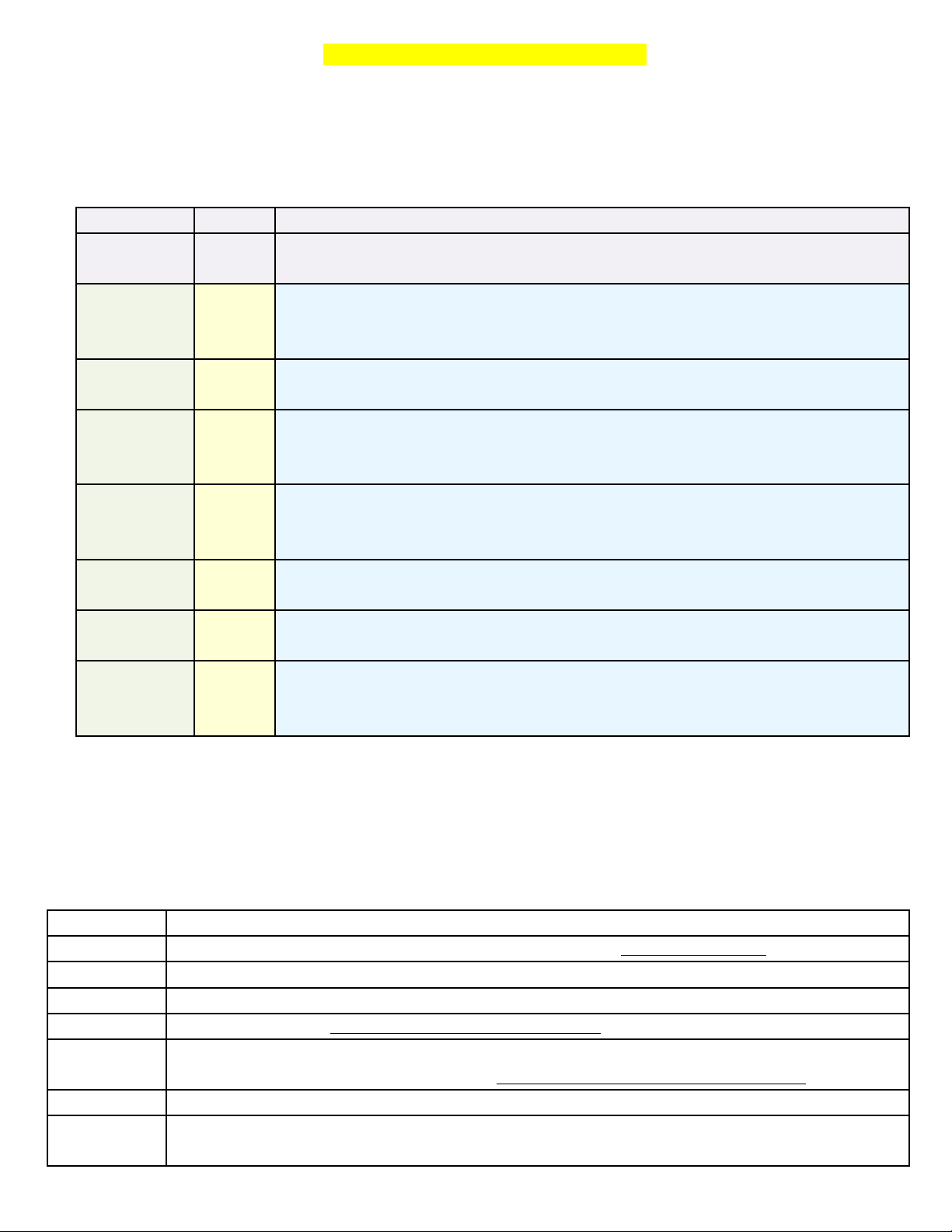
-*./0,:Liên từ dùng để kết hợp các từ, cụm từ, mệnh đề hoặc câu với nhau.
)))123
- Các liên từ cơ bản
./0 456 789:;4<=>:;
?.Liên từ
đẳng lập
6: Dùng để bổ sung thêm thông tin trong câu hoặc cho mệnh đề đứng trước nó.
Khi nối 2 mệnh đề ta:@4:ABCDEFG6:
Eg:I like watching news and game show.
E hoặc
Được dùng khi có sự lựa chọn.&Or không đứng đầu câu&chỉ đứng giữa câu&nối 2
mệnh đề&và có dấu phẩy& & & & & &Eg:Hurry up, or you will be late.
H nhưng Dùng để nối 2 mệnh đề mang nghĩa trái ngược, đối lập nhau. But không đứng đầu
câu chỉ đứng giữa câu nối 2 mệnh đề và có thể có dấu phẩy đứng trước.
Eg: My father likes horror films but my mother doesn't like them
8 Nên, vì
vậy
Dùng để nói về một kết quả của sự việc được nhắc đến trước đó,&so chỉ đứng giũa
câu& và&trước “so” ta dung dấu phẩy
Eg: I'm listening to music, so I can't hear what you are saying.
2.Liên từ
phụ thuộc
H68 bởi vì
Dùng để nói về lí do của một sự việc được nhắc tới trước hoặc sau nó.
Eg: My sister likes sitcom because it is very interesting.
64)I
43
mặc dù Dùng để nối 2 mệnh đề mà mệnh đề chính mang kết quả tương phản với mệnh đề
phụ,. &&Eg: Although he likes football, he doesn't often watch football
programmes.
.FJ&
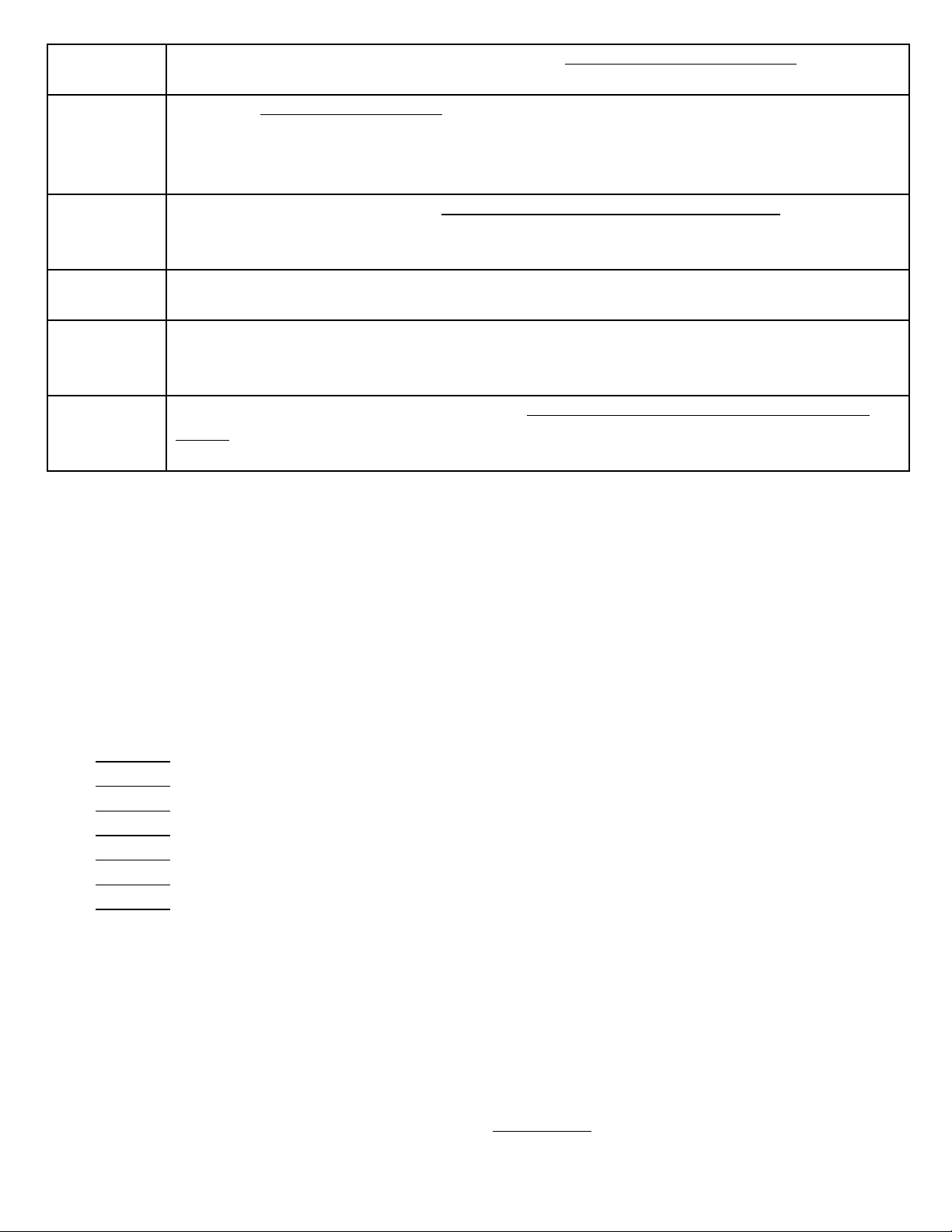
4)vàH)không thể đi cùng nhau trong một câu tiếng Anh. Do vậy nếu đã dùng64)thì không
dùngH)và ngược lại.
Tương tự trên, trong một câu nếu dùng8)thì không dùngH68)và ngược lại.
!KLG0MNL$OP8
Các câu hỏi có từ để hỏi cho phép người nói tìm thêm thông tin về chủ thể để mà mình quan tâm. Các từ để
hỏi theo thông tin muốn tìm có thể được liệt kê như sau:
When?33333333 Hỏi thông tin về thời gian (Khi nào?) 3 3 3 33When were you born?
What time Hỏi thông tin về giờ cụ thể (Mấy giờ?) câu trả lời thường34QK6R4S
Where? Hỏi thông tin về nơi chốn (Nơi nào?) 3 3 3 3Where are you from?
Who? Hỏi thông tin về người (Ai?) 3 3 3 3 3 3 3 3 3 3 3Who is your English teacher?
Why? Hỏi lí do (Tại sao?)3câu trả lời gạch chân Because 3 3 3 3 Why do you study English?
How? Hỏi cách thức, phương thức (Như thế nào?) 3 3 3 3 3 3 3How did you make the cake?
LBFT4/46U4&KEVS)4QKHDRBFT4W46U4
What? Hỏi về vật/ý kiến/hành động (Cái gì?) 3 3 3 33What are you doing?
Which
(one)?
Hỏi thông tin về sự lựa chọn (Cái nào)
Which soup do you like for lunch, chicken soup or crab one?
E64?

Whose? Hỏi thông tin về sở hữu của ai. Câu trả lời thường3 gạch chân vào tính từ sở hữu
Whose keys are they?Những cái chìa khóa này của ai?
How much? Hỏi giá cả3*4QKX47Y), số lượng (không đếm được) (gạch chân vào các từ định
lượng)
- How much is it?Cái này giá bao nhiêu?
- How much sugar do you like?Bạn muốn bao nhiêu đường?
How many? Hỏi về lượng (đếm được) (thường346KX78ZM[&I\IE,
A: How many books do you have?Bạn có bao nhiêu cuốn sách?
B: I have about one hundred books.Tôi có khoảng 100 cuốn sách.
How long? Hỏi về khoảng thời gian (Bao lâu)
A: How long do you walk from your house to school?   B: Around 15 minutes.
How often? Hỏi về mức độ thường xuyên
A: How often do you study in English?
B: Three times a week, on Monday, Wednesday and Friday.
How far? Hỏi về khoảng cách (Bao xa?) (gạch chân từ3]^V47I8ZM[^E8*^8,I
E8
A: How far is it from your house to school?     B: One kilometer.Một cây số.
8H8B_`_Ea:6EE68\E
1. A: _____ can I buy some beef? B: At the supermarket.  A. WhatB. Who  C. When  D. Where
2. My friend likes cartoons, ___________ she doesn’t like talent shows.
A. and B. so C. butD. because
3. A: ___________ do you play badminton? B: Twice a week.
A. How oftenB. WhenC. How much D. Why
4. The programme is boring, ___________ he doesn’t want to watch it.
A. soB. but C. because D. and
5. A: ___________ programme does your sister often watch? B: Films.
A. Who B. WhatC. WhenD. How many
bH6^\O6_OE_O_OD_O_\_\c6E
1. is your family name? - It’s Nguyen.
2. old are you? - I’m thirteen.
3. do you live? - On Nguyen Trai Street.
4. do you live with? - My parents.
5. is it from your house to school? - About three kilometers.
6. do you go to school? - At half past six.
7. are you late? - Because I miss the bus.
1. What is your family name? - It’s Nguyen.
2. How old are you? - I’m thirteen.
3. Where do you live? - On Nguyen Trai Street.
4. Who do you live with? - My parents.
5. How far is it from your house to school? - About three kilometers.
6. When do you go to school? - At half past six.
7. Why are you late? - Because I miss the bus.
I 6^P8cE:E:B6E&
1. MC in the game show "who are millionaires" isLai Van Sam.

E64!

2.Millions ofviewers will watch the EURO football match on TV this evening.

3.My father watches TVtwice a day.

4.The game show lastssixty minutes.

5.The studio of Viet Nam's national TV station isin Ha Noi.
   ………………………………………………………………………………..
6.I like Mr. Bean bestbecause he always makes me laugh when I see him on TV.

7.We can meet in front of theaterat 7 p.m.

8. He travelled to Mexicoby plane.
………………………………………………………………………………………
9. Minh goes to the karate clubthree times a week.
………………………………………………………………………………………
10. Pele scored1.281goals in his career.
………………………………………………………………………………………
1. Who is the MC in the game show "Who Wants to Be a Millionaire"?
2. How many viewers will watch the EURO football match on TV this evening?
3. How often does your father watch TV?
4. How long does the game show last?
5. Where is the studio of Vietnam’s national TV station?
6. Why do you like Mr. Bean best?
7. What time can we meet at in front of the theater?
8. How did he travel to Mexico?
9. How often does Minh go to the karate club?
10. How many goals did Pele score in his career?
UNIT 8 SPORTS AND GAMES
NGỮ PHÁP)*+ +,
?_dP7^eMT*B688B,
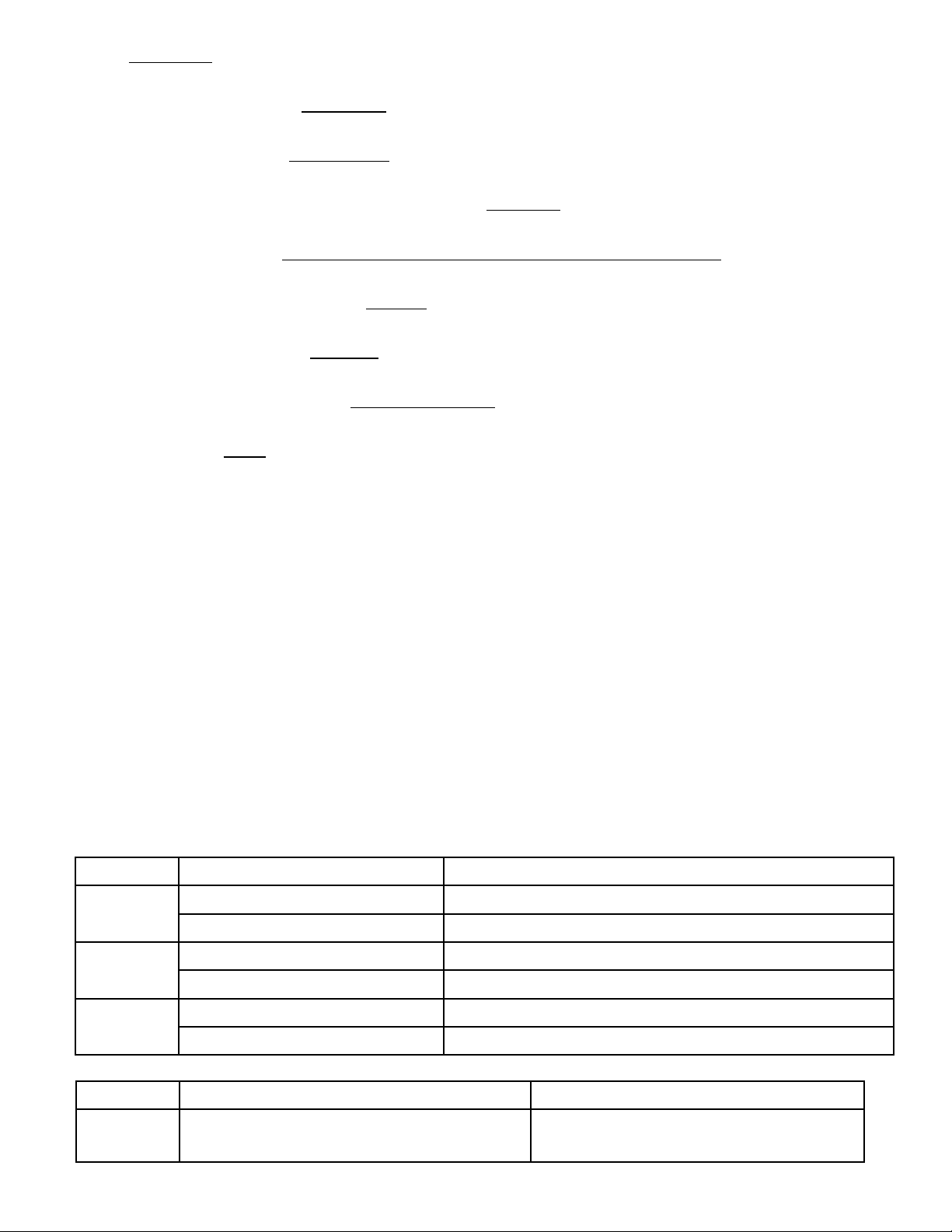
a) Cách thành lập
1-Với động từ “to be ”
 7XfB =>:;
g4Mh
II8II>R\68R)))))))) She was at home last night.
OIDIDIR\ER They were at home last night.
iMh
3?R\68*\68j,R She wasn’t at home last night.
3!R\E*\Ej,R They weren’t at home last night.
4A
\68R3?R Was she at home last night?
\ER3!R Were they at home last night?
2-Với động từ thường
N 7XfB =>:;
g4Mh 3+=$:I=!R
I went shopping last week.
He played football last Friday.
E64k

iMh 3+::*::j,)+=*4D/N,R
I didn’t go shopping last week.
He didn’t play football last Friday.
4A
a:)+ s +=*4D/N,R
l)Từ hỏi + did+ S + V ....?
Did you go shopping last week?
Did he play football last Friday?
!KWW*6DD/m,
a) Câu khẳng định:3Câu mệnh lệnh là câu bắt đầu bằng một động từ nguyên mẫu không có “to”.
=R
b) Câu phủ định
Ở thể phủ định có nghĩa là đừng làm điều gì đó phụ thuộc vào động từ mà người ta sử dụng
ajR=
Ex: -Don’t go. Đừng đi.
Luu ý:Thông thường để câu mệnh lệnh mang tính lịch sự hơn, người ta thêm “please” (xin vui lòng) vào
trước hoặc sau câu mệnh lệnh đó.
Ex: -Please come in! Xin mời vào.
- Come in, please! Xin mời vào
=.+\Ec\488_848EEcBE6
Ex: You should go to bed early. => Go to bed early.
You should not stay up late => Don’tstay up late.
1. You should not eat too much ice cream.
2. You should not ride your bike too fast.
3. You should not climb the tree.
4. You should brush your teeth twice a day.
5. You should do your homework everyday
6. You should not play video games too much.
7. You should do more exercise.
8. You should not smoke.
k_.n_aRaoIapo)(GO, PLAY, DO + N/ V-ING)
6B6D
• các môn thể thao đồng đội
• có sử dụng bóng (ball) hoặc các thiết bị khác
=>:;&
• play football/ play chess/ play tennis
• play computer games (chơi trò chơi máy tính)
H:
• các hoạt động mang tính tiêu khiển
• các môn thể thao cá nhân, không đồng đội
• các môn thể thao không sử dụng bóng
=>:;&
* do puzzle/ homework// housework (giải câu đố)
* do exercise (tập thể dục)
* do aerobics/ do judo/ do yoga / do karate
4
các động từ tận cùng là$4để diễn tả các hoạt
động4VE>_F4q
• go jogging/ go cycling/ go skiing/ go swimming
• go skateboarding (đi trượt ván)
`r=as
B88\EEcEc)‘do’, ‘go’)E)‘play’.
1. Every morning, Peterexercise.
2. Theybasketball in the sport club yesterday.
3. Lucy likesbadminton with her friends after school.
1. oftenaerobics at the weekends.
E64#

2. Did youfishing last Sunday?
3. Brianbaseball for the school team.
4. The children aretheir homework now.
5. Alexkarate twice a week.
6. Do you oftenswimming?
1. likeskating in winter.
1. Every morning, Peter does exercise.
2. They played basketball in the sports club yesterday.
3. Lucy likes playing badminton with her friends after school.
4. I often do aerobics at the weekends.
5. Did you go fishing last Sunday?
6. Brian plays baseball for the school team.
7. The children are doing their homework now.
8. Alex does karate twice a week.
9. Do you often go swimming?
10. I like going skating in winter.
B88\EEcEcEH8HE6^8
1. My mom (make)a chocolate cake yesterday.
2. David (visit)his grandparents a week ago.
3. Peter (write)an email to his friend last night.
4. The girls (buy)new T-shirts last Saturday.
5. It (snow)yesterday!
6. They (finish)their homework two hours ago.
7. I (tidy)my room yesterday.
8. I (see)your sister at the library last week.
1. My mom made a chocolate cake yesterday.
2. David visited his grandparents a week ago.
3. Peter wrote an email to his friend last night.
4. The girls bought new T-shirts last Saturday.
5. It snowed yesterday!
6. They finished their homework two hours ago.
7. I tidied my room yesterday.
8. I saw your sister at the library last week
2t&
uo3vw2=rxo3vw2
?3y^7HW4zMQ08{zX>08{z))))))))
>08{z Q08{z
h
456
Tính từ sở hữu(B8888
6:-,)là từ để chỉ sự sở hữu và
đứng trước danh từ.
Đại từ sở hữu*B8888BE8,)dùng để thay
thế hẳn cho tính từ sở hữu và danht từ.
Đại từ sở hữu vừa có thể đứng ở vị trí chủ ngữ, vừa
có thể là tân ngữ trong câu.
=>:; This is my book→Trong câu sử dụng
tính từ sở hữu|D”và danh từ
“H^}
68. →Trong câu sử dụng đại từ sở hữu
}để thay thế cho “DH^” vì người nói
không muốn lặp lại từ.
))))))!`V4W^/MQ0K~F4i4z_>08{zXMQ08{z
E64%

Q0K~F4i4z >08{z Q08{z 456
I my  của tôi
You your DE8 của bạn/các bạn
We our E8 của chúng tôi
They their E8 của họ
He his 8 của anh ấy
She her E8 của cô ấy
It its 8 của nó
+•
E\E:\8:E:B6E8BE::ccEDcEE8&
1. A. worked     B. rainedC. stoppedD. watched
2.A.thoseB.thankC.throwD.thing
3. A. Saturday       B. racket         C. character        D. game
4. A. earthB. fatherC. bothD.thank
5. A.thinkB.thisC.thirtyD.thank
6. A. neededB. workedC. helpedD. watched
7.A.this         B. anything    C. earthD.theatre
8. A. contest   B. chess       C. volleyball       D. best
8EE68\E*_`_Ea,B88&
?))))))))This camera belongs to my auntThis camera is _____________
AhersBmineChisDours
2. Where did you go last night? - __________.
  A. I watched TV with my father  B. I go to the movies  
   C. I listened to music  D. I went to the movies
3. Lan likes watching game shows, _________ she doesn’t like watching news programmes.
A. butB. soC. orD. and
4. Last summer, I __________ fishing with my uncle in the afternoon.
   A. go       B. went      C. goesD. going
5. I’d like to watch motor racing because it is very __________.
A. bored B. excitingC. excited D. boring
6. My sister is doing aerobics with __________ friends at the moment.
   A. herB. his     C. my  D. their
7. “_____ play computer games too much”. – “I see”A. Not      B. Do    C. Don’t 
D. Did
8. “ _____ do you do judo?" - "Twice a week.".  A. How long B. Where B. Why      D.How
often
9. My father….…. Ha Noi capital yesterday.    A. visits   B. visited      C. visiting    D .
to visit
10. Lan and Hoa…… table tennis every morning.  A. play  B. do  C. goD. watch
11. “I’ve got an excellent mark.” – “_____________”
A. Thank you. B.Congratulations!C. Yes, I’d love to. D. No let’s not.
12. _____ draw on the walls and tables, please!    A. DoB. Don'tC. ShouldD. Shouldn't
13. Ken ____football yesterday. He went fishing. A. doesn’t play  B. don’t play C. didn’t play
14. Minh ____ jogging nearly every day.   A. goes      B. plays      C. doesD. is going
15. Peter: “Is that the Queen’s hat?” – Mary: “No, it’s _________ crown.”
E64(

A. hisB. herC. our      D. my
16. “________ is he so happy?” – “Because he gets a good mark in English.”
 A. What   B. How many  C. Why   D. How
17. _________ your book, please. Now we move to listening skill.
 A. Opening   B. Open  C. To openD. Opens
18. My father likes watching TV ___________ he also loves plays football.
 A. soB. becauseC. and      D. but
19. My sister likes _____ table tennis in her free time.  A. playing  B. play   C. playedD. to
playing
20. “____ do you play table tennis?” – “Once a week.” A. How much B. How long  C. How far D. How
often
21. It’s raining heavily outside, so you ____________ bring your raincoat.
 A. can B. should  C. shouldn’t       D. must
22. He ______ out with his friends last week.  A. go B. goes C. goingD. went
23. I love ________. Tom and Jerry are my favourite characters.
 A. comedies B. cartoonsC. documentaries D. romances
24. My father…… home late last night.      A. went      B. goes      C. are going       D. go 
25. You should…… your homework before going to school.  A. doing    B. do     C. to do     D. did
26. Nam often ……to music in his free time.  A. listen     B. listens    C. is listening      D. 
listened
27. His Dad doesn’t play soccer …… he likes watching soccer matches on TV.
   A. but            B. and              C. so               D.  because
28. They………out for breakfast every weekend.  A goes      B. go     C. are going       D. went
29. …….. your raincoat on, Ba. It’s raining now.   A. To put   B. Putting C. Put           D. Not
put
k")“A: ______do you like this TV programme?     B: Because it helps me relax
AWhatBWhereCWho  DWhy
k?)______does the movie start? – At 9 o’clock   AWhere     BWhat
timeCWhichDWhen
k!)______ is your favourite comedian? - Charlie Chaplin  AWho  BWhichCHowDWhat
kkMy little brother can draw ______colour pictures very well  Aand   Bbut     Cor
Dso
k#It was very warm, ______ we all went swimming   Aand      BbutCor     Dso
k%My brother likes talent shows, ______he doesn’t like animated films
Aand BbutCor Dso
k(Music channel attracts millions of _______ throughout the country
AcharactersBwritersCreportersDviewers
k€I play sport very often, so I look very_______
AsportBsportsCsportyDsporting
k•We ______to Ho Chi Minh for our last summer vacation    Ago  Bwent  Cgoed
Dwill go
ktJohn ______return to America last week  Adoesn’t     Bisn’t   Cdidn’tDwasn’t
#"Last weekend Phong and Lan ______their grandparents Avisit  Bis visiting Cwill visit
Dvisited
#?All of us ______at home yesterday eveningAwere     Bwas     Cdid     Dare
#!_______run too fastYou may fall  ADon’t BDo    CDidn’tDDid
E64€

#k______ draw on the walls and tables, please  Do      
`Don'tShouldaShouldn't
##. ______ watch too much TV, Jack! Turn it off ANot       BDon’tCDoesn’tDNo
#%His new bike is quite small_____ is bigger AMy         BHerCTheirDMine
#(David has got two brothersThey are _____________ daughters
AitsBhisCherDtheir
#€My cousins phoned me from ____ house in Mexico City  Aits    BhisCherDtheir
#•This computer game belongs to me and my brotherThis computer game is _____________
AusBoursCwe’reDour
#t))))))))Can you lend me your red pen? I don’t know where _____________ is
AIBmeCmyDmine
%"))))))))New York City is a big city_____________ buildings are high
AItsBIt’sCTheirDTheirs
%?Can you lend me your red pen? I don’t know where _____________ is.
A. mineB. myC. hersD. their
%!))))))))There are a lot of ______ in Thailand  AShopBrestaurant   Cfloating
marketsDstreet food
53. She is tired, ….. she will go to bed early.  A. and     B. but        C. because      D. so
54. Alice and Lisa enjoy petting….. dogs.    A. them    B. their      C. they      D. theirs
55. People in my city are helpful and……..   A. useless    B. unkind     C. delicious     
D.friendly
56. John, you are late. The match......... ten minutes ago. A. starts B. started C. is starting  D.
start
57. Ben ____ his parents a postcard while he was on holiday. A. writeB. writesC. wrote   D. to
write
58. Hong Kong is famous for.......... double-decker buses. A. its B. it C. it’s      D. it is
59. The USA ..... first colour TV in 1953.  A. has B. have C. had      D. having
60. We are now in the city museum. ........... any objects on display.
A. Not touchB. Don't touch    C. Don’t touching  D. Not to touch
61. ____ bike is dirty, and I can't tell what color it is. A. YourB. YoursC. You      D. ours
62. Your country is much bigger than ________.   A. our      B. yoursC. their     D.
theirs
63. _____ dog is so friendly. It never barks.      A. They     B. TheirC. TheirsD. Them
Choose the word or phrase that is CLOSEST in meaning to the underlined part in each of the following
sentences.
1. Thecontentof the movie I watched last night is really thrilling.
A. topic B. theme C. script D. plot
2. Hello Fatty! is a cartoon series about acleverfox and his clumsy human friend.
A. smartB. skilful C. careful D. foxy
3. Playing sportsregularlycan bring many health benefits.
A. frequentlyB. rarely C. sometimes D. randomly
4. Whathappenedat the football match yesterday?
A. played B. occurredC. mattered D. came
5. I love looking at6H:48at night with their colourful lights.
A. sky trains B. skyscrapersC. skylines D. sky zones\
6. Oxford University is the86university in Britain.
E64•

A. biggest B. youngestC oldestD. most famous
Choose the word or phrase that is OPPOSITE in meaning to the underlined part in each of the following
sentences.
7. Thank God,you’re hereis a veryentertainingcomedy programme based on an Australian TV show.
A. interesting B. unhappy C. sad D. boring
8. Can you pleaseturn upthe volume? I can't hear anything.
A. turn on B. turn off C. turn downD. turn into
9. My brother wants to become aprofessional. swimmer, so he practices swimming every day.
A. lazy B. poor C. bad D. amateurish
10. Linh oftenwastesmoney in buying clothes that she just wears a few times.
A. spends B. pays C. savesD. makes
11. Lan enjoys living in the country side because it is veryP.
A. silent B. noisyC. loudD. peaceful
12. Melbourne is quite a86ccity to live in.
A. peaceful B. secure C. dirty D. dangerous
8E_`__Ea:6EE6EE64c886^6
64c:646cc\4P88
?&)Why do you like this programme?
1. I like the wildlife programme.
2. I like it because I learn a lot about our earth from this programme.
3. What is your favourite TV programme?
A. d – c – a – bB. d – b – a – cC. b – d – c – aD. b – a – c – d
!&
a. Thank you, Minh.
b. Last week I won the first prize of my school’s singing contest.            
c. So you're your school’s idol. Anyway, last week I also won the championship of my school’s badminton
competition.
d. Congratulations!
A. c – a – d – bB. c – b – d – a C. b – d – a – cD. a – d – c – d
k
a. It’s located in Quang Binh province.
b. What is the largest cave in Viet Nam?
c. It’s Son Doong Cave.
d. Where is it located?
A. b – d – a – c
B. b – c – d – a
C. d – b – a – c
D. c – b – d – a
#
a. It’s very beautiful with crystal-clear water and limestone islands.
b. Yes, I have. I went there last summer.
c. Have you ever visited Ha Long Bay? d. What do you think about it?
A. b – c – d – a
B. d – b – c – a
C. b – d – a – c
D. c – b – d – a
E64t

%?)88*6$,EEE:E_cH6^6^646~
Last night, my family wanted to watch a TV show together, but we had a small problem.
a. We couldn’t find the remote control anywhere in the living room.
b. After searching for a while, my brother finally found it under the sofa.
c. We all laughed and enjoyed our favorite show together.
A. a-b-c
B. b-a-c
C. c-a-b
D. a-c-b
%!Choose the sentence that can end the text most appropriately.
A. From now on, we decided to keep the remote in one place.
B. We argued about what to watch next.
C. The TV suddenly stopped working in the middle of the show.
D. My brother accidentally dropped the remote again.
6.188*6$,EEE:E_cH6^6^646~
Last weekend, my friends and I played a football match at the schoolyard.
a. Everyone cheered, and we celebrated our victory.
b. In the last minute, my team scored the winning goal.
c. The match was very exciting, and both teams played well.
A. a-b-c
B. b-a-c
C. a-c-b
D. c-b-a
(!Choose the sentence that can end the text (in Question 1) most appropriately.
A. We were all tired but very happy.
B. The referee canceled the match due to the rain.
C. We decided to practice more for the next match.
D. My friend was sad because his team lost.
 2
8H8B_`_E:6886HE8B8B6c
c\4~648
8
1. Lan: "What’s your favorite TV program?" Minh: "________"
A. I don’t watch TV at all.
B. I love ‘The Voice Kids’. It’s really exciting!
C. I have a new TV at home.
D. I usually do my homework in the evening.
2. Nam: "Why do you like watching documentaries?" Hoa: "________"
A. Because they help me learn new things.
B. No, I don’t like them.
C. I usually watch TV in the evening.
D. I prefer action movies.
3BE86:68
3. Coach: "You played very well in today’s match!" Player: "________"
A. Thank you! I will try my best.
B. I don’t like playing football.
E64?"

C. Sorry, I can’t play.
D. I think I lost the match.
4. Mai: "Who won the badminton competition yesterday?" Tuan: "________"
A. It was great fun.
B. I think Linh did. She played really well!
C. I don’t have a badminton racket.
D. I didn’t watch the match.
6E6O:E8c=6
5. Tourist: "Wow! Ha Long Bay is so beautiful!" Guide: "________"
A. Yes, it’s one of the most famous natural wonders of Vietnam.
B. No, I haven’t been there.
C. Let’s go shopping instead.
D. I don’t like traveling.
6. Peter: "What’s the best time to visit Phong Nha Cave?" Linh: "________"
A. It’s in Quang Binh province.
B. I think from April to August when the weather is nice.
C. It’s a very large cave.
D. I have never been there before.
+•a&)
+•a&.•b.•3I2• •3
+6:4?&
22 `+•
Dear parents,
Please note that school will be closed (1) _____ Monday 23
rd
October to Sunday 29
th
October for the
Mid Term Autumn break.
Students should (2)_____ to school on Monday 30
th
October, 2023 wearing winter (3)_____.
Regards
Penguin Lower school
1. A. fromB. onC. betweenD. in
2. A. be returnB. returnC. returnsD. returned
3. A. clothesB. coatC. uniformD. dress
+6:4!&
)EDE8:6‚
How are you? I'm very (1)… to receive your letter. I dont know, do you miss me, but I miss you very
much. Are you free on Sunday? If you are free, I"ll invite you to go to (2)… cinema. I have two
stickers of a film. My friend told me it's very nice. It"ll start at 7.00 p.m at Starlight cinema. Can you
go with me? If you can, meet at the park near your house. I hope we"ll (3) …… great and fun times
together.
Looking forward to seeing you there.
Have a nice day!
1. A. happyB. happilyC. the happyD. the happily
2. A. aB. anC. theD. Ø (no article)
3. A. hasB. haveC. hadD. having
+6:4k&
Dear MS. Gonzalez,
E64??

     Our next course starts in three weeks, on Monday, 9 May. This is a 6- week course and it (1)
……………$150. If you want (2)....................in june, we have a 10-week course for $200. I hope this is the
(3)…………….. you are looking for.
Yours,
David May
1. )costs     `)takesbe a)has
2. beginning`)beginsto begin a)beginning
3. informative`informationinform a)informatics
+6:4#&
School Announcement: Field Trip to Cuc Phuong National Park
We are (?) _____ to announce a field trip to Cuc Phuong National Park. Please note the following
details:
Date: Next Friday, February 12
th
Departure: School bus (!) _______ at 8:00 AM
Bring: Packed lunch, water bottle, and comfortable shoes.
Explore: Nature trails, wildlife, and learn (k) _____ conservation efforts.
Don't miss out on this educational adventure!
1. . excite`. excited. excitementa. excitingly
2. . left`. has left. had lefta. leaves
3. . with`. to. abouta. at
+6:4%&
`a .2`
Are&you already*?,ƒƒƒƒƒƒ badminton player? Do youwant to learnto play badminton?
Everyoneis&welcome at our club, especially beginners.
Wemeet&in the school*!,ƒƒƒƒƒƒƒevery Thursday at 4 p.m. We*k,ƒƒƒƒƒƒƒ&for fun, but we also play
matches andpractise&our skills.
Come&to our club!
Should you have any questions, please phone&Laura on 07700 900227.
1. A. a    B. an         C. the         D. Ø
2. A. library    B. classroom    C. gym      D)gate
3. A. studyB. playC. readD. do
+•a&b..
+6:4?&))
 VTV1 is a national television (1) _____ in Viet Nam. It attracts millions of viewers because it offers many
different interesting programs. The 7 o'clock news tells people what is happening in Viet Nam and the rest
(2) ________ the world. Comedies bring a lot of laughter and help people relax after a hard working day.
The most exciting programs are game shows. (3) _________can be both entertaining and educational. Many
people (4) ________ hard every day to produce quality programs for television. Some of them (5) _______
program designers, writers and reporters.
1. A. channelB. eventC. programD. sport
2. A. atB. onC. ofD. with
3. A. TheirsB. TheirC. ThemD. They
4. A. haveB. workC. makeD. do  
5. A. is          B. was          C. are            D. were
+6:4!
E64?!

Welcome to Ho Chi Minh City! This energetic city that never sleeps attracts millions of tourists. It is also a
wonderful destination and (1)………………many tourist attractions.(2)……………….. example, tourist can
choose to visit various historical landmarks like Nha Rong Harbour, or the Independence (3)
………………….. they can also sit at a pavement cafe' and enjoy a glass of milk tea, when they watch
people moving hurriedly in the street. Another special thing is that wi-fi is very fast (4) ………………..free
in most coffee shops or restaurants. This (5)…………………….a lot of foreigners surprised and excited.
1. A. have    B. hadC. has       D. is having
2. A. With          B. For       C. As  D. From
3.A. Palace   B. Market     C. Pagoda  D. Temple
4. A. so          B. or      C. and       D. because
5. A. is making    B. made     C. make        D. makes
+6:4k
Sydney is the (23) of the state New South Wales in Australia. It is the largest, oldest, and perhaps
the (24) beautiful city in Australia. Sydney has a population of 4.5 million. Its Harbour is one of the
largest in the world, and famous (25) the Harbour Bridge and the Opera House. The streets in the
city centre are narrow (26) many art galleries, restaurants, pubs, but the streets in Paddington are
(27) and houses are big.
1. A. homeB. siteC. capitalD. village 
2. A. moreB. mostC. lessD. fewer  
3. A. withB. forC. inD. at     
4. A. onB. atC. toD. with  
5. A. narrowB. shortC. longD. wide   
+•a +••3
Watching television is an interesting and fun activity. The first television broadcast in Australia was in 1956.
Back then, the pictures on a TV were black and white only. Television has changed a lot since then. There
are several channels and they show different TV programmes. In Western Australia, the main channels are
ABC, Seven, Nine, Ten, and SBS. TV guides tell us what programmes are showing on which channel, and at
what time on a day.
   Many programmes on television are episodes. They are parts of a series. These episodes usually last for
either 30 minutes or a full hour. At the weekend there are interesting films. You can watch them instead of
going to the cinema.
1. When was the first Australian TV broadcast? 
A. In 1986B. In 1956C. In 1965          D. In 1956     
How were the pictures on a TV then? 
2. A. colour B. black onlyC. black and white onlyD. white only
Are there any TV channels in Western Australia? 
3. A. Yes, there isB. Yes, there areC. No, They aren’t  D. No, there aren’t
Where can you find out the time of your favourite TV show? 
A. In TV guideB. At work  C. At the cinemaD. At home
4. How long do episodes on TV usually last for? 
A. an hourB. 30 minutes or a full hourC. a dayD. a full hour
1. +6:B688646:8EE68\E_`_Ea68\EP88
Tokyo is the capital of JapanIn Tokyo, there are always too many people in the place where you want to
comePeople are very polite even when they often spend a long time on traffic jamsTokyo is different from
London when you want to walk to a place
E64?k

During the day, most people travel to work by trainTokyo people buy six million train tickets every
dayAlthough they are usually crowded, Japanese trains are very goodThey always leave and arrive on
timeOn a London train, everybody in a seat seems to be asleep whether the journey is long or short
The worst time to be in the street at night is about 1130 when the nightclubs are closing and everybody
wants to go home
1Tokyo is different from London because
it has a larger population `it is a noisy city
))))))))it is more difficult to walk to somewhereaits people are friendly and more polite
2When does the writer think the worst time to go into the street?
When the nightclubs are closing`At 800 am
))))))))When the trains are fullaAt 1130 am
3What does the writer think of Japanese trains?
They are very nice and comfortable`There are not enough trains
They often run lateaThey leave and arrive on time
4In London trains, every British in a seat
reads a newspaper `looks like being asleep
talks with other people alooks out of the window
2. +6:B688646:8EE68\E_`_Ea68\EP88
     Michael Jordan was born on February 17, 1963in Brooklyn, New York. He is considered one of the
best basketball players ever. He played for the Chicago Bulls and led the team to sixNational Basketball
Associationchampionships, and won the NBA's Most Valuable Player Award five times.
Jordan86E:studying at the University of North Carolina (UNC) in 1981. He soon became an important
member of the school's basketball team. In 1982, with Jordan scoring the final basket,the team)defeated
Georgetown University and became the champion. He was the College Player of the Year in 1983 and in
1984.
In 1984, Jordan became a member of the U.S. Olympic basketball team. The team won the gold medal that
year.
1. Where is Michael Jordan from?
  A. France        B. The USA   C. England         D. London
2. Did Michael Jordan play for Chicago Bulls team?
  A. Yes, he did.   B. No, he didn’t.     C. No information     D. Yes, he does.
3. What does the word“started”in line 5 mean?
  A. played         B. finished         C. began         D. studies
4. When did the U.S. Olympic basketball team win the gold medal?
A. in 1963    B. in 1983         C. in 1984          D. In 1982
5. What is the best title of this passage?
   A. Michael Jordan and his family     B. Michael Jordan: the best basketball player  
   C. Basketball teams                D. Michael Jordan’s life style
+•a&33a•3
E64?#

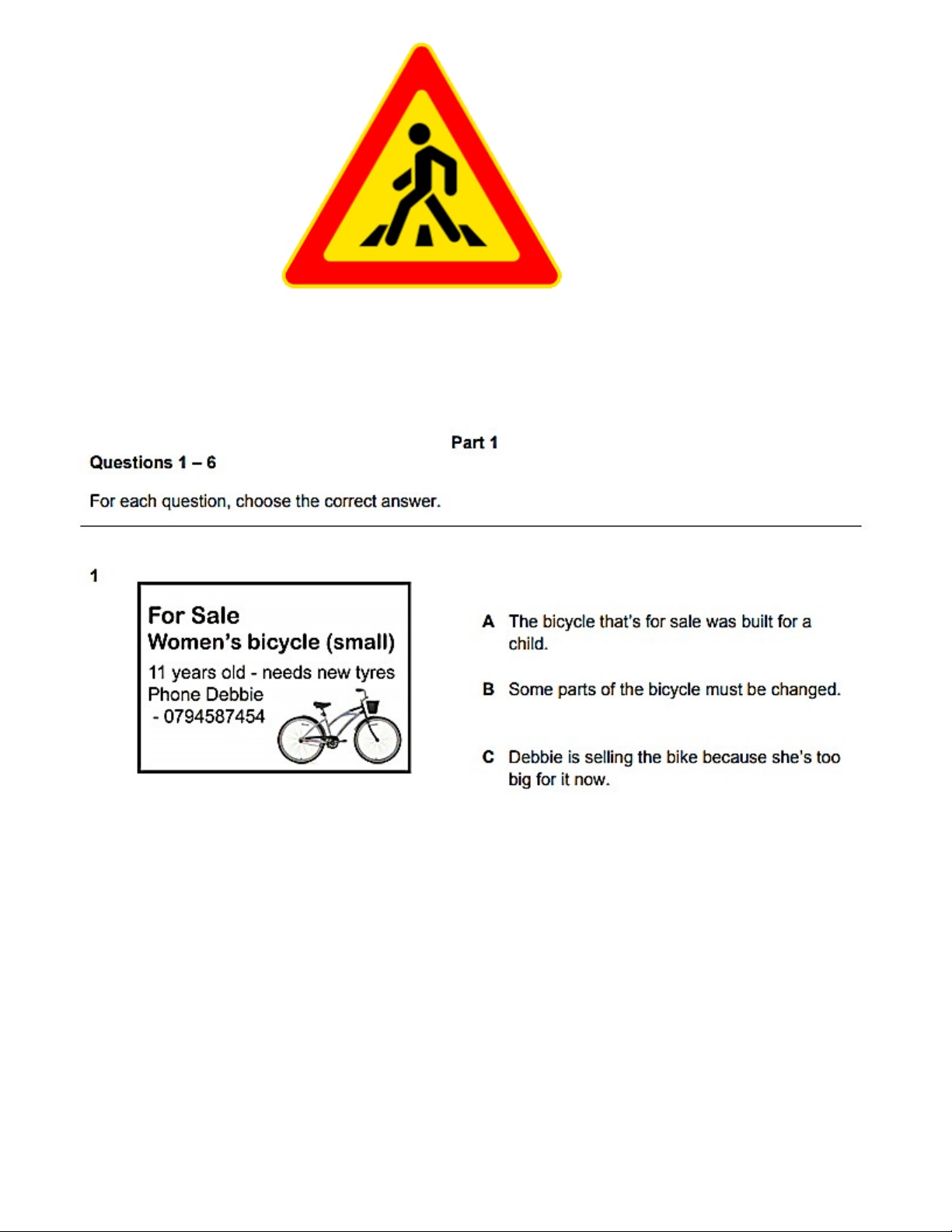
?&What does this sign say?
School ahead
`Road works ahead.
Pedestrian crossing ahead
aTraffic light ahead
!&)Correct information from the announcement?
The bicycle that's for sale was built for a child
`Some parts of the bicycle must be changed
Debbie is selling the bike because she's too big for it now.
aThe bike needs to be sold because the tyres are bad
k&What does this sign say?
E64?%

You can have some drinks and food here.
`Your breakfast is done.
No one helps you take food and drinks.
aYou can't drink and eat here.
#&)Correct information from the announcement?
E64?(

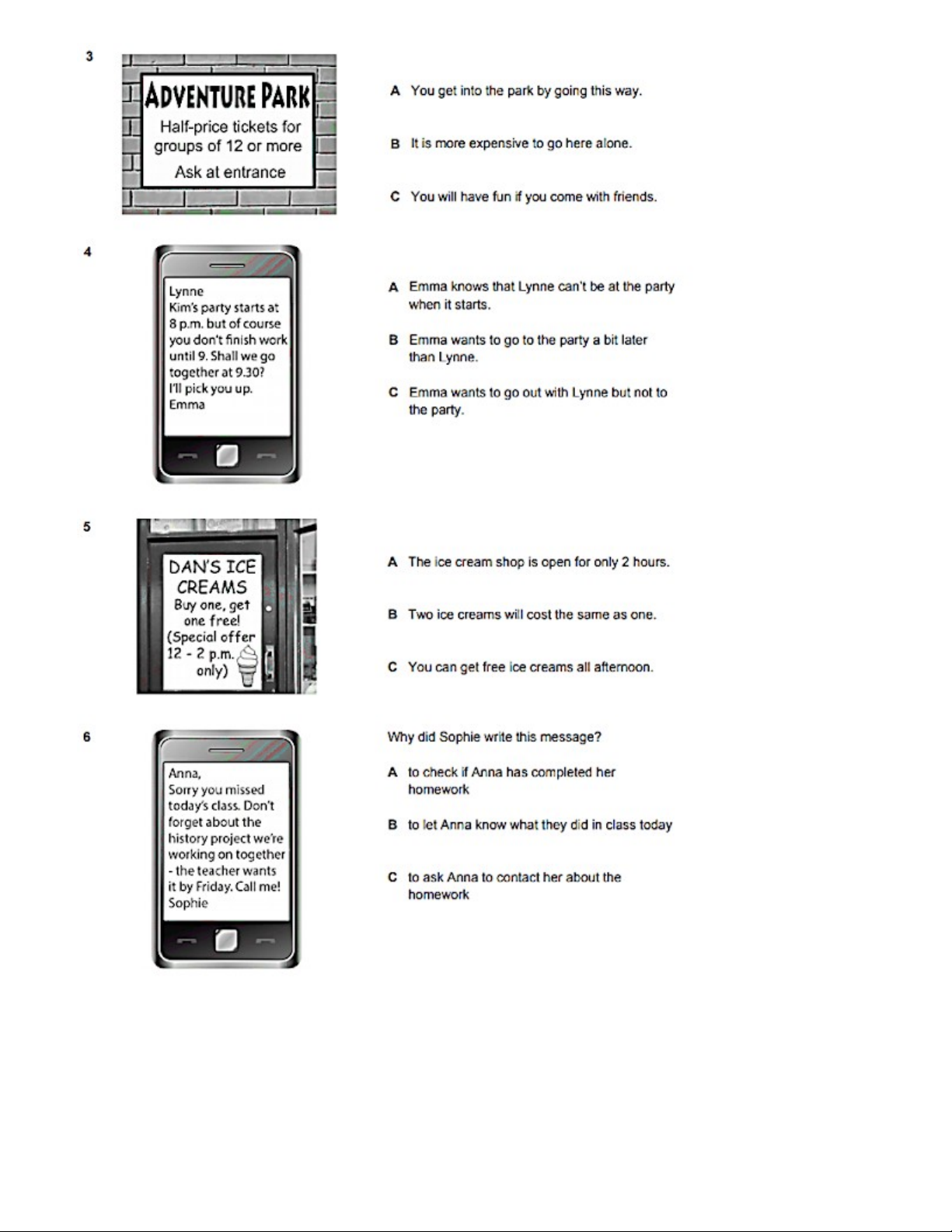
A Only discount for groups of 12.B Going alone will cost more.
C You will have more fun with friendsD Going with a group of 12 will get a discount.
E64?€

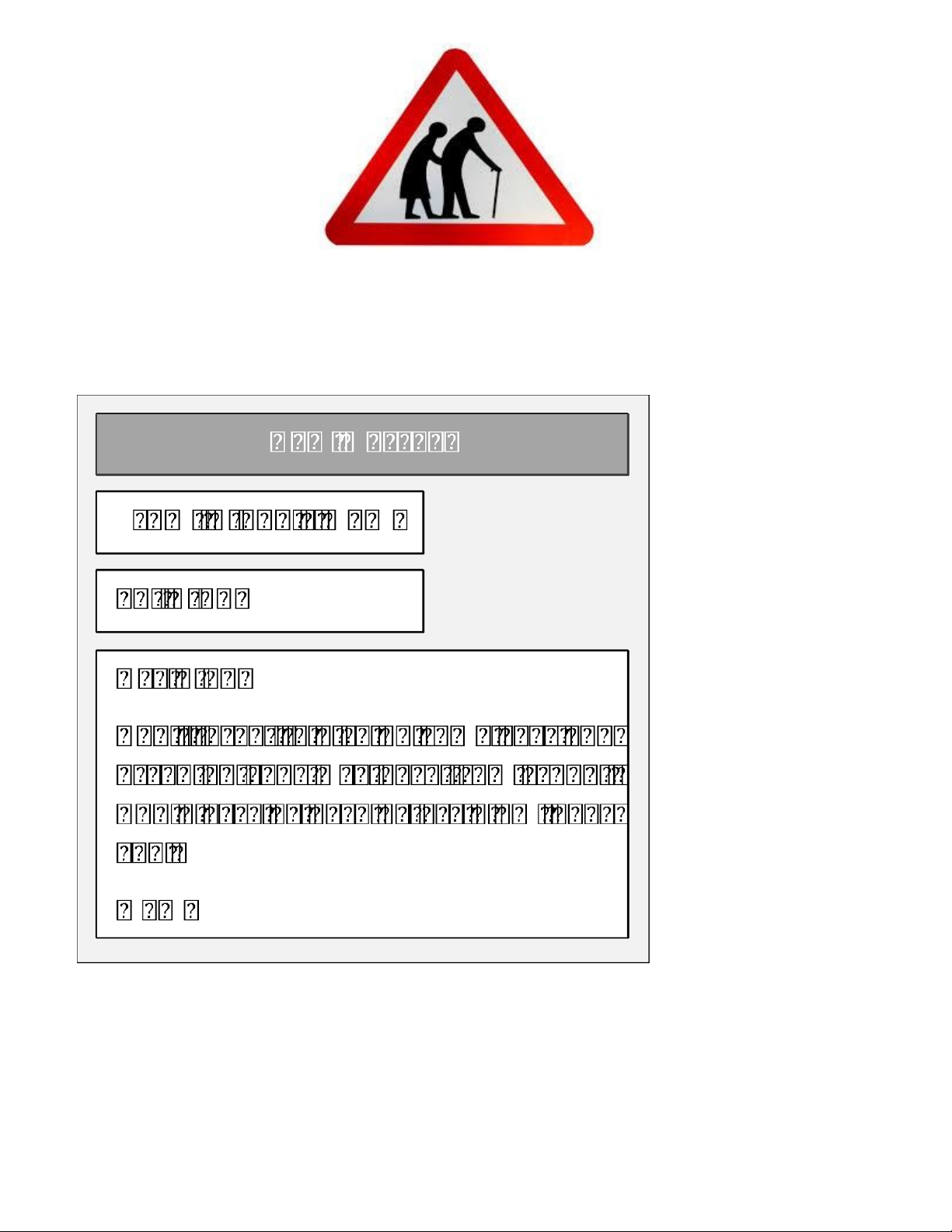
%&What does this sign mean?
Be cautious as elderly people may be crossing the road
`There are two old people here.
Be careless as elderly people may be crossing the road
aThey are wearing traditional clothing.
(&)What are the things that Mom asked her kid to pick up?
Eggs and milk `Eggs, bread, and milk Eggs and breadaBread and milk
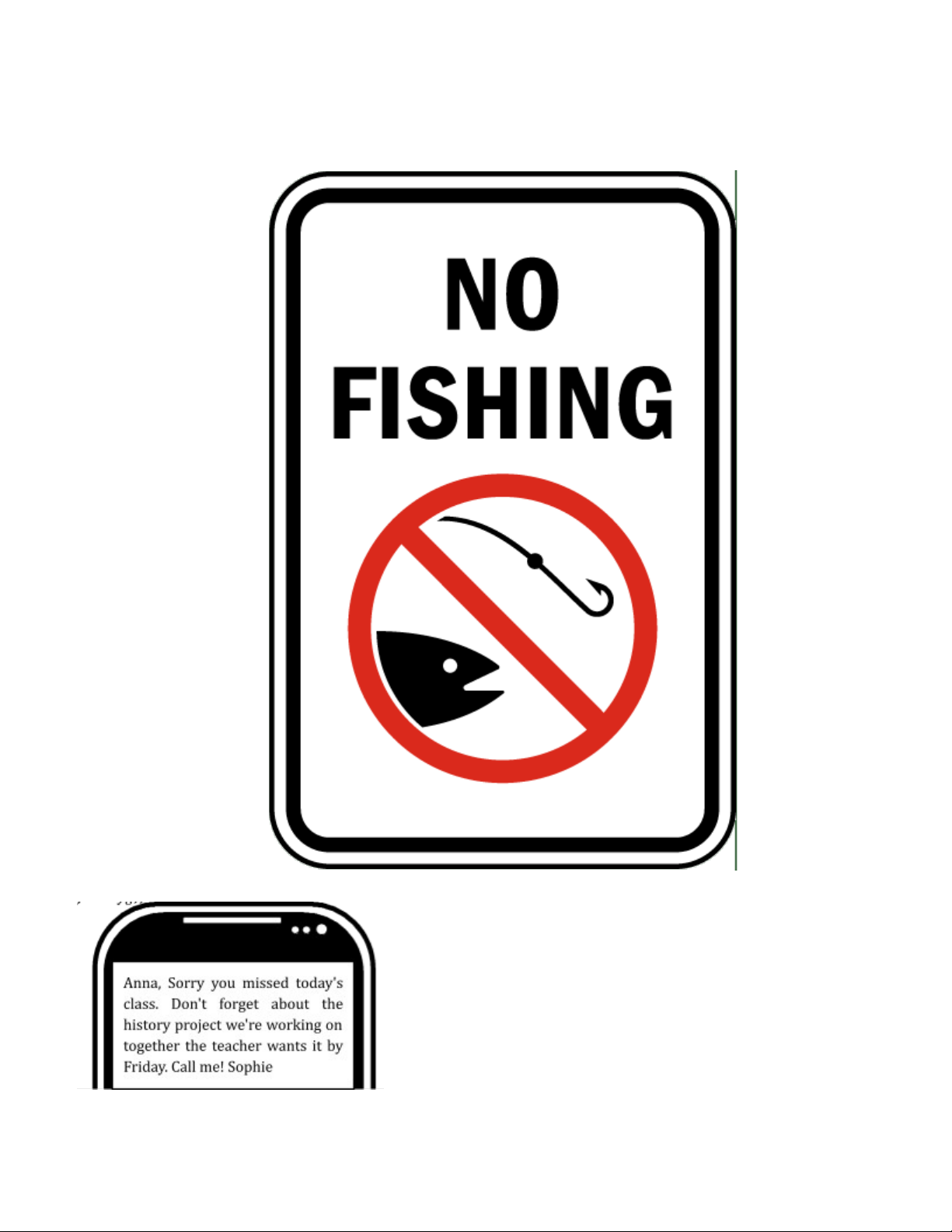
€&What does this sign mean?
Fishing is allowed here.
`Fishing is not allowed in this area
E64?•

Fishing is only allowed with a permit.
aFishing is encouraged
•&)Why did Sophie write this message?
to check if Anna has finished her homework`to let Anna know what they did in class today
to ask Anna to contact her about her homeworkato ask her if she has finished her homework
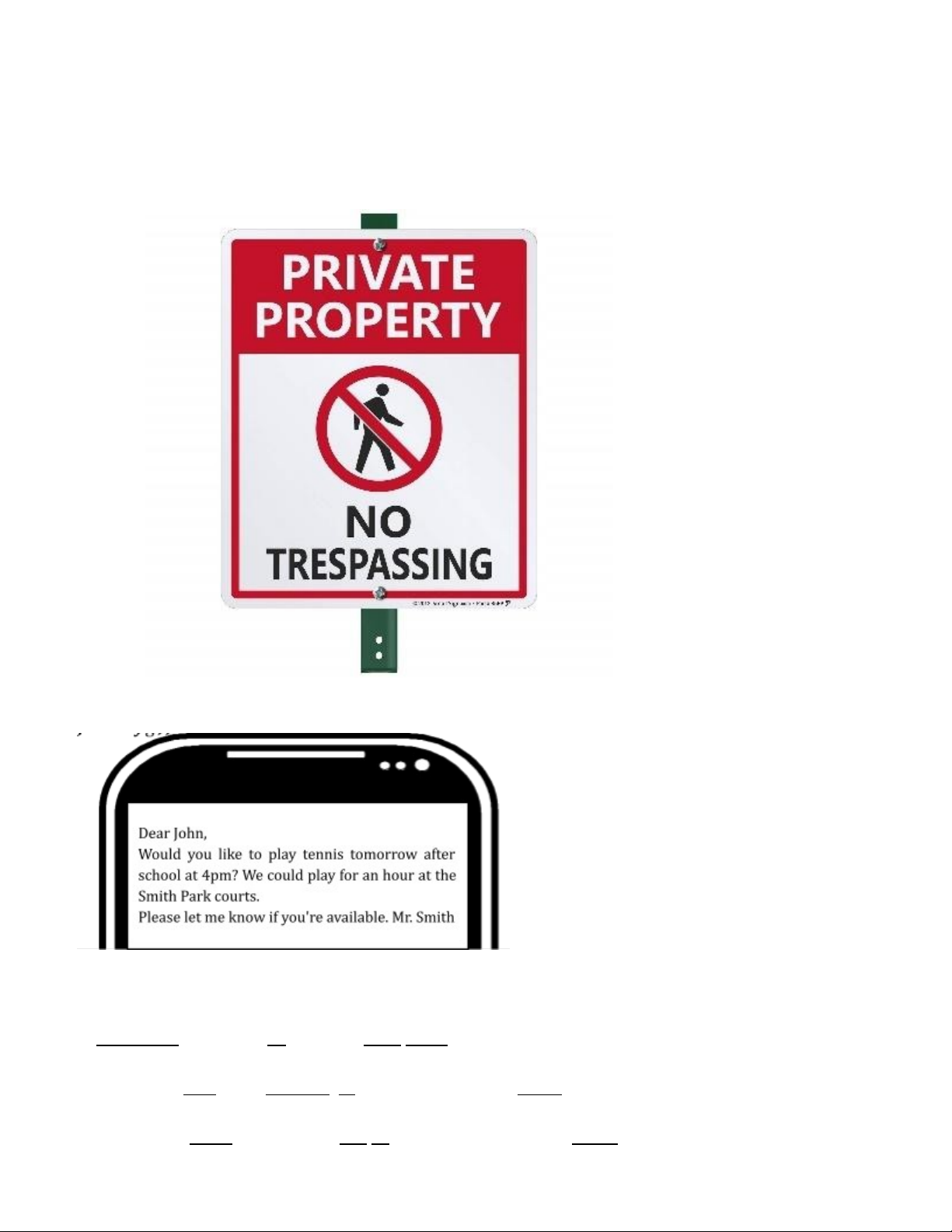
E64?t

t&What does this sign mean?
Trespassing is allowed
`Only specific times allow trespassing.
Going in without permission is not
allowed
aTrespassing is encouraged here.
?"&)What activity is being proposed in the message?
Going swimming      `Playing footballPlaying tennisaGoing for a run
3•++•
8:E:B6E*_`_Ea,6:8EE4&
1.How manyhomeworkdoyou haveto dotoday?
A. How manyB. doC. to doD. today
2. Sometimestheylistento music,sosometimes they readbooks.
A. theyB. to musicC. soD. books
3. Her son canspeakEnglish well,andhecan’t write any Englishwords.
A. speakB. andC. heD. works
E64!"