Đề Ôn Tập Kỳ 1 Tiếng Anh 11 Smart World 2025-2026 Có Đáp Án File Nghe-Đề 9
Đề Ôn Tập Kỳ 1 Tiếng Anh 11 Smart World 2025-2026 Có Đáp Án File Nghe-Đề 9. Tài liệu sưu tầm gồm 7 trang. Mời các bạn tham khảo
Chủ đề: Đề HK1 Tiếng Anh 11 35 tài liệu
Môn: Tiếng Anh 11 1 K tài liệu
Tác giả:







Preview text:
ĐỀ 9
ĐỀ ÔN TẬP CUỐI HỌC KỲ I NĂM HỌC 2025-2026 MÔN: TIẾNG ANH 11 PART 1. LISTENING: (2.0 pts)
I. Listen to the passage about an interview, and mark the letter A, B, C or D on your answer sheet to
indicate the correct answer. You will hear the conversation twice. (1.0pt)
Question 1. What is being built? A wind farm
B. a nuclear power plant C. a coal power plant
Question 2. People have been told already ___________.
A. how much it will cost B. where it will be
C. that will reduce pollution
Question 3. ___________ is a current problem in the area . A. A lot of traffic B. high unemployment
C. high electricity prices
Question 4. Emma is worried the project will cause ___________. A. Traffic jams B. pollution
C. higher electricity prices
Question 5. What is Emma’s main point ?
A. People don’t need to know more about the project B. People know enough.
C. People need to know more about the project
II. Listen to a talk about a man talking about street beggars in Ho Chi Minh City and decide
whether the statements are TRUE or FALSE, then mark the letter A or B. You will hear the conversation twice. (1.0pt)
Question 6. Giving money is a good way to support beggars. A. True B. False
Question 7. Telling touching stories is a form of begging. A. True B. False
Question 8. Some beggars don't want to get medical help. A. True B. False
Question 9. Begging should be supported in every society. A. True B. False
Question 10. Social protection centers provide beggars with jobs. A. True B. False
PART 2. USE OF LANGUAGE: (2.0 pts)
I. Read of the following announcement and mark the letter A, B, C or D on your answer sheet
to indicate the option that best fits each of the numbered blanks from 11 to 15.
H1N1 Flu (Swine Flu) Information
As you are likely aware, the Centres for Disease Control (CDC) has confirmed a growing
number of H1N1 flu cases (11) _______ the U.S.
Should you (12) _______ flu symptoms, please contact your health care provider immediately.
We recommend that any staff or faculty member with flu-like symptoms remain home (13) _______
symptom-free (no fever for 24 hours). Please contact Human Resources at 617-879-2193 if you, or a
member of your family, (14) _______ for flu. Normal sick leave policies will apply.
Symptoms of H1N1 flu are similar to regular flu and include:
• Sudden fever over 100 degrees
• Cough, sore throat, muscle aches, headache, chills, fatigue, and general weakness.
• These symptoms can range from mild to severe and may cause a worsening or underlying
chronic medical (15) _______. Question 11. A. of B. at C. on D. in Question 12. A. had B. has C. have had D. have Question 13. A. so B. before C. until D. because Trang 1
Question 14. A. treating B. have treated
C. are being treated D. treats
Question 15. A. location B. condition C. position D. situation
II. Read the following passage and mark the letter A, B, C or D on your answer sheet to
indicate the option that bestfits each of the numbered blanks from 16 to 20.
WELCOME TO YOUR NEW CITY!
Moving to a new city can be both exciting and overwhelming. Whether you're here for work, study,
or a fresh start, our guide will help you settle in quickly and enjoy everything the city has to offer.
First, check out the public transport system. Unlike (16) _____ cities you've lived in; this one has a
highly efficient network that connects all major areas. If you're unsure about routes, you can (17)
_____ the official app for schedules and maps.
For work and leisure, this city is home to many opportunities in technology, education, and
healthcare. It's a hub for (18) _____ and growth!
(19) _____ struggling to find parking, consider biking or using ride-share services—eco-friendlier and more stress-free!
Also, there are many exciting events happening year-round, from music festivals to art exhibitions.
Finally, don't forget to visit our iconic landmarks, including the new (20) _____ that opened
downtown—a true architectural masterpiece.
Question 16: A. another B. other C. the other D. others
Question 17: A. take up B. give up C. look up D. set up
Question 18: A. stagnation B. innovation C. preservation D. tourism
Question 19: A. On account of B. In view of
C. Irrespective of D. Instead of
Question 20: A. building B. factor C. resource D. site PART 3. READING: (2,0 pts)
I. Read the following passage and mark the letter A, B, C, or D on your answer sheet to indicate
the correct answer to each of the questions. (1.0pt)
EXHAUSTION OF LAND RESOURCES DEFORESTATION
Deforestation is the process of removing trees and other plants from an area of forest. This can occur for various reasons.
Agricultural expansion is one of the main causes of deforestation. As the demand for food
increases, more land is cleared to make way for crops and animals raised for meat. An industry called
logging is another common cause of deforestation, as trees are cut down for wood and other products.
In addition to these human activities, deforestation can also occur due to natural causes, such as
diseases which are spread by insects.
There is a dangerous circular process at work in some parts of the world. On the one hand,
deforestation contributes to global warming, because trees take carbon dioxide, a greenhouse gas,
out of the atmosphere during the day. Their loss, therefore, leads to less CO2 being removed. Yet
global warming is, itself, responsible for the loss of forests in some areas, because rising temperatures
and changing weather patterns can increase the frequency of wildfires.
Deforestation can also lead to the loss of animals and plants. These animals and plants may be
beautiful or interesting, but what we lose is much more important. According to the World Health
Organization, of the 252 most important chemicals used in the treatment of illness, 11.1% come from
plants and 8.7% from animals. If we lose plants and animals from the Earth, we may lose more
chemicals which can fight disease.
( Adapted from https://www.gauthmath.com/solution)
Question 21. How many human causes of deforestation are given in paragraph two? A. One B. Two C. Three D. Four
Question 22: The word “contributes” in paragraph 3 most probably means______. A. adds B. influences C. supports D. causes
Question 23. What does “Their” refer to in paragraph three? A. trees B. forests
C. carbon dioxide D. greenhouse gases
Question 24. What is paragraph four about? Trang 2
A. beautiful animals
B. beautiful plants C. diseases D. medical benefits
Question 25. What is a good title for this text?
A. Forest animals and birds
B. The cost of deforestation
C. From forest to farmland D. How forests die
II. Read the following passage and mark the letter A, B, C, or D on your answer sheet to
indicate the correct answer to each of the questions. (1.0pt)
Plants and animals will find it difficult to escape from or adjust to the effect of global
warming. Scientists have already observed shifts in the life cycles of many plants and animals, such
as flowers blooming earlier and birds hatching earlier in the spring. Many species have begun
shifting where they live or their annual migration patterns due to warmer temperatures.
With further warming, animals will tend to migrate toward the poles and up mountain sides toward
higher elevations. Plants will also attempt to shift their ranges, seeking new areas as old habitats grow
too warm. In many places, however, human development will prevent these shifts. Species that find
cities or farmland blocking their way north or south may become extinct. Species living in unique
ecosystems, such as those found in polar and mountaintop regions, are especially at risk because
migration to new habitats is not possible. For example, polar bears and marine mammals in the Arctic
are already threatened by dwindling sea ice but have nowhere farther to go.
Projecting species extinction due to global warming is extremely difficult. Some scientists have
estimated that 20 to 50 percent of species could be committed to extinction with 2 to 3 Celsius
degrees of further warming. The rate of warming, not just the magnitude, is extremely important for
plants and animals. Some species and even entire ecosystems, such as certain types of forest, may not
be able to adjust quickly enough and may disappear.
Ocean ecosystems, especially fragile ones like coral reefs, will also be affected by global warming.
Warmer ocean temperatures can cause coral to “bleach”, a state which if prolonged will lead to the
death of the coral. Scientists estimate that even 1 Celsius degree of additional warming could lead to
widespread bleaching and death of coral reefs around the world. Also increasing carbon dioxide in
the atmosphere enters the ocean and increases the acidity of ocean waters. This acidification furter stresses ocean ecosystems.
(Adapted from IPCC Special Report on Global Warming)
Question 26. What observable changes in plants and animals have scientists noted as a result of global warming?
A. Flowers blooming later in the spring
B. Birds hatching later in the spring
C. Flowers blooming earlier in the spring
D. Birds migrating less frequently
Question 27. The word “shifting” in paragraph 1 most probably means______. A. accelerating B. stabilizing C. changing D. adapting
Question 28. Why are species in polar and mountaintop regions particularly at risk due to global warming?
A. Lack of suitable habitats for migration B. Inability to adjust their life cycles
C. Threats from human development
D. Limited availability of food resources
Question 29. The pronoun “those” in paragraph 2 refers to ________. A. species B. ecosystems C. habitats D. areas
Question 30. What does the passage mainly discuss?
A. Influence of climate changes on human lifestyles.
B. Effects of global warming on animals and plants.
C. Global warming and possible solutions
D. Global warming and species migration
PART 4. WRITING: (2.0 pts) Trang 3
I. Mark the letter A, B, C or D on your answer sheet to indicate the best arrangement of
utterances or sentences to make a meaningful exchange or text in each of the following questions from 31 to 32. Question 31:
a. Tom: Oh, I’ve heard about that one! Is it playing at our local theater?
b. Tom: Not yet! There are so many good ones out right now. Do you have any suggestions?
c. Mia: Yes, it is! I checked the showtimes, and there’s a screening at 7 PM.
d. Mia: I was thinking we could watch that new action movie, “Chase the Night.” I heard it's really exciting!
e. Mia: Hey Tom, have you decided what movie we should watch this Saturday? A. c-b-d-a-e B. b-a-e-d-c C. e-b-d-a-c D. d-e-c-b-a Question 32:
a. Protecting our planet is crucial for future generations. Simple actions like recycling, conserving
water, and reducing waste can make a significant difference.
b. Education is key; by raising awareness about environmental issues, we can inspire others to take action.
c. In conclusion, it is our responsibility to protect the environment. Together, we can create a
healthier, more sustainable world for everyone.
d. The environment is essential for our survival, yet it faces numerous threats from pollution,
deforestation, and climate change.
e. Planting trees helps combat air pollution and supports wildlife. Additionally, using public transport
or biking reduces carbon emissions. A. b-a-d-e-c B. d-a-e-b-c C. a-e-c-d-b D. e-d-b-a-c
II. Rewrite each of the following sentences in such a way that it means the same as the given
sentence. Write your answer on your answer sheet.
Question 33. You didn’t remember her name until she left, did you?
=> You forgot______________________________________________, _________________?
Question 34. My aunt started living on the urban area when she graduated from university.
=> We have_____________________________________________________________________.
III. Combine each of the following sentences in such a way that it means the same as the given
sentence. Write your answer on your answer sheet.
Question 35. I’ve been working hard. I want to keep up with my classmates.
=> I’ve been working hard so that ___________________________________________________.
Question 36. The girl is very young. She isn’t allowed to drive a car.
=> The girl isn’t _________________________________________________________________.
IV. In about 120 - 150 words, write a cause and effect essay about stress of teenagers in Vietnam. (0,8 pt)
Following the guidelines below. Causes:
- stress from exams; stress from parents Effects:
- affect your sleep; affect mental health _The end_ ĐÁP ÁN A. MULTIPLE CHOICE: PART 1. LISTENING
(10 question items x 0.2pts/each = 2.0pts) PART 2. LANGUAGE
(10 question items x 0.2pts/each = 2.0pts) PART 3. READING
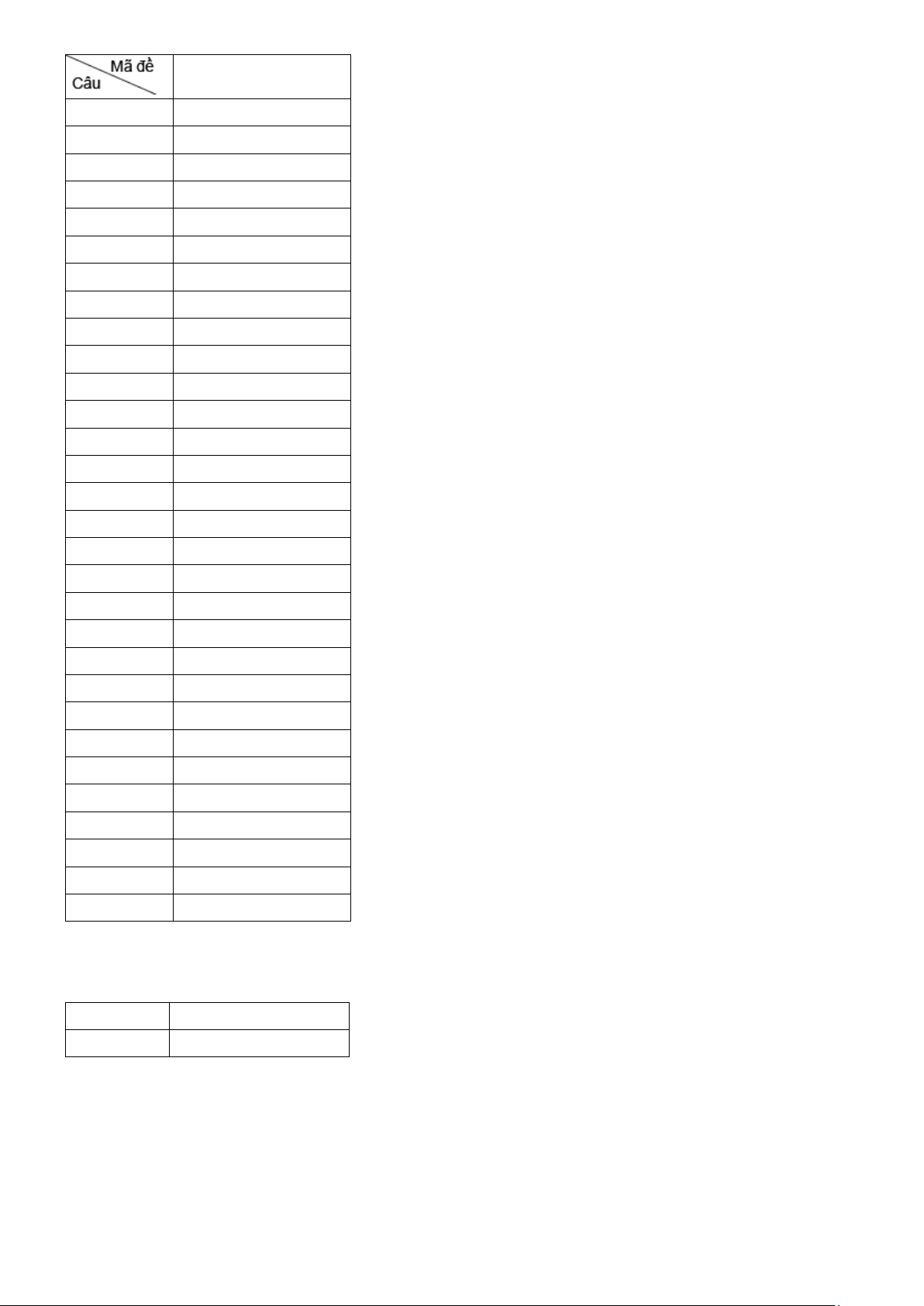
(10 question items x 0.2pts/each = 2.0pts) Trang 4 2b 1 B 2 C 3 B 4 A 5 C 6 B 7 A 8 A 9 B 10 B 11 D 12 D 13 C 14 C 15 B 16 B 17 C 18 B 19 D 20 A 21 B 22 D 23 A 24 D 25 B 26 C 27 C 28 A 29 A 30 B PART 4. WRITING:
I. (02 question items x 0.2pts/each = 0.4pts) 31 C 32 B
II&III. (04 question items x 0.2pts/each = 0.6pts)
Question 33: You forgot her name until she left, didn’t you?
Question 34: We have lived in the urban area since my aunt graduated from university.
Question 35: I have been working hard so that I can keep up with my classmates.
Question 36. The girl isn’t old enough to drive a car. PART 3: (0,8 pt) Trang 5
HƯỚNG DẪN CHẤM BÀI VIẾT:
GENERAL MARK SCHEME FOR WRITING FOR PART 4 (IV) • MARK CRITERIA 0.8
All content elements covered appropriately.
Message clearly communicated to reader. 0.6
All content elements adequately dealt with.
Message communicated successfully, on the whole 0.5
All content elements attempted.
Message requires some effort by the reader OR
One content element omitted but others clearly communicated. 0.3
Two content elements omitted, or unsuccessfully dealt with.
Message only partly communicated to reader OR
Script may be slightly short (50-55 words). 0.2
Little relevant content and/or message requires expressive effort by the reader, or short (25-45 words) 0
Totally irrelevant or totally incomprehensible or too short (under 20 words) V. SPEAKING: (2.0pts)
HƯỚNG DẪN CHẤM NÓI:
HƯỚNG DẪN CHẤM KỸ NĂNG NÓI (2 điểm) rubric • TIÊU CHÍ
(Xuất sắc) 2điểm (Tốt) 1,5 điểm (Đạt) 1 điểm
(Chưa đạt) 0,5 điểm 1. Nội dung & ý Phong phú, logic, Đủ ý, logic,
Ý còn đơn giản, Ý nghèo nàn, rời rạc tưởng sáng tạo tương đối thiếu phát triển
2. Tổ chức bài nói Rõ ràng, mạch lạc, Có bố cục, liên Liên kết yếu, ý
Thiếu bố cục, rời rạc liên kết tốt kết khá sắp xếp chưa rõ
3. Ngữ pháp & từ Đa dạng, chính xác,
Đa số đúng, ít lỗi Nhiều lỗi ngữ
Lỗi liên tục, khó hiểu vựng dùng linh hoạt nhỏ pháp/ từ vựng ảnh hưởng đến hiểu
4. Phát âm & ngữ
Rõ ràng, ngữ điệu tự Khá rõ, đôi khi Khó nghe, phát Rất khó nghe, không thể điệu nhiên chưa chuẩn âm sai nhiều hiểu 5. Tương tác/ thái Tự tin, chủ động, Tương tác tương
Ít tương tác, rụt Không tương tác, thụ độ hợp tác tốt đối tốt rè động TAPESCRIPT FOR LISTENING:
LISTENING PART 1: Listen to an interview.
Interviewer: Welcome back. I'm here talking to Emma Ishins about the new nuclear power plant project. Emma: Hello. Trang 6
Interviewer: So Emma, most people think the power plant is a great thing. What do you think?
Emma: I don't think people know enough about it. Interviewer: Oh?
Emma: We have been told how it will reduce pollution and reduce electricity prices, which is a great
thing, but there is so much more. Interviewer: I see.
Emma: People need to know how long the project is going to take. Interviewer: Okay.
Emma: It may reduce pollution, but when will it start to help? They also need to know how many
jobs the project will create. There are lots of unemployed people in this area.Is the project going to
create enough jobs for the local people?
Interviewer: Yes. Very interesting. What else?
Emma: They need to think about how the project will affect the roads and transport. A lot of
materials will need to be moved around the city. I worry it will create traffic jams.Will people be late
for work? These things are important.
Interviewer: Yes, they are.
Emma: And what about the dangers? We have all heard of nuclear power and know it can be
dangerous. Are we safe having this nuclear power station so close to us?
Interviewer: Some very good points.That's all we have time for. Thanks for joining us, Emma. Emma: Thank you.
LISTENING PART 2: Listen to a man talking about street beggars in Ho Chi Minh City
Ho Chi Minh City is trying to persuade residents to stop giving money to local beggars
because it is not the best way to help them.
In large cities, the art of begging can take many forms. Beggars can be found at street lights, local
markets, and even open-air restaurants.
Telling touching stories in a common way to trick kind people for their money. One might
claim to be lost and ask for spared change for a bus ticket home. Many beggars can be seen sitting on
the roadside with children, some of whom are obviously ill and may not even be their own babies.
Most notably, some beggars refuse people's help to provide medical help or shelter for their children
because they say that they would rather care for their children on their own.
Begging must be discouraged at all costs. Children should attend school while adults should
work to support their families. We can certainly address this issue if the authorities take adequate
steps to enroll all children in school and create enough jobs.
According to the city's Department of Labor, war-involids and social affairs, the homeless and
beggars who stay at social protection centers receive general education and vocational training to
eliminate literacy and provide them with access to primary school education. The flexible training
period helps them quickly return to their communities, find good jobs and live stable lives. The
centers also work with businesses to find jobs for former beggars or the homeless. Trang 7
Document Outline
- WELCOME TO YOUR NEW CITY!
Tài liệu liên quan:
-
Tài liệu ôn tập kiểm tra HK1 tiếng anh 11 năm 2025 - 2026 THPT Nguyễn Văn Thoại
69 35 -
Đề cương chi tiết cuối kì 1 tiếng anh 11 năm 2025 - 2026 THPT Chu Văn An
42 21 -

Đề Ôn Tập HK 1 Anh 11 Global Success 2025-2026 Có Đáp Án File Nghe-Đề 6
135 68 -

Đề Ôn Tập HK 1 Anh 11 Smart World 2025-2026 Có Đáp Án File Nghe-Đề 7
85 43 -

Đề Ôn Tập Học Kỳ 1 Tiếng Anh 11 Smart World 2025-2026 Có Đáp Án File Nghe-Đề 8
98 49