Định nghĩa và cấu trúc Câu ghép (Compound Sentence)
Định nghĩa và cấu trúc Câu ghép (Compound Sentence). Tài liệu được sưu tầm giúp bạn tham khảo, ôn tập và đạt kết quả cao. Mời bạn đọc đón xem.
Chủ đề: Tài liệu ôn thi THPTQG môn Tiếng Anh 54 tài liệu
Môn: Tiếng Anh 318 tài liệu
Tác giả:








Preview text:
Định nghĩa và cấu trúc câu ghép (Compound Sentence)
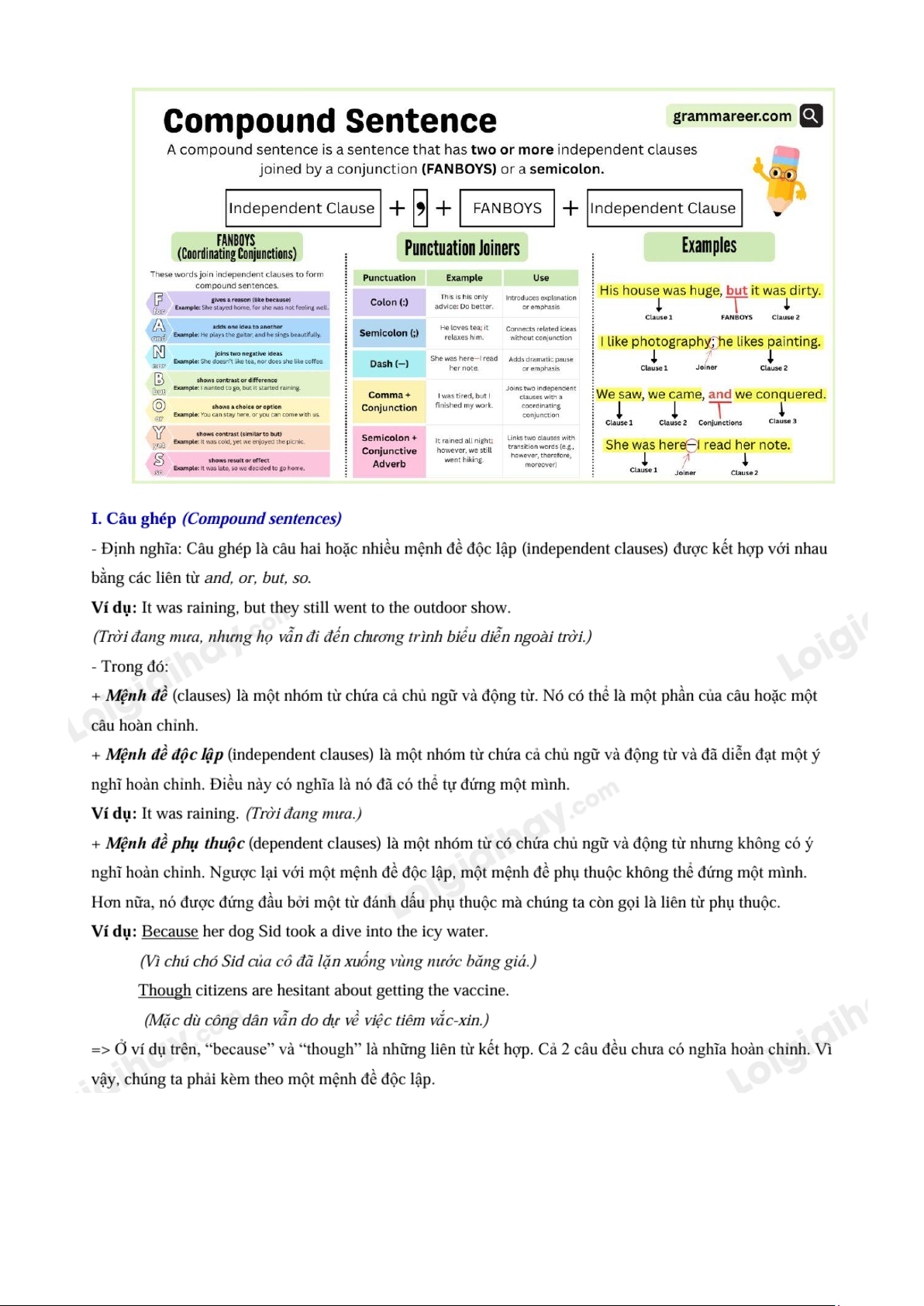
Một câu ghép (Compound Sentence) được hình thành từ hai hay nhiều mệnh đề độc lập
(Independent Clause). Các mệnh đề này thường được nối với nhau bằng liên từ
(conjunction) hoặc dấu chấm phẩy (;).
• Liên từ (Conjunction): for, and, nor, but, or, yet, so (FANBOYS)
• Trạng từ nối (Conjunctive Adverb): however, therefore, moreover, consequently, etc.
• Dấu chấm phẩy (;): sử dụng khi hai mệnh đề có quan hệ gần gũi với nhau.
Các Ví Dụ Về Câu Ghép Cách Nối Ví Dụ Liên từ
I like playing tennis, but my sister enjoys playing badminton.
My big brother is good at math; moreover, he is excellent at Trạng từ nối English. Dấu chấm
I’m making a cake; my mother is cooking for dinner. phẩy
• 1. Sử dụng liên từ (Conjunction)
Liên từ (Conjunction) là từ nối giữa các mệnh đề độc lập trong câu ghép. Các liên từ
phổ biến bao gồm: for, and, nor, but, or, yet, so (viết tắt là FANBOYS).
o For: I stayed home, for it was raining.
o And: I enjoy reading books, and I love watching movies.
o Nor: She didn't go to school, nor did she stay at home.
o But: He is smart, but he doesn't work hard.
o Or: We can go to the park, or we can stay home.
o Yet: He studied hard, yet he failed the exam.
o So: She was tired, so she went to bed early.
• 2. Sử dụng trạng từ nối (Conjunctive Adverb)
Trạng từ nối dùng để nối các mệnh đề độc lập trong câu ghép và thường đi kèm với dấu
chấm phẩy và dấu phẩy.
o However: She wanted to join the trip; however, she was too busy.
o Therefore: He didn't study; therefore, he failed the test.
o Moreover: The book is interesting; moreover, it is informative.
o Otherwise: You need to hurry; otherwise, you'll miss the bus.
o Meanwhile: I was cooking dinner; meanwhile, he was setting the table.
• 3. Sử dụng dấu chấm phẩy (;)
Dấu chấm phẩy được sử dụng để nối hai mệnh đề độc lập có liên quan mật thiết mà
không cần dùng liên từ hoặc trạng từ nối.
o She loves playing the piano; her sister enjoys painting.
o He finished his homework; he went out to play.
o The weather was cold; they decided to stay inside.
Các cách tạo câu ghép
Câu ghép (compound sentence) là loại câu được hình thành từ hai hay nhiều mệnh đề
độc lập. Các mệnh đề này thường được nối với nhau bằng các liên từ, trạng từ liên kết
hoặc dấu chấm phẩy. Dưới đây là các cách tạo câu ghép phổ biến:
1. Sử dụng liên từ (Conjunction)
Liên từ là từ nối hai mệnh đề độc lập với nhau. Các liên từ phổ biến bao gồm:
• For: dùng để chỉ nguyên nhân.
o Ví dụ: I never stay in that hotel, for it is really bad. (Tôi không bao giờ ở khách
sạn đó vì nó quá tệ.)
• And: dùng để cộng thêm vào.
o Ví dụ: I like playing the guitar and I often go to the guitar club. (Tôi thích chơi
ghi-ta và tôi thường đến câu lạc bộ ghi-ta.)
• Nor: dùng để bổ sung một ý phủ định vào ý phủ định đã được nêu trước đó.
o Ví dụ: Students don’t do homework, nor do they learn vocabulary. (Học sinh
không làm bài tập về nhà cũng không học từ vựng.)
• But: chỉ sự mâu thuẫn.
o Ví dụ: I studied hard, but I didn’t pass the exam. (Tôi học hành rất chăm chỉ
nhưng tôi vẫn thi không đậu.)
• Or: dùng để bổ sung một lựa chọn khác.
o Ví dụ: You should stop smoking, or your health will be worse. (Bạn nên ngừng
hút thuốc hoặc sức khỏe của bạn sẽ trở nên tệ hơn.)
• Yet: dùng để diễn tả ý kiến trái ngược so với ý trước.
o Ví dụ: He said he was my friend, yet he kept disappointing me. (Anh ấy nói
rằng anh ấy là bạn tôi, nhưng mà anh ấy cứ làm tôi thất vọng.)
• So: dùng để chỉ kết quả.
o Ví dụ: Sarah was late for the meeting, so she missed the information. (Sarah đã
đi trễ trong buổi họp, nên cô ấy không nghe được thông tin trong buổi họp đó.)
2. Sử dụng trạng từ nối (Conjunctive Adverb)
Trạng từ nối dùng để nối hai mệnh đề độc lập thành câu ghép và thường đứng sau dấu
phẩy hoặc dấu chấm phẩy. Các trạng từ nối phổ biến bao gồm: however, therefore, moreover, meanwhile, etc.
• Ví dụ: I enjoy playing tennis; however, I hate playing badminton. (Tôi thích chơi
tennis; tuy nhiên, tôi ghét chơi cầu lông.)
3. Sử dụng dấu chấm phẩy (;)
Dấu chấm phẩy được sử dụng để nối hai mệnh đề độc lập có quan hệ chặt chẽ với nhau
mà không cần sử dụng từ nối.
• Ví dụ: I enjoy playing tennis; I hate playing badminton. (Tôi thích chơi tennis; tôi ghét chơi cầu lông.)
4. Sử dụng mệnh đề quan hệ (Relative Clause)
Đôi khi mệnh đề quan hệ cũng được dùng để tạo thành câu ghép nhằm bổ sung thông tin cho mệnh đề chính.
• Ví dụ: The book, which I bought yesterday, is very interesting. (Quyển sách mà tôi
mua hôm qua rất thú vị.) BÀI TẬP
Task 1. Complete the sentences with the words given and but or so for
1. I feel tired, _____I feel weak.
2. The Japanese eat healthily, _____they live for a long time.
3. I have flu, _____I don't feel very tired.
4. You should eat less fast food, _____you can put on weight.
5. You can go and see the doctor, _____you can go to bed now and rest.
6. The Japanese eat a lot of rice, _____they eat lots of fish, too.
7. I want to eat ice-cream, _____I have a sore throat
8. You should eat less fast food, _____you can put on weight.
9. The Americans often eat fast food, _____ many of them are overweight.
10. You can walk, _____ you can ride a bike to get there.
Task 2. Combine sentences, using appropriate coordinating conjunction in the box
1. You may have an allergy. Be careful with what you eat and drink. (so)
___________________________________________________________________
2. Tom has a temperature. Tom has a sore throat. (and)
___________________________________________________________________
3. I want to buy other car. I have no money. (but)
___________________________________________________________________
4. It’s raining. I will stay at home and sleep. (so)
___________________________________________________________________
5. I pass the test. My parents took me to the cinema. (therefore)
___________________________________________________________________
Task 3. Combine sentences, using appropriate coordinating conjunction in the box
1. I feel sleepy. I must finish the report. (however)
______________________________________________________________
2. His shoes are worn. He has no socks. (for)
______________________________________________________________
3. I wanted to buy a set of Lego. I started to save my money. (so)
______________________________________________________________
4. I enjoy visiting many different countries. I wouldn’t want to live overseas. (yet)
______________________________________________________________
5. I couldn’t go to your party. I was tired. (for)
______________________________________________________________
Task 4. Nối hai câu riêng lẻ dưới đây thành một câu
1. He worked for a woman. She used to be an artist.
2. They called a doctor. He lived nearby.
3. I wrote an email to my sister. She lives in Italy.
4. Linh liked the waiter. He was very friendly.
5. We broke a car. It belonged to my uncle.
6. Ba dropped a cup. It was new.
7. Nam loves books. They have happy endings.
Task 5. Complete the sentences with the words given: and, but, or, so, for.
1. I feel tired, _______ I feel weak.
2. The Japanese eat healthily, _______ they live for a long time.
3. I have the flu, _______ I don’t feel very tired.
4. You should eat less fast food, _______ you can put on weight.
5. You can go and see the doctor, _______ you can go to bed now and rest.
6. The Japanese eat a lot of rice, _______ they eat lots of fish, too.
7. I want to eat ice-cream, _______ I have a sore throat
8. You should eat less fast food, _______ you can put on weight.
9. Americans often eat fast food, _______ many of them are overweight.
10. You can walk, _______ you can ride a bike to get there.
Task 6. Combine sentences, using appropriate coordinating conjunction in the box.
1. You may have an allergy. Be careful with what you eat and drink. (so)
→ __________________________________________________.
2. Tom has a temperature. Tom has a sore throat. (and)
→ __________________________________________________.
3. I want to buy another car. I have no money. (but)
→ __________________________________________________.
4. It’s raining. I will stay at home and sleep. (so)
→ __________________________________________________.
5. I passed the test. My parents took me to the cinema. (therefore)
→ __________________________________________________.
6. I feel sleepy. I must finish the report. (however)
→ __________________________________________________.
7. His shoes are worn. He has no socks. (for)
→ __________________________________________________.
8. I enjoy visiting many different countries. I wouldn’t want to live overseas. (yet)
→ __________________________________________________.
9. She doesn’t like vegetables. She doesn’t eat fruit. (nor)
→ __________________________________________________.
10. Paul has a three – week holiday. He has enough money to travel. (moreover)
→ __________________________________________________.
Task 7. The sentences below are compound or complex sentences?
1. I can swim but my brother can’t do it.
2. Jane brings an umbrella, for it is going to rain.
3. The number of cars which were sold last year was 5,000.
4. When he handed in his exercises, he forgot to give his teacher the last page.
5. We will go to the cinema after we finish our homework.
Task 8. Arrange the following sentences into complete compound sentences.
1. walks to work/ John/ every day/ in the morning/.
2. They/ and/ swam/ in/ went to/ the/ beach/ the/ sea/.
3. couldn’t/ sleep/ last/ night/ She/ because/ of/ the/ noise/.
4. after/ school/ does/ her/ homework/ and/ then/ goes/ to/ soccer/ practice/.
5. we’ll/ have/ to/ If/ it/ rains/ stay/ indoors/.
6. pizza/ but/ he/ loves/ He/ likes/ pasta/.
7. didn’t/ have/ enough/ money/ They/ wanted/ to/ go/ on/ vacation/ this year/.
8. The/ cat/ sat/ watched/ the/ birds/ outside/ on/ the/ windowsill/ and/.
9. She/ and/ then/ celebrated/ finished/ her/ project/ with/ her/ friends/.
10. loves/ to read/ the/ library/ books/ She/ and/ often/ visits/.
Task 9. Chọn đáp án đúng.
1. He is the right man for the job; accordingly / additionally, he has all the required experience.
2. Jack easily gets angry; otherwise / consequently, nobody talks to him.
3. She likes children; in fact / as a result, she loves them so much.
4. Andrea was badly hurt; however / moreover, he recovered fast.
5. He missed his train; therefore / however, he managed to go to the company on time.
6. Mario studies well; besides / as a result, he scores well.
7. Everybody wants to succeed; nevertheless / furthermore, not everyone puts in the required effort.
8. Charlie must be driving back home; therefore / additionally, he is not receiving your call.
9. The cost of materials rose sharply last year; accordingly / in fact, we were forced to increase our prices.
10. Agatha Christie was a well-known detective author, but besides / nevertheless that, few
people know she also worked as a pharmacist’s assistant.