Dive Into Design Patterns by Alexander Shvets
Dive Into Design Patterns by Alexander Shvets
Môn: Thiết kế phần mềm (DEPA330879) 7 tài liệu
Trường: Trường Đại học Sư phạm Kỹ thuật Thành phố Hồ Chí Minh 4.4 K tài liệu
Tác giả:











Preview text:
Dive Into DESIGN PATTERNS v2023-2.44 A Few Words on Copyright
Hi! My name is Alexander Shvets. I'm
the author of the book Dive Into Design
Patterns 1 and the online course Dive Into Refactoring2.
This book is for your personal use only.
Please don't share it with any third
parties except your family members. If you'd like to share the
book with a friend or colleague, buy and send them a new
copy. You can also buy a site license for your whole team or the entire company.
All profit from the sale of my books and courses is spent on
the development of Refactoring.Guru. Each copy sold helps
the project immensely and brings the moment of a new book release a little bit closer.
Alexander Shvets, Refactoring.Guru, 2022
support@refactoring.guru
Illustrations: Dmitry Zhart
Editing: Andrew Wetmore, Rhyan Solomon
1. Dive Into Design Patterns: https://refactoring.guru/design-patterns/book
2. Dive Into Refactoring: https://refactoring.guru/refactoring/course
I dedicate this book to my wife, Maria. If it
hadn't been for her, I'd probably have finished
the book some 30 years later. 4 Table of Contents #156629 Table of Contents
Table of Contents .................................................................................................. 4
How to Read This Book......................................................................................... 6
INTRODUCTION TO OOP ........................................................................................ 7
Basics of OOP........................................................................................8
Pillars of OOP..................................................................................... 13
Relations Between Objects............................................................ 20
INTRODUCTION TO DESIGN PATTERNS........................................................... 26
What's a Design Pattern?................................................................ 27
Why Should I Learn Patterns?....................................................... 31
SOFTWARE DESIGN PRINCIPLES ..................................................................... 32
Features of Good Design................................................................ 33
Design Principles........................................................................................... 37
§ Encapsulate What Varies........................................................ 38
§ Program to an Interface, not an Implementation ......... 42
§ Favor Composition Over Inheritance................................. 47
SOLID Principles .............................................................................................51
§ Single Responsibility Principle............................................ 52
§ Open/Closed Principle............................................................ 54
§ Liskov Substitution Principle................................................ 57
§ Interface Segregation Principle........................................... 64
§ Dependency Inversion Principle ......................................... 67
sevenbookyue@gmail.com (#156629) 5 Table of Contents #156629
CATALOG OF DESIGN PATTERNS...................................................................... 71
Creational Design Patterns......................................................................... 72
§ Factory Method ......................................................................... 74
§ Abstract Factory........................................................................ 90
§ Builder........................................................................................105
§ Prototype ...................................................................................124
§ Singleton ...................................................................................138
Structural Design Patterns....................................................................... 147
§ Adapter.......................................................................................150
§ Bridge .........................................................................................164
§ Composite .................................................................................179
§ Decorator...................................................................................193
§ Facade ........................................................................................211
§ Flyweight...................................................................................221
§ Proxy ...........................................................................................235
Behavioral Design Patterns ...................................................................... 247
§ Chain of Responsibility.........................................................251
§ Command ..................................................................................269
§ Iterator........................................................................................290
§ Mediator.....................................................................................305
§ Memento....................................................................................321
§ Observer.....................................................................................337
§ State............................................................................................353
§ Strategy......................................................................................369
§ Template Method....................................................................382
§ Visitor..........................................................................................394
Conclusion ......................................................................................................... 410
sevenbookyue@gmail.com (#156629) 6 How to read this book #156629 How to Read This Book
This book contains the descriptions of 22 classic design pat-
terns formulated by the “Gang of Four” (or simply GoF) in 1994.
Each chapter explores a particular pattern. Therefore, you can
read from cover to cover or by picking the patterns you’re inter- ested in.
Many patterns are related, so you can easily jump from topic
to topic using numerous anchors. The end of each chapter has
a list of links between the current pattern and others. If you
see the name of a pattern that you haven’t seen yet, just keep
reading—this item will appear in one of the next chapters.
Design patterns are universal. Therefore, all code samples in
this book are written in pseudocode that doesn’t constrain the
material to a particular programming language.
Prior to studying patterns, you can refresh your memory by
going over the key terms of object-oriented programming.
That chapter also explains the basics of UML diagrams, which
is useful because the book has tons of them. Of course, if you
already know all of that, you can proceed to learning patterns right away.
sevenbookyue@gmail.com (#156629) #156629 INTRODUCTION TO OOP
sevenbookyue@gmail.com (#156629) 8
Introduction to OOP / Basics of OOP #156629 Basics of OOP
Object-oriented programming is a paradigm based on the con-
cept of wrapping pieces of data, and behavior related to that
data, into special bundles called objects, which are construct-
ed from a set of “blueprints”, defined by a programmer, called classes. Objects, classes
Do you like cats? I hope you do because I’ll try to explain the
OOP concepts using various cat examples.
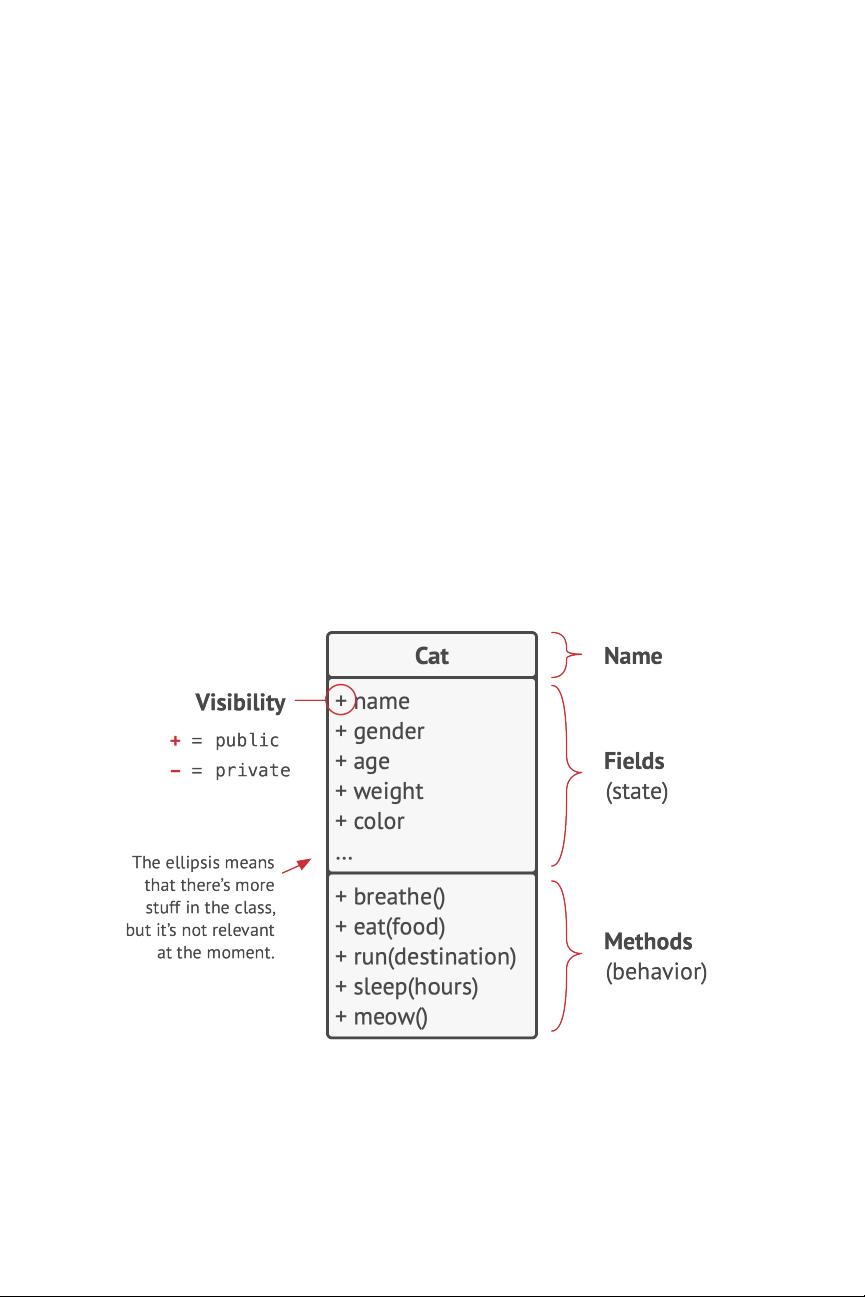
This is a UML class diagram. You’ll see a lot of such diagrams in the book.
sevenbookyue@gmail.com (#156629) 9
Introduction to OOP / Basics of OOP #156629
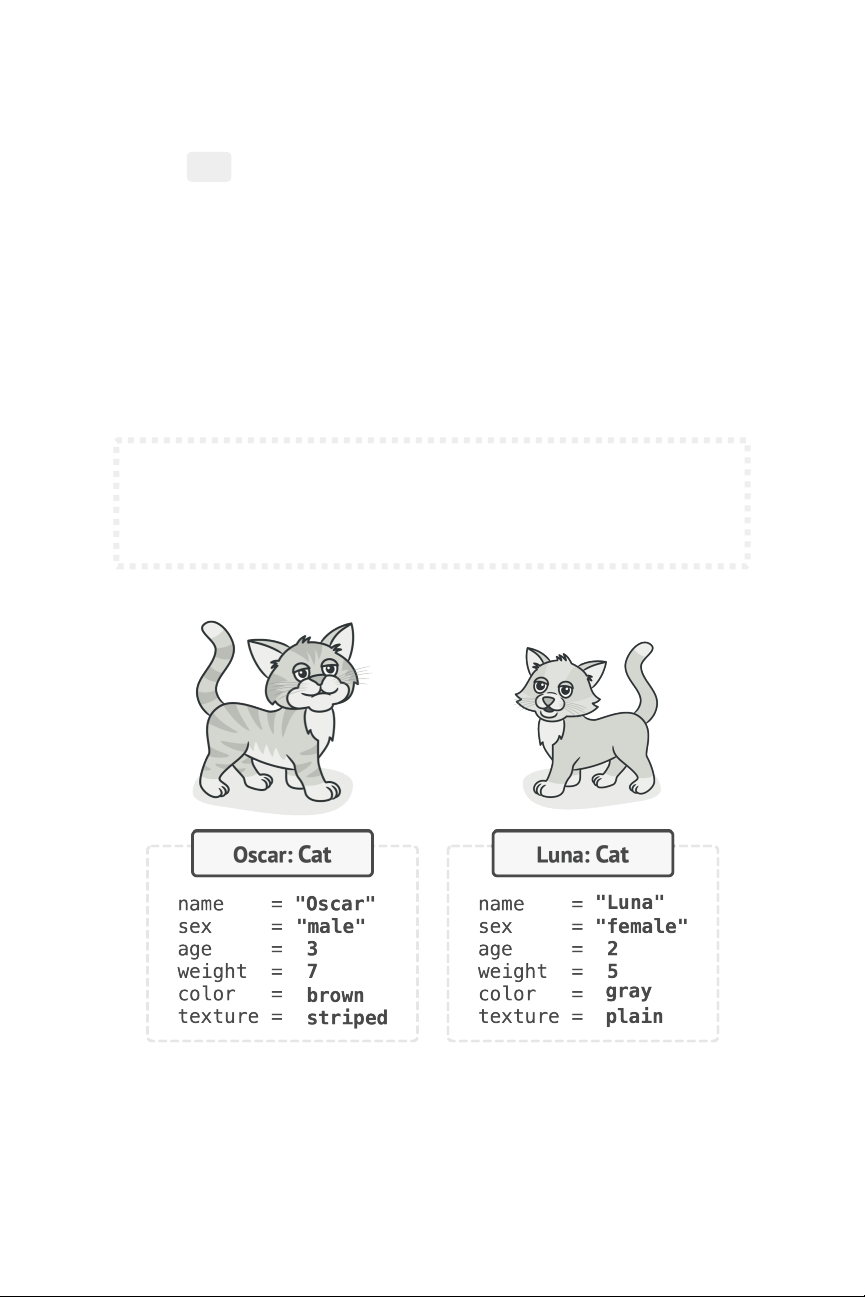
Say you have a cat named Oscar. Oscar is an object, an instance
of the Cat class. Every cat has a lot of standard attributes:
name, sex, age, weight, color, favorite food, etc. These are the class’s fields.
All cats also behave similarly: they breathe, eat, run, sleep and
meow. These are the class’s methods. Collectively, fields and
methods can be referenced as the members of their class.
Data stored inside the object’s fields is often referenced
as state, and all the object’s methods define its behavior.
Objects are instances of classes.
sevenbookyue@gmail.com (#156629) 10
Introduction to OOP / Basics of OOP #156629
Luna, your friend’s cat, is also an instance of the Cat class.
It has the same set of attributes as Oscar. The difference is in
values of these attributes: its sex is female, it has a different color, and weighs less.
So a class is like a blueprint that defines the structure for
objects, which are concrete instances of that class. Class hierarchies
Everything’s fine and dandy when we talk about one class. Nat-
urally, a real program contains more than a single class. Some
of these classes might be organized into class hierarchies. Let’s find out what that means.
Say your neighbor has a dog called Fido. It turns out, dogs
and cats have a lot in common: name, sex, age, and color are
attributes of both dogs and cats. Dogs can breathe, sleep and
run the same way cats do. So it seems that we can define the
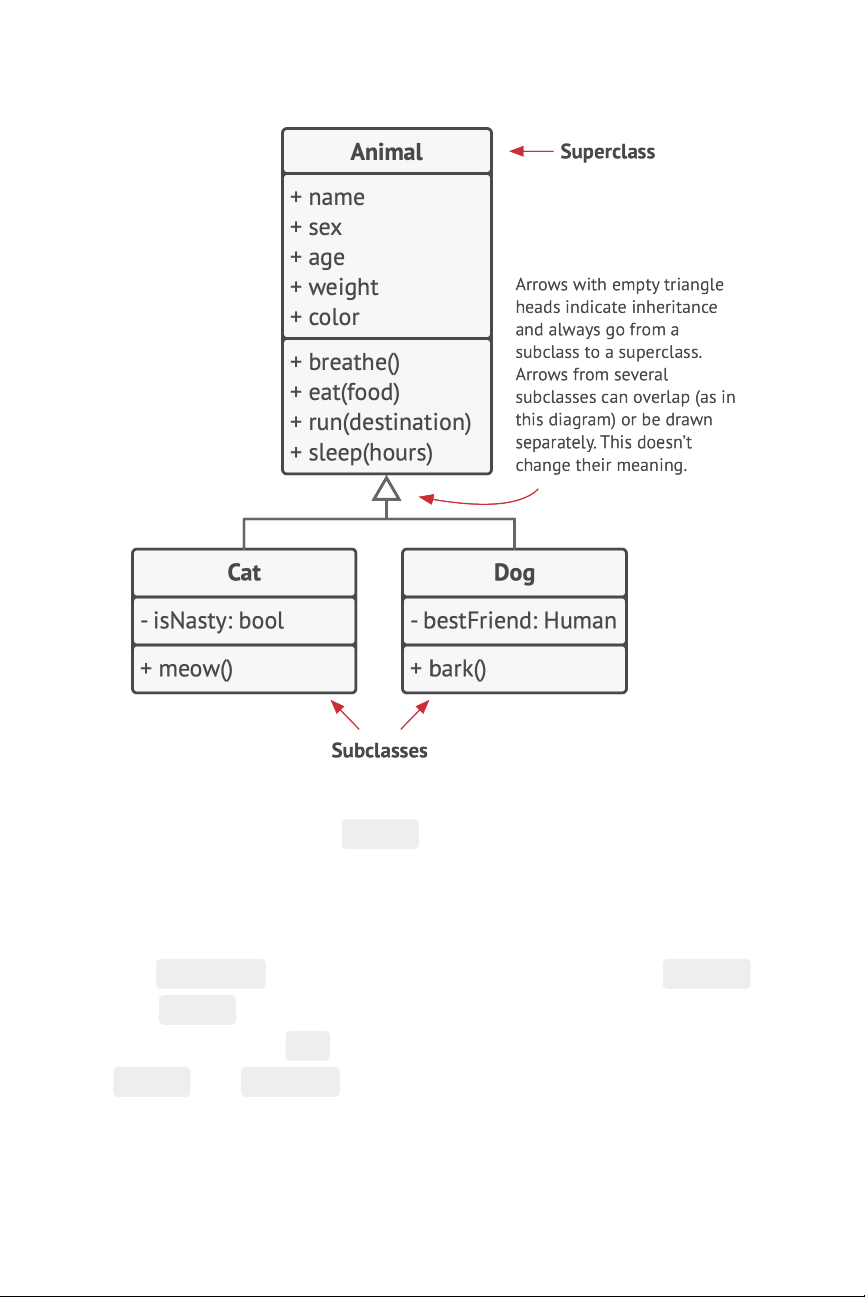
base Animal class that would list the common attributes and behaviors.
A parent class, like the one we’ve just defined, is called a
superclass. Its children are subclasses. Subclasses inherit state
and behavior from their parent, defining only attributes or
behaviors that differ. Thus, the Cat class would have the meow
method, and the Dog class the bark method.
sevenbookyue@gmail.com (#156629) 11
Introduction to OOP / Basics of OOP #156629
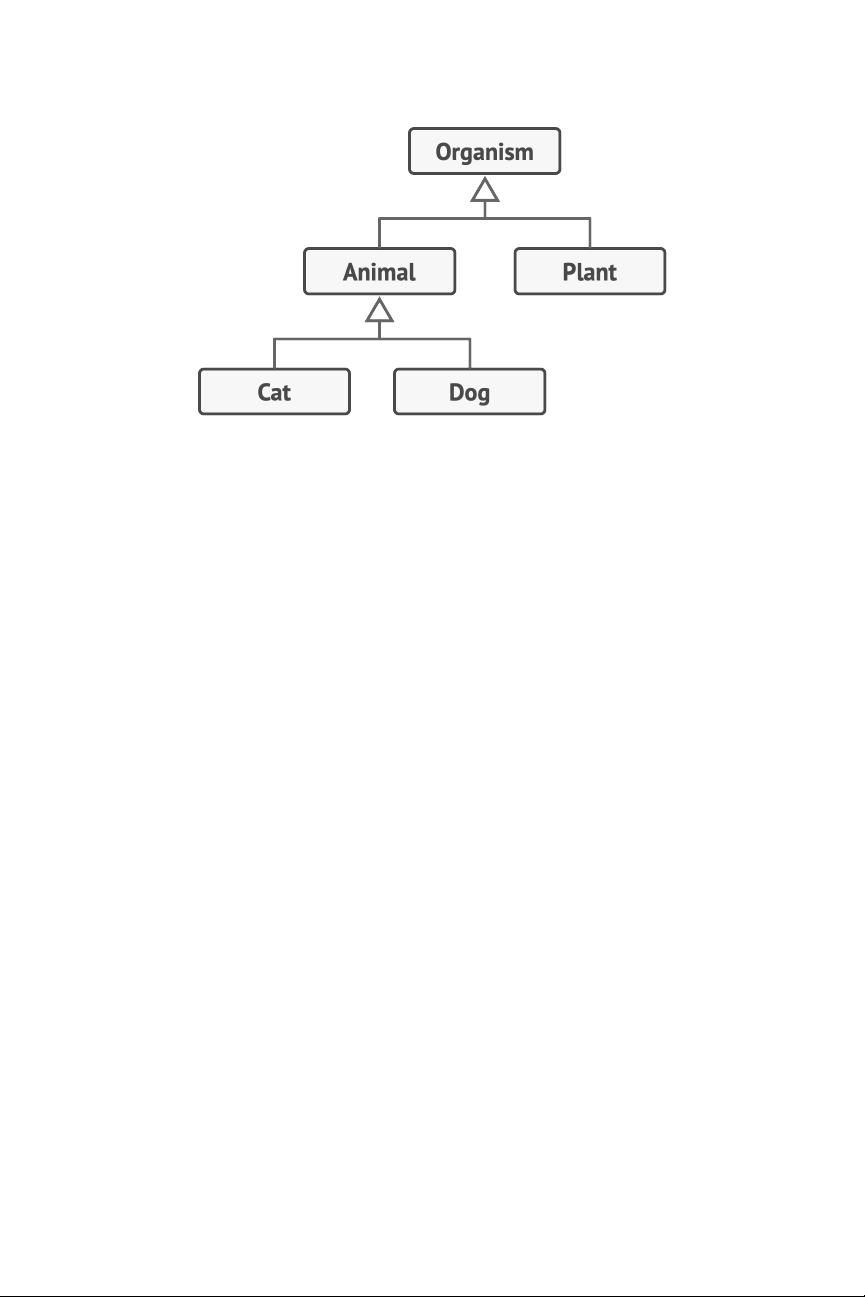
UML diagram of a class hierarchy. All classes in this diagram are part of
the Animal class hierarchy.
Assuming that we have a related business requirement, we can
go even further and extract a more general class for all liv-
ing Organisms which will become a superclass for Animals
and Plants . Such a pyramid of classes is a hierarchy. In such
a hierarchy, the Cat class inherits everything from both the Animal and Organism classes.
sevenbookyue@gmail.com (#156629) 12
Introduction to OOP / Basics of OOP #156629
Classes in a UML diagram can be simplified if it’s more important to show
their relations than their contents.
Subclasses can override the behavior of methods that they
inherit from parent classes. A subclass can either complete-
ly replace the default behavior or just enhance it with some extra stuff.
sevenbookyue@gmail.com (#156629) 13
Introduction to OOP / Pillars of OOP #156629 Pillars of OOP
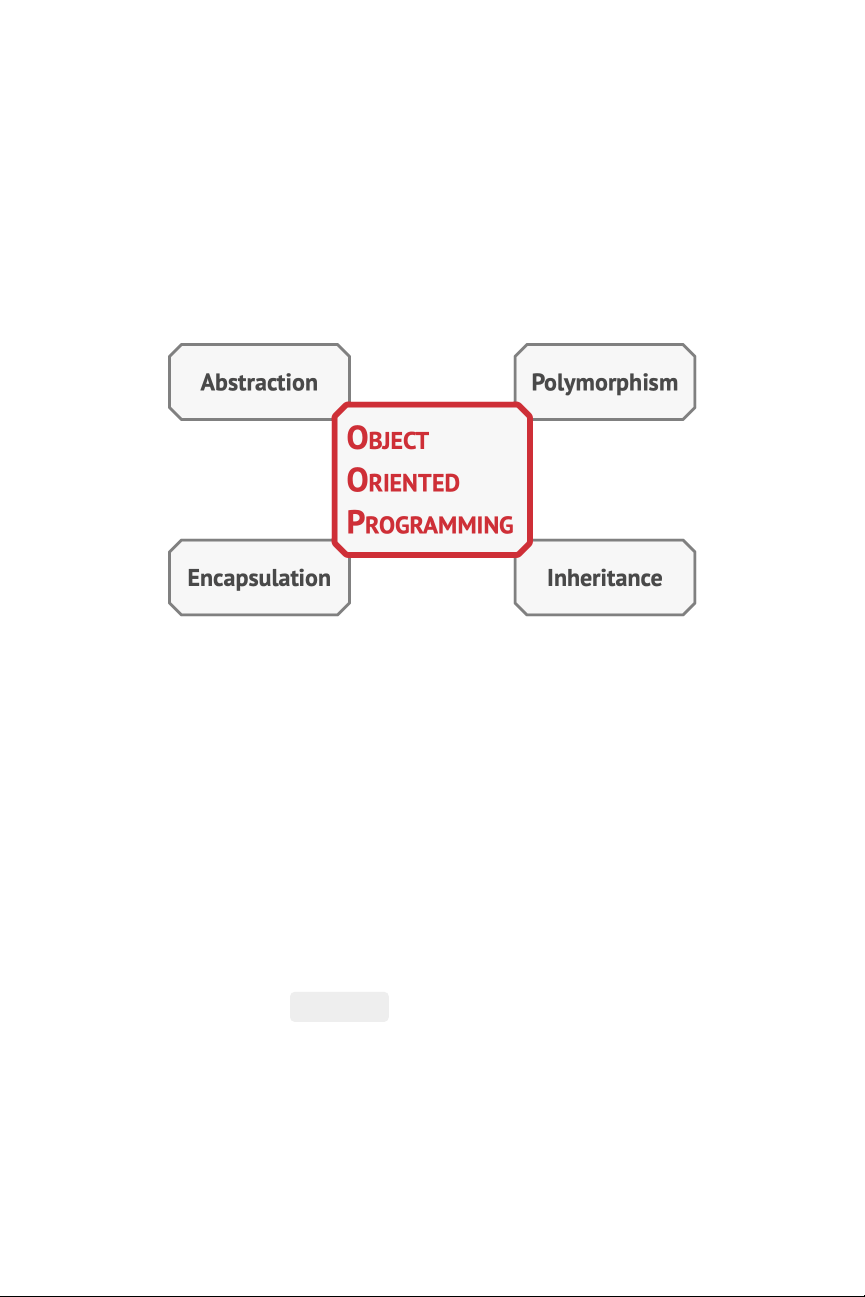
Object-oriented programming is based on four pillars, con-
cepts that differentiate it from other programming paradigms. Abstraction
Most of the time when you’re creating a program with OOP,
you shape objects of the program based on real-world objects.
However, objects of the program don’t represent the origi-
nals with 100% accuracy (and it’s rarely required that they do).
Instead, your objects only model attributes and behaviors of
real objects in a specific context, ignoring the rest.
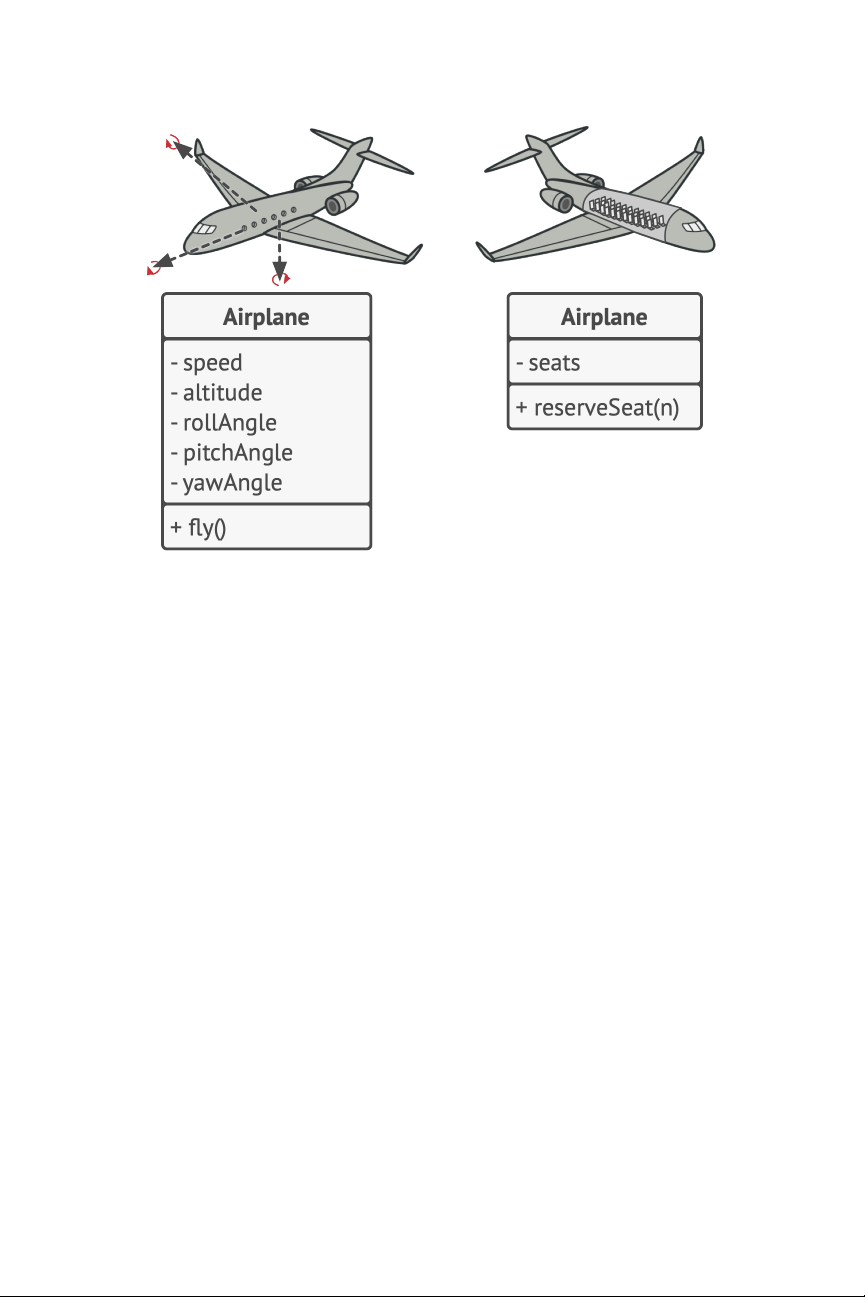
For example, an Airplane class could probably exist in both
a flight simulator and a flight booking application. But in the
former case, it would hold details related to the actual flight,
whereas in the latter class you would care only about the seat
map and which seats are available.
sevenbookyue@gmail.com (#156629) 14
Introduction to OOP / Pillars of OOP #156629
Different models of the same real-world object.
Abstraction is a model of a real-world object or phenomenon,
limited to a specific context, which represents all details rele-
vant to this context with high accuracy and omits all the rest. Encapsulation
To start a car engine, you only need to turn a key or press a
button. You don’t need to connect wires under the hood, rotate
the crankshaft and cylinders, and initiate the power cycle of
the engine. These details are hidden under the hood of the
car. You have only a simple interface: a start switch, a steering
wheel and some pedals. This illustrates how each object has
an interface—a public part of an object, open to interactions with other objects.
sevenbookyue@gmail.com (#156629) 15
Introduction to OOP / Pillars of OOP #156629
Encapsulation is the ability of an object to hide parts of its
state and behaviors from other objects, exposing only a limit-
ed interface to the rest of the program.
To encapsulate something means to make it private , and thus
accessible only from within the methods of its own class.
There’s a little bit less restrictive mode called protected that
makes a member of a class available to subclasses as well.
Interfaces and abstract classes/methods of most programming
languages are based on the concepts of abstraction and encap-
sulation. In modern object-oriented programming languages,
the interface mechanism (usually declared with the interface
or protocol keyword) lets you define contracts of interac-
tion between objects. That’s one of the reasons why the inter-
faces only care about behaviors of objects, and why you can’t
declare a field in an interface.
The fact that the word interface stands for a public part
of an object, while there’s also the interface type in
most programming languages, is very confusing. I’m with you on that.
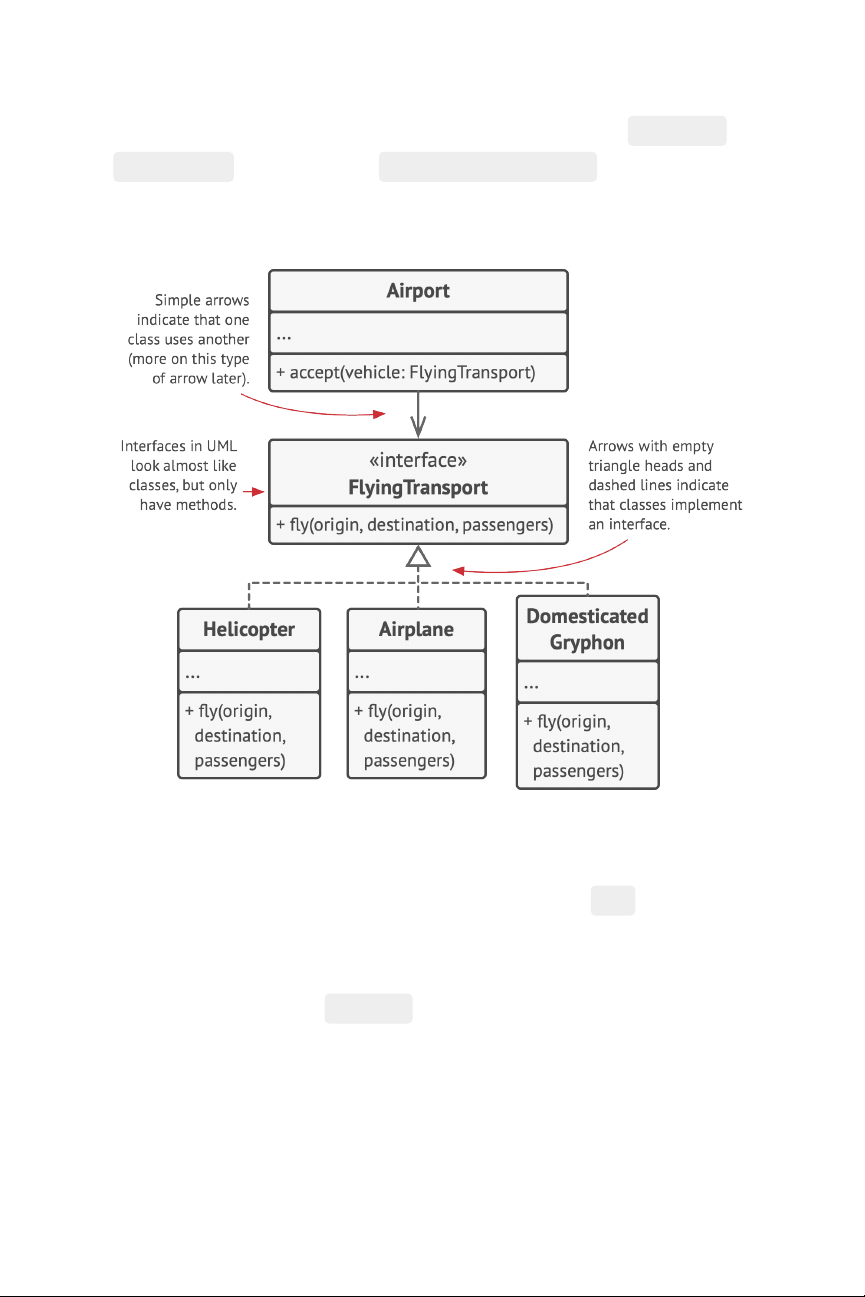
Imagine that you have a FlyingTransport interface with a
method fly(origin, destination, passengers) . When design-
ing an air transportation simulator, you could restrict the
Airport class to work only with objects that implement the
FlyingTransport interface. After this, you can be sure that any
sevenbookyue@gmail.com (#156629) 16
Introduction to OOP / Pillars of OOP #156629
object passed to an airport object, whether it’s an Airplane , a
Helicopter or a freaking DomesticatedGryphon would be able
to arrive or depart from this type of airport.
UML diagram of several classes implementing an interface.
You could change the implementation of the fly method in
these classes in any way you want. As long as the signature
of the method remains the same as declared in the interface,
all instances of the Airport class can work with your flying objects just fine.
sevenbookyue@gmail.com (#156629) 17
Introduction to OOP / Pillars of OOP #156629 Inheritance
Inheritance is the ability to build new classes on top of exist-
ing ones. The main benefit of inheritance is code reuse. If you
want to create a class that’s slightly different from an existing
one, there’s no need to duplicate code. Instead, you extend the
existing class and put the extra functionality into a resulting
subclass, which inherits fields and methods of the superclass.
The consequence of using inheritance is that subclasses have
the same interface as their parent class. You can’t hide a
method in a subclass if it was declared in the superclass. You
must also implement all abstract methods, even if they don’t make sense for your subclass.
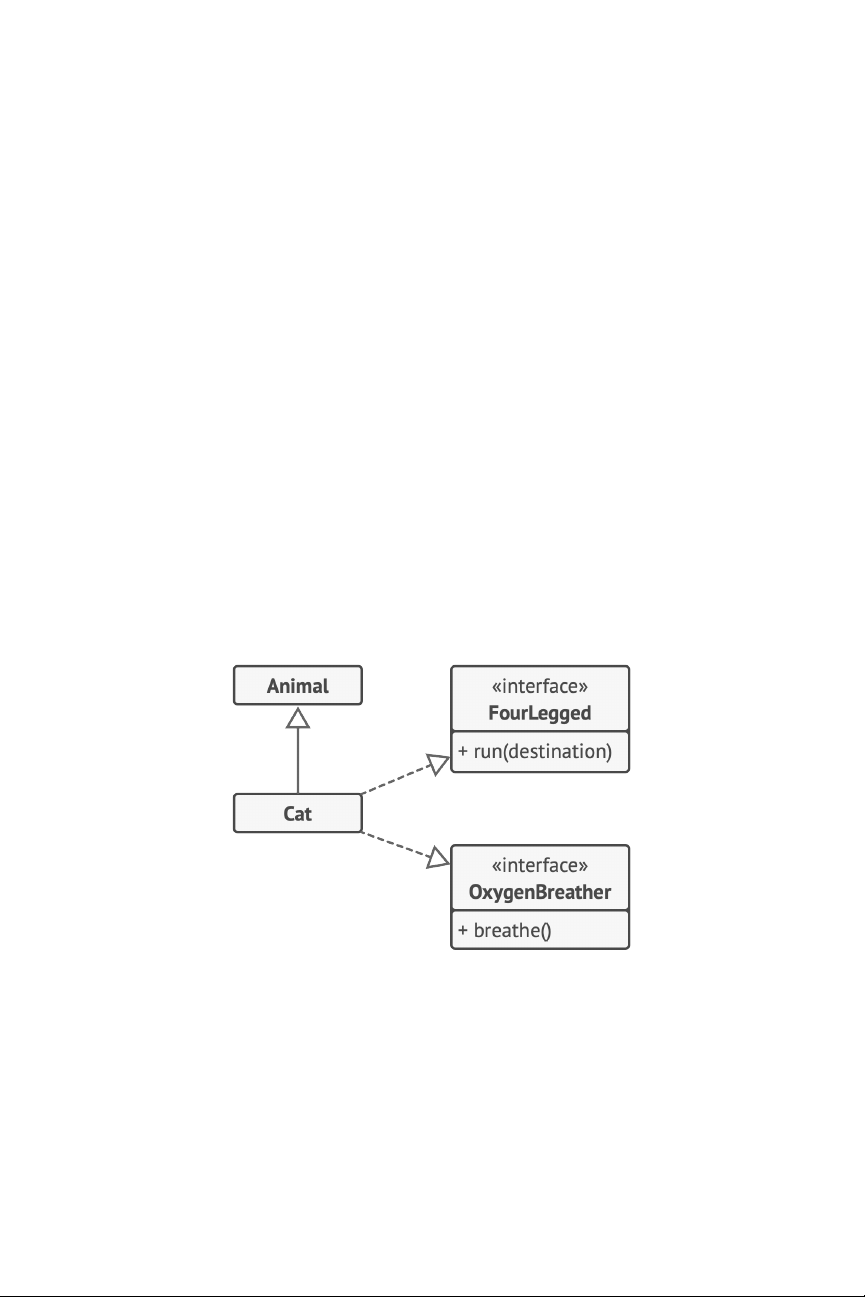
UML diagram of extending a single class versus implementing multiple
interfaces at the same time.
In most programming languages a subclass can extend only
one superclass. On the other hand, any class can implement
several interfaces at the same time. But, as I mentioned before,
sevenbookyue@gmail.com (#156629) 18
Introduction to OOP / Pillars of OOP #156629
if a superclass implements an interface, all of its subclasses must also implement it. Polymorphism
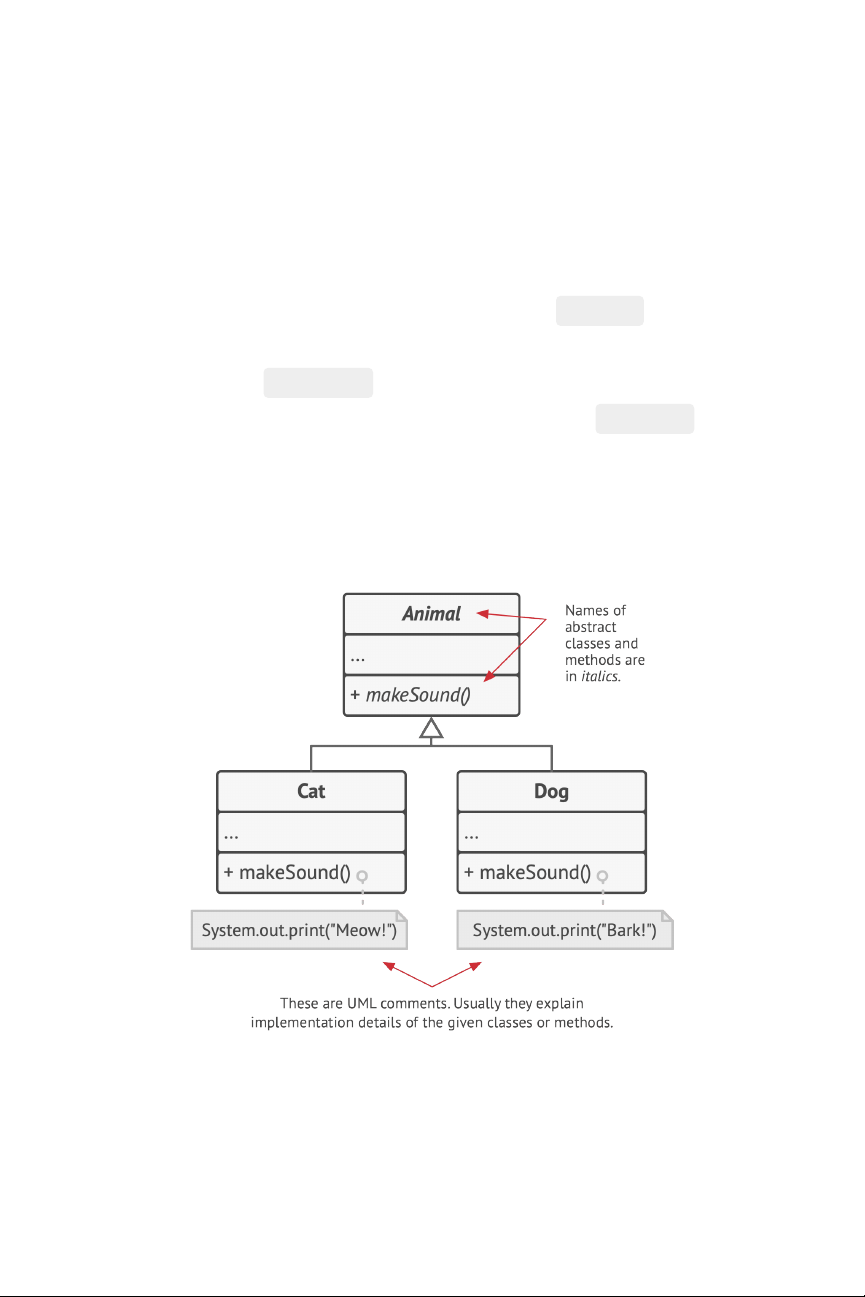
Let’s look at some animal examples. Most Animals can make
sounds. We can anticipate that all subclasses will need to over-
ride the base makeSound method so each subclass can emit
the correct sound; therefore we can declare it abstract right
away. This lets us omit any default implementation of the
method in the superclass, but force all subclasses to come up with their own.
Imagine that we’ve put several cats and dogs into a large bag.
Then, with closed eyes, we take the animals one-by-one out of
sevenbookyue@gmail.com (#156629) 19
Introduction to OOP / Pillars of OOP #156629
the bag. After taking an animal from the bag, we don’t know
for sure what it is. However, if we cuddle it hard enough, the
animal will emit a specific sound of joy, depending on its con- crete class. 1 bag = [new Cat(), new Dog()]; 2 3 foreach (Animal a : bag) 4 a.makeSound() 5 6 // Meow! 7 // Woof!
The program doesn’t know the concrete type of the object con-
tained inside the a variable; but, thanks to the special mech-
anism called polymorphism, the program can trace down the
subclass of the object whose method is being executed and run the appropriate behavior.
Polymorphism is the ability of a program to detect the real
class of an object and call its implementation even when its
real type is unknown in the current context.
You can also think of polymorphism as the ability of an object
to “pretend” to be something else, usually a class it extends or
an interface it implements. In our example, the dogs and cats
in the bag were pretending to be generic animals.
sevenbookyue@gmail.com (#156629)
Tài liệu liên quan:
-
Quản lý Dự án Phần mềm: Phương Pháp và Ứng Dụng Thực Tế | Môn Thiết kế phần mềm - Đại học Sư phạm Kỹ thuật Thành phố Hồ Chí Minh
134 67 -
Quy trình Thiết Kế Phần Mềm: Hướng Dẫn ERD và Mô Hình Dữ Liệu | Môn Thiết kế phần mềm - Đại học Sư phạm Kỹ thuật Thành phố Hồ Chí Minh
119 60 -
Thiết kế và phát triển hệ thống quản lý tuyển dụng nhân sự | Tài liệu môn Thiết kế phần mềm Trường đại học sư phạm kỹ thuật TP. Hồ Chí Minh
369 185 -
Báo cáo 10 mẫu hành vi - môn học: mẫu thiết kế phần mềm. học kỳ II – năm học 2023-2024 | Trường đại học sư phạm kỹ thuật TP. Hồ Chí Minh
304 152