Final Exam: Eliminate SQL Injection Using LINQ môn Lập trình Windows | Trường Đại học Sư phạm Thành phố Hồ Chí Minh
Many developers have learned that the most effective way to build secure applications and prevent damaging attacks is to design and implement the applications securely from the beginning. Tài liệu được sưu tầm gồn 5 trang, giúp cho các bạn học sinh, sinh viên ôn luyện và phục vụ cho việc học tập tốt. Mời các bạn đón xem!
Môn: Lập trình Windows (SPHCM) 13 tài liệu
Trường: Đại học Sư phạm Thành phố Hồ Chí Minh 563 tài liệu
Tác giả:




Preview text:
lOMoAR cPSD| 22014077
ISSN : 2347 - 8446 (Online)
ISSN : 2347 - 9817 (Print)
International Journal of Advanced Research in
Vol. 2 Issue Special 1 Jan- March 2014
Computer Science & Technology (IJARCST 2014)
Eliminate Sql Injection Using LINQ
IV. Vilasini, IIP. Chellamal
IME II CSE, JJ College of Engineering and Technology, Thiruchirapalli, India
IIAssistant Professor, JJ College of Engineering and Technology, Thiruchirapalli, India Abstract
As web application security breaches and attempts rise, developers are increasingly being asked to take more responsibility for the
security of their applications. In fact security-related concerns are hard to apply as they involve adding complexity to already
complex code. In this paper, we have proposed a lightweight approach to prevent SQL Injection attacks, that it can actually be well
defended by using LINQ (Language Integrated Query) .LINQ to SQL, when used exclusively for data access, eliminates the
possibility of SQL injection in your application for one simple reason: every SQL query that LINQ executes on your behalf is
parameterized. Internally, it means that when LINQ to SQL queries the database, instead of using plain values, it passes them as
SQL parameters, which means they can never be treated as executable code by the database. This is also true for most (if not all) ORM mappers out there. Keywords
SQL Injection Attacks , LINQ, Web security, Injection prevention, OWASP I. Introduction
reasons and garners a lot of attention from attackers. When SQL
Many developers have learned that the most effective way to injection is possible in a web application, it is very easy for an
build secure applications and prevent damaging attacks is to attacker to detect it and to then exploit it. So it stands to reason
design and implement the applications securely from the that even if SQL injection mistakes are not the most frequent
beginning. Unfortunately, development teams often lack the security mistakes made by developers, they very well may be the
training and resources to make educated design decisions about most frequently uncovered and exploited in the wild.
application security. As developers assume more of the security
burden, the first web application vulnerability that many One easy way to detect SQL injection vulnerability is to insert a
developers learn about is a particularly dangerous form of meta character into an input that you know an application will
command injection known as SQL injection. Command use to craft a database access statement. For example, on any
injection in its archetypal form is any vulnerability that allows web site that contains a search input field, an attacker can input
an attacker to run an unintended command on your server by a database meta character such as a tick mark (‘) and click the
providing unanticipated input that alters the way you intended
the web application to run. Because it’s so well
Search button to submit the input. If the application returns a -known, SQL
injection attacks are common, dangerous, and pervasive. database error message, the attacker not only knows that he has
Fortunately, you can prevent SQL injection easily once you found a databasedriven portion of the application, but also that
understand the problem. Even better, a new Microsoft data he may be able to inject more meaningful commands and have
access technology offers .NET developers the opportunity to your server execute them. Application security researcher
eliminate SQL injection vulnerabilities altogether—when used Michael Sutton recently emphasized the ease of discovering web
properly. That technology is called Language Integrated Query
(LINQ). This paper explores LINQ’s potential for hardening applications vulnerable to SQL injection by identifying
hundreds of potentially vulnerable sites in a matter of minutes
your web application’s data access code so that it’s impossible using the Google search API .
to attack through SQL Injection.
A. Anatomy of SQL Injection II. Overview
Here’s a simple SQL injection example walkthrough to
SQL injection is a type of web application security vulnerability demonstrate both how easy the mistakes are to make and how
whereby an attacker supplies malicious data to the application, simple they can be to prevent with some design and
tricking it into executing unanticipated SQL commands on the programming rigor. The sample web application contains a
server. These attacks are fairly easy to prevent, but they’re also simple customer data search page named SQLInjection.aspx that
both common and pernicious because they allow attackers to run is vulnerable to SQL injection. The page contains a Company
database commands directly against your production data. In the Name input server control and a data grid control to display the
most extreme cases, attackers can not only gain unfettered access search results from the Microsoft sample Northwind database
to all of your data, but can also drop tables and databases or even that ships with SQL Server 2005 Express Edition. The query
gain control of the database server itself. If these attacks are easy executed during the search includes a very common mistake in
to prevent, then why are they so dangerous? First, your application design—it dynamically builds a SQL query from
application database is a very attractive target for obvious lOMoAR cPSD| 22014077
user-provided input. This is the cardinal sin of web application C. Typical SQL Safeguards
data access because it implicitly trusts what the user posts, and You can see now how easy it is to both create a SQL injection
sends it straight to your database. The query looks like this when vulnerability in your application and to exploit it. Fortunately, as
initiated from the Search button click event:
mentioned before, SQL injection can usually be prevented easily
with a few simple countermeasures. The most common and cost
protected void btnSearch_Click(object sender, EventArgs e)
effective way to prevent SQL injection is to properly validate all {
inputs in the application that are ultimately used as data access.
String cmd = “SELECT [CustomerID], [CompanyName], Any input that originates with users—either directly through the [ContactName]
web application or persisted in a data store—must be validated
FROM [Customers] WHERE CompanyName =’” +
on the server for type, length, format and range before txtCompanyName.Text
processing your data-access commands on the server. + “’”;
Unfortunately, code-based countermeasures are not foolproof and can fail when: •
SqlDataSource1.SelectCommand = cmd;
Validation routines aren’t properly designed. • GridView1.Visible = true;
Validation is performed only on the client layer. }
customer record for that company, as expected. But an attacker
In the intended scenario, if a user inputs “Ernst Handel” as the could easily manipulate this dynamic query, for example, by
company and clicks the Search button, the response shows the inserting
www.ijarcst.com © All Rights Reserved, IJARCST 2014
International Journal of Advanced Research in
ISSN : 2347 - 8446 (Online)
Computer Science & Technology (IJARCST 2014)
Vol. 2 Issue Special 1 Jan-March 2014
ISSN : 2347 - 9817 (Print)
a UNION clause and terminating the rest of the intended •
Validation misses even a single field in the application. An
statement with comment marks (—). In other words, instead of
additional layer of defense to prevent SQL injections
entering “Ernst Handel,” the attacker would input the following:
involves properly parameterizing all the SQL queries in
Ernst Handel’ UNION SELECT CustomerID, ShipName,
your application, whether in dynamic SQL statements or ShipAddress
stored procedures. For example, the code would have been FROM ORDERS--
safe if it had structured the query like the following:
The result is that the SQL statement executed on the server ends SELECT [CustomerID], [CompanyName], [ContactName]
up appending the malicious request. It transforms the dynamic FROM [Customers] SQL to this:
WHERE CompanyName = @CompanyName SELECT [CustomerID], [CompanyName],
[ContactName] FROM [Customers]
Parameterized queries treat input as a literal value when
executed as part of the SQL statement; thereby making it
WHERE CompanyName =’Ernst Handel’ impossible for
UNION SELECT CustomerID, ShipName, ShipAddress FROM ORDERS--’
© 2014, IJARCST All Rights Reserved
This is a perfectly legal SQL statement that will execute on the the server to treat parameterized input as executable code. Even
application database, returning all the customers in the Orders if you use stored procedures, you must still take this extra step
table who have processed orders through the application.
to parameterize input, because stored procedures provide no
B. Kinds of SQL injection
inherent protection from SQL injection over embedded queries.
Even with these simple fixes, SQL injection is still a big problem 1. In-band
for many organizations. The challenge in your development
team is to educate every developer about these types of
Also called Error-based or Union based SQL Injection or first vulnerabilities, put meaningful and effective security standards
order Injection. Here communication between the attacker and in place to prevent attacks, enforce the standards and conduct
the application happens through a single channel.
security assessments to validate that nothing was missed. This 2. Out-band
introduces a lot of variables in your efforts to secure your
applications, so you would be much more productive if you were
This kind of an attack uses two different channels for to select a data-access technology that renders these SQL
communication between attacker and the application.
injection attacks impossible. This is where LINQ comes in. 3. Inferred III. LINQ Overview
Also known as Blind – SQL – Injection. Here the server doesn’t At its simplest, LINQ adds standard patterns for querying and
respond with any syntax error or other means of notification.The updating data in any type of data store—from SQL databases to
attacker needs to retrieve the data by asking true or false XML documents to .NET objects. When building
questions through SQL commands.
databasedriven applications, the component of LINQ that
enables developers to manage relational data as objects in C# or
VB is known as “LINQ to SQL,” which is considered part of the lOMoAR cPSD| 22014077
ADO.NET family of data technologies. When originally ISSN : 2347 - 8446 (Online)
introduced in CTP form, LINQ to SQL was known as DLINQ.
With that in mind, here’s how you can implement the customer
search example using LINQ to SQL to protect against SQL
injection attacks. The first step is to create the object model of
the relational data in the database. Visual Studio Orcas includes
a new Object Relational Designer (O/R Designer) that enables
you to generate the full object model for your database by
dragging tables onto the design surface and defining
relationships. To build the object model for our Northwind
Customers table, you create a LINQ to SQL database file in your
application by selecting “Add
New Item…” on your project and choosing the “LINQ to SQL
File” template, which opens in the O/R Designer. To
automatically build the complete object model for the Customers
table, select that table in the Server Explorer and drag it on to the
O/R Designer design surface. In this example, the O/R Designer
adds a file named Customers.designer.cs that defines the classes
you’ll use in code rather than writing code to interact directly with the database.
After defining the object model classes for the data in the
Customers table, you can query the data directly in code for the
customer data search page. The Page_Load method for the
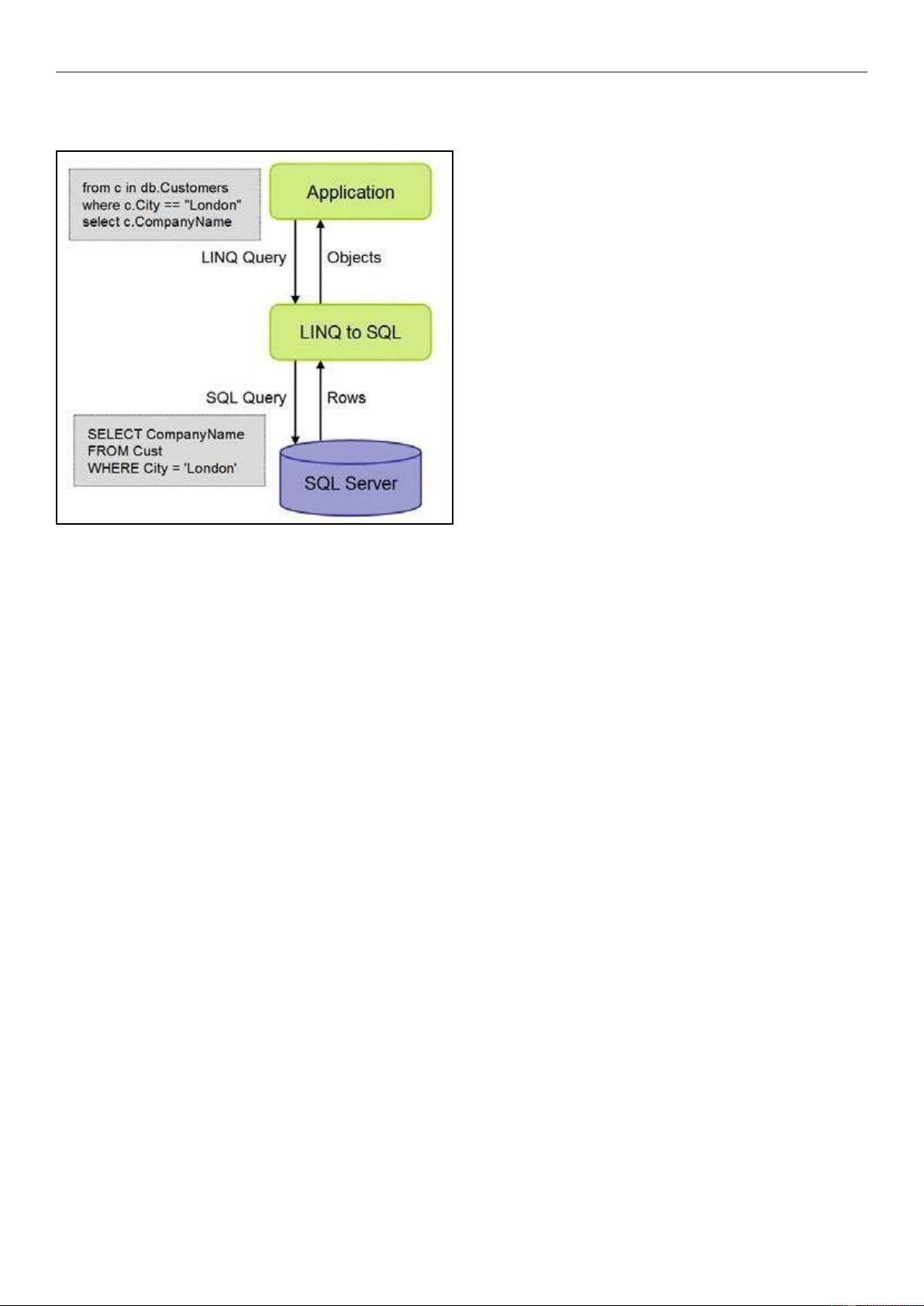
Fig. 1: Execution Architecture
LINQ-powered page (LINQtoSQL.aspx.cs), instantiates the
CustomersDataContext class created by the O/R Designer,
LINQ to SQL enables you to treat data in your applications as reusing the same connection string used previously in the
native objects in the programming language you are using, SQLInjection. aspx page. The LINQ query below retrieves a
abstracting the complexity of relational data management and collection of Customer objects that match my where clause:
database connections. In fact, you can display and manipulate protected void Page_Load(object sender, EventArgs e)
database data through LINQ without writing a single SQL { string
statement. At runtime, LINQ to SQL translates queries connectionString =
embedded or “integrated” in your code into SQL, and executes ConfigurationManager.ConnectionStrings
them on the database. LINQ to SQL returns the query results to [“northwndConnectionString1”].ConnectionString;
the application as objects, completely abstracting your
interaction with the database and SQL. There is no faster way to CustomersDataContext db = new
eliminate the possibilities of SQL injection in web applications CustomersDataContext(connectionString);
than to eliminate SQL from your application. With LINQ to SQL, you can do that.
GridView1.DataSource = from customer in db.Customers where customer.CompanyName == txtCompanyName.Text orderby www.ijarcst.com
International Journal of Advanced Research in
ISSN : 2347 - 9817 (Print)
Vol. 2 Issue Special 1 Jan-March 2014
Computer Science & Technology (IJARCST 2014)
IV. Securing Data Access with LINQ
customer.CompanyName select customer;
LINQ to SQL, when used exclusively for data access, eliminates GridView1.DataBind();
the possibility of SQL injection in your application for one }
simple reason: every SQL query that LINQ executes on your Using LINQ to SQL, if I provide “Ernst Handel” as the Search
behalf is parameterized. Any input provided to the query from value, the SQL statement generated by LINQ at runtime and
any source is treated as a literal when LINQ builds the SQL executed on the server looks like this:
query from your embedded query syntax. Furthermore, LINQ’s
integration with Visual Studio Orcas assists developers in SELECT [t0].[CustomerID], [t0].[CompanyName],
building valid queries through IntelliSense and compile-time [t0].[ContactName],[t0].[ContactTitle],[t0].[Address],
syntax checking. The compiler catches a lot of query misuse that [t0].[City], [t0].[Region], [t0].[PostalCode], [t0].[Country],
might introduce functional defects or other types of [t0].[Phone], [t0].[Fax]
vulnerabilities into your application. In contrast, SQL statements FROM [dbo].[Customers] AS [t0]
you write are parsed and interpreted on the database only at WHERE [t0].[CompanyName] = @p0
runtime before you know whether it is correct or not. The only ORDER BY [t0].[CompanyName]}
attack vector against LINQ to SQL is for an attacker to try to As you can see, the WHERE clause is parameterized
trick LINQ into forming illegal or unintended SQL. Fortunately, automatically; therefore, it’s impervious to attack with
the languages and compilers are designed to protect you from conventional SQL injection attacks. No matter what values a that.
user provides as input to the search page, this query is type-safe lOMoAR cPSD| 22014077
and will not allow input to execute commands on the server. If References
you input the attack string used earlier for the SQL injection [1] Atefeh Tajpour and Maslin Massrum, “Comparison of SQL
exploit, the query returns no rows. In fact, the most harm that a
Injection Detection and Prevention Techniques,” in 201O
2nd International Conference on Education Technology and
user could do with this query is to perform a brute force attack, Computer (ICETC).
using the search function to enumerate all the company records [2] Debabrata Kar and Suvasini Panigrahi, “Prevention of
in the Customers table by guessing every possible value. But
SQL Injection Attack Using Query Transformation and
even that only provides the Customers values already exposed
Hashing”in 2013 3rd IEEE International Advance
on that page, and gives attackers no opportunity to inject
Computing Conference (IACC).
commands that provide access to additional tables or data in the [3] Diallo Abdoulaye Kindy and Al-Sakib Khan Pathan, “A database.
Survey On Sql Injection: Vulnerabilities, Attacks, And V. Conclusion
Prevention Techniques” in 2011 IEEE 15th International
As the examples have shown, it’s easy to introduce SQL
Symposium on Consumer Electronics.
injection vulnerabilities into web applications, and easy to fix [4] David Byers, Nahid Shahmehri, “Unified modeling of
them with proper diligence. But nothing inherently protects
attacks, vulnerabilities and security activities,” Proc. 2010
developers from making these simple, yet dangerous mistakes.
ICSE Workshop on Software Engineering for Secure
However, Microsoft’s LINQ to SQL technology removes the Systems, IEEE, 2010.
possibility of SQL injection attacks from database applications [5] Elizabeth Fong, Romain Gaucher, Vadim Okun, Paul
by letting developers interact directly with object models
E.Black, Eric Dalci, “Building a test suite for web
generated from relational data rather than directly with the
application scanners,” Proc. Annual Hawaii International
database itself. The LINQ infrastructure built into C# and Visual
Conference on System Sciences, IEEE.
Basic takes care of formulating legal and safe SQL statements, [6] Ezumalai.R and Aghila.G,“ Combinatorial Approach for
preventing SQL injection attacks and enabling developers to
Preventing SQL Injection Attacks ” in 2009 IEEE
focus on the programming language most natural to them.
International Advance Computing Conference (IACC 2009).
www.ijarcst.com © All Rights Reserved, IJARCST 2014
International Journal of Advanced Research in
ISSN : 2347 - 8446 (Online) Computer Science & Technology (IJARCST 2014)
Vol. 2 Issue Special 1 Jan-March 2014
ISSN : 2347 - 9817 (Print)
[7] Jason Bau, Elie Bursztein,Divij Gupta,John Mitchel, “State of the
Art: Automated Black-Box Web Application Vulnerability
Testing,” 2010 IEEE Symposium on Security and Privacy. IEEE, 2010.
[8] Jie Wang, Raphael C.-W. Phan, John N. Whitley, David J.
Parish, “Augmented Attack Tree Modeling of SQL Injection
Attacks,” Proc. 2nd IEEE International Conference on
Information Management and Engineering, IEEE, 2010.
[9] Ke Wei, M. Muthuprasanna and Suraj Kothari. Preventing SQL
Injection Attacks in Stored Procedures. IEEE, 2006.
[10] Lwin Khin Shar and Hee Beng Kuan Tan, “Mining Input
Sanitization Patterns for Predicting SQL Injection and Cross Site
Scripting Vulnerabilities,” in ICSE 2012.
[11] MeiJunjin, “ An approach for SQL Injection vulnerability
detection” IEEE,2009.
[12] Nuno Antunes and Marco Vieira, “ Detecting SQL Injection
vulnerabilities in web services” IEEE,2009.
[13] TIAN Wei, YANG Ju-Feng and XU Jing, SI Guan-Nan,
“Attack model based penetration test for SQL injection
vulnerability,” 2012 IEEE 36th International Conference
on Computer Software and Applications Workshops.
[14] Robert Dollinger and Kent Thomas,“Using LINQ Transformation
Patterns to evaluate SQL Queries”in 2011 IEEE.
© 2014, IJARCST All Rights Reserved www.ijarcst.com
Tài liệu liên quan:
-
Bài tập Chương 8: KIỂU CẤU TRÚC môn Lập trình Windows | Trường Đại học Sư phạm Thành phố Hồ Chí Minh
95 48 -

Báo cáo môn Lập trình Windows | Trường Đại học Sư phạm Thành phố Hồ Chí Minh
187 94 -

CSharp Console - Tài liệu thực hành lập trình môn Lập trình Windows | Trường Đại học Sư phạm Thành phố Hồ Chí Minh
114 57 -
Mô hình hoá cấu trúc môn Lập trình Windows | Trường Đại học Sư phạm Thành phố Hồ Chí Minh
114 57 -

Mô hình hoá chức năng môn Lập trình Windows | Trường Đại học Sư phạm Thành phố Hồ Chí Minh
128 64