


Preview text:
Original Article
Vertical and horizontal proportions of the face and their
correlation to phi among Indians in Moradabad population: A survey
Shruti Anand, Siddhi Tripathi1, Anubhav Chopra2, Karan Khaneja3, Swatantra Agarwal4
B.D.S, M.D.S (Prosthodontics and Implantology), Delhi, 1Senior Lecturer, Department of Prosthodontics and Crown and Bridge, Kothiwal
Dental College and Research Centre, Moradabad, Uttar Pradesh, 2B.D.S, M.D.S (Prosthodontics and Implantology), Delhi, 3Senior Lecturer,
Department of Conservative Dentistry and Endodontics, I.T.S Dental College, Hospital and Research Centre, Greater Noida, Uttar Pradesh,
4HOD and Principal, Department of Prosthodontics and Crown and Bridge, Kothiwal Dental College and Research Centre,
Moradabad, Uttar Pradesh, India
Purpose: The purpose was to examine the existence of divine proportions among the Indian faces in
Abstract Moradabad population.
Materials and Methods: Totally, 100 patients (50 males; 50 females) aged 25-45 years were selected for the
study. All facial photographs were analyzed based on the method of Ricketts assessing the divine proportions
in vertical and transverse facial planes. Six horizontal and seven vertical ratios were determined, which
were then compared with the phi ratio.
Results: The horizontal ratio results showed that three male and female ratios were not significantly
different from each other (P > 0.05), and interchilion/nose width ratio was highly significant (P < 0.001).
The horizontal mean ratios for females as well as males were highly significant from the phi ratio (P < 0.001)
except for interchilion/interdacryon ratio, which was significant (P < 0.05) for females and not significant
(P > 0.05) for males. The vertical ratio results showed that there was a highly significant difference (P < 0.001)
for forehead height/stomion-soft menton ratio and no significant difference for two ratios between the
mean ratios of males and females. All the vertical mean ratios for both the groups were highly significant
(P < 0.001), except for the intereye-soft menton/intereye-stomion ratio, which was significant (P < 0.05)
for female group and not significant (P > 0.05) for the male group.
Conclusion: Although, the golden proportion is a prominent and recurring theme in esthetics, it should not
be embraced as the only method by which human beauty is measured to the exclusion of others factors.
Key Words: Dentofacial esthetics, esthetics, facial attractiveness, golden proportion, phi, Ricketts facial proportions
Address for correspondence:
Dr. Shruti Anand, D-29, Lajpat Nagar-I, New Delhi - 110 024, India. E-mail: shruti.anand19@yahoo.com
Received: 9th June, 2014, Accepted: 26th August, 2014 INTRODUCTION
Access this article online Quick Response Code: Website:
The face is the most important individual factor determining www.j-ips.org
the physical appearance of the individuals.[1] The importance
of physical and facial attractiveness, in which the smile DOI:
arguably plays a major role, has been extensively reviewed 10.4103/0972-4052.155033
and related to job recruitment decisions, initial impressions,
susceptibility to peer pressure, voting and juror decisions,
The Journal of Indian Prosthodontic Society | Apr-Jun 2015 | Vol 15 | Issue 2 125
Anand, et al.: Correlation of facial proportions to phi
and social interactions including dating decisions.[2] The
The null hypothesis to be tested was that there was no
esthetic outcome is also critical for patient satisfaction and,
correlation between phi ratio and different horizontal and
therefore, essential to the overall treatment objectives. Beauty
vertical facial reference points defined by Ricketts among
and facial attractiveness are easy to identify but difficult
Indians in Moradabad population.
to quantify. Despite its subjective nature, an attempt can
be made to define, measure and explain the captivating MATERIALS AND METHODS
phenomenon of beauty by describing it numerically and geometrically.[3]
The study was conducted in Kothiwal Dental Col ege and Research
Centre, Moradabad. 100 patients (50 males and 50 females) aged
The golden ratio, also known as the divine proportion, is
25-45 years were selected for the study. The inclusion criteria
considered by many to be the mystery of esthetics, attraction
included: Orthognathic profile, a full complement of teeth in
and human beauty.[4] It is denoted by the symbol Φ (phi) and
both the arches and absence of craniofacial anomalies or other
is an irrational number of the order of 1.618033988.[4,5]
pathologies and no significant skeletal asymmetry. The exclusion
criteria included: Subjects with trauma, any maxillofacial surgery;
Ricketts devised a golden proportion caliper to establish and
apparent loss of tooth structure due to attrition, fracture, caries,
evaluate the ratios between various elements of the attractive face.[6]
or restorations; and obvious problems that could disfigure or
In 1982, he claimed to have found a large number of golden
otherwise affect the face and dentition.
proportions after examining lateral and frontal cephalograms
that were considered ideal. He also found, after examining photos
Each subject was seated in a dental chair with the head upright,
of models, a number of divine ratios within the face. Ricketts
supported by the headrest. The individual’s head was fixed in a
therefore advocated the use of these divine proportion ratios as
cephalostat so that the Frankfort horizontal plane was parallel
guides for planning orthognathic surgery. Lombardi was the first
to the floor, and the midsagittal plane was aligned with the
to propose the application of the golden proportion in dentistry,
center of the camera lens. Standardized frontal view of each
but he also stated, “It has proved too strong for dental use.”[7]
subject was taken using a Canon EF 85 mm f / 1.2 L II USM
Snow stated that the concept of the golden percentage is a useful
Lens SLR camera (Canon U.S.A., Inc., Lake Success, NY).
application in the diagnosis and development of symmetry,
The camera was stabilized with the help of a tripod, at a fixed
dominance, and the proportion for an esthetically pleasing smile.[8] distance of 36 inches.
The theory that the phi ratio is the associated proportion that
The photographs were then cropped and adjusted to a
describes ideal facial beauty has been proposed at least since the
standardized image size (5” ×4”). All photographs were
age of Phidias. Although there are supporters of this theory,
made by the same investigator to ensure standardization of
there are limited research studies correlating phi and ideal facial the procedure.
beauty.[9-11] Conflicting research outcomes have been reported
for the occurrence of phi in the facial view of maxillary
All facial photographs were analyzed based on the method
teeth.[12-15] Few authors stated that the occurrence of the phi
of Ricketts assessing the divine proportions in vertical and
ratio does not decisively determine the attractiveness through
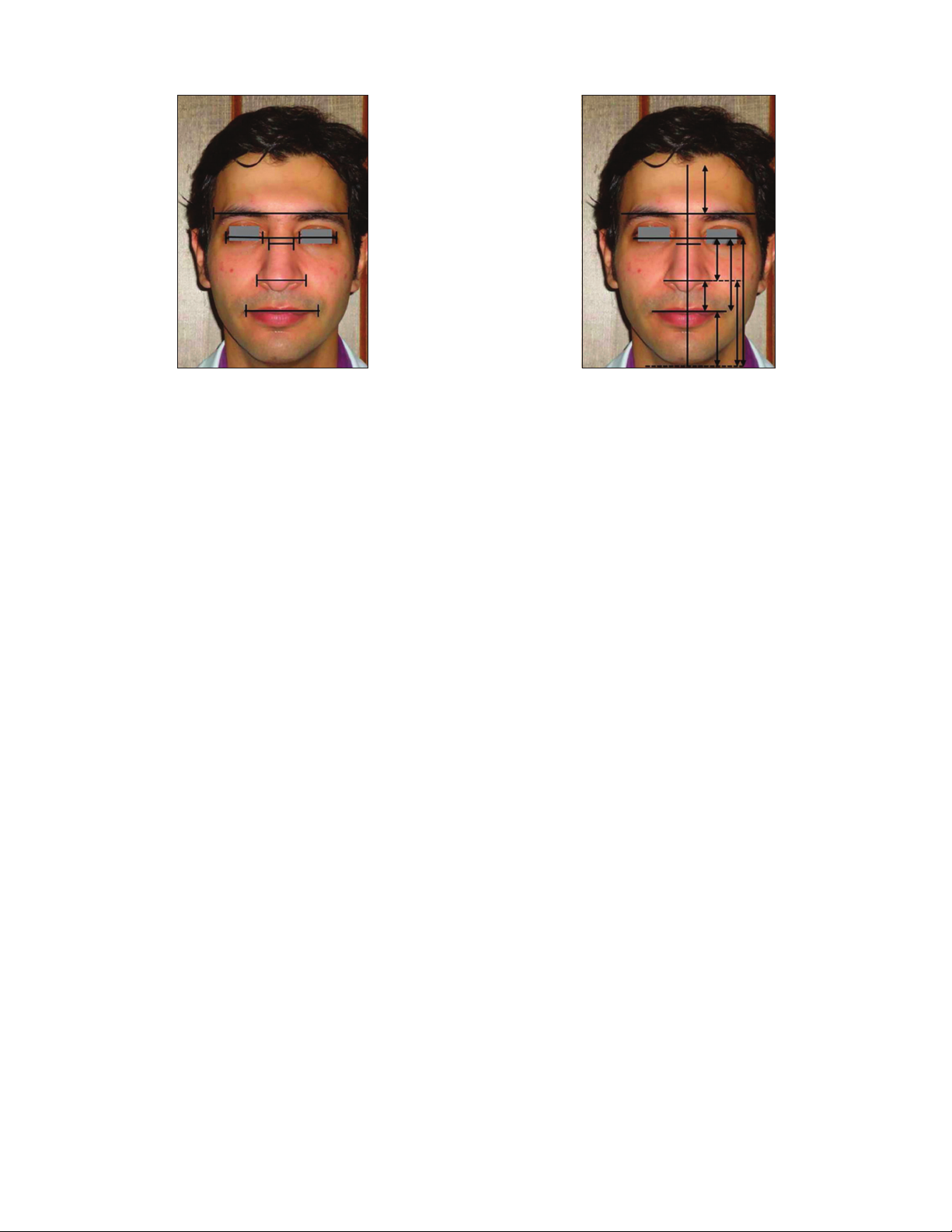
transverse facial planes. The following 7 facial reference points
color photographs, and neither was a statistically significant were used [Figures 1 and 2]:
golden ratio or any other continuous proportion found for the
1. The lateral canthi of the eyes, located at the extreme lateral anterior teeth as a whole. commissures of the eyelids [14,15]
2. The supraorbital foramen, located at the height of the
However, in a study of 229 participants, that evaluated the eyebrows
proportion between the inner canthal distance and the maxillary
3. The dacryons, located at the medial commissures of
incisor width, the phi ratio was evident.[16]
the eyes and representing the junctions of the maxillary, lacrimal and frontal bones
Several studies have shown the existence of the correlation
4. The soft tissue border of the temporal, located at the most
between attractiveness and proportions in face measurements lateral points of the face
that approach the Golden Ratio. According to these reports,
5. The lateral alae, located at the most lateral points on the
faces that have features with ratios close to the Golden Ratio rims of the wings of the nose
are thought to be esthetically pleasing. To determine the
6. The chilions, located at the extreme lateral points at the
validity of this claim, the present study was designed to verify angles of the mouth
the existence of divine proportions among the Indian faces in
7. The soft tissue menton (soft menton), located at the most Moradabad population. inferior point of the face. 126
The Journal of Indian Prosthodontic Society | Apr-Jun 2015 | Vol 15 | Issue 2
Anand, et al.: Correlation of facial proportions to phi
Figure 1: Landmarks and measurements for facial width analysis
Figure 2: Landmarks and measurements for facial height analysis
Six horizontal measurements were made [Figure 1]:
Adobe Photoshop CS5.1 software was used for all the
1. Intercanthal: The horizontal measurement from the left measurements.
lateral canthus of the left eye to the right lateral canthus
of the right eye. The midpoint of the measurement was
Using the aforementioned measurements, different ratios were the intereye point
calculated in the horizontal and vertical planes, which allowed
2. Interdacryon: The horizontal measurement between the
direct comparisons with the phi ratio. Intertemporal/intercanthal;
eyes from the left dacryon to the right dacryon
intercanthal/interchillion; interalae/interdacryon; interalae/
3. Interalae: The horizontal measurement between the left
nose width; interchilion/interdacryon; interchilion/interalea
lateral rims of the ala of the nose to the right lateral rim
ratios, and forehead height/intereye-interalae; forehead height/
of the ala of the nose. The ala point was the midpoint of
stomion-soft menton; ala-soft menton/stomion-soft menton; the line
intereye-interalae/interalae-stomion; intereye-soft menton/
4. Interchilion: The horizontal measurement from the left
interalae-soft menton; intereye-soft menton/intereye-stomion
chilion to the right chilion of the mouth. The stomion
ratios were calculated in horizontal and vertical planes respectively. was the midpoint of the line
5. Intertemporal: The horizontal measurement from the soft
SPSS Statistics for Windows, Version 21.0. (Armonk, NY: IBM
tissue lateral border of the left temple to the soft tissue
Corp. Released 2012) was used to perform various statistical
lateral border of the right temple measured along a line that
tests and calculate different measures. The Kolmogorov-
passed through the estimated location of the supraorbital
Smirnov test was first performed to check for normality of the foramen of the of the head
distribution of data for the different ratios in the males and
6. Nose width: The horizontal measurement of the bridge
females, followed by Mann-Whitney test. of the nose. RESULTS
Ricketts’ index point, the beginning of the hairline or the
junction of facial and skull fascia, trichion, was considered for
The results showed that in case of interchilion/nose width the vertical measurements.
(P < 0.001) and forehead height/stomion-soft menton
(P < 0.001), a highly significant difference were noted between
Seven vertical measurements were made along the facial
the mean ratios of males and females [Table 1].
bisecting vertical line [Figure 2]:
1. Forehead height: Trichion to the line bisecting the Male t-test intertemporal plane
It was seen that in all the ratios except interchilion/interdacryon
2. Intereye point to soft menton
the tests return to significant P values [Table 2]. 3. Intereye point to stomion
4. Intereye point to the ala point Female t-test 5. Ala point to stomion
As far as females were concerned it was seen that intereye-soft 6. Ala point to soft menton
menton/intereye-stomion was the only ratio which returned 7. Stomion to soft menton.
a nonsignificant P value and as such could be considered to
The Journal of Indian Prosthodontic Society | Apr-Jun 2015 | Vol 15 | Issue 2 127
Anand, et al.: Correlation of facial proportions to phi
be not significantly different from the value of phi =1.6180.
Table 1: Mean horizontal and vertical ratios and mean difference
In the rest of the ratios the P values were highly significant
of the male and female groups [Table 2]. Mean difference P Horizontal ratios DISCUSSION Intertemporal/intercanthal −0.017 0.548 Intercanthal/interchilion −0.007 0.783 Interalae/interdacryon 0.082 0.021
The null hypothesis that Ricketts horizontal facial proportion Interchilion/nose width 0.441 0.000
would not include phi was accepted in the female group and was Interchilion/interdacryon 0.101 0.056
rejected only for one of the six male horizontal proportions. Interchilion/interalae −0.085 0.050 Vertical ratios
For the vertical facial proportions, the null hypothesis was
Forehead height/intereye‑interalae −0.120 0.009
accepted in the female group and was rejected only for one of
Forehead height/stomion‑soft menton −0.180 0.000
Ala‑soft menton/stomion‑soft menton −0.053 0.010
the six male vertical proportions.
Intereye‑interalae/interalae‑stomion 0.015 0.687
Intereye‑soft menton/interalae‑soft menton −0.046 0.013
From the era of ancient Greeks, through the Renaissance, and
Intereye‑soft menton/intereye‑stomion 0.015 0.448
the present day, mathematicians, scientists, architects, artists,
and cosmetic surgeons have been intrigued by the ubiquitous
Table 2: Comparison between phi and mean horizontal and
vertical ratios for male and female groups
nature of the divine proportion and its correlation with esthetics. Females Males
Ricketts showed that the proportions in a face generally perceived Mean P Mean P
as being beautiful are intimately related to the golden ratio.[6,17-19] difference difference Horizontal ratios
The face is divided into horizontal thirds. The upper third Intertemporal/intercanthal −0.251 0.000 −0.268 0.000
extends from the hairline to the glabella, the middle third Intercanthal/interchilion 0.173 0.000 0.166 0.000 Interalae/interdacryon −0.478 0.000 −0.396 0.000
from the glabella to the subnasale and the lower third from the Interalae/nose width 0.577 0.000 1.019 0.000
subnasale to the menton. These facial thirds are rarely equal. Interchilion/interdacryon −0.138 0.003 −0.037 0.122
In Caucasians, the middle third is often less than the upper Interchilion/interalae −0.239 0.000 −0.324 0.000 Vertical ratios
third, and the middle and upper thirds are less than the lower Forehead height/ −0.101 0.001 −0.221 0.000
third.[20] In East Asians, the middle third of the face if often intereye‑interalae
greater than the upper third and equal to the lower third, and Forehead height/ −0.303 0.000 −0.483 0.000 stomion‑soft menton
the upper third is less than the lower third.[21] The lower third Ala‑soft menton/ 0.139 0.000 0.086 0.000
is further divided into its own thirds, defining the upper lip, stomion‑soft menton Intereye‑interalae/ −0.463 0.000 −0.448 0.000
lower lip and the chin. Anic-Milosevic et al.[22] compared the interalae‑stomion
proportions of the lower facial third segments in males and Intereye‑soft menton/ −0.098 0.000 −0.143 0.000
females. The chin represented the largest segment and the interalae‑soft menton Intereye‑soft menton/ 0.024 0.169 0.039 0.007
lower lip height the smallest in both the sexes. The width of intereye‑stomion
the lips should be about 40% of the width of the lower face,
and usually equal to the distance between the medial limbi.
These horizontal preferences have been reported in
The width to height ratio of the face is typically 3:4, with an
contemporary studies utilizing photographs.[12,23,24]
oval shaped face being the esthetic ideal.
The neoclassical canon of facial proportions divides the face
In the present study, phi was examined as a potential feature
vertically into fifths, with the width of each eye, the intercanthal
of the judgment of beauty. The horizontal ratio results
distance, and the nasal width all measuring one-fifth. However,
showed that the three male and female ratios were not
studies using direct anthropometry and photogrammetric
significantly different from each other (P > 0.05) except for
analyses in white and Asian subjects found variations in these
the interchilion/nose width ratio, which was highly significant
proportions, with the width of the eyes and the nasal widths
(P < 0.001), interalae/interdacryon and interchilion/interalae
often being either less than or greater that the intercanthal
ratios which were significant (P < 0.05). The horizontal distance.[20,21,25]
mean ratios for females were highly significant from the phi
ratio (P < 0.001) except for interchilion/interdacryon ratio
The vertical ratio results showed that there was a significant
(P < 0.05) which was significant. The horizontal mean ratios
difference (P < 0.05) between the mean ratios of males
for males were highly significant from the phi ratio (P < 0.001)
and females for forehead height/intereye-interalae, ala-soft
except for the interchilion/interdacryon ratio (P > 0.05) which
menton/stomion-soft menton and intereye-soft menton/
was not significant [Tables 1 and 2].
interalae-soft menton ratios and a highly significant difference 128
The Journal of Indian Prosthodontic Society | Apr-Jun 2015 | Vol 15 | Issue 2
Anand, et al.: Correlation of facial proportions to phi
(P < 0.001) for forehead height/stomion-soft menton ratio.
a prominent and recurring theme in esthetics, it should not
The remaining two ratios showed no significant difference
be embraced as the only method by which human beauty is
between the mean ratios of males and females [Table 1].
measured to the exclusion of others factors.
All the vertical mean ratios for both the groups were highly
significant (P < 0.001), except for the intereye-soft menton/
It should be kept in mind that divine proportions are not
intereye-stomion ratio, which was significant for female group
absolute determinants of facial attractiveness. It is the
and not significant for the male group [Table 2].
individual esthetic character of facial features, not just their
proportions that significantly influence the assessment of
These results are contradictory to the findings of the previous
facial beauty and attractiveness. If the divine proportions are
studies, in which attractive females and cover models had
to be used in orthodontic/orthognathic surgical planning,
Ricketts facial ratios closer to phi than the unattractive
they should be used only as general guidelines alongside other females.[9,12,18]
well-established treatment planning methods.
Few studies have suggested that, in general, there are no concrete REFERENCES
evidences to consider the Golden Proportion as the ideal esthetic
standard to rehabilitate either a human face or the anterior dental
1. Durgekar SG, Nagaraj K, Naik V. The ideal smile and its orthodontic
implications. World J Orthod 2010;11:211-20.
segment.[26-28] Recent observations of 81 Brazilian undergraduate
2. Desai S, Upadhyay M, Nanda R. Dynamic smile analysis: Changes with
students (37 females and 44 males), with a mean age of
age. Am J Orthod Dentofacial Orthop 2009;136:310.e1-10.
21 years old, showed that facial architecture was not significantly
3. Prendergast PM. Facial proportions. In: Erian A, Shiffman MA, editors.
dimensioned according to Divine Proportion. The lack of Divine
Advanced Surgical Facial Rejuvenation: Art and Clinical Practice. Berlin: Springer; 2012. p. 15-22.
Proportion among dental and facial structures are also stated in
4. Bashour M. History and current concepts in the analysis of facial
recent literature attesting this proportion as an unsuitable method
attractiveness. Plast Reconstr Surg 2006;118:741-56.
to relate dentofacial dimensions with natural or even “attractive”
5. Wiener RC, Wiener Pla RM. The occurrence of phi in dento-facial beauty
of fine art from antiquity through the Renaissance. Eur J Esthet Dent
appearance during rehabilitation treatments.[23,29,30] 2012;7:440-52.
6. Rickets RE. The divine proportion in facial esthetics. Clin Plast Surg
Such proportions are only guidelines, as ideal proportions 1982;9:401-42.
change over time, and the ideal result varies with patient
7. Lombardi RE. The principles of visual perception and their clinical application
expectations. The horizontal facial proportions can be used in
to denture esthetics. J Prosthet Dent 1973;29:358-82.
8. Snow SR. Esthetic smile analysis of maxillary anterior tooth width: The
orthodontic surgeries to alter the shape of the jaws to improve
golden percentage. J Esthet Dent 1999;11:177-84.
dental occlusion stability, improve temporomandibular joint
9. Naini FB, Moss JP, Gill DS. The enigma of facial beauty: Esthetics,
function (corrective jaw surgery) and in the correction of
proportions, deformity, and controversy. Am J Orthod Dentofacial Orthop
bilateral asymmetries to improve the patient’s facial proportions. 2006;130:277-82.
10. Pancherz H, Knapp V, Erbe C, Heiss AM. Divine proportions in attractive
and nonattractive faces. World J Orthod 2010;11:27-36.
Patients often are specific on their requests for facial rejuvenation
11. Matoula S, Pancherz H. Skeletofacial morphology of attractive and
procedures: Nose reduction, nose tip elevation, lip enhancement,
nonattractive faces. Angle Orthod 2006;76:204-10.
brow lift, or chin augmentation. Creating the esthetic ideal relies
12. A Computation of a Face Attractiveness Index Based on Neoclassical
less on site specific reduction, augmentation or straightening
Canons, Symmetry, and Golden Ratios. University of Nebraska Lincoln
Department of Statistics Faculty Publications; 2006. Available from: http://
of facial features and more on a holistic approach, considering
www.digitalcommons.unl.edu/statisticsfacpub/12. [Last accessed on
each feature as it relates to the rest of the face. Hence, one must 2012 Aug 28].
consider the (n) number of various measurements that can be
13. Magne P, Gallucci GO, Belser UC. Anatomic crown width/length ratios
of unworn and worn maxillary teeth in white subjects. J Prosthet Dent
made in an area as anatomically complicated as human skull and 2003;89:453-61.
further study relative to this mathematical relationship is needed
14. Ong E, Brown RA, Richmond S. Peer assessment of dental attractiveness.
before ascertaining its clinical implications as an important
Am J Orthod Dentofacial Orthop 2006;130:163-9.
parameter for achieving esthetic harmony.
15. Hasanreisoglu U, Berksun S, Aras K, Arslan I. An analysis of maxillary
anterior teeth: Facial and dental proportions. J Prosthet Dent 2005;94:530-8.
16. Abdullah MA. Inner canthal distance and geometric progression as a
Further research can be carried out amongst various other age
predictor of maxillary central incisor width. J Prosthet Dent 2002;88:16-20.
groups and racial parameters. Dentate and edentate population
17. Ricketts RM. Esthetics, environment, and the law of lip relation. Am J Orthod
can be compared as well, with larger sample size. 1968;54:272-89.
18. Ricketts RM. The biologic significance of the divine proportion and Fibonacci CONCLUSION
series. Am J Orthod 1982;81:351-70.
19. Ricketts RM. The golden divider. J Clin Orthod 1981;15:752-9.
20. Farkas LG, Hreczko TA, Kolar JC, Munro IR. Vertical and horizontal
In the assessment of dentofacial esthetics, art and science must
proportions of the face in young adult North American Caucasians: Revision
act in unison. Although the golden proportion is certainly
of neoclassical canons. Plast Reconstr Surg 1985;75:328-38.
The Journal of Indian Prosthodontic Society | Apr-Jun 2015 | Vol 15 | Issue 2 129
Anand, et al.: Correlation of facial proportions to phi
21. Sim RS, Smith JD, Chan AS. Comparison of the aesthetic facial
27. Condon M, Bready M, Quinn F, O’Connell BC, Houston FJ, O’Sullivan M.
proportions of southern Chinese and white women. Arch Facial Plast Surg
Maxillary anterior tooth dimensions and proportions in an Irish young adult 2000;2:113-20.
population. J Oral Rehabil 2011;38:501-8.
22. Anic-Milosevic S, Mestrovic S, Prlic A, Slaj M. Proportions in the upper
28. Al-Johany SS, Alqahtani AS, Alqahtani FY, Alzahrani AH. Evaluation of
lip-lower lip-chin area of the lower face as determined by photogrammetric
different esthetic smile criteria. Int J Prosthodont 2011;24:64-70.
method. J Craniomaxillofac Surg 2010;38:90-5.
29. Bukhary SM, Gill DS, Tredwin CJ, Moles DR. The influence of varying
23. Mizumoto Y, Deguchi T Sr, Fong KW. Assessment of facial golden
maxillary lateral incisor dimensions on perceived smile aesthetics. Br Dent
proportions among young Japanese women. Am J Orthod Dentofacial J 2007;203:687-93. Orthop 2009;136:168-74.
30. Murthy BV, Ramani N. Evaluation of natural smile: Golden proportion, RED
24. Cunningham MR. Measuring the physical in physical attractiveness: Quasi-
or Golden percentage. J Conserv Dent 2008;11:16-21.
experiments on the sociobiology of female facial beauty. J Pers Soc Psychol 1986;50:925-35.
25. Wang D, Qian G, Zhang M, Farkas LG. Differences in horizontal,
How to cite this article: Anand S, Tripathi S, Chopra A, Khaneja K, Agarwal
neoclassical facial canons in Chinese (Han) and North American Caucasian
S. Vertical and horizontal proportions of the face and their correlation to phi
among Indians in Moradabad population: A survey. J Indian Prosthodont
populations. Aesthetic Plast Surg 1997;21:265-9. Soc 2015;15:125-30.
26. Nikgoo A, Alavi K, Alavi K, Mirfazaelian A. Assessment of the golden ratio
in pleasing smiles. World J Orthod 2009;10:224-8.
Source of Support: Nil, Conflict of Interest: None declared.
New features on the journal’s website
Optimized content for mobile and hand-held devices
HTML pages have been optimized of mobile and other hand-held devices (such as iPad, Kindle, iPod) for faster browsing speed.
Click on [Mobile Full text] from Table of Contents page.
This is simple HTML version for faster download on mobiles (if viewed on desktop, it will be automatically redirected to full HTML version)
E-Pub for hand-held devices
EPUB is an open e-book standard recommended by The International Digital Publishing Forum which is designed for reflowable content i.e. the
text display can be optimized for a particular display device.
Click on [EPub] from Table of Contents page.
There are various e-Pub readers such as for Windows: Digital Editions, OS X: Calibre/Bookworm, iPhone/iPod Touch/iPad: Stanza, and Linux: Calibre/Bookworm. E-Book for desktop
One can also see the entire issue as printed here in a ‘flip book’ version on desktops.
Links are available from Current Issue as well as Archives pages. Click on View as eBook 130
The Journal of Indian Prosthodontic Society | Apr-Jun 2015 | Vol 15 | Issue 2