




 !"# $  !%
& 
&'
!!
(!
)*+
,&
-$ 
 !
!"
#"
$!
. 

%&$
1/ There are several causes of global warming. ''
'$(!)$)!$$*$
'$&
+,,,,,,,,,,,,,,,,,,,,,,,,,,,,,,,,,,,,,,,
,,,,,,,,,,,,,,,,,,,,,,,,,,,,,,,,,,,,,,,,,,,,,,,,,,,,,,,,,,,,,,,,,,,,,
,,,,,,,,,,,,,,,,,,,,,,,,,,,,,,,,,,,,,,,,,,,,,,,,,,,,,,,,,,,,,,,,,,,,,
,,,,,,,,,,,,,,,,,,,,,,,,,,,,,,,,,,,,,,,,,,,,,,,,,,,,,,,,,,,,,,,,,,,,,,
,
2/ Global warming has many negative eects. '#
$&$+
(!,,,,,,,,,,,,,,,,,,,,,,,,,,,,,,,,,,,,,,,,,,,,,,
,,,,,,,,,,,,,,,,,,,,,,,,,,,,,,,,,,,,,,,,,,,,,,,,,,,,,,,,,,,,,,,,
,,,,,,,,,,,,,,,,,,,,,,,,,,,,,,,,,,,,,,,,,,,,,,,,,,,,,,,,,,,,,,
-./



$'(
/$$  !
0.0,1
$-$
 *,.
 !($
23-$"$%

4/0050,6,78*!($7

&' 
9)$',& $#!:!;
!<=!$>
3*!?@=A$
7!#$7#BC
D *!!E#=A!E#
7'F$E
 $ !G)H
 I!J
 IK
&'L7MN)O&'-L#LHPL
7M
7#BQ#E
')0123(34
*(*)(5(67
8('(9':;'<
%!'$0='>'
8*;'>'
*?@&A7B'(<@
./



*3C
!!
903,6
R0
!
S(!
+
D= +TU
-+&!&!$$DD
Yes/ No, ………. because………/For example,…..
+!$D
I think …………… is a popular trend because…….
&'
!*"%!!
!)
7)!
V)$7
7+
D= +T
&'
/7(!'!
)$7!
-7)$+!!
)$
"W-%+
D3= +T
,,
R!X7$
1 
  !""#$%%%%%%&'(
%%%%%%%%%%%%%(!!)*+,-)*+ +
./



,&./0/&'%%%%%%%%%%
12 !"&
  !""#3)( /!! !"
&-4)(! !"&.
&'-(& %%%%%%%%56/ )
%%%%%%%%
72!0 8' 
3)(&   8' -4)(
!&  8' 
( %%%%%%%%%)&  
%%%%%%%*/ "%%%%
Y,RW
,
Z!([
 !'!' !!'
/
1 9!:-'"
!/!!/)) '
7 (!0!9!!!0
!!/-
 *'!6;!0!
!!/-
< 6' ;!
!
= >'0! !"! /
1=/!!"9!
0.0,1
? !!"#@!A' 
*0#!7
! !#
@!<B' ? !!"
4
4R4/000R093$'/7C@*
C1=
&' 
&'
E*))+
*'
F!(!'+
D= +T
+'-!-7##''\
'$*!#\.!'\.!'\
%%%%%%%%%%%%%%'//!!/'!(
0-(! 0/&'%%%%%%%%%%%%
8+!'-!#!'7V&(
'\.!'\
3)-4)!%%%%%%%%%%%%
&'%%%%%%%%%%
9)$',& 

$&
G&!


'$$
!

!
./



!7?
903,6
R0
&'8
)F!
($
+H$$!
(!!+
:%H+IJK'!L
-+!)&)D!$*D
My favorite food is Thai hot pot because it has a good smell
and a spicy taste. I 'rst ate it on my 'rst trip to Thailand last
year.
M)&)()$!J(N(OL(!
P&)!$'$$+QR')'$
Q$Q!!$$)(*)+
+%!)''D)D
D
Yes, I connect ……………….…with my childhood. It looks
……………..….This food brings back happy memories because
….
SHQ*J:TL'$+Q$*
'$(!$!+)((*''
(!''!'*)'&'
()$+
+*))!$+%(
!!!+
Recently, I ate………………..…..It looked………………..the smell
was………….……When I took a bite, it taste……………...
U$HQ(''+Q$*
$)!$H'$$)V+Q*
(H!!)H':)
'H&($H!
&'
E(!
!$)+'$
'J-WXLYG
Y+
D3= +T
&'
!7!(
+# $!
 D# $
"]W4%(!0
R.0(7+
D= +T4
K$
Z
/!
X./



I
-[
--)$
--#--X'
&'4
)'
'
\&+E
'$
+
D= +T4
&']
!-$$(
S+
D= +T4
+.!-7-#'$  $!
-!($7\.!'7'!*!'  $\
…………………………..is popular in other parts of the world
because ………………………
8+.!-7-#'$#!#
!  $\.!'\
Vietnamese………………………………….…. might seem like a
strange food to other people because.……………………………..
,,
R!77$
1
^S
)Z7$-7[

+.!#7$7!''\
'$'!""""""++H
""""+"+"""""""++"+$))
#'+&!F!____++
___++_+______++-298O7=($72
9)_++
+' -*!#\.!'\
Q)""""""""+""+(!""""""""++
:'$H""""""+++-298O7=($72
9)_____++

-+%$!!$$$)D
SH$'!$$$)$
&&&+]GH$'!^
$)'+
U"""""""""""""""+"++
Y,RW
R
$ $!*
-U!)!$$
_$*F!+
*)($'+
K./



' "% E)*'+
Y$!)!&$$$
+
XQ)!'H!'&:+
K*!)!$$+
0.0,1 $E-X)$
*E _X
$
`E-K8)$J$L
]
4.,R,9.
0,0,,
//R,,
&' 
0,0
,,
.  !-
$8U(7
# 7O
(
+
//R
,,
.  !-
$8U(7
7! &

Z./



-!
+
0.0,1 $]-$
 *,.4
 !($
2`3-$"$%
/./

Preview text:

ACADEMIC ENGLISH 3

Lesson 13

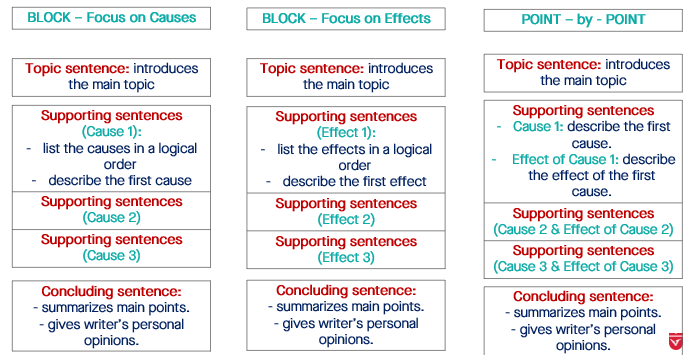
Unit 4: Cause-Effect Paragraph (A complete paragraph)

Activities

Notes

Activity 1

Choose the correct answers in the brackets.

Structure Revision

Useful Language

For Writing Topic sentence:

For Writing Supporting sentences:

Causes:…

Effects:…

For Writing Concluding sentence:

Write supporting sentences

Develop the idea

1/ There are several causes of global warming. The most important one is that too many people are burning fossil fuels like coal and gas to create power their cars and motorcycles every day._______________________________________

_____________________________________________________________________

_____________________________________________________________________

_______________________________________________________________________

2/ Global warming has many negative effects. The main effect is that sea levels are rising. This is because______________________________________________

________________________________________________________________

______________________________________________________________

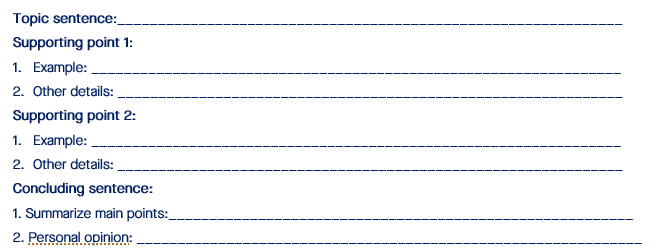
Plan your writing

Full paragraph

HOMEWORK

  • E-learning: Lesson 13- After class
  • Spark: RW-Unit 4
  • Prepare the new lesson:

+ Lesson 14 - Before class (E-learning)

Lesson 14

Lesson 14 -Unit 5: FOOD JOURNEY- Reading 2: Cooking the world(Pathways RW 1 – p.90-94)

Activity

Notes

Vocabulary Revision

Almost: hầu như

Argue: tranh cãi, tranh luận

Break: nghỉ ngơi, giải lao

dish - meal - diet: món ăn

experience: kinh nghiệm,trải nghiệm

ingredient: nguyên liệu

popular: phổ biến

recipe: công thức

respect: tôn trọng

variety: đa dạng ->bring/ offer a variety of: đem đến sự đa dạng

dessert: món tráng miệng

ready made food: đồ ăn chế biến sẵn

Skip breakfast: bỏ bữa sáng

Bibimbap = mixed rice: cơm trộn

Dumplings: điểm sấm

Broken rice: cơm tấm

Fish and chip: khoai tây chiên và cá tẩm bột chiên

Stay connected: kết nối

Sourdough:

VOCABULARY APPLICATION

Discuss these questions with a partner.

Exercise C, p.90

1. Have you ever argued with people online? What happened?

Yes/ No, ………. because………/For example,…..

2. What trends are popular now?

I think …………… is a popular trend because…….

Activity 3

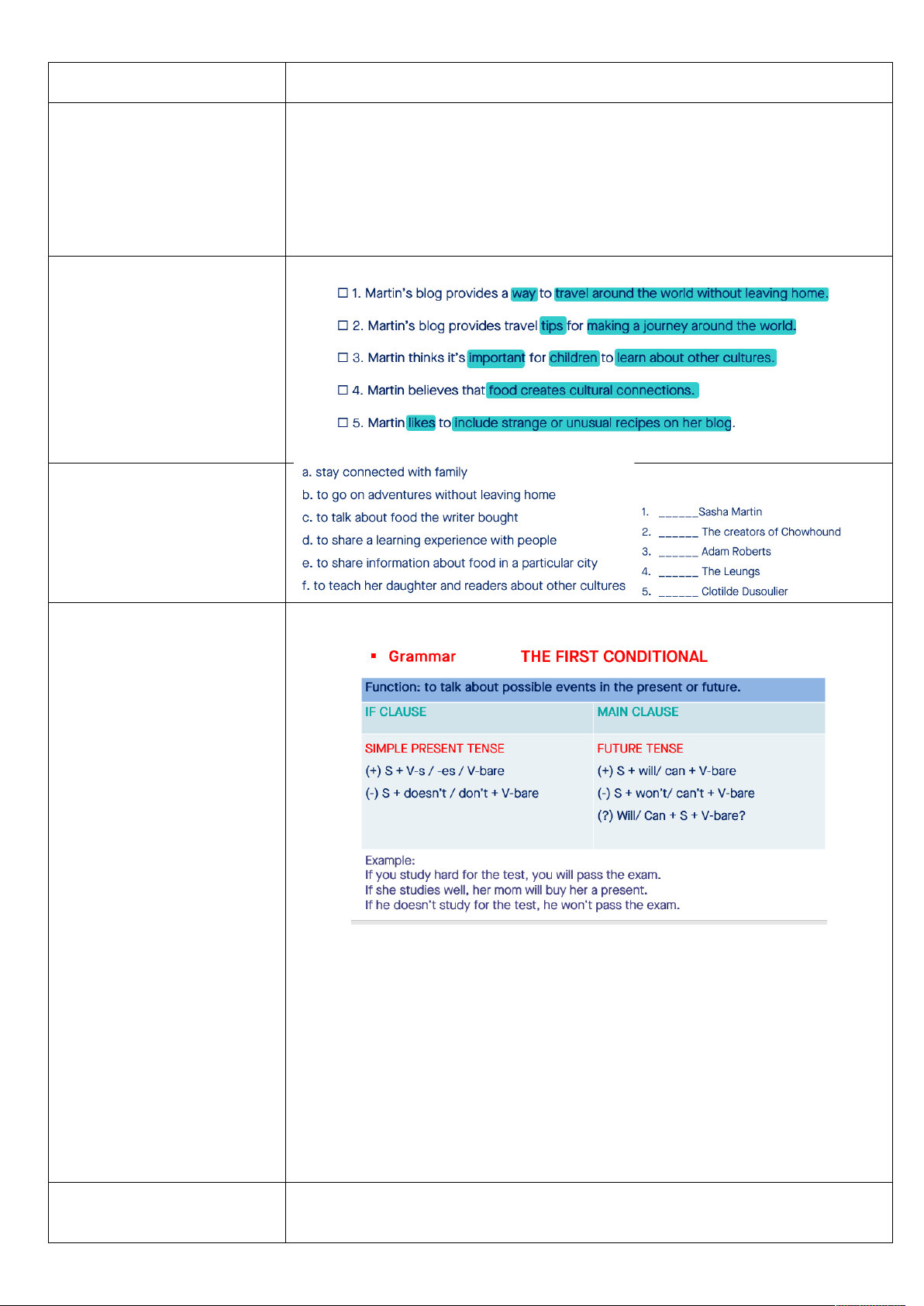
Check (✓) the three sentences that best describe Sasha Martin’s blog and ideas.

Exercise A, p.93

Activity 4

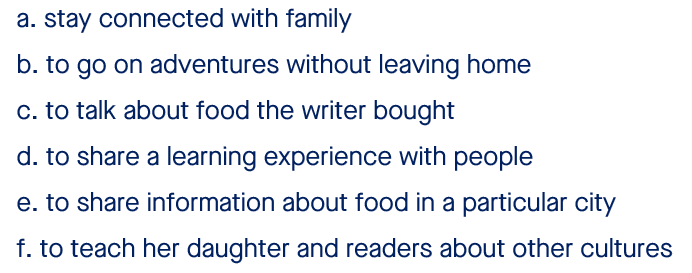
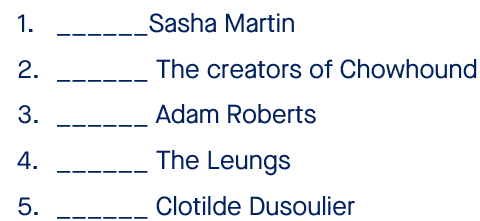
Find out why each blogger created their food blog. Match each blogger to a reason or reasons (a–f).

Exercise B, p.93

GRAMMAR

The first conditional

SPEAKING

1. What’s your favorite dish?

Useful language: My favorite dish is ………………. because I ………………………………..… In addition, if S + V(s/es), S + will + Vbase. This makes me happy because ………………………….

2. Do you have healthy eating habits?

Useful language: Yes, I always try to maintain healthy eating habits. / No, I don’t have healthy eating habits. This is because/ I believe……. ……………….For example,…………………….

3. Do you think people’s diets affect their health?

Yes, I believe people’s diets really affect their health./ No, I don’t believe people’s diets affect their health.

If people eat ………………………., their body will feel ……………..…….. Some people argue that …………

EXAM PRACTICE – READING

“Short Answer”

  1. Read the instruction carefully and notice the word limit.​
  2. Read the questions. Guess/ predict the type of target information (name, date, place).​
  3. Identify keywords in questions and think of their synonyms/paraphrases. ​
  4. Scan the text to find the part that has keywords and synonyms/paraphrases. ​
  5. Read that part of the text carefully to find the answers.​
  6. Check your answers’ spelling and word limit.​

Repeat steps 2 to 6 for the remaining questions.​

HOMEWORK

  • E-learning: Lesson 14 - After class
  • Spark: RW-Unit 3
  • Prepare the new lesson:

Lesson 15 - Before class (E-learning)

Lesson 15

Lesson 15-UNIT 5: FOOD ON THE MOVE-Listening B: Ugly Food-(Pathways LS 1 – P.92-96)

Activity

Notes

Activity 1

Look at the photos of food. Ask and answer some questions about them.

Exercise A, p.94

1. Are any of these foods common in your country? Do you like them? Why? Why not?

…………………………………… are common in my country. I like/ I don’t like them because…. ……………………………..

2. Are there any of them that you don’t ever want to try? Why not?

Yes, there are / No, there aren’t…………………………….…because …………………………..

Vocabulary Revision

Appearance

Connect

Flavor

Nervous

Senses

Sight

Smell

Sound

Taste

Tough

Fruit: trái cây

VOCABULARY APPLICATION

Activity 2

Choose one of the questions below and write notes in the chart. Then, tell your partner about your answers.

Exercise D, p.93 (6 minutes)

1. What is your favorite food? Why do you like it?

My favorite food is Thai hot pot because it has a good smell and a spicy taste. I first ate it on my first trip to Thailand last year.

My favorite food is beef noodle soup (bún bò) because it has a strong flavor and a wonderful smell. I first ate it with my family when I was a child and I usually eat it for breakfast.

2. Do you connect any food with a memory? What is the food? Why?

Yes, I connect ……………….…with my childhood. It looks ……………..…. This food brings back happy memories because ….

Yes, I connect sticky rice (xôi) with my childhood. It looks simple but delicious. This food brings back happy memories because my mother used to make it for me every morning before school.

3. Think of a food that you ate recently. Describe the senses you used as you ate it.

Recently, I ate………………..…..It looked………………..the smell was………….……When I took a bite, it taste……………...

Recently, I ate banh mi Vietnamese. It looked crispy and colorful, the smell was so fresh and appetizing. When I took a bite, it tasted crunchy outside and soft inside, with a mix of meat, vegetables, and sauce

Activity 3

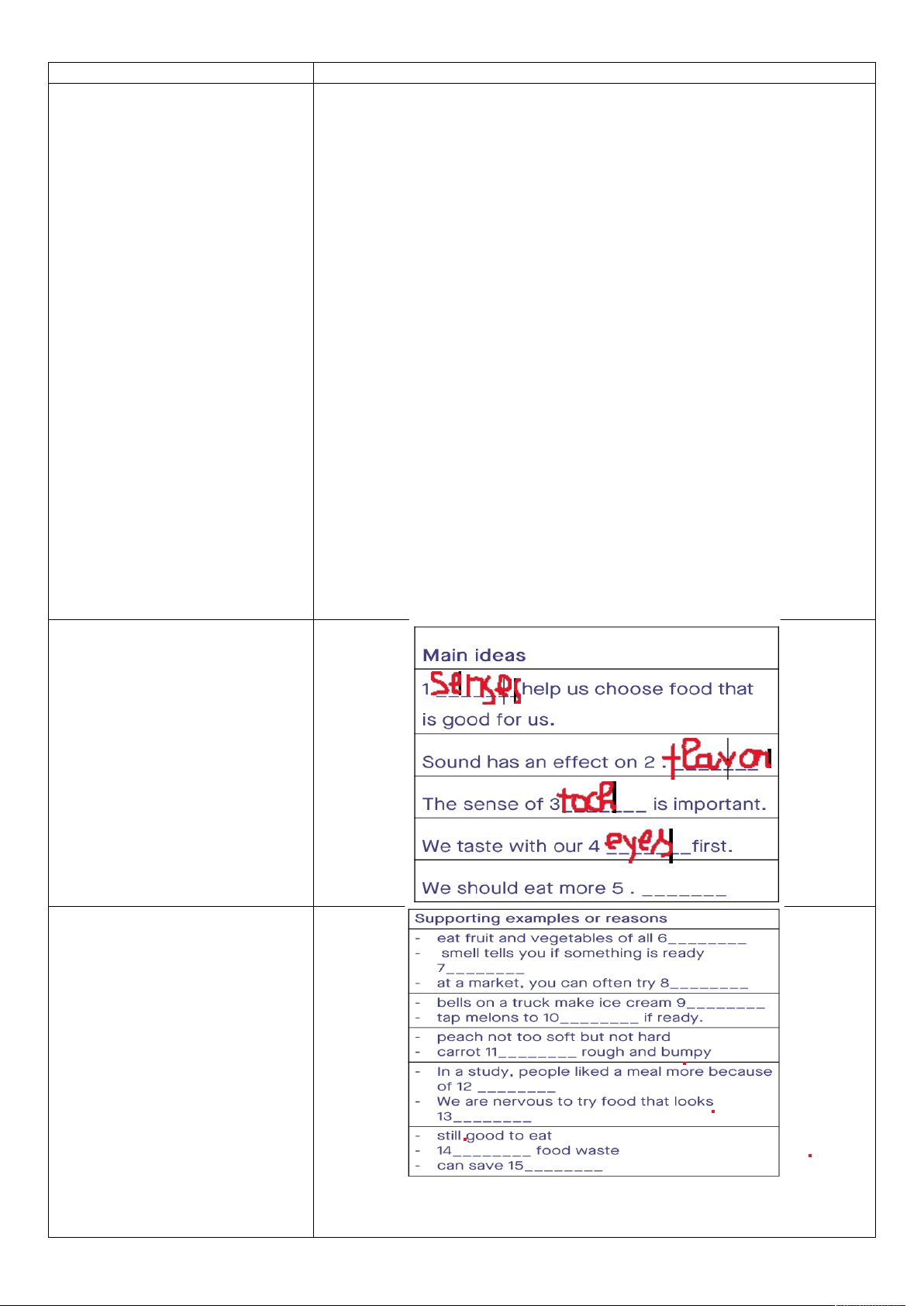
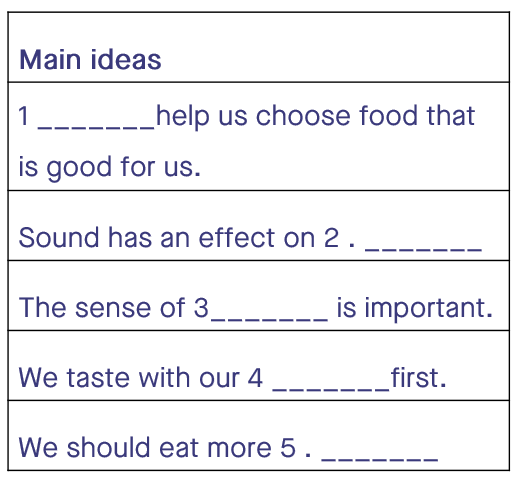
Listen to a radio show about ugly foods. Complete the main ideas (1–5) with ONE or TWO words.

Exercise B, p.9

Activity 4

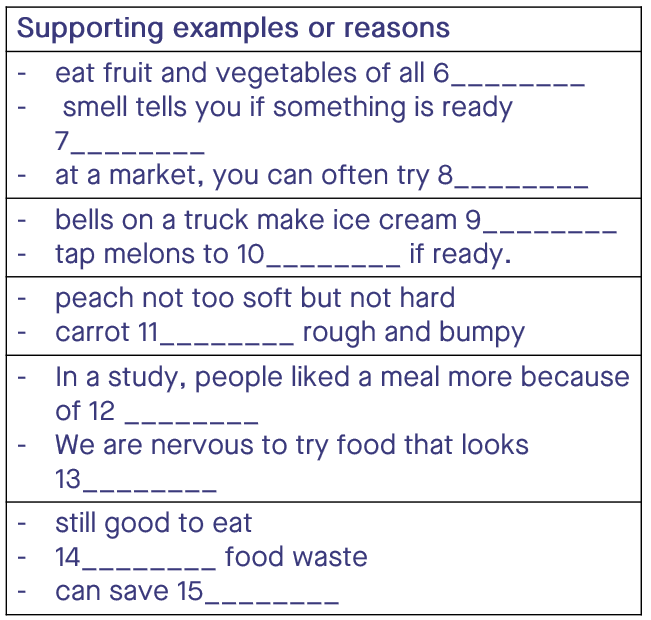
Listen to the radio show again. Complete the supporting examples or reasons (6–15) with ONE or TWO words.

Exercise C, p.95

6 colors

7 to eat

8 Fruit

9 taste sweeter

10 hear

11 feels

12 its appearance 13 different 14 decrease 15 money

Activity 5

Each phrase from the radio show is missing one adjective. Listen to the sentences and complete the phrases.

Exercise D, p.95

Activity 6

Discuss the following questions.

Exercise E, p.95

1. What foods from your culture are popular in other parts of the world? Why do you think they are popular?

…………………………..is popular in other parts of the world because ………………………

2. What foods from your culture might seem strange to other people? Why?

Vietnamese………………………………….…. might seem like a strange food to other people because.……………………………..

GRAMMAR

The second conditional

SPEAKING

Part 1 & 3 questions about “traditional food”

Part 1:

1. What are some traditional dishes in your country?

Some traditional dishes in my country are ……………….., ………….….and …………………..…. Each dish is a special food of a different region in Vietnam. They have their unique …………..………..…. and ……………….. If S + V2/ed, S would + Vbase…..

2. Do you prefer eating out or cooking at home? Why?

I prefer …………………….……. because …………………….. For example, ………………... If S + V2/ed, S would + Vbase……………..

Part 3:

1. Do people in your country still eat traditional food?

Yes, people in my country still eat traditional food in special events or even everyday./ No, people in my country don’t eat traditional food anymore.

Reason:……………………………………….…..

EXAM PRACTICE – LISTENING

Multiple - Choice task type (Part 4)

Step 1: Read the instructions carefully

Step 2: Underline the keywords in each question and option. Think of their possible synonyms or paraphrases.​

Step 3: Listen for any keywords or synonyms.​

Step 4: Only choose your answer after you have listened to all options.​

Step 5: If you miss an answer, guess and move on to the next.​

Step 6: Check your answers carefully.​

HOMEWORK

  • E-learning: Lesson 15 - After class
  • Spark: LS-Unit 5
  • Prepare the new lesson:

+ Lesson 16 - Before class (E-learning)

Lesson 16

Unit 5: WRITING REVIEW

  • A COMPARISON PARAGRAPH
  • A CAUSE-AND-EFFECT PARAGRAPH

Activity

Notes

A COMPARISON PARAGRAPH

Write a paragraph of at least 120 words to compare and/or contrast two tourist attractions.

A CAUSE-AND-EFFECT PARAGRAPH

Write a paragraph of at least 120 words to discuss the positive effects of using the Internet.

HOMEWORK

  • E-learning: Lesson 16 - After class
  • Spark: RW-Unit 5
  • Prepare the new lesson:

+ Lesson 17 - Before class (E-learning)