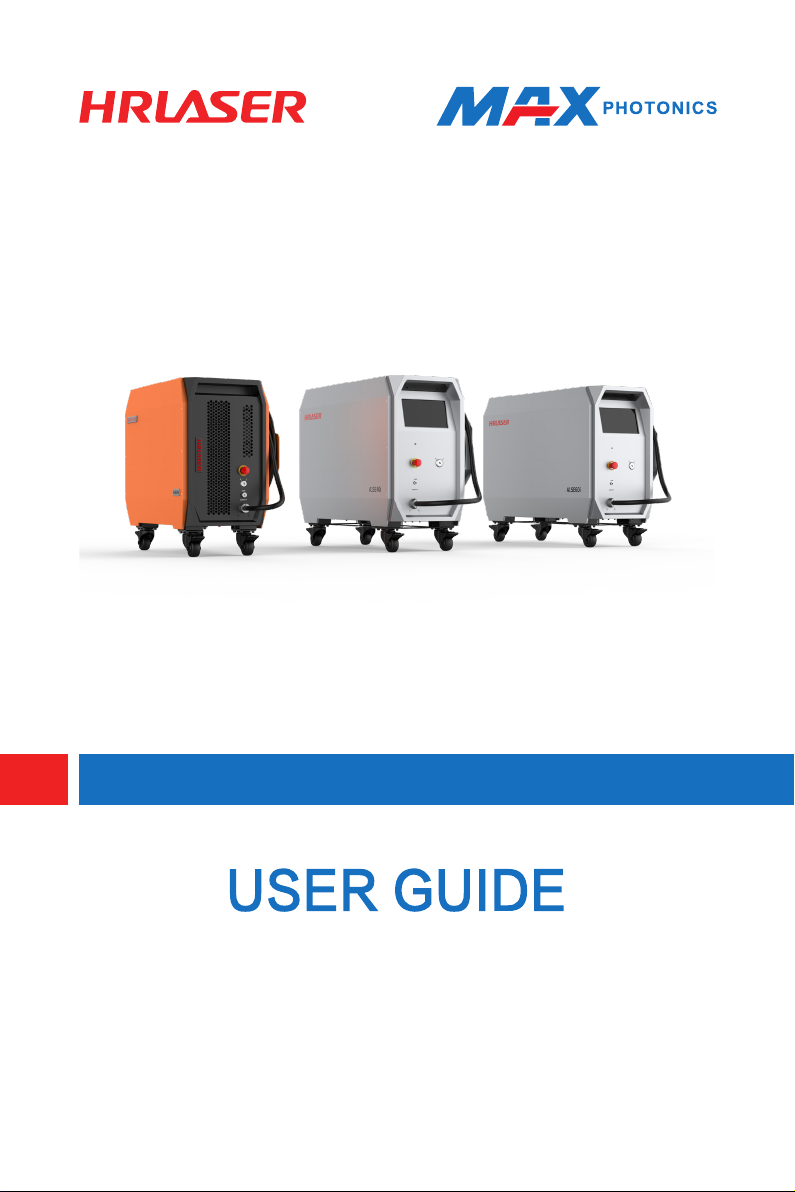
Manual A1 Series Handheld Laser Welding MAchine


















Preview text:
A1 Series Handheld Laser Welding Machine Revision:v1.1
©Copyright2023 Maxphotonics Co.,Ltd. Disclaimer
Maxphotonics believesthat the provided User Guide is accurate and reliable.
However, no warranty or representation, either expressed or implied, is made
concerning this document, including, without limitation, any implied warranty of
merchantability or fitness for a particular use, purpose, or application, whether
alone or in conjunction with any other device, equipment, plant materials, or
processes. The user must assume full responsibility for any product to which it
applies. Maxphotonics shall not be liable for any incidental, inevitable, indirect,
or special damages, including, without limitation, lost profits, losses, and
production expenses or similar damages. The information contained in this
document may lead to infringement of patents or other rights of third parties,
and Maxphotonics shall not be liable for any indirect or special damage resulting
from misrepresentations or omissions in this document or any consequential consequences. 1 Preliminary Note
Before using the product, ensure that you have read and understood all
contents of this manual and are familiar with the instructions for operation and
maintenance. Maxphotonics strongly recommends that all operators of the
Product read and take special care to confirm all safety information contained in
this document before operating the product. This User Guide provides important
operational, safety, and other information to be reviewed regularly for operators, users, and product owners.
For product technical assistance, please contact Maxphotonics Customer Service.
Shenzhen Maxphotonics Co., LTD.:
Maxphotonics Industrial Park, Furong Third Road, Shajing Furong Industrial Zone, Baoan District, Shenzhen
Phone number: 400-900-9588 E-mail: info@Maxphotonics.com
This guide applies to all owners and operators of Maxphotonics equipment
and to all persons working in the vicinity of the Product at the time of use.
Usage of this product should be limited to fully trained professional and non-
professional welding operators. 2 Copyright Notice
©Maxphotonics Co., Ltd (hereinafter referred to as Maxphotonics). All rights
reserved. Unauthorized copying, modification, transmission, or publication of
this material, in any form, media, or by any means, is strictly prohibited without
the prior written consent of Maxphotonics, except as permitted under applicable
copyright laws. Any permitted copies must include the original copyright and proprietary notices.
While Maxphotonics endeavors to ensure the accuracy and reliability of the
information provided, no warranties, representations, or guarantees are made
that this document may be used as a reference in other contexts. Moreover,
Maxphotonics assumes no responsibility for any infringement of patents or
other third-party rights resulting from the use of the information contained in
this document. Maxphotonics will not be held accountable for any errors in this
document, nor for any direct or indirect damages to relevant equipment.
Maxphotonics and the Maxphotonics Logo are registered trademarks of
Maxphotonics Co., Ltd., and their use complies with the trademark law.
Maxphotonics does not grant any rights to patents or other intellectual property mentioned herein.
All information contained in this document is subject to change and revision without prior notice. Maxphotonics Co.,Ltd.
Address: Maxphotonics Industrial Park, 3rd Furong Road,
Furong Industrial Area, Shajing, Baoan, Shenzhen, China.518125 E-Mail: info@maxphotonics.com http://en.maxphotonics.com
Subject to change without notice. 3 Preface
Thank you for choosing Maxphotonics' handheld laser welding products.
This User's Guide has been compiled to help you use and maintain the laser
properly. While we have made every effort to provide accurate information in this
document, there may be occasional oversights due to the writer's limitations
and time constraints. We appreciate your understanding and welcome any suggestions for improvements.
Before using the product, please take the time to read and understand this
User's Guide and familiarize yourself with the operating and maintenance
instructions. We highly recommend that the operator review Section 2, "Safety
Information," before operating the product.
Keep this User's Guide with the product, as it provides crucial operating, safety,
and other information for you and any future users or owners.
Throughout the document, we have underscored sections that require special
attention. Please take note of these sections to prevent unnecessary damage.
Thank you once again for choosing Maxphotonics' products. 4 Company Profile Introduction:
Founded in 2004, MaxPhotonics is a leading global provider of high-performance
fiber lasers, laser solutions, and optical components for various industries,
including manufacturing, healthcare, research, and telecommunications. over
the years, MaxPhotonics has consistently focused on developing state-of-the-art
products, driving innovation, and delivering cutting-edge solutions to customers
worldwide. With a strong commitment to quality, excellence, and customer
satisfaction, MaxPhotonics has earned a reputation for precision, reliability, and
innovation in the field of photonics.
Headquarters and Locations:
MaxPhotonics maintains its headquarters in Shenzhen, China, and holds a
strong presence in many countries across the globe. This extensive network
enables the company to rapidly respond to customer needs and effectively
collaborate with industrial partners. Products and Services:
MaxPhotonics specializes in offering a wide range of high-quality products and services, such as:
Fiber Lasers: MaxPhotonics provides a comprehensive portfolio of fiber lasers,
including continuous wave (CW) fiber lasers, pulsed fiber lasers, ultrafast fiber
lasers, and high-power fiber lasers. These lasers cater to a vast range of
applications, including material processing, healthcare, optical transmission, sensing, and research.
Optical Components: The company also designs, manufactures, and markets
high- performance optical components that include fiber Bragg gratings, optical
isolators, optical circulators, couplers, and other passive components required in various photonic systems.
Laser Solutions: MaxPhotonics delivers turnkey laser solutions and customized
systems for a myriad of industries like automotive, aerospace, electronics, 5
and semiconductors. These solutions enable customers to achieve improved
efficiency, productivity, and cost-effectiveness.
Engineering Services: With a highly skilled and knowledgeable team of
engineers, MaxPhotonics offers technical consulting, system integration, and
customer training services, ensuring that customers receive the best value and
optimal performance from their laser systems.
Quality and Certifications:
MaxPhotonics is dedicated to providing world-class quality products and services
to its customers. The company adheres to stringent quality control procedures
and has achieved significant certifications such as ISO 9001, CE, and RoHS,
demonstrating its commitment to international quality standards.
Research and Development (R&D):
MaxPhotonics continually invests in R&D, driving technological advancements
and product innovation. The company's in-house R&D team collaborates with
leading research institutions and universities, exploring new technologies and
materials to create breakthroughs in the field of photonics. Customers and Partners:
MaxPhotonics serves an extensive global customer base, ranging from small
businesses to Fortune 500 companies, across various industries such as
automotive, aerospace, electronic, telecommunications, and semiconductor
industries. The company has established strategic partnerships with numerous
industry-leading businesses and organizations, leveraging their combined
expertise to innovate and provide premium solutions for its customers. Core Values and Vision:
MaxPhotonics's core values revolve around innovation, customer-focus, and
excellence. The company is dedicated to pushing the boundaries of photonic
technology and delivering cutting-edge, reliable, and customized solutions that exceed customer expectations. 6
The company's vision is to become a global industry leader in advanced fiber
lasers, expand its product portfolio, and provide advanced photonic solutions
that empower businesses to achieve revolutionary improvements in their
operations, ultimately contributing to a better world. Conclusion:
With more than a decade of experience in optics and photonics, MaxPhotonics
has become a trusted leader in the global photonics industry. As it continues to
drive innovation and deliver world-class products and solutions, MaxPhotonics
remains committed to its core values and vision, ensuring sustainable growth
and success for its customers and partners alike.
More information ,please visit our website: http://en.maxphotonics.com CONTENT 7
Company Profile ……………………………………………………… 7
Chapter 1 Product information …………………………………… 10
Chapter 2 General Safety Information ………………………… 12
1-Safe Usage of Handheld Laser Welding Machines ����� 12
2-Safety Conventions ������������������� 13
3-Laser Protection Measures ��������������� 15
4-Weld Feature Safety ������������������ 15
5-Reference Standard ������������������ 28
6-General Safety Instructions ��������������� 28
7-Additional Safety Information �������������� 33
8-Important Safety Information ��������������� 34
Chapter 3 Product Description …………………………………… 36
1-Features ������������������������ 36
2-Module Configuration ������������������ 36
3-Laser Model overview and Safety Features �������� 37
4-Certificate of Assurance ����������������� 37
5-Front and Back Panel Description of Laser Welding Machine 38
6-Torch Instructions�������������������� 42
Chapter 4 Specification …………………………………………… 46
1-optics Characteristic Parameters ������������� 46
2-General Characteristic Parameters ������������ 47 8 CONTENT
3-Structural Layout �������������������� 48
Chapter 5 Disassembly Guide …………………………………… 50
1-Unpacking Instructions for Shipping Container ������� 50
2-Deliveryand Transportation ��������������� 50
Chapter 6 operation Guide ……………………………………… 52
1-Notice ������������������������� 52
2-Electrical Power Connection Guidelines ���������� 52
3-Electrostatic Grounding Process ������������� 53
4-Securely Lock the Connection �������������� 54
5-Safely Secure the Gas Connection ������������ 54
6-Wire Feeder Instructions and Installation Guide ������ 55
7-Installation of Wire Feeding Tube ������������� 60
8-Wire Feeder and Torch Connection ������������ 60
9-Wire Feed Frame and Hand Welding Connection ����� 62
10-Maintenance and Trouble shooting of Wire Feeders ���� 63
11-Routine Maintenance ����������������� 63
12-Startup Steps for Laser operation ������������ 66
13-WeldingProcessParameters �������������� 67
14-How To Use The Fish Scale Function ���������� 70
15-Product Accessory Inspection and Cleaning Guide ���� 71
Chapter 7 Service and Maintenance …………………………… 78 CONTENT 9
1- Maintenance Notes ������������������ 78
2- Service Statements ������������������ 79
Chapter 8 Warranty Statements ………………………………… 80
1- General Provisions ������������������� 80
2-Warranty Limitations ������������������ 80
Chapter 9 Operation GUI Description …………………………… 82
1- Startup safety instructions ��������������� 82
2-operation interface ������������������� 83 10 Chapter 1 Product Information
Introducing the A1 Series: High-Efficiency, High-Reliability, Maintenance-Free
High-Power Lasers from Maxphotonics.
The A1 series by Maxphotonics offers a high-performance, efficient, and reliable
range of lasers designed for a variety of applications. Utilizing phase transition
heat dissipation technology, these lasers feature a wavelength range of 1070 nm
to 1090 nm, with an approximate efficiency of 30%.
As Class 4 certified laser products, safety has been a priority in the design
and testing of the A1 series. However, due to the unique properties of lasers,
they can pose safety hazards that should not be overlooked. It is crucial that all
personnel operating or near the laser are aware of these risks and adhere
to the safety guidelines and warnings provided within this manual to
ensure both secure operation and optimal performance. Disassembling
the device is strongly discouraged to maintain user safety during operation, maintenance, and service.
The A1 series is designed to be user-friendly, with no parts or
components requiring user repair or servicing. Unauthorized disassembly can
lead to voiding any warranties provided by Maxphotonics.
Maxphotonics also offers a handheld welding laser system, featuring a
compact control unit and lightweight torch with a built-in beam swing function. By
adhering to the user guide and implementing proper laser safety measures, this
system can be a dependable tool. All operators and nearby personnel must be
attentive to the laser's special hazards and use personal protective equipment as needed.
Chapter 1 Product information 11
Following all instructions and safety warnings in this guide will ensure a
safe operation and maximum performance.
Intended Use: The A1 series is suitable for welding and brazing
applications, handling materials such as stainless steel, carbon steel,
galvanized sheet, aluminum, and copper.
Maxphotonics ensures that this laser has undergone rigorous testing and
inspection, complying with all published specifications before shipment.
Upon receiving the equipment, please inspect the packaging and components
for any damage that may have occurred during transit. If any damage
is found, contact Shenzhen Maxphotonics Co., LTD for assistance. 12 Chapter 2
General Safety Information
1 - Safe Usage of Handheld Laser Welding Machines
Handheld laser welding machines fall under the hazardous Class 4 laser product
category due to their emission of invisible, infrared laser radiation with a wavelength
of 1080nm. With the welding head radiating over 100W on average, this
high- intensity light can cause direct or indirect damage to eyes and skin. In
particular, exposure to this laser beam may result in irreversible damage to the
retina or cornea. It is imperative to wear appropriately certified 1080nm near-
infrared laser safety glasses before operating a handheld laser welding machine to ensure safety. IMPORTANT:
◆ Always avoid looking directly at the fiber output connector and ensure that you
are wearing appropriate protective eyewear while using the laser to prevent potential eye injuries.
◆ Refrain from opening the laser device as there are no parts or accessories
intended for user access inside. All maintenance and repair work must be performed
by authorized service personnel only.
◆ Ensure proper grounding power supply and normal voltage when operating this product.
◆ Before starting the laser, verify that the surrounding temperature and humidity are within the recommended range.
◆ Avoid subjecting the product to excessive moisture.
◆ This laser relies on air cooling; ensure that the surrounding air is dry and clean.
◆ Any operation or adjustments made outside of the guidelines specified in this
manual may result in damage or malfunction.
Chapter 2 General Safety Information 13 2-Safety Conventions
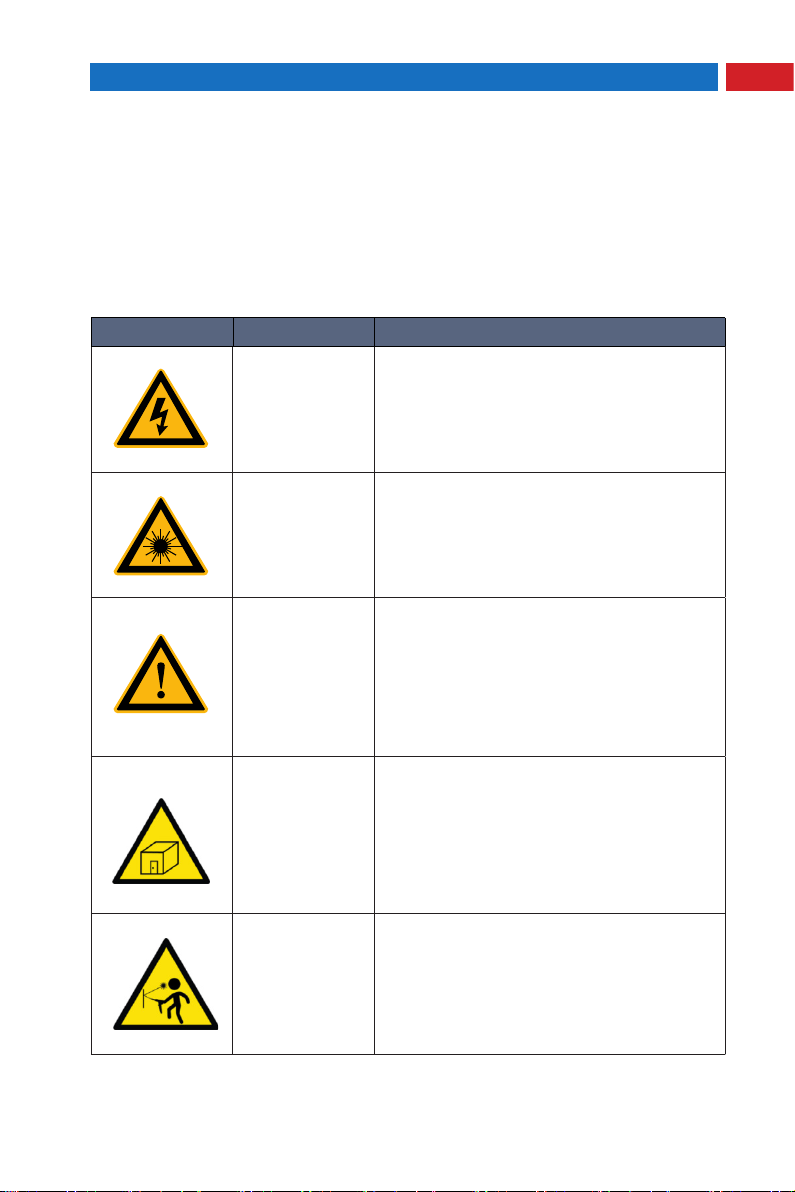
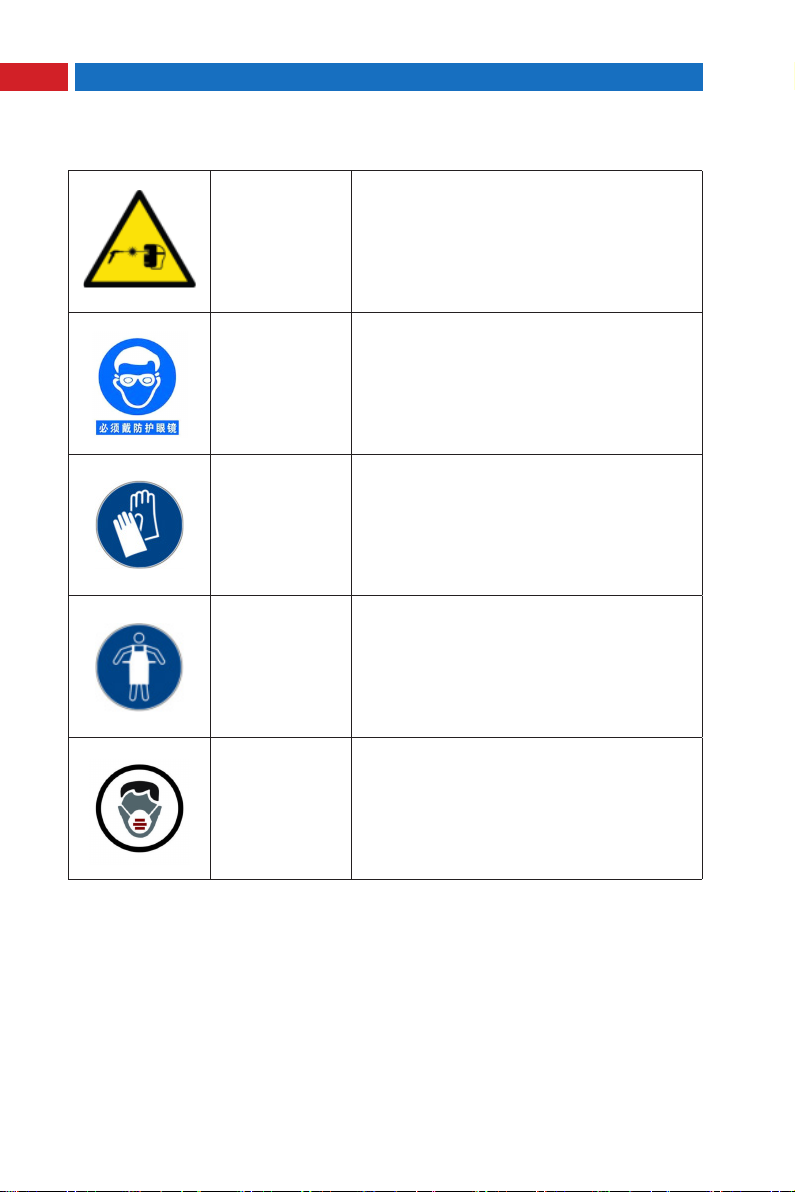
As shown in the following table, all safety warning signs (not limited to those
affixed to the laser body) during the operation of the handheld laser welding machine include: SAFETY SIGNS NAME DESCRIPTION Warning:
Text marked with electrical warning symbol
Electrical hazard indicates potential personal danger. If you do
not follow certain procedures, certain or fatal
harm may be caused to you or others. Note:
Text with a laser radiation warning symbol Laser radiation
indicates a potential personal danger. We hazards
have affixed this mark to the laser output end of the product. Note:
Text with a warning symbol indicates a
potential product hazard. It requires an Warnings
operating procedure that, if not followed
correctly, can result in damage or destruction of the product or component. Note:
Welding device operation should only be Laser safety
done in the laser safe or in the enclosure housing
(or room) with interlocking safety devices. If
someone enters unexpectedly, the interlock
automatically shuts down the welding system. Note:
The symbol represents a potential hazard, Direct and
indirectly or directly causing damage to the
reflected beams eyes or skin from the laser beam reflected are dangerous
by welding.Personnel must wear protective equipment and clothing. 14
Chapter 2 General Safety Information Note: Direct beam to
Never look directly at the output welding danger
head "gun" or point the gun at another
person. This is very dangerous.
Symbol indicates that personnel must wear
Wear laser safety laser safety glasses (personal protective glasses
equipment) to prevent laser radiation hazards.
Wear protective The symbol indicates that personnel must gloves
wear laser - and heat-resistant protective gloves.
Wear protective The symbol indicates that personnel must clothing
wear protective aprons against laser and heat.
The symbol indicates that personnel must Put on helmets
put on the helmet against laser and heat.
Chapter 2 General Safety Information 15
3-Laser protection Measures
1.Requirements for Laser Safety Goggles
When using a hand-held laser welding machine, it is crucial to wear laser
safety goggles that provide protection against the entire wavelength range
emitted by the device. To select the appropriate goggles, end-users must
accurately identify the product's wavelength range. If the device is a tunable
laser or Raman product, it emits light in a range of wavelengths, and users
should confirm that the chosen laser safety goggles effectively block light across
this entire range. Additionally, it is essential to verify that all personal protective
equipment (e.g., safety shields, viewing windows, goggles) is sufficient for the
device's output power and wavelength range. Consideration should also be
given to any secondary radiation hazards posed by the welding process (refer to Chapter II, Section 4-1).
2.Suppliers of Laser Protective Equipment
Whether incorporating a laser into a new facility or retrofitting an existing system,
the end-user bears sole responsibility for determining the appropriateness
of all personal protective equipment.
Numerous laser safety equipment suppliers offer materials and equipment,
including LaserVision USA, Kentek Corporation, and Rockwell Laser Industries.
While there are other laser personal protective equipment suppliers,
Maxphotonics provides these names for convenience only, without endorsing
or recommending any specific supplier, product, or service. Furthermore,
Maxphotonics assumes no responsibility for the advice, products, or services provided by these suppliers.
4-Welding Feature Safety
1.Eye and Ultraviolet Radiation Hazards
Welding generates visible and invisible radiation, which can pose risks to
welders. The high-power laser beam's interaction with the material being 16
Chapter 2 General Safety Information
welded can create plasma, emitting ultraviolet radiation and "blue light." These
emissions can lead to conjunctivitis, photochemical damage to the retina,
and skin reactions similar to sunburn. Welders exposed to UV light without
adequate protection may experience permanent eye damage.For all personnel
in the laser controlled area, TRC Laser recommends wearing personal protective
equipment, including safety glasses and helmet shield devices, to protect the
eyes from any reflected or scattered laser beam as well as welding strong light,
ultraviolet light and heat and sparks. 2.Skin Hazards
Welders are at risk of skin damage from infrared and ultraviolet radiation
during welding. These types of radiation can cause skin burns, increase the
likelihood of skin cancer, and promote premature skin aging. Welding sparks
can also lead to burns. Laser material processing can cause parts to become
extremely hot even after the cutting process has ended. It is essential to
use appropriate personal protective equipment to avoid potential burns. To
prevent skin damage, wear protective clothing such as heat-resistant gloves,
hats, leather aprons, and other flame-resistant garments. Button up sleeves and collars. 3.Fire Hazards
The heat and sparks generated during welding can ignite or explode
flammable materials near the welding area. only perform laser welding in
areas clear of combustible materials. Never weld containers that contain,
or are assumed to contain, flammable or combustible materials. Ensure fire
extinguishers are easily accessible and nearby, and have personnel trained to use them. 4.Smoke and Fume Hazards
Welding "fumes" can consist of fine particles and gases produced
Chapter 2 General Safety Information 17
by the combination of welding materials, filler materials, shielding gases,
paint, coatings, chemical reactions, and air pollutants. Welding fumes can
negatively impact the lungs, heart, kidneys, and central nervous system. To mitigate these risks:
(1) Keep the head away from the smoke while welding. Always work in a
well- ventilated area to ensure safe breathing conditions.
(2) Implement a fume extraction system to remove vapors, particulates,
and hazardous debris from the welding process area.
(3) Use a respirator in confined spaces or other situations where it may be required.
(4) Conduct regular air monitoring to determine the level of noxious fumes in the welding area. 5.Cylinder Safety Measures
A gas cylinder poses a risk of explosion if it is damaged or situated close to
the welding zone. To ensure safety, place shielding gas cylinders in a secure
location where they are not susceptible to impact or damage, and maintain
distance from sources of heat, sparks, or flames. It is essential to store the
cylinders in an upright position and fasten them securely to a stationary
stand. Utilize a functioning regulator specifically designed for the intended gas
and pressure. Additionally, verify that all hoses and fittings are appropriate for
their intended application and are in optimal working condition.
6. Important Safety Notice for outbound Security Indicators: Important:
◎ It is crucial to be aware that when the power supply (PS) is activated, 18
Chapter 2 General Safety Information
the laser is in a hazardous state. Every necessary precaution must be
taken to prevent accidental exposure to direct and reflected beams. Both
diffuse and specular reflections can lead to severe retinal or corneal
damage, potentially causing permanent eye damage. Class 4 laser beams
may also pose fire and skin damage risks when handling equipment or being
in its vicinity. Ensure that all personnel wear appropriate personal protective
equipment (PPE), including safety goggles and helmets with face shields.
To maintain laser safety information, adhere to laser control measures and
operate the system correctly, otherwise, exposure to detrimental radiation may occur. 7. Safety guidance
To ensure the safe use of the product and optimize its performance, please
follow the instructions, warnings, and precautions detailed in this manual. WARNING:
Use the appropriate ground power supply when operating this product. WARNING:
Do not open any parts within the product for maintenance. If required,
contact Maxphotonics laser technicians for servicing. Unauthorized
alterations to this product will void the warranty. WARNING:
Be cautious when using hand-held welding tips connected to the output
connector of this product via optical fiber cable. WARNING:
Adhere to the provided instructions as improper use may affect the
safety mechanisms of the product. This product must only be operated under conventional conditions.