





Preview text:
Psychological Science http://pss.sagepub.com/
The Pen Is Mightier Than the Keyboard: Advantages of Longhand Over Laptop Note Taking
Pam A. Mueller and Daniel M. Oppenheimer
Psychological Science published online 23 April 2014 DOI: 10.1177/0956797614524581
The online version of this article can be found at:
http://pss.sagepub.com/content/early/2014/04/22/0956797614524581 Published by:
http://www.sagepublications.com On behalf of:
Association for Psychological Science can be found at:
Psychological Science
Additional services and information for Email Alerts:
http://pss.sagepub.com/cgi/alerts
http://pss.sagepub.com/subscriptions Subscriptions:
http://www.sagepub.com/journalsReprints.nav Reprints: Permissions:
http://www.sagepub.com/journalsPermissions.nav - Apr 23, 2014 OnlineFirst Version of Record >> What is This?
at Erciyes Universitesi on May 2, 2014 pss.sagepub.com Downloaded from
524581PSSXXX10.1177/0956797614524581Mueller, OppenheimerLonghand and Laptop Note Taking research-article2014
Psychological Science OnlineFirst, published on April 23, 2014 as doi:10.1177/0956797614524581 Research Article Psychological Science 1 –10
The Pen Is Mightier Than the Keyboard: © The Author(s) 2014 Reprints and permissions:
sagepub.com/journalsPermissions.nav
Advantages of Longhand Over Laptop DOI: 10.1177/0956797614524581 pss.sagepub.com Note Taking
Pam A. Mueller1 and Daniel M. Oppenheimer2
1Princeton University and 2University of California, Los Angeles Abstract
Taking notes on laptops rather than in longhand is increasingly common. Many researchers have suggested that laptop
note taking is less effective than longhand note taking for learning. Prior studies have primarily focused on students’
capacity for multitasking and distraction when using laptops. The present research suggests that even when laptops
are used solely to take notes, they may still be impairing learning because their use results in shallower processing.
In three studies, we found that students who took notes on laptops performed worse on conceptual questions than
students who took notes longhand. We show that whereas taking more notes can be beneficial, laptop note takers’
tendency to transcribe lectures verbatim rather than processing information and reframing it in their own words is detrimental to learning. Keywords
academic achievement, cognitive processes, memory, educational psychology
Received 5/11/13; Revision accepted 1/16/14
The use of laptops in classrooms is controversial. Many
important but relatively unsurprising, given the literature
professors believe that computers (and the Internet)
on decrements in performance when multitasking or task
serve as distractions, detracting from class discussion and
switching (e.g., Iqbal & Horvitz, 2007; Rubinstein, Meyer,
student learning (e.g., Yamamoto, 2007). Conversely, stu- & Evans, 2001).
dents often self-report a belief that laptops in class are
However, even when distractions are controlled for,
beneficial (e.g., Barak, Lipson, & Lerman, 2006; Mitra &
laptop use might impair performance by affecting the
Steffensmeier, 2000; Skolnick & Puzo, 2008). Even when
manner and quality of in-class note taking. There is a
students admit that laptops are a distraction, they believe
substantial literature on the general effectiveness of note
the benefits outweigh the costs (Kay & Lauricella, 2011).
taking in educational settings, but it mostly predates lap-
Empirical research tends to support the professors’ view,
top use in classrooms. Prior research has focused on two
finding that students using laptops are not on task during
ways in which note taking can affect learning: encoding
lectures (Kay & Lauricella, 2011; Kraushaar & Novak,
and external storage (see DiVesta & Gray, 1972; Kiewra,
2010; Skolnick & Puzo, 2008; Sovern, 2013), show 1989). The encoding hypothesis suggests that the pro-
decreased academic performance (Fried, 2008; Grace-
cessing that occurs during the act of note taking improves
Martin & Gay, 2001; Kraushaar & Novak, 2010), and are
learning and retention. The external-storage hypothesis
actually less satisfied with their education than their peers
touts the benefits of the ability to review material (even
who do not use laptops in class (Wurst, Smarkola, &
from notes taken by someone else). These two theories Gaffney, 2008).
are not incompatible; students who both take and review
These correlational studies have focused on the capac-
ity of laptops to distract and to invite multitasking.
Experimental tests of immediate retention of class mate- Corresponding Author:
Pam A. Mueller, Princeton University, Psychology Department,
rial have also found that Internet browsing impairs per- Princeton, NJ 08544
formance (Hembrooke & Gay, 2003). These findings are E-mail: pamuelle@princeton.edu
at Erciyes Universitesi on May 2, 2014 pss.sagepub.com Downloaded from 2 Mueller, Oppenheimer
their notes (as most do) likely profit from both approaches
conceptual than for factual items (e.g., Bretzing & (Kiewra, 1985). Kulhavy, 1979).
The beneficial external-storage effect of notes is robust
Thus, we conducted three experiments to investigate
and uncontroversial (Kiewra, 1989). The encoding whether taking notes on a laptop versus writing long-
hypothesis has been supported by studies finding posi-
hand affects academic performance, and to explore the
tive effects of note taking in the absence of review (e.g.,
potential mechanism of verbatim overlap as a proxy for
Aiken, Thomas, & Shennum, 1975; Bretzing & Kulhavy, depth of processing.
1981; Einstein, Morris, & Smith, 1985); however, other
results have been more mixed (see Kiewra, 1985;
Kobayashi, 2005, for reviews). This inconsistency may be Study 1
a result of moderating factors (Kobayashi, 2005), poten- Participants
tially including one’s note-taking strategy.
Note taking can be generative (e.g., summarizing,
Participants were 67 students (33 male, 33 female, 1
paraphrasing, concept mapping) or nongenerative (i.e.,
unknown) from the Princeton University subject pool.
verbatim copying). Verbatim note taking has generally
Two participants were excluded, 1 because he had seen
been seen to indicate relatively shallow cognitive pro-
the lecture serving as the stimulus prior to participation,
cessing (Craik & Lockhart, 1972; Kiewra, 1985; Van
and 1 because of a data-recording error.
Meter, Yokoi, & Pressley, 1994). The more deeply infor-
mation is processed during note taking, the greater the Materials
encoding benefits (DiVesta & Gray, 1973; Kiewra, 1985).
Studies have shown both correlationally (Aiken et al.,
We selected five TED Talks (https://www.ted.com/talks)
1975; Slotte & Lonka, 1999) and experimentally (Bretzing
for length (slightly over 15 min) and to cover topics that
& Kulhavy, 1979; Igo, Bruning, & McCrudden, 2005) that
would be interesting but not common knowledge.2
verbatim note taking predicts poorer performance than
Laptops had full-size (11-in. × 4-in.) keyboards and were
nonverbatim note taking, especially on integrative and
disconnected from the Internet. conceptual items.
Laptop use facilitates verbatim transcription of lecture Procedure
content because most students can type significantly
faster than they can write (Brown, 1988). Thus, typing
Students generally participated 2 at a time, though some
may impair the encoding benefits seen in past note-tak-
completed the study alone. The room was preset with
ing studies. However, the ability to transcribe might
either laptops or notebooks, according to condition.
improve external-storage benefits.
Lectures were projected onto a screen at the front of the
There has been little research directly addressing
room. Participants were instructed to use their normal
potential differences in laptop versus longhand note tak-
classroom note-taking strategy, because experimenters
ing, and the existing studies do not allow for natural
were interested in how information was actually recorded
variation in the amount of verbatim overlap (i.e., the
in class lectures. The experimenter left the room while
amount of text in common between a lecture and stu- the lecture played.
dents’ notes on that lecture). For example, Bui, Myerson,
Next, participants were taken to a lab; they completed
and Hale (2013) found an advantage for laptop over
two 5-min distractor tasks and engaged in a taxing work-
longhand note taking. However, their results were driven
ing memory task (viz., a reading span task; Unsworth,
by a condition in which they explicitly instructed partici-
Heitz, Schrock, & Engle, 2005). At this point, approxi-
pants to transcribe content, rather than allowing them to
mately 30 min had elapsed since the end of the lecture.
take notes as they would in class. Lin and Bigenho (2011)
Finally, participants responded to both factual-recall ques-
used word lists as stimuli, which also ensured that all
tions (e.g., “Approximately how many years ago did the
note taking would be verbatim. Therefore, these studies
Indus civilization exist?”) and conceptual-application
do not speak to real-world settings, where laptop and
questions (e.g., “How do Japan and Sweden differ in their
longhand note taking might naturally elicit different
approaches to equality within their societies?”) about the
strategies regarding the extent of verbatim transcription.1
lecture and completed demographic measures.3
Moreover, these studies only tested immediate recall,
The first author scored all responses blind to condi-
and exclusively measured factual (rather than concep-
tion. An independent rater, blind to the purpose of the
tual) knowledge, which limits generalizability (see also
study and condition, also scored all open-ended ques-
Bohay, Blakely, Tamplin, & Radvansky, 2011; Quade,
tions. Initial interrater reliability was good (α = .89); score
1996). Previous studies have shown that detriments
disputes between raters were resolved by discussion.
due to verbatim note taking are more prominent for
Longhand notes were transcribed into text files.
at Erciyes Universitesi on May 2, 2014 pss.sagepub.com Downloaded from
Longhand and Laptop Note Taking 3
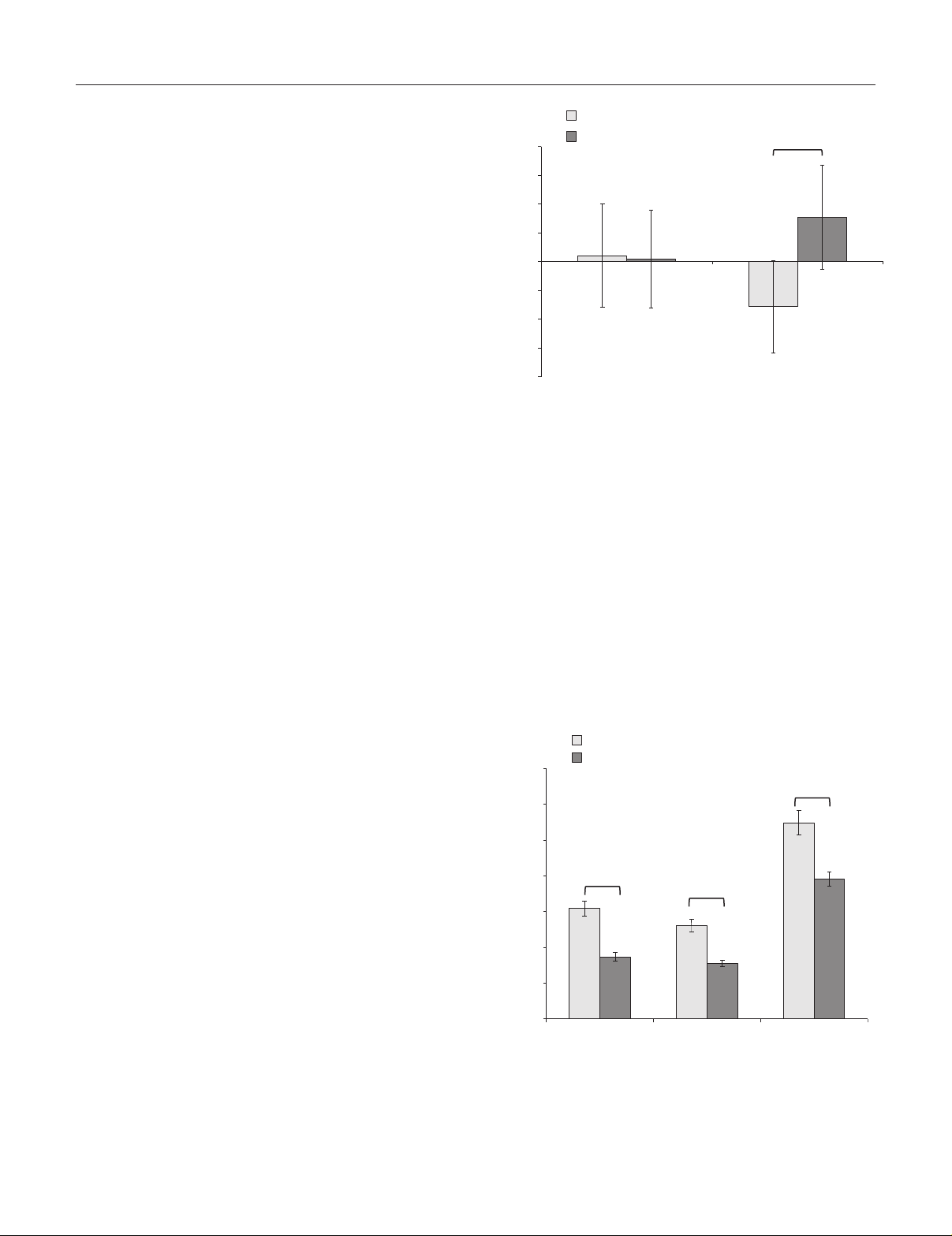
Results and discussion Laptop Longhand
Laptop versus longhand performance. Mixed fixed- 0.4 *
and random-effects analyses of variance were used to 0.3
test differences, with note-taking medium (laptop vs.
longhand) as a fixed effect and lecture (which talk was 0.2
viewed) as a random effect. We converted the raw data
to z scores because the lecture assessments varied in dif- 0.1 z score)
ficulty and number of points available; however, results 0.0
did not differ when raw scores were analyzed.4 On fac-
tual-recall questions, participants performed equally well –0.1
across conditions (laptop: M = 0.021, SD = 1.31; long- Performance ( –0.2
hand: M = 0.009, SD = 1.02), F(1, 55) = 0.014, p = .91.
However, on conceptual-application questions, laptop –0.3
participants performed significantly worse (M = −0.156, –0.4
SD = 0.915) than longhand participants (M = 0.154, SD = Factual Conceptual
1.08), F(1, 55) = 9.99, p = .03, η 2
p = .13 (see Fig. 1).5
Fig. 1. Mean z-scored performance on factual-recall and conceptual-
Which lecture participants saw also affected performance
application questions as a function of note-taking condition (Study 1).
on conceptual-application questions, F(4, 55) = 12.52,
The asterisk indicates a significant difference between conditions (p < p = .02, η 2
.05). Error bars indicate standard errors of the mean.
p = .16; however, there was no significant
interaction between lecture and note-taking medium,
F(4, 55) = 0.164, p = .96.
model, the direct effect of note-taking medium remained
a marginally significant predictor, b = 0.54 (β = 0.27),
Content analysis. There were several qualitative dif-
p = .07, partial R2 = .05; both indirect effects were signifi-
ferences between laptop and longhand notes.6 Partici-
cant. Longhand note taking negatively predicted word
pants who took longhand notes wrote significantly
count, and word count positively predicted performance,
fewer words (M = 173.4, SD = 70.7) than those who
indirect effect = −0.57, 95% confidence interval (CI) =
typed (M = 309.6, SD = 116.5), t(48.58) = −5.63, p < .001,
[−1.03, −0.20]. Longhand note taking also negatively pre-
d = 1.4, corrected for unequal variances (see Fig. 2). A
dicted verbatim overlap, and verbatim overlap negatively
simple n-gram program measured the extent of textual
predicted performance, indirect effect = 0.34, 95% CI =
overlap between student notes and lecture transcripts. It
[0.14, 0.71]. Normal theory tests provided identical
compared each one-, two-, and three-word chunk of text conclusions.7
in the notes taken with each one-, two-, and three-word
chunk of text in the lecture transcript, and reported Laptop
a percentage of matches for each. Using three-word Longhand
chunks (3-grams) as the measure, we found that laptop 700
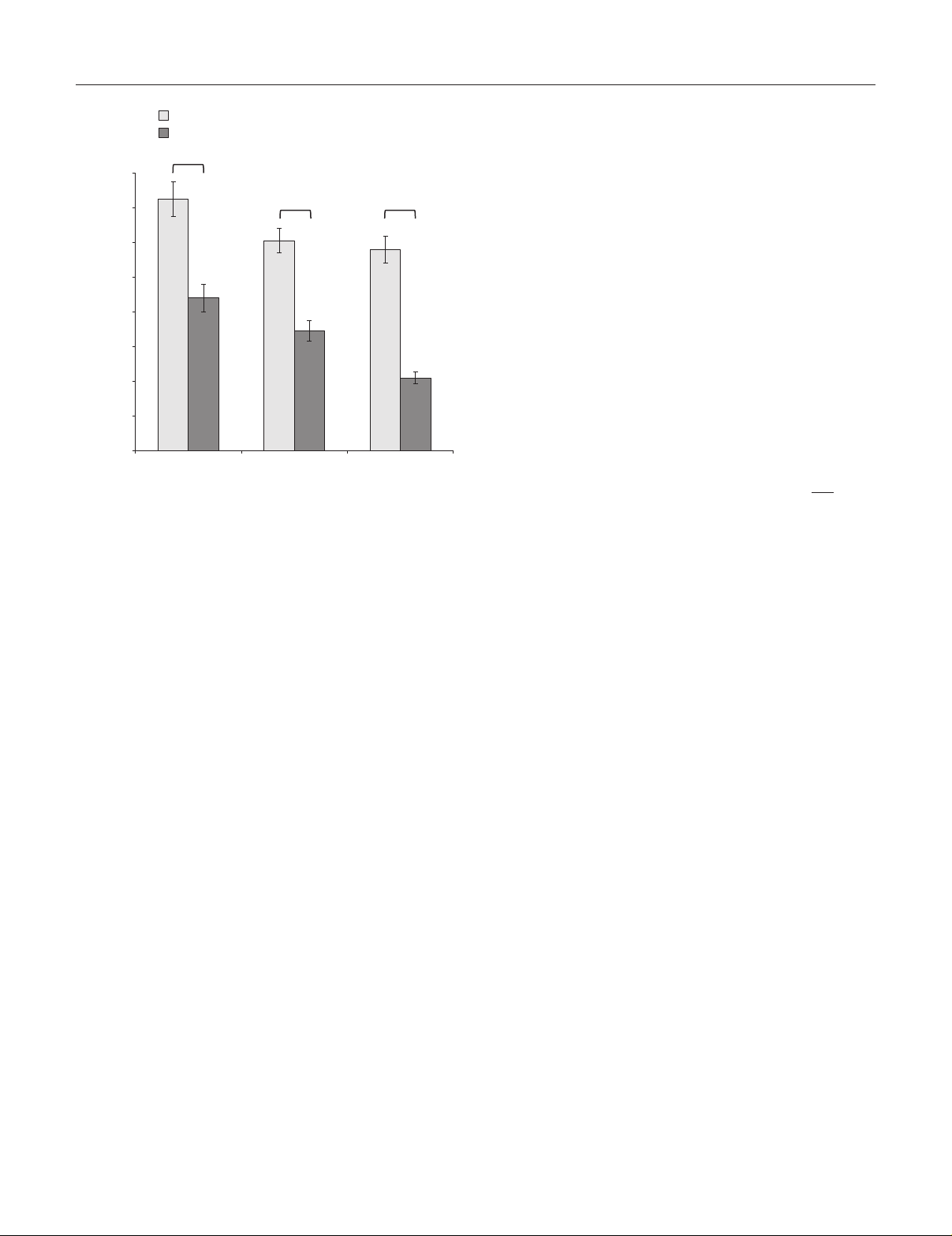
notes contained an average of 14.6% verbatim overlap ***
with the lecture (SD = 7.3%), whereas longhand notes 600
averaged only 8.8% (SD = 4.8%), t(63) = −3.77, p < .001,
d = 0.94 (see Fig. 3); 2-grams and 1-grams also showed 500
significant differences in the same direction. 400
Overall, participants who took more notes performed *** ***
better, β = 0.34, p = .023, partial R2 = .08. However, those 300
whose notes had less verbatim overlap with the lecture Word Count
also performed better, β = −0.43, p = .005, partial R2 = .12. 200
We tested a model using word count and verbatim over-
lap as mediators of the relationship between note-taking 100
medium and performance using Preacher and Hayes’s
(2004) bootstrapping procedure. The indirect effect is 0
significant if its 95% confidence intervals do not include Study 1 Study 2 Study 3
zero. The full model with note-taking medium as the
independent variable and both word count and verbatim
Fig. 2. Number of words written by students using laptops and note-
books in Studies 1, 2, and 3. Asterisks indicate a significant difference
overlap as mediators was a significant predictor of per-
between conditions (p < .001). Error bars indicate standard errors of
formance, F(3, 61) = 4.25, p = .009, R2 = .17. In the full the mean.
at Erciyes Universitesi on May 2, 2014 pss.sagepub.com Downloaded from 4 Mueller, Oppenheimer Laptop Procedure Longhand
Participants completed the study in groups. Each partici- ***
pant viewed one lecture on an individual monitor while 16%
wearing headphones. Stimuli were the same as in Study
1. Participants in the laptop-nonintervention and long- 14% *** ***
hand conditions were given a laptop or pen and paper, 12%
respectively, and were instructed, “We’re doing a study
about how information is conveyed in the classroom. 10%
We’d like you to take notes on a lecture, just like you
would in class. Please take whatever kind of notes you’d 8%
take in a class where you expected to be tested on the
material later—don’t change anything just because you’re 6% Verbatim Overlap in a lab.”
Participants in the laptop-intervention condition were 4%
instructed, “We’re doing a study about how information is
conveyed in the classroom. We’d like you to take notes 2%
on a lecture, just like you would in class. People who 0%
take class notes on laptops when they expect to be tested Study 1 Study 2 Study 3
on the material later tend to transcribe what they’re hear-
ing without thinking about it much. Please try not to do
Fig. 3. Percentage of verbatim overlap between student notes and lec-
this as you take notes today. Take notes in your own
ture transcripts in Studies 1, 2, and 3 as a function of note-taking condi-
tion. Verbatim overlap was measured using 3-grams (i.e., by comparing
words and don’t just write down word-for-word what the
three-word chunks of text in the student notes and lecture transcripts). speaker is saying.”
Error bars indicate standard errors of the mean.
Participants then completed a typing test, the Need for
Cognition scale (Cacioppo & Petty, 1982), academic self-
efficacy scales, and a shortened version of the reading
This study provides initial experimental evidence that
span task used in Study 1. Finally, they completed the
laptops may harm academic performance even when
same dependent measures and demographics as in Study
used as intended. Participants using laptops are more
1. Longhand notes were transcribed, and all notes were
likely to take lengthier transcription-like notes with analyzed with the n-grams program.
greater verbatim overlap with the lecture. Although tak-
ing more notes, thereby having more information, is ben-
eficial, mindless transcription seems to offset the benefit
Results and discussion
of the increased content, at least when there is no oppor- tunity for review.
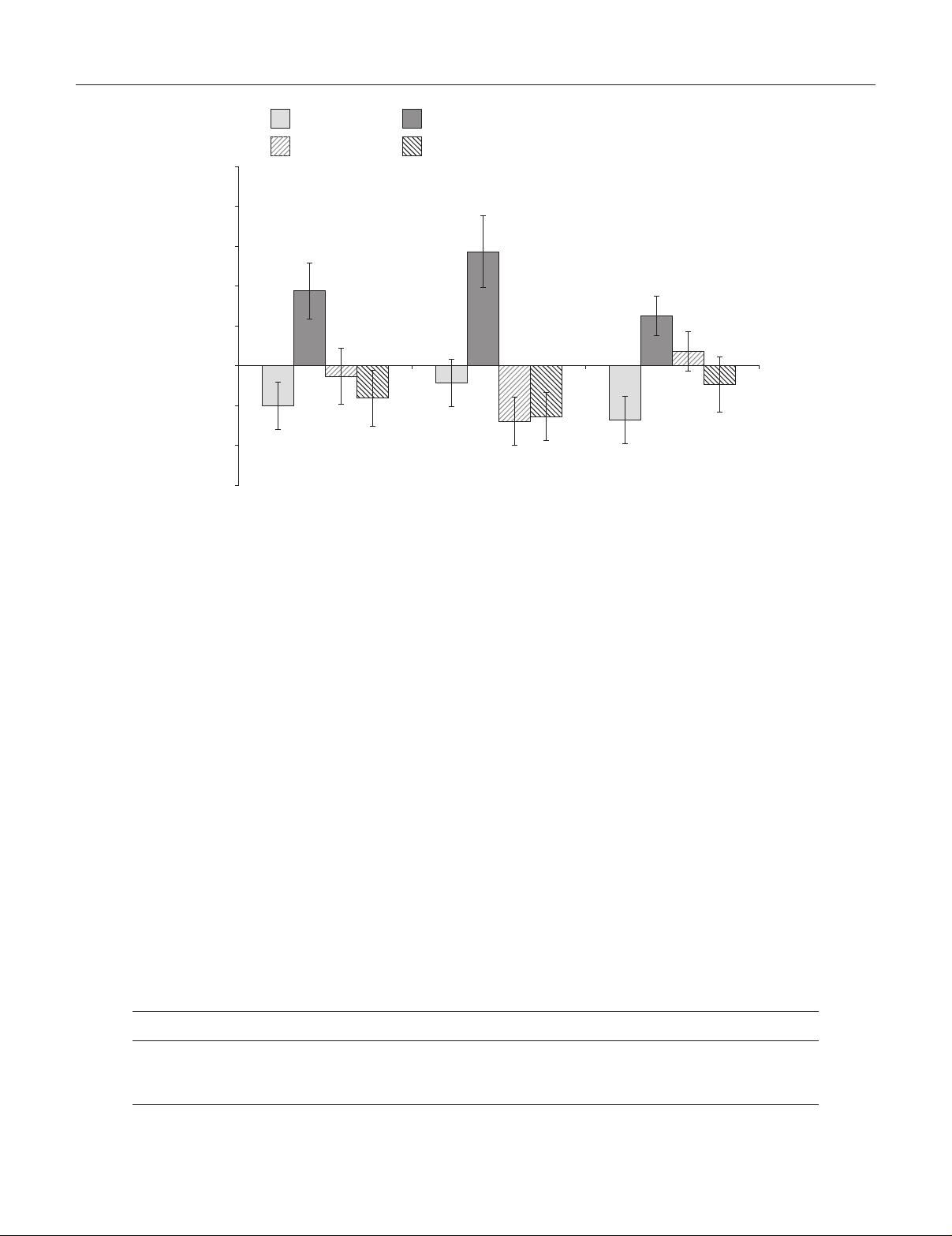
Laptop versus longhand performance. Responses
were scored by raters blind to condition. Replicating our Study 2
original finding, results showed that on conceptual-appli-
cation questions, longhand participants performed better
Because the detrimental effects of laptop note taking
(z-score M = 0.28, SD = 1.04) than laptop-nonintervention
appear to be due to verbatim transcription, perhaps
participants (z-score M = −0.15, SD = 0.85), F(1, 89) =
instructing students not to take verbatim notes could ame- 11.98, p = .017, η 2
p = .12. Scores for laptop-intervention
liorate the problem. Study 2 aimed to replicate the findings
participants (z-score M = −0.11, SD = 1.02) did not signifi-
of Study 1 and to determine whether a simple instructional
cantly differ from those for either laptop-nonintervention
intervention could reduce the negative effects of laptop
(p = .91) or longhand (p = .29) participants. The pattern of
note taking. Moreover, we sought to show that the effects
data for factual questions was similar, though there were
generalize to a different student sample.
no significant differences (longhand: z-score M = 0.11,
SD = 1.02; laptop intervention: z-score M = 0.02, SD = Participants
1.03; laptop nonintervention: z-score M = −0.16, SD =
0.91; see Fig. 4).8 For both question types, there was no
Participants were students (final N = 151; 35 male) from
effect of lecture, nor was there an interaction between
the University of California, Los Angeles Anderson lecture and condition.
Behavioral Lab subject pool. Two participants were
Participants’ self-reported grade point average, SAT
removed because of data-collection errors. Participants
scores, academic self-efficacy, Need for Cognition scores,
were paid $10 for 1 hr of participation.
and reading span scores were correlated with performance
at Erciyes Universitesi on May 2, 2014 pss.sagepub.com Downloaded from
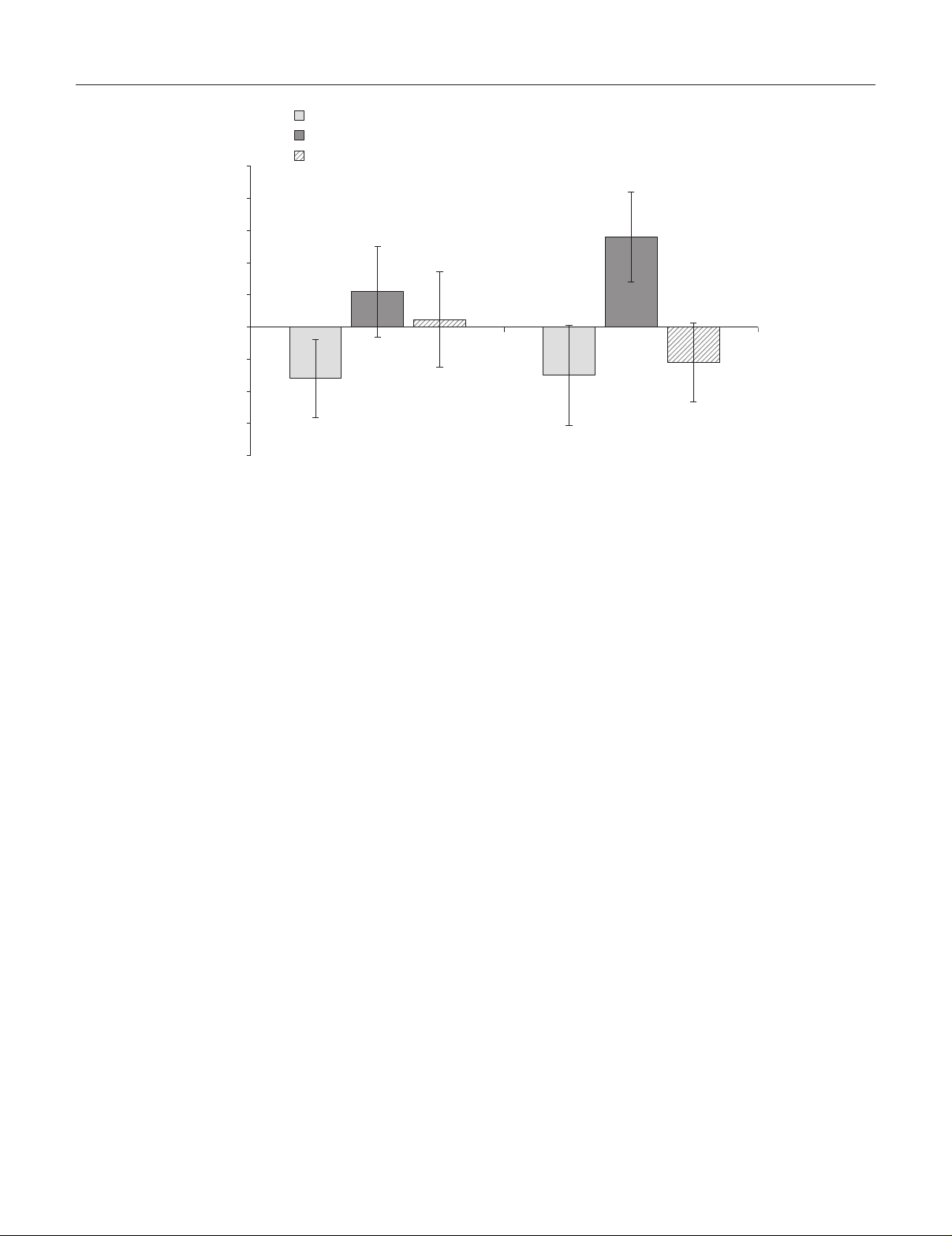
Longhand and Laptop Note Taking 5 Laptop (No Intervention) Longhand Laptop (Intervention) 0.5 0.4 0.3 0.2 z score) 0.1 0 –0.1 Performance ( –0.2 –0.3 –0.4 Factual Conceptual
Fig. 4. Mean z-scored performance on factual-recall and conceptual-application questions as a function
of note-taking condition (Study 2). Error bars indicate standard errors of the mean.
on conceptual items, but were not significant covariates
word count, and word count positively predicted perfor-
when included in the overall analysis, so we will not dis-
mance, indirect effect = −0.34, 95% CI = [−0.56, −0.14]. cuss them further.
Longhand note taking also negatively predicted verbatim
overlap, and verbatim overlap negatively predicted per-
Content analysis. Participants who took longhand formance, indirect effect = 0.19, 95% CI = [0.01, 0.49]. The
notes wrote significantly fewer words (M = 155.9, SD =
direct effect of note-taking medium remained significant,
59.6) than those who took laptop notes without receiving
b = 0.58 (β = 0.30), p = .01, partial R2 = .06, so there is
an intervention (M = 260.9, SD = 118.5), t(97) = −5.51,
likely more at play than the two opposing mechanisms
p < .001, d = 1.11 (see Fig. 2), as well as less than those
we identified here. When laptop (with intervention) was
who took laptop notes after the verbal intervention (M =
included as an intermediate condition, the pattern of
229.02, SD = 84.8), t(98) = −4.94, p < .001, d = 1.00. Long-
effects remained the same, though the magnitude
hand participants also had significantly less verbatim
decreased; indirect effect of word count = −0.18, 95%
overlap (M = 6.9%, SD = 4.2%) than laptop-noninterven-
CI = [−0.29, −0.08], indirect effect of verbatim overlap =
tion participants (M = 12.11%, SD = 5.0%), t(97) = −5.58, 0.08, 95% CI = [0.01, 0.17].
p < .001, d = 1.12 (see Fig. 3), or laptop-intervention
The intervention did not improve memory perfor-
participants (M = 12.07%, SD = 6.0%), t(98) = −4.96, p <
mance above that for the laptop-nonintervention condi-
.001, d = 0.99. The instruction to not take verbatim notes
tion, but it was also not statistically distinguishable from
was completely ineffective at reducing verbatim content
memory in the longhand condition. However, the inter- (p = .97).
vention was completely ineffective at reducing verbatim
Comparing longhand and laptop-nonintervention note
content, and the overall relationship between verbatim
taking, we found that for conceptual questions, partici-
content and negative performance held. Thus, whereas
pants taking more notes performed better, β = 0.27, p =
the effect of the intervention on performance is ambigu-
.02, partial R2 = .05, but those whose notes had less ver-
ous, any potential impact is unrelated to the mechanisms
batim overlap also performed better, β = −0.30, p = .01, explored in this article.
partial R2 = .06, which replicates the findings of Study 1.
We tested a model using word count and verbatim over- Study 3
lap as mediators of the relationship between note-taking
medium and performance; it was a good fit, F(3, 95) =
Whereas laptop users may not be encoding as much
5.23, p = .002, R2 = .14. Again, both indirect effects were
information while taking notes as longhand writers are,
significant: Longhand note taking negatively predicted
they record significantly more content. It is possible that
at Erciyes Universitesi on May 2, 2014 pss.sagepub.com Downloaded from 6 Mueller, Oppenheimer
Table 1. Examples of Each Question Type Used in Study 3
read from a teleprompter by a graduate student acting as
a professor at a lectern; two “seductive details” (i.e., Question type Example
“interesting, but unimportant, information”; Garner, Factual
What is the purpose of adding calcium
Gillingham, & White, 1989, p. 41) were added to lectures propionate to bread?
that did not have them. Each filmed lecture lasted approx- Seductive detail
What was the name of the cow whose imately 7 min.
cowpox was used to demonstrate
the effectiveness of Edward Jenner’s
technique of inoculation against smallpox? Procedure Conceptual
If a person’s epiglottis was not working
Participants completed the study in large groups. They
properly, what would be likely to happen?
were given either a laptop or pen and paper and were Inferential
Sometimes bats die while they are
instructed to take notes on the lectures. They were told
sleeping. What will happen if a bat dies
they would be returning the following week to be tested
while it is hanging upside down?
on the material. Each participant viewed all four lectures Application
Psychologists have investigated a
on individual monitors while wearing headphones.
phenomenon known as “attitude
When participants returned, those in the study condi-
inoculation,” which works on the same
tion were given 10 min to study their notes before being
principle as vaccination, and involves
tested. Participants in the no-study condition immediately
exposing people to weak arguments
against a viewpoint they hold. What
took the test. This dependent measure consisted of 40
would this theory predict would happen
questions, 10 on each lecture—two questions in each of
if the person was later exposed to a
five categories adapted from Butler (2010): facts, seduc-
strong argument against their viewpoint?
tive details, concepts, same-domain inferences (infer-
ences), and new-domain inferences (applications). See
Table 1 for examples. Participants then answered demo-
this increased external-storage capacity could boost per-
graphic questions. All responses were scored by raters
formance on tests taken after an opportunity to study
blind to condition. Longhand notes were transcribed, and
one’s notes. Thus, in Study 3, we used a 2 (laptop, long-
all notes were analyzed using the n-grams program.
hand) × 2 (study, no study) design to investigate whether
the disadvantages of laptop note taking for encoding are
potentially mitigated by enhanced external storage. We Results
also continued to investigate whether there were consis-
Laptop versus longhand performance. Across all
tent differences between responses to factual and con-
question types, there were no main effects of note-taking
ceptual questions, and additionally explored whether the
medium or opportunity to study. However, there was a
note-taking medium affected transfer of learning of con-
significant interaction between these two variables, F(1,
ceptual information to other domains (e.g., Barnett &
105) = 5.63, p = .019, η 2
p = .05. Participants who took Ceci, 2002).
longhand notes and were able to study them performed
significantly better (z-score M = 0.19) than participants in Participants
any of the other conditions (z-score Ms = −0.10, −0.02,
−0.08), t(105) = 3.11, p = .002, d = 0.64 (see Fig. 5).
Participants were students (final N = 109; 27 male) from
Collapsing questions about facts and seductive details
the University of California, Los Angeles Anderson into a general measure of “factual” performance, we
Behavioral Lab subject pool. One hundred forty-two par-
found a significant main effect of note-taking medium,
ticipants completed Session 1 (presentation), but only 118
F(1, 105) = 5.91, p = .017, η 2
p = .05, and of opportunity to
returned for Session 2 (testing). Of those 118, 8 partici-
study, F(1, 105) = 13.23, p < .001, η 2 p = .11, but this was
pants were removed for not having taken notes or failing
qualified by a significant interaction, F(1, 105) = 5.11,
to respond to the test questions, and 1 was removed p = .026, η 2
p = .05. Again, participants in the longhand-
because of a recording error. Participant loss did not differ
study condition (z-score M = 0.29) outperformed the
significantly across conditions. Participants were paid $6
other participants (z-score Ms = −0.04, −0.14, −0.13),
for the first session and $7 for the second session.
t(105) = 4.85, p < .001, d = 0.97. Collapsing performance
on conceptual, inferential, and application questions into Stimuli
a general “conceptual” measure revealed no significant
main effects, but again there was a significant interaction
Materials were adapted from Butler (2010). Four prose
between note-taking medium and studying, F(1, 105) = 4.27,
passages—on bats, bread, vaccines, and respiration—were p = .04, η 2
p = .04. Longhand-study participants (z-score
at Erciyes Universitesi on May 2, 2014 pss.sagepub.com Downloaded from
Longhand and Laptop Note Taking 7 Laptop-Study Longhand-Study Laptop–No Study Longhand–No Study 0.5 0.4 0.3 0.2 (z score) 0.1 0 Performance –0.1 –0.2 –0.3 Combined Factual Conceptual
Fig. 5. Mean z-scored performance on factual-recall and conceptual-application questions as a function
of note-taking condition and opportunity to study (Study 3). Combined results for both question types are
given separately. Error bars indicate standard errors of the mean.
M = 0.13) performed marginally better than the other par-
their notes (and thus those who were most likely to be
ticipants (z-score Ms = −0.14, 0.04, −0.05), t(105) = 1.82,
affected by the contents), verbatim overlap negatively pre-
p = .07, d = 0.4 (for raw means, see Table 2).
dicted overall performance, β = −0.27, p = .046, R2 = .07.
When looking at overall test performance, longhand note
Content analysis of notes. Again, longhand note tak-
taking negatively predicted word count, which positively
ers wrote significantly fewer words (M = 390.65, SD =
predicted performance, indirect effect = −0.15, 95% CI =
143.89) than those who typed (M = 548.73, SD = 252.68),
[−0.24, −0.08]. Longhand note taking also negatively pre-
t(107) = 4.00, p < .001, d = 0.77 (see Fig. 2). As in the pre-
dicted verbatim overlap, which negatively predicted per-
vious studies, there was a significant difference in verba-
formance, indirect effect = 0.096, 95% CI = [0.004, 0.23].
tim overlap, with a mean of 11.6% overlap (SD = 5.7%) for
However, a more nuanced story can be told; the indi-
laptop note taking and only 4.2% (SD = 2.5%) for long-
rect effects differ for conceptual and factual questions.
hand, t(107) = 8.80, p < .001, d = 1.68 (see Fig. 3). There
For conceptual questions, there were significant indirect
were no significant differences in word count or verbatim
effects on performance via both word count (−0.17, 95%
overlap between the study and no-study conditions.
CI = [−0.29, −0.08]) and verbatim overlap (0.13, 95% CI =
The amount of notes taken positively predicted perfor-
[0.02, 0.15]). The indirect effect of word count for factual
mance for all participants, β = 0.35, p < .001, R2 = .12. The
questions was similar (−0.11, 95% CI = [−0.21, −0.06]), but
extent of verbatim overlap did not significantly predict
there was no significant indirect effect of verbatim overlap
performance for participants who did not study their
(0.04, 95% CI = [−0.07, 0.16]). Indeed, for factual ques-
notes, β = 0.13. However, for participants who studied
tions, there was no significant direct effect of overlap on
Table 2. Raw Means for Overall, Factual, and Conceptual Performance in the Four Conditions of Study 3 Question type Longhand-study Longhand–no study Laptop-study Laptop–no study Factual only 7.1 (4.0) 3.8 (2.8) 4.5 (3.2) 3.7 (3.1) Conceptual only 18.5 (7.8) 15.6 (7.8) 13.8 (6.3) 16.9 (8.1) Overall 25.6 (10.8) 19.4 (9.9) 18.3 (9.0) 20.6 (10.7)
Note: Standard deviations are given in parentheses.
at Erciyes Universitesi on May 2, 2014 pss.sagepub.com Downloaded from 8 Mueller, Oppenheimer
performance (p = .52). As in Studies 1 and 2, the detri-
than laptop note takers, thus selecting more important
ments caused by verbatim overlap occurred primarily for
information to include in their notes, which enables them
conceptual rather than for factual information, which
to study this content more efficiently. It is worth noting
aligns with previous literature showing that verbatim
that longhand note takers’ advantage on retention of fac-
note taking is more problematic for conceptual items
tual content is limited to conditions in which there was a
(e.g., Bretzing & Kulhavy, 1979).
delay between presentation and test, which may explain
When participants were unable to study, we did not see
the discrepancy between our studies and previous
a difference between laptop and longhand note taking.
research (Bui et al., 2013). The tasks they describe would
We believe this is due to the difficulty of test items after a
also fall under our factual-question category, and we
week’s delay and a subsequent floor effect; average scores
found no difference in performance on factual questions
were about one-third of the total points available. However,
in immediate testing. For conceptual items, however, our
when participants had an opportunity to study, longhand
findings strongly suggest the opposite conclusion.
notes again led to superior performance. This is suggestive
Additionally, whereas Bui et al. (2013) argue that verba-
evidence that longhand notes may have superior external-
tim notes are superior, they did not report the extent of
storage as well as superior encoding functions, despite the
verbatim overlap, merely the number of “idea units.” Our
fact that the quantity of notes was a strong positive predic-
findings concur with theirs in that more notes (and there-
tor of performance. However, it is also possible that,
fore more ideas) led to better performance.
because of enhanced encoding, reviewing longhand notes
The studies we report here show that laptop use can
simply reminded participants of lecture information more
negatively affect performance on educational assess-
effectively than reviewing laptop notes did.
ments, even—or perhaps especially—when the computer
is used for its intended function of easier note taking. General Discussion
Although more notes are beneficial, at least to a point, if
the notes are taken indiscriminately or by mindlessly
Laptop note taking has been rapidly increasing in preva-
transcribing content, as is more likely the case on a lap-
lence across college campuses (e.g., Fried, 2008). top than when notes are taken longhand, the benefit dis-
Whereas previous studies have shown that laptops (espe-
appears. Indeed, synthesizing and summarizing content
cially with access to the Internet) can distract students,
rather than verbatim transcription can serve as a desir-
the present studies are the first to show detriments due to
able difficulty toward improved educational outcomes
differences in note-taking behavior. On multiple college
(e.g., Diemand-Yauman, Oppenheimer, & Vaughan, 2011;
campuses, using both immediate and delayed testing
Richland, Bjork, Finley, & Linn, 2005). For that reason,
across several content areas, we found that participants
laptop use in classrooms should be viewed with a healthy
using laptops were more inclined to take verbatim notes
dose of caution; despite their growing popularity, laptops
than participants who wrote longhand, thus hurting
may be doing more harm in classrooms than good.
learning. Moreover, we found that this pattern of results
was resistant to a simple verbal intervention: Telling stu- Author Contributions
dents not to take notes verbatim did not prevent this
Both authors developed the study concept and design. Data deleterious behavior.
collection was supervised by both authors. P. A. Mueller ana-
One might think that the detriments to encoding would
lyzed the data under the supervision of D. M. Oppenheimer.
be partially offset by the fact that verbatim transcription
P. A. Mueller drafted the manuscript, and D. M. Oppenheimer
would leave a more complete record for external storage,
revised the manuscript. Both authors approved the final version
which would allow for better studying from those notes. for submission.
However, we found the opposite—even when allowed to
review notes after a week’s delay, participants who had Acknowledgments
taken notes with laptops performed worse on tests of both
Thanks to Jesse Chandler, David Mackenzie, Peter Mende-
factual content and conceptual understanding, relative to
Siedlecki, Daniel Ames, Izzy Gainsburg, Jill Hackett, Mariam
participants who had taken notes longhand.
Hambarchyan, and Katelyn Wirtz for their assistance.
We found no difference in performance on factual
questions in the first two studies, though we do not dis-
Declaration of Conflicting Interests
count the possibility that with greater power, differences
The authors declared that they had no conflicts of interest with
might be seen. In Study 3, it is unclear why longhand
respect to their authorship or the publication of this article.
note takers outperformed laptop note takers on factual
questions, as this difference was not related to the rela- Supplemental Material
tive lack of verbatim overlap in longhand notes. It may be
Additional supporting information may be found at http://pss
that longhand note takers engage in more processing
.sagepub.com/content/by/supplemental-data
at Erciyes Universitesi on May 2, 2014 pss.sagepub.com Downloaded from
Longhand and Laptop Note Taking 9 Open Practices
Barnett, S. M., & Ceci, S. J. (2002). When and where do we apply
All data and materials have been made publicly available via
what we learn? A taxonomy for far transfer. Psychological
Open Science Framework and can be accessed at http://osf.io/
Bulletin, 128, 612–637.
crsiz. The complete Open Practices Disclosure for this article
Bohay, M., Blakely, D. P., Tamplin, A. K., & Radvansky, G. A.
can be found at http://pss.sagepub.com/content/by/supplemental-
(2011). Note taking, review, memory, and comprehension.
data. This article has received badges for Open Data and Open
The American Journal of Psychology, 124, 63–73.
Materials. More information about the Open Practices badges
Bretzing, B. H., & Kulhavy, R. W. (1979). Notetaking and depth
can be found at https://osf.io/tvyxz/wiki/view/ and http://pss
of processing. Contemporary Educational Psychology, 4,
.sagepub.com/content/25/1/3.full. 145–153.
Bretzing, B. H., & Kulhavy, R. W. (1981). Note-taking and pas-
sage style. Journal of Educational Psychology, 73, 242–250. Notes
Brown, C. M. (1988). Comparison of typing and handwriting
1. See Additional Analyses in the Supplemental Material avail-
in “two-finger typists.” Proceedings of the Human Factors
able online for some findings regarding real-world data.
Society, 32, 381–385.
2. See Lecture Information in the Supplemental Material for
Bui, D. C., Myerson, J., & Hale, S. (2013). Note-taking with com-
links to all five TED Talks used in Study 1 and the four prose
puters: Exploring alternative strategies for improved recall. passages used in Study 2.
Journal of Educational Psychology, 105, 299–309.
3. See Raw Means and Questions in the Supplemental Material
Butler, A. C. (2010). Repeated testing produces superior trans-
for full question lists from all three studies.
fer of learning relative to repeated studying. Journal
4. For factual questions, laptop participants’ raw mean score
of Experimental Psychology: Learning, Memory, and
was 5.58 (SD = 2.23), and longhand participants’ raw mean
Cognition, 36, 1118–1133.
score was 6.41 (SD = 2.84). For conceptual questions, the raw
Cacioppo, J. T., & Petty, R. E. (1982). The need for cognition.
mean scores for laptop and longhand participants were 3.77
Journal of Personality and Social Psychology, 42, 116–131.
(SD = 1.23) and 4.29 (SD = 1.49), respectively. See Raw Means
Craik, F. I., & Lockhart, R. S. (1972). Levels of processing:
and Questions in the Supplemental Material for raw means
A framework for memory research. Journal of Verbal from Studies 1 and 2.
Learning and Verbal Behavior, 11, 671–684.
5. In all three studies, the results remained significant when we
Diemand-Yauman, C., Oppenheimer, D. M., & Vaughan, E. B.
controlled for measures of academic ability, such as self-ratings
(2011). Fortune favors the bold (and the italicized): Effects of
of prior knowledge and scores on the SAT and reading span
disfluency on educational outcomes. Cognition, 118, 111–115. task.
DiVesta, F. J., & Gray, G. S. (1972). Listening and note taking.
6. Linguistic Inquiry and Word Count (LIWC) software was
Journal of Educational Psychology, 63, 8–14.
also used to analyze the notes on categories identified by
DiVesta, F. J., & Gray, S. G. (1973). Listening and note taking: II.
Pennebaker (2011) as correlating with improved college grades.
Immediate and delayed recall as functions of variations in the-
Although LIWC analysis indicated significant differences in the
matic continuity, note taking, and length of listening-review
predicted direction between laptop and longhand notes, none
intervals. Journal of Educational Psychology, 64, 278–287.
of the differences predicted performance, so they will not be
Einstein, G. O., Morris, J., & Smith, S. (1985). Note-taking, indi- discussed here.
vidual differences, and memory for lecture information.
7. For all three studies, we also analyzed the relation between
Journal of Educational Psychology, 77, 522–532.
verbatim overlap and students’ preferences for longhand or
Fried, C. B. (2008). In-class laptop use and its effects on student
laptop note taking. Results of these analyses can be found in
learning. Computers & Education, 50, 906–914.
Additional Analyses in the Supplemental Material.
Garner, R., Gillingham, M. G., & White, C. S. (1989). Effects of
8. For conceptual questions, laptop-nonintervention par-
“seductive details” on macroprocessing and microprocessing
ticipants had lower raw scores (M = 2.30, SD = 1.40) than
in adults and children. Cognition and Instruction, 6, 41–57.
did longhand note takers (M = 2.94, SD = 1.73) and laptop-
Grace-Martin, M., & Gay, G. (2001). Web browsing, mobile
intervention participants (M = 2.43, SD = 1.59). For factual
computing and academic performance. Educational
questions, laptop-nonintervention participants’ raw scores
Technology & Society, 4, 95–107.
(M = 4.92, SD = 2.62) were also lower than those of longhand
Hembrooke, H., & Gay, G. (2003). The laptop and the lec-
note takers (M = 5.11, SD = 3.05) or laptop-intervention par-
ture: The effects of multitasking in learning environments.
ticipants (M = 5.25, SD = 2.89).
Journal of Computing in Higher Education, 15, 46–64.
Igo, L. B., Bruning, R., & McCrudden, M. T. (2005). Exploring
differences in students’ copy-and-paste decision mak- References
ing and processing: A mixed-methods study. Journal of
Aiken, E. G., Thomas, G. S., & Shennum, W. A. (1975). Memory
Educational Psychology, 97, 103–116.
for a lecture: Effects of notes, lecture rate, and informational
Iqbal, S. T., & Horvitz, E. (2007). Disruption and recov-
density. Journal of Educational Psychology, 67, 439–444.
ery of computing tasks: Field study, analysis, and direc-
Barak, M., Lipson, A., & Lerman, S. (2006). Wireless laptops
tions. In Proceedings of the SIGCHI Conference on
as means for promoting active learning in large lecture
Human Factors in Computing Systems (pp. 677–686).
halls. Journal of Research on Technology in Education, 38,
New York, NY: Association for Computing Machinery. 245–263. doi:10.1145/1240624.1240730
at Erciyes Universitesi on May 2, 2014 pss.sagepub.com Downloaded from 10 Mueller, Oppenheimer
Kay, R., & Lauricella, S. (2011). Exploring the benefits and chal-
Technology (pp. 559–570). Retrieved from http://files.eric
lenges of using laptop computers in higher education class- .ed.gov/fulltext/ED397772.pdf
rooms: A formative analysis. Canadian Journal of Learning
Richland, L. E., Bjork, R. A., Finley, J. R., & Linn, M. C. (2005).
and Technology, 37(1). Retrieved from http://www.cjlt.ca/
Linking cognitive science to education: Generation and
index.php/cjlt/article/view/565/299
interleaving effects. In B. G. Bara, L. Barsalou, & M.
Kiewra, K. A. (1985). Investigating notetaking and review: A depth
Bucciarelli (Eds.), Proceedings of the Twenty-Seventh
of processing alternative. Educational Psychologist, 20, 23–32.
Annual Conference of the Cognitive Science Society (pp.
Kiewra, K. A. (1989). A review of note-taking: The encoding-
1850–1855). Mahwah, NJ: Erlbaum.
storage paradigm and beyond. Educational Psychology
Rubinstein, J. S., Meyer, D. E., & Evans, J. E. (2001). Executive
Review, 1, 147–172.
control of cognitive processes in task switching. Journal
Kobayashi, K. (2005). What limits the encoding effect of
of Experimental Psychology: Human Perception and
note-taking? A meta-analytic examination. Contemporary
Performance, 27, 763–797.
Educational Psychology, 30, 242–262.
Skolnick, R., & Puzo, M. (2008). Utilization of laptop com-
Kraushaar, J. M., & Novak, D. C. (2010). Examining the affects
puters in the school of business classroom. Academy of
of student multitasking with laptops during the lecture.
Educational Leadership Journal, 12, 1–10.
Journal of Information Systems Education, 21, 241–251.
Slotte, V., & Lonka, K. (1999). Review and process effects
Lin, L., & Bigenho, C. (2011). Note-taking and memory in dif-
of spontaneous note-taking on text comprehensions.
ferent media environments. Computers in the Schools, 28,
Contemporary Educational Psychology, 24, 1–20. 200–216.
Sovern, J. (2013). Law student laptop use during class for non-
Mitra, A., & Steffensmeier, T. (2000). Changes in student atti-
class purposes: Temptation v. incentives. University of
tudes and student computer use in a computer-enriched
Louisville Law Review, 51, 483–517.
environment. Journal of Research on Computing in
Unsworth, N., Heitz, R. P., Schrock, J. C., & Engle, R. W. (2005).
Education, 32, 417–432.
An automated version of the operation span task. Behavior
Pennebaker, J. W. (2011). The secret life of pronouns: What our
Research Methods, 37, 498–505.
words say about us. New York, NY: Bloomsbury Press.
Van Meter, P., Yokoi, L., & Pressley, M. (1994). College stu-
Preacher, K. J., & Hayes, A. F. (2004). SPSS and SAS procedures
dents’ theory of note-taking derived from their percep-
for estimating indirect effects in simple mediation models.
tions of note-taking. Journal of Educational Psychology,
Behavior Research Methods, Instruments, and Computers, 86, 325–338. 36, 717–731.
Wurst, C., Smarkola, C., & Gaffney, M. A. (2008). Ubiquitous
Quade, A. Q. (1996). An assessment of retention and depth
laptop usage in higher education: Effects on student
of processing associated with notetaking using tradi-
achievement, student satisfaction, and constructivist mea-
tional pencil and paper and an on-line notepad dur-
sures in honors and traditional classrooms. Computers &
ing computer-delivered instruction. In M. R. Simonson,
Education, 51, 1766–1783.
M. Hays, & S. Hall (Eds.), Proceedings of Selected Research
Yamamoto, K. (2007). Banning laptops in the classroom:
and Development Presentations at the 1996 Convention
Is it worth the hassle? Journal of Legal Education, 57,
of the Association for Educational Communications and 477–520.
at Erciyes Universitesi on May 2, 2014 pss.sagepub.com Downloaded from