Reading Explorer Foundations (Third Edition) môn IELTS | Học viện Phụ nữ Việt Nam
Reading Explorer Foundations (Third Edition) môn IELTS | Học viện Phụ nữ Việt Nam. Tài liệu được sưu tầm giúp bạn tham khảo, ôn tập và đạt kết quả cao. Mời bạn đọc đón xem.
Môn: IELTS (02) 14 tài liệu
Trường: Học viện Phụ nữ Việt Nam 808 tài liệu
Tác giả:









Preview text:
FOUNDATIONS THIRD EDITION BECKY TARVER-CHASE DAVID BOHLKE
Australia • Brazil • Mexico • Singapore • United Kingdom • United States
001-006_16289_REX_SBF_FM_ptg01.indd 1 6/12/19 11:43 AM National Geographic Learning, © 2020 Cengage Learning, Inc. a Cengage Company
ALL RIGHTS RESERVED. No part of this work covered by the copyright herein
may be reproduced or distributed in any form or by any means, except as
permitted by U.S. copyright law, without the prior written permission of the
Reading Explorer Foundations copyright owner. Third Edition
“National Geographic”, “National Geographic Society” and the Yellow Border
Becky Tarver-Chase and David Bohlke
Design are registered trademarks of the National Geographic Society
Publisher: Andrew Robinson ® Marcas Registradas
Executive Editor: Sean Bermingham
Senior Development Editor: Christopher Street
For permission to use material from this text or product,
Director of Global Marketing: Ian Martin
submit all requests online at cengage.com/permissions
Heads of Regional Marketing:
Further permissions questions can be emailed to
Charlotte Ellis (Europe, Middle East and Africa)
permissionrequest@cengage.com Kiel Hamm (Asia) Irina Pereyra (Latin America)
Student Book with Online Workbook:
Product Marketing Manager: Tracy Bailie ISBN-13: 978-0-357-12472-7
Senior Production Controller: Tan Jin Hock Student Book:
Associate Media Researcher: Jeffrey Millies ISBN-13: 978-0-357-11628-9
Art Director: Brenda Carmichael
Operations Support: Hayley Chwazik-Gee
National Geographic Learning
Manufacturing Planner: Mary Beth Hennebury 20 Channel Center Street
Composition: MPS North America LLC Boston, MA 02210 USA
Locate your local office at international.cengage.com/region
Visit National Geographic Learning online at ELTNGL.com
Visit our corporate website at www.cengage.com
Printed in the United States of America Print Number: 03 Print Year: 2019
001-006_16289_REX_SBF_FM_ptg03.indd 2 11/7/19 7:30 PM CONTENTS Scope and Sequence 4 Introduction 6 Unit 1: Mysteries 7 Unit 2: Eating Extremes 21 Unit 3: Cool Jobs 35 Unit 4: Shipwrecks 49 Unit 5: Science Investigators 63 Unit 6: Plants and Trees 75 Unit 7: Mind’s Eye 89 Unit 8: Animal Wonders 103 Unit 9: Building Beauty 117
Unit 10: Forces of Nature 131
Unit 11: Giants of the Past 145 Unit 12: Technology 159 Credits and Acknowledgments 173
Glossary / Exam Question Type Index 175 Tips for Effective Reading 176
001-006_16289_REX_SBF_FM_ptg01.indd 3 6/12/19 11:43 AM SCOPE AND SEQUENCE UNIT THEME READING VIDEO 1 Mysteries A: A Mysterious Visitor B: Moon Mystery The Lost City of Atlantis 2 Eating Extremes
A: The World of Speed Eating B: Science of Taste The Hottest Chilies 3 Cool Jobs A: Digging for the Past B: Right Dog for the Job Getting the Shot 4 Shipwrecks
A: I’ve Found the Titanic! B: An Ancient Shipwreck My Descent to the Titanic 5 Science Investigators
A: The Disease Detective B: The Flu Virus At the Scene of a Crime 6 Plants and Trees
A: Planting for the Planet B: Giants of the Forest Fatal Attraction 7 Mind’s Eye A: Understanding Dreams B: Parasomnia Seeing the Impossible 8 Animal Wonders A: A Penguin’s Year B: Amazing Narwhals Do Animals Laugh? 9 Building Beauty A: A Love Poem in Stone B: Brunelleschi’s Dome The Great Dome of Florence 10 Forces of Nature A: Wild Weather B: Tornado Terror When Weird Weather Strikes 11 Giants of the Past A: The Mammoth’s Tale B: Ichthyosaurs Monsters of the Deep 12 Technology
A: The Robots are Coming! B: A Social Robot How Will We Live in 2045? 4 Scope and Sequence
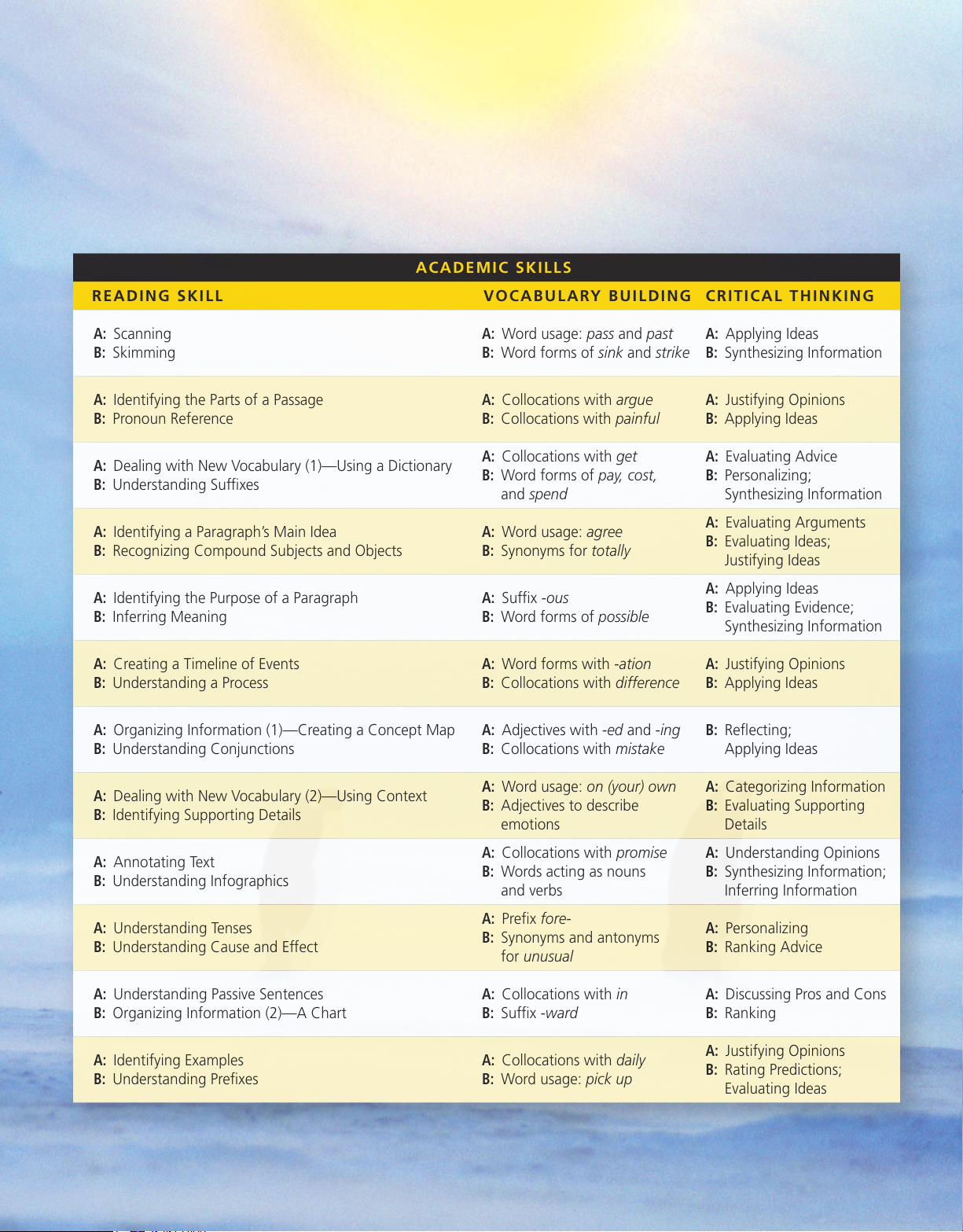
001-006_16289_REX_SBF_FM_ptg01.indd 4 6/12/19 11:43 AM ACADEMIC SKILLS READING SKILL
VOCABULARY BUILDING CRITICAL THINKING A: Scanning
A: Word usage: pass and past A: Applying Ideas B: Skimming
B: Word forms of sink and strike B: Synthesizing Information
A: Identifying the Parts of a Passage
A: Collocations with argue A: Justifying Opinions B: Pronoun Reference
B: Collocations with painful B: Applying Ideas A: A: A: Collocations with get Evaluating Advice
Dealing with New Vocabulary (1)—Using a Dictionary B: B: B:
Word forms of pay, cost, Personalizing; Understanding Suffixes and spend Synthesizing Information A: A: Evaluating Arguments
Identifying a Paragraph’s Main Idea
A: Word usage: agree B: B: Evaluating Ideas;
Recognizing Compound Subjects and Objects
B: Synonyms for totally Justifying Ideas A: A: Applying Ideas
Identifying the Purpose of a Paragraph A: Suffix -ous B: B: Evaluating Evidence; Inferring Meaning
B: Word forms of possible Synthesizing Information
A: Creating a Timeline of Events
A: Word forms with -ation A: Justifying Opinions
B: Understanding a Process
B: Collocations with difference B: Applying Ideas
A: Organizing Information (1)—Creating a Concept Map
A: Adjectives with -ed and -ing B: Reflecting;
B: Understanding Conjunctions
B: Collocations with mistake Applying Ideas A: A: A:
Word usage: on (your) own Categorizing Information
Dealing with New Vocabulary (2)—Using Context B: B: B: Adjectives to describe Evaluating Supporting Identifying Supporting Details emotions Details A: A: A:
Collocations with promise Understanding Opinions Annotating Text B: B: B: Words acting as nouns Synthesizing Information; Understanding Infographics and verbs Inferring Information A: A: Prefix fore- Understanding Tenses A: B: Personalizing B: Synonyms and antonyms Understanding Cause and Effect B: Ranking Advice for unusual
A: Understanding Passive Sentences
A: Collocations with in
A: Discussing Pros and Cons
B: Organizing Information (2)—A Chart B: Suffix -ward B: Ranking A: A: Justifying Opinions Identifying Examples
A: Collocations with daily B: B: Rating Predictions; Understanding Prefixes
B: Word usage: pick up Evaluating Ideas Scope and Sequence 5
001-006_16289_REX_SBF_FM_ptg03.indd 5 11/7/19 7:02 PM
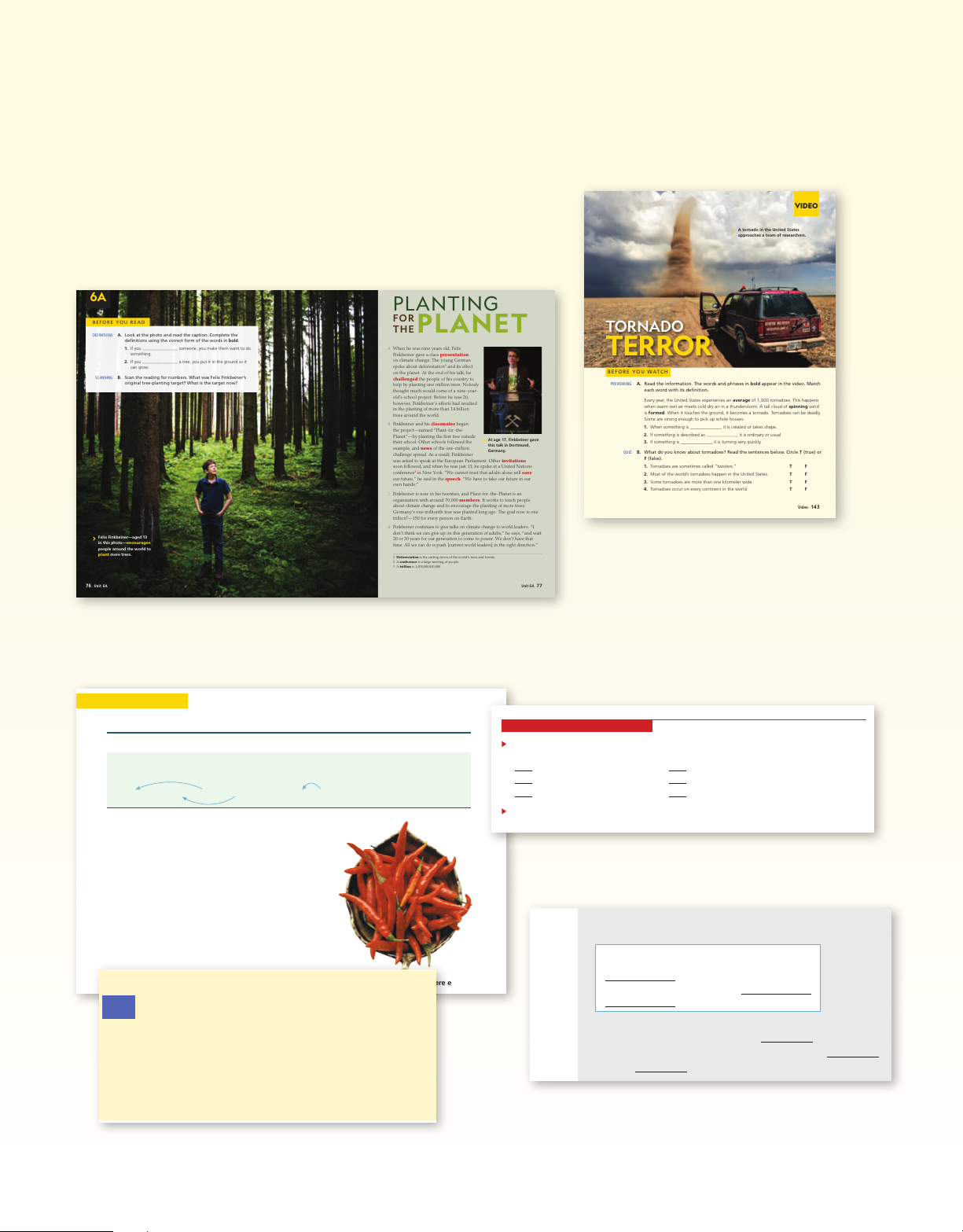
READING EXPLORER brings the world to your classroom.
With Reading Explorer you learn about real people and
places, experience the world, and explore topics that matter.
What you’ll see in the Third Edition: VIDEO
A tornado in the United States
approaches a team of researchers.
Real-world stories give you a better
understanding of the world and your place in it. 6A PLANTING B E F O R E Y O U R E A D FOR PLANET THE DEFINITIONS
A. Look at the photo and read the caption. Complete the R E A D I N G S K I L L TORNADO
definitions using the correct form of the words in bold. 1. If you
someone, you make them want to do
A When he was nine years old, Felix something.
Finkbeiner gave a class presentation TERROR 2. If you
a tree, you put it in the ground so it
on climate change. The young German can grow.
spoke about deforestation1 and its effect
on the planet. At the end of his talk, he SCANNING
B. Scan the reading for numbers. What was Felix Finkbeiner’s Inferring Meaning B E F O R E Y O U WAT C H
challenged the people of his country to
original tree-planting target? What is the target now? PREVIEWING
A. Read the information. The words and phrases in bold appear in the video. Match
help by planting one million trees. Nobody
thought much would come of a nine-year- each word with its definition.
old’s school project. Before he was 20,
A text does not always state everything directly. Sometimes you need to infer meaning by “reading
Every year, the United States experiences an average of 1,000 tornadoes. This happens
however, Finkbeiner’s efforts had resulted
between the lines.” You can infer meaning by using what you already know about the topic, clues in
when warm wet air meets cold dry air in a thunderstorm. A tall cloud of spinning wind
in the planting of more than 14 billion trees around the world.
the text, and common sense. For example, in Reading B, we know ther
is formed. When it touches the gr e wer ound, it becomes a tor e tir nado. Tor e marks at the crime nadoes can be deadly.
Some are strong enough to pick up whole houses.
B Finkbeiner and his classmates began
the project—named “Plant-for-the-
scene, so it is likely that the thief traveled by car 1. . When something is
, it is created or takes shape.
2. If something is described as , it is ordinary or usual.
Planet”—by planting the first tree outside
their school. Other schools followed the
At age 17, Finkbeiner gave 3. If something is , it is turning very quickly. this talk in Dortmund,
example, and news of the one-million Germany.
challenge spread. As a result, Finkbeiner
INFERRING A. Look at some facts from Reading B. What can QUIZ
B. What do you know about tornadoes? Read the sentences below. Circle T (true) or
was asked to speak at the European Parliament. Other MEANING F (false). invitations
soon followed, and when he was just 13, he spoke at a United Nations you infer?
1. Tornadoes are sometimes called “twisters.” T F
conference2 in New York. “We cannot trust that adults alone will save
our future,” he said in the speech. “We have to take our future in our
1. There was no broken glass on the str
2. Most of the world’s tor eet.
nadoes happen in the United States. T F
3. Some tornadoes are more than one kilometer wide. T F own hands.”
a. The thief broke the window fr 4. Tor om the inside.
nadoes occur on every continent in the world. T F
C Finkbeiner is now in his twenties, and Plant-for-the-Planet is an
organization with around 70,000 members. It works to teach people
b. The thief broke the window from the outside.
about climate change and to encourage the planting of more trees. Video 143
Germany’s one millionth tree was planted long ago. The goal now is one
trillion3—150 for every person on Earth.
2. The shoeprints were large.
D Finkbeiner continues to give talks on climate change to world leaders. “I a. The thief was a man.
don’t think we can give up on this generation of adults,” he says, “and wait
Felix Finkbeiner—aged 13
20 or 30 years for our generation to come to power. We don’t have that b. The thief was a woman.
in this photo—encourages
time. All we can do is push [current world leaders] in the right direction.”
National Geographic Videos people around the world to plant more trees.
1 Deforestation is the cutting down of the world’s trees and forests.
3. The space between shoeprints near the tire marks
2 A conference is a large meeting of people.
3 A trillion is 1,000,000,000,000. got farther apart.
expand on the unit topic and give you
a. The thief was walking more slowly, and then
A police officer searches for 76 Unit 6A Unit 6A 77 stopping. fingerprints.
a chance to apply your language skills.
V O C A B U L A RY P R A C T I C E
b. The thief was walking faster, maybe running.
INFERRING B. How sure are you of these things? Check (✓) the things you can infer from
R E A D I N G C O M P R E H E N S I O N MEANING
the passage. Compare your ideas with a partner and explain your reasons. COMPLETION
A. Complete the information using the words in the box. 1. The crime happened at night.
Reading Skill and Reading Comprehension sections 2.
The investigator will check the fingerprints of people who work in the stor
dangerous expert illness kill touch e.
A. Choose the best answer for each question.
provide the tools you need to become an effective reader. 3.
The thief had help from another person. VOCABULARY
1. In the title ”Getting the Shot,” what does the
To most people, a bee sting is painful but not really 4.
The hair belongs to the thief. word shot mean? 1
. However, for some, a little bee sting can R E A D I N G S K I L a. L 5.
The thief was wearing expensive shoes. job b. photo c. magazine 2
. In fact, every year, there are many people who DETAIL
2. Which of the following sentences about Joel
CRITICAL THINKING Evaluating Evidence
die from bee stings. But scientists are learning that bee stings Sartore is NOT true?
can also be used to help people. Dr. Chris Kleronomos is a(n) Pronoun Reference
a. His first job was with National Geographic.
Imagine the following items are also found at the crime scene in Reading B. How helpful will 3
b. He once worked for a newspaper.
on natural medicines. He is trying to help a young
they be for solving the crime? Rate each one from 1 (very useful) to 5 (not useful). Pronouns are words such as c. he, she, it, they He is also a writer.
, and them, and usually refer to a noun earlier in a passage. a rock by the window a mark made with a glove
man named Erick. Erick has a(n) 4
that causes his muscles to hurt. He
To understand a passage, it is important to know what each pr MAIN IDEA onoun refers to.
3. What was Sartore’s main point in his answer to
a drop of blood near the window a dr
experiences pain when people op of oil fr 5 om the car
him. Dr. Kleronomos uses the bee’s
Sara bought chilies. She
Question 3? put them in my favorite curry. It was too hot to eat!
a cellphone on the road outside
poison to take away Erick’ a flashlight on the store floor
s pain. It may sound strange, but for people like Erick, it
a. Photographers need to use more technology.
b. Putting your photos online can lead to other
Discuss your ideas with a partner. seems to be working. REFERENCE
A. In each sentence, draw an arrow from jobs. DEFINITIONS
B. Complete the sentences. Circle the correct words. the pronoun in
In 2015, some of Sartore’s c. It’ bold to the word it
s not easy to get paid work as a
photos were projected onto
refers to, as in the examples above. 1. If something is photographer these days.
dirty, it is not cheap / clean. Unit 5B 71
the Empire State Building,
1. The jalapeño is a popular chili from PARAPHRASING New York. 2. A
4. In paragraph E, the sentence There’s something to
list usually has just one thing / many things on it.
Mexico. It takes its name from Jalapa, in
photograph everywhere is closest in meaning to
3. If you see something on the ground, you are probably looking down / up. Veracruz.
a. With new technology, anyone can be a photographer.
2. My brother and sister asked my mother
4. An expert on a subject knows a lot / very little about it.
b. Take more photos than you think you will need.
not to put chilies in the food she made.
c. You can find interesting things in many different places.
3. Chilies have been eaten in the Americas WORD FORMS
C. The suffix -ous can be added to some nouns to make adjectives MAIN IDEA
5. What is the main idea of paragraph F?
for thousands of years. Nowadays, they
(e.g., danger à dangerous). Complete the chart below. a. ar
Y e popular all around the world.
ou should try to see people in different ways.
b. If you work hard, you can make money as a photographer.
4. Indians put chili peppers in many of their Nouns Adjective
c. You should ask yourself why you want to be a photographer.
dishes. They often add them to curries. danger à dangerous REFERENCE
PRONOUN B. B. Look back at Reading B. Find the
Look back at Reading B. What does each pronoun refer to? Circle the à adventurous
People in the Americas were eating REFERENCE
following sentences in the passage. correct option.
chilies as early as 7500 b.c. fame à Review this
Write the word each pronoun in bold reading skill à mysterious 1. refers to. there (paragraph B) in Unit 2B 1. a. Your mouth feels like at the newspaper it’s on fir b. e. (paragraph A) at the magazine it =
Now complete the sentences using the correct form of the words above. 2. 2. It
some helps you breathe better (paragraph B) . (paragraph C) It =
1. My road trip through New Zealand was a real . 3.
a. She began eating chilies when Joel Sartore’s photos b. she was a child.
National Geographic’ she = s photos
2. The doctor had no idea about the cause of the illness. It was a(n) . (paragraph F) 3. them (paragraph E) 3. If you’re
, many people will recognize you.
4. To be honest, I barely notice them now. them = a. different situations b. other people’s photos (paragraph F) 4. it (paragraph F) CRITICAL THINKING a. Applying Ideas
become a photographer b. take a photograph
Expanded Vocabulary Practice sections Unit 5A 67
Work with a partner. Think of four famous spicy foods. List them below.
teach you the most useful words and phrases 44 Unit 3B needed for academic reading.
Now rank the foods in your list from 1–4 (1 = the hottest). 6 Introduction Unit 2B 31
001-006_16289_REX_SBF_FM_ptg01.indd 6 6/12/19 11:43 AM 1 MYSTERIES
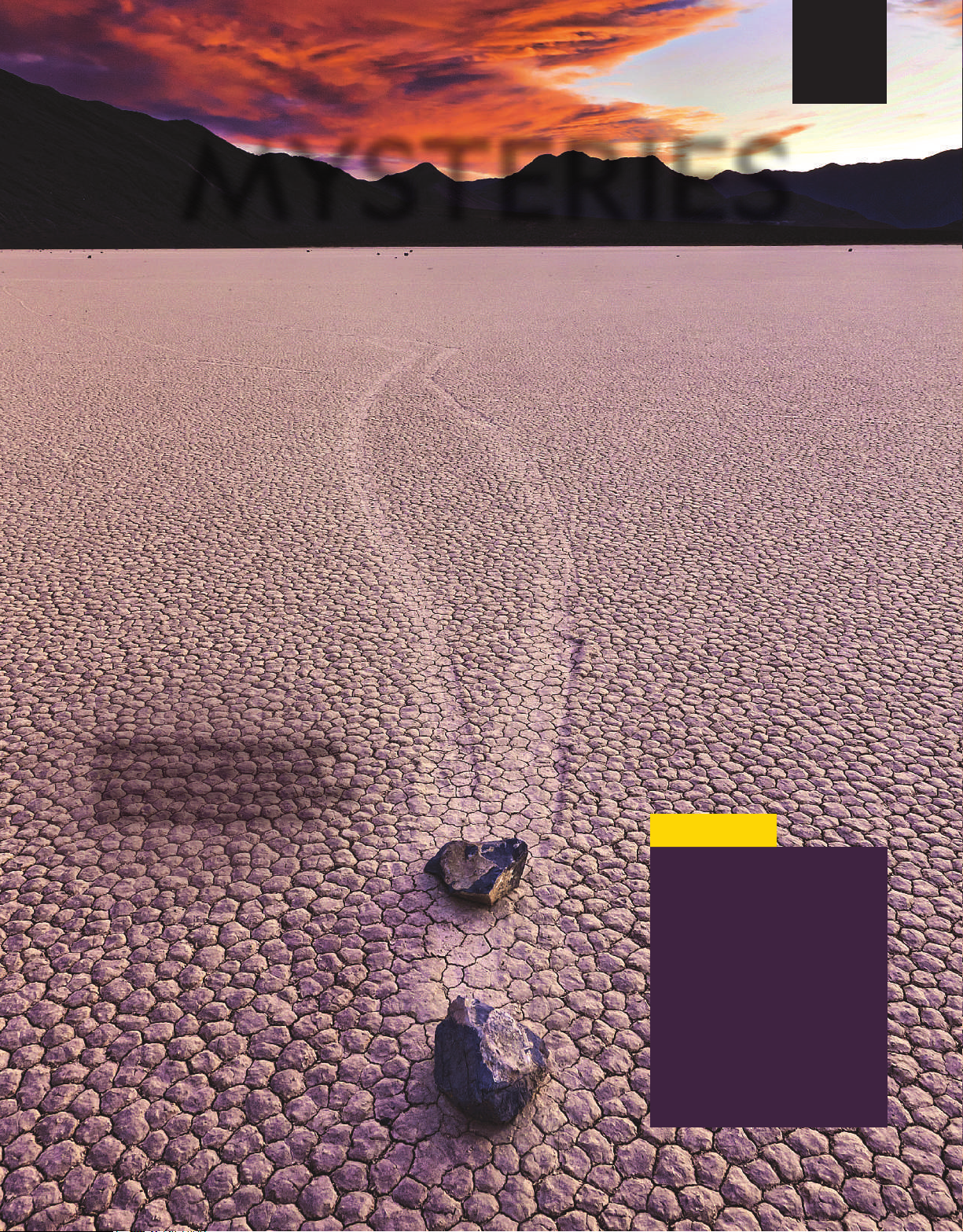
California’s “sailing stones” were once a mystery. We now know
that the rocks are moved by strong
winds when the ground is icy. WA R M U P Discuss these questions with a partner. 1. Read the caption. How do the rocks move? 2. Do you think there are things that science cannot explain? If so, give an example. 7
007-020_16289_REX_SBF_U01_ptg01.indd 7 6/12/19 10:41 AM 1A B E F O R E Y O U R E A D DEFINITIONS
A. Look at the image and read the caption. Complete
the definitions using the words in bold. 1.
: scientists who study objects in space 2.
: a rock that moves through space SKIMMING
B. Skim the passage. According to some scientists, what else could ‘Oumuamua be?
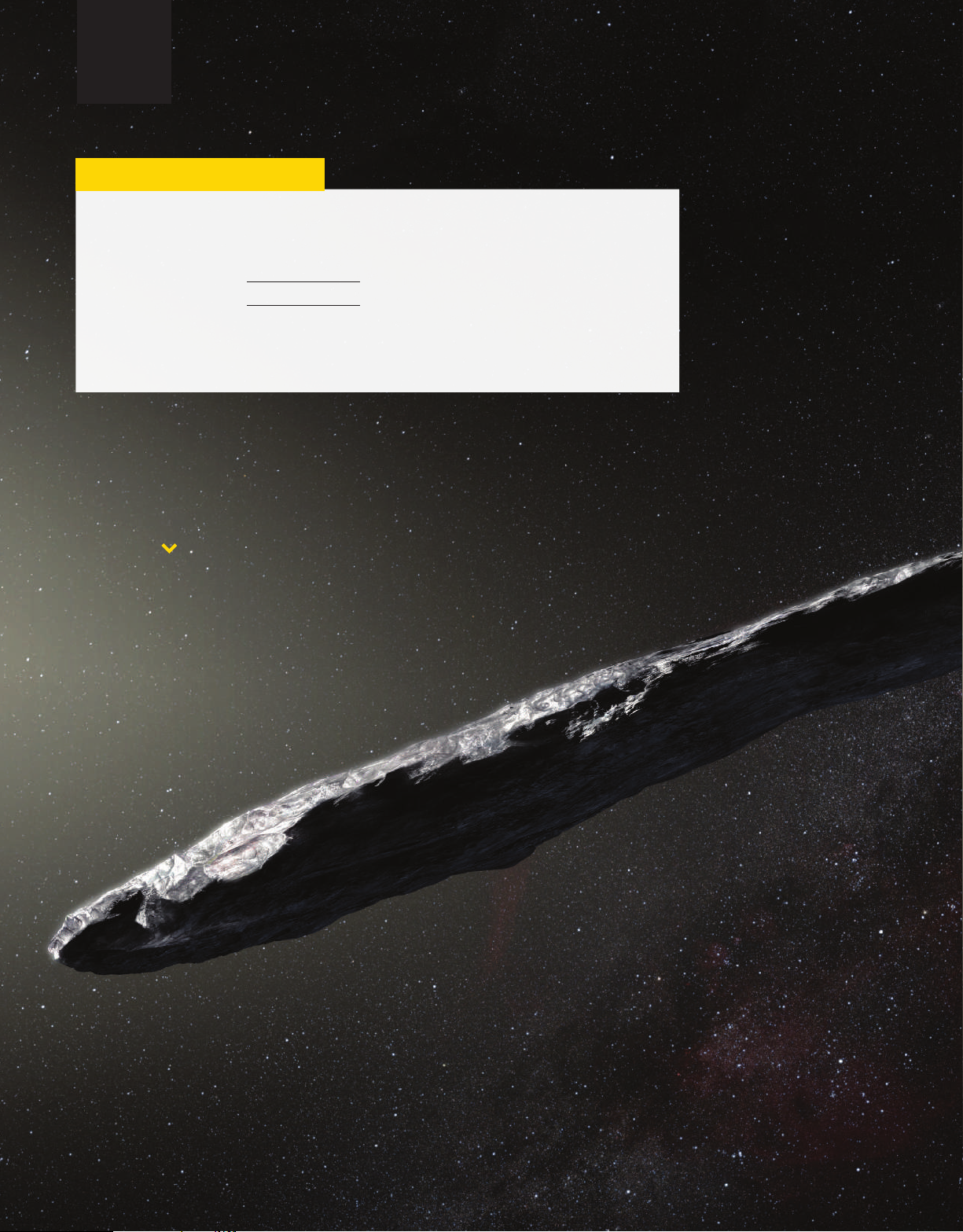
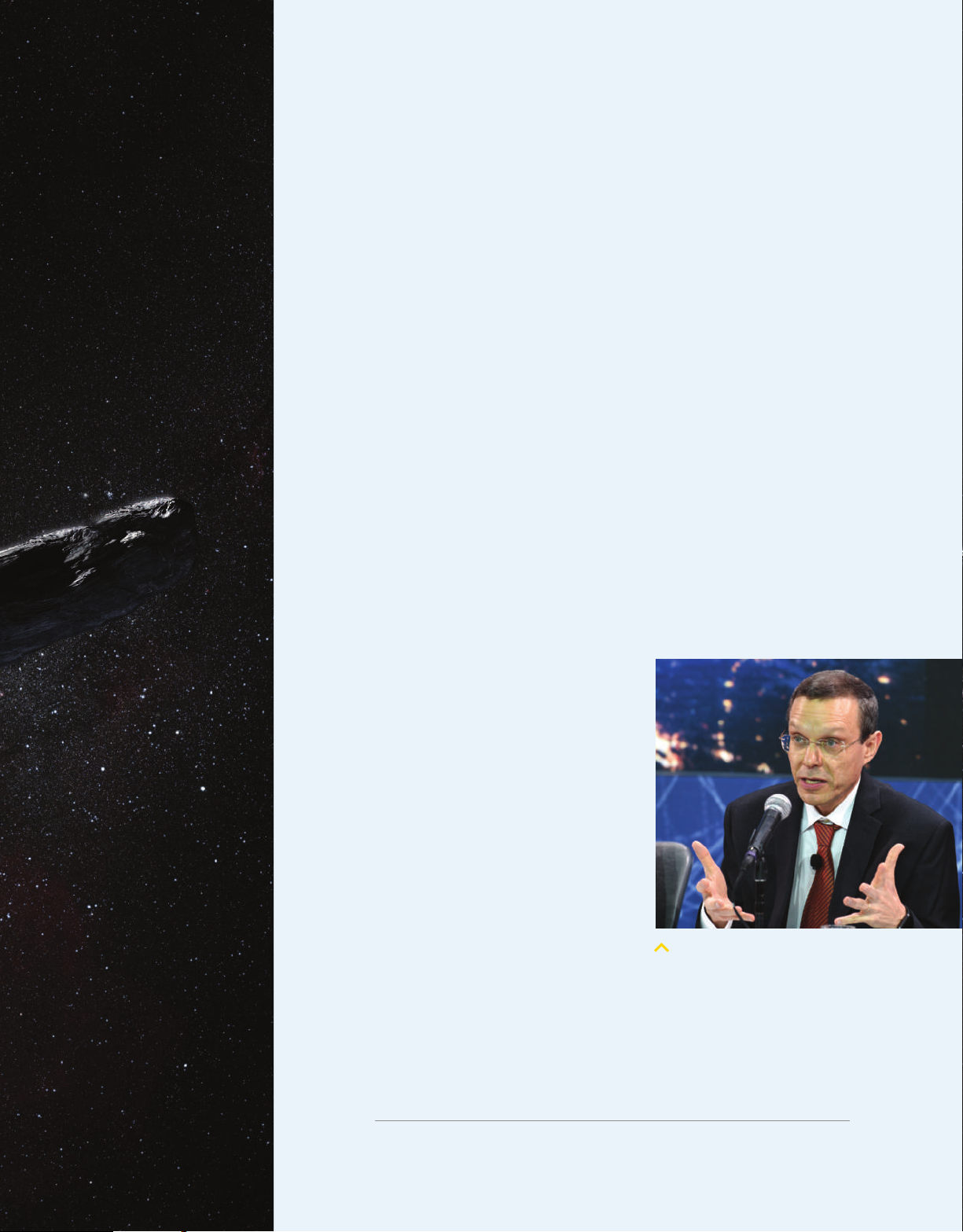
An artist’s drawing of ‘Oumuamua—a
strangely shaped object that passed
by Earth. Astronomers are not sure
if it was an asteroid, or something else altogether. 8 Unit 1A
007-020_16289_REX_SBF_U01_ptg01.indd 8 6/12/19 10:41 AM A MYS TERIOUS VISITOR
A In October 2017, astronomers in Hawaii saw something
surprising. A strange object was moving through the solar
system. They had seen many asteroids before, but this was
something different. It was long and thin—like a cucumber.
The object’s speed and direction also showed something
surprising. This was an interstellar1 object—the first ever seen.
B The object was named ‘Oumuamua—Hawaiian for “visitor
from afar.” Nobody is sure exactly what it is. The simplest
idea is that ‘Oumuamua is a strangely shaped piece of
rock. Perhaps it was knocked out of a far-off star system.
However, astronomers saw that its speed increased after
passing the sun. Some scientists therefore suggest a different theory.
C “’Oumuamua could be a piece
of alien technology,” says Professor Abraham Loeb from
Harvard University. Loeb
believes this could explain the
object’s long, thin shape, and
also its change in speed. Maybe ‘Oumuamua was a spaceship
that came to explore our solar
system. “All possibilities should be considered,” says Loeb. Professor Abraham Loeb
D ‘Oumuamua can no longer be
suggested that ‘Oumuamua
seen from Earth. But astronomers
could be an alien spaceship.
continue to study the information
they got from it. It is still not clear if the object was a large
rock, or something else altogether. ‘Oumuamua will likely be
a mystery for many years to come.
1 If an object is described as interstellar, it has traveled between different stars. Unit 1A 9
007-020_16289_REX_SBF_U01_ptg01.indd 9 6/12/19 10:41 AM 10 Unit 1A
007-020_16289_REX_SBF_U01_ptg01.indd 10 6/12/19 10:41 AM
R E A D I N G C O M P R E H E N S I O N
A. Choose the best answer for each question. GIST
1. What is the reading mainly about?
a. new technology to help scientists find asteroids
b. the largest asteroid ever seen by scientists
c. a mysterious object that passed by Earth DETAIL
2. What did scientists learn from studying
‘Oumuamua’s speed and direction?
a. It came from another star system.
b. It was possible it could hit the Earth. c. It was an asteroid. DETAIL
3. What is NOT given as a reason why
‘Oumuamua could be an alien spaceship?
a. the object’s size and shape
b. the object’s change in speed c. the object’s color VOCABULARY
4. In paragraph C, what does considered mean? a. explained in detail b. thought about carefully c. chosen from a list Scientists believe INFERENCE
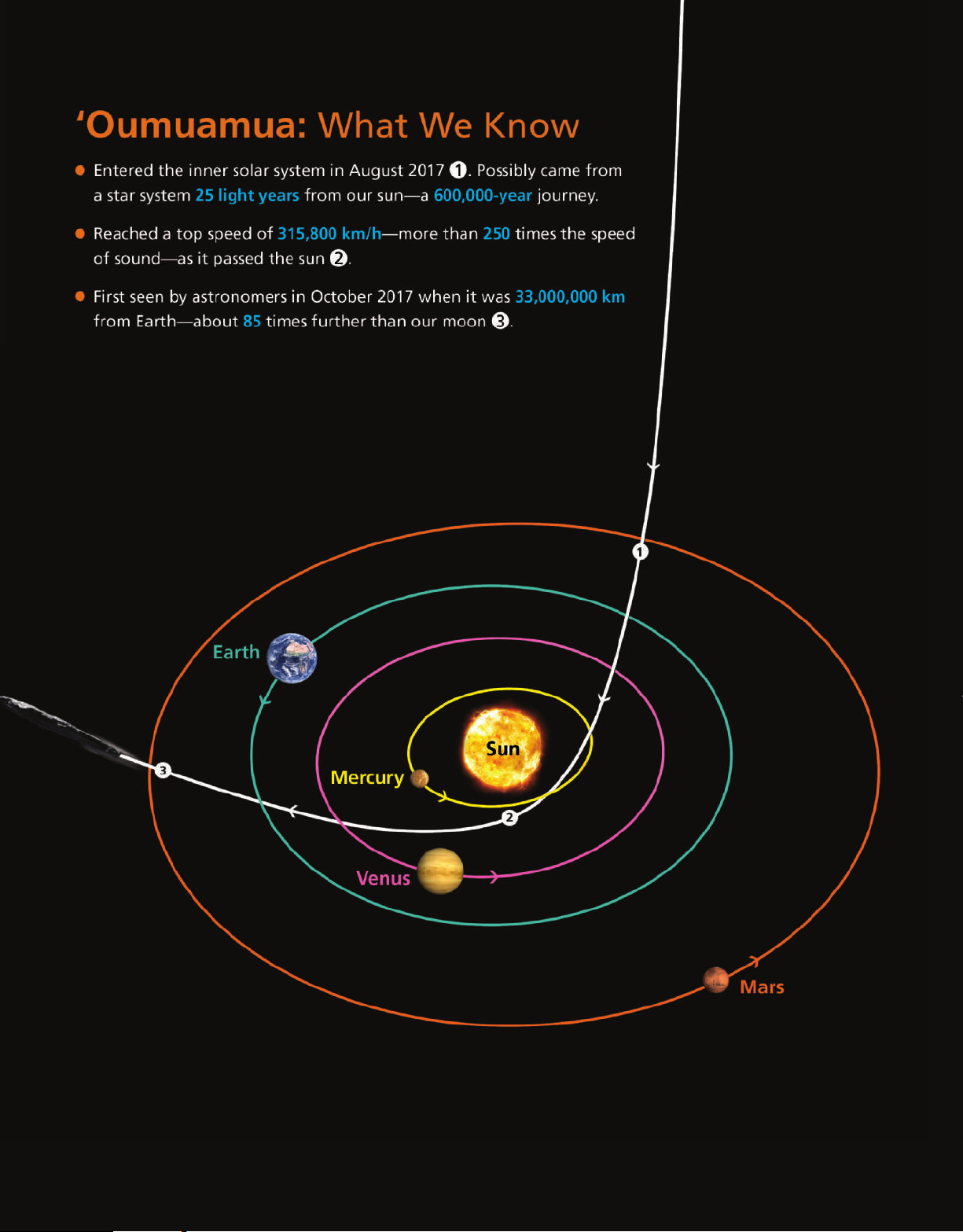
5. According to the infographic on page 10, ‘Oumuamua is
when was ‘Oumuamua first seen from Earth? spinning end-
a. as it entered the inner solar system over-end as it
b. just before it passed the sun travels through c. after it passed the sun space. SUMMARIZING
B. Complete the summary with the phrases in the box. One is extra. a. alien technology b. a cucumber c. another star system d. a rock e. its speed and direction f. our solar system
In October 2017, astronomers saw a strange object that was shaped like 1 . By studying 2
, the scientists realized that the object had come from 3 .
The object was called ‘Oumuamua. Most scientists think it was just 4 .
However, others—such as Abraham Loeb—have suggested it could be a piece of 5 . Unit 1A 11
007-020_16289_REX_SBF_U01_ptg01.indd 11 6/12/19 10:41 AM R E A D I N G S K I L L Scanning
You scan a text when you want to find specific information. When you scan, you only look for the
information you want. You don’t read the rest of the text. For example, for the question What does
‘Oumuamua mean in Hawaiian?, look through the text for the words ‘Oumuamua and Hawaiian, and
possibly quotation marks (“ ”). SCANNING
A. Look back at Reading A. Find and underline these words in the passage as quickly as you can. 1. Hawaii 2. surprising 3. theory 4. alien 5. solar system 6. likely SCANNING
B. Read the questions below. Think about what answers you need to look for.
Then scan Reading A and the infographic on page 10, and write the answers.
1. When did astronomers first see ‘Oumuamua?
2. What does ‘Oumuamua mean in Hawaiian?
3. When did ‘Oumuamua’s speed increase?
4. What is Abraham Loeb’s job?
5. Where does Abraham Loeb work?
6. When did ‘Oumuamua enter the inner solar system?
7. What was ‘Oumuamua’s top speed?
8. How far was ‘Oumuamua from Earth when it was first seen?
CRITICAL THINKING Applying Ideas What extra information about ’Oumuamua would be useful
to help scientists solve the mystery? Note some ideas below. Then discuss with a partner.
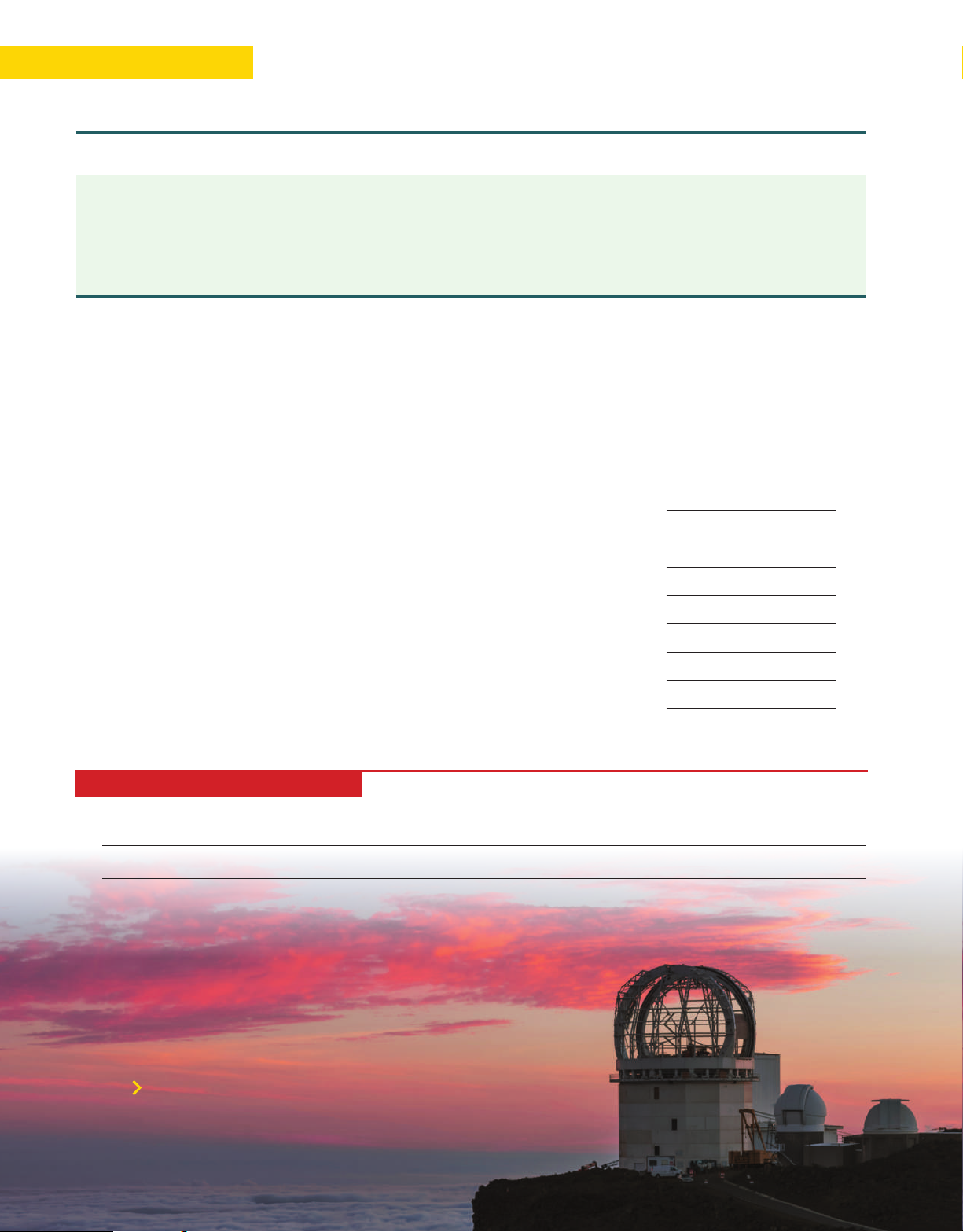
’Oumuamua was first spotted by astronomers
at the Haleakala‐ Observatory in Hawaii. 12 Unit 1A
007-020_16289_REX_SBF_U01_ptg01.indd 12 6/12/19 10:41 AM
V O C A B U L A RY P R A C T I C E DEFINITIONS
A. Read the information. Match each word in
red with its definitions. Crop Circles
A farmer wakes up to find something very
strange. Someone, or maybe something, has
made unusual shapes in his field by pushing
down his crops.1 The shapes can only be seen
from the sky. These are called crop circles.
Some people think that aliens make crop circles
when they land their spaceships. However, it
seems clear that they are made by people. The
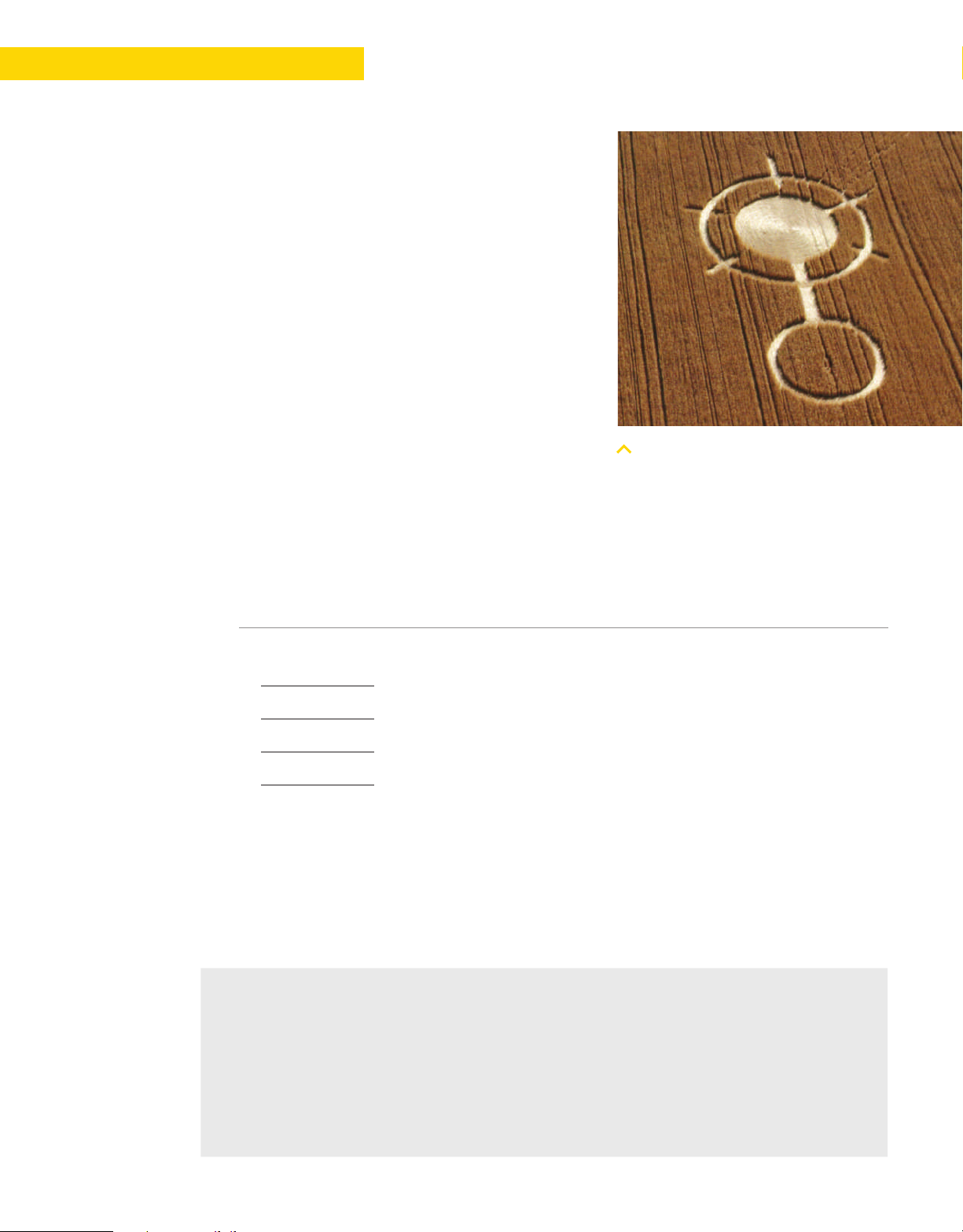
A crop circle is made by pushing
technology to make them is simple—just a crops down, leaving empty spaces in the field.
rope and different sizes of wood to make thick or thin lines.
Some people make crop circles so others will believe in aliens. Other people make them just for fun.
1 Crops are plants grown in large amounts. 1.
: hard to understand or explain 2. : perhaps; possibly 3. : not wide or thick 4.
: the use of science and machines to do things DEFINITIONS
B. Match the two parts of each definition.
1. If you move at high speed, • • a. you hit it.
2. If you knock something, • • b. you go very fast.
3. If you pass a place, •
• c. you learn more about it.
4. When you explore a place, • • d. you do not stop there. WORD USAGE
C. The past tense of the verb pass (passed ) is sometimes confused with the
preposition past. Complete the sentences by circling the correct words.
1. Scientists saw a large asteroid moving past / passed Earth.
2. I passed / past by the supermarket on my way home, so I bought some bread.
3. My friend just walked passed / past me and didn’t stop to chat.
4. ‘Oumuamua reached its top speed as it past / passed the sun. Unit 1A 13
007-020_16289_REX_SBF_U01_ptg01.indd 13 6/12/19 10:41 AM 1B B E F O R E Y O U R E A D PREVIEWING
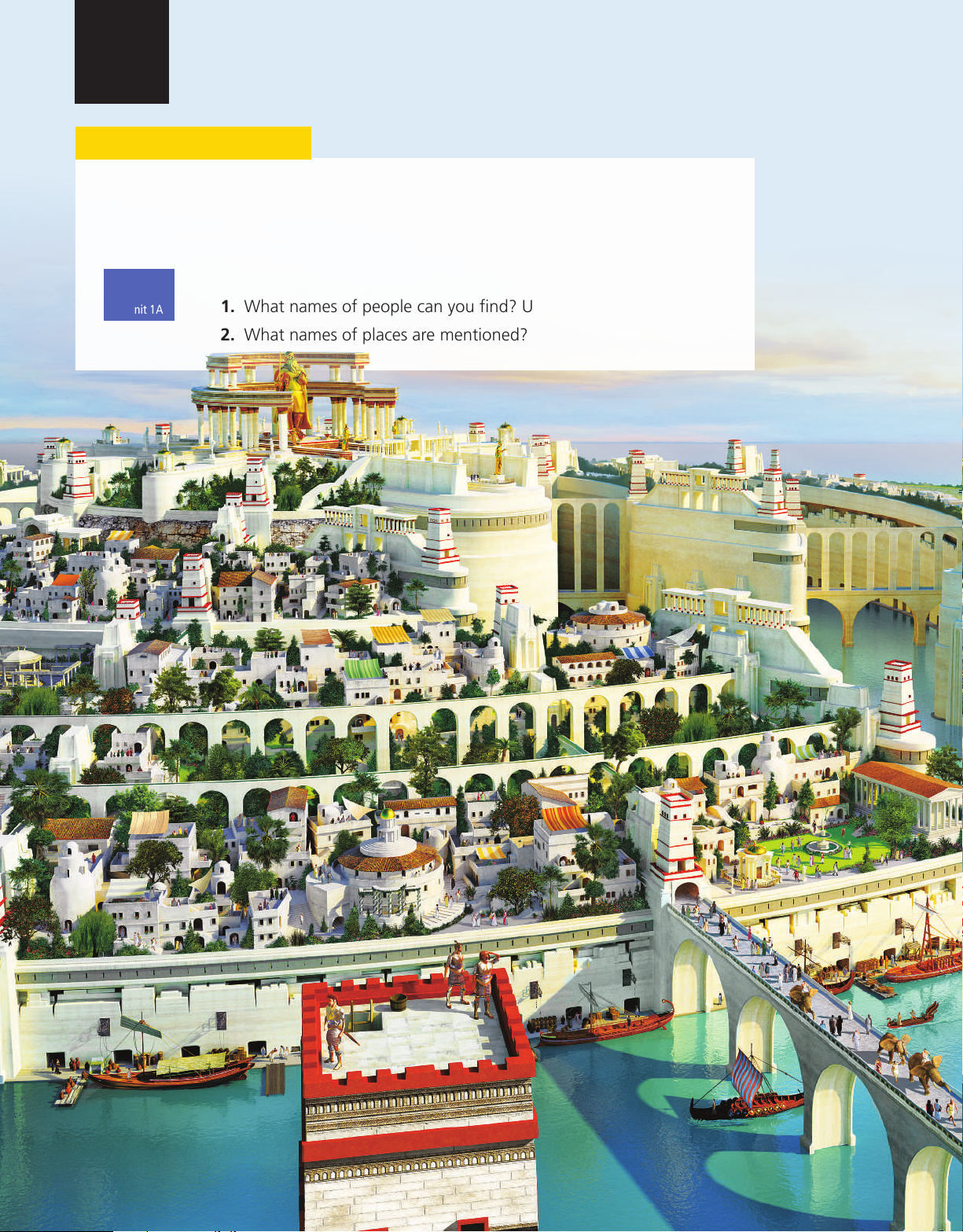
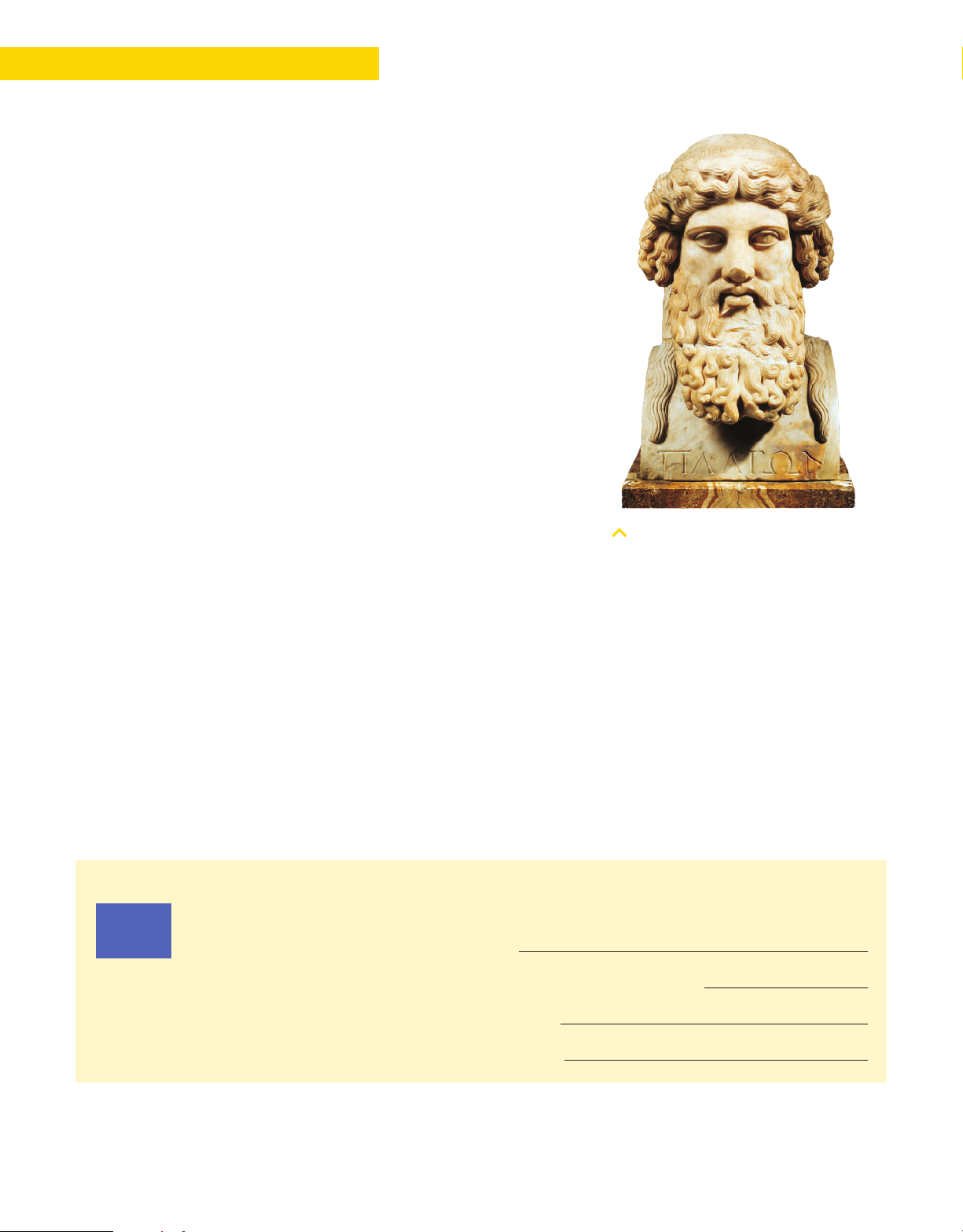
A. Look at the picture and read the caption. Who wrote the story
of Atlantis? What happened to the island? SCANNING
B. Quickly scan the passage on the next page. Remember that Review this
names of people and places usually start with capital letters. reading skill in Unit 1A
1. What names of people can you find? Underline them.
2. What names of places are mentioned? Circle them. 14 Unit 1B
007-020_16289_REX_SBF_U01_ptg01.indd 14 6/12/19 10:42 AM THE LOST CITY OF ATLANTIS
A Most people have heard the story of the lost city of
Atlantis. But is any part of the story true?
Long ago, the Greek writer Plato
B Over two thousand years ago, the Greek writer
wrote about Atlantis—an island that
Plato wrote about Atlantis, an island in the Atlantic
disappeared into the sea.
Ocean. The island’s people were very rich. They
built a big city with many great buildings. But the
people became greedy—they had many things, but
they still wanted more. So the gods became angry.
Earthquakes1 and large waves began to strike the
island. Finally, Atlantis sank into the sea.
C Many explorers have looked for Atlantis. In 2004,
explorer Robert Sarmast reported finding the
remains2 of a city under the sea near Cyprus.
However, Sarmast and other scientists later realized
the structures he found under the sea were natural,
not man-made. Mark Adams, author of the 2016
book Meet Me in Atlantis believes the city was in
Morocco. Plato wrote about red and black stone
circles around the city. Adams found similar red
and black stones in the desert there, very near the Atlantic Ocean.
D Most people, however, think Atlantis is simply a
story. The purpose of the story may be to teach
people not to be greedy. Richard Ellis also wrote a
book about Atlantis in 1999. He says “there is not a
piece of solid evidence”3 for a real Atlantis.
E So was the island real or not? We only know one
thing: The mystery of Atlantis will be with us for a long time.
1 An earthquake is the shaking of the ground caused by movement of the Earth.
2 The remains of something are the parts that are left after most of it is gone.
3 Evidence is anything that makes you believe that something is true. Unit 1B 15
007-020_16289_REX_SBF_U01_ptg01.indd 15 6/12/19 10:42 AM
R E A D I N G C O M P R E H E N S I O N
A. Choose the best answer for each question. GIST
1. What could be another title for the reading? a. Atlantis Sinks b. Is Atlantis Real? c. I Found Atlantis! SEQUENCE
2. What happened after Robert Sarmast said he found Atlantis?
a. He wrote a book about his findings.
b. Richard Ellis said that Atlantis was not real.
c. He found out the structures were not man-made. MAIN IDEA
3. What is the main idea of paragraph C?
a. Scientists believe Atlantis is just a story.
b. Explorers found a city under the sea near Morocco.
The story of Atlantis was
c. People have looked for Atlantis, but no
first written down in Plato’s Dialogues in 360 one has found it. b.c. DETAIL
4. Why does Mark Adams believe Atlantis could be in Morocco?
a. He discovered the remains of houses in the ocean there.
b. He found colored stones similar to ones described by Plato.
c. He found a map that showed Atlantis’s location in the Atlantic Ocean. PARAPHRASING
5. In paragraph D, which sentence is closest in meaning to “there is not a piece of
solid evidence” for a real Atlantis?
a. There is only one reason to believe the Atlantis story is true.
b. The story of Atlantis is made up of many small pieces.
c. There is nothing to make us believe the Atlantis story is true. SCANNING
B. Write short answers to the questions below. Use words from the passage for each answer. Review this reading skill in Unit 1A
1. When did Plato write about Atlantis?
2. When did Robert Sarmast report finding the remains of a city?
3. What was the title of Mark Adams’s book?
4. Which author thinks Atlantis is just a story? 16 Unit 1B
007-020_16289_REX_SBF_U01_ptg01.indd 16 6/12/19 10:42 AM R E A D I N G S K I L L Skimming
You skim when you look quickly at the whole reading to see what it is about. You do not read every
word. Instead, look at the title, headings, photos, and captions. Read the first line of each paragraph,
and quickly read the conclusion.
SKIMMING OR A. Look at these reasons for reading. For each reason, should you skim or scan? SCANNING Check (✓) the correct boxes. Skim Scan
1. to see if a story is funny or serious
2. to find the names of countries mentioned
3. to find a quote (“ ”) by a scientist
4. to see how the author feels about a topic SKIMMING
B. Quickly skim the passage below. What is it mainly about? Circle the correct option.
a. A diver who found Atlantis in the Pacific Ocean
b. A scientist who believes he has found a lost land near Japan
c. A strange structure that was found in a Japanese city
The Lost Continent in the Pacific Ocean
People believe that thousands of years ago
the lost continent of Mu sank because of an
earthquake. Today, no one knows if there
really was a place called Mu, or where it was.
However, Professor Masaaki Kimura thinks
he knows where the remains of Mu are. He
believes they are near the Yonaguni Islands of
A diver explores the strange
Japan. Kimura thinks the strange structures he
steplike structures in the waters
has found were made by people. Some other
near the Yonaguni Islands.
researchers don’t think so. No one is sure, but the research continues.
CRITICAL THINKING Synthesizing Information Which mystery do you think will be more difficult
to solve: Atlantis or ‘Oumuamua? Why? Note your ideas below. Then discuss with a partner. Unit 1B 17
007-020_16289_REX_SBF_U01_ptg01.indd 17 6/12/19 10:42 AM
V O C A B U L A RY P R A C T I C E DEFINITIONS
A. Read the information. Match each word
in red with its definition.
Some people believe the Greek island of
Santorini is the likely location for the lost
city of Atlantis. The two are similar in several ways.
Plato described Atlantis as being in the
shape of a circle. In the past, Santorini
was also circular. However, the island was
struck by earthquakes and nearly destroyed
by a volcano, causing parts of the island to
sink. There were also people living in cities
The Greek island of Santorini
on Santorini for thousands of years. viewed from above
There are, however, important differences. First of all, the dates in Plato’s writing do not
match with events on Santorini. Plato also said Atlantis was in the Atlantic Ocean, but
Santorini is in the Mediterranean Sea. And finally, the sizes of the two islands are very
different. Atlantis was described as very large, but Santorini is small. 1. : lastly, in the end 2. : unable to be found 3. : suddenly hit 4.
: to move slowly downwards, often in water. COMPLETION
B. Complete the sentences. Circle the correct options.
1. Something natural is made / not made by humans.
2. A piece of something is all / part of it.
3. To find out the purpose of something, you should ask “Where?” / “Why?”
4. When you report something, you don’t tell / tell others about it. WORD FORMS
C. Many verbs, such as sink and strike, have irregular past forms. Complete the
sentences using the words in the box. sink sank strike struck
1. Last night, large waves the side of the ship.
2. If you drop coins in water, they . 3. Earthquakes often
in countries along the Pacific.
4. Sadly, their small boat in the storm. 18 Unit 1B
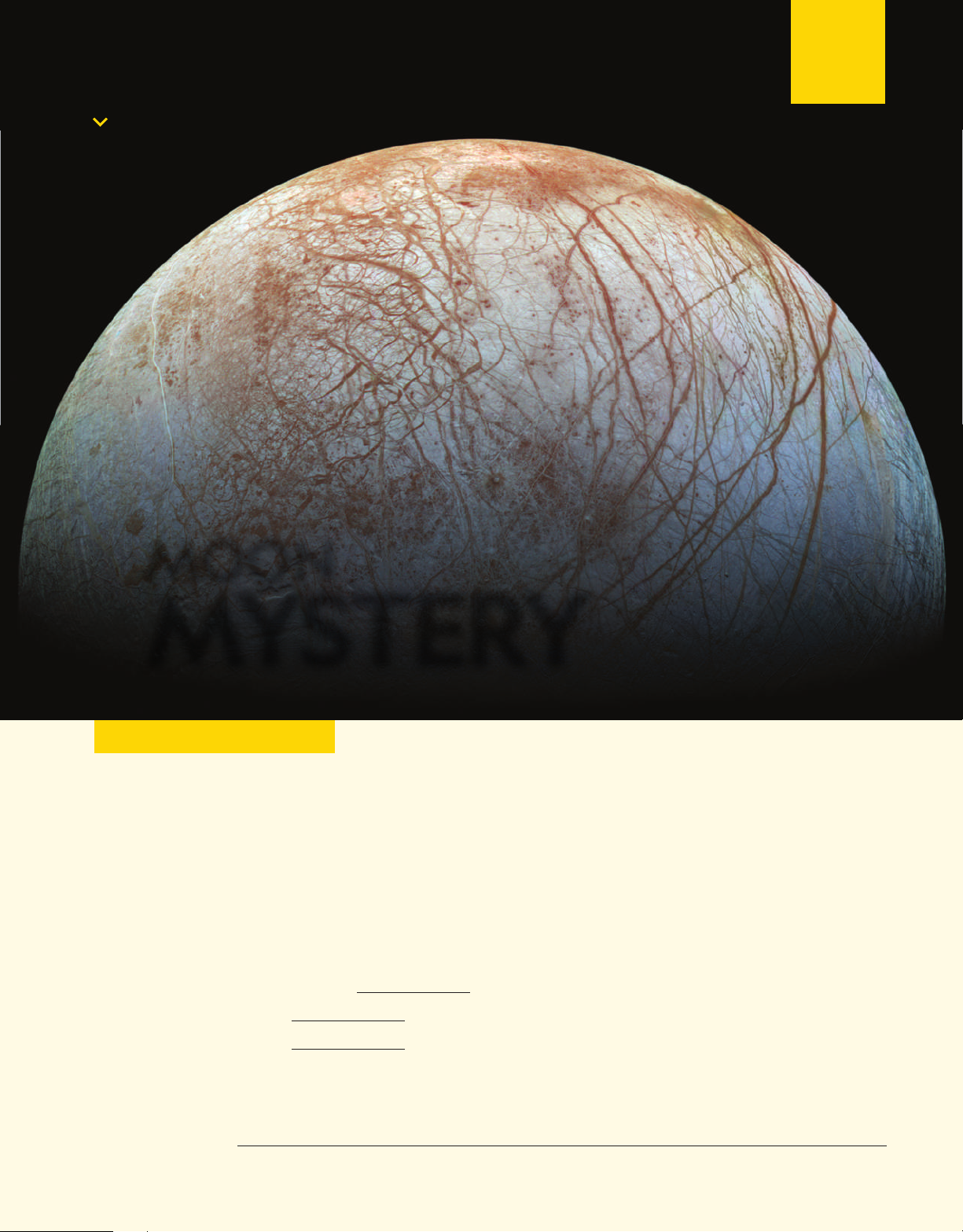
007-020_16289_REX_SBF_U01_ptg01.indd 18 6/12/19 10:42 AM VIDEO Europa, one of Jupiter’s many moons MOON MYSTERY B E F O R E Y O U WAT C H PREVIEWING
A. Read the information. The words in bold appear in the video. Complete the
definitions with the correct form of each word.
For many years, scientists have searched for life in space. Spacecrafts have been sent to
every planet in the solar system, and robots have landed on the surfaces of Mars and
Venus. So far, nothing has been found. Many believe, however, that the best places
to look for life might not be planets at all. Europa—one of Jupiter’s many moons—is
thought to have conditions where life may exist. Whether it does or not remains a mystery for now. 1. If something , it stays alive. 2. The
of something is the outside part of it. 3. The
of a place include things like its temperature or weather. DISCUSSION
B. Why do you think scientists believe there might be life on Europa? What
conditions might exist there? Note your ideas. Then discuss with a partner. Video 19
007-020_16289_REX_SBF_U01_ptg01.indd 19 6/12/19 10:42 AM W H I L E Y O U WAT C H GIST
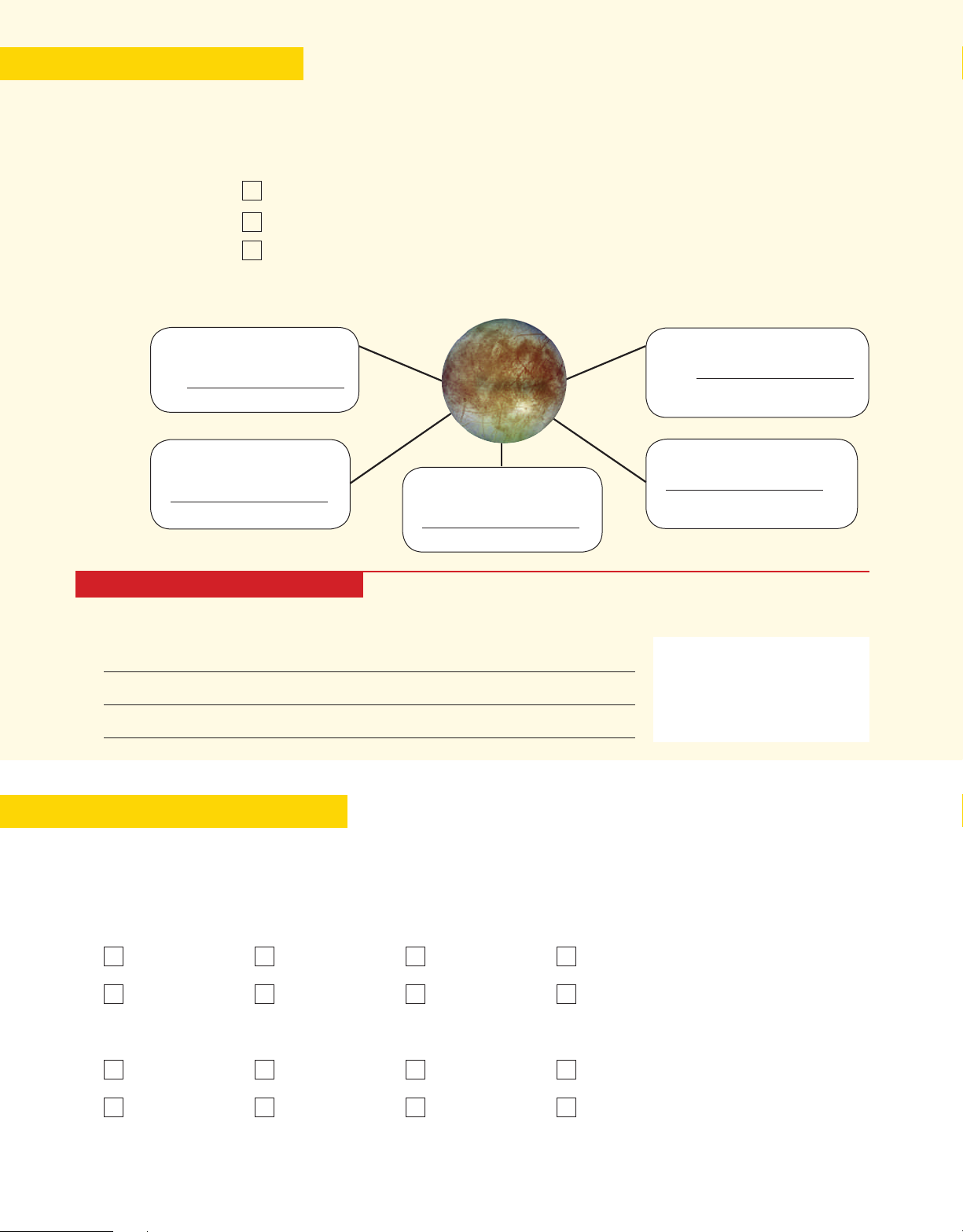
A. Watch the video. Why do scientists believe Europa is a good place to look for
life? Choose the correct answer. a.
It may have an ocean beneath its surface. b.
Its surface temperature is similar to Earth’s. c.
It is a similar size to Earth’s moon. DETAILS
B. Watch the video again. Complete the notes. Discovered by Galileo Future missions may send in 1 a(n) 5 Europa to Europa. Life has been found on Slightly smaller than 4 in 2 Surface covered in similar conditions. 3
CRITICAL THINKING Applying Ideas Consider what you know about the conditions on Europa.
If scientists do find life there, what do you think it will look like? Note your ideas or draw a
picture. Explain your ideas to a partner. V O C A B U L A RY R E V I E W
Do you remember the meanings of these words? Check (✓) the ones you know. Look back at the
unit and review any words you’re not sure of. Reading A explore knock maybe pass speed strange technology* thin Reading B finally* lost natural piece purpose report sink strike * Academic Word List 20 Video
007-020_16289_REX_SBF_U01_ptg01.indd 20 6/12/19 10:42 AM
Tài liệu liên quan:
-
Sách Cambridge IELTS 11 - Academic with answers | Học viện Phụ nữ Việt Nam
25 13 -
25 Đề dự đoán SPEAKING quý 1 2026 môn IELTS | Học viện Phụ nữ Việt Nam
61 31 -
Sách bài tập "Complete IELTS Band 4-5" môn IELTS | Học viện Phụ nữ Việt Nam
44 22 -

Hướng dẫn học IELTS Writing | Học viện Phụ nữ Việt Nam
34 17