Reading - Final test - Inter




















Preview text:
INTERMEDIATE COURSE Final test - Reading Xin chào các TCE-ers,
Chào mừng các bạn đến với bài thi cuối khóa của dòng lớp Intermediate. Chúng mình hi
vọng các bạn đã có những trải nghiệm học tập tuyệt vời cùng team TCE. Dưới đây là
cấu trúc của bài kiểm tra, các bạn vui lòng đọc kỹ trước khi bắt đầu làm:
Bài thi gồm 3 bài đọc với tổng thời gian là 75 phút. Các bạn nên dành 20 - 25 phút làm mỗi bài.
Một số lưu ý khi làm bài:
- Tất cả các đáp án cần được điền vào answer sheet. 75 phút bao gồm cả thời gian làm
bài và chuyển đáp án vào phiếu, các bạn lưu ý để kiểm soát tốt thời gian.
- Các bạn không mất điểm khi làm sai, nên cố gắng đừng bỏ trống bất kì câu nào nhé
- Các bạn vui lòng không sử dụng từ điển, không tham khảo kiến thức. Bài thi chỉ phục
vụ mục đích đánh giá đầu ra để TCE tiện hỗ trợ các bạn, không mang bất kì mục đích nào khác.
Cuối cùng, chúc các bạn làm bài tốt và đạt được kết quả tốt nhất. Chúng mình mong
sớm được gặp lại các bạn ở khóa học tiếp theo! Best, Team TCE ----- THE CATALYST FOR ENGLISH
❖ Cơ sở 1: Số 7, Phố Nguyễn Văn Tuyết, Đống Đa, HN
❖ Cơ sở 2: Số 26, Ngõ 133, Thái Hà, Đống Đa, HN
❖ Hotline: 096 2799 826
Họ và tên - Lớp: …………………………………….
SĐT: ……………………………
Giáo viên giảng dạy:
Email: …………………………………………. …….
…………………………………. READING PASSAGE 1
You should spend about 20 minutes on Questions 1-13, which are based on Reading Passage 1 below.
How tennis rackets have changed
In 2016, the British professional tennis player Andy Murray was ranked as the world’s number one.
It was an incredible achievement by any standard – made even more remarkable by the fact that he
did this during a period considered to be one of the strongest in the sport’s history, competing
against the likes of Rafael Nadal, Roger Federer and Novak Djokovic, to name just a few. Yet five
years previously, he had been regarded as a talented outsider who entered but never won the major tournaments.
Of the changes that account for this transformation, one was visible and widely publicised: in 2011,
Murray invited former number one player Ivan Lendl onto his coaching team – a valuable addition
that had a visible impact on the player’s playing style. Another change was so subtle as to pass
more or less unnoticed. Like many players, Murray has long preferred a racket that consists of two
types of string: one for the mains (verticals) and another for the crosses (horizontals). While he
continued to use natural string in the crosses, in 2012 he switched to a synthetic string for the mains.
A small change, perhaps, but its importance should not be underestimated.
The modification that Murray made is just one of a number of options available to players looking to
tweak their rackets in order to improve their games. ‘Touring professionals have their rackets
customised to their specific needs,’ says Colin Triplow, a UK-based professional racket stringer. ‘It’s a
highly important part of performance maximisation.’ Consequently, the specific rackets used by the
world’s elite are not actually readily available to the public; rather, each racket is individually made
to suit the player who uses it. Take the US professional tennis players Mike and Bob Bryan, for
example: ‘We’re very particular with our racket specifications,’ they say. ‘All our rackets are sent from
our manufacturer to Tampa, Florida, where our frames go through a … thorough customisation
process.’ They explain how they have adjusted not only racket length, but even experimented with
different kinds of paint. The rackets they use now weigh more than the average model and also have
a denser string pattern (i.e. more crosses and mains).
The primary reason for these modifications is simple: as the line between winning and losing
becomes thinner and thinner, even these slight changes become more and more important. As a
result, players and their teams are becoming increasingly creative with the modifications to their
rackets as they look to maximise their competitive advantage.
Racket modifications mainly date back to the 1970s, when the amateur German tennis player
Werner Fischer started playing with the so-called spaghetti-strung racket. It created a string bed
that generated so much topspin that it was quickly banned by the International Tennis Federation.
However, within a decade or two, racket modification became a regularity. Today it is, in many ways,
an aspect of the game that is equal in significance to nutrition or training.
Modifications can be divided into two categories: those to the string bed and those to the racket
frame. The former is far more common than the latter: the choice of the strings and the tension with
which they are installed is something that nearly all professional players experiment with. They will
continually change it depending on various factors including the court surface, climatic conditions,
and game styles. Some will even change it depending on how they feel at the time.
At one time, all tennis rackets were strung with natural gut made from the outer layer of sheep or
cow intestines. This all changed in the early 1990s with the development of synthetic strings that
were cheaper and more durable. They are made from three materials: nylon (relatively durable and
affordable), Kevlar (too stiff to be used alone) or co-polyester (polyester combined with additives
that enhance its performance). Even so, many professional players continue to use a ‘hybrid set-up’,
where a combination of both synthetic and natural strings are used.
Of the synthetics, co-polyester is by far the most widely used. It’s a perfect fit for the style of tennis
now played, where players tend to battle it out from the back of the court rather than coming to the
net. Studies indicate that the average spin from a co-polyester string is 25% greater than that from
natural string or other synthetics. In a sense, the development of co-polyester strings has revolutionised the game.
However, many players go beyond these basic adjustments to the strings and make changes to the
racket frame itself. For example, much of the serving power of US professional player Pete Sampras
was attributed to the addition of four to five lead weights onto his rackets, and today many
professionals have the weight adjusted during the manufacturing process.
Other changes to the frame involve the handle. Players have individual preferences for the shape of
the handle and some will have the handle of one racket moulded onto the frame of a different racket.
Other players make different changes. The professional Portuguese player Gonçalo Oliveira replaced
the original grips of his rackets with something thinner because they had previously felt uncomfortable to hold.
Racket customisation and modification have pushed the standards of the game to greater levels that
few could have anticipated in the days of natural strings and heavy, wooden frames, and it’s exciting
to see what further developments there will be in the future. Questions 1—7
Do the following statements agree with the information given in Reading Passage 1?
In boxes 1—7 on your answer sheet, write TRUE
if the statement agrees with the information FALSE
if the statement contradicts the information NOT GIVEN
if there is no information on this
1 People had expected Andy Murray to become the world's top tennis player for at least five years before 2016. false
2 The change that Andy Murray made to his rackets attracted a lot of attention. NF
3 Most of the world's top players take a professional racket stringer on tour with them. T
4 Mike and Bob Bryan use rackets that are light in comparison to the majority of rackets. NG
5 Werner Fischer played with a spaghetti-strung racket that he designed himself. NG
6 The weather can affect how professional players adjust the strings on their rackets. F
7 It was believed that the change Pete Sampras made to his rackets contributed to his strong serve. T
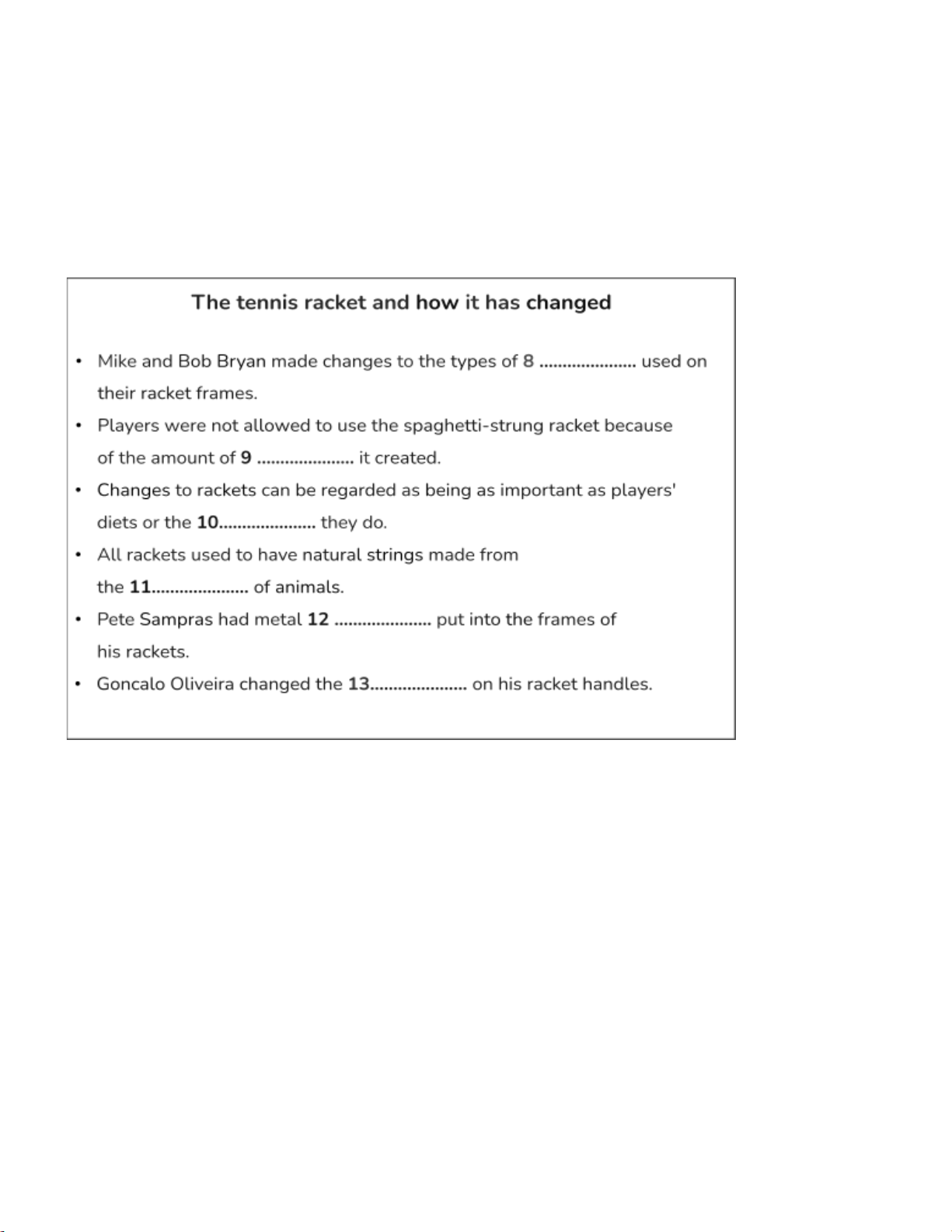
Questions 8—13
Complete the notes below.
Choose ONE WORD ONLY from the passage for each answer.
Write your answers in boxes 8—13 on your answer sheet. PAINT TOPSPIN lead grips READING PASSAGE 2
You should spend about 20 minutes on Questions 14-26, which are based on Reading Passage 2 below.
The pirates of the ancient Mediterranean
In the first and second millennia BCE, pirates sailed around the Mediterranean,
attacking ships and avoiding pursuers
A. When one mentions pirates, an image springs to most people’s minds of a crew of misfits,
daredevils and adventurers in command of a tall sailing ship in the Caribbean Sea. Yet from the first
to the third millennium BCE, thousands of years before these swashbucklers began spreading fear
across the Caribbean, pirates prowled the Mediterranean, raiding merchant ships and threatening
vital trade routes. However, despite all efforts and the might of various ancient states, piracy could
not be stopped. The situation remained unchanged for thousands of years. Only when the pirates
directly threatened the interests of ancient Rome did the Roman Republic organise a massive fleet to
eliminate piracy. Under the command of the Roman general Pompey, Rome eradicated piracy,
transforming the Mediterranean into ‘Mare Nostrum’ (Our Sea).
B. Although piracy in the Mediterranean is first recorded in ancient Egypt during the reign of Pharaoh
Amenhotep I I (c 1390-1353 BCE), it is reasonable to assume it predated this powerful civilisation.
This is partly due to the great importance the Mediterranean held at this time, and partly due to its
geography. While the Mediterranean region is predominantly fertile, some parts are rugged and
hilly, even mountainous. In the ancient times, the inhabitants of these areas relied heavily on marine
resources, including fish and salt. Most had their own boats, possessed good seafaring skills, and
unsurpassed knowledge of the local coastline and sailing routes. Thus, it is not surprising that during
hardships, these men turned to piracy. Geography itself further benefited the pirates, with the
numerous coves along the coast providing places for them to hide their boats and strike undetected.
Before the invention of ocean-going caravels in the 15th century, ships could not easily cross long
distances over open water. Thus, in the ancient world most were restricted to a few well- known
navigable routes that followed the coastline. Caught in a trap, a slow merchant ship laden with
goods had no other option but to surrender. In addition, knowledge of the local area helped the
pirates to avoid retaliation once a state fleet arrived.
C. One should also add that it was not unknown in the first and second millennia BCE for
governments to resort to pirates’ services, especially during wartime, employing their skills and
numbers against their opponents. A pirate fleet would serve in the first wave of attack, preparing the
way for the navy. Some of the regions were known for providing safe harbours to pirates, who, in
return, boosted the local economy.
D. The first known record of a named group of Mediterranean pirates, made during the rule of
ancient Egyptian Pharaoh Akhenaten (c 1353-1336 BCE), was in the Amarna Letters. These were
extracts of diplomatic correspondence between the pharaoh and his allies, and covered many
pressing issues, including piracy. It seems the pharaoh was troubled by two distinct pirate groups,
the Lukka and the Sherden. Despite the Egyptian fleet’s best efforts, the pirates continued to cause
substantial disruption to regional commerce. In the letters, the king of Alashiya (modern Cyprus)
rejected Akhenaten’s claims of a connection with the Lukka (based in modern-day Turkey). The king
assured Akhenaten he was prepared to punish any of his subjects involved in piracy.
E. The ancient Greek world’s experience of piracy was different from that of Egyptian rulers. While
Egypt’s power was land-based, the ancient Greeks relied on the Mediterranean in almost all aspects
of life, from trade to warfare. Interestingly, in his works the Iliad and the Odyssey, the ancient Greek
writer Homer not only condones, but praises the lifestyle and actions of pirates. The opinion
remained unchanged in the following centuries. The ancient Greek historian Thucydides, for instance,
glorified pirates’ daring attacks on ships or even cities. For Greeks, piracy was a part of everyday life.
Even high-ranking members of the state were not beyond engaging in such activities. According to
the Greek orator Demosthenes, in 355 BCE, Athenian ambassadors made a detour from their official
travel to capture a ship sailing from Egypt, taking the wealth found onboard for themselves! The
Greeks’ liberal approach towards piracy does not mean they always tolerated it, but attempts to
curtail piracy were hampered by the large number of pirates operating in the Mediterranean.
F. The rising power of ancient Rome required the Roman Republic to deal with piracy in the
Mediterranean. While piracy was a serious issue for the Republic, Rome profited greatly from its
existence. Pirate raids provided a steady source of slaves, essential for Rome’s agriculture and
mining industries. But this arrangement could work only while the pirates left Roman interests alone.
Pirate attacks on grain ships, which were essential to Roman citizens, led to angry voices in the
Senate, demanding punishment of the culprits. Rome, however, did nothing, further encouraging
piracy. By the 1st century BCE, emboldened pirates kidnapped prominent Roman dignitaries, asking
for a large ransom to be paid. Their most famous hostage was none other than Julius Caesar, captured in 75 BCE.
G. By now, Rome was well aware that pirates had outlived their usefulness. The time had come for
concerted action. In 67 BCE, a new law granted Pompey vast funds to combat the Mediterranean
menace. Taking personal command, Pompey divided the entire Mediterranean into 13 districts,
assigning a fleet and commander to each. After cleansing one district of pirates, the fleet would join
another in the next district. The process continued until the entire Mediterranean was free of pirates.
Although thousands of pirates died at the hands of Pompey’s troops, as a long-term solution to the
problem, many more were offered land in fertile areas located far from the sea. Instead of a maritime
menace, Rome got productive farmers that further boosted its economy. Questions 14-19
Reading Passage 2 has seven paragraphs, A-G.
Which paragraph contains the following information?
Write the correct leffer, A-G, in boxes 14-19 on your answer sheet.
NB You may use any letter more than once.
14 a reference to a denial of involvement in piracy D
15 details of how a campaign to eradicate piracy was carried out
16 a mention of the circumstances in which states in the ancient world would make use of pirates C
17 a reference to how people today commonly view pirates A
18 an explanation of how some people were encouraged not to return to piracy G
19 a mention of the need for many sailing \/esseIs to stay relatively close to land Questions 20 and 21
Choose TWO letters, A—E.
Write the correct letters in boxes 20 and 21 on your answer sheet.
Which TWO of the following statements does the writer make about inhabitants of the
Mediterranean region in the ancient world?
A They often used stolen vessels to carry out pirate attacks.
B They managed to escape capture by the authorities because they knew the area so well.
C They paid for information about the routes merchant ships would take.
D They depended more on the sea for their livelihood than on farming.
E They stored many of the goods taken in pirate attacks in coves along the coastline. Questions 22 and 23
Choose TWO letters, A-E.
Write the correct letters in boxes 22 and 23 on your answer sheet.
Which TWO of the following statements does the writer make about piracy and ancient Greece?
A The state estimated that very few people were involved in piracy.
B Attitudes towards piracy changed shortly after the Iliad and the Odyssey were written.
C Important officials were known to occasionally take part in piracy.
D Every citizen regarded pirate attacks on cities as unacceptable.
E A favorable view of piracy is evident in certain ancient Greek texts. Questions 24—26
Complete the summary below.
Choose ONE WORD ONLY from the passage for each answer.
Write your answers in boxes 24 - 26 on your answer sheet.
Ancient Rome and piracy
Piracy was an issue ancient Rome had to deal with, but it also brought some benefits for Rome.
For example, pirates supplied slaves that were important for Rome’s industries. However, attacks grain punishment
on vessels transporting 24……………. to Rome resulted in calls for 25 …………… for the pirates
responsible. Nevertheless, piracy continued, with some pirates demanding a 26 …………… for the
return of the Roman officials they captured. ransom READING PASSAGE 3
You should spend about 20 minutes on Questions 27-40, which are based on Reading Passage 3 below.
The persistence and peril of misinformation
Brian Southwell looks at how human brains verify information and discusses some of
the challenges of battling widespread falsehoods
Misinformation – both deliberately promoted and accidentally shared -is perhaps an inevitable part
of the world in which we live, but it is not a new problem. People likely have lied to one another for
roughly as long as verbal communication has existed. Deceiving others can offer an apparent
opportunity to gain strategic advantage, to motivate others to action, or even to protect interpersonal
bonds. Moreover, people inadvertently have been sharing inaccurate information with one another for thousands of years.
However, we currently live in an era in which technology enables information to reach large
audiences distributed across the globe,and thus the potential for immediate and widespread effects
from misinformation now looms larger than in the past. Yet the means to correct misinformation
might,over time,be found in those same patterns of mass communication and of the facilitated spread of information.
The main worry regarding misinformation is its potential to unduly influence attitudes and behavior,
leading people to think and act differently than they would if they were correctly informed, as
suggested by the research teams of Stephan Lewandowsky of the University of Bristol and Elizabeth
Marsh of Duke University, among others. In other words, we worry that misinformation might lead
people to hold misperceptions (or false beliefs) and that these misperceptions, especially when they
occur among large groups of people, may have detrimental, downstream consequences for health,
social harmony, and the political climate.
At least three observations related to misinformation in the contemporary mass-media environment
warrant the attention of researchers, policy makers, and really everyone who watches television,
listens to the radio, or reads information online. First of all, people who encounter misinformation
tend to believe it, at least initially. Secondly, electronic and print media often do not block many
types of misinformation before it appears in content available to large audiences. Thirdly, countering
misinformation once it has enjoyed wide exposure can be a resource-intensive effort.
Knowing what happens when people initially encounter misinformation holds tremendous
importance for estimating the potential for subsequent problems. Although it is fairly routine for
individuals to come across information that is false, the question of exactly how – and when – we
mentally label information as true or false has garnered philosophical debate. The dilemma is neatly
summarized by a contrast between how the 17th-century philosophers Rene Descartes and Baruch
Spinoza described human information engagement, with conflicting predictions that only recently
have been empirically tested in robust ways. Descartes argued that a person only accepts or rejects
information after considering its truth or falsehood; Spinoza argued that people accept all
encountered information (or misinformation) by default and then subsequently verify or reject it
through a separate cognitive process. In recent decades, empirical evidence from the research teams
of Erik Asp of the University of Chicago and Daniel Gilbert at Harvard University, among others, has
supported Spinoza’s account: people appear to encode all new information as if it were true, even if
only momentarily, and later tag the information as being either true or false, a pattern that seems
consistent with the observation that mental resources for skepticism physically reside in a different
part of the brain than the resources used in perceiving and encoding.
What about our second observation that misinformation often can appear in electronic or print media
without being preemptively blocked? In support of this, one might consider the nature of regulatory
structures in the United States: regulatory agencies here tend to focus on post hoc detection of
broadcast information. Organizations such as the Food and Drug Administration (FDA) offer
considerable monitoring and notification functions, but these roles typically do not involve
preemptive censoring. The IDA oversees direct-to-consumer prescription drug advertising, for
example, and has developed mechanisms such as the ‘Bad Ad’ program, through which people can
report advertising in apparent violation of FDA guidelines on drug risks. Such programs, although
laudable and useful, do not keep false advertising off the airwaves. In addition, even misinformation
that is successfully corrected can continue to affect attitudes.
This leads us to our third observation: a campaign to correct misinformation, even if rhetorically
compelling, requires resources and planning to accomplish necessary reach and frequency. For
corrective campaigns to be persuasive, audiences need to be able to comprehend them, which
requires either effort to frame messages in ways that are accessible or effort to educate and sensitize
audiences to the possibility of misinformation. That some audiences might be unaware of the
potential for misinformation also suggests the utility of media literacy efforts as early as elementary
school. Even with journalists and scholars pointing to the phenomenon of ‘fake news’, people do not
distinguish between demonstrably false stories and those based in fact when scanning and
processing written information.
We live at a time when widespread misinformation is common. Yet at this time many people also are
passionately developing potential solutions and remedies. The journey forward undoubtedly will be
a long and arduous one. Future remedies will require not only continued theoretical consideration
but also the development and maintenance of consistent monitoring tools and a recognition among
fellow members of society that claims which find prominence in the media that are insufficiently
based in scientific consensus and social reality should be countered. Misinformation arises as a result
of human fallibility and human information needs. To overcome the worst effects of the
phenomenon, we will need coordinated efforts over time, rather than any singular one-time panacea we could hope to offer. Questions 27—30
Choose the correct letter, A, B, C or D.
Write the correct letter in boxes 27—30 on your answer sheet.
27 What point does the writer make about misinformation in the first paragraph?
A Misinformation is a relatively recent phenomenon.
B Some people find it easy to identify misinformation.
C Misinformation changes as it is passed from one person to another.
D There may be a number of reasons for the spread of misinformation.
28 What does the writer say about the role of technology?
A It may at some point provide us with a solution to misinformation.
B It could fundamentally alter the way in which people regard information.
C It has changed the way in which organisations use misinformation.
D It has made it easier for people to check whether information is accurate.
29 What is the writer doing in the fourth paragraph?
A comparing the different opinions people have of misinformation
B explaining how the effects of misinformation have changed over time
C outlining which issues connected with misinformation are significant today
D describing the attitude of policy makers towards misinformation in the media
30 What point does the writer make about regulation in the USA?
A The guidelines issued by the FDA need to be simplified.
B Regulation does not affect people's opinions of new prescription drugs.
C The USA has more regulatory bodies than most other countries.
D Regulation fails to prevent misinformation from appearing in the media. Questions 31—36
Complete the summary using the list of phrases, A—J, below.
Write the correct letter, A—J, in boxes 31—36 on your answer sheet.
What happens when people encounter misinformation?
Although people have 31. . . . . . . . to misinformation, there is debate about
precisely how and when we label something as true or untrue. The philosophers Descartes
and Spinoza had 32 . . . . . .J . . . . . . . about how people engage with information. While
Descartes believed that people accept or reject information after considering whether it is
true or not, Spinoza argued that people accepted all information they encountered (and by
default misinformation) and did not verify or reject it until afterwards. Moreover, Spinoza
believed that a distinct 33. . . . . . . is involved in these stages. Recent research has provided
34. . . . . . . for Spinoza's theory and it would appear that people accept all encountered
information as if it were true, even if this is for an extremely 35. . . . . . . , and do not label the
information as true or false until later. This is consistent with the fact that the resources for
scepticism and the resources for perceiving and encoding are in 36 . . . . . . . in the brain. A constant conflict B additional evidence C different locations D
experimental subjects E short period F extreme distrust G frequent exposure H mental operation I dubious reason J different ideas Questions 37—40
Do the following statements agree with the claims of the writer in Reading Passage 3?
In boxes 37-40 on your answer sheet, write YES
if the statement agrees with the claims of the writer NO
if the statement contradicts the claims of the writer NOT GIVEN
if it is impossible to say what the writer thinks about this
37 Campaigns designed to correct misinformation will fail to achieve their purpose if people yes
are unable to understand them.
38 Attempts to teach elementary school students about misinformation have been opposed. no
39 It may be possible to overcome the problem of misinformation in a relatively short period. no
40 The need to keep up with new information is hugely exaggerated in today's world. not given
CHÚC MỪNG BẠN ĐÃ HOÀN THÀNH BÀI KIỂM TRA ĐỌC
Xin chúc mừng bạn đã hoàn thành xong bài test!
Bạn hãy kiểm tra lại kĩ bài trước khi nộp nhé vì bạn sẽ không thể điều chỉnh được câu trả lời sau khi
nộp bài. Kết quả sẽ được gửi lại các bạn trong vòng 1 tuần, các bạn hãy kiên nhẫn chờ kết quả và nếu
còn bất cứ băn khoăn gì, hãy nhắn tin cho account TCE Helper để được hỗ trợ sớm nhất nhé.
Cuối cùng, The Catalyst for English trân trọng những nỗ lực, cố gắng học tập của bạn trong thời gian
qua. Được đồng hành cùng với bạn trên hành trình chinh phục bài thi IELTS là niềm vinh dự và hạnh
phúc của chúng mình. TCE hi vọng sẽ được tiếp tục đồng hành với bạn trong những khoá học tiếp
theo và cùng bạn đạt kết quả cao nhất!
Cảm ơn bạn và hẹn gặp lại bạn sớm, our TCE-er 💕 Thân mến, Team TCE ----- THE CATALYST FOR ENGLISH
❖ Cơ sở 1: Số 7, Phố Nguyễn Văn Tuyết, Đống Đa, HN
❖ Cơ sở 2: Khu tập thể Nguyễn Ái Quốc, Phố Đặng Tiến Đông, Đống Đa, HN ❖ Hotline: 096 2799 826
❖ Nhận tư vấn khóa học IELTS tích hợp 1 kèm 1 từ 0 - 7.5: m.me/11059855797137