Relevance of Schools & Modern Education Insights | Nhập môn Ngôn ngữ Anh | Đại học Hàng hải Việt Nam
Do you think single-sex schools are still relevant in today’s world? Yes, I think single-sex schools are still relevant, but maybe not as common as before. Some studies show that students in single-sex schools can focus better because there are fewer distractions, especially during their teenage years. Tài liệu được sưu tầm và soạn thảo dưới dạng file PDF để gửi tới các bạn cùng tham khảo, ôn tập đầy đủ kiến thức, chuẩn bị cho các buổi học thật tốt. Mời bạn đọc đón xem!
Môn: Nhập môn ngôn ngữ Anh 11 tài liệu
Trường: Trường Đại học Hàng Hải Việt Nam 175 tài liệu
Tác giả:



Preview text:
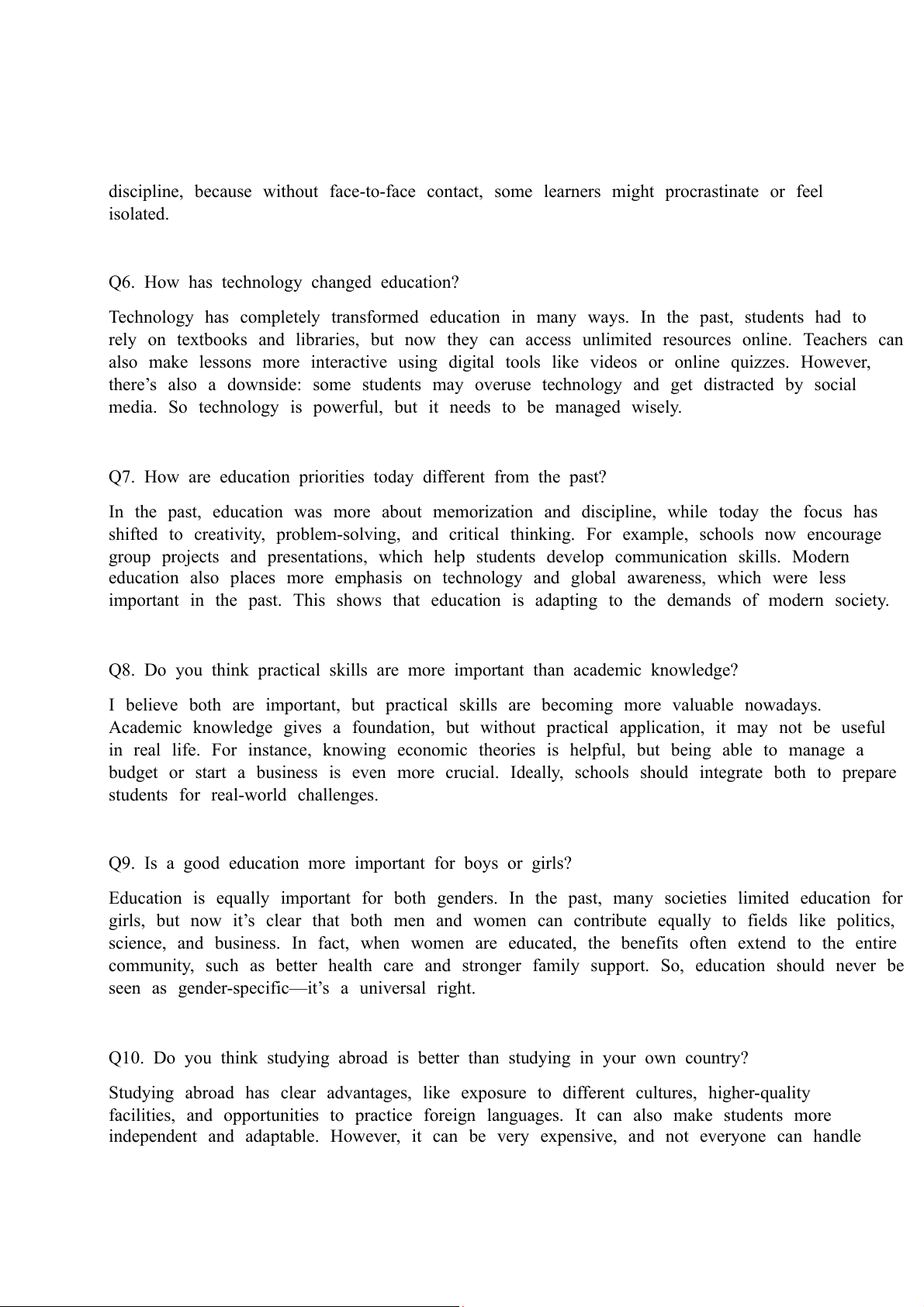
PART 3
Q1. Do you think single-sex schools are still relevant in today’s world?
Yes, I think single-sex schools are still relevant, but maybe not as common as before. Some
studies show that students in single-sex schools can focus better because there are fewer
distractions, especially during their teenage years. On the other hand, mixed schools prepare
students for real-life social situations where men and women need to work together. So I think
single-sex schools can be useful, but they should remain an option rather than the norm.
Q2. What are the benefits and drawbacks of boarding schools?
The biggest benefit of a boarding school is independence. Students live away from their families,
so they learn how to manage their daily routines and make decisions on their own. Boarding
schools also provide a wide range of extracurricular activities, which can help students discover
new talents. However, the drawback is that children may feel homesick or lack family support
when they need it. The balance between independence and emotional support is the real challenge.
Q3. Do you think exams are the best way to assess students’ abilities?
Not really. Exams mostly test how well students can memorize and perform under pressure, but
they don’t always reflect creativity or practical skills. For example, a student who is brilliant in
teamwork or problem-solving may still struggle with time-limited written exams. A better
approach might be a combination of exams, projects, and presentations, so students with
different strengths have a fair chance to show their abilities.
Q4. How do exams affect students’ mental health?
Exams can create a lot of stress and anxiety, especially in countries where academic performance
is linked to social status or career opportunities. Some students lose sleep or even develop health
problems due to exam pressure. On the positive side, exams can also teach resilience and time
management, but I believe schools should try to reduce unnecessary pressure by diversifying assessment methods.
Q5. What are the advantages of distance learning?
Distance learning is flexible and cost-effective. Students can study at their own pace and don’t
have to spend money on accommodation or transportation. This is especially helpful for people
who work full-time or live far from universities. On the other hand, it requires strong self-
discipline, because without face-to-face contact, some learners might procrastinate or feel isolated.
Q6. How has technology changed education?
Technology has completely transformed education in many ways. In the past, students had to
rely on textbooks and libraries, but now they can access unlimited resources online. Teachers can
also make lessons more interactive using digital tools like videos or online quizzes. However,
there’s also a downside: some students may overuse technology and get distracted by social
media. So technology is powerful, but it needs to be managed wisely.
Q7. How are education priorities today different from the past?
In the past, education was more about memorization and discipline, while today the focus has
shifted to creativity, problem-solving, and critical thinking. For example, schools now encourage
group projects and presentations, which help students develop communication skills. Modern
education also places more emphasis on technology and global awareness, which were less
important in the past. This shows that education is adapting to the demands of modern society.
Q8. Do you think practical skills are more important than academic knowledge?
I believe both are important, but practical skills are becoming more valuable nowadays.
Academic knowledge gives a foundation, but without practical application, it may not be useful
in real life. For instance, knowing economic theories is helpful, but being able to manage a
budget or start a business is even more crucial. Ideally, schools should integrate both to prepare
students for real-world challenges.
Q9. Is a good education more important for boys or girls?
Education is equally important for both genders. In the past, many societies limited education for
girls, but now it’s clear that both men and women can contribute equally to fields like politics,
science, and business. In fact, when women are educated, the benefits often extend to the entire
community, such as better health care and stronger family support. So, education should never be
seen as gender-specific—it’s a universal right.
Q10. Do you think studying abroad is better than studying in your own country?
Studying abroad has clear advantages, like exposure to different cultures, higher-quality
facilities, and opportunities to practice foreign languages. It can also make students more
independent and adaptable. However, it can be very expensive, and not everyone can handle
culture shock or homesickness. Personally, I think the best choice depends on the individual’s
goals and financial situation rather than a universal rule.
Tài liệu liên quan:
-
Sách 汉语听说教程 | Trường Đại học Hàng Hải Việt Nam
59 30 -
Classification - Polar Tourism Insights and Historical Context | Nhập môn Ngôn ngữ Anh | Đại học Hàng hải Việt Nam
45 23 -
Writing Unit 8: Self-Introduction and Personal Skills Overview | Nhập môn Ngôn ngữ Anh | Đại học Hàng hải Việt Nam
51 26 -

360 Động Từ Bất Quy Tắc | Nhập môn Ngôn ngữ Anh | Đại học Hàng hải Việt Nam
37 19