REVIEW 1: LANGUAGE - Giáo án Unit 1 -5 global success | Tiếng Anh 10
REVIEW 1: LANGUAGE - Giáo án Unit 1 -5 global success | Tiếng Anh 10. Tài liệu giúp bạn tham khảo, ôn tập và đạt kết quả cao. Mời đọc đón xem!
Chủ đề: Giáo án Tiếng Anh 10 53 tài liệu
Môn: Tiếng Anh 10 697 tài liệu
Tác giả:









Preview text:
Date of planning: 5/1/2026
Date of teaching: 14/1/2026
Period 53
REVIEW 1: LANGUAGE
Class: 10C
I. OBJECTIVES
By the end of the lesson, students are expected to achieve the following objectives:
1. Knowledge:
-Vocabulary: review the words and phrases related to the topics: For a better community, Inventions ( device, donate, volunteer, access, charity)
- Pronunciation: review how to pronounce correctly stress in two-syllable words with the same spelling andstress in three-syllable nouns
.- Grammar : review the use of the grammatical points ( past simple vs. the past continuous,present perfect, gerunds and to-infinitives.)
2. Competencies:
a. General competencies:
- Form and improve such competencies as: problem-solving skill, collaboration, pairwork, teamwork.
b. Specific competencies:
- Understand and use words and phrases related to the topics :For a better community, Inventions (Individual, pairs, group work)
- Pronounce correctly stress in two-syllable words with the same spelling andstress in three-syllable nouns ( individual, pair, group work)
- Understand and use the grammatical points to do the tasks (individual, pair, group work)
3. Qualities:
- Develop flexibility and creativity in learning.
- Be responsible for studying, using educational apps.
- Raise students’ knowledge aboutdiscoveries of inventions
II. PREPARATIONS
- Teacher: projector, laptop, posters, cards.
- Students: pencils, markers, blank papers
III. PROCEDURE
ACTIVITY 1: WARM-UP (6’) 1. Aim: - To create an active atmosphere in the class before the lesson; - To lead into the new unit 2. Content: - T asks students to find a word they have learnt in Unit 4,5 3. Products: - Ss answer the questions naturally. 4. Implementation: - Play the game | |
TEACHER AND STUDENTS’ ACTIVITIES | CONTENTS |
Step 1: Task delivering -T divides the class into 2 groups - Teacher lists out some key words of Unit 4 and Unit 5: generous, donate, community, application, invention, laptop, smartphone, experiment. - T calls a volunteer in each team to come to the front then whispers one of the words into his/her ears. - Ss have to draw or mime the word. The rest of the class makes guesses. - T checks if the answers are correct or incorrect and leads in the lesson. Step 2: Task performance - Ss work in groups to guess the answer Step 3: Report and discussion - The first student who correctly calls out the word gets a point. Step 4: Judgement - The team has more correct answers is the winner T leads in the lesson. | GAME: Miming game generous, donate, community, application, invention, laptop, smartphone, experiment. |
ACTIVITY 2:PRACTICE | |
*PRONUNCIATION( 8’) Listen and write the words in the correct columns. Then practise saying the words. 1. Aim: - To check if students can identify the correct stress placement and provide further pronunciation practice. - To further practise putting stress on three-syllable words 2. Content: Ss listen to the tape and practice saying the words. 3. Products:Ss pronounce the words with stress on the first syllable correctly 4. Implementation: | |
TEACHER AND STUDENTS’ ACTIVITIES | CONTENTS |
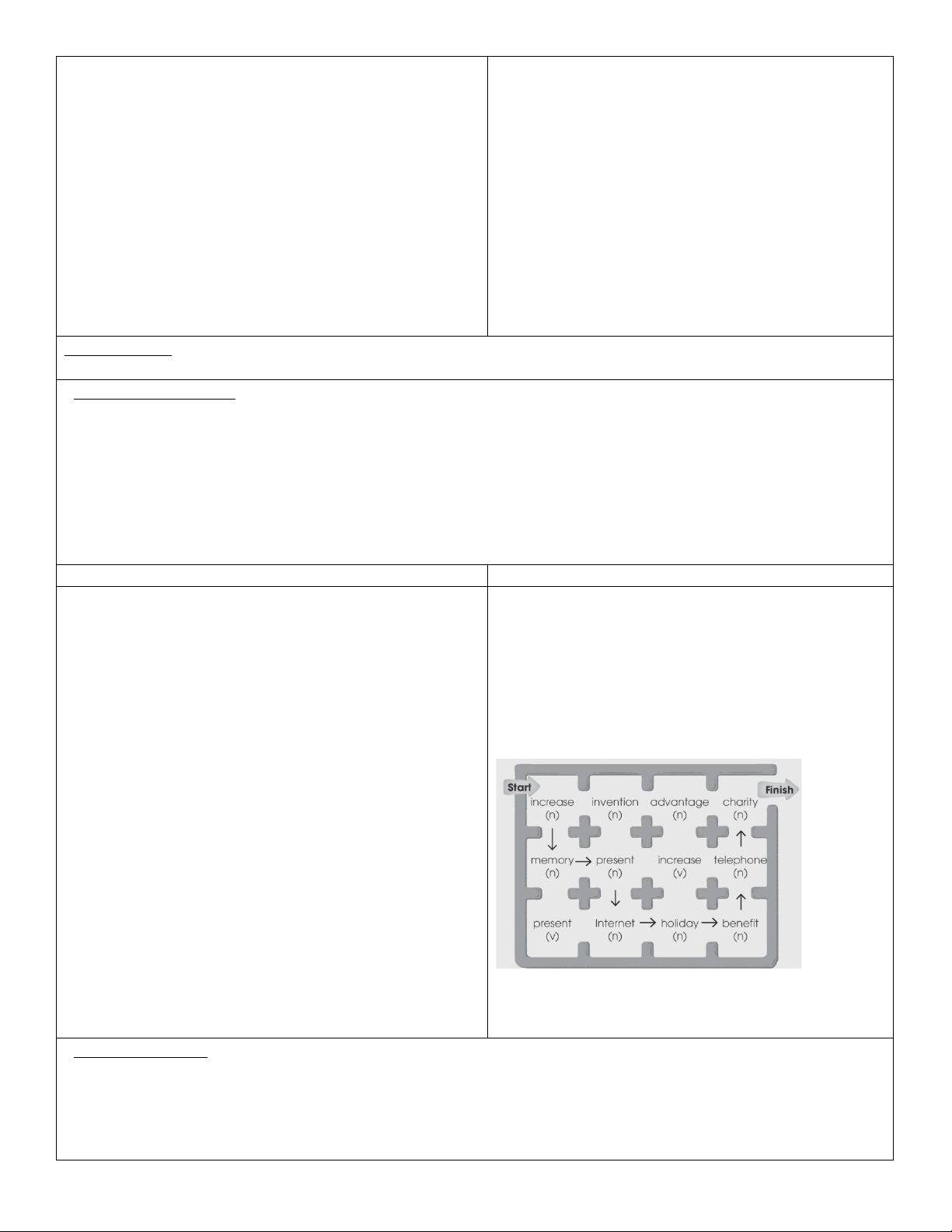
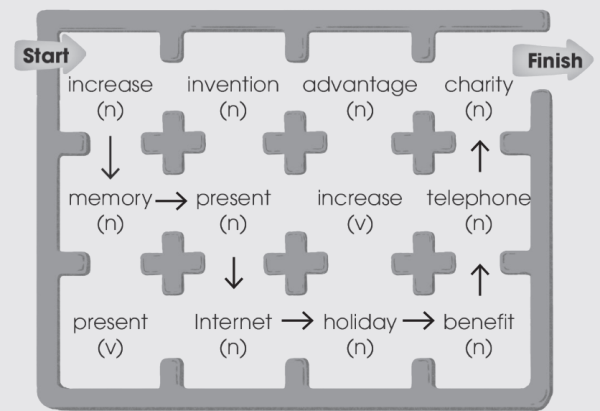
Step 1: Task delivering - TASK 1. ESCAPE THE MAZE (p.62) Escape the maze by connecting all words with the stress on the first syllable. Follow the examples and then listen to check your answers. Practise saying the words. - T explains the activity. - Ss try to escape the maze by connecting all words with the stress on the first syllable. T tells them to study the examples. Step 2: Task performance - Ss work in pairs. - Ss connect the words then listen to check the answers Step 3: Report and discussion T asks them to say these words aloud (increase, memory) with stress on the first syllable. Step 4: Judgement - T gives feedback and discusses with the class. T plays the audio file for students to listen and repeat. Key: | PRONUNCIATION TASK 1. ESCAPE THE MAZE (p.62) Escape the maze by connecting all words with the stress on the first syllable. Follow the examples and then listen to check your answers. Practise saying the words.
|
*VOCABULARY (13’) Task 1: Find the missing letter What are the missing letters? Complete the sentences using the pictures to help you. 1. Aim:To check if students can use words and phrases related to volunteering and inventions 2. Content: Ss look at the pictures and complete the words 3. Products:Ss complete sentences. 4. Implementation: | |
TEACHER AND STUDENTS’ ACTIVITIES | CONTENTS |
Step 1: Task delivering. - T explains the activity. T demonstrates with the example by asking Ss to guess what the picture shows and elicits the answer from the Ss. -T reminds them that these are the words they learnt in Unit 4 and 5. Step 2: Task performance - Ss work out the missing letters of the item by using the pictures. Step 3: Report and discussion - Ss share the answers with their partner - T calls some ss to give their answers - Ss read the sentences aloud Step 4: Judgement - T checks the answers as a class and gives feedback. | VOCABULARY Task 1. Find the missing letter What are the missing letters? Complete the sentences using the pictures to help you. Key: 1. devices, communicate 2. donate, volunteer |
Task 2. Complete the sentences using these words. There are some extra ones 1. Aim: To check if students recognize the differences between -ing and -ed, -ful and -less adjectives 2. Content: T asks Ss to complete sentences using the words from the box. 3. Products: Ss complete and practice sentences. 4. Implementation: | |
TEACHER AND STUDENTS’ ACTIVITIES | CONTENTS |
Step 1: Task delivering. - T quickly reviews the differences between -ing and -ed, -ful and -less adjectives. - T asks Ss work individually to fill in the gaps with words from the box and reminds them that there are some extra words that they might not need. Step 2: Task performance - Students work individually to complete the task. Step 3: Report and discussion - T calls some ss to say their answers aloud And give their explanations Step 4: Judgement - T checks the answers as a class. | VOCABULARY Task 2: Complete the sentences using these words. There are some extra ones Key: 1. interesting / useful, careful 2. useless, interested |
*GRAMMAR (10’) Task 1: Read the text and circle the correct answers (p.63) 1. Aim: To help Ss review the use of the past simple, past continuous, present perfect, gerunds, and to-infinitives. 2. Content: Ss read the text about discoveries of some inventions and circle the correct answers 3. Products: Ss understand and use of the past simple, past continuous, present perfect, gerunds, and to-infinitives. | |
TEACHER AND STUDENTS’ ACTIVITIES | CONTENTS |
Step 1: Task delivering. * T explains the context of the text. - T tells Ss that new ideas are usually the result of careful planning and analysis, but sometimes there are accidents which lead to useful inventions. - T asks them to look at the pictures and guess what these inventions are. - T reminds students to use the correct forms of the verbs as requested in each sentence then allows them to share answers before discussing as a class. -T can ask students to read aloud the full sentences and correct their pronunciation if needed. Step 2: Task performance - Ss read the passage and choose the correct answers as they read. - Ss exchange the answers with their partner. Step 3: Report and discussion - Ss share the answers with their partner - T calls some ss to read out their answers and explain - Ss read the ansers aloud Step 4: Judgement - T confirms the correct answers. | GRAMMAR Task 1: Read the text and circle the correct answers (p.63) Key: 1. find 2. Discovering 3. was sitting 4. fell 5. was cleaning 6. discovered 7. have used 8. to make 9. making |
Task 2: Complete the sentences. Make sure they mean the same as the sentences above them. 1. Aim: To help Ss review the use of passive voice 2. Content: Ss work individually toComplete the sentences 3. Products: Ss understand and use The passive voice. 4. Implementation: | |
TEACHER AND STUDENTS’ ACTIVITIES | CONTENTS |
Step 1: Task delivering. - T asks students to read the sentences first. - T reminds students to pay attention to the passive and active forms of the sentences then allows them to share answers before discussing as a class. -T can ask students to read aloud the full sentences and correct their pronunciation if needed. Step 2: Task performance - Ss do the task individually. Step 3: Report and discussion - Ss share the answers with their partner - T calls some ss to write their answers on the board - Ss read the sentences aloud Step 4: Judgement - T gives feedbacks. | Task 2: Complete the sentences. Make sure they mean the same as the sentences above them. 1. The rubbish in the neighbourhood is collected three times a week. 2. All the electrical devices in the house were turned off. 3. His music videos will be watched online (by millions of people). |
Task 3: Match the two parts to make complete sentences. 1. Aim: To help Ss review the use of compound sentences 2. Content: Ss work individually to Match the two parts to make complete sentences 3. Products: Ss understand and use thecompound sentences 4. Implementation: | |
TEACHER AND STUDENTS’ ACTIVITIES | CONTENTS |
Step 1: Task delivering. -T asks students to read the two halves given of the sentence. -T reminds students to pay attention to the coordinating conjunctions (and, or, but, so) then allows them to share answers before discussing as a class. -T can ask students to read aloud the full sentences and correct their pronunciation if needed. Step 2: Task performance - Ss do the task individually. Step 3: Report and discussion - Ss share the answers with their partner - T calls some ss to write their answers on the board - Ss read the sentences aloud Step 4: Judgement - T checks as a class. | Task 3: Match the two parts to make complete sentences. 1. b 2. c 3. d 4. a |
ACTIVITY 3: APPLICATION (6’) : RECALL THE INFORMATION Talk aboutan inventionfrom the text and pretend you are the person who has invented or discovered the thing. 1. Aim: to help ss be aware of the importance of doing housework ,and they apply the present simple to talk about daily activities. 2. Content: Ss work in group to do activity 3. Products: Ss further practise speaking about inventions 4. Implementation: | |
TEACHER AND STUDENTS’ ACTIVITIES | CONTENTS |
Step 1: Task delivering - T divides the class into groups of four. - T has each student in the groups choose a different invention from the text and pretend he/she is the person who has invented or discovered the thing. - Each student should try to explain how they did it using the information from the text. Step 2: Task performance -Each student try to explain how they did it using the information from the text. - Ss work in group to do the task. Step 3: Report and discussion Ss work in groups and then report to the whole class - T calls the representative of each group to talk about an invention Step 4: Judgement - T gives Ss feedback. | RECALL THE INFORMATION Talk about an invention from the text E.g. I’m Isaac Newton and I discovered the law of gravity. I was sitting under the apple tree when an apple fell on my head. I realized that something made apples fall straight to the ground. That’s how I discovered gravity. |
WRAPPING – UP & HOME ASSIGNMENT (2’) Aim: - Tohelp students memorise the target language and skills that they have learned - To help ss revise the knowledge they have learnt in the class WRAPPING – UP Teacher asks students to talk about what they have learnt in the lesson. - Review on how to pronounce stress on three-syllable words, grammar points (past simple, past continuous, present perfect, gerunds, and to-infinitives, the use of passive voice, the compound sentences) and vocabulary of Unit 1, 2, and 3, 4, 5. HOME ASSIGNMENT - Do exercise in workbooks: Test yourself 2 (page 40-41) | |
FEED-BACK: - Some comments on students’ typical mistakes | |
Date of planning: 6/1/2026
Date of teaching: 14/1/2026
Period 54
REVIEW 1: SKILLS
Class: 10C
I. OBJECTIVES
By the end of the lesson, students are expected to achieve the following objectives:
1. Knowledge:
- practice listening for general and specific information about invention;
- practice talking about favorite invention.
- practice reading for general and specific information about volunteering;
- practice writing a short paragraph about how to apply for a volunteer job.
2. Competencies:
a. General competencies:
- Form and improve such competencies as: collaboration, communication, presentation, critical thinking
b. Specific competencies:
- Improve reading, listening, and speaking skills
- Actively join in class activities.
3. Qualities:
- Have a positive attitude towards music and singers.
II. PREPARATIONS
- Teacher: handouts, projector, laptop, posters, pictures, handouts.
- Students: pencils, pictures, blank papers.
III. PROCEDURE
ACTIVITY 1: WARM-UP (3’) 1. Aim: - To lead in the lesson. 2. Content: - T asks ss guess the word relating the topic : Inventions. 3. Products: - Ss answers the questions naturally. 4. Implementation: | ||
TEACHER AND STUDENTS’ ACTIVITIES | CONTENTS | |
Step 1: Task delivering GAME: HANGMAN - T writes 9 blank letters on the board. _ _ _ _ _ _ _ _ _ - Ss guess the letters in turn. -The class plays the game together. The first student to get the correct answer is the winner. Step 2: Task performance - T calls some students to guess the letters -Ss guess the letters in turn. Step 3: Report and discussion --The class plays the game together. - The first student to get the correct answer is the winner. Step 4: Judgement - T checks if the answers are correct or incorrect and leads in the lesson. | Game: HANGMAN _ _ _ _ _ _ _ _ _ Key: SMART HOME | |
ACTIVITY 2: PRACTICE | ||
*LISTENING (10’) Task 1: Listen and choose the best title for the talk. 1. Aim: To help Ss practise listening for gist. 2. Content: T asks Ss to listen to the talk and choose the best title. 3. Products: Ss give the best title. 4. Implementation: | ||
TEACHER AND STUDENTS’ ACTIVITIES | CONTENTS | |
Step 1: Task delivering : - T has Ss read three options for the title of the talk. - T plays the recording once for Ss to listen and choose the best answer. Step 2: Task performance - Ss look at three options, read and underline key words. - Ss work individually. - Ss exchange the answers with their partner. Step 3: Report and discussion - Ss give the answers and explanation. Step 4: Judgement - T confirms the answers as a class. | LISTENING Task 1: Listen and choose the best title for the talk. Answer: A | |
Task 2: Listening again and fill in each gap with ONE word. 1. Aim: To help Ss practise listening for specific information 2. Content: Ss listen to the talk and fill in each blank with one word 3. Products: complete the sentences 4. Implementation: | ||
TEACHER AND STUDENTS’ ACTIVITIES | CONTENTS | |
Step 1: Task delivering - T asks Ss to read through the sentences - T asks Ss to listen again. This time they are filling in notes, using one word for each blank. - Before having Ss do the task, T reviews the techniques for this type of exercise, e.g. skimming through the note, predicting parts of speech and answers based on context clues. - T gives Ss some time to skim through the note and try to work out the answers before they listen. Step 2: Task performance - Ss listen and do the task individually and then compare their answer with the friend’s. Step 3:Report and discussion - T calls on some Ss to report their answers for the class. Step 4: Judgment - T gives feedback and discusses with the class. | Task 2: Listening again and fill in each gap with ONE word. Keys: 1. voice 2. Lights 3. alarm 4. devices | |
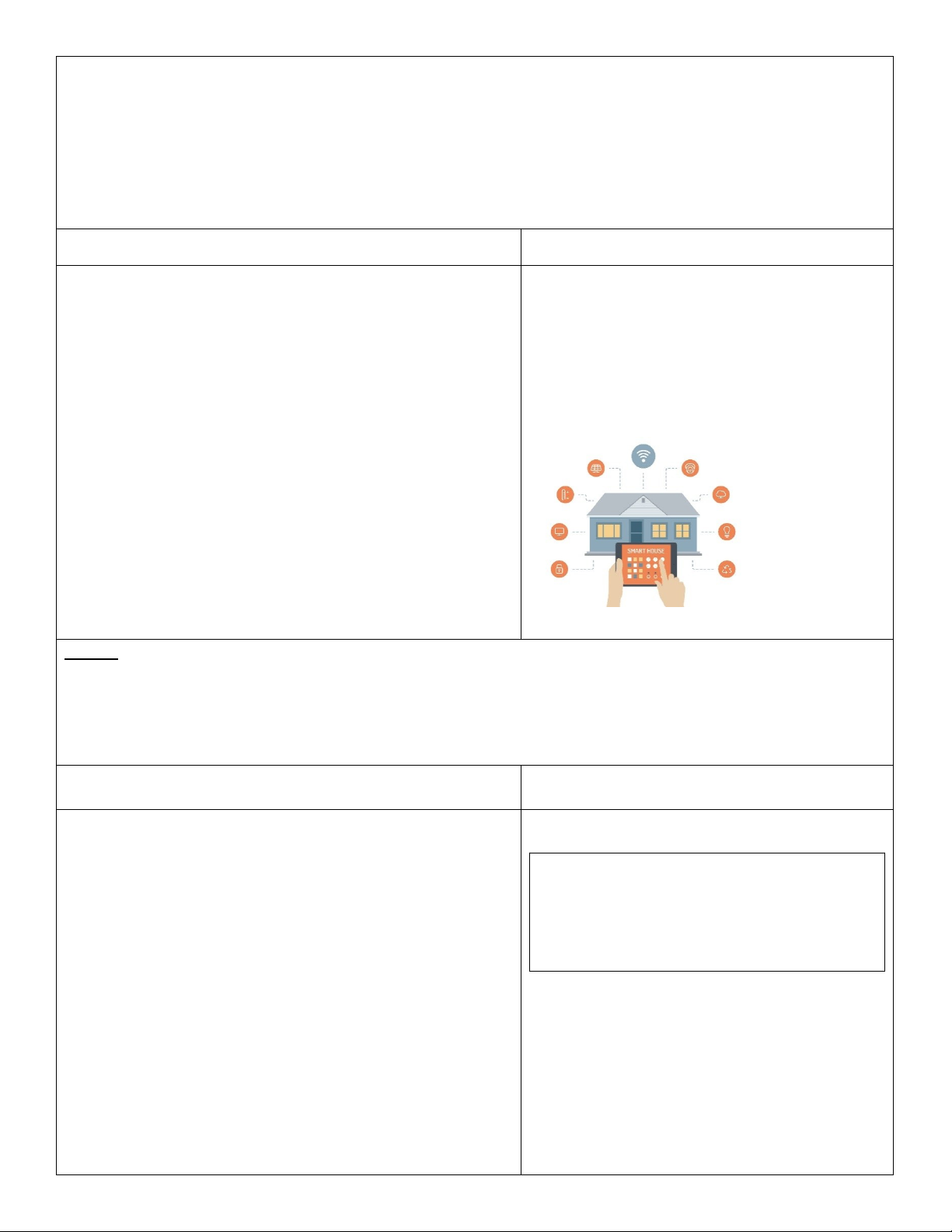
**SPEAKING.( 10’) Work in groups. What other features should a smart home have? How will they help us? Use the expressions you learnt in unit 5 to help you. (p. 64) Task 1: Brainstorming and mind mapping 1. Aim: To help Ss practise discussing and planning about smart homes 2. Content: T asks Ss to brainstorm and make a mind map about features of smart homes 3. Products: Ss give a mind map about the features a smart home should have. 4. Implementation: | ||
TEACHER AND STUDENTS’ ACTIVITIES | CONTENTS | |
Step 1: Task delivering : - T tells Ss that now they will be talking about smart homes and suggesting new features. - T gives each group a piece of A0 paper. -T asks Ss to read through the expressions in the box. -T calls on some Ss to report their answers for the class. Step 2: Task performance Ss work in groups, try to brainstorm and make a mind map on the paper given. Ss can draw and colour the mind map. Step 3:Report and discussion - T walks round the class and gives support if necessary. - T asks them to stick their papers on the board and read their answers aloud. Step 4: Judgment -T checks the answers and adds more information if necessary | SPEAKING Work in groups. What other features should a smart home have? How will they help us? Use the expressions you learnt in unit 5 to help you. (p. 64) Task 1: Brainstorming and mind mapping
| |
Task 2: Presentation. 1. Aim: To help Ss practise discussing and planning about smart homes 2. Content: T asks Ss to talk about smart home. 3. Products: Ss give the features a smart home should have. 4. Implementation: | ||
TEACHER AND STUDENTS’ ACTIVITIES | CONTENTS | |
Step 1: Task delivering
Step 2: Task performance
Step 3: Report and discussion
Step 4: Judgement
| Task 2: Presentation
Example: I think a smart home should have a smart heating system that is controlled from a mobile phone. This will allow us to save energy and money | |
***READING( 10’) Task 1: Read the text below. Match the highlighted words with their meanings 1. Aim: To practice understanding words from context. 2. Content: T asks Ss to match the highlighted words with their meanings. 3. Products: Ss complete the matching 4. Implementation: | ||
TEACHER AND STUDENTS’ ACTIVITIES | CONTENTS | |
Step 1: Task delivering : - T explains the context of the text. - T writes down the words ‘community service’ and ‘volunteering’ on the board. - T asks if Ss know the difference between them and tells them that they will find the answer in the reading text. Step 2: Task performance - Ss complete the matching exercise by focusing on the highlighted words in the text. Step 3:Report and discussion - Ss present their talk in front of the class. - T praises for interesting ideas and fluent delivery. Step 4: Judgment - T checks the answers and adds more information if necessary. *** Ss check the answers as a class. **** T gives feedback and discusses with the class and elicits the difference between ‘community service’ and ‘volunteering’, e.g. Community service can be either voluntary or compulsory, so volunteering is just one type of community service. | READING Read the text below. Match the highlighted words with their meanings Key: 1. c 2. b 3. a | |
Task 2: Read the text again and choose the best answers. 1. Aim: To help Ss practise reading for main ideas and specific information. 2. Content: Ss read the text and choose the best answers 3. Products: Ss do the task individually and give their answers. 4. Implementation: | ||
TEACHER AND STUDENTS’ ACTIVITIES | CONTENTS | |
Step 1: Task delivering. - T asks Ss to read through the questions and check understanding of the vocabulary. -T calls on some Ss to report their answers for the class Step 2: Task performance -Ss read the text again and look for the answers to the questions. Step 3: Report and discussion - Ss to report their answers for the class. Step 4: Judgement -T checks the answers and adds more information if necessary | READING Task 2: Read the text again and choose the best answers. Keys: 1. B 2. C (Clue: For example, they may volunteer to meet new people, to develop social skills, or to ‘find themselves’ (learn what they truly want in life) 3. A (Clue: In general, people may volunteer not just to have others, but to help themselves) | |
****WRITING ( 10’) Complete this application letter for a volunteer job by writing a short paragraph. You may use the ideas below to help you. (p.65) Task 1. Brainstorm ( GW) 1. Aim: To help studentsto brainstorm ideas before writing a job application letter 2. Content: - Sswork in group and think about skills and qualities for job application. 3. Products: Ss’ideas about skills and qualities for job application. 4. Implementation: | ||
TEACHER AND STUDENTS’ ACTIVITIES | CONTENTS | |
Step 1: Task delivering - T asks Ss to work in groups and brainstorm ideas to answer the question: Which skills and qualities are needed to be a volunteer for an organization collecting books for children?. Step 2: Task performance -Ss read through the ideas in the box, work in groups and brainstorm more ideas and write them on the board. - Ss can use the ideas in students’ book page 65. Step 3: Report and discussion - T asks Ss to share their ideas - T calls some ss to write their ideas on the board - Ss contribute to the discussion and note down the important points in their notebooks Step 4: Judgement - T checks and gives Ss feedback | WRITING Complete this application letter for a volunteer job by writing a short paragraph. You may use the ideas below to help you. (p.65) Task 1. Brainstorm Which skills and qualities are needed to be a volunteer for an organization collecting books for children?. Suggested ideas: - Fond of reading - Love helping others - Love meeting new people - Good interpersonal skills - Be enthusiastic and helpful - Develop social skills | |
Task 2.Complete the application letter 1. Aim: To help students practice writing a job application letter 2. Content: - Ss complete a job application letter. 3. Products: Ss write a paragraph. 4. Implementation: | ||
TEACHER AND STUDENTS’ ACTIVITIES | CONTENTS | |
Task 2: Complete the application letter. Step 1: Task delivering T explains the task: Ss must finish an application letter for a volunteer job. Specifically, they need to write the reasons why they are interested in the job. They should write 50 - 70 words. -T draws their attention to the suggested ideas and tells Ss they can incorporate them in their letters. Step 2: Task performance - Ss complete the task individually and write an application letter (50-70 words) Step 3: Report and discussion - Ss complete the application letter - T gives Ss enough time to write their letters.
Step 4: Judgement - T collects some or all Ss’ writings to give written feedback. - T gives the sample paragraph. | Task 2. Complete the application letter Sample answer: I am very interested in the job because I am very fond of reading and I can sort books very well. I also love helping others and meeting new people, especially children. In fact, reading books to children is my favourite hobby. I am also interested in this job because it will help me to develop my social skills, such as communication and teamwork skills. | |
WRAPPING – UP & HOME ASSIGNMENT (2’) Aim:- Tohelp students memorise the target language and skills that they have learned - To help ss revise the knowledge they have learnt in the class WRAPPING – UP T asks Ss: What have you learnt today? What can you do now? T summarizes the main points of the lesson HOME ASSIGNMENT - Do exercise in the workbook: Test yourself 2: part III –Reading(p42) part V – writing (p44) part IV- speaking (p43) | ||
FEED-BACK: - Some comments on students’ typical mistakes | ||