Practice Tests
Andrew Betsis
Lawrence Mamas
Globai
ELT
English
language
Teaching
Bo
oks

Succeed
in
Cambridge English: Advanced - I 0 Practice Tests
Advanced
20
IS Revised Format
Paper Time
Tasl<
Types Test Focus
Paper I
Reading &
Use
of
English
Paper
2
Writing
Paper 4
Listening
Paper 5
Speaking
• I
hour
30
min
Part I
-multiple-choice
cloze (eight
gaps
)
• 34 questions Part
2-
open cloze (eight gaps)
• length
of
texts: Part 3
-word
formation
(eight gaps)
aboutSS0-850
per
part
•
word
count
3,
000
- 3,500
Part 4 - key
wo
rd transformations
(six questions)
Part 5 -
text
followed
by six
4-option
mult
iple-choice questions
Part 6 -
four
short
texts
,
followed
by
four
cross-text multiple-matching
questions
Part 7 - gapped
te
xt task - paragraphs
removed
Part 8 -
multiple
matching - a
text
or
several
short
texts, preceded by
I 0
multiple
-matching questions
Part I -
compulsory
task: essay w i
th
a
discursive focus
(220-260
words
)
• I
hour
30 min Part 2 - Q .2-4 choice
of
one task
from
the
following
:
•
2 parts •
letter
•
Approximately
40
minutes
• 30 questions
• IS minutes
(for
pairs)
• 4 parts
• proposal
•
report
•
review
(220-260
words
)
Part I -
multiple
choice;
three
short
unrelated extracts; exchanges
between
interacting speakers;
two
questions
per
text
Part 2 - sentence
completion
task
with
eight items; a
monologue
(could be
introduced
by a
presenter
)
Part 3 - 6
mult
iple choice questions;
a conversation
between
interacting
speakers
Part 4 -
multiple
matching task - five
short
themed
monologues.
Two
linked
tasks, requiring selection
from
list
of
eight options - I 0 multiple-matching
questions. All
texts
will
be heard
twice
.
Part I - conversation between the
interlocutor and each candidate
(spoken questions)
Part 2 - individual
one-minute
'long
turn'
for
each candidate
with
bri
ef
response
from
second candidate; each
candidate
is
given
three
visual stimuli,
with
questions
Part 3 -
two-way
conversation betw een
the
candidates (
written
stimuli w ith
spoken instructions)
Part 4 - discussion on
top
ics related to
Part 3
(s
poken questio
ns
)
Part I - lexical/lexico-grammati
ca
l,
vocabulary, collocations, fixed phrases,
idioms etc.
Part 2 - grammatical/lexico-grammatical,
grammar
with
some focus on vocabulary
Part 3 - lexical/lexico-grammati
cal
,
focus on vocabulary, compounding
Part 4 - grammatical/lexico-grammatical,
grammar, vocabulary & collocations
Part 5 - detail, opinion,
tone
, purpose,
main idea, implication,
attitude
,
text
organisati
on
features (exemplification,
comparison, reference)
Part 6 - Understanding
of
opinion and
attitude
; comparing and contrasting
of
opinions and attitudes across
texts
.
Part 7 -
text
structure, cohesion and
coherence
Part 8 - Detail, opinion,
att
i
tude
,
specific
information
.
Part I - focus
on
evaluating, expressing
opinions, hypothesising, persuading
Part 2 - varying focuses according
to
task; including giving opinions,
persuading, justifying, giving advice,
comparing
Part I - feeling, attitude, opinion,
purpose, function, agreement, cour
se
of
action, general gist, detail,
etc
.
Part 2 - specific
information
, stated
opinion
Part 3 - attitude and opini
on
Part 4 - gist,
attitude
, main
po
int
s,
interpret
ing
conte
xt
Part I - general i
era
o
soci
al
langu
age
Part 2 - organ· ·
greei
ng

Succeed
in
Cambridge
English:
Advanced
- I 0
Practice
Tests
Contents
CONTENTS
SPEAKING
SECTION
Page
4
CAMBRIDGE
ENGLISH:
ADVANCED
Page
33
EXAM
GUIDE
PRACTICE
TEST
1
Page
49
PRACTICE
TEST
2
Page
64
PRACT
I
CE
TEST
3
Page
78
PRACT
I
CE
TEST
4
Page
92
PRACTICE
TEST
5
Page
106
PRACTICE
TEST
6
Page
120
PRACTICE
TEST
7
Page
134
PRACTICE
TEST
8
~-T
~--~~-
:!
'~!.L_I
,··-
Page 148
PRACTICE
TEST
9
PRACTICE
T
EST
1 0
Published
by
GLOBAL
ELT
LTD
Brighton
,
Ea
st Sussex,
UK
www.globalelt.
co. uk
Copyright
© G
LOBAL
ELT LTD, 201 4
Page
162
Page
176
A
ll
rights reserved. No
part
of
this publication may
be
r
eproduced
, stored
in
a retrieval system,
or
transmitted
in
any form
or
by
any means, electronic,
mechanical, photocopying, record
in
g
or
ot
herwise, with
out
the prior permission
in
writing
of
the Publisher. Any
per
son who does any unauthorised act
in
rel
at
ion to th is publication may be liable to criminal prosecution and civil claims for damages.
• Succeed
in
Cambridge English: Advance
d-
2015 Forma
t-
10 Practice
Te
sts -
Student
's Bo
ok-
ISBN: 9781781641521
• Succeed
in
Cambridge English:
Advanced-
2015 Forma
t-
10 Practice Tests - Teacher·s
Book-
ISBN:
97817
81641538
Every effort has been made
to
trace
the
copyright holders a
nd
we
apologize in advance for any unintentional omission.
We w
ill
be happy
to
insert the appropriate acknowl
edgeme
nts in any subsequent editions.
The authors
and
publishers wish
to
acknowledge the following
use
of
material:
Salla
,
P.
, 'Recognizing Stress' © buzzle.com.
Lam,
S.,
'A
feast of urban festivals' ©
Th
e
Ind
ependent
UK
(
May
20th, 2004
).
Wroe. N., 'The Power of
Now'
© Guardian News and Media limited
(October
14th. 2006
).
Nunall,
P.,
'Smoking: the office
partition'
© iVillage Limited 2000-2010, ivillage.co.uk.
Davi
s.
H
..
'Up, up
and
away' © Guardian
News
and
Media
Li
mited (
October
14th. 2006).
Harrison. M .. 'The A380 superjumbo: Europe's
white
elephant' © The Independent
UK
(Nov
22nd
2006).
Vi hear.
P..
' I 0 Journeys
for
the 21st
Century
' © Wanderlust 20 I 0 (
Dec
2006).
Chesshyre,
T.
, 'Italy's Secret Getaway' © Times Newspapers Limited (
Nov
24th 2006).
Morr
is, N
.,
" Supernannies' will
try
to
improve behavi
our
of
out-of-control
children' © The Independent
UK
(Nov 22nd, 2006)
Pickrell. J
..
'Introduction: Endangered Species' ©
Reed
Business Information Ltd. (September 4th, 2006)
Pickard,
P.
, 'Victoria's
Sec
r
et
' © Wanderlust 20
10
(D
ec
2006).
Hunt-Grubbe
, C.,
'A
Life in the Day:
Rachel
Hogan' © Times Newspapers Limited (
November
19th,
2006
).
Milmo, C., '
World
faces
hottest year ever,
as
El
Niflo
combines
with
global warming' © The
Independent
UK
Qanuary
I"·
2007)
Extract
from
Girl
from the South by Joanna Trollope. Copyright ©
Joanna
Trollope, reprinted
with
per-
mission
of
Rbooks
from
the Random House B
ook
Group.
Dawson,
T.
, 'Bread and Tulips'© bbc.co.uk (September 13th, 2005).
Davies, C., "Teenage girls
'too
embarrassed'
to
keep fit" © Telegraph Media
Group
Limited
(
October
7th, 2004).
Author
Unknown
. "
Teens
'inherit' Weight Worries", © Associated Newspapers Limited
Harding, L
.,
'Mob
i
les
; exeunt after
St
Petersburg theatre installs jammers' © Guardian
Ne
ws
and
Media
Limited (March
6th
2007).
Tremlett, G .. 'Spanish cars
to
use
different type
of
juice' © Guardian
News
and
Media
Li
mited
(March
6th
2007).
Scheiber, D
.,
'Robots
to
the
Rescue
' ©
St.
Petersburg Times (March 2nd. 2003)
Crace, J., Screen
Writing
' © Guardian
News
and Media Limited (March 6th, 2007)
Kennedy, D., 'jets that could fly
to
Australia
in
two
hours' © Times Newspapers Limited
(March 29th, 2004)
Giles,
T.
, 'The future at y
our
fingertips' © Telegraph Media group Limited (February 24th, 2007)
Extract
from
Death in Malta by Rosanne Dingli. Copyright ©
Rosanne
Dingli,
reprinted
wi
th
perm
i
ss
i
on
of
BeWrite Books
Rowan. D. , '
Par
king Hell:
The
parking industry investigated' © Times Newspapers
limited
(Februa
ry
11th, 2006).
Papam
ichael, S
.,
Pr
ide
and
Prejudice
DVD
© bbc.co.uk
Papamichael, S
.,
Mr
Bean
's Holiday
DVD
© bbc.co.uk
Papamichael,
S
.,
Fast
Food Nation
DVD
© bbc.co.uk
Papam
ichael. S., Shooter
DVD
© bbc.co.uk
Papamichael,
S
..
The Namesake DVD © bbc.co.uk
Papamichael.
S.,
Amazing Grace
DVD
© bbc.co.uk
Extract from
Chasm
City
by Alastair Reynolds. Copyright Alastair R
ey
nol
ds.
reprinted
with
permission
of
Victor
Gollancz Ltd.
Lemonick, M
.,
'
What
makes
us
different', © Time I
nc
. (
October
1
st
. 2006).

CAE Practice Test I
Pa
per 5 - Speaking
Paper
5:
SPEAKING
Time: IS minutes
per
pair
of
candidates
Candidates take
the
Speaking
test
in pa
ir
s (occasionally,
where
there
is
an
uneven
numbe
r of candidates,
thr
ee students
may be
required
to
take
the
test
together
).
There
are
two
examiners (
an
assessor and
an
inter
loc
utor
)
an
d one
of
them
(
the
assessor) does
not
take
part
in
the
interaction
but
assesses
your
performance
according
to
four analyti
cal
scales.
The
other
examiner
(
the
interlocutor
) conducts
the
test
and tells
you
what
you have
to
do
.
The
inte
rlo
cuto
r also gives
you
a global
mark
for
your
performance
in
the
test
as
a
whole
.
Part
1 2 minutes (5 minutes
for
groups
of
three)
In
Part I
of
the
Speaking
test
,
you
may be asked
to
talk
about
your
inte
rests, gener
al
experiences, studies
or
career, and
plans
fo
r
the
future
.
The
examiner
will
first ask
you
for
some general
information
about
yourself
, and
then
widen
the
scope
of
the
conversation
to
include subjects like leisure activities, studies,
tr
avel, holiday experiences and daily life. Respond
directly
to
the
examiner
's questions, avoid
very
short
answers, and listen
when
your
partner
is
speaking. You a
re
not
required
to
interact
with
your
partner
in
this
part
,
but
you
may
do
so
if
you
wish.
Interlocutor:
Good
morning/afternoon/evening
.
My
name
is
...
.....
... and this
is
my
colleague ..... .... .
And
your
names are? Can I have
your
mark
sheets, please?
Thank
you.
First
of
a
ll
,
we'd
like
to
know
something
about
you.
Select one
or
two
questions and ask candidates
in
turn,
as
appropri
a
te
.
•
Where
a
re
you
from?
•
What
do
you
do?
•
How
long have
you
been studying English?
•
Wh
at
do
you
enjoy
most
about
learning English?
Select
one
or
more
questions
from
any
of
the
following
categories,
as
appropr
iate.
Family and Friends
•
How
important
do
you
think
family
is
?
...
(Why
?)
•
How
much
time
do
you
spend
with
your family and
wh
at
do
you
enjoy
doing
with
them?
•
What
qualities does a close friend need
to
possess?
e
With
whom
would
you
discuss a difficult personal situation, a family
member
or
a close friend?
...
(Why?)
Art
•
What
would
you
say
your
relationship
with
the
arts
is?
e
Which
kind
of
art
are
you
most
interested
in?
... (Why?)
•
When
w as
the
last
time
you
visited a museum, ga
llery
or
an
exhibition?
What
we
re
your
impressions on this vi
sit?
•
Who
is
your
favourite artist?
...
(Why?)
Travel
•
Who
do
you
prefer
to
travel with? ...
(Why
?)
•
Are
you
more
fond
of
long
or
short
distance travel?
•
What
has
been
your
most
exciting travel experience thus fa
r?
e
Name
some things
that
you
would
never leave behind
you
when
you
travel.
Sports
•
Do
you
prefer
team
sports
or
individual sports?
•
What
qualities
do
you
need
to
possess in
order
to
do
well
in
a
team
sport?
e
What
do
you
think
about
extreme
sports?
e
What
are
the
most
popular
sports in
your
country?
Celebrities
•
Wh
at a
re
some
of
the
advantages and disadvantages
of
being famous?
•
Who
is
your
favourite celebrity? .. . (Why?)
•
What
would
you
be
willing
to
sacrifice in
orde
r
to
be famous?
e
Why
do
you
think
more
and
more
young people
nowad
a
ys
long
for
fa
me
and m one

CAE Practice Test I Paper
5-
Speal<ing
Part 2 -
long
turn 4 minutes (6
minutes
for
groups
of
three)
In
this part
of
the
test you each have
to
speak
for
I
minute
without
inter
ruption.
The
examiner
will
give you a set
of
pictures and
ask you
to
talk
about
them
.
You
may be asked
to
describe, compare
or
contrast
the
pictur
es,
and
to
make a
further
comment
on
them
. Your
partner
will
get
a
different
set
of
pictures,
but
you
should pay
attention
during
your
partner
's
turn
because
the
ex
aminer
will
ask
you
to
comment
for
about
30 seconds
after
your
partner
has
finished speaking.
1 : Isolated places
Interlocutor:
In this
part
of
the
test
, I' m going
to
give each
of
you
three
pictures
. I'd like
you
to
ta
lk
about
two
of
them
on
y
our
own
for
about
a
minute,
and also
to
answer
a
question
briefly
about
your
partner's pi
ctures
.
(
Candidate
A)
,
it
's
your
turn
first.
Here
are your pictures.
They
show
people in isolated places.
Lo
ok at page 6,
Part
2,
Task
I.
I'd like you
to
compare
two
of
the
pictures
, and
say
how
the
people
might
be feeling and
why
they
might
be
in
these
situations.
All right?
Candidate
A:
-
(I
minute)
..........
..
......
..
......
..
...
....
..............
..
.
..
..................................
..
......
....
..... .... .................................
....
.. ..
.
Interlocutor:
Thank
you.
Candidate
B, which
of
these places looks
the
most
isolated? .
..
(Why?)
Candidate
B:
-
(approx.
30
seconds)
...
.. ..
...............
..
..............................................
..
.....................
.. .. ..
...
.. ..
................
..
......
..
.
Interlocutor:
Thank
you
.
2:
People taking a
break
Interlocutor:
Now
,
(Candidate
B),
here
are
your
pictures.
They
show
people
taking
a
break.
I'd
li
ke you
to
compare
two
of
the
pictures, and say
how
the
people
might
be
feeling and
how
demanding
their
activities
might
be. All right?
Lo
ok
at
page
6,
Part
2,
Task
2.
Candidate
B:
-
(I
minute)
........
..
...............
.. ..
..
.
..
.......... ....
.. ..
....
..
.............
..
......
..
..............
..
....
..
................
..
.........
..
................
..
Interlocutor:
Thank
you
.
(
Candidate
A)
,
who
needs a
break
most?
..
. (Why?)
Candidate
A:
-
(approx.
30
seconds) ...............
..
......................
..
..
..
.. ..
.......... ......
..
...........
..
........
..
....
..
......
..
..........
..
..............
..
Interlocutor:
Thank
you
.
Part 3 - Collaborative task 4
minutes
(6 minutes
for
groups
ofthreeJ
This
part
tests
your
ability
to
take
part
in a discussion
with
the
other
candidate and reach a decision.
Interlocutor:
Now
, I'd like
you
to
talk
a
bout
something
together
for
about
two
minutes.
(3
minutes
for
groups
of
three)
Here
are
some things
that
people consider
when
deciding
what
career
path
they
will pursue
in
life and a question
for
y
ou
to
discuss. First
you
have
some
time
to
look
at
the
task.
Look at page 7,
Part
3.
(You
have
15
seconds to
look
at the task) .
Now
,
talk
to
each
other
about
what
people
might
have
to
consider
when
deciding on a
career
path.
Candidates A
&
B:
-
(2
minutes
or
3 minutes
for
groups
of
three)
Interlocutor:
Thank
you.
Now
you
have a
bout
a
minute
(2
minutes
for
groups
of
three
)
to
decide which
would
be
the
best
career
path
for
you.
Candidates A
&
B:
-
(I
minute
or
2 minutes
for
groups
of
three)
Interlocutor:
Thank
you.

Part 2 -
long
turn
1 : Isolated places
•
How
might
the
people be feeling?
•
Why
might they
be
in
these
situations?
Pa
p
er
5 - Speaking
Part 2 -
Long
turn
2:
People taking a
break
•
Ho
w might t e people be feeling?
• H
ow
de m a di g ig t the
ir
activities
be?

CAE
Practice
Test
I
Pa
p
er
5-
Sp
eaking
Part 3 - Collaborative task
get
a
university
start
their
own
education
f-..--
What
might
people
':-----
business
have
to
consider
~
when
deciding
on
a
~
career
path?
~
work
as
a
volunteer
work
abroad
to
help
people
who
to
get
new
are
suffering
experiences
~
learn
a
trade
~
through
an
apprenticeship
~
Part 4 - Discussion 5
minutes
(8
minutes
for
groups
of
three)
Interlocutor:
e
In
what
ways can training change people's attitudes in
the
workplace?
• Some people
think
that
school does
not
train young people adequately
for
the
world
of
work
today
.
Do
you agree?
• Which
is
more
important
to
teach people: a
sense
of
team spirit
or
individual initiative? Why?
e
How
difficult
is
it
for
young people
to
find jobs nowadays
in
your
country? Why?
e
What
can
be
done
to
create jobs
fo
r young people?
Thank
you.
That
is
the
end
of
the
test.
e
What
do
you think?
•
Do
you agree?
e
What
about
you?
I'

CAE
Practice
Test
2 Pap
er
5 - Sp
eaking
TEST 2
Part 2 -
long
turn 4 minutes (6
minutes
for
groups
of
threeJ
In
this part of
the
test
you each have
to
speak
fo
r I minute without interruption.
The
examiner
will
give you a
set
of pictures
and ask you
to
talk about them.
You
may be asked
to
describe,
compare
or
contrast
the
pictures, and
to
make a further com-
ment on
them
. Your partner
will
get a differ
ent
set
of pictures, but you should pay attention during your partner's turn
because
the
examiner
will
ask you
to
comment
for about 30 seconds after your partner has finished speaking.
1 :
People
and
personalities
Interlocutor
:
In
this part
of
the
test
,
I'
m going
to
give each of you
three
pictures. I'd like you
to
talk about
two
of
them
on
your own for about a minute, and also
to
answer
a question briefly about your partner's pictures.
(Candidate
A), it's your turn first.
Here
are your pictures. They
show
different
people
at
work.
Look
at
page
9,
Part
2,
Task
I.
I'd
like you
to
compare
two
of
the
pictures, saying
what
sort
of
personalities
the
people
in
them
might
have
and
what
they
might
do
for
a living.
All
right?
Candidate
A: -
(I
minute)
.......
..
........................................................................
..
.......................
..
.................
..
..... ........
..
........ .
Interlocutor:
Thank you.
(Candidate
B),
which
of
these
people
is
the
most
interesting
to
you?
...
(Why?)
Candidate
B:
-
(approx.
30
seconds)
.............................................................
..
....................................
..
............................... .
Interlocutor:
Thank you.
2:Water
Now,
(Candidate
B), here are your pictures .They show
different
ways
in which
people
use
water.
I'd
like you
to
compare
two
of
the
pictures and
describe
the
different ways
in
which
water
is
being
used,
saying
why
it
might
be
important
in
the
lives
of
these
people.
All right?
Look
at
page
9,
Part
2.
Task
2.
Candidate
B: - (I
minute)
.............................................
..
..................
..
........
..
...
.......................
..
...................................
..
....... .
Inter
l
ocutor:
Thank you.
(Candidate
A)
, in
which
picture
do
you
think
the
water
is
most
important?
...
(Why?)
Candidate
A:
-
(approx.
30
seconds)
...................
..
.............................................
..
................................................ ...... .......
..
.
Interlocutor:
Thank you.
Part 3 - Collaborative
task
4 minutes (6 minutes
for
groups
of
thr
ee)
This part tests your
ability
to
take part
in
a discussion with
the
other
candidate and reach a decision.
Interlocutor:
Now,
I'd
like you
to
talk about something
together
for about
two
minutes.
(3
m
inu
tes
for
gro
ups
of
three)
Here
are
some
ways
in
which
companies
market
and
sell
their
services
and/or
products
to
their
customers
and a
question for you
to
discuss. First you have
some
time
to
look at
the
task.
Look
at
page
10
,
Part
3.
(You
have
15
seconds
to
look at the task).
Now, talk
to
each
other
about
what
companies
might
have
to
consider
when
marketing
and
selling
their
products
to
consumers.
Candidates
A &
B:
-
(2
minutes
or
3
minutes
for
groups
of
three)
Interlocutor:
Thank you.
Now
you have about a minute (2 minutes for groups of three) cec
ce
which
would
be
the
least
expensive
way
to
market
and
sell
their
products
to
consumers.
Candidates
A & B: -
(I
minute
or
2
minutes
for
groups
of
three)
Interlocutor:
Thank you.

C
AE
Practice Test 2
Pap
er
5 - Speal<ing
Part
2-
Long
turn
1 : People and personalities
•
What
sort
of
personalities might they
have?
•
What
might they
do
for
a
living?
.
~
...
Part 2 -
Long
turn
2:
Water
•
What
are the different ways
in
which
water
is
being
used?
•
Why
might
water
be important
in
the lives
of
these people?

CAE Practice Test 2
Pa
p
er
5 - Speaking
Part
3 - Collaborative
task
using
the
internet
e.g.
social
media
~
What
might
companies
~
or
email marketing
have
to
consider
when
,,
marketing and selling
~
their
products
to
consumers?
..J
"-...
attending
sales
conferences
or
exhibitions
~
print
adverts
(magazines,
newspapers)
~
Part
4 -
Discussion
5
minutes
(B
minutes
for
groups
of
three)
Interlocutor:
•
In
what
other
ways can a
company
keep its
customers
happy?
•
The
best
form
of
publicity
for
a
product
was
once
thought
to
be
"word
of
mouth"
.
How
true
is
this nowadays?
sponsorship
of
major
events
or
charities
television
or
radio
adverts
e
What
do
y
ou
thin
k?
•
Do
you agree?
e
What
about y
ou?
•
Advertising
campaigns persuade
us
to
buy unnecessary things. To
what
extent
do
you
agree?
e
What
future
is
there
for
small companies in
today
's
world?
•
How
important
is
it
for
companies
to
be
aware
of
environmental
issues?
Thank
you.
That
is
the
end
of
the
test
.
~
~

CAE Practice Test 3
Pa
p
er
5 - Speaking
Part 2 -
long
turn 4
minutes
(6
minutes
for
groups
of
three)
In this
part
of
the
test
you
each have
to
speak
for
I
minute
without
interruption
.
The
examiner
will
give you a set
of
pictures
an
d ask you
to
talk
about
them
. You may be asked
to
describe,
compare
or
contrast
the
pictures, and
to
make a
further
cem-
e
nt
on
them
.
Your
partner
will
get
a
different
set
of
pictures
,
but
you
should pay
attention
during
your
partner
's
turn
;)ecause
the
examiner
will
ask
you
to
comment
for
about
30 seconds
after
your
partner
has
finished speaking.
1:
Sharing
Inte
rlocutor:
In
this
part
of
the
test,
I'
m going
to
give each
of
you
three
pictures
. I'd like
you
to
talk
about
two
of
them
on
our
own
for
about
a
minute
, and also
to
answer
a question
briefly
about
your
partner
's pictures.
(
Candidate
A),
it's
your
turn
first.
Here
are
your
pictures
.
They
show
people sharing
different
experiences.
Lo
ok
at
page
12
,
Part
2,
Task
I.
I d like you
to
compare
two
of
the
pictures, saying
what
moments
or
experiences
are
being shared and
how
the
peo-
ple
might
feel
about
each other. All right?
Ca
ndidate
A:
-
(I
minute)
..
....................................................................................................................................
..
.............. .
Inte
rlocutor:
Thank
you.
(
Candidate
B), which picture appeals
to
you most
as
an example of sharing?
...
(Why?)
Candidate
B:
-
(approx.
30
seconds) ..................................................................................................................
..
......
..
......
..
.
Inter
locutor:
Thank
you
.
2:
Up
in
the
air
\J
ow,
(Candidate
B),
here
are
your
pictures
.
They
show
people who
are
up
in
the
air for various reasons.
I d like
you
to
compare
two
of
the
pictures
saying
what
the
people
are
doing and how you think
they
might be feeling.
All right?
L
oo
k at
page
12
,
Part
2,
Task
2.
(
Candidate
B - I
minute)
Thank
you
.
(
Candidate
A),
which
of
these situations looks
the
most dangerous?
...
(Why?)
Ca
ndidate
A:
-
(approx.
30
seconds) ............................................................
..
................................. ...................................
..
Interlocutor:
Thank
you
.
Part 3 - Collaborative task 4
minutes
(6
minutes
for
groups
of
three)
This
part
tests
your
ability
to
take
part
in a discussion
with
the
other
candidate and reach a decision.
Inte
rlocutor:
Now,
I'd
like
you
to
talk
about
something
together
for
about
two
minutes
.
(3
minutes
for
groups
of
three)
Here
are
some ways
that
people
make
extra
money
and a question
for
you
to
discuss. First
you
have
some
time
to
look
at
the
task.
Lo
ok
at
page
13
,
Part
3.
(You
have
15
seconds
to
look
at the task).
N
ow
,
talk
to
each
other
about
what
options one
might
consider
when
looking
to
increase his
or
her
income.
Candidates A
&
B:
-
(2
minutes
or
3 minutes
for
groups
of
three)
Int
erlocutor:
Thank
you.
Now
you
have
about
a
minute
(2 minutes
for
groups
of
three)
to
decide which
option
would
be
the
most
suitable
for
a
student
and why.
Candidates A
&
B:
-
(I
minute
or
2 minutes
for
groups
of
three)
Interlocutor:
Thank
you.

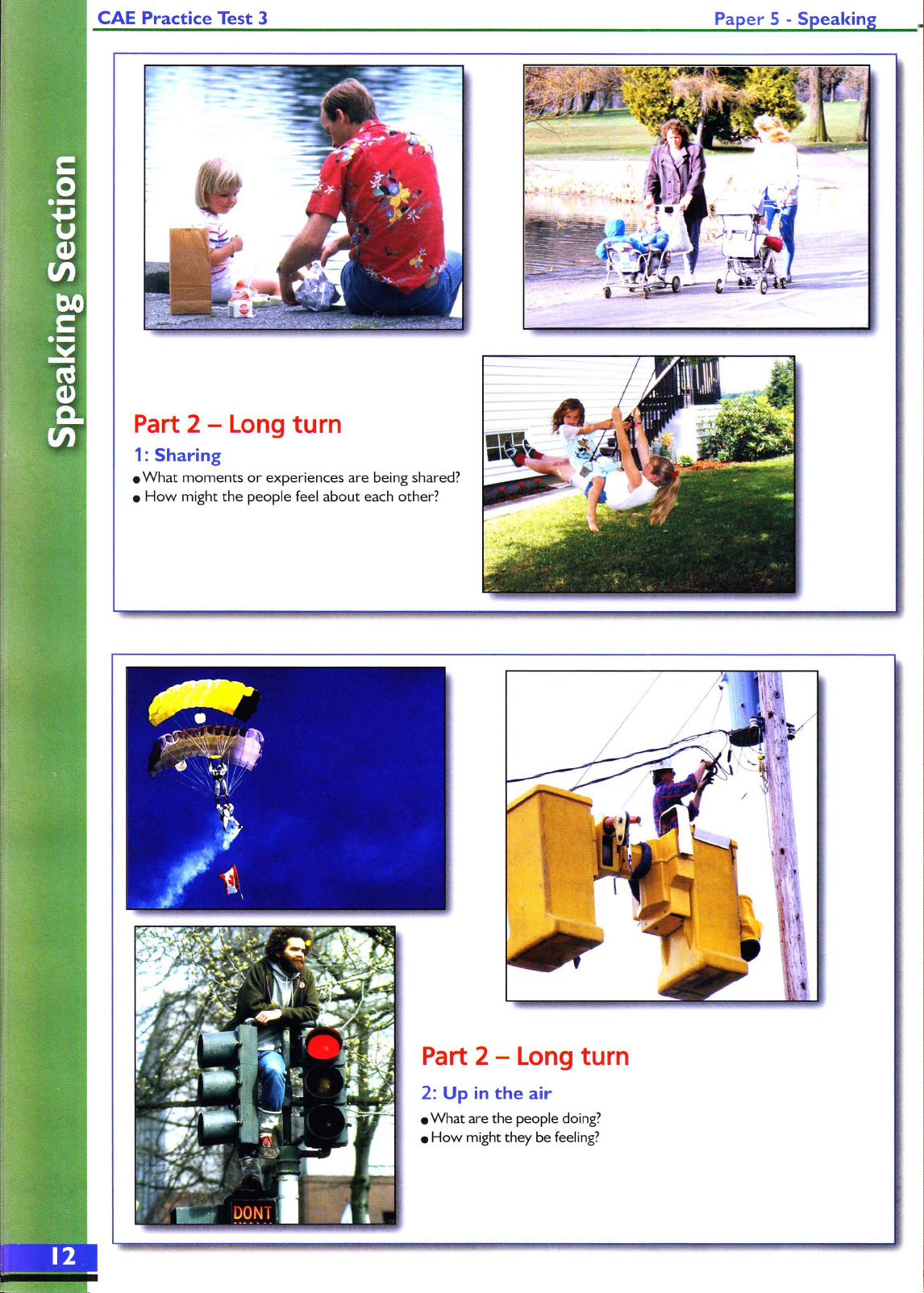
CAE Practice Test 3
Part 2 - long turn
1:
Sharing
•
What
moments
or
experiences
are
being shared?
•
How
might
the
people feel
about
each other?
Part
2
-long
turn
2:
Up
in
the
air
• What are the people
doing?
•
How
might they be
feeling?
Pa
p
er
5 - Speaking

CAE
Practice
Test
3
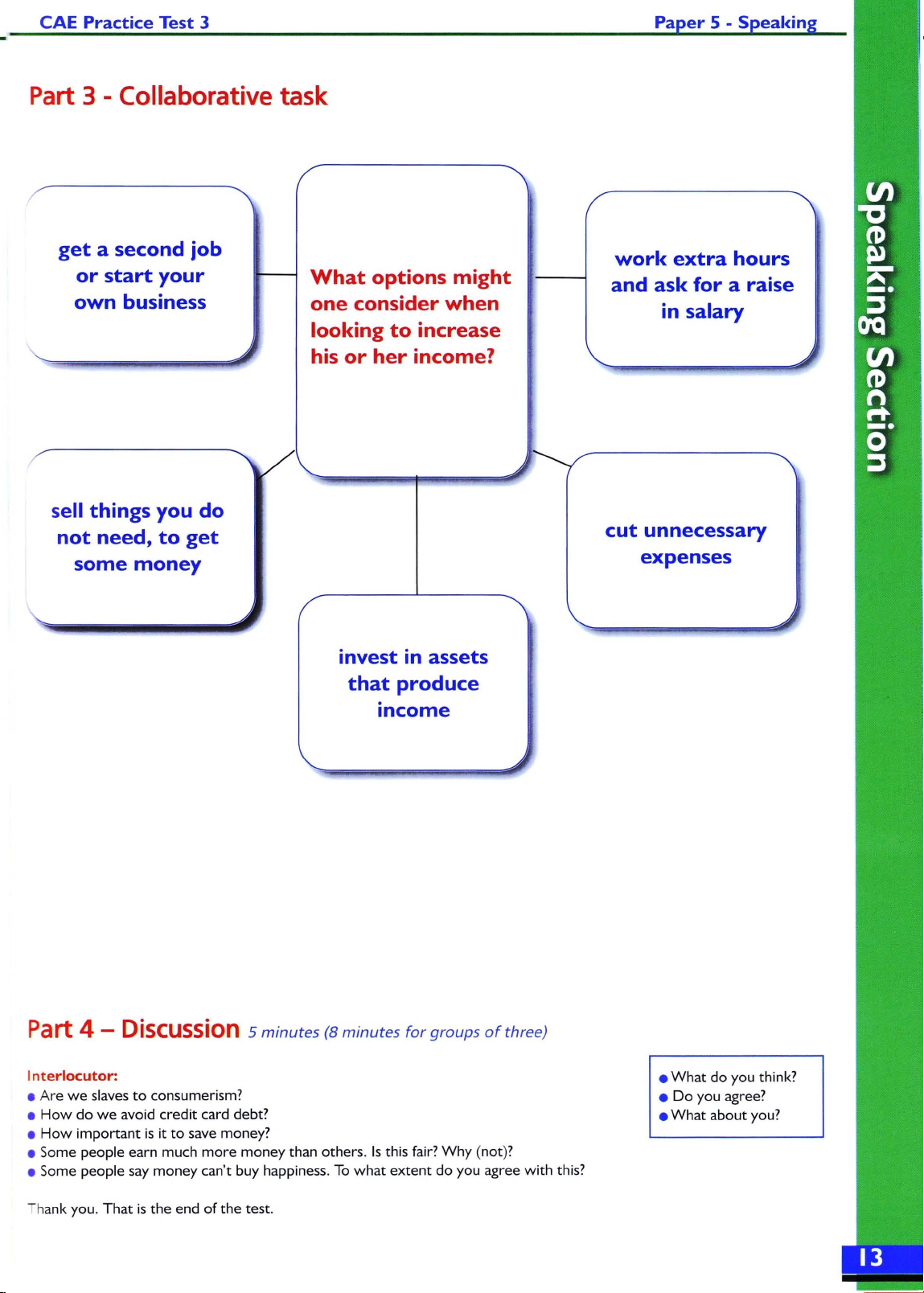
Part 3 - Collaborative task
get
a
second
job
or
start
your
own
business
sell
things
you
do
not
need,
to
get
some
money
What
options
might
one
consider
when
looking
to
increase
his
or
her
income?
invest
in
assets
that
produce
income
Part 4 - Discussion 5
minutes
(8
minutes
for
groups
of
three)
In
terlocutor
:
•
Are
we
slaves
to
consumerism?
•
How
do
we
avoid credit card debt?
•
How
important
is
it
to
save money?
• Some people
earn
much
more
money than
others
.
Is
this
fair?
Why (
not
)?
e Some people say
money
can't buy happiness.
To
what
extent
do
you agree with this?
- hank you.
That
is
the
end of
the
test.
Pa
p
er
5 - Sp
eaking
work
extra
hours
and
ask
for
a
raise
in
salary
cut
unnecessary
expenses
e
What
do you think?
•
Do
you agree?
•
What
about you?

14
'
·---
,
..
CAE
Practice
Test
4
Pa
p
er
5 - Sp
eaking
TEST 4
Part 2 -
long
turn 4
minutes
(6
minutes
for
groups
of
three)
In
this part of
the
test
you each have
to
speak for I minute without interruption.
The
examiner
will
give you a
set
of pictures
and ask you
to
talk about them.
You
may be asked
to
describe,
compare
or
contrast
the
pictures, and
to
make a further
comment
on them. Your
partner
will
get a different
set
of pictures, but you should pay attention during your partner's turn
because
the
examiner
will
ask you
to
comment
for about 30 seconds after your partner has finished speaking.
1 :
Environmental
problems
Interlocutor:
In
this part of
the
test
, I' m going
to
give each
of
you
three
pictures.
I'd
like you
to
talk about
two
of
them
on
your own for about a minute, and also
to
answer a question briefly about your partner's pictures.
(Candidate
A)
,
it
's your turn first.
Here
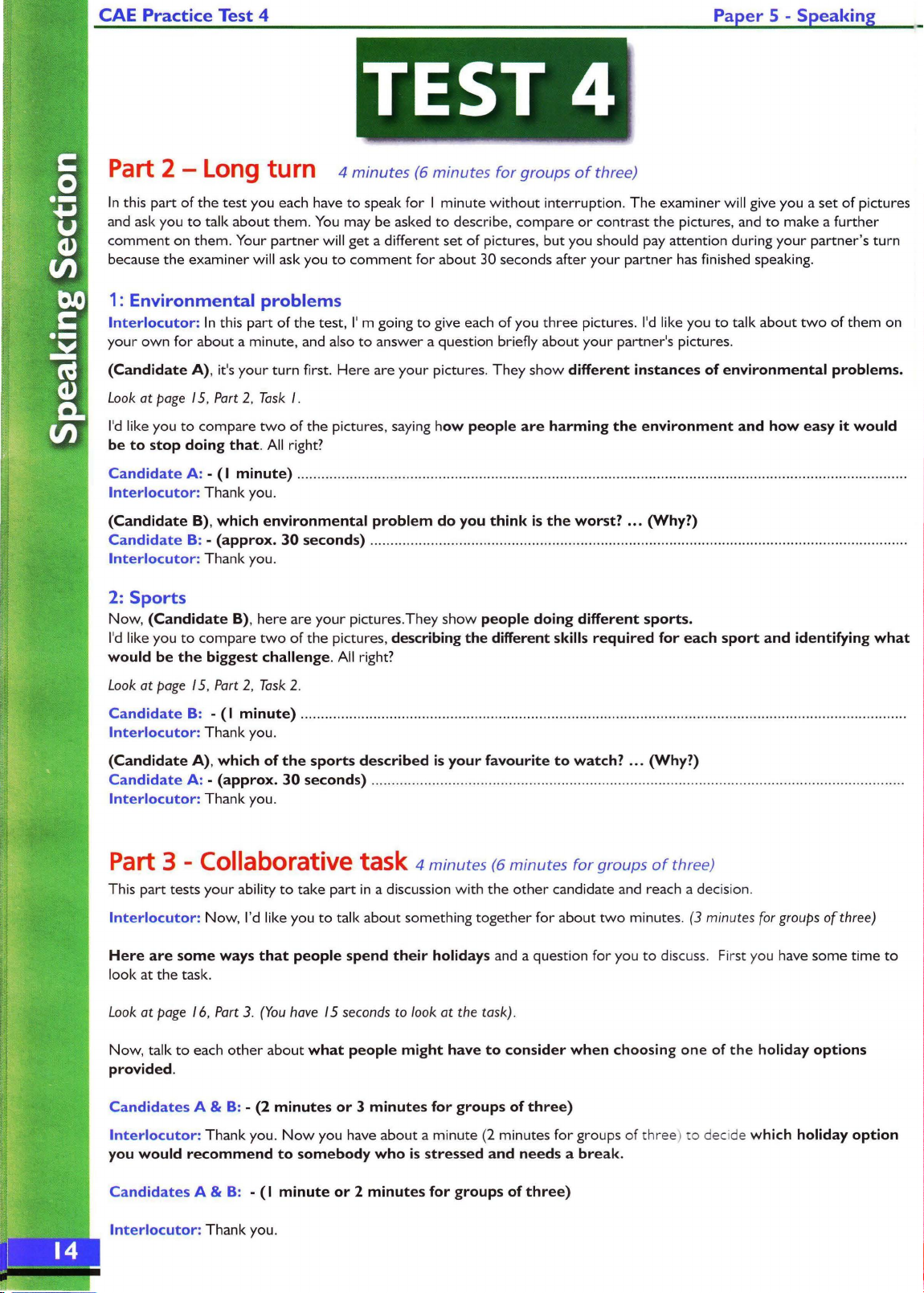
are your pictures. They
show
different
instances
of
environmental
problems.
Look
at page
15
,
Part
2,
Task
I.
I'd like you
to
compare
two
of
the
pictures, saying
how
people
are
harming
the
environment
and
how
easy
it
would
be
to
stop
doing
that
.
All
right?
Candidate
A: -
(I
minute)
.............................................
..
...
..
....
..
..................
..
..........
.. .. .. .. .. .. ..
...........
..
......
..
..
..
.
..
.
..
................. .
Interlocutor:
Thank you.
(Candidate
B),
which
environmental
problem
do
you
think
is
the
worst?
...
(Why?)
Candidate
B:
-
(approx.
30
seconds)
.......................................................................... ...
....
.......................................
..
.......... .
Interlocutor:
Thank you.
2:
Sports
Now
,
(Candidate
B),
here
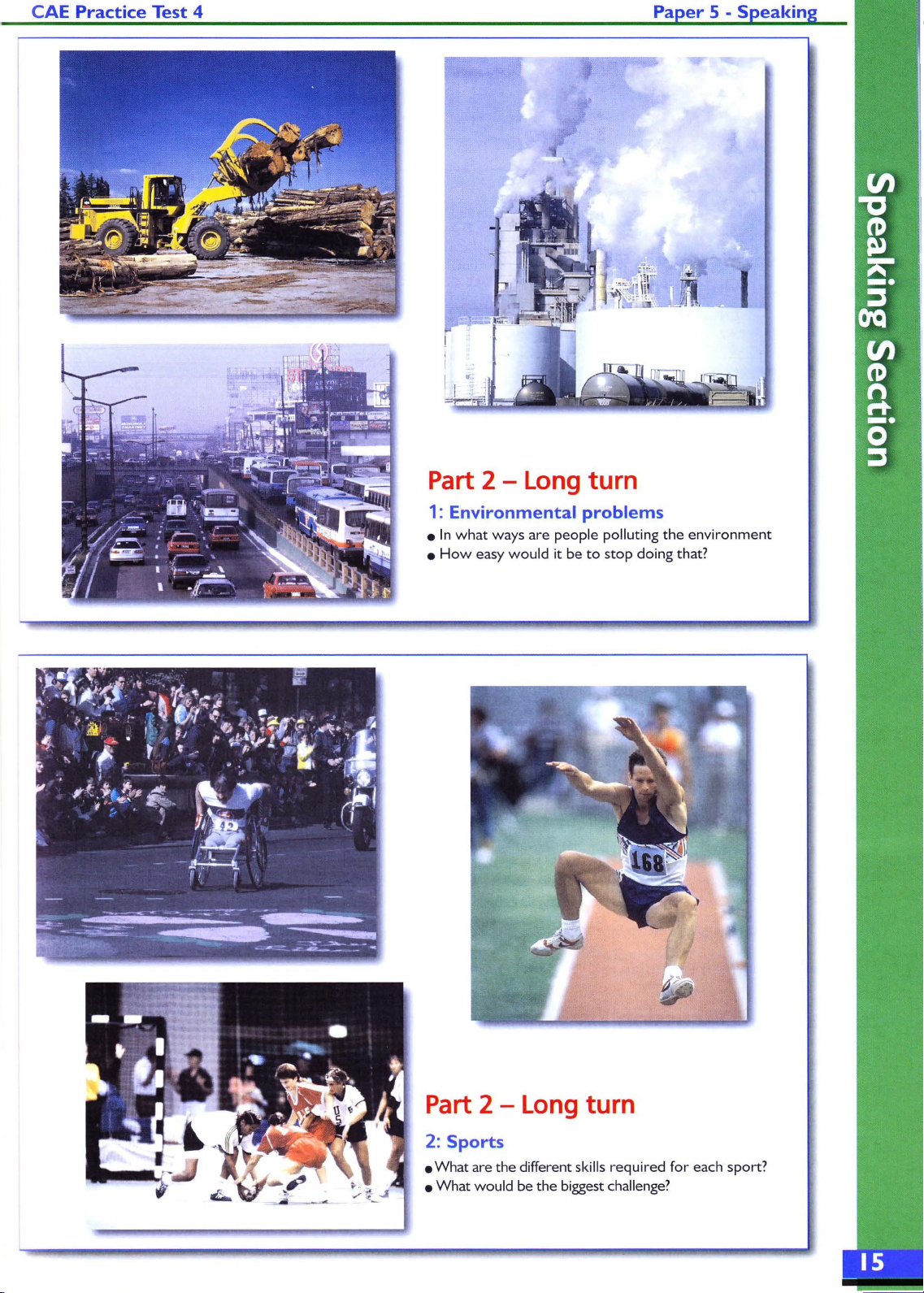
are your pictures.They
show
people
doing
different
sports.
I'd like you
to
compare
two
of
the
pictures, describing
the
different skills
required
for
each
sport
and
identifying
what
would
be
the
biggest
challenge
.
All
right?
Look
at page
15
,
Part
2,
Task
2.
Candidate
B:
-(I
minute)
....
..........
..
.................
..
..
................................................
..
...................
..
...
.. ..
.........
..
.........
..
..
.........
..
Interlocutor:
Thank you.
(Candidate
A),
which
of
the
sports
described
is
your
favourite
to
watch?
...
(Why?)
Candidate
A: -
(approx.
30
seconds)
................................................. ..........
..
.....
..
................
.. ..
.
..
......
..
..
.................
...
.....
..
.. ..
Interlocutor:
Thank you.
Part 3 - Collaborative
task
4
minutes
(6
minutes
for
groups
of
three)
This part tests your ability
to
take part
in
a discussion with
the
other
candidate and reach a decision.
Interlocutor:
Now, I'd like you
to
talk about something
together
for about
two
minutes.
(3
minutes
for
groups
of
three)
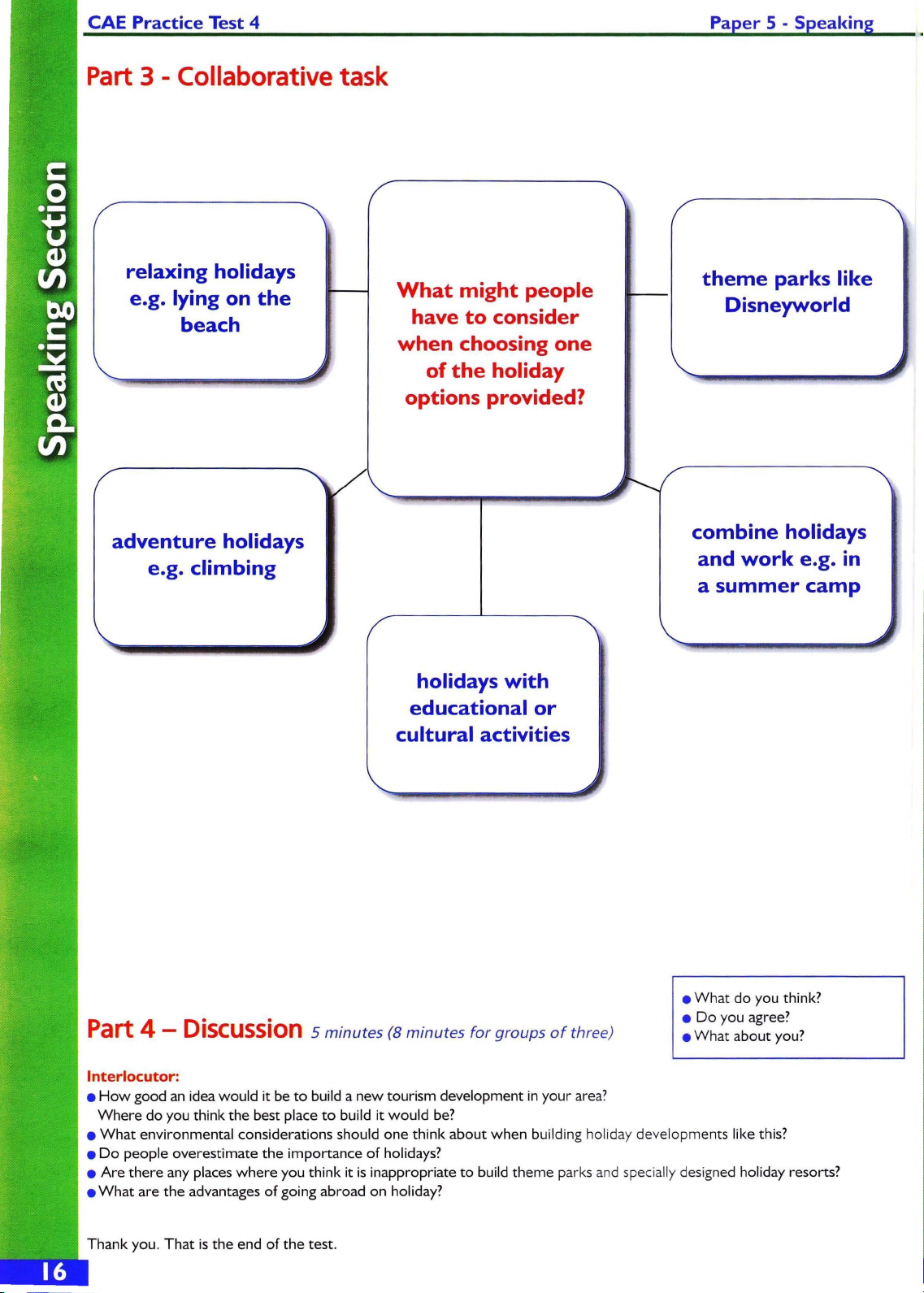
Here
are
some
ways
that
people
spend
their
holidays and a question for you
to
discuss. F
ir
st you have
some
time
to
look
at
the
task.
Look
at page
16
,
Part
3.
(You
have
15
seconds to
loo
k at the task) .
Now, talk
to
each
other
about
what
people
might
have
to
consider
when
choosing
one
of
the
holiday
options
provided
.
Candidates
A &
B:
-
(2
minutes
or
3
minutes
for
groups
of
three)
Interlocutor:
Thank you.
Now
you have about a minute (2 minutes for groups of
three
) to decide
which
holiday
option
you
would
recommend
to
somebody
who
is
stressed
and
needs
a
break
.
Candidates
A &
B:
-
(I
minute
or
2
minutes
for
groups
of
three)
Interlocutor:
Thank you.

CAE
Practice Test 4
Pap
er
5 - Speaking
Part
2 - long turn
1:
Environmental
problems
•
In
what
ways are people
polluting
the
environment
•
How
easy
would
it
be
to
stop
doing
that?
Part
2 - long turn
2:
Sports
•
What
are the different skills r
equired
for
each sport?
•
What
would
be the biggest challenge?

CAE
Practice Test 4
Pa
p
er
5 - Speaking
Part
3 - Collaborative
task
relaxing holidays
I!
theme
parks like
e.g. lying on
the
~
What
might
people
~
have
to
consider
Disneyworld
beach
11
when
choosing one
~
of
the
holiday
options provided?
~
-..........
-
adventure
holidays
combine holidays
e.g. climbing
and
work
e.g. in
a
summer
camp
~
holidays
with
educational
or
cultural activities
~
•
Wh
at
do
you
think?
Part
4 -
Discussion
5
minutes
(B
minutes
for
groups
of
three)
•
Do
you agree?
e
What
a
bout
you?
Interlocutor:
e
How
good an idea
would
it
be
to
build a
new
tou
rism development in your
area?
Whe
re
do
you think
the
best place
to
build it
would
be?
e
Wh
at
envir
onmen
tal considerations should
one
think
a
bout
when
building holiday
development
s
li
ke this?
•
Do
people overestima
te
the
import
ance
of
holida
ys?
e Are
the
re any pla
ces
whe
re you thi
nk
it
is inappropriate
to
build theme parks and speci
all
y designed holiday reso
rt
s?
e
Wh
at are
the
a
dv
antages
of
going abroad
on
holiday?
Thank
you
.
Th
at is
the
end
of
the test.
~
~

CAE
Practice
Test
5
Pa
p
er
5 - Sp
eaking
TEST 5
Part 2 -
long
turn 4
minutes
(6
minutes
for
groups
of
three)
n th
is
part of
the
test
you each have
to
speak for I minute without interruption.
The
examiner
will
give you a
set
of pictures
an
d ask you
to
talk
about
them.
You
may be asked
to
describe,
compare
or
contrast
the
pictures, and
to
make a further com-
-n
ent on them. Your
partner
will
get
a different
set
of pictures, but you should pay attention during
your
partner
's turn
Jecause
the
examiner
will
ask you
to
comment
for
about
30 seconds after your
partner
has finished speaking.
1:
Unusual
situations
I
nterlocutor:
In
this part of
the
test
,
I'
m going
to
give each of you
three
pictures.
I'd
like you
to
talk
about
two
of
them
on
vour
own
for
about
a minute, and also
to
answer
a question briefly
about
your partner's pictures.
(
Candidate
A),
it's
your
turn first.
Here
are
your pictures. They
show
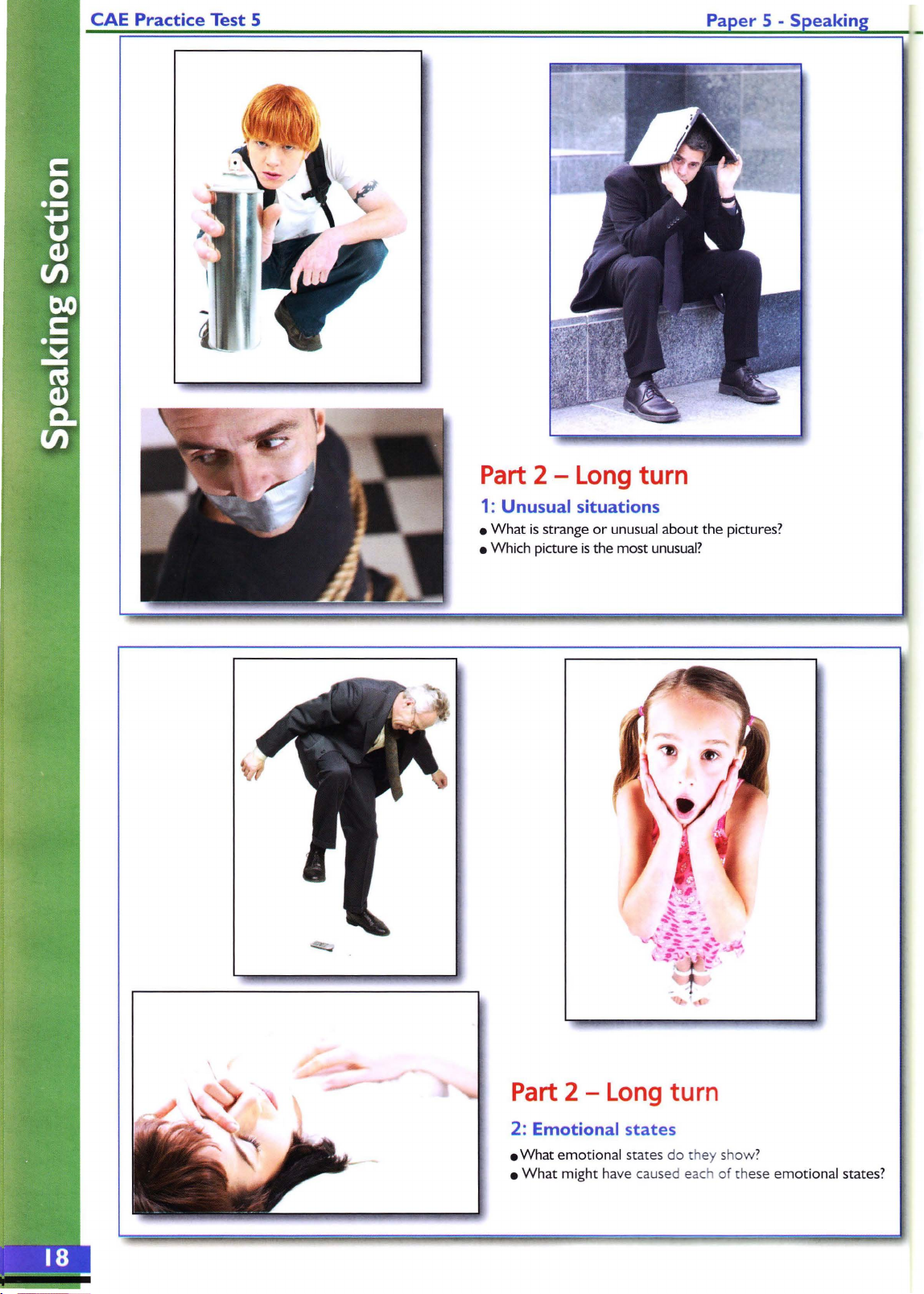
strange
or
unusual
situations.
_o
ok
at
page
18
,
Part
2,
Task
I.
d l
ik
e you
to
compare
two
of
the
pictures, saying
what
is
strange
or
unusual
about
them
and
which
picture
you
think
is
the
most
unusual.
All
right?
Candidate
A: -
(I
minute)
............
..
........... ........
..
.............
..
.....
....
..
..
... ..
..
.....
..
.....
..
................ ...................
..
.................
..
.......... .
In
terlocutor:
Thank you.
(Ca
ndidate
B),
what
point
might
the
photographer
have
wanted
to
make?
.
..
(Why?)
Ca
ndidate
B:
-
(approx.
30
seconds)
..
.......
...
...
..
..... .................................................
..
.................
..
....
..
......
..
.......................... .
In
terlocutor:
Thank you.
2:
Emotional
states
ow,
(Candidate
B),
here
are
your pictures. They
show
people
in
different
emotional
states
.
I'd
like
you
to
compare
two
:)
th
e pictures and say
what
emotional
states
they
show
and
what
might
have
caused
these
emotional
states.
All
right?
_ook at
page
18
,
Part
2,
Task
2.
Can
didate
B: - (I
minute)
....................................................
..
......................................
......
.............
..
......
..
.................
..
......... .
I
nte
rl
ocutor:
Thank you.
(
Candidate
A)
,
which
of
these
emotional
states
is
the
most
difficult
to
deal
with?
...
(Why?)
Can
didate
A: -
(approx.
30
seconds)
...............
..
.....................................................
..
... ..
..
.....
....
....... .....
..
......... ........
..
.
..
... .... .
I
nter
locutor:
Thank you.
Part 3 - Collaborative
task
4
minutes
(6
minutes
for
groups
of
three)
- h
is
part tests your ability
to
take part
in
a discussion with
the
other
candidate and reach a decision.
Inte
rlocutor:
Now
, I'd like you
to
talk about something
togethe
r for
about
two
minutes. (3 minutes
for
groups
of
three)
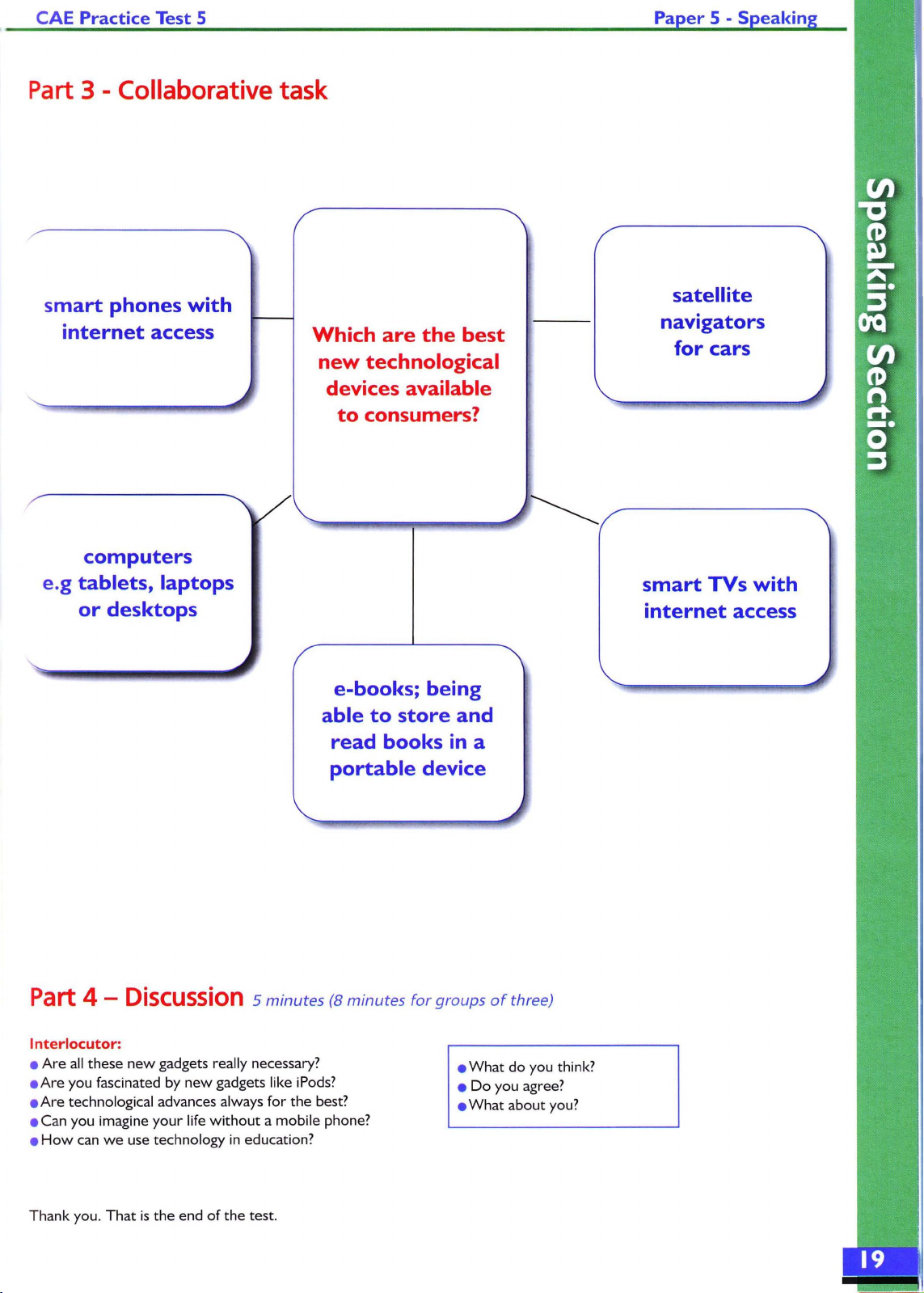
Here
are
some
of
the
technological
devices
that people have made part of their
daily
lives
and a question for you
to
discuss.
=irst you have
some
time
to
look
at
the
task.
_o
ok
at
page
19
,
Part
3.
(You
have
15
seconds to
look
at the task) .
ow
, talk
to
each
other
about which
are
the
best
new
technolog
ical
devices
available
to
consumers.
Ca
ndidates
A &
8:
-
(2
minutes
or 3
minutes
for
groups
of
three)
In
terlocutor:
Thank you.
Now
you have about a minute
(2
minutes for groups of
three)
to
decide
which
device
you
consider
to
be
the
most
useful
for
people
who
work
in
an
office.
C
andidates
A &
8:
-
(I
minute
or
2
minutes
for
groups
of
three)
I
nterlocutor:
Thank you.

CAE
Practice Test 5
Pa
p
er
5 - Speaking
Part
2
-long
turn
1:
Unusual situations
•
What
is
strange
or
unusual
about
the
pictures?
• Which picture
is
the most unusual?
Part
2 - long turn
2:
Emotional
states
• What emotional
st
ates
do
they
show
7
•
What
might have caused each of th
ese
emotional states?

C
AE
Practice
Test 5
Part 3 - Collaborative task
i
I'
smart
phones
with
;,,
,_______
internet
access
Which
are
the
best
i
new
technological
I
..J
devices
available
to
consumers?
I'
I
11
~
~
computers
e.
g
tablets,
laptops
or
desktops
~
e-books;
being
able
to
store
and
read
books
in a
portable
device
..J
Part 4 - Discussion 5
minutes
(B
minutes
for
groups
of
three)
Interlocutor:
e
Are
all
these
new
gadgets really necessary?
e
Are
you fascinated by
new
gadgets like
iPods?
e
Are
technological advances always
for
the
best?
e Can you imagine
your
life
without
a
mobile
phone?
e
How
can
we
use
technology
in education?
Thank
you.
That
is
the
end
of
the
test.
e
What
do
you think?
•
Do
you agree?
•
What
about
you?
Pa
p
er
5 - Sp
eaking
satellite
i'
navigators
'
~
for
cars
i'
~
smart
TVs
with
internet
access
...J

.
~
20
CAE
Practice
Test
6
Pa
p
er
5 - Sp
eaking
TEST 6
- - . .
Part 2 -
long
turn 4
minutes
(6
minutes
for
groups
of
three)
In
this part
of
the
test
you each have
to
speak for I minute without interruption.
The
examiner
will
give you a
set
of pictures
and ask you
to
talk
about
them
.
You
may be asked
to
describe,
compare
or
contrast
the
pictures, and
to
make a further com-
ment
on
them
. Your
partner
will
get
a different
set
of pictures, but you should pay attention during
your
partner's
turn
because
the
examiner
will
ask you
to
comment
for
about
30 seconds after your
partner
has finished speaking.
1:
On
your
bike
Interlocutor:
In
this part of
the
test, I' m going
to
give each of you
three
pictures. I'd like you
to
talk
about
two
of
them
on
your
own
for
about
a minute, and also
to
answer
a question briefly
about
your partner's pictures.
(Candidate
A)
, it's your turn first.
Here
are
your
pictures. They
show
people
with
bicycles
.
Look
at page
21
,
Part
2,
Task
I.
I'd
like
you
to
compare
two
of the pictures, saying
what
the
people
are
getting
from
the
experience
and
how
successful
the
pictures
might
be
in
encouraging
people
to
use
bicycles.
All
right?
Candidate
A: -
(I
minute)
..........................
..
...
..
...................................... .................
..
.........................
....
............................... .
Interlocutor:
Thank you.
(Candidate
B),
which
picture
is
the
most
interesting?
...
(Why?)
Candidate
B:
-
(approx.
30
seconds)
......................................................... .
..
..................................................
..
........... .
..
...... .
Interlocutor:
Thank you.
2:
Masks
Now,
(Candidate
B), here are your pictures. They
show
people
wearing
masks
.
I'd
like
you
to
compare
two
of the pictures,
saying
why
these
people
are
wearing
masl<s
and
how
important
these
masks
are
to
them.
All
right?
Look
at page
21
,
Part
2,
Task
2.
Candidate
B: - (I
minute)
...
....
..........................................
..
.................................................................................................
..
Interlocutor:
Thank you.
(Candidate
A),
which
mask
do
you
think
is
the
least
necessary?
...
(Why?)
Candidate
A: -
(approx.
30
seconds)
.....................................................................................................
..
............................ .
Interlocutor:
Thank you.
Part 3 - Collaborative task 4
minutes
(6
minutes
for
groups
of
three)
This part tests your ability
to
take part
in
a discussion with
the
other
candidate and reach a decision.
Interlocutor:
Now
, I'd like you
to
talk
about
something
together
for
about
two
minutes.
(3
min
utes
for
groups
of
three)
Here
are
some
industries
or
fields
that
have
been
greatly
affected
by
advances
in
technology
and a question for
you
to
discuss. First you have
some
time
to
look
at
the
task.
Look
at page 22,
Part
3.
(You
have
15
seconds to
look
at the task).
Now
, talk
to
each
other
about
how
these
fields
have
benefited
from
advances
in
technology.
Candidates
A &
B:
- (2
minutes
or
3
minutes
for
groups
of
three)
Interlocutor:
Thank you.
Now
you have
about
a minute
(2
minutes for groups
oft
r
ee
-
ce
ide
which
field
has
been
affected
by
advances
in
technology
in a
negative
way.
Candidates
A & B: -
(I
minute
or
2
minutes
for
groups
of
three)
Interlocutor:
Thank you.
Bấm Tải xuống để xem toàn bộ.