Sách Market Leader Pre-Intermediate Course Book - 3rd Edition môn Business English | Trường Đại học Khoa học Xã hội và Nhân văn, Đại học Quốc gia Thành phố Hồ Chí Minh
Sách Market Leader Pre-Intermediate Course Book - 3rd Edition môn Business English | Trường Đại học Khoa học Xã hội và Nhân văn, Đại học Quốc gia Thành phố Hồ Chí Minh. Tài liệu được sưu tầm giúp bạn tham khảo, ôn tập và đạt kết quả cao. Mời bạn đọc đón xem.
Môn: Business English 13 tài liệu
Trường: Trường Đại học Khoa học Xã hội và Nhân văn, Đại học Quốc gia Thành phố Hồ Chí Minh 1.2 K tài liệu
Tác giả:







Preview text:
3rd Edition Pre-intermediate
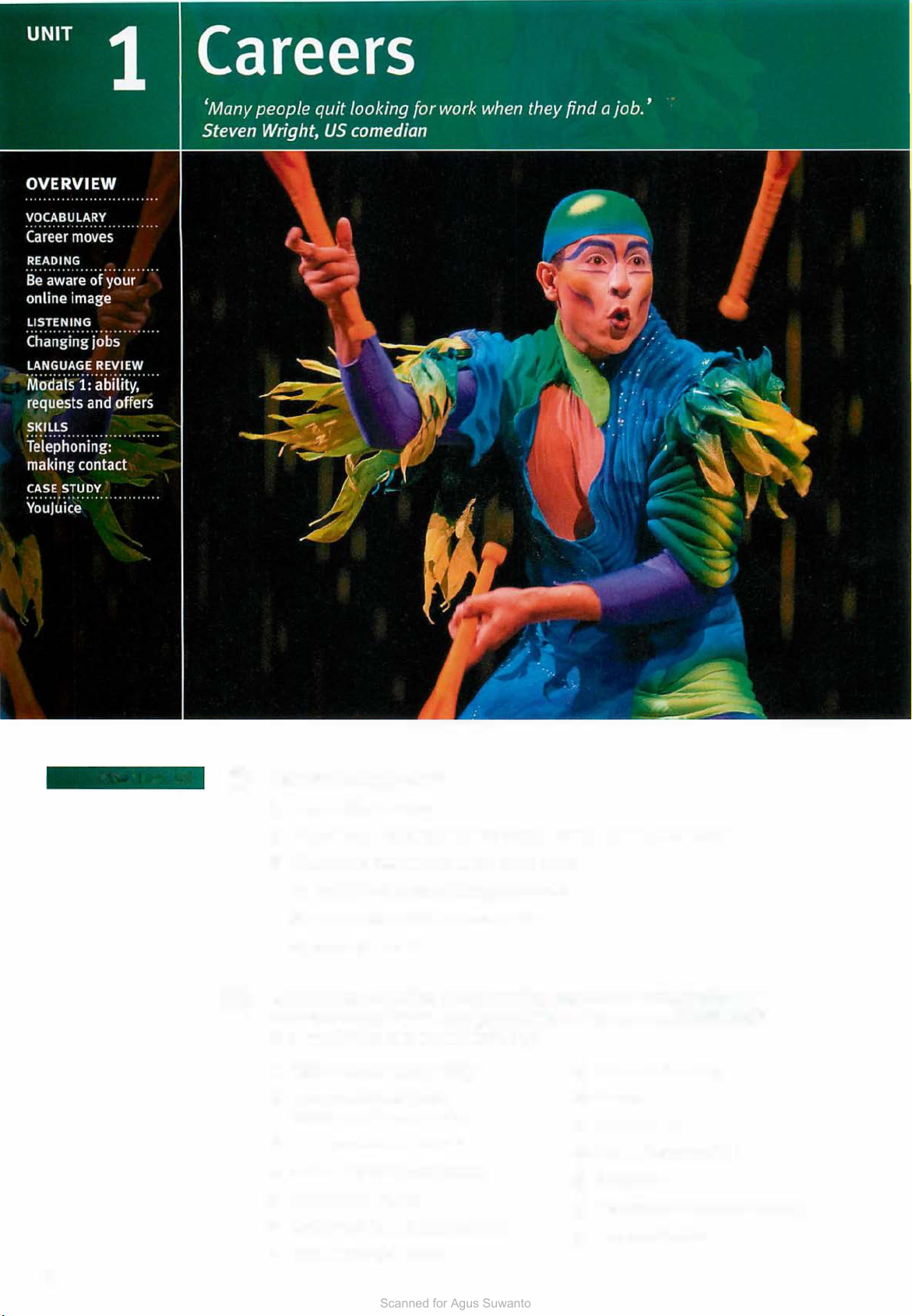
David Cotton David Falvey Simon Kent Scanned for Agus Suwanto DISCUSSION TEXTS LANGUAGE WORK SKILLS CASE STUDY Talk about your Listening: An interview with Career moves Telephoning: You)uice: Decide UNIT 1 career plan the Finance Director of a TV on the successful CAREERS Modals 1: ability, making contact company requests and offers candidate for a job c:) page 6 Reading: Facebook Writing: e-mail profile 'could damage job prospects'- Telegraph Talk about Reading: India: Tata's search Describing companies
Presenting your Dino Conti Ice Cream: UNIT2 companies for a new CEO- Financial company Decide on the best COMPANIES Present simple and Times way to invest in a present continuous C) Is John Lewis the best company's future page 14 company in Britain to work Writing: proposal for?- Guardian Listening: An interview with the CEO of a food company UNIT3 Talk about Listening: An interview with Making sales Negotiating: A partnership shopping habits the Director of Marketing of reaching agreement: Work on a SELLING Modals 2: must, need to, a TV shopping channel agreement proposed partnership have to, should C) Reading: Women on top in between a jet charter page 22 new sales industry survey company and a hotel web article group Writing: letter
WORKING ACROSS CULTURES: 1 SAYING 'NO' POLITELY C) page 30 REVISION UNIT A C) page32 DISCUSSION TEXTS LANGUAGE WORK SKILLS CASE STUDY Discuss what
Listening: An interview with a Verb and noun Successful The new attraction: UNIT4
··-� makes a great researcher combinations meetings Decide on the best GREAT IDEAS idea Reading: Who needs idea for a new Past simple and C) attraction page 36 translators?- web article past continuous Safer cycling- web article Writing: report Going for gold- web article Discuss stressful Listening: An interview with Stress in the workplace Participating in Davies-Miller UNIT 5 situations and the Director of Marketing at Advertising: Suggest STRESS Past simple and discussions activities a health consultancy present perfect ways of reducing C) stress amongst staff page
Reading: Over half of business 44 owners feeling increasingly Writing: report stressed - web article
Discuss corporate Listening: An interview with the Eating and drinking Socialising: Organising a UNIT6 entertaining
Chief Executive of a corporate greetings and conference: Choose ENTERTAINING Multiword verbs entertainment company small talk the location for a C) sales conference page 52 Reading: Interview with three corporate entertainment Writing: e-mail experts
WORKING ACROSS CULTURES: 2 DOING BUSINESS INTERNATIONALLY =page60 REVISION UNIT B C) page 62 WRITING FILE ACTIVITY FILE Cl page 126 c:) page 132 . Scanned for Agus Suwanto CONTENTS DISCUSSION TEXTS L ANGUAGE WORK SKILLS CASE STUDY Discuss new Listening: Interviews with Economic terms Dealing with Taka Shimizu Cycles: UNIT7 businesses and the CEO of a money-transfer numbers Choose the location NEW BUSINESS Time clauses business seclors company and the CEO of a for a new factory food company Writing: e-mail � page 66 Reading: Internet whiz-kid's discount idea makes billions in two years- Financial Times Help with exports- Financial Times - ·--�J Talk about the Listening: An interview Word partnerships Telephoning: Wincote International: UNITS marketing mix with the European exchanging Devise a plan to MARKETING : Questions and marketing Marketing Manager of a information improve sales at an campaigns pharmaceutical company outdoor-clothing � page 74 Reading: Adidas targets company the Chinese interior- Writing: e-mail Financial Times Discuss how and Listening: An interview Making plans Meetings: European Press and UNIT9 when to plan with a business consultant interrupting Media Corporation: PLANNING Talking about and author and clarifying Plan a new issue of future plans Reading: When there's no a magazine � page 82 Plan A- Financial Times Writing: letter
WORKING ACROSS CULTURES: 3 IN TERNATIONAL CONFERENCE CALLS �page90 REVISION UNIT C �page 92 DISCUSSION TEXTS LANGUAGE WORK SKILLS CASE STUDY Discuss the Listening: An interview Verbs and prepositions Socialising and Ashley Cooper Search UNIT 10 qualities of a with the author of a entertaining Agency: Advise MANAGING · • Reported speech good manager management book on improving staff PEOPLE Reading: Share the power relations at a property Financial Times company � page 96 Writing: report Do a quiz on Listening: An interview Word-building Negotiating: Herman & Corrie UNIT 11
managing conflict with an expert in dispute dealing with Teas: Decide whether CONFLICT Conditionals resolution conflict a company should Reading: Intervening accept a buy-out offer � page 104 quickly in cases of conflict Writing: letter - Chartered Institute a{ Personnel and Development
Discuss products Listening: An interview with Describing products Presenting a The George Marshall UNIT 12 the editor of a news network product Awards: Choose PRODUCTS Passives Reading: A path to salvation the winner of a through innovation- product-innovation � page 112 Financial Times competition Writing: report
WORKING ACROSS CULTURES: 4 PREPARING TO DO BUSINESS IN TERNATIONALLY �page 120 REVISION UNIT D �page 122 GRAMMAR REFERENCE AUDIO SCRIPTS GLOSSARY �page 141 �page 153 �page 167 Scanned for Agus Suwanto
What is Market Leader, and who is it for?
Market Leader is a multi-level business English course for businesspeople and students of business
English. It has been developed in association with the Financial Times, one of the leading sources of
business information in the world. It consists of 12 units based on topics of great interest to everyone
involved in international business.
This third edition of the Pre-intermediate level features completely updated content and a
significantly enhanced range of authentic resource material, reflecting the latest trends in the
business world. If you are in business, the course will greatly improve your ability to communicate
in English in a wide range of business situations. If you are a student of business, the course will
develop the communication skills you need to succeed in business and will enlarge your knowledge
of the business world. Everybody studying this course will become more fluent and confident in using
the language of business and should increase their career prospects. The authors
David Falvey (left) has over 25 years' teaching and managerial experience in the UK, Japan and Hong
Kong. He has also worked as a teacher trainer at the British Council in Tokyo, and was previously
Head of the English Language Centre and Principal Lecturer at London Metropolitan University.
David Cotton (centre) has over 40 years' experience teaching and training in EFL, ESP and English for
Business, and is the author of numerous business English titles, including Agenda, World of Business,
International Business Topics and Keys to Management. He is also one of the authors of the best
selling Business Class. He was previously a Senior Lecturer at London Metropolitan University.
Simon Kent (right) has over 20 years' teaching experience, including three years as an in-company
trainer in Berlin at the time of German reunification. He is currently a Senior Lecturer in business
and general English, as well as having special responsibility for designing new courses at London Metropolitan University. 4 Scanned for Agus Suwanto I NTRODUCTION What is in the units? STARTING UP
You are offered a variety of interesting activities in which you discuss the topic
of the unit and exchange ideas about it. VOCABULARY
You will learn important new words and phrases which you can use when you carry
out the tasks in the unit. You can find definitions and examples, and listen to the
pronunciation of new vocabulary in the i-Giossary feature on the DVD-ROM. The
DVD-ROM also contains practice exercises. A good business dictionary, such as the
Longman Business English Dictionary, will also help you to increase your business vocabulary. READING
You will read authentic articles on a variety of topics from the Financial Times and
other newspapers and books on business. You will develop your reading skills and
learn essential business vocabulary. You will also be able to discuss the ideas and issues in the articles. LISTENING
You will hear authentic interviews with businesspeople and a variety of scripted
recordings. You will develop listening skills such as listening for information and
note-taking. You can also watch the interviews and find further practice exercises on the DVD-ROM. L ANGUAGE REVIEW
This section focuses on common problem areas at Pre-intermediate level. You will
become more accurate in your use of language. Each unit contains a Language
review box which provides a review of key grammar items. A Grammar reference
section can be found at the bac_k of the book and on the DVD-ROM. The DVD-ROM
also provides extra grammar practice. SKILLS
You will develop essential business communication skills, such as making
presentations, taking part in meetings, negotiating, telephoning and using English
in social situations. Each Skills section contains a Useful language box, which
provides you with the language you need to carry out the realistic business tasks
in the book. The DVD-ROM supplements the Course Book with additional activities. CASE STUDY
The Case studies are linked to the business topics of each unit. They are based
on realistic business problems or situations and allow you to use the language
and communication skills you have developed while working through the unit.
They give you the opportunity to practise your speaking skills in realistic business
situations. Each Case study ends with a writing task. Aher you've finished the Case
study, you can watch a consultant discussing the issues it raises on the DVD-ROM.
These four units focus on different aspects of international communication. WORKING ACROSS
They help to raise your awareness of potential problems or misunderstandings CULTURES
that may arise when doing business with people from different cultures. REVISION UNITS
Market Leader Pre-intermediate third edition also contains four revision units,
each based on material covered in the preceding three Course Book units.
Each revision unit is designed so that it can be completed in one session or on a unit-by-unit basis. 5 Scanned for Agus Suwanto STARTING UP IJ Discuss these questions. 1 How ambitious are you?
2 Do you have a career plan? Where do you want to be in 10 years' time?
3 Which of the following would you prefer to do?
a) work for one company during your career
b) work for several different companies c) work for yourself
I] Look at these activities (1-7). In pairs, match each activity to its
corresponding area of work (a-g). Which of these areas do you work
in or would you like to work in? Why? 1 making/manufacturing things a) Sales and Marketing 2 being in charge of people b) Finance and running the organisation c) Management
3 selling products or services d) Human Resources (H R)
4 dealing with clients/consumers e) Production 5 working with figures
f) Research and Development (R&D)
6 dealing with employees and training g) Customer Service 7 investigating and testing 6 Scanned for Agus Suwanto UNIT 1 ... CAREERS
B What should you do to get ahead in your career? Choose the four most
important tips from this list. Compare your ideas in a group and try to agree on a final choice. 1 Change companies often.
5 Be energetic and enthusiastic at all times.
2 Use charm with your superiors.
6 Be the last to leave work every day. 3 Attend all meetings.
7 Find a n experienced person to give you help and advice. 4 Go to your company's social functions.
8 Study for extra qualifications in your free time.
These phrases (1-6) all include the word career. Match each of them to
its correct meaning (a-f). Use a dictionary to help you. 1 career move
a) chances to start/improve your career 2 career break
b) ideas you have for your future career 3 career plan
c) an action you take to progress in your career 4 career opportunities
d) a period of time away from your job to, for
example, look after your children 5 career path
e) a series of levels or steps in your working life 6 career ladder
f) the direction your working life takes
I!J �>l) CDl.l-1.3 Listen to three people talking about their careers. Which person
is at the beginning, in the middle and at the end of their career?
B �>l) CDl.l-1.3 Listen again. Which of the phrases with career in Exercise A
does each person use? Which of the experiences do you think are common?
liJ Complete the sentences below with the verbs in the box. Use a dictionary to help you.
climb decide ffitve make offer take
1 Employees in large multinationals . . h�'{� . . . excellent career opportunities if they are willing to travel.
2 Some people . . . . . . . . . . . . a career break to do something adventurous like sailing
round the world or going trekking in India.
3 One way to . . . . . . . . . . . . a career move is to join a small but rapidly growing company.
4 Certain companies . . . . . . . . . . . . career opportunities to the long-term unemployed or
to people without formal qualifications.
5 Ambitious people often . . . . . . . . . . . . on a career plan while they are still at university.
6 I n some industries, it can take a long time to . . . . . . . . . . . . the career ladder.
IJI Look at these groups of words. Cross out the noun or noun phrase in each
group which doesn't go with the verb in italics.
1 make a fortune I progress I a living I 4 do part-time work I a mistake I
a nine-to-five job I your best 2 get
progress I a promotion I a bonus I
5 take a pension I an opportunity I fired (AmE) I the sack (BrE) time off I early retirement
3 earn commission I a part-time job I
6 work flexitime I anti-social hours I money I 40,000 per year overtime I an office job 7 Scanned for Agus Suwanto UNIT 1 �� CAREERS
D Complete each of these sentences with the appropriate form of a word partnership from Exercise E.
1 In banking, you can . . . . . . . . . . . . with the big bonuses and retire at 35.
2 When you . . . . . . . . . . . . , you can arrange your own schedule, so this is very convenient when you have children.
3 People who work in sales often have the opportunity to . . . . . . . . . . . . on top of a basic salary.
4 Luke is ambitious and does not want to be a sales assistant all his life. In fact, he
hopes to . . . . . . . . . . . . and become Assistant Manager very soon. See the DVD-ROM
5 Many students . . . . . . . . . . . . when they are at university because it fits in with their studies. for the i·Giossary.
6 Go ran is 59, but he does not want to . . . . . . . . . .. . . In fact, he is taking on more work! READING
Discuss these questions in pairs. Be aware of
1 What social-networking sites do you a) know, and b) use? your online 2 Why do you use them? image
Scan the article below quickly and answer these questions.
1 What percentage of employers research candidates online?
2 Which social-networking sites are mentioned?
3 Who do Peter Cullen and Farhan Vas in work for? by Andy Bloxham
Jobseekers have beeniVqmed that their Face book profile could damage their emplo_) men! prospects,
after a study found that seven in I 0 employers now research candidates online.
According to new figures released by Microsofl. checks on
Facebook and Twitter arc now as important in the job-selection s process as a CV or interview.
The survey. which questioned human-resource managers at
the top 100 companies in the UK. the US, Germany and France.
found that 70 per cent admitted to rejecting a candidate because of their online behaviour. 10
But HR bosses also said that a strong image online could LIKE us on Facebook
actually help job hunters to land their dream job. Peter Cullen, of
Microsoft. said: '·Your online reputation is not something to
be scared of, it's something to be proactively managed. These
days. it's essential that web users cultivate the kind of online
15 reputation that they would want an employer to sec."
Facebook faux pas include drunken photographs, bad
language and messages complaining about work.
Farhan Yasin. of online rccn1itment network Careerbuilder.co.uk.
said: "Social networking is a great way to make connections with
20 job opportunities and promote your personal brand across the
Interne!. People really need to make sure they are using this
resource to their advantage. by conveying a professional image.''
But Mr Yasin cautioned job seekers to be aware of their online
image even after landing the perfect job. after their own research
l5 found that 28 per cent of employers had fired staff for content Linked 1m.
found on their social-networking profile. He added. "A huge
number of employers have taken action against staff for writing
negative comments about the company or another employee on
their social-networking page." adapted from the Telegraph 8 Scanned for Agus Suwanto UNIT 1 .... CAREERS
II Read the article again and choose the best headline (a, b or c).
a) Complaining about your job could lose you your job
b) Facebook profile 'could damage job prospects'
c) Ambition is key to a successful career
liJ According to the article, how can social-networking sites make or break your career?
IJ In pairs, write a short list of things you should not do on your social
networking pages. You can include your own ideas.
D Should staff be allowed to use social-networking sites during the working day? Discuss.
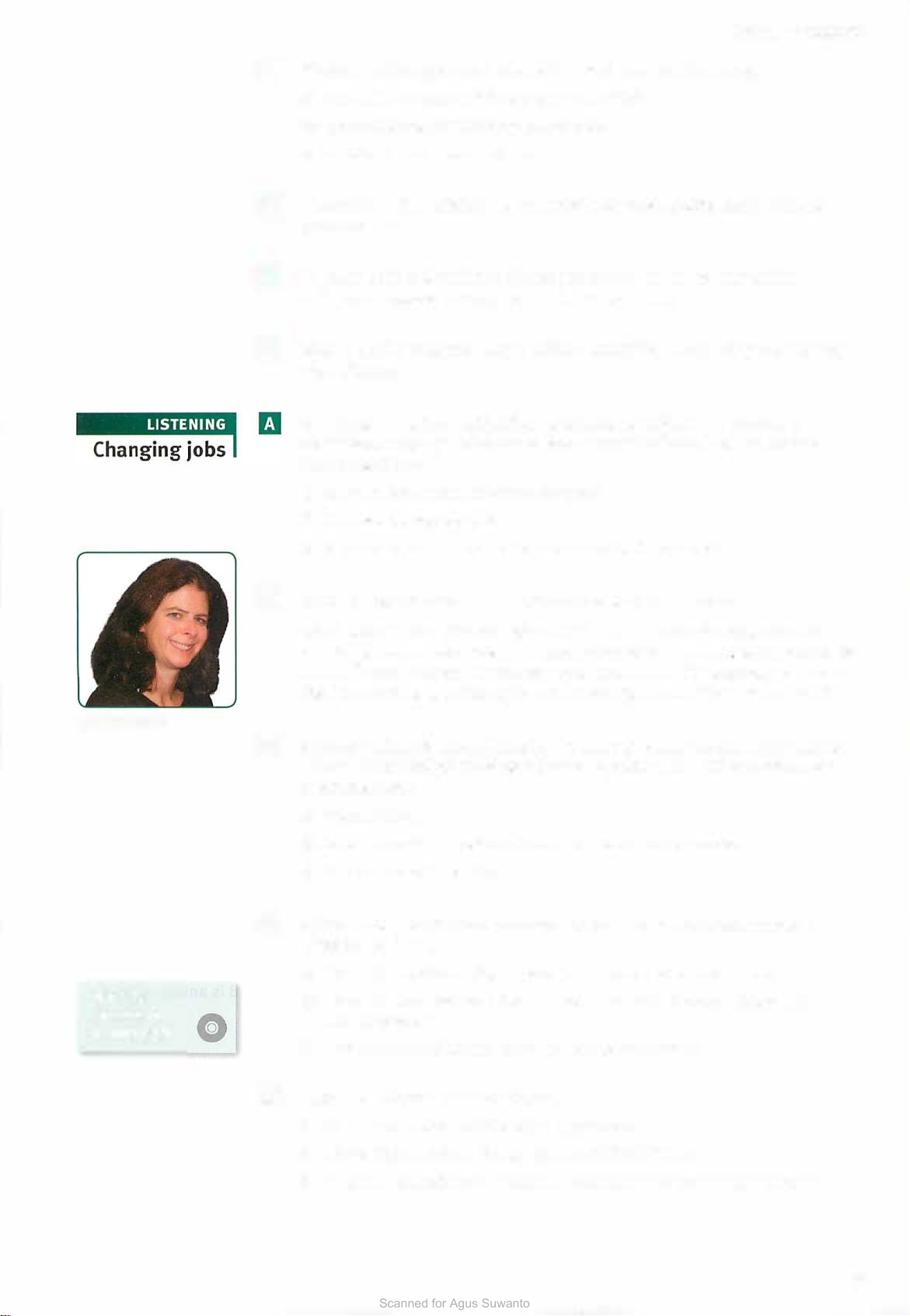
�>)) CD1.4 Melissa Foux is the Finance Director of CSC Media Limited, a
television company. Listen to the first part of the interview and answer these questions.
1 How does she describe her current company? 2 What was her previous job?
3 Why is it easy to move from sector to sector in the finance world?
m �>l) CD1.5 Listen to the second part and complete this extract.
When I was a student, although I was studying \ . . . . . . . . . . . . I thought I would like to do
something . . . . . . . . . . . . 2 afterwards, and I actually did a summer . . . . . . . . . . . J with one of the big . . . . . . . . . . . .
'· firms, which was an excellent way to get an . . . . . . . . . . . . 5 of what the job would be
like. I started off as an auditor, and it was through that . . . . . . . . . . . . 6 that I got my first job. Melissa Foux
II �>l) CD1.6 Melissa is asked if she has had any good advice during her career.
Listen to the third part and number these points in the order in which she mentions them. a) maintain clarity
b) be able to see the key point and the key decision you have to make
c) do not overcomplicate things
m �>» CD1.7 Listen to the final part and decide which was the interviewer's question {a, b or c).
a) What is the most interesting question you have been asked at interview? Watch the
b) What is the key difference between people who work in finance and those who interview on work in research? the DVD-ROM.
c) How would you advise people who are starting their careers?
IJ In groups, discuss these questions.
1 What do you hope to do in the future in your career?
2 Do you think there is an ideal career for you? What is it? Why?
3 What is the best advice you have been given during your career or your studies? 9 Scanned for Agus Suwanto UNIT 1 �� CAREERS LANGUAGE REVIEW
Modal verbs are very common i n English. Match these functions (a-c) t o the examples (1-3). Modals 1: a) making an offer b) describing ability c) making a request ability, requests 1 Can you help me? and offers
Could you say that again, please? 2 Can I help you?
Would you like a cup of coffee?
3 I can speak Polish and Russian.
She could read and write before she was three. Cl Grammar reference page 141
EJ Rearrange the words to make questions from a job interview. Then decide
whether each question is a) making a request, b) making an offer, or c) asking about ability.
1 get I you I can I I I a drink I ? Can I 9etyov a drink? (b)
2 e-mail address I your I confirm I I I could I ?
3 can I you I spreadsheets I use I ?
4 speak I languages I any other I you I can I ?
5 about I tell I you I job I us I your present I more I could I ?
6 tell I your current salary I me I you I could I ?
7 would you I as soon as possible I your decision I let us know I ?
8 start I you I when I can I ?
9 like I tea I some more I you I would I ?
1!1 Match the questions in Exercise A (1-9) to these interviewee's answers (a-i). a) It's €60,000 a year.
b) Not very well, but I'm doing a course next week.
c) I can let you know next week.
d) Thank you. A cup of tea, please.
e) The address is correct, but I've got a new mobile number. f) I'd love some. Thank you.
g) Well, I'm currently supervising an HR project.
h) Yes, I can speak Korean and Japanese.
i) My notice period is two months.
II Work in pairs. Student A is an interviewer and Student B is an interviewee.
Student A: Follow the instructions below.
Student B: Answer the questions truthfully. Then switch roles. Student A • Offer tea or coffee. • Ask Student B: •
Find out Student B's ability to:
1 to tell you about themselves; 1 speak any languages;
2 for the best number to contact them
2 use Excel, PowerPoint or Publisher; on tomorrow; 3 drive. 3 to repeat the number;
4 if they would like to work abroad;
5 if there are any hours they wouldn't be able to work. 1 0 Scanned for Agus Suwanto
Tài liệu liên quan:
-
The Archivist: Business Model Canvas môn Business English | Trường Đại học Khoa học Xã hội và Nhân văn, Đại học Quốc gia Thành phố Hồ Chí Minh
48 24 -

Giới thiệu Trung Tâm Thể Thao Quận 7: Tiềm Năng và Những Nét Đặc Trưng
57 29 -
Đề cương ôn tập môn Business English | Trường Đại học Khoa học Xã hội và Nhân văn
221 111 -
Đề cương ôn tập môn Business English | Trường Đại học Khoa học Xã hội và Nhân văn
221 111