Semantics - A - Tài liệu ôn thi ngữ nghĩa tiếng Anh (Units 1-10)
Semantics - A - Tài liệu ôn thi ngữ nghĩa tiếng Anh (Units 1-10)
Chủ đề: Tài liệu chung Tiếng Anh 12 390 tài liệu
Môn: Tiếng Anh 12 1.1 K tài liệu
Tác giả:







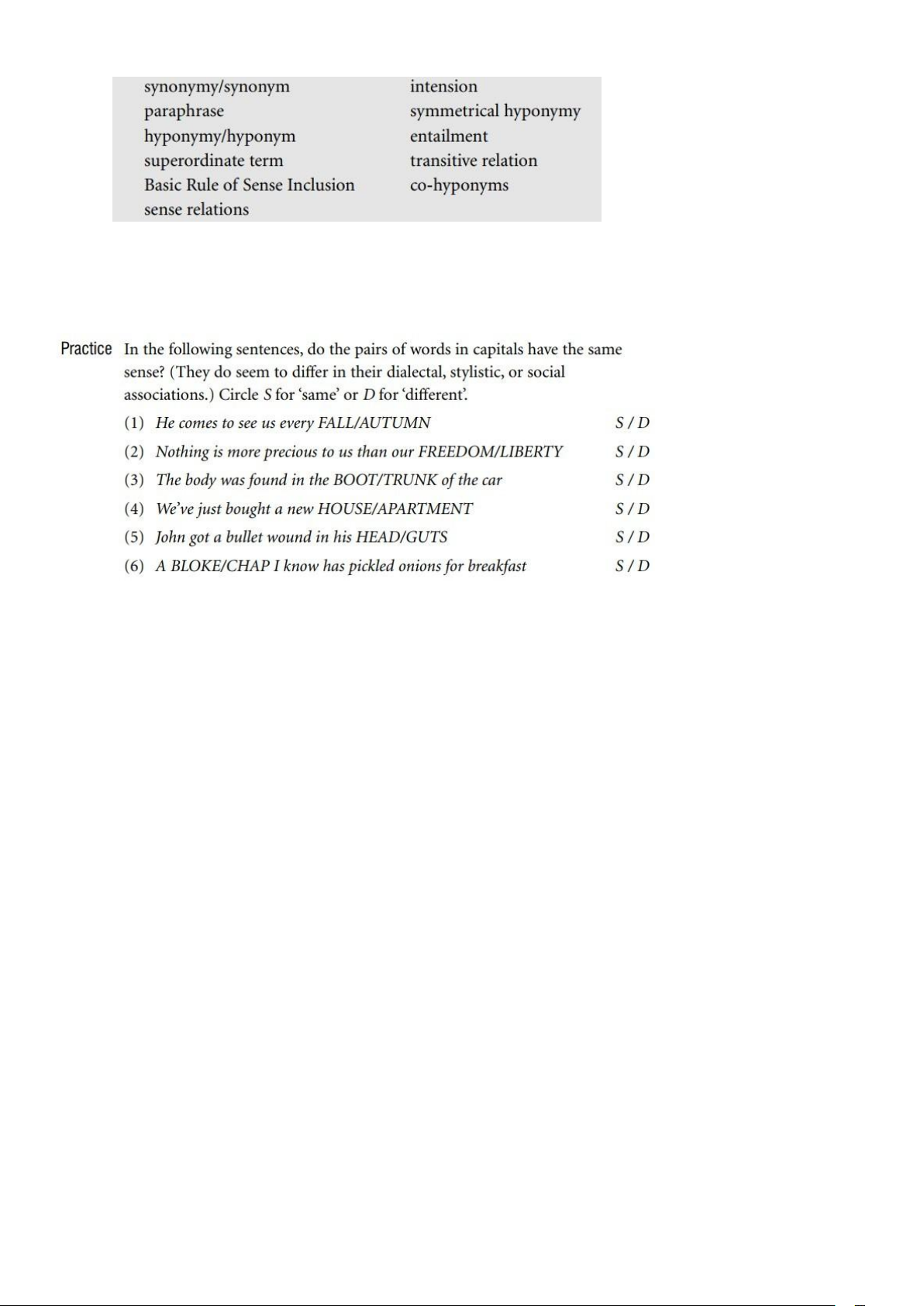
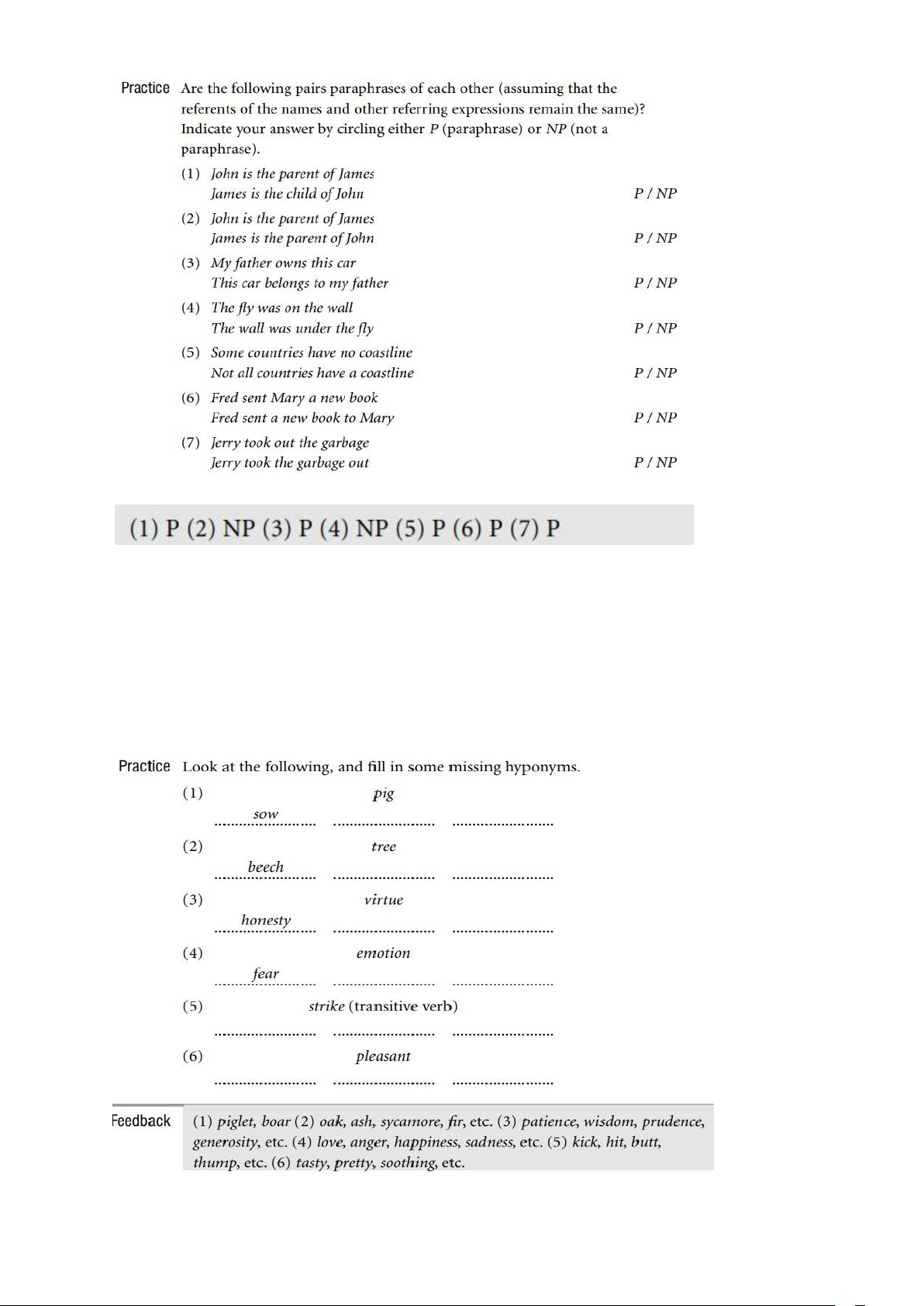
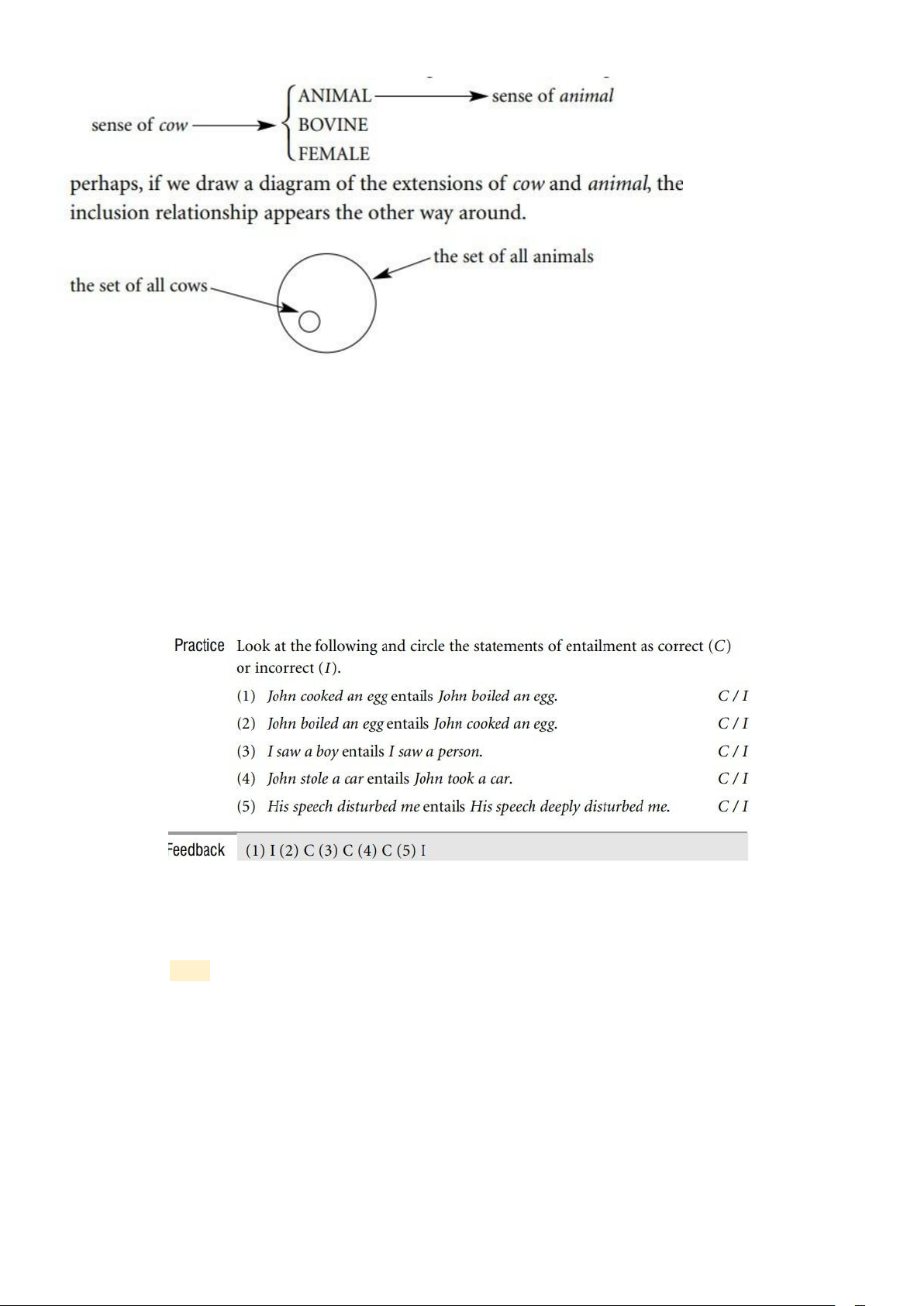
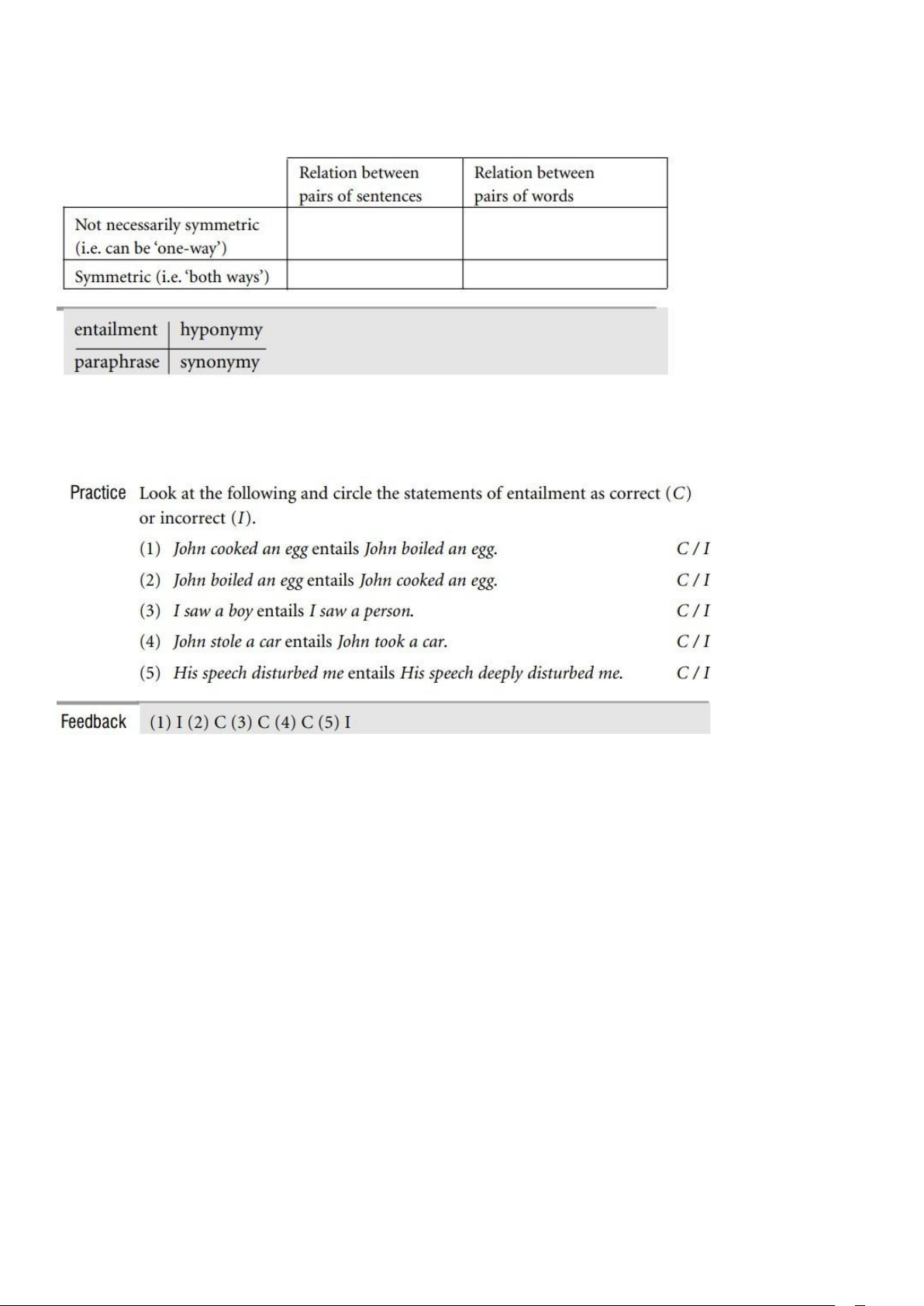

Preview text:
1
Nội dung ôn CK: 1→11, 20, 21, 22
Unit 1: Basic ideas in semantics Thuật ngữ: - utterances: lời phát biểu
e.g. ‘Are you?’, ‘That’ll be nice for the family’, ‘Nice day’,... Definition: -
SEMANTICS is the study of MEANING in LANGUAGE. -
SPEAKER MEANING is what a speaker means (i.e. intends to convey) when he uses a piece of language. -
SENTENCE MEANING (or WORD MEANING) is what a sentence (or word) means, i.e.
what it counts as the equivalent of in the language concerned. -
A THEORY is a precisely specified, coherent, and economical frame-work of interdependent
statements and definitions (các tuyên bố và định nghĩa phụ thuộc lẫn nhau), constructed so that
as large a number as possible of particular basic facts can either be seen to follow from it or be describable in terms of it.
e.g. iron rusts in water; salt dissolves in water
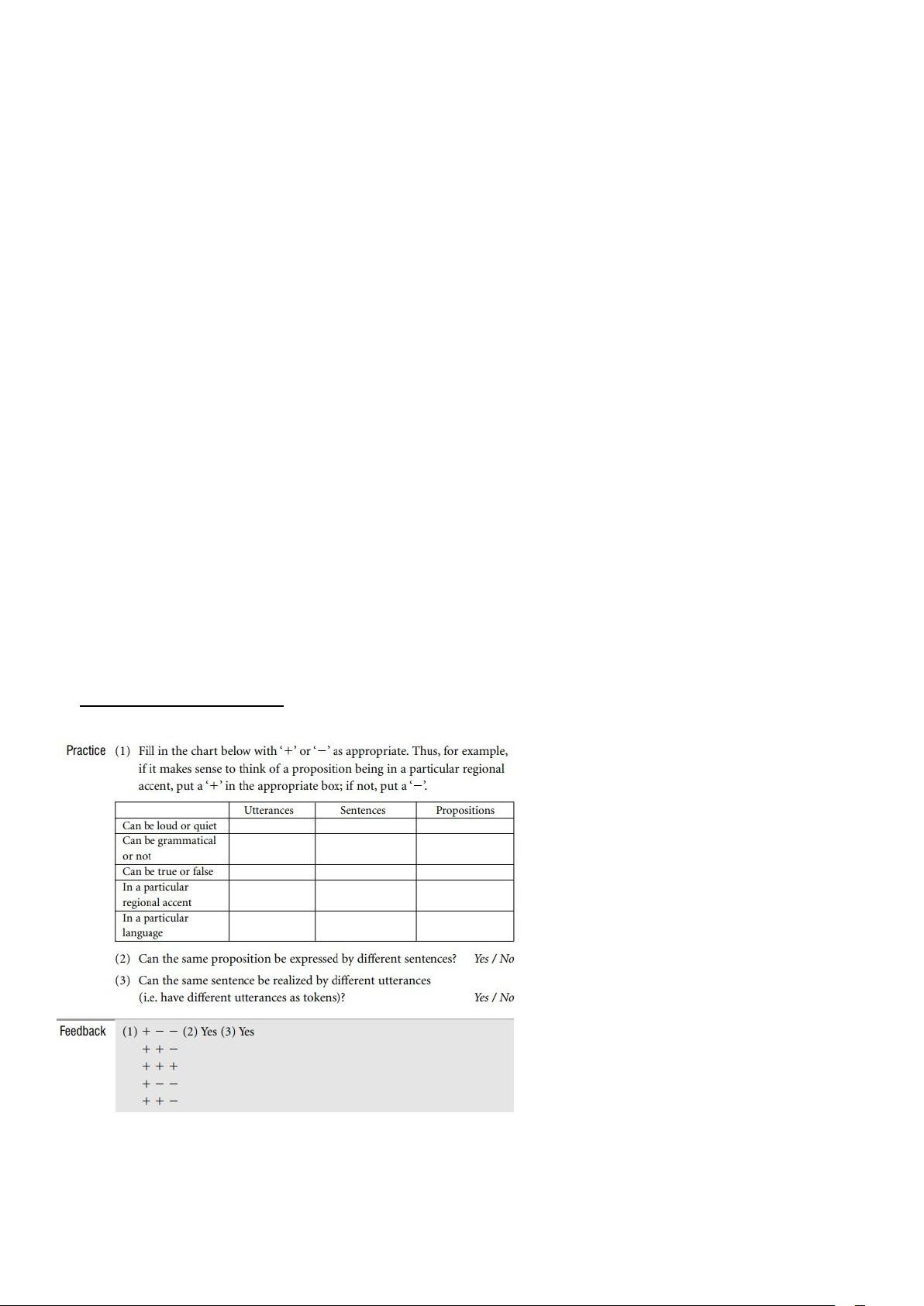
Unit 2: SENTENCES, UTTERANCES, AND PROPOSITIONS interrogatives=nghi vấn imperatives= mệnh lệnh 1. UTTERANCES -
Def: is any stretch of talk, by one person, before and after which there is silence on the part of that person.
→ An utterance is the USE by a particular speaker, on a particular occasion, of a piece of
language, such as a sequence of sentences, or a single phrase, or even a single word. - Eg. +
Hello, Not much,...--> utterances +
Pxgotmgt: this string of sounds is not from any language→ isn’t an utterance -
Note: utterance can be loud or quiet. 2. SENTENCES -
Def: is neither a physical event nor a physical object. It is, conceived abstractly, a string
of words put together by the grammatical rules of a language. A sentence can be thought
of as the IDEAL string of words behind various realizations in utterances and inscriptions (chữ viết). -
Phân biệt utterance và sentence: +
anything written between single quotation marks represents an utterance, and +
anything italicized represents a sentence or (similarly abstract) part of a sentence, such as a phrase or a word. - Eg.
‘Help’ represents an utterance.
The steeples have been struck by lightning represents a sentence.
‘The steeples have been struck by lightning’ represents an utterance.
John represents a word conceived as part of a sentence. -
Note: Not all utterances are actually tokens of sentences, but sometimes only of
parts of sentences, e.g. phrases or single words. 2 Eg.
Magnus: ‘When did Goethe die?’ Fred: ‘In 1832’ -
Def: A SENTENCE is a grammatically complete string of words expressing a complete thought.
Eg. 1 câu phải có động từ
I would like a cup of coffee is a sentence.
Coffee, please is not a sentence.
In the kitchen is not a sentence.
Please put it in the kitchen is a sentence. 3. PROPOSITIONS: -
Def: A PROPOSITION is that part of the meaning of the utterance of a declarative sentence
which describes some state of affairs. (mệnh đề là một phần ý nghĩa của câu nói của một câu
tuyên bố mô tả một số trạng thái của sự việc.) Eg. +
Harry took out the garbage,
Harry took the garbage out: these are always either both true or both false. + Dr Findlay killed Janet
Dr Findlay caused Janet to die: one could be true and the other false. For
example in the situation where Dr. Findlay had caused Janet to die, but not
intentionally, say by sending her to a place where, unknown to him, she was attacked.
Someone else could in fact be guilty of killing her. -
Note: True propositions correspond to facts, in the ordinary sense of the word fact.
False propositions do not correspond to facts.
→ Note rút ra trong bài tập: -
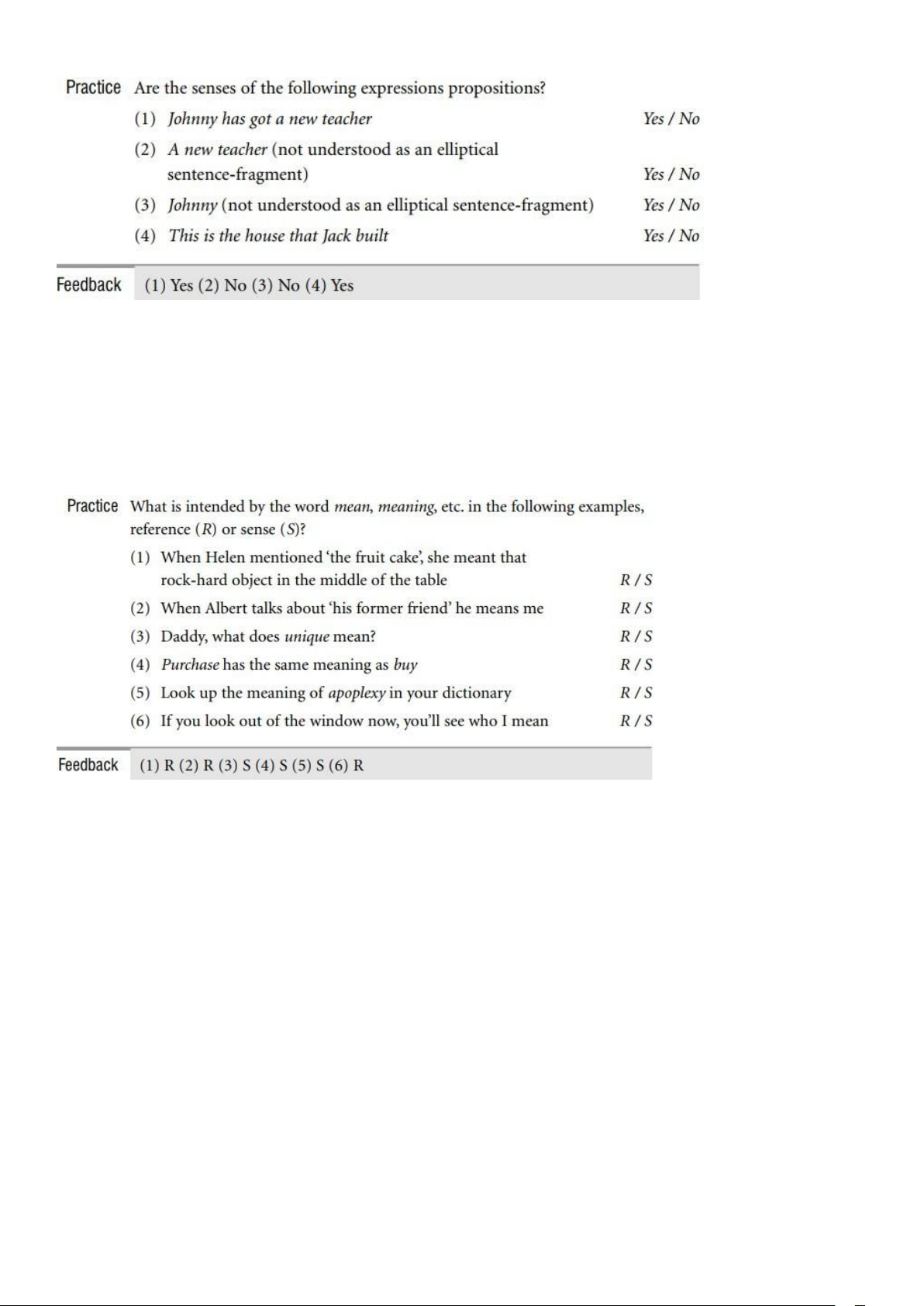
An utterance is tied to a particular time and place (a sentence thì không) Unit 3: Reference and sense
có liên quan đến unit 2 3 1. REFERENCE -
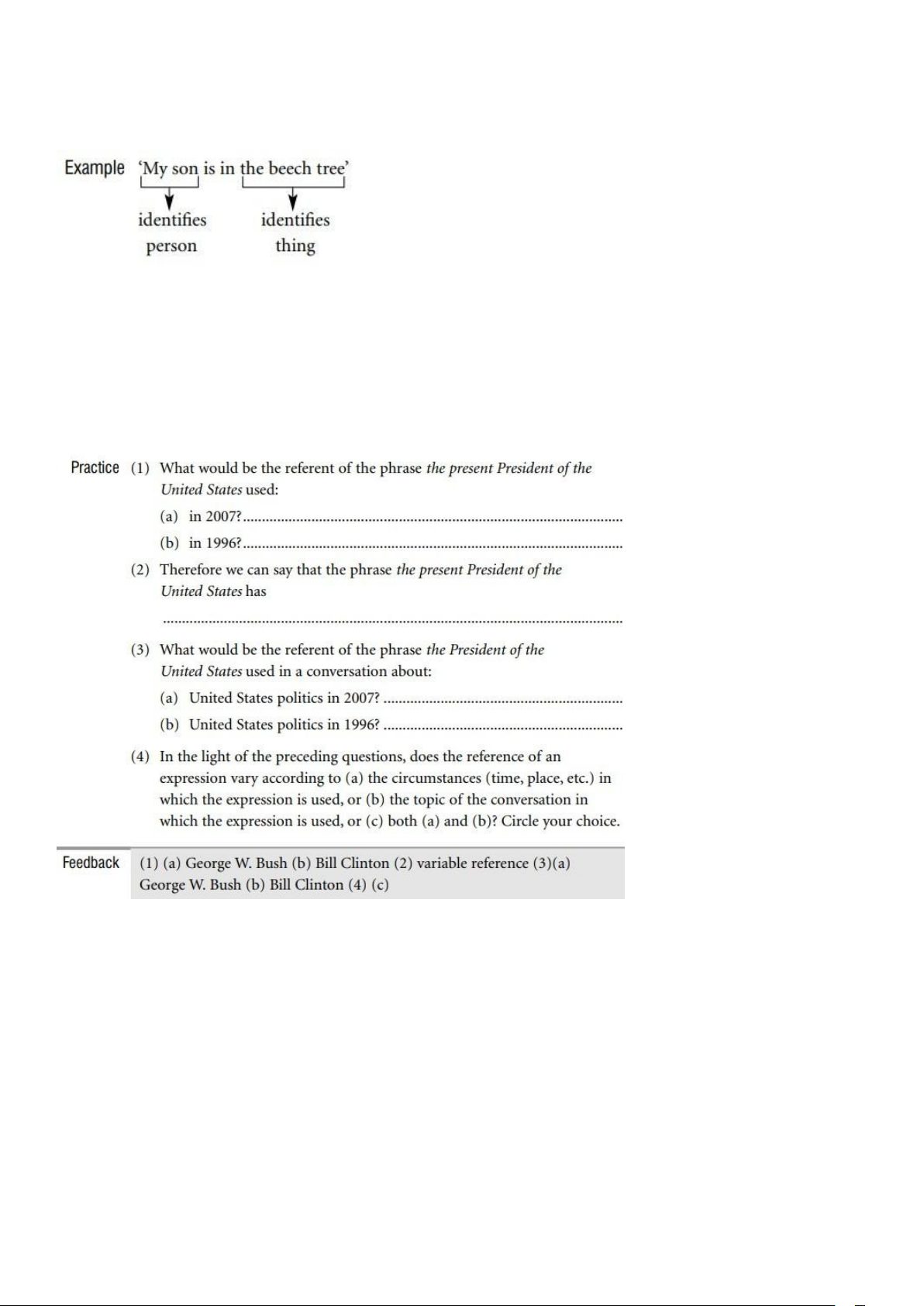
Def: By means of reference, a speaker indicates which things in the world (including
persons) are being talked about. - Eg. +
touch your left ear: your left ear is the referent of the phrase your left ear: reference is a
relationship between parts of a language and things outside the language (in the world). +
If you say to your mother ‘There’s a wasp on your left ear’, it refers to your mother’s left ear.
→ some (in fact very many) expressions in a language can have variable reference. -
Note: Two different expressions can have the same referent. The classic example is
the Morning Star and the Evening Star, both of which normally refers to the planet Venus. 2. SENSE -
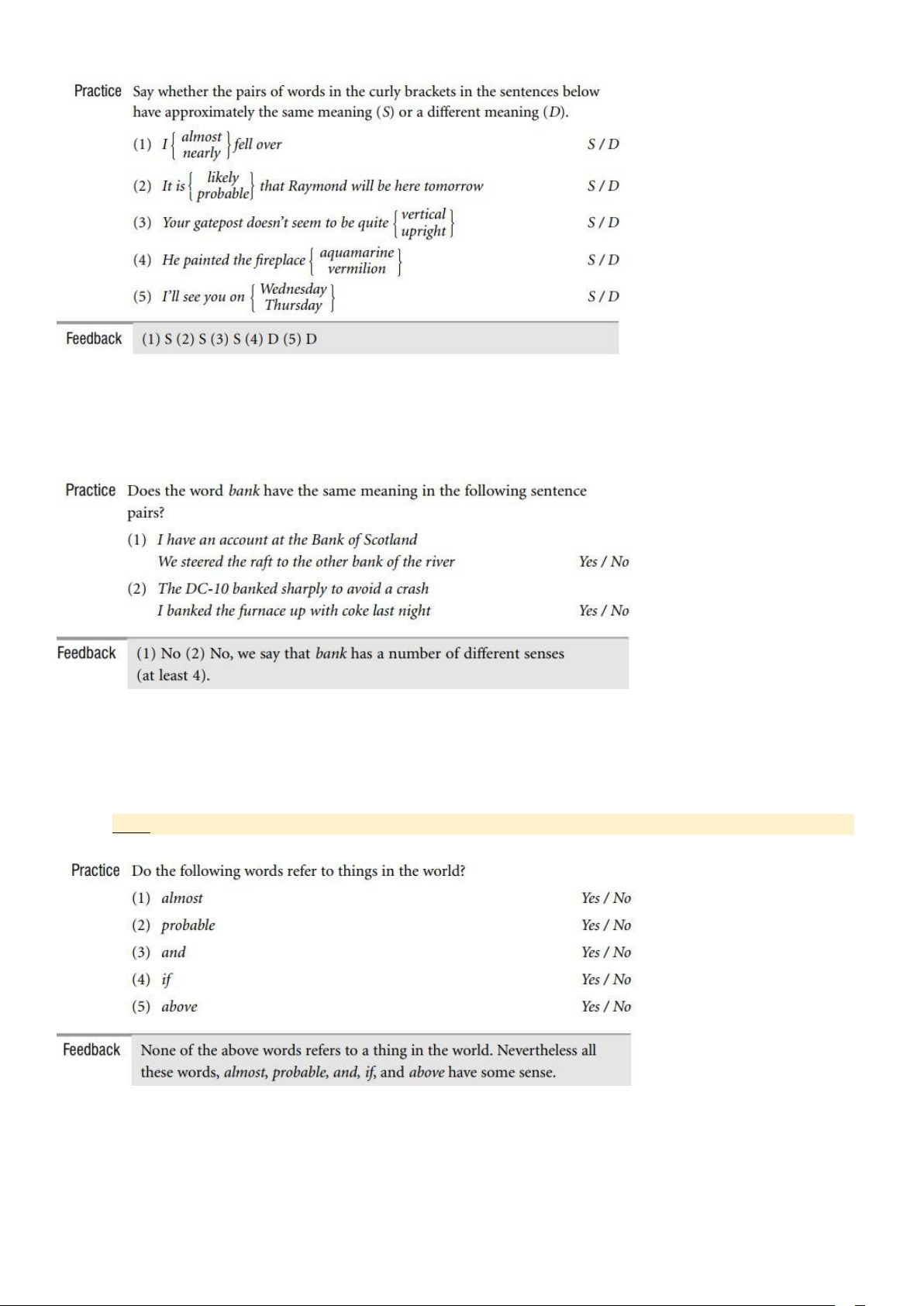
Def: the SENSE of an expression is its place in a system of semantic relationships with other expressions in the languag - Eg. 4 - Note: +
We can talk about the sense, not only of words, but also of longer expressions such as phrases and sentences. +
In some cases, the same word can have more than one sense. Eg. -
In the relationship between sense and reference: +
the referent of an expression is often a thing or a person in the world; whereas the sense of
an expression is not a thing at all. +
think of sense as that part of the meaning of an expression that is left over when reference is factored out. -
Rule: Every expression that has meaning has sense, but not every expression has reference. Eg. -
A proposition corresponds to a completely independent thought. Eg. 5 -
Just as one can talk of the same sense in different languages, so one can talk of expressions
in different dialects of one language as having the same sense.
Eg. pavement in British English and sidewalk in American English have the same sense. -
Điểm giống nhau: Both referring and uttering are acts performed by particular speakers on particular occasions. -
In everyday conversation the words meaning, means, mean, meant, etc. are sometimes used
to indicate reference and sometimes to indicate sense.
S: 2 chủ thể cùng chỉ một cái gì đó Unit 4: REFERRING EXPRESSIONS
có liên quan đến unit 3 - REFERRING EXPRESSIONS: +
Def: is any expression used in an utterance to refer to something or someone (or a clearly
delimited collection of things or people), i.e. used with a particular referent in mind. +
Eg. The name Fred in an utterance such as ‘Fred hit me’, where the speaker has a particular
person in mind when he says ‘Fred’, is a referring expression. Fred in ‘There’s no Fred at
this address’ is not a referring expression, because in this case, a speaker would not have a
particular person in mind in uttering the word. - Note: +
All of the ambiguities examples could be resolved by the use of the word certain
immediately following the indefinite article a, as in, for example: ‘Nancy wants to marry a certain
Norwegian’ or ‘John is looking for a certain car’. +
Indefinite noun phrases can be referring expressions 6
Eg. the man who shot Abraham Lincoln in ‘The man who shot Abraham Lincoln was an unemployed actor’ - An OPAQUE CONTEXT: +
Def: a part of a sentence which could be made into a complete sentence by the addition of a
referring expression, but where the addition of different referring expressions, even though they
refer to the same thing or person, in a given situation, will yield sentences with DIFFERENT
meanings when uttered in a given situation. +
Eg. ‘Laura Bush thinks that the President is a genius’ +
typically involves a certain kind of verb, like want, believe, think, and wonder about. - EQUATIVE SENTENCE: +
one which is used to assert the identity of the referents of two referring expressions, i.e. to
assert that two referring expressions have the same referent. +
Eg. The following are equative sentences:
→ Tony Blair is the Prime Minister
That woman over there is my daughter’s teacher. +
Note: A feature of many equative sentences is that the order of the two referring
expressions can be reversed without loss of acceptability.
Eg. The largest city in Africa is Cairo
Cairo is the largest city in Africa. Unit 5: PREDICATES
liên quan đến unit 3 & unit 4 - PREDICATOR: +
Def: The PREDICATOR of a simple declarative sentence is the word (sometimes a group of
words) which does not belong to any of the referring expressions and which, of the
remainder, makes the most specific contribution to the meaning of the sentence.
Intuitively speaking, the predicator describes the state or process in which the referring expressions are involved. +
Eg. asleep is the predicator in Mummy is asleep and describes the state Mummy is in.
love is the predicator in The white man loved the Indian maiden and describes the
process in which the two referring expressions the white man and the Indian maiden are involved.
wait for is the predicator in Jimmy was waiting for the downtown bus and describes
the process involving Jimmy and the downtown bus. + Note: ●
the verb be in its various forms (is, was, are, were, am) is not the predicator in any example
sentence that we have seen so far. ●
conjunctions (and, but, or) and articles (the, a), cannot serve as predicators in sentences. +
simple declarative sentences reveal 2 major semantic roles: ● role of predicator ●
the role(s) of argument(s), played by the referring expression(s)
Eg. Juan took Pablo to Rio predicator: take, arguments: Juan, Pablo, Rio 7 - PREDICATE: +
Def: is any word (or sequence of words) which (in a given single sense) can function as the predicator of a sentence. +
Eg. hungry, in, crook, asleep, hit, show, bottle, are all predicates; and, or, but, not, are not predicates. +
Phân biệt PREDICATOR VÀ PREDICATE: ●
The term ‘predicate’ identifies elements in the language system, independently of particular example sentences ●
The term ‘predicator’ identifies the semantic role played by a particular word (or group of
words) in a particular sentence. ●
A simple sentence only has one predicator, although it may well contain more than one instance of a predicate. ●
Eg. A tall, handsome stranger entered the saloon
This sentence has just one predicator, enter, but the sentence also contains the
words tall, handsome, stranger, and saloon, all of which are predicates, and
can function as predicators in other sentences, e.g. John is tall, He is
handsome, He is a stranger, and That ramshackle building is a saloon. - The DEGREE of a predicate: +
Def: a number indicating the number of arguments it is normally understood to have in simple sentences. +
Phân loại: (Có O đứng đằng sau V thì là 2 place (two arguments, one as its subject, and one
as its object), không có thì là 1 place) ●
one-place predicate. Eg: Thornbury sneezed ●
two-place predicate. Eg: Martha hit the sideboard ●
three-place predicates (a few). Eg: Herod gave Salome a nice present + Note: ●
the majority of adjectives are one-place predicates ●
Most nouns are one-place predicates. But a few nouns could be said to be ‘inherently
relational’. These are nouns such as father, son, brother, mother, daughter, neighbour. Eg. John
is a brother of the Mayor of Miami→ two-place predicate +
the identity relation=identity of the referents of two different referring expressions is
expressed by a form of the verb be. Eg: This is my father
Unit 6: PREDICATES, REFERRING EXPRESSIONS, AND UNIVERSE OF DISCOURSE
có liên quan đến unit 4 & 5 ● Thuật ngữ: ○ Predicate: vị ngữ ○
Referring expression: chỉ mối quan hệ giữa word và object được nói đến ○
Discourse: nghị luận, liên quan đến điều tra, nghiên cứu A generic sentence ●
Def: is a sentence in which some statement is made about a whole unrestricted class of
individuals, as opposed to any particular individual. ● generic: ○ Eg: ■
The whale is a mammal (understood in the most usual way) → is a generic sentence 8 ■
The whale over there is a mammal → is not a generic sentence ■
Gentlemens prefer blondes → generic sentence ●
A generic sentence can be introduced by either a or the (or neither) Universe of discourse ●
Def: We define the UNIVERSE OF DISCOURSE for any utterance as the particular world,
real or imaginary (or part real, part imaginary), that the speaker assumes he is talking about at the time. ● Type: ○ real-world - R
Eg: Mother to child: “Don’t touch those berries. They might be poisonous” ○ (partly) fictitious world - F
Eg: Mother to child: “Santa Claus might bring u a toy” ○ Different universes Eg:
A: ‘Did Jack’s son come in this morning?’
B: ‘I didn’t know Jack had a son’
A: ‘Then who’s that tall chap that was here yesterday?’
B: ‘I don’t know, but I’m pretty sure Jack hasn’t got any kids’
A: ‘I’m sure Jack’s son was here yesterday’
→ In A’s universe of discourse Jack’s son exists; In B’s he does not ○ Same universes
Eg: Optician: ‘Please read the letters on the bottom line of the card’ Patient: ‘E G D Z Q N B A’
Optician: ‘Correct. Well done’ ● Summary: ○
the notion of the universe of discourse is introduced to account for the way in which
language allows us to refer to non-existent things.
Unit 7: DEIXIS AND DEFINITENESS
liên quan đến Unit 2: Utterance và Unit 6 ● Thuật ngữ: ○
Deixis: trực chỉ; về thực chất là một hiện tượng nằm trong phạm vi quy chiếu. ■
Cách gọi trực chỉ bắt nguồn từ những hành động chỉ xuất ngoài ngôn ngữ. Vì vậy, trực chỉ
được dùng để áp dụng cho những phương tiện ngôn ngữ thực hiện chức năng quy chiếu. ■
Hay, nói một cách khác, nó chỉ ra và đồng nhất quy chiếu bằng cách trực tiếp dựa ngay vào
những mốc do hành động phát ngôn của người nói tạo ra. Những mốc cơ bản là: người nói – lúc nói – nơi nói. ■
Các phương tiện thực hiện chức năng trực chỉ: ● tôi, tao, mày... ●
hôm qua, hôm nay, ngày mai... ● đây, kia… ■
Ngoài ra, những phương tiện về phạm trù thời cũng mang nội dung có tính trực chỉ. A deictic ●
Def: A DEICTIC word is one which takes some element of its meaning from the context or
situation (i.e. the speaker, the addressee, the time, and the place) of the utterance in which it is used. 9 ● Eg: ○
The first person singular pronoun I is deictic ○
Ben says “ I’ve lost the contract” → “I” refers to Ben ○
If Wyatt Earp meets Doc Holliday in Dodge City and says, ‘This town ain’t big enough for
the both of us’, what does this town refer to?
→ “This town refers to “Đoge City” ●
“this” and “yesterday” are also deictic ● Type: ○ Personal deixis: I, you, he, ○
Demonstratives: this, that, these, those ○
Spatial deixis: here, there, etc ○
Temporal deixis: yesterday, today, tomorrow, etc ●
Some verbs have deictic ingredient: come, take, bring, go…
Eg: Go to the school → the speaker is not at school ●
Tenses are also regarded as deictic
Eg: "I graduated from high school in 2004."
→ This utterance can be made in or after the year 2004 ●
In reported speech, deictic words in the original utterance have to be changed to preserve the original reference Eg:
John said "I won the lottery yesterday."
John said he had won the lottery the day before "I was there yesterday" → I → personal → there → spatial → yesterday → temporal Definiteness ●
Def: A feature of noun phrase selected by the speaker to convey his assumption that the
hearer will be able to identify the referent of the noun phrase ● Eg: ○ the sun, the moon, the star
→ definite → bcs there is only 1 sun, 1 moon, 1 star in the context. ○
I was in the bed when the phone rang
→ the phone in my house → the phone is definite ●
Three main types of definite noun phrases in English: ○
Proper name: Mary, Princess Diana ○ Personal pronouns: he, she, it ○
Phrase introduced by a definite determiner: this, that, the, those, these, my, his, .. ●
*It follows from definition of definiteness all definite noun phrases are referring expression ○
However not every noun phrase using the so-called "definite article" the is necessarily semantically definite
Eg: In genetic sentences: The whale is a mammal
→ Definiteness contributes to truth of a sentence. 10
Unit 8: EXTENSIONS AND PROTOTYPES
Liên quan đến Unit 3, 5 và 6 Extensions ●
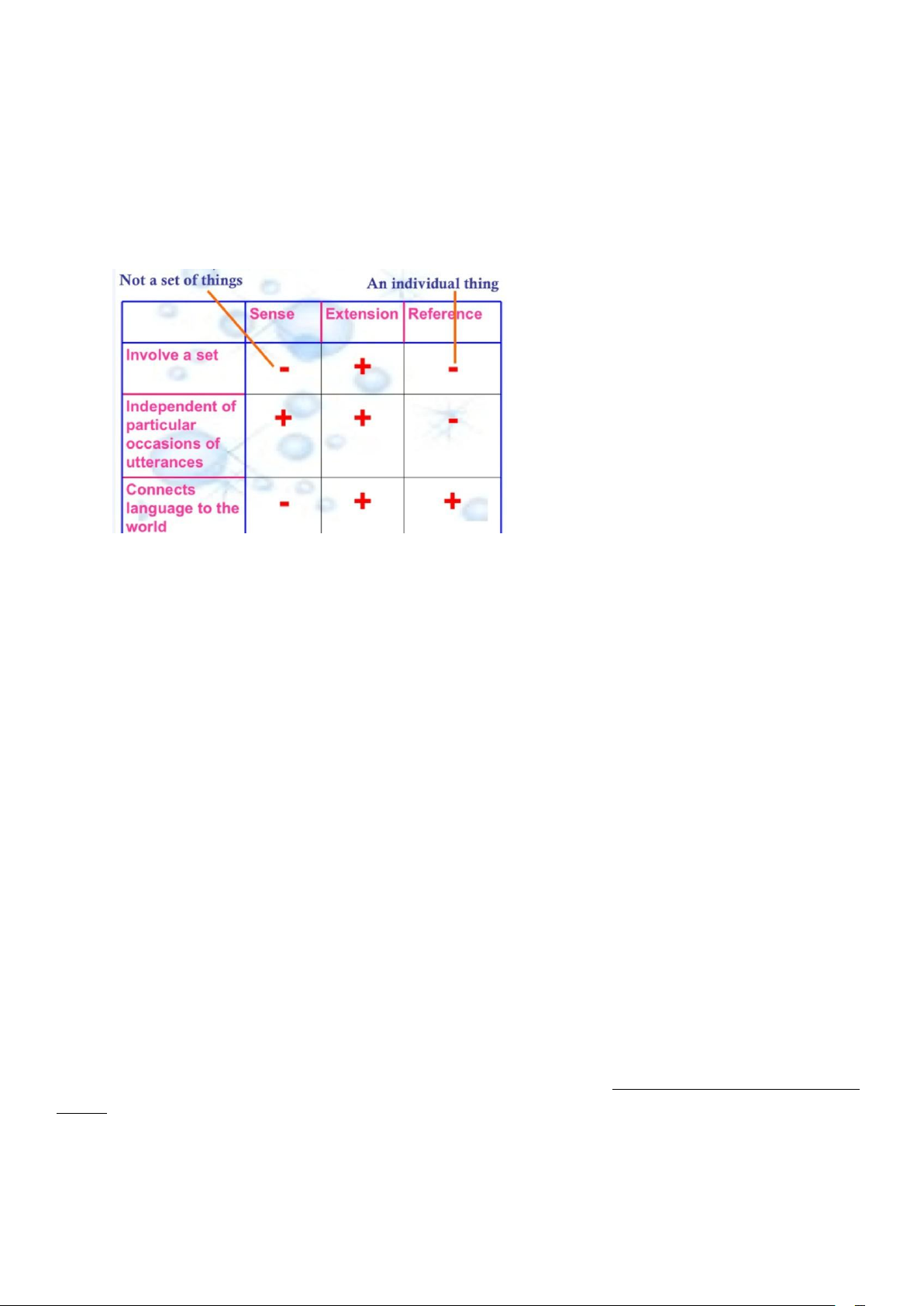
Def: Extension of a predicate of degree one is the set of all referents which that predicate potentially refers to. ● Sense, extension and reference ●
Having knowledge of the sense of a predicate (đoán vị ngữ)
→ (Definition of Dog: an animal with four legs and a tail, often kept as a pet or trained for
work, for example hunting or guarding building)
→ Define the set of all individual referents
(decide what is a dog, separate it from a cat or a wolf) → Develop its extension (the extension of dog) ●
The context of the utterance usually helps the hearers to identify which particular member is.
Eg: "The dog has bitten the postman."
→ Some members of the set of dogs have bitten the postman ○
Context of the utterance: in his own household, which has just one dog, named Bob
→ An individual of the extension of dog
→ Identify Bob as the referent of “the dog" ●
The extension of a predicate is relative to all times, past, present and future. ○ The extension of "dog" ■
The dog you had in the past and was dead ■ Your present dog ■
A dog you may own one day in the distant future ●
For some predicate, drawing a clear line around the set of all individuals, past, present, and
future and separating them from all the non-ones is impossible → a fuzzy set
Eg: Four-legged creatures: four-legged things -
Four-legged creatures: tiger, bird, cow, man (nói chung là có sự sống, là tập to) -
Four-legged things: table, tiger, chair, cow (không là người)
Eg: Striped-creatures: Striped (có sọc) human (là tập rỗng)
→ khác với cái trên không thể chia 11 Prototype: nguyên mẫu ● Def: ○
an object held to be very TYPICAL ○
can be referred to by an expression containing the predicate. ● Eg: ○
Cultural differences lead to different prototypes ■
Prototype of house of the Ethnic minority in Vietnam ■
Prototype of house of the American
Unit 9: SENSE PROPERTIES AND STEREOTYPES ● Thuật ngữ ○ Synthetic: giả tạo ○
contradiction: sự mâu thuẫn ○ indispensable: k thể thiếu Sense of expression ●
Def: The SENSE of an expression is its indispensable hardcore of meaning.
Eg: The sense of man includes the sense of human → Hyponymy Sense properties of sentences ●
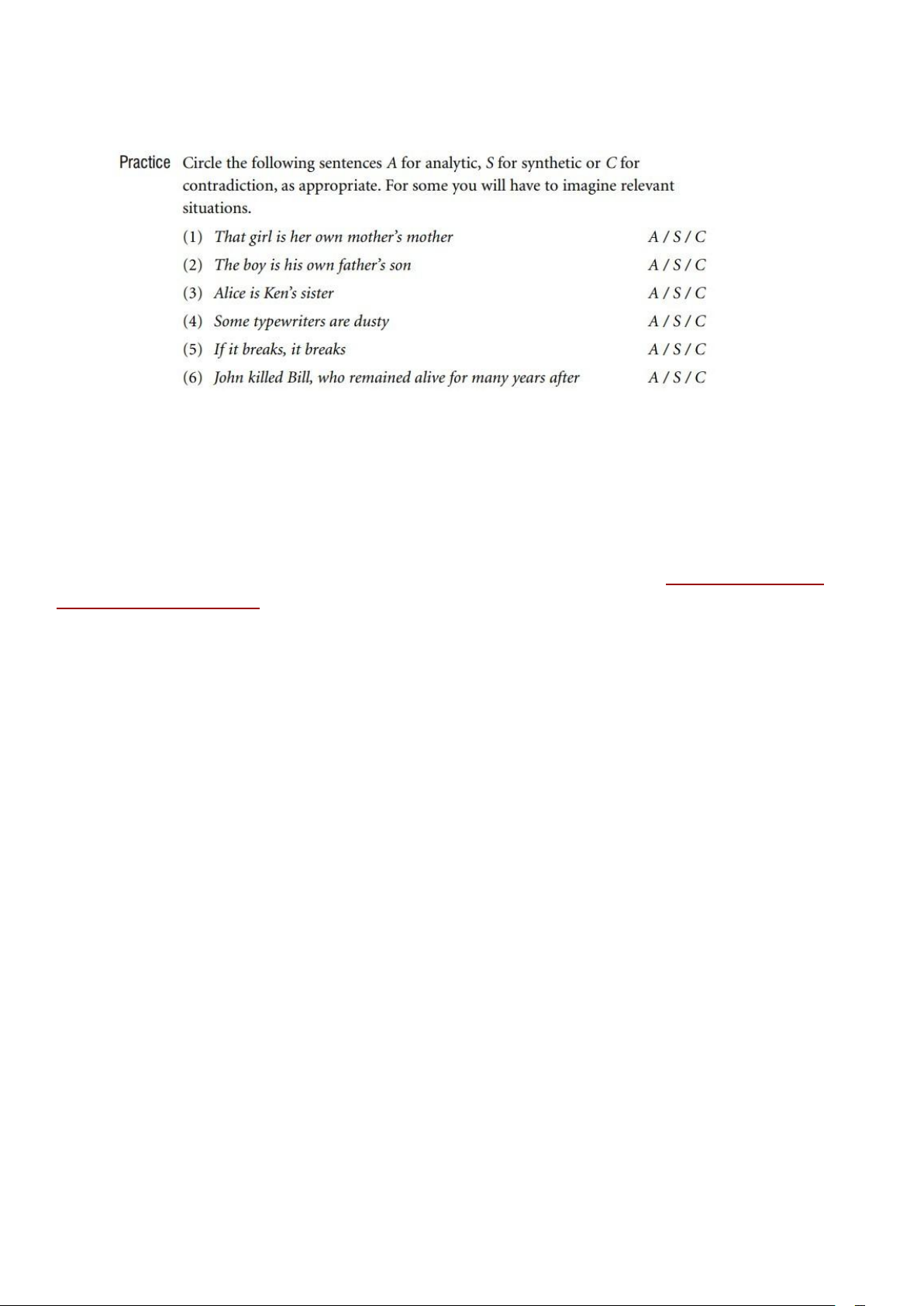
An ANALYTIC - A sentence is one that is necessarily TRUE, as a result of the senses of the
words in it. An analytic sentence, therefore, reflects a tacit (unspoken) agreement by speakers of
the language about the senses of the words in it. ○
whereas analytic sentences and contradictions are not informative to anyone who already
knows the meaning of the words in them ○
A SYNTHETIC - S sentence is one that is NOT analytic but may be either true or false,
depending on the way the world is ■
synthetic sentences are potentially informative in real-world situation ○
A CONTRADICTION - C is a sentence that is necessarily FALSE, as a result of the
senses of the words in it. Thus a contradiction is in a way the opposite of an analytic sentence ○ Eg: ○
Analytic: All elephants are animals
→ The truth of the sentence follows from the senses of elephants and animals. ○
Synthetic: John is from Ireland
→ There is nothing in the senses of John or Ireland or from which makes this necessarily true or false ● Eg: Contradiction ○
This animal is a vegetable → is a contradiction.
→ This must be false because of the senses of animals and vegetables. 12 ○
Both of John’s parents are married to aunts of mine → is a contradiction.
→ This must be false because of the senses of both parents, married, and aunt Key page 97 (113/366) ●
Analytic sentences can be formed from contradictions, and vice versa, by the insertion or
removal, as appropriate, of the negative particle word not. ○
That man is human has the sense property of analyticity (or of being analytic). ○
That man is tall has the sense property of syntheticity (or of being synthetic). ○
That man is a woman has the sense property of being a contradiction.
→ The sense of an expression can be thought of as the sum of its sense properties and sense relations (U10) Necessary condition ●
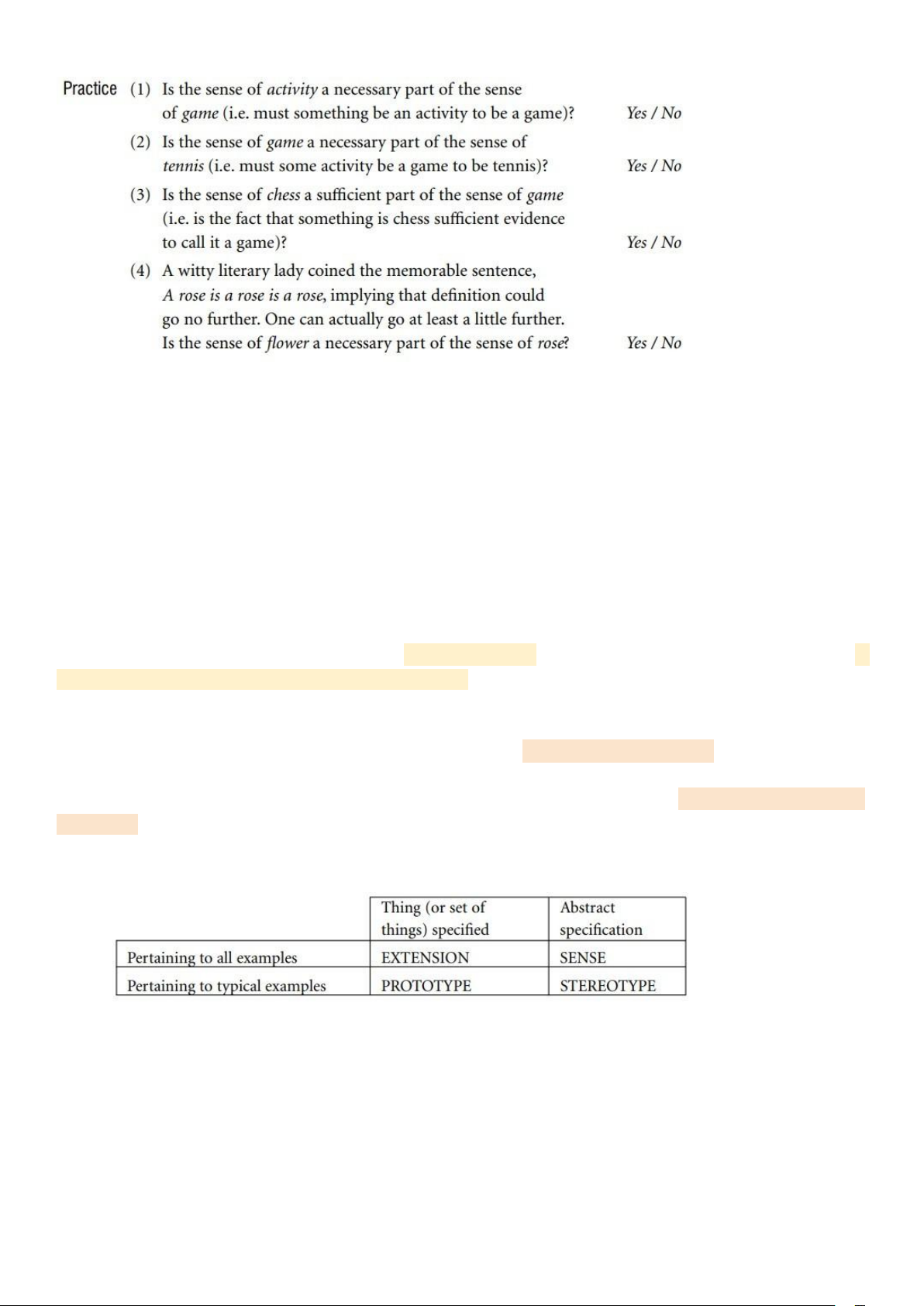
Def: A NECESSARY CONDITION on the sense of a predicate is a condition (or criterion) in
which a thing MUST meet in order to qualify as being correctly described by that predicate. ● Eg: ○ Predicate: square
→ necessary condition is “four-sided” A sufficient set of conditions ●
A SUFFICIENT SET OF CONDITIONS on the sense of a predicate is a set of conditions (or
criteria) which, if they are met by a thing, are enough in themselves to GUARANTEE that the
predicate correctly describes that thing ● Eg: ○
Plane figure, four-sided, equal-sided, and containing right angles’
→ is a sufficient set of conditions for the predicate square ○
‘Four-sided and containing right angles’
→ is not a sufficient set of conditions for square.
→ bcs other shapes (non-square), such as rectangles meet the conditions 13 Key 101 (117/366) Stereotype: khuôn mẫu ●
Def: The STEREOTYPE of a predicate is a list of the TYPICAL characteristics or features of
things to which the predicate may be applied ●
Eg: The stereotype of cat would be something like: ○
Quadruped, domesticated, either black, or white, or grey, or tortoise-shell, or marmalade in
colour, or some combination of these colours, adult specimens about 50 cm long from nose to tip
of tail, furry, with sharp retractable claws, etc., etc ● Stereo vs Prototype ○
A stereotype is related to a prototype (see the previous unit) but is not the same thing. ○
A prototype of an elephant is some actual elephant, whereas the stereotype of elephant is a
list of characteristics which describe the prototype. ○
Stereotype of predicate & Prototype of predicate ■
The stereotype of a predicate may often specify a range of possibilities (e.g. the range of colours of typical cats) ■
An individual prototype of this predicate will necessarily take some particular place within this range (e.g. black) ○
A speaker may well know a stereotype for some predicate (eg: ghost, witchdoctor) BUT not
actually be acquainted w/ any prototype of it ○ ○ Unit 10: SENSE RELATIONS (1)
IDENTITY AND SIMILARITY OF SENSE Liên quan đến U3 và 9 ●
Hyponymy: (ngôn ngữ) quan hệ thượng hạ vị (quan hệ giữa hai từ nghĩa của một từ
(scarlet đỏ tươi) luôn bao gồm nghĩa của từ kia (red đỏ), (nhưng không ngược lại) ● symmetric: đối xứng 14 Synonym ●
Def: SYNONYMY is the relationship between two predicates that have the same sense. ○ Eg: stubborn ~ obstinate Key 107 (123/366)
→ SYNONYM is not a relation btw words, words can be an intransitive verb or a transitive verb ● Eg: deep/ profound
(a) You have my deep/profound sympathy
(b) This river is very deep (This river is very profound is unacceptable.) Paraphrase ●
A sentence which expresses the same proposition as another sentence is a PARAPHRASE of
that sentence (assuming the same referents for any referring expressions involved) ●
Paraphrase is to SENTENCES (on individual interpretations) as SYNONYMY is to
PREDICATES (though some semanticists talk loosely of synonymy in the case of sentences as well). ●
Eg: Bachelors prefer redhaired girls
→ is a paraphrase of Girls with red hair are preferred by unmarried men 15 Key 109 (125 / 366) Hyponym ●
Def: HYPONYMY is a sense relation between predicates (or sometimes longer phrases) such
that the meaning of one predicate (or phrase) is included in the meaning of the other. ● Eg: ○
The meaning of red is included in the meaning of scarlet. ○
Red is the superordinate term; scarlet is a hyponym of red (scarlet is a kind of red) 16
Symmetrical Hyponymy (đối xứng quan hệ thượng hạ vị) ●
Rule: If X is a hyponym of Y and if Y is also a hyponym of X, then X and Y are synonymous ●
A proposition X ENTAILS a proposition Y if the truth of Y follows necessarily from the truth
of X. We extend this basic definition in terms of propositions to cover SENTENCES in the
following way. A sentence expressing proposition X entails a sentence expressing proposition Y if
the truth of Y follows necessarily from the truth of X ○
Eg: John ate all the kippers (X) entails Someone ate something (Y).
John killed Bill (X) entails Bill died (Y).
→ It is not possible to think of any circumstances in which sentence X is true and sentence Y false.
→ Hyponymy and synonymy are sense relations between predicates. ●
The sense relations between predicates and those between sentences are systematically
connected by rules such as the basic rule of sense inclusion. ●
These sense relations are also systematically connected with such sense properties of
sentences as ANALYTICITY and CONTRADICTION. Entailments ●
Entailment applies cumulatively. Thus if X entails Y and Y entails Z, then X entails Z.
(Technically, entailment is a transitive relation. See Unit 18.) ● Eg: ○
John and Mary are twins entails Mary and John are twins; ○
Mary and John are twins entails John and Mary are twins.
→ Therefore, John and Mary are twins is a paraphrase of Mary and John are twins. 17 ●
Two sentences may be said to be PARAPHRASES of each other if and only if they have
exactly the same set of ENTAILMENTS; or, which comes to the same thing, if and only if they
mutually entail each other so that whenever one is true the other must also be true ●
The relationship between entailment and paraphrase is parallel to the
relationship between hyponymy and synonymy ●
as synonymy is symmetric (i.e. two-way) hyponymy, paraphrase is symmetric
(i.e. two-way) entailment. Unit 11: SENSE RELATIONS (2)
OPPOSITENESS AND DISSMILARITY OF SENSE AND AMBIGUITY Liên quan đến U3, 9, 10 ● Antonymy: từ trái nghĩa ○
gồm binary antonymy: chắc là trái nghĩa đôi nhg k liên quan đến nhau → quan hệ loại trừ ● Homonymy: từ đồng âm ●
Gradable: có thể chia cấp độ, cấp bậc được ● Polysemy: từ nhiều nghĩa ●
referential versatility: tính linh hoạt có thể tham khảo ●
incompatibility: sự xung khắc, kỵ nhau ●
proposition: lời tuyên bố, lời xác nhận
Binary antonymy (Complementarity) ●
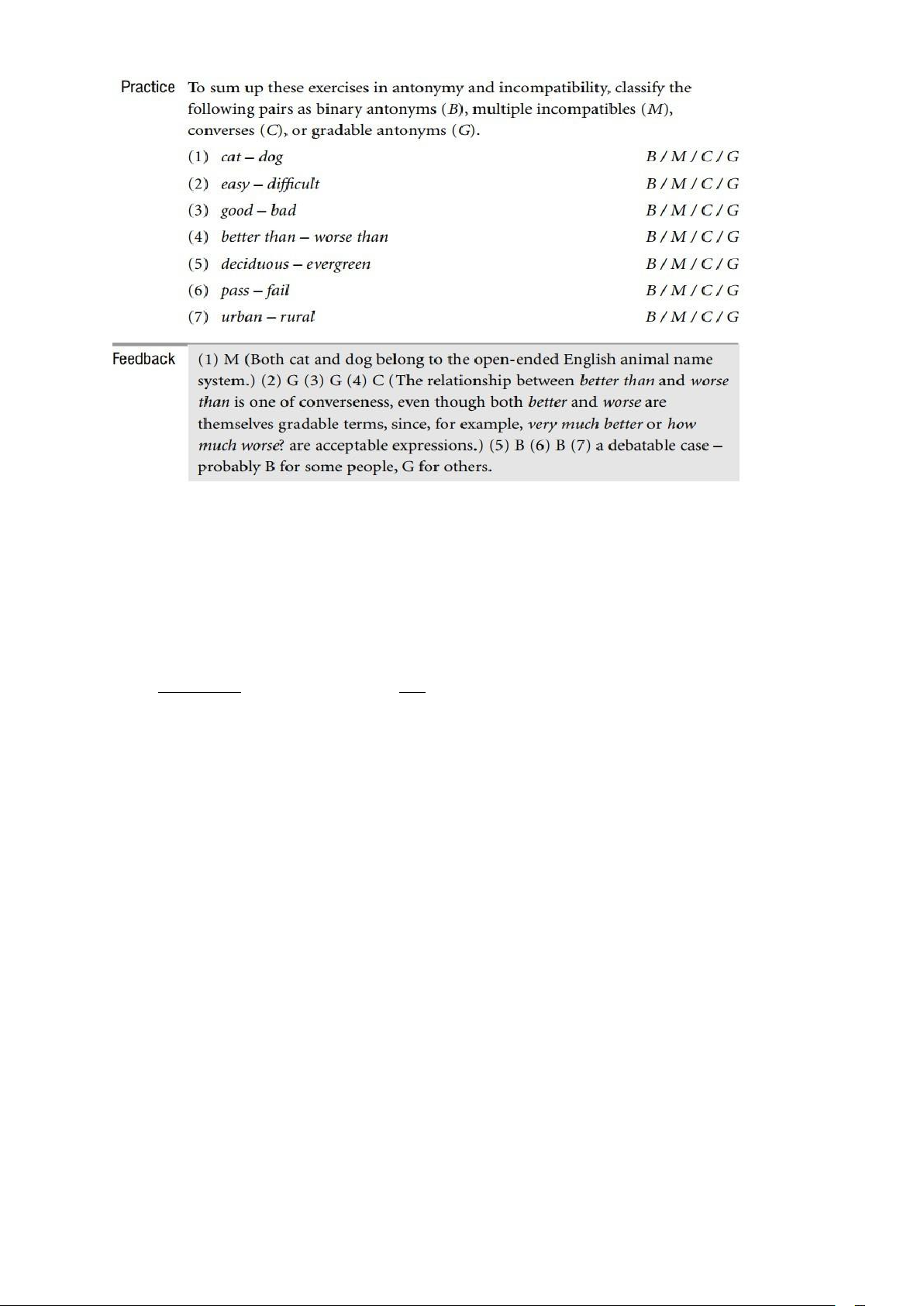
Def: BINARY ANTONYMS are predicates which come in pairs and between them exhaust all the relevant possibilities. ○
If the one predicate is applicable, then the other cannot be, and vice versa. Another way to
view this is to say that a predicate is a binary antonym of another predicate if it entails the negative of the other predicate. ○
Eg: true - false / same - different / dead - alive / married - unmarried 18
→ If a sentence is true, it cannot be false. If it is false, it cannot be true. Alternatively,
if something is true, this entails that it is not false. If it is false, this entails it is not true. Converses ●
Def: If a predicate describes a relationship between two things (or people) and some other
predicate describes the same relationship when the two things (or people) are mentioned in the
opposite order, then the two predicates are CONVERSES of each other. ● Eg: btw 2 things ○
Parent - child are converses
→ because X is the parent of Y (one order) describes the same situation (relationship)
as Y is the child of X (opposite order). ○
Below - above are converse → If X is below, Y is above ○
Grandparent - grand children ○ love - hate → No ● Eg: btw 3 things ○
If A bought a car from B, is it the case that B sold a car for A? → Yes ○ borrow - lend ○
give - take → No, if X takes something from Y, Y does not necessarily give that thing to X
(for example, X might take it without Y’s permission)
Systems of multiple incompatibility: sự xung khắc ●
What these systems have in common is that (a) all the terms in a given system are mutually
incompatible, and (b) together, the members of a system cover all the relevant area. ● Eg: ○
a playing card cannot belong to both the hearts suit and the spades suit. And besides hearts,
clubs, diamonds, and spades, there are no other suits.
→ bộ bài → là 1 bộ nhưng quân bài khác nhau ○
the flower system (pansy, primrose, poppy, etc.) ○
the furniture system (table, chair, bed, etc.)
Gradable antonyms (từ trái nghĩa cấp bậc) ●
Two predicates are GRADABLE antonyms if they are at opposite ends of a continuous scale
of values (a scale which typically varies according to the context of use). ● Eg: ○
Hot - cold → Between hot and cold is a continuous scale of values, which may be given
names such as warm, cool, or tepid. ○ tall - short ○
love - hate → Yes, intermediate expressions on the scale include like, dislike, be indifferent to ○ top - bottom → No ●
có cách kiểm tra graduable antonyms → xem từ đó có thể kết hợp với very, how?, how
much? được hay không 19
Contradictoriness (said of sentences) trái nghĩa của câu ●
Def: A proposition is a CONTRADICTORY of another proposition if it is impossible for them
both to be true at the same time and of the same circumstances. ● Eg: ○
This beetle is alive is a contradictory of This beetle is dead ○
John murdered Bill / John did not kill Bill ○
Bill died / James can not swim → No ● Statement A ○
(a) one contains a word X where the other contains a word Y, ○
and (b) X is an antonym of Y (or X is incompatible with Y),
→ then the two sentences are contradictories of each other
Conclusion → Statement A true or false?
Ambiguity (structure & lexical) ● Def: ○
A word or sentence is AMBIGUOUS when it has more than one sense. ○
Structure: A sentence is ambiguous if it has two (or more) paraphrases which are not
themselves paraphrases of each other ● Eg: ○
We saw her duck is a paraphrase of We saw her lower her head and of We saw the duck belonging to her
→ these last two sentences are not paraphrases of each other. Therefore We saw her duck is ambiguous. ○
Visiting relatives can be boring ■
It can be boring to visit relatives ■
vs Relatives who are visiting can be boring ● Def: lexical 20 ○
In the case of words and phrases, a word or phrase is AMBIGUOUS if it has two (or more)
SYNONYMS that are not themselves synonyms of each other. ●
Eg: coach is synonymous with trainer and with charabanc (or bus)
→ but these two are not synonyms of each other, so coach is ambiguous. Homonymy: từ đồng âm ● Def: ○
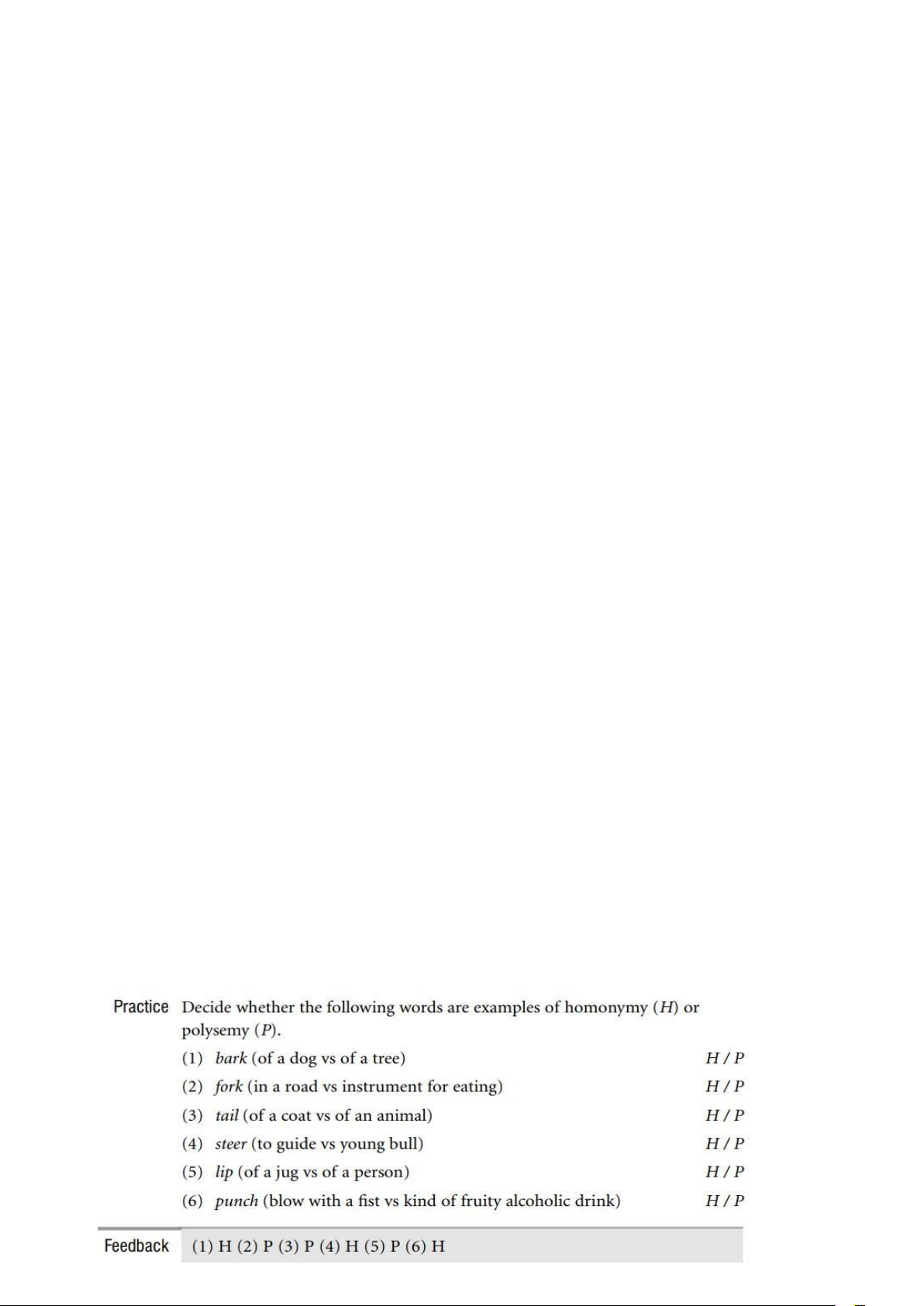
A case of HOMONYMY is one of an ambiguous word whose different senses are far apart
from each other and not obviously related to each other in any way with respect to a native speaker’s intuition. ○
Cases of homonymy seem very definitely to be matters of mere accident or coincidence. ● Eg: ○
Mug (drinking vessel vs gullible person) would be a clear case of homonymy. ○
Bank (financial institution vs the side of a river or stream) is another clear case of
homonymy. → There is no obvious conceptual connection between the two meanings of either word. Polysemy: từ nhiều nghĩa ● Def: ○
A case of POLYSEMY is one where a word has several very closely related senses ○
In other words, a native speaker of the language has clear intuitions that the different senses
are related to each other in some way ● Eg: ○
Mouth (of a river vs of an animal) is a case of polysemy.
→ The two senses are clearly related by the concepts of an opening from the interior
of some solid mass to the outside, and of a place of issue at the end of some long narrow channel. ●
Polysemy in nouns is quite common in human languages ○ Eg: Run ■ run a race (on foot), ■
run for office, this road runs from east to west, the motor is running, ■
the water is running down the roof, ○
drive (as in drive a nail vs as in drive a car)
→ Both contain the concept of land at different levels of generality (earth as land, not sky Referential versatility & vagueness vs ambiguity ● Def: A sentence even though