











Preview text:
December 2023 - Volume 41 - Issue 12 Bài báo trước Bài viết tiếp theo Đề cương Mục lục GIỚI THIỆU THIỆU
CÓ GÌ MỚI VÀ NHỮNG GÌ ĐÃ THAY ĐỔI TRONG HƯỚNG DẪN CỦA XÃ HỘI TĂNG ÁP CHÂU ÂU NĂM 2023?
1. PHƯƠNG PHÁP VÀ ĐỊNH NGHĨA CHỨNG CỨ
1.1 Phương pháp phân loại bằng chứng 1.2 Mức độ bằng chứng
2. NGUYÊN TẮC SINH LÝ BỆNH TĂNG HUYẾT ÁP
3. ĐỊNH NGHĨA TUYỆT VỜI VÀ PHÂN LOẠI HA
3.1 Định nghĩa tăng huyết áp
3.2 Phân loại tăng huyết áp
3.3 Tỷ lệ tăng huyết áp
3.4 Mối liên quan giữa HA với nguy cơ biến cố não, tim mạch và thận
3.5 Tăng huyết áp và đánh giá nguy cơ tim mạch tổng thể
3.6 Lọc để phát hiện bệnh trong áp lực tăng huyết áp
3.7 Xác nhận chẩn đoán tăng huyết áp
4. ĐO LƯỜNG VÀ THEO DÕI HA
4.1 Thiết bị đo huyết áp
4.1.1 Thiết bị dựa trên vòng bít tiêu chuẩn
4.1.2 Thiết bị đo huyết áp không vòng bít
4.1.3 Kiểm định thiết bị đo huyết áp
4.2 Tiêu chuẩn đo huyết áp phòng khám
4.3 Đo huyết áp tại phòng khám không cần giám sát
4.4 Huyết áp khi tập luyện
4.5 Đo huyết áp tại bệnh viện 4.6 Huyết áp trung tâm
4.7 Theo dõi huyết áp tại nhà
4.8 Theo dõi huyết áp lưu động
4.9 Chỉ sẵn sàng lâm sàng của HBPM và ABPM 4.10 Biến thiên huyết áp 5. LÀM VIỆC BỆNH NHÂN
5.1 Lịch sử cá nhân và y tế 5.2 Khám thực thể
5.3 Xét nghiệm hóa học lâm sàng thường quy
5.4 Các nghiên cứu khác về tăng huyết áp 5.4.1 Điện tâm đồ 5.4.2 Siêu âm thận
5.4.3 Các dấu ấn sinh học và dấu hiệu di truyền được chọn lọc 5.4.3.1 Lipoprotein (a)
5.4.3.2 Dấu ấn sinh học tim 5.4.3.3 Dấu hiệu thận
5.4.3.4 Dấu hiệu di truyền
5.5 Đánh giá tổn thương cơ quan do tăng huyết áp 5.5.1 HMOD trong tim
5.5.1.1 Khối lượng và hình dạng thất trái
5.5.1.2 Siêu âm tim qua thành ngực
5.5.1.3 Cộng hưởng từ tim
5.5.1.4 Chụp cắt lớp vi tính tim
5.5.2 HMOD trong động mạch
5.5.2.1 IMT và mảng bám động mạch cảnh 5.5.2.2 Vận tốc sóng xung
5.5.2.3 Chỉ số cổ chân – cánh tay 5.5.3 HMOD ở thận 5.5.4 HMOD trong não 5.5.5 HMOD ở mắt
5.6 Sử dụng HMOD giúp phân tầng nguy cơ ở bệnh nhân tăng huyết áp
5.7 Khi nào cần giới thiệu bệnh nhân đến bác sĩ chuyên khoa hoặc chăm sóc tại bệnh viện
6. TĂNG HUYẾT ÁP THỨ PHÁP
6.1 Nguyên nhân di truyền gây tăng huyết áp thứ phát 7. CAN THIỆP LỐI SỐNG
7.1 Sự liên quan của việc thay đổi lối sống 7.2 Giảm cân 7.3 Hạn chế ăn natri
7.4 Tăng cường lượng kali ăn vào
7.5 Tăng mức độ hoạt động thể chất hàng ngày và tập thể dục thường xuyên
7.6 Uống rượu vừa phải 7.7 Cai thuốc lá
7.8 Các can thiệp về chế độ ăn uống khác
7.9 Cải thiện việc quản lý căng thẳng
7.10 Tiếp xúc với tiếng ồn và ô nhiễm không khí
8. LỢI ÍCH CỦA ĐIỀU TRỊ BỆNH TĂNG HUYẾT ÁP
9. BẮT ĐẦU ĐIỀU TRỊ BẰNG THUỐC KHI TĂNG HUYẾT ÁP
9.1 Việc bắt đầu điều trị có nên dựa trên tổng nguy cơ tim mạch không?
9.2 Ngưỡng HA tại phòng khám để bắt đầu điều trị bằng thuốc
9.3 Có nên bắt đầu điều trị hạ huyết áp ở bệnh nhân có huyết áp tại phòng khám <140/90 mmHg?
9.4 Bắt đầu điều trị bằng thuốc ở người lớn tuổi
10. MỤC TIÊU ĐIỀU TRỊ CỦA VĂN PHÒNG BP
10.1 Mục tiêu HA tại phòng khám ở bệnh nhân tăng huyết áp nói chung
10.2 Mục tiêu huyết áp tại phòng khám so với tại nhà và cấp cứu
10.3 Thời điểm kiểm soát HA và thời gian trong khoảng điều trị 10.4 Rủi ro tồn dư
10.5 Những thách thức liên quan đến bằng chứng về mục tiêu huyết áp
11. THUỐC GIẢM TĂNG ÁP VÀ ĐIỀU TRỊ
11.1 Thuốc chẹn hệ thống renin-angiotensin (RAS)
11.1.1 Thuốc ức chế men chuyển angiotensin
11.1.2 Thuốc chẹn thụ thể angiotensin 11.1.3 Chất ức chế renin
11.1.4 Kết hợp thuốc ức chế RAS
11.2 Thuốc chẹn kênh canxi 11.2.1 CCB dihydropyridine 11.2.2 CCB nondihydropyridine 11.3 Thuốc lợi tiểu 11.3.1 Thiazide/Thiazide-like 11.3.2 Loop diuretics
11.3.3 Potassium-sparing diuretics
11.4 Mineralocorticoid receptor antagonists 11.5 Beta-blockers 11.6 Alpha-1 blockers 11.7 Central y acting drugs 11.8 Vasodilators
11.9 Angiotensin receptor-neprilysin inhibitor (ARNI)
11.10 Antihypertensive drug combinations
11.10.1 Impact on hypertension drug treatment strategy 11.10.2 Drug combinations
11.10.3 Rationale for initial two-drug combination therapy
11.10.4 Up-titration of treatment to three-drug combination
11.10.5 Rationale for single-pil combination therapy 11.10.6 The quadpil concept 11.10.7 The polypil concept
11.10.8 Choice of drug combinations for initiation of treatment
11.10.9 Tolerability and side effects of drugs
11.10.10 Prescribing of antihypertensive drugs
11.10.10.1 Standard drug administration
11.10.10.2 Partial treatment reduction or complete withdrawal
11.10.10.3 Antihypertensive drugs and cancer risk
11.10.11 Concomitant medications
11.10.11.1 LDL-cholesterol lowering
11.10.11.2 Antiplatelet therapy
12. TRUE RESISTANT HYPERTENSION
12.1 Definition, prevalence, pathophysiology and cardiovascular risk 12.2 Diagnostic work-up
12.3 Optimizing lifestyle changes and ongoing drug therapy
12.4 Fourth and subsequent lines of antihypertensive therapy
13. DEVICE-BASED TREATMENT OF HYPERTENSION 13.1 Renal denervation (RDN)
13.1.1 Clinical Evidence of the BP-lowering effect of RDN 13.1.2 Off-medications studies 13.1.3 On-medications studies 13.1.4 Safety 13.1.5 Durability 13.1.6 Application
13.2 Carotid baroreceptor stimulation
13.3. Other device-based treatments
14. SPECIFIC HYPERTENSION PHENOTYPES
14.1 Sustained hypertension and true normotension 14.2 White-coat hypertension 14.3 Masked hypertension
14.4 White-coat uncontrol ed hypertension (WUCH) and masked uncontrol ed hypertension (MUCH)
14.5 Isolated systolic hypertension of the young
14.6 Isolated systolic hypertension in older persons
14.7 Isolated diastolic hypertension
14.8 Night-time hypertension and dipping
14.9 Orthostatic hypertension and hypotension
14.10 Baroreflex failure and efferent autonomic failure
15. HYPERTENSION IN DIFFERENT DEMOGRAPHIC SITUATIONS
15.1 Blood pressure in children, adolescents and transition period
15.1.1 Blood pressure measurements in children and adolescents
15.1.2 Hypertension in children and adolescents
15.1.3 Transition period to adulthood
15.2 Hypertension in young adults
15.3 Hypertension in older persons
15.3.1 Patients 65–79 years old
15.3.1.1 Threshold and target for drug treatment
15.3.1.2 Antihypertensive treatment strategies
15.3.1.3 Antihypertensive drugs
15.3.1.4 Monitoring the effects of treatment
15.3.2 Patients 80 years old or beyond
15.3.3 How to assess the level of frailty/functionality to better personalize therapeutic strategies
15.4 Sex and gender aspects in hypertension
15.4.1 Epidemiology and pathophysiology
15.4.2 Blood pressure and cardiovascular risk
15.4.3 Differences in clinical phenotypes
15.4.3.1 White-coat hypertension and masked hypertension
15.4.3.2 Hypertension-mediated organ damage
15.4.4 Sex differences in hypertension outcomes
15.4.5 Benefits of antihypertensive treatment and target blood pressure
15.4.6 Sex differences in hypertension management
15.4.7 Infertility treatments and hypertension in women
15.4.8 Oral contraceptive pil s and hypertension
15.4.9 Hormone-replacement therapy and hypertension
15.4.10 Gender-affirming hormone therapy and hypertension
15.5 Hypertension and ethnicity
15.5.1 Nomenclature and relevance 15.5.2 Management
16. HYPERTENSION IN SPECIFIC SETTINGS
16.1 Hypertension disorders in pregnancy
16.1.1 Definition and classification of hypertension in pregnancy
16.1.2 Blood pressure measurement in pregnancy
16.1.3 Laboratory examinations in pregnancy
16.1.4 Prediction and prevention of preeclampsia 16.1.5 Lifestyle interventions
16.1.6 Clinical management of hypertension in pregnancy
16.1.6.1 Mild preexisting essential hypertension
16.1.6.2 Mild gestational hypertension 16.1.6.3 Preeclampsia 16.1.6.4 Severe hypertension
16.1.6.5 Preexisting secondary hypertension
16.1.7 Blood pressure during puerperium
16.1.8 Postpartum hypertension and breastfeeding
16.1.9 Risk of recurrence of hypertensive disorders in a subsequent pregnancy
16.1.10 Long-term cardiovascular consequences of hypertensive disorders in pregnancy
16.2 Hypertensive urgencies and emergencies
16.2.1 Definitions of hypertensive urgencies and emergencies
16.2.2 Hospital work-up, treatments and fol ow-up
16.2.3 Blood pressure in the emergency department
16.3 Perioperative hypertension and its management
17. HYPERTENSION IN ESTABLISHED CARDIOVASCULAR DISORDERS 17.1 Coronary artery disease
17.1.2 Treatment of hypertensive patients with coronary artery disease 17.2 Heart failure
17.2.1 Prevention of heart failure in hypertension
17.2.2 Heart failure with reduced ejection fraction (HFrEF)
17.2.3 Heart failure with preserved ejection fraction (HFpEF)
17.2.4 Overal management of heart failure and classification
17.3 Hypertension and atrial fibril ation
17.3.1 Blood pressure measurement in atrial fibril ation
17.3.2 Detection of atrial fibril ation
17.3.3 Prevention and treatment of atrial fibril ation in hypertension
17.3.4 Oral anticoagulation and BP control 17.4 Valvular heart disease 17.4.1 Aortic stenosis 17.4.2. Aortic regurgitation 17.4.3 Mitral regurgitation
17.5 Cerebrovascular disease and cognition
17.5.1 Management of elevated BP in acute stroke
17.5.1.1 Acute hemorrhagic stroke 17.5.1.2 Acute ischemic stroke
17.5.2 Management of elevated BP in patients with previous stroke or transient ischemic attack
17.5.3 Management of patients with cognitive dysfunction and dementia 17.6 Vascular disease
17.6.1 Lower extremity arterial disease
17.6.2 Aortic dilatation, aneurysm and dissection
18. HYPERTENSION AND DIABETES MELLITUS
18.1. Epidemiology and risk classification 18.2 Benefits of BP-lowering
18.3 Antihypertensive drug treatment
19. HYPERTENSION AND THE KIDNEY
19.1 Treatment of hypertension in CKD 19.1.1 Treatment BP targets
19.1.2 Antihypertensive drug treatment
19.1.3 Special therapeutic chal enges
19.1.4 Sử dụng thêm thuốc bảo vệ tim mạch và bảo vệ thận trong bệnh thận mạn 19.2 Bệnh mạch máu thận
19.3 Tăng huyết áp ở bệnh nhân ghép thận
20. TĂNG HUYẾT ÁP VÀ CÁC BỆNH KẾT HỢP ĐƯỢC LỰA CHỌN KHÁC 20.1 Béo phì
20.1.1 Thuốc điều trị tăng huyết áp ở bệnh béo phì
20.1.2 Vai trò của can thiệp giảm cân không dùng thuốc
20.1.3 Vai trò của thuốc giảm cân
20.1.4 Vai trò của phẫu thuật giảm béo
20.2 Chứng ngưng thở khi ngủ do tắc nghẽn 20.3 Hen suyễn
20.4 Bệnh phổi tắc nghẽn 20.5 Bệnh gút và axit uric
20.6 Bệnh viêm qua trung gian miễn dịch
20.6.1 Viêm khớp dạng thấp
20.6.2 Viêm khớp vảy nến
20.6.3 Lupus ban đỏ hệ thống
20.7 Bệnh tăng nhãn áp trong tăng huyết áp
20.8 Ung thư tăng huyết áp
20.8.1 Tăng huyết áp và mối liên quan với bệnh ung thư
20.8.2 Tăng huyết áp do điều trị ung thư
20.8.2.1 Tăng huyết áp do thuốc ức chế VEGF
20.8.2.2 Tăng huyết áp do thuốc chống ung thư khác gây ra
20.8.2.3 Tăng huyết áp do các liệu pháp bổ trợ, xạ trị hoặc phẫu thuật
20.8.3 Quản lý tăng huyết áp ở bệnh nhân ung thư
20.8.3.1 Theo dõi huyết áp và quản lý chung trước khi bắt đầu điều trị ung thư
20.8.3.2 Liệu pháp hạ huyết áp tổng quát và quản lý trong quá trình điều trị ung thư
20.8.3.3 Điều trị tăng huyết áp do thuốc ức chế VEGF
20.8.4 Theo dõi và quản lý tăng huyết áp ở những người sống sót sau ung thư
20.9 COVID-19 và tăng huyết áp
20.9.1 Thuốc ức chế COVID-19 và RAS
20.9.2 Quản lý khóa máy và tăng huyết áp do COVID-19
20.9.3 Tiêm vắc xin ngừa SARS-CoV-2 và tăng huyết áp
20.9.4 Covid-19 kéo dài và tăng huyết áp 21. THEO DÕI
21.1 Tầm quan trọng của việc theo dõi 21.2 Tuân thủ 21.2.1 Định nghĩa
21.2.2 Tỷ lệ không tuân thủ và gánh nặng liên quan
21.2.3 Các phương pháp phát hiện không tuân thủ điều trị hạ huyết áp
21.2.4 Nguyên nhân của việc không tuân thủ điều trị hạ huyết áp
21.2.5 Khi nào và làm thế nào để sàng lọc tình trạng không tuân thủ
21.2.6 Xử lý việc không tuân thủ điều trị hạ huyết áp 21.3 Quán tính lâm sàng
21.4 Trao quyền cho bệnh nhân
21.5 Theo dõi bệnh nhân tăng huyết áp nguy cơ thấp và kê đơn
21.6 Sử dụng công nghệ y tế từ xa và y tế từ xa
21.7 Những thách thức của việc theo dõi lâu dài
21.8 Vai trò của bác sĩ đa khoa, nhà thuốc và chăm sóc theo nhóm
21.9 Phòng khám tăng huyết áp
21.10 Rủi ro sức khỏe tại nơi làm việc
21.11 Tổ chức của bệnh nhân
22. Khoảng trống về bằng chứng và cơ hội trong tương lai SỰ NHÌN NHẬN Xung đột lợi ích NGƯỜI GIỚI THIỆU Hình ảnh trình chiếu Phòng trưng bày Xuất tập tin PowerPoint Tải xuống PDF EPUB Trích dẫn Sao chép Xuất sang RIS Xuất sang EndNote Chia sẻ E-mail Facebook Twitter LinkedIn Yêu thích Quyền Hơn Trích dẫn Quyền thư viện hình ảnh HƯỚNG DẪN ESH
Hướng dẫn ESH 2023 về quản lý tăng huyết áp động mạch Lực
lượng đặc nhiệm quản lý tăng huyết áp động mạch của Hiệp hội
Tăng huyết áp Châu Âu
Được xác nhận bởi Hiệp hội Tăng huyết áp Quốc tế (ISH) và
Hiệp hội Thận Châu Âu (ERA) a,∗ b,∗ c d e
Mancia, Giuseppe ; Kreutz, Reinhold ; Brunström, Mattias ; Burnier, Michel ; Grassi, Guido ; f g h i
Januszewicz, Andrzej ; Muiesan, Maria Lorenza ; Tsioufis, Konstantinos ; Agabiti-Rosei, Enrico ; Đáng chú b j,k l m n
ý là Engi Abd Elhady ; Azizi, Michel ; Lợi ích, Athanase ; Borghi, Claudio ; Hitij, Jana Brguljan ; Cifkova, o,p q r s t,u Renata
; Coca, Antonio ; Cornelissen, Veronique ; Cruickshank, J. Kennedy ; Cunha, Pedro G. ; Danser, v w x y z
AH Jan ; Pinho, Rosa Maria de ; Delles, Christian ; Dominiczak, Anna F. ; Dorobantu, Maria ; Doumas, aa bb,cc dd,ee,ff gg
Michalis ; Fernández-Alfonso, María S. ; Halimi, Jean-Michel
; Járai, Zoltán ; Jelaković, Bojan hh ii,jj kk ll mm nn,oo,pp ; Jordan, Jens
; Kuznetsova, Tatiana ; Laurent, Stephane ; Lovic, Dragan ; Lurbe, Empar ; qq,rr ss tt,uu vv Mahfoud, Felix
; Manolis, Athanasios ; Miglinas, Marius
; Narkiewicz, Krzystof ; Niiranen, Teemu ww,xx yy zz,aaa bbb ccc ddd
; Palatini, Paolo ; Parati, Gianfranco ; Pathak, Atul
; Persu, Alexandre ; Polonia, Jorge ; oo,eee,fff ggg hhh iii jjj Redon, Josep ; Sarafidis, Pantelis ; Schmieder, Roland
; Spronck, Bart ; Stabouli, Stella ; kkk lll mmm nnn,ooo Stergiou, George
; Taddei, Stefano ; Thomopoulos, Costas ; Tomaszewski, Maciej ; Van de ppp qqq rrr sss ttt Borne, Philippe ; Wanner, Christoph
; Weber, Thomas ; Williams, Bryan ; Zhang, Zhen-Yu ; uuu Kjeldsen, Sverre E. Thông tin tác giả
aUniversity of Milano-Bicocca, Milan, Italy
bCharité – Universitätsmedizin Berlin, Corporate Member of Freie Universität Berlin and Humboldt-Universität
zu Berlin, Institute of Clinical Pharmacology and Toxicology, Berlin, Germany
cDepartment of Public Health and Clinical Medicine, Umeå University, Umeå, Sweden
dFaculty of Biology and Medicine, University of Lausanne, Lausanne, Switzerland
eClinica Medica, University Milano-Bicocca, Milan, Italy
fDepartment of Hypertension, National Institute of Cardiology, Warsaw, Poland
gUOC 2 Medicina, ASST Spedali Civili di Brescia, Department of Clinical and Experimental Sciences, University of Brescia, Brescia, Italy
hFirst Department of Cardiology, Medical School, University of Athens, Hippokration Hospital, Athens, Greece
iDepartment of Clinical and Experimental Sciences, University of Brescia, Italy
jUniversité Paris Cité, Paris, France; AP-HP Hôpital Européen Georges-Pompidou, Hypertension Department and DMU CARTE kINSERM, Paris
lUniversité de Lorraine, CHRU-Nancy, Department of Geriatric Medicine and INSERM DCAC, Nancy, France
mDepartment of Medical and Surgical Sciences-IRCCS AOU S. Orsola di Bologna, Bologna, Italy
nUniversity Medical Centre Ljubljana, Department of Hypertension, Medical University Ljubljana, Ljubljana, Slovenia
oCenter for Cardiovascular Prevention, Thomayer University Hospital
pDepartment of Medicine II, Charles University in Prague, First Faculty of Medicine, Prague, Czech Republic
qHypertension and Vascular Risk Unit, Department of Internal Medicine, Hospital Clínic, University of Barcelona, Spain
rDepartment of Rehabilitation Sciences, KU Leuven, Leuven, Belgium sKing's College, London, UK
tCenter for the Research and Treatment of Arterial Hypertension and Cardiovascular Risk, Internal Medicine
Department, Hospital Senhora da Oliveira, Guimarães/Minho University
uLife and Health Science Research Institute (ICVS), School of Medicine, University of Minho; ICVS/3B's – PT
Government Associate Laboratory, Braga/Guimarães, Portugal
vDepartment of Internal Medicine, Erasmus MC, Rotterdam, The Netherlands
wFamily and general practitioner, São João da Madeira, Portugal
xSchool of Cardiovascular and Metabolic Health, University of Glasgow, Glasgow, UK
yRegius Professor of Medicine, University of Glasgow, Glasgow, UK
zUniversity of Medicine and Pharmacy ‘Carol Davila’, The Romanian Academy
aa2nd Prop Department of Internal Medicine, Aristotle University, Thessaloniki, Greece
bbInstituto Pluridisciplinar and Facultad de Farmacia, Universidad Complutense de Madrid
ccInstituto de Investigación Sanitaria del Hospital Clínico San Carlos (IdISSC), Madrid, Spain
ddService de Néphrologie-Hypertension, Dialyses, Transplantation Rénale, CHRU Tours
eeEquipe d’Accueil EA4245, Université de Tours ffINI-CRCT, Tours, France
ggSouth-Buda Center Hospital St. Imre University Hospital, Budapest & Semmelweis University, Budapest, Hungary
hhUHC Zagreb, Dept for Nephrology, Hypertension, Dialysis and Transplantation, School of Medicine, University of Zagreb, Zagreb, Croatia
iiInstitute of Aerospace Medicine, German Aerospace Center
jjMedical Faculty, University of Cologne, Cologne, Germany
kkResearch Unit Hypertension and Cardiovascular Epidemiology, KU Leuven, Department of Cardiovascular
Sciences, University of Leuven, Leuven, Belgium
llParis-Cité University, Paris, France
mmSingidunum University, Clinic for internal Disease Intermedica Cardiology Department, Hypertension Centre, Nis, Serbia
nnConsorcio Hospital General Universitario de Valencia, Valencia
ooBiomedical Research Networking Center for Physiopathology of Obesity and Nutrition (CIBEROBN), Institute
of Health Carlos III (ISCIII), Madrid
ppUniversity of Valencia, Valencia, Spain
qqCardiology, Angiology and Intensive Care Medicine, Saarland University Hospital and Saarland University, Homburg, Germany
rrInstitute for Medical Engineering and Science, Massachusetts Institute of Technology, Cambridge, Massachusetts, USA
ssMetropolitan Hospital, Piraeus, Greece
ttInstitute of Clinical Medicine, Faculty of Medicine, Vilnius University
uuVilnius University Hospital Santaros Klinikos, Vilnius, Lithuania
vvDepartment of Hypertension and Diabetology, Medical University of Gdańsk, Gdańsk, Poland
wwDepartment of Internal Medicine, Turku University Hospital and University of Turku, Turku
xxFinnish Institute for Health and Welfare, Helsinki, Finland
yyStudium Patavinum, Department of Medicine, University of Padova, Padova, Italy
zzIRCCS, Istituto Auxologico Italiano, Ospedale San Luca
aaaDepartment of Medicine and Surgery, University of Milano-Bicocca, Milan, Italy
bbbPrincess Grace Hospital Monaco (Centre Hospitalier Princesse Grace, CHPG)
cccDivision of Cardiology, Department of Cardiovascular Diseases, Cliniques Universitaires Saint-Luc and Pole of
Cardiovascular Research, Institut de Recherche Expérimentale et Clinique, Université Catholique de Louvain, Brussels, Belgium
dddCINTESIS; Faculty of Medicine of Porto, Portugal
eeeIncliva Research Institute, University of Valencia
fffCIBEROBN, Institute of Health Carlos III (ISCIII), Madrid, Spain
ggg1st Department of Nephrology, Hippokration Hospital, Aristotle University of Thessaloniki, Greece
hhhUniversity Hospital Erlangen, Friedrich Alexander University Erlangen/Nürnberg, Germany
iiiDepartment of Biomedical Engineering, CARIM School for Cardiovascular Diseases, Maastricht University, Maastricht, The Netherlands
jjjFirst Department of Pediatrics, Aristotle University Thessaloniki, Hippokratio Hospital, Thessaloniki
kkkHypertension Center STRIDE-7, School of Medicine, Third Department of Medicine, Sotiria Hospital,
National and Kapodistrian University of Athens, Athens, Greece
lllDepartment of Clinical and Experimental Medicine, University of Pisa, Pisa, Italy
mmmDepartment of Cardiology, Helena Venizelou Hospital, Athens, Greece
nnnDivision of Cardiovascular Sciences, Faculty of Medicine, Biology and Health, University of Manchester
oooManchester Royal Infirmary, Manchester Academic Health Science Centre, Manchester University NHS
Foundation Trust, Manchester, UK
pppDepartment of Cardiology, Erasme Hospital-ULB, Brussels, Belgium
qqqDivision of Nephrology, Wuerzburg University Clinic, Wuerzburg, Germany
rrrCardiology Department, Klinikum Wels-Grieskirchen, Wels, Austria
sssInstitute of Cardiovascular Sciences, University College London (UCL); National Institute for Health Research
UCL Hospitals Biomedical Research Centre, London, UK
tttHypertension and Cardiovascular Epidemiology, Department of Cardiovascular Sciences, KU Leuven, Leuven, Belgium
uuuDepartments of Cardiology and Nephrology, Institute for Clinical Medicine, and Ullevål Hospital, University of Oslo, Oslo, Norway
Correspondence to Giuseppe Mancia, Piazza dei Daini 4, Milan 20126, Italy, E-mail: giuseppe.mancia@unimib.it
or Reinhold Kreutz, Charité – Universitätsmedizin Berlin, Institute of Clinical Pharmacology and Toxicology,
Berlin, Germany. E-mail: reinhold.kreutz@charite.de
Abbreviations: AAA, abdominal aortic aneurysm; ABI, ankle–brachial index; ABPM, ambulatory blood pressure
monitoring; ACEi, angiotensin-converting-enzyme inhibitor; ACR, albumin–creatinine ratio; ADL, activity daily
living; ADR, adverse drug reactions; AGB, adjustable gastric banding; ARB, angiotensin receptor blocker; ARNI,
angiotensin receptor neprylisin inhibitor; ARR, aldosterone–renin ratio; ARVD, atherosclerotic renal vascular
disease; AS, aortic stenosis; ASCVD, atherosclerotic cardiovascular disease; AV, atrio-ventricular; baPWV,
brachial–ankle pulse wave velocity; BB, beta blocker; BNP, brain natriuretic peptide; BP, blood pressure; BSA,
body surface area; CAC, coronary arterial calcium; CAD, coronary or ischemic heart disease; CCB, calcium
channel blocker; cfPWV, carotid–femoral pulse wave velocity; CKD, chronic kidney disease; CKD-EPI, Chronic
Kidney Disease Epidemiology Collaboration Equation; CMR, cardiac magnetic resonance; COPD, chronic
obstructive pulmonary disease; CPAP, continuous positive airway pressure; CV, cardiovascular; CVD,
cardiovascular disease; DDim, diastolic dimension; DOAC, direct oral anticoagulant; DPP-4, dipeptidyl peptidase
4; eGFR, estimated glomerular filtration rate; EPO, erythropoietin; ESKD, end-stage kidney disease; ET1,
endothelin 1; FEV1, forced expiratory volume in 1s; FLAIR-MRI, fluid-attenuated inversion recovery magnetic
resonance imaging; FMD, fibromuscular dysplasia; FU, follow-up; GDMT, guideline-directed medical therapy;
GFR, glomerular filtration rate; GIP, gastric inhibitory polypeptide; GLP-1, glucagon-like peptide-1; GLP-1 RA,
GLP-1 receptor antagonist; GLS, global longitudinal strain; HbA1c, hemoglobinA1c; HBPM, home blood pressure
monitoring; HDL, high-density lipoprotein; HDP, hypertensive disorders in pregnancy; HELLP, Hemolysis,
Elevated liver enzymes, Low platelet count syndrome; HF, heart failure; HFpEF, heart failure with preserved
ejection fraction; HFrEF, heart failure with reduced ejection fraction; HIV, Human Immuno-deficiency Virus;
HMOD, hypertension-mediated organ damage; IDH, isolated diastolic hypertension; IMID, immune-mediated
inflammatory diseases; IMT, intima–media thickness; INOCA, Ischemia with non obstructive coronary arteries;
ISH, isolated systolic hypertension; ISHY, isolated systolic hypertension of the young; IVT, intravenous
thrombolysis; KTR, kidney transplant recipients; KWB, Keith Wagener Barger; LA, left atrium; LAV, left atrial
volume; LEAD, lower extremity artery disease; LGE, late gadolinium enhancement; LMIC, low-income and
middle-income countries; LV, left ventricle; LVDD, left ventricular diastolic dysfunction; LVDP, left ventricular
diastolic pressure; LVEF, left ventricular ejection fraction; LVH, left ventricular hypertrophy; LVM, left
ventricular mass; LVSD, left ventricular systolic dysfunction; LVSP, left ventricular systolic pressure; MACE,
major adverse cardiovascular events; MAS, middle aortic syndrome; MH, masked hypertension; MI, mitral
insufficiency; MINOCA, myocardial infraction with nonobstructive coronary arteries; MMSE, Mini Mental State
Examination; MoCA, Montreal Cognitive Assessment; MRA, mineralocorticoid receptor antagonist; MT,
mechanical thrombectomy; MUCH, masked uncontrolled hypertension; NASH, nonalcoholic steatohepatitis;
NHANES, National Health and Nutrition Examination Study; NOAC, non-Warfarin oral anticoagulants; NRI,
Net Reclassification Index; NSAIDS, nonsteroidal antiinflammatory drugs; NT-proBNP, N-Terminal Pro-B-Type
Natriuretic Peptide; OBPM, office blood pressure monitoring; OSA, obstructive sleep apnea; PA, primary
aldosteronism; PAC, plasma aldosterone concentration; POAG, primary open angle glaucoma; PRA, plasma
renin activity; PRC, plasma renin concentration; PTRA, percutaneous transluminal renal angioplasty; PTSD,
posttraumatic stress disease; PWV, pulse wave velocity; RAS, renin–angiotensin system; RAAS, renin-
angiotensin-aldosterone system; RCT, randomized controlled trial; RDN, renal denervation; RTKIs, receptor
tyrosine kinase inhibitors; RVH, renovascular hypertension; RWT, relative wall thikness; RYGB, Roux-en-Y
gastric bypass; SCr, serum creatinine; SIADH, syndrome of inappropriate antidiuretic hormone; SLE, systemic
lupus erythematosus; SNS, sympathetic nervous system; SNV, single nucleotide variant; SGLT2i, sodium-glucose
co-transporter-2 inhibitor; T1DM, type 1 diabetes mellitus; T2DM, type 2 diabetes mellitus; TIA, transient
ischemic attack; UACR, urinary albumin creatinine ratio; UPCR, urinary protein creatinine ratio; VEGF, vascular
endothelium growth factor; VEGFI, vascular endothelium growth factor inhibitor; WCE, white-coat effect; WCH,
white-coat hypertension; WML, white matter lesion; WUCH, white-coat uncontrolled hypertension
Nhận vào ngày 16 tháng 5 năm 2023
Được chấp nhận ngày 22 tháng 5 năm 2023
Tạp chí Tăng huyết áp 41(12):p 1874-2071, tháng 12 năm 2023. | DOI: 10.1097/HJH.0000000000003480 Miễn phí Lỗi sai Số liệu trừu tượng
Người đánh giá tài liệu:
Luis Alcocer (Mexico), Christina Antza (Hy Lạp), Mustafa Arici (Thổ Nhĩ Kỳ), Eduardo Barbosa (Brazil), Adel
Berbari (Lebanon), Luís Bronze (Bồ Đào Nha), John Chalmers (Úc), Tine De Backer (Bỉ), Alejandro de la Sierra
(Tây Ban Nha), Kyriakos Dimitriadis (Hy Lạp), Dorota Drozdz (Ba Lan), Béatrice Duly-Bouhanick (Pháp), Brent
M. Egan (Mỹ), Serap Erdine (Thổ Nhĩ Kỳ), Claudio Ferri (Ý), Slavomira Filipova ( Cộng hòa Slovakia), Anthony
Heagerty (Anh), Michael Hecht Olsen (Đan Mạch), Dagmara Hering (Ba Lan), Sang Hyun Ihm (Hàn Quốc),
Uday Jadhav (Ấn Độ), Manolis Kallistratos (Hy Lạp), Kazuomi Kario (Nhật Bản), Vasilios Kotsis (Hy Lạp), Adi
Leiba (Israel), Patricio López-Jaramillo (Colombia), Hans-Peter Marti (Na Uy), Terry McCormack (Anh), Paolo
Mulatero (Ý), Dike B. Ojji (Nigeria), Sungha Park ( Hàn Quốc), Priit Pauklin (Estonia), Sabine Perl (Áo), Arman
Postadzhian (Bulgaria), Aleksander Prejbisz (Ba Lan), Venkata Ram (Ấn Độ), Ramiro Sanchez (Argentina),
Markus Schlaich (Úc), Alta Schutte (Úc) ), Cristina Sierra (Tây Ban Nha), Sekib Sokolovic (Bosnia và
Herzegovina), Jonas Spaak (Thụy Điển), Dimitrios Terentes-Printzios (Hy Lạp), Bruno Trimarco (Ý), Thomas
Unger (Hà Lan), Bert-Jan van den Born ( Hà Lan), Anna Vachulova (Cộng hòa Slovakia), Agostino Virdis (Ý),
Jiguang Wang (Trung Quốc), Ulrich Wenzel (Đức), Paul Whelton (Mỹ), Jiri Widimsky (Cộng hòa Séc), Jacek
Wolf (Ba Lan), Grégoire Wuerzner (Thụy Sĩ), Eugene Yang (Mỹ), Yuqing Zhang (Trung Quốc). Lỗi sai
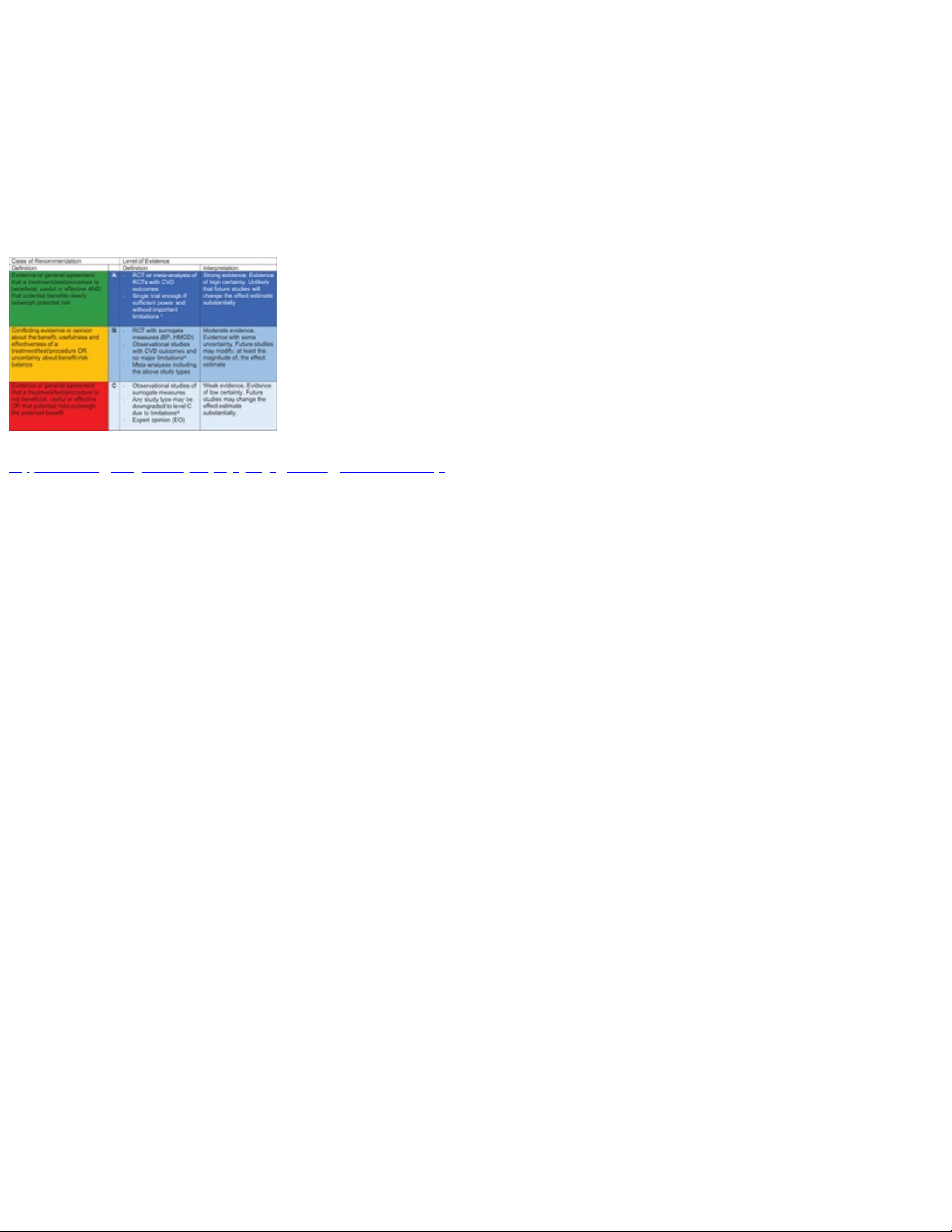
Trong Hướng dẫn ESH 2023, màu ở cột 3, 4 và 5 của hàng dành cho Loại Khuyến nghị I trong Hình 2 đã được
sửa từ trắng sang xanh đậm trong phiên bản trực tuyến của bài báo để khớp với màu được sử dụng trong tất cả
các Bảng tham chiếu khác. đến mức độ bằng chứng. Màu của văn bản đã được thay đổi từ đen sang trắng để
hỗ trợ việc đọc. Hình 2 đã sửa được hiển thị bên dưới. Ngoài ra, trong phần 7.5 trên trang 1916, '... để giảm thiểu
vấn đề hạ huyết áp sau tập luyện [411–413]'. nên đổi thành '... do tác dụng hạ huyết áp ngay lập tức của việc tập thể dục [411–413]' 5+ hình ảnh
Tạp chí tăng huyết áp. 42(1):194, tháng 1 năm 2024. Mục lục GIỚI THIỆU 10
CÓ GÌ MỚI VÀ NHỮNG GÌ ĐÃ THAY ĐỔI TRONG HƯỚNG DẪN CỦA XÃ HỘI TĂNG ÁP CHÂU ÂU NĂM 2023? 12
1. Phương pháp luận và định nghĩa chứng cứ 14
1.1 Phương pháp phân loại chứng cứ 14
1.2 Mức độ bằng chứng 14
2. NGUYÊN TẮC SINH LÝ BỆNH TĂNG HUYẾT ÁP 16
3. ĐỊNH NGHĨA TĂNG HUYẾT ÁP VÀ PHÂN LOẠI HA 18
3.1 Định nghĩa tăng huyết áp 18
3.2 Phân loại tăng huyết áp 19
3.3 Tỷ lệ tăng huyết áp 20
3.4 Mối liên quan giữa huyết áp với nguy cơ biến cố não, tim mạch và thận 20
3.5 Tăng huyết áp và đánh giá nguy cơ tim mạch tổng thể 21
3.6 Sàng lọc so với phát hiện ca bệnh trong phát hiện tăng huyết áp 24
3.7 Khẳng định chẩn đoán tăng huyết áp 25
4. ĐO LƯỜNG VÀ THEO DÕI HA 26
4.1 Thiết bị đo huyết áp 26
4.1.1 Thiết bị dựa trên vòng bít tiêu chuẩn 26
4.1.2 Thiết bị đo huyết áp không vòng bít 27
4.1.3 Kiểm định thiết bị đo huyết áp 27
4.2 Tiêu chuẩn đo huyết áp phòng khám 28
4.3 Đo huyết áp tại phòng khám không cần giám sát 30
4.4 Huyết áp khi vận động 32
4.5 Đo huyết áp tại bệnh viện 32
4.6 Huyết áp trung tâm 33
4.7 Theo dõi huyết áp tại nhà 34
4.8 Theo dõi huyết áp lưu động 36
4.9 Chỉ định lâm sàng của HBPM và ABPM 39
4.10 Biến thiên huyết áp 41 5. XỬ LÝ BỆNH NHÂN 42
5.1 Lịch sử cá nhân và y tế 42 5.2 Khám thực thể 44
5.3 Xét nghiệm hóa học lâm sàng thường quy 45
5.4 Các thăm dò khác về tăng huyết áp 45 5.4.1 Điện tâm đồ 45 5.4.2 Siêu âm thận 46
5.4.3 Các dấu ấn sinh học và dấu hiệu di truyền được lựa chọn 46 5.4.3.1 Lipoprotein (a) 46
5.4.3.2 Dấu ấn sinh học tim 46
5.4.3.3 Dấu hiệu thận 47
5.4.3.4 Dấu hiệu di truyền 47
5.5 Đánh giá tổn thương cơ quan qua trung gian tăng huyết áp 48 5.5.1 HMOD trong tim 49
5.5.1.1 Khối lượng và hình dạng thất trái 50
5.5.1.2 Siêu âm tim qua thành ngực 50
5.5.1.3 Cộng hưởng từ tim 51
5.5.1.4 Chụp cắt lớp vi tính tim 52
5.5.2 HMOD trong động mạch 52
5.5.2.1 IMT động mạch cảnh và mảng xơ vữa 52
5.5.2.2 Tốc độ sóng xung 53
5.5.2.3 Chỉ số cổ chân – cánh tay 55 5.5.3 HMOD ở thận 55 5.5.4 HMOD trong não 56 5.5.5 HMOD ở mắt 58
5.6 Sử dụng HMOD giúp phân tầng nguy cơ ở bệnh nhân tăng huyết áp 60
5.7 Khi nào cần giới thiệu bệnh nhân đến bác sĩ chuyên khoa hoặc chăm sóc tại bệnh viện 62 6. TĂNG HUYẾT ÁP THỨ 63
6.1 Nguyên nhân di truyền gây tăng huyết áp thứ phát 67
7. CAN THIỆP LỐI SỐNG 69
7.1 Sự liên quan của việc thay đổi lối sống 69 7.2 Giảm cân 70
7.3 Hạn chế nạp natri 70
7.4 Tăng cường lượng kali ăn vào 71
7.5 Tăng mức độ hoạt động thể chất hàng ngày và tập thể dục thường xuyên 72
7.6 Uống rượu vừa phải 73 7.7 Cai thuốc lá 74
7.8 Các can thiệp về chế độ ăn uống khác 75
7.9 Cải thiện việc quản lý căng thẳng 75
7.10 Tiếp xúc với tiếng ồn và ô nhiễm không khí 76
8. LỢI ÍCH CỦA ĐIỀU TRỊ BỆNH TĂNG HUYẾT ÁP 77
9. BẮT ĐẦU ĐIỀU TRỊ BẰNG THUỐC HẠT HUYẾT ÁP 79
9.1 Việc bắt đầu điều trị có nên dựa trên tổng nguy cơ tim mạch không? 79
9.2 Ngưỡng HA tại phòng khám để bắt đầu điều trị bằng thuốc 79
9.3 Có nên bắt đầu điều trị hạ huyết áp ở bệnh nhân có huyết áp tại phòng khám <140/90 mmHg? 81
9.4 Bắt đầu điều trị bằng thuốc ở người lớn tuổi 82
10. MỤC TIÊU ĐIỀU TRỊ CỦA VĂN PHÒNG BP 85
10.1 Mục tiêu huyết áp tại phòng khám ở nhóm bệnh nhân tăng huyết áp nói chung 85
10.2 Mục tiêu huyết áp tại phòng khám và tại nhà 87
10.3 Thời điểm kiểm soát HA và thời gian trong khoảng điều trị 88
10.4 Rủi ro tồn đọng 88
10.5 Những thách thức liên quan đến bằng chứng về mục tiêu BP 89
11. THUỐC GIẢM TĂNG ÁP VÀ ĐIỀU TRỊ 92
11.1 Thuốc chẹn hệ thống renin-angiotensin 96
11.1.1 Thuốc ức chế men chuyển angiotensin 96
11.1.2 Thuốc chẹn thụ thể angiotensin 96
11.1.3 Chất ức chế renin 96
11.1.4 Phối hợp thuốc ức chế RAS 97
11.2 Thuốc chẹn kênh canxi 97 11.2.1 CCB dihydropyridine 97
11.2.2 Thuốc ức chế canxi nondihydropyridine 97 11.3 Thuốc lợi tiểu 97
11.3.1 Thuốc lợi tiểu thiazide và giống thiazide 97
11.3.2 Thuốc lợi tiểu quai 99
11.3.3 Thuốc lợi tiểu giữ kali 99
11.4 Thuốc đối kháng thụ thể Mineralocorticoid 99 11.5 Thuốc chẹn beta 100
11.6 Thuốc chẹn Alpha-1 102
11.7 Thuốc tác dụng trung ương 103
11.8 Thuốc giãn mạch 103
11.9 Thuốc ức chế neprilysin-thụ thể angiotensin 103
11.10 Phối hợp thuốc hạ huyết áp 104
11.10.1 Tác động đến chiến lược điều trị thuốc tăng huyết áp 104
11.10.2 Phối hợp thuốc 106
11.10.3 Cơ sở lý luận cho liệu pháp phối hợp hai thuốc ban đầu 110
11.10.4 Tăng liều điều trị lên phối hợp ba thuốc 112
11.10.5 Cơ sở lý luận của liệu pháp phối hợp viên đơn 112
11.10.6 Khái niệm bốn viên 113
11.10.7 Khái niệm polypill 114
11.10.8 Lựa chọn phối hợp thuốc khi bắt đầu điều trị 115
11.10.9 Khả năng dung nạp và tác dụng phụ của thuốc 115
11.10.10 Kê đơn thuốc hạ huyết áp 116
11.10.10.1 Tiêu chuẩn quản lý thuốc 116
11.10.10.2 Giảm điều trị một phần hoặc ngừng hoàn toàn 117
11.10.10.3 Thuốc hạ huyết áp và nguy cơ ung thư 118
11.10.11 Thuốc dùng đồng thời 119
11.10.11.1 Giảm cholesterol LDL 119
11.10.11.2 Liệu pháp kháng tiểu cầu 121
12. TĂNG ÁP KHÁNG THỰC 122
12.1 Định nghĩa, tỷ lệ hiện mắc, sinh lý bệnh và nguy cơ tim mạch 122
12.2 Công việc chẩn đoán 123
12.3 Tối ưu hóa các biện pháp can thiệp lối sống và điều trị bằng thuốc liên tục 125
12.4 Dòng điều trị hạ huyết áp thứ tư và tiếp theo 126
13. ĐIỀU TRỊ TĂNG HUYẾT ÁP DỰA TRÊN THIẾT BỊ 131
13.1 Hủy thần kinh thần kinh thận 131
13.1.1 Bằng chứng lâm sàng về tác dụng hạ huyết áp của RDN 131
13.1.2 Nghiên cứu không dùng thuốc 132
13.1.3 Nghiên cứu về thuốc 132 13.1.4 An toàn 133 13.1.5 Độ bền 134 13.1.6 Ứng dụng 134
13.2 Kích thích thụ thể áp lực động mạch cảnh 136
13.3. Các phương pháp điều trị dựa trên thiết bị khác 136
14. CÁC LOẠI TĂNG HUYẾT ÁP ĐẶC BIỆT 137
14.1 Tăng huyết áp kéo dài và huyết áp bình thường thực sự 137
14.2 Tăng huyết áp áo choàng trắng 138
14.3 Tăng huyết áp ẩn giấu 139
14.4 Tăng huyết áp áo choàng trắng không kiểm soát và tăng huyết áp giấu mặt 141
14.5 Tăng huyết áp tâm thu đơn độc ở người trẻ 142
14.6 Tăng huyết áp tâm thu đơn độc ở người lớn tuổi 144
14.7 Tăng huyết áp tâm trương đơn độc 146
14.8 Tăng huyết áp ban đêm và hạ huyết áp 147
14.9 Tăng huyết áp tư thế và hạ huyết áp 149
14.10 Suy phản xạ áp lực và suy giảm thần kinh tự động ly tâm 150
15. TĂNG HUYẾT ÁP TRONG CÁC TÌNH HÌNH NHÂN KHÁC KHÁC NHAU 152
15.1 Huyết áp ở trẻ em, thanh thiếu niên và giai đoạn chuyển tiếp 152
15.1.1 Đo huyết áp ở trẻ em và thanh thiếu niên 152
15.1.2 Tăng huyết áp ở trẻ em và thanh thiếu niên 153
15.1.3 Thời kỳ chuyển tiếp sang tuổi trưởng thành 154
15.2 Tăng huyết áp ở người trẻ tuổi 155
15.3 Tăng huyết áp ở người lớn tuổi 156
15.3.1 Bệnh nhân 65–79 tuổi 157
15.3.1.1 Ngưỡng và mục tiêu điều trị bằng thuốc 157
15.3.1.2 Chiến lược điều trị hạ huyết áp 158
15.3.1.3 Thuốc hạ huyết áp 158
15.3.1.4 Theo dõi hiệu quả điều trị 159
15.3.2 Bệnh nhân 80 tuổi trở lên 159
15.3.3 Cách đánh giá mức độ suy yếu/chức năng để cá nhân hóa chiến lược điều trị tốt hơn 160
15.4 Các khía cạnh giới tính trong tăng huyết áp 163
15.4.1 Dịch tễ học và sinh lý bệnh 163
15.4.2 Huyết áp và nguy cơ tim mạch 164
15.4.3 Sự khác biệt về kiểu hình lâm sàng 164
15.4.3.1 Tăng huyết áp áo choàng trắng và tăng huyết áp ẩn giấu 164
15.4.3.2 Tổn thương cơ quan qua trung gian tăng huyết áp 164
15.4.4 Sự khác biệt giới tính trong kết quả tăng huyết áp 165
15.4.5 Lợi ích của điều trị hạ huyết áp và huyết áp mục tiêu 166
15.4.6 Sự khác biệt giới tính trong quản lý tăng huyết áp 167
15.4.7 Điều trị vô sinh và tăng huyết áp ở phụ nữ 167
15.4.8. Thuốc tránh thai đường uống và tăng huyết áp 168
15.4.9 Liệu pháp thay thế hormone và tăng huyết áp 169
15.4.10 Liệu pháp hormone khẳng định giới tính và tăng huyết áp 169
15.5 Tăng huyết áp và dân tộc 169
15.5.1 Danh pháp và mức độ liên quan 169 15.5.2 Quản lý 170
16. TĂNG HUYẾT ÁP TRONG CÁC BỆNH NHÂN CỤ THỂ 171
16.1 Rối loạn tăng huyết áp trong thai kỳ 171
16.1.1 Định nghĩa và phân loại tăng huyết áp trong thai kỳ 173
16.1.2 Đo huyết áp thai kỳ 174
16.1.3 Xét nghiệm trong thai kỳ 175
16.1.4 Dự đoán và phòng ngừa tiền sản giật 175
16.1.5 Can thiệp lối sống 176
16.1.6 Xử lý lâm sàng tăng huyết áp trong thai kỳ 176
16.1.6.1 Tăng huyết áp vô căn nhẹ từ trước 176
16.1.6.2 Tăng huyết áp thai kỳ nhẹ 177
16.1.6.3 Tiền sản giật 178
16.1.6.4 Tăng huyết áp nặng 178
16.1.6.5 Tăng huyết áp thứ phát từ trước 179
16.1.7 Huyết áp trong thời kỳ hậu sản 180
16.1.8 Tăng huyết áp sau sinh và cho con bú 181
16.1.9 Nguy cơ tái phát rối loạn tăng huyết áp ở lần mang thai tiếp theo 181
16.1.10 Hậu quả tim mạch lâu dài của rối loạn tăng huyết áp trong thai kỳ 181
16.2 Tăng huyết áp khẩn cấp và cấp cứu 183
16.2.1 Định nghĩa tăng huyết áp cấp cứu và cấp cứu 183
16.2.2 Công tác tại bệnh viện, điều trị và theo dõi 185
16.2.3 Huyết áp tại khoa cấp cứu 189
16.3 Tăng huyết áp chu phẫu và cách xử trí 190
17. TĂNG HUYẾT ÁP TRONG CÁC BỆNH TIM MẠCH 192
17.1 Bệnh động mạch vành 192
17.1.2 Điều trị bệnh nhân tăng huyết áp có bệnh mạch vành 193 17.2 Suy tim 195
17.2.1 Phòng ngừa suy tim ở người tăng huyết áp 195
17.2.2 Suy tim phân suất tống máu giảm 197
17.2.3 Suy tim phân suất tống máu bảo tồn 199
17.2.4 Xử lý tổng thể suy tim và phân loại 200
17.3 Tăng huyết áp và rung nhĩ 201
17.3.1 Đo huyết áp trong rung nhĩ 201
17.3.2 Phát hiện rung nhĩ 202
17.3.3 Phòng ngừa và điều trị rung nhĩ ở bệnh nhân tăng huyết áp 202
17.3.4 Thuốc chống đông máu đường uống và kiểm soát HA 204 17.4 Bệnh van tim 206
17.4.1 Hẹp động mạch chủ 206
17.4.2 Hở van động mạch chủ 207 17.4.3 Hở van hai lá 207
17.5 Bệnh mạch máu não và nhận thức 208
17.5.1 Xử trí tăng huyết áp trong đột quỵ cấp 208
17.5.1.1 Đột quỵ xuất huyết cấp tính 208
17.5.1.2 Đột quỵ thiếu máu cục bộ cấp tính 209
17.5.2 Xử trí tăng huyết áp ở bệnh nhân có tiền sử đột quỵ hoặc cơn thiếu máu cục bộ thoáng qua 210
17.5.3 Quản lý bệnh nhân rối loạn chức năng nhận thức và sa sút trí tuệ 211 17.6 Bệnh mạch máu 213