Textbook English- Chapter 2. Thinking Like an Economist
Textbook English- Chapter 2. Thinking Like an Economist.Tài liệu tổng hợp được sưu tầm. Mời mọi người tham khảo
Chủ đề: Tài liệu chung Tiếng Anh 12 528 tài liệu
Môn: Tiếng Anh 12 1.3 K tài liệu
Tác giả:
















Preview text:
E CHAPTER
very field of study has its own language and way of thinking.
Mathematicians talk about axioms, integrals, and vector spaces.
Psychologists talk about ego, id, and cognitive dissonance. Lawyers
talk about venue, torts, and promissory estoppel.
Economics is no different. Supply, demand, elasticity, comparative
advantage, consumer surplus, deadweight loss—these terms are part 2
of the economist’s language. In the coming chapters, you will encoun-
ter many new terms and some familiar words that economists use in Thinking Like
specialized ways. At first, this new language may seem needlessly
arcane. But as you will see, its value lies in its ability to provide you with
a new and useful way of thinking about the world in which you live. an Economist
The purpose of this book is to help you learn the economist’s way
of thinking. Just as you cannot become a mathematician, psycholo-
gist, or lawyer overnight, learning to think like an economist will
take some time. Yet with a combination of theory, case studies, and
examples of economics in the news, this book will give you ample
opportunity to develop and practice this skill.
Before delving into the substance and details of economics, it is
helpful to have an overview of how economists approach the world.
This chapter discusses the field’s methodology. What is distinctive
about how economists confront a question? What does it mean to think like an economist? S K N A B O R /EU M O .C K C ; ISTO K C TO S LO /LO M .CO K C O IST 18 PART I INTRODUCTION 2-1 The Economist as Scientist
Economists try to address their subject with a scientist’s objectivity. They approach
the study of the economy in much the same way a physicist approaches the study
of matter and a biologist approaches the study of life: They devise theories, collect
data, and then analyze these data to verify or refute their theories.
To beginners, the claim that economics is a science can seem odd. After all,
economists do not work with test tubes or telescopes. The essence of science, how- R E
ever, is the scientific method—the dispassionate development and testing of theories K R K
about how the world works. This method of inquiry is as applicable to studying YO W AN E B
a nation’s economy as it is to studying the earth’s gravity or a species’ evolution. N N E O
As Albert Einstein once put it, “The whole of science is nothing more than the /TH TO N R A
refinement of everyday thinking.” CA E LSM
Although Einstein’s comment is as true for social sciences such as economics as E /TH D N N
it is for natural sciences such as physics, most people are not accustomed to look- A TIO . H C
ing at society through a scientific lens. Let’s discuss some of the ways economists J.B LLE O © C
apply the logic of science to examine how an economy works. “I’m a social scientist,
2-1a The Scientific Method: Observation, Michael. That means Theory, and More Observation I can’t explain electricity
Isaac Newton, the famous 17th-century scientist and mathematician, allegedly or anything like that,
became intrigued one day when he saw an apple fall from a tree. This observation but if you ever want
motivated Newton to develop a theory of gravity that applies not only to an apple to know about people,
falling to the earth but to any two objects in the universe. Subsequent testing of I’m your man.”
Newton’s theory has shown that it works well in many circumstances (but not all,
as Einstein would later show). Because Newton’s theory has been so successful at
explaining what we observe around us, it is still taught in undergraduate physics courses around the world.
This interplay between theory and observation also occurs in economics. An
economist might live in a country experiencing rapidly increasing prices and be
moved by this observation to develop a theory of inflation. The theory might
assert that high inflation arises when the government prints too much money. To
test this theory, the economist could collect and analyze data on prices and money
from many different countries. If growth in the quantity of money were unrelated
to the rate of price increase, the economist would start to doubt the validity of
this theory of inflation. If money growth and inflation were correlated in inter-
national data, as in fact they are, the economist would become more confident in the theory.
Although economists use theory and observation like other scientists, they face
an obstacle that makes their task especially challenging: In economics, conducting
experiments is often impractical. Physicists studying gravity can drop objects in
their laboratories to generate data to test their theories. By contrast, economists
studying inflation are not allowed to manipulate a nation’s monetary policy simply
to generate useful data. Economists, like astronomers and evolutionary biologists,
usually have to make do with whatever data the world gives them.
To find a substitute for laboratory experiments, economists pay close attention
to the natural experiments offered by history. When a war in the Middle East inter-
rupts the supply of crude oil, for instance, oil prices skyrocket around the world.
For consumers of oil and oil products, such an event depresses living standards. For
economic policymakers, it poses a difficult choice about how best to respond. But
for economic scientists, the event provides an opportunity to study the effects of a
key natural resource on the world’s economies. Throughout this book, we consider
CHAPTER 2 THINKING LIKE AN ECONOMIST 19
many historical episodes. Studying these episodes is valuable because they give
us insight into the economy of the past and allow us to illustrate and evaluate eco- nomic theories of the present. 2-1b The Role of Assumptions
If you ask a physicist how long it would take a marble to fall from the top of a
ten-story building, he will likely answer the question by assuming that the marble
falls in a vacuum. Of course, this assumption is false. In fact, the building is sur-
rounded by air, which exerts friction on the falling marble and slows it down. Yet
the physicist will point out that the friction on the marble is so small that its effect
is negligible. Assuming the marble falls in a vacuum simplifies the problem without
substantially affecting the answer.
Economists make assumptions for the same reason: Assumptions can simplify
the complex world and make it easier to understand. To study the effects of inter-
national trade, for example, we might assume that the world consists of only two
countries and that each country produces only two goods. In reality, there are many
countries, each of which produces thousands of different types of goods. But by
considering a world with only two countries and two goods, we can focus our
thinking on the essence of the problem. Once we understand international trade
in this simplified imaginary world, we are in a better position to understand inter-
national trade in the more complex world in which we live.
The art in scientific thinking—whether in physics, biology, or economics—is
deciding which assumptions to make. Suppose, for instance, that instead of drop-
ping a marble from the top of the building, we were dropping a beach ball of the
same weight. Our physicist would realize that the assumption of no friction is less
accurate in this case: Friction exerts a greater force on the beach ball because it is
much larger than a marble. The assumption that gravity works in a vacuum is rea-
sonable when studying a falling marble but not when studying a falling beach ball.
Similarly, economists use different assumptions to answer different questions.
Suppose that we want to study what happens to the economy when the govern-
ment changes the number of dollars in circulation. An important piece of this
analysis, it turns out, is how prices respond. Many prices in the economy change
infrequently: The newsstand prices of magazines, for instance, change only once
every few years. Knowing this fact may lead us to make different assumptions
when studying the effects of the policy change over different time horizons. For
studying the short-run effects of the policy, we may assume that prices do not
change much. We may even make the extreme assumption that all prices are com-
pletely fixed. For studying the long-run effects of the policy, however, we may
assume that all prices are completely flexible. Just as a physicist uses different
assumptions when studying falling marbles and falling beach balls, economists
use different assumptions when studying the short-run and long-run effects of a
change in the quantity of money. 2-1c Economic Models
High school biology teachers teach basic anatomy with plastic replicas of the
human body. These models have all the major organs—the heart, liver, kidneys, and
so on—and allow teachers to show their students very simply how the important
parts of the body fit together. Because these plastic models are stylized and omit
many details, no one would mistake one of them for a real person. Despite this lack
of realism—indeed, because of this lack of realism—studying these models is useful
for learning how the human body works. 20 PART I INTRODUCTION
Economists also use models to learn about the world, but unlike plastic mani-
kins, their models mostly consist of diagrams and equations. Like a biology teach-
er’s plastic model, economic models omit many details to allow us to see what is
truly important. Just as the biology teacher’s model does not include all the body’s
muscles and blood vessels, an economist’s model does not include every feature of the economy.
As we use models to examine various economic issues throughout this book, you
will see that all the models are built with assumptions. Just as a physicist begins the
analysis of a falling marble by assuming away the existence of friction, economists
assume away many details of the economy that are irrelevant to the question at
hand. All models—in physics, biology, and economics—simplify reality to improve our understanding of it.
2-1d Our First Model: The Circular-Flow Diagram
The economy consists of millions of people engaged in many activities—buying,
selling, working, hiring, manufacturing, and so on. To understand how the economy
works, we must find some way to simplify our thinking about all these activities. In
other words, we need a model that explains, in general terms, how the economy is
organized and how participants in the economy interact with one another. circular-flow diagram
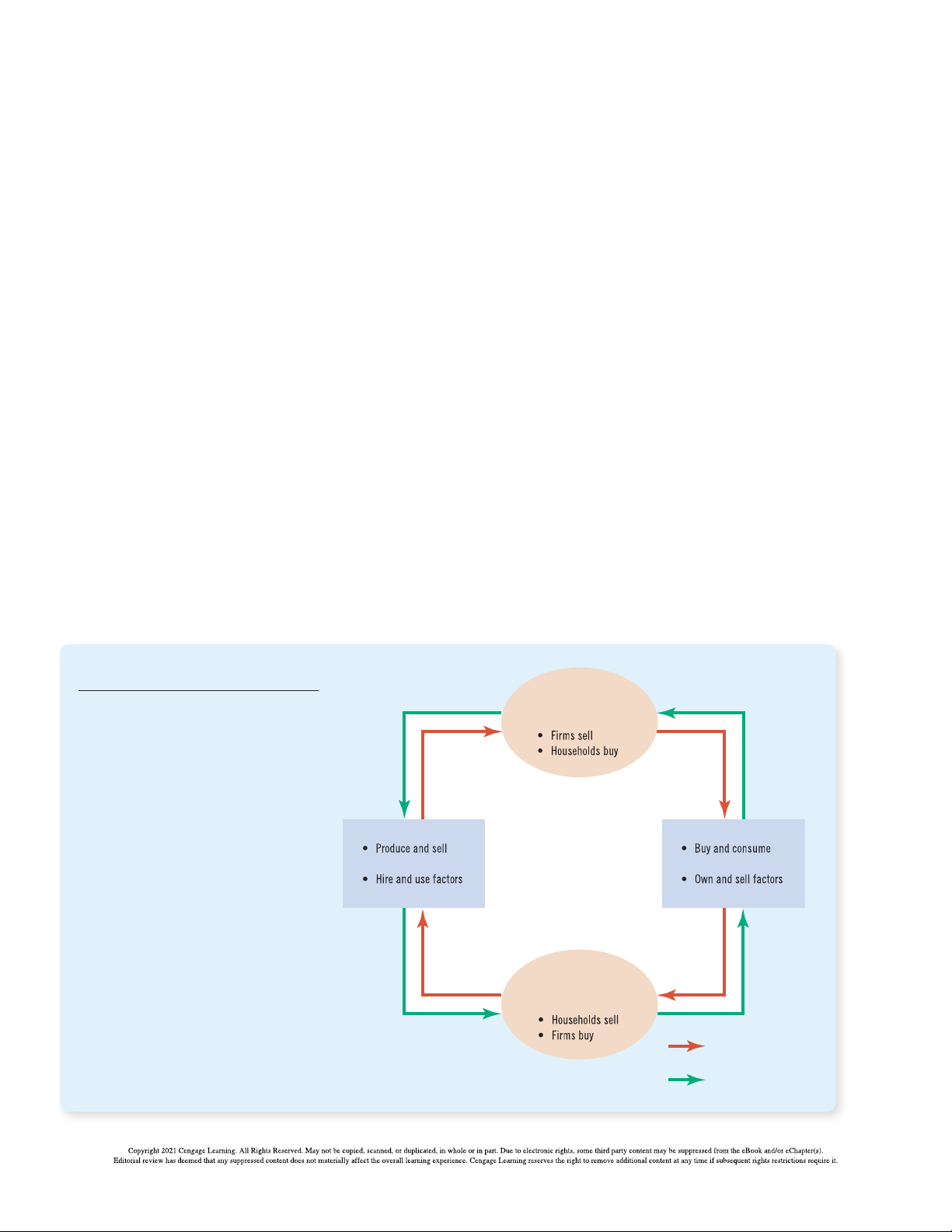
Figure 1 presents a visual model of the economy called the circular-flow a visual model of the
diagram. In this model, the economy is simplified to include only two types of economy that shows
decision makers—firms and households. Firms produce goods and services using how dollars flow
inputs, such as labor, land, and capital (buildings and machines). These inputs through markets among
are called the factors of production. Households own the factors of production and households and firms
consume all the goods and services that the firms produce. FIGURE 1 MARKETS The Circular Flow Revenue FOR Spending This diagram is a schematic GOODS AND SERVICES
representation of the organization of Goods Goods and
the economy. Decisions are made by and services services
households and firms. Households and sold bought
firms interact in the markets for goods
and services (where households are
buyers and firms are sellers) and in the FIRMS HOUSEHOLDS
markets for the factors of production
(where firms are buyers and households goods and services goods and services
are sellers). The outer set of arrows shows
the flow of dollars, and the inner set of of production of production
arrows shows the corresponding flow of inputs and outputs. Labor, land, Factors of MARKETS and capital production FOR FACTORS OF PRODUCTION Wages, rent, Income and profit 5 Flow of inputs and outputs 5 Flow of dol ars
CHAPTER 2 THINKING LIKE AN ECONOMIST 21
Households and firms interact in two types of markets. In the markets for goods
and services, households are buyers, and firms are sellers. In particular, households
buy the output of goods and services that firms produce. In the markets for the
factors of production, households are sellers, and firms are buyers. In these markets,
households provide the inputs that firms use to produce goods and services. The
circular-flow diagram offers a simple way of organizing all the transactions that
occur between households and firms in an economy.
The two loops of the circular-flow diagram are distinct but related. The inner
loop represents the flows of inputs and outputs. Households sell the use of their
labor, land, and capital to firms in the markets for the factors of production. Firms
then use these factors to produce goods and services, which in turn are sold to
households in the markets for goods and services. The outer loop of the diagram
represents the corresponding flow of dollars. Households spend money to buy
goods and services from firms. The firms use some of the revenue from these sales
for payments to the factors of production, such as workers’ wages. What’s left is
the profit for the firm owners, who are themselves members of households.
Let’s take a tour of the circular flow by following a dollar bill as it makes its
way from person to person through the economy. Imagine that the dollar begins at
a household—say, in your wallet. If you want a cup of coffee, you take the dollar
(along with a few of its brothers and sisters) to the market for coffee, which is one
of the many markets for goods and services. When you buy your favorite drink at
your local Starbucks, the dollar moves into the shop’s cash register, becoming rev-
enue for the firm. The dollar doesn’t stay at Starbucks for long, however, because
the firm spends it on inputs in the markets for the factors of production. Starbucks
might use the dollar to pay rent to its landlord for the space it occupies or to pay
the wages of its workers. In either case, the dollar enters the income of some house-
hold and, once again, is back in someone’s wallet. At that point, the story of the
economy’s circular flow starts once again.
The circular-flow diagram in Figure 1 is a simple model of the economy. A more
complex and realistic circular-flow model would include, for instance, the roles of
government and international trade. (A portion of that dollar you gave to Starbucks
might be used to pay taxes or to buy coffee beans from a farmer in Brazil.) Yet these
details are not crucial for a basic understanding of how the economy is organized.
Because of its simplicity, this circular-flow diagram is useful to keep in mind when
thinking about how the pieces of the economy fit together.
2-1e Our Second Model: The Production Possibilities Frontier
Most economic models, unlike the circular-flow diagram, are built using the tools of
mathematics. Here we use one of the simplest such models, called the production
possibilities frontier, to illustrate some basic economic ideas.
Although real economies produce thousands of goods and services, let’s con-
sider an economy that produces only two goods—cars and computers. Together,
the car industry and the computer industry use all of the economy’s factors of production possibilities
production. The production possibilities frontier is a graph that shows the various frontier
combinations of output—in this case, cars and computers—that the economy a graph that shows the
can possibly produce given the available factors of production and the available combinations of output
production technology that firms use to turn these factors into output. that the economy can
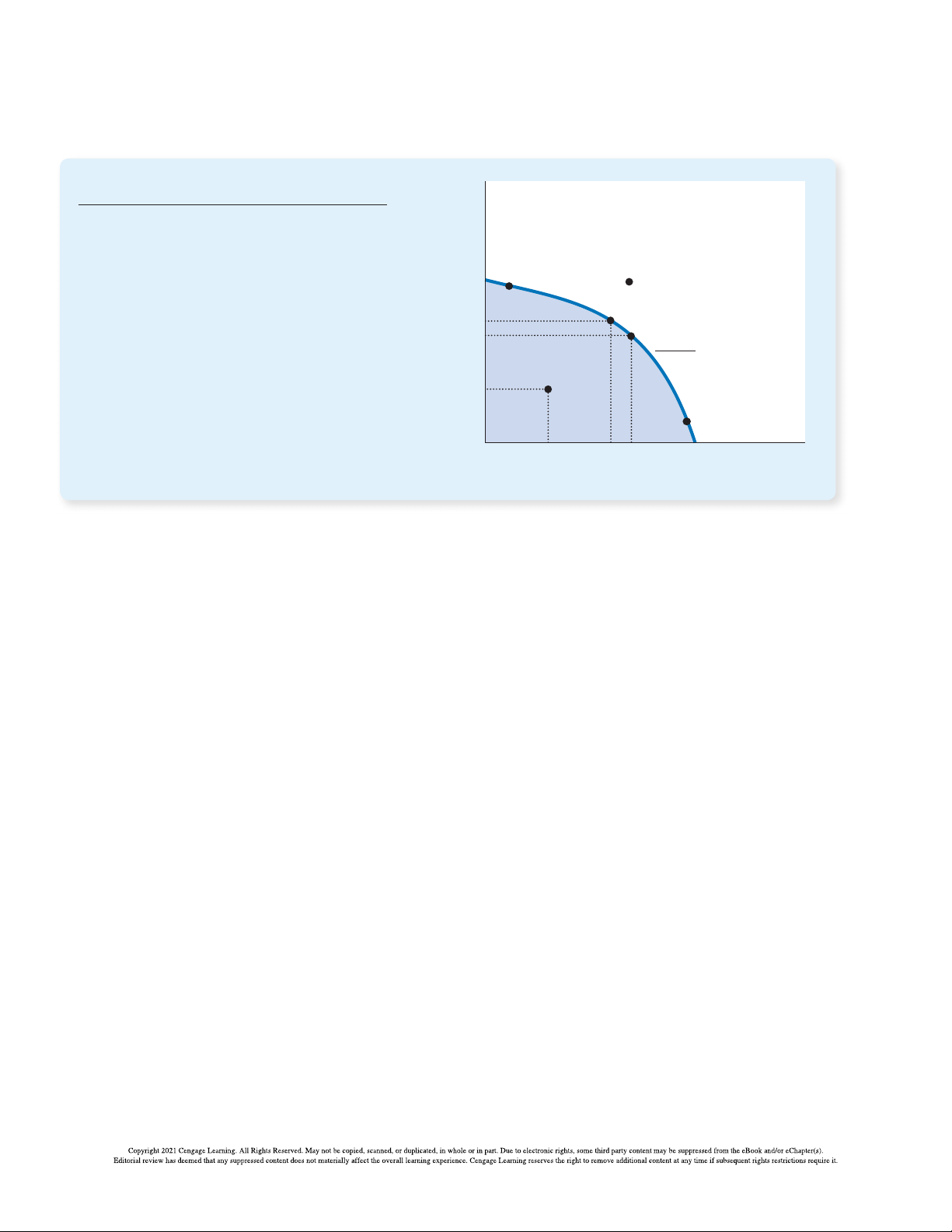
Figure 2 shows this economy’s production possibilities frontier. If the economy possibly produce given
uses all its resources in the car industry, it produces 1,000 cars and no computers. If the available factors
it uses al its resources in the computer industry, it produces 3,000 computers and of production and the
no cars. The two endpoints of the production possibilities frontier represent these available production extreme possibilities. technology 22 PART I INTRODUCTION FIGURE 2 Quantity of Computers
The Production Possibilities Frontier Produced
The production possibilities frontier shows the
combinations of output—in this case, cars and
computers—that the economy can possibly produce. 3,000 F
The economy can produce any combination on or C
inside the frontier. Points outside the frontier are not A
feasible given the economy’s resources. The slope 2,200 B
of the production possibilities frontier measures the 2,000
opportunity cost of a car in terms of computers. This Production possibilities
opportunity cost varies, depending on how much of frontier
the two goods the economy is producing. 1,000 D E 0 300 600 700 1,000 Quantity of Cars Produced
More likely, the economy divides its resources between the two industries, pro-
ducing some cars and some computers. For example, it can produce 600 cars and
2,200 computers, shown in the figure by point A. Or, by moving some of the factors
of production to the car industry from the computer industry, the economy can
produce 700 cars and 2,000 computers, represented by point B.
Because resources are scarce, not every conceivable outcome is feasible. For
example, no matter how resources are allocated between the two industries,
the economy cannot produce the amount of cars and computers represented
by point C. Given the technology available for making cars and computers, the
economy does not have enough of the factors of production to support that level
of output. With the resources it has, the economy can produce at any point on or
inside the production possibilities frontier, but it cannot produce at points outside the frontier.
An outcome is said to be efficient if the economy is getting all it can from the
scarce resources it has available. Points on (rather than inside) the production pos-
sibilities frontier represent efficient levels of production. When the economy is
producing at such a point, say point A, there is no way to produce more of one
good without producing less of the other. Point D represents an inefficient outcome.
For some reason, perhaps widespread unemployment, the economy is producing
less than it could from the resources it has available: It is producing only 300 cars
and 1,000 computers. If the source of the inefficiency is eliminated, the economy
can increase its production of both goods. For example, if the economy moves from
point D to point A, its production of cars increases from 300 to 600, and its produc-
tion of computers increases from 1,000 to 2,200.
One of the Ten Principles of Economics in Chapter 1 is that people face trade-offs.
The production possibilities frontier shows one trade-off that society faces. Once
we have reached an efficient point on the frontier, the only way of producing more
CHAPTER 2 THINKING LIKE AN ECONOMIST 23
of one good is to produce less of the other. When the economy moves from point A
to point B, for instance, society produces 100 more cars at the expense of producing 200 fewer computers.
This trade-off helps us understand another of the Ten Principles of Economics: The
cost of something is what you give up to get it. This is called the opportunity cost.
The production possibilities frontier shows the opportunity cost of one good as
measured in terms of the other good. When society moves from point A to point B,
it gives up 200 computers to get 100 additional cars. That is, at point A, the oppor-
tunity cost of 100 cars is 200 computers. Put another way, the opportunity cost
of each car is two computers. Notice that the opportunity cost of a car equals the
slope of the production possibilities frontier. (Slope is discussed in the graphing appendix to this chapter.)
The opportunity cost of a car in terms of the number of computers is not con-
stant in this economy but depends on how many cars and computers the economy
is producing. This is reflected in the shape of the production possibilities frontier.
Because the production possibilities frontier in Figure 2 is bowed outward, the
opportunity cost of a car is highest when the economy is producing many cars and
few computers, such as at point E, where the frontier is steep. When the economy
is producing few cars and many computers, such as at point F, the frontier is flatter,
and the opportunity cost of a car is lower.
Economists believe that production possibilities frontiers often have this
bowed-out shape. When the economy is using most of its resources to make com-
puters, the resources best suited to car production, such as skilled autoworkers,
are being used in the computer industry. Because these workers probably aren’t
very good at making computers, increasing car production by one unit will cause
only a slight reduction in the number of computers produced. Thus, at point F,
the opportunity cost of a car in terms of computers is small, and the frontier is
relatively flat. By contrast, when the economy is using most of its resources to
make cars, such as at point E, the resources best suited to making cars are already
at work in the car industry. Producing an additional car now requires moving
some of the best computer technicians out of the computer industry and turn-
ing them into autoworkers. As a result, producing an additional car requires a
substantial loss of computer output. The opportunity cost of a car is high, and the frontier is steep.
The production possibilities frontier shows the trade-off between the outputs of
different goods at a given time, but the trade-off can change over time. For example,
suppose a technological advance in the computer industry raises the number of
computers that a worker can produce per week. This advance expands society’s
set of opportunities. For any given number of cars, the economy can now make
more computers. If the economy does not produce any computers, it can still pro-
duce 1,000 cars, so one endpoint of the frontier stays the same. But if the economy
devotes some of its resources to the computer industry, it will produce more com-
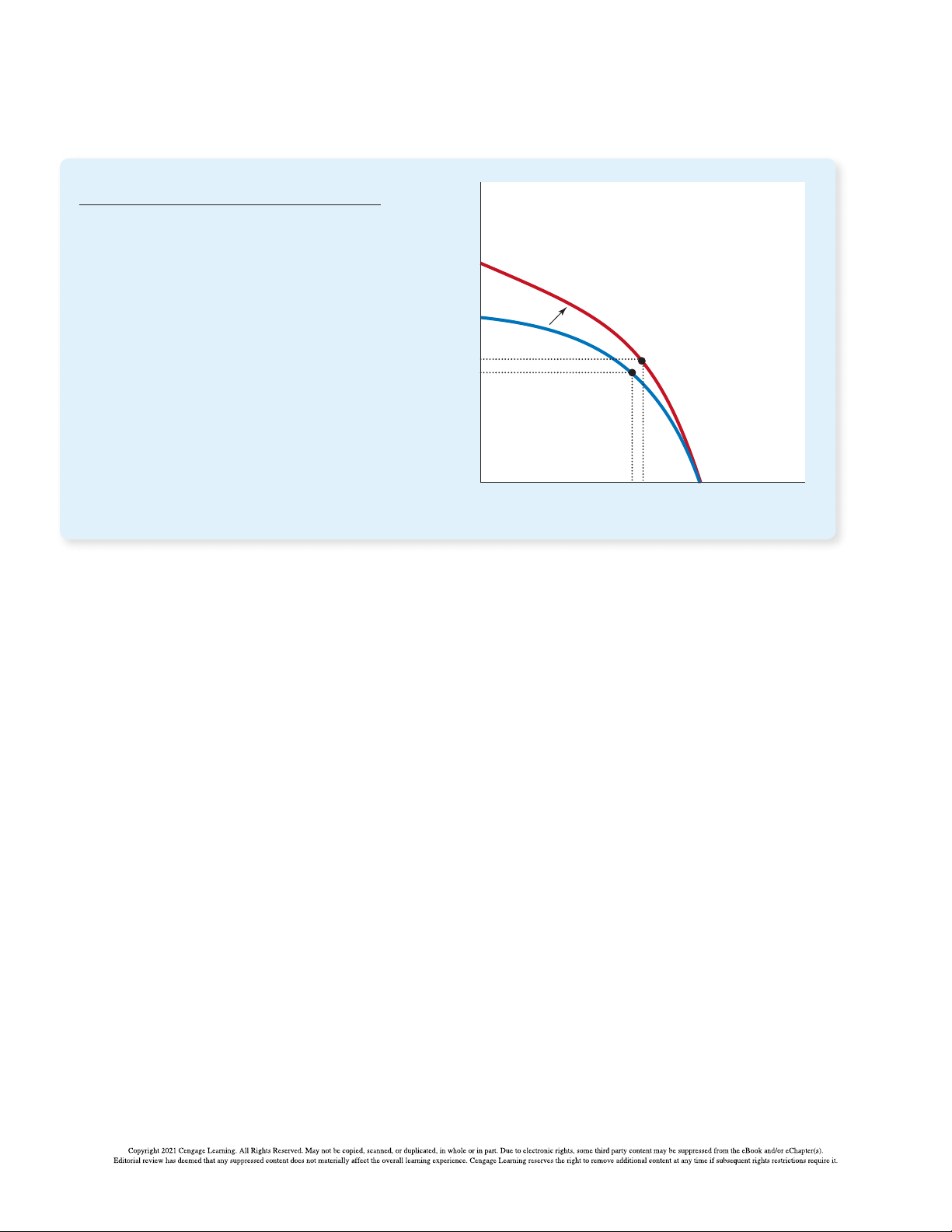
puters from those resources. As a result, the production possibilities frontier shifts outward, as in Figure 3.
This figure shows what happens when an economy grows. Society can move
production from a point on the old frontier to a point on the new frontier. Which
point it chooses depends on its preferences for the two goods. In this example,
society moves from point A to point G, enjoying more computers (2,300 instead of
2,200) and more cars (650 instead of 600). 24 PART I INTRODUCTION FIGURE 3 Quantity of Computers
A Shift in the Production Possibilities Frontier Produced
A technological advance in the computer industry
enables the economy to produce more computers 4,000
for any given number of cars. As a result, the
production possibilities frontier shifts outward. If the
economy moves from point A to point G, then the
production of both cars and computers increases. 3,000 2,300 G 2,200 A 0 600 650 1,000 Quantity of Cars Produced
The production possibilities frontier simplifies a complex economy to highlight
some basic but powerful ideas: scarcity, efficiency, trade-offs, opportunity cost,
and economic growth. As you study economics, these ideas will recur in various
forms. The production possibilities frontier offers one simple way of thinking about them.
2-1f Microeconomics and Macroeconomics
Many subjects are studied on various levels. Consider biology, for example.
Molecular biologists study the chemical compounds that make up living things.
Cellular biologists study cells, which are made up of many chemical compounds
and, at the same time, are themselves the building blocks of living organisms.
Evolutionary biologists study the many varieties of animals and plants and how
species gradually change over the centuries.
Economics is also studied on various levels. We can study the decisions of indi-
vidual households and firms. We can study the interaction of households and firms
in markets for specific goods and services. Or we can study the operation of the microeconomics
economy as a whole, which is the sum of the activities of all these decision makers the study of how in all these markets. households and firms
The field of economics is traditionally divided into two broad subfields. make decisions and how
Microeconomics is the study of how households and firms make decisions and they interact in markets
how they interact in specific markets. Macroeconomics is the study of economy- macroeconomics
wide phenomena. A microeconomist might study the effects of rent control on the study of economy-
housing in New York City, the impact of foreign competition on the U.S. auto wide phenomena,
industry, or the effects of education on workers’ earnings. A macroeconomist might including inflation,
study the effects of borrowing by the federal government, the changes over time unemployment, and
in the economy’s unemployment rate, or alternative policies to promote growth in economic growth national living standards.
CHAPTER 2 THINKING LIKE AN ECONOMIST 25
Microeconomics and macroeconomics are closely intertwined. Because
changes in the overall economy arise from the decisions of millions of indi-
viduals, it is impossible to understand macroeconomic developments without
considering the underlying microeconomic decisions. For example, a macro-
economist might study the effect of a federal income tax cut on the overall
production of goods and services. But to analyze this issue, he must consider
how the tax cut affects households’ decisions about how much to spend on goods and services.
Despite the inherent link between microeconomics and macroeconomics, the
two fields are distinct. Because they address different questions, each field has its
own set of models, which are often taught in separate courses. QuickQuiz 1. An economic model is
3. A point inside the production possibilities frontier is
a. a mechanical machine that replicates the a. efficient but not feasible. functioning of the economy. b. feasible but not efficient.
b. a fully detailed, realistic description of the
c. both efficient and feasible. economy.
d. neither efficient nor feasible.
c. a simplified representation of some aspect of the
4. All of the following topics fall within the study of economy. microeconomics EXCEPT
d. a computer program that predicts the future of
a. the impact of cigarette taxes on the smoking the economy. behavior of teenagers.
2. The circular-flow diagram illustrates that, in markets
b. the role of Microsoft’s market power in the pricing for the factors of production, of software.
a. households are sellers, and firms are buyers.
c. the effectiveness of antipoverty programs in
b. households are buyers, and firms are sellers. reducing homelessness.
c. households and firms are both buyers.
d. the influence of the government budget deficit on
d. households and firms are both sellers. economic growth. Answers at end of chapter.
2-2 The Economist as Policy Adviser
Often, economists are asked to explain the causes of economic events. Why, for
example, is unemployment higher for teenagers than for older workers? Sometimes,
economists are asked to recommend policies to improve economic outcomes. What,
for instance, should the government do to improve the well-being of teenagers?
When economists are trying to explain the world, they are scientists. When they
are helping improve it, they are policy advisers.
2-2a Positive versus Normative Analysis
To clarify the two roles that economists play, let’s examine the use of language.
Because scientists and policy advisers have different goals, they use language in different ways.
For example, suppose that two people are discussing minimum-wage laws. Here
are two statements you might hear: :
Minimum-wage laws cause unemployment. :
The government should raise the minimum wage. 26 PART I INTRODUCTION
Why Tech Companies Hire Economists
But prestige was not enough to keep
But what the tech economists are doing is
Mr. Coles at Harvard. In 2013, he moved to the different: Instead of thinking about national or Many high-tech companies find
San Francisco Bay Area. He now works at Airbnb,
global trends, they are studying the data trails
expertise in economics a useful input
the online lodging marketplace, one of a number of consumer behavior to help digital compa- into their decision making.
of tech companies luring economists with the nies make smart decisions that strengthen
promise of big sets of data and big salaries.
their online marketplaces in areas like adver- Goodbye, Ivory Tower. Hello,
Silicon Val ey is turning to the dismal sci-
tising, movies, music, travel and lodging. Silicon Valley Candy Store
ence in its never-ending quest to squeeze more
Tech outfits including giants like Amazon,
money out of old markets and build new ones. Facebook, Google and Microsoft and up-and- By Steve Lohr
In turn, the economists say they are eager to
comers like Airbnb and Uber hope that sort of
For eight years, Jack Coles had an econo- explore the digital world for fresh insights into improved efficiency means more profit.
mist’s dream job at Harvard Business timeless economic questions of pricing, incen-
At Netflix, Randall Lewis, an economic School. tives and behavior.
research scientist, is finely measuring the
His research focused on the design of effi-
“It’s an absolute candy store for econo-
effectiveness of advertising. His work also gets
cient markets, an important and growing field mists,” Mr. Coles said. . . .
at the correlation-or-causation conundrum in
that has influenced such things as Treasury
Businesses have been hiring economists economic behavior: What consumer actions
bill auctions and decisions on who receives for years. Usually, they are asked to study occur coincidental y after people see ads, and
organ transplants. He even got to work with macroeconomic trends—topics like recessions what actions are most likely caused by the ads?
Alvin E. Roth, who won a Nobel in economic and currency exchange rates—and help their
At Airbnb, Mr. Coles is researching the science in 2012. employers deal with them.
company’s marketplace of hosts and guests
Ignoring for now whether you agree with these statements, notice that Prisha
and Noah differ in what they are trying to do. Prisha is speaking like a scien-
tist: She is making a claim about how the world works. Noah is speaking like
a policy adviser: He is making a claim about how he would like to change the world.
In general, statements about the world come in two types. One type, such positive statements
as Prisha’s, is positive. Positive statements are descriptive. They make a claim claims that attempt to
about how the world is. A second type of statement, such as Noah’s, is normative. describe the world as it is
Normative statements are prescriptive. They make a claim about how the world ought to be. normative statements
A key difference between positive and normative statements is how we judge claims that attempt to
their validity. We can, in principle, confirm or refute positive statements by examin- prescribe how the world
ing evidence. An economist might evaluate Prisha’s statement by analyzing data on should be
changes in minimum wages and changes in unemployment over time. By contrast,
evaluating normative statements involves values as well as facts. Noah’s statement
cannot be judged using data alone. Deciding what is good or bad policy is not
just a matter of science. It also involves our views on ethics, religion, and political philosophy.
Positive and normative statements are fundamentally different, but within a
person’s set of beliefs, they are often intertwined. In particular, positive views about
how the world works affect normative views about what policies are desirable.
CHAPTER 2 THINKING LIKE AN ECONOMIST 27
for insights, both to help build the business
marketplace, where advertisers bid to have
To answer such questions, economists
and to understand behavior. One study focuses their ads shown on search pages. . . .
work in teams with computer scientists and
on procrastination—a subject of great inter-
For the moment, Amazon seems to be people in business. In tech companies, market
est to behavioral economists—by looking at the most aggressive recruiter of economists. design involves not only economics but also
bookings. Are they last-minute? Made weeks or It even has an Amazon Economists website engineering and marketing. How hard is a
months in advance? Do booking habits change for soliciting résumés. In a video on the site, certain approach technical y? How easy is it
by age, gender or country of origin?
Patrick Bajari, the company’s chief economist, to explain to customers?
“They are microeconomic experts, heavy on says the economics team has contributed to
“Economics influences rather than
data and computing tools like machine learn-
decisions that have had “multibillion-dol ar determines decisions,” said Preston McAfee,
ing and writing algorithms,” said Tom Beers, impacts” for the company . . . .
Microsoft’s chief economist, who previously
executive director of the National Association
A current market-design challenge for worked at Google and Yahoo. ■ for Business Economics.
Amazon and Microsoft is their big cloud
Understanding how digital markets work is computing services. These digital services, for Questions to Discuss
getting a lot of attention now, said Hal Varian, example, face a peak-load problem, much as
Google’s chief economist. But, he said, “I electric utilities do.
1. Think of some firms that you often interact
thought it was fascinating years ago.”
How do you sel service at times when
with. How might the input of economists
Mr. Varian, 69, is the godfather of the tech there is a risk some customers may be improve their businesses?
industry’s in-house economists. Once a well-
bumped off? Run an auction for what custom-
2. After studying economics in col ege, what
known professor at the University of California, ers are willing to pay for interruptible service?
kind of businesses would be most fun to
Berkeley, Mr. Varian showed up at Google in
Or offer set discounts for different levels of work for?
2002, part time at first, but soon became an risk? Both Amazon and Microsoft are working
employee. He helped refine Google’s AdWords on that now.
Source: New York Times, September 4, 2016.
Prisha’s claim that the minimum wage causes unemployment, if true, might lead
her to reject Noah’s conclusion that the government should raise the minimum
wage. Yet normative conclusions cannot come from positive analysis alone; they
involve value judgments as well.
As you study economics, keep in mind the distinction between positive and
normative statements because it will help you stay focused on the task at hand.
Much of economics is positive: It just tries to explain how the economy works. Yet
those who use economics often have normative goals: They want to learn how to
improve the economy. When you hear economists making normative statements,
you know they are speaking not as scientists but as policy advisers. 2-2b Economists in Washington
President Harry Truman once said that he wanted to find a one-armed economist.
When he asked his economists for advice, they always answered, “On the one
hand, . . . . On the other hand, . . . .”
Truman was right that economists’ advice is not always straightforward. This
tendency is rooted in one of the Ten Principles of Economics: People face trade-offs.
Economists are aware that trade-offs are involved in most policy decisions. A policy
might increase efficiency at the cost of equality. It might help future generations
but hurt the current generation. An economist who says that all policy decisions
are easy is an economist not to be trusted. 28 PART I INTRODUCTION
Truman was not the only president who relied on economists’ advice. Since R E K
1946, the president of the United States has received guidance from the Council of R O Y K
Economic Advisers, which consists of three members and a staff of a few dozen W E AN N B
economists. The council, whose offices are just a few steps from the White House, E N O
has no duty other than to advise the president and to write the annual Economic / TH TO N AR
Report of the President, which discusses recent developments in the economy and SO C N E VE
presents the council’s analysis of current policy issues. /TH N STE
The president also receives input from economists in many administrative S TIO E C M
departments. Economists at the Office of Management and Budget help formu- JA LLE O © C
late spending plans and regulatory policies. Economists at the Department of the
Treasury help design tax policy. Economists at the Department of Labor analyze “Let’s switch.
data on workers and those looking for work to help formulate labor-market poli- I’ll make the policy, you
cies. Economists at the Department of Justice help enforce the nation’s antitrust implement it, and he’ll laws. explain it.”
Economists are also found outside the executive branch of government. To
obtain independent evaluations of policy proposals, Congress relies on the advice
of the Congressional Budget Office, which is staffed by economists. The Federal
Reserve, the institution that sets the nation’s monetary policy, employs hundreds
of economists to analyze developments in the United States and throughout the world.
The influence of economists on policy goes beyond their role as advisers: Their
research and writings can affect policy indirectly. Economist John Maynard Keynes offered this observation:
The ideas of economists and political philosophers, both when they are right
and when they are wrong, are more powerful than is commonly understood.
Indeed, the world is ruled by little else. Practical men, who believe themselves
to be quite exempt from intel ectual influences, are usually the slaves of some
defunct economist. Madmen in authority, who hear voices in the air, are distill-
ing their frenzy from some academic scribbler of a few years back.
These words were written in 1935, but they remain true today. Indeed, the “academic
scribbler” now influencing public policy is often Keynes himself.
2-2c Why Economists’ Advice Is Not Always Followed
Economists who advise presidents and other elected leaders know that their recom-
mendations are not always heeded. Frustrating as this can be, it is easy to under-
stand. The process by which economic policy is actually made differs in many ways
from the idealized policy process assumed in economics textbooks.
Throughout this text, whenever we discuss policy, we often focus on one ques-
tion: What is the best policy for the government to pursue? We act as if policy
were set by a benevolent king. Once the king figures out the right policy, he has no
trouble putting his ideas into action.
In the real world, figuring out the right policy is only part of a leader’s job,
sometimes the easiest part. After a president hears from his economic advisers
what policy they deem best, he turns to other advisers for related input. His com-
munications advisers will tell him how best to explain the proposed policy to the
public, and they will try to anticipate any misunderstandings that might make the
challenge more difficult. His press advisers will tell him how the news media will
report on his proposal and what opinions will likely be expressed on the nation’s
editorial pages. His legislative affairs advisers will tell him how Congress will
CHAPTER 2 THINKING LIKE AN ECONOMIST 29
view the proposal, what amendments members of Congress will suggest, and the
likelihood that Congress will pass some version of the president’s proposal into
law. His political advisers will tell him which groups will organize to support or
oppose the proposed policy, how this proposal will affect his standing among dif-
ferent groups in the electorate, and whether it will change support for any of the
president’s other policy initiatives. After weighing all this advice, the president then decides how to proceed.
Making economic policy in a representative democracy is a messy affair, and
there are often good reasons why presidents (and other politicians) do not advance
the policies that economists advocate. Economists offer crucial input to the policy
process, but their advice is only one ingredient of a complex recipe. QuickQuiz
5. Which of the following is a positive, rather than a
6. The following parts of government regularly rely on normative, statement? the advice of economists:
a. Law X will reduce national income. a. Department of Treasury.
b. Law X is a good piece of legislation.
b. Office of Management and Budget.
c. Congress ought to pass law X. c. Department of Justice.
d. The president should veto law X. d. All of the above. Answers at end of chapter. 2-3 Why Economists Disagree
“If all the economists were laid end to end, they would not reach a conclusion.”
This quip from George Bernard Shaw is revealing. Economists as a group are often
criticized for giving conflicting advice to policymakers. President Ronald Reagan
once joked that if the game Trivial Pursuit were designed for economists, it would
have 100 questions and 3,000 answers.
Why do economists so often appear to give conflicting advice to policymakers? There are two basic reasons:
Economists may disagree about the validity of alternative positive theories of how the world works.
Economists may have different values and therefore different normative
views about what government policy should aim to accomplish.
Let’s discuss each of these reasons.
2-3a Differences in Scientific Judgments
Several centuries ago, astronomers debated whether the earth or the sun was at the
center of the solar system. More recently, climatologists have debated whether the
earth is experiencing global warming and, if so, why. Science is an ongoing search
to understand the world around us. It is not surprising that as the search continues,
scientists sometimes disagree about the direction in which truth lies.
Economists often disagree for the same reason. Although the field of econom-
ics sheds light on much about the world (as you will see throughout this book), 30 PART I INTRODUCTION
there is still much to be learned. Sometimes economists disagree because they
have different hunches about the validity of alternative theories. Sometimes
they disagree because of different judgments about the size of the parameters that
measure how economic variables are related.
For example, economists debate whether the government should tax a house-
hold’s income or its consumption (spending). Advocates of a switch from the cur-
rent income tax to a consumption tax believe that the change would encourage
households to save more because income that is saved would not be taxed. Higher
saving, in turn, would free resources for capital accumulation, leading to more
rapid growth in productivity and living standards. Advocates of the current income
tax system believe that household saving would not respond much to a change in
the tax laws. These two groups of economists hold different normative views about
the tax system because they have different positive views about saving’s respon- siveness to tax incentives. 2-3b Differences in Values
Suppose that Jack and Jill both take the same amount of water from the town
well. To pay for maintaining the well, the town taxes its residents. Jill has income
of $150,000 and is taxed $15,000, or 10 percent of her income. Jack has income of
$40,000 and is taxed $6,000, or 15 percent of his income.
Is this policy fair? If not, who pays too much and who pays too little? Does it
matter whether Jack’s low income is due to a medical disability or to his decision to
pursue an acting career? Does it matter whether Jill’s high income is due to a large
inheritance or to her willingness to work long hours at a dreary job?
These are difficult questions about which people are likely to disagree. If the
town hired two experts to study how it should tax its residents to pay for the well,
it would not be surprising if they offered conflicting advice.
This simple example shows why economists sometimes disagree about public
policy. As we know from our discussion of normative and positive analysis, policies
cannot be judged on scientific grounds alone. Sometimes, economists give conflict-
ing advice because they have different values or political philosophies. Perfecting
the science of economics will not tell us whether Jack or Jil pays too much. 2-3c Perception versus Reality
Because of differences in scientific judgments and differences in values, some
disagreement among economists is inevitable. Yet one should not overstate the
amount of disagreement. Economists agree with one another more often than is sometimes understood.
Table 1 contains twenty propositions about economic policy. In surveys of
professional economists, these propositions were endorsed by an overwhelming
majority of respondents. Most of these propositions would fail to command a simi-
lar consensus among the public.
The first proposition in the table is about rent control, a policy that sets a legal
maximum on the amount landlords can charge for their apartments. Almost all
economists believe that rent control adversely affects the availability and qual-
ity of housing and is a costly way of helping the neediest members of society.
Nonetheless, many city governments ignore the advice of economists and place
ceilings on the rents that landlords may charge their tenants.
The second proposition in the table concerns policies that restrict trade among
nations: tariffs (taxes on imports) and import quotas (limits on how much of a good
can be purchased from abroad). For reasons we discuss more fully in later chapters,
CHAPTER 2 THINKING LIKE AN ECONOMIST 31 TABLE 1
Proposition (and percentage of economists who agree) Propositions
1. A ceiling on rents reduces the quantity and quality of housing available. (93%) about Which Most
2. Tariffs and import quotas usually reduce general economic welfare. (93%) Economists Agree
3. Flexible and floating exchange rates offer an effective international monetary arrangement. (90%)
4. Fiscal policy (e.g., tax cut and/or government expenditure increase) has a significant
stimulative impact on a less than fully employed economy. (90%)
5. The United States should not restrict employers from outsourcing work to foreign countries. (90%)
6. Economic growth in developed countries like the United States leads to greater levels of well-being. (88%)
7. The United States should eliminate agricultural subsidies. (85%)
8. An appropriately designed fiscal policy can increase the long-run rate of capital formation. (85%)
9. Local and state governments should eliminate subsidies to professional sports franchises. (85%)
10. If the federal budget is to be balanced, it should be done over the business cycle rather than yearly. (85%)
11. The gap between Social Security funds and expenditures will become unsustainably
large within the next 50 years if current policies remain unchanged. (85%)
12. Cash payments increase the welfare of recipients to a greater degree than do
transfers-in-kind of equal cash value. (84%)
13. A large federal budget deficit has an adverse effect on the economy. (83%)
14. The redistribution of income in the United States is a legitimate role for the government. (83%)
15. Inflation is caused primarily by too much growth in the money supply. (83%)
16. The United States should not ban genetically modified crops. (82%)
17. A minimum wage increases unemployment among young and unskilled workers. (79%)
18. The government should restructure the welfare system along the lines of a “negative income tax.” (79%)
19. Effluent taxes and marketable pollution permits represent a better approach to pollution
control than the imposition of pollution ceilings. (78%)
20. Government subsidies on ethanol in the United States should be reduced or eliminated. (78%)
Source: Richard M. Alston, J. R. Kearl, and Michael B. Vaughn, “Is There Consensus among Economists in the 1990s?” American Economic Review (May 1992):
203–209; Dan Ful er and Doris Geide-Stevenson, “Consensus among Economists Revisited,” Journal of Economics Education (Fal 2003): 369–387; Robert Whaples,
“Do Economists Agree on Anything? Yes!” Economists’ Voice (November 2006): 1–6; Robert Whaples, “The Policy Views of American Economic Association Members:
The Results of a New Survey,” Econ Journal Watch (September 2009): 337–348.
almost all economists oppose such barriers to free trade. Nonetheless, over the
years, presidents and Congress have often chosen to restrict the import of certain
goods. The policies of the Trump administration are a vivid example.
Why do policies such as rent control and trade barriers persist if the experts are
united in their opposition? It may be that the realities of the political process stand 32 PART I INTRODUCTION
as immovable obstacles. But it also may be that economists
have not yet convinced enough of the public that these poli- Ticket Resale
cies are undesirable. One purpose of this book is to help you
understand the economist’s view on these and other sub-
jects and, perhaps, to persuade you that it is the right one.
“Laws that limit the resale of tickets for entertainment and
As you read the book, you will occasionally see small
sports events make potential audience members for those
boxes called “Ask the Experts.” These are based on the
events worse off on average.”
IGM Economics Experts Panel, an ongoing survey of sev-
eral dozen prominent economists. Every few weeks, these What do economists say?
experts are offered a proposition and then asked whether 8% disagree 12% uncertain
they agree with it, disagree with it, or are uncertain. The
results in these boxes will give you a sense of when econo-
mists are united, when they are divided, and when they just 80% agree don’t know what to think.
You can see an example here regarding the resale of tick-
ets to entertainment and sporting events. Lawmakers some-
times try to prohibit reselling tickets, or “scalping” as it is
Source: IGM Economic Experts Panel, April 16, 2012.
sometimes called. The survey results show that many econ-
omists side with the scalpers rather than the lawmakers. QuickQuiz
7. Economists may disagree because they have
8. Most economists believe that tariffs are different
a. a good way to promote domestic economic
a. hunches about the validity of alternative growth. theories.
b. a poor way to raise general economic well-being.
b. judgments about the size of key parameters.
c. an often necessary response to foreign
c. political philosophies about the goals of public competition. policy.
d. an efficient way for the government to raise d. All of the above. revenue. Answers at end of chapter. 2-4 Let’s Get Going
The first two chapters of this book have introduced you to the ideas and methods of
economics. We are now ready to get to work. In the next chapter, we start learning
in more detail the principles of economic behavior and economic policy.
As you proceed through this book, you will be asked to draw on many intel-
lectual skills. You might find it helpful to keep in mind some advice from the great economist John Maynard Keynes:
The study of economics does not seem to require any specialized gifts of an
unusually high order. Is it not . . . a very easy subject compared with the higher
branches of philosophy or pure science? An easy subject, at which very few excel!
The paradox finds its explanation, perhaps, in that the master-economist must
possess a rare combination of gifts. He must be mathematician, historian, states-
man, philosopher—in some degree. He must understand symbols and speak in
words. He must contemplate the particular in terms of the general, and touch
abstract and concrete in the same flight of thought. He must study the present
CHAPTER 2 THINKING LIKE AN ECONOMIST 33
in the light of the past for the purposes of the future. No part of man’s nature or
his institutions must lie entirely outside his regard. He must be purposeful and
disinterested in a simultaneous mood; as aloof and incorruptible as an artist, yet
sometimes as near the earth as a politician.
This is a tall order. But with practice, you will become more and more accustomed to thinking like an economist. CHAPTER IN A NUTSHELL
Economists try to address their subject with a scien-
A positive statement is an assertion about how the
tist’s objectivity. Like all scientists, they make appro-
world is. A normative statement is an assertion about
priate assumptions and build simplified models to
how the world ought to be. While positive state-
understand the world around them. Two simple eco-
ments can be judged based on facts and the scientific
nomic models are the circular-flow diagram and the
method, normative statements entail value judg-
production possibilities frontier. The circular-flow
ments as well. When economists make normative
diagram shows how households and firms interact
statements, they are acting more as policy advisers
in markets for goods and services and in markets for than as scientists.
the factors of production. The production possibilities
Economists who advise policymakers sometimes offer
frontier shows how society faces a trade-off between
conflicting advice either because of differences in sci- producing different goods.
entific judgments or because of differences in values.
The field of economics is divided into two sub-
At other times, economists are united in the advice
fields: microeconomics and macroeconomics.
they offer, but policymakers may choose to ignore
Microeconomists study decision making by households
the advice because of the many forces and constraints
and firms and the interactions among households and
imposed on them by the political process.
firms in the marketplace. Macroeconomists study the
forces and trends that affect the economy as a whole. KEY CONCEPTS circular-flow diagram, p. 20 microeconomics, p. 24 positive statements, p. 26
production possibilities frontier, p. 21 macroeconomics, p. 24 normative statements, p. 26 QUESTIONS FOR REVIEW
1. In what ways is economics a science?
What happens to this frontier if a disease kills half of
2. Why do economists make assumptions? the economy’s cows?
3. Should an economic model describe reality exactly?
7. Use a production possibilities frontier to describe the
4. Name a way that your family interacts in the markets idea of efficiency.
for the factors of production and a way that it
8. What are the two subfields of economics? Explain
interacts in the markets for goods and services. what each subfield studies.
5. Name one economic interaction that isn’t covered by
9. What is the difference between a positive and a
the simplified circular-flow diagram.
normative statement? Give an example of each.
6. Draw and explain a production possibilities frontier
10. Why do economists sometimes offer conflicting
for an economy that produces milk and cookies. advice to policymakers? 34 PART I INTRODUCTION
1. Draw a circular-flow diagram. Identify the parts
cars. In an hour, Larry can either mow one lawn or
of the model that correspond to the flow of goods
wash one car; Moe can either mow one lawn or wash
and services and the flow of dollars for each of the
two cars; and Curly can either mow two lawns or following activities. wash one car.
a. Selena pays a storekeeper $1 for a quart of milk.
a. Calculate how much of each service is produced
b. Stuart earns $8 per hour working at a fast-food
in the following scenarios, which we label A, B, restaurant. C, and D:
c. Shanna spends $40 to get a haircut.
All three spend all their time mowing lawns. (A)
d. Salma earns $20,000 from her 10 percent
All three spend all their time washing cars. (B) ownership of Acme Industrial.
All three spend half their time on each activity. (C)
Larry spends half his time on each activity, while
2. Imagine a society that produces military goods and
Moe only washes cars and Curly only mows
consumer goods, which we’ll cal “guns” and “butter.” lawns. (D)
a. Draw a production possibilities frontier for guns
b. Graph the production possibilities frontier for this
and butter. Using the concept of opportunity cost,
economy. Using your answers to part a, identify
explain why it most likely has a bowed-out shape.
points A, B, C, and D on your graph.
b. Show a point on the graph that is impossible for
c. Explain why the production possibilities frontier
the economy to achieve. Show a point on the has the shape it does.
graph that is feasible but inefficient.
d. Are any of the allocations calculated in part a
c. Imagine that the society has two political parties, inefficient? Explain.
called the Hawks (who want a strong military)
and the Doves (who want a smaller military).
5. Classify each of the following topics as relating to
Show a point on your production possibilities
microeconomics or macroeconomics.
frontier that the Hawks might choose and a point
a. a family’s decision about how much income to that the Doves might choose. save
d. Imagine that an aggressive neighboring country
b. the effect of government regulations on auto
reduces the size of its military. As a result, both emissions
the Hawks and the Doves reduce their desired
c. the impact of higher national saving on economic
production of guns by the same amount. Which growth
party would get the bigger “peace dividend,”
d. a firm’s decision about how many workers to hire
measured by the increase in butter production?
e. the relationship between the inflation rate and Explain.
changes in the quantity of money
3. The first principle of economics in Chapter 1 is that
6. Classify each of the following statements as positive
people face trade-offs. Use a production possibilities or normative. Explain.
frontier to illustrate society’s trade-off between two
a. Society faces a short-run trade-off between
“goods”—a clean environment and the quantity of inflation and unemployment.
industrial output. What do you suppose determines
b. A reduction in the growth rate of the money
the shape and position of the frontier? Show what
supply will reduce the rate of inflation.
happens to the frontier if engineers develop a
c. The Federal Reserve should reduce the growth
new way of producing electricity that emits fewer rate of the money supply. pollutants.
d. Society ought to require welfare recipients to look for jobs.
4. An economy consists of three workers: Larry, Moe,
e. Lower tax rates encourage more work and more
and Curly. Each works 10 hours a day and can saving.
produce two services: mowing lawns and washing QuickQuiz Answers
1. c 2. a 3. b 4. d 5. a 6. d 7. d 8. b
Tài liệu liên quan:
-
Test 1 Academic Set - Climate Change Threats to the Great Barrier Reef
16 8 -

Bìa tiếng anh - Bìa tiếng anh UEH
15 8 -
Đề thi tham khảo môn Tiếng Anh 2023 - Sửa đáp án và câu hỏi_test
20 10 -
Module 3, 4, 5 - Tieng Anh: Reducing Relative Clauses & Tenses
16 8 -

Gợi ý đề thi thử TNTHPT năm 2026 môn tiếng anh
28 14