Văn học các nước nói tiếng Anh - ENG
Giáo trình
Môn: Tiếng Anh (ULIS) 39 tài liệu
Trường: Trường Đại học Ngoại ngữ, Đại học Quốc gia Hà Nội 646 tài liệu
Tác giả:



















Preview text:
VIETNAM NATIONAL UNIVERSITY, HANOI
UNIVERSITY OF LANGUAGES AND INTERNATIONAL STUDIES
FACULTY OF LINGUISTICS AND CULTURE OF ENGLISH-SPEAKING COUNTRIES
______________________________ Literature of English-Speaking Countries - COURSE BOOK - Hanoi - 2024 - 1 - Table of Contents
CHAPTER 1. RESPONDING TO LITERATURE ........................................................ 3
1.1. RESPONDING TO A SHORT STORY .......................................................... 6
1.2. RESPONDING TO SHORT FICTION .......................................................... 13
1.3. RESPONDING TO LITERATURE – THE WRITING PROCESS .............. 17
1.4. TOTALLY INCLUSIVE SELF-LOVE .......................................................... 26
1.5. HILLS LIKE WHITE ELEPHANTS ............................................................. 32
CHAPTER 2. PLOT ...................................................................................................... 38 2.1.
THEORY AND EXERCISE .......................................................................... 38
2.2. BROKEBACK MOUNTAIN ......................................................................... 40
CHAPTER 3. POINT OF VIEW ................................................................................... 70
3.1. THEORY AND EXCERCISE ........................................................................ 70
3.2. THE GREAT GATSBY ................................................................................. 72
3.3. THE ESCAPE ................................................................................................. 88
CHAPTER 4. CHARACTERISATION ........................................................................ 93
4.1. THEORY AND EXERCISE .......................................................................... 93
4.2. MR KNOW-ALL ............................................................................................ 94 4.3.
DÉSIRÉE’S BABY ...................................................................................... 103 - 2 -
CHAPTER 1. RESPONDING TO LITERATURE
___________________________________ GENERAL INTRODUCTION
Responding to literature requires both imagination and critical reading skills. As readers,
we anticipate, imagine, feel, worry, analyze, and question. A literary work is like an
empty balloon that we inflate with the warm breath of our imagination and experience.
Our participation makes us partners with the author in the artistic recreation.
First, readers must imagine and recreate that special world described by the writer. The
first sentences of a short story, for example, throw open a door to a world that-attractive
or repulsive-tempts our curiosity and imagination. Like Alice in Alice in Wonderland,
we cannot resist following a white rabbit with pink eyes who mutters to himself, checks
his watch, and then zips down a rabbit hole and into an imaginary world.
Here are three opening sentences of three very different short stories:
Young Goodman Brown came forth at sunset into the street at Salem village; but put his
head back, after crossing the threshold, to exchange a parting kiss with his young wife.
- Nathaniel Hawthorne, “Young Goodman Brown”
As Gregor Samsa awoke one morning from uneasy dreams he found himself
transformed in his bed into a gigantic insect.
- Franz Kafka, “The Metamorphosis”
The morning of June 27th was clear and sunny, with the fresh warmth of a full-summer
day; the flowers were blossoming profusely and the grass was green.
- Shirley Jackson, “The Lottery”
Whether our imaginations construct the disturbing image of a “gigantic insect” or the
seemingly peaceful picture of a perfect summer day, we actively recreate each story.
Responding to literature also requires that readers reread. First, you should reread for - 3 -
yourself-that is, reread to write down your ideas, questions, feelings, and reactions. To
heighten your role in re-creating a story or poem, you should note in the margins your
questions and responses to main characters, places, metaphors and images, and themes
that catch your attention: ‘‘Are the names of Hawthorne’s characters significant? Is
Young Goodman Brown really good? Is his wife, Faith, really faithful?” “Why does
Emily Dickinson have her speaker personify Death as the driver of a carriage? Why does
her speaker say that ‘he kindly stopped for me’? What action is taking place?” Don’t just
underline or highlight passages. Actually write your questions and responses in the margins.
Second, you should reread with a writer’s eye. In fiction, identify the major and minor
characters. Look for conflicts between characters. Mark passages that contain
foreshadowing. Pinpoint sentences that reveal the narrative point of view. Use the
appropriate critical terms (character, plot, conflict, point of view, setting, style, and
theme) to help you reread with a writer’s eye and see how the parts of a story relate to
the whole. Similarly, in poetry, look for character, key events, and setting, and always
pay attention to images and metaphors, to voice and tone, to word choice, and to rhythm
and rhyme. Each critical term is a tool-a magnifying glass that helps you understand and
interpret the literary work more clearly.
In addition to rereading, responding to literature requires that readers share ideas,
reactions, and interpretations. Sharing usually begins in small-group or class
discussions, but it continues as you explain your interpretation in writing. A work of
literature is not a mathematical equation with a single answer. Great literature is worth
interpreting precisely because each reader responds differently. The purpose of literature
is to encourage you to reflect on your life and the lives of others-to look for new ways
of seeing and understanding your world-and ultimately to expand your world. Sharing
is crucial to appreciating literature.
Hawthorne doesn’t come right out and say that people become disillusioned by
experiencing evil. He shows how it actually happens in the life of young Goodman Brown.
Shirley Jackson’s “The Lottery” helps me see that the notion of human sacrifice and the - 4 -
idea of the human scapegoat still exist in our culture today.
In “Because I could not stop for Death,” Emily Dickinson uses personification and
metaphors as vehicles for her own reflection and introspection.
Writing about your responses and sharing them with other readers helps you “reread”
your own ideas in order to explain them fully and clearly to other readers. - 5 -
1.1. RESPONDING TO A SHORT STORY
Read and respond to Kate Chopin’s “The Story of an Hour.” Use your imagination to
help create the story as you read. Then reread the story, noting in the margin your
questions and responses. When you finish rereading and annotating your reactions, write
your interpretation of the last line of the story. PROFESSIONAL WRITING THE STORY OF AN HOUR Kate Chopin
Kate O’Flaherty Chopin (1851-1904) was an American writer whose mother was
French and Creole and whose father was Irish. In 1870, she moved from St. Louis to
New Orleans with her husband, Oscar Chopin, and over the next ten years she gave
birth to jive sons. After her husband died in 1882, Chopin returned to St. Louis to begin
a new life as a writer. Many of her best stories are about Louisiana people and places,
and her most famous novel, The Awakening, tells the story of Edna, a woman who leaves
her marriage and her children to fulfill herself through an artistic career.
Knowing that Mrs. Mallard was afflicted with a heart trouble, great care was taken to
break to her as gently as possible the news of her husband’s death.
It was her sister Josephine who told her, in broken sentences; veiled hints that revealed
in half concealing. Her husband’s friend Richards was there, too, near her. It was he who
had been in the newspaper office when intelligence of the railroad disaster was received,
with Brently Mallard’s name leading the list of “killed.” He had only taken the time to
assure himself of its truth by a second telegram, and had hastened to forestall any less
careful, less tender friend in bearing the sad message.
She did not hear the story as many women have heard the same, with a paralyzed
inability to accept its significance. She wept at once, with sudden, wild abandonment,
in her sister’s arms. When the storm of grief had spent itself she went away to her room
alone. She would have no one follow her. - 6 -
There stood, facing the open window, a comfortable, roomy armchair. Into this she sank,
pressed down by a physical exhaustion that haunted her body and seemed to reach into her soul.
She could see in the open square before her house the tops of trees that were all aquiver
with the new spring life. The delicious breath of rain was in the air. In the street below
a peddler was crying his wares. The notes of a distant song which someone was singing
reached her faintly, and countless sparrows were twittering in the eaves.
There were patches of blue sky showing here and there through the clouds that had met
and piled one above the other in the west facing her window.
She sat with her head thrown back upon the cushion of the chair, quite motionless,
except when a sob came up into her throat and shook her, as a child who has cried itself
to sleep continues to sob in its dreams.
She was young, with a fair, calm face, whose lines bespoke repression and even a certain
strength. But now there was a dull stare in her eyes, whose gaze was fixed away off
yonder on one of those patches of blue sky. It was not a glance of reflection, but rather
indicated a suspension of intelligent thought.
There was something coming to her and she was waiting for it, fearfully. What was it?
She did not know; it was too subtle and elusive to name. But she felt it, creeping out of
the sky, reaching toward her through the sounds, the scents, the color that filled the air.
Now her bosom rose and fell tumultuously. She was beginning to recognize this thing
that was approaching to possess her, and she was striving to beat it back with her will–
as powerless as her two white slender hands would have been. When she abandoned
herself a little whispered word escaped her slightly parted lips. She said it over and over
under the breath: “free, free, free!” The vacant stare and the look of terror that had
followed it went from her eyes. They stayed keen and bright. Her pulses beat fast, and
the coursing blood warmed and relaxed every inch of her body. - 7 -
She did not stop to ask if it were or were not a monstrous joy that held her. A clear and
exalted perception enabled her to dismiss the suggestion as trivial. She knew that she
would weep again when she saw the kind, tender hands folded in death; the face that
had never looked save with love upon her, fixed and gray and dead. But she saw beyond
that bitter moment a long procession of years to come that would belong to her
absolutely. And she opened and spread her arms out to them in welcome.
There would be no one to live for during those coming years; she would live for herself.
There would be no powerful will bending hers in that blind persistence with which men
and women believe they have a right to impose a private will upon a fellow-creature. A
kind intention or a cruel intention made the act seem no less a crime as she looked upon
it in that brief moment of illumination.
And yet she had loved him–sometimes. Often she had not. What did it matter! What
could love, the unsolved mystery, count for in the face of this possession of self-
assertion which she suddenly recognized as the strongest impulse of her being!
“Free! Body and soul free!” she kept whispering.
Josephine was kneeling before the closed door with her lips to the keyhold, imploring
for admission. “Louise, open the door! I beg; open the door–you will make yourself ill.
What are you doing, Louise? For heaven’s sake open the door.”
“Go away. I am not making myself ill.” No; she was drinking in a very elixir of life through that open window.
Her fancy was running riot along those days ahead of her. Spring days, and summer
days, and all sorts of days that would be her own. She breathed a quick prayer that life
might be long. It was only yesterday she had thought with a shudder that life might be long.
She arose at length and opened the door to her sister’s importunities. There was a
feverish triumph in her eyes, and she carried herself unwittingly like a goddess of - 8 -
Victory. She clasped her sister’s waist, and together they descended the stairs. Richards
stood waiting for them at the bottom.
Someone was opening the front door with a latchkey. It was Brently Mallard who
entered, a little travel-stained, composedly carrying his grip-sack and umbrella. He had
been far from the scene of the accident, and did not even know there had been one. He
stood amazed at Josephine’s piercing cry; at Richards’ quick motion to screen him from the view of his wife.
When the doctors came they said she had died of heart disease–of the joy that kills.
TECHNIQUES FOR RESPONDING TO LITERATURE
As you read and respond to a work of literature, keep the following techniques in mind. -
Understanding the assignment and selecting a possible purpose and interpret
a work of literature. Your audience will be other members of your class, including the teacher. -
Actively reading, annotating, and discussing the literary work. Remember
that literature often contains highly condensed experiences. In order to give imaginative
life to literature, you need to reread patiently both the major events and the seemingly
insignificant passages. In discussions, look for the differences between your responses and other readers’ ideas. -
Focusing your essay on a single, clearly defined interpretation. In your essay,
clearly state your main idea or thesis, focusing on a single idea or aspect of the piece of
literature. Your thesis should not be a statement of fact. Whether you are explaining,
evaluating, or arguing, your interpretation must be clearly stated. -
Supporting your interpretation with evidence. Because your readers will
probably have different interpretations, you must show which specific characters,
events, scenes, conflicts, images, metaphors, or themes prompted your response, and - 9 -
you must use these details to support your interpretation. Do not merely retell the major
events of the story or describe the main images in the poem-your readers have already read your story or poem.
WARMING UP: Journal Exercises
Read all of the following questions and then write for five minutes on two or three.
These questions should help clarity your perceptions about literature or develop your
specific responses to “The Story of an Hour” 1.
On your bookshelves or in the library, find a short story that you read at least six
months ago. Before you reread it, write down the name of the author and the title of the
work. Note when you read it last and describe what you remember about it. Then reread
the story. When you finish, write for five minutes, describing what you noticed that you
did not notice the last time you read it. 2.
Write out the question that “The Story of an Hour” seems to ask. What is your
answer to this question? What might have been Kate Chopin’s answer? 3.
The words heart, joy, free, lift, and death appear several times in “The Story of
an Hour.” Underline these words (or synonyms) each time they appear. Explain how the
meaning of each of these words seems to change during the story. Is each word used ironically? 4.
Write out a dictionary definition of the word feminism. Then write out your own
definition. Is Mrs. Mallard a feminist? Is Kate Chopin a feminist? What evidence in the story supports your answers? 5.
Kate Chopin’s biographer, Per Seyersted, says that Chopin saw that “truth is
manifold” and thus preferred not to “take sides or point a moral.” Explain how “The
Story of an Hour” does or does not illustrate Seyersted’s observations. 6.
Literature often expresses common themes or tensions, such as the conflict
between generations, the individual versus society, appearance versus reality, self-
knowledge versus self-deception, and civilization versus nature. Which of these themes
are most apparent in “The Story of an Hour”? Explain your choices. - 10 -
PURPOSES FOR RESPONDING TO LITERATURE
In responding to literature, you should be guided by the purposes that you have already
practiced in previous chapters. As you read a piece of literature and respond in the
margin, begin by writing for yourself. Your purposes are to observe, feel, remember,
understand, and relate the work of literature to your own life: What is happening? What
memories does it trigger? How does it make you feel? Why is this passage confusing?
Why do you like or dislike this character? Literature has special, personal value. You
should write about literature initially in order to discover and understand its importance in your life.
When you write an interpretive essay, however, you are writing for others. You are
sharing your experience in working with the author as imaginative partners in recreating
the work. Your purposes will often be mixed, but an interpretive essay often contains
elements of explaining, evaluating, problem solving, and arguing. 1.
Explaining. Interpretive essays about literature explain the what, why, and how
of a piece of literature. What is the key subject? What is the most important line, event,
or character? What are the major conflicts or the key images? What motivates a
character? How does a character’s world build or unravel? How does a story meet or
fail to meet our expectations? How did our interpretations develop? Each of these
questions might lead to an interpretive essay that explains the what, why, and how of your response. 2.
Evaluating. Readers and writers often talk about “appreciating” a work of
literature. Appreciating means establishing its value or worth. It may mean praising the
work’s literary virtues; it may mean finding faults or weaknesses. Usually, evaluating
essays measure both strengths and weaknesses, according to specific criteria. What
important standards for literature do you wish to apply? How does the work in question
measure up? What kinds of readers might find this story worth reading? An evaluative
essay cites evidence to show why a story is exciting, boring, dramatic, puzzling, vivid, relevant, or memorable. - 11 - 3.
Problem solving. Writers of interpretive essays occasionally take a problem-
solving approach, focusing on how the reader overcomes obstacles in understanding the
story or poem, or on how the author solved problems in writing key scenes, choosing
images and language, developing character, and creating and resolving conflicts.
Particularly if you like to write fiction yourself, you may wish to take the writer’s point
of view: how did the writer solve (or fail to solve) problems of image, metaphor,
character, setting, plot, or theme? 4.
Arguing. As readers share responses, they may discover that their interpretations
diverge sharply from the ideas of other readers. Does “The Story of an Hour” have a
feminist theme? Is it about women or about human nature in general? Is the main
character admirable, or is she selfish? In interpretive essays, writers sometimes argue
for their beliefs. They present evidence that refutes an opposing or alternate
interpretation and supports their own reading.
Most interpretive essays about literature are focused by these purposes, whether used
singly or in combination. Writers should select the purpose(s) that are most appropriate
for the work of literature and their own responses. - 12 -
1.2. RESPONDING TO SHORT FICTION
Begin by noting in the margins your reactions at key points. Summarize in your own
words what is happening in the story. Write down your observations or reactions to
striking or surprising passages. Ask yourself questions about ambiguous or confusing passages.
After you respond initially and make your marginal annotations, use the following basic
elements of fiction to help you analyze how the parts of a short story relate to the whole.
Pay attention to how setting or plot affects the character, or how style and setting affect
the theme. Because analysis artificially separates plot, character, and theme, look for
ways to synthesize the parts: Seeing how these parts relate to each other should suggest
an idea, focus, or angle to use in your interpretation.
CHARACTER A short story usually focuses on a major character-particularly on how
that character faces conflicts, undergoes changes, or reveals himself or herself. Minor
characters may be flat (one-dimensional), static (unchanging), or stereotyped. To get a
start on analyzing character, diagram the conflicts between or among characters.
Examine characters for motivation: What causes them to behave as they do? Is their
behavior affected by internal or external forces? Do the major characters reveal
themselves directly (through their thoughts, dialogue, and actions) or indirectly (through
what other people say, think, or do)?
PLOT Plot is the sequence of events in a story, but it is also the cause-and effect
relationship of one event to another. As you study a story’s plot, pay attention to
exposition, foreshadowing, conflict, climax, and denouement. To clarify elements of the
plot, draw a time line for the story, listing in chronological order every event –including
events that occur before the story opens. Exposition describes the initial circumstances
and reveals what has happened before the story opens. Foreshadowing is an author’s
hint of what will occur before it happens. Conflicts within characters, between
characters, and between characters and their environment may explain why one event
leads to the next. The climax is the high point, the point of no return, or the most dramatic
moment in a story. At the climax of a story, readers discover something important about - 13 -
the main character. Denouement literally means the “unraveling” of the complications
and conflicts at the end of the story. In “The Story of an Hour,” climax and denouement
occur almost at the same time, in the last lines of the story.
NARRATIVE POINT OF VIEW
Fiction is usually narrated from either the first-person or the third-person point of view.
A first-person narrator is a character who tells the story from his or her point of view.
A first-person narrator may be a minor or a major character. This character may be
relatively reliable (trustworthy) or unreliable (naive or misleading). Although reliable
first-person narrators may invite the reader to identify with their perspectives or
predicaments, unreliable narrators may cause readers to be wary of the narrator’s naive
judgments or unbalanced states of mind.
A third-person omniscient narrator is not a character or participant in the story.
Omniscient narrators are assumed to know everything about the characters and events.
They move through space and time, giving readers necessary information at any point
in the story. A selective omniscient narrator usually limits his or her focus on a single
character’s experiences and thoughts, as Kate Chopin focuses on Mrs. Mallard in “The
Story of an Hour.” One kind of selective omniscient point of view is stream-of-
consciousness narration, in which the author presents the thoughts, memories, and
associations of one character in the story. Omniscient narrators may intrusive, jumping
into the story to give their editorial judgments, or they may objective, removing
themselves from the action and the minds of the characters.
‘An objective point of view creates the impression that events are being recorded by camera or acted on a stage.
Reminder: As you reread a story, do not stop with analysis. Do not quit, for example
after you have identified and labeled the point of view. Determine how the point of view
affects your reaction to the central character or to your understanding of the theme. How
would a different narrative point of view change the story? If a different character told
the story, how would that affect the theme? - 14 -
SETTING Setting is the physical place, scene, and time of the story. It also eludes the
social or historical context of the story. The setting in “The Story of an Hour” is the
house and the room in which Mrs. Mallard waits, but it is also the social and historical
time frame. Setting is usually important for what it reveals about the characters, the
plot, or the theme of the story. Does the setting reflect a character’s state of mind? Is the
environment a source of tension or conflict in the story? Do changes in setting reflect
changes in key characters? Do sensory details of sight, touch, smell, hearing, or taste
affect or reflect the characters or events? Does the author’s portrait of the setting contain
images and symbols that help you interpret the story?
STYLE Style is a general term that may refer to sentence structure and to figurative
language and symbols, as well as to the author’s tone or use of irony. Sentence structure
may be long and complicated or relatively short and simple. Authors may use figurative
language (Mrs. Mallard is described in “The Story of an Hour” as sobbing, “as a child
who has cried itself to sleep continues to sob in its dreams”). A symbol is a person, place,
thing, or event that suggests or signifies something beyond itself In “The Story of an
Hour,” the open window and the new spring life suggest or represent Mrs. Mallard’s
new freedom. Tone is the author’s attitude toward the characters, setting, or plot. Tone
may be sympathetic, humorous, serious, detached, or critical. Irony suggests a double
meaning. It occurs when the author or a character says or does one thing but means the
opposite or something altogether different. The ending of “The Story of an Hour” is
ironic: The doctors say Mrs. Mallard has died “of joy that kills.” In fact, she has died of killed joy.
THEME The focus of an interpretive essay is often on the theme of a story. In arriving
at a theme, ask how the characters, plot, point of view, setting, and style contribute to
the main ideas or point of the story. The theme of a story depends, within limits, on your
reactions as a reader. “The Story of an Hour” is not about relationships between sisters,
nor is it about medical malpractice. It is an ironic story about love, personal freedom,
and death, but what precisely is the theme? Does “The Story of an Hour” carry a feminist
message, or is it more universally about the repressive power of love? Is Mrs. Mallard - 15 -
to be admired or criticized for her impulse to free herself? Do not trivialize the theme of
a story by looking for some simple “moral.” In describing the theme, deal with the
complexity of life recreated in the story. - 16 -
1.3. RESPONDING TO LITERATURE – THE WRITING PROCESS
ASSIGNMENT FOR RESPONDING TO LITERATURE
Choose one of the poems or short stories from this chapter (or a work of literature
assigned in your class), reread and annotate the work, and share your responses with
others in the class. Then write an interpretative “essay. Assume that you are writing for
other members of your class (including your instructor) who have read the work but who
may not understand or agree with your interpretation. 1.3.1 COLLECTING
In addition to reading, rereading, annotating, and sharing your responses, try the
following collecting strategies. Illustrations below are based on an interpretive essay
about “The Story of an Hour.” 1.
Collaborative annotation. In small groups, choose a work of literature or select
a passage that you have already annotated. In the group, read each other’s annotations.
Then discuss each annotation. Which annotations does your group agree are the best?
Have a group recorder record the best annotations. 2.
Elements of poetry analysis. Reread the paragraphs earlier in the chapter on
voice and tone, word choice, figures of speech, and sound, rhyme, and rhythm. Focus
on the elements that seem most important for the poem you have selected. After you
have finished annotating, free write a paragraph explaining how these elements work
together to create the theme or overall effect of the poem. 3.
Elements of fiction analysis. Reread the paragraphs defining character, plot,
point of view, setting, and style. Choose three of these elements that seem most important
in the story that you are reading. Reread the story, annotating for these three elements.
Then free write a paragraph explaining how these three elements are interrelated or how they explain the theme. - 17 - 4.
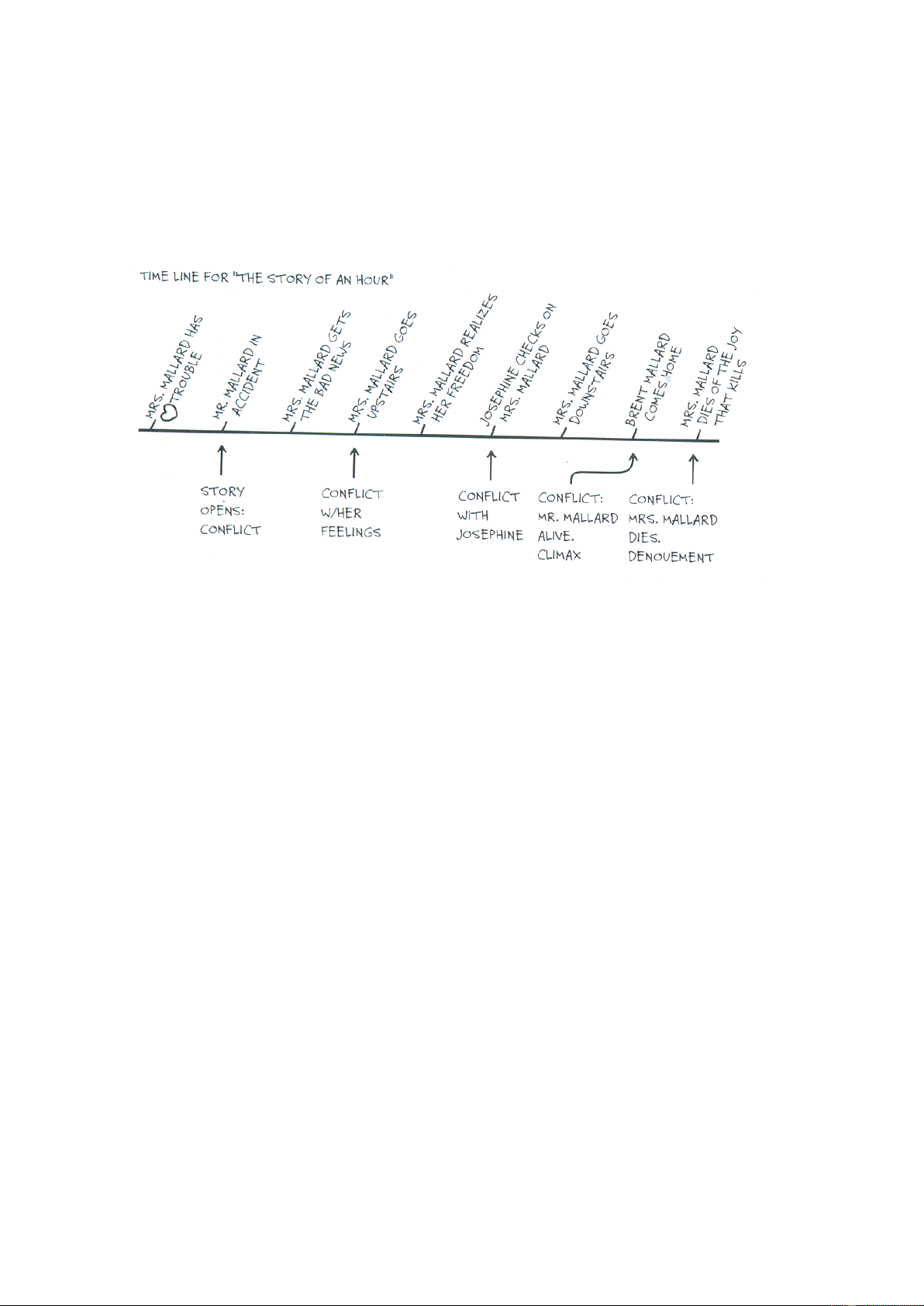
Time line. In your journal, draw a time line for the story. List above the line
everything that happens in the story. Below the line, indicate where the story opens,
when the major conflicts occur, and where the climax and the denouement occur. For
“The Story of an Hour,” student writer Karen Ehrhardt drew the following time line. 5.
Feature list. Choose a character trait, repeated image, or idea that you wish to
investigate in the poem or story. List, in order of appearance, every word, image, or reference that you find. 6.
Scene vision or revision. Write a scene for this story in which you change some
part of it. You may add a scene to the beginning, middle, or end of the story. You may
change a scene in the story. You may write a scene in the story from a different
character’s point of view. You may change the style of the story for your scene. How,
for example, might Eudora Welty have described the opening scene of “The Story of an Hour”? 7.
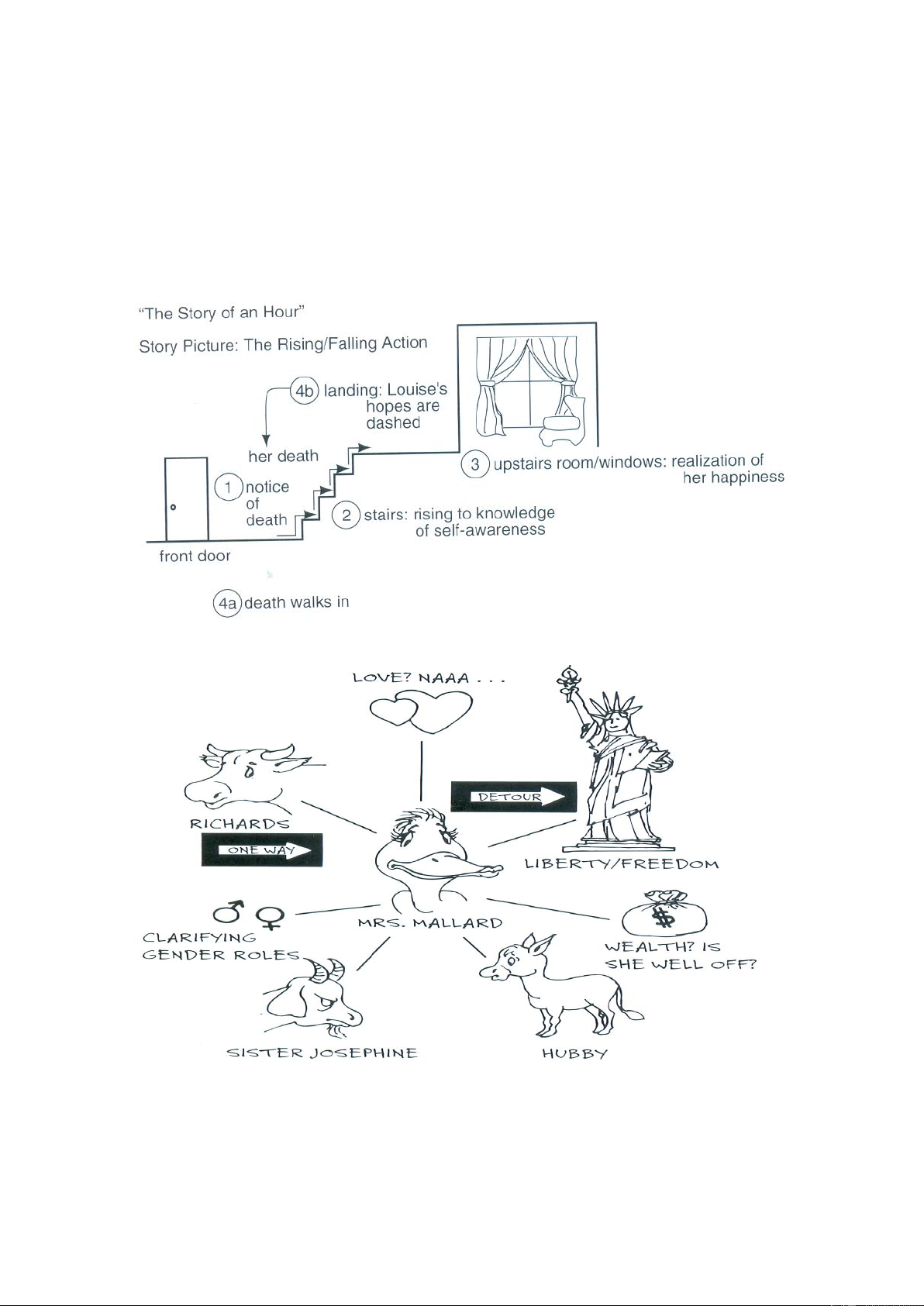
Draw a picture. For your poem or short story, draw a picture based on images,
characters, conflicts, or themes in the work of literature. Student writer Lori Van Sike
drew the following picture for “The Story of an Hour” that shows how the rising and
falling action of the plot parallels Mrs. Mallard’s ascent and descent of the stairs. 8.
Character conflict map. Start with a full page of paper. Draw a main character - 18 -
in the center of the page. Locate the other major characters, internal forces, and external
forces (including social, economic, and environmental pressures) in a circle around the
main character. Draw a line between each of these peripheral characters or forces and
the main character. For his character conflict map for “The Story of an Hour,” student
writer Darren Marshall used images from his computer program to surround his picture of Mrs. Mallard. 9.
Background investigation. Investigate the biographical, social, or historical
context of the poem or story. Go online or to your library databases to find biographical
information or other stories or poems by the same author. How does this background - 19 -
information increase your understanding or appreciation of the poem or story? 10.
Reconsideration of purposes. What idea, theme, or approach most interests
you? Will you be explaining, evaluating, problem solving, or arguing? Are you
combining purposes? Do these purposes suggest what kinds of information you might collect? - 20 -
Tài liệu liên quan:
-
Chapter 4 Asessing personal personality and interest
20 10 -

BÀI GIẢNG VỀ TIẾNG NGA Giáo Trình Chủ Nghĩa Xã Hội Khoa Học
13 7 -

30 ngày thành thạo IELTS Listening | Trường Đại học Ngoại ngữ, Đại học Quốc gia Hà Nội
23 12 -

The ten essential IELTS vocabulary topics with definitions - IELTS band 9 | Trường Đại học Ngoại ngữ, Đại học Quốc gia Hà Nội
29 15