Week 6 Reference and Citation
Week 6 Reference and Citation. Tài liệu tổng hợp được sưu tầm. Mời mọi người tham khảo
Môn: Tiếng Anh cơ sở (FL1128) 62 tài liệu
Trường: Đại học Bách Khoa Hà Nội 5.7 K tài liệu
Tác giả:








Preview text:
2/12/25
HANOI UNIVERSITY OF SCIENCE AND TECHNOLOGY
SCHOOL OF ECONOMICS AND MANAGEMENT WEEK 6
Academic Writing and Presentation Reference and Citation MBA. Nguyen Hong Van
Department of Business 1 Content
2.5.1. Ethical and Legal Standards
2.5.2. APA style citation 2.5.3. Plagiarism 2.5.4. References 2 2 1 2/12/25
2.5.1. Ethical and Legal Standards in Publishing
● Style involves no inherent right or wrong
● conventional way of presenting information that is designed to ease communication.
● Different scholarly disciplines have different publication styles. 3 3 2.5.1. Principles
● To ensure the accuracy of scientific knowledge,
● To protect the rights and welfare of research participants, and
● To protect intel ectual property rights.
"Ethical Principles of Psychologists and Code of Conduct”
APA Ethics Code; APA, at http://www.apa.org/ethic 4 4 2 2/12/25
2.5.1. Ensure Accuracy of Scientific Knowledge
Ethical Reporting of Research Results
● APA Ethics Code Standard, Avoidance of False or Deceptive Statements
● Observations that can be repeated and verified by others
● Do not fabricate or falsify data
● Do not modify results to support a hypothesis
● Do not omit troublesome observations 5 5 Duplicate Publications
● Distorts the knowledge base by making it appear that there is more
information available than real y exists
● Wastes scarce resources (journal pages and the time and efforts of editors and reviewers)
● Can give the erroneous impression that findings are more replicable
than is the case or that conclusions are more strongly supported than is
warranted by the cumulative evidence
● Can also lead to copyright violations; authors cannot assign the
copyright for in the same material to more than one publisher. 6 6 3 2/12/25
Previously published research
● Authors must not submit to an APA journal a manuscript describing
work that has been published previously in whole or in substantial part
elsewhere, whether in English or in another language
● Authors should not submit manuscripts that have been published
elsewhere in substantial y similar form or with substantial y similar content.
● Authors in doubt about what constitutes prior publication should
consult with the editor of the journal in question. 7 7
Author's Copyright on an Unpublished Manuscript
● Authors are protected by federal statute against unauthorized use of their unpublished manuscripts.
● unpublished work is copyrighted from the moment it is fixed in tangible
form—for example, typed on a page
● Until authors formal y transfer copyright (see section 8.05), they own the
copyright on an unpublished manuscript, and al exclusive rights due the
copyright owner of a published work are also due authors of an unpublished work. 8 8 4 2/12/25 2.5.2. APA style
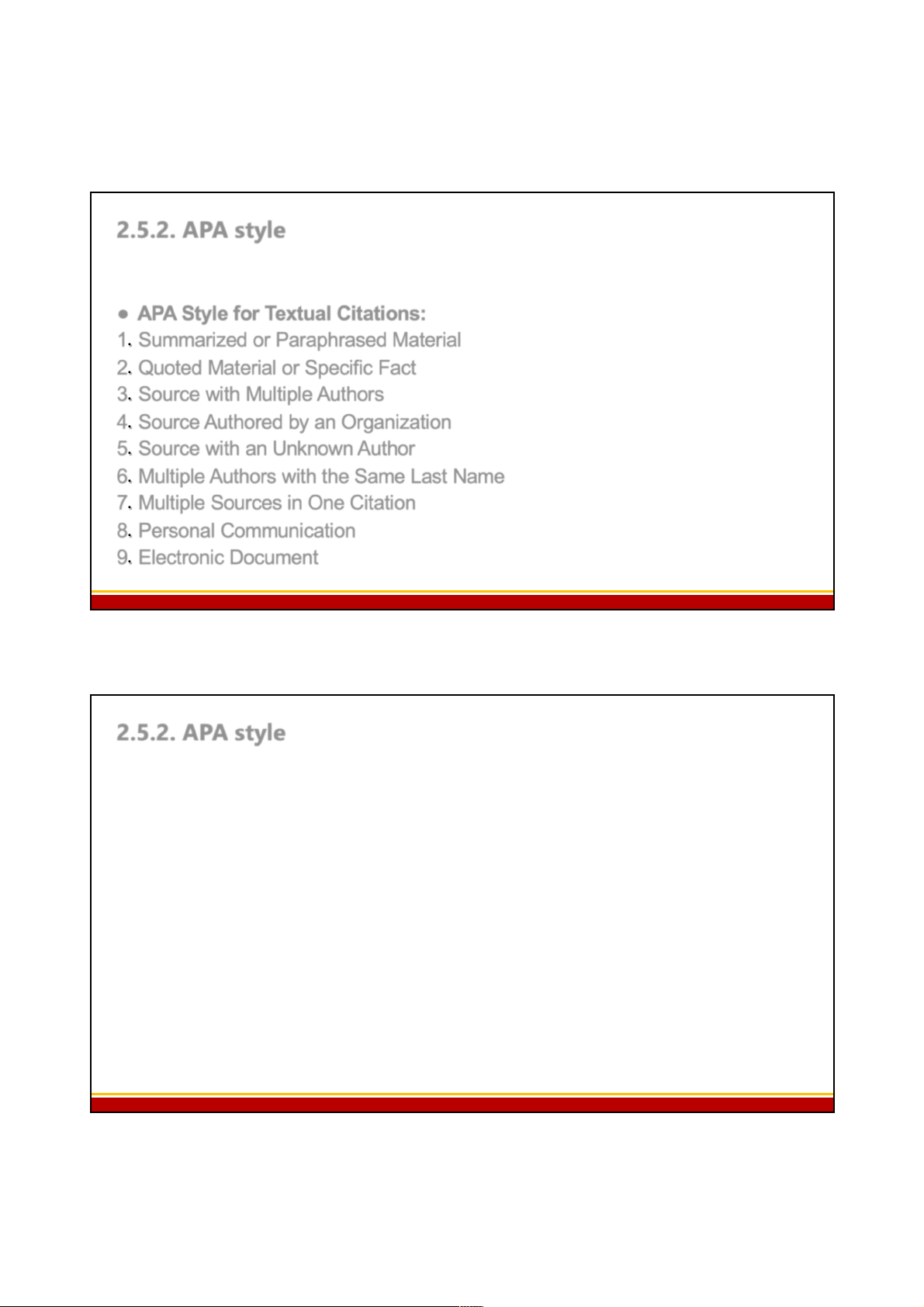
● APA (American Psychological Association) style consists of two elements: citations
in the text and a list of references at the end of the document.
● APA Style for Textual Citations:
1. Summarized or Paraphrased Material
2. Quoted Material or Specific Fact
3. Source with Multiple Authors
4. Source Authored by an Organization
5. Source with an Unknown Author
6. Multiple Authors with the Same Last Name
7. Multiple Sources in One Citation 8. Personal Communication 9. Electronic Document 9 9 2.5.2. APA style
● APA Style for Reference List Entries: 1. BOOKS 2. PERIODICALS 3. ELECTRONIC SOURCES 4. OTHER SOURCES 10 10 5 2/12/25
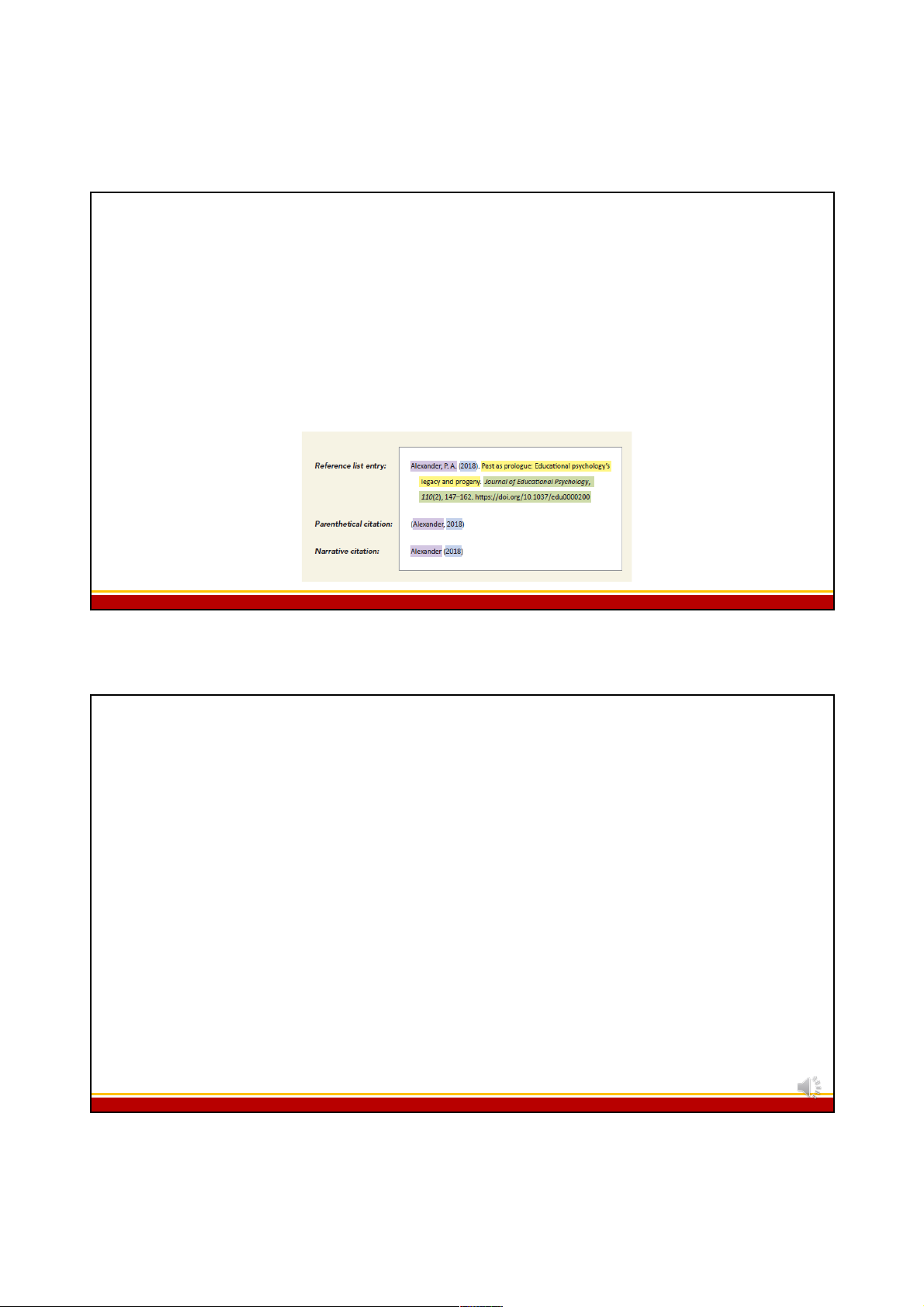
2.5.2. In-Text Citations
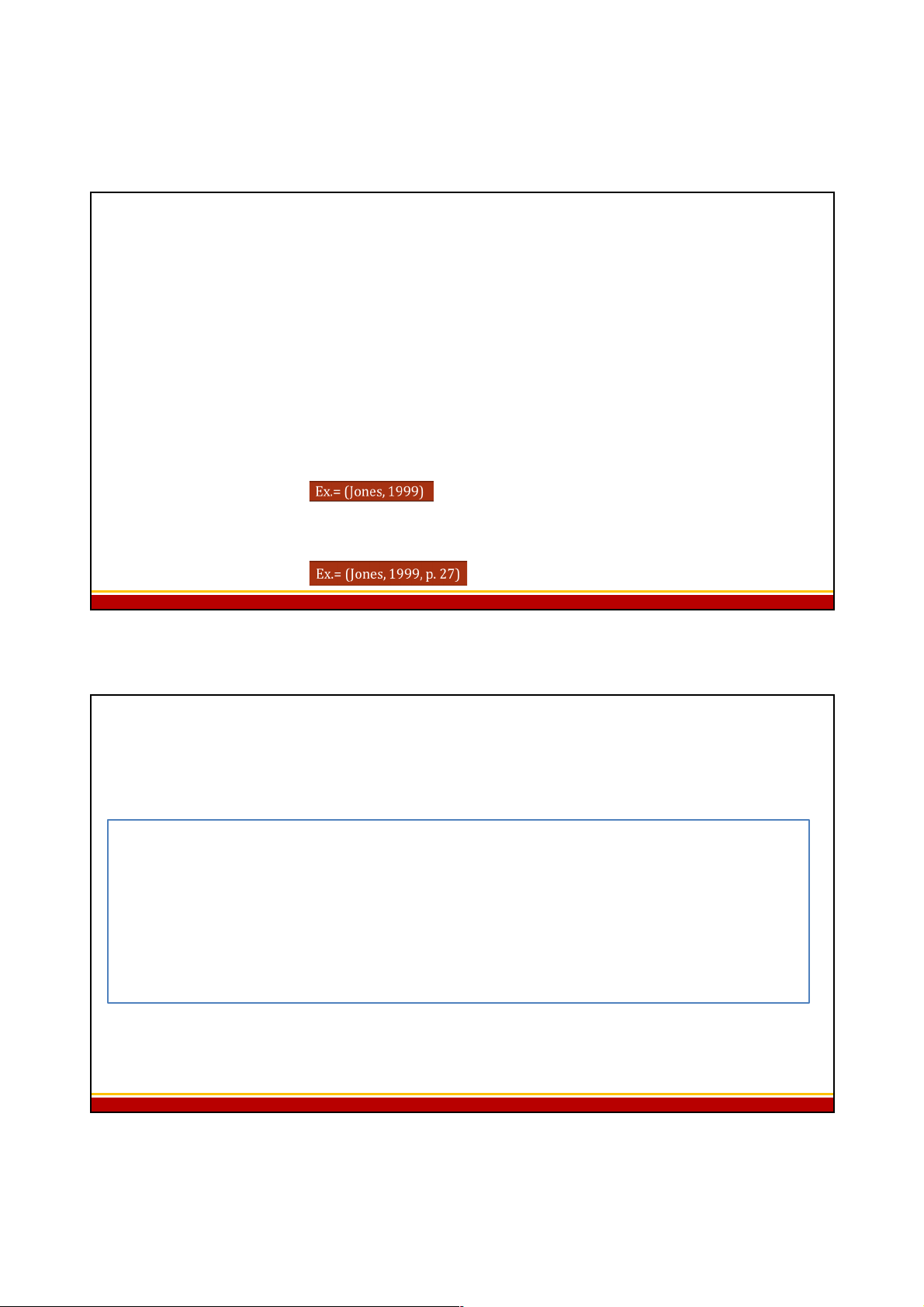
● Used to cite information that you have taken
from another source and used in your paper in the form of: ● Direct Quotes ● Paraphrasing ● Summary
● Whenever you use a source, provide in parenthesis:
● the author’s name and the date of publication
● for quotations and close paraphrases, provide the
author ’ s name, date of publication, and a page number 11 11
Summarized or Paraphrased Material
For material or ideas that you have summarized or paraphrased, include
the author’s name and the publication date in parentheses immediately
fol owing the borrowed information:
Ex: This phenomenon was identified almost 70 years ago (Wilkinson, 1948).
If your sentence already includes the source’s name, do not repeat it in the parenthetical notation.
Ex: Wilkinson (1948) identified this phenomenon almost 70 years ago. 12 12 6 2/12/25
Quoted Material or Specific Fact
If the reference is to a specific fact, idea, or quotation,
add the page number(s) from the source to your citation.
This phenomenon was identified almost 70 years ago (Wilkinson, 1948, p. 36).
Wilkinson (1948) identified this phenomenon almost 70 years ago (p. 36). 13 13
Source with Multiple Authors
For a source written by two authors, cite both names. Use
an ampersand (&) in the parenthetical citation itself but use the word and in regular text.
(Tyshenko & Paterson, 2010)
Tyshenko and Paterson (2010) argued …
For a source written by three, four, or five authors, include all the names the first time you
cite the reference; after that, include only the last name of the first author followed by et al. First Text Citation
Cashman, Walls, and Thomas (2016) argued … Subsequent Citations
Cashman et al. (2016) found …
For a source written by six or more authors, use only the first author’s name followed by et al. (Marken et al., 2017)
Marken et al. (2017) reported … 14 14 7 2/12/25
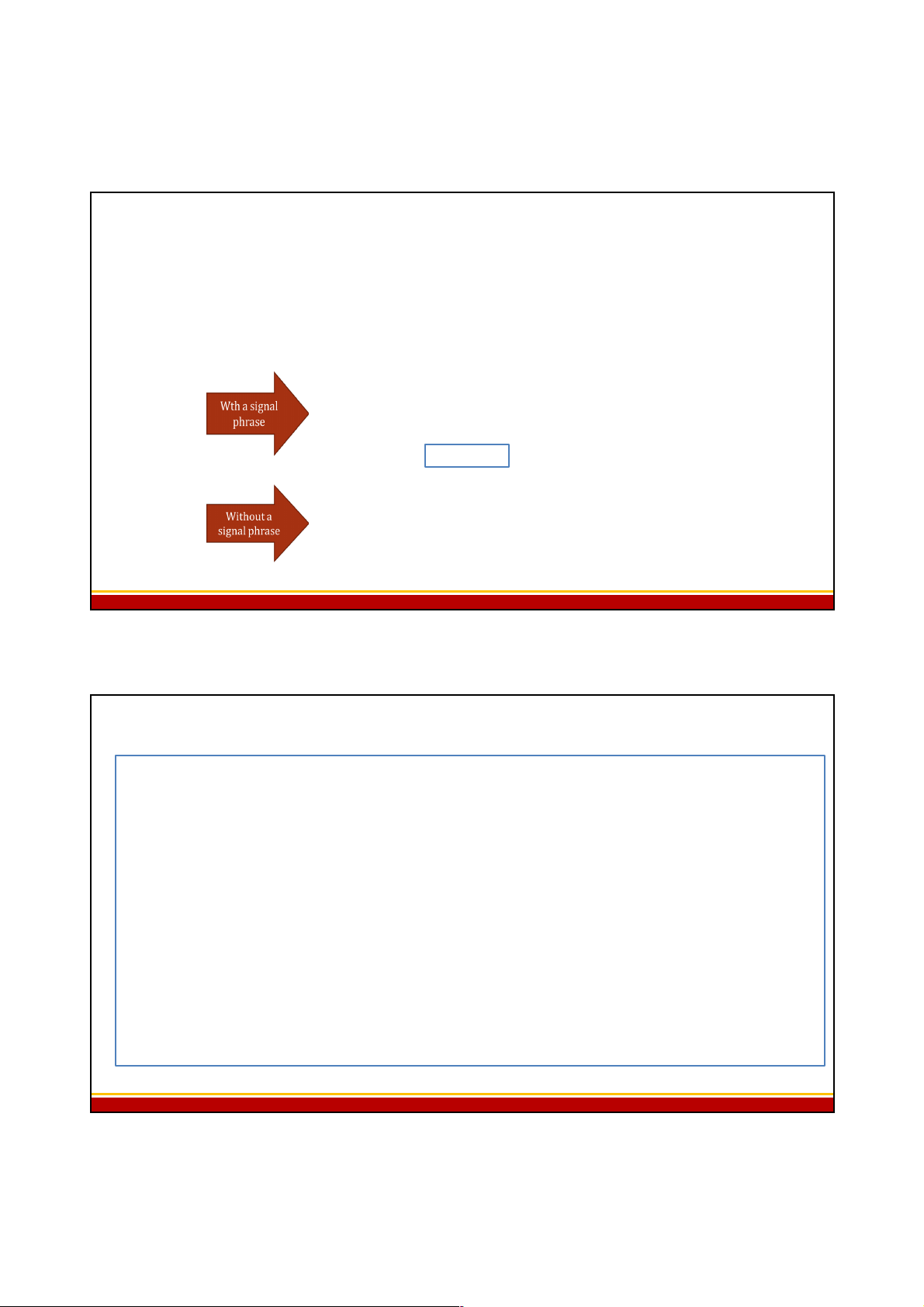
● When citing a work with six and more authors, identify
the first author’s name fol owed by “et al.”
Smith et al. (2006) maintained that…. OR… (Smith et al., 2006) 15 15
Source Authored by an Organization
If the author is an organization rather than a person, use the name of the organization.
There is ongoing discussion of the scope and practice of nursing
informatics (American Nurses Association, 2010).
In a policy statement, the American Nurses Association (2010) discusses the
scope and practice of nursing informatics.
If the organization name is commonly abbreviated, you may include the
abbreviation in the first citation and use it in any subsequent citations. First Text Citation
(International Business Machines [IBM], 2017) Subsequent Citations (IBM, 2017) 16 16 8 2/12/25
A Work of Unknown Author
● When citing a work of unknown author, use the source’s
ful title in the signal phrase and cite the first word of the
title fol owed by the year of publication in parenthesis.
Put titles of articles and chapters in quotation marks;
italicize titles of books and reports.
According to “Indiana Joins Federal Accountability System” (2008), …
(“Indiana,” 2008) or (Anonymous, 2016) 17 17
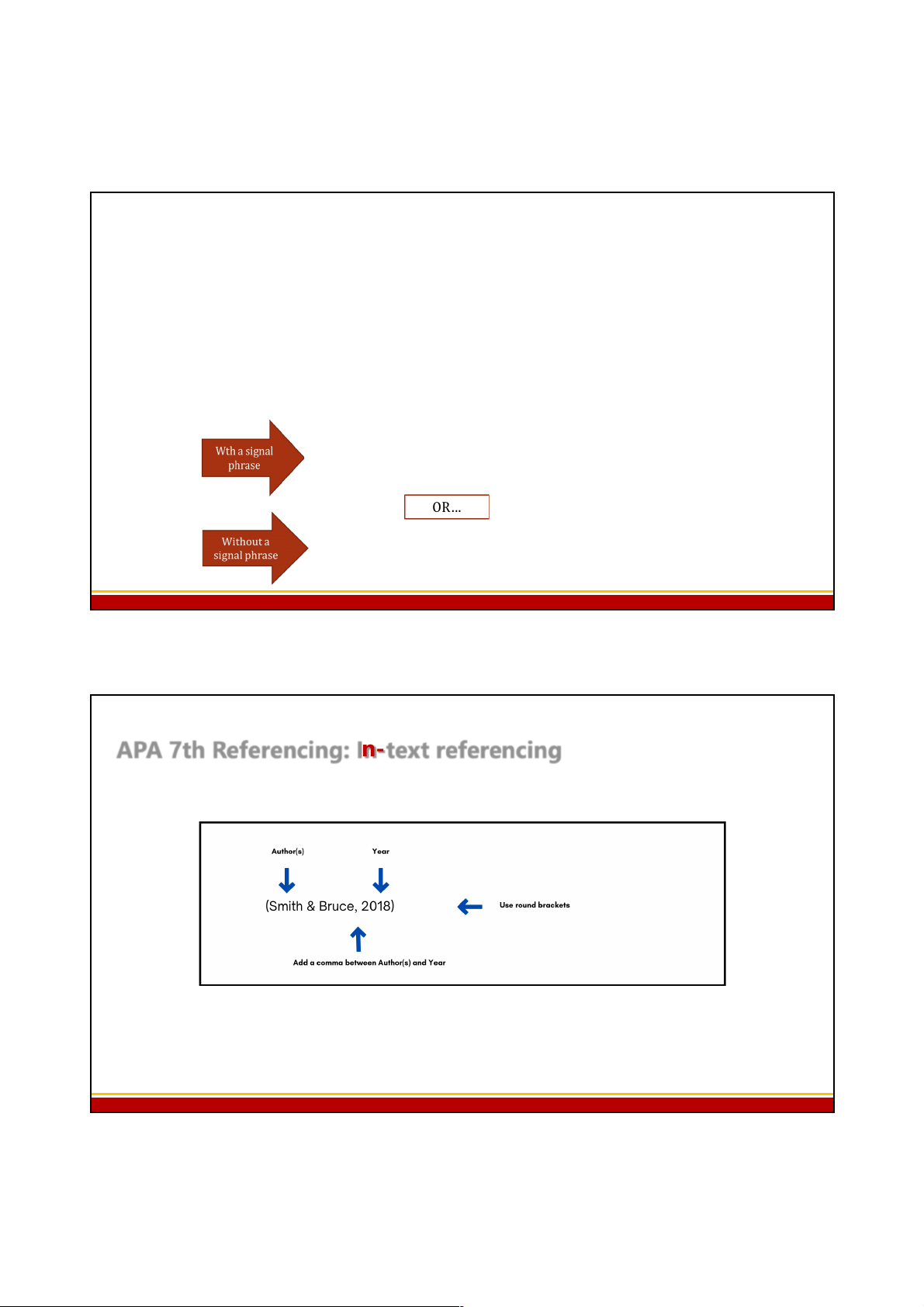
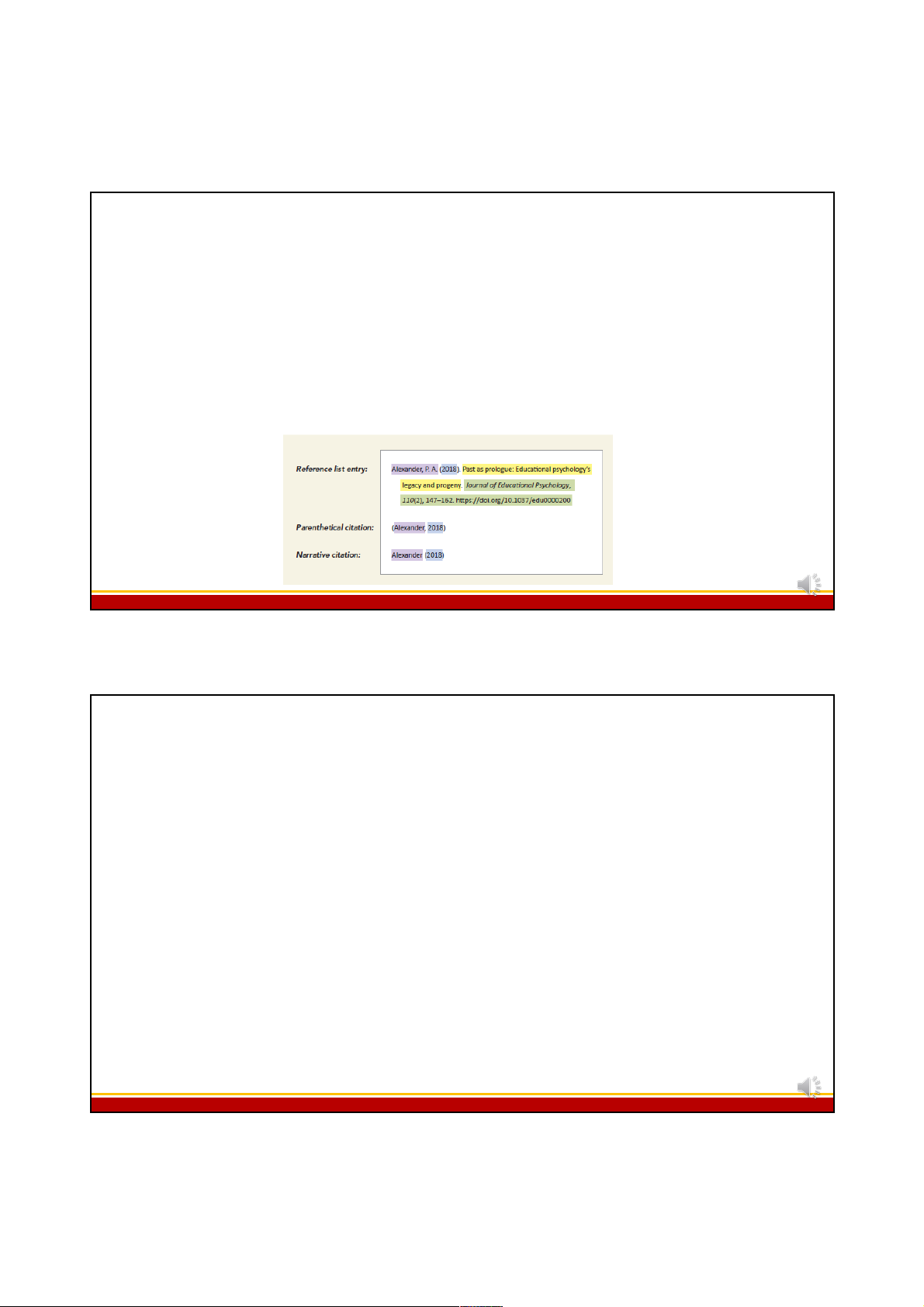
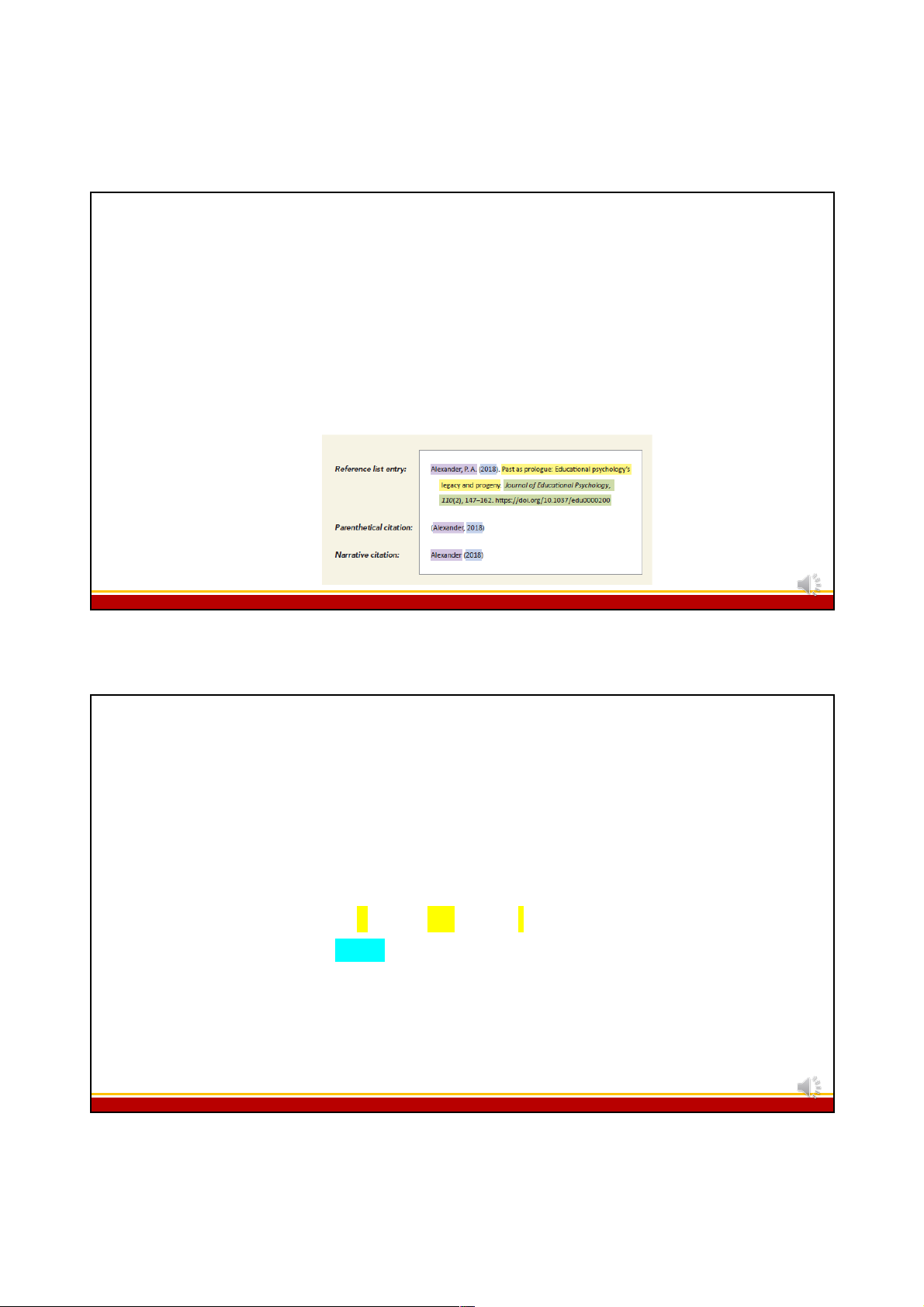
APA 7th Referencing: In-text referencing 18 18 9 2/12/25
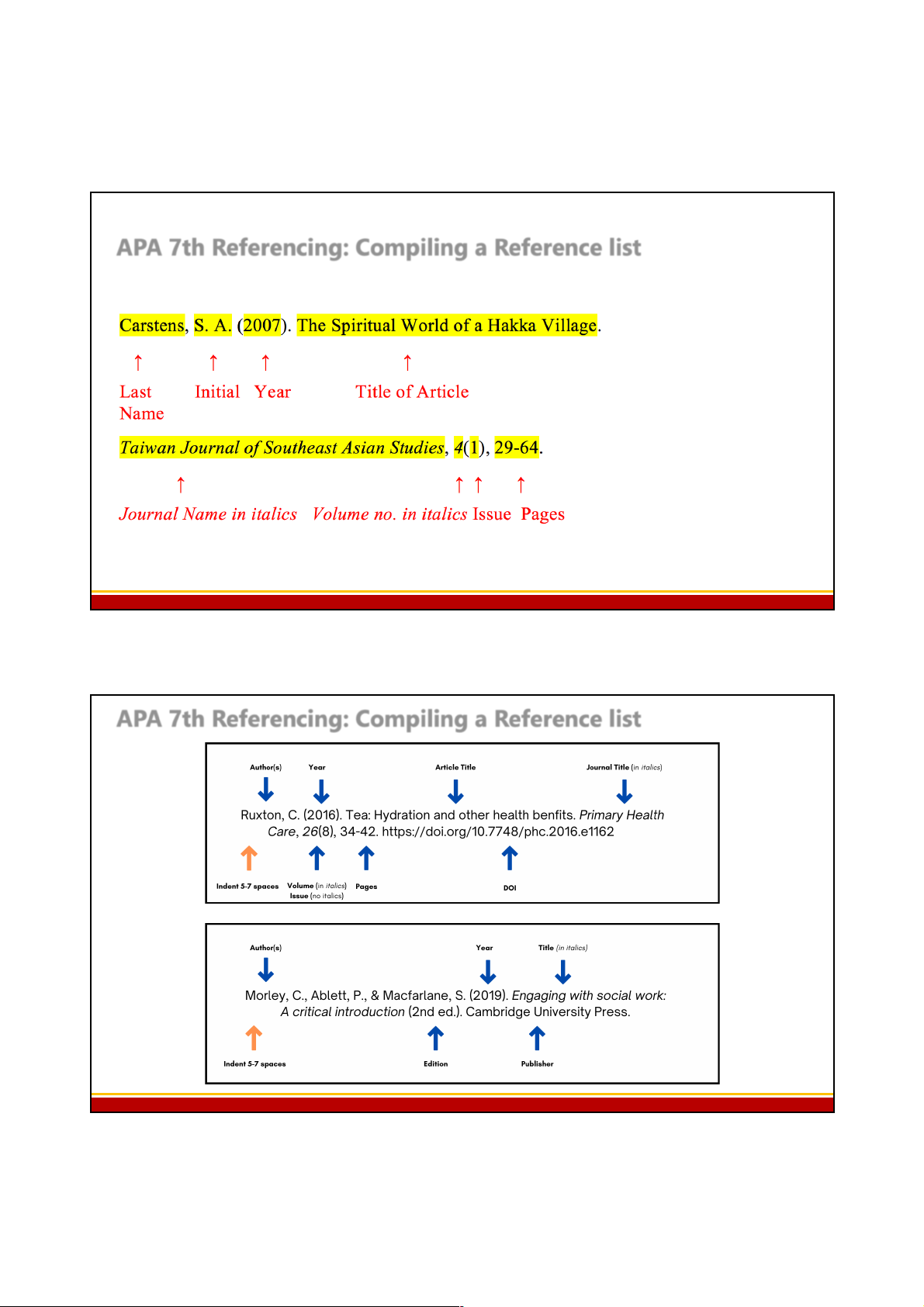
APA 7th Referencing: Compiling a Reference list 19 19
APA 7th Referencing: Compiling a Reference list 20 20 10 2/12/25
Practice Questions with Full References:
1. Johnson, A. B. (2019). Exploring human behavior: A psychological perspective. Boston: Pearson.
● How would you cite the above book in two different ways in the text? o
Example: Exploring human behavior offers insight into psychological processes ___________. o
Example: ___________ argues that human behavior is influenced by multiple factors. 21 21
Practice Questions with Full References:
1. Johnson, A. B. (2019). Exploring human behavior: A psychological
perspective. Boston: Pearson.
● How would you cite Johnson’s (2019) book in two different ways in the text?
Example: Exploring human behavior offers insight into psychological o processes (Johnson, 2019).
Example: Johnson (2019) argues that human behavior is influenced by o multiple factors. 22 22 11 2/12/25
Practice Questions with Full References:
2. Smith, J. K., & Patel, R. (2015). Modern education and the future of learning. New York: Academic Press.
● How would you cite this book in two different ways? o
Example: The future of learning is discussed extensively in modern education (___________). o
Example: ___________ suggest that technology will play a pivotal role in education. 23 23
Practice Questions with Full References:
2. Smith, J. K., & Patel, R. (2015). Modern education and the future of
learning. New York: Academic Press.
● How would you cite Smith and Patel’s (2015) book in two different ways?
Example: The future of learning is discussed extensively in modern o
education (Smith & Patel, 2015).
Example: Smith and Patel (2015) suggest that technology will play a o pivotal role in education. 24 24 12 2/12/25
Practice Questions with Full References:
3. Williams, D., Brown, T., & Garcia, M. (2018). Advances in neuroscience
research. Washington, DC: Neuroscience Institute.
● How would you cite this book in two different ways?
Example: Advances in neuroscience research have opened new possibilities o ___________.
Example: ___________ demonstrated the significance of their findings in o neuroscience. 25 25
Practice Questions with Full References:
3. Williams, D., Brown, T., & Garcia, M. (2018). Advances in neuroscience
research. Washington, DC: Neuroscience Institute.
● How would you cite this book in two different ways?
Example: Advances in neuroscience research have opened new o
possibilities (Williams, Brown, & Garcia, 2018).
Example: Williams et al. (2018) demonstrated the significance of their o findings in neuroscience. 26 26 13 2/12/25
Practice Questions with Full References:
5. World Health Organization. (2021). Global vaccine rollout for COVID-19. Geneva: WHO.
● How would you cite the this report in two different ways?
Example: The global rollout of vaccines is a key focus in public health o ___________.
Example: ___________ emphasized the challenges in distributing o COVID-19 vaccines worldwide. 27 27
Practice Questions with Full References:
5. World Health Organization. (2021). Global vaccine rollout for COVID-19. Geneva: WHO.
● How would you cite the this report in two different ways?
Example: The global rollout of vaccines is a key focus in public health o
(World Health Organization [WHO], 2021).
Example: WHO (2021) emphasized the challenges in distributing o COVID-19 vaccines worldwide. 28 28 14 2/12/25
Practice Questions with Full References:
6. Lee, P., & Thomas, S. (2016). Technological advances in healthcare. Journal of Medical Technology, 28(2), 58-70.
https://doi.org/10.1016/j.jmt.2016.02.003
● How would you cite this journal article in two different ways?
Example: Technological advancements in healthcare have improved o
patient outcomes (___________).
Example: __________(__________) found that new technologies are o
revolutionizing healthcare practices. 29 29
Practice Questions with Full References:
6. Lee, P., & Thomas, S. (2016). Technological advances in healthcare. Journal of Medical Technology, 28(2), 58-70.
https://doi.org/10.1016/j.jmt.2016.02.003
● How would you cite this journal article in two different ways?
Example: Technological advancements in healthcare have improved o
patient outcomes (Lee & Thomas, 2016).
Example: Lee and Thomas (2016) found that new technologies are o
revolutionizing healthcare practices. 30 30 15 2/12/25
Practice Questions with Full References:
7. Jones, H. (n.d.). Digital learning and student engagement. Boston: Academic Innovations.
● How would you cite this book in two different ways?
Example: Digital learning is transforming student engagement (Jones, o n.d.).
Example: According to __________ (__________), digital tools enhance o the learning experience. 31 31
Practice Questions with Full References:
8. International Business Machines (IBM). (2017). The future of cloud computing. New York: IBM.
● How would you this report in two different ways? •
Example: The future of cloud computing is rapidly evolving (__________
__________ __________ [__________], ________). •
Example: __________ (__________) predicts major innovations in cloud
technology over the next decade. 32 32 16 2/12/25
Practice Questions with Full References:
9. Baker, S., Robinson, P., & Lee, A. (2021). Sustainable development in
urban planning. New York: Urban Studies Press.
● How would you cite this book in two different ways?
Example: Sustainable development is crucial in urban planning (Baker, o
Robinson, & Lee, 2021).
Example: Baker et al. (2021) discuss various strategies for sustainable o urban development. 33 33 References
● Peter John Wanner. (2019). Graduate School of International Cultural
Studies, Tohoku University. Academic Writing for Scholarly Publications
http://www.intcul.tohoku.ac.jp; wanner.peter.john.e3@tohoku.ac.jp; peterjohnwanner@gmail.com
● https://apastyle.apa.org/style-grammar-guidelines/references/examples
● https://uscmed.sc.libguides.com/c.php?g=477787&p=3266940 34 34 17