English Vocabulary In Use Elementary Cambridge Third Edition | Sách Tiếng Anh
English Vocabulary In Use Elementary Cambridge Third Edition | Sách Tiếng Anh. Tài liệu giúp bạn tham khảo, ôn tập và đạt kết quả cao. Mời đọc đón xem!
Môn: Tiếng Anh chuyên ngành 332 tài liệu
Trường: Tài liệu Tiếng Anh chuyên ngành, Tiếng Anh cho người đi làm 432 tài liệu
Tác giả:





Preview text:
University Printing House, Cambridge CB2 8BS, United Kingdom
One Liberty Plaza, 20th Floor, New York, NY 10006, USA
477 Williamstown Road, Port Melbourne, VIC 3207, Australia
4843/24, 2nd Floor, Ansari Road, Daryaganj, Delhi – 110002, India
79 Anson Road, #06–04/06, Singapore 079906
Cambridge University Press is part of the University of Cambridge.
It furthers the University’s mission by disseminating knowledge in the pursuit of
education, learning and research at the highest international levels of excellence. www.cambridge.org
Information on this title: www.cambridge.org/elt
© Cambridge University Press 2017
This publication is in copyright. Subject to statutory exception
and to the provisions of relevant collective licensing agreements,
no reproduction of any part may take place without the written
permission of Cambridge University Press. First published 2005 Third Edition 2017
A catalogue record for this publication is available from the British Library
ISBN 978-1-316-63152-2 Edition with answers and ebook
ISBN 978-1-316-63153-9 Edition with answers ISBN 978-1-316-631546 ebook
Cambridge University Press has no responsibility for the persistence or accuracy
of URLs for external or third-party internet websites referred to in this publication,
and does not guarantee that any content on such websites is, or will remain,
accurate or appropriate. Information regarding prices, travel timetables, and other
factual information given in this work is correct at the time of first printing but
Cambridge University Press does not guarantee the accuracy of such information thereafter. Contents Thanks
16 Communications address, Introduction computer, memory stick People
17 Your phone apps, voicemail, text
1 The family mother, uncle, relatives Leisure
2 Birth, marriage and death birthday,
18 Holidays package holiday, married, die currency, visa
3 Parts of the body head, foot,
19 Shops and shopping chemist’s, shoulder
department store, credit card
4 Clothes hat, shirt, trousers
20 Online shopping reviews, basket, delivery
5 Describing people tall, dark, good-looking
21 In a hotel single room, key, luggage
6 Health and illness headache, heart attack, exercise
22 Eating out café, menu, fish and chips
7 Feelings love, tired, thirsty
23 Sports table tennis, judo,
8 Conversations 1: Greetings and volleyball
wishes Good morning, Happy New Year, well done
24 Cinema western, film star, director
9 Conversations 2: Useful words
25 Free time at home gardening,
and expressions I don’t mind,
listening to CDs, programme anyway, let’s
26 Music and musical instruments At home guitar, jazz, orchestra
10 Food and drink rice, tea, vegetables The world
11 In the kitchen fridge, glass,
27 Countries and nationalities Spain, saucepan Chinese, continent
12 In the bedroom and bathroom
28 Weather cold, rain, storm
wardrobe, shampoo, mirror
29 In the town railway station, bank,
13 In the living room bookshelf, lamp, town hall remote control
30 In the countryside hill, farm, river School and workplace
31 Animals horse, giraffe, pet
14 Jobs secretary, factory, nurse
32 Travelling train, map, flight
15 At school and university biology, notebook, pass an exam
33 UK culture fireworks, roast beef, Christmas
English Vocabulary in Use Elementary 3 Social issues Words and grammar
34 Crime murder, prison, guilty
50 Conjunctions and connecting words because, only, before
35 The media TV channel, magazine, talk show
51 Days, months, seasons Monday, July, winter
36 Problems at home and work repair, untidy, in a bad mood
52 Time words next year, often, once a week
37 Global problems hurricane, war, strike
53 Places middle, front, abroad Everyday verbs
54 Manner fast, loud, the right way
38 Have / had / had have breakfast,
55 Common uncountable nouns have time, have a swim
money, bread, information
39 Go / went / gone go away, go
56 Common adjectives: Good and bad shopping, go home
things nice, awful, lovely
40 Do / did / done do an exercise, do
57 Words and prepositions wait for,
your best, do the washing belong to, good at
41 Make / made / made make coffee,
58 Prefixes impossible, ex- wife,
make a mistake, make a noise unsafe
42 Come / came / come come in, come
59 Suffixes swimmer, useless, sunny from, come back
60 Words you may confuse quiet /
43 Take / took / taken take the bus,
quite, lend / borrow, cook / cooker
take a photo, take an exam Answer key
44 Bring / brought / brought bring
something here, bring back, take Phonemic symbols
45 Get / got / got get tired, get better, Index get married Irregular verbs
46 Phrasal verbs get up, put on, turn down How to learn vocabulary
47 Everyday things watch TV, wash Acknowledgements clothes, go for a walk How to use the ebook █████████
48 Talking say, tell, ask
49 Moving walk, drive, fly 4
English Vocabulary in Use Elementary Thanks
Sabina Ostrowska wrote two new units for the Third Edition: Unit 17, Your phone, and Unit 20,
Online shopping. The publishers would like to thank Sabina for her contribution to this new edition.
English Vocabulary in Use Elementary 5 Introduction To the student
This book will help you learn around 1, 250 new words and phrases. You can use the book
yourself, without a teacher. You can do the units in any order you like. If you have the edition with
the ebook, you can listen to the pronunciation of all the new vocabulary, and highlight text. see
page 171 for more information about the ebook.
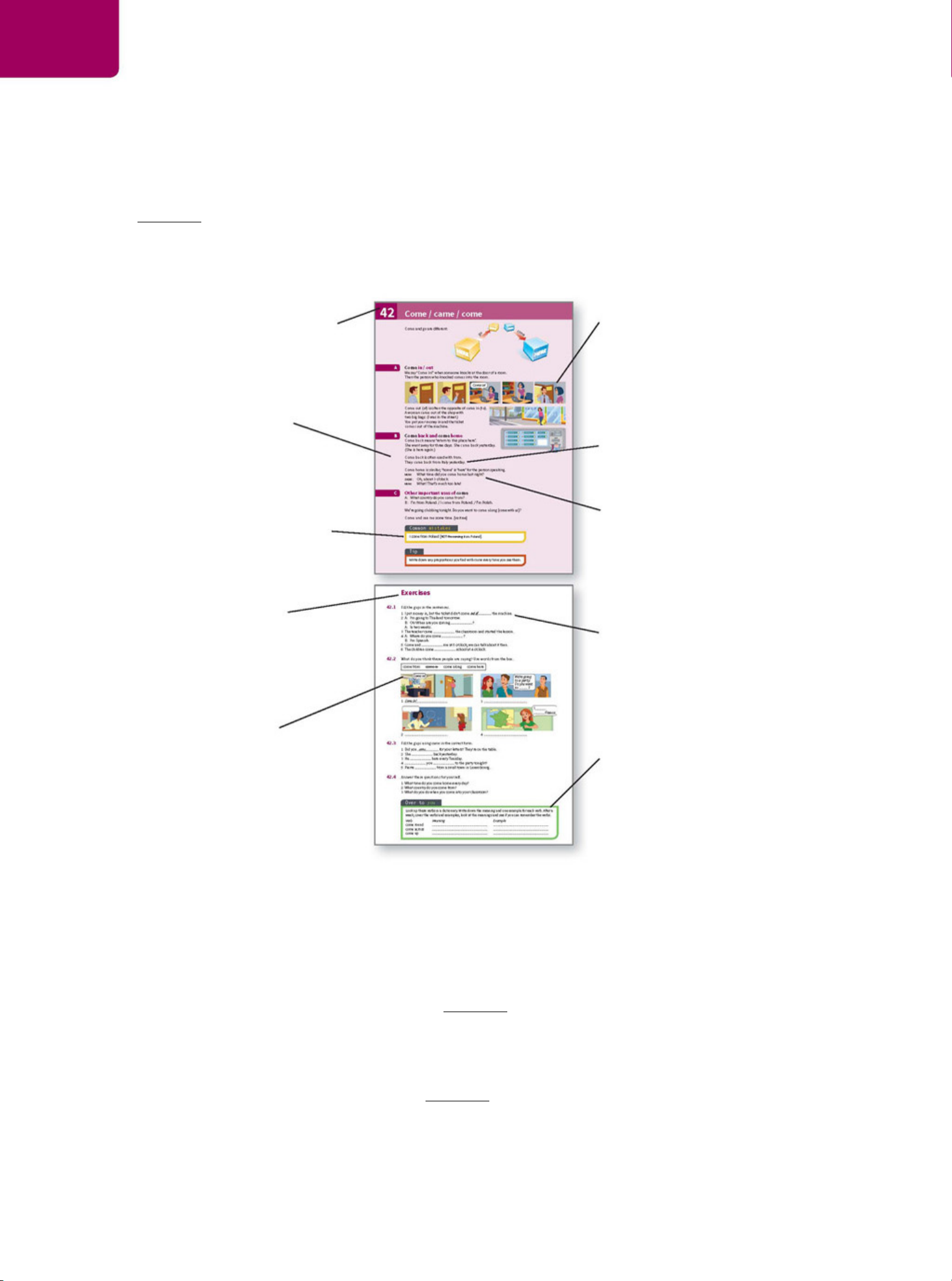
Here is what the pages look like: The left-hand page presents Diagrams and pictures the new vocabulary. show the meaning. The left-hand page is divided into sections. Example sentences show the words in context. Common mistakes and Mini-dialogues show how learning tips are also given people use the words in on the left-hand page. real situations. The right-hand page practises the new A lot of diff erent exercise vocabulary. types are used: gap-fills, answering questions, matching, etc. Pictures, tables and diagrams give variety to the exercises. Over to you tasks give you a chance to do more work on the topic of the unit.
The Answer key at the end of the book is for you to check your answers to the exercises aft er you
do them. The Answer key sometimes has more than one answer. This is because there is oft en
not just one correct way of saying something. The Answer key also has possible answers for most
of the exercises which are open-ended, or where you are asked to talk about yourself.
The Index at the end of the book has all the important words and phrases from the left-hand
pages. The Index also tells you how to pronounce words. There is a list of phonemic symbols to
help you understand the pronunciation on page 158.
It is a good idea to have a dictionary with you when you use the book so you can check the
meaning of something, or translate a word into your own language. sometimes, you will also
need a dictionary for the exercises; we tell you when this is so. You also need a vocabulary
notebook to write down new words. see page 170 for ideas on how to learn and remember these new words.
We hope you like this book. When you have finished all the units in this book, you can go to the next
bookintheseries,EnglishVocabularyinUse:Pre-intermediateandIntermediate,andafterthat,tothe
higher levels, English Vocabulary in Use: Upper-intermediate and English Vocabulary in Use: Advanced. 6
English Vocabulary in Use Elementary To the teacher
This book can be used in class or as a self-study book. It is intended for learners at A1–A2 levels
of the Council of Europe scale. It aims to take learners with a very basic level of vocabulary to
a point where they can use approximately 2,000 words and phrases and teaches them around
1, 250 new words and phrases. The vocabulary has been chosen for its usefulness in everyday
situations, and we consulted a written and spoken corpus of present-day English to help us
decideonthewordsandphrasestobeincluded.Thenewvocabulary(onaverage20–30items
perunit)ispresentedwithphotosorillustrationsandexplanationsontheleft-handpage,and
thereareexercisesandactivitiesontheright-handpage.ThereisanAnswerkeyandanIndex
withpronunciationforallthekeyvocabulary.
The book focuses not just on single words, but also on useful phrases and collocations. For
example,difficultteachingpointssuchasthedifferencebetweendoandmakearedealt
withthroughcollocation(wedoourhomework,butwemakemistakes),andusefulphrases
(e.g.comealong)arepresented.
Thebookisorganisedaroundeverydaytopics,butalsohasunitsdevotedtocoreverbssuch
asgetandbring/take.Typicalerrorsareindicatedwhereappropriate,andthemosttypical
meanings and uses are focused on for each key item. The units in the book can be used in any
order you like, but it is often a good idea to do blocks of units based round the same topic
(e.g.People,Athome,Leisure).
Theright-handpagesofferavarietyofdifferenttypesofactivities,includingtraditionalonessuch
asgap-filling,butalsomoreopen-endedonesandpersonalisedactivitieswhichenablelearnersto
talkabouttheirownlives.Althoughtheactivitiesandexercisesaredesignedforself-study,theycan
easilybeadaptedforpairwork,groupworkorwhole-classactivitiesintheusualways.Forexample,
where there are dialogues, students can take the speaking parts and practise the conversations,
and where the exercises have questions and answers, students can practise asking each other
the questions and answering them. See who has the best ideas for recording vocabulary in their
notebook. The Answer key sometimes gives alternative answers to the exercises, and also gives
possible model answers for the more personalised ones.
When the learners have worked through a group of units, it is a good idea to repeat some of
the work (for example, the exercises) and to expand on the meaning and use of key words and
phrases by extra discussion in class, and find other examples of the key items in other texts and
situations. This can be done at intervals of one to three months after first working on a unit. This
is important, since it is usually the case that learners need five to seven exposures to a word or
phrase before they can really know it, and no single book can do enough to ensure that words are always learnt first time.
When your students have finished and reviewed all the units in this book, they can move on to
the next book in this series: English Vocabulary in Use: Pre-intermediate and Intermediate, by Stuart Redman.
Findmoreresourcesforteachersatwww.cambridge.org
We hope you enjoy using the book.
English Vocabulary in Use Elementary 7 1 Thefamily A Family words
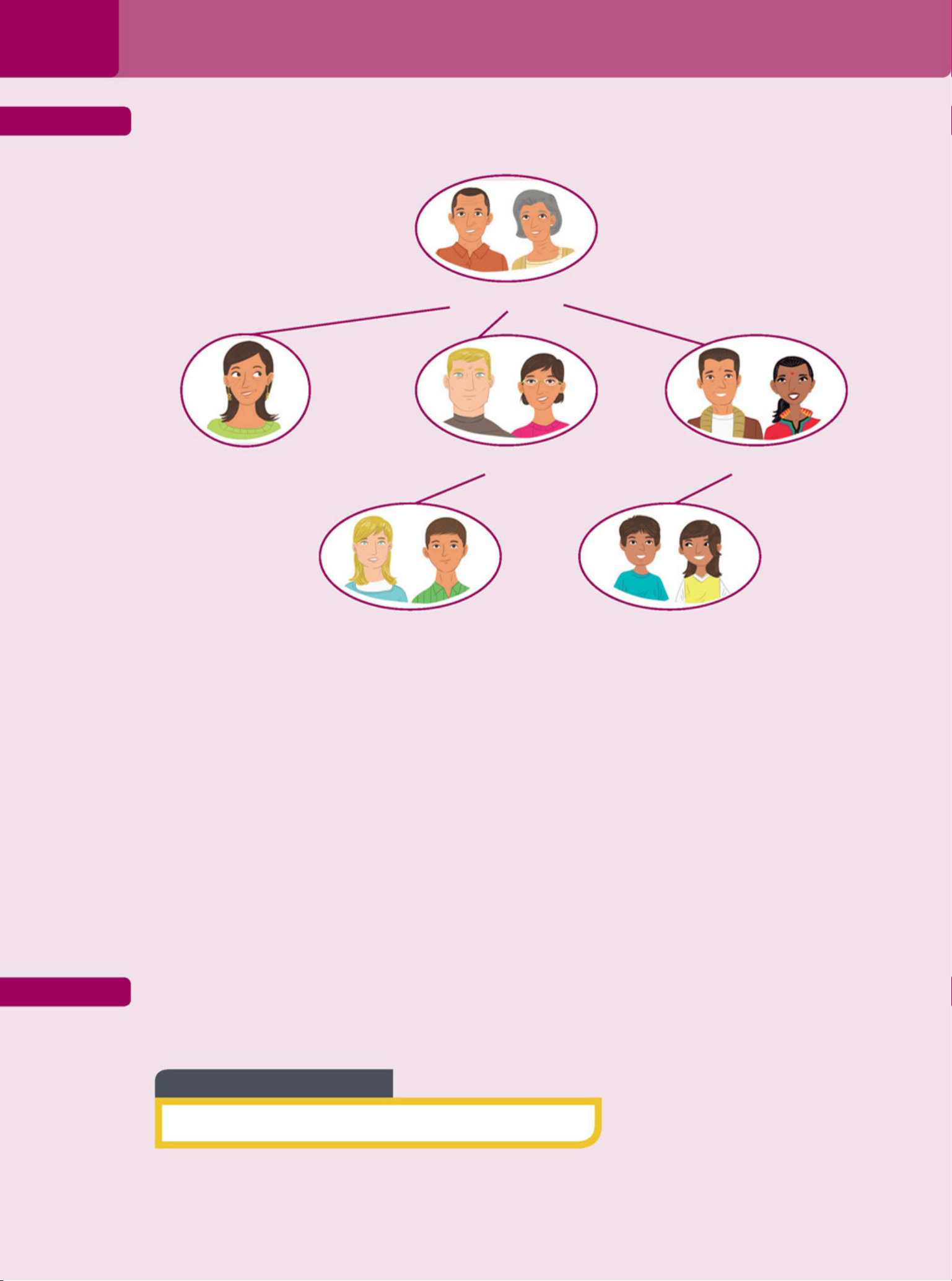
A family tree for some of Anne and Ivan Sorokin’s relatives or relations. Henry + Diana Amelia Ivan + Anne George + Meena Karen Jack Ravi Kavita
Ivan and Anne and their children
IvanisAnne’shusbandandKarenandJack’sfather.
AnneisIvan’swifeandKarenandJack’smother.
AnneandIvanareKarenandJack’sparents.
KarenisAnneandIvan’sdaughter.Jackistheirson.
KarenisJack’ssister.JackisKaren’sbrother. Henry and Diana
HenryisKarenandJack’sgrandfather.Dianaistheirgrandmother.
HenryandDianaareKarenandJack’sgrandparents.
KarenisHenryandDiana’sgranddaughter.Jackistheirgrandson. Amelia,GeorgeandMeena
GeorgeisKarenandJack’suncle.
AmeliaandMeenaareKarenandJack’saunts.
KarenisAmelia,GeorgeandMeena’sniece.Jackistheirnephew.
KavitaandRaviareKarenandJack’scousins. B Expressions
Haveyougotanybrothersandsisters? No,Iamanonlychild.
Doyoucomefromabigfamily?
Yes,Ihavethreebrothersandtwosisters. Common mistakes
We say ‘my/his wife’ (singular) but ‘our/their wives’ (plural). 8
EnglishVocabularyinUseElementary Audio not supported Exercises
1.1 Lookatthefamilytreeontheoppositepage.Completethesentences. 1 Kavita is Ravi’s sister 2 Ravi is Kavita’s Chenff văn bản vào đây 3 Anne is Kavita’s 4 Ivan is Ravi’s 5 Diana is Ravi’s 6 Henry is Kavita’s 7 Ravi is Ivan’s 8 Kavita is Ivan’s 9 Meena is Kavita’s 10 Meena is George’s 11 Karen is Ravi’s
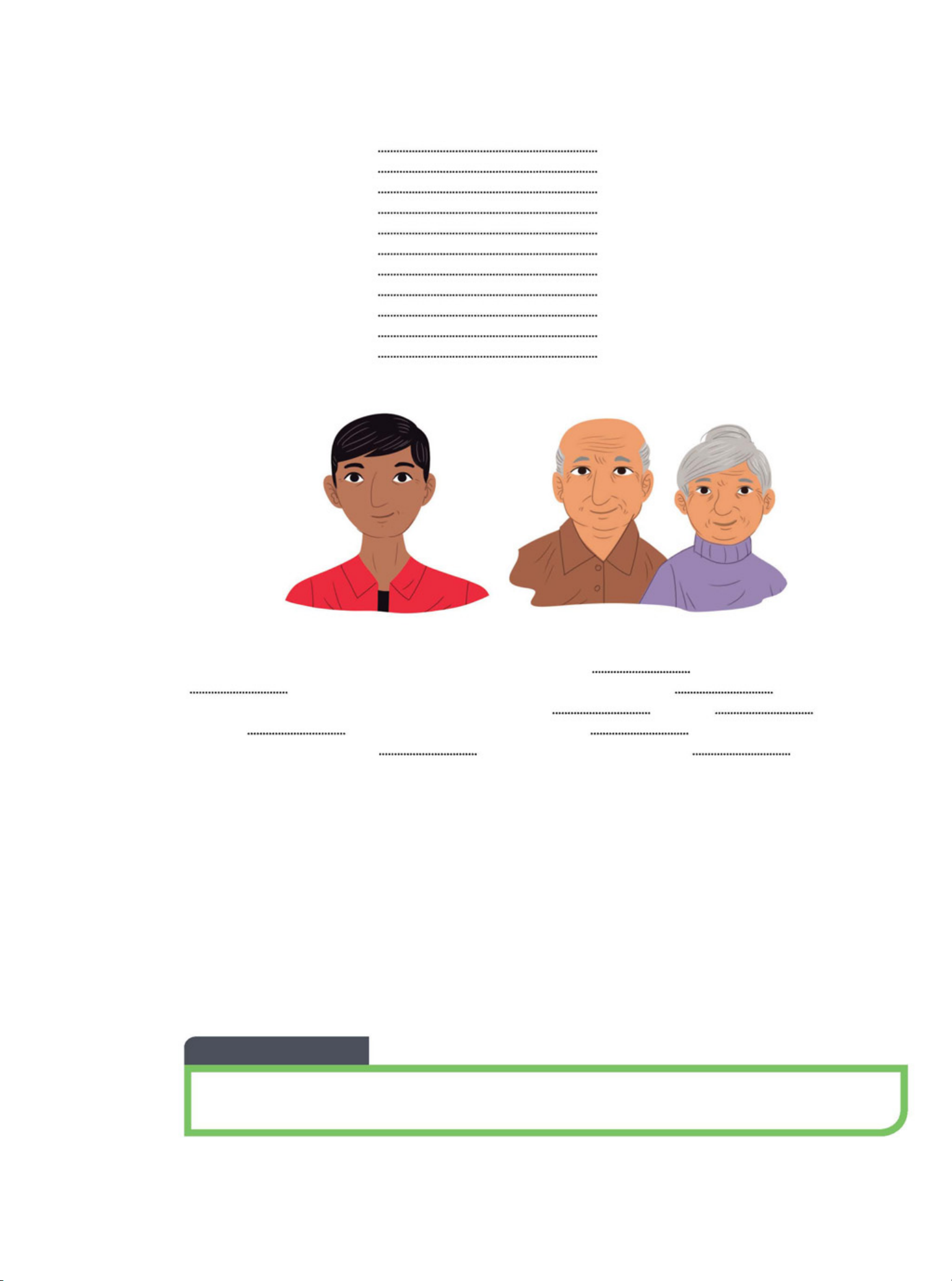
1.2 TheSorokinshavesomeotherrelatives.Completethesentencesaboutthem. Sanjay AlexanderandLeila
Meenahasabrother,Sanjay.SanjayisKavitaandRavi’s1 uncle and Sanjay’s wife is their 2
. Sanjay and his wife have one son, Prem. Prem is an 3 .
Henry’sparentsarestillalive.AlexanderisHenry’s 4 and his 5 Leila is Henry’s 6
. Alexander and Leila have three 7 –Amelia, Ivan and George. Ivan and George and their 8 , Anne and Meena, love their 9 and visit them as often as possible.
1.3 Askafriendthesequestions.Thenwritesentencesaboutyourfriendandtheirfamily.For
example,Martahasonebrotherbutnosisters.
1 Haveyougotanybrothersandsisters? 2 Haveyougotanycousins?
3 Haveyougotanyniecesornephews? 4 Haveyougotanygrandparents? 5 Doyoucomefromabigfamily?
1.4 Covertheoppositepage.Howmanyfamilywordscanyouwritedownintwominutes?Check
whatyouwrotecarefullywiththebook.Didyouspelleverythingcorrectly?Whichwordsdid youforget? Over to you
Drawyourfamilytree.Thenwritesentences.Writeaboutyourrelations. Marta is my mother. Useadictionarytohelpyou.
English Vocabulary in Use Elementary 9
2 Birth, marriage and death A Birth
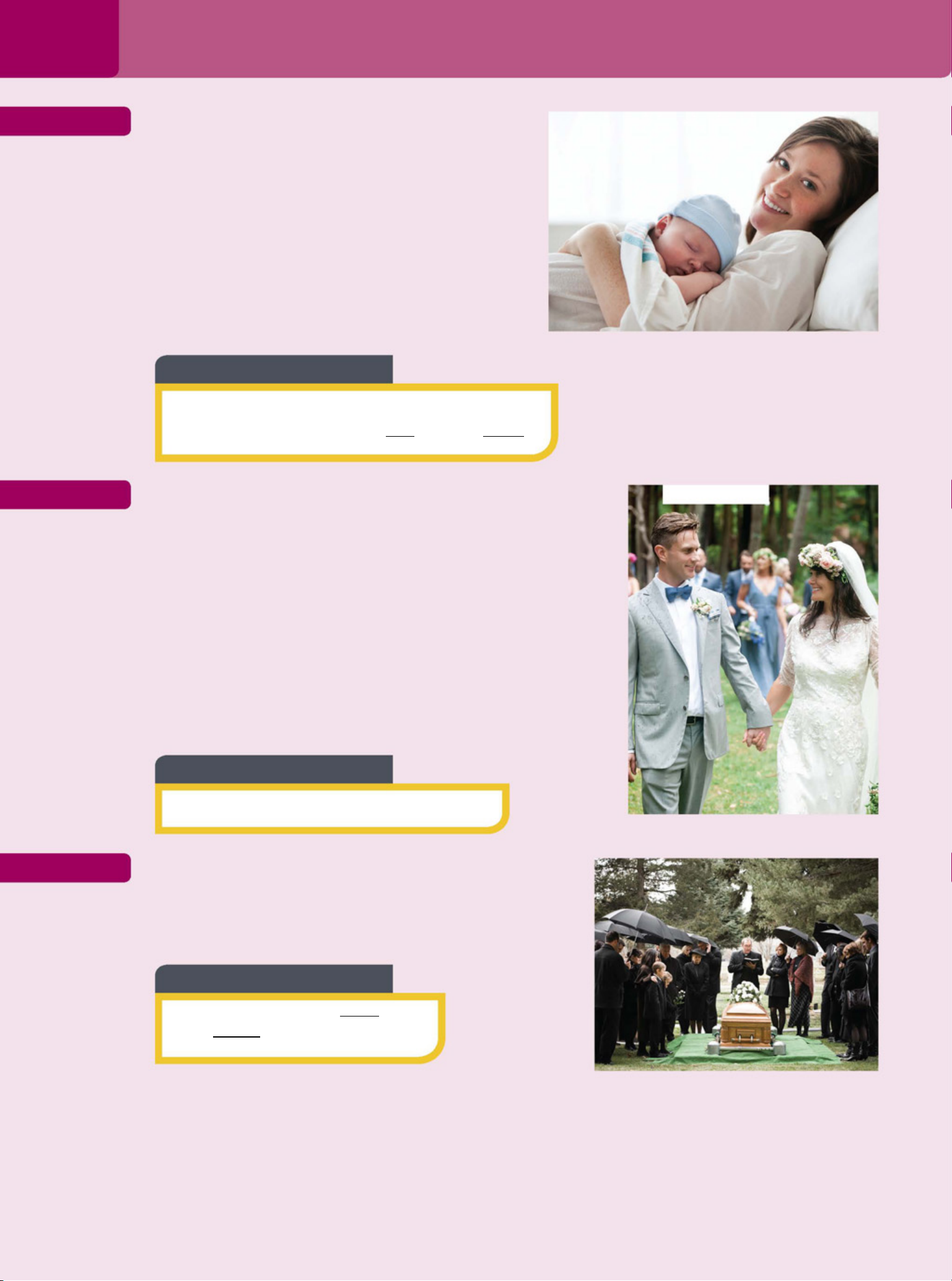
Anna had a baby yesterday.
He was born at 1.15 yesterday morning. He weighed 3 kilograms.
They are going to call him John – after John, his
grandfather.Hisgrandfather’sbirthdayisJune
16th too – but he was born in 1957!
The baby’s parents were born in 1986. Common mistakes
Anna had a baby [NOT Anna got a baby].
He/ She was born [NOT He/ She born or He/ She is born]. B Marriage The wedding
Ifyoudonothaveapartner,youaresingle.
Ifyouhaveahusbandorwife,youaremarried.
Ifyourhusbandorwifedies,youarewidowed.
Ifyourmarriagebreaksup,youareseparated/divorced.
[the marriage has legally ended]
Harry and Sarah got married.
They (got) married in 2001.
(married without got is more formal) (bride)
They went on their honeymoon to Italy. groom
They were married for 15 years. Common mistakes
Sarah got married to Harry [NOT with Harry]. bride C Death
Then Harry became ill. He died last year.
He died of a heart attack. Common mistakes
Harry is dead [NOT Harry is died or Harry is death]. The funeral 10
English Vocabulary in Use Elementary Exercises
2.1 Think of people you know. Where were they born? When?
1 My mother was born in Scotland on July 4th 1967. 2 3 4 5
2.2 Findawordontheoppositepagewhichmeans…
1 thenameforawomanonherweddingday. bride
2 thenameforamanonhisweddingday.
3 whatyouareifyouhaven’tgotapartner. 4 tobe57kilograms.
5 whatyouareifyourmarriagehaslegallyended.
6 areligiousserviceforadeadperson. 7 aholidayafterawedding.
8 whatyouareifyourhusbandorwifedies.
2.3 Completethesentenceswithwordsfromthebox. in after of to born on 1 In 2003 Anne got married 2
Daniel Smith. Unfortunately, Daniel’s grandmother,LydiaSmith,died 3
old age soon after their wedding. Daniel and Anne were 4
their honeymoon when she died. Anne’s baby daughter was5 two years
later.TheycalledthebabyLydia, 6 Daniel’s grandmother.
2.4 When were these people born and when did they die? Write sentences.
1 Genghis Khan (1162–1227)Genghis Khan was born in 1162 and died in 1227.
2 Christopher Columbus (1451–1506)
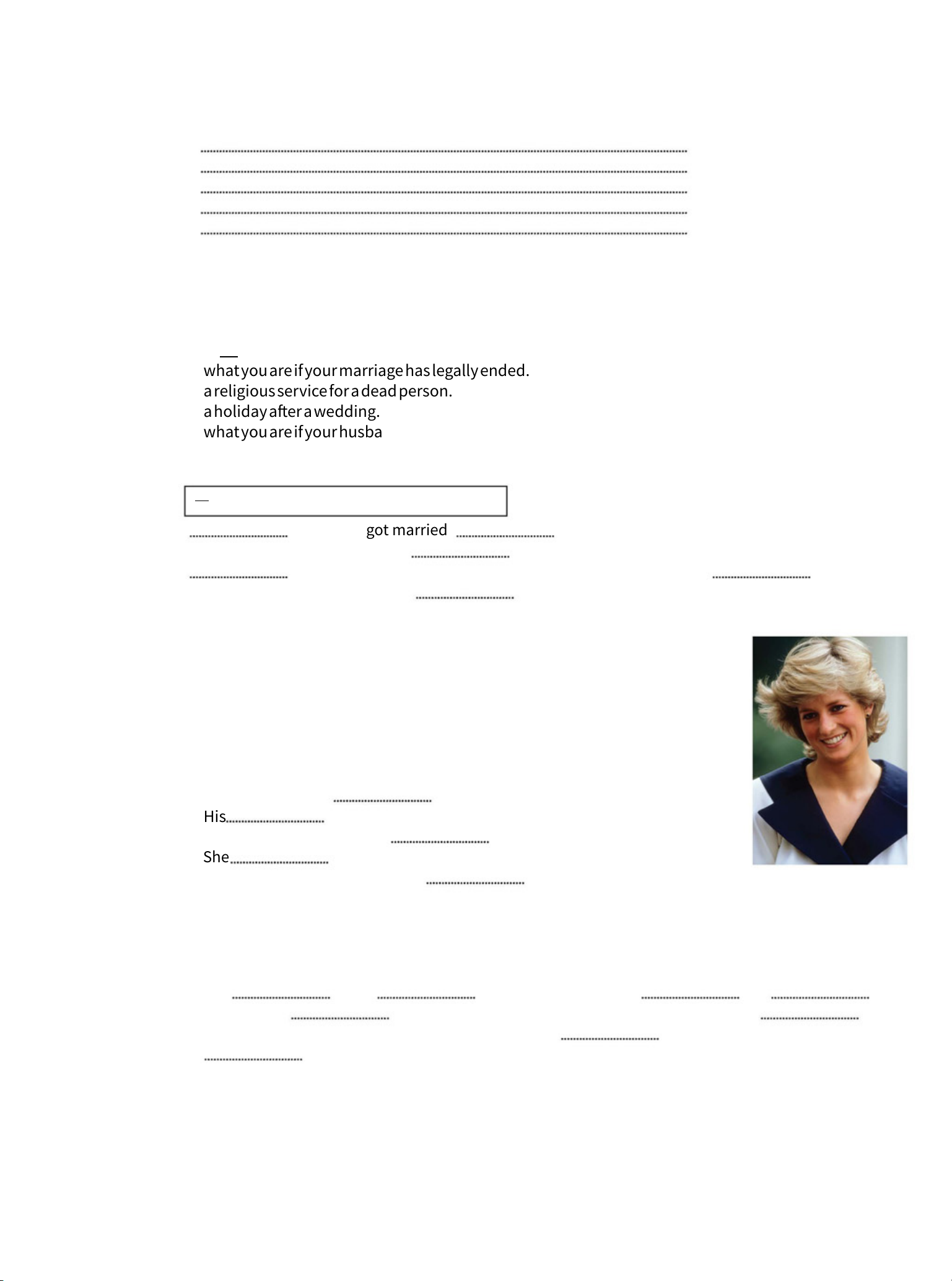
3 Leonardo da Vinci (1452–1519) 4 Princess Diana (1961–1997) 5 Heath Ledger (1979–2008)
2.5 Complete the sentences using died, dead or death. 1 Kelly’s grandfather died last year. 2 His made her very sad. 3 Her grandmother has been for five years now. 4 She of a heart attack.
5 Now all Kelly’s grandparents are .
2.6 Write about your family. Use words and expressions from the opposite page.
Here are some ideas for making your sentences. I have . I/my I have / My has got married in (year). children. They were born in and
For my/his/her honeymoon, I/he/she went (years). to .
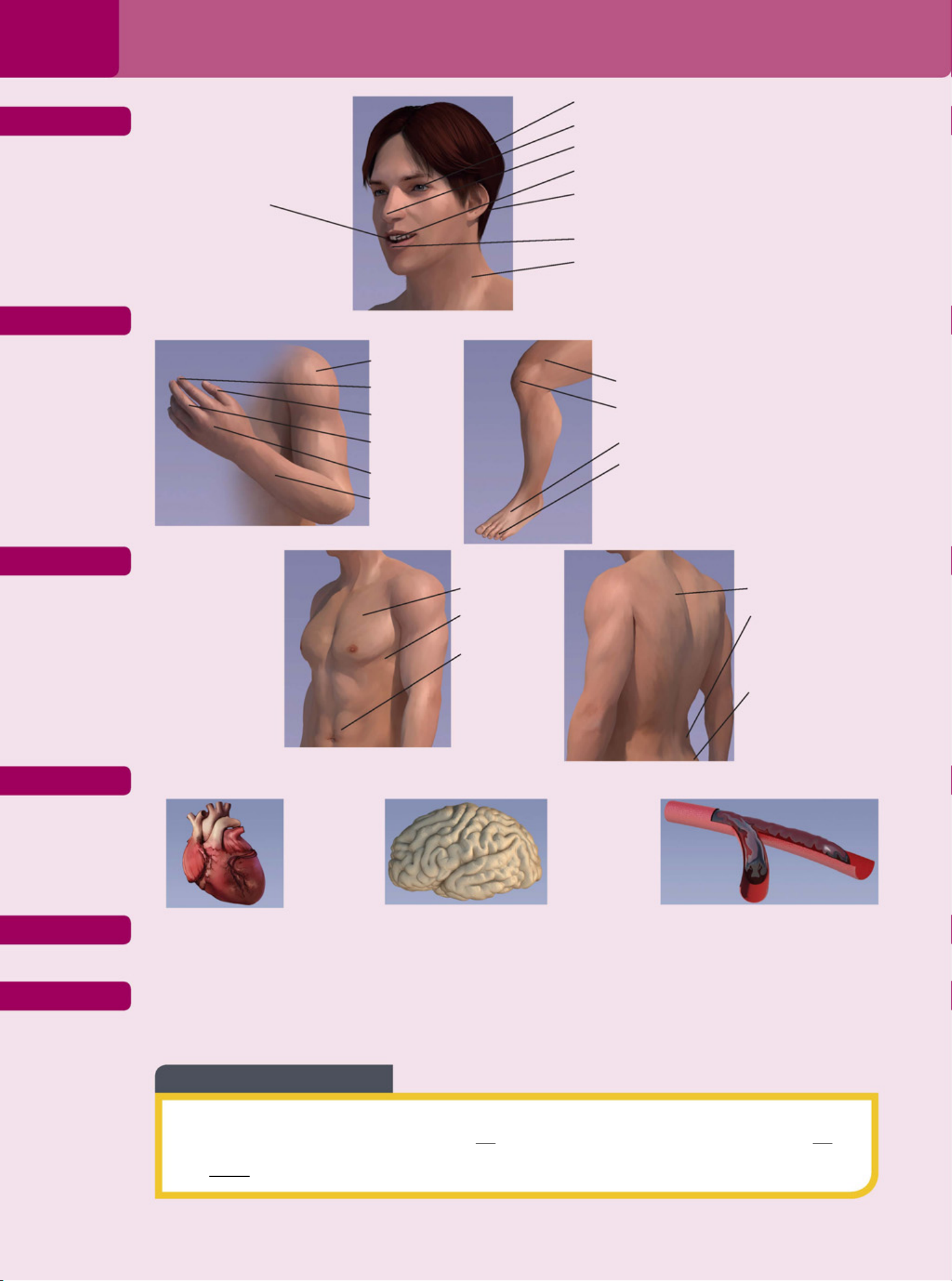
English Vocabulary in Use Elementary 11 3 Parts of the body hair A Head and face eye nose tooth / teeth ear mouth lip neck B Arm and leg shoulder nail leg knee thumb finger foot / feet hand toe arm C Rest of body chest back side waist stomach We have skin hip covering our bodies. D Inside the body heart brain blood E Pronunciation problems
eye /aɪ/ knee /niː/ stomach /ˈstʌmək/ heart /hɑːt / blood /blʌd/ foot /fʊt/ tooth /tuːθ/ F Singular and plurals one foot – two feet one tooth – two teeth
Hair is a singular word. My hair is very long – I must cut it soon. Common mistakes
Usually we use my, your, his, her, etc. with parts of the body.
Katie is washing her hair [NOT Jane is washing the hair]. I have a pain in my leg [NOT I have a pain in the leg].
(See Unit 6: Health and illness.) 12
English Vocabulary in Use Elementary Exercises
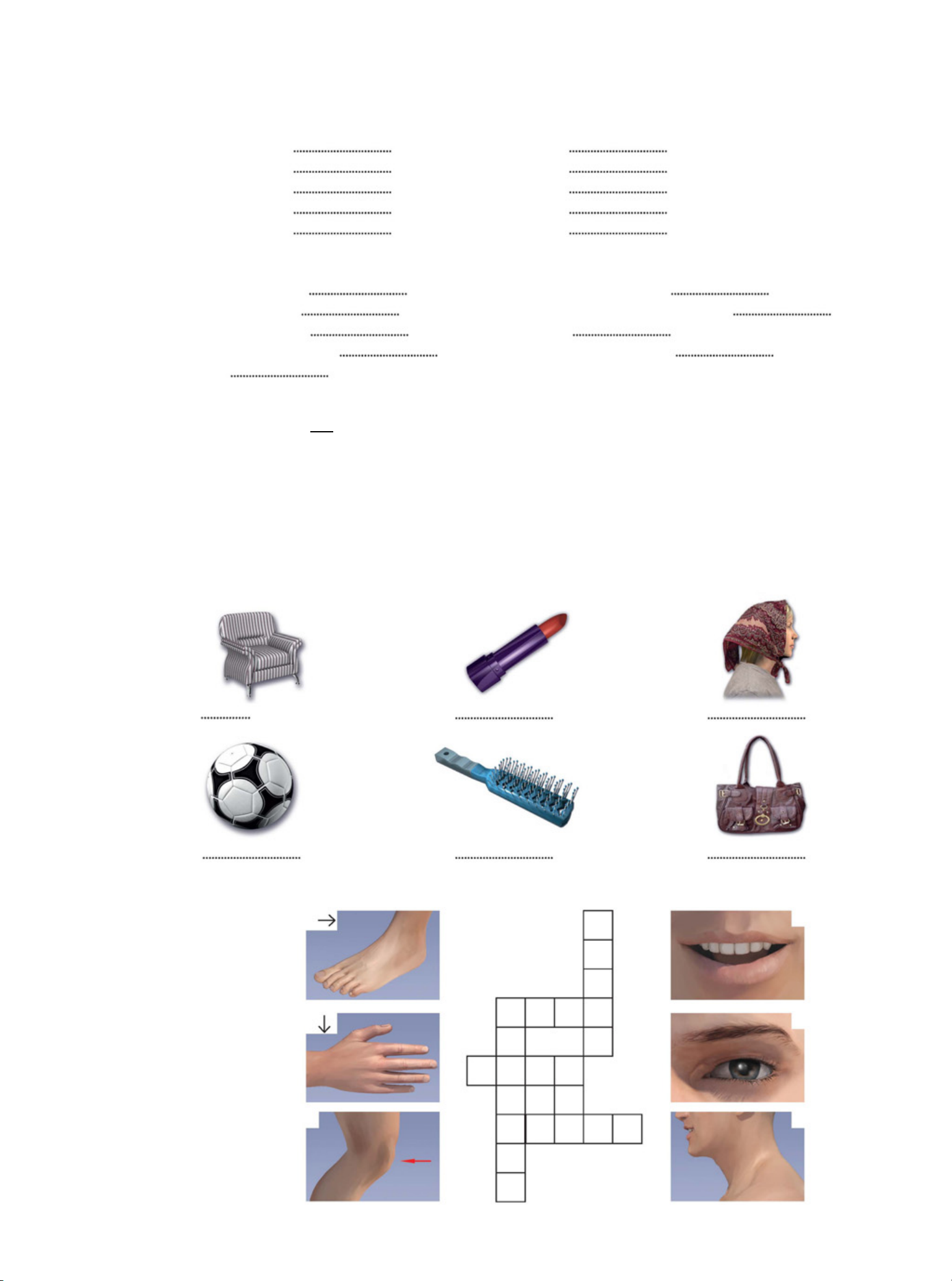
3.1 Here are the names of some parts of the body with the letters mixed up. What are they? 1 eken knee 6 are 2 osen 7 hotot 3 rathe 8 buhtm 4 hamcost 9 akbc 5 olderush 10 tiwas
3.2 Complete these sentences with words from the opposite page. 1 Ahandhasfive fingers . 6 Youhearwithyour . 2 Afoothasfive . 7 Thechildsatonherfather’s . 3 Anadulthas32 . 8 Your type can be A, B, AB or O. 4 Yousmellwithyour . 9 You think with your . 5 The is a symbol of love.
3.3 Correct the mistakes in the sentences.
1 I have a pain in the side. I have a pain in my side.
2 That woman has got very big foots.
3 My grandfather has a pain in the shoulder.
4 The baby has already got two tooths.
5 The little girl needs to wash the face and the hands before dinner.
6 My hairs are dirty. I need to wash them.
3.4 Parts of the body are often used in compound nouns too. Complete these nouns with a word from the opposite page. 1 arm chair 3 stick 5 scarf 2 ball 4 brush 6 bag
3.5 Complete the crossword. Look at the pictures. 2 1 1 2 2 4 3 4 3 5 5
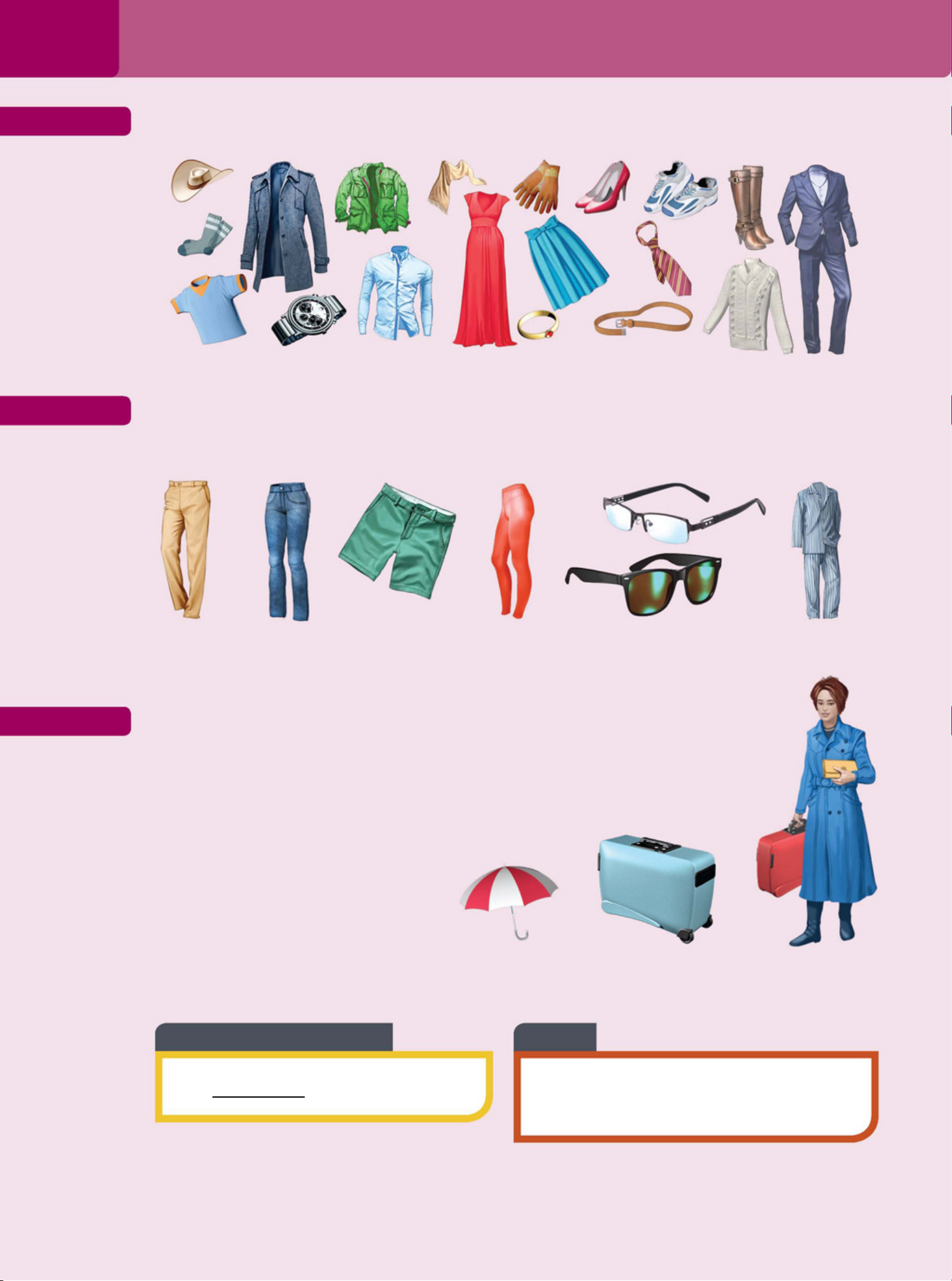
English Vocabulary in Use Elementary 13 4 Clothes A Clothes coat jacket scarf gloves shoes trainers boots suit hat skirt tie socks T-shirt watch shirt belt dress ring sweater / jumper B Plural words
These words are always plural in English. They need a plural verb. trousers jeans shorts tights glasses pyjamas sunglasses
My suit is new but these trousers are old. Her jeans / shorts / tights are blue.
Note: You say: a pair of trousers / shorts / glasses, etc. C Verbs
You wear clothes but you carry things. You wear glasses.
Naomi is wearing a long blue coat.
She’s carrying a suitcase and a handbag.
You can also say: Naomi has (got) a blue coat on.
You carry a bag and an umbrella.
In the morning you get dressed or put your clothes on. At night you get undressed or you take your clothes off. Common mistakes Tip
You put clothes on but you take clothes off
When you get dressed in the morning, say to [NOT put clothes off].
yourself Now I’m putting on my socks. Now I’m
putting on my shoes and so on. 14
English Vocabulary in Use Elementary Exercises
4.1 Complete the sentences.
1 Joe has a job interview today, so he’s wearing a smart suit , a white sh andat .
2 Julia’s not working today, so she’s wearing a T- and sh s.
3 Lucy is going to play tennis. She’s wearing white s s and tr s.
4 Gianni is going to a business meeting. He’s ingab with his papers and laptop.
5 My trousers are too big. I have to wear a b .
6 It’scoldtoday.I’llwearmyj ,andI’lltakemyc too.
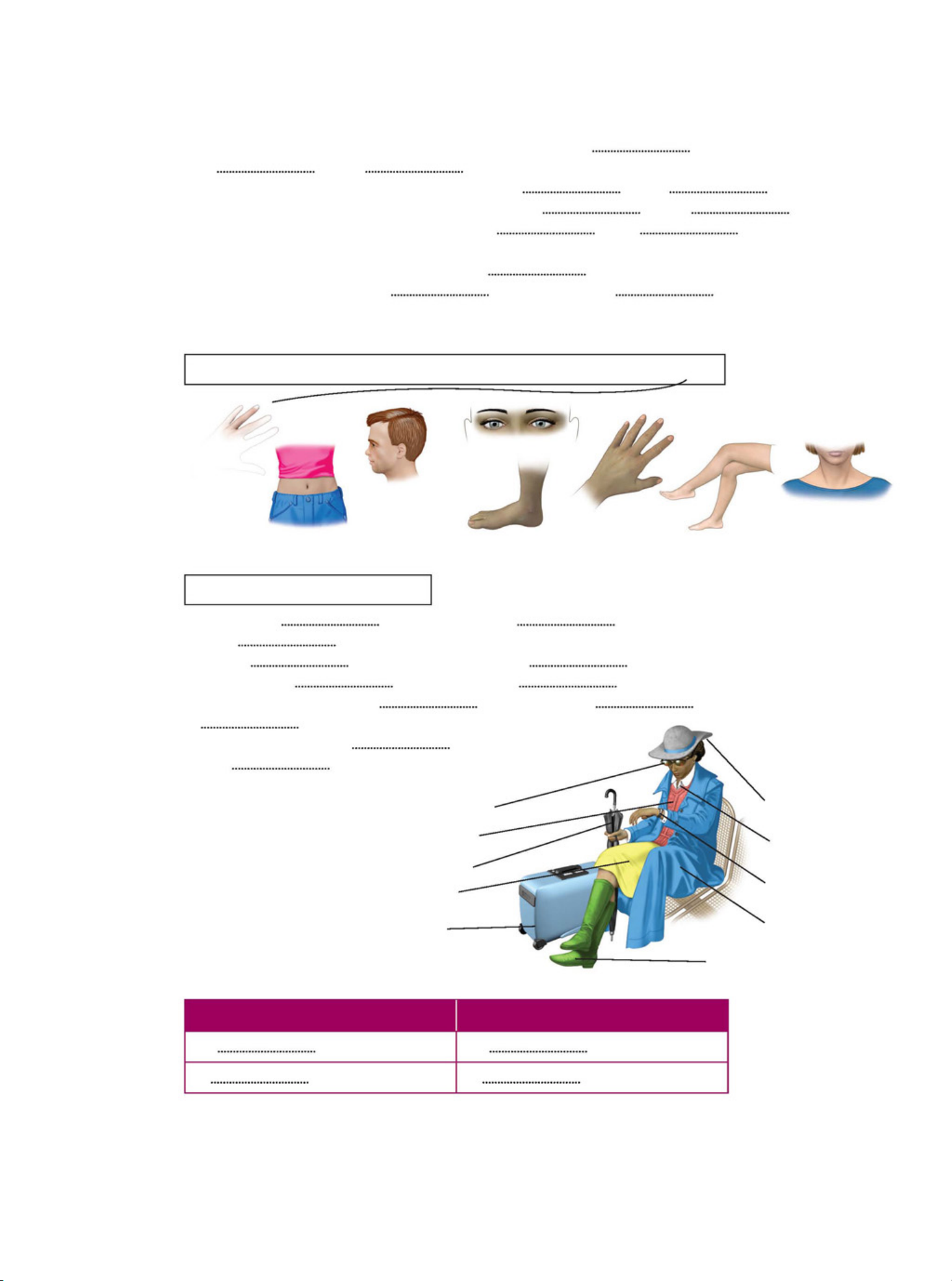
4.2 Match the item of clothing with the part of the body. scarf belt shoe hat glove glasses tights ring 1 3 4 6 8 2 7 5
4.3 Complete the sentences with one of the verbs in the box and put it in the right form. be wear carry have 1 Tim’s jeans are blue and his T-shirt red. 2 Julia jeans and a T-shirt today. 3 Meena got a red coat on and she some flowers. 4 Sarah’s dress old but her shoes new. 5 Last year Harry’s trousers white. Now they grey. 6 this a new pair of jeans? 7 My favourite pyjamas dark green. 8 Kim a new pair of shorts. 4.4 Label the picture. 1 sunglasses 10 2 9 3 4 8 5 7 4.5 6
Complete the verbs in the table. morning night get dressed get or your clothes on or your clothes off
4.6 What are you wearing today? Use a dictionary to help you.
I’m wearing a white T-shirt and a blue jumper. I’ve got a pair of black trousers on. I’m wearing blue socks and white
trainers. I’ve also got a watch and a pair of glasses on.
English Vocabulary in Use Elementary 15 5 Describingpeople A
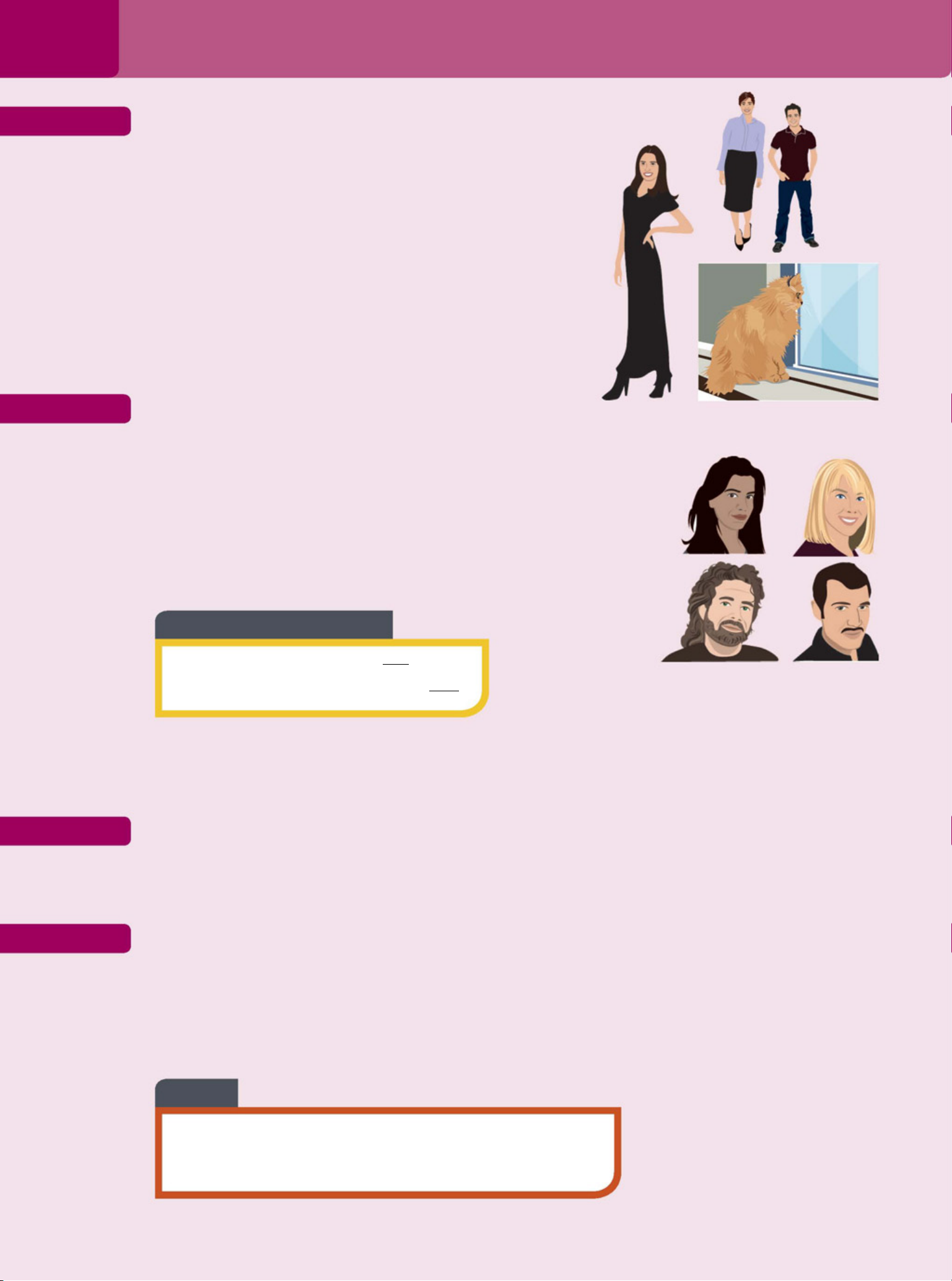
Height /haIt/ and weight /weIt/ Bettina Schwenke
Bettina Schwenke is a very tall woman. Tom Jakes
Tom Jakes is quite short.
If you aren’t tall or short, you are of medium height.
Agata Sanchez is really slim.
I was very thin when I was in hospital.
[slim is more polite than thin] Agata Sanchez
The doctor said I am overweight. [weigh too much]
Their cat is very fat. It needs to go on a diet. B Face and head
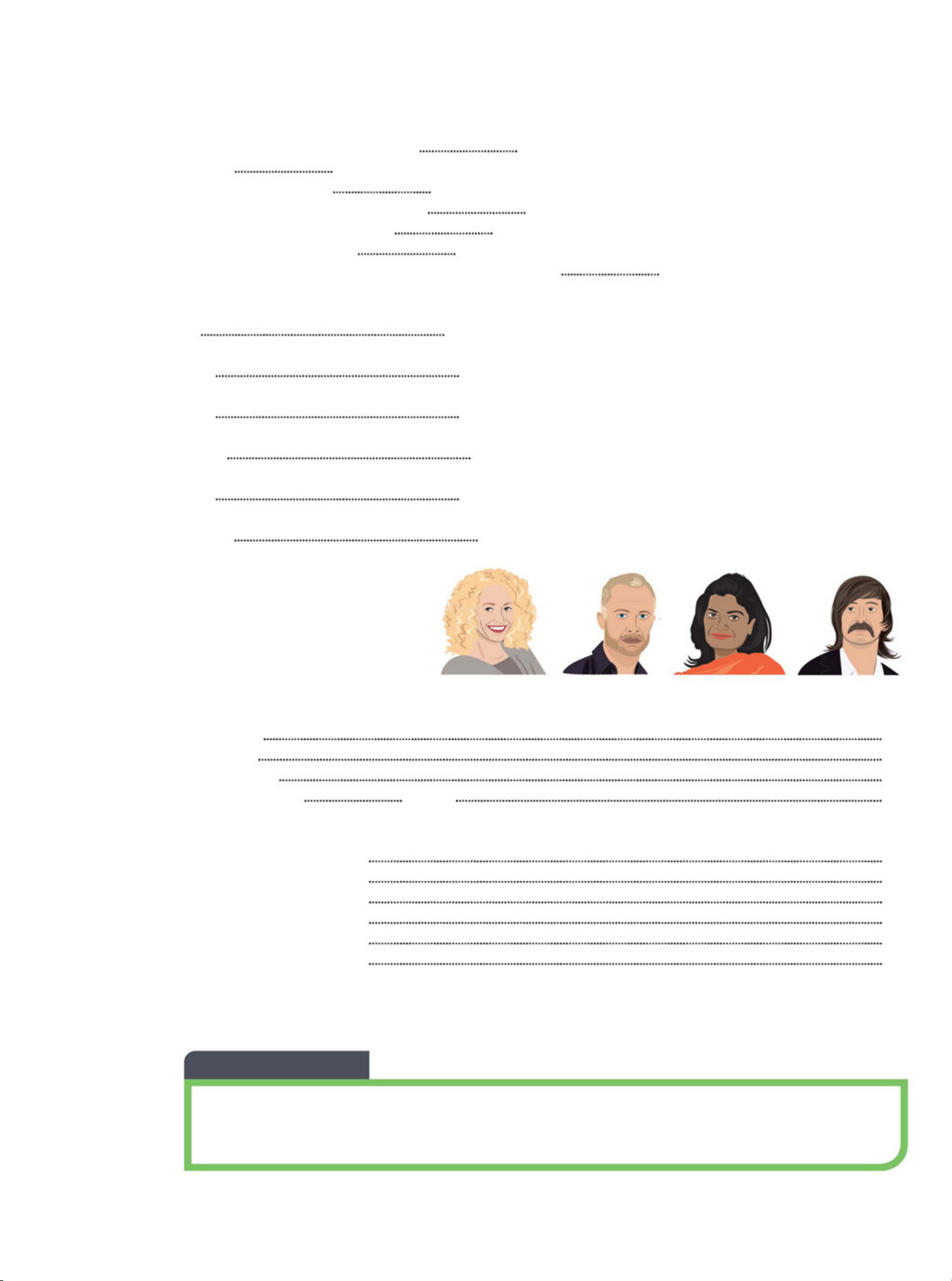
Suri has dark skin and dark hair. She has brown eyes. Polly
Polly has blonde (or fair) hair and fair skin. She has blue eyes. Suri
Ben has a beard and long hair. He has green eyes.
Luca has a moustache /mʊˈstɑːʃ/ and short hair.
You can also use has got, for example, Suri has got
dark hair and dark skin.
My mother is a very beautiful woman. [very pretty]
My dad’s a very good-looking man. Common mistakes
People are tall [NOT People are high]. Ben Luca
People have blonde or dark hair [NOT hairs].
My sister is pretty. (usually girls / women only)
Bob’s an ugly man. [ugly = the opposite of beautiful or good-looking]
I’m not ugly or beautiful, I’m just average-looking! C Age
My grandmother is 97. She’s very old. My sister is 14. She’s young, but would like to be older. My
father is 56. He’s middle-aged, but would like to be younger!
This hospital is for elderly people. (more polite than old) D Expressions
A: How tall is Bettina / Tom? B: She’s 1.85 metres tall. / He’s 1.48 metres tall.
A: How heavy are you? / How much do you weigh? B: I weigh 62 kilos / 74 kilos, etc.
A: How old is he? B: He’s 84.
A: What does Gemma / your sister look like?
B: She’s tall and dark. She’s very pretty. Tip
Some of the words on this page are a little negative, so be
careful how you use them. It’s better not to say to someone:
‘You are fat / thin / ugly / old.’ 16
English Vocabulary in Use Elementary Exercises
5.1 Complete the sentences.
1 He’s only 1 metre 52. He’s quite.short 2 Very
people are often good at basketball. 3 Models are usually .
4 Does she have dark skin? No, it’s .
5 She’s only seven. She’s very . 6 If I eat too much I’ll be .
7 My grandmother is in this hospital. It’s a hospital for
people. (don’t use ‘ old’)
5.2 Complete the questions using the words in brackets (). 1 How tall is your brother? (your brother) He’s about 1 metre 75. 2 Is ? (Elena’s hair) No, she’s got dark hair. 3 Is ? (Mike’s hair) Yes, it is quite long. 4 Are ? (your parents)
Not really, they’re middle-aged. 5 Is ? (his sister) Yes, she’s very pretty. 6 Why ? (Sara, so thin) She’s very ill.
5.3 Write sentences about the
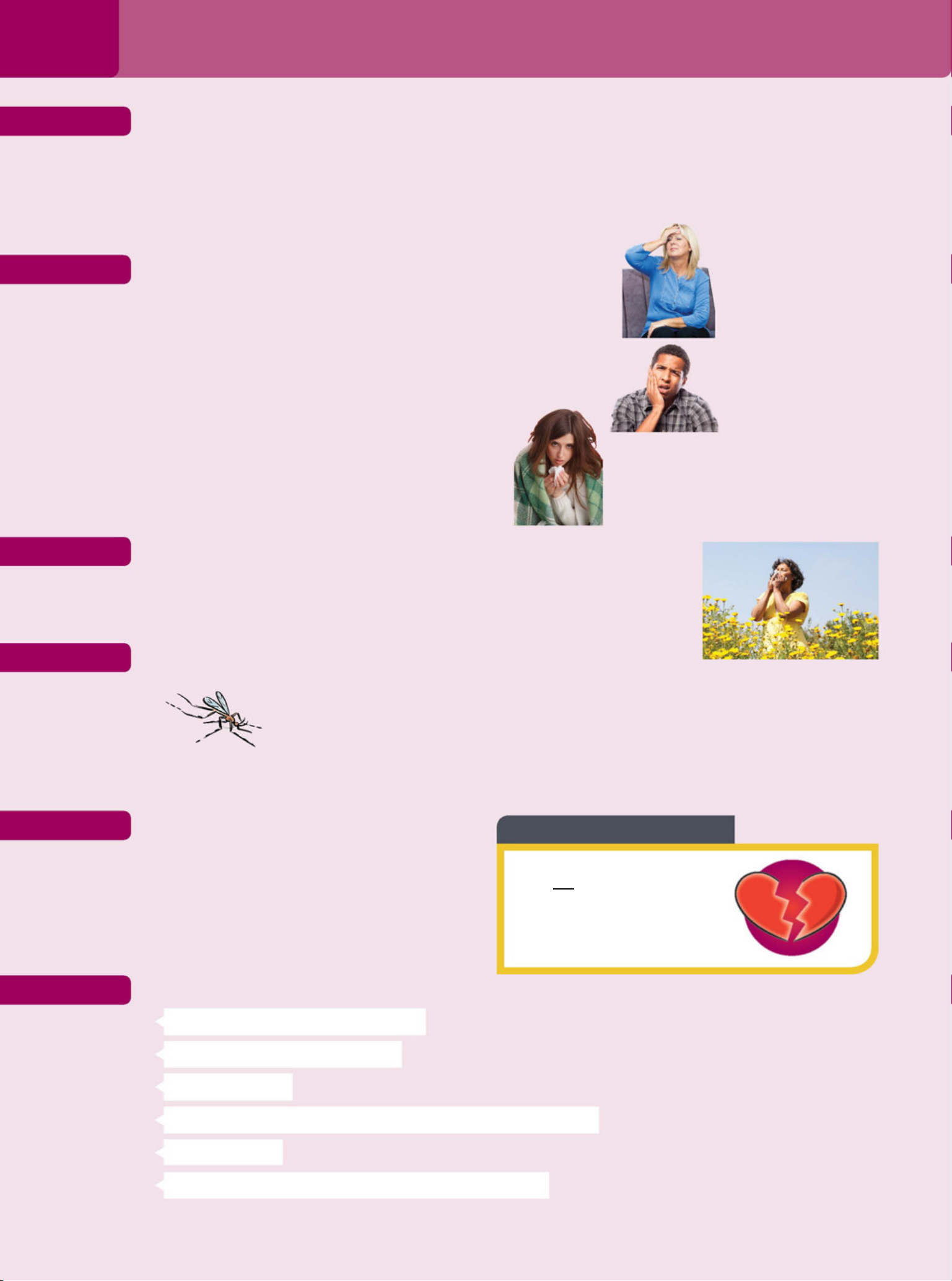
people in these pictures. Felicity Jeff Anika Stefan
1 Felicity’s got blonde hair and fair skin. 2 Jeffhas 3 Anika’s got 4 Stefan’s hair is and he 5.4 Write questions. 1 your brother, height How tall is your brother? 2 your teacher, looks 3 you, weight 4 your mother, age 5 your sister, height 6 your parents, looks
5.5 Now write answers to the questions in 5.4.
1 He’s not very tall. He’s 1 metre 52. Over to you
Write down the names of three people you know. Then write about their:
• height (tall, short, medium height) • eyes (colour)
• hair (colour, long, short, beard)
• looks (pretty, average-looking, etc.)
English Vocabulary in Use Elementary 17 6 Healthandillness A How are you today?
I’m very well, thanks. I’m fine, thanks.
I don’t feel very well. I must go home and rest. (I’ll probably be OK tomorrow.)
I feel ill. Can you get a doctor, please? (Perhaps it’s a serious problem.)
That fish was bad. I think I’m going to be sick! (I want to vomit.) B Everyday problems
Have you got an aspirin? I’ve got a headache. /'hedeIk/
I’ve got toothache. /ˈtuːθeɪk/ I need to go to the dentist.
I’m going to bed with a hot drink. I’ve got a cold. C
Problems people have for many years / all their lives
I get hay fever every summer, from flowers and grass. I sneeze all day. /sniːz/
My little brother has asthma; sometimes he can’t breathe. /ˈæsmə/ D
Illnesses in hot / tropical countries
In some countries, mosquitoes can give people mosquito
malaria. /məˈleərɪə/
The drinking water was bad, and many children
had cholera. /ˈkɒlərə/ E Serious illnesses Common mistakes
Every year cancer kills many people who smoke. /ˈkænsə/
My father had a heart attack
My father went to hospital when he [NOT got a heart attack]. had a heart attack. F Expressions
A Do you have a healthy diet?
B Yes, I eat lots of fruit and vegetables.
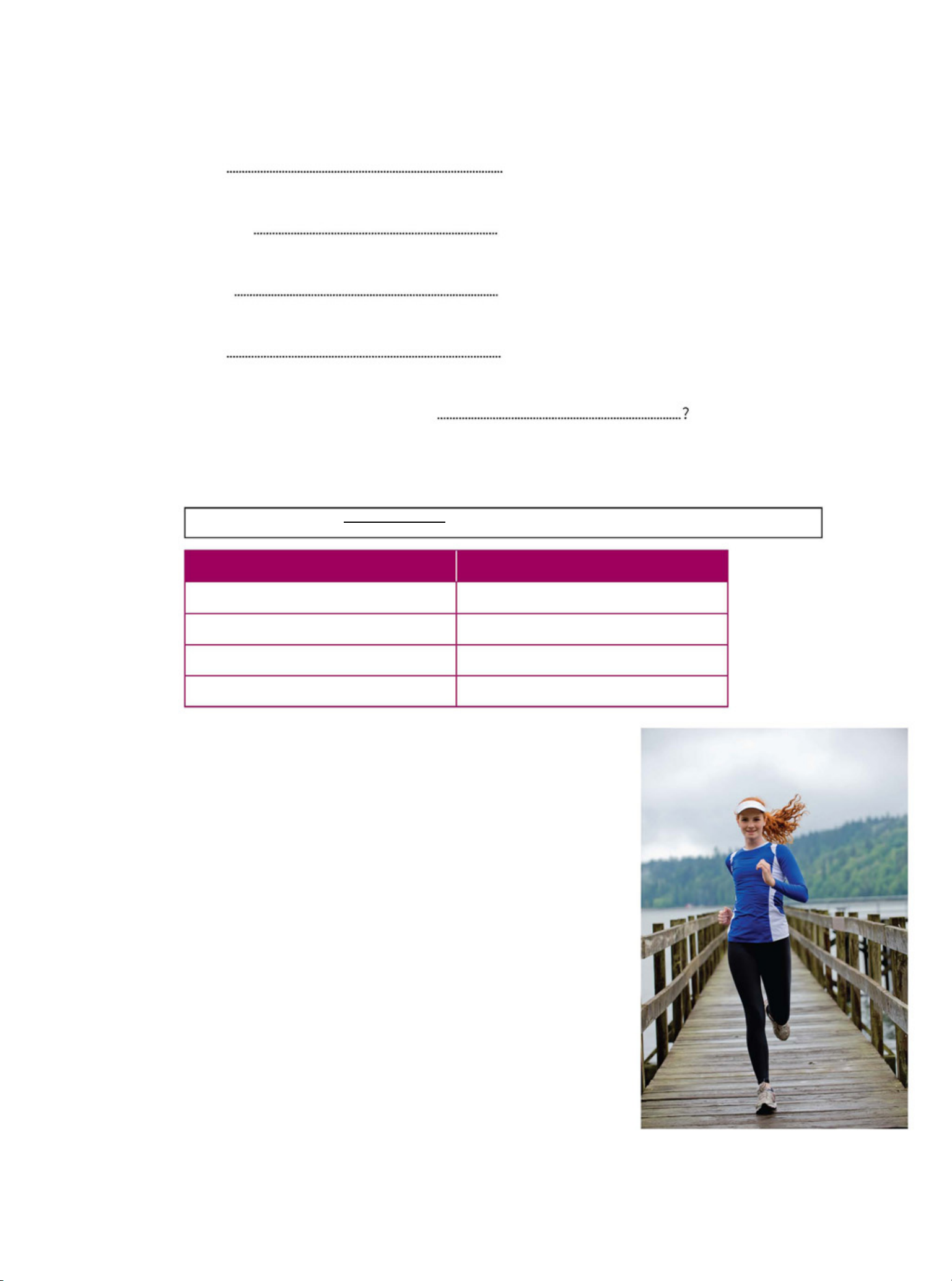
A Do you exercise?
B Yes, I like swimming, jogging and cycling. They’re really good for you. A I feel stressed!
B Do you? You need to relax more and don’t panic about work! 18
English Vocabulary in Use Elementary Exercises
6.1 Complete the dialogues. 1 A: How are you today? B: Very well, thanks. A: Good! 2 A: Are you OK? B: No,
A: Would you like to use the bathroom? B: Yes, thank you. 3 A: I B: I’ll get a doctor. A: Oh, thank you. 4 A:
B: Here’s the dentist’s phone number. A: Thanks.
5 A: Your nose is red. Have you got ? B: Yes.
A: Have a hot drink and go to bed early.
6.2 Match the illnesses in the table with a possible treatment. gotothedentist takeanaspirin gotohospital gotobedwithahotdrink illness treatment a headache take an aspirin toothache a heart attack a cold
6.3 What illnesses are connected with … 1 a mosquito bite? malaria 2 bad drinking water?
3 pollution, traffic fumes, etc.?
4 grass, flowers, sunshine, etc.?
5 smoking, unhealthy diet, no exercise?
6.4 Answer these questions. Use a dictionary to help you. 1 Do you have a healthy diet? 2 What exercise do you do? 3 Do you often feel stressed?
4 Have you ever been in hospital?
5 Do you get hay fever in summer?
English Vocabulary in Use Elementary 19
Tài liệu liên quan:
-
Cambridge IELTS 13 Test-1 Overview and Practice Review | Tài liệu Tiếng Anh
5 3 -
IELTS Test 2 Review - Cambridge 13 Preparation Guide | Tài liệu Tiếng Anh
7 4 -
Litfocus Litreading Survey: Student Reading Interests & Habits Questionnaire | Tài liệu Tiếng Anh
6 3 -
Sách Pre-intermediate Market leader - Business English Course Book
21 11 -
Exam booster for B1 preliminary and B1 preliminary for schools with answer key
8 4