The Influence of Motivation, Digital Competence, and Work Environment on the Performance of Employees of the Secretariat of the South Sulawesi Provincial DPRD | Tài liệu Tiếng Anh
The Influence of Motivation, Digital Competence, and Work Environment on the Performance of Employees of the Secretariat of the South Sulawesi Provincial DPRD | Tài liệu Tiếng Anh. Tài liệu giúp bạn tham khảo, ôn tập và đạt kết quả cao. Mời đọc đón xem!
Môn: Tiếng Anh chuyên ngành 353 tài liệu
Trường: Tài liệu Tiếng Anh chuyên ngành, Tiếng Anh cho người đi làm 454 tài liệu
Tác giả:











Preview text:
eCo-Fin: Economics and Financial Vol.7, No.1, February 2025
Available online at: https://jurnal.kdi.or.id/index.php/ef
The Influence of Motivation, Digital Competence, and Work
Environment on the Performance of Employees of the
Secretariat of the South Sulawesi Provincial DPRD
Dihaq Allaamah 1) *, Roslina Alam 2) , Djamaluddin Bijaang 3)
1) dihaqathirah@gmail.com
123 ) Universitas Muslim Indonesia
Jl. Urip Sumoharjo No. 225, Makassar, Indonesia Article history: ABSTRACT Received: 08 January 2025 Revised: 21 January 2025
This research investigates the impact of work motivation, Accepted: 22 January 2025
Available online: 10 February 2025
digital competence, and the work environment on the performance
of employees at the South Sulawesi Provincial DPRD Secretariat. Keywords:
Employing a quantitative methodology, the study gathered data Digital Competence ;
through questionnaires distributed to 78 respondents, comprising DPRD Secretariat ;
ASN staff, contract employees, and outsourced workers. The data Employee Performance ; Work motivation ;
were analyzed using multiple linear regression techniques, Work environment
revealing that all independent variables significantly and positively
affected employee performance. Digital competence is the most
dominant variable, with a contribution of 44%. Each increase of one
unit in digital competence has the potential to increase employee
performance by 4.04 units. This is supported by the implementation
of a digital system that facilitates data management and increases
work efficiency. Indicators of data access and use of digital tools
are the main contributions in this variable. Work motivation also
has a significant effect on performance, especially on indicators of
physical, social and self-actualization needs. When basic needs such
as salary and facilities are met, and opportunities for potential
development are available, employee motivation increases which
has an impact on their productivity. The work environment is a key
factor in fostering a productive and supportive workplace
atmosphere. Indicators of effective communication and a
comfortable work atmosphere are the main drivers. Good
communication between employees and superiors helps reduce
obstacles in completing tasks. In conclusion, developing digital
competencies, fulfilling work motivation, and creating a supportive
work environment are the main strategies for improving employee performance. * Corresponding author EISSN. 2656-095X PISSN. 2656-0941
Published by Komunitas Dosen Indonesia. DOI: 10.32877/ef.v7i1.2029
Dihaq Allaamah, Roslina Alam, & Djamaluddin Bijaang
eCo-Fin: Economics and Financial, 2025, 7 (1), 192 INTRODUCTION
Human resources (HR) are a fundamental element that determines the success of an
organization, both in the public and private sectors. Quality HR is not only able to carry out
administrative tasks, but also becomes the main driver in achieving the strategic goals of the
organization. The superiority of an organization is often determined by the extent to which the
quality of its HR is able to adapt to changes in the environment and work demands (Sinambela,
2019). In the government sector, especially in the Secretariat of the South Sulawesi Provincial
DPRD, HR has a very important role in supporting the implementation of the DPRD's
legislative, supervisory, and budgeting functions.
However, major challenges in HR management often become major obstacles in achieving
optimal organizational performance. One of the issues that emerges is the unfairness in the
distribution of official travel assignments, which creates a sense of dissatisfaction and
demotivation among employees. This unfairness, as explained by (Bakker et al., 2014), can
trigger burnout and reduce employee loyalty to the organization. In addition, limited digital
competence among employees is a significant obstacle in carrying out administrative tasks that
are increasingly dependent on technology.
Digital competence is becoming increasingly important in the era of digital transformation
(Iswandi, 2025). The ability of employees to use software, access digital information, and utilize
technology to support daily work is a key indicator in increasing work efficiency and
effectiveness (Nikmah et al., 2023). (Asari et al., 2023)emphasized that organizations that are
able to improve the digital competence of their employees will be more adaptive to change and
superior in achieving organizational goals. In the context of the DPRD Secretariat, digital
competence is not only important for carrying out internal tasks, but also to ensure transparency
and accountability in public services.
The work environment also plays a key role in supporting employee productivity (Otoluwa
et al., 2023). A conducive work environment includes a comfortable working atmosphere,
harmonious interpersonal relationships, and effective communication. According to
(Ramdhana, 2016), the quality of relationships between employees greatly affects the success
of the team and the overall productivity of the organization. Internal conflict,
miscommunication, and an unsupportive work atmosphere are often the main obstacles to
achieving optimal performance. Consequently, establishing a supportive work environment
should be a central focus of human resource management.
The motivation theory proposed by Maslow and Herzberg in (Ihensekien & Joel, 2023)is
provide a framework for understanding how elements like physiological needs, safety, social
belonging, esteem, and self-actualization impact employee motivation. Maslow's hierarchy of
needs highlights that addressing fundamental needs is essential before individuals can reach the
stage of self-actualization. Meanwhile, Herzberg in (Lopang et al., 2023) categorizes the factors
affecting job satisfaction into two groups: motivators, which include aspects like achievement
and recognition, and hygiene factors, such as workplace conditions and interpersonal
relationships. These theories are particularly relevant in examining the relationship between
work motivation and employee performance.
Previous studies have also shown that a supportive work environment plays a major role
in improving employee performance. (Faruq et al., 2023)stated that employees who work in a
positive work environment are more likely to show optimal performance than those who face
obstacles in daily work interactions. A supportive work environment includes aspects such as
Dihaq Allaamah, Roslina Alam, & Djamaluddin Bijaang
eCo-Fin: Economics and Financial, 2025, 7 (1), 193
harmonious interpersonal relationships, effective communication, and a comfortable work atmosphere.
Based on this background, this study aims to analyze the influence of work motivation,
digital competence, and work environment on employee performance at the Secretariat of the
South Sulawesi Provincial DPRD. The main problem to be answered in this study is to what
extent the three factors affect employee performance and how each factor contributes to each
other in creating better productivity.
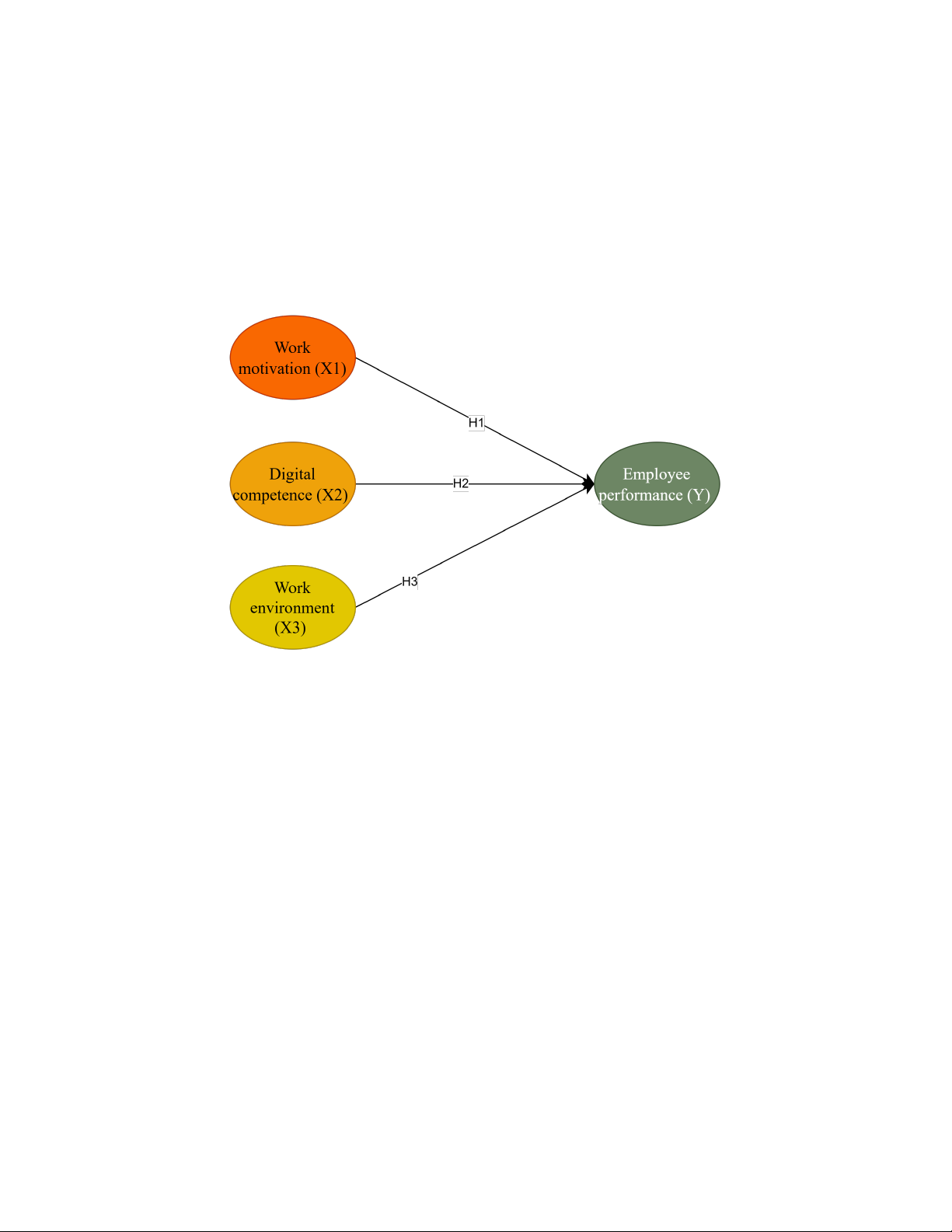
Conceptual framework and hypotheses
Source: Data Processing, 2024
Figure 1. Conceptual Framework
H0: Work environment, work motivation, and digital competence together do not have a
significant effect on employee performance.
H1: Work motivation has a positive effect on employee performance at the Secretariat of the
South Sulawesi Provincial DPRD.
H2: Digital competence has a positive effect on employee performance at the Secretariat of the
South Sulawesi Provincial DPRD.
H3: The work environment has a positive effect on employee performance at the Secretariat of
the South Sulawesi Provincial DPRD. RESEARCH METHOD
This research adopts a quantitative approach and was conducted at the South Sulawesi
Provincial DPRD Secretariat Office located at Jl. Urip Sumoharjo No. 59, Makassar, South
Sulawesi, for 3 (three) months. Data collection carried out in this study used observation,
questionnaires designed using a Likert scale, and documentation. The study population was all
employees of the South Sulawesi Provincial DPRD Secretariat, totaling 354 people. Based on
Slovin's calculation with a 10% margin of error, the number of samples was determined to be 78 respondents.
Dihaq Allaamah, Roslina Alam, & Djamaluddin Bijaang
eCo-Fin: Economics and Financial, 2025, 7 (1), 194
From the population of 354 people, the Slovin formula was utilized to calculate the sample size, as demonstrated below: 𝑵 𝒏 = (1) 𝟏 + (𝑵(𝒆)𝟐)
Where, n is the number of samples, N is the number of populations, and e is the error rate (standard error 10%).
The multiple linear formula used is:
𝒀 = 𝒂 + 𝒃𝟏 𝒙𝟏 + 𝒃𝟐 𝒙𝟐 + 𝒃𝟑 𝒙𝟑 (2)
Information: Y is employee performance; X1 is work motivation; X2 is digital competence; X3 is work environment Operational Variables
Table 1. Indicators and Questionnaire of Relatedness Variables Indicator Question Work Physiological
1. The salary I receive is enough to meet my daily needs. Motivation needs,
safety, 2. The bonus I receive is in accordance with my achievements (X1)
social, esteem, 3. I feel safe with the health insurance provided by the company self-
4. Existing work safety facilities provide a sense of security at work. actualization
5. I have a good relationship with my co-workers
6. Social interactions at work make me feel accepted in the group.
7. My boss appreciates the work I have achieved
8. The awards given by the company are in accordance with the efforts I have made.
9. The work I do provides challenges that help me grow.
10. I received useful training to improve my work skills. Digital Data
access 1. I can find job-related information through digital devices Competence capabilities,
2. I often use digital devices to access information from various sources. (X2)
software usage , 3. I can store data in various formats using digital devices. simple
4. I often use digital devices to record data. application
5. I can create useful applications to support my work. creation
6. I can create work reports using digital software
7. I use email as a communication tool to stay in touch with coworkers.
8. I often collaborate with colleagues through digital tools.
9. I can utilize digital applications to organize my daily work.
10. I feel that the digital technology used really supports my tasks. Work Work
1. The working atmosphere in the office supports my productivity Environment atmosphere,
2. I feel comfortable working because of the positive working (X3) interpersonal atmosphere. relationships,
3. I have a good working relationship with my co-workers. communication
4. My coworkers always provide support in completing tasks
5. My relationship with the boss is going well
6. The leader always provides clear direction in completing tasks
7. Communication in the workplace always takes place clearly and openly.
8. I feel valued in team discussions.
9. I feel the office provides flexibility in managing work hours with personal life.
10. The office supports a balance between my workload and my rest time.
Dihaq Allaamah, Roslina Alam, & Djamaluddin Bijaang
eCo-Fin: Economics and Financial, 2025, 7 (1), 195 Employee Quantity,
1. I can complete work according to the set quantity target. Performance quality,
2. I complete work with quality that meets standards (Y) reliability,
3. I can work with minimal supervision from superiors. presence,
4. I can be relied upon to complete work on time. collaboration
5. My presence at work is always on time
6. My presence at work has a big impact on team productivity.
7. I can work well in a team to achieve goals.
8. I always coordinate well with my co-workers
9. I try to give the best quality in my work
10. I have a big responsibility for the results of the work I complete. Data Analysis Techniques
The data analysis methods employed include descriptive analysis, data quality assessment
through validity and reliability tests, classical assumption tests (normality, multicollinearity, and
heteroscedasticity tests), and multiple linear regression analysis encompassing regression
coefficient evaluation, coefficient of determination, T-test, and F-test. The analysis was
conducted using IBM SPSS Statistics software version 27.0. RESULTS AND DISCUSSION
The object of this study was 354 employees of the South Sulawesi Provincial DPRD
Secretariat. Based on the Slovin method with a margin of error of 10%, a sample of 78
respondents was obtained. The employees who became respondents consisted of various work
units with diverse educational backgrounds, work experience, and responsibilities. The results
of the descriptive analysis showed that most respondents had a minimum education level of
bachelor's degree, with an average work experience of 7-10 years. The majority of respondents
also stated that they had attended training related to their duties and responsibilities. Statistics Description
Table 2. Statistical Description Descriptive Statistics N Minimum Maximum Mean Std. Deviation Work motivation 78 29.00 45.00 36.8205 3.69887 Digital Competence 78 15.00 50.00 38.1282 6.32735 Work environment 78 23.00 49.00 37.6282 5.20766 Performance 78 23.00 50.00 39.1667 5.70581 Valid N (listwise) 78
Source: Processed data (2024)
The average value of the Work Motivation variable of 36.82 indicates that the respondents'
motivation is generally quite high. The Digital Competence variable has an average of 38.13
which also shows good digital understanding among respondents. The average value of the
Work Environment of 37.63 indicates a positive perception of the existing work environment,
while the Employee Performance variable has the highest average of 39.17, indicating a fairly
good level of employee performance.
Dihaq Allaamah, Roslina Alam, & Djamaluddin Bijaang
eCo-Fin: Economics and Financial, 2025, 7 (1), 196 Table 3. Validity Test Variables Statement Person Sig (2- Information Items Correlation Tailed) Work X1.1 0.262 0.021 Valid Motivation X1.2 0.425 0.000 (X1) X1.3 0.398 0.000 X1.4 0.272 0.016 X1.5 0.373 0.001 X1.6 0.369 0.017 X1.7 0.343 0.002 X1.8 0.426 0.000 X1.9 0.358 0.001 X1.10 0.286 0.011 Digital X2.1 0.537 0.000 Valid Competence X2.2 0.599 0.000 (X2) X2.3 0.578 0.000 X2.4 0.566 0.000 X2.5 0.394 0.000 X2.6 0.552 0.000 X2.7 0.456 0.000 X2.8 0.581 0.000 X2.9 0.623 0.000 X2.10 0.651 0.000 Work X3.1 0.515 0.000 Valid Environment X3.2 0.55 0.000 (X3) X3.3 0.442 0.000 X3.4 0.462 0.000 X3.5 0.614 0.000 X3.6 0.588 0.000 X3.7 0.412 0.000 X3.8 0.577 0.000 X3.9 0.265 0.019 X3.10 0.271 0.017
Source: Processed data (2024)
The validity test measures the correlation between each question item score and the total
score of its respective variable, using the Pearson correlation coefficient. An item is considered
valid if its correlation coefficient is both high and statistically significant (p-value < 0.05). The
results indicate that all question items in this study have significance values below 0.05, confirming their validity.
Table 4. Reliability Test Variables
Number of Questions Cronbach's Alpha Information Work Motivation (X1) 10 0.835 Reliable Digital Competence (X2) 10 0.835 Work Environment (X3) 10 0.835 Employee Performance (Y) 10 0.835 Source: Processed data (2024)
(Basu, 2021)stated that a variable is considered reliable if its Cronbach's Alpha value
exceeds 0.6. The Cronbach Alpha coefficient test of all variables of 0.835 ≥ 0.6, so the
measuring instrument can be declared reliable.
Dihaq Allaamah, Roslina Alam, & Djamaluddin Bijaang
eCo-Fin: Economics and Financial, 2025, 7 (1), 197
Table 5. Normality Test
One-Sample Kolmogorov-Smirnov Test Unstandardized Residual N 78 Normal Mean .0000000 Parameters a,b Std. Deviation 4.18115575 Most Extreme Absolute .073 Differences Positive .042 Negative -.073 Test Statistics .073 Asymp. Sig. (2-tailed) .200 c, d
Source: Processed data (2024)
Using the Kolmogorov-Smirnov test, the results test show that the significance value is
0.200 (greater than 0.05). This indicates that the residual data does not deviate significantly from the normal distribution.
Table 6. Multicollinearity Test Coefficients a Model Unstandardized Standardized t Sig. Collinearity Coefficients Coefficients Statistics B Std. Beta Tolerance VIF Error 1 (Constant) 4,340 5,504 .789 .433 Work Motivation .280 .136 .181 2,056 .043 .934 1,071 Digital Competence .404 .099 .448 4.065 .000 .598 1,672 Work Environment .243 .120 .222 2,031 .046 .610 1,640 Source: Processed data (2024)
If the tolerance value is ≥ 0.10 and the VIF value is ≤ 10, it indicates the absence of
multicollinearity issues. The VIF (Variance Inflation Factor) value for the work motivation
variable is 0.934, for the digital competence is 0.598, for the work environment is 0.610 so that
all independent variables are below 10 and the tolerance value for the work motivation variable
is 1.071, for the digital competence variable is 1.672, for the work environment variable is 1.610
so that all variables are above 0.1, which means there is no multicollinearity problem.
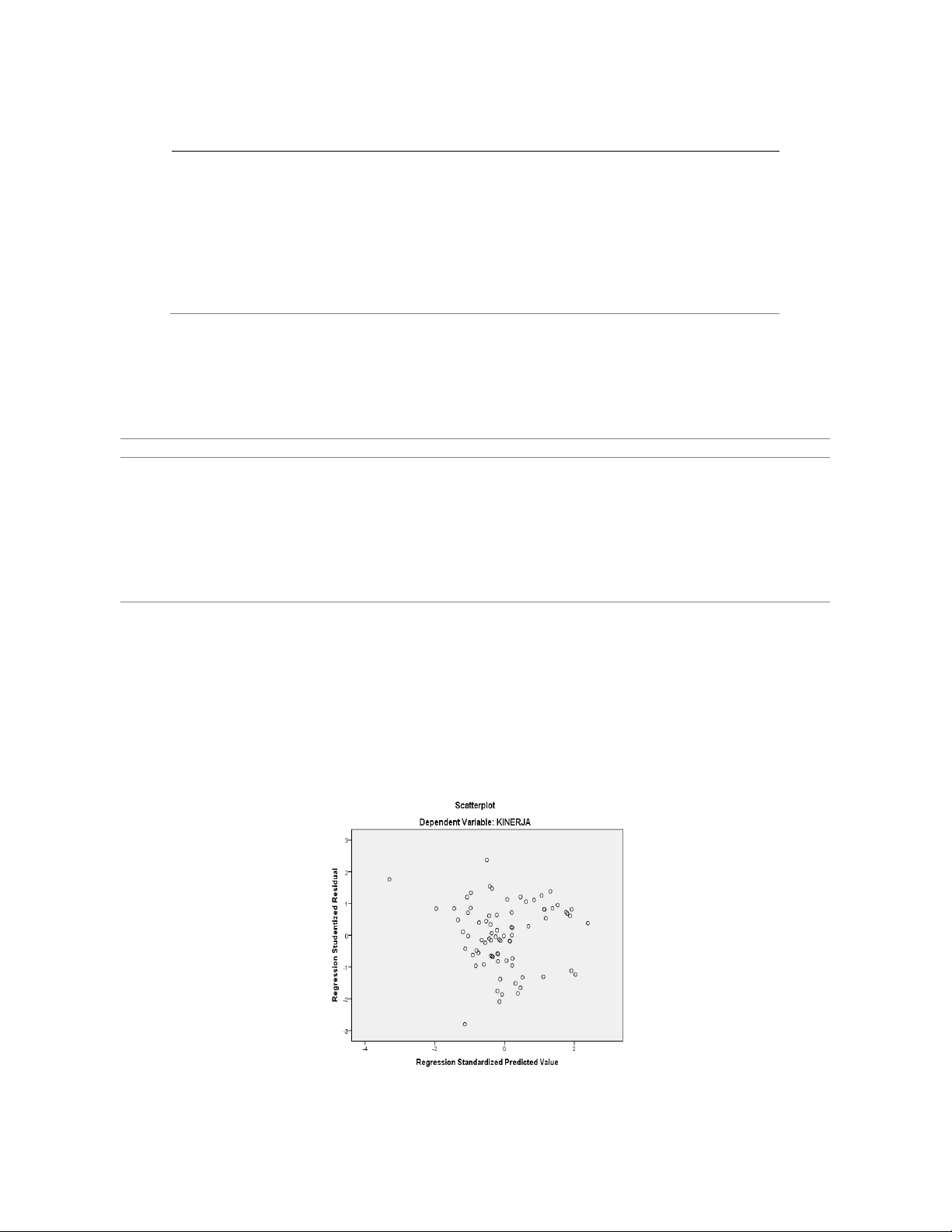
Heteroscedasticity Test
Source: Processed data (2024)
Figure 2. Residual Scatter Plot
Dihaq Allaamah, Roslina Alam, & Djamaluddin Bijaang
eCo-Fin: Economics and Financial, 2025, 7 (1), 198
Using the Glejser test, the image above shows a residual distribution pattern that tends to
spread evenly around the zero-horizontal line. There is no clear pattern such as forming a funnel
or other specific pattern. This indicates that the variance of the residual tends to be constant or
homogeneous. In other words, there is no strong evidence to state the presence of
heteroscedasticity in this regression model.
Multiple Linear Regression Analysis
The sign of the coefficient indicates the direction of the relationship (positive or negative),
while the t-value and significance level (sig.) reflect the statistical significance of the effect.
Table 7. Results of Multiple Linear Regression Analysis Test Coefficients a Model Unstandardized Standardized t Sig. Coefficients Coefficients B Std. Beta Error 1 (Constant) 4,340 5,504 .789 .433 Work Motivation .280 .136 .181 2,056 .043 Digital Competence .404 .099 .448 4.065 .000 Work Environment .243 .120 .222 2,031 .046
Source: Processed data (2024)
Both work motivation, digital competence, and work environment have a positive and
significant influence on employee performance. However, digital competence has the most
dominant influence. This means that the higher the digital competence of an employee, the
higher their performance. (Larasshati, 2024) also states that competence has a significant effect on employee performance.
Table 8. Coefficient of Determination Model Summary b Model R R Adjusted R Std. Error of the Square Square Estimate 1 .680 a .463 .441 4.26507
a. Predictors: (Constant), Work Environment, Work Motivation, Digital Competence
b. Dependent Variable: Performance
Source: Processed data (2024)
The R² value ranges from 0 to 1. The closer it is to 1, the greater the contribution of the
independent variables in explaining the variation of the dependent variable. Conversely, an R²
value that is close to 0 indicates that the regression model built is not good at explaining the
data. The data above shows that the R² value is 0.463. This means that around 46.3% of the
variation in employee performance can be explained by the three independent variables included
in the model. This indicates that these variables together provide a significant contribution to
employee performance. Thus, the alternative hypothesis (Ha) can be accepted, while the null hypothesis (Ho) is rejected.
Further analysis of the remaining 53.7% of unexplained factors in the model indicates the
possibility of external variables that influence employee performance, including (1)
organizational policies where organizational policies include rules and procedures set by
management to regulate employee behavior. This policy can influence employee performance
Dihaq Allaamah, Roslina Alam, & Djamaluddin Bijaang
eCo-Fin: Economics and Financial, 2025, 7 (1), 199
in various ways such as organizational structure and reward and punishment, (2) incentives are
a form of appreciation given to employees as recognition of their performance. These incentives
can be in the form of bonuses, promotions, or other benefits, (3) work-life balance is very
important to maintain employee mental and physical health such as flexibility of working hours
and family support. Further research is recommended to explore these variables. t-test
The T-test result is compared to the T-Table value (1.991) at a specific significance level,
typically 5%. If the T-count exceeds the T-Table value, the null hypothesis is rejected, indicating
a significant relationship between the independent and dependent variables. Table 9. t-Test Result Coefficients a Model Unstandardized Coefficients Standardized t Sig. Coefficients B Std. Error Beta 1 (Constant) 4,340 5,504 .789 .433 Work Motivation .280 .136 .181 2,056 .043 Digital Competence .404 .099 .448 4.065 .000 Work Environment .243 .120 .222 2,031 .046
a. Dependent Variable: Performance
Source: Processed data (2024)
The three variables exceed the T-Table value (1.991), indicating that each has a significant
individual effect on employee performance. This means that improvements in each of these
variables can potentially improve employee performance. F Test
(Fitria, 2024) the significance value (Sig.) obtained from the F-test determines whether the
null hypothesis is accepted or rejected. Table 10. F Test ANOVA a Model Sum of Squares df Mean Square F Sig. 1 Regression 1160.714 3 386,905 21,269 .000 b Residual 1346.119 74 18,191 Total 2506.833 77
Source: Processed data (2024)
The simultaneous influence of all independent variables on employee performance. The
significance obtained is 0.000 (much smaller than 0.05). This shows that we reject the null
hypothesis. Thus, it can be concluded that together, the variables of work environment, work
motivation, and digital competence have a very significant influence on employee performance. Discussion Work Motivation (X1)
Work motivation shows a positive and significant effect on employee performance with a
regression coefficient of 0.280 and a significant level of 0.043. This indicates that employees
who have high motivation, such as the need for self-actualization, a sense of appreciation, and
a sense of security, tend to show better performance. The reward factor for individual
achievement was the most influential aspect in increasing employee motivation. (Elisnawati,
Dihaq Allaamah, Roslina Alam, & Djamaluddin Bijaang
eCo-Fin: Economics and Financial, 2025, 7 (1), 200
2023) also proves that work motivation has a positive and significant effect on employee
performance. This finding is consistent with Maslow's motivation theory in (Ihensekien & Joel,
2023)which emphasizes the importance of fulfilling basic needs to self-actualization.
The analysis shows that the need for esteem and the need for security have the highest
average scores among the indicators of work motivation. Employees feel motivated when they
receive recognition for their achievements, either through formal awards or informal
appreciation from superiors. In contrast, social needs, such as interpersonal relationships at
work, show a smaller but still significant contribution.
Digital Competence (X2)
Digital competence has the most dominant influence with a regression coefficient of 0.404
and a significance level of 0.000. This confirms that employees' ability to access data, use
software, and utilize technology for administrative tasks is the main key to work efficiency. The
average employee digital competence score is in the high category, with the ability to operate
administrative software as the most mastered aspect. This finding is in accordance with (Blanka
et al., 2022), which states that digital competence influences the successful implementation of modern organizational tasks.
Further analysis showed that employees’ ability to complete technology-based tasks, such
as data processing and reporting using software, significantly contributed to improving work
accuracy. The questionnaire also revealed that previous technology-based training played an
important role in building employees’ digital competencies, although there was a need to
increase further training in certain areas, such as cybersecurity and the use of cloud-based applications. Work Environment (X3)
The work environment contributes significantly to employee performance with a
regression coefficient of 0.243 and a significant level of 0.046. A conducive work atmosphere,
harmonious interpersonal relationships, and effective communication are the main factors in
increasing employee productivity. The employees considered that a comfortable work
atmosphere and good interpersonal relationships had a positive impact on work enthusiasm.
(Zhou et al., 2023)support this finding by stating that a supportive work environment can increase
collaboration and reduce internal conflict. This is in line with Herzberg's two-factor motivation
theory in (Ihensekien & Joel, 2023) that the work environment is related to employee satisfaction
and dissatisfaction so that it can affect performance.
Additional analysis shows that a comfortable working environment, such as a clean
workspace and adequate facilities, is the most valued work environment indicator by employees.
Interpersonal relationships between employees are also considered very good, with high average
scores in the indicators of mutual support and maintaining professional relationships. However,
there is an important note regarding internal communication, where several respondents
indicated the need for a more structured communication system to reduce miscommunication.
Work motivation, digital competence, and work environment significantly affect
employee performance. High work motivation encourages employees to achieve optimal work
results, as supported by the theories of Maslow (1943) and Herzberg (1968) in (Ihensekien & Joel,
2023). Adequate digital competence allows employees to complete administrative tasks more
efficiently and accurately, in line with the findings of (Blanka et al., 2022). In addition, a conducive
Dihaq Allaamah, Roslina Alam, & Djamaluddin Bijaang
eCo-Fin: Economics and Financial, 2025, 7 (1), 201
work environment creates an atmosphere that supports team collaboration and organizational
productivity, as stated by (Yustinus, 2024).
Thus, this study provides empirical evidence that HR management focuses on increasing
work motivation, developing digital competencies, and improving the work environment can
have a significant impact on employee productivity and effectiveness in the South Sulawesi
Provincial DPRD Secretariat. This study also provides practical contributions for policy makers
to design training programs, rewards, and create a better work environment. CONCLUSION
This study revealed that work motivation, digital competence, and work environment
significantly affect employee performance at the Secretariat of the South Sulawesi Provincial
DPRD. Digital competence emerged as the variable with the greatest influence, emphasizing the
importance of mastering technology to support work efficiency and accuracy. Work motivation
was also shown to have a significant influence, especially through the fulfillment of self-
actualization needs and appreciation for individual achievements. In addition, a conducive work
environment plays an important role in creating an atmosphere that supports productivity and
collaboration between employees. Overall, this study provides empirical evidence that HR
management focuses on these three factors can improve organizational productivity and effectiveness. RECOMMENDATIONS
The management of the South Sulawesi Provincial DPRD Secretariat pay special attention
to the development of digital competencies through technology-based training programs, such
as administrative software training by holding intensive training on software such as Microsoft
Office, project management applications, and management information systems that are relevant
to employee duties and digitization of correspondence by implementing a digitization system
for correspondence that has been learned from other provincial DPRDs that allows employees
to access and manage administrative documents efficiently via mobile devices. In addition,
achievement-based reward programs by designing a reward system that provides incentives to
employees based on performance achievements, such as financial bonuses, award certificates,
opportunities to take further training outside the region. It is also important to create a supportive
work environment, such as improving internal communication by building an effective internal
communication platform, such as an instant messaging application or discussion forum to
facilitate the exchange of information and ideas between employees, providing comfortable
work facilities such as chairs that support back health, collaborative workspaces, and pleasant
rest areas and strengthening interpersonal relationships between employees by holding regular
team-building activities to strengthen relationships between employees and create a harmonious
work atmosphere. The implementation of these strategies is expected to improve overall
employee performance and encourage the achievement of organizational goals. REFERENCES
Asari, A., Romindo, Rijal, S., Abdurohim, Hendriati, Y., Faidal, Afifah, Z., Kartiko, A.,
Sunarno, N., Mujanah, S., Damanik, H. M., Sukamdani, N. B., & Baedowi, M. (2023).
Manajemen SDM di Era Transformasi Digital (M. A. Yaqin, Ed.). CV. Istana Agency.
Dihaq Allaamah, Roslina Alam, & Djamaluddin Bijaang
eCo-Fin: Economics and Financial, 2025, 7 (1), 202
Bakker, A. B., Demerouti, E., & Sanz-Vergel, A. I. (2014). Burnout and Work Engagement:
The JDR Approach. Annual Review of Organizational Psychology and Organizational
Behavior, 1(March), 389–411. https://doi.org/10.1146/annurev-orgpsych-031413-091235
Basu, A. (2021). Open Peer Review on Qeios Cronbach’s alpha. 1951, 3–4.
https://doi.org/10.5116/ijme.4dfb.8dfd.Qeios
Blanka, C., Krumay, B., & Rueckel, D. (2022). The interplay of digital transformation and
employee competency: A design science approach. Technological Forecasting and Social
Change, 178(July 2020), 121575. https://doi.org/10.1016/j.techfore.2022.121575
Faruq, U., Andayani, S., & Pudjianto, A. (2023). PENGARUH MOTIVASI KERJA DAN
LINGKUNGAN KERJA TERHADAP KINERJA KARYAWAN DENGAN GAYA
KEPEMIMPINAN SEBAGAI VARIABEL MODERASI (Studi Kasus Pada Karyawan
PT. Ausman Grosir Indo Surabaya). Sosialita Untag, 2, 520–529.
Fitria, D. (2024). PENGARUH GAYA KEPEMIMPINAN DEMOKRATIS DAN
LINGKUNGAN KERJA NON FISIK TERHADAP KINERJA PEGAWAI
SEKRETARIAT DPRD PROVINSI JAMBI. Jurnal Akuntansi, Keuangan, Perpajakan Dan Tata Kelola Perusahaan (JAKPT, 1(3), 59–67.
https://doi.org/10.59407/jakpt.v1i3.522
Ihensekien, O. A., & Joel, A. C. (2023). Abraham Maslow’s Hierarchy of Needs and Frederick
Herzberg’s Two-Factor Motivation Theories: Implications for Organizational Performance. The Romanian Economic Journal, 85.
https://doi.org/10.24818/rej/2023/85/04
Iswandi, R. R. F. (2025). Pengembangan Sumber Daya Manusia di Era Digital. Jurnal Bisnis Dan Pemasaran Digital, 4(1), 15-28. Yogyakarta: Andi.
https://doi.org/https://doi.org/10.30640/inisiatif.v4i1.3525
Lopang, Y. L., Sendow, G. M., & Uhing, Y. (2023). Pengaruh Faktor Hygiene, Motivator Dan
Keterlibatan Kerja Terhadap Kepuasan Kerja Karyawan Pada Manado Quality Hotel.
Jurnal EMBA : Jurnal Riset Ekonomi, Manajemen, Bisnis Dan Akuntansi, 11(3), 512–522.
https://doi.org/10.35794/emba.v11i3.49481
Nikmah, W., Mukarromah, A., Widyansyah, D., & Anshori, M. I. (2023). Penggunaan
Teknologi Dalam Pengembangan SDM. Mutiara : Jurnal Penelitian Dan Karya Ilmiah,
1(5), 366–286. https://doi.org/https://doi.org/10.59059/mutiara.v1i4.511
Otoluwa, I. N., Burhan, H., & Hasan, A. (2023). Pengaruh Lingkungan Kerja dan Motivasi Kerja
Terhadap Produktivitas Karyawan Pada PT. Suracojaya Abadimotor Cabang Maros.
YUME : Journal of Management, 6(2), 301–310.
Ramdhana, A. W. L. ; M. A. C. N. (2016). PENGARUH KUALITAS HUBUNGAN SESAMA
ANGGOTA TIM DAN KEPEMIMPINAN BERSAMA TERHADAP EFEKTIVITAS TIM PADA ORGANISASI PUBLIK. Ilmiah Manajemen, 8(2), 1–23.
https://doi.org/dx.doi.org/10.22441/mix.2018.v8i2.011
Sinambela, L. P. (2019). Manajemen Sumber Daya Manusia. In S. dan R. Damayanti (Ed.),
Sustainability (Switzerland) (Pertama, Vol. 11, Issue 1). PT. Bumi Aksara.
Yustinus, J. P. G. (2024). Analisis Gaya Kepemimpinan dalam Meningkatkan Motivasi Kerja
Pegawai. 1(1), 44–60. https://doi.org/10.62138/management.v1i3.xx
Zhou, Q., Sacramento, C., & Martinaityte, I. (2023). Work meaningfulness and
performance among healthcare professionals: The role of professional respect and
participative management. Journal of Business Research, 163(March), 113908.
https://doi.org/10.1016/j.jbusres.2023.113908
Tài liệu liên quan:
-
Reading and Writing Module 1 | Tài liệu Tiếng Anh
33 17 -
Cambridge IELTS 13 Test-1 Overview and Practice Review | Tài liệu Tiếng Anh
30 15 -
IELTS Test 2 Review - Cambridge 13 Preparation Guide | Tài liệu Tiếng Anh
34 17 -
Litfocus Litreading Survey: Student Reading Interests & Habits Questionnaire | Tài liệu Tiếng Anh
31 16 -

Sách Pre-intermediate Market leader - Business English Course Book
55 28