High
-scoring
.
Formulas
to
Answer
the
IELTS
Speaking
Questions
Jonathan
PaHey.
Adrian
Li.
Oliver
Davies
!i
NHA
XUA:T
BAN
TONG
HQP
THANH
PH6
H6
CHi
MINH
NTV
COngtyTNHH
NhaD
Tri
Vi~t

31
High-scoring
Formulas
to
Answer
the
lELTS
Speaking
Questions
Copyright
©
2011-2014
Foreign
Language
Teaching
and
Research
Press
Published
in
Vietnam,
20
14
This
edition
is
published
'
in
Vietnam
under
a
license
Agreement
between
Foreign
Language
Teaching
and
Research
Press
and
Nhan
Tri
Viet
Co.,
Ltd.
All
rights
reserved
.
No
part
of
this
publication
may
be
reproduced,
stored
in
a
retrieval
system,
or
transmitted,
in
any
form
or
by
any
means,
electronic,
mechanical,
photocopying,
recording,
or
otherwise,
without
the
prior
written
permission
of
the
copyright
owner.

Preface
Looking
back
at
your
past
time
of
speaking
English
or
your
latest
conversation
with
a
foreigner,
did
you
encounter
any
of
the
following
problems:
so
embarrassed
that
you
were
empty-minded?
thinking
of
many
aspects
but
not
knowing
which
one
to
begin
with?
knowing
the
answer
but
unable
to
express
it
in
English
fluently?
31
High-scoring
Formulas
to
Answer
the
IELTS
Speaking
Questions
can
help
IELTS
candi-
dates
solve
the
problems
of
"not
knowing
what
to
say"
and
"not
knowing
how
to
say
it"
in
the
Speaking
test.
These
31
high-scoring
formulas
are
designed
based
on
effective
strategies
to
deal
with
actual
IELTS
Speaking
test
questions.
They
cover
nearly
all
topics
in
the
real
Speaking
test.
Mastering
them
enables
the
candidates
to
answer
every
question
naturally
and
confidently
in
order
to
get
the
highest
score
possible
at
their
level
of
proficiency.
Take
one
common
question
in
the
IELTS
Speaking
test
as
an
example,
"How
often
do
you
play
sports?"
So
many
candidates
would
answer
"Yes,
I
play
sports
every
day."
The
answer
may
sound
grammatically
correct,
but
it
fails
to
earn
them
a
decent
score
on
the
IELTS
Speak-
ing
test.
In
fact,
with
this
type
of
question,
it
is
expected
that
candidates
would
apply
the
order
of
forming
responses
similar
to
the
following
model:
Step
1:
Forming
the
answer
*
Say
how
frequently
you
do
the
activity
the
examiner
asks
you
about.
*
Explain
why
you
do
it that
frequently.
Step
2:
Applying
language
skills
to
elicit
the
answer
*
Use
a
range
of
different
adverbs
of
frequency
correctly.
I
play
badminton
very
often.
I
never
go
skiing.
If
candidates
follow
the
recommended
steps
of
forming
the
answer,
their
responses
will
be
more
coherent
and
well
structured.
Based
on
this
high-scoring
formula,
an
expected
response
may
be
"I
play
sports
a
few
times
a
week.
Usually
I
play
basketball
with
my
friends,
but
sometimes
I
play
football
instead.
I
think
team
sports
are
a
great
way
to
socialise
and
keep
fit."
Compared
to
the
answer
"Yes,
I
play
sports
every
day,"
this
response
is
clearly
richer
and
more
detailed
in
content,
and
more
accurate
and
natural
in
using
language
expressions.
Once
you
have
mastered
this
high-scoring
formula,
all
questions
which
start
with
"How
often
...
?"
will
be
solved
easily.
For
example,
"How
often
do
you
eat
in
restaurants?,
How
often
do
you
go
for
a
long
walk?,
How
often
do
you
take
public
transport?",
etc.
Just
in
the
same
manner,
a
good
grasp
of
31
essential
high-scoring
formulas
in
this
book
can
allow
candidates
to
answer
every
IELTS
Speaking
test
question
with
confidence
and
great
effectiveness.
www
.nhantr
ivi
et.com
3

Contents
Overview
of
the
IEL
TS
Speaking
Test
"""'"''
""'"''
"" ""
"""
'"''''''
"""""''''''''''
'
''
'
"""""""""'''''',''''''''''''''''''''''
''''''''''''''''''''''
""""""""""""'"
6
How to
Use
31
High-scoring
Formulas
to
Answer
the
IELTS
Speaking
Questions
''''''
''''''',''''''
9
Part
@OO[§
Introduction to Part
One
Formulas
",,,,,,,,,,,,,,,,,,,
""""""""'"''''''''''
"""''''''''''''''''''
"""""""
"""
,,,"
,,""''''''''''''''''''''''''
"'"
'"''''''''''
""""""""""""''''''''
11
Formula
1:
Do
you
prefer
X
to
y?
""
"'''''''''''''''''''''''''''''''''''''''''''''''''''''''''''''''''''''''''''''''''''''',,''''
""""",,,,,
,
,,,,,,,,,,
,
,,,,,,,,,,,,,,,,,,,,,,,,,,,,,,,,,,,,,,,,,,
13
Formula
2:
What
do
you
usually
/normally
do?
""""""",,,,,,,,,,,,,,,,,,,,,,,,,,,,,,,,,,,,,,,,,,,,,,,,,,,,,
,,
,
",,,,,,,,,,,,,,,,,,,,,,,,,,,,,,,,,,,,,,,,,,,
20
Formula
3:
What
do
you
like
to
do
(in your
spare
time)?
"""""""'"''''''''''''''''''''''''','''''''''''''''''''''''''''''''''''''''''''''''''''''''"""",
28
Formula
4:
What
do
you
dislike
about
X?
'"''''''''''''''''
",,,,,,,,,,,,,,,,,,,,,,,,
34
Formula
5:
How
often
do
you
do
X?
",,,,,,,,,,,,,,,,,,,,,,,,,,,,,,,,,,,,,,,,
''''''''''''''''''''''''''''',,''''''''''''''''''''''''''''''''''''''''''''''
"""",,,,,,,,,,,,,,,,,,,
40
Formula
6:
What
do
you
like
most
about
X?
""""""""""""""
Is
X
popular
(in your
country)?
""",,,,,
""""
''''
'''''''
''
''''''''''''''''''''''''''''''''"''''''''''','''''''',,,'",,,
47
Formula
7:
Formula
8:
What
is
the
best
time (of
year)
to
do
X?
""""",,,,,,,,,,,,
""""",
54
",,,,,,,,
61
Formula
9:
Why
do
some
people
like
X?
"""""""",,,,,,,,,,,,,,,,,,,,,,,,,,,,,,,,,,,,,,,,,,,,,,,,,,,,,,,,,,,,
,,,,,,,,,,,,
"
"'""""""
"'''
'',,''
",""'"
69
Formula
10:
When
was
the
first/last
time
you
did
X?
""""""
"""'"'''''''''''''''''''''''''''''''''''''''''','',,',,'''''''''''''''
""""""""""""""
76
Formula
11
: Did
you
ever
learn
to
do
X?
"",,,,,,,,,,,,,,,,,,,,,,,,,,,,
"""'"''''''''''''''''''
""',"""""""""""""''''''''''''''''''''''''''''''''''''''''''
"""",
84
Formula
12:
How
has
X
changed?
"""",,,,,,,,,,,,,,,,,,,,,,,,,,,,,,,,,,,,,,,,,,,,,,,,,,,,,,,,,,,,"""",,
",,"",,,""'''''''''''''''''''''''''''''''''''''''''''''''',
""""""'''''''''"''''''''''''''
",""",,"''''',,'','''','
91
Formula
13:
How
would
you
improve
X?
""""",,,,,
,,,,,,,,,,,,,,,,,,,,,,,,,,,,,,,,,,,,,,,,,,,,,,,,,,,,,,,,,,,,,,,
""""'''''''''''''''''''''''''''''''''''''''
''
''''''"
',,,''
,,'',,''
'''''''''''''''''''''''''''''''''',
97
Formula
14:
How important
is
X?
""
"",,,,,,,,,,,,,,,,,,,,,,,,,,,,,,,,,,,,,,,,,,,,,,,,,,,,,,,,,,,,,,,,,,,,,,,,,,,,,,,,,",""
""
'
,,""""""
"""""
"
""
""""'"
""''''
1
03
Formula
15:
What
do
you
want/hope
to
do
(in
the
future)?
""",,,,,,,,,,,,,,,,,,,,,
,
,,,,,,,,
"""""
'"
''''''''''''''''''
"""
110
Formula
16:
Do
people
do
/
get
enough
X?
"""'"''
'",,'''
,,",,",,""""""""""'"'''''
''
'''''''''''''''
'''
''''
'''''''''
''''''''
"""""""'
"''''''''
''''''',,'',,
'',
'''''''','''
116
Formula
17:
How
can
people
find out
about
X?"
"",,,,,,,,,,,,,,,
,,,,,,
,,,,,,,,,,,,,,,,,,,
"""""""""""""""""'""'''',,,,'''''''''''''''''''''
'"''''''''
122
Formula
18:
Should
people
be
given
X?
",,,,,,,,,,,,,,,,,,,,,,,,,,,,,,,,,,,,,,,,,,,,,,,,,,,,,,,,,,,,,,,,,,,,,,,,,,
"""""""'""""""'"
","""",,,,"""""""""
"""""'"
128
Formula
19:
Is
it
difficult to
do
X?
"""",,,,,,,,,,,,,,,,,,,,,,,,,,,,,,,,,,,,,,,,,,,,,,,,,,,,,,,,,,,,,,,,,,,,,,,,,,,,,,,,,,,,,,,"""''''',,',''''''''''''''''''''''''''''''''''''''''''''''''''''''''''
""""""""'""""""'"
"""'"
135
Formula
20:
Is
X
suitable
for
(types
of
people)?
""""",,,,,,,,,,,,,,,,,,,,,,,,,,,,
,,,,,,,,,,,,
,,
""'"''''''''''''''''''''''''''''''''''''''
""""""""""""""""""'"
141
4
www
.nhantriviet.com

Contents
Part
LrW@
Introduction
to
Part
Two
Formulas
",,,,,,,,,,,,,,,,,,,,,,,,,,,,,,,,,,
,
,,,
,,,,,,,,,,,,,
,,,,,,,,,,,,,,,,,,,,""""''''
''
''''''''''
"""'"
''''''''''''
"""
" " "
"'"
"""""""""""
147
Formula
21:
Person
Monologue
""",,,,,,,,,,,,,,,,,,,,,,,,,,,,,,,,,,,,,,,,,,,,,,,,,
,
,,,,
,,,,,,,,,,,,,,""""""""""""""""""''','",,'',,''"""'""""""''''''''''
"""""'"",,
''''''''''''
"''''''",,''''''
""
""
149
Formula
22:
Place
Monologue"
""
"""""""""",,,,,,,,,,,,,,,,,,,,,,,,,,,,,,,,,,,,,,,,,,,,,,,,,,,,,,,,,,,,"'
''
''
''''''
''''''
''
'
''
''''''''''''''''''''''''''''''''''''''''''
''
''''''''''''''
''''
'''''''',,''''''''"""'"'''''''''
''
'''''''''''''''''
177
Formula
23
:
Object
Monologue
"",,,,,,,,,,,,,,,,,,,,,,,,,,,,,,,,,,,,,,,,,,,,,,,,,,,,,,,,,,,,,,,,,,,,,,,,,,,,,,,,,,,,",,",,",,""""''''''''''''''
"""""
""""'"''''''''''''
''''''''''''''''''''''''''''''''''''''
""""""""""""""
204
Formula
24:
Past
Event
Monologue
""",.""",,,,,.,,
..
,,
..
,,,
..
,,,
..
,,,.,,,.,,.,,,,,,,.,,,,,,,,,,,"""
...
",."."""
..
""
,
..
"."''''"
.....
"''".,,.,,.,,
......
,,'',,.,,''"
....
""".,,,.,,"''''''',,.,,''''
""""."
.............
234
Introduction
to
Part
Three
Formulas
",,,,,,,,,,,,,,,,,,,,,
,,,,,
,,,,,,,,,,
"""""""""'"'''''''''''''
"
..
"''''''''''".,,'''''''''''''''''',,.,,'''''"""""
'
".,'''''".,'''''''''''''''''''"
....
"
'''''''''',."
,,,
267
Formula
25:
Giving
and
Supporting
Opinions
."
..
"
..
" ..
",
...
"
..
"."
..
",."
..
. "
..
"
..
".
".""
..
..
"."."."
....
"
...
".".".
"" .
....
".".""""
.. "
...
"."
..
""
..
,,
..
".""."."
...
. "
..
".
"."""
...
269
Formula
26
:
Evaluating
Two
Different
Opinions"
..
"
...
"
..
. ,
..
"
..
".""
..
"."
..
"
..
"
..
"
....
"."."
..
,"
.
..
",."."""."
...
.
..
"."."
..
"
....
"
...
".""."'"''''".,,,,.,,'''
..
..
""''''''',,
..
....
279
Formula
27:
Agreeing
and
Disagreeing
.
",,,,,,,,,,,,,,,,,,,.,,,,,,,,,,,,,,,,.,,,,,,,
..
,,.,,,,,,,,,,,,,.,,,,,,,,,."
...
"
....
".""'''''"
..
"''''''''''''''"
....
"''''''''''"
..
,,
...
,,
..
,,
..
"'''''''''''''".""
....
"'''''".",,
..
,,,
289
Formula
28:
Talking
about
Advantages
and
Disadvantages
"""""
..
""".""""
.,,
""'''''''''',,
.
....
,,''''''
''
,,
...
,,'"""'"."'''''''''''''''''''"
....
"'''''".",,.,,,,
300
Formula
29:
Expressing
Importance
and
Priority
..
""
..
"""."".".""."""""."""
..
"""""
.",
.
"'''".""
..
"'''',,
.,,''
"""""""
....
""."'".""",,,
310
Formula
30
:
Proposing
Solutions
to
Problems
,,,.,,,,,,
,,,,,,,,,,,,,,,,,,,,,,,,,,,,,,,,,,.,,,,,,,,,,,,
..
,,,,,,,,,.,,
..
.
"'"
'''
''''".,'"
...
"'
''"."'''".",,.,,''''''''''''''''''''''''''',,
...
,,'''''",,,,,
..
,,,,,
321
Formula
31:
Speculating
about
Future
Events
and
Outcomes
..
.
"."."."
..
"."."""""""
..
".".""
..
"
..
""
..
"
..
" ..
""
.. "
..
"".".""
....
"""
..
"."
..
",,,
329
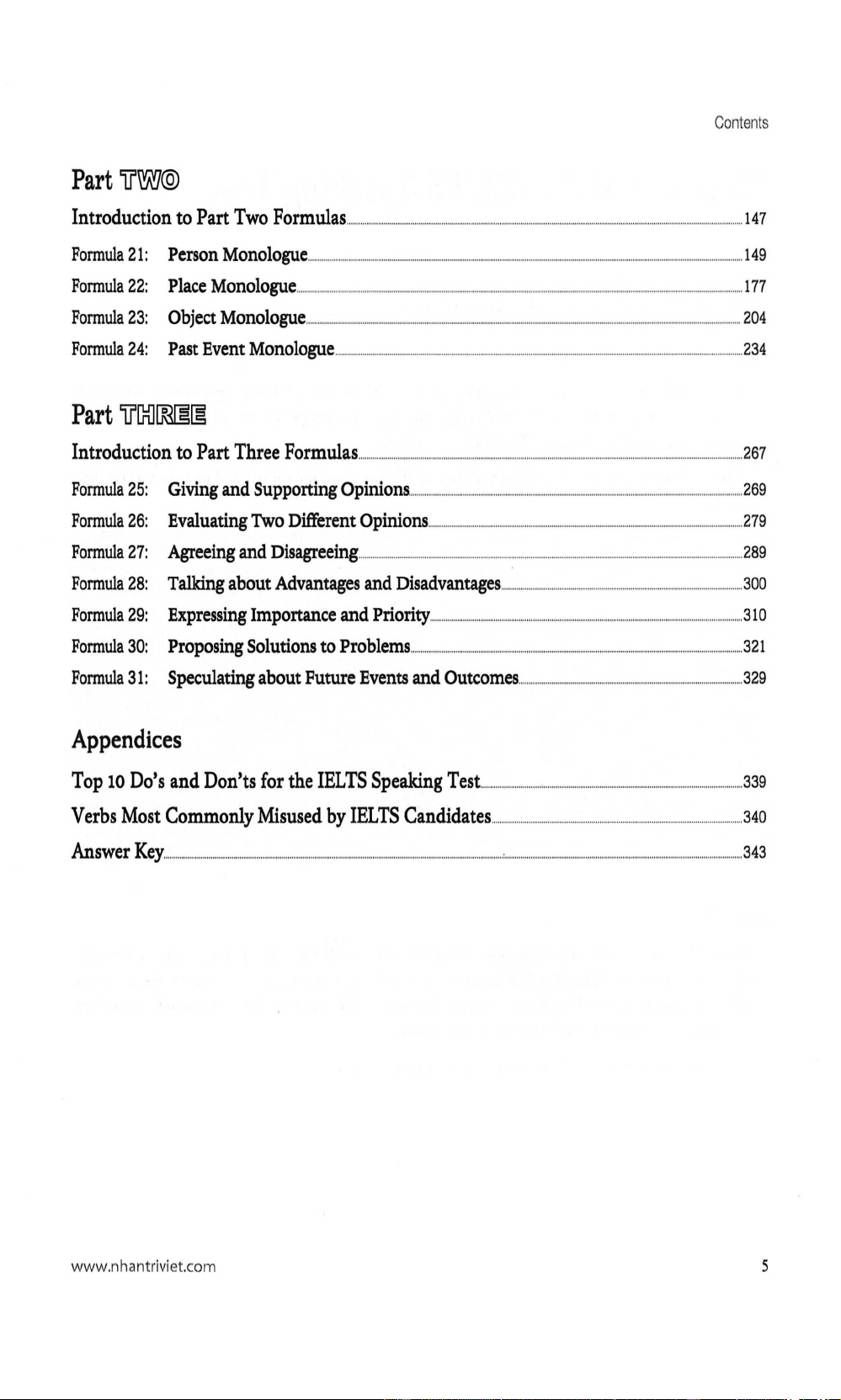
Appendices
Top
10
Do's
and
Don'ts
for
the
IELTS
Speaking
Test..
"""""
..
".""
...
".
"."
....
"".""""
..
"
....
""
..
""
..
"
..
""
..
"
..
",
.. "
...
"
..
,,.,,".,,,
..
,,,,,,.,,
..
,,.,,
..
,,,,,
339
Verbs
Most
Commonly
Misused
by
IELTS
Candidates
"""""."".,
,,
,,,,,,,.,,
..
,,,,,,,,,,,,,,,.,,,,
.
,,,,,,
.,,.
,,
.
,,,.,,"
..
""""."".",,.
."."."",,
340
An.swer
Key.
,,,,,,
.,,
,
,,,,,
,,,,,,,,,,,,,,,,,,,,,,,,,,,,,,,,,,,,,,,,,,,,,,,,,,,,,,,,,,,,.,,,,,.,,"'''''''',.,,''''''''''''''''''''''''''''''''',,.,,,,.,,'''''''''''',,.,,'',,,.,,"""",:,"",,.,,''''''''''''''''''''''''''''''''''
''''''''''''''''
''''''''''""
"""."".,,""
"",,,,,,,,,
343
www.nhantriviet.com 5

Overview
of
the
IEL
TS
Speaking
Test
The
IELTS
Speaking
test
is
divided
into
3
parts:
Part 1
Part 1
lasts
for
4-5
minutes.
The
examiner
will
ask
you
some
familiar
questions
about
your
hometown,
family,
hobbies,
acquaintances,
etc.
You
are
supposed
to
answer
the
questions
briefly
and
accurately,
along
with
specific
examples.
Part 1
aims
to
test
the
candidate's
ability
to
discuss
familiar
topics
and
use
simple
English
grammar.
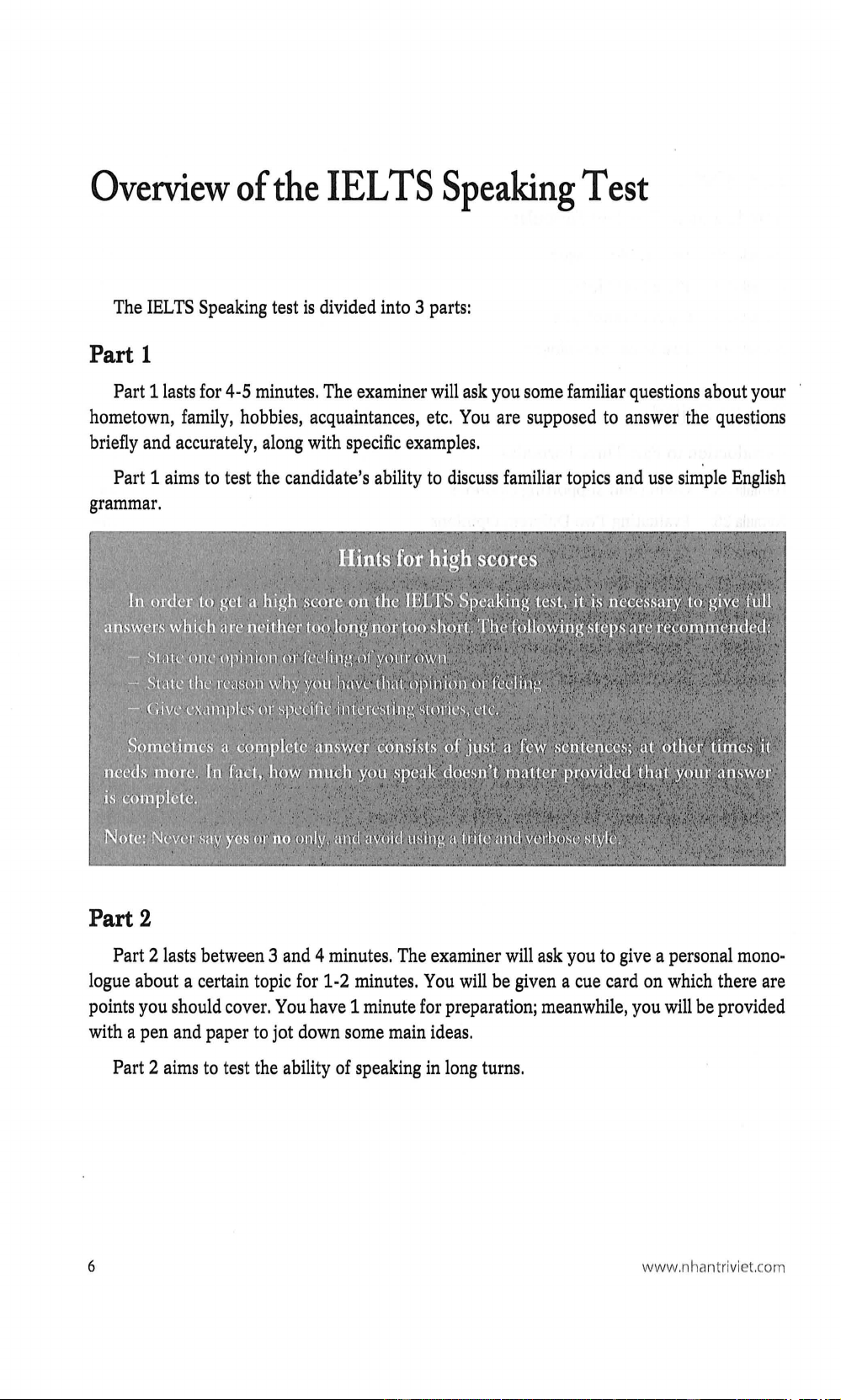
Part 2
Part 2
lasts
between
3
and
4
minutes.
The
examiner
will
ask
you
to
give
a
personal
mono-
logue
about
a
certain
topic
for
1-2
minutes.
You
will
be
given
a
cue
card
on
which
there
are
points
you
should
cover.
You
have
1
minute
for
preparation;
meanwhile,
you
will
be
provided
with
a
pen
and
paper
to
jot
down
some
main
ideas.
Part
2
aims
to
test
the
ability
of
speaking
in
long
turns.
6 www.nhantriviet.com

Part 3
In
Part 3
of
the
IELTS
Speaking
test,
which
lasts
4-5
minutes,
you
will
participate
in
a
discussion
with
the
examiner
based
on
the
topic
in
Part
2.
You
should
express
and
support
your
opinion
clearly,
as
well
as
show
your
skills
of
using
English
in
discussing
various
topics
in
depth
.
Part 3
aims
to
test
the
candidate's
ability
to
express
personal
interpretations
of
argumenta-
tive
issues
and
to
discuss
them
in
detail.
www.nhantriviet.com
7

8 www.nhantriviet.com

How
to
Use
31
High-scoring
Formulas
to
Answer
the
IEL
TS
Speaking
Questions
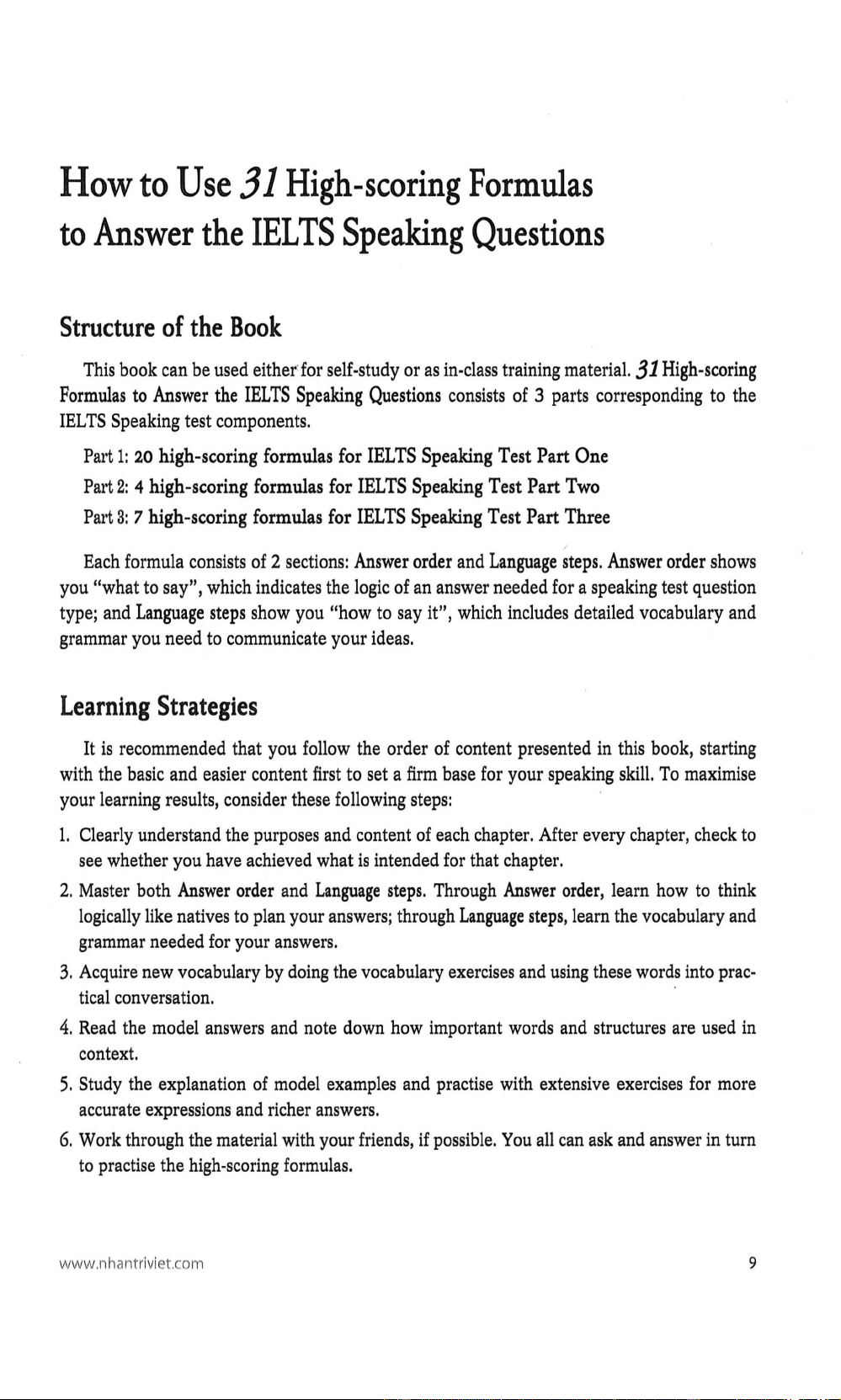
Structure
of
the
Book
This
book
can
be
used
eithedor
self-study
or
as
in-class
training
material.
31
High-scoring
Formulas
to
Answer
the
IELTS
Speaking
Questions
consists
of
3
parts
corresponding
to
the
IELTS
Speaking
test
components.
Part
1:
20 high-scoring formulas for
IELTS
Speaking Test Part One
Part
2:
4 high-scoring formulas
for
IELTS
Speaking Test Part
Two
Part
3:
7 high-scoring formulas
for
IELTS
Speaking Test Part Three
,
Each
formula
consists
of
2
sections:
Answer
order
and
Language
steps.
Answer
order
shows
you
"what
to
say",
which
indicates
the
logic
of
an
answer
needed
for
a
speaking
test
question
type;
and
Language
steps
show
you
"how
to
say
it",
which
includes
detailed vocabulary
and
grammar
you
need
to
communicate
your
ideas.
Learning
Strategies
It
is
recommended
that
you
follow
the
order
of
content presented
in
this
book,
starting
with
the
basic
and
easier
content
first
to
set
a
firm
base
for
your
speaking
skill.
To
maximise
your
learning
results,
consider
these
following
steps:
1.
Clearly
understand
the
purposes
and
content
of
each
chapter.
After
every
chapter,
check
to
see
whether
you
have
achieved
what
is
intended
for
that
chapter.
2.
Master
both
Answer
order
and
Language
steps.
Through
Answer
order,
learn
how
to
think
logically
like
natives
to
plan
your
answers;
through
Language
steps,
learn
the
vocabulary
and
grammar
needed
for
your
answers.
3.
Acquire
new
vocabulary
by
doing
the
vocabulary
exercises
and
using
these
words
into
prac-
tical
conversation.
4.
Read
the
model
answers
and
note
down
how
important
words
and
structures
are
used
in
context.
5.
Study
the
explanation
of
model
examples
and
practise
with
extensive
exercises
for
more
accurate
expressions
and
richer
answers.
6.
Work
through
the
material
with
your
friends,
if
possible.
You
all
can
ask
and
answer
in
turn
to
practise
the
high-scoring
formulas.
www,nhantriviet,(
om
9

10


12

Formula
1
Do
you
prefer
X
to
.
Y?
Aims
In
this
lesson
you'll master the Formula
for
Do
you
prefer X
to
Y?
type
questions.
Do
you
prefer writing letters
or
sending
emails?
Do
you
prefer talking
on
the phone
or
chatting
online?
Do
you
prefer
to
travel
by
bike
or
on
foot?
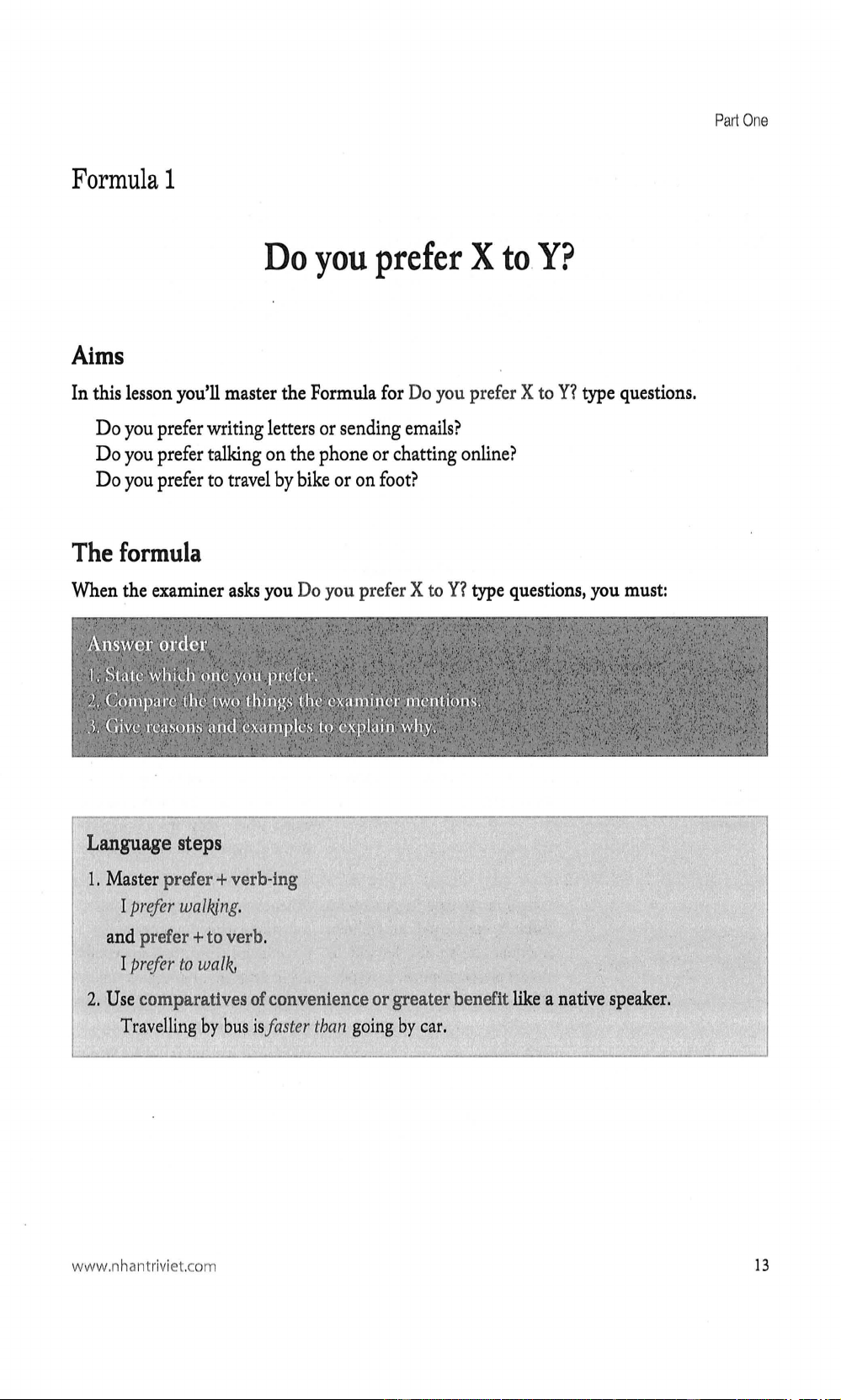
The
formula
When
the examiner
asks
you
Do
you
prefer X
to
Y?
type
questions,
you
must:
L
anguage
steps
1.
Master
prefer + verb-ing
I
prefer
walkjn.g
.
and prefer +
to
verb.
I
prefer
to
walk.,
2.
Use
comparatives
of
convenience or greater benefit
like
a
native
speaker
.
Tra
velling
by
bus
is
faster
them
g0ing
by
car.
ww
w.
nhantl.
ivi
et.com
Part
One
13

Native
speaker
words
Let's learn some native speaker words which are useful
for
answering this
type
of
question.
These
words
can
also
help
you understand the model
answers
on the next
page
more
thoroughly.
convenient
adjecti
ve
fitting
in
well
with
a
person's
needs
Is
it
convenient
for
you
to
meet
or
pl
ans
.
Friday
afternoon?
in
factj
really
(
usu
a
ll
y
used
before
Many
people
think
that
philoso-
actually
ad
v
erb
a s
li
ghtly
surprising
statement
)
phy
is
rea
ll
y
boring,
but
it's
actu-
ally
quite
fascinating
when
you
start
finding
out
about
it.
to
get
into
a
situation
when
you
We
got
stuck
in
traffic
for
hours
cannot
move
easily
(
It
can
be
used
and
so
we
missed
our
plane.
get
stuck
in
an
abstract
or
a
specific
situation.
It
is
often
used
when
you
cannot
move
in
a:
traffic
j
am.
)
a
lo
t of
vehi
cl
es
very
cl
o
se
to
gether
Traffic
j
ams
are
usua
ll
y j
ust
caused
so
that
the
y
cann
ot m
ov
e
by
the
amount
of
cars
on
the
road,
traffic
j
am
rather
than
by
accidents.
This
is
why
there
are
al
ways
traffic
j
ams
during
rush
hour.
all
the
different
types
of
transport:
Although
a
car
is
probably
the
most
cars
,
buses,
trains,
the
subway,
popular
means
of
transport,
it
is
means
of
pl
anes,
etc
.
not
ver
y
suitab
le
for
modern
li
fe
in
transport
cities,
wh
ere
they
are
too
expen-
sive
and
there
is
not
enough
space
to
drive
them.
a
small
image
used
in
chat
r
oo
ms
Whenever
I
make
a
joke
about
o
nline
by
users
to
indicate
different
somebody
while
I
am
on
the
In-
.
smiley
n
ou
n
em
o
ti
o
ns
(
It
can
al
so
be
sent
by
ternet
and
I
worry
that
somebody
mo
bile
ph
o
ne
or
email.
Example:
might
get
angry,
I
just
put
a
smiley
@)
at
the
end
of
my
message
to
show
I
was
on
ly j
oking.
ad
j
ec
tlv
e/
on
the
Internet
I
won't
Jet
my
child
surf
the
Web;
online
there
are
too
many
dangerous
and
ad
ver
b
dirty
things
online.
describing
so
mebody
wh
o
likes
Mark
isn't
a
ve
ry
sociable
person
at
sociable
adjective
meeting
new
people
or
spending
all;
he
hardly
ever
goes
out
to
have
time
with
people
fun
and
spends
all
his
time
alone
in
his
room
playing
computer
games.
14 www.nhantriviet.com

Part
O
ne
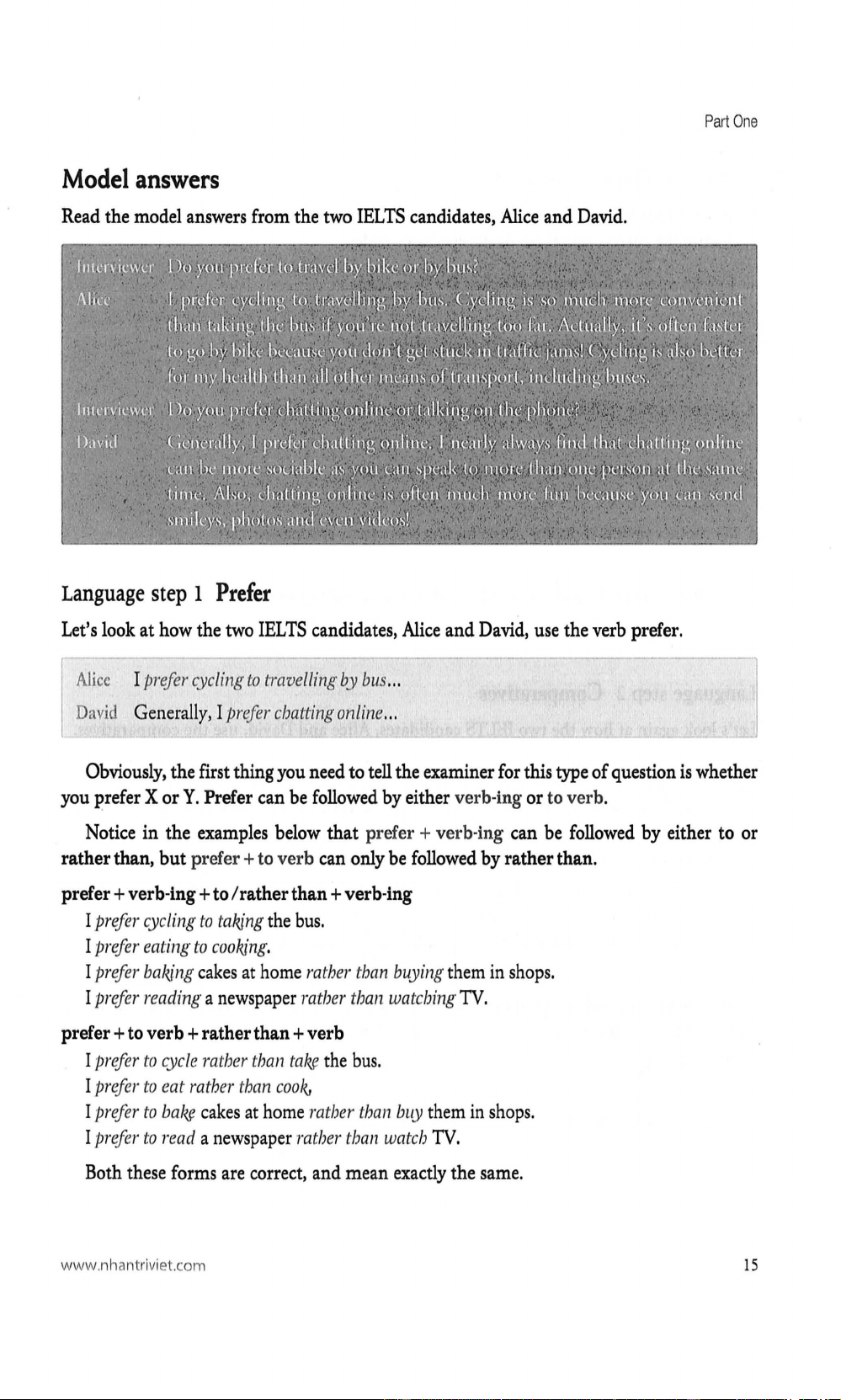
Model
answers
Read
the
model
answers
from
the
two
IELTS
candidates,
Alice
and
David.
Language
step
I
Prefer
Let's
look
at
how
the
two
IELTS
candidates,
Alice
and
David,
use
the
verb
prefer.
Alice
I
prefer
cy
cl
ing to
trave
llin
g
by
bus
...
]
David
Gen
er
ally,
I
pr
efe
r ch
att
in
g
onlin
e
...
~'"-------~
Obviously,
the
first
thing
you
need
to
tell
the examiner
for
this
type
of question
is
whether
you
prefer X or
Y.
Prefer
can
be
followed
by
either verb-ing or
to
verb.
Notice
in the
examples
below
that prefer + verb-ing
can
be
followed
by
either
to
or
rather than, but prefer +
to
verb
can
only
be
followed
by
rather than.
prefer
+ verb-ing +
to
/ rather than + verb-ing
I
prefer
cycli
ng to
t:akjng
the
bus.
I
prefer
eat
i
ng
to
coo
k
jng.
I prefer
ba
l
{jn.g
cakes
at
home
rather
than
buying
them
in
shops.
I
prefer
reading
a
newspaper
rather
than
watching
TV.
prefer +
to
verb + rather than + verb
I
prefer
to
c
ycle
rather
than
tak§
the
bus.
I prefer
to
eat
rather
than
cool?,
I
pr
efer
to
ba/~
cakes
at
home
rather
than
bLtV
them
in
shops.
I
prefer
to
read
a
newspaper
rather
than
watch
TV.
Both
these
forms
are
correct,
and mean
exactly
the
same.
www
.nhantriviet.com
15

dJ
Exercise
1.1:
Error
Correction
Some
of the
sentences
below
are
incorrect,
some
are
correct.
Identify the incorrect
sentences
and
write
the correct
sentences
in the
spaces
provided.
1.
I
prefer
to
go
to
the
cinema
to
watch
DVDs
at
home.
2.
My
sister
prefers
writing
letters
to
write
emails.
3.
I
prefer
to
talk
with
friends
on
the
phone
rather than
using
emails.
4.
I
much
prefer
to
live
in
a
town
rather than a
big
city.
5.
My
mother
prefers
shopping
at
the
market
more
than
in
supermarkets.
6.
My
friends
generally
prefer
to
send
text
messages
to
talking
on
the
phone.
Language
step
2
Comparatives
Let's
look
again
at
how
the
two
IELTS
candidates,
Alice
and
David,
use
the
comparatives.
Alice
...
Cycling
is
so
much
more
convenient
than
taking
the
bus
if you're
not
travelling
too
far.
Actually,
it's
often
faster
to
go
by
bike
because
you
don't
get
stuck
in
traffic
jams!
Cycling
is
also
better
for
my
health
than
all
other
means
of transport,
including
buses.
David
..
.I
nearly
always
find
that chatting online
can
be
more
sociab
le
as
you
can
speak
to
more
than
one
person
at
the
same
time.
Also,
chatting
online
is
often
much
more
fun
because
you
can
send
smileys,
photos
and
even
videos!
Mter
you
have
told the examiner whether
you
prefer X
or
Y,
you
should
compare
them,
so
it's
very
important
to
use
comparatives
correctly.
16
To
form
the comparative of
an
adjective,
you
should:
add
-er
if
the
adjective
is
one
syllable
long.
add
-ier if the
adjective
has
two
syllables
and
ends
in
-y
o
add
more
before
the
adjective
ifit
has
two
or
more
syllables.
www.nhantriviet.com

Part
One
Look
at the table
below
to
see
how
these
rules
work.
large
fast
slow
larger
fasteI!
slower
heavy
pretty
ugly
heavier
. prettier
uglier
comfortable
more
comfortable
'fashionable
more
fashionable
useful
more
useful
When
you
compare X and
Y,
you
should
use
one
of the
following
comparative structures:
X +
be
+ comparative + than + Y
Watching
TV
is
more in
te
r
esti
ng th
an
listening
to
the
radio.
Cars
are
pr
et
ti
er t
ha
n
buses.
X +
be
+ not
as
+ adjective +
as
+ Y
Listening
to
the
radio
is
no
t
as
in
te
r
esti
ng
as
watching
TV.
Buses
are
no
t as
pr
et
ty
as
cars.
IdJ
Exercise
1.2:
Multiple
Ch~ice
Choose
the correct
answers
to
complete
the
sentences
below.
1.
My
mother
prefers
to
eat
a~
home
rather than
eat
in
restaurants
because
she
says
it's
__
__
for
one's
health.
A. mo
re
b
ette
r
B.
b
est
C.
b
etter
2.
I think that I
prefer
student
life
to
working
life
because
we
are
allowed
to
be
our attitude
and
express
ourselves
more.
A.
mo
re
creat
i
vity
B.
mo
re
cr
eat
iv
e
C.
c
reat
iv
er
in
3.
Most
people
prefer
taking
the
airport
express
light
railway
to
taking
a
taxi
to
the
airport
because
it
is
A.
much
quicker
B.
more
quick
C.
more
quicker
www
.
nh
antriviet.com
17

4.
I
prefer
to
go
to
parties
with
friends
rather than
with
family
-
partying
with
friends
is
so
much
A.
exciting
because
I
can
drink
wine
and
let
my
hair
downl
B.
ex
cit
inger
C.
mo
re
exciting
5.
To
be
honest,
I
prefer
travelling
to
work
by
bus
rather than
by
foot
because
it's
A.
easier
B. mo
re
easy
C. mo
re
easier
6.
I don't
like
taking
the
subway
- it's
definitely
as
the
bus.
A.
mo
re
comf
o
rta
b
le
than
B.
l
ess
c
om
forta
bl
e
C.
not
as
co
mf
o
rta
b
le
7.
For
me,
sending
text
messages
is
sending
emails.
A.
funnel'
than
B.
mo
re
fun
than
C.
not
as
fun
8.
I
prefer
studying
to
working
because
I
feel
____
and
____
when
I
study.
A.
freer;
mo
re
independent
B.
mo
re
free;
mo
re
indepen
d
ent
C.
freer;
independent
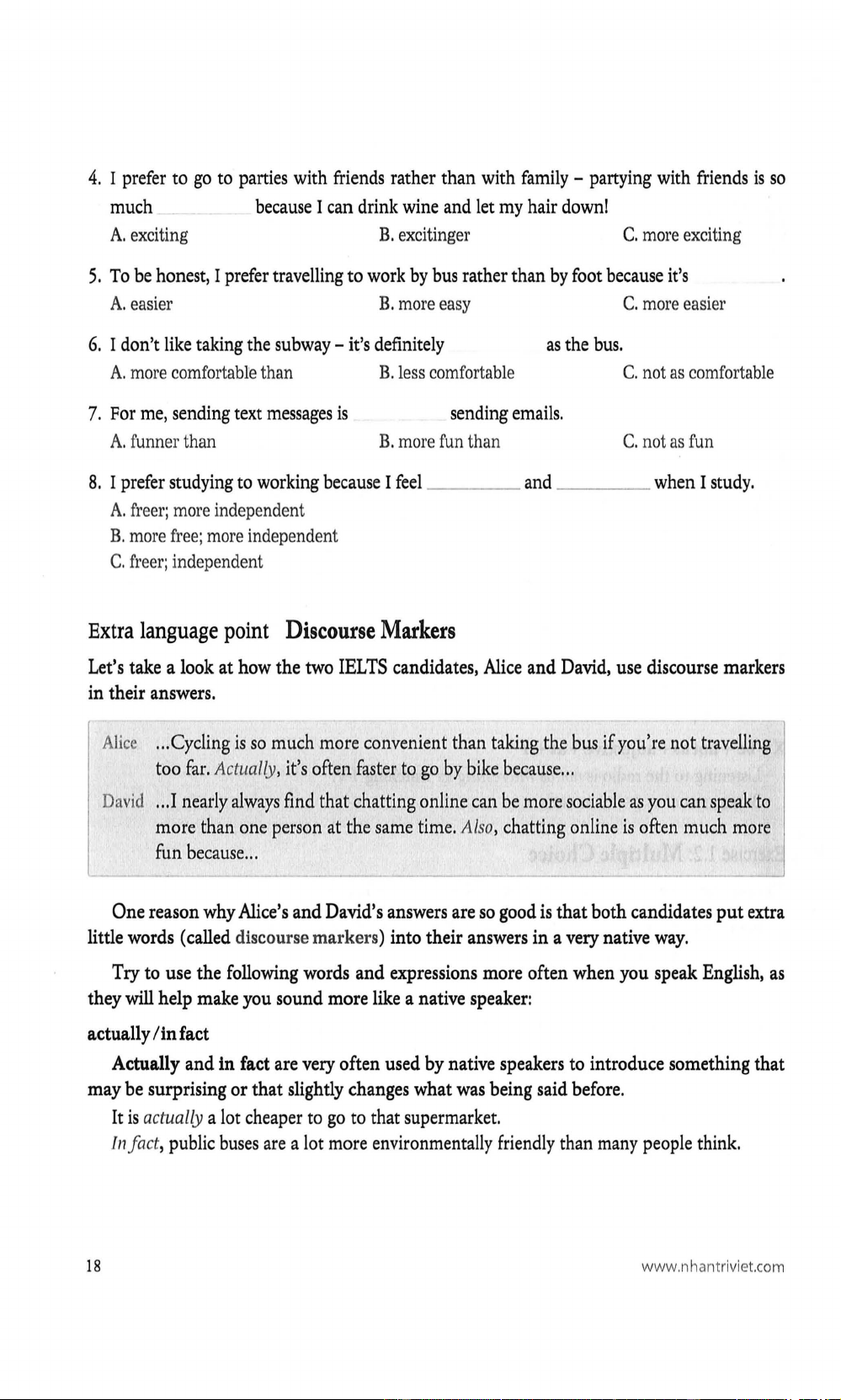
Extra
language
point
Discourse
Markers
Let's
take
a
look
at
how
the
two
IELTS
candidates,
Alice
and
David,
use
discourse
markers
in
their
answers.
Alice
...
Cycling
is
so
much
mo
re
conv
e
ni
ent
than
taking
th
e
bus
if you're not tr
avelling
too
fa
r.
Actually
, it's often
faster
to
go
by
bike
becaus
e
..
.
David
..
.I
ne
arly
always
find
tha
t chatting online
can
be
mo
re
sociabl
e
as
you
can
speak
to
more
than
on
e pe
rson
at
the
sam
e
tim
e.
Also
,
cha
tting
online
is
oft
en
much
mor
e
fun
b
eca
use
..
.
One
reason
why
Alice's
and
David's
answers
are
so
good
is
that both candidates put
extra
little
words
(called
discourse markers) into their
answers
in a
very
native
way.
Try
to
use
the
following
words
and
expressions
more
often
when
you
speak
English,
as
they
will
help
make
you
sound
more
like
a
native
speaker:
actually
lin
fact
Actually and in
fact
are
very
often
used
by
native
speakers
to
introduce something that
may
be
surprising or that
slightly
changes
what
was
being
said
before.
It
is
actually a
lot
cheaper
to
go
to
that
supermarket.
1
11
fact,
public
buses
are
a
lot
more
environmentally
friendly
than
many
people
think.
18
www
.n
hantr
ivi
et.c
om

Part
On
e
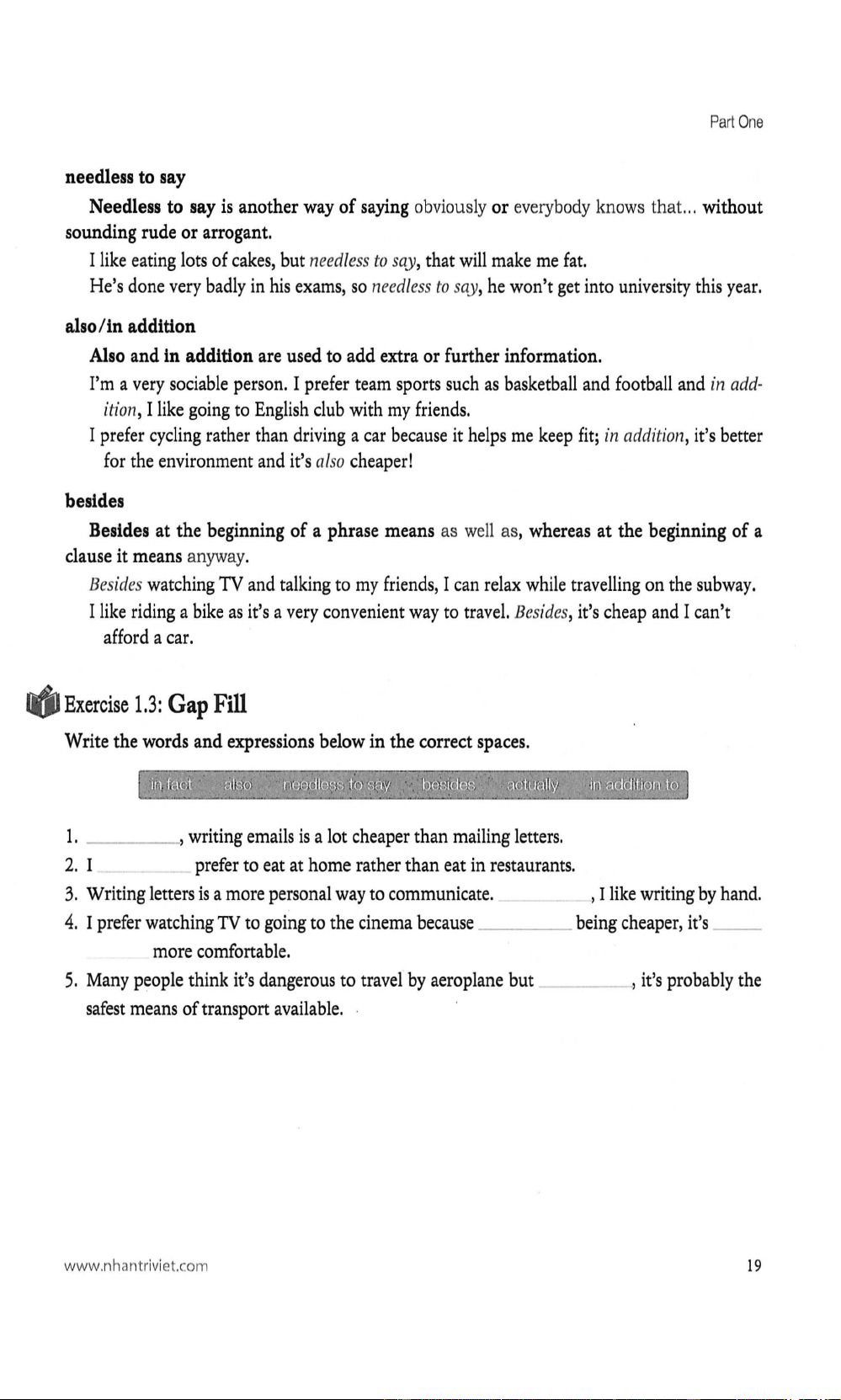
needless
to
say
Needless
to
say
is
another
way
of
saying
obv
i
ou
sly or ev
ery
body
kn
o
ws
that." without
sounding
rude
or
arrogant.
I
like
eating
lots
of
cakes,
but
need
l
ess
to
say
,
that
will
make
me
fat.
He's
done
very
badly
in
his
exams,
so
need
l
ess
to
say
,
he
won't
get
into
university
this
year.
also/in addition
Also
and in addition
are
used
to
add extra
or
further information.
I'm
a
very
sociable
person.
I
prefer
team
sports
such
as
basketball
and
football
and
in
add-
ition
, I
like
going
to
English
club
with
my
friends.
I
prefer
cycling
rather
than
driving
a
car
because
it
helps
me
keep
fit;
in
addition
,
it's
better
for
the
environment
and
it's
al
so
cheaper!
besides
Besides at the beginning of a phrase
means
as
well
as
,
whereas
at the beginning
of
a
clause
it
means
anyway
.
Besides
watching
TV
and
talking
to
my
friends,
I
can
relax
while
travelling
on
the
subway.
I
like
riding
a
bike
as
it's a
very
convenient
way
to
travel.
Besides
,
it's
cheap
and
I can't
afford
a
car.
IdJ
Exercise
1.3:
Gap
Fill
Write
the
words
and
expressions
below
in the correct
spaces.
','
.(.
, "
1.
____
,
writing
emails
is
a
lot
cheaper
than
mailing
letters.
2.
I
prefer
to
eat
at
home
rather than
eat
in
restaurants.
3.
Writing
letters
is
a
more
personal
way
to
communicate.
, I
like
writing
by
hand.
4.
I
prefer
watching
TV
to
going
to
the
cinema
because
____
being
cheaper,
it's
__
more
comfortable.
5.
Many
people
think
it's
dangerous
to
travel
by
aeroplane
but
safest
means
of transport
available.
'
www.nhantl.iviet.com
__
~
,
it's
probably
the
19

Formula
2
What
do
you
usually/normally
do?
Aims
In this
lesson
you'll master
the
Formula
for
What
do
you
usually/norm
ally
do?
type
questions.
What
do
.
you
do
on
an
average
day?
What
is
your
normal
daily
routine?
Can
you
describe
your
typical
day?
What
do
you
usually
do
on
weekends?
The
formula
When
the
examiner
asks
you
Wha
t
do
you
usually/nor
mally
do?
type
questions,
you
must:
20
Language
steps
1.
Use
adverbs
of
frequency
liI<e
a
native
speaker
to
show
how
frequently
or
infrequently
you
do
things.
I
often
meet
up
with
my
,
classmates
.
I
so
metimes
go
shopping.
2.
-
Use
the present simple tense & times
of
day
correctly
for
general
habits.
I
ride
my
bike
every
day
at
2
o'clock.
We
h
ave
dinner
together
in
the
eveni
ng.
3.
Show
that
you
can
use
one
or
two
common
sequence markers.
Before
class
starts
we
talk.
We
th
en
go
to
bed.
www.
nh
antriviet.com
Bấm Tải xuống để xem toàn bộ.