Analysis of ADI Company Môn Organizational behavior | Đại học Kinh Tế Quốc Dân
This research will examine ADI agriculture development and trade investment joint stock company's organizational behavior, including its culture, power, and politics. In addition, it will detail how these practices affect the performance of their staff. Tài liệu được sưu tầm gồm 12 trang, giúp bạn ôn tập tốt hơn. Mời các bạn đón xem.
Môn: Organizational behavior 38 tài liệu
Trường: Trường Đại học Kinh Tế Quốc Dân 6.7 K tài liệu
Tác giả:











Preview text:
lOMoAR cPSD| 58675420 Contents
Introduction:....................................................................................
3 1. An introduction to the organisation.........................................4
2. ADI agriculture development and trading investment joint stock
company culture.................................................................5 a.
Schein’s Model.....................................................................5 b.
Handy’s model......................................................................8 3.
ADI agriculture development and trading investment joint stock
company power..................................................................9 -
Power tactics:.....................................................................11
4. ADI agriculture development and trading investment joint stock
company politics:..............................................................12 5.
Relationship between culture, politics, power......................12 6.
Recommendations................................................................13
Conclusion:...................................................................................1 3 References
list:.............................................................................14 Introduction:
This research wil examine ADI agriculture development and trade investment joint stock
company's organizational behavior, including its culture, power, and politics. In addition, it wil
detail how these practices affect the performance of their staff. It also offers guidance on how the
ADI farm development and trade investment joint stock company may boost its staff's output in order to achieve its goals.
1. An introduction to the organisation
ADI AGRICULTURE., JSC is the abbreviated name for ADI AGRICULTURE DEVELOPMENT
AND TRADING INVESTMENT JOINT STOCK COMPANY. The company involved specializes in
the agricultural sector and is classified as Other specialized wholesale n.e.c. (VietnamCredit. n.d).
The company specializes in Pesticides Trading, Fertilizers & Chemicals Trading & Production,
Agriculture & Food Trading, Aquaculture, and Handicrafts Trading in plant seeds. In addition, the
company was founded on October 30, 2008, with its headquarters located in Hanoi, Vietnam. The
subject is a joint stock corporation with a registered capital of 32 bil ion Vietnamese Dong. The
foremost authorities on the topic are Nguyen Van Tinh, Le Thi Van, and Nuyen Thanh Huyen. (VietnamCredit. n.d). lOMoAR cPSD| 58675420
The organization's vision is to lead the company to grow steadily and become one of the leading
firms in Vietnam to deliver optimal crop solutions for farmers (https://adiagri.com). In addition, the
organization's mission is that ADI collaborates with domestic and international partners to master
and lead the most advanced technologies in the field of AGRICULTURE, and to build a team with
a wealth of knowledge, high discipline, solidarity - consensus, and dynamism inventiveness in
thinking and acting. Therefore, the organization may provide solutions and services with added
value to its clientele. ADI cultivates a corporate culture with distinct qualities, which serves as the
basis for running the organization's equipment to achieve greatness. ADI advances in the
following spearhead sectors: Insecticide, seed, organic, and service (https://adiagri.com).
2. ADI agriculture development and trading investment joint stock company culture
The key to an organization's success is a culture built on a set of deeply held and generally held
values that are reinforced by strategy and structure (SHRM. n.d). A company's culture defines
acceptable behavior within the firm. An organization's culture is its shared beliefs and values,
which are established by top management and disseminated and reinforced in many ways to
affect workers' attitudes, actions, and understanding (SHRM. n.d). This paper wil also analyze
the cultural elements of ADI using Schein's and Handy's models. a. Schein’s Model
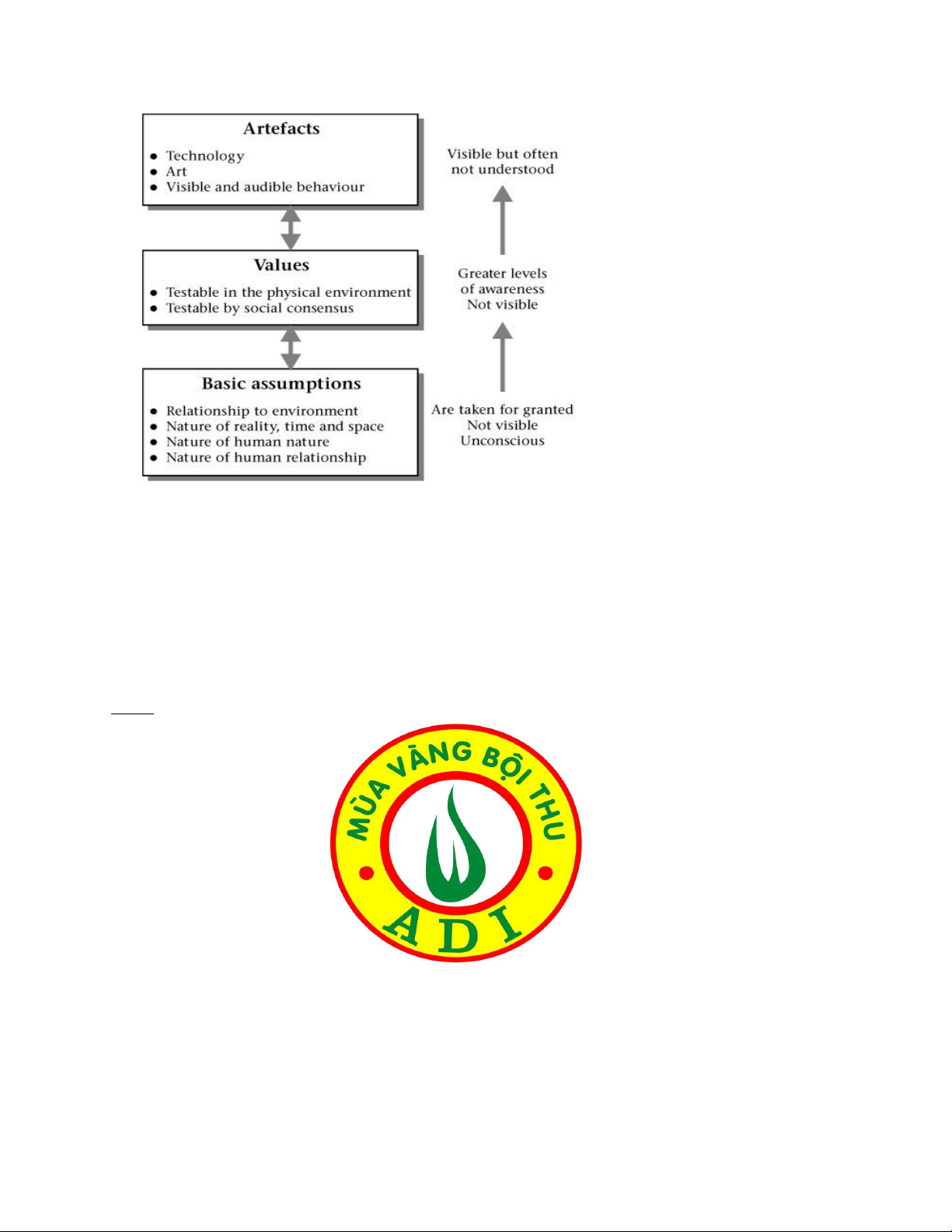
Edgar Schein (1980) created a methodology for assessing and comprehending corporate
culture. Schein distinguished three separate levels of organizational culture: artifacts, values,
and assumptions (Burkus, 2014). lOMoAR cPSD| 58675420 - Artifacts:
Artifacts are the overt and obvious components of a group. Typical examples include furniture and
workplace layout, dress codes, inside jokes, and mantras, which an outsider can readily observe (Burkus, 2014). Logo:
ADI is one of the Vietnamese agricultural firms with a statewide branch network. Consequently,
ADI's logo includes a variety of aspects to enhance brand awareness. The modern corporation
logos consist of three primary components. The emblem in the center is a stylized, modern
representation of a flame, with a connection resembling a seed and colored green to represent
the traditional hue of green trees, which symbolizes robust vitality and natural strength. In addition,
the two primary colors of the logo are yellow and red, where green is, with red and yellow
representing enthusiasm and a commitment to spreading a message of optimism for economic lOMoAR cPSD| 58675420
growth. Additionally, these colors enhance brand awareness. Other elements of the emblem
include the company's name and slogan. The tagline " Mùa vàng bội thu" or "Beautiful golden
season" accompanied by the image of a flame has a significant value within the organization.
When surrounded by red and yellow blood, it demonstrates the passion, thoughtfulness, and
enthusiasm of the company's team towards clients as well as the unity of the organization's
personnel. Through this logo, ADI has clearly exhibited a work culture centered on the strength
and unity of its people, while also expressing the enterprise's principles. Ceremonies:
According to an interview with a member of ADI's staff, the company frequently hosts events on
key holidays such as International Women's Day, International Labor Day, etc. In addition, on
International Women's Day, the organization hosted numerous activities to build the
relationships between all employees, with a focus on honoring female employees. In addition,
they awarded bonuses on Tet and Labor Day. Ritual:
Each individual employee has the primary responsibility for ensuring that al external and internal
requirements are followed. Al personnel are required to dress in uniform per company policy. It is
easy to spot an ADI employee by their distinctive blue and red uniform shirt. -
Espoused belief and values:
The company's proclaimed set of principles and standards are its expressed beliefs and values.
Values impact member interactions and organization representation (Burkus, 2014). Moreover, if
the professed views and values are reasonably consistent with the underlying assumptions, then
the articulation of these principles into an operating philosophy can aid in bringing the group
together, providing as a source of identity and fundamental mission (Schein, 2004).
ADI's guiding principle is to always place ourselves in the shoes of partners and consumers in
order to comprehend, collaborate, and identify the optimal solution to a problem. It is not only the
prestige and quality of ADI's products and services that have contributed to the brand's value, but
also the company's professional working style. According to an interview with one of the
company's employees, "in order to develop a professional and devoted working style, the
organization's employees always adhere to its regulations and guiding principles in all of their endeavors."
According to the employee interview, there are three company policies and principles that
employees must constantly adhere to in order to maintain a professional and dedicated work
ethic. First and foremost, employees must ensure that their words and exterior look are
commensurate with the value of the company's image and brand, which they represent. Second,
without exception, all employees must comply with all applicable laws and regulations, as well as lOMoAR cPSD| 58675420
all guidelines and internal policies. In order for each employee to behave in the most suitable
manner at work, they must be aware of their position and role within the organization. Respecting
the communicator, as well as exhibiting a soft and pleasant demeanor, are the concepts that
individuals must adopt and implement in order to attain the best possible working outcomes. -
Underlying assumptions:
The basis of organizational culture is underlying assumptions. They are the deeply ingrained
beliefs and practices that sometimes go unrecognized (Burkus, 2014). According to an interview
with an employee of the company, there is a joke on social networks that people in the company
joke about with each other: " cần cù bù siêng năng" or "hard work recoups hard work," which is a
variation of the phrase " cần cù bù thông minh" or "hard work compensates for lack of intelligence"
to express the zeal and operation of employees in the organization, as they always put In addition,
all employees maintain the spirit of internal cooperation, are direct yet courteous, close, and
friendly, and take turns upholding the traditional Vietnamese value that "good leaves shield ripped
leaves" This work culture dates back to the early days of the company's founding and has
contributed to its current success. b. Handy’s model
According to the renowned philosopher Charles Handy, organizations adhere to four distinct
cultures, including power culture, role culture, task culture, and person culture (Juneja, 2015).
The application of "role culture" and "task culture" can be determined following an interview with
an employee of the organization. First, "role culture" is a culture in which each employee is
assigned duties and responsibilities based on their specialty, educational background, and
personal interests in order to bring out the best in them (Juneja, 2015). Second, "task culture"
refers to the formation of teams to achieve objectives or address crucial problems in accordance
with the task culture (Juneja, 2015). These cultures are highly formalized, centralized, and based
on partnerships. The corporation has well-established official rules and procedures, as well as a
clearly defined organizational hierarchy, which ensures that both the manager and the employees
are aware of their responsibilities and rigidly enforce them. In addition, all lower-level employees'
decisions must be approved by leaders and supervisors. However, each person in the
organization has their own responsibilities and functions, but they frequently collaborate as a team
to fulfil the organization's objectives or address a vital problem. As stated in the underlying
assumption, they always prioritize clients and work, therefore not only must they adhere to their
tasks and obligations, but they must also function efficiently as a team.
Therefore, the ultimate objective can be attained. lOMoAR cPSD| 58675420 -
Advantages: As a result of the implementation of Role culture at ADI, employees understand
precisely what is expected of them, and there are well defined processes and procedures to
follow inside the business. This type of culture enables the company to operate efficiently and
optimally in the setting of a continuously and steadily expanding market. In addition, in the
context of Job culture, Workers are inspired to do their best work when they are given the
freedom to make choices within their team, when they feel respected for their contributions,
and when they see their efforts rewarded by the team's success (Learnmanagement2, 2018). -
Disadvantages: The role culture is detrimental to the organization if experts are chosen to
undertake a variety of tasks. As the results of the management's selection demonstrate any
level of prejudice, there is a likelihood of failure. At ADI, faulty selection criteria are the likely
cause of failure in the role-cultured organization. In addition, the downside of task culture is
the absence of effective control over the procedures used to improve results. Most managers
are preoccupied with assigning tasks to team leaders and lack the time to review the methods
each team use to fulfil its responsibilities. Each section is organized to aid one another.
Therefore, operational control is a key aspect of an organization's mission culture (Ivory Research, 2021).
3. ADI agriculture development and trading investment joint stock company power
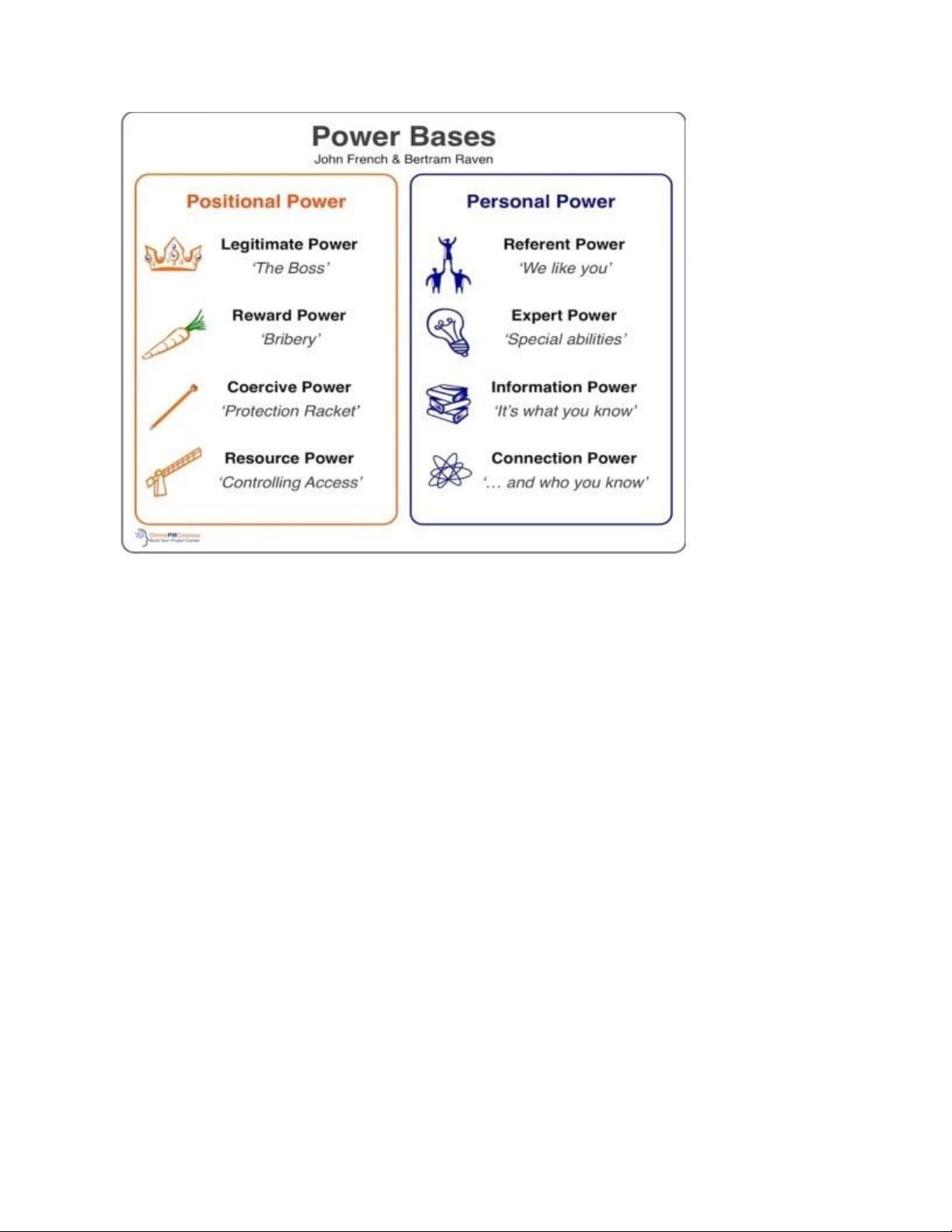
Power refers to the capability to influence the behavior of subordinates through the management
of resources. According to a 1959 study by French and Raven cited by ebrary (n.d.), there are
two sorts of power: positional power and personal power. lOMoAR cPSD| 58675420
In the case of ADI, Mr. Le Thanh Hai possesses "Legitimate Power" due to his position as CEO.
In this role, he has the authority to construct the entire firm infrastructure, including personnel
selection, arrangement, wage hikes, and regular allowances. He also represents the company
when negotiating and signing commercial contracts. Before being deployed, all new products,
services, and projects must be appraised, evaluated, and approved by Mr. Hai.
Advantages: Mr. Hai is able to view the organizational structure with clarity owing to his valid
power, and he should not worry about his directions not being carried out.
Disadvantages: Mr. Hai's connection with his staff wil be strained if he often employs excessive
force. Employee output may decline if they feel pressured to succeed.
Additionally, as CEO, Mr. Hai employs "Reward power" to recognize employees who have
achieved KPIs. Throughout a quarter, for instance, a team sale devotes a great deal of time and
effort to the company's project and tries as hard as possible to sell it; as a consequence, the
outcome exceeds expectations. According to the employee's interview, only workers who achieve
or surpass the quota may obtain awards as the quarter's top key performers and a raise.
Advantages: Reward power contributes to an improvement in employee happiness and
contentment. The implementation of a pay system tends to reduce the workers' concerns about
being undervalued and underappreciated, as well as their sense of belonging to the firm. lOMoAR cPSD| 58675420
Disadvantages: Employee resentment may be induced. Employees who are fortunate enough
to earn regular compensation for their achievement may cause distress among passive achievers.
As a consequence, this resentment wil have a negative impact on production, erode the talents
of the deprived workers, and reduce their drive.
Additionally, "Coercive Power" is utilized within the organization. This form of authority is derived
from the authority of various firm roles, such as branch manager, department head, etc. According
to an interview with an ADI employee, if staff are tardy to work or do not complete assigned
responsibilities, they wil be reprimanded in a manner determined by the branch manager.
Advantages: With this power, managers may ensure that all jobs are performed in a timely
manner and at the highest possible standard. Workers wil focus on the job at hand and stay on the right track.
Disadvantages: Workers might be frightened by this level of power. The management has to use
threats effectively if they want to get anything done. Otherwise, it might damage their standing
with their subordinates and dampen morale on the workplace.
“Personal power”, more precisely Expert Power, is used in addition to "Positional powers." The
promotion of high-level personnel based on their expertise and experience is a clear
demonstration of this power. In a company with a "task culture," upper-level workers act as role
models for junior workers, earning the latter's respect and confidence in their judgment.
Advantages: The leader's ability to inspire confidence in his team's abilities is bolstered by
Expertise, which in turn improves their performance. Leaders who utilize their expertise to set
goals and achieve them inspire their teams to work harder.
Disadvantages: Management and staff in specialized authority roles need upkeep, which
necessitates ongoing education and training.
In addition, "Referent power" is also employed since it involves leading by example and
encouraging others. In this instance of ADI, "Referent power" wil enable the leader to compel
subordinates to conform, trust, and work with dedication and loyalty.
Advantages: Leaders that rely on Referent power may generate high rates of employee retention.
This is due to the fact that occasionally employees who feel intimidated by their leaders quit
sooner or later, since they do not see themselves learning or developing under such managers.
Disadvantages: Companies with a robust organizational culture may not be significantly affected
by referent power. If atypical conduct is the norm in the organization, it may be chal enging for a lOMoAR cPSD| 58675420
relevant leader to get things done. Therefore, if the culture does not encourage employee
appreciation, it may be difficult for relevant leaders to demonstrate it.
- Power tactics: There are nine methods to organizational power. Individuals employ these
strategies to channel their force into certain acts. Legitimacy, logic, persuasion, inspirational
appeals, consultation, exchange appeals, ingratiation, pressure, and alliances are among the
nine strategies (toppr, n.d).
The most frequently employed tactic within ADI is the "Legitimacy tactic." The decisionmakers
for the majority of legal decisions within a business wil be the CEO and management. The
corporation use this strategy not to motivate employees, but to ensure that they properly
adhere to company laws and standards. In addition, "rational persuasion" is frequently
employed between superiors and subordinates, and vice versa. Indeed, while presenting an
idea or approach to a management, employees must demonstrate rationality and efficacy.
Moreover, if a manager wishes to implement new rules, regulations, or strategies, he or she
must properly explain this to subordinates.
Advantages: Within the company, the execution of these power methods promotes a
professional and productive work environment. Legitimacy assists managers in managing
worker activities and boosting the overall efficiency of a business.
Disadvantages: While these tactics help workers take their job more seriously, they may
result in bad emotions while working under extreme pressure and direction. Moreover, under
extreme pressure, workers may revolt, resulting in intra-organizational disputes and decreased productivity.
4. ADI agriculture development and trading investment joint stock company politics:
Organizational politics encompass a variety of activities including the use of influence methods to
further personal or organizational goals (Jarrett, 2017). According to studies, politically savvy
individuals are better at establishing personal power and handling stress and job demands than
their politically ignorant counterparts (Jarrett, 2017). Additionally, they have a bigger influence on
organizational outcomes. There are three typical political behaviors: networking, reciprocity, and
coalition building (Jarrett, 2017).
"Networking" is the key organizational activity in order to link individuals with one another and
organizations with other organizations. Al managers and employees participate actively in lOMoAR cPSD| 58675420
networking events and maintain a high degree of political conduct. According to the employee's
interview, creating such ties has a positive impact on the firm since coworkers may assist one
another at work. Additional y, "Reciprocity" may be seen in certain members of this group. For
instance, in ADI, a busy person may ask his colleagues for assistance in completing his work, and
those colleagues are accountable for assisting them when they are busy in the future.
Advantages: Networking enhances the bonds between employees and their coworkers, as well
as between employees and their superiors. Furthermore, it is a fantastic chance to exchange
expertise and important information. Reciprocity allows people to accomplish additional things
that they could not do on their own, allowing them to achieve their objectives more quickly.
Disadvantages: High-level political conduct does not seem to have any detrimental effects.
However, networking and reciprocity may impair employees' ability to concentrate since they are
so preoccupied with forming connections and assisting peers with their responsibilities.
5. Relationship between culture, politics, power
In order to achieve success, the company must include these characteristics into an effective
working environment. As previously indicated, the organization utilizes "Role culture" and "Task
culture." This kind of culture is distinguished by a high level of power distribution and cooperation.
This il ustrates that culture has a considerable impact on the power structures and tactics of an
organization. Thus, Legitimate Power and Legitimacy approach have a close tie with the culture.
When managers use legal power appropriate with their positions, they get employee
collaboration. The organization continually encourages cohesion among employees and between
employees and managers. This culture impacts the political networking habits of employees. This
behavior also has a positive impact on employee motivation, since great working relationships
create a healthy and enjoyable work environment that inspires employees to come to work every
day. According to the evaluation presented before, all three factors (culture, power, and politics)
are interdependent and linked. The data reveals that in order to construct a powerful and enduring
brand, the company had to develop a culture unique from its competitors and other companies,
as well as a legitimate use of authority to retain workers and achieve consensus among directors and junior staff. 6. Recommendations
The corporation is currently thriving in two areas: corporate culture and employee political
conduct. Along with showcasing its strengths, the business must also recognize and address its
deficiencies. First, the use of "Legitimate authority" or "Coercive power" may cause staff to feel
constricted or overburdened, resulting in poorer productivity or even intra-organizational conflict.
As a result, directors, managers, and department heads must utilize their authority to keep people lOMoAR cPSD| 58675420
from joining rivals. Second, ADI should provide its staff greater autonomy in little tasks so that
they may acquire experience and enhance their abilities as a result of "task culture." Furthermore,
the organization should have a clear promotion route so that workers know what they need to do
to be promoted, pushing them to work harder. Conclusion:
This study has emphasized the corporate culture, powers, and political behaviors inside the
business by using several concepts. The company's performance in all three areas has been
positive. However, there are stil deficiencies that must be addressed for the business to maintain
its position and achieve future success. References list:
1. VietnamCredit. n.d. ADI AGRICULTURE DEVELOPMENT AND TRADING
INVESTMENT JOINT STOCK COMPANY. [online] Available at:
andtrading-investment-joint-stock-company_3373> [Accessed 10 October 2022]. 2. https://adiagri.com
3. SHRM. n.d. Understanding and Developing Organizational Culture. [online] Available at:
understandinganddevelopingorganizationalculture.aspx> [Accessed 10 October 2022].
4. Burkus, D., 2014. How to Tell if Your Company Has a Creative Culture. [online] Harvard
Business Review. Available at: hasa-creative-culture#:~:text=Schein%20divided%20an%20organization's
%20culture,obvious%20elements%20of%20an%20organization> [Accessed 10 October 2022]. lOMoAR cPSD| 58675420
5. Juneja, P., 2015. Charles Handy Model of Organization Culture. [online]
Managementstudyguide.com. Available at: [Accessed 10 October 2022].
6. Learnmanagement2. 2018. Organisational Culture. [online] Available at:
%20a,team%20complete%20the%20task%20successfully> [Accessed 10 October 2022].
7. Ivory Research., 2021. Essay on Advantages and Disadvantages of Handy’s Model of
Organizational Culture. [online]. Available from:
https://www.ivoryresearch.com/samples/essay-on-advantages-and-disadvantages-
ofhandys-model-of-organizational-culture/ [Accessed 10 October 2022].
8. Ebrary. n.d. Definition of power. [online] Available at:
%20ability%20to,an%20agent%20and%20a%20target> [Accessed 10 October 2022].
9. toppr. n.d. The Concept of Power. [online] Available at:
organising/the-concept-of-power/> [Accessed 10 October 2022].
10. Jarrett, M., 2017. The 4 Types of Organizational Politics. [online] Harvard Business Review. Available at: [Accessed 10 October 2022].
Tài liệu liên quan:
-
Ôn thi Môn Organizational behavior | Đại học Kinh Tế Quốc Dân
61 31 -
Câu hỏi tổng hợp Môn Organizational behavior | Đại học Kinh Tế Quốc Dân
64 32 -
Case Study Analysis Costco's Competitive Strategy | Môn Organizational behavior - Đại học Kinh Tế Quốc Dân
73 37 -
Ảnh hưởng của drone R2D2 đến hành vi nhân viên và đạo đức | Môn Organizational behavior - Đại học Kinh Tế Quốc Dân
57 29 -
Analyzing InnovateX's Organizational Behavior Issues | Môn Organizational behavior - Đại học Kinh Tế Quốc Dân
56 28