Analysis of Viettel Group's Culture and Motivation | Môn Organizational behavior - Đại học Kinh Tế Quốc Dân
Viettel Group is a state-owned defense economic enterprise. After more than a decade of participation with the vision of “Caring Innovator” and the mission of “Lead the way to create a digital society”, Viettel has made great progress in the Vietnamese telecommunications sector. By the end of 2020, Viettel has formed 6 key foundations of a digital society. Tài liệu được sưu tầm gồm 21 trang, giúp bạn ôn tập tốt hơn. Mời các bạn đón xem.
Môn: Organizational behavior 38 tài liệu
Trường: Trường Đại học Kinh Tế Quốc Dân 6.7 K tài liệu
Tác giả:













Preview text:
lOMoAR cPSD| 58675420 lOMoAR cPSD| 58675420 INTRODUCTION
In the current context, the competition between telecommunications businesses is
increasingly fierce. Therefore, the purpose of this report is to analyze the factors affecting
the organizational behavior with relevant theories, thereby making assessments as well as
recommendations to improve Viettel's business performance. lOMoAR cPSD| 58675420 I.
INTRODUCTION TO VIETTEL
International transaction name: VIETTEL GROUP
Industry: Telecommunication - Information Technology Founded: 1 June 1989
Headquarters: Lot D26 Cau Giay New Urban Area, Yen Hoa Ward, Cau Giay District, Hanoi, Vietnam.
Website: https://www.viettel.com.vn
Viettel Group is a state-owned defense economic enterprise. After more than a decade of
participation with the vision of “Caring Innovator” and the mission of “Lead the way to
create a digital society”, Viettel has made great progress in the Vietnamese
telecommunications sector. By the end of 2020, Viettel has formed 6 key foundations of a
digital society. According to Mr. Le Dang Dung - General Director of Viettel Group (2021),
that is why Viettel decided to reinvent its brand, to commit that Viettel is a technological and innovative enterprise. II. CULTURE 1. Schein’s model lOMoAR cPSD| 58675420
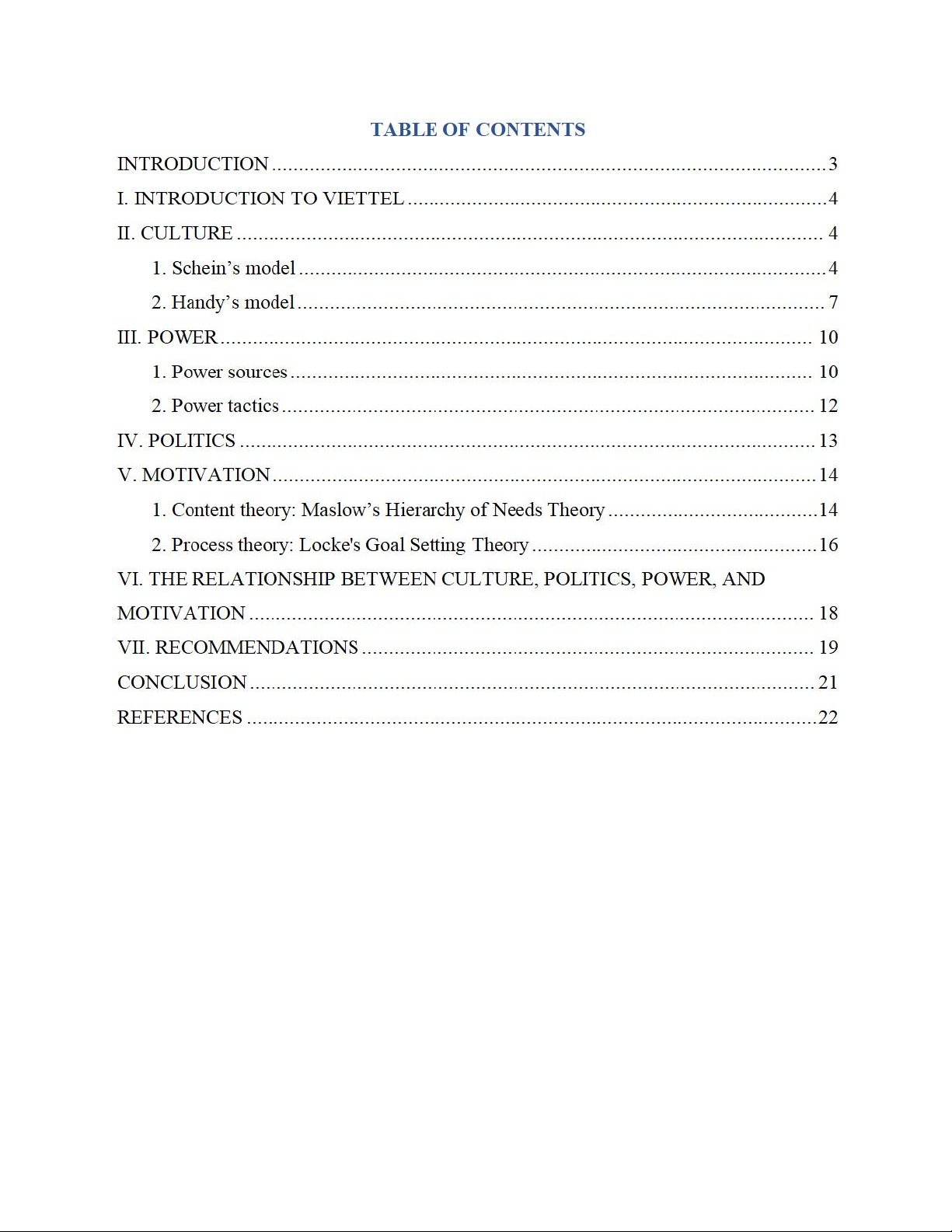
Figure 1: Edgar Schein's Culture Model
Edgar Schein, an American professor, established a model of organizational culture in 2004
to make culture more evident in the workplace, divided into three different levels as above. Level 1: Artifacts Logo:
Figure 2: Viettel’s logo
Instead of the previous blue logo, Viettel's new logo has the main color red "with the
meaning of youth, desire, passion, and dynamism (Viettel, 2021). This is also a symbol of
the national flag's color and pride. The letter “Viettel” is designed to be linked together,
showing the cohesion, the consensus of the employees. Slogan:
Figure 3: Viettel’s slogan
The new slogan is shortened to "Your way" with the implication of empowering and
inspiring customers to fulfill their desires (Viettel, 2021). Its open structure assists Viettel
in conveying a message that encourages each individual to be more creative and express
themselves, resulting in greater values for living together. With the new slogan, the core
value is expanded not only in the field of telecommunications but also raised to a new level.
For the company internally, this slogan also shows interest, listens to the needs, opinions,
creative ideas of each individual and allows them to express themselves in their way. Office layout: lOMoAR cPSD| 58675420
Workspace is the factor that affects emotions, evokes positive inspiration to participate in
meetings, propose ideas to solve problems,... for members of the organization (Vischer et
al., 2015). Viettel has a flexible, airy agile-style, open with round tables inside a transparent
tempered glass frame workspace, especially filled with greenery to create cohesion
between people and help maximize the creativity of employees.
Level 2: Espoused values Vision:
Setting its vision to “Caring Innovator”, Viettel considers each customer as an individual
that needs to be cared for, respected, listened to, understood, and served uniquely. With the
foundation of social development, the corporation is committed to reinvesting in society in
many ways such as business activities associated with national defense, program activities
serving community health, education, and support for the poor and remote areas. Mission:
In 2019, Viettel released a new mission statement "Lead the way to create a digital society".
With this mission, Viettel seeks to demonstrate a significant shift in thought, behavior, and
decision-making. In the digital age of a society undergoing exceptionally powerful digital
transformations, its future direction is to genuinely be a pioneer and important digital
service provider (Le Dang Dung, 2021). Core values:
- Practice is the criterion for testing truth.
- Grow through challenges and failures.
- Rapid adaptation is a competitive strength. - Creativity is vitality. - Knowledge system.
- Combination of East and West. lOMoAR cPSD| 58675420
- Tradition and how to be a soldier.
- Viettel is the common house. Level 3: Assumptions For staff:
- Appreciate every creation, no matter how small: Unexpected incentives of up to 210
million VND were offered at Viettel for a technical initiative.
- Who emulates well, that person has a high income
- Always attaches importance to and promotes the emulation movement of the Decisionto
win and has an appropriate reward policy. For internal company:
Viettel's "Military" aspect produces a strong sense of discipline, seriousness, caution, and
responsibility for each officer and employee, as well as closeness, warmth, and kindness,
all for the common good of Viettel's common house.
2. Handy’s model
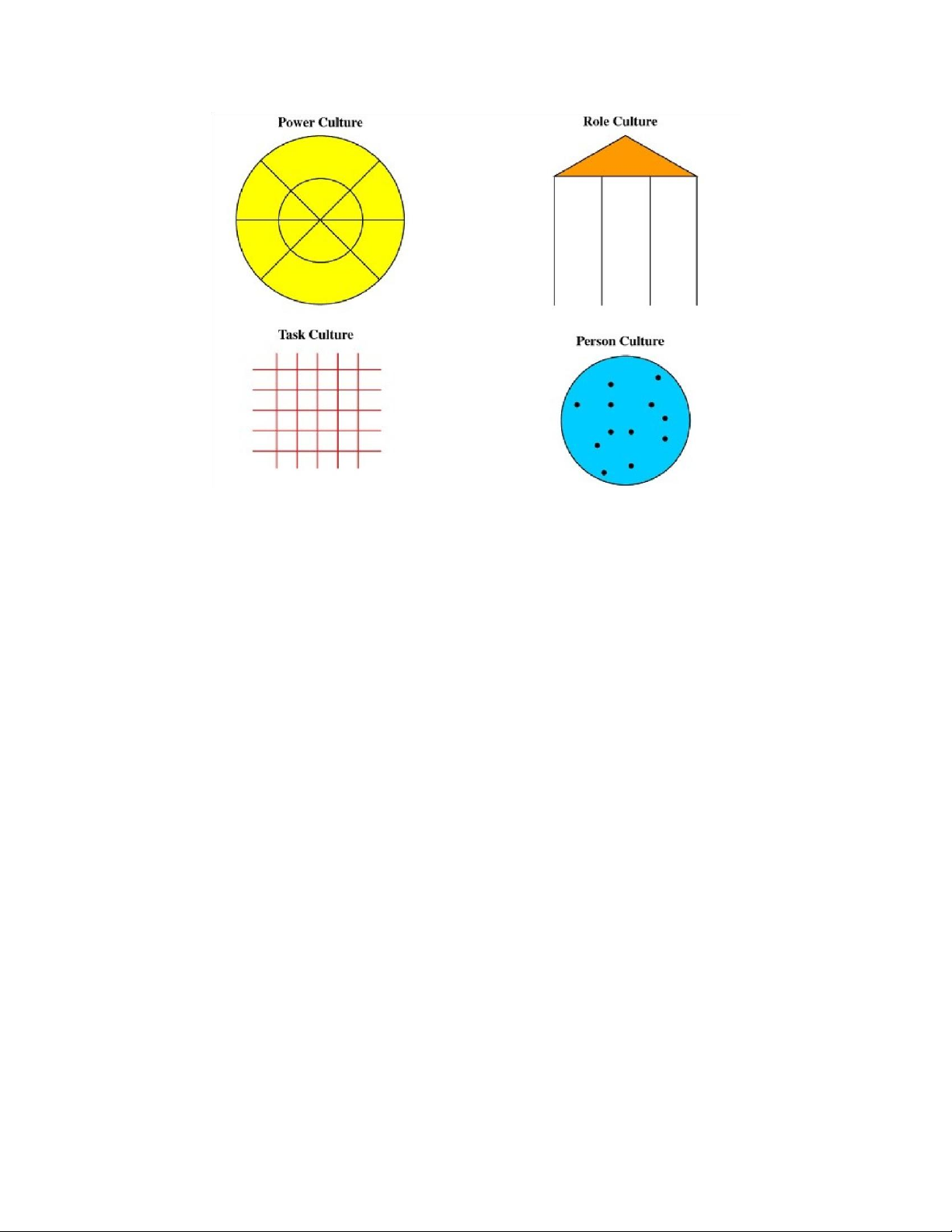
There are four common types of organizational culture defined by Charles Handy (1978)
according to the model of Harrison (1972) as shown below: lOMoAR cPSD| 58675420
Figure 4: Handy’s Model of Organizational Culture
According to the theory of Handy (1978), the strength of a role-centered culture is reflected
in functional specialization (production, marketing, procurement, finance, etc.) that is
coordinated and controlled uniformly by a group of senior managers. It can be seen that
Viettel belongs to a role culture organization based on the Group's organizational structure.
It includes General Director, Deputy General Directors, Chief Accountant, and Group
agencies; block of dependent accounting units; non-business units; Subsidiaries block
includes subsidiaries that the Group owns 100% of charter capital and subsidiaries where
the Group owns more than 50% of charter capital; The group of associate companies in
which the Group owns less than 50% of charter capital. During its operation, the parent
company directly conducts production and business activities, but at the same time
performs the task of leading, orienting, and strictly controlling the member units. To fulfill
that role, the Group forms organizations under the parent company that directly manage
the business and develop network infrastructure globally. From the organizational model,
each board performs the function of advising and assisting the Board of Directors in
orienting, managing, directing, training, inspecting, supervising, and evaluating all
activities in the assigned fields within the Group. lOMoAR cPSD| 58675420 3. Evaluation
Through the above analysis, it can be seen that Viettel is an enterprise with a strong culture
as a whole with a unified and strong structure, always maintaining the core ideology and
encouraging employees to continuously improve; unifying views/thoughts/actions;
standardizing all activities in management, production, and business. However, according
to Kay (1963), a strong culture can have positive or negative effects on the organization and its employees' behavior. Positive impacts:
It can be said that Viettel Group has built an ideal and positive working environment that employees expect:
- Creating a suitable working environment for Viettel employees to perform their taskswell,
be highly proactive in the organization, and dare to accept difficulties and challenges,
thereby maximizing their creativity and improving labor efficiency.
- Creating a positive atmosphere, giving employees work morale, believing
inmanagement's ability, and seeing a compelling vision of the company's good future.
- Transparently sharing information with employees.
- Creating excitement for each employee when being honored, foster a more
enthusiasticworking attitude and a spirit of readiness to confront and overcome challenges employees. Negative impacts:
Although the corporate culture at Viettel Military Telecommunications Group has been
focused on building by the Group's leaders right from the early days of business
establishment and has had obvious results, there are still some outstanding problems that
require the Group's leaders and employees to make more efforts to develop the
organizational culture of the unit. Each person in the Viettel common house is responsible
for protecting and promoting their own cultural values, but that creates dependence in an lOMoAR cPSD| 58675420
organization. Everyone thinks that if they do not do it, someone else will do it and if they
cannot do it, someone else will do it. Therefore, they do not try their best with the assigned
work. Moreover, the closeness as members of a family easily leads to the conservatism of
the previous generation, not listening to the opinions of the following generations. Hence,
creativity cannot be promoted. It is also easy for people to cover for each other in cases of mistakes or errors. III. POWER 1. Power sources
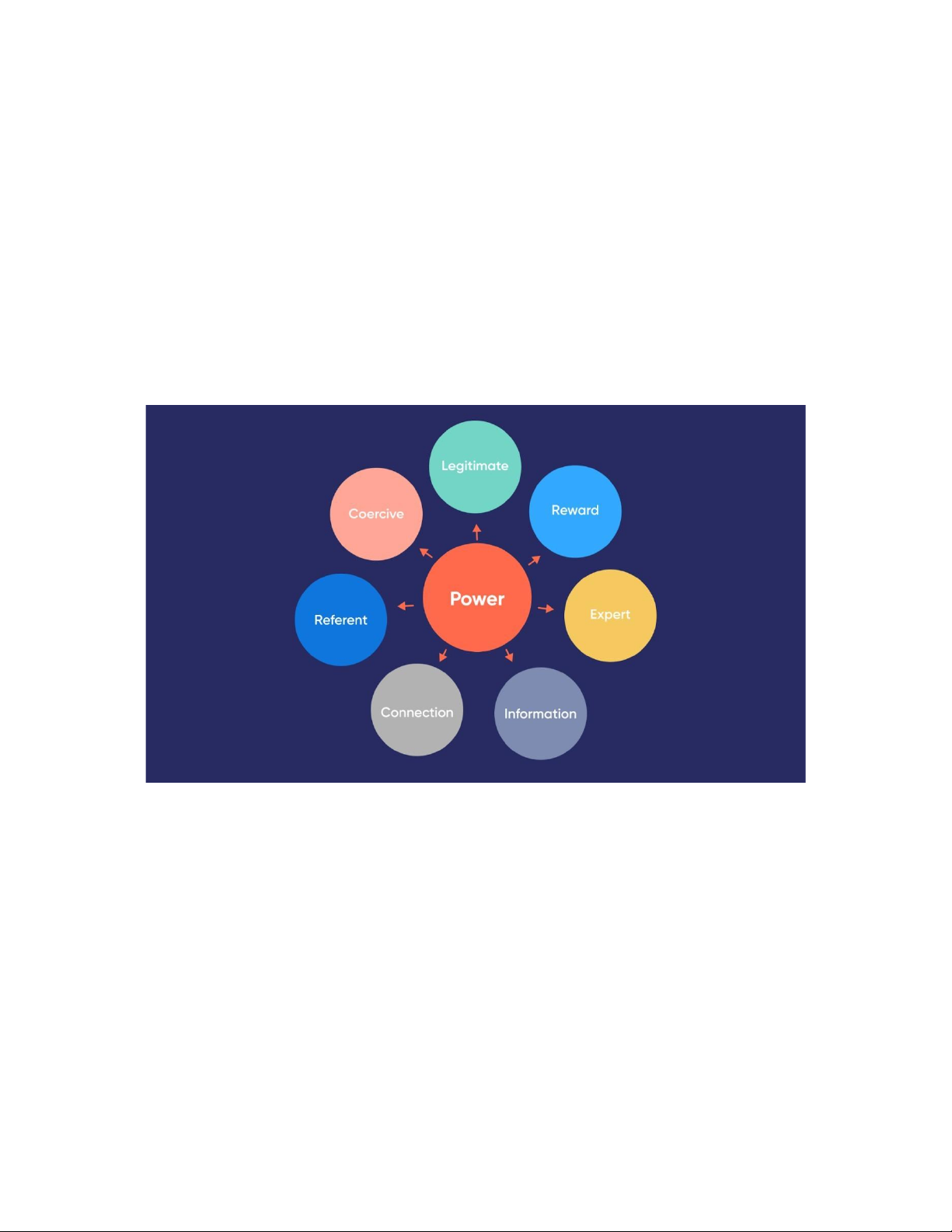
Figure 4: Bases of Power
Formal power: Mr. Tao Duc Thang - Chairman and General Director
The leader's power in the organization to reward personnel, notably tangible goods, to
promote performance in the working process is known as reward power. Mr. Thang will
be the one to approve staff bonus decisions, both material (salaries, bonuses, etc.) and
intangible (gifts) (thanks letter, commendation ceremony...). With this power, he was able
to motivate employees both physically and intellectually to execute their jobs well. In
addition, Mr. Thang also used his legitimate power to directly manage all production and lOMoAR cPSD| 58675420
business activities in the Regions and Provincial Branches to ensure efficiency, by the laws
and regulations of the State and the Group, responsible to the Party Committee and Board
of Directors of the Group for building companies to become leaders in the field of
telecommunications. However, the limitation of these types of power is not stable and its
scope is constrained by organizational boundaries (EPM, 2018). Hence, Mr. Thang has
power only within the Viettel Group, and if he loses his position, his power will disappear immediately.
Personal power: Mr. Nguyen Thanh Nam - Deputy General Director
Firstly, expert power refers to an individual's ability to influence others through
mentorship on certain abilities due to his or her high level of experience. Mr. Nam must
have extensive specialized knowledge, understanding of many areas related to functional
blocks, such as business strategy, executive management, provincial branches, direct
production blocks, and so on, to affirm their leading position to perform management work
and lead their subordinates to work more professionally and effectively, contribute to the
increasing growth of the Group. Secondly, the ability of a leader to capture information,
access information, and monopolize data within an organization is known as information
power. Those that are better informed will have a competitive advantage, especially in this
Information Age. Besides the general director, Mr.Nam is the owner of all data about the
business and its specific projects. Because he has access to a big amount of data, including
confidential data, he can generate a lot of important information while working. This makes
it simple for the employee to have faith in his capacity to do the task. However, the
drawback is that having expert and information power can be a double-edged sword
because Mr.Nam’s power can reduce as he shares his expertise or secret information with others. lOMoAR cPSD| 58675420
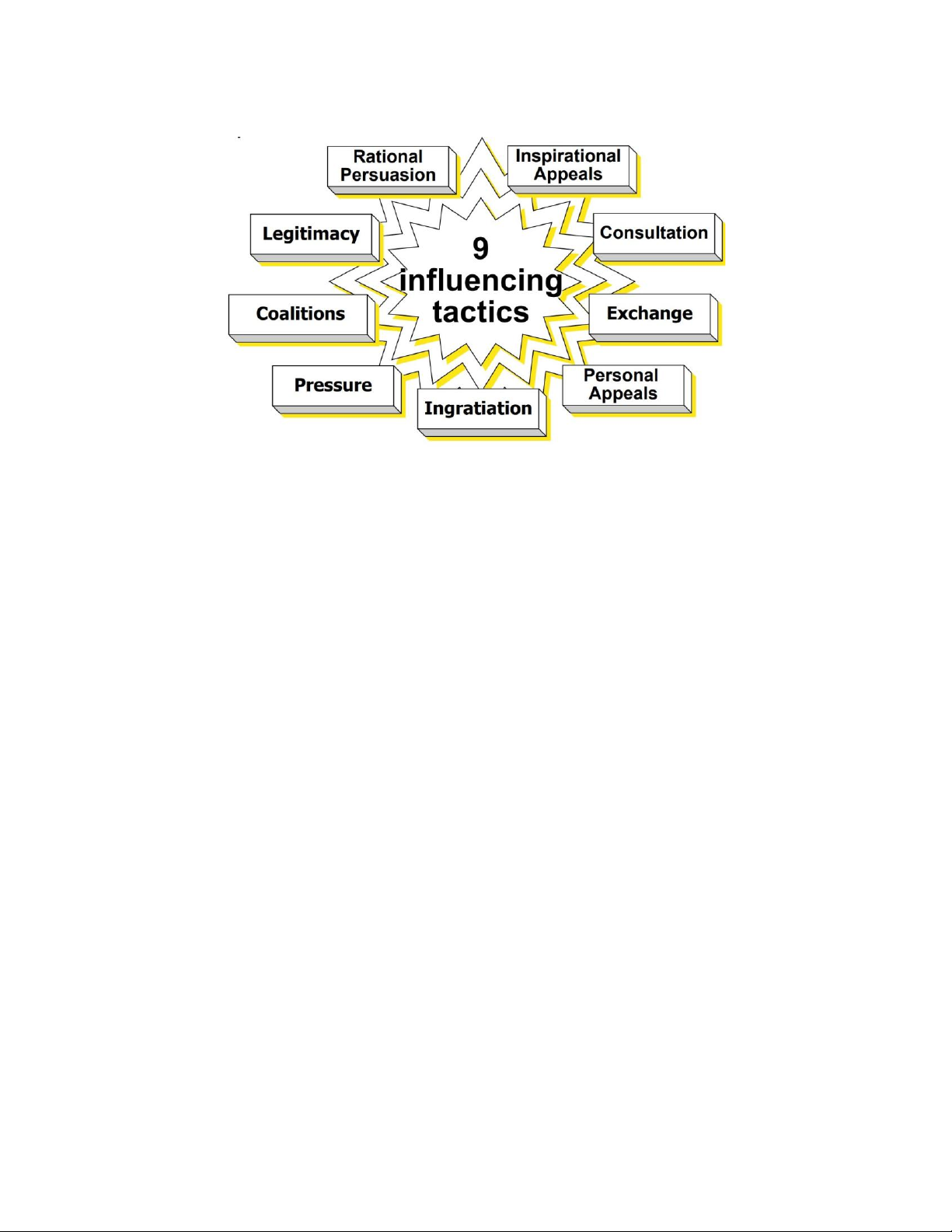
2. Power tactics
Figure 5: Nine influencing tactics
Rational Persuasion: At Viettel, whenever there is an opportunity, the leaders often
consult with employees instead of always asking them what to do and how. This will
encourage employees to think creatively and have a voice to protect their rights. If the ideas
are approved, the leader will acknowledge and support the ideas of the employees.
Pressure: At Viettel, there are regulations, the heads of Viettel's units, if 6 months do not
complete the plan, voluntarily apply for a job transfer. Job rotation is not just a type of
"punishment," but it is also a method of training and detecting management human
resources, locating management candidates for suitable jobs, and helping personnel to
detect their hidden abilities. In the view of Major General Nguyen Manh Hung, "Typically,
only 20% of one's abilities are developed. Workers will, however, promote 80% of their
capacity if there is an environment and pressure.".
Inspirational Appeals: Viettel administrators always have the right attitude and encourage
subordinates with praise. Although the reward is not large, it is rewarded in front of many
people, making employees happy and proud. By calling on the efforts of the staff to
improve the working environment and help them work better, Viettel makes them feel more
important in the company and become more loyal. lOMoAR cPSD| 58675420
Power has a lot of influence in the business world, and it often leads to the achievement of
corporate goals. The organizational objectives will be readily realized if power is correctly
employed in Viettel by the managers to increase productivity. However, according to
Viettel's reports, the average turnover rate of the Group is 5% due to the increasingly fierce
competition in the telecommunications market, leading to Viettel Group requiring high
work pressure for employees. The reason for this negative impact is the stressful working
environment, employees do not have time to balance life and take care of their families. IV. POLITICS
According to Metin and Asli (2015), there are three main types of political behaviors:
networking, reciprocity, and coalitions. When coming to the office, most workers want to
create a good relationship with their colleagues because this greatly affects the morale of
employees. In the relationship between individuals in the enterprise, Viettel Group
regularly rotates employees by the work and business situation. This helps Viettel
strengthen the networking among employees, making the work smoother and more
convenient. It is also a way for Viettel to tighten solidarity and cohesion between leaders
and employees and between employees in the group. Next, besides the production and
business emulation movement activities, Viettel often organizes collective activities, sports
contests, creative days, travel,... to help bond the feelings of colleagues, building a strong
and united team. Moreover, the relationship between superiors and subordinates is also
very focused on Viettel's leadership. Leaders care about employees' lives, creating a special
relationship between the two parties. Mentoring relationships help employees progress in
their careers (Berk, 2005). Among employees and leaders of Viettel, there is always an
attitude of respect, listening, and good completion of assigned tasks with dedicated
guidance. The gap between what an employee has and what he or she should have is
addressed through a plan that combines formal training, specific tasks, and regular
mentoring from a respected superior (Nda & Fard, 2013).
The benefits of strong internal networks are increasing employee engagement, improving
talent retention as well as streamlining knowledge sharing. Employees who know how to lOMoAR cPSD| 58675420
navigate organizational politics are found to be more product than their counterparts
(Kulkarni, 2016). This will provide a stable foundation for individuals who will one day
lead the company as technical specialists, managers, or senior executives, helping the
business to achieve its objectives step by step. V. MOTIVATION
1. Content theory: Maslow’s Hierarchy of Needs Theory
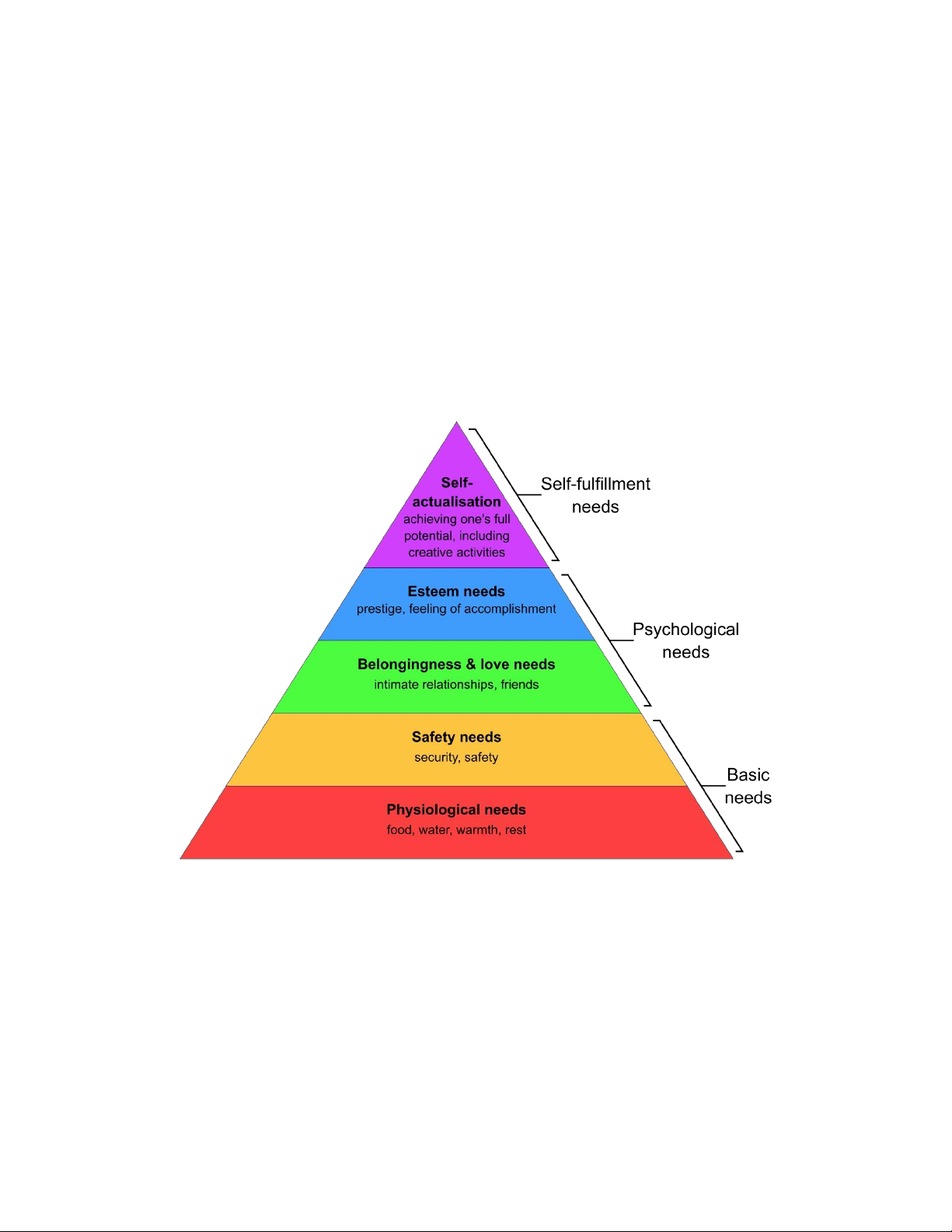
Maslow (1943) suggested that workers have 5 needs according to the hierarchy from low
to high as shown in the figure below.
Figure 3: Maslow’s Hierarchy of Needs Theory
Physiological needs: Viettel has all of the required workplace machinery, equipment, and
tools to ensure that workers work in a pleasant environment. Furthermore, the company
has established a salary payment system that ensures democracy, transparency, and attaches
payments to task accomplishment in order to reward individuals with talent, technical lOMoAR cPSD| 58675420
expertise, and high labor productivity. For professions that require regular travel, Viettel
Group offers optional benefits like as lunch money and travel expenses.
Safety needs: Being aware of the importance of welfare regimes for motivating employees,
Viettel Group constantly complies with state requirements regarding mandatory benefits
such as social insurance, health insurance, unemployment insurance, and maternity
regimes. Employee information is confidential, employees are equipped with modern
technology and high safety, and the insurance tools are fully equipped for the construction work.
Belongingness & love needs: When coming to work, most employees want to create good
relationships with their colleagues because this greatly affects the morale of employees.
With Viettel Group's point of view: "People consider the workplace as a common home,
employees feel really comfortable coming to the workplace and consider it their second
home”, Viettel has found ways to attract employees to stick with the workplace and create
a really comfortable working environment to limit their pressure.
Esteem needs: Leaders of Viettel Group attach great importance to training staff because
all successful businesses are run by employees within the enterprise. Therefore, every
employee of Viettel Group has the same promotion opportunities. Each person's chances
of promotion depend on the results of the quarterly performance assessment and the
knowledge test every 6 months. Many important director positions of Viettel Group are
appointed from employees, heads, deputy heads...
Self-actualisation: At Viettel, each employee's idea or initiative that is implemented will
be awarded 5% of the benefit value provided by the idea or initiative. Every quarter and
every year, Viettel organizes to honor and reward collectives and individuals who have
completed their tasks. Moreover, an exam is held to select staff for positions every year,
and all staff members can register to participate in the exam if they find themselves eligible.
Hence, everyone has an equal opportunity for advancement; everyone who tries and works
hard has a chance to improve and develop. lOMoAR cPSD| 58675420
2. Process theory: Locke's Goal Setting Theory
In the late 1960s, Edwin Locke and his colleague Gary P. Latham showed a "path-togoal"
relationship. This theory shows that specific and challenging goals lead to better job
performance. Therefore, to create employee motivation, Viettel has applied the theory with 3 basic steps as follows:
Step 1: Determine the right goal
Viettel's objective for the 2020-2025 period is to transition from a telecom to a digital
service provider while maintaining its No. 1 position in Vietnam's telecommunications and
information technology sectors.
Step 2: Make employees accept the goal
To achieve the above goal, Viettel's Board of Directors has stimulated the creativity of all
employees in management, building the Group to become their second home, allowing
employees to participate in the goal-setting process. Besides, Viettel Group has built a
worthy remuneration mechanism to attract highly qualified staff and good workers.
Step 3: Facilitate the environment and provide feedback
Leaders of Viettel regularly provide feedback to employees. When employees have access
to the relevant information, they will feel more responsibility to the organization.
Employees who understand their strengths will find methods to exploit them, and
employees who understand their flaws will find ways to overcome them. Moreover, talent
training and development is always interested and appreciated by the Group's leaders and
is considered one of the leading and key strategies to help employees successfully achieve the goals of the business. 3. Evaluation
The above analysis shows that these policies are consistent with Maslow's theory of needs
and Locke's goal-setting theory. These have brought great impacts that Viettel has attracted
high-quality human resources at home and abroad; build a team of managers, technicians, lOMoAR cPSD| 58675420
and experts to meet the requirements of domestic development and foreign investment;
awaken the potential, capacity, arouse the enthusiasm and aspirations of officials and
employees in the work for the strong and sustainable development of Viettel Group.
Besides, on average, Viettel rotates about 30% of employees each year. Through this
motivation by job design method, many employees have matured and become an
important leadership force at Viettel as it has aroused the working spirit, promoted
creativity, and helped employees learn many things from different managers. The report
for 2021 shows that employee motivation also has a positive impact on the results of
production and business activities of Viettel Group. Viettel has comprehensively completed
the objectives with the best results in the industry; revenue reached 274 trillion (up 3.3%),
profit reached 40.1 trillion (up 2.0%), contributed nearly 32 trillion to the state budget.
With these achievements, it is impossible not to mention the motivational policies of Viettel
Group's employees, which have brought employees closer to their work, peace of mind,
and dedication to the common house of Viettel’s development.
However, creating motivation at Viettel still has limitations that need to be overcome, specifically:
- Although Viettel uses the motivation by rewards technique with the current reward and
welfare funds is reasonable and relatively high compared to other companies in the same
industry. However, that salary compared to the needs of employees and the labor they put
in can be said to be inadequate because the bonus is still based on the job completion
coefficient and is bound by the rate prescribed by Viettel Group, thus reducing motivation of the worker.
- The identification of workers' needs has not been carried out in a methodical manner.
- The job performance evaluation sheet has not provided specific performance
evaluationcriteria for the work of the blocks following the nature and work characteristics of each functional block.
- Lack of grounds to accurately determine the training needs of people. lOMoAR cPSD| 58675420 VI.
THE RELATIONSHIP BETWEEN CULTURE, POLITICS, POWER, AND MOTIVATION
Culture and Motivation:
Motivation and performance are influenced by culture in the workplace. A strong culture
can motivate employees to be more loyal, and dedicated to the firm, which reduces the
turnover rate (Kay, 1963). Accordingly, the unemployment rate of Viettel decreased from
10% in 2015 to 5-7% in the last 3 years. Moreover, Sudiardhita et al. (2018) stated that if
the organization pays adequate wages to employees, it will have the effect of motivating
employees to improve their skills, develop creativity and focus their spirit and will on the
products that are guaranteed to be safe and quality assurance which leads to increased
revenue and profit of the organization. As a result of Viettel Group's present salary payment
method, it has recruited professionals and good engineers to work for the company. As of
2021, Viettel’s employees has 60% bachelor, 15% master, and 1% doctor. Besides, the fact
that Viettel organizes an annual salary increase contest for employees is also a factor that
creates good motivation for employees to work better to have the opportunity to advance and increase income. Power and Motivation:
The power to encourage others and lead an organization is in the hands of a company's top
executives (Elias, 2008). In other word, managers use power to drive their people.
Managers at Viettel use their power to design flexible work schedules so that employees
are motivated and may work when it is convenient for them. They also have the power to
reward their staff for good work via bonuses, incentives,... This power encourages people
to execute their jobs well in the hopes of being rewarded, thereby directing their actions
toward the achievement of the organization's objectives (Randolph and Kemery, 2011).
Politics and Motivation:
Positive political behavior by leaders can allow employees to speak up, express opinions,
and participate in decision-making, allowing them to feel confident about themselves lOMoAR cPSD| 58675420
(Kulkarni, 2016). Employees become more accountable for their actions and more
determined to execute their jobs better as a result of engaging in this process, then business
will be able to successfully create employee trust and drive them through common goals.
Therefore, Viettel's policies and politics always create opportunities for employees to
contribute their ideas, give workers and subordinates more authority such as regularly
rotating to make the horizontal and vertical relationships better within the Group,…
According to Dubrin (2001), discussing with members of the same company creates a sense
of participation and creates motivation. The more people discuss and plan together, the
more efficient the ideation and decision-making process becomes. VII. RECOMMENDATIONS
To survive and develop, the key issue is building strong cultural traits and motivating
employees. To improve the effectiveness of this activity, Viettel Group should also add
some mental stimulation measures such as: -
Paying attention to the achieved qualifications of employees when paying salaries
tomake them fully understand the issues of qualifications and dedication. -
Completing the work performance evaluation by clearly defining the
evaluationobjectives; designing complete and detailed evaluation criteria; selecting
appropriate and scientific assessment methods. -
Improving employees’ English skills by implementing English classes or
organizingEnglish-speaking contests for Viettel global citizens as Viettel’s strategy is
becoming a global corporation. -
Building a unique program to recruit new graduates, and a separate training program
to suit the job requirements and Viettel's working culture as there are many new graduates
with high demand for finding a job. -
Reducing working pressure in the workplace so that employees can feel a
comfortableatmosphere in their working environment by allowing chatting within the lOMoAR cPSD| 58675420
workplace and organizing trips for employees in departments and branches to better
understand each other and stick with the company. lOMoAR cPSD| 58675420 CONCLUSION
During the time of writing the report, I researched and understood the actual situation of
organizational behavior at Viettel Group, thereby seeing some of its advantages and
limitations. From those limitations, I would like to offer some solutions to improve the
activities of this group with the hope of contributing a part to Viettel's development.
Tài liệu liên quan:
-
Ôn thi Môn Organizational behavior | Đại học Kinh Tế Quốc Dân
61 31 -
Câu hỏi tổng hợp Môn Organizational behavior | Đại học Kinh Tế Quốc Dân
64 32 -
Case Study Analysis Costco's Competitive Strategy | Môn Organizational behavior - Đại học Kinh Tế Quốc Dân
73 37 -
Ảnh hưởng của drone R2D2 đến hành vi nhân viên và đạo đức | Môn Organizational behavior - Đại học Kinh Tế Quốc Dân
57 29 -
Analyzing InnovateX's Organizational Behavior Issues | Môn Organizational behavior - Đại học Kinh Tế Quốc Dân
56 28