Bài 1: Các thì trong tiếng anh | Tài liệu tiếng anh chuyên ngành
Bài 1: Các thì trong tiếng anh | Tài liệu tiếng anh chuyên ngành. Tài liệu giúp bạn tham khảo, ôn tập và đạt kết quả cao. Mời đọc đón xem!
Môn: Tiếng anh (English) 25 tài liệu
Trường: Trường Đại học Ngoại Thương 1.1 K tài liệu
Tác giả:









Preview text:
PHẦN 3
Ngữ pháp - Từ vựng
BÀI 1: CÁC THÌ TRONG TIẾNG ANH (TENSE) 1. THÌ HIỆN TẠI ĐƠN A. Cấu trúc Dạng câu Động từ To be Động từ thường Khẳng định (+) S + am/ is/ are + ...
S (I, We, You, They, N số nhiều) + V
Ví dụ: I am an excellent student.
S (He, She, It, N số ít, N không đếm được) +V-s/es Ví dụ: I have a big dream. Phủ định (-) S + am/ is/ are + not + ...
S (I, We, You, They, N số nhiều) + do not + V
Ví dụ: They are not friendly.
S (He, She, It, N so it, N không đếm được) + does not + V
Ví dụ: He doesn’t go to class today. Nghi vấn (?) Am/ Is/ Are + S + ...?
Do + S (I, We, You, They, N số nhiều) + V? - Yes, D + am/ is/ are.
Does + S (He, She, It, N số ít, N không đếm
- No, sD + am not/ isn’t/ aren’t. được) + V? Ví du: Are you bored?
Trả lời: S + don’t/ doesn’t. No, I am not. Ví dụ: Do they live here? Yes, they do. Chú ý: (i) S (I) + am
S (We, You, They, N số nhiều) + are
S (He, She, It, N số ít) + is
(ii) are not = aren’t; is not = isn’t
(iii) do not = don’t; does not = doesn’t B. Cách dùng
- Được dùng để diễn tả hành động sự việc được lặp đi lặp lại nhiều lần, thói quen hoặc sở thích.
Ex: She never comes late fish - fish: đếm được
She writes to her mother twice a month
They like drinking coffee. sheep-sheep
- Được dùng để diễn tả một sự thật hiển nhiên
Ex: The earth moves around the Sun Water boils at 1000C money: ko đếm được
- Để diễn tả thời gian biểu, kế hoạch, dự đoán,…….
Ex: The train leaves at 9.00 information
C. Dấu hiệu nhận biết a loaf of bread advice
o Trong câu thường có các trạng từ sau: số ít số nhiều
Every + thời gian (every month - hàng tháng), always (luôn luôn), usually (thường xuyên), often (thường
thường), frequently (thường xuyên), rarely/ seldom (hiếm khi), generally (thông thường), sometimes
(thỉnh thoảng), never (chưa bao giờ) đếm được
a. Cách thêm đuôi -s/es vào sau động từ
o Nếu động từ kết thúc cùng bằng: o, ch, s (ss), x, sh, zz → ta thêm -es N Ví dụ: to be ko đếm go → goes watch → watches được
o Các trường hợp còn lại, ta chỉ thêm -s Ví dụ: thường swim → swims play → plays He is handsome
Exercise: Dùng động từ trong ngoặc ở thì Simple Present
1. Water ( boil ) at 100 0 C. usually , frequently
2. Nam usually ( get ) up at 6.00 ?
sometimes, always, rarely, never
3. What you often ( have ) for lunch ? Wh - do/does + S + V0? Mondays
danh từ ko đếm được - danh từ số
4. She’ very clever. She ( speak ) 4 languages.
5. Steve ( smoke ) ten cigarettes a day. ít
6. An insect ( have ) six legs.
7. She often ( visit ) you at weekend ?
Mary's teeth are washed twice a day
8. Mary ( wash ) her teeth twice a day.
9. You often ( watch ) film in the evening ? 10. Mary ( swim ) very well ?
Coffee is drunk by my father every morning
11. She ( not/like ) watching T.V. I will wash my car tomorrow
12. She ( get ) at 6. o’clock, and ( go ) to school at 7 o’clock.
13. He ( not/ usually/ drive ) to work. He usually ( walk ). 14. Kangaroo ( se a er ) e e sve e ryw en here in Australia.
be+ V3/ed My car will be washed
15. My father ( drink ) coffee every morning. tomorrow
16. At Christmas, people often ( decorate ) a tree. (have/has/had) been
17. It ( not rain ) in the dry season. am was/were
18. Nam often ( visit ) you on Sunday ? is
- No. He ( visit ) me on Saturday are
19. What time she ( finish ) work everyday ? - She ( finish ) it at 16.00
20. My mother ( take ) Jim to the dentist many times.
21. My little sister ( drink ) milk everyday. 22. Long ( like ) tennis ? - No. He ( like ) badminton.
23. The Earth ( move ) around the Sun
24. The Sun ( rise ) in the East and ( set ) in the West
25. What you often ( do ) in your free time?
2. THÌ HIỆN TẠI TIẾP DIỄN A. Cấu trúc S + am/ is/ are +V-ing. (+)
Ví dụ: They are playing badminton now.
S + am not/ aren’t/ isn’t +V-ing. (-)
Ví dụ: I am not listening to music at the moment. Am/ Is /Are +V-ing? (?)
Ví dụ: Is he going out with you? Chú ý:
aren’t = are not; isn’t = is not B. Cách sử dụng
o Diễn tả một hành động đang xảy ra ngay tại thời điểm nói.
We are watching TV now. (Bây giờ chúng tôi đang xem ti vi.)
o Diễn tả sự việc hoặc hành động nói chung đang diễn ra nhưng không nhất thiết phải thực sự diễn ra ngay lúc nói. Ví dụ:
They are building the house. (Họ đang xây ngôi nhà đó.) be going to
o Diễn tả một sự việc đã sắp xếp trước cho tương lai. Ví dụ: will - be going to - HTTD
I am flying to Viet Nam tomorrow. (Tôi định bay đến Việt Nam vào ngày mai.)
o Diễn tả hành động thường xuyên lặp đi lặp lại, gây sự bực mình hay khó chịu cho người nói và trong
câu có sử dụng từ “always”. Ví dụ: He is always smoking
You are always coming late. (Bạn lúc nào cũng đến muộn.) C.
D. Dấu hiệu nhận biết
o Trong câu thường có các trạng từ sau:
Now (bây giờ); at the moment (lúc này); at present (hiện tại); right now (ngay bây giờ); at + giờ cụ thể (Ví dụ: at 12 o’lock)
o Hoặc các động từ: Look! (Nhìn kìa!); Listen! (Hãy nghe này!); Keep silent! (Hãy im lặng!) E. Ghi nhớ quan trọng:
o Không chia thì hiện tại tiếp diễn với các động từ chỉ tri giác, sở hữu như:
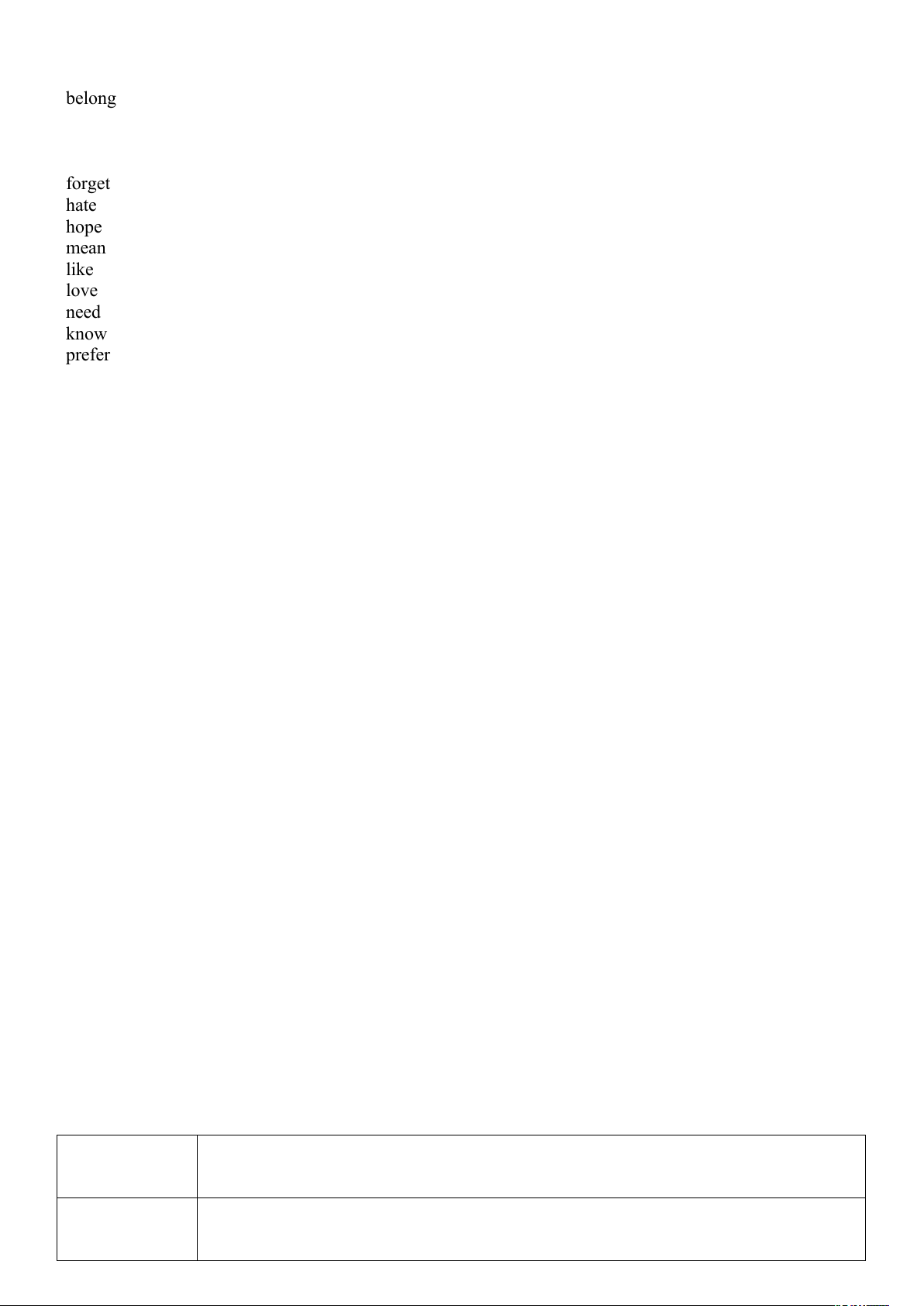
belong (thuộc về) have
contain (chứa đựng) have dinner consist (gồm có) have breakfast depend (phụ thuộc) have a bath forget (quên) hate (ghét) have fun hope (hi vọng)
mean (có nghĩa, có ý định) like (thích) ý là / I mean love (yêu) need (cần) know (biết) It smells good prefer (thích hơn) realize (nhận ra) remember (nhớ)
suppose (giả sử) smell (có mùi) seem (có vẻ) smell (ngửi) - V-ing smell (có mùi...)
taste (có vị...) taste (có vị) understand (hiểu) taste (nếm) - V-ing want (muốn)
o Quy tắc thêm đuôi -ing vào động từ Quy tắc 1
Khi động từ kết thúc bằng một chữ -e, ta phải bỏ -e trước khi thêm -ing Ví dụ:
love → loving; write → writing Quy tắc 2
Khi động từ kết thúc bằng một phụ âm, ngay trước nó là một nguyên âm và trọng âm rơi vào âm tiết cuối
(đối với những động từ có hai âm tiết trở lên) thì ta gấp đôi phụ âm đó lên trước khi thêm đuôi -ing. Ví dụ:
begin → beginning; prefer → preferring
Trường hợp đặc biệt:
die → dying, lie → lying: tie → tying
Exercise: Dùng động từ trong ngoặc ở thì Present Progressive
1. She’s tired. She ( want ) to go home now.
2. Tom ( plant ) the trees in the garden at the moment ?
The trees are being planted by tom 3. What you ( do ) now ? at the moment
4. Listen ! someone ( knock ) on the front door.
5. He ( write ) a novel at present.
A novel is being written at present
6. They ( watch ) T.V at present ?
- No. They ( listen ) to the radio
7. He and I ( play ) soccer at the moment. will go to . .
8. Tom and I ( be ) busy at the moment. will be v3/ed
9. They ( see ) a movie at the moment.
They are seeing a movie at the moment
10. We ( want ) to go to school at the moment.
A movie is being seen (by them) at the
3. THÌ HIỆN TẠI HOÀN THÀNH A. Cấu trúc moment S + have/ has + PII. (+)
Ví dụ: He has bought a new car.
This is the best movie I've ever seen S + haven’t/ hasn’t + PII. (-)
Ví dụ: They haven’t met each other for years. Have/ Has + S + PII? (?)
Ví dụ: Have you finished the test? Chú ý:
(1) S (I, We, You, They, N số nhiều) + have S
(He, She, It, N số ít) + has
(2) haven’t = have not; hasn’t = has not have / has + v3/ed B. Cách sử dụng
Have/has been + V-ing -> thời gian
Thì hiện tại hoàn thành diễn tả:
I ____ (wait) for you for 3 hours
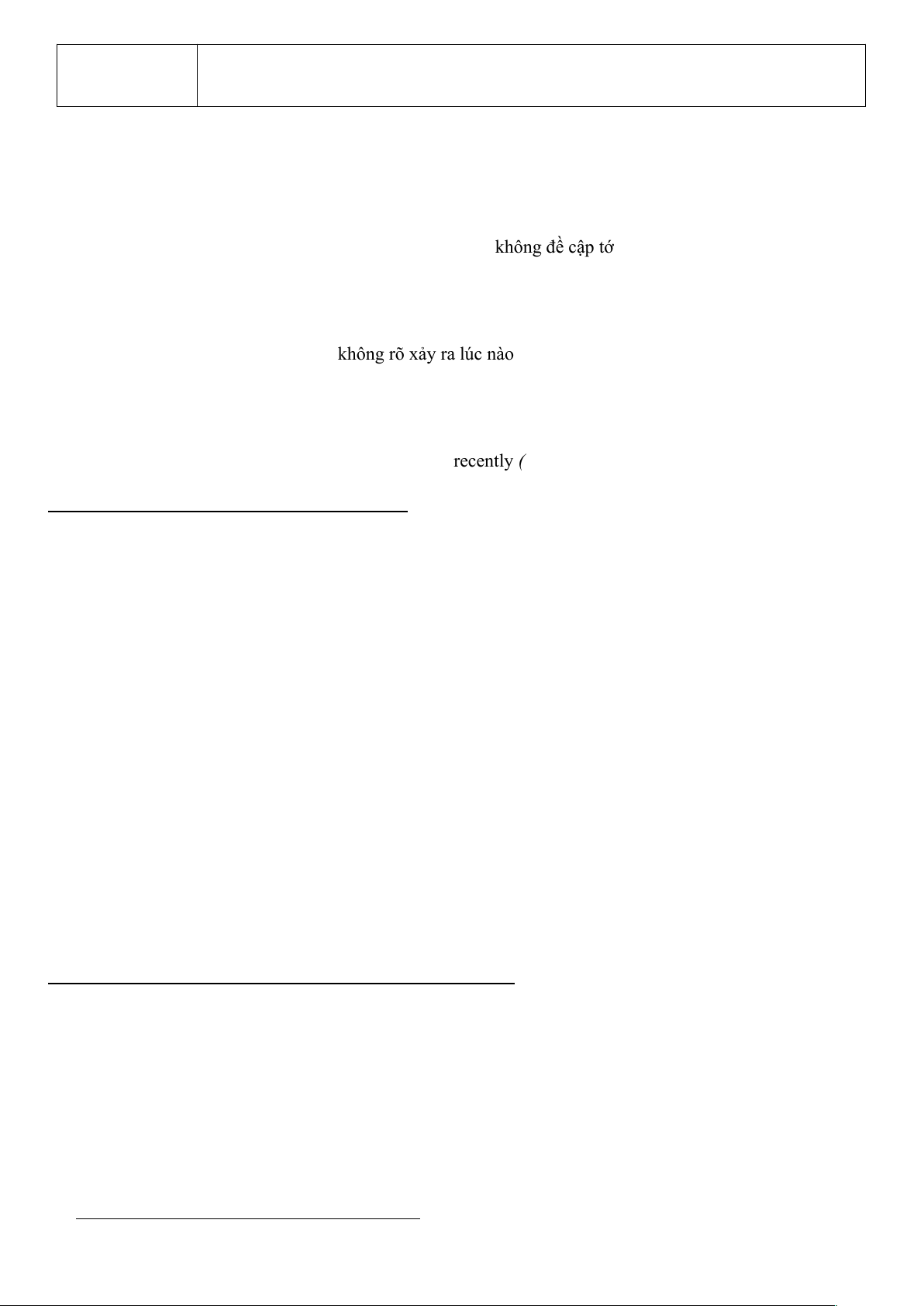
o Hành động đã hoàn thành cho tới thời điểm hiện tại mà không đề cập tới việc nó xảy ra khi nào. Ví dụ:
I’ve finished my homework. (Tớ đã hoàn thành tất cả bài tập về nhà.) just, yet , never, ever
o Hành động đã xảy ra nhiều lần từ quá khứ đến hiện tại.
We have seen that movie three times. (Chúng ta đã xem phim đó 3 lần rồi.) already
o Một việc đã xảy ra trong quá khứ, không rõ xảy ra lúc nào nhưng kết quả của nó vẫn còn liên quan đến hiện tại. since / for Ví dụ:
I have lost my key. (Tôi làm mất chìa khóa rồi) (Và giờ tôi không mở được cửa)
C. Dấu hiệu nhận biết
o Trong câu thường có các trạng từ: just (vừa mới), recently (gần đây), lately (gần đây); already (rồi);
ever (đã từng); never (chưa từng, chưa bao giờ); yet (chưa - dùng trong câu phủ định và câu hỏi)
Complete the sentences using SINCE or FOR
1. Linda has been the manage of Timeways travel in London ___t for hree years
2. I’ve lived in Rome_____I w since as two
3. Mr.Woods hasn’t been feeling well ____ove for r a month
4. Sally and her boyfriend Peter have been going out together____l since ast winter 5. I’ve been waiting ____ a for few minutes
6. He’s been in Japan ____ 1986 since 7. I haven’t seen you ____ c since hristmas
8. It hasn’t rained here _____ m for ore than a month
9. we haven’t bought a new shoes ____ ages for / years 10. We’ve been here ____ j since anuary
11. It has been raining..................l since unch time.
12. My boss has gone away .............t for en days
13. I haved lived in England...............a for year.
14. She has lived in London.................1985. since
15. Please hurry up We have been waiting .............a for n hour.
16. I have known her...............J since anuary.
17. Nam’s father has worked in this company .................20 ye for ars.
18. Have you learned English.........a for long time?
19. I haven’t seen Tom................M since onday.
20. This house is very dirty. Wer haven’t cleaned it .............a for ges
Put the verb in the correct tense and insert SINCE or FOR
21. ____ the last two years, clothes (be) very dear
22. Coal (become) dearer ___ the end of last year
23. I (write) ten letters _____ breakfast
24. “You (see) my friends lately?” “not ___3 days”
25. I (not see) him ____ more than a week
26. “ How long you(wait)?””____half an hour”
27. That boy (not wash) his face ___ some time
28. I (not have) a good night’s sleep ____ last week
29. She (practice) the piano ___ 6.00
30. Henry (not have) a holiday ____ the year before last
Put the verbs into the present perfect tense
31. I (live) here since 1970 I have lived here since 1970
32. He (study) English for three years
33. They (come) here many times
34. He (already read) these books he has already read these books
These books have been already read 35. She (just visit) us She has just visited us We have just been visited 36. I (ever see) this cartoon
This cartoon has been ever seen 37. You (ever talk) to her? 38. He(have) lunch yet? Has he had lunch yet?
39. We (not see) her parents yet
Have / has + V3/ed have / has + been +
40. His sister (work) for this company since 1995 had + v3/ed V3/ed
41. They (build) those building recently
They have built those building recently had+ been + v3/ed
42. I (not be) successful so far
43. Up to now he (win) the prize
44. It’s the second time he (visit) the USA
45. I (not live) here since he (be) a child
46. This is the nicest restaurant I (ever see) Those building have been built (by them) recently
47. The doctor (be) here since 8 o’clock
48. It (rain) yesterday after it (be) dry for many month
49. We (already choose) the new person for the job
50. You (pay) the taxi-driver yet? Choose the best answer S + Vs/es
1.We’ve been here ............last week. am / is/ are + V3/ed am/is/are being + V3/ed A. since B. for C. by D. from have/has been + V3/ed
2.They haven’t seen each other ...........a long time. have/has + been + V-ing A. since B. for C. with D. about
have/has + been + being+ V3/ed
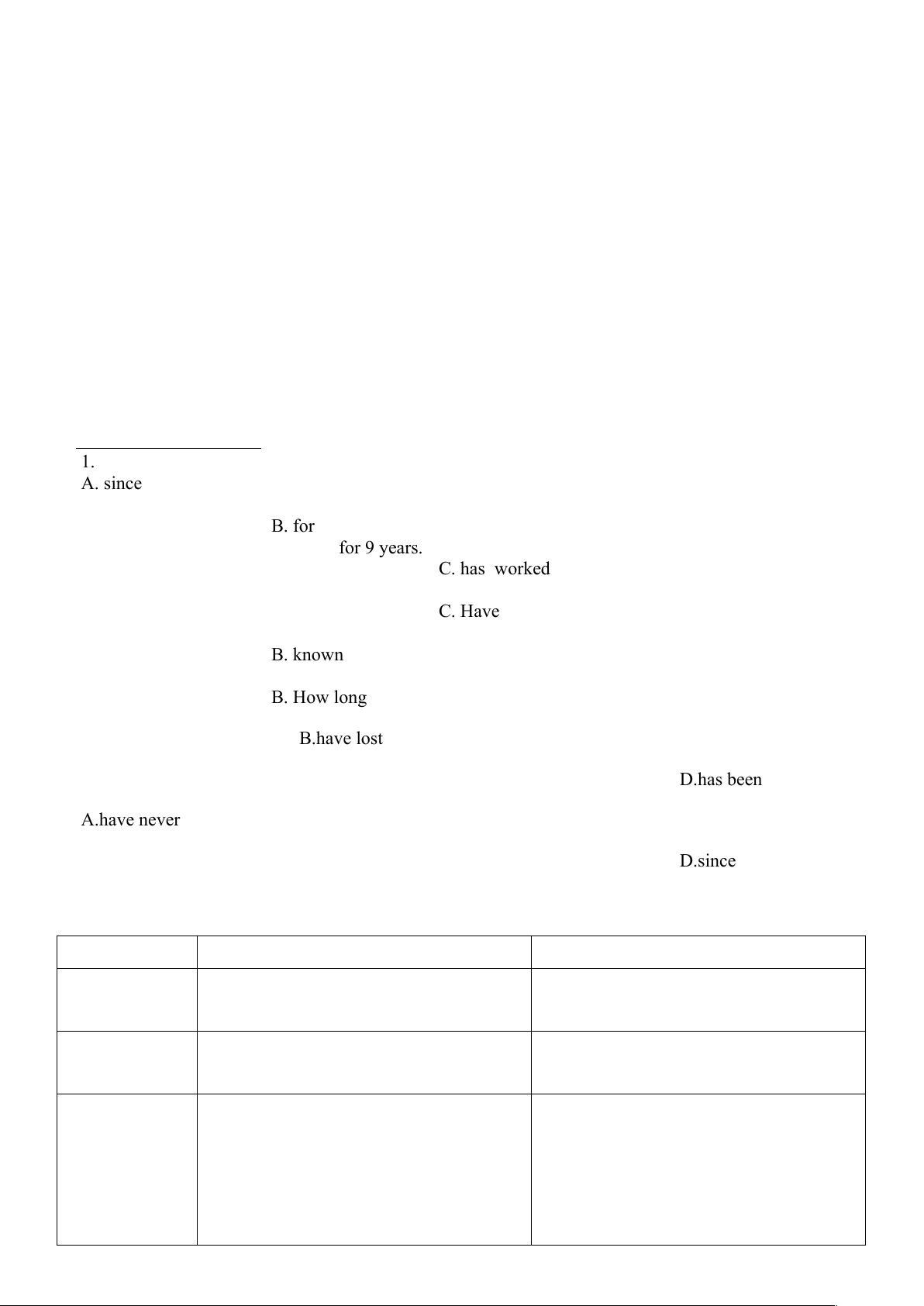
3.My mother..........in this hospital for 9 years. A. have worked B. worked C. has worked D. works
4............you had breakfast since 6.00 a. m ? A. Do B. Does C. Have D. Has
5.I have.........her for some years. A. know B. known C. knew D. knowing
6............ have you lived here? A. When
B. How long C. What time D. What
7.I ...................................my book .I can’t find it anywhere. A.lost B.have lost C.has lost D. lose
8.For a long time, the ¸Ao dai................the subject of poems,novels,and songs. A.were B.was C.have been D.has been
9.I don’t know Minh.I............................met him. A.have never B.never have C.haven’t never D.ever haven’t He 10. ha a s t b eaecnhe
r.......................he was 20 years old. A.for B.about C.at D.since 4. THÌ QUÁ KHỨ ĐƠN A. cấu trúc Động từ To be Động từ thường S + were/ was + ... S + V-ed. (+) Ví dụ: I was so happy. Ví dụ: I passed the exam. S + were/ was + not S + did not + V (-)
Ví dụ: They weren’t at home last week.
We did not invite them to our party. Were/ Was + S + ...? Did + S + V? (?)
Trả lời: Yes, S + were/ was. Trả lời: Yes, S + did. No, S + weren’t/ wasn’t No, S + didn’t. Ví dụ: Was she ill?
Ví dụ: Did they get married? - Yes, she was … Yes, they did. Ghi chú:
S (We/ You/ They/ N số nhiều + were
S (I/ He/ She/ It/ N số ít) + was
were not = weren’t; was not = wasn’t did not = didn’t
B. Cách thêm đuôi –ed vào sau động từ
o Nếu động từ có kết thúc bằng một phụ âm và trước nó là một nguyên âm, thông thường, ta gấp đôi phụ
âm rồi mới thêm đuôi –ed.
Ví dụ: occur → occurred commit → committed
Trừ một số trường hợp nếu động từ đó có trọng âm nhấn vào âm thứ nhất thì ta thêm -ed như bình thường
mà không phải gấp đôi phụ âm cuối của từ đó.
Ví dụ: happen → happened open → opened
o Nếu động từ có tận cùng bằng “e”, ta thêm “d”:
Ví dụ: combine → combined smile → smiled
o Nếu động từ có tận cùng bằng “y” thì ta đổi “y” thành “i” rồi mới thêm -ed:
Ví dụ: study → studied reply → replied
Ngoại trừ: play → played stay → stayed toy → toyed key → keyed C. Cách sử dụng
Thì quá khứ đơn được dùng để:
o Diễn tả hành động xảy ra, chấm dứt hoàn toàn trong quá khứ và không còn liên quan đến hiện tại. Ví dụ:
I started running a business last year.
(Tôi đã bắt đầu kinh doanh vào năm ngoái.)
o Liệt kê một chuỗi hoạt động đã xảy ra trong quá khứ, hành động này xảy ra kế tiếp hành động kia Ví dụ:
She went to class, sat down, and opened her book. (Cô bé đến lớp, ngồi xuống và mở cuốn sách.)
5. THÌ QUÁ KHỨ TIẾP DIỄN A. Cấu trúc S + were/ was + V-ing (+)
Ví dụ: He was planting trees in the garden at 4 pm yesterday. S + were/ was + not + V-ing (-)
Ví dụ: At this time last year, I was not attending that course. Were/ Was + S + V-ing? (?)
Ví dụ: Was the lorry going very fast when it hit your car? B. Cách sử dụng
Thì quá khứ tiếp diễn được dùng để:
o Thì quá khứ tiếp diễn diễn tả một hành động đang xẩy ra tại một thời điểm xác định trong quá khứ.
Ex: I was watching Tv at 8 last night
o Diễn tả một hành động đang xẩy ra thì có một hành động khác xen vào, hành động xen vào đó được chia
ở thì quá khứ đơn giản. Trong câu thường có when hoặc while
Ex: when I was having dinner, he came
o Diễn tả 2 hành động cùng song song xẩy ra
Ex: while I was watching Tv, my father was reading book
C. Dấu hiệu nhận biết
o Trong câu có các trạng từ chỉ thời gian trong quá khứ kèm theo thời điểm xác định. Ví dụ:
at + giờ + thời gian trong quá khứ (at 12 o’clock last night, ...);
at this time + thời gian trong quá khứ. (at this time two weeks ago, ...)
o Trong câu có “when” khi diễn tả một hành động đang xảy ra và một hành động khác xen vào. Hành
động xen vào bắt đầu bằng ”when” và được chia ở thì quá khứ đơn. Ví dụ:
I was singing when she came in. (Tôi đang hát thì cô ấy đi vào.)
o Trong câu có liên từ “while” nối 2 mệnh đề. Khi đó, cả 2 mệnh đề đều được chia ở thì quá khứ tiếp diễn
để diễn tả hai hành động xảy ra đồng thời. Ví dụ:
She was painting a picture while her mother was making a cake. II.choose the best answer.
1.I (met/was meeting) a friend while I (did/was doing)the shopping.
2.I (turned/was turning) round and (saw/was seeing) Paula.
3.She (wore/was wearing) a bright red coat when I saw her.
4.I (paid/was paying) for my things when I (heard/was hearing) call my name.
5.We(left/was leaving) the cafe and (said/was saying) goodbye.
6.this time last month we (took/were taking) the final test.
7.While we (had/were having) a drink, a waiter (dropped/was dropping) a pile of plates.
8.When I (came/was coming), he (read/was reading) books.
III. correct form of the verbs
1.the doorbell (ring)while Tom (watch) T.V .
2.How fast you(drive)when the accident (happen)
3.Ann and Susan (make).dinn er when Martin (arrive)home.
4.The light (go)out when we (have)dinner, but it (come)on again after about ten minutes.
5.It suddenly (begin)to rain while Laura (sit)in the garden.
6.What you(do)this time yesterday? I (work)on the computer.
7.It (be)cold when we (leave)the house that day, and a slight snow (fall)
8.When I last (see)them they (try)to find a new house near their work.
9.I (walk)along the street when I suddenly(feel)something hit me in the back. I (not/know)what it was.
10.When we (drive)down the hill, a strange object (appear)in the sky.
11.What (you/do)this time yesterday?I was asleep.
12.When we came, he (read)books.
13.I (see)Sue in town yesterday but she (not see)me.she (look)the other way.
14.I(meet)Tom and Ann at the airport a few week ago.They (go) to Berlin and I (go)to Madrid. We (have)a
chat while we(wait) for our flight.
15.I (cycle) home yesterday when suddenly a man (step )out into the road in front of me.I (go)quite fast but
luckly I (manage) to stop in time and (not/hit) him.
16.Jane (wait) for me when I (arrive)
17(you/ go) out last night ?No, I was too tired.
18.John (take)a photograph of me while I (not/look)
19.I haven’t seen Alan for ages. When I last (see)him , he(try)to find a job in London
20.I (walk)along the street when suddenly I (hear)footsteps behind me. Somebody (follow)me. I was frighted and I (start)to run.
6. THÌ QUÁ KHỨ HOÀN THÀNH A. Cấu trúc S + had + PII (+)
They had finished their work right before the deadline last week. S + had + not + PII (-)
We hadn’t cleaned the board when our teacher came. Had + S + PII? (?)
Had the film ended when you arrived at the cinema? B. CÁCH SỬ DỤNG
Thì quá khứ hoàn thành được dùng để:
o Diễn tả một hành động đã xảy ra và hoàn thành trước một thời điểm cụ thể trong quá khứ Ví dụ:
He had lived here by last year. (Trước năm ngoái, anh ta đã sống ở đây.)
o Diễn tả một hành động đã xảy ra trước một hành động khác trong quá khứ. Ví dụ:
I had gone to the warehouse before I went home.
(Tôi đã đến nhà kho trước khi về nhà.)
C. Dấu hiệu nhận biết Trong câu có các từ: o when (khi) Ví dụ:
When they arrived at the airport, her flight had taken off.
(Khi họ tới sân bay, chuyến bay của cô ấy đã cất cánh.)
o before: trước khi (Trước “before” ta sử dụng thì quá khứ hoàn thành và sau “before” ta sử dụng thì quá khứ đơn.) Ví dụ:
She had done her homework before her mother asked her to do so.
(Cô bé đã làm bài tập về nhà trước khi mẹ nó yêu cầu làm như vậy.)
o after: sau khi (Trước “after” ta sử dụng thì quá khứ đơn và sau “after” ta sử dụng thì quá khứ hoàn thành.) Ví dụ:
They went home after- they had eaten a big roasted chicken. (Họ về nhà sau khi đã ăn một con gà quay lớn.)
o by the time (vào thời điểm) Ví dụ:
He had cleaned the house by the time her mother came back. (Cậu ấy đã lau xong nhà vào thời điểm mẹ cậu ấy trở về.)
Bài 2: Cho dạng đúng của động từ trong ngoặc.
1- The storm destroyed the tent that we (build) ____________.
2- Liz (not / be) ____________ to New York before 2014.
3- When Johnathan went out to play soccer, he (do / already) ____________ his homework.
4- Kristen ate all of the cake that our mom (make) ____________ .
5- The docter took off the plaster that she (put on) ____________ two weeks before.
6- The waiter brought a drink that I (not / order) ____________ .
7- Kenny could not remember the words we (learn) ____________ three week before.
8- My kids collected coconuts that (fall) ____________ from the tree.
9- (she / phone) ____________ Jackie before she went to see him in Korea?
10- He (not / ride) ____________ a horse before that day.
Bài 3: Viết lại câu sao cho nghĩa không đổi sử dụng từ gợi ý cho sẵn.
1. David had gone home before we arrived. – After
…………………………………………………………………………………….
2. We had lunch then we took a look around the shops. – Before
……………………………………………………………………………………
3. The light had gone out before we got out of the office. –
When…………………………………………………………………………………….
4. After she had explained everything clearly, we started our work. – By the time
…………………………………………………………………………….
5. My father had watered all the plants in the garden by the time my mother came home. – Before
…………………………………………………………………………………. 7. THÌ TƯƠNG LAI ĐƠN A. Cấu trúc S + will/ shall + V (+)
Ví dụ: We will go to bed now. S + will/ shall + not + V (-)
Ví dụ: I will not be there.. Will/Shall + S + V? (?) Ví dụ: Will him follow me? B. CÁCH SỬ DỤNG
Thì tương lai đơn được dùng để:
o Diễn tả một quyết định tại thời điểm nói Ví dụ:
I miss my grandma so much. I will visit her tomorrow. (Tớ nhớ bà quá. Ngày mai tớ sẽ qua thăm bà.)
o Đưa ra lời hứa hẹn Ví dụ:
I promise I will take you to the water park this weekend.
(Bố hứa sẽ đưa con đến công viên nước cuối tuần này.)
o Đưa ra lời mời, yêu cầu, đề nghị Ví dụ:
Will you bring me that book? (Cậu mang cho tớ quyển sách đó nhé.)
C. Dấu hiệu nhận biết
Trong câu có các trạng từ chỉ thời gian trong tương lai:
o in + thời gian: trong ... nữa (in 2 minutes: trong 2 phút nữa) o tomorrow (ngày mai)
o next day (ngày hôm tới)
o next week/ next month/ next year (tuần tới/ tháng tới/năm tới)
Exercise: Chia động từ ở các câu sau.
1. I'm afraid I……………… (not/ be) able to come tomorrow.
2. Because of the train strike, the meeting ……………… (not/ take) place at 9 o'clock.
3. A: “Go and tidy your room.”
B: “Okay. I ……………… (do) it now!”
4. If it rains, we ……………… (not/ go) to the beach.
5. In my opinion, she ……………… (not/ pass) the exam.
6. A: “I'm driving to the party, would you like a lift?”
B: “Thank you but I ……………… (take) the bus.”
7. Look at the sky! It………………(rain) very heavily!
8. The company (hold)………………a very important meeting next month.
9. According to the weather forecast, it ……………… (not/ snow) tomorrow.
10. I think I (go)…………………study abroad.
8. THÌ TƯƠNG TIẾP DIỄN A. CÁCH SỬ DỤNG
Thì tương lai tiếp diễn được dùng để diễn tả:
o Một hành động hay sự việc đang diễn ra tại một thời điểm xác định trong tương lai. Ví dụ:
At 12 p.m tomorrow, my friends and I will be having lunch at school.
(Vào lúc 12 giờ trưa ngày mai, các bạn tôi và tôi sẽ đang ăn trưa tại trường.)
o Một hành động, một sự việc có thể đang xảy ra thì một hành động, sự việc khác sẽ xen vào trong tương lai. Ví dụ:
When you come tomorrow, they will be playing tennis.
(Khi bạn đến vào ngày mai, thì họ sẽ đang chơi tennis rồi.)
o Hành động sẽ diễn ra và kéo dài liên tục suốt một khoảng thời gian ở tương lai. Ví dụ:
My parents are traveling to London, so I’ll be staying with my grandma for the next 2 weeks.
(Cha mẹ tớ sẽ đi du lịch ở Luân Đôn, vì vậy tớ sẽ ở với bà trong 2 tuần tới.) B. Cấu trúc S + will + be + V-ing (+)
I will be staying at the hotel in Nha Trang at 1 p.m tomorrow.. S + will + not + be + V-ing (-)
We won’t be studying at 8 a.m tomorrow. Will + S + be + V-ing? Trả lời: Yes, S + will. (?) No, S + won’t.
Ví dụ: Will you be waiting for the train at 9 a.m next Monday? - Yes, I will.
C. Dấu hiệu nhận biết
o Trong câu có các trạng từ chỉ thời gian trong tương lai kèm theo thời điểm xác định:
- at this time/ at this moment + thời gian trong tương lai: Vào thời điểm này...
- At + giờ cụ thể + thời gian trong tương lai: vào lúc...
Exercies: Complete these sentences using the future continuous tense.
1. This time next year I (live)______ in London.
2. At 8PM tonight I (eat)_________ dinner with my family.
3. They (run)________ for about four hours. Marathons are incredibly difficult!
4. Unfortunately, I (work)______ on my essay so I won’t be able to watch the match.
5. She (study)_________ at the library tonight.
6. (you/wait)______ at the station when she arrives?
7. I (drink)_________ at the pub while you are taking your exam!
8. (she/visit)________ her Grandmother again this week?
9. At 3PM I (watch)__________ that movie on channel four.
10. (they/attend)____________ your concert next Friday? It would be lovely to see them. A.
BÀI KIỂM TRA ĐÁNH GIÁ NĂNG LỰC
I. Choose the letter A, B, C, D to indicate the correct answer to each of the following questions.
Question 1. I _________ at school now. A. am being B. was being C. was D. am
Question 2. I _________ to Ho Chi Minh City several times this year. A. have been B. was C. were D. had been
Question 3. He _________ here three hours ago. A. is leaving B. left C. has left D. have left
Question 4. We _________ Peter since last Monday. A. don’t see B. haven’t seen C. didn’t see D. hadn’t seen
Question 5. Tim _________ a book when I came to his house. A. is reading B. read C. was reading D. reading
Question 6. My brother _________ badminton. A. usually play B. is usually playing C. usually plays D. have usually played
Question 7. I _________ my clothes at 7 o’clock yesterday evening. A. am ironing B. have ironed C. ironed D. was ironing
Question 8. My mother _________ English for ten years. A. has learnt B. is learning C. learn D. learns
Question 9. _________ you go to the zoo? A. How often are B. How often do C. How often does D. How are
Question 10. The sun _________ in the East. A. is rising B. rose C. has risen D. rises
Question 11: When I was young, I _________ to be a teacher. A. want B. was wanting C. wanted D. had wanted
Question 12. My grandmother _________ 10 years ago. A. had died B. died C. has died D. was dying
Question 13. Look at those black clouds. It _________ . A. rains B. is raining C. is going to rain D. rain
Question 14. Tomorrow I _________ my parents.
A. am going to visit B. will have visited C. have visited D. visit
Question 15. She _________ books now. A. is reading B. read C. reads D. was reading
II. Put the verbs in the brackets into the correct tense.
Question 16. We seldom (eat) ____________ breakfast before 7 o’clock.
Question 17. What ____________ you (do) ____________ every morning?
Question 18. We (build) ____________ this house five years ago.
Question 19. It (be) ____________ often hot in the summer.
Question 20. ____________ you (watch) ____________ TV yesterday?
Question 21. He often (go) ____________ fishing with his friends when he was a child.
Question 22. We (live) ____________ here for 2 years.
Question 23. I (not see) ____________ him since we (say) ____________ goodbye.
Question 24. Nam and I (play) ____________ soccer at 3 p.m yesterday.
Question 25. While I (cook) ___________ dinner, my sister (read) _________ books last night.
Question 26. He always (forget) ____________ his homework. He isn’t careful.
Question 27. We (be) ____________ close friends since last year.
Question 28. Uncle Ho (die) ____________ in 1969.
Question 29. We (buy) ____________ a new car next year.
Question 30. Keep silent! The baby (sleep)
NGUỒN SƯU TẦM VÀ CHIA SẺ TÀI LIỆU MIỄN PHÍ CHO BÉ
MUỐN BÉ GIỎI TIẾNG ANH BA MẸ NÊN ĐỌC FILE NÀY
https://drive.google.com/drive/folders/1PvH2u-NQknWuXihb_GLAryuiULLPwNaf?usp=sharing
TỔNG HỢP THƯ VIỆN TÀI LIỆU MIỄN PHÍ CHO BÉ TỪ MẦM NON ĐẾN LỚP 12 TẠI ĐÂY
https://docs.google.com/presentation/d/1c5uj8NtXKypKzMcdaaDEEys0KDXYphpuMn3_DrCwJHk/ edit#slide=id.p
Hoặc ba mẹ vào nhóm sưu tầm và chia sẻ tài liệu, APP học TIẾNG ANH CHO BÉ MIỄN PHÍ
https://www.facebook.com/100004598379391/videos/796054742280796/
Hoặc nhóm zalo chia sẻ tài liệu: 0917.427.940 https://zalo.me/g/strvoy468
TỔNG HỢP KÊNH YOUTUBE VÀ TRANG WEB HỌC TIẾNG ANH MIỄN PHÍ RẤT CẦN CHO BÉ
https://drive.google.com/file/d/1OOrX_J5yy-mjvzjh6ZQWNRXOv6yks2-9/view?usp=sharing
Hoặc ghé kênh youtube có link tải tài liệu trong phần mô tả của video trong
DANH SÁCH PHÁT: TÀI LIỆU TIẾNG ANH
https://www.youtube.com/watch?v=GUt_fticYrM&t=341s
https://www.youtube.com/watch?v=7RMJ6CmjT3c&t=6s
https://www.youtube.com/watch?v=cd1JBXu3jl4&t=62s
Document Outline
- PHẦN 3
- A. Cấu trúc
- C. Dấu hiệu nhận biết
- a. Cách thêm đuôi -s/es vào sau động từ
- Ví dụ:
- Ví dụ:
- 2. THÌ HIỆN TẠI TIẾP DIỄN
- A. Cấu trúc
- Ví dụ:
- Ví dụ:
- D. Dấu hiệu nhận biết
- E. Ghi nhớ quan trọng:
- Quy tắc 1
- Ví dụ:
- Quy tắc 2
- Ví dụ:
- Trường hợp đặc biệt:
- 3. THÌ HIỆN TẠI HOÀN THÀNH
- A. Cấu trúc
- Ví dụ:
- Ví dụ:
- C. Dấu hiệu nhận biết
- 4. THÌ QUÁ KHỨ ĐƠN
- A. cấu trúc
- B. Cách thêm đuôi –ed vào sau động từ
- Ví dụ:
- Ví dụ:
- 5. THÌ QUÁ KHỨ TIẾP DIỄN
- A. Cấu trúc
- Ví dụ:
- Ví dụ:
- Ví dụ:
- 6. THÌ QUÁ KHỨ HOÀN THÀNH
- A. Cấu trúc
- Ví dụ:
- Ví dụ:
- Ví dụ:
- Ví dụ:
- Ví dụ:
- Ví dụ:
- 7. THÌ TƯƠNG LAI ĐƠN
- A. Cấu trúc
- Ví dụ:
- Ví dụ:
- Ví dụ:
- 8. THÌ TƯƠNG TIẾP DIỄN
- Ví dụ:
- Ví dụ:
- Ví dụ:
- B. Cấu trúc
Tài liệu liên quan:
-
Sách Cambridge English - Certificate in advanced - Practice test
21 11 -
Sách Cambridge English - Certificate in proficient english - Practice test
20 10 -
Từ vựng IELTS Writing Task 2 môn English | Trường Đại học Ngoại Thương
44 22 -
Tổng hợp từ vựng IELTS theo chủ đề Holidays | Trường Đại học Ngoại Thương
57 29 -

Succeed in Cambridge English Starters - 2018 Edition (Answer Key) | Trường Đại học Ngoại Thương
38 19