The Relationship between Capital and Earnings in Banking
Author(s): Allen N. Berger
Source:
Journal of Money, Credit and Banking,
Vol. 27, No. 2 (May, 1995), pp. 432-456
Published by: Ohio State University Press
Stable URL: http://www.jstor.org/stable/2077877 .
Accessed: 29/12/2013 09:41
Your use of the JSTOR archive indicates your acceptance of the Terms & Conditions of Use, available at .
http://www.jstor.org/page/info/about/policies/terms.jsp
.
JSTOR is a not-for-profit service that helps scholars, researchers, and students discover, use, and build upon a wide range of
content in a trusted digital archive. We use information technology and tools to increase productivity and facilitate new forms
of scholarship. For more information about JSTOR, please contact support@jstor.org.
.
Ohio State University Press is collaborating with JSTOR to digitize, preserve and extend access to Journal of
Money, Credit and Banking.
http://www.jstor.org
This content downloaded from 66.77.17.54 on Sun, 29 Dec 2013 09:41:34 AM
All use subject to JSTOR Terms and Conditions
ALLEN N. BERGER
The Relationship between Capital
and Earnings in Banking
ACCORDING TO CONVENTIONAL WISDOM in banking, a high-
er capital-asset ratio (CAR) is associated with a lower after-tax return on equity
(ROE). The arguments in favor of this hypothesized negative relationship between
capital and earnings have intuitive appeal and are consistent with standard one-
period models of perfect capital markets with symmetric inforrnation between a
bank and its investors. A higher capital ratio tends to reduce the risk on equity and
therefore lowers the equilibrium expected return on equity required by investors. In
addition, a higher CAR lowers after-tax earnings by reducing the tax shield provided
by the deductibility of interest payments. Moreover, the reduced risk from a higher
capital ratio may depress earnings by lowering the value of access to federal deposit
insurance that at best imperfectly prices risk.
Despite these arguments, the data on U.S. banks in the mid-to-late 1980s tell a
very different story. Book values of CAR and ROE are positively related, and this
relationship is both statistically and economically significant. As shown below, the
positive relationship between CAR and ROE holds both cross-sectionally and over
time, holds when lags are included, and becomes even stronger when an extensive
set of control variables is added to the regressions.
There are a number of potential explanations for the positive capital-earnings re-
The opinions expressed do not necessarily reflect those of the Board of Governors or its staff. The
author thanks Alan Greenspan for suggesting the original idea for this research, and the anonymous refer-
ees for making numerous suggestions that improved the paper. The author also thanks Sankar Acharya,
Mark Carey, Sally Davies, Ed Ettin, Gary Gorton, David Jones, Pat McAllister, Myron Kwast, Jim
O'Brien, Rich Rosen, and Greg Udell for helpful comments and thanks John Leusner, Jalal Akhavein,
and Joe Scalise for outstanding research assistance.
ALLEN N. BERGER is senior economist at the Board of Governors of the Federal Reserve
Stystem and senior fellow at Wharton Financial Institutions Center.
Journal of Money, Credit, and Banking, VO1. 27, NO. 2 (MaY 1995)
This content downloaded from 66.77.17.54 on Sun, 29 Dec 2013 09:41:34 AM
All use subject to JSTOR Terms and Conditions
ALLEN
N. BERGER
:
433
lationship,
once
the assumptions
of the
one-period
model of
perfect
capital
markets
with
symmetric
information
are
relaxed.
Relaxation
of the
one-period
assumption
allows
an
increase
in earnings
to
raise
the capital
ratio,
provided
that
marginal
earn-
ings
are
not fully
paid
out in
dividends.
Relaxation
of the
perfect
capital
markets
assumption
allows
an increase
in capital
to raise
expected
earnings
by reducing
the
expected
costs of
financial
distress
including
bankruptcy.
Finally,
relaxation
of
the
symmetric
information
assumption
allows
for a signaling
equilibrium
in which
banks
that
expect
to have
better
performance
credibly
transmit
this information
through
higher
capital.
The purpose
of this
paper is
to examine
closely
the
capital-earnings
relationship
to
try to
determine
which
among
the
potential
explanations
of the
relationship
ap-
pear
to be
important.
We
employ
annual
data
1983-1989
plus
three
years
of lags
on
book
values
of
capital,
earnings,
and
a number
of
other
variables.
Data
from
the
Call
Report
for
virtually
every
insured
U.S.
commercial
bank
are
used, yielding
an
unusually
large
data set
of over
80,000
bank-year
observations.
We regress
CAR
and
ROE on
three
years of
lagged
CAR and
ROE
and a
number
of
control
variables,
including
dummies
for every
bank
and time
period.
We
find posi-
tive
causation
in
the Granger
sense to
run in
both
directions
between
capital
and
earnings.
We note
that
our results
are
gross statistical
associations
that do
not neces-
sarily
prove
economic
causality.
Nevertheless,
they
may be
useful
for determining
which
among
the
various
theories
are
consistent
with
the data.
The positive
Granger-causality
from
earnings
to
capital is
consistent
with
the
hy-
pothesis
that
banks
retain
some
of their
marginal
earnings
in the form
of
equity
in-
creases.
This finding
is
not surprising.
We
pay primary
attention,
however,
to
the
positive
Granger-causality
from
capital
to earnings,
which
is quite
surprising.
This
finding
is
also the
most
relevant
to the
policy
debate
over capital
standards,
and
the
one
that
most directly
challenges
conventional
wisdom.
Further
evidence
suggests
that
higher
capital
is followed
by higher
earnings
primarily
through
reduced
interest
rates
on uninsured
purchased
funds.
These
findings
are strongest
for
banks
with low
capital
and
high
portfolio
risk
who
decreased
their
portfolio
risks
as
well as
in-
creased
their
capital
positions
relative
to what
they
otherwise
would have
been.
These
findings
are consistent
with the
hypothesis
that because
of factors
making
banks
riskier
in
the 1980s,
some
banks
may
have
had greater
than
optimal
risk
of
bankruptcy
and
the associated
deadweight
liquidation
costs,
and
as a result
paid
very
high
risk premia
on uninsured
funds
and
suffered
lower
earnings.
Banks that
reacted
by
increasing
capital
quickly
appear to
have
paid lower
uninsured
debt rates
and
had higher
earnings
than those
that
did
not react
in this
way.
The data
also
show that
the
positive
Granger-causality
from capital
to
earnings
does
not
hold for
the
1990-1992
time
period.
This
suggests
that
banks
may have
"overshot"
their
optimal
capital
ratios
in the
early l990s
because
of
declines
in bank
risk
that lowered
optimal
capital
ratios,
and
because
of regulatory
changes
and
un-
expectedly
high
earnings
that raised
capital
above
these
optimal
levels.
Section
1 discusses
alternative
hypotheses
about
the relationship
between
capital
and
earnings.
Section
2 presents
the
empirical
analysis,
and
Section
3
concludes.
This content downloaded from 66.77.17.54 on Sun, 29 Dec 2013 09:41:34 AM
All use subject to JSTOR Terms and Conditions
434 : MONEY, CREDIT, AND BANKING
1. ALTERNATIVE HYPOTHESES ABOUT THE CAPITAL-EARNINGS RELATIONSHIP
We begin examining the relationship between CAR and ROE in the simplest pos-
sible case and then relax assumptions one at a time. Consider a one-period model of
a bank under the assumptions of perfect capital markets, that is, value-maximizing
behavior, no bankruptcy costs, no barriers to entry, no taxes, and no deposit insur-
ance. Assume also that bank management has no private information, so that debt
and equity investors are symmetrically informed with management about bank in-
vestment payoffs. Nonnegative amounts of equity and debt are chosen at the begin-
ning of the period, and a random cash flow to be split between equity and debt
holders occurs at the end of the period. In this simple model, market and book rates
of return are identical. Here, an increase in CAR by substituting additional equity
for debt reduces the risk on both instruments, and therefore lowers the market's re-
quired expected rate of return on both, as long as investors are risk averse and can-
not completely diversify away the bank's risks. Thus, in the one-period, perfect
markets, symmetric information case, we expect a negative correlation between
CAR and ROE.1
When we relax these assumptions, a number of additional factors may affect the
capital-earnings relationship, making it either positive or negative. Causation may
run from ROE to CAR when the assumption of a single time period is relaxed. If
bank managers tend to retain marginal changes in earnings rather than distribute
them to shareholders, earnings will have a positive influence on capital over time.
This implies that changes in earnings would be followed by changes in capital in the
same direction, that is, ROE would positively Granger-cause CAR.
Causation may also run from CAR to ROE in a number of ways. In the remainder
of this section, we concentrate on theories that might explain our surprising empiri-
cal finding of a positive Granger-causality from capital to earnings. In our frame-
work of analysis, we assume that there is an interior solution to the choice of the
capital ratio that maximizes value, balancing off competing factors that affect opti-
mal capital, so that a positive optimal CAR exists for each bank.
We first consider the effects of capital on the expected costs of financial distress,
especially the deadweight costs of bankruptcy. The optimal CAR for a bank will be
higher, the greater are the exogenous factors increasing its expected bankruptcy
costs [see Berger et al. (1995) for a more complete discussion of how the expected
costs of financial distress and other factors affect bank capital decisions]. We define
expected bankruptcy costs as the probability of bank failure times the deadweight
liquidation costs that must be absorbed by creditors in the event of failure. These
costs may be quite substantial, making the expected bankruptcy costs for a risky
bank a matter of considerable importance.2 When expected bankruptcy costs in-
crease because of environmental changes that increase the probability of bank fail-
1. Although expected returns on both debt and equity decrease, expected total financing costs are
unchanged because the lower rates are offset by the shift into equity, the more expensive instrument.
2. James (1991) found that the FDIC's administrative and legal costs of bank failures averaged 10
percent of assets, while the devaluation of assets was another 30 percent of book value. The latter figure
probably overstates economic losses because book values of failed banks are often overstated.
This content downloaded from 66.77.17.54 on Sun, 29 Dec 2013 09:41:34 AM
All use subject to JSTOR Terms and Conditions
ALLEN N.
BERGER :
435
ure or
increase
the
liquidation costs
per
failure,
the
optimal CAR
increases in
order
to
reduce the
probability of
failure
and
thereby
lower
the
expected
value of
bank-
ruptcy
costs.
These
costs,
which
are
borne
directly by
the
bank's
creditors
in the
event of
bankruptcy,
are paid
for by
shareholders
to the
extent
they are
anticipated
through
higher
required
interest
rates on
bank
debt. A
notable
exception
occurs
when
the
creditor is
the
FDIC,
which until
recently did
not base
its
premia on
risk.
For a
bank
with
capital
below its
equilibrium
ratio,
expected
bankruptcy
costs are
relatively high,
and
an
increase in
CAR
raises
expected
ROE
by
lowering
interest
expenses on
uninsured
debt,
all else
equal.
Similarly, for
a bank
with
capital
above
its
equilibrium,
an
increase
in CAR
reduces
ROE.
This
"expected
bankruptcy
costs
hypothesis"
could
explain
all or
part of
the ob-
served
positive
relationship
between
CAR
and
ROE under
certain
circum
stances. If
expected
bankruptcy
costs
rose
unexpectedly
because of
an
exogenous
increase in
the risk
of
failure in
the
banking
industry,
then
most
banks
would be
below
their
equilibrium
CARs
until
enough
time
passed for
them to
adjust.
Those
banks
that
raised
their
CARs
most
quickly
toward the
new
equilibrium
would
pay
relatively
low
rates on
their
uninsured
debt and
have
relatively good
ROE
performance,
ceteris
paribus.
Note
that the
exogenous
increase
in the
probability of
bank
failure
does not
raise the
ROE
of any
bank
it
lowers the
ROEs
of all
banks,
but
lowers them
less
for the
banks
that
promptly
increase
their
CARs to
the
new
equilibrium
levels.
Expected
bankruptcy costs
almost
surely
increased
substantially in
the
1980s.
The
probability
of
bank
failure
increased as
the
number
of
failures rose
from
ten or
fewer
per year
as late
as 1981
and to
over
two
hundred
per year
from
1987 to
1989.
This
period
also
coincides
with
industry
declines
due to
the
loss of
market
power
from the
repeal
of
regulatory
deposit
rate
ceilings
and
financial
market
innovations
that
favored
nonbank
competitors.
In
addition,
competition for
bank
products in-
creased
because of
the
elimination
of
some
interstate
banking
restrictions,
liber-
alized
bank
charters,
and
globalization
of
banking
markets.
Supporting
these
conclusions,
Keeley
(1990)
found a
decline
in bank
charter
values
through 1986
(his
last year
of
data) and
determined
that this
decline was
an
important
cause of
the
increase
in
bank
failures.
The
expected
bankruptcy
costs
hypothesis has
several
empirical
implications.
First,
the
relatively
higher
earnings
for
banks
that
raised their
capital
over
other
banks
would be
manifested
primarily
in the
form of
lower
interest
expenses on
unin-
sured
debt, as
the
rates on
this debt
would
incorporate
lower
premia
for the
lower
expected
bankruptcy
costs.
That is,
the
rates paid
on debt
would
decrease by
more
than in
the
simple
perfect
capital
markets
model,
more
than
enough
to offset
the
direct
decline in
expected
ROE from
the
greater
safety of
equity
described
above. A
second
empirical
implication
of this
hypothesis is
that
the
Granger-causation
from
capital to
earnings
would be
stronger
for
risky
banks, that
is,
those with
low
CAR or
high
portfolio
risk,
since
these banks
would
get the
greatest
"kick" in
reducing
risk
per unit
increase in
CAR.
Third,
portfolio
risk
decreases
would
have
effects
similar
to
CAR
increases on
earnings,
since
both
actions
reduce
expected
bankruptcy
costs.
These
implications are
tested
below.
An
alternative
theory of the
positive
Granger-causation
from
capital to
earnings is
This content downloaded from 66.77.17.54 on Sun, 29 Dec 2013 09:41:34 AM
All use subject to JSTOR Terms and Conditions
436 : MONEY,
CREDIT,
AND BANKING
the "signaling
hypothesis."
Here,
we relax the
symmetric information
assumption
and allow
bank managers
to have
private information
about
the future cash
flows.
Management
may be
able to signal
this information
through
capital decisions
(for
example,
Acharya 1988).
To the extent
that management
has
a stake in the
value of
the bank
through personal
ownership,
stock options,
etc.,
it is less costly
for a
"good"
bank to signal
high quality
through increased
capital
than for a "bad"
bank.
As a result,
a signaling
equilibrium
may exist
in which banks
that expect
to have
better future
performance
have higher
capital. The
private information
could
be any
of several
types-that
management's
private expectations
of
revenues, costs,
or risk
are more
favorable than
is publicly
thought. We
test several
empirical implications
of this hypothesis
below.3
We focus
primarily
on the expected
bankruptcy
costs and
signaling hypotheses,
the most
plausible and
theoretically
interesting explanations
of the positive
Granger-
causality
from capital
to earnings.
However, we
also briefly
consider the
following
alternative
explanations.
Higher
CAR may also
cause higher
ROE if the
higher capital
reduces risk-related
barriers
to entry or expansion
into
some profitable
product lines.
Banks that
increase
capital and
reduce their
risks may
be better able
to avail themselves
of opportunities
to issue
off-balance-sheet
guarantees,
such as loan
commitments
and standby
letters
of credit.
Safer banks
may also be
able to borrow
uninsured
funds more
easily to
pursue high
revenue
on-balance-sheet
investment
opportunities
as they arise.
This
hypothesis
implies that
the banks
that increase
CAR will have
higher revenue,
and
may also
issue more
off-balance-sheet
guarantees
or uninsured
debt.
The capital-earnings
relationship
may also
be affected
by portfolio
decisions.
Banks that
increase capital
may choose
portfolios
with different
risk and return
pro-
files. This
is especially
relevant when
banks raise
capital because
they are
required
to do so
by regulators.
Desired portfolio
risk may
either increase
or decrease
when
capital is
increased involuntarily.4
In some cases,
regulators
may force
relatively
risky banks
to reduce
their portfolio
risks as well.
Under most
circumstances,
the
expected
value of revenues
would
move in the
same direction
as portfolio
risk.5
Capital
may also affect
earnings
through operating
costs.
If banks are
not fully
cost efficient,
a change
in CAR could
affect the
pressure on
management
to control
costs. If
capital is more
costly than
debt at the
margin, then a
rise in capital
precipi-
tated by
regulators might
raise pressure
on banks
to reduce
operating costs
to help
offset the
higher financing
costs.
On the other hand,
the reduction
in debt
servicing
load may
reduce short-term
pressures
to save on
operating costs
to provide
funds to
pay debt
holders or take
away from
debt holders
the control
they need in
the pres-
ence of
agency costs
(Jensen 1986,
Harris and
Raviv 1990).
3. Signaling
equilibria
are also possible
in which lower,
rather than higher
capital signals
favorable
private information,
particularly
if management's
interests
are more aligned
with the interests
of debt
holders (see
Ross 1977). We
do not consider
this alternative
here because we
are interested in
explaining
the observed
positive capital-earnings
relationship.
4. Gennotte
and Pyle ( 1991
) showed that
under general conditions,
banks
may choose higher
or lower
portfolio risks
and higher
or lower failure probabilities
when
forced to raise
capital.
5. If banks
have monopoly
power over their
borrowers,
risk and expected
return could be
either pos-
itively or
negatively related,
since loan prices
will not necessarily
adjust to
market prices.
This content downloaded from 66.77.17.54 on Sun, 29 Dec 2013 09:41:34 AM
All use subject to JSTOR Terms and Conditions
ALLEN N.
BERGER :
437
Finally, in
addition
to these
possible
direct
relationships
between
capital and
earn-
ings, a
spurious
relationship
between CAR
and
ROE may
occur
if they
are both
cor-
related
with
the same
tertiary
variables.
For
example, if
local
market
concentration
results
in high
earnings, and
if
banks in
concentrated
markets
hold
more
capital to
protect
the
franchise
value of
their
access
to these
markets, then
a
positive
correla-
tion
between
CAR and
ROE
may
result.
All of
these
lines of
causation may
be
operative
to some
degree, so
that the
empir-
ical
relationship
between
CAR and
ROE
reflects
the
net effect
of
these
different
forces.
In the
following
section, we
both
estimate
the net
effect
and try
to
determine
which
of these
forces
dominate.
2.
EMPIRICAL
ANALYSIS
We
begin
the
empirical
analysis
by
assuming
that
CAR and
ROE
form a
simple
two-variable
system
without
the
necessity
of
controlling
for
other
factors.
A
Simple
Two-Variable
Empirical
Model
We
examine
the
relationship
between
these
variables
using
annual
data
over the
period
1983-1989.
During
this
time,
relatively
constant
flat-rate
capital
standards
were in
place.
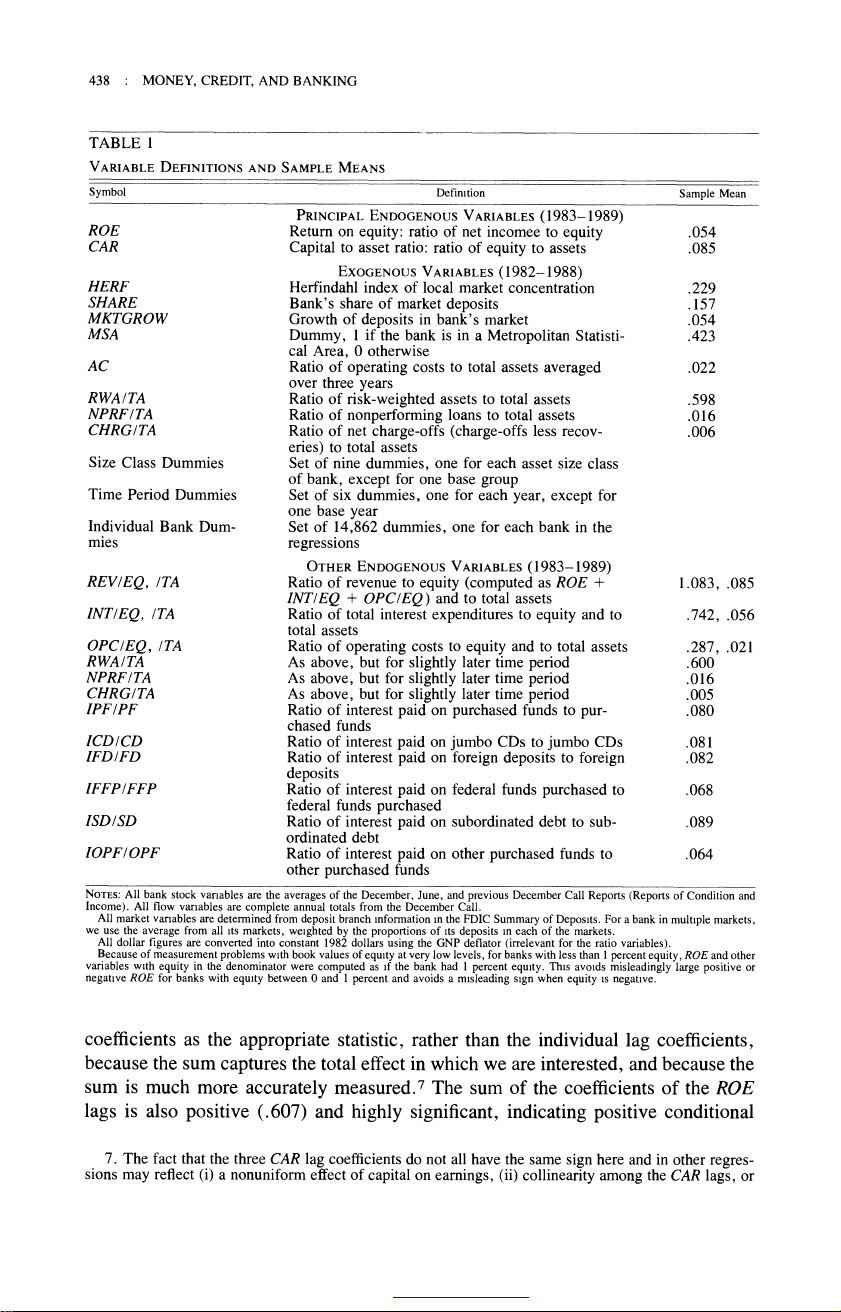
The
definitions and
sample
means
of all
the
variables
used in
this
paper
are given
in
Table 1.
In most
cases,
the data
are
taken
from the
Call
Report.
The
contemporaneous
correlation
between
CAR and
ROE
for the
entire
1983-
1989
sample is
.132,
which
is
statistically
significant at
standard
confidence
levels.
The
correlation
is
robust
over time,
remaining
positive
and
significant
for
each of
the
seven years
individually.6
In
order to
determine
whether
this
positive
relation-
ship is
due to
capital
causing
earnings or
earnings
causing
capital, we
use
Granger-
causality
tests
of what
happens to
each
variable
in the
next
several
years
after the
other
variable
changes. Each
variable (Yt)
is
regressed on
three
annual
lags of
both
itself
(Yt- l,
Yt-2, Yt-3)
and
the other
variable (xt- l,
xt_2,
xt_3). If
the
coefficients of
the x
lags are
statistically
significantly
different
from
zero, then
x
helps
predict or
Granger-cause
y.
Granger-causality
gives
historical
associations
in
which a
change
in
one
variable
precedes a
change in
the
other, but
does
not
necessarily
imply
eco-
nomic
causation.
However, as
we
add
control
variables,
search
for
spurious
associa-
tions,
and
decompose
the
relationships in
the
more
complex
models
below, we
are
able to
assess
which
among
the
economic
hypotheses are
most
consistent with
the
data.
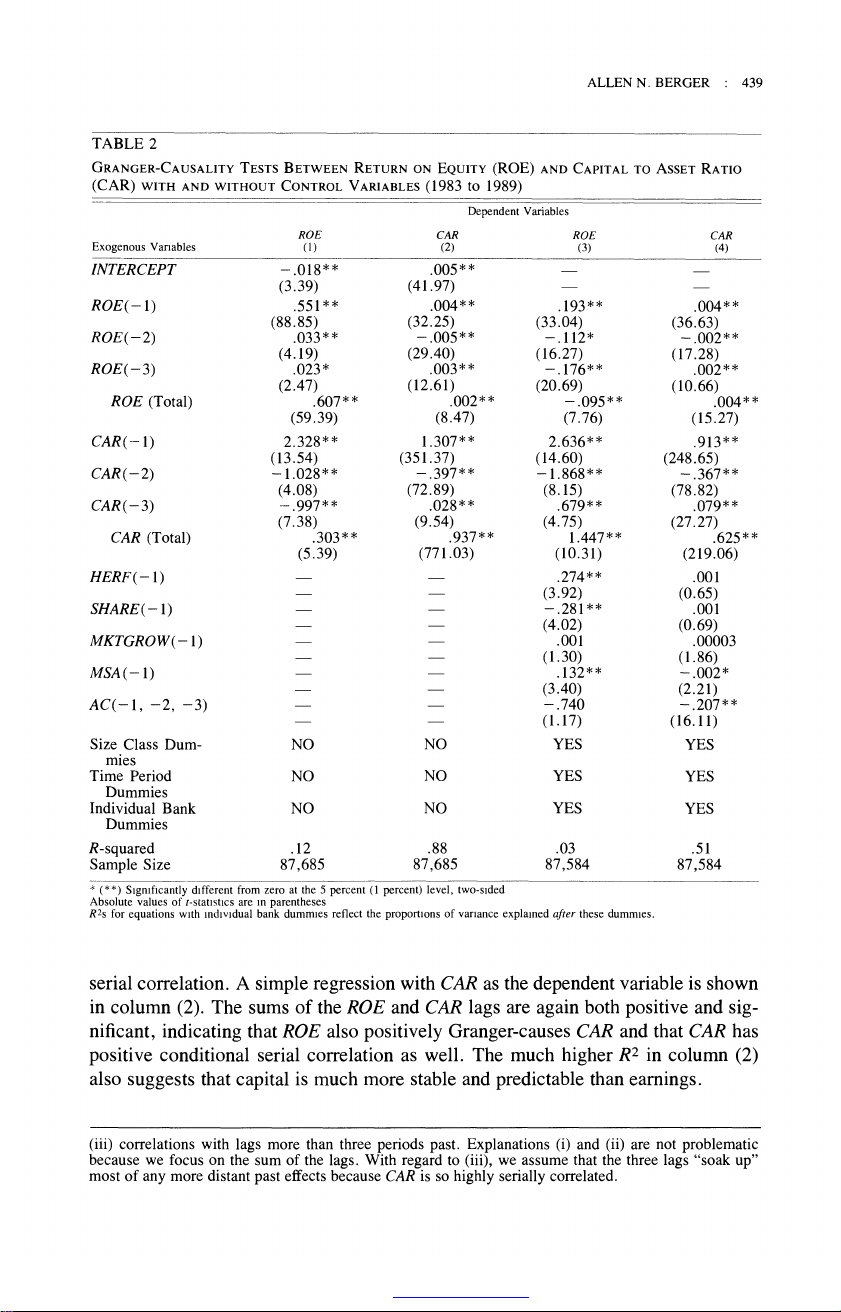
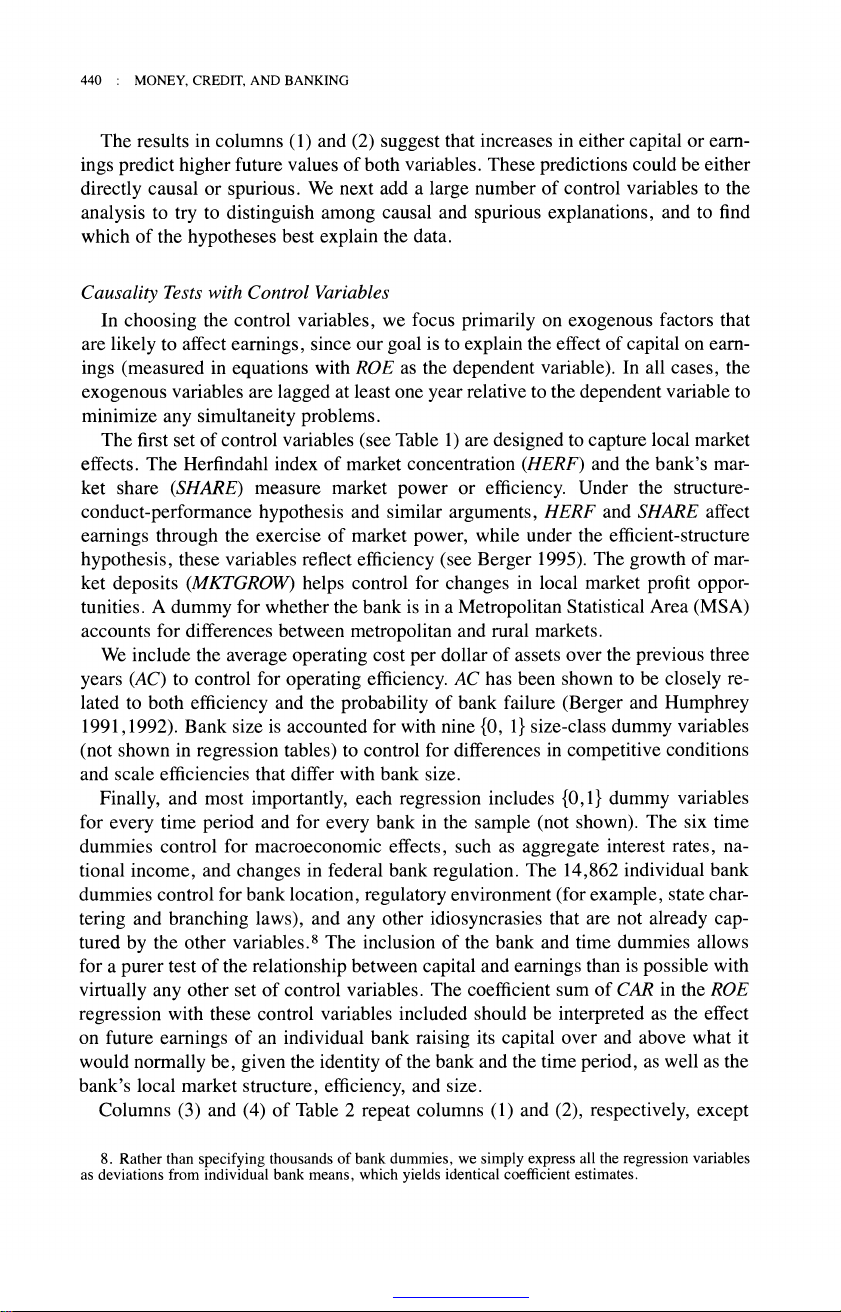
A
simple
causality
regression with
ROE
as the
dependent
variable is
summarized
in
column (1)
of Table
2. The
sum
of the
coefficients of
the
three CAR
lags is
.303
and is
statistically
significantly
different
from
zero,
suggesting
that a
higher
CAR
Granger-causes
or
helps
predict a
higher
future
ROE. We
focus on
the
sum of
the lag
6.
These sample
correlations (as
well as
the
regression
coefficients
below)
are
biased
downward
somewhat
by the
exclusion
of
observations
on failed
banks in
the year
in which
they fail.
The
missing
observations
generally have
very
low
(actually
negative)
values of
both
capital and
earnings,
which
would
increase the
positive
correlations
between CAR
and ROE
if they
were
included.
This content downloaded from 66.77.17.54 on Sun, 29 Dec 2013 09:41:34 AM
All use subject to JSTOR Terms and Conditions
438
:
MONEY,
CREDIT, AND
BANKING
TABLE 1
VARIABLE
DEFINITIONS AND
SAMPLE
MEANS
Symbol
ROE
CAR
HERF
SHARE
MKTGROW
MSA
AC
RWA I TA
NPRFI TA
CHRGI TA
Size Class
Dummies
Time Period
Dummies
Individual
Bank
Dum-
mies
REVIEQ,
ITA
INTIEQ,
ITA
OPCIEQ,
ITA
RWAITA
NPRFI TA
CHRGI TA
IPFIPF
ICDICD
IFDIFD
IFFPIFFP
ISDISD
IOPFI OPF
Definltion
PRINCIPAL
ENDOGENOUS
VARIABLES
(1983-1989)
Return on
equity:
ratio of
net
incomee to
equity
Capital to
asset
ratio: ratio
of equity
to assets
EXOGENOUS
VARIABLES
(1982-1988)
Herfindahl index
of local
market
concentration
Bank's
share of
market
deposits
Growth
of deposits
in
bank's market
Dummy,
1 if the
bank is in
a
Metropolitan
Statisti-
cal Area,
O
otherwise
Ratio of
operating
costs to
total assets
averaged
over three
years
Ratio of
risk-weighted assets
to total
assets
Ratio of
nonperforming
loans to total
assets
Ratio of
net
charge-offs
(charge-offs
less
recov-
eries) to
total assets
Set of
nine
dummies, one
for each
asset size
class
of bank,
except for
one base
group
Set of six
dummies, one for
each
year, except
for
one base
year
Set of
14,862
dummies, one
for each
bank in
the
regressions
OTHER
ENDOGENOUS
VARIABLES
(1983-1989)
Ratio of
revenue to
equity
(computed
as ROE
+
INTIEQ
+
OPCIEQ) and to
total
assets
Ratio of
total
interest
expenditures to
equity
and to
total
assets
Ratio of
operating
costs to
equity and
to total
assets
As above,
but for
slightly
later time
period
As above,
but for
slightly
later time
period
As above,
but for
slightly
later time
period
Ratio of
interest
paid on
purchased
funds to
pur-
chased
funds
Ratio of
interest
paid on
jumbo CDs
to jumbo
CDs
Ratio of
interest
paid on
foreign
deposits to
foreign
deposits
Ratio of
interest
paid on
federal funds
purchased to
federal
funds
purchased
Ratio of
interest
paid on
subordinated
debt to
sub-
ordinated
debt
Ratio of
interest
paid on
other
purchased funds
to
other
purchased
funds
Sample
Mean
.054
.085
.229
.157
.054
.423
.022
.598
,016
.006
1 .083,
.742,
.287,
.600
.016
.005
.080
.081
.082
.068
.089
.064
.085
.056
.021
NOTES: All bank
stock
varlables are the
averages of
the December,
June, and
previous
December Call
Reports
(Reports of
Condition and
Income). All
flow varlables
are complete
annual totals
from the
December
Call.
All market
vanables are
determined
from deposit
branch
lnformation ln the
FDIC
Summary of Deposlts.
For a bank
in multlple
markets,
we
use the
average from all
lts markets,
welghted by
the
proportions of lts
deposits ln each
of the
markets.
All
dollar
figures are
converted into
constant 1982
dollars using
the GNP
deflator
(irrelevant for the
ratio
variables).
Because of
measurement
problems w1th
book values
of equ1ty at
very low
levels, for banks
with less than
1 percent
equity, ROE
and other
variables w1th
equity in the
denominator
were
computed as lf the
bank had 1
percent
equ1ty. Thls
avolds
misleadingly large
positive or
negatlve ROE for
banks with
equ1ty
between O and 1
percent and
avoids a
mlsleading slgn
when equity
ls negatlve.
coefficients as the
appropriate
statistic,
rather
than the
individual lag
coefficients,
because
the sum
captures
the total
effect
in which
we are
interested, and
because the
sum is
much
more
accurately
measured.7 The
sum of
the
coefficients
of the
ROE
lags is
also
positive
(.607) and
highly
significant,
indicating
positive
conditional
7. The
fact that the
three
CAR lag
coefficients
do not all
have the
same sign
here and
in other
regres-
sions may
reflect (i) a
nonuniform effect
of capital
on
earnings, (ii)
collinearity
among
the CAR
lags, or
This content downloaded from 66.77.17.54 on Sun, 29 Dec 2013 09:41:34 AM
All use subject to JSTOR Terms and Conditions
(iii) correlations with lags
more than three periods past. Explanations
(i) and (ii) are not problematic
because we focus on the
sum of the lags. With regard to (iii), we assume
that the three lags "soak up"
most of any more distant
past effects because CAR is so highly serially
correlated.
ALLEN N. BERGER : 439
TABLE 2
GRANGER-CAUSALITY
TESTS BETWEEN RETURN ON EQUITY (ROE) AND
CAPITAL TO ASSET RATIO
(CAR) WITH AND
WITHOUT CONTROL VARIABLES (1983 to 1989)
Dependent Vanables
ROE CAR
ROE CAR
Exogenous Varlables
(1) (2)
(3) (4)
INTERCEPT
-. 018** .005**
(3.39) (41.97)
ROEf-1)
.551 ** .004**
.193** .004**
(88.85) (32.25) (33
04) (36.63)
ROEf-2)
.033** -.005**
-.112* -.002**
(4.19) (29.40)
(16.27) (17.28)
ROEf-3)
.023* .003**
-.176** .002**
(2.47) (12.61)
(20.69) (10.66)
ROE (Total)
.607 * * .002* *
-.095 * * .004* *
(59.39) (8.47)
(7.76) (15.27)
CARf-1)
2.328** 1.307**
2.636** .913**
(13.54) (351.37)
(14.60) (248.65)
CARf-2)
-1.028** -.397**
-1.868** -.367**
(4.08) (72.89)
(8.15) (78.82)
CAR (-3)
-.997 * * .028 * *
.679 * * .079 * *
(7.38) (9.54) (4
75) (27.27)
CAR (Total)
.303** .937**
1.447** .625**
(5.39) (771.03)
(1O.31) (219.06)
HERFf-1)
.274** .001
(3.92) (0.65)
SHAREf-1)
-.281 ** .001
(4.02) (0.69)
MKTGROW(-1)
.001 .00003
(1.30) (1.86)
MSA f-1)
.132** -.002*
(3.40) (2.21)
ACf-1, -2, -3)
-.740 -.207**
(1.17) (16.11)
Size Class Dum-
NO NO
YES YES
mies
Time Period
NO NO
YES YES
Dummies
Individual Bank
NO NO
YES YES
Dummies
R-squared
.12 .88
.03 .51
Sample Size
87,685 87,685
87,584 87,584
* (**) Slgnlflcantly dlfferent from
zero at the S percent (1 percent) level, two-slded
Absolute values of t-statlstlcs are
In parentheses
R2s for equations wlth IndlVldual
bank dummles reflect the proportlons of varlance explalned
after these dummles.
serial correlation. A
simple regression with CAR as the
dependent variable is shown
in column (2). The
sums of the ROE and CAR lags are
again both positive and sig-
nificant, indicating
that ROE also positively
Granger-causes CAR and that CAR has
positive conditional
serial correlation as well. The much
higher R2 in column (2)
also suggests that
capital is much more stable and
predictable than earnings.
This content downloaded from 66.77.17.54 on Sun, 29 Dec 2013 09:41:34 AM
All use subject to JSTOR Terms and Conditions
440 :
MONEY, CREDIT, AND
BANKING
The
results in columns
(1) and (2)
suggest that
increases in either
capital or earn-
ings predict
higher future
values of both
variables. These
predictions
could be either
directly
causal or
spurious. We next add
a large number
of control
variables to the
analysis to
try to
distinguish among
causal and spurious
explanations,
and to find
which of
the hypotheses
best explain the
data.
Causality
Tests with
Control Variables
In
choosing the control
variables, we
focus primarily
on exogenous
factors that
are likely
to affect
earnings, since our
goal is to explain
the effect of
capital on earn-
ings
(measured in
equations with ROE as
the dependent
variable). In
all cases, the
exogenous
variables are
lagged at least
one year relative
to the dependent
variable to
minimize
any simultaneity
problems.
The first
set of control
variables (see
Table 1) are
designed to capture
local market
effects.
The Herfindahl
index of market
concentration
(HERF) and the
bank's mar-
ket share
(SHARE)
measure market
power or
efficiency. Under the
structure-
conduct-performance
hypothesis and
similar arguments,
HERF and
SHARE affect
earnings
through the
exercise of market
power, while
under the
efficient-structure
hypothesis,
these variables
reflect
efficiency (see Berger
1995). The
growth of mar-
ket
deposits (MKTGROW)
helps control
for changes in
local market
profit oppor-
tunities. A
dummy for
whether the bank is
in a
Metropolitan Statistical
Area (MSA)
accounts
for differences
between
metropolitan and rural
markets.
We
include the average
operating cost
per dollar of
assets over the
previous three
years (AC)
to control for
operating
efficiency. AC has
been shown to be
closely re-
lated to
both efficiency
and the
probability of bank
failure (Berger and
Humphrey
1991,1992). Bank size is
accounted for
with nine {O, 1}
size-class
dummy variables
(not shown
in regression
tables) to control
for differences
in competitive
conditions
and scale
efficiencies that
differ with bank
size.
Finally,
and most
importantly, each
regression
includes {0,1}
dummy variables
for every
time period and
for every bank
in the sample
(not shown).
The six time
dummies
control for
macroeconomic
effects, such as
aggregate interest
rates, na-
tional
income, and
changes in federal
bank regulation.
The 14,862
individual bank
dummies
control for bank
location,
regulatory
environment (for example,
state char-
tering and
branching
laws), and any
other idiosyncrasies
that are not
already cap-
tured by
the other
variables.8 The
inclusion of the bank
and time
dummies allows
for a purer
test of the
relationship between
capital and
earnings than is
possible with
virtually
any other set of
control
variables. The
coefficient sum of CAR
in the ROE
regression
with these
control variables
included should
be interpreted
as the effect
on future
earnings of an
individual bank
raising its
capital over and
above what it
would
normally be, given
the identity of
the bank and the
time period, as
well as the
bank's local
market
structure, efficiency,
and size.
Columns
(3) and (4) of
Table 2 repeat
columns (1)
and (2),
respectively, except
8. Rather
than specifying
thousands of bank
dummies, we simply
express all the
regression variables
as deviations
from individual
bank means, which
yields identical
coefficient estimates.
This content downloaded from 66.77.17.54 on Sun, 29 Dec 2013 09:41:34 AM
All use subject to JSTOR Terms and Conditions
ALLEN N.
BERGER :
441
for the
addition
of the control
variables.
The results
again
indicate that
capital and
earnings
Granger-cause
each
other with
positive
coefficient
sums. Somewhat
sur-
prisingly,
the causation
appears
to be
much stronger,
with
the coefficient
sums
on
the lags
of the
"other" variable
increasing
substantially.
This suggests
that the
simple
bivariate
positive relationship
between capital
and
earnings may
have been
held down
by the
"spurious"
effects.
The coefficients
of the
control
variables
are
generally
of the
expected signs
except
for SHARE.
The
regressions
with control
variables
were also
rerun several
different
ways
to
test for
robustness
(not shown).
Adding
variables
for portfolio
composition;
exclud-
ing banks
with less
than 1
percent equity,
whose
book values
may
be misleading
(see notes
to Table
1); and
adding interactions
between
the
CAR lags and
the control
variables
had no
material effect
on the
results.9
The
results in
Table 2 plus
the robustness
checks
suggest
that capital
and earnings
positively
affect
each other
and are both
affected
by spurious
factors.
On net, these
spurious
factors
appear to
dampen the
positive
relationship,
since the
association
becomes
even stronger
with
the control
variables
included.
The positive
causation
from
earnings to
capital suggests
that
banks tend
to retain
at least part
of marginal
changes
in their
earnings, rather
than
paying them
out to shareholders.
This result
is
not particularly
surprising.
The positive
causation
from capital
to earnings,
by con-
trast, is
quite unexpected.
It
runs contrary
to conventional
wisdom
in banking
and
to
the simple
perfect
capital
markets, symmetric
information
model described
above.
In the
rest of the
analysis,
we focus
on examining
this unexpected
and
interesting
causation
from capital
to earnings.
Causation
from
Capital to the
Components
of Earnings
We
try to determine
the
channel through
which
higher capital
is associated
with
higher
future earnings
by decomposing
earnings
into components
and
ascertaining
which
of these are
favorably
related to
capital. By
definition,
ROE equals
the ratio
of
revenue
to equity
(REVIEQ),
less the
ratio of interest
expenses
to equity
(INTIEQ),
less the
ratio of
operating costs
to equity
(OPCIEQ).
The first
three columns
of
Ta-
ble 3 show
regressions
of these
ROE components
on CAR and
the other
variables.
In
part, the
CAR coefficients
in
these regressions
may
reflect the
fact that
equity (EQ)
is the
denominator
of the
dependent
variables
and in the
numerator
of CAR.
To
check
the robustness
of the
results to
this effect,
the revenue
and cost
dependent
variables
are also
expressed
as ratios to
total assets
in columns
(4), (5),
and (6) of the
table.
Thus, REVITA,
INTITA,
and OPCITA
replace
REVIEQ,
INTIEQ,
and OPCI
EQ, respectively.
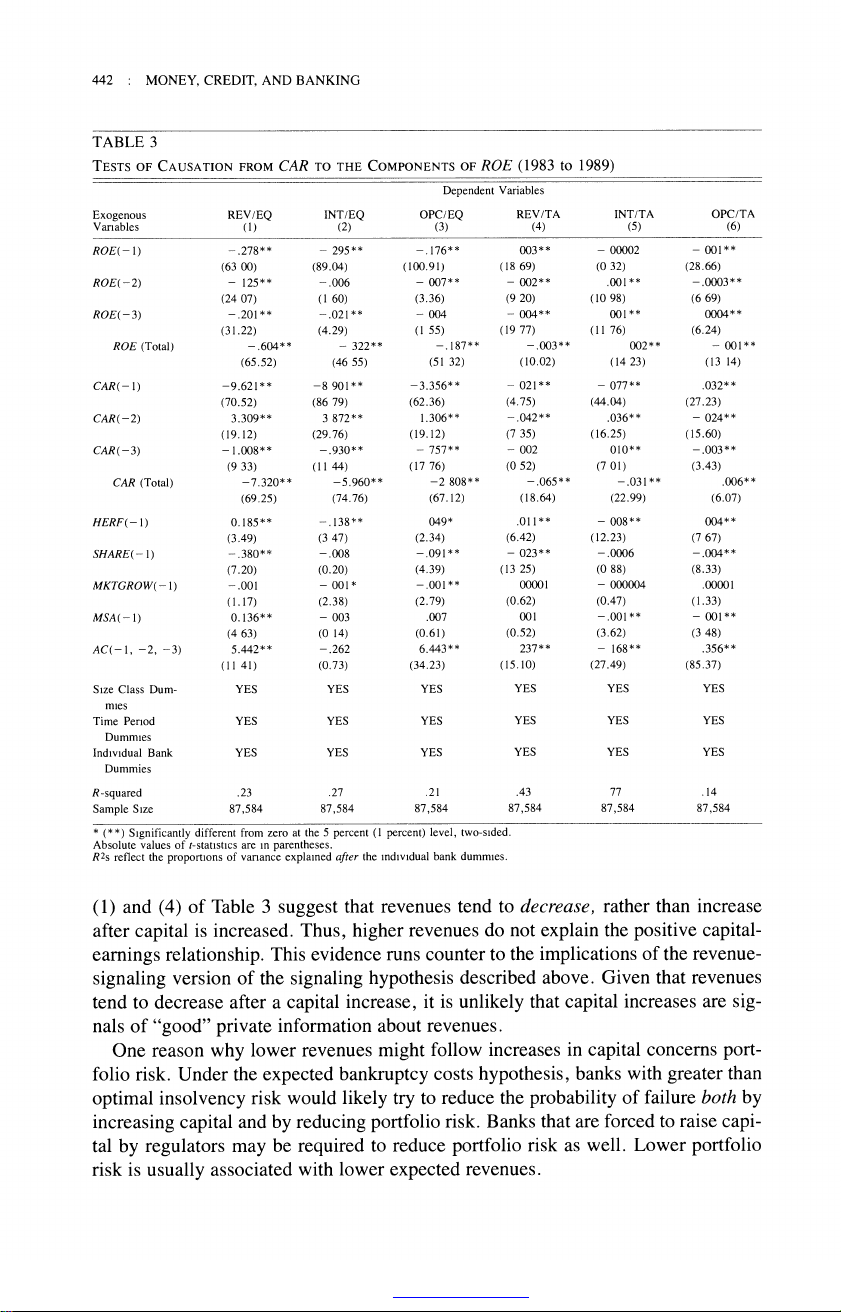
The overall
finding
suggested
by Table
3 and other
information
detailed
below is
that capital
positively
Granger-causes
earnings
because
banks pay
substantially
lower
rates on
uninsured
debt after
raising capital.
Revenues.
Turning
to specifics,
the
REVIEQ and
REVITA
regressions
in columns
9. Consistent
with
these hndings,
Avery and
Berger (1991)
found that
banks with
capital above
the
regulatory
standards
had higher future
earnings
than banks
violating the
standards. They
used a very
different
set of control
variables,
providing additional
support
for a conclusion
of robustness.
This content downloaded from 66.77.17.54 on Sun, 29 Dec 2013 09:41:34 AM
All use subject to JSTOR Terms and Conditions
442 :
MONEY, CREDIT, AND
BANKING
TABLE 3
TESTS OF
CAUSATION FROM CAR
TO THE
COMPONENTS OF ROE (1983
tO 1989)
Dependent Variables
Exogenous
Vanables
ROEf-1 )
ROE f-2)
ROEf-3)
ROE (Total)
CAR (-1 )
CARf-2)
CARf-3)
CAR (Total)
HERF f-1 )
SHAREf-1)
MKTGROW(-1)
MSAf-1)
ACf-1, -2, -3)
Slze Class Dum-
mles
Time Period
Dummles
Individual Bank
Dummies
R-squared
Sample Slze
REV/EQ
INT/EQ
OPC/EQ
REV/TA INT/TA
( 1 )
(2)
(3) (4)
(5)
OPC/TA
(6)
- 001**
(28 .66)
- .0003**
(6 69)
0004* *
(6.24)
- 001**
(13 14)
.032* *
(27.23)
- 024**
(15.60)
- .003 * *
(3.43)
.006**
(6.07)
004* *
(7 67)
- .004 * *
(8.33)
.0000 1
(1 .33)
- 001**
(3 48)
.356**
(85.37)
YES
- .278
(63 OO)
- 125
(24 07)
-.201
(3 1 .22)
- .604**
(65 . 52)
-9.621
(70.52)
3.309
(19. 12)
- 1.008
(9 33)
-7.320* *
(69.25)
0.185
(3.49)
- .380
(7.20)
- .001
(1.17)
0. 136
(4 63)
5.442
(11 41)
YES
- 295**
(89.04)
- .006
(1 60)
-.021 **
(4.29)
- 322**
(46 55)
-8 901**
(86 79)
3 872**
(29.76)
- .930**
(11 44)
-5.960**
(74.76)
- . 1388*
(3 47)
- .008
(0.20)
- 001*
(2.38)
- 003
(0 14)
- .262
(0.73)
YES
-.
176**
(100.91)
-
007**
(3.36)
-
004
(1
55)
-. 187**
(51 32)
-3.356* *
(62.36)
1
.306**
(19.
12)
-
757**
(17
76)
-2 808**
(67. 1 2)
049*
(2.34)
-
.091 **
(4.39)
-
.001 **
(2.79)
.007
(0.61)
6.443**
(34
.23)
YES
003**
(18 69)
-
002**
(9 20)
-
004**
(19 77)
-
.003**
(
10.02)
-
021**
(4.75)
-
.042**
(7 35)
- 002
(0 52)
-
.065**
(18.64)
.011 **
(6.42)
- 023**
(13 25)
00001
(0.62)
001
(0.52)
237**
(15. 10)
YES
- 00002
(0 32)
.001 **
(10 98)
001 **
(11 76)
002**
(14 23)
- 077**
(44.04)
.036**
( 16.25)
010**
(7 01)
-.031**
(22.99)
- 008**
( 12.23)
- .0006
(0 88)
- 000004
(0.47)
- .001 **
(3.62)
- 168**
(27.49)
YES
YES
YES
YES YES
YES
YES
YES
YES
YES YES
YES
YES
.43
87,584
77
87,584
.14
87,584
.23
87,584
.27
87,584
.21
87,584
* (**) Slgnificantly
different from zero at
the S percent (1 percent)
level, two-slded.
Absolute values of
t-statlstlcs are In
parentheses.
R2s reflect the
proportlons of varlance
explalned after the Indlvldual
bank dummles.
(1) and (4)
of Table 3
suggest that
revenues tend to
decrease, rather
than increase
after capital
is increased.
Thus, higher
revenues do not
explain the
positive capital-
earnings
relationship. This
evidence runs
counter to the
implications of
the revenue-
signaling
version of the
signaling
hypothesis described
above. Given
that revenues
tend to
decrease after a
capital increase, it
is unlikely
that capital
increases are sig-
nals of
"good" private
information about
revenues.
One
reason why lower
revenues might
follow
increases in capital
concerns port-
folio risk.
Under the
expected bankruptcy
costs
hypothesis, banks with
greater than
optimal
insolvency risk
would likely try to
reduce the
probability of
failure both by
increasing
capital and by
reducing
portfolio risk. Banks
that are forced to
raise capi-
tal by
regulators may be
required to
reduce portfolio risk
as well.
Lower portfolio
risk is
usually associated
with lower
expected revenues.
This content downloaded from 66.77.17.54 on Sun, 29 Dec 2013 09:41:34 AM
All use subject to JSTOR Terms and Conditions
ALLEN
N. BERGER
:
443
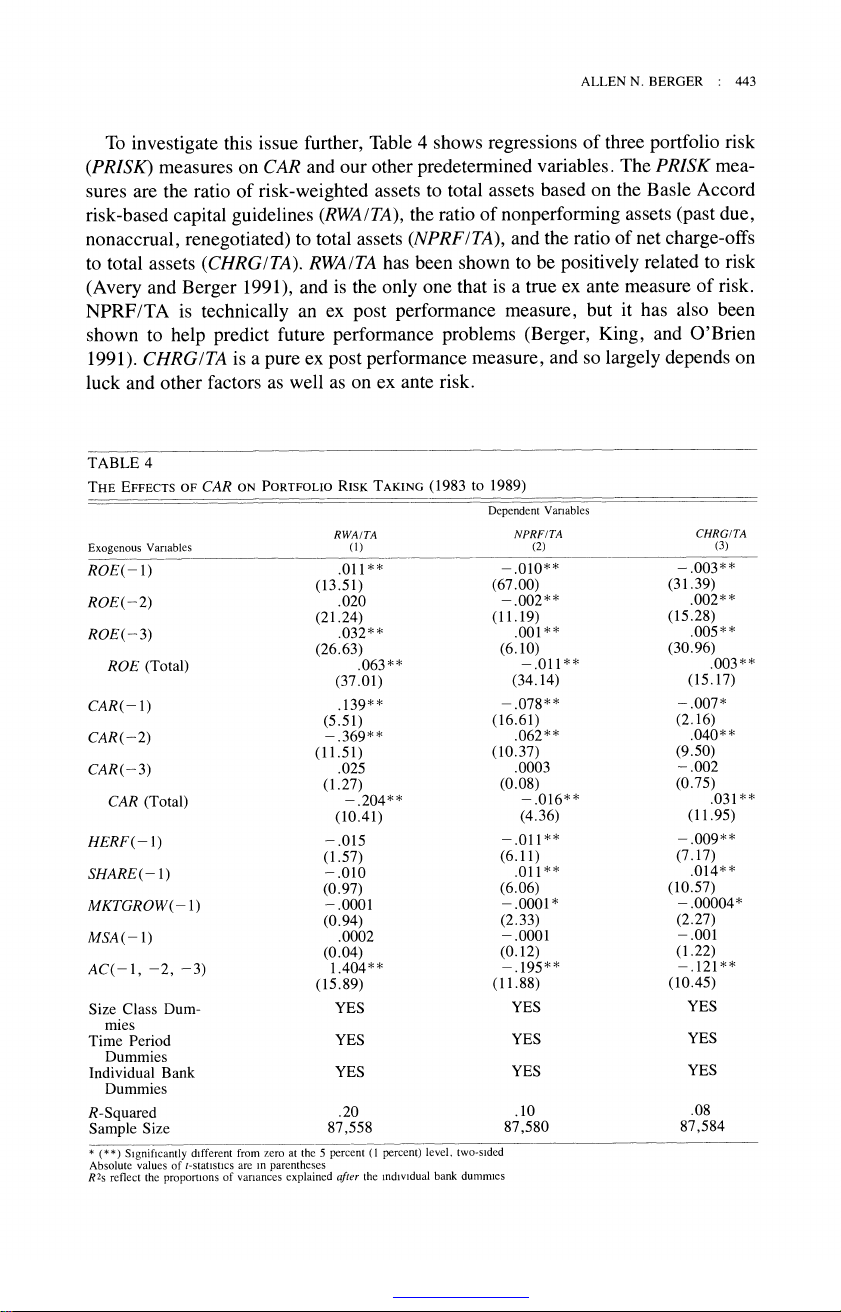
To investigate
this issue
further,
Table
4 shows
regressions
of three
portfolio
risk
(PRISK)
measures
on CAR
and
our other
predetermined
variables.
The PRISK
mea-
sures
are
the ratio
of risk-weighted
assets
to
total assets
based
on
the Basle
Accord
risk-based
capital
guidelines
(RWAITA),
the ratio
of
nonperforming
assets
(past due,
nonaccrual,
renegotiated)
to total
assets
(NPRFI
TA),
and the
ratio
of net charge-offs
to
total assets
(CHRGITA).
RWAITA
has
been
shown
to be
positively
related
to risk
(Avery
and
Berger
1991),
and
is the only
one
that is
a true
ex ante
measure
of risk.
NPRF/TA
is technically
an ex
post
performance
measure,
but
it has
also been
shown
to
help
predict
future
performance
problems
(Berger,
King,
and
O'Brien
1991).
CHRGITA
is a pure
ex
post performance
measure,
and
so largely
depends
on
luck
and
other factors
as
well
as on ex
ante risk.
TABLE
4
THE
EFFECTS
OF CAR
ON PORTFOLIO
RISK TAKING
(1983
to 1989)
Dependent
Varlables
RWA I TA
NPRFI TA
CHRGI
TA
Exogenous
Varlables
(1)
(2)
(3)
ROE(-1)
.011 **
-.010**
-.003**
(13.51)
(67.00)
(31.39)
ROE
f-2)
.020
-.002 * *
.002 *
*
(21.24)
(11.19)
(15.28)
ROEf-3)
.032**
.001 **
.005**
(26.63)
(6.10)
(30.96)
ROE (Total)
.063
* *
-.011
* *
.003
* *
(37.01)
(34.14)
(15.17)
CAR(-1)
.139**
-.078**
-.007*
(5.51)
(16.61)
(2.16)
CAR(-2)
-.369**
.062**
.040**
(11.51)
(10.37)
(9 50)
CAR(-3)
.025
.0003
-.002
(1.27)
(0.08)
(0.75)
CAR (Total)
-.204*
*
-.016*
*
.031
* *
(10.41)
(4.36)
(11.95)
HERFf-1)
-.015
-.011 **
-.009**
(1.57)
(6.11)
(7.17)
SHAREf-1)
-.010
.011 * *
.014*
*
(0.97)
(6.06)
(10.57)
MKTGROW(-1)
-.0001
-.0001 *
-.00004*
(0.94)
(2.33)
(2.27)
MSA
f-1)
.0002
-.0001
-.001
(0.04)
(0.12)
(1.22)
ACf-1,
-2,
-3)
1.404**
-.195**
-.121 **
(15.89)
(11.88)
(10.45)
Size
Class
Dum-
YES
YES
YES
mies
Time
Period
YES
YES
YES
Dummies
Individual
Bank
YES
YES
YES
Dummies
R-Squared
.20
.10
.08
Sample
Size
87,558
87,580
87,584
* (**)
Slgniflcantly
dlfferent
from zero
at the 5 percent
(I percent)
level
two-slded
Absolute
values
of t-statlstlcs
are ln parentheses
R2s
reflect the
proportlons
of varlances
explained
after the lndlvldual
bank
dummles
This content downloaded from 66.77.17.54 on Sun, 29 Dec 2013 09:41:34 AM
All use subject to JSTOR Terms and Conditions
444 :
MONEY,
CREDIT,
AND
BANKING
The
results in
Table
4
indicate
negative
CAR
coefficient
sums
for
RWAITA
and
NPRFI TA
and a
positive
CAR sum
for
CHRGI
TA .
Since
RWAI TA
and
NPRFI
TA
seem to be
better
ex
ante
indicators
of risk,
we
take this
evidence to
be at
least
weak-
ly
consistent with
the
hypothesis
that
banks that
increase their
capital
tend
to
reduce
their
portfolio
risks. As
well,
Avery
and
Berger
(1991)
found
that
banks
that
passed
the
capital
standards
had
lower
future
charge-offs,
contrary to
the
CHRGITA
result
here.
Additional
evidence in
Avery
and
Berger
(1991)
and
McAllister
and
McManus
(1992)
support
the
conclusion
that
more
highly
capitalized
banks
tend to
have
lower
portfolio
risks.
These
indications
that
capital
increases
and
portfolio
risk
decreases
are
often
coincident is
consistent
with
the
expected
bankruptcy
costs
hypothesis,
under
which both
actions may
be
used to
reduce
the
probability of
bank
failure
and
its
costs.
The
finding of
lower
future
revenue for
banks
that
increase
capital is
not
consis-
tent
with
the
risk-related
barriers-to-entry
hypothesis
described
above. By
that
argu-
ment, the
greater
safety of
a
bank
from
higher
capital
may
create
additional
opportunities to
issue
off-balance-sheet
guarantees or
allow
the
raising
of
large
amounts
of
uninsured
debt to
finance
profitable
on-balance-sheet
investments.
To
investigate
this
further,
loan
commitments,
standby
letters of
credit,
and
uninsured
purchased
funds
were
regressed
against
CAR and
the
other
predetermined
variables
(not
shown). The
results
showed
no
consistent
pattern and
failed
to
support
the
barriers-to-entry
hypothesis.
Interest
Expenses.
We next
examine the
interest
expense
equations
shown in
col-
umns
(2)
and (5)
of
Table 3.
As
expected,
interest
expenses
as
measured
by
either
INTIEQ or
INTI
TA
decrease
with
increases
in
CAR. Of
course,
even
if
interest
rates
on
debt did
not
change,
an
increase
in CAR
would be
associated with
a
reduction
in
interest
expenses
because the
quantity of
debt
upon
which
interest is
paid
decreases.
More
interesting
is the
change
in the
rates
on
debt.
There
should also
be a
reduction
in
the
interest
rates
paid on
uninsured
purchased
funds since
an
increase
in
CAR
directly
reduces
the
risk of
uninsured
debt.
Some
research
also
suggested
that
in-
sured
deposit
rates may
respond to
bank
risk
because of
deposit
liquidation
costs
or
possible
insurer
repudiation in
the
event of
bank
failure
(Cook
and
Spellman
1991).
Bank
debt rates
are
regressed
against
CAR and
the
other
predetermined
variables
in
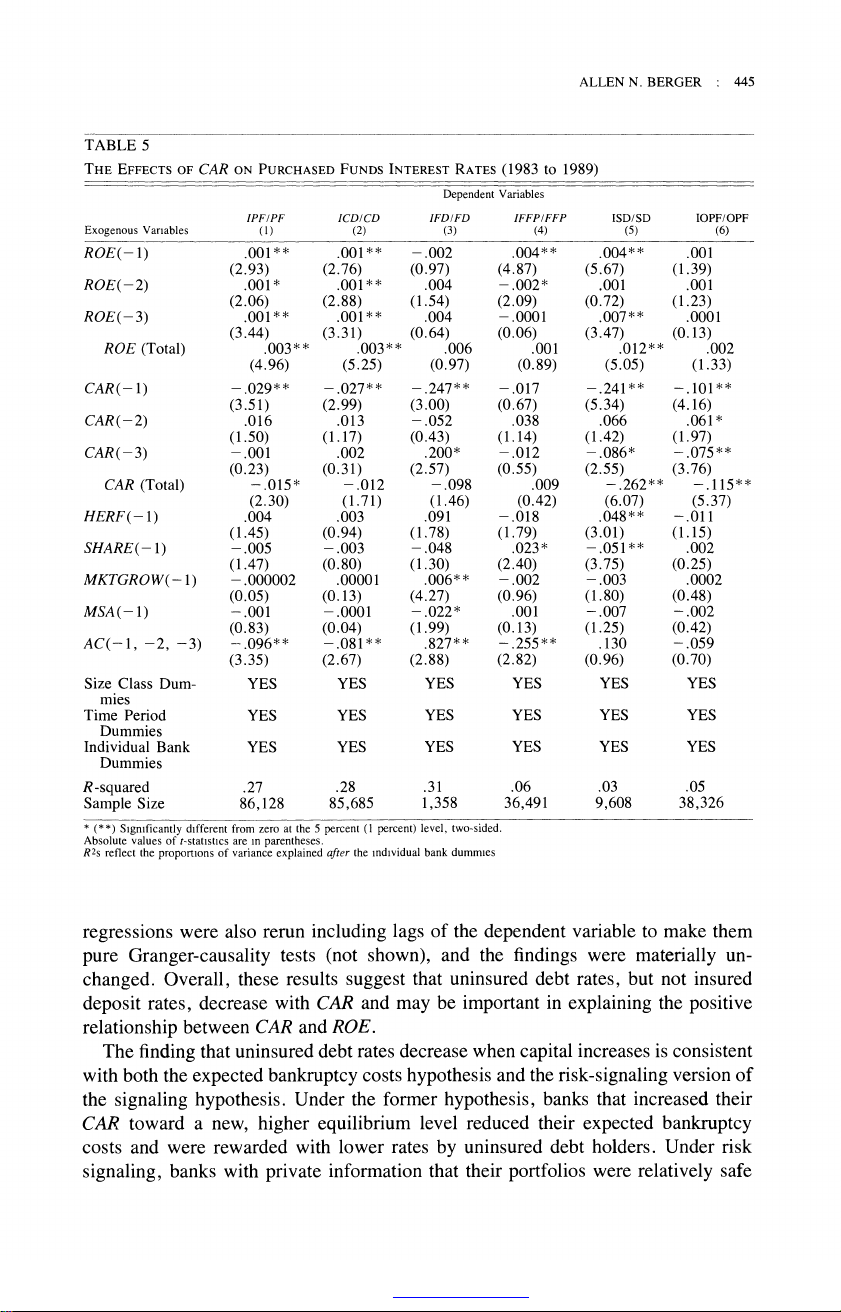
Table 5.
In
column
(1),
the
dependent
variable is
the
average
rate
paid on
all
uninsured
purchased
funds
(IPFIPF). The
coefficient
sum on
CAR
is
negative
and
statistically
significant,
suggesting
that
capital
has the
expected
effect of
reducing
rates
paid
on
uninsured
funds.
Columns
(2)-(6)
show
the
rates on
the
components
of
purchased
funds
wholesale CDs
(ICDICD),
foreign
deposits
(IFDIFD),
federal
funds
purchased
(IFFPIFFP),
subordinated
debt
(ISDISD),
and
otherpurchased
funds
(IOPFIOPF).
Four of
the five
components
have
the
predicted
negative
CAR
coefficient
sums,
with
subordinated
debt
and
other
purchased
funds
statistically
sig-
nificant.
The
finding that
uninsured
debt
rates
respond to
bank
risk is
consistent
with
most,
but
not all
of the
market
discipline
literature in
banking
[see
surveys
by
Gil-
bert
(1990),
Berger
(1991)].
We also
regressed
insured
deposit
rates
on CAR
and
the
other
variables
(not
shown)
and
found
essentially no
effect
of
CAR. All
of
these
This content downloaded from 66.77.17.54 on Sun, 29 Dec 2013 09:41:34 AM
All use subject to JSTOR Terms and Conditions
ALLEN N. BERGER : 445
TABLE S
THE EFFECTS OF CAR ON PURCHASED FUNDS INTEREST RATES (1983 to
1989)
Dependent Variables
IPFIPF ICDICD IFDIFD IFFPIFFP
ISD/SD IOPF/OPF
Exogenous Varlables (1) (2) (3) (4)
(5) (6)
ROEf-1) .001 ** .001 ** -.002 .004**
.004** .001
(2.93) (2.76) (0.97) (4.87)
(5.67) (1.39)
ROEf-2) .001 * .001 ** .004 -.002*
.001 .001
(2.06) (2.88) (1.54) (2.09)
(0.72) (1.23)
ROEf-3) .001 ** .001 ** .004 -.0001
.007** .0001
(3.44) (3.31) (0.64) (0.06)
(3.47) (0.13)
ROE (Total) .003 * * .003 * * .006 .001
.012 * * .002
(4.96) (5.25) (0.97) (0.89)
(5.05) (1.33)
CARf-1) -.029** -.027** -.247** -.017
-.241 ** -.101 **
(3.51) (2.99) (3.00) (0.67)
(5.34) (4.16)
CARf-2) .016 .013 -.052 .038
.066 .061 *
(1.50) (1.17) (0.43) (1.14)
(1.42) (1.97)
CAR f-3) -.001 .002 .200* -.012
-.086* -.075 * *
(0.23) (0.31) (2.57) (0 55)
(2.55) (3.76)
CAR (Total) -.015* -.012 -.098 .009
-.262** -.115**
(2.30) (1.71) (1.46) (0.42)
(6.07) (5 37)
HERFf-1) .004 .003 .091 -.018
.048** -.011
(1.45) (0.94) (1.78) (1.79)
(3.01) (1.15)
SHARE f-1 ) -.005 -.003 -.048 .023 *
-.051 * * .002
(1.47) (0.80) (1.30) (2.40)
(3.75) (0.25)
MKTGR O W (-1 ) -. 000002 .00001 .006 * * -.002
-.003 .0002
(0 05) (0.13) (4.27) (0.96)
(1.80) (0.48)
MSA (-1) -.001 -.0001 -.022 * .001
-.007 -.002
(0.83) (0.04) (1.99) (0.13)
(1.25) (0.42)
ACf-1, -2, -3) -.096** -.081 ** .827** -.255**
.130 -.059
(3.35) (2.67) (2.88) (2.82)
(0.96) (0.70)
Size Class Dum- YES YES YES YES
YES YES
mies
Time Period YES YES YES YES
YES YES
Dummies
Individual Bank YES YES YES YES
YES YES
Dummies
R -squared .27 .28 .31 .06
.03 .05
Sample Size 86,128 85,685 1,358 36,491
9,608 38,326
* (**) Slgnlficantly dlfferent from zero at the S percent (1 percent) level, two-sided.
Absolute values of t-statlstlcs are In parentheses.
R2s reflect the proportlons of variance explained after the Indlvidual bank dummles
regressions were also rerun including lags of the dependent
variable to make them
pure Granger-causality tests (not shown), and the findings
were materially un-
changed. Overall, these results suggest that uninsured debt
rates, but not insured
deposit rates, decrease with CAR and may be important in
explaining the positive
relationship between CAR and ROE.
The finding that uninsured debt rates decrease when capital
increases is consistent
with both the expected bankruptcy costs hypothesis and the risk-signaling
version of
the signaling hypothesis. Under the former hypothesis, banks
that increased their
CAR toward a new, higher equilibrium level reduced their
expected bankmptcy
costs and were rewarded with lower rates by uninsured debt
holders. Under risk
signaling, banks with private information that their portfolios
were relatively safe
This content downloaded from 66.77.17.54 on Sun, 29 Dec 2013 09:41:34 AM
All use subject to JSTOR Terms and Conditions
446 :
MONEY, CREDIT, AND
BANKING
may have
credibly
transmitted this
information to debt
holders through
higher capi-
tal, and
therefore were
able to pay lower
interest rates on
uninsured
funds.
To try to
distinguish
better between
these hypotheses,
we also
replicated the main
ROE
regression in Table 2,
column (3),
for some subsets
of the data set.
If any form
of the
signaling
hypothesis is the
primary
explanation of the
positive capital-
earnings
relationship, the
relationship
should be strongest
when banks
increase capi-
tal, rather
than decrease
it. This is
because banks with
"good" private
information
would want
to separate
themselves by
increasing capital,
but banks with
"bad" pri-
vate
information would
not want to reveal
this by
decreasing capital.
Here we mean
actual
capital increases
and decreases,
rather than just
relative to what
capital would
normally
be for the bank
and time
period, as in the rest
of the text.
When the data
were
separated into actual
capital
increases and
decreases, we find that
the capital-
earnings
relationship was
positive only
for the subset
that decreased
capital, and
was
negative and
significant for the
subset that decreased
capital (not
shown). This
is
inconsistent with the
signaling
hypothesis, since
positive capital
signals do not
predict
improved future
performance. By
contrast, this
result is
consistent with the
expected
bankruptcy
hypothesis it
suggests that those
banks that
decreased their
capital had
the largest
earnings loss from
the shift to the
riskier regime of
the 1980s.
We
further subdivided
the subset of
banks with
actual capital
increases by the
reason for
the increase: (i)
whether new
equity was
issued or not, (ii)
whether loan
loss
provisions (which
decrease capital)
were high or
low (top or
bottom quarter),
(iii)
whether dividends
and stock
buybacks (which
decrease capital)
were high or
low, and
(iv) whether
retained earnings
(computed as the
residual change
in capital)
were high
or low. The
capital-earnings
relationship was
negative for
almost all of
these
groups, and was
especially negative
and significant
when new
capital was is-
sued. This
again runs
contrary to the
signaling
hypothesis, which would
predict the
strongest
positive effect
of capital when
a bank actively
issues new
capital. Sim-
ilarly, the
results were
also negative for
both the high
and low loan
loss provision
groups,
suggesting that
banks likely are
not signaling
about the risks of
their portfo-
lios with
this variable.
We also
examined the
signaling
hypothesis by
checking the
robustness of the
main
results by bank size.
Signaling
effects are
expected to be
strongest for small
banks,
where managers
often have a large
ownership
stake in the bank,
where infor-
mation is
most likely to be
private, and
where capital
decisions are most
likely to be
voluntary.
When the
regressions were
rerun separately for
small,
medium, and large
banks (not
shown), the
positive
capital-earnings
relationship remained
strong for all
three
groups, contrary to
the predictions
of the signaling
hypothesis.
Operating Costs. We
turn next to the
operating cost
regressions in
columns (3)
and (6) of
Table 3. The
effect of capital
does not appear
to be
consistent-the CAR
coefficient
sum is
negative in the
OPCIEQ equation,
but positive in
the OPCITA
equation.
This
inconsistency, combined
with the result
shown elsewhere
that operat-
ing cost
efficiencies do
not change
substantially over
time (Berger and
Humphrey
1991,1992), suggests that
short-term
changes in
operating efficiency do
not explain
the positive
effect of CAR
on ROE.
These data also
suggest that
changes in capital
This content downloaded from 66.77.17.54 on Sun, 29 Dec 2013 09:41:34 AM
All use subject to JSTOR Terms and Conditions
ALLEN N.
BERGER
: 447
do not
constitute a
signal
that
management
has
favorable
private
information
abollt
operating
costs.
Robustness
Checks
with
PorMolio
Risk
As a
further
check,
the
ROE
regressions
were
rerun
with
measures
of
portfolio
risk
(PRlSK)
controlled for
on the
right-hand side.
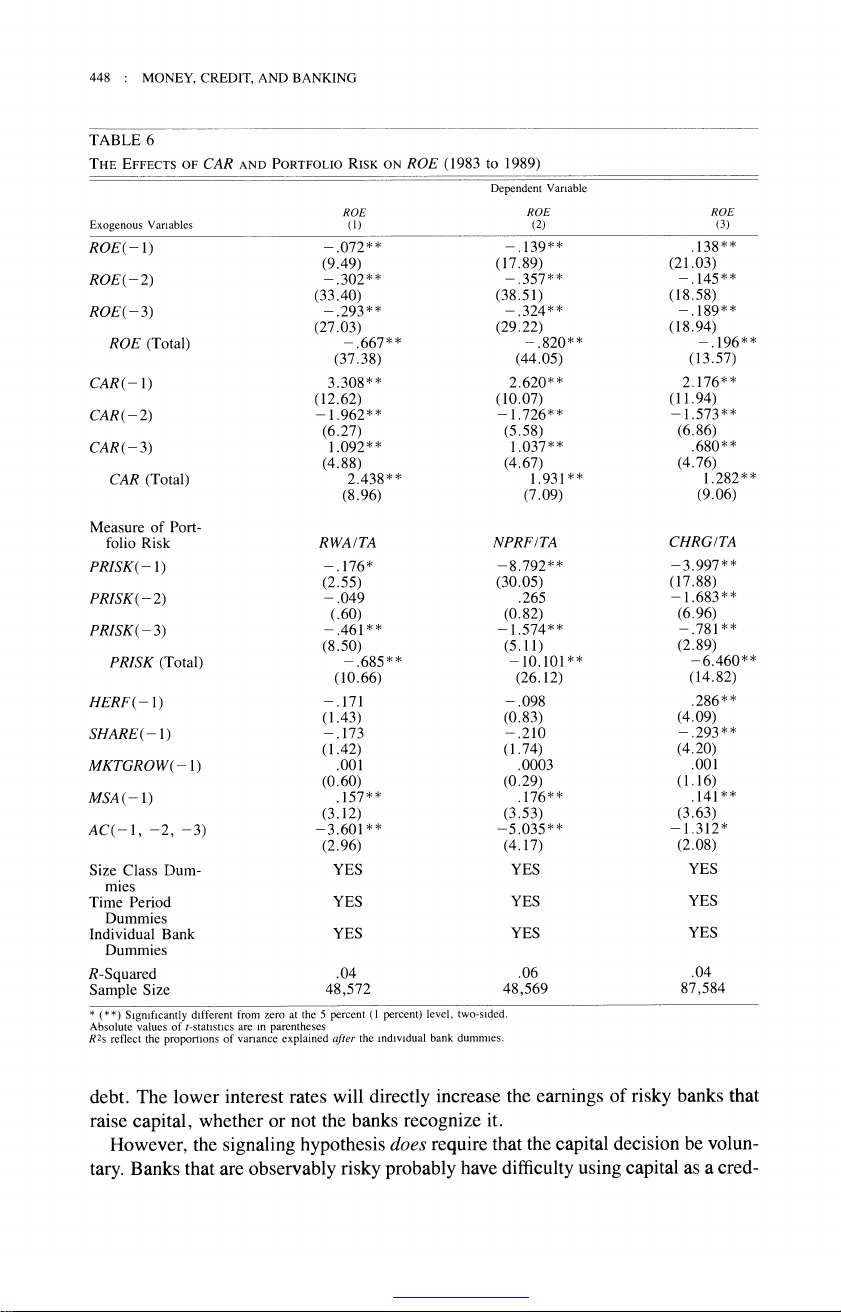
Table
6
replicates
our main
ROE
regression,
except that
each
regression
includes
three lags
of one
of the
PRlSK
mea-
sures
(RWAITA,
NPRFITA,
CHRGITA).
These
regressions
remove
from the
CAR
coefficients
some of
the
endogenous
effects of
banks
lowering
their
portfolio
risks
after
raising
their
capital (as
shown
in
Table 4).
The
CAR
coefficient
sums
remain
positive
and
statistically
significant,
and
actually
increase
when
the
PRlSK
lags are
included,
confirming
the
robustness
of our
main
result.
The
PRlSK
coefficient
sums
are also
negative and
significant in
all
three
cases.
These
findings
suggest
that re-
ductions
in
bank
failure risk
from
either
capital
increases
or
portfolio
risk
decreases
tend to
predict
higher
earnings.
These
findings
are
consistent
with
the
expected
bankruptcy
costs
hypothesis.
Further
checking
reveals
two
notable
areas in
which
the
employment
of the
PRlSK
variables yield
new
results.
First,
the
interest
rates paid
on
uninsured
pur-
chased
funds
do not
consistently
decrease
with
CAR
when
PRlSK is
included
in the
regressions,
although
these
rates do
consistently
increase
with
PRlSK
(not
shown).
This
suggests
that
uninsured
creditors may
often
reduce
their
required
returns
in re-
sponse
to a
change in
capital only
after
the
recapitalizing
bank has
also
reduced
portfolio
risk
(which
usually
occurs
in our
data
set).
Second, we
find
that the
capital-earnings
relationship
is not
uniform
across
risk
classes
of
banks. In
Table
7,
banks are
grouped
into
high-,
medium-, and
low-
risk
thirds
based first
on
CAR,
which
measures
leverage
risk,
and
then
based on
RWAITA,
which
measures
portfolio
risk.
For all
six
groups, we
ran an
ROE
regres-
sion
including
the
RWAtTA
lags on
the
right-hand
side as
well as
the
CAR lags
and
the other
usual
regressors.
Examination of
the CAR
(Total)
row
of the
table
suggests
that the
main
result
that
capital
positively
Granger-causes
earnings is
only
strong
and
consistent
for the
highest-risk
third of
the
data as
measured
by
either
leverage
risk or
portfolio
risk.
These
findings
suggest
that
the
benefits from
increasing
capital
may
largely
accrue to
the
riskiest
banks.
This
supports
the
expected
bankruptcy
costs
hypothesis,
under
which the
riskiest
banks
with
the
highest
expected
bank-
ruptcy
costs
stand to
gain
the most
by
reducing
these
costs.
That is,
the
riskiest
banks
are the
most
likely to
be
below their
equilibrium
CAR
and have
the
largest
expected
bankruptcy
costs to
be
reduced by
increasing
CAR.
Note
that
these
observably
risky
banks
(low
CAR
and/or
high
RWAITA)
often
have the
least
control
over
their
capital
decisions.
For
these
banks,
regulatory
inter-
vention
or the
fear of
it may
dominate the
decision to
raise
capital.
The
expected
bankruptcy
costs
hypothesis
does not
depend upon
the
capital
decision
being
volun-
tary. All
that is
required for
this
hypothesis
is that
capital
market
participants
recog-
nize the
value
of
higher
capital and
reflect
this in
their
demands
for
uninsured
bank
This content downloaded from 66.77.17.54 on Sun, 29 Dec 2013 09:41:34 AM
All use subject to JSTOR Terms and Conditions
448 :
MONEY, CREDIT, AND
BANKING
TABLE 6
THE EFFECTS
OF CAR AND
PORTFOLIO RISK ON
ROE (1983 to 1989)
Dependent
Varlable
ROE
ROE
ROE
Exogenous
Varlables
(1)
(2)
(3)
ROEf-1)
-.072**
-.139**
.138**
(9.49)
(17.89)
(21.03)
ROEf-2)
-.302**
-.357**
-.145**
(33.40)
(38.51)
(18.58)
ROEf-3)
-.293**
-.324**
-.189**
(27.03)
(29.22)
(18.94)
ROE
(Total)
-.667 * *
-.820 * *
-.196
(37.38)
(44
05)
(13.57)
CARf-1)
3.308**
2.620**
2.176**
(12.62)
(10.07)
(11.94)
CARf-2)
-1.962**
-1.726**
-1.573**
(6.27)
(5.58)
(6.86)
CARf-3)
1.092**
1.037**
.680**
(4.88)
(4.67)
(4.76)
CAR
(Total)
2.438**
1.931**
1.282
(8.96)
(7.09)
(9.06)
Measure of
Port-
folio Risk
RWAITA
NPRFITA
CHRGITA
PRISK(-1)
-.176*
-8.792**
-3.997**
(2.55)
(30.05)
(17.88)
PRISK(-2)
-.049
.265
-1.683 * *
(.60)
(0.82)
(6.96)
PRISK(-3)
-.461 **
-1.574**
-.781 **
(8.50)
(5.11)
(2.89)
PRISK
(Total)
-.685**
-10.101 **
-6.460
(10.66)
(26.12)
(14.82)
HERFf-1)
-.171
-.098
.286**
(1.43)
(0.83)
(4.09)
SHAREf-1)
-.173
-.210
-.293**
(1.42)
(1.74)
(4.20)
MKTGROW(-1)
.001
.0003
.001
(0.60)
(0.29)
(1.16)
MSA f-1)
.157**
.176**
.141 **
(3.12)
(3.53)
(3.63)
ACf-1, -2,
-3)
-3.601 **
-5.035**
-1.312*
(2.96)
(4.17)
(2.08)
Size Class
Dum-
YES
YES
YES
mies
Time Period
YES
YES
YES
Dummies
Individual
Bank
YES
YES
YES
Dummies
R-Squared
.04
.06
.04
Sample Size
48,572
48,569
87,584
* (**) Slgnlflcantly
dlfferent from zero at
the S percent (I percent)
level, two-slded.
Absolute values of
t-statlstlcs are In
parentheses
R2s reflect the
proportlons of varlance
explained after the Indlvldual
bank dummles.
debt. The
lower interest
rates will directly
increase the
earnings of risky
banks that
raise
capital, whether or
not the banks
recognize it.
However,
the signaling
hypothesis does
require that the
capital
decision be volun-
tary. Banks
that are
observably risky
probably have
difficulty using
capital as a cred-
This content downloaded from 66.77.17.54 on Sun, 29 Dec 2013 09:41:34 AM
All use subject to JSTOR Terms and Conditions
TABLE 7
THE
EFFECTS
OF CAR
AND
PORTFOLIO
RISK ON
ROE
FOR BANKS
IN LOW,
MEDIUM, AND
HIGH
THIRDS OF
CAR
ANDRWAITA (1983
to 1989)
Sample
of Banks
Included
Low
Medium
High
High
Medium
Low
CAR
CAR
CAR
RWAITA
RWAITA
RWAITA
Dependent
Vanable
ROE
ROE
ROE
ROE
ROE
ROE
Exogenous
Variables
(1)
(2)
(3)
(4)
(5)
(6)
ROEf-1)
-.113**
.261 **
.394**
-.048**
.039**
-.088**
(9.71)
(11.89)
(13.99)
(3.70)
(3.20)
(13.19)
ROEf-2)
-.278**
-.020
-.010
-.212**
-.135**
-.090**
(20.04)
(0.90)
(0.34)
(13.44)
(12.02)
(14.57)
ROEf-3)
-.221
**
-.096**
.048*
-.254**
-.149**
-.089**
(10.07)
(5-55)
(2.04)
(13.02)
(12.03)
(16.03)
ROE
(Total)
-.612**
.146**
-.431 **
-.514**
-.245**
-.268**
(19.70)
(3.88)
(8.54)
(16.71)
(10.47)
(21.72)
CARf-1)
14.598**
.398
.155
12.064**
.013
-.445**
(14.91)
(0.79)
(1.09)
(15.50)
(°-°S)
(8.39)
CAR
f-2)
-7.770*
*
-.074
-.092
-6.293
* *
-.973 * *
.006
(7.86)
(0.19)
(0.51)
(7-03)
(3.65)
(0.07)
CAR
(-3)
3.787 *
*
-.048
.247
2.324
* *
-.054
-.632* *
(6.25)
(0.20)
(1.81)
(4.76)
(0.31)
(8.88)
CAR (Total)
10.615**
.267
.310*
8.095**
-1.015**
-1.071**
(10.93)
(0-59)
(2.04)
(12.52)
(4.56)
(17.29)
RWAITA f-1)
-. 155
-.315**
-.193**
-.202
-.233**
-.073**
(1.11)
(6.30)
(3.89)
(1.05)
(3.80)
(3.96)
RWA I
TA (-2)
-.266
-.024
-.070
-.248
-.098 *
-.098 * *
(1.78)
(0.46)
(1.35)
(1.38)
(2.07)
(5-77)
RWAI
TA f-3)
-.644*
*
-.037
-.009
-.559
* *
-.078
.022
(5.58)
(0.89)
(0.21)
(3.93)
(1.96)
(1.70)
RWAITA
(Total)
-1.065**
-.376**
-.272**
-1.009**
-.409**
-.149**
(8.02)
(8.25)
(6.28)
(5.08)
(6.69)
(9.16)
(continued
)
This content downloaded from 66.77.17.54 on Sun, 29 Dec 2013 09:41:34 AM
All use subject to JSTOR Terms and Conditions
TABLE 7
(Continued )
Sample
of Banks
Included
Low
Medlum
Hlgh
Hlgh
Medlum
Low
CAR
CAR
CAR
RWAITA
RWAITA
RWAITA
Dependent
Varlable
ROE
ROE
ROE
ROE
ROE
ROE
Exogenous
Vanables
(1)
(2)
(3)
(4)
(5)
(6)
HERFf-1)
-.1 13
-. 164*
.005
-.327
-.026
.
104**
(0.41)
(2.05)
(0.05)
(1
03)
(0.35)
(3.65)
SHAREf-1)
-.616*
-.161
-.080
-.425
-.114
-.142**
(2.34)
(1.91)
(0.85)
(1.45)
(1.53)
(4.76)
MKTGROW(-1 )
.001
-.001
.001
.001
.001
.0001
(0.87)
(0.92)
(0.26)
(0.82)
(0.70)
(0.33)
MSA
f-1)
.075
-.007
.004
.287**
.005
-.0001
(0.82)
(0.16)
(0.08)
(2.59)
(0.12)
(0.01)
ACf-1, -2,
-3)
-3.738
1.600
-1.311
-.207**
1.921 *
-.209**
(1.51)
(1.53)
(1.61)
(16.11)
(2.11)
(14.00)
Size
Class
Dum-
YES
YES
YES
YES
YES
YES
mies
Time
Period
Dum-
YES
YES
YES
YES
YES
YES
mies
Individual
Bank
YES
YES
YES
YES
YES
YES
Dummies
R
-squared
.04
.02
.02
.04
.03
.06
Sample
Size
20,413
20,415
20,414
20,414
20,415
20,413
* (**)
Slgnlflcantly
dlfferent from
zero at the
5 percent
(I
percent) level,
two-slded.
Absolute
values of
t-statlstlcs are In
parentheses
R2s
reflect the
proportlons
of
varlance
explalned after
the
Indlvldual bank
dummles.
This content downloaded from 66.77.17.54 on Sun, 29 Dec 2013 09:41:34 AM
All use subject to JSTOR Terms and Conditions

Preview text:

The Relationship between Capital and Earnings in Banking Author(s): Allen N. Berger
Source: Journal of Money, Credit and Banking, Vol. 27, No. 2 (May, 1995), pp. 432-456
Published by: Ohio State University Press
Stable URL: http://www.jstor.org/stable/2077877 . Accessed: 29/12/2013 09:41
Your use of the JSTOR archive indicates your acceptance of the Terms & Conditions of Use, available at .
http://www.jstor.org/page/info/about/policies/terms.jsp .
JSTOR is a not-for-profit service that helps scholars, researchers, and students discover, use, and build upon a wide range of
content in a trusted digital archive. We use information technology and tools to increase productivity and facilitate new forms
of scholarship. For more information about JSTOR, please contact support@jstor.org. .
Ohio State University Press is collaborating with JSTOR to digitize, preserve and extend access to Journal of Money, Credit and Banking. http://www.jstor.org
This content downloaded from 66.77.17.54 on Sun, 29 Dec 2013 09:41:34 AM
All use subject to JSTOR Terms and Conditions
This content downloaded from 66.77.17.54 on Sun, 29 Dec 2013 09:41:34 AM
All use subject to JSTOR Terms and Conditions
This content downloaded from 66.77.17.54 on Sun, 29 Dec 2013 09:41:34 AM
All use subject to JSTOR Terms and Conditions
This content downloaded from 66.77.17.54 on Sun, 29 Dec 2013 09:41:34 AM
All use subject to JSTOR Terms and Conditions
This content downloaded from 66.77.17.54 on Sun, 29 Dec 2013 09:41:34 AM
All use subject to JSTOR Terms and Conditions
This content downloaded from 66.77.17.54 on Sun, 29 Dec 2013 09:41:34 AM
All use subject to JSTOR Terms and Conditions
This content downloaded from 66.77.17.54 on Sun, 29 Dec 2013 09:41:34 AM
All use subject to JSTOR Terms and Conditions
This content downloaded from 66.77.17.54 on Sun, 29 Dec 2013 09:41:34 AM
All use subject to JSTOR Terms and Conditions
This content downloaded from 66.77.17.54 on Sun, 29 Dec 2013 09:41:34 AM
All use subject to JSTOR Terms and Conditions
This content downloaded from 66.77.17.54 on Sun, 29 Dec 2013 09:41:34 AM
All use subject to JSTOR Terms and Conditions
This content downloaded from 66.77.17.54 on Sun, 29 Dec 2013 09:41:34 AM
All use subject to JSTOR Terms and Conditions
This content downloaded from 66.77.17.54 on Sun, 29 Dec 2013 09:41:34 AM
All use subject to JSTOR Terms and Conditions
This content downloaded from 66.77.17.54 on Sun, 29 Dec 2013 09:41:34 AM
All use subject to JSTOR Terms and Conditions
This content downloaded from 66.77.17.54 on Sun, 29 Dec 2013 09:41:34 AM
All use subject to JSTOR Terms and Conditions
This content downloaded from 66.77.17.54 on Sun, 29 Dec 2013 09:41:34 AM
All use subject to JSTOR Terms and Conditions
This content downloaded from 66.77.17.54 on Sun, 29 Dec 2013 09:41:34 AM
All use subject to JSTOR Terms and Conditions
This content downloaded from 66.77.17.54 on Sun, 29 Dec 2013 09:41:34 AM
All use subject to JSTOR Terms and Conditions
This content downloaded from 66.77.17.54 on Sun, 29 Dec 2013 09:41:34 AM
All use subject to JSTOR Terms and Conditions
This content downloaded from 66.77.17.54 on Sun, 29 Dec 2013 09:41:34 AM
All use subject to JSTOR Terms and Conditions
This content downloaded from 66.77.17.54 on Sun, 29 Dec 2013 09:41:34 AM
All use subject to JSTOR Terms and Conditions