Bài giảng Chapter 01: Introduction to ASPNET Core and RESTful Service môn Lập trình | Trường Đại học FPT Hà Nội
Bài giảng Chapter 01: Introduction to ASPNET Core and RESTful Service môn Lập trình | Trường Đại học FPT Hà Nội. Tài liệu được sưu tầm giúp bạn tham khảo, ôn tập và đạt kết quả cao. Mời bạn đọc đón xem.
Môn: Lập trình (FPT) 6 tài liệu
Trường: Trường Đại học FPT Hà Nội 62 tài liệu
Tác giả:

Preview text:
ASP.NET Core and RESTful Service Objectives ◆ Hypertext Transfer Protocol ◆
Representational State Transfer (REST) ◆ RESTful Web Service ◆
Introducing ASP.NET Core RESTful Services ◆ ASP.NET Core HTTP Verbs ◆
Controller Actions with RESTful Services ◆
Running OWIN middleware in ASP.NET Core pipeline 2
Hypertext Transfer Protocol (HTTP) ◆ A communications protocol ◆
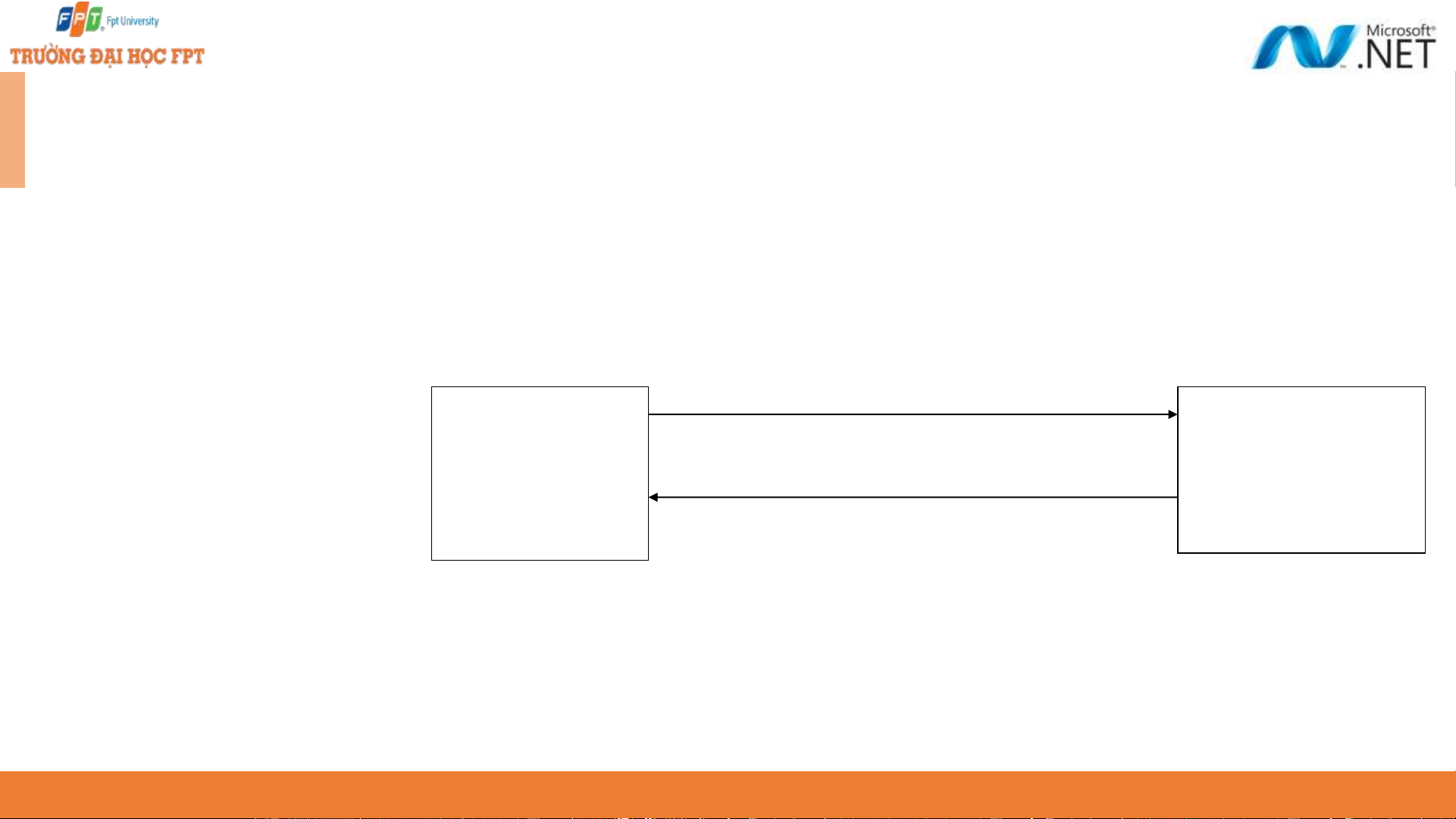
Allows retrieving inter-linked text documents (hypertext) ▪ World Wide Web. ◆ HTTP Verbs GET /index.html HTTP/1.1 ▪ HEAD Host: www.university.edu ▪ GET Browser Web Server ▪ POST ▪ PUT HTTP/1.1 200 OK ▪ DELETE Content-Type: text/html ▪ TRACE ▪ OPTIONS … ▪ CONNECT 3
HTTP Request-response format ◆ Request consists of ▪
Request line, such as GET /images/logo.gif HTTP/1.1, which requests a
resource called /images/logo.gif from server. ▪
Headers, such as Accept-Language: en ▪ An empty line ▪ An optional message body ◆ Response consists of ▪
Status line which includes numeric status code and textual reason phrase ▪ Response headers ▪ An empty line ▪ The requested content 4 HTTP Request Components ◆
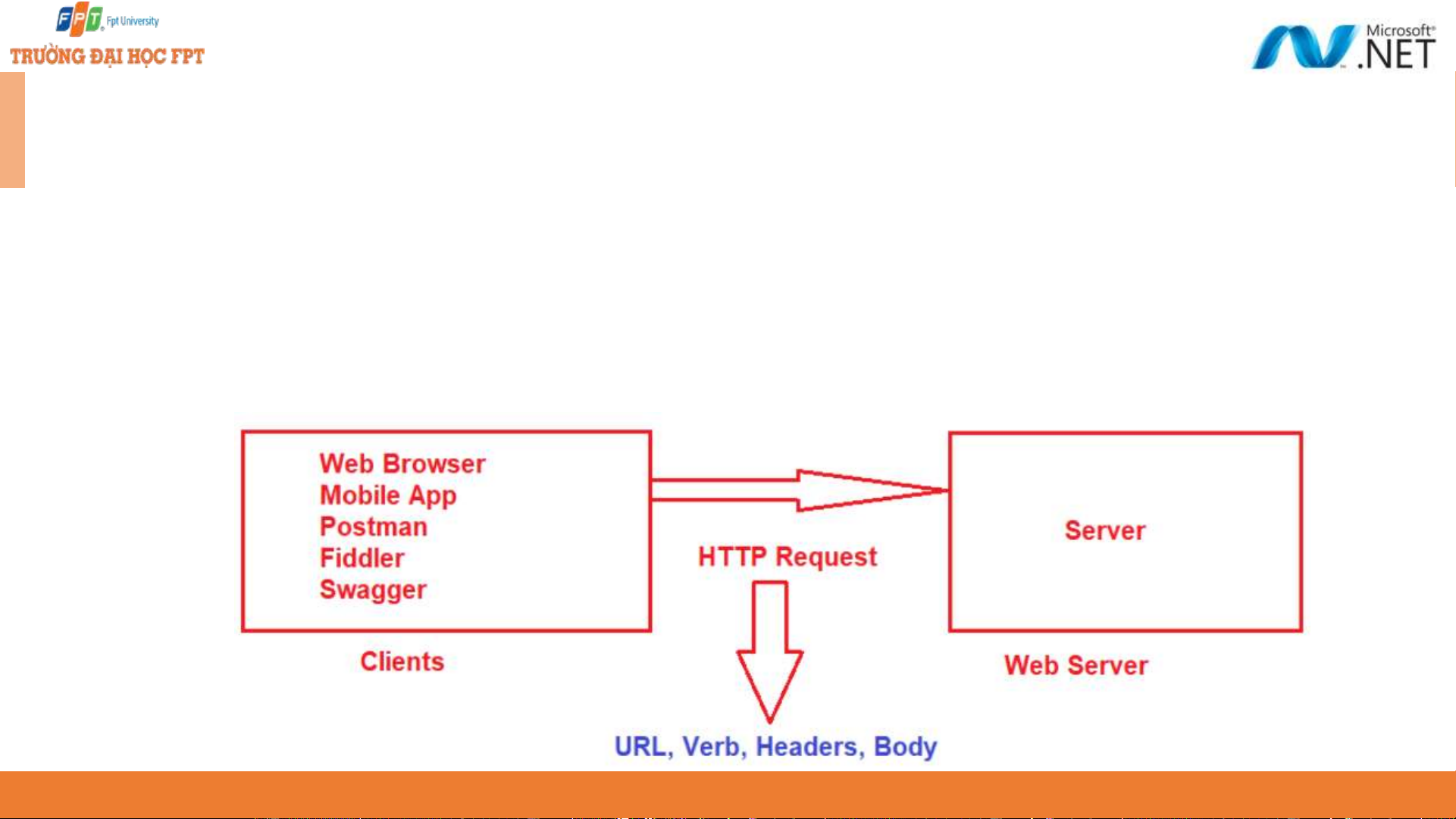
URL: Each Request must have a unique URL ◆
Verb (Method): Each Request must have an HTTP Verb. ◆
Header(s): Each Request can contain one or more Headers. ◆
Body: Each request can have a body. The body contains the data that we want to send to the server. 5
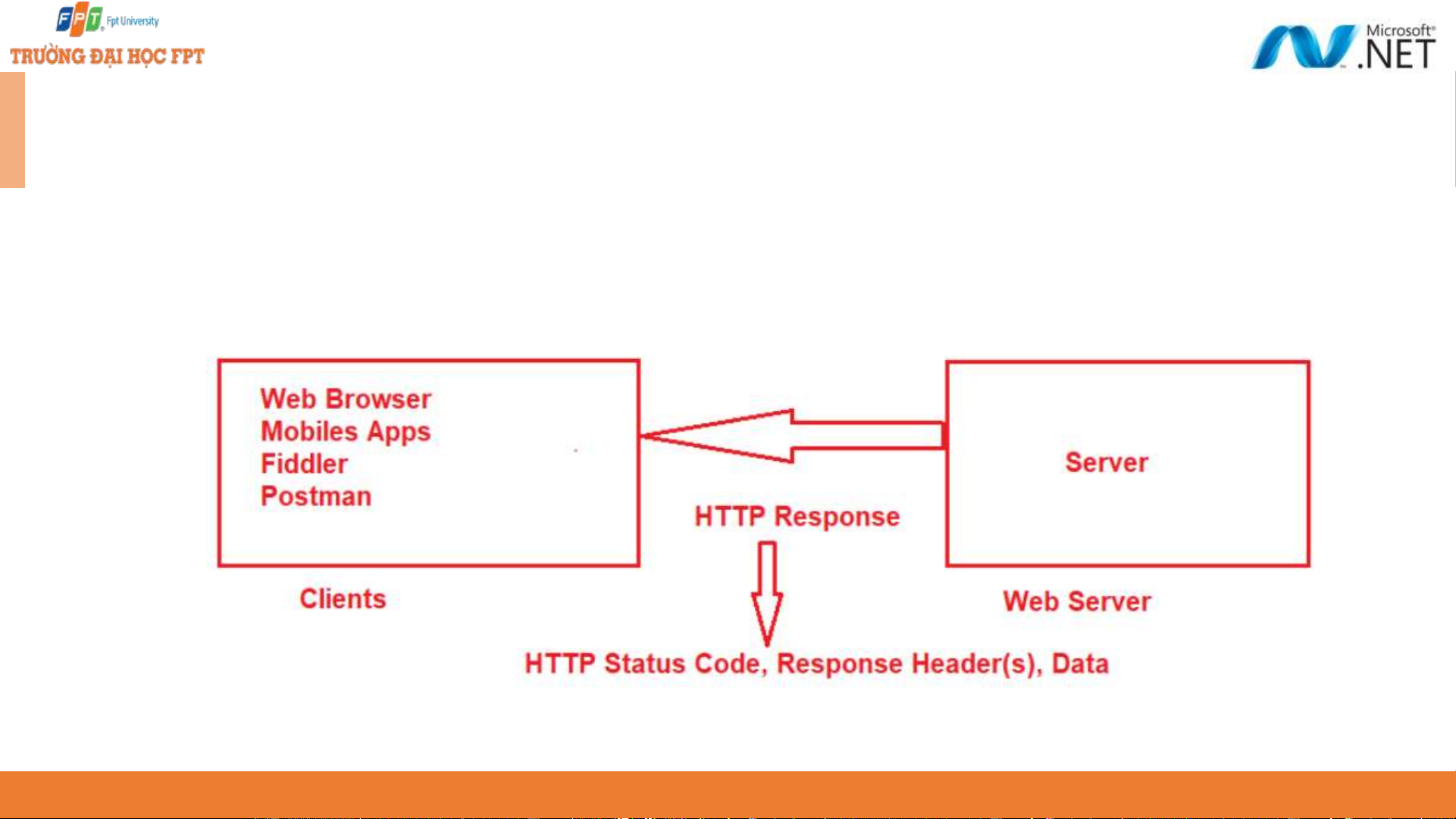
HTTP Response Components ◆
HTTP Status Code: It must have a Status Code. ◆
Response Headers: It can have one or more response headers. ◆
Data: Response can have data i.e. return to the client. 6 HTTP Status Codes ◆
The Status code is issued from the server and they give information about the response. ◆
1XX: Informational Response ◆
2XX: Successful, whenever you get 2XX as the response code, it means the request is successful. ◆
3XX: Redirection, whenever you get 3XX as the response code, it means it is re-
directional i.e. some re-directional is happening on the server. ◆
4XX: Client Error, whenever you get 4XX as the response code, it means there is
some problem with your request. ◆
5XX: Server Error. Whenever you get 5XX as the response code, it means there is some problem in the server. 7 REST ◆
REST stands for Representational State Transfer ◆
It is an architectural pattern for developing web services as opposed to a specification ◆
REST web services communicate over the HTTP specification, using HTTP vocabulary ▪ Methods (GET, POST, etc.) ▪
HTTP URI syntax (paths, parameters, etc.) ▪ HTTP Response codes. ▪
Media types (xml, json, html, plain text, etc) 8
SOAP: Simple Object Access Protocol
◆ A protocol specification for exchanging structured information in the implementation
of Web Services. It defines a standard message format.
◆ Purpose: Designed for robust, standardized communication, often in enterprise
environments. Ensures interoperability between applications built on different platforms/languages. ◆ Key characteristics: ▪
XML-Based: All SOAP messages must be formatted in XML. ▪
Standards-Driven: Relies heavily on related WS-* standards (Web Services
Specifications) like WSDL (Web Services Description Language), WS-Security ▪
Transport Independent: Can operate over various protocols (HTTP, SMTP,
TCP, etc.), although HTTP/HTTPS is the most common. 9
Major REST principles - 1 ◆
Information is organized in the form of resources ▪
Sources of specific information, ▪
Referenced with a global identifier (e.g., a URI in HTTP). ◆
Components of the network (user agents and origin servers) communicate via a
standardized interface (e.g., HTTP) ▪
exchange representations of these resources (the actual documents conveying the information). 10
Major REST principles - 2 ◆
Any number of connectors (e.g., clients, servers, caches, tunnels, etc.) can mediate
the request, but each does so without being concern about anything but its own request ▪
an application can interact with a resource by knowing two things: the identifier of
the resource and the action required ▪
no need to know whether there are caches, proxies, gateways, firewalls, tunnels, or
anything else between it and resource ▪
The application needs to understand the format of the information (representation) returned. 11
Characteristics of a REST based network ◆
Client-Server: a pull-based interaction style(Client request data from servers as and when needed). ◆
Stateless: each request from client to server must contain all the information
necessary to understand the request, and cannot take advantage of any stored context on the server. ◆
Cache: to improve network efficiency, responses must be capable of being labeled as cacheable or non-cacheable. ◆
Uniform interface: all resources are accessed with a generic interface (e.g., HTTP GET, POST, PUT, DELETE). ◆
Named resources - the system is comprised of resources which are named using a URL. ◆
Interconnected resource representations - the representations of the resources are
interconnected using URLs, thereby enabling a client to progress from one state to another. 12
RESTful Web Service definition ◆ A RESTful Web service is: ▪ A set of Web resources. ▪ Interlinked. ▪
Data-centric, not functionality-centric. ▪ Machine-oriented. ◆
Like Web applications, but for machines. ◆
Like WS-*, but with more Web resources (WS-* stands for a variety of
specifications related to SOAP-based Web Services). 13
Principles of RESTful web service design - 1
1. Identify all the conceptual entities that we wish to expose as services. (Resources
such as : parts list, detailed part data, purchase order)
2. Create a URL to each resource.
3. Categorize our resources according to whether clients can just receive a
representation of the resource (using an HTTP GET), or whether clients can modify
(add to) the resource using HTTP POST, PUT, and/or DELETE).
4. All resources accessible via HTTP GET should be side-effect free. That is, the
resource should just return a representation of the resource. Invoking the resource
should not result in modifying the resource. 14
Principles of RESTful web service design - 2
5. Put hyperlinks within resource representations to enable clients to drill down for
more information, and/or to obtain related information.
6. Design to reveal data gradually. Don't reveal everything in a single response
document. Provide hyperlinks to obtain more details.
7. Specify the format of response data using a schema (DTD, W3C Schema,
RelaxNG, or Schematron). For those services that require a POST or PUT to it, also
provide a schema to specify the format of the response.
8. Describe how our services are to be invoked using either a WSDL document, or simply an HTML document. 15
SOAP vs. REST - Key Differences Feature SOAP
REST (Representational State Transfer) Type Protocol Specification Architectural Style Data Format Strictly XML
Flexible (JSON, XML, YAML, Text, etc.) - JSON is dominant Transport Independent (HTTP, SMTP,Primarily HTTP/HTTPS TCP...) Standardization Heavy reliance on
WS-*Leverages existing HTTP standards (Verbs: GET,
standards (WSDL, WS-Security,POST, PUT, DELETE; Status Codes: 200, 404, 500; etc.) URIs; Caching) State Can be stateful Primarily Stateless Management Security
Comprehensive standards (WS-Relies on Transport Layer Security (HTTPS) and Security)
application-level security (e.g., OAuth, JWT) Bandwidth Generally higher
(XMLGenerally lower (especially with JSON) Usage verbosity, envelope overhead) Error Handling
Standardized element inUses HTTP Status Codes; error details often in Body response body (format varies) 16
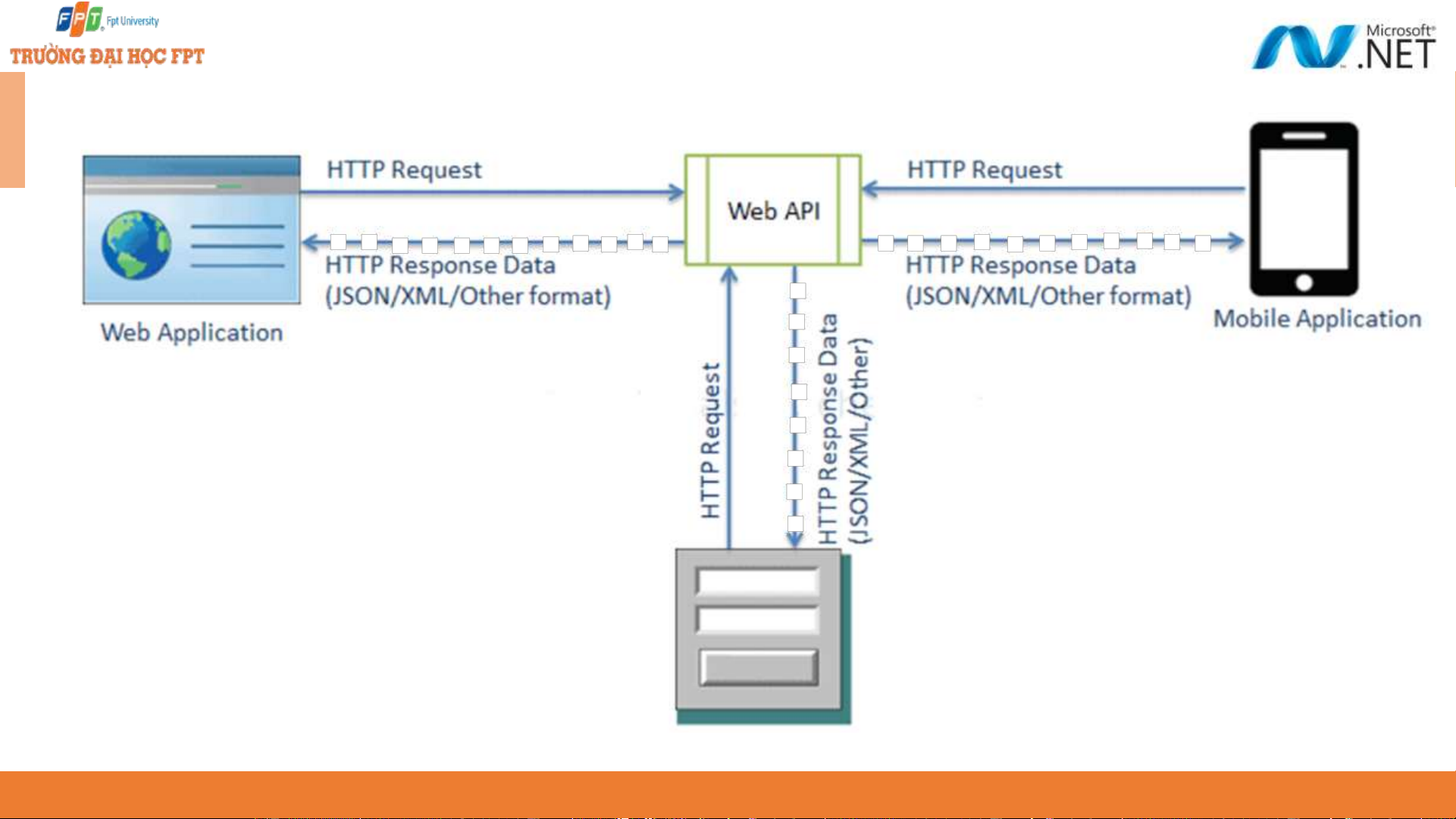
Introducing ASP.NET Core RESTful Services ◆
ASP.NET Web API, from the beginning, was designed to be a service-based
framework for building REpresentational State Transfer (RESTful) services. ◆
It is based on the MVC framework minus the V (view), with optimizations for creating headless services. ◆
Calls to a Web API service are based on the core HTTP verbs (Get, Put,
Post, Delete) through a uniform resource identifier (URI). ◆
Calls to Web API use the Hypertext Transfer Protocol (HTTP) scheme on a particular
host on a specific port, followed by the path and an optional query and fragment. 17
Reasons for choosing .NET for Web Services - 1
Use .NET for your server application or service when: ◆ You have cross-platform needs. ▪
If your web or service application needs to run on multiple platforms, for example,
Windows, Linux, and macOS, use .NET. ◆
You're targeting microservices. ▪
A microservices architecture allows a mix of technologies across a service
boundary. This technology mix enables a gradual embrace of .NET for new
microservices that work with other microservices or services. ◆
You need side-by-side .NET versions per application. ▪
This side-by-side installation allows multiple services on the same server, each of
them on its own version of .NET. 18
Reasons for choosing .NET for Web Services - 2
Use .NET for your server application or service when: ◆
You're using Docker containers. ▪
Containers are commonly used in conjunction with a microservices architecture.
Containers can also be used to containerize web apps or services that follow any
architectural pattern. .NET Framework can be used on Windows containers, but the
modularity and lightweight nature of .NET makes it a better choice for containers. ◆
You need high-performance and scalable systems. ▪
When your system needs the best possible performance and scalability, .NET and
ASP.NET Core are your best options. The high-performance server runtime for
Windows Server and Linux makes ASP.NET Core a top performing web framework
on TechEmpower benchmarks 19 1/5/2026 20