Bài giảng Chapter 1: The Nature of Strategic Management môn Quản trị chiến lược | Trường Cao đẳng Du lịch Sài Gòn
Bài giảng Chapter 1: The Nature of Strategic Management môn Quản trị chiến lược | Trường Cao đẳng Du lịch Sài Gòn. Tài liệu được sưu tầm giúp bạn tham khảo, ôn tập và đạt kết quả cao. Mời bạn đọc đón xem.
Môn: Quản trị chiến lược 3 4 tài liệu
Trường: Trường Cao đẳng Du lịch Sài Gòn 80 tài liệu
Tác giả:


















Preview text:
Strategic Management: A Competitive
Advantage Approach, Concepts and Cases
Eighteenth Edition, Global Edition Chapter 1 The Nature of Strategic Management
Copyright © 2025 Pearson Education Ltd. Learning Objectives
1.1 Describe the strategic management process.
1.2 Discuss the three stages of activities for strategy
formulation, implementation, and evaluation.
1.3 Explain the need for integrating analysis and intuition in strategic management.
1.4 Define and give examples of key terms in strategic management.
Copyright © 2025 Pearson Education Ltd.
Learning Objectives (continued)
1.5 Describe the benefits of engaging in strategic management.
1.6 Explain why some firms do not engage in strategic planning.
1.7 Describe the pitfal s in doing strategic planning.
1.8 Discuss the connection between business and military strategies.
1.9 Explain how this course can enhance a student’s employability.
Copyright © 2025 Pearson Education Ltd.
Defining Strategic Management (1 of 3) Strategic Management
• The art and science of formulating, implementing, and
evaluating cross-functional decisions that enable an
organization to achieve its objectives.
Copyright © 2025 Pearson Education Ltd.
Defining Strategic Management (2 of 3)
• Strategic management is used synonymously with the
term strategic planning in this course.
• Sometimes the term strategic management is used to refer
to strategy formulation, implementation, and evaluation,
with strategic planning referring only to strategy formulation.
• In contrast, long-range planning tries to optimize trends of today for tomorrow.
Copyright © 2025 Pearson Education Ltd.
Defining Strategic Management (3 of 3)
• A strategic plan is a company’s game plan.
• A strategic plan results from tough managerial choices
among numerous good alternatives, and it signals
commitment to specific markets, policies, procedures, and operations.
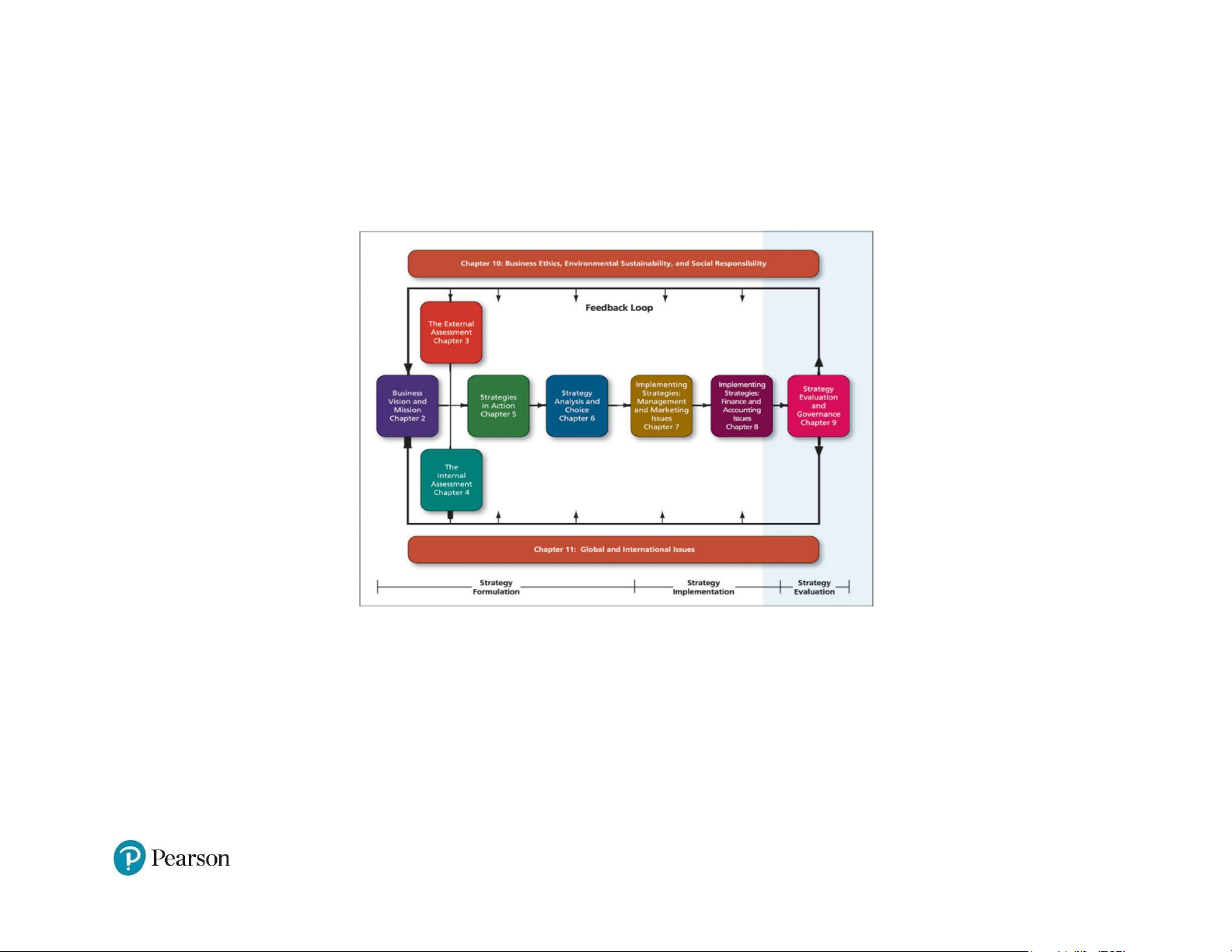
Copyright © 2025 Pearson Education Ltd. Figure 1.1
The Comprehensive, Integrative, Strategic Management Model
Source: Fred R. David, “How Companies Define Their Mission,” Long Range Planning 22, no. 1 (February 1989): 91.
See also Anik Ratnaningsih, Nadjadji Anwar, Patdono Suwignjo, and Putu Artama Wiguna, “Balance Scorecard of David’s
Strategic Modeling at Industrial Business for National Construction Contractor of Indonesia,” Journal of Mathematics and
Technology no. 4 (October 2010): 20.
See also Meredith E. David, Fred R. David, and Forest R. David, “Closing the Gap Between Graduates’ Skil s and
Employers’ Requirements: A Focus on the Strategic Management Capstone Business Course,” Administrative Sciences 11, no. 1 (2021): 10.
Copyright © 2025 Pearson Education Ltd. The Strategic-Management Model • Where are we now? • Where do we want to go?
• How are we going to get there?
Copyright © 2025 Pearson Education Ltd.
Stages of Strategic Management (1 of 4) • Strategy formulation. • Strategy implementation. • Strategy evaluation.
Copyright © 2025 Pearson Education Ltd.
Stages of Strategic Management (2 of 4) • Strategy Formulation
– Developing a vision and mission.
– Identifying an organization’s external opportunities and threats.
– Determining internal strengths and weaknesses.
– Establishing long-term objectives.
– Generating alternative strategies.
– Choosing particular strategies to pursue.
Copyright © 2025 Pearson Education Ltd. Strategy Formulation Decisions
• What new businesses to enter.
• What businesses to abandon.
• Whether to expand operations or diversify.
• Whether to enter international markets.
• Whether to merge or form a joint venture.
• How to avoid a hostile takeover.
Copyright © 2025 Pearson Education Ltd.
Stages of Strategic Management (3 of 4) • Strategy Implementation
– Requires a firm to establish annual objectives, devise
policies, motivate employees, and al ocate resources
so that formulated strategies can be executed.
– Includes developing a supportive culture, creating an
organizational structure, redirecting marketing efforts,
preparing budgets, devising tactics, and other tasks.
– Often called the action stage.
Copyright © 2025 Pearson Education Ltd.
Stages of Strategic Management (4 of 4) • Strategy Evaluation
– Determining which strategies are not working well.
– Three fundamental activities:
Reviewing external and internal factors that are the bases for current strategies. Measuring performance. Taking corrective actions.
Copyright © 2025 Pearson Education Ltd.
Key Terms in Strategic Management (1 of 6) • Competitive Advantage
– Any activity a firm does especial y wel compared to
activities done by rival firms, or;
– Any resource a firm possesses that rival firms desire.
• A firm must strive to achieve sustained competitive advantage.
Copyright © 2025 Pearson Education Ltd.
Key Terms in Strategic Management (2 of 6) • Strategists
– Individuals most responsible for the success or failure of an organization.
– Help an organization gather, analyze, and organize information.
• Vision and Mission Statements
– A vision statement answers the question “What do we want to become?”
– A mission statement answers the question “What is our business?”
Copyright © 2025 Pearson Education Ltd.
Key Terms in Strategic Management (3 of 6)
• External Opportunities and Threats
– Political, economic, sociocultural, technological,
environmental, legal, (PESTEL) and competitive trends
and events that could significantly benefit or harm an organization.
• Internal Strengths and Internal Weaknesses
– An organization’s control able activities that are
performed especial y wel or poorly.
– Determined relative to competitors.
Copyright © 2025 Pearson Education Ltd. Some Opportunities and Threats
• Consumers' expectation for green operations and products
is rising 8 percent annual y in Western Europe.
• Internet marketing is growing 11 percent annual y in the United States.
• Commodity food prices rose 6 percent the prior year.
• Oil and gas prices increased 8 percent in the last twelve months.
• Computer hacker problems are increasing 14 percent annual y.
Copyright © 2025 Pearson Education Ltd.
Key Terms in Strategic Management (4 of 6) • Long-Term Objectives
– Specific results that an organization seeks to achieve in pursuing its basic mission.
– Long term means more than one year.
– Should be chal enging, measurable, consistent, reasonable, and clear.
Copyright © 2025 Pearson Education Ltd.
Key Terms in Strategic Management (5 of 6) • Strategies
– The means by which long-term objectives wil be achieved.
– May include geographic expansion, diversification,
acquisition, product development, market penetration,
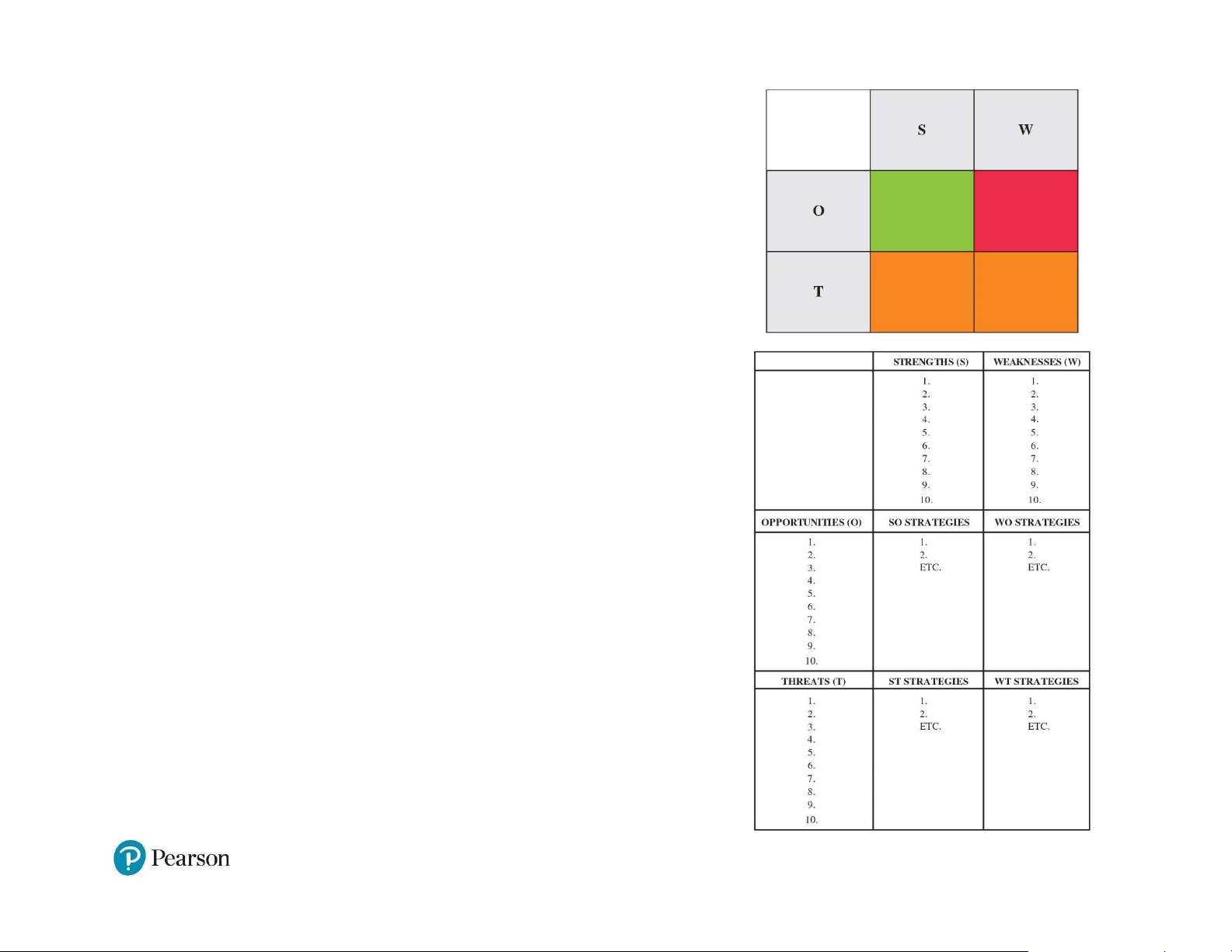
retrenchment, divestiture, liquidation, and joint ventures. • SWOT analysis
– SWOT stands for Strengths, Weaknesses, Opportunities, and Threats.
– This tool helps managers identify four different potential strategies.
Copyright © 2025 Pearson Education Ltd. Figure 1.2 The Basic SWOT Matrix Format
Copyright © 2025 Pearson Education Ltd.
Tài liệu liên quan:
-
Bài giảng Chapter 3: The External Assessment môn Quản trị chiến lược | Trường Cao đẳng Du lịch Sài Gòn
18 9 -

Tiểu luận Quản trị chiến lược Công ty Du lịch Vietravel | Môn Quản trị chiến lược 3 - Trường Cao đẳng Du lịch Sài Gòn
83 42 -
Tiểu luận Quản trị chiến lược | Trường Cao đẳng Du lịch Sài Gòn
707 354