Bài giảng Chapter 3: The External Assessment môn Quản trị chiến lược | Trường Cao đẳng Du lịch Sài Gòn
Bài giảng Chapter 3: The External Assessment môn Quản trị chiến lược | Trường Cao đẳng Du lịch Sài Gòn. Tài liệu được sưu tầm giúp bạn tham khảo, ôn tập và đạt kết quả cao. Mời bạn đọc đón xem.
Môn: Quản trị chiến lược 3 4 tài liệu
Trường: Trường Cao đẳng Du lịch Sài Gòn 80 tài liệu
Tác giả:


















Preview text:
Strategic Management: A Competitive
Advantage Approach, Concepts and Cases
Eighteenth Edition Global Edition Chapter 3 The External Assessment
Copyright © 2025 Pearson Education Ltd. Learning Objectives
3.1 Describe the nature and purpose of an external
assessment in formulating strategies.
3.2 Identify and discuss the P E S T E L external forces that impact organizations.
3.3 Explain Porter’s Five-Forces Model and competitive
forces that impact organizations.
Copyright © 2025 Pearson Education Ltd.
Learning Objectives (continued)
3.4 Describe key sources of information for identifying opportunities and threats.
3.5 Discuss forecasting tools and techniques.
3.6 Explain how to develop and use an External Factor Evaluation (E F E) Matrix.
3.7 Explain how to develop and use a Competitive Profile Matrix (C P M).
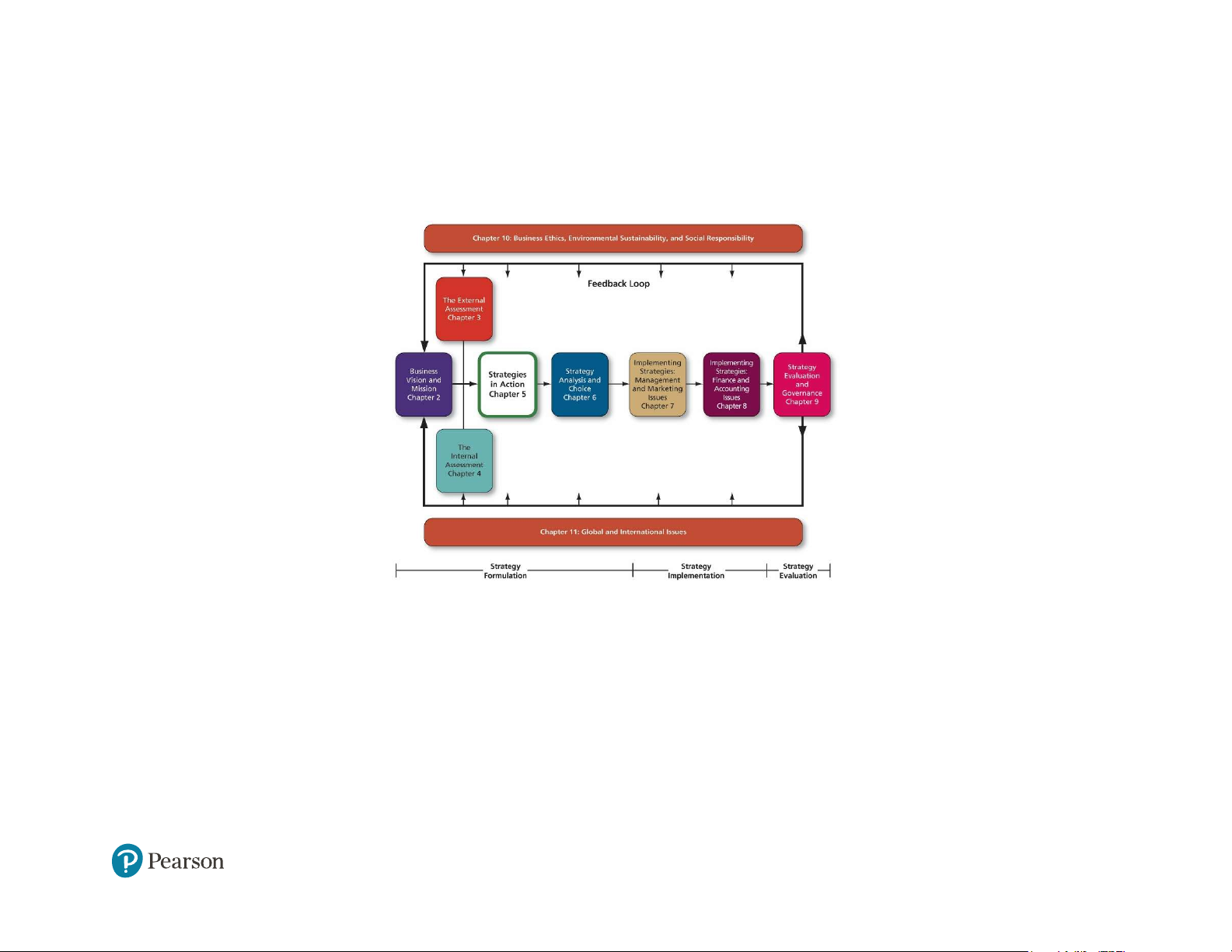
Copyright © 2025 Pearson Education Ltd. Figure 3.1
The Comprehensive, Integrative, Strategic Management Model
Source: Fred R. David, “How Companies Define Their Mission,” Long Range Planning 22, no. 1 (February 1989): 91.
See also Anik Ratnaningsih, Nadjadji Anwar, Patdono Suwignjo, and Putu Artama Wiguna, “Balance Scorecard of David’s
Strategic Modeling at Industrial Business for National Construction Contractor of Indonesia,” Journal of Mathematics and
Technology no. 4 (October 2010): 20.
See also Meredith E. David, Fred R. David, and Forest R. David, “Closing the Gap Between Graduates’ Skil s and
Employers’ Requirements: A Focus on the Strategic Management Capstone Business Course,” Administrative Sciences 11, no. 1 (2021): 10–26.
Copyright © 2025 Pearson Education Ltd. External Audit • External audit
– Focuses on identifying and evaluating trends and
events beyond the control of a single firm.
– Reveals key opportunities and threats confronting an
organization so that managers can formulate strategies
to take advantage of the opportunities and avoid or reduce the impact of threats.
– Sometimes called industry analysis.
Copyright © 2025 Pearson Education Ltd.
The Purpose of an External Audit
• The external audit is aimed at identifying key variables that offer actionable responses.
• Firms should be able to respond either offensively or
defensively to the factors by formulating strategies that
take advantage of external opportunities or that minimize
the impact of potential threats.
Copyright © 2025 Pearson Education Ltd. Key External Forces
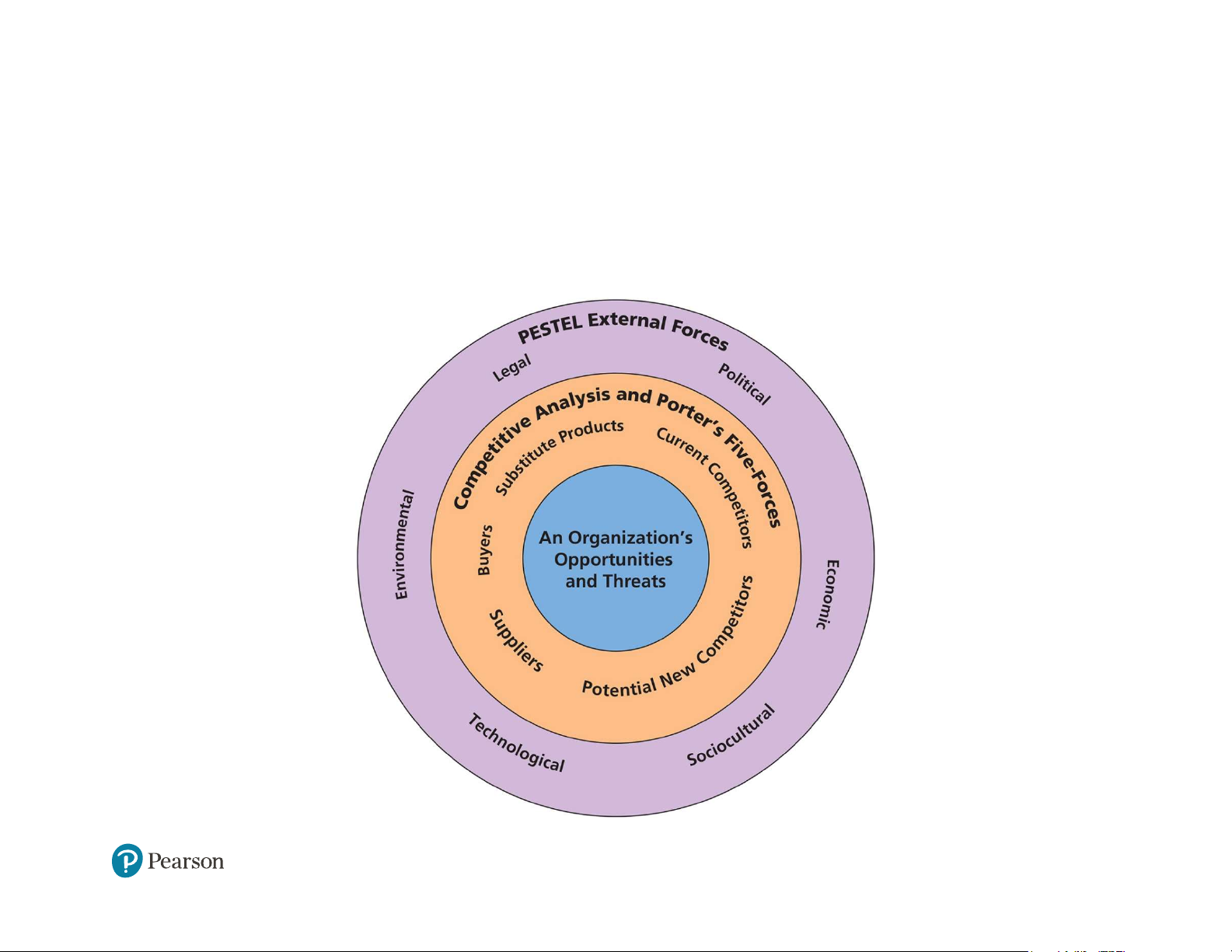
External forces can be divided into six groups: 1. Political. 2. Economic. 3. Sociocultural. 4. Technological. 5. Environmental. 6. Legal.
P E S T E L is the acronym for these six forces.
Copyright © 2025 Pearson Education Ltd. Five-Forces Analysis
The five-forces analysis focuses on: 1. Current competitors. 2. Potential new competitors. 3. Suppliers. 4. Buyers. 5. Substitute products.
Copyright © 2025 Pearson Education Ltd.
Five-Forces Analysis and P E S T E L
• Five-Forces is more refined than the P E S T E L analysis.
• Five-Forces focuses on key industry stakeholders.
• Combined with P E S T E L it helps the firm discover key opportunities and threats.
• P E S T E L can account for up to 25% of a firm’s performance.
– P E S T E L can include Black Swan events such as the COVID-19 pandemic.
• Five-Forces Model can explain another 20% of the firm’s performance.
Copyright © 2025 Pearson Education Ltd. Figure 3.2
How Are Key External Factors Identified in Performing Strategic Planning in a Firm?
Copyright © 2025 Pearson Education Ltd. The A Q C D Test
• When identifying and prioritizing essential P E S T E L and
Five-Forces external factors in strategic planning, the
following 4 criteria are important: – Actionable. – Quantitative. – Comparative. – Divisional.
• The A Q C D is a measure of the quality of an external factor.
Copyright © 2025 Pearson Education Ltd.
P E S T E L: Political External Forces
that Impact Organizations (1 of 3)
Local, state, and federal laws, as well as regulatory agencies and
special-interest groups, can have a major impact on the strategies
of smal , large, for-profit, and nonprofit organizations. • A few examples include:
– Seven U.S. states have zero state income taxes which
makes it attractive to locate facilities.
– Between 2016 and 2020 FedEx invested $71 mil ion on
campaign contributions and lobbying, and the company
received tax credits of $877 million between 2018 and 2020.
– Dubai’s political and social reforms such as zero tax rates,
al owing the consumption of alcohol without a license, and
others have made it one of the most booming economies in the world.
Copyright © 2025 Pearson Education Ltd.
P E S T E L: Political External Forces
that Impact Organizations (2 of 3)
Table 3.1 contains some examples of political variables to be monitored that include:
• Natural environmental regulations.
• Protectionist actions by countries. • Changes in patent laws.
• Equal employment opportunity laws.
• Level of defense expenditures. • Unionization trends. • Antitrust legislation.
Copyright © 2025 Pearson Education Ltd.
P E S T E L: Political External Forces
that Impact Organizations (3 of 3)
Additional political variables to be monitored include:
• U S A versus other country relationships.
• Political conditions in countries.
• Global price of oil changes.
• Local, state, and federal laws. • Import-export regulations.
• Tariffs, particularly on steel and aluminum.
• Local, state, and national elections.
Copyright © 2025 Pearson Education Ltd.
P E S T E L: Economic Forces (1 of 3)
Economic factors have a direct impact on the potential
attractiveness of various strategies. Examples include:
• Current strong U.S. dol ar can boost profits of importers
but harms large multinational firms since it makes U.S.
goods more expensive to foreign buyers.
• In the first four months of 2022, the U.S. dollar rose 10
percent against the Japanese yen and more than 5 percent against the euro.
Copyright © 2025 Pearson Education Ltd.
P E S T E L: Economic Forces (2 of 3)
• Shift to a service economy. • Availability of credit.
• Level of disposable income.
• Propensity of people to spend. • Interest rates. • Inflation rates.
• Gross domestic product (G D P) trends. • Import/export factors. • Unemployment trends.
• Value of the dol ar in world markets.
Copyright © 2025 Pearson Education Ltd.
P E S T E L: Economic Forces (3 of 3)
• Demand shifts for different goods and services.
• Income differences by region and consumer groups. • Price fluctuations.
• Foreign countries’ economic conditions.
• Monetary and fiscal policies. • Stock market trends.
• Tax rate variation by country and state.
• European Economic Community (E EC) policies.
• Organization of Petroleum Exporting Countries (O P E C) policies.
Copyright © 2025 Pearson Education Ltd.
P E S T E L: Sociocultural Forces (1 of 3)
• Sociocultural forces impact strategic decisions on virtual y
al products, services, markets, and customers.
• These forces are shaping the way people live, work, produce, and consume. • Examples include:
– The decline in demand for packaged foods as people
demand healthier and fresher food options.
– The ongoing shift to online shopping. – Aging U.S. population.
Copyright © 2025 Pearson Education Ltd.
P E S T E L: Sociocultural Forces (2 of 3)
• Population changes by race, age, and geographic area.
• Regional changes in tastes and preferences. • Number of marriages. • Number of divorces. • Number of births. • Number of deaths.
• Immigration and emigration rates. • Social Security programs.
Copyright © 2025 Pearson Education Ltd.
P E S T E L: Sociocultural Forces (3 of 3) • Life expectancy rates. • Per capita income.
• Social media pervasiveness.
• Attitudes toward retirement.
• Attitudes toward product quality.
• Attitudes toward customer service. • Social programs.
• Social responsibility issues.
Copyright © 2025 Pearson Education Ltd.
Tài liệu liên quan:
-
Bài giảng Chapter 1: The Nature of Strategic Management môn Quản trị chiến lược | Trường Cao đẳng Du lịch Sài Gòn
19 10 -

Tiểu luận Quản trị chiến lược Công ty Du lịch Vietravel | Môn Quản trị chiến lược 3 - Trường Cao đẳng Du lịch Sài Gòn
83 42 -
Tiểu luận Quản trị chiến lược | Trường Cao đẳng Du lịch Sài Gòn
707 354