Bài giảng Interprocess Communication môn Nguyên lý hệ điều hành | Trường Đại học Công nghệ, Đại học Quốc gia Hà Nội
Bài giảng Interprocess Communication môn Nguyên lý hệ điều hành | Trường Đại học Công nghệ, Đại học Quốc gia Hà Nội. Tài liệu được sưu tầm giúp bạn tham khảo, ôn tập và đạt kết quả cao. Mời bạn đọc đón xem.
Môn: Nguyên lý hệ điều hành (UET) 12 tài liệu
Trường: Trường Đại học Công nghệ, Đại học Quốc gia Hà Nội 823 tài liệu
Tác giả:




















Preview text:
Operating Systems Phan Xuan Hieu
Data Science & Knowledge Technology Lab Faculty of IT, VNU-UET hieupx@vnu.edu.vn Interprocess Communication Materials § Textbook:
• A. Silberschatz, P. B. Galvin, and G. Gagne: Operating System Concepts,
10th edition, John Wiley & Sons, 2018. • Chapter 3 § Futher reading:
• A. S. Tanenbaum and H. Bos: Modern Operating Systems, 4th edition, Pearson Prentice Hal , 2015. • Chapter 2 3 Contents
§ Interprocess communication (IPC)
§ IPC in shared-memory systems
§ IPC in message-passing systems § Examples of IPC systems 4 Contents
§ Interprocess communication (IPC)
§ IPC in shared-memory systems
§ IPC in message-passing systems § Examples of IPC systems 5 Interprocess communication
§ Processes within a system may be independent or cooperating
§ Cooperating process can affect or be affected by other processes, including data
§ Reasons for cooperating processes: • Information sharing • Computation speedup • Modularity • Convenience
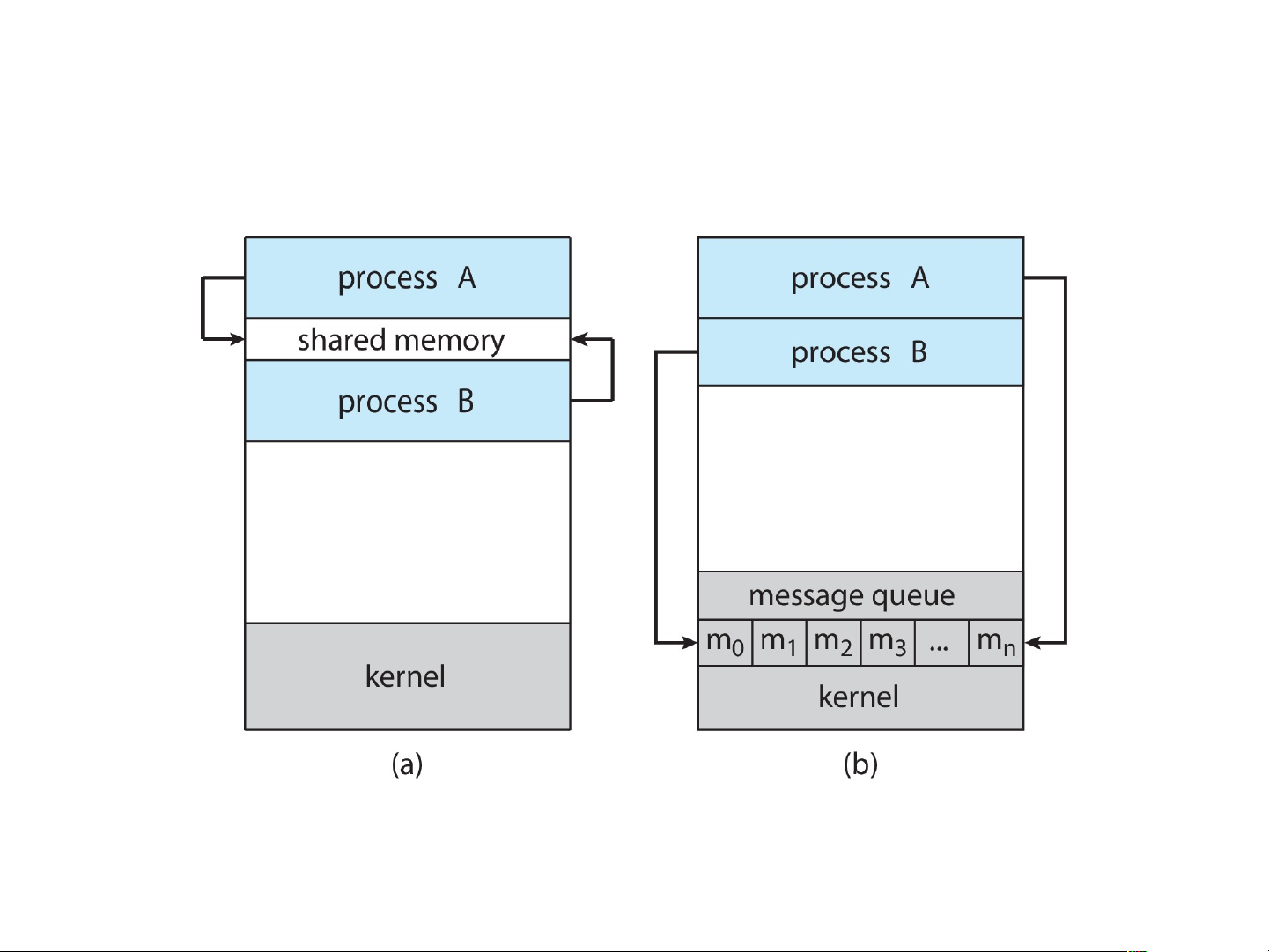
§ Cooperating processes need interprocess communication (IPC) § Two models of IPC • Shared memory • Message passing 6 Communication models Shared memory Message passing 7 Producer-consumer problem
§ Paradigm for cooperating processes:
• Producer process produces information that is consumed by a consumer process § Two variations:
• Unbounded-buffer places no practical limit on the buffer size: • Producer never waits
• Consumer waits if there is no data in the buffer to consume
• Bounded-buffer assumes that there is a fixed buffer size
• Producer must wait if the buffer is full
• Consumer waits if there is no data in the buffer to consume 8 Contents
§ Interprocess communication (IPC)
§ IPC in shared-memory systems
§ IPC in message-passing systems § Examples of IPC systems 9 IPC – shared memory
§ An area of memory shared among the processes that wish to communicate
§ The communication is under the control of the user
processes, not the operating system
§ Major issue is to provide mechanism that wil al ow the
user processes to synchronize their actions when they access shared memory
§ Synchronization is discussed in detailed in later lectures 10
Bounded-buffer shared-memory solution § Shared data #define BUFFER_SIZE 10 typedef struct { . . . } item; item buffer[BUFFER_SIZE]; int in = 0; int out = 0;
§ Solution is correct, but can only use BUFFER_SIZE-1 elements 11
Producer process (shared memory) item next_produced; while (true) {
/* produce an item in next produced */
while (((in + 1) % BUFFER_SIZE) == out); /* do nothing */
buffer[in] = next_produced;
in = (in + 1) % BUFFER_SIZE; } 12
Consumer process (shared memory) item next_consumed; while (true) {
while (out == in); /* do nothing */
next_consumed = buffer[out];
out = (out + 1) % BUFFER_SIZE;
/* consume the item in next consumed */ } 13
What about using al the buffer?
§ Suppose that we want a solution to the producer-
consumer problem that can use al the buffer.
§ We can do so by having an integer counter that keeps
track the current number of elements in the buffer.
§ Initial y, counter is set to 0.
§ The integer counter is incremented by the producer
after it produces a new element.
§ The integer counter is decremented by the consumer after it consumes an element. 14 Producer process while (true) {
/* produce an item in next produced */
while (counter == BUFFER_SIZE); /* do nothing */
buffer[in] = next_produced;
in = (in + 1) % BUFFER_SIZE; counter++; } 15 Consumer process while (true) {
while (counter == 0); /* do nothing */
next_consumed = buffer[out];
out = (out + 1) % BUFFER_SIZE; counter--;
/* consume the item in next consumed */ } 16 Race condition
§ counter++ could be implemented as • register1 = counter
• register1 = register1 + 1
• counter = register1
§ counter-- could be implemented as • register2 = counter
• register2 = register2 – 1
• counter = register2
§ Consider if execution interleaving with “counter = 5” initial y:
• S0: producer executes register1 = counter (register1 = 5)
• S1: producer executes register1 = register1 + 1 (register1 = 6)
• S2: consumer executes register2 = counter (register2 = 5)
• S3: consumer executes register2 = register2 – 1 (register2 = 4)
• S4: producer executes counter = register1 (counter = 6)
• S5: consumer executes counter = register2 (counter = 4) 17 Race condition (cont.) § Why race condition?
§ How to deal with race condition?
Wil be discussed in detailed in later lecture. 18 Contents
§ Interprocess communication (IPC)
§ IPC in shared-memory systems
§ IPC in message-passing systems § Examples of IPC systems 19 IPC – message passing
§ Processes communicate with each other without resorting to shared variables
§ IPC facility provides two operations:
• send(message)
• receive(message)
§ The message size is either fixed or variable 20
Tài liệu liên quan:
-

Bài giảng Nguyên lý hệ điều hành | Trường Đại học Công nghệ, Đại học Quốc gia Hà Nội
35 18 -

Câu hỏi ôn tập môn Nguyên lý hệ điều hành | Trường Đại học Công nghệ, Đại học Quốc gia Hà Nội
50 25 -
Đáp án NLHDH Đề 1: Phân tích và Giải thích Các Khái Niệm Hệ Điều Hành. Môn Nguyên lý hệ điều hành (UET) | Trường Đại học Công nghệ, Đại học Quốc gia Hà Nội.
164 82 -
Chapter 13: I/O systems overview and device driver management. Môn Nguyên lý hệ điều hành (UET) | Trường Đại học Công nghệ, Đại học Quốc gia Hà Nội.
149 75