Bài giảng Overview of Programming Paradigms môn Lập trình hướng đối tượng | Trường Đại học Khoa học, Đại học Huế
Bài giảng Overview of Programming Paradigms môn Lập trình hướng đối tượng | Trường Đại học Khoa học, Đại học Huế. Tài liệu được sưu tầm giúp bạn tham khảo, ôn tập và đạt kết quả cao. Mời bạn đọc đón xem.
Môn: Lập trình hướng đối tượng (LTHDT) 6 tài liệu
Trường: Trường Đại học Khoa học, Đại học Huế 52 tài liệu
Tác giả:
















Preview text:
Applied Programming and Design Principles Lecture 2
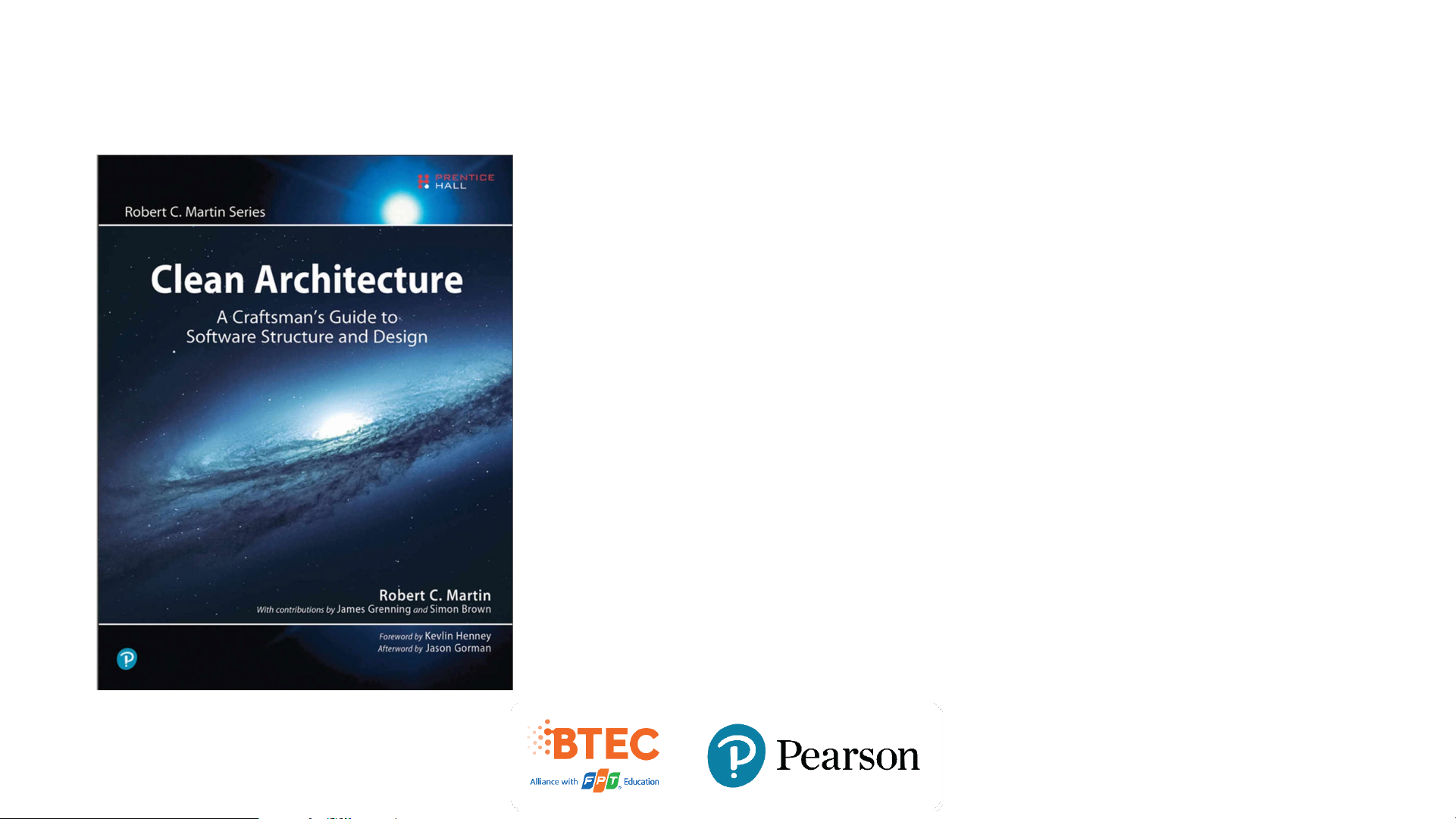
Overview Of Programming Paradigms Clean Architecture A CRAFTSMAN’S GUIDE TO SOFTWARE STRUCTURE AND DESIGN Lesson’s objectives • Structured Programming • Functional Programming
• Object-Oriented Programming PROGRAMMING PARADIGMS
• In 1938, Alan Turing laid the foundations of what was to become computer programming
• He was not the first to conceive of a programmable machine, but he
was the first to understand that programs were simply data
• By 1945, Turing was writing real programs on real computers in code that we would recognize
• Those programs used loops, branches, assignment, subroutines,
stacks, and other familiar structures
• Turing’s language was binary. Martin, R.C. (2017). PROGRAMMING PARADIGMS [2]
• Since those days, a number of revolutions in programming have occurred.
• First, in the late 1940s, came assemblers.
• In 1951, Grace Hopper invented A0, the first compiler. In fact, she coined the term compiler.
• Fortran was invented in 1953
• What followed was an unceasing flood of new programming
languages—COBOL, PL/1, SNOBOL, C, Pascal, C++, Java, ad infinitum. PROGRAMMING PARADIGMS [3]
• Another, probably more significant, revolution was in programming paradigms.
• Paradigms are ways of programming, relatively unrelated to languages
• A paradigm tells you which programming structures to use, and when to use them. Martin, R.C. (2017). STRUCTURED PROGRAMMING [1]
• The first paradigm to be adopted (but not the first to be invented)
was structured programming, which was discovered by Edsger Wybe Dijkstra in 1968
• Dijkstra showed that the use of unrestrained jumps (goto statements)
is harmful to program structure.
• He replaced those jumps with the more familiar if/then/else and do/while/until constructs
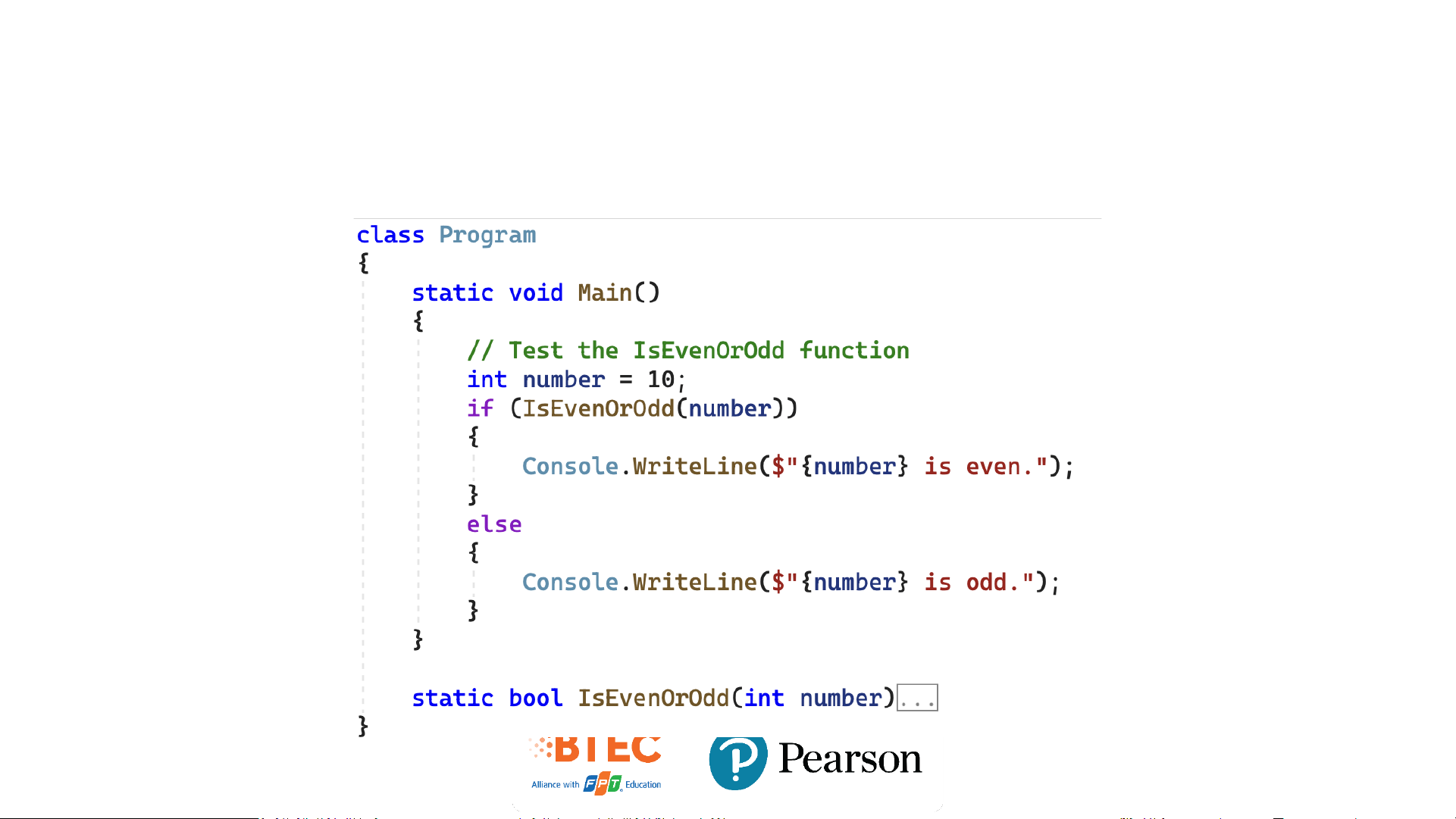
An example of structured programming STRUCTURED PROGRAMMING [2]
• Dijkstra started his career in the era of vacuum tubes, when
computers were huge, fragile, slow, unreliable, and (by today’s standards) extremely limited.
• In those early years, programs were written in binary, or in very crude assembly language
• Input took the physical form of paper tape or punched cards.
• The edit/compile/test loop was hours —if not days—long Martin, R.C. (2017). STRUCTURED PROGRAMMING [3]
• Dijkstra discovered that certain uses of goto statements prevent
modules from being decomposed recursively into smaller and smaller
units, thereby preventing use of the divide-and-conquer approach
necessary for reasonable proofs
• Other uses of goto, however, did not have this problem. Dijkstra
realized that these “good” uses of goto corresponded to simple
selection and iteration control structures such as if/then/else and do/while. STRUCTURED PROGRAMMING [4]
• Dijkstra knew that those control structures, when combined with
sequential execution, were special
• They had been identified two years before by Böhm and Jacopini,
who proved that all programs can be constructed from just three
structures: sequence, selection, and iteration. STRUCTURED PROGRAMMING [5]
• In 1968, Dijkstra wrote a letter to the editor of CACM
• The title of this letter was “Go To Statement Considered Harmful.”
• The feedback from the programming world is mostly negative
• And so the battle was joined, ultimately to last about a decade.
• Eventual y, the argument petered out. The reason was simple: Dijkstra had won.
• Most modern languages do not have a goto statement FUNCTIONAL DECOMPOSITION
• Structured programming allows modules to be recursively
decomposed into provable units, which in turn means that modules
can be functionally decomposed.
• That is, you can take a large-scale problem statement and decompose it into high-level functions
• Each of those functions can then be decomposed into lower-level functions, ad infinitum.
• Building on this foundation, disciplines such as structured analysis
and structured design became popular in the late 1970s and throughout the 1980s Martin, R.C. (2017). TESTS
• Dijkstra once said, “Testing shows the presence, not the absence, of bugs.”
• In other words, a program can be proven incorrect by a test, but it cannot be proven correct
• Structured programming forces us to recursively decompose a
program into a set of small provable functions.
• We can then use tests to try to prove those small provable functions incorrect
• If such tests fail to prove incorrectness, then we deem the functions
to be correct enough for our purposes OBJECT-ORIENTED PROGRAMMING • Some definitions of OO:
• The combination of data and function
• A way to model the real world.
• Nature of OO: encapsulation, inheritance, and polymorphism. Encapsulation
• Encapsulation is one of the fundamental principles of object-oriented
programming that allows you to hide the internal details of an object
and only expose a controlled and well-defined interface to the outside world
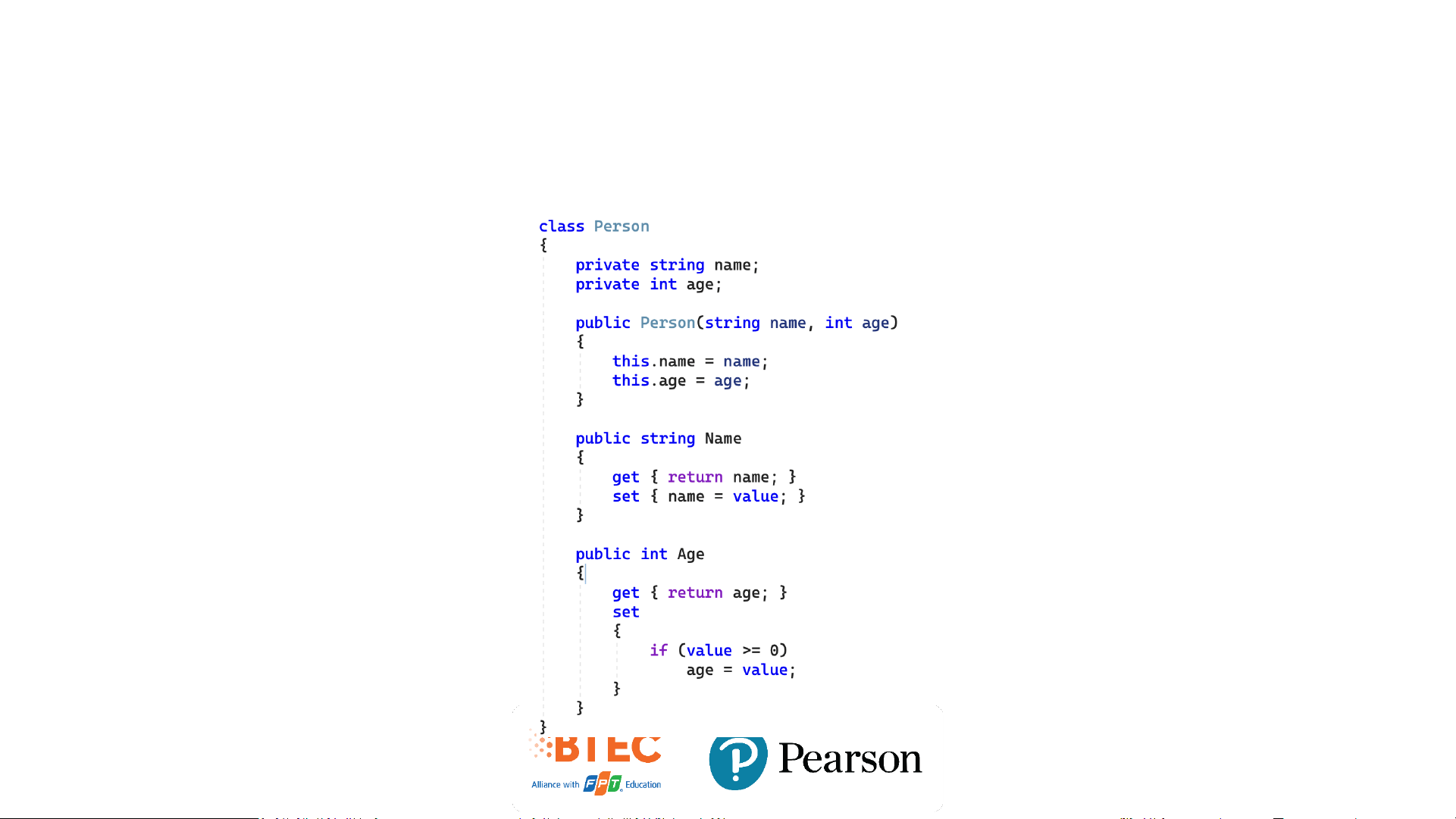
• In C#, you can achieve encapsulation using classes, access modifiers, and properties An encapsulation example Polymorphism
• Polymorphism is an application of pointers to functions.
• Programmers have been using pointers to functions to achieve
polymorphic behavior since Von Neumann architectures were first implemented in the late 1940s
• OO languages may not have given us polymorphism, but they have
made it much safer and much more convenient
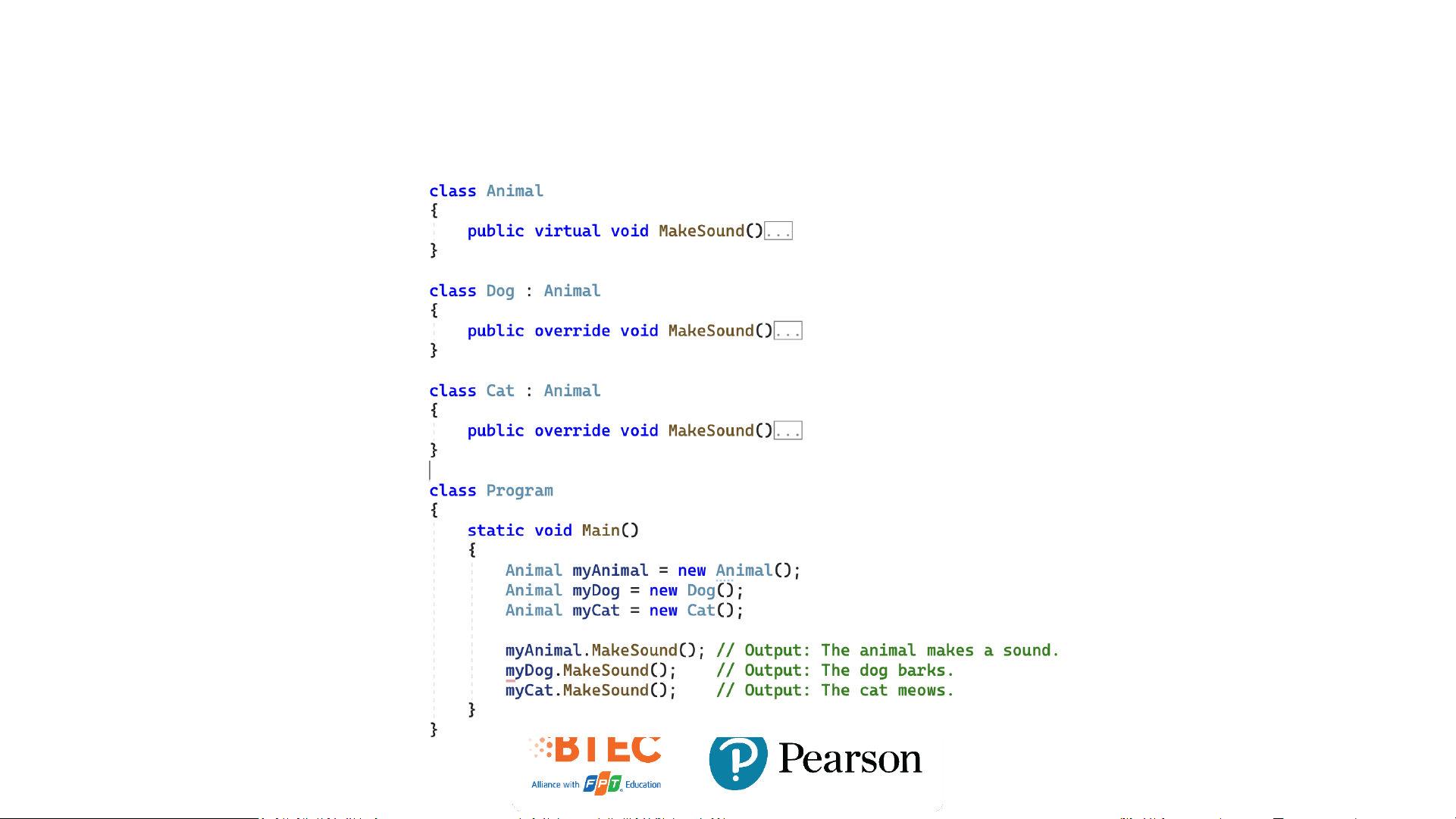
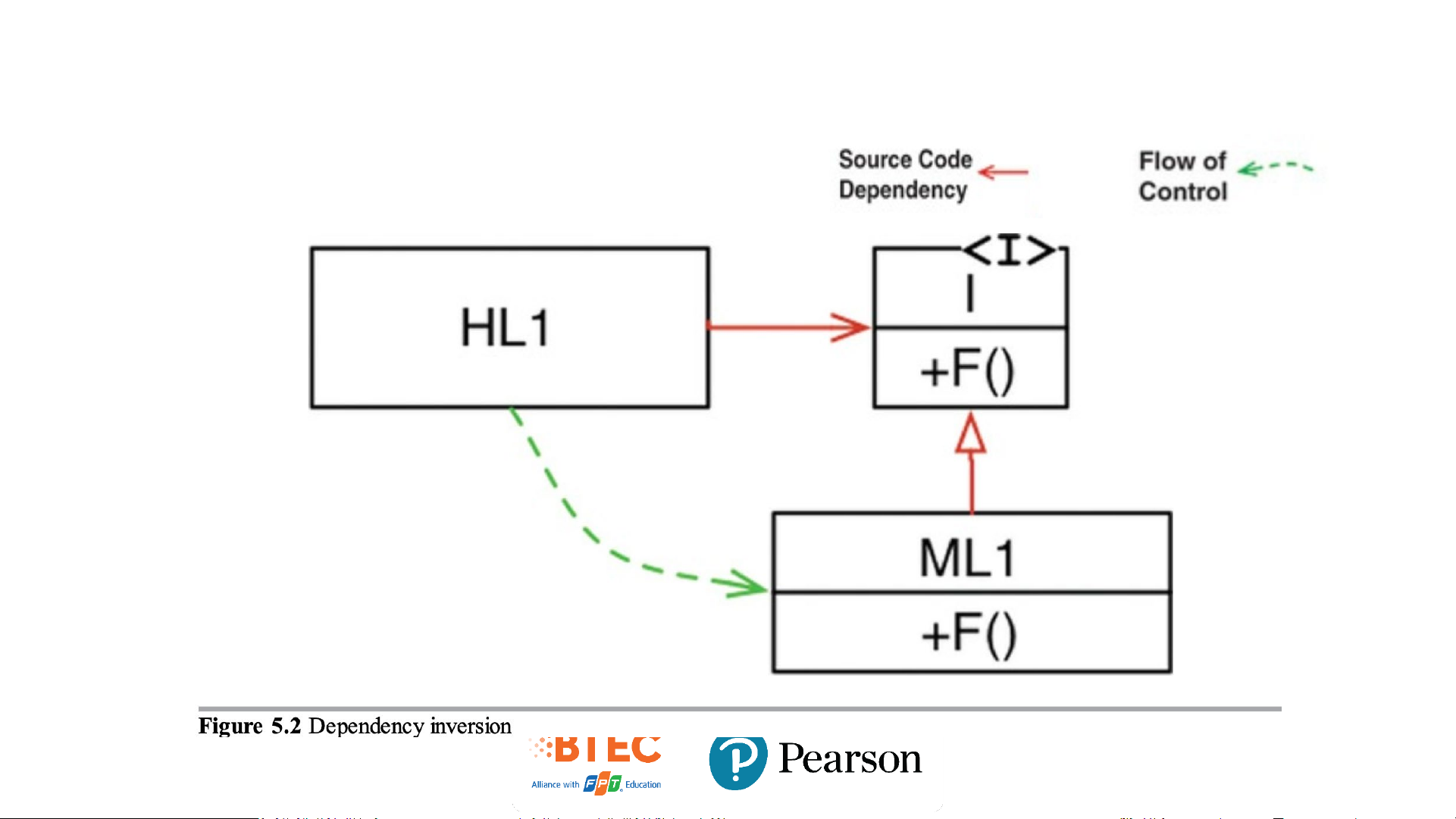
A polymorphism and inheritance example Dependency inversion [1] Martin, R.C. (2017). Dependency inversion [2]
• HL1 calls the F() function in module ML1.
• The fact that it calls this function through an interface is a source
code contrivance. At runtime, the interface doesn’t exist. HL1 simply calls F() within ML1
Tài liệu liên quan:
-
Bài giảng The Unified Modelling Language (UML) - Part 2 môn Lập trình hướng đối tượng | Trường Đại học Khoa học, Đại học Huế
31 16 -
Bài tập môn Lập trình hướng đối tượng | Trường Đại học Khoa học, Đại học Huế
29 15 -
Tóm tắt kiến thức Môn Lập trình hướng đối tượng | Trường Đại học Khoa học, Đại học Huế
89 45 -
Lộ Trình Lập Trình JAVA | Môn Lập trình hướng đối tượng - Trường Đại học Khoa học, Đại học Huế
75 38