bài giảng tiếng anh chuyên ngành 1
tiếng anh 4
Môn: Tiếng Anh thống kê (NEU) 3 tài liệu
Trường: Trường Đại học Kinh Tế Quốc Dân 7.4 K tài liệu
Tác giả:














Preview text:
Business English Course Book u�1�1 u�j e:?.JD 3rd Edition I Pre-intermediate
Business English Course Book
David Cotton David Falvey Simon Kent
o�'.H.' o�j � .>0 uP9,I � b.c94?-0 �,
.UJJJI b�J u+J � J.ob .9 �.>:' � UJ,9Jl> �
-� �Ip �Js..: .. : J.oL.t .9 UJJJI cj�I .9 c.� 'u,g:,Lli LS� ol jl l5Jb.J:' � DISCUSSION TEXTS LANGUAGE WORK SKILLS CASE STUDY UNIT 1 Talk about your Listening: An interview with Career moves Telephoning: YouJuice: Decide career plan the Finance Director of a TV making contact on the successful CAREERS Modals 1: ability, company requests and offers candidate for a job =page6 Reading: Facebook Writing: e-mail profile 'could damage job prospects' - Telegraph UNIT 2 Talk about
Reading: India: Tata's search Describing companies Presenting your Dino Conti Ice Cream: . ' companies
for a new CEO - Financial company Decide on the best COMPANIES Times Present simple and way to invest in a present continuous company's future =page 14 Is John Lewis the best company in Britain to work Writing: proposal for? - Guardian Listening: An interview with the CEO of a food company UNIT3 Talk about
Listening: An interview with Making sales Negotiating: A partnership SELLING shopping habits the Director of Marketing of reaching agreement: Work on a a TV shopping channel
Modals 2: must, need to, agreement proposed partnership have to, should between a jet charter = page 22 Reading: Women on top in new sales industry survey - company and a hotel web article group Writing: letter
WORKING ACROSS CULTURES: 1 SAYING 'NO' POLITELY = page30 REVISION UNIT A = page 32 DISCUSSION TEXTS LANGUAGE WORK SKILLS CASE STUDY UNIT4 Discuss what
Listening: An interview with a Verb and noun Successful The new attraction: ::• makes a great researcher combinations meetings Decide on the best GREAT IDEAS '� idea Reading: Who needs idea for a new Past simple and = attraction page 36 translators? - web article past continuous Safer cycling - web article Writing: report Going for gold - web article UNIT 5 Discuss stressful Listening: An interview with Stress in the workplace Participating in Davies-Miller situations and the Director of Marketing at discussions Advertising: Suggest STRESS Past simple and activities a health consultancy present perfect ways of reducing stress amongst staff = page44
Reading: Over half of business owners feeling increasingly Writing: report stressed - web article UNIT6
Discuss corporate Listening: An interview with the Eating and drinking Socialising: Organising a entertaining
Chief Executive of a corporate greetings and conference: Choose ENTERTAINING entertainment company Multiword verbs small talk the location for a sales conference = page 52 Reading: Interview with three corporate entertainment Writing: e-mail experts
WORKING ACROSS CULTURES: 2 DOING BUSINESS INTERNATIONALLY = page60 REVISION UNIT B = page62 WRITING FILE ACTIVITY FILE I:] page 126 I:] page 132 CONTENTS DISCUSSION TEXTS LANGUAGE WORK SKILLS CASE STUDY UNIT? Discuss new Listening: Interviews with Economic terms Dealing with Taka Shimizu Cycles: businesses and the CEO of a money-transfer numbers Choose the location NEW BUSINESS = Time clauses business sectors company and the CEO of a for a new factory food company page66 Writing: e-mail Reading: Internet whiz-kid's discount idea makes billions
in two years - Financial Times Help with exports - Financial Times UNIT 8 Talk about the Listening: An interview Word partnerships Telephoning: Wincote International: marketing mix with the European exchanging Devise a plan to MARKETING Questions and marketing Marketing Manager of a information improve sales at an campaigns pharmaceutical company outdoor-clothing page 74 Reading: Adidas targets company the Chinese interior - Writing: e-mail Financial Times Discuss how and Listening: An interview Making plans Meetings: European Press and UNIT9 when to plan with a business consultant interrupting Media Corporation: PLANNING = and author Talking about and clarifying Plan a new issue of future plans a magazine page82 Reading: When there's no
Plan A- Financial Times Writing: letter
WORKING ACROSS CULTURES: 3 INTERNATIONAL CONFERENCE CALLS =page90 REVISION UNIT C =page92 DISCUSSION TEXTS LANGUAGE WORK SKILLS CASE STUDY UNIT 10 Discuss the Listening: An interview Verbs and prepositions
Socialising and Ashley Cooper Search qualities of a with the author of a entertaining Agency: Advise MANAGING Reported speech good manager management book on improving staff PEOPLE Reading: Share the power- relations at a property company = page 96 Financial Times Writing: report UNIT 11 Do a quiz on Listening: An interview Word-building Negotiating: Herman & Corrie
managing conflict with an expert in dispute dealing with Teas: Decide whethe'r CONFLICT = Conditionals resolution conflict a company should accept a buy-out offer page 104 Reading: Intervening quickly in cases of conflict Writing: letter
- Chartered Institute of
Personnel and Development UNIT 12 Discuss products
Listening: An interview with Describing products Presenting a The George Marshall the editor of a news network product Awards: Choose PRODUCTS Passives Reading: A path to salvation the winner of a product-innovation = page 112 through innovation - Financial Times competition Writing: report
WORKING ACROSS CULTURES: 4 PREPARING TO DO BUSINESS INTERNATIONALLY =page120 REVISION UNIT D =page 122 GRAMMAR REFERENCE AUDIO SCRIPTS GLOSSARY c:) page 141 c:) page 153 c:) page 167
What is Market Leader, and who is it for?
Market Leader is a multi-level business English course for businesspeople and students of business
English. It has been developed n association with the Financial Times, one of the leading sources of
business nformation in the world. It consists of 12 units based on topics of great nterest to everyone
nvolved n international business.
This third edition of the Pre-intermediate level features completely updated content and a
significantly enhanced range of authentic resource material, reflecting the latest trends n the
business world. If you are n business, the course will greatly improve your ability to communicate
n English n a wide range of business situations. If you are a student of business, the course will
develop the communication skills you need to succeed n business and will enlarge your knowledge
of the business world. Everybody studying this course will become more fluent and confident n using
the language of business and should ncrease the r career prospects. The authors
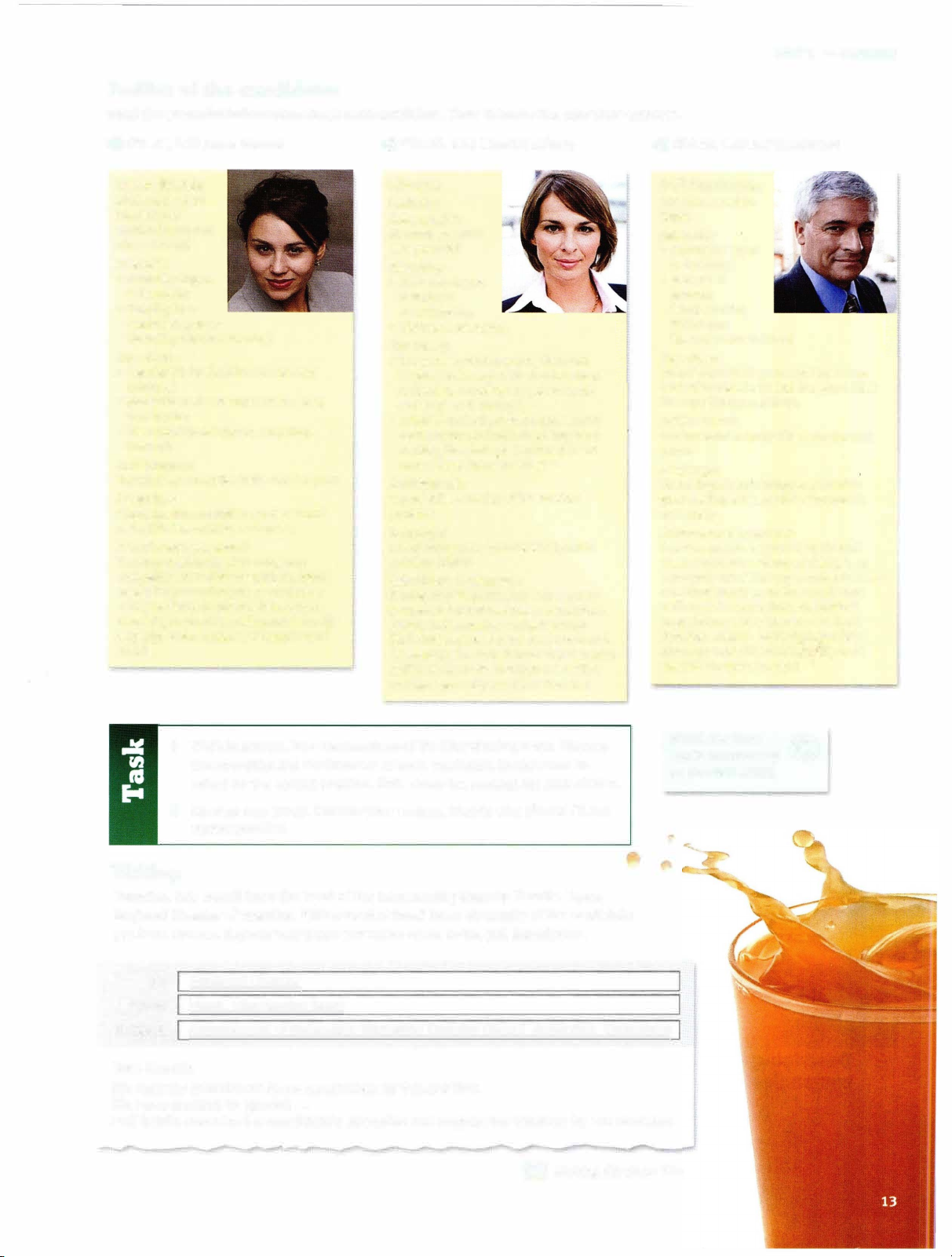
David Falvey (left) has over 25 years' teach ng and managerial experience n the UK, Japan and Hong
Kong. He has also worked as a teacher trainer at the British Counci n Tokyo, and was previously
Head of the English Language Centre and Principal Lecturer at London Metropolitan University.
David Cotton (centre) has over 40 years' experience teach ng and train ng n EFL, ESP and English for
Business, and is the author of numerous business English titles, ncluding Agenda, World of Business,
International Business Topics and Keys to Management He is also one of the authors of the best
selling Business Class. He was previously a Senior Lecturer at London Metropolitan University.
Simon Kent (right) has over 20 years' teach ng experience, nclud ng three years as an n-company
trainer n Berlin at the time of German reunification He is currently a Senior Lecturer in business
and general English, as well as having special responsibility for design ng new courses at London Metropolitan University. 4 INTRODUCTION What is in the units? STARTING UP
You are offered a variety of interesting activities in which you discuss the topic
of the unit and exchange ideas about it. VOCABULARY
You will learn important new words and phrases which you can use when you carry
out the tasks in the unit. You can find definitions and examples, and listen to the
pronunciation of new vocabulary in the i-Glossary feature on the DVD-ROM. The
DVD-ROM also contains practice exercises. A good business dictionary, such as the
Longman Business English Dictionary, will also help you to increase your business vocabulary. READING
You will read authentic articles on a variety of topics from the Financial Times and
other newspapers and books on business. You will develop your reading skills and
learn essential business vocabulary. You will also be able to discuss the ideas and issues in the articles. LISTENING
You will hear authentic interviews with businesspeople and a variety of scripted
recordings. You will develop listening skills such as listening for information and
note-taking. You can also watch the interviews and find further practice exercises on the DVD-ROM. LANGUAGE REVIEW
This section focuses on common problem areas at Pre-intermediate level. You will
become more accurate in your use of language. Each unit contains a Language
review box which provides a review of key grammar items. A Grammar reference
section can be found at the back of the book and on the DVD-ROM. The DVD-ROM
also provides extra grammar practice. SKILLS
You will develop essential business communication skills, such as making
presentations, taking part in meetings, negotiating, telephoning and using English
in social situations. Each Skills section contains a Useful language box, which
provides you with the language you need to carry out the realistic business tasks
in the book. The DVD-ROM supplements the Course Book with additional activities. CASE STUDY
The Case studies are linked to the business topics of each unit. They are based
on realistic business problems or situations and allow you to use the language
and communication skills you have developed while working through the unit.
They give you the opportunity to practise your speaking skills in realistic business
situations. Each Case study ends with a writing task. After you've finished the Case
study, you can watch a consultant discussing the issues it raises on the DVD-ROM. WORKING ACROSS
These four units focus on different aspects of international communication. CULTURES
They help to raise your awareness of potential problems or misunderstandings
that may arise when doing business with people from different cultures. REVISION UNITS
Market Leader Pre-intermediate third edition also contains four revision units,
each based on material covered in the preceding three Course Book units.
Each revision unit is designed so that it can be completed in one session or on a unit-by-unit basis. 5 STARTING UP
fJI Discuss these questions. 1 How ambitious are you?
2 Do you have a career plan? Where do you want to be in 10 years' time?
3 Which of the following would you prefer to do?
a) work for one company during your career
b) work for several different companies c) work for yourself
I] Look at these activities (1-7). In pairs, match each activity to its
corresponding area of work (a-g). Which of these areas do you work
in or would you like to work in? Why?
1 making/manufacturing things a) Sales and Marketing 2 being in charge of people b) Finance and running the organisation c) Management selling products or services d) Human Resources (HR)
4 dealing with clients/consumers e) Production 5 working with figures
f) Research and Development (R&D)
6 dealing with employees and training g) Customer Service
7 investigating and testing 6
UNIT 1 H CAREERS
II What should you do to get ahead in your career? Choose the four most
important tips from this list. Compare your ideas in a group and try to
agree on a final choice.
1 Change companies often.
5 Be energetic and enthusiastic at all times.
2 Use charm with your superiors.
6 Be the last to leave work every day. 3 Attend all meetings.
7 Find an experienced person to give you help and advice. 4 Go to your company's social functions.
8 Study for extra qualifications in your free time.
B These phrases (1-6) all include the word career. Match each of them to
its correct meaning (a-f). Use a dictionary to help you. 1 career move
a) chances to start/improve your career 2 career break
b) ideas you have for your future career 3 career plan
c) an action you take to progress in your career 4 career opportunities
d) a period of time away from your job to, for 5 career path
example, look after your children 6 career ladder
e) a series of levels or steps in your working life
f) the direction your working life takes
[I �» co1.1-1.3 Listen to three people talking about their careers. Which person
is at the beginning, in the middle and at the end of their career?
II �» co1.1-1.3 Listen again. Which of the phrases with career in Exercise A
does each person use? Which of the experiences do you think are common?
l:J Complete the sentences below with the verbs in the box. Use a dictionary to help you.
I climb decide htt'te make offer take I
1 Employees in large multinationals h
.. �':-'� ... excellent career opportunities if they are willing to travel.
2 Some people ............ a career break to do something adventurous like sailing
round the world or going trekking in India.
3 One way to ............ a career move is to join a small but rapidly growing company.
4 Certain companies ............ career opportunities to the long-term unemployed or
to people without formal qualifications.
5 Ambitious people often ............ on a career plan while they are still at university.
6 In some industries, it can take a long time to ............ the career ladder.
II Look at these groups of words. Cross out the noun or noun phrase in each
group which doesn't go with the verb in italics.
1 make a fortune I progress I a living I 4 do
part-time work/ a mistake I a tFaifliflg eeuFse a nine-to-five job/ your best 2 get
progress / a promotion / a bonus /
5 take a pension / an opportunity I fired (AmE) / the sack (BrE) time off/ early retirement
3 earn commission / a part-time job/
6 work flexitime/ anti-social hours I
money I 40,000 per year
overtime I an office job 7 UNIT 1 ._. CAREERS
D Complete each of these sentences with the appropriate form of a word
partnership from Exercise E.
1 In banking, you can ............ with the big bonuses and retire at 35.
2 When you ............ , you can arrange your own schedule, so this is very convenient when you have children.
3 People who work in sales often have the opportunity to ....... .... on top of a basic salary.
4 Luke is ambitious and does not want to be a sales assistant all his life. In fact, he
hopes to ............ and become Assistant Manager very soon. See the DVD-ROM�
5 Many students ............ when they are at university because it fits in with their studies.
for the i-G/ossary. ..,
6 Goran is 59, but he does not want to ............. In fact, he is taking on more work! READING
Discuss these questions in pairs. Be aware of
1 What social-networking sites do you a) know, and b) use? youronline image 2 Why do you use them?
Scan the article below quickly and answer these questions.
1 What percentage of employers research candidates online?
2 Which social-networking sites are mentioned?
3 Who do Peter Cullen and Farhan Yasin work for? by Andy Bloxham
Jobseekers have been warned that their Facebook profile could damage their employment prospects,
after a study found that seven in 10 employers now research candidates online.
According to new figures released by Microsoft, checks on
Facebook and Twitter are now as important in the job-selection
s process as a CV or interview.
The survey, which questioned human-resource managers at
the top 100 companies in the UK, the US, Germany and France, irLanguage.com
found that 70 per cent admitted to rejecting a candidate because
of their online behaviour. 10
But HR bosses also said that a strong image online could LIKE us on Facebook
actually help job hunters to land their dream job. Peter Cullen, of
Microsoft, said: "Your online reputation is not something to
be scared of, it's something to be proactively managed. These
days, it's essential that web users cultivate the kind of online
15 reputation that they would want an employer to see."
Facebook faux pas include drunken photographs, bad t:witter»
language and messages complaining about work.
Parhan Yasin, of online recruitment network Careerbuilder.co.uk,
said: "Social networking is a great way to make connections with
20 job opportunities and promote your personal brand across the
Internet. People really need to make sure they are using this
resource to their advantage, by conveying a professional image."
But Mr Yasin cautioned job seekers to be aware of their on line
image even after landing the perfect job, after their own research
25 found that 28 per cent of employers had fired staff for content Linked Im.
found on their social-networking profile. He added, "A huge
number of employers have taken action against staff for writing
negative comments about the company or another employee on
their social-networking page."
adapted from the Telegraph 8 UNIT 1 .... CAREERS
II Read the article again and choose the best headline (a, b or c).
a) Complaining about your job could lose you your job
b) Face book profile 'could damage job prospects'
c) Ambition is key to a successful career
l:J According to the article, how can social-networking sites make or break your career?
II In pairs, write a short list of things you should not do on your social
networking pages. You can include your own ideas.
D Should staff be allowed to use social-networking sites during the working day? Discuss.
a .. >>) co1.4 Melissa Foux is the Finance Director of CSC Media Limited, a
television company. Listen to the first part of the interview and answer these questions.
1 How does she describe her current company? 2 What was her previous job?
3 Why is it easy to move from sector to sector in the finance world?
m �» (01.5 Listen to the second part and complete this extract.
When I was a student, although I was studying ............ 1, I thought I would like to do
something ............ 2 afterwards, and I actually did a summer ........... .3 with one of the big
.......•.... 4 firms, which was an excellent way to get an ............ 5 of what the job would be
like. I started off as an auditor, and it was through that ............ 6 that I got my first job. Melissa Foux
II �» co1.6 Melissa is asked if she has had any good advice during her career.
Listen to the third part and number these points in the order in which she mentions them. a) maintain clarity
b) be able to see the key point and the key decision you have to make
c) do not overcomplicate things
m �)) COl.7 Listen to the final part and decide which was the interviewer's question (a, b or c).
a) What is the most interesting question you have been asked at interview? Watch the
b) What is the key difference between people who work in finance and those who interview on work in research? the DVD-ROM. 0
c) How would you advise people who are starting their careers?
II In groups, discuss these questions.
1 What do you hope to do in the future in your career?
2 Do you think there is an ideal career for you? What is it? Why?
3 What is the best advice you have been given during your career or your studies? 9
UNIT 1 H CAREERS LANGUAGE REVIEW
Modal verbs are very common in English. Match these functions (a--c) to the examples (1-3). Modals 1: a) making an offer b) describing ability c) making a request ability, requests 1 Can you help me? and offers
Could you say that again,. please? 2 Can I help you?
Would you like a cup of coffee?
3 I can speak Polish and Russian.
She could read and write before she was three.
= Grammar reference page 141
El Rearrange the words to make questions from a job interview. Then decide
whether each question is a) making a request, b) making an offer,
or c) asking about ability.
1 get I you I can I I I a drink I ? Can I 9et ou a drink? (b) y
2 e-mail address I your I confirm I I I could I ?
3 can I you I spreadsheets I use I ?
4 speak I languages I any other I you I can I ?
5 about I tell I you I job I us I your present I more I could I ?
6 tell I your current salary I me I you I could I ?
7 would you I as soon as possible I your decision I let us know I ?
8 start I you I when I can I ?
9 like I tea I some more I you I would I ?
El Match the questions in Exercise A (1-9) to these interviewee's answers (a-i). a) It's €60,000 a year.
b) Not very well, but I'm doing a course next week.
c) I can let you know next week.
d) Thank you. A cup of tea, please.
e) The address is correct, but I've got a new mobile number.
f) I'd love some. Thank you.
g) Well, I'm currently supervising an HR project.
h) Yes, I can speak Korean and Japanese.
i) My notice period is two months.
D Work in pairs. Student A is an interviewer and Student B is an interviewee.
Student A: Follow the instructions below.
Student B: Answer the questions truthfully. Then switch roles. Student A • Offer tea or coffee. • Ask Student B:
• Find out Student B's ability to:
1 to tell you about themselves; 1 speak any languages;
2 for the best number to contact them
2 use Excel, PowerPoint or Publisher; on tomorrow; 3 drive. 3 to repeat the number;
4 if they would like to work abroad;
5 if there are any hours they wouldn't be able to work. 10
UNIT 1 H CAREERS
II What kinds of phone calls do you make in English? What useful telephone Telephoning:
expressions do you know?
making contact El �)) co1.s-1.10 Listen to three phone calls and answer these questions.
1 What is the purpose of each call?
2 Do the callers know each other?
B �)) co1.s Listen to the first call again. Complete the expressions on the right
so they have the same meaning as the ones on the left. 1 Can I talk to ... ?
I'd .. !iki? .. to .. fP.l?�k .. to .. . 2 Just a moment ...
Thank you ............. ............ . 3 I'll connect you.
I'll ............ ............ ............ .
4 Am I speaking to Corina Molenaar?
Hello ............. ............ Corina Molenaar? 5 Yes, it's me.
6 The reason I'm calling is ...
Yes, I'm ............ ............ your advert .. .
7 Can I have your name and address?
your name and address, please?
liJ •O co1.9 Listen to the second call again and complete this extract.
A: Hello ... C.'?.<!.1.� .. ). .�P.1?�k.1 to Giovanna, please?
B: ............ ............ 2 she's not here at the moment. Can 1 ........... .3 a ............ 4?
A: Yes, please ............. ............ 5 Johan from lntec ............. 6 you ............ 7 her I won't
be able to ............ 8 the training course on Saturday? She can ............ 9 me ............ 10
if there's a problem. I'm ........ . .. 11 0191 498 0051.
II �>)) co1.10 Listen to the third call again. Choose the phrases the speakers use. Matt: Hello, Matt speaking. Karl: Hi, Matt. Karl here.
Matt: Oh, hello, Karl. How are things /you'? Karl:
Fine, thanks. Listen, just a quick word /question2• Matt: Yeah, go ahead. Karl:
Do you think you could give me /let me have3 the other number for Workplace
Solutions? I can't get through to them. Their phone's always busy /engaged 4• Matt:
I've got it here /right in front of me5• It's 020 9756 4237. Karl:
Sorry, I didn't hear /catch6 the last part. Did you say 4227? Matt: No, it's 4237. Karl: OK. Thanks. Bye. Matt:
No problem /Don't mention it7• Bye.
II Study the Useful language box below. Then role-play the phone calls.
Student A: Turn to page 132. Student B: Turn to page 136. USEFUL LANGUAGE [ MAKING CALLS RECEIVING CALLS
Could I speak to Carmela Cantani, please? Who's calling, please?
Yes, this is Erika Mueller from KMV.
Could you tell me what it's about?
Is this the sales/finance/marketing department? I'll put you through. I'm calling about ... Can you hold?
Could you transfer me to the IT department, please?
He seems to be with someone right now. Can I get him to call you?
Could you tell him/her that I called?
I'm afraid there's no answer. Can I take a message?
Could you ask him/her to call me back?
I'm sorry, there's no answer. I can transfer you to his/her voice mail.
Can I leave a message, please? 11
• increasing sales and developing marketing strategies
• coordinating the work of the sales teams so that
they are more motivated and effective
• carrying out market research to improve customer numbers.
The successful candidate will be:
• a strong personality with leadership qualities
• energetic, dynamic, and enthusiastic. He/She will have:
• a good academic background and relevant work experience
• organizational and interpersonal skills
• numeracy skills and analytical ability • good linguistic ability.
The position will involve frequent travel in the three countries. UNIT 1 H CAREERS
Profiles of the candidates
Read the essential information about each candidate. Then listen to the interview extracts.
�l» CDl.11, 1.12 Juana Ramos
�)» CDl.13, 1.14 Chantal Lefevre
�» CDl.15, 1.16 Jeff Sanderson Juana Ramos Chantal Jeff Sanderson Mexican, aged 30 Lefevre American, aged 54 Married, two Swiss, aged 41 Single children (seven and Divorced, one child Education nine years old) (five years old) • University degree Education Education in Sociology • University degree • University degree • Master's in in Economics in Business Business • Studying for a Administration Administration Master's degree in • Diploma in Marketing (MBA) from Marketing (distance learning) Experience Harvard Business School Experience
• Two years' market research, then over Experience
• Has worked for YouJuice since leaving
15 years' sales and marketing in various
Joined YouJuice 20 years ago. Has always university.
companies, including one year in Spain
worked in sales. In the last five years, Sales
• Worked in market research for one year. and six years in Portugal. Manager (France and Italy). then in sales.
• Joined YouJuice three years ago as sales Achievements
• Has a good knowledge of computing;
representative in Switzerland. Very hard
Has increased sales by 8% in the five-year numerate.
working. Has done an excellent job and period Achievements
earned large bonuses each year. Languages
Top sales representative in the last five years Achievements
Fluent English and Portuguese; Spanish: Languages
A good sales record in all her previous
good reading skills, needs to improve his
Fluent Spanish and Italian; good standard positions oral ability
of English; intermediate Portuguese Languages
Interviewer's comments
Interviewer's comments
Fluent Portuguese; intermediate Spanish;
A serious person. Respected by his staff.
A strong, charismatic personality. Very excellent English
Has a strong sense of responsibility. 'I am
competitive. Not afraid to speak her mind,
Interviewer's comments
a company man.' Not very creative. Believes
even if it upsets colleagues. A good sense
A quiet. modest person, but very eager to
new ideas should come from staff. Some
of humor. Wants to advance in her career
progress in her career. Answered questions
staff say he's a workaholic and difficult
as quickly as possible. Intelligence test (IQ):
directly and honestly. A sociable person.
to get to know. Very interested in South
very high. Is she diplomatic? Interpersonal
She's chief organizer of her local tennis club.
American cultures. Intelligence test (IQ): skills?
Believes that the new director should involve
above average. Why does he really want
staff in all decisions. Intelligence test (IQ): the job? Energetic enough?
average. Leadership qualities? Decisive?
1 Work in groups. You are members of the interviewing team. Discuss Watch the Case
study commentary 0
the strengths and weaknesses of each candidate. Decide who to on the DVD-ROM.
select for the vacant position. Note down the reasons for your choice.
2 Meet as one group. Discuss your choices. Decide who should fill the vacant position. Writing
Complete this e-mail from the head of the interviewing team to Claudia Lopez,
Regional Director of YouJuice. Write about at least three strengths of the candidate
you have chosen. Explain how these strengths relate to the job description. To: Regional Director From: Head, interviewing team
Subject: Appointment of Sales and Marketing Director (Brazil, Argentina, Colombia) Dear Claudia
We recently interviewed three candidates for this position.
We have decided to appoint ...
I will briefly describe the candidate's strengths and explain the reasons for our decision.
=:] Writing file page 126 STARTING UP
El. Which of these companies do you or would you like to work for? 1 a family-owned company 2 a multinational company
3 your own company (be self-employed)
II Can you name a company in each of these business sectors? Is there one
that you would like to work for? • Telecommunications/Media • Banking and finance • Food and drink • Engineering • Transport • Retailing • Pharmaceuticals/Chemicals • Manufacturing • Another service industry • Construction • IT /Electronics • Tourism
El Complete the chart on the next page with the information in the box below. Describing
Then write sentences about the companies. companies
EXAMPLE: Cisco Systems is a11 America11 compa11y w'1icl-, supplies
I11ter11et eqvipme11t.
American Express container-ship operator fashion/retail Finnish
Japanese Korean Nokia oil and gas pharmaceuticals Toyota 14 UNIT 2 .... COMPANIES Company Main activity Nationality Cisco Systems Internet-equipment supplier American Car manufacturer Inditex Spanish
Travel and financial services provider American Roche Swiss Samsung Electronic-goods maker Telecommunications Hapag-Lloyd German Petro bras 10 Brazilian
l3 Complete the sentences below with the words and phrases in the box.
head office market share net profit parent company
share price subsidiary turne,er workforce
1 The amount of money a company receives from sales in a particular period is
called its .tY.!'."!.'?.'{.£!!'..
2 The money a company makes after taking away its costs and tax is its ............ .
3 A company which owns another company is called a ............ .
4 The employees in a particular country or business are called the ............ .
5 The percentage of sales a company has in a particular market is its ............ .
6 The main building or location of a large organisation is its ............ .
7 The cost of a company's shares is its ............ .
8 A company which is more than 50% owned by another company is called a ............ .
II Complete this extract from a company report with appropriate words or
phrases from the box in Exercise B. Financial performance
I am pleased to say the. P.�!'��t. ���-P.<:l."!}(.1 has continued its excellent performance. We
are changing, growing and doing well at a difficult time for the industry ............. 2 was
€57.2 million, an increase of 15% on last year, and ............ 3 rose by 5% to €6.4 million.
We are a highly competitive business. We have increased our ............ 4 to 20%.
Consequently, our ............ 5 has risen and is now at an all-time high of €9.6.
Increased production and strong demand have had a positive effect on our cashflow, so
we are able to finance a number of new projects. We have successfully moved to our new
............ 6 in central London. We are now planning to start full production at the recently
opened Spanish ............ 7 in October.
Finally, thanks once again to our loyal and dedicated ............ 8. Our employees will
always be our most valuable asset.
liJ �» CDl.17 Listen to the CEO reading from the company report and check your answers to Exercise C.
II Now talk in the same way about your own company or one you know well.
See the DVD-ROMO for the i-G/ossary.
Which other companies in your country are doing well / not doing well at the moment? 15 UNIT 2 .. COMPANIES
a �» co1.1s Listen to the first part of an interview with Susan Barratt, the Chief A successful
Executive Officer of Nature's Way Foods, and correct the six mistakes in this company paragraph.
Nature's Way Foods is a drinks-manufacturing company based on the east coast of Ireland.
They put chilled product, the majority of which is milk and cheese, into various types of
packaging for the major retailers and various food-service companies in Ireland.
El �» co1.19 Listen to the second part, where Susan talks about the reasons
for the company's success, and complete these notes with one word in each gap.
First reason for success: the ............ 1 • Susan B
Health - desire to eat healthy ............ 2 t
• Convenience -........... .3-poor
• Sustainability - low level of food ............ 4
• Indulgence - diet Monday to Friday, but have several pieces of cake on Friday night
Second reason for success: the way they ............ 5 the business
• High-............ 6 business
• Produce hundreds of ............ 7 of units
• Need to be very ............ 8 in the way they produce them
• Invested heavily in ............ 9 and processes
D '4>1l co1.20 Listen to the third part and answer these questions.
1 What two things has Susan enjoyed the most when running a company?
What does she not enjoy about running a company?
m '4>1l (01.21 Listen to the final part and complete this extract.
I've learned a lot of lessons from the companies I've worked for. l think the key thing
_is that you have to make sure your ............ 1 in the organisation are engaged with the Watch the
organisation and have a clear ............ 2 of what that organisation is trying to ........... .3. interview on 0
If you can get that clarity of ............ 4 and ............ 5 from the people within the the DVD·ROM.
organisation, then that will help move the business forward in itself.
II Discuss this question in pairs.
Would you like to run your own company? Why? I Why not?
El 'Companies should be owned by their employees.' Discuss. Two different
organisations II Work in pairs. As you read, make a note of the key points about your
company in the chart below.
Student A: Read Article 1 on the opposite page.
Student B: Read Article 2 on the opposite page. Tata John Lewis
India's- bi99es-t company
O�ned by its- employees- 16 Article 1
UNIT 2 .... COMPANIES FT
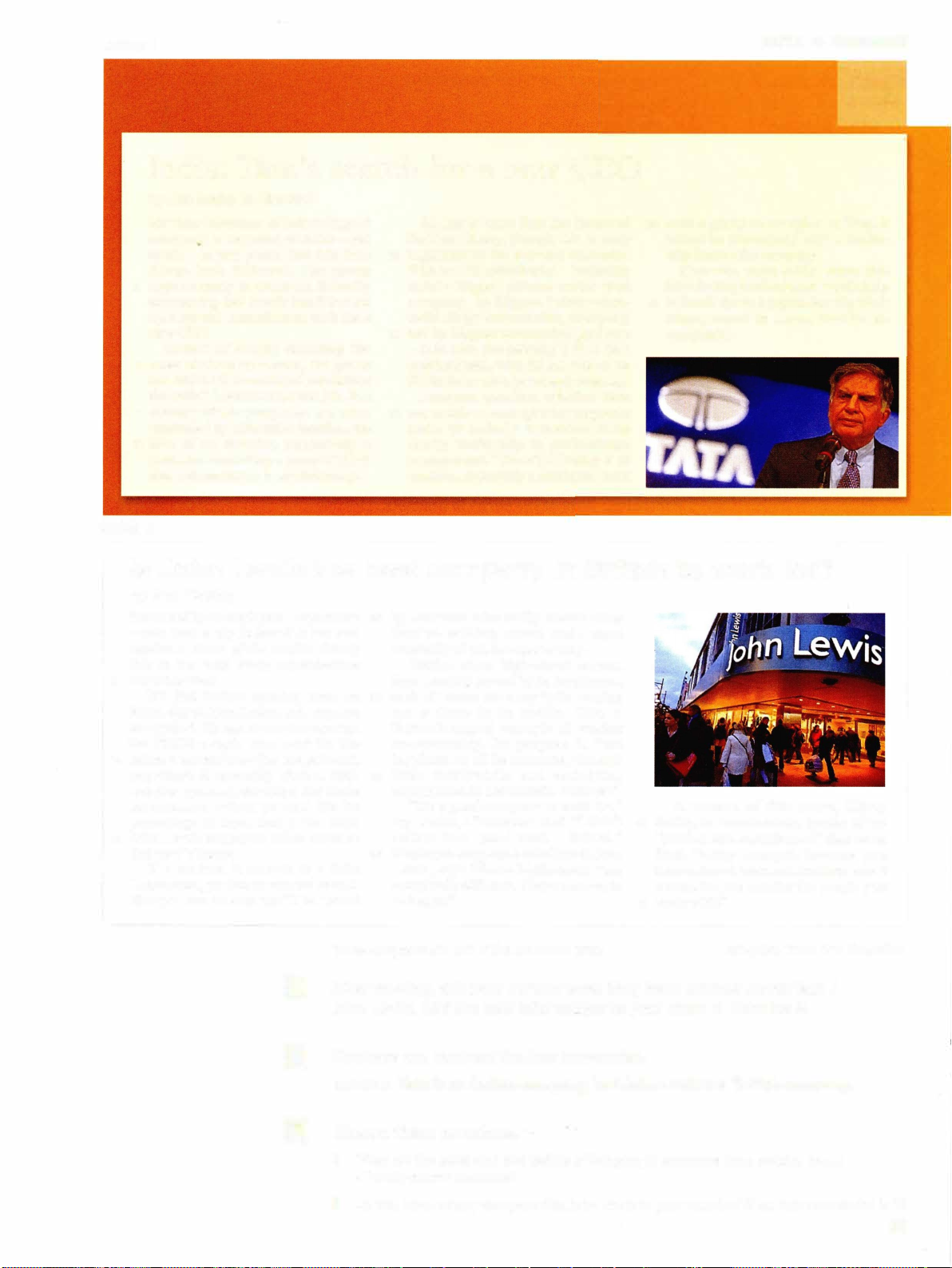
India: Tata's search for a new CEO by Joe Leahy in Mumbai
Mr Tata, Chairman of India's biggest
At risk is more than the future of
35 over a group as complex as Tata, it
company, is expected to retire - yet
the Tata Group, though this is very
would be disastrous," says a banker
again - in two years. But this time
20 important to the national economy. who knows the company.
things look different. The group
With its 100 subsidiaries - including
However, some critics argue that
5 appears ready to move on, formally
India's biggest private-sector steel
introducing professionals would help
announcing last month that it has set
company, its biggest information
40 to break down a reputation for weak
up a special committee to look for a
technology outsourcing company
management in large, family-run new CEO.
25 and its biggest automotive producer companies.
Instead of simply choosing the
- it is also the country's first true
10 most obvious successor, the group
multinational, with 65 per cent of its
has said it will consider all candidates
$71 bn in revenue generated overseas.
for India's biggest corporate job. In a
Analysts question whether Tata
country where companies are often
30 can create an example for corporate
controlled by influential families, the
India of orderly transition from
15 idea of an outsider, particularly a
family leadership to professional
foreigner, controlling a group ofTata's
management. "There's a feeling if an
size and reputation is revolutionary.
outsider, especially a foreigner, took Article 2
Is John Lewis the best company in Britain to work for? by Jon Henley
It is owned by its employees-or partners 20 by someone who really knows what
- who have a say in how it is run and
they're talking about and, most
receive a share of the profits. Surely
unusually of all, is eager to help.
this is the way every organisation
Unlike other high-street names, 5 should be run?
John Lewis is owned by its employees,
It's just before opening time on 25 each of whom has a say in its running
bonus day at John Lewis and, boy, are
and a share in its profits. This is
we excited. Up and down the country,
Britain's largest example of worker
the 69,000 people who work for the
co-ownership. Its purpose is "the
10 nation's favourite retailer are gathered,
happiness of all its members, through
impatient. A specially chosen staff 30 their worthwhile and satisfying
member opens an envelope and reads
employment in a successful business".
out a number. Fifteen per cent. It's the
"It's a good company to work for,"
A veteran of five years, Kirsty
percentage of their salary that each
says Pedro, a Waitrose* chef. "I didn't 40 Reilly, in womenswear, speaks of the
15 John Lewis employee takes home as
realise how good until I joined."
"passion and commitment" that come that year's bonus.
35 Employer-employee relations at John
from "being engaged, because you
If a product is on sale in a John
Lewis, says Nicola McRoberts, "are
have a shared interest in making sure it
Lewis store, you know you can trust it.
completely different. They want you to
works, for you and for the people you
Plus you can be sure you'll be served be happy." 45 work with."
*A supermarket chain, part of the John Lewis group
adapted from the Guardian
II After reading, ask your partner what they have learned about Tata /
John Lewis. Add the new information to your chart in Exercise B.
l:'J Compare and contrast the two companies.
EXAMPLE: Tata i, an Indian company, bvt Jolin LeL-vi, i, a /3riti,J, company.
II Discuss these questions. ··
1 What are the good and bad points of bringing in someone from outside to run a family-owned business?
2 Do you know of any company like John Lewis in your country? If so, how successful is it? 17 UNIT 2 .... COMPANIES LANGUAGE REVIEW··.
Complete the rules below with these phrases. Present simple a) faetttel iflfermati6fl and present b) future arrangements continuous
c) routine activities and habits
d) temporary situations We use the present simple to:
• give .f�.�t��!.i!'.fot.".l'.l.':'.t!�!'.1
Tata produces cars. • talk about ............ 2
I usually arrive at the office at eight o'clock.
Some verbs are almost always used in the present simple rather than the present
continuous, for example like, want, know, need.
We use the present continuous to: • describe ........... .3
She's staying in Mumbai till the end of the week. • talk about ............ 4
What are you doing on Tuesday afternoon?
c;] Grammar reference page 142
El Complete these sentences with either the present simple or the present
continuous form of the verbs in brackets.
We normally ... h'?I� ... (hold) our sales conference in Mumbai, but this year we
............ (hold) it in Delhi.
2 Although we ............ (use) our own sales representative at the moment, we generally
............ (use) agents in China.
3 Tatsuo ............ (work) for a financial magazine. At the moment, he ............ (write)
an article on insider trading.
tJ Usually our Sales Director ............ (deaf) with important customers, but I ........... .
(deaf) with all enquiries while she is on holiday.
5 I ............ (come) from Poland, but at the moment I ............ (live) in Germany.
6 John Lewis ............ (want) to continue with expansion this year.
II Complete the job advertisement below with either the present simple
or the present continuous form of the verbs in the box.
I be consider employ have grow look need offer offer prepare Sales Manager
•We ... �!".'? .... ' one of the largest
• We ............ 8 for people who
mobile-phone retailers in Europe.
are reliable, confident and
• We ............ 2 independent and
enthusiastic. We ............ 9
impartial advice on mobile phones.
experienced people who want • We ............
to work for an expanding 3 more than 800 stores
in 10 countries, and we ............ company. 4 fast. • We ............ • We ............ 10 a competitive 5 over 3,000 workers.
salary and private health
Currently, we ............ 6 the next stage
insurance. We are willing to
in our development, and we ............ 7
reward staff with attractive
for major growth outside Europe.
performance-based bonuses.
Ring 020 7948 0008 for an information pack. II Work in pairs. Student A: Turn to page 134. Student B: Turn to page 136. 18 UNIT 2 .,. COMPANIES
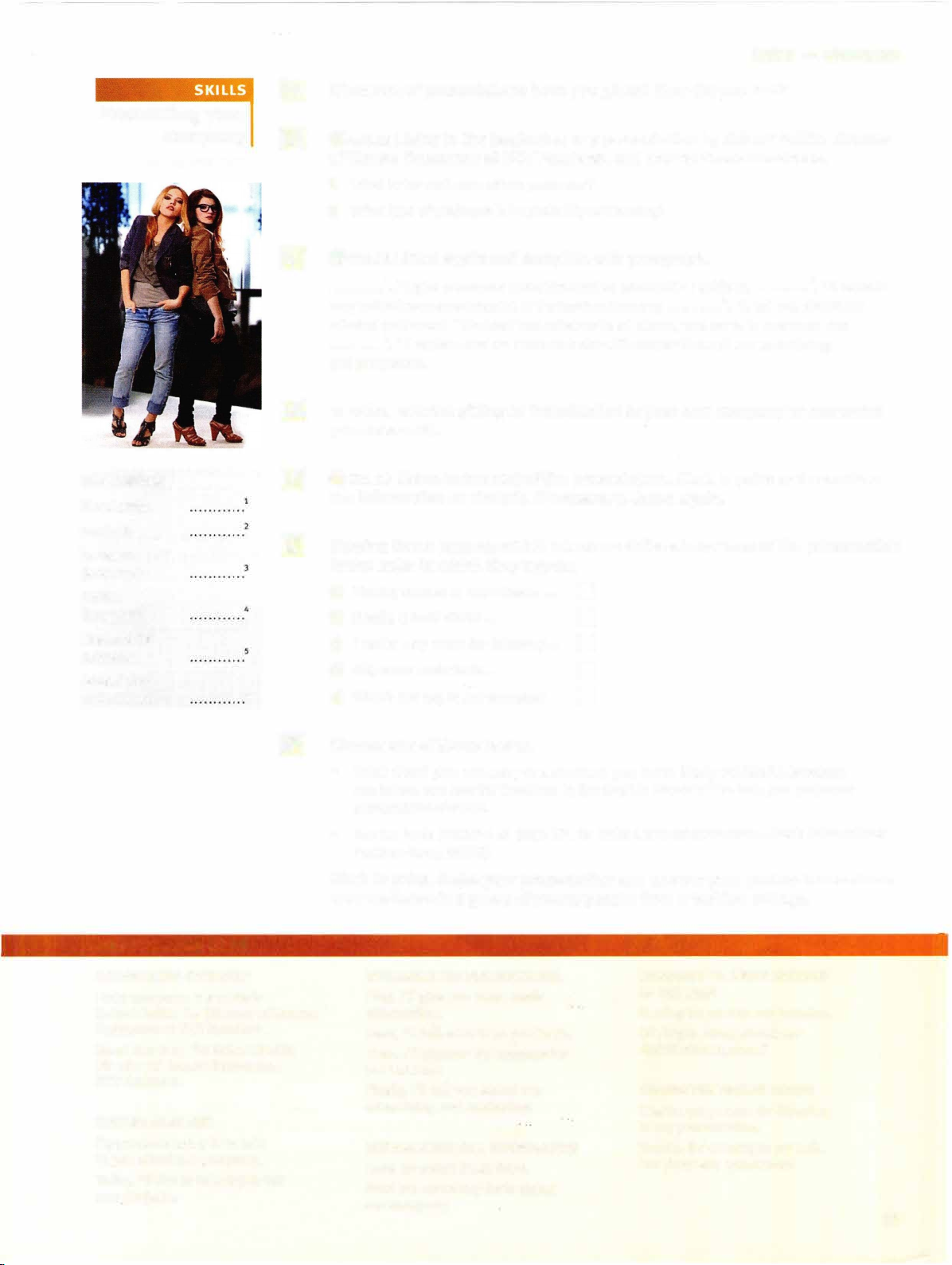
E1 What sort of presentations have you given? How did you feel? Presenting your
company m .. >» CDl.22 Listen to the beginning of a presentation by Robert Pullin, Director irLanguage.com
of Human Resources at DCV Fashions, and answer these questions.
1 What is the main aim of the presenter?
2 What kind of audience is he probably addressing?
a �» CDl.22 Listen again and complete this paragraph .
.. .. ... . . .. . 1, I'll give you some basic information about DCV Fashions ............. 2, I'll explain
why we've been so successful in the fashion industry ............. 3, I'll tell you about our
mission statement. This describes what we're all about, why we're in business. And 4
.....•.••••• , I'll explain how we communicate with people through our advertising and promotion.
II In pairs, practise giving an introduction to your own company or one which you know well. DCV Fashions
II ,.))) CDl.23 Listen to the rest of the presentation. Work in pairs and complete Head office
the information on the left. If necessary, listen again. Products
Ill Number these phrases which introduce different sections of the presentation Turnover (last year)
in the order in which they appear. Profits
a) Moving on now to our mission ... D (last year)
b) Finally, a word about ... D Reasons for
c) Thanks very much for listening ... D success
d) OK, some basic facts ... D Advertising and promotion 6
e) What's the key to our success? D
l!I Choose one of these topics.
• Think about your company or a company you know. Study the Useful language
box below, and use the headings in the chart in Exercise E to help you prepare a presentation about it.
• Use the facts provided on page 133 to make a presentation about Moda International Fashion Group (MIFG).
Work in pairs. Make your presentation and answer your partner's questions.
Your audience is a group of young people from a fashion college. USEFUL LANGUAGE I INTRODUCING .YOURSELF
OUTLINING THE PRESENTATION
CHANGING TO A NEW SECTION Hello everyone, my name's
First, I'll give you some basic OF THE TALK
Robert Pullin. I'm Director of Human information. Moving on now to our mission. Resources at DCV Fashions.
Next, I'll talk about our products. OK/Right. What about our
Good morning, I'm Robert Pullin,
Then, I'll discuss the reasons for distribution system? Director of Human Resources, our success. DCV Fashions.
Finally, I'll tell you about our
ENDING THE PRESENTATION advertising and marketing.
Thanks very much for listening STATING YOUR AIM to my presentation. My purpose today is to talk
INTRODUCING NEW INFORMATION Thanks for coming to my talk. to you about our company. Here are some basic facts. Are there any questions?
Today, I'd like to talk about our new projects. Here are some key facts about our company. 19