bài luyện tập thứ hai dễ dàng luyện tập
luyện tập và ôn lại
Môn: Kinh tế vĩ mô (NEU) 109 tài liệu
Trường: Trường Đại học Kinh Tế Quốc Dân 8.9 K tài liệu
Tác giả:

Preview text:
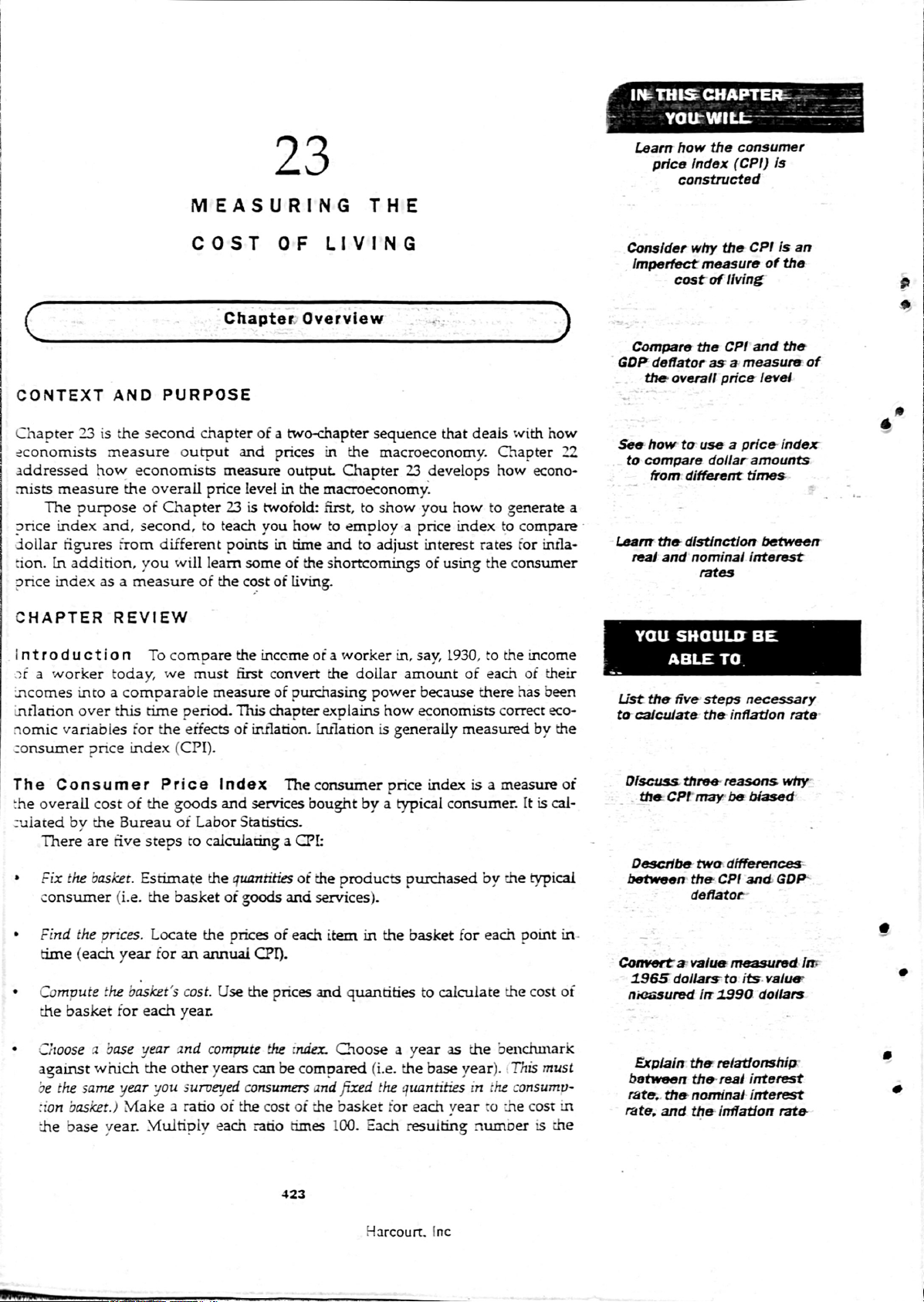
INTHISCHAPTERE YOU WIEE Learn how the consumer price index (CP!) is 23 constructed MEASURING THE COST OF LIVING Consider why the CPI is an Imperfect measure of the cost of living Chapter Overview Compare the CP! and the GDP deflator as a measure of the overall price level CONTEXT AND PURPOSE
Chapter 23 is the second chapter of a two-chapter sequence that deais with how See how to use a price index economists measure output and prices in the macroeconomy. Chapter 22 to compare dollar amounts
addressed how economists measure output. Chapter 23 develops how econo- from different times
mists measure the overall price level in the macroeconomy.
The purpose of Chapter 23 is twofold: frst, to show you how to generate a
Drice index and, second, to teach you how to employ a price index to compare
dollar igures irom different points in time and to adjust interest rates for intla- Leam the distinction between real and nominal interest
tion. In addition, you will learn some of the shortcomings of using the consuner rates
price index as a measure of the cost of living. CHAPTER REVIEW Yau SHGULDDBE
introduction To compare the inccme ofa worker in, say, 1930, to the income ABLE TO of a worker
today, we must first convert the dollar amount of each of their
incomes into a comparable measure of purchasing power because there has been List the five steps necessary
intlation over this time period. This chapter explains how economists correct eco-
to calculate the inflation rate
nomic variabies for the effects of inflation. inrlation is generally measured by the consumer price index (CPI). The Consumer Price Index
The consumer price index is a measure of DiscusS three reasons wry the CP! may be bíased
the overall cost of the goods and services bought by a typical consumer. It is cal-
cuiated by the Bureau of Labor Statistics.
There are five steps to calculating a CPI: Descrtbe twa differences
Fix the basket. Estimate the quantities of the products purchased by the typical between the CPl and GDP
consumer (i.e. the basket of goods and services). deflator
Find the prices. Locate the prices of each item in the basket for each point in
time (each year for an annuai CPI). Coverta vaiuemeasured in 1965 dollars to its.value •
Compute the basket's cost. Use the prices and quantities to calculate the cost of nicasured in 1990 dollars the basket for each year.
Choose a base year and compute the index. Choose a year as the benchmark Explain the relatornship
against which the other years can be compared (i.e. the base year). (This must botween the reat interest
be the same year you surveyed consumers and fxed the quantities in the consump- rate, the nominal interest
tion basket.) Make a ratio of the cost of the basket for each vear to the cost in rate, and the infiatíon rate the base year. Multiply
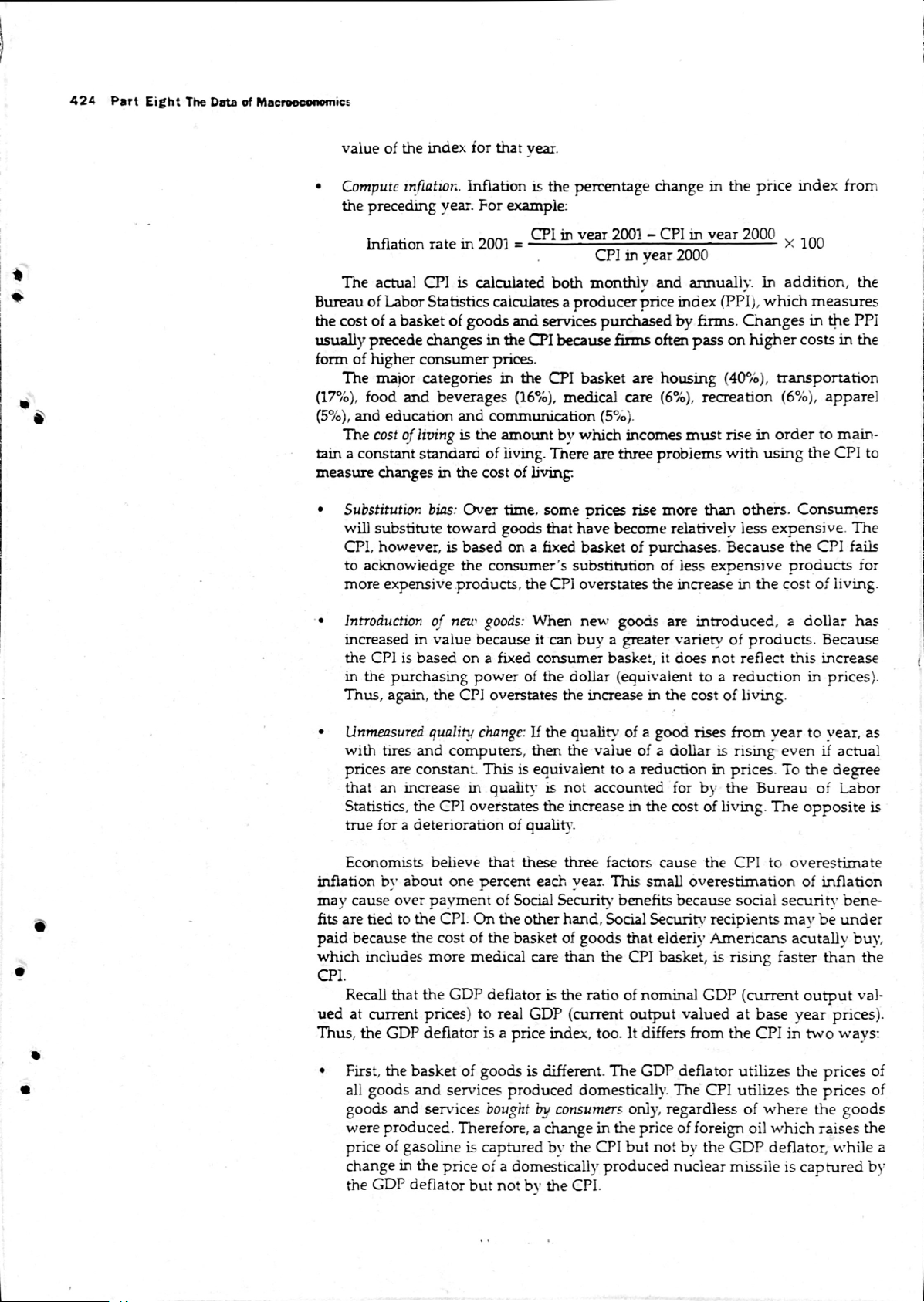
each raio times 100. Each resuiting number is the 423 Harcour. Inc 424
Part Eight The Data of Macroeconomics
vaiue of the index for that vear.
Compute infatior. inflation is the percentage change in the price index from
the preceding year. For exampie:
, CPl in vear2001 - CPl in vear 2000 Inflation rate in 2001 = 100 CPl in vear 2000
The actual CPI is calculated both monthiy and annually. in addition, the :
Bureau of Labor Statistics caiculates a producer price index (PPI), which measures
the cost of a basket of goods and services purchased by frms. Changes in the PPi
usually precede changes in the CPI because firms often pass on higher costs in the
form of higher consumer prices.
The major categoies in the CPI basket are housing (40%), transportation
(17%), food and beverages (16%), medical care (6%), recreation (6o), apparel
(5%), and education and communication (5%).
The cost of iiving is the amount by which incomes must rise in order to main-
tain a constant standará of iiving. There are three probiems with using the CPl to
measure changes in the cost of living:
Substitution bias: Over time, some prices rise more than others. Consumers
will substitute toward goods that have become relativelv less expensive. The
CPI, however, is based on a fixed basket of purchases. Because the CPI fails
to acknowiedge the consumer's substitution of less expensive products for
more expensive products, the CPi overstates the increase in the cost of living. İntroduction
of new goods: When new goods are introduced, a dollar has
increased in value because it can buy a greater variety of products. Because
the CPl is based on a fixed consumer basket, it does not reflect this increase
in the purchasing power of the dolar (equivalent to a reduction in prices).
Thus, again, the CPi overstates the increase in the cost of living.
Unmensured quality change: If the quality of a good rises from vear to vear, as
with tires and computers, then the vaiue of a dollar is rising evern if actual
prices are constant. This is equivaient to a reduction in prices. To the degree
that an increase in quality is not accounted for by the Bureau of Labor
Statistics, the CPl overstates the increase in the cost of living. The opposite is
true for a deterioration of quality.
Economists believe that these three factors cause the CPI to overestimate
inflation bv about one percent each vear. This small overestimation of inflation
may cause over payment of Social Security benefits because social security bene-
fits are tied to the CPI. On the other hand, Social Security recipients mav be under
paid because the cost of the basket of goods that elderiy Americans acutally buy,
which inciudes more medical care than the CPI basket, is rising faster than the CPI. .
Recall that the GDP deflator is the ratio of nominal GDP (current output val-
ued at current prices) to real GDP (current output valued at base year prices).
Thus, the GDP deflator is a price index, too. lt differs from the CPI in two ways:
First, the basket of goods is different. The GDP deflator utilizes the prices of .
all goods and services produced domestically. The CPI utilizes the prices of
goods and services bought b consumers only, regardless of where the goods
were produced. Therefore, a change in the price of foreign oil which raises the
price of gasoline is captured by the CPI but not by the GDP deflator, while a
change in the price of a domestically produced nuciear missile is captured by
the GDP deflator but not by the CPI.
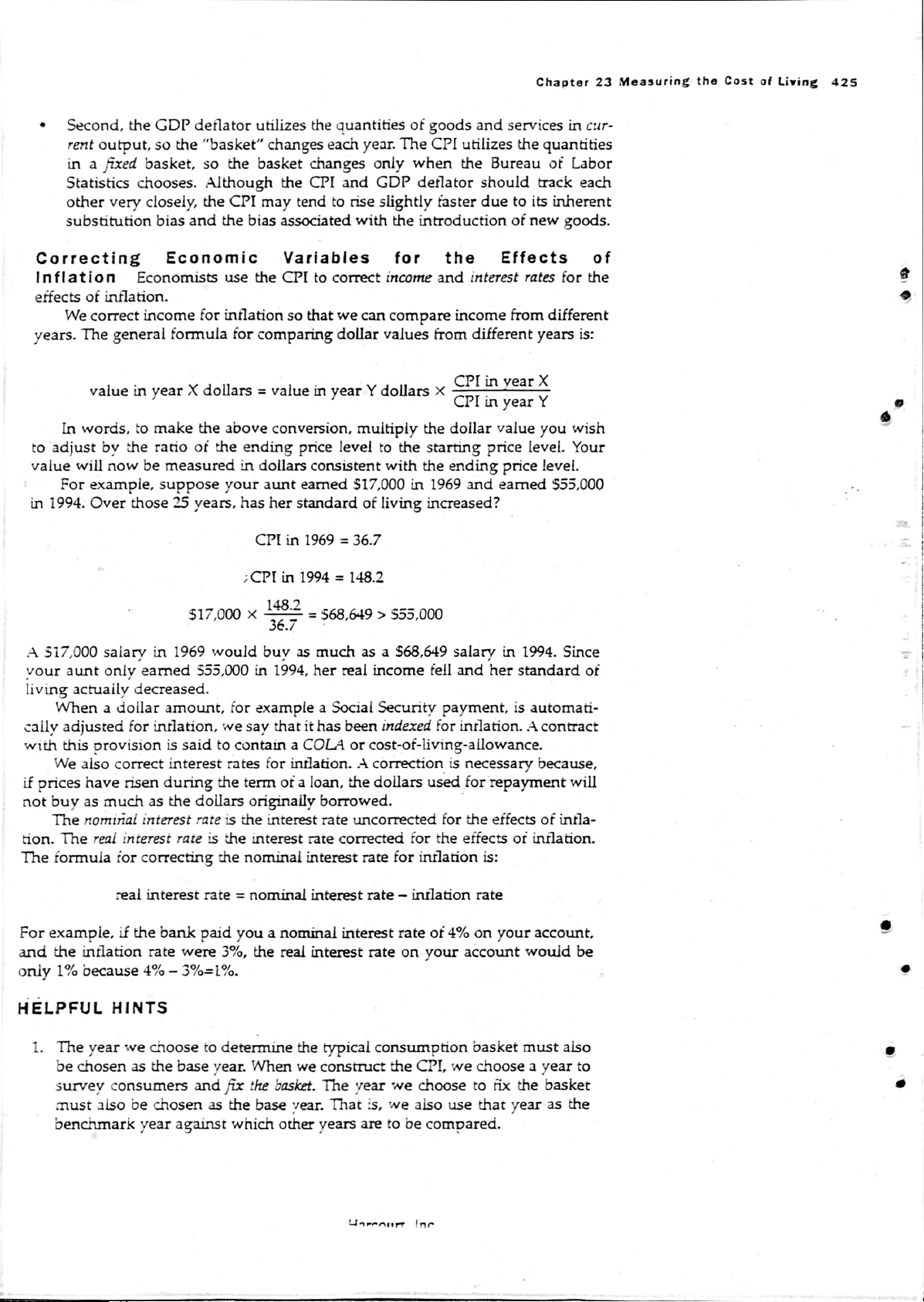
Chapter 23 Measuring the Cost of Living 425
Second, the GDP deflator utilizes the quantities of goods and services in cur-
rent output, so the "basket" changes each year. The CPI utilizes the quantities
in a fixed basket, so the basket changes only when the Bureau of Labor
Statistics chooses. Although the CPI and GDP deflator should track each
other very closely, the CPI may tend to rise slightly faster due to its inherent
substitution bias and the bias associated with the introduction of new goods. Correcting Economic Variables for the Effects of
Economists use the CPI to correct income and interest rates for the Inflation effects of inflation.
We correct incomne for inflation so that we can compare income from different
years. The general formula for comparing dollar values from differernt years is: CPI in year X
value in year X dollars = value in year Y dollars x CPI in year Y
In words, to make the above conversion, muitiply the dollar value you wish
to adjust by the ratio of the ending price level to the starting price level. Your
value will now be measured in dollars consistent with the ending price level.
For example, suppose your aunt earned S17,000 in 1969 and earned s55,000
in 1994. Over those 25 years, has her standard of living increased? CPI in l969 = 36.7 :CPI in 1994 = 148.2 148.2 S17,000 X = S68,649 > $55,000 36.7
A S17,000 salary in 1969 would buy as much as a $68,649 salary in 1994. Since
vour aunt only earned $55,000 in 1994, her real income fell and her standard of living actuailydecreased. When a doilar
amount, for example a Social Security payment, is automati-
cally adjusted for intlation, we say that it has been indexed for intlation. A contract
with this provision is said to contain a COLA or cost-of-living-ailowance.
We aiso correct interest rates for intlation. A correction is necessary because,
if prices have risen during the term of a loan, the dollars used for repayment will
not buy as much as the dollars originaily borrowed.
The nomirial interest rate is the interest rate uncorrected for the effects of intla-
tion. The real interest rate is the interest rate corrected for the effects of inflation.
The formula for correcting the nominal interest rate for intlation is:
real interest rate = nominal interest rate - intlation rate
For example, if the bank paid you a nominal interest rate of 4% on your account,
and the inflation rate were 3%, the real interest rate on your account wouid be only 1% because 4%- 3%=1%. HELPFUL HINTS
1. The year we choose to determine the typical consumption basket must also
be chosen as the base year. When we construct the CPI, We choose a year to
survey consumers and fix the basket. The year we choose to fix the basket
must also be chosen as the base vear. That is, we aiso use that year as the
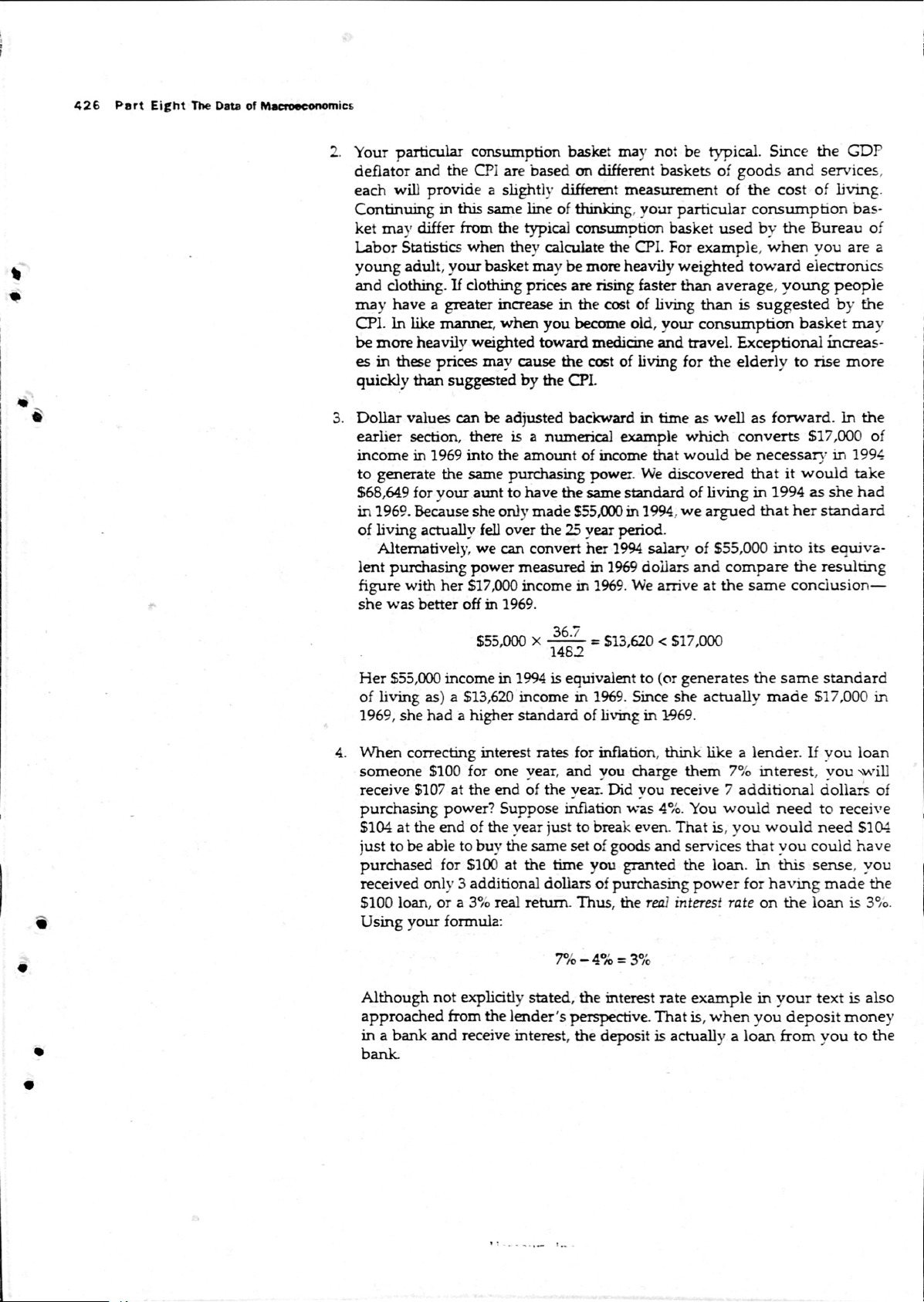
bencimark year against which other years are to be compared. Uareut Inc 426
Part Eight The Data of Macroeconomics 2. Your particular
consumption basket may not be typical. Since the GDP
deflator and the CPI are based on different baskets of goods and services,
each will provide a slightiy differernt measurement of the cost of living.
Continuing in this same line of thinking, your particular consumption bas-
ket may differ from the typical consumption basket used by the Bureau of
Labor Statistics when they calculate the CPI. For example, when you are a
young adult, yoư basketmay be ore heavily weighted toward electronics
and clothing. If clothing prices are rising faster than average, young people
may have a greater increase in the cost of living than is suggested by the
CPI. İn like manne, when you become old, your consumption basket may
be more heavily weighted toward medicine and travel. Exceptional inereas-
es in these prices mav cause the cost of living for the elderly to rise mnore
quickly than suggested by the CPI 3.
Dollar values can be adjusted backward in time as well as forward. in the
earlier section, there is a numerical example which converts $17,000 of
income in 1969 into the amount of income that would be necessary in 1994
to generate the sarme purchasing power. We discovered that it would take
$68,649 for your aunt to have the same standard of living in 1994 as she had
in 1969.Becauseshe only made$55,000in 1994, we argued that her standard
of living actually fell over the 25 vear period.
Alternatively, we can convert her 1994 salary of $55,000 into its equiva-
lent purchasing power measured in 1969 doiiars and compare the resulting
figure with her S17,000 income in 1969. We arrive at the same conciusion- she was better off in 1969. 36. $55,000 >x =S13,620 < S17,000 148.2
Her $55,000 income in 1994 is equivalent to (or generates the same standard
of living as) a $13,620 incomne in 1969. Since she actually made $17,000 in
1969, she had a higher standard of living in 1969.
4. When correcting interest rates for infiation, think like a lender. If you loan
someone $100 for one vear, and you charge them 7% interest, vou will
receive S107 at the end of the year. Did vou receive 7 additional dollars of
purchasing power? Suppose inflation was 4%. You would need to receive
$104 at the end of the vear just to break even. That is, you would need $104
just to be able to buy the same set of goods and services that vou could have
purchased for S100 at the time you granted the loan. In this sense, vou
received only 3 additional dollars of purchasing power for having made the
$100 loan, or a 3o real retum. Thus, the real interest rate on the loan is 3o. Using your formula: 7% -4% =3%
Although not explicitly stated, the interest rate example in your text is also
approached from the lender's perspective. That is, when you deposit money
in a bank and receive interest, the deposit is actually a loan from you to the bank.
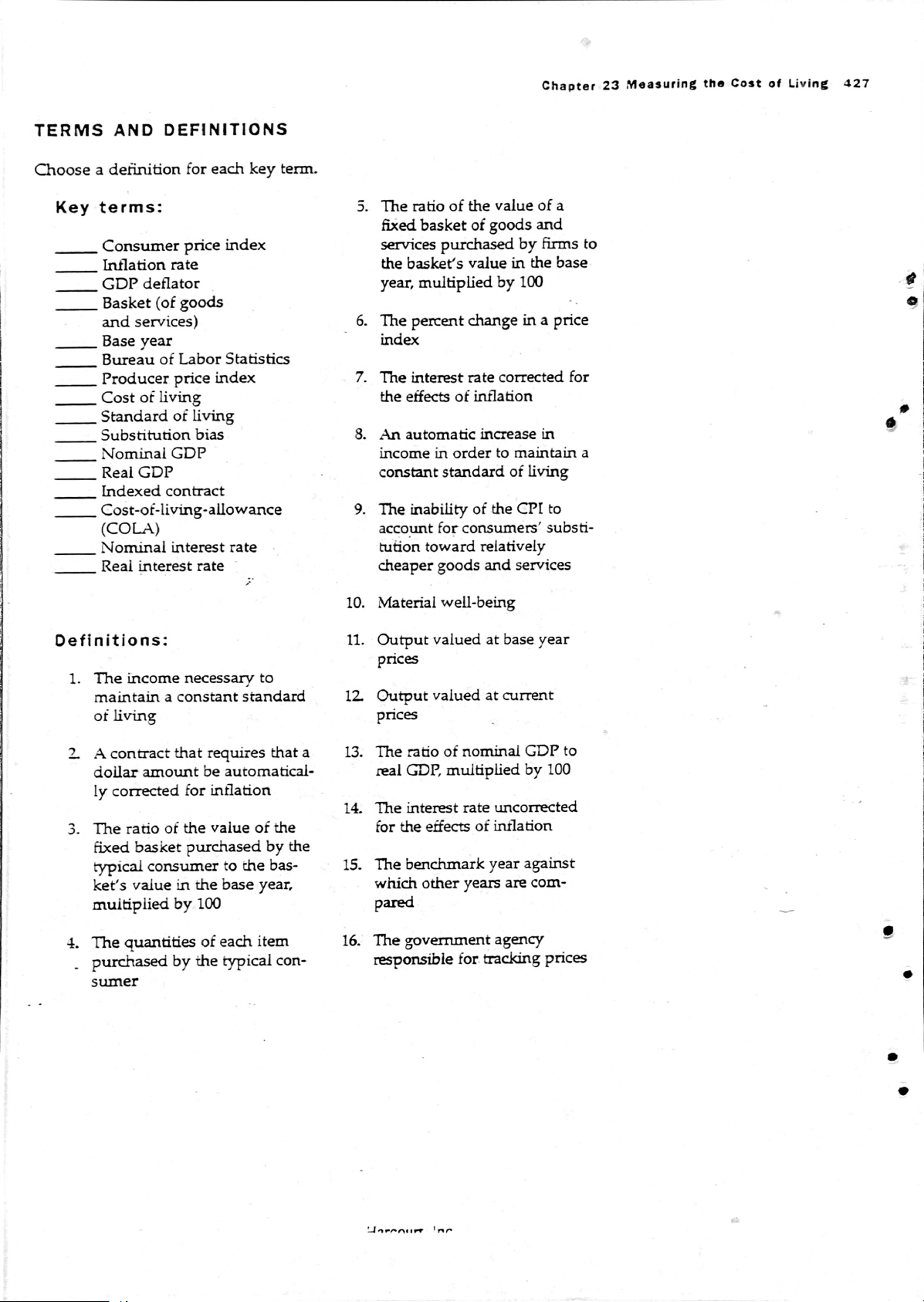
Chapter 23 Measuring the Cost of Living 427 TERMS AND DEFINITIONS
Choose a deinition for each key term. Key terms: 5. The ratio of the value of a fixed basket of goods and Consumner price index services purchased by firms to Inflation rate the basket's value in the base GDP deflator year, multiplied by 100 Basket (of goods and services) 6. The percent change in a price Base year index Bureau of Labor Statistics Producer price index
7. The interest rate corrected for Cost of living the effects of inflation Standard of living Substitution bias 8. An automatic increase in Nominal GDP income in order to maintain a Real GDP constant standard of living Indexed contract Cost-of-living-allowance 9. The inability of the CPI to (COLA) account for consumers' substi- Nominal interest rate tution toward reiatively Reai interest rate cheaper goods arnd services 10. Material well-being Definitions: 11. Output valued at base year prices 1. The income necessary to maintain a constant standard 12. Output valued at current of living prices 2.
A contract that requires that a
13. The ratio of nominal GDP to doilar amount be automatical- real GDP, muitiplied by 100 ly corrected for inflation
14. The interest rate uncorrected 3. The ratio of the value of the for the effects of inflation fixed basket purchased by the typical consumer to the bas- 15. The benchmark year against ket's value in the base year, which other years are com- muitiplied by 100 pared 4. The quantities of each item 16. The govemment agency purchased by the typical con- responsiblefor tracking prices Sumer 428 Port
Eight The Data of Macroeconomics
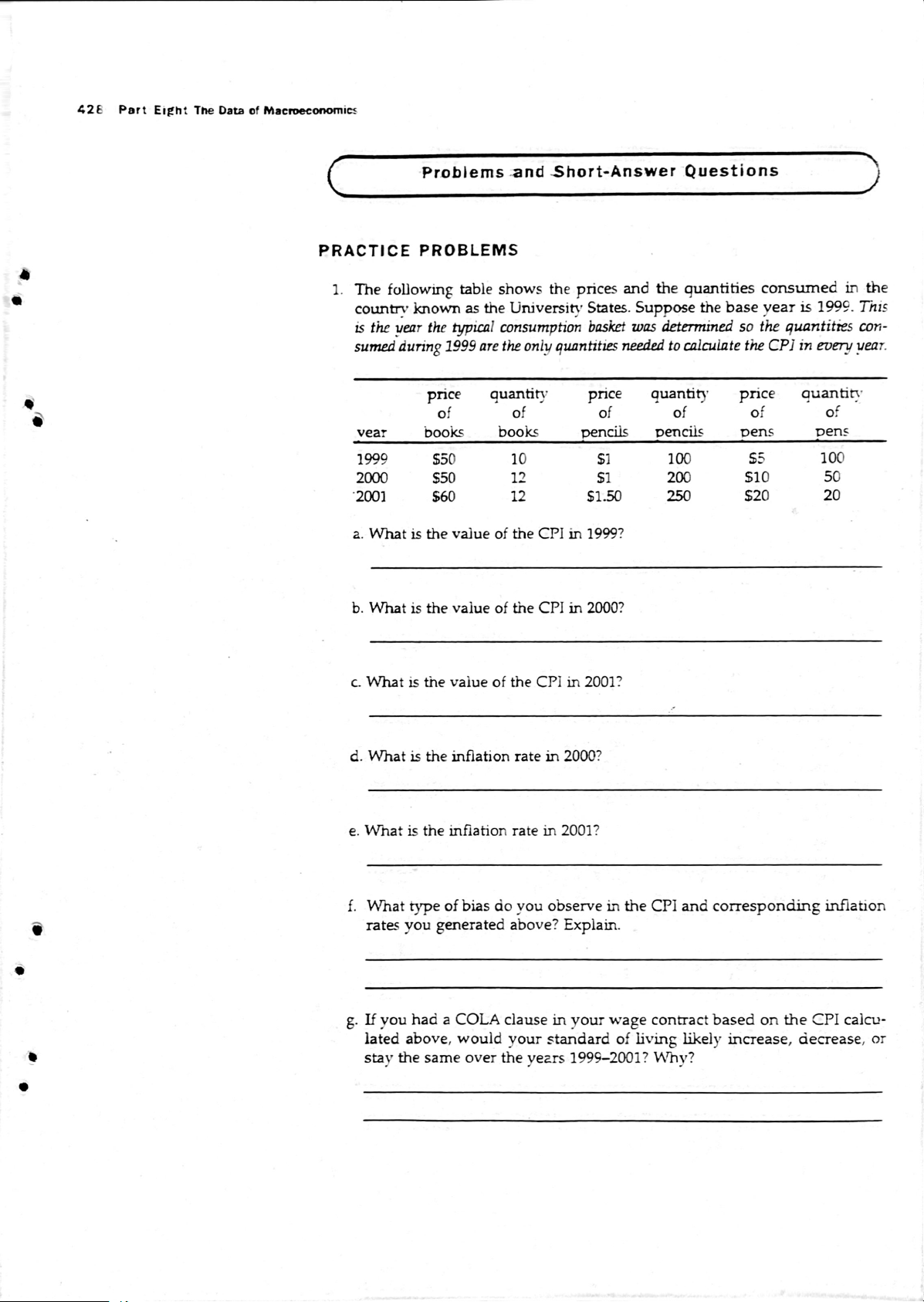
Problems and Short-Answer Questions PRACTICE PROBLEMS 1. The folowing
table shows the prices and the quantities consumed in the :
countrv known as the University States. Suppose the base year is 1999. Tnis
is the vear the typical consumption basket was determined so the quantities con-
Sumed during 1999 are the oniy quantities needed to calcuiate tne CPi in every vear. price quantity price quantity price quantit of of of of vear books books penciis Denciis pens pens 1999 $50 10 $1 100 S5 100 2000 $50 12 S1 200 S10 50 2001 $60 12 S1.50 250 $20 20
a. What is the value of the CPI in 1999?
b. What is the value of the CPI in 2000?
c. What is the vaiue of the CPl in 2001?
d. What is the inflation rate in 2000?
e. What is the infiation rate in 2001?
f. What type of bias do you observe in the CPi and corresponding inflation
rates you generated above? Explain. .
g. If you had a COLA clause in your wage contract based on the CPl calcu-
lated above, would your standard of living likely increase, decrease, or .
stay the same over the years 1999-2001? Why? Chapter 23 Measuring the Cost of Living 429
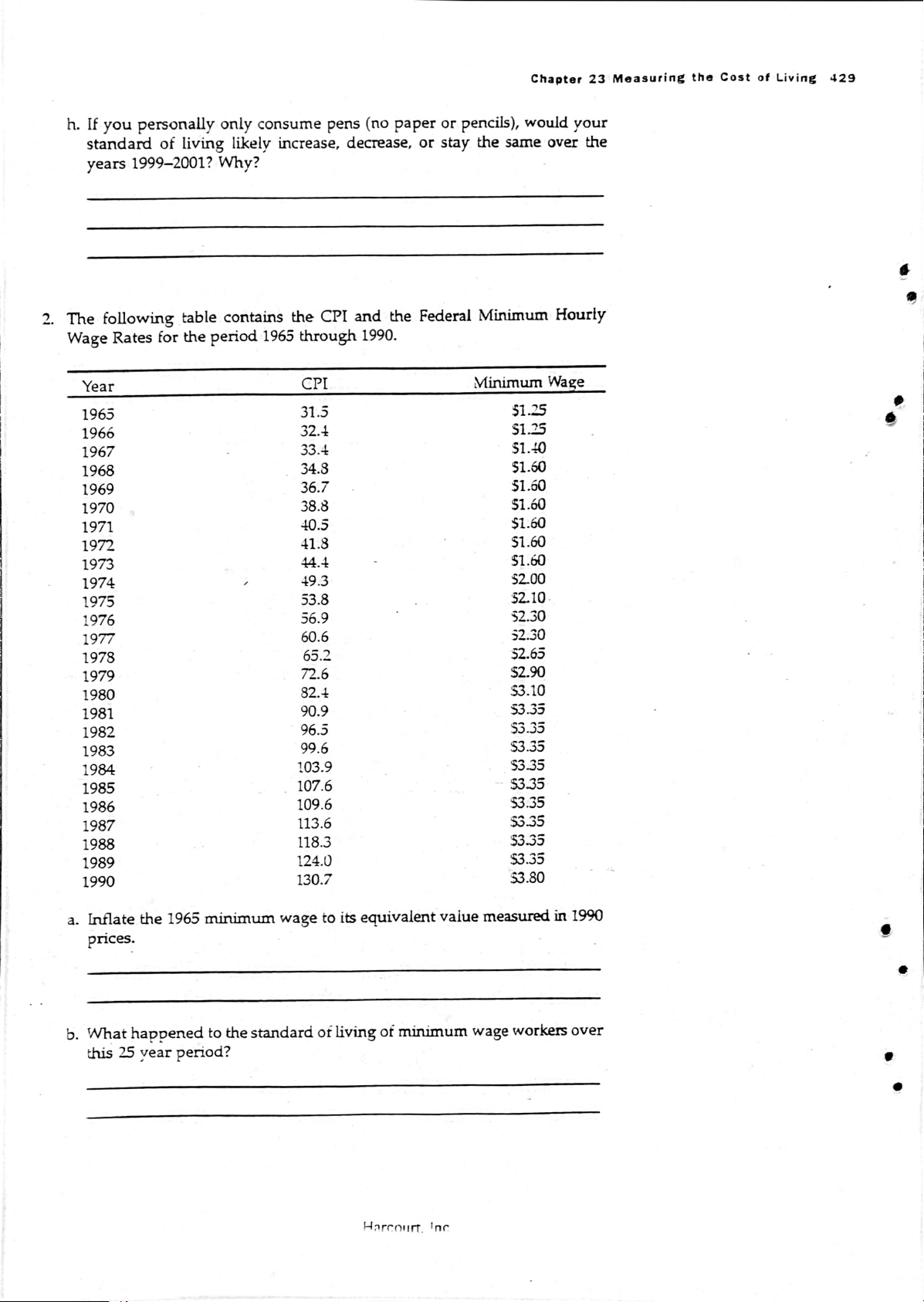
h. If you personally only consume pens (no paper or pencils), would your
standard of living likely increase, decrease, or stay the same over the years 1999-2001? Why? 2. The following
table contains the CPI and the Federal Minimum Hourly
Wage Rates for the period 1965 through 1990. Year CPI Minimum Wage 1963 31.3 $1.2 1966 32.4 S1.25 1967 33.4 S1.40 1968 34.3 S1.60 1969 36.7 S1.60 1970 38.8 S1.60 1971 40.5 S1.60 1972 41.3 S1.60 1973 44.4 S1.60 1974 49.3 $2.00 1975 53.8 52.10 1976 56.9 $2.30 1977 60.6 52.30 1978 65.2 52.63 1979 72.6 S2.90 1980 82.4 $3.10 1981 90.9 $3.35 1982 96.5 $3.35 1983 99.6 $3.35 1984 103.9 S3.35 1985 107.6 $3.35 1986 109.6 S3.35 1987 113.6 S3.35 1988 118.3 S3.35 1989 124.0 S3.35 1990 130.7 $3.80
a. Inflate the 1965 minimum wage to its equivalent vaiue measured in 1990 prices.
b. What happened to the standard of living of minimum wage workers over this 25 year period? Harcort. Inc 430 Part
Eight The Data of Macroeconomics
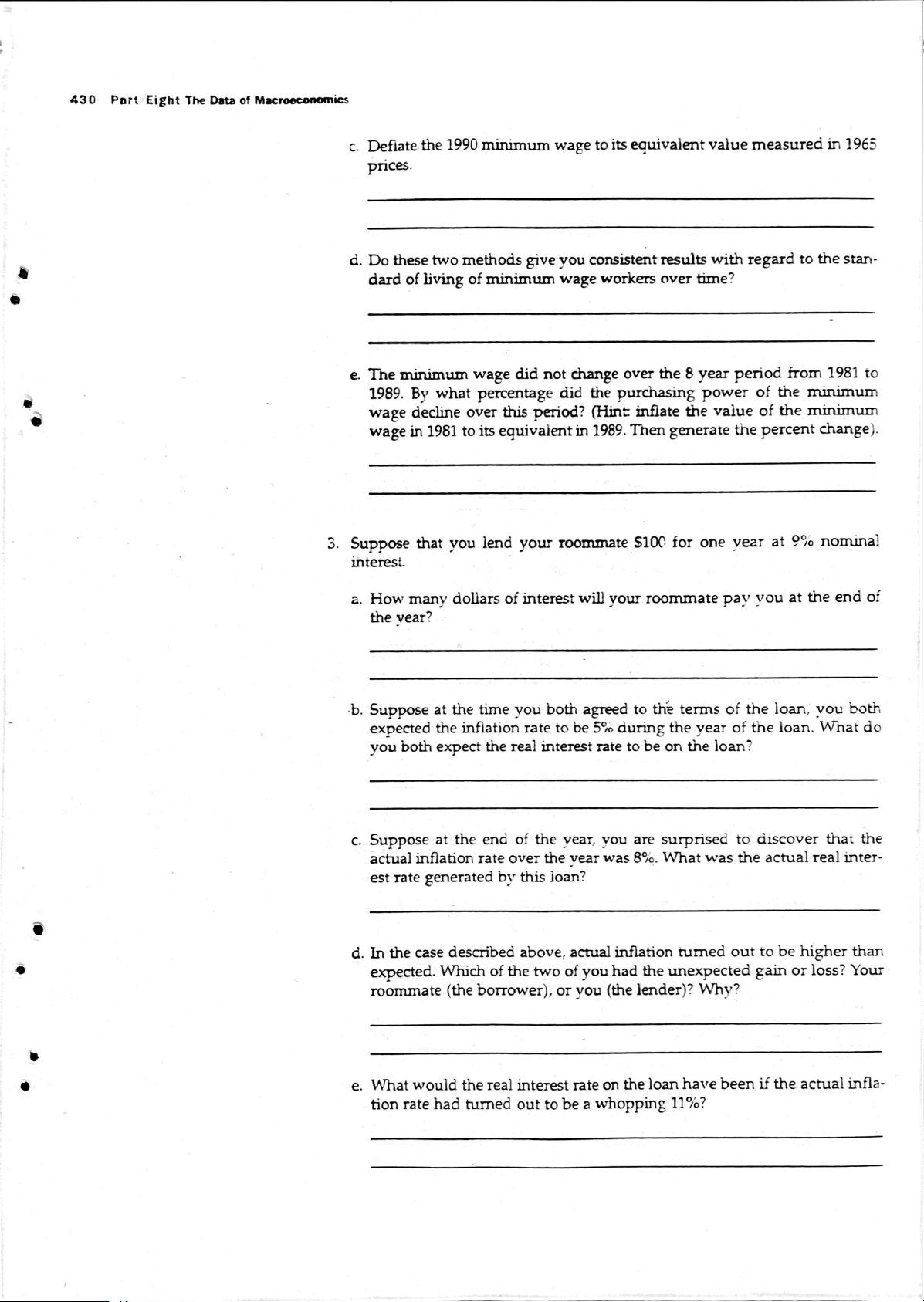
c. Deflate the 1990 minimun wage to its equivalent value measureả in 1965 prices.
d. Do these two methods give vou consistent results with regard to the star-
dard of living of minimum wage workers over time?
e. The minimum wage did not change over the 8 year period from 1981 to
1989. By what percentage did the purchasing power of the minimum
wage decline over this period? (Hint inflate the value of the minimum
wage in 1981 to its equivalent in 1989. Then generate the percent change).
5. Suppose that you lend your roommate $10 for one vear at 9% nomina! interest.
a. How many dollars of interest will your roommate pay vou at the end of the vear?
-b. Suppose at the time you both agreed to the terms of the loan, you both
expected the infiation rate to be 5% during the year of the loan. What do
you both expect the real interest rate to be on the loan?
c. Suppose at the end of the vear, vou are surprised to discover that the
actual inflation rate over the vear was 8%. What was the actual real inter-
est rate generated by this loan?
d. In the case described above, actual inflation turmed out to be higher than
expected. Which of the two of you had the unexpected gain or loss? Your
roommate (the borrower), or you (the lender)? Why?
e. What would the real interest rate on the loan have been if the actual infla-
tion rate had turmed out to be a whopping 11%?
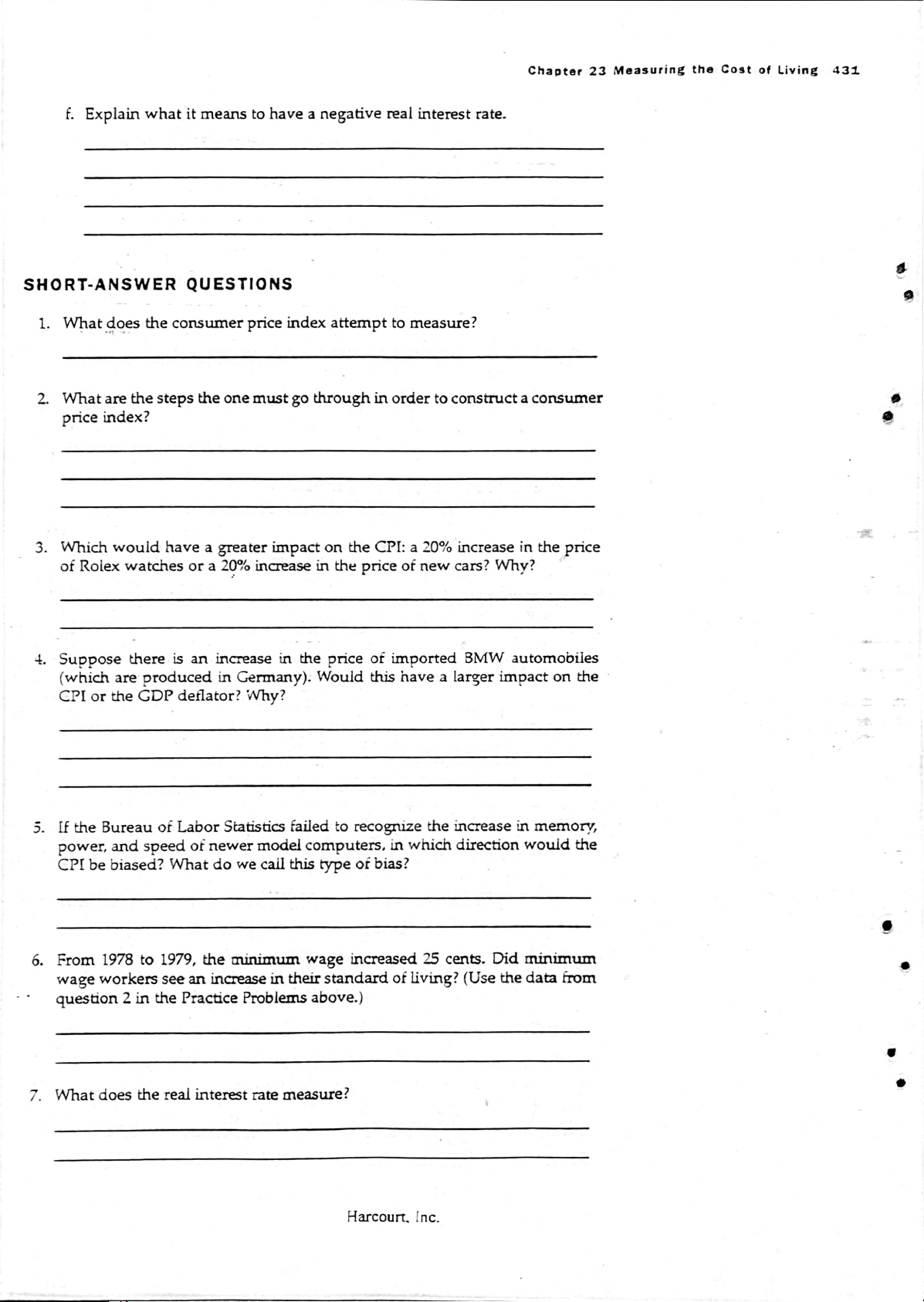
Chapter 23 Measuring the Cost of Living 431 f.
Explain what it means to have a negative real interest rate. SHORT-ANSWER QUESTIONS 1.
What does the consumner price index attempt to measure? 2.
What are the steps the one must go through in order to construct a consumer price index? 3. Which
would have a greater impact on the CPI: a 20% increase in the price
of Rolex watches or a 20% inrease in the price of new cars? Why? 4.
Suppose there is an increase in the price of imported BMW automobiles
(which are produced in Germany). Would this have a larger impact on the CPI or the GDP deflator? Why? 5.
If the Bureau of Labor Statistics failed to recognize the increase in memory,
power, and speed of newer model computers, in which direction would the
CPI be biased? What do we cail this type of bias? 6.
From 1978 to 1979, the minimum wage increased 25 cents. Did minimum
wage workers see an increase in their standard of living? (Use the data from
question 2 in the Practice Problems above.) 7.
What does the real interest rate measure? Harcourt, Inc. 432 Part
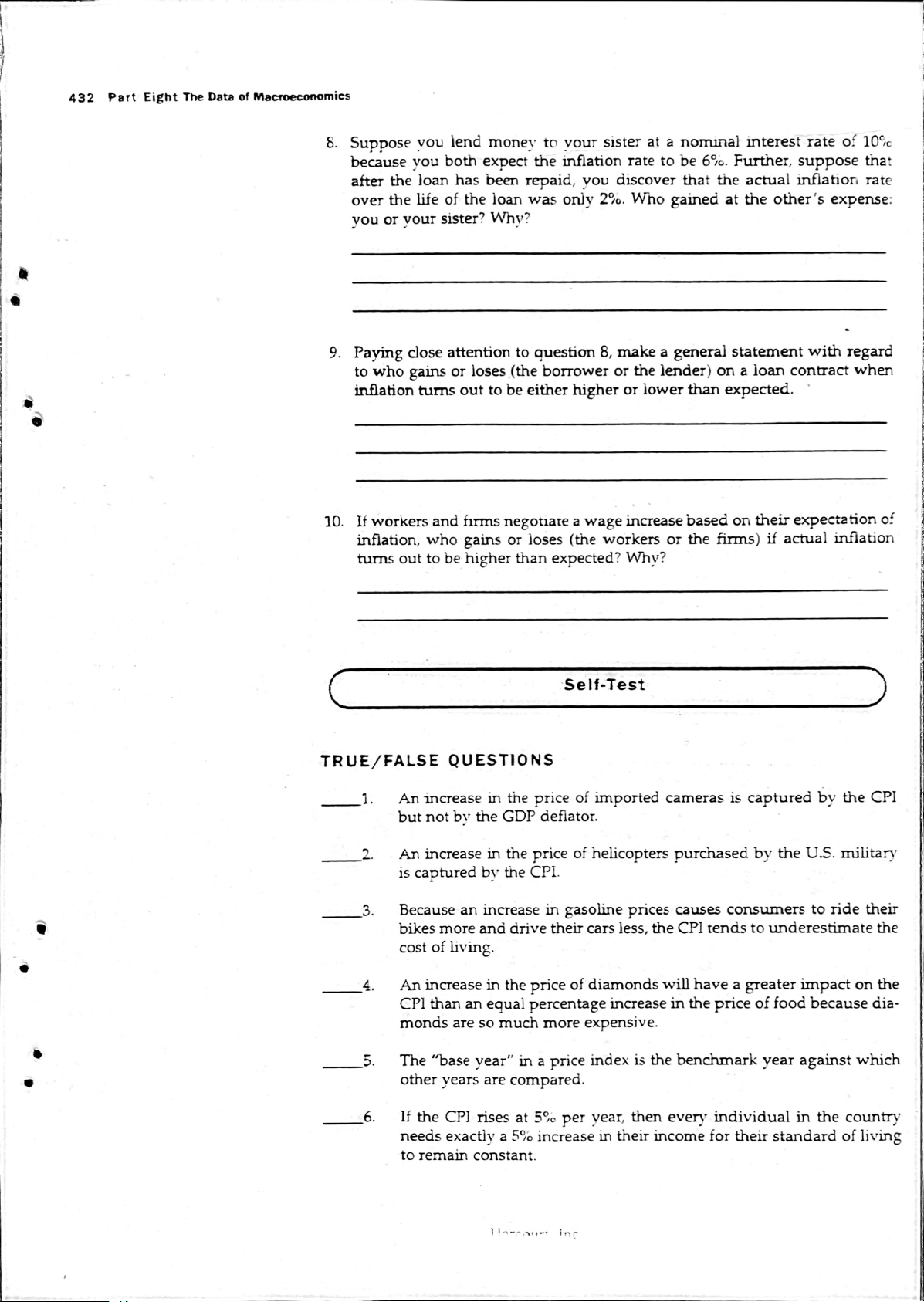
Eight The Data of Macroeconomics 8.
SuppOse vou lend monev to vour sister at a nominal interest rate of 10%
because vou both expect the inflation rate to be 6%. Further, Suppose that
after the loan has been repaid, vou discover that the actual inflatiorn rate
over the life of the loan was only 2%. Who gained at the other's expense: Vou or vour sister? Whv?
Paying close atterntion to question 8, make a general statement with regard
to who gains or loses (the borTOwer or the lender) on a loan contract when
inflation turms out to be either higher or lower than expected. 10.
If workers and furms negotiate a wage increase based on their expectation of
inflation, who gains or loses (the workers or the firms) if actual infiation
turns out to be higher than expected? Why? Self-Test TRUE/FALSE QUESTIONS
An increase in the price of imported cameras is captured by the CPI
i. but not by the GDP deflator.
An increase in the price of helicopters purchased by the U.S. military is captured by the CPI.
Because an increase in gasoline prices causes consumers to ride their
bikes more and drive their cars less, the CPl tends to underestimate the cost of living. .
An increase in the price of diamonds will have a greater impact on the
CPl than an equal percentage increase in the price of food because dia-
monds are so much more expensive.
The "base year" in a price index is the benchmark year against which 5. other years are compared. 6.
If the CPI rises at 5% per year, then every individual in the country
needs exactiy a59%increase in their income for their standard of living to remain constant. |la ing
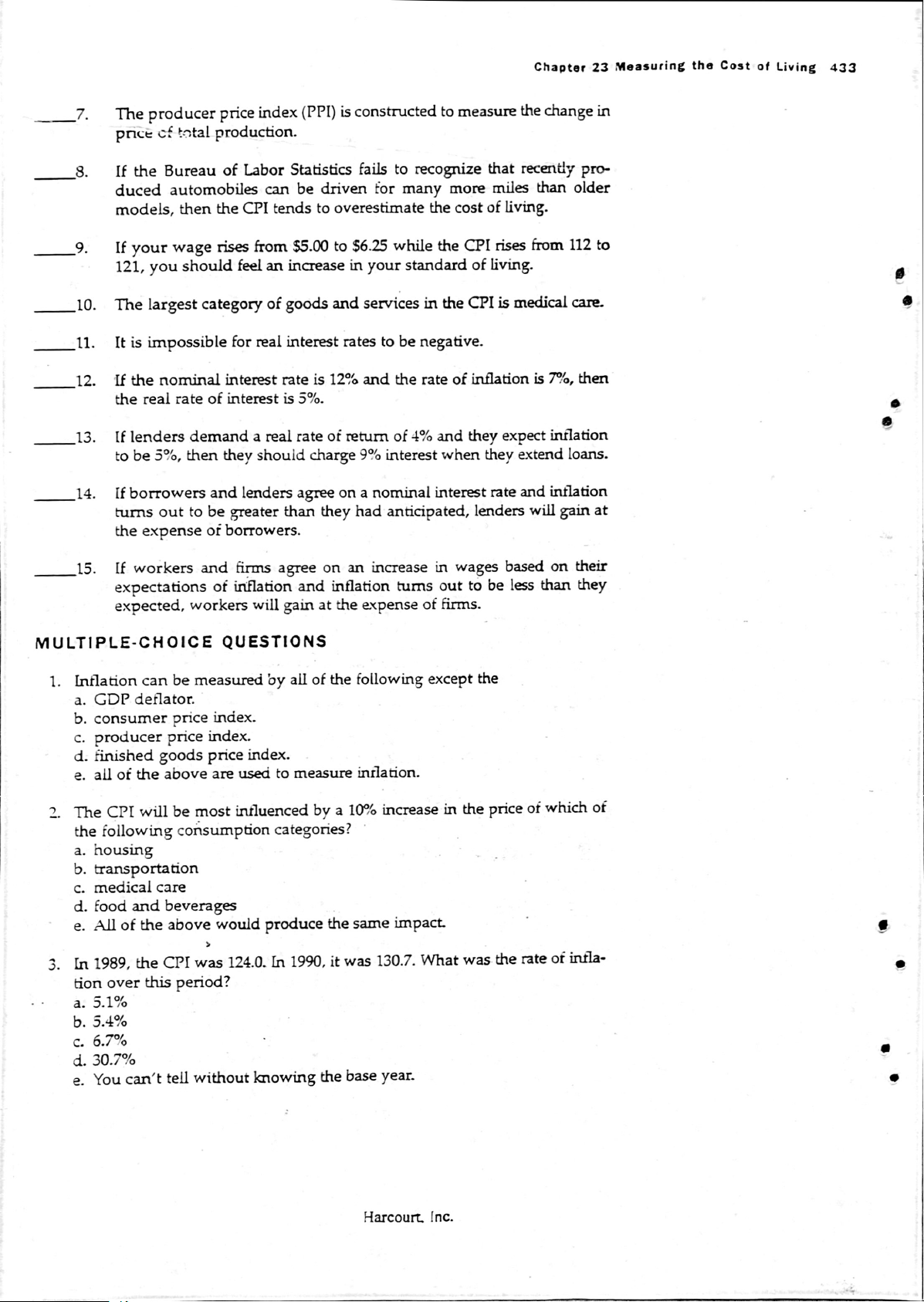
Chapter 23 Measuring the Cost of Living 433 L7.
The producer price index (PPI) is constructed to measure the change in price cf tatal production. 8
If the Bureau of Labor Statistics fails to recognize that recentty pro- duced
automobiles can be driven for many more miies than older
models, then the CPI tends to overestimate the cost of living. 9
If your wage rises from $5.00 to S6.25 while the CPI rises from 112 to
121, you should feel an increase in your standard of living. 10.
The largest category of goods and services in the CPl is medical care. 11.
It is impossible for real interest rates to be negative. 12.
If the nominal interest rate is 12% and the rate of inflation is T%, then
the real rate of interest is 5%. 13.
If lenders demand a real rate of return of 4% and they expect inflation
to be 3%, then they shouid charge 9% interest when they extend loans. 14.
If borrowers and lenders agree on a nomninal interest rate and inflation
turns out to be greater than they had anticipated, lenders will gain at the expense of borrowers. 15. If workers
and firms agree on an increase in wages based on their
expectations of inflation and inflation turns out to be less than they
expected, workers will gain at the expense of firms. MULTIPLE-CHOICE QUESTIONS 1.
Inflation can be measured by all of the following except the a. GDP deflator. b. consumer price index. C. producer price index. d. finished goods price index.
e. all of the above are used to measure iniiation.
2. The CPI will be most influenced by a 10% increase in the price of which of
the foilowing consumption categories? a. housing b. transportation G. medical care d. food and beverages
e. All of the above would produce the same impact. 3.
In 1989, the CPI was 124.0. In 1990, it was 130.7. What was the rate of infla- tion over this period? a. 5.1% b. 3.4% c. 6.7% d. 30.7%
e. You can't tell without knowing the base year. Harcourt, Inc. 434 Part
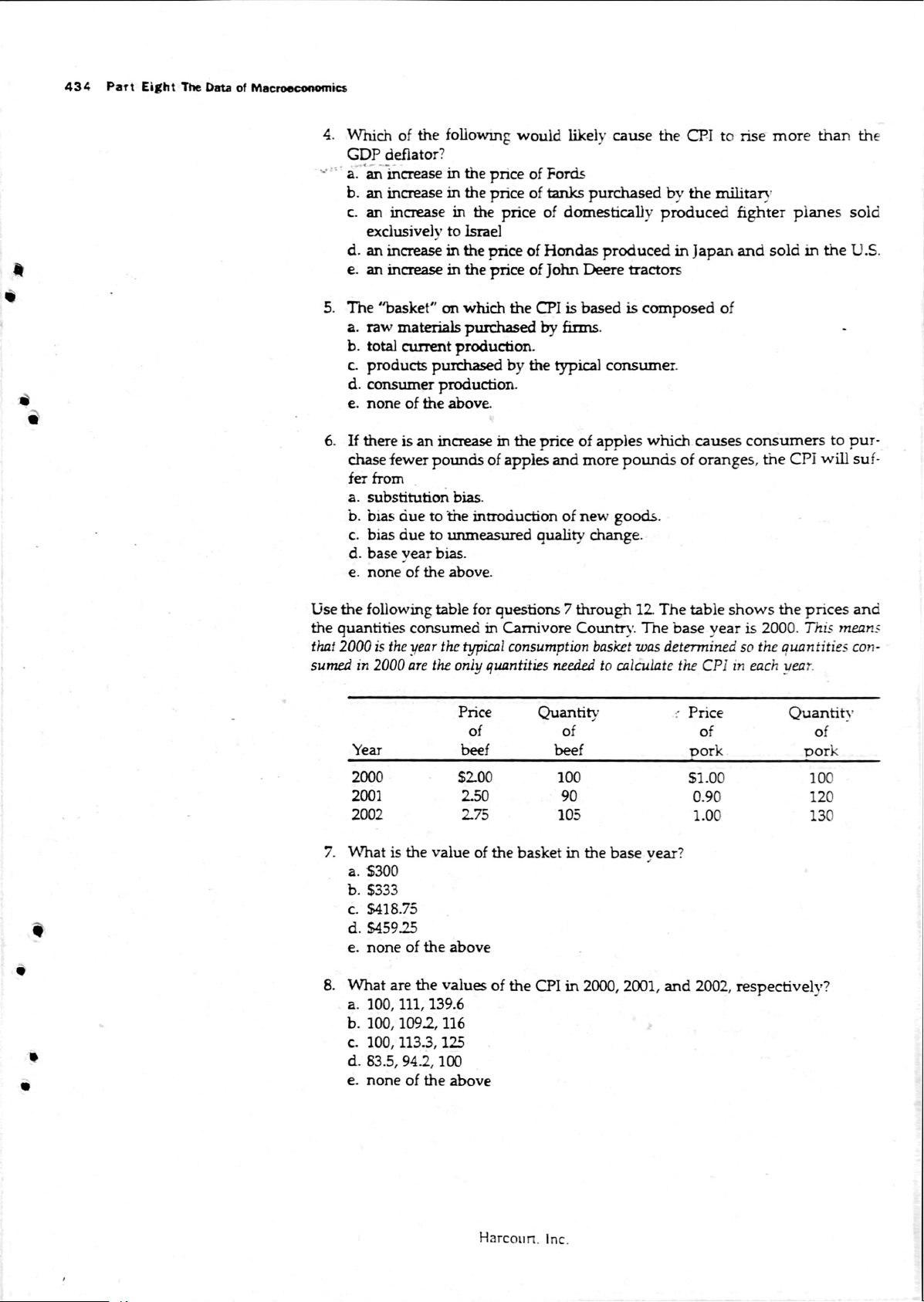
Eight The Data of Macroeconomics
4. Which of the foliowing wouid
ikely cause the CPI to rise more than the GDP deflator?
a. an increase in the price of Fords
b. an increase in the price of tanks purchased by the military
c. an increase in the price of domesticaly produced fighter pianes sold exclusively to lsrael
d. an increase in the price of Hondas produced in Japan arnd sold in the U.S.
e. an increase in the price of John Deere tractors
5. The "basket" on which the CPI is based is composed of
a. raw materials purchased by firms. b. total current production.
c products purchased by the typical consumer. d. consumer production. e. none of the above.
6. If there is an increase in the price of apples which causes consumers to pur-
chase fewer pounds of appies and more pounds of oranges, the CPi will suf- fer from a. substitution bias.
b. bias ảue to tihe introduction of new goods.
c. bias due to unmeasured quality change. d. base vear bias. e. none of the above.
Use the following table for questions 7 through 12. The table shows the prices and
the quantities consumed in Carmivore Country. The base year is 2000. This means
that 2000 is the year the typical consumption basket was determined so the quantities con-
sumed in 2000 are the oniy quantities needed to calculate the CPi in each vear. Price Quantity : Price Quantity of of of of Year beef beef pork pork 2000 $2.00 100 $1.00 100 2001 2.50 90 0.90 120 2002 2.75 103 1.00 130 7.
What is the value of the basket in the base vear? a $300 b $333 C. S418.75 d. $459.25 e. none of the above . 8.
What are the values of the CPI in 2000, 2001, and 2002, respectively? a. 100, 111, 139.6 b. 100, 109.2, 116 c. 100, 113.3, 125 d. 83.5, 94.2, 100 e. none of the above Harcourt. Inc.
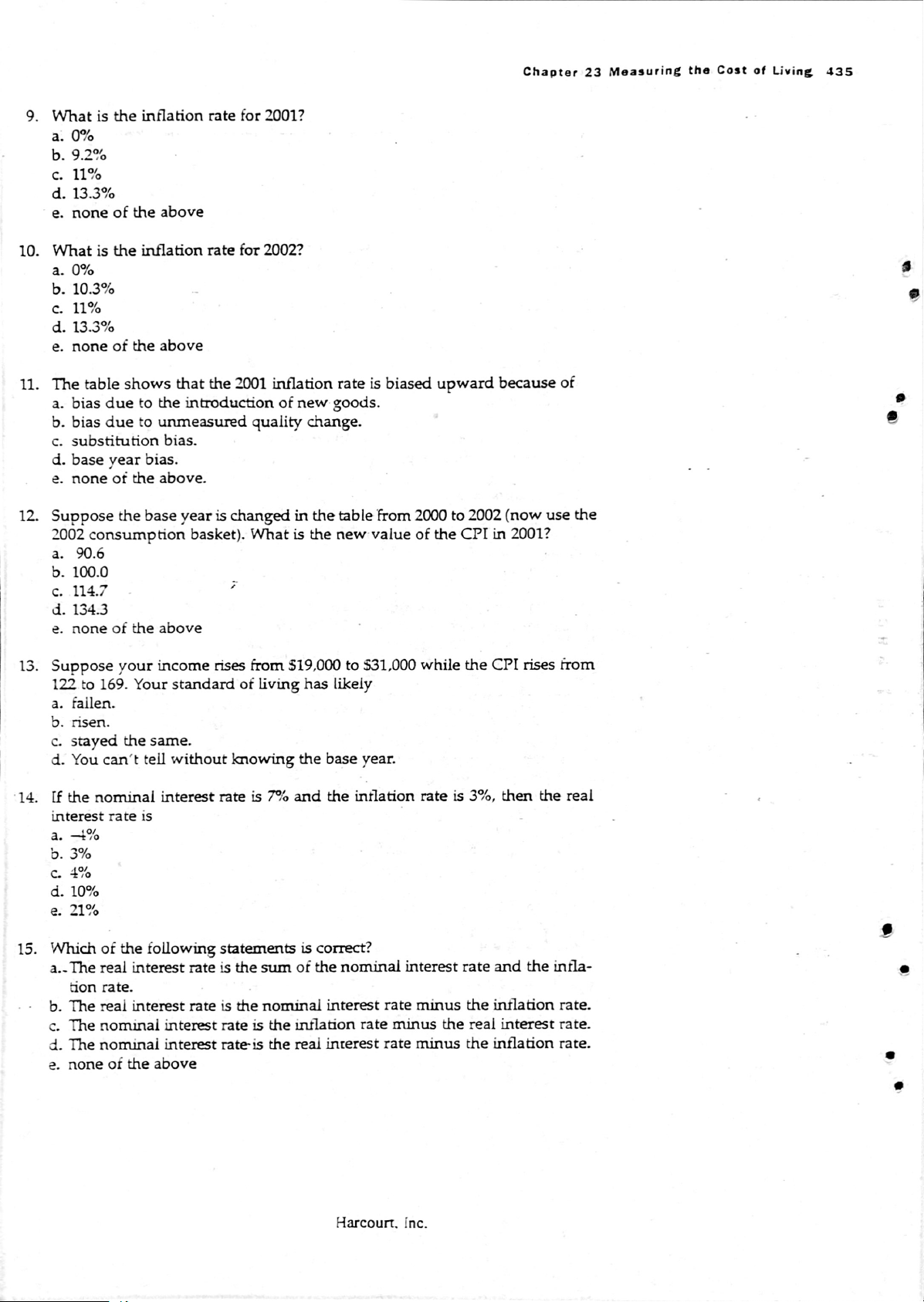
Chapter 23 Measuring the Cost of Living 435 9.
What is the inflation rate for 2001? a. 0% b. 9.2% C. 11% d. 13.3% e. none of the above 10.
What is the inflation rate for 2002? a 0% b. 10.3% C. 11% d. 13.3% e. none of the above
11. The table shows that the 2001 inflation rate is biased upward because of
a. bias due to the introduction of new goods.
b. bias due to unmeasured quality change. C. substitution bias. d. base year bias. e. none of the above. 12.
Suppose the base year is changed in the table From 2000 to 2002 (now use the
2002 consumption basket). What is the new value of the CPI in 2001? a. 90.6 b. 100.0 C. 114.7 134.3 e. none of the above
13. Suppose your income rises from S19,000 to $31,000 while the CPI rises from
122 to l69. Your standard of living has likely a. failen. b. risern. C. stayed the same.
d. You can't teil without knowing the base year. 14. If the nominal
interest rate is 7% and the inflation rate is 3%, then the real interest rate is a. 4% b. 3% C. 4% d. 10% e. 21%
15. Which of the following statements is correct?
a..The real interest rate is the sum of the nominal interest rate and the infla- tion rate.
b. The real interest rate is the nominal interest rate minus the inflation rate.
c. The nominal interest rate is the inflation rate minus the real interest rate.
d. The nominai interest rate- is the reai interest rate minus the inflation rate. e. none of the above Harcourt, Inc. 436 Part
Eight The Data of Macroeconomics 16.
If infiation is 8% and the real interest rate is 3%, then the nominal interest rate should be a. 3/8o b. 5% c. 11% d. 24% e. -5% 17.
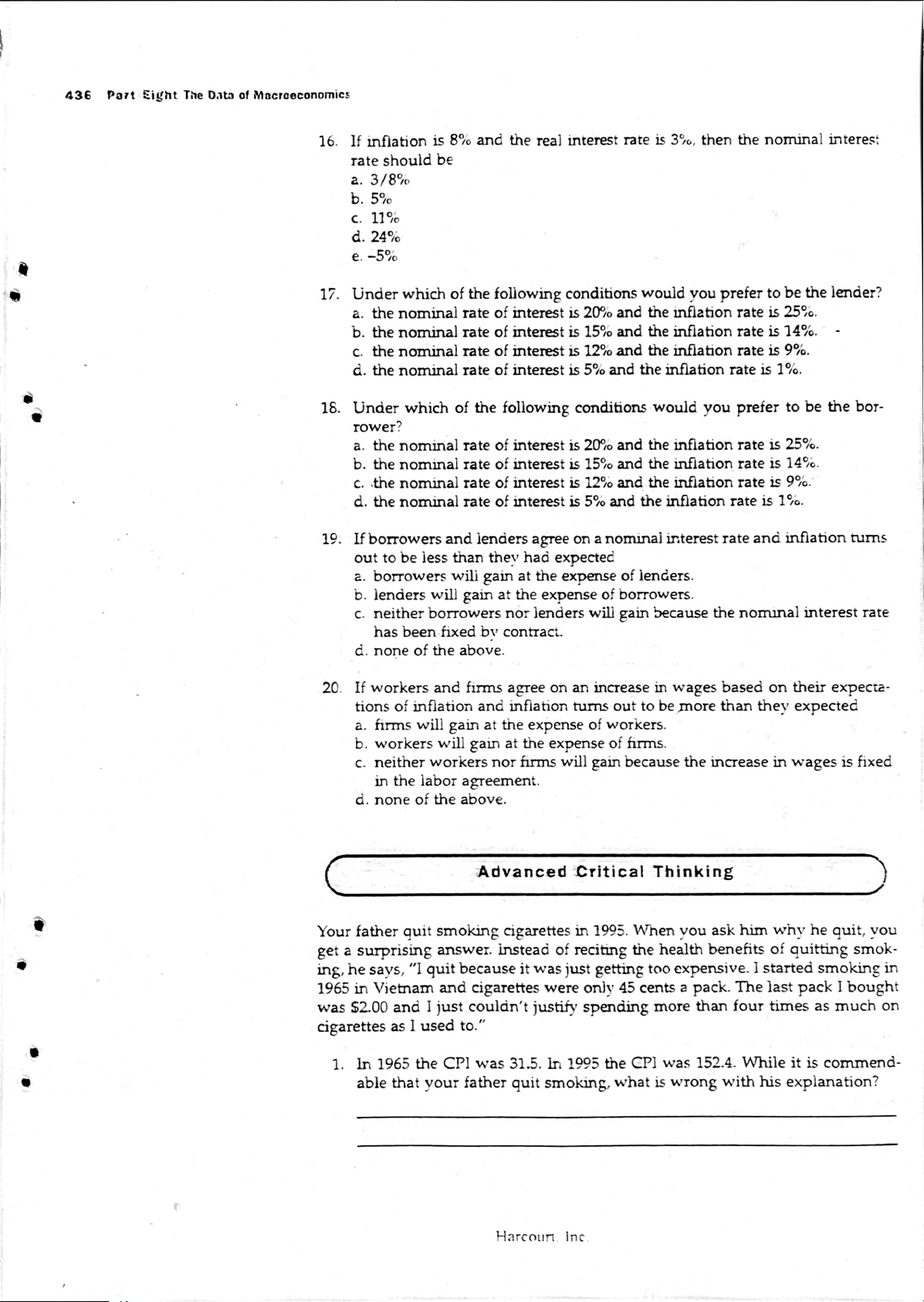
Under which of the foliowing conditions would you prefer to be the lender?
a. the nominal rate of interest is 20% and the inflation rate is 25%.
b. the nominal rate of interest is 15% and the inflation rate is 14%. -
c. the nominal rate of interest is 12% and the infiation rate is 9%.
d. the nominal rate of interest is 5% and the inflation rate is 1%.
18. Under which of the following conditions would you prefer to be the bor- rower?
a. the nominal rate of interest is 20% and the infiation rate is 25%.
b. the nominal rate of interest is 15o and the inflation rate is 14%.
c. the nominal rate of interest is 12% and the inflation rate is 9%.
d. the nominal rate of interest is 5% and the inflation rate is 1o. 19.
If borrowers and lenders agree on a nominal irterest rate and inflation turms
out to be less tharn thev had expected
a. borrowers wili gain at the expense of lenders.
b. lenders will gain at the expense of borrowers.
c. neither borrowers nor lenders wili gain because the nomınal interest rate has been fixed bv contract. d. none of the above. 20.
If workers and firms agree on an increase in wages based on their expecta-
tions of inflation and inflation turns out to be more than they expected
a. firms will gain at the expense of workers.
b. workers will gain at the expense of firms.
C. neither workers nor firms will gain because the increase in wages is fixed in the labor agreement. d. none of the above. Advanced Critical Thinking
Your father quit smoking cigarettes in 1995. When you ask him why he quit, vou
get a surprising answer. instead of reciting the health benefits of quitting smok-
ing, he says, "I quit because it was just getting too expensive. I started smoking in
1965 in Vietnam and cigarettes were ondy 45 cents pack. The last pack I bought
was $2.00 and I just couldn't justify spending more than four times as much on cigarettes as I used to."
1. In 1965 the CPI was 31.5. In 1995 the CPl was 152.4. While it is commend-
able that your father quit smoking, what is wTOng with his explanation? Harcourn. Inc
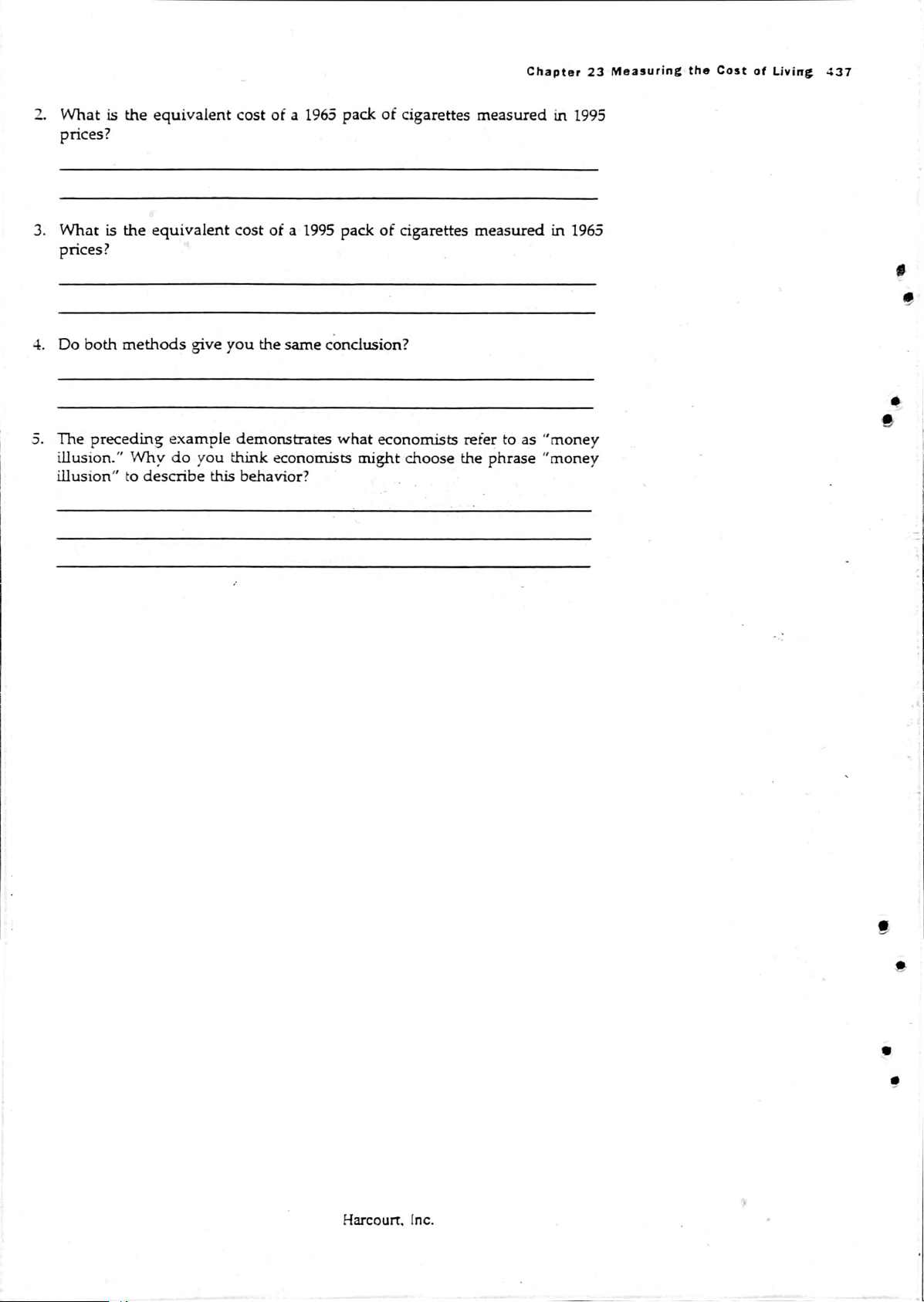
Chapter 23 Measuring the Cost of Living 437 2.
What is the equivalent cost of a 1963 pack of cigarettes measured in 1995 prices? 3.
What is the equivalent cost of a 1995 pack of cigarettes measured in 1965 prices?
4. Do both methods give you the same conclusion?
5. The preceding example demonstrates what economists refer to as "money
illusion." Why do you think economists might choose the phrase "money
illusion" to describe this behavior? Harcourt, Inc.