bài tập vĩ mô luyện tập đầy đủ dễ hiểu
luyện tập lại bài cũ
Môn: Kinh tế vĩ mô (NEU) 109 tài liệu
Trường: Trường Đại học Kinh Tế Quốc Dân 8.9 K tài liệu
Tác giả:

Preview text:
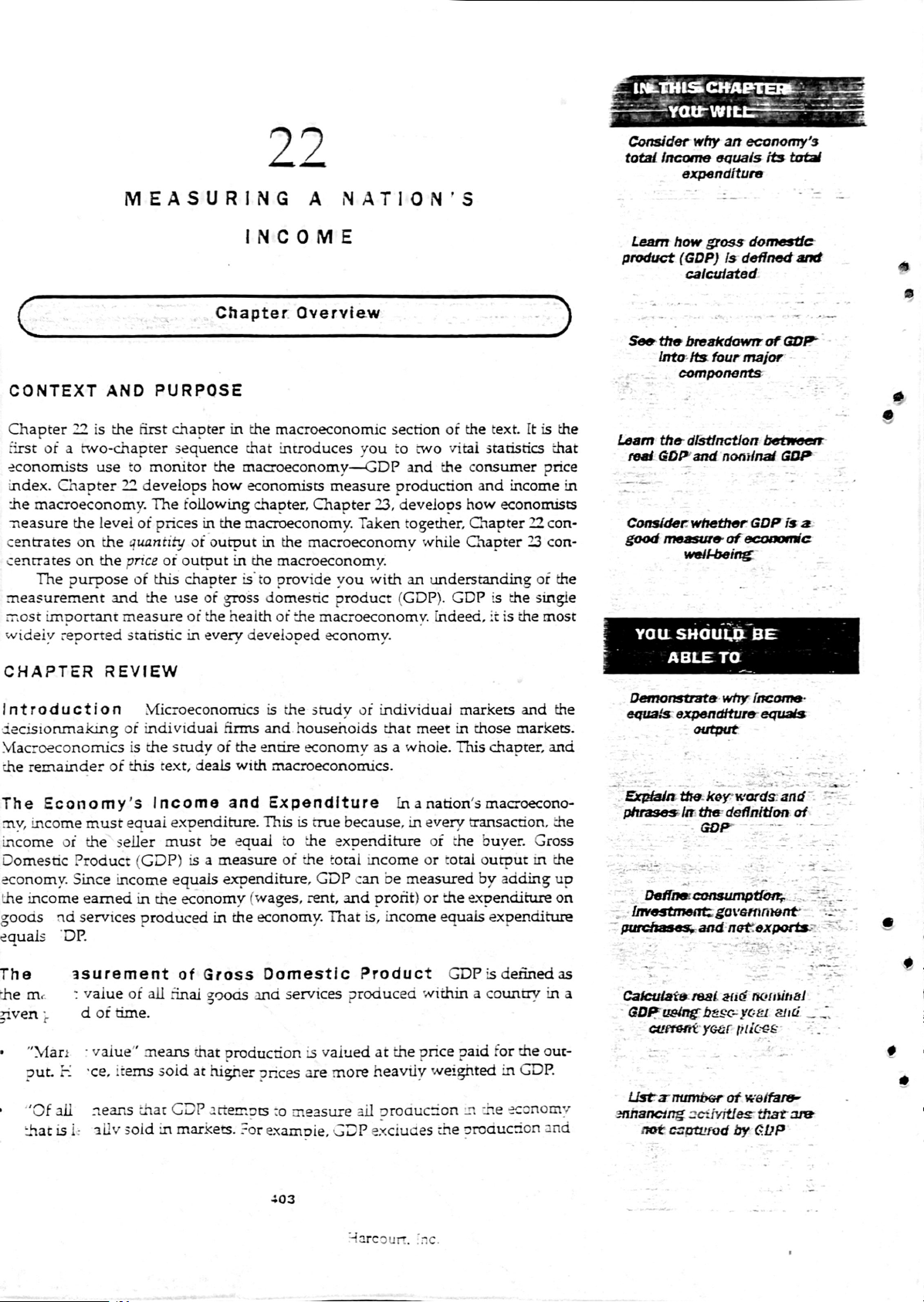
INETHISCHALTER YatWItL Consider why an econoy's 22 total income squais its total expenditure MEASURING ANATION'S - INCO ME Leam how gross domestc product (GDP) İs defined and calcutated Chapter Overview Soo tho breakdawn of GDP Lnto Its four major components CONTEXT AND PURPOSE
Chapter 22 is the first chapter in the macroeconomic section of the text. It is the Leam the dlstinctiorn betwoerr
first of a two-chapter sequence chat introduces you to two vitai statistics that reat GDP and nonilnat GOP economists use to monitor the macroeconomy-GDP and the consumer price
index. Chapter 22 develops how economnists measure production and income in
he macroeconomy. The following chapter, Chapter 23, develoDs how economists
neasure the levei of prices in the macroeconomy. Taken togeher, Chapter 22 con- Consider. whether GDP is a
centrates on the quantity of output in the macroeconomy while Chapter 23 con- good mesure ofeconomic wellbeing
centrates on the price of output in the macroeconomy.
The purpose of this chapter is to provide vou with an understanding of the
measurement and the use of gross domestic product (GDP). GDP is the singie
most important measure of the heaith of the macroeconomy. Indeed, it is the most
wideiv reported statistic in every developed economy. Yau sHauLo BE ABLE TO CHAPTER REVIEW Demonstrate whyincomae- Introduction
Microeconomics is the study of individuai markets and the equats expendtture equals
decisionmaking of individuai fims and housenoids that meet in those markets. output
Macroeconomics is the study of the enire economy as a whoie. This chapter, and
the remainder of this text, deals with macroeconomics. Expfaln the key wards and The Economy's Income and Expenditure In a nation's macroecono- prases ln the defnitlon of
my, income must equai expenditure. This is true because, in every transaction, he GDP income of the seller must be equai to the expenditure of the buyer. Gross
Domestic Product (GDP) is a measure of the total income or totai output in the
economy. Since income equais expernditure, GDP can be measured by adding up
the income earned in the economy (wages, rent, and prorit) or the expenditure on Define:consurmptlon Ivestment govemment
goods nd services produced in the economy. That is, income equais expenditure purchases and not.exports equals DP. The asurement of Gross Domestic Product GDP is defined as he m.
: vaiue of all finai goods and services produced within a country in a Calculateraal liố nensinal d of time. GDPueng bascyeat aii given ; CUTGRÉ yGaf picEE "Mar:
vaiue" means that production is vaiued at the price paid for the out- put. H
ce, items soid at higher prices are more heaviy weighted in GDP. ist rtumbGrofweffare- "Of all
neans that GDP attemots to measure ail production in he conomy enhancing zciivittes that are hat is i:
alv soid in markets. For exampie, GDP exciudes the oroducion and rot capturod by GUP 403 4arcourt. Ínc. 04
Per: Eigh: TheDate efmacroeconomics
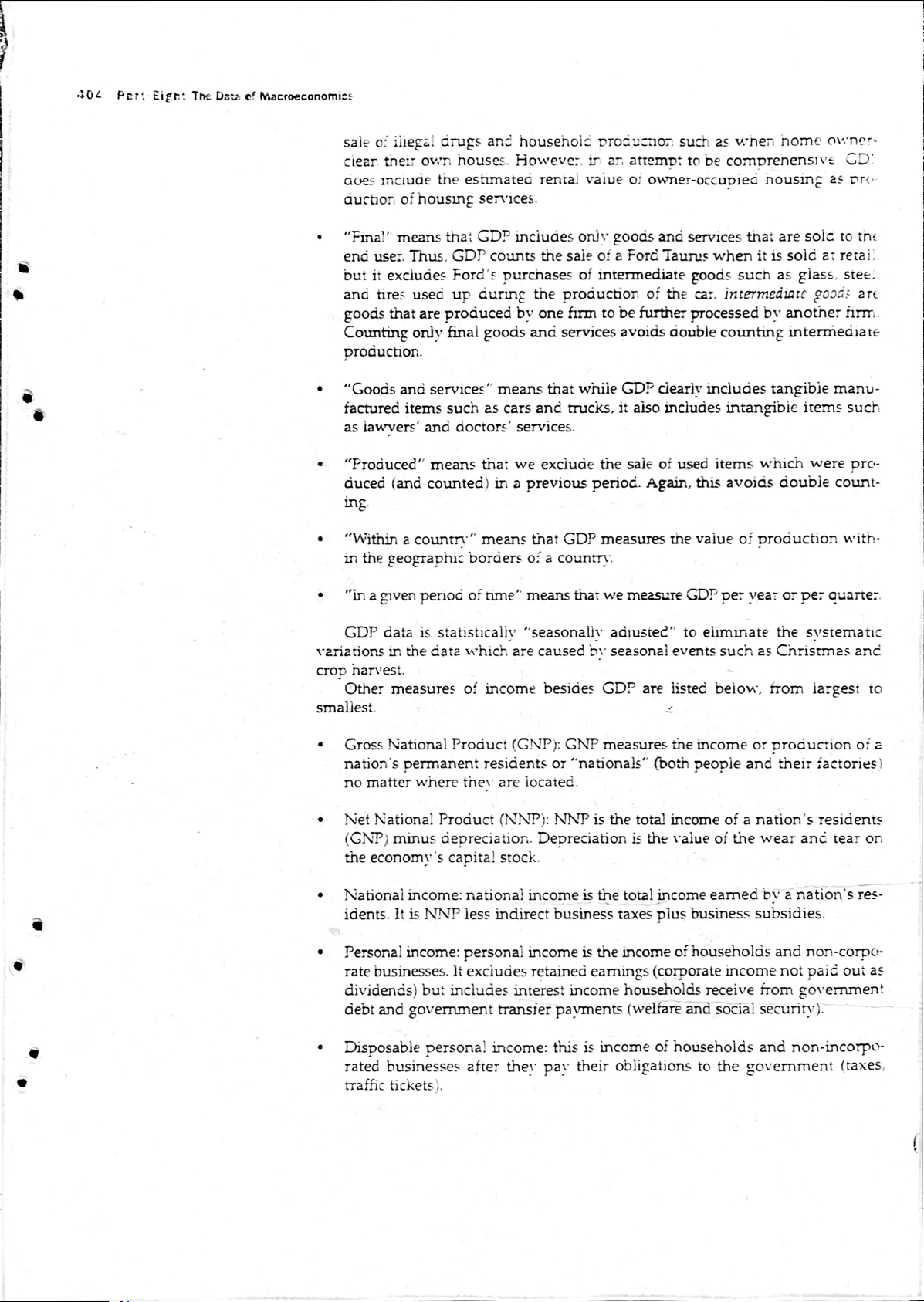
sale o: iliega! arugs and householc Droduction. such 2s when nome ow'ner-
ciear their own houses. Howeve:. in ar. attemp: to be comprenensivE GD
aoes inciude the estimated rental vaiue of owner-occupied nousing 2s pr(- auction of housing serices.
"Fina!" means that GDP inciudes oniv goods and services that are solc to tne
end user. Thus, GDP counts the saie of a Ford Taurus when it is soid a: retai.
but it exciudes Ford's purchases of intermediate goods such as glass, stee.
and tires used up auring the proảuction of the ca. intermediate goods are
goods that are produced by one firm to be further prOcessed by another firm
Counting only final goods arnd services avoids double counting intermediate production.
"Goods and services" means that while GDP cieariv inciuảes tangibie manu-
factured items such as cars and trucks, it aiso inciudes intangibie items such
as lawvers' and doctors' services.
"Produced" means that we exciude the sale of used items which were pro-
duced (and counted) in a previous perioć. Again, this avoids doubie count- ing.
"Within a countr" means that GDP measures the value of production with-
in the geographic borders oí a countrT: •
"in a given period of timne" means that we mezsure GDP per vear OI per auarte.. GDP data is statisticaliv
"seasonaliv adjusted" to eliminate the svstematic
rariations in the data which are caused br seasonal events such as Christmas and crop harvest.
Other measures of income besides GDP are iisted beiow, from iargest to Smallest.
Gross National Product (GNP)}; GNP measures the income or production of a
nation's permanent residents or "nationals" (both peopie and their íactories)
no matter where thev are iocated.
Net National Proauct (NNP): NNP is the total income of a nation's residernts
(GNP) minus depreciation. Depreciation is the value of the wear anć tear or the economy's capital stock.
National income: national income is the total income earmed bv a nation's res-
idents. It is NNP less indirect business taxes plus business subsidies.
Personal income: personal income is the income of householàs and non-corpo-
rate businesses. It exciudes retained earnings (corporate income not paid out as
dividends) but includes interest income households receive from govemment
debt and goverrnent transier pavments (welfare and social security).
Disposable persona! income: this is income of households and non-incorpo-
rated businesses after ther pav their obligations to the govemment (taxes, . traffc tickets). Chapter 22 Measuring a Country's Income 405 The Components of GDP
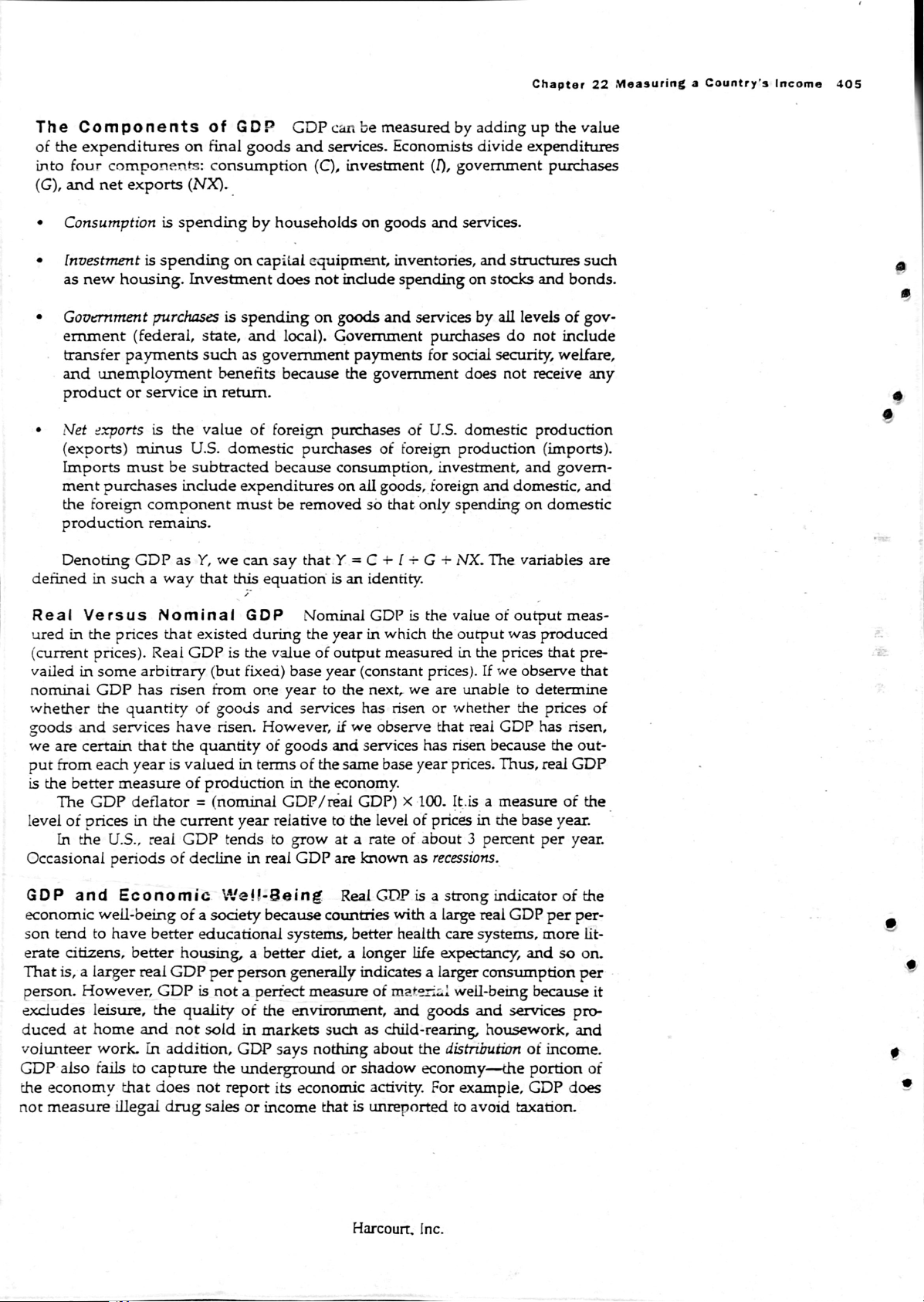
GDP can be measured by adding up the value
of the expenditures on final goods and services. Economists divide expenditures
into four components: consumption (C), investment (), government purchases (G), and net exports (NX). •
Consumption is spending by households on goods and services.
Investment is spending on capilal cquipment, inventories, and structures such
as new housing. Investment does not inciude spending on stocks and bonds. •
Government purchases is spending on goods and services by all levels of gov-
ernment (federal, state, and local). Government purchases do not include
transfer payments such as goverrment payments for social security, welfare, and unemployment
benefits because the government does not receive any product or service in returm.
Net exports is the value of foreign purchases of U.S. domestic production
(exports) minus U.S. domestic purchases of foreign production (imports).
Imports must be subtracted because consumption, investment, and govern-
ment purchases inciude expenditures on all goods, foreign and domestic, and
the foreign component must be removed so that only spending on domestic production remains.
Denoting GDP as Y, we can say that Y = C + [+G+ NX. The variabies are
defined in such a way that this equation is an identity. Real Ve rsus Nominal GDP
Nominal GDP is the value of output meas-
ured in the prices that existed during the year in which the output was produced
(current prices). Reai GDP is the value of output measured in the prices that pre-
vailed in some arbitrary (but fixed) base year (constant prices). If we observe that
nominai GDP has risen from one year to the next, we are unable to determine
whether the quantity of goous and services has risen or whether the prices of
goods and services have risen. However, if we observe that reai GDP has risen,
we are certain that the quantity of goods and services has risen because the out-
put from each year is valued in tems of the same base year prices. Thus, real GDP
is the better measure of production in the economy. The GDP deflator = (nominal
GDP/real GDP) × 100. It.is a measure of the
level of prices in the current year relative to the level of prices in the base year.
In the U.Ss., real GDP tends to grow at a rate of about 3 percent per year.
Occasional periods of decline in real GDP are known asrecessions. GDP and Economic e!l-8eing
Real GDP is a strong indicator of the
economic well-being of a society because countries with a large real GDP per per-
son tend to have better educational systems, better health care systems, more lit-
erate citizens, better housing, a better diet, a longer life expectancy, and so on.
That is, a larger real GDP per person generally indicates a larger consumption per
person. However, GDP is not a pertect measure of material well-being because it
excludes leisure, the quality of the environment, and goods and services pro-
duced at home and not sold in markets such as child-rearing, housework, and
voiunteer work. In addition, GDP says nothing about the distribution of income.
GDP also fails to capture the underground or shadow economy-the portion of
the economy that does not report its economic activity. For example, GDP does
not measure illegal drug sales or income that is unreported to avoid taxation. Harcourt, Inc. 406 Part
Eight The Data of Macroeconomics HELPFUL HINTS
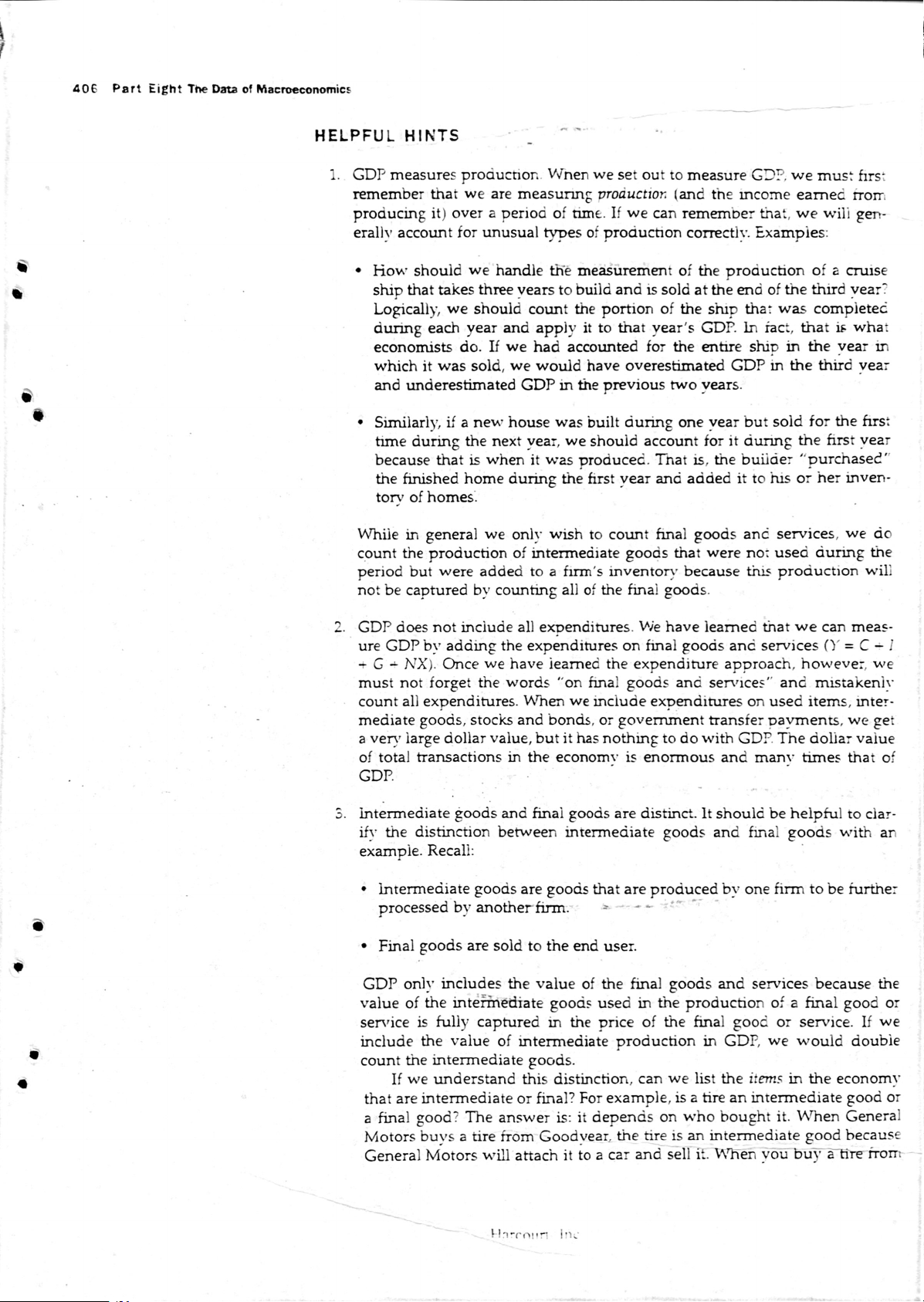
1. GDP measures production. Wnern we set out to measure GDP, we must first
remember that we are measuring production (and the income eamed from
producing it) over a period of time. If we can remember that, we wili ger-
erallv acCount for unusual types of production correctiv. Examnpies: •
How shouid we handie the measurement of the production of a cruise
ship that takes three vears to build and is sold at the ernd of the third vear?
Logically, we should count the portion of the ship that was compietec
during each year and apply it to that year's GDP. in fact, that is what
economists do. If we had accounted for the entire ship in the vear in
which it was sold, we wouid have overestimated GDP in the third vear
and underestimated GDP in the previous two years.
Similarly, if a new house was built during one vear but sold for the first
time during the next vear, we shouid account for it during the first year
because that is when it was produced. That is, the builder "purchased"
the finished home during the first vear and added it to his or her inven- tory of homes.
Whiie in general we only wish to count final goods and services, we do
count the production of intermediate goods that were not used during the
period but were added to a firm's inventory because this production will
not be captured by counting all of the final goods.
2. GDP does not inciude all expenditures. We have leamed that we can meas-
ure GDP bv adding the expenditures on final goods and services (Y = C- 1
+G+ NX). Once we have iearned the expenditure approach, howevez, we
must not forget the words "on final goods and services" and mistakeniv
count all expenditures. When we inciude expenditures on used iterms, inter-
mediate goods, stocks and bonds, or govermment transfer pavments, we get
a very large dollar value, but it has nothing to do with GDP. The doliar vaiue
of total transactions in the economy is enormous and manv times that of GDP. 3.
intermediate goods and final goods are distinct. It should be helpful to ciar- ify the distinction between
intermediate goods and final goods with arn example. Recali: •
Intermediate goods are goods that are produced bv one firm to be further processed by another firm.
• Final goods are sold to the end user. .
GDP only includes the value of the final goods and services because the
value of the intermediate goods used in the production of a final good or service is fully
captured in the price of the final good or service. If we
include the value of intermediate production in GDP, we would doubie count the intermediate gocods.
If we understand this distinction, can we list the items in the economy .
that are intermediate or final? For example, is a tire an intermediate good or
a final good? The answer is: it depends on who bought it. Whern General
Motors buvs a tire from Good vear, the tire is an intermediate good because
General Motors wil attach it to a car and sell it. When you buy a tire fro Harcor in
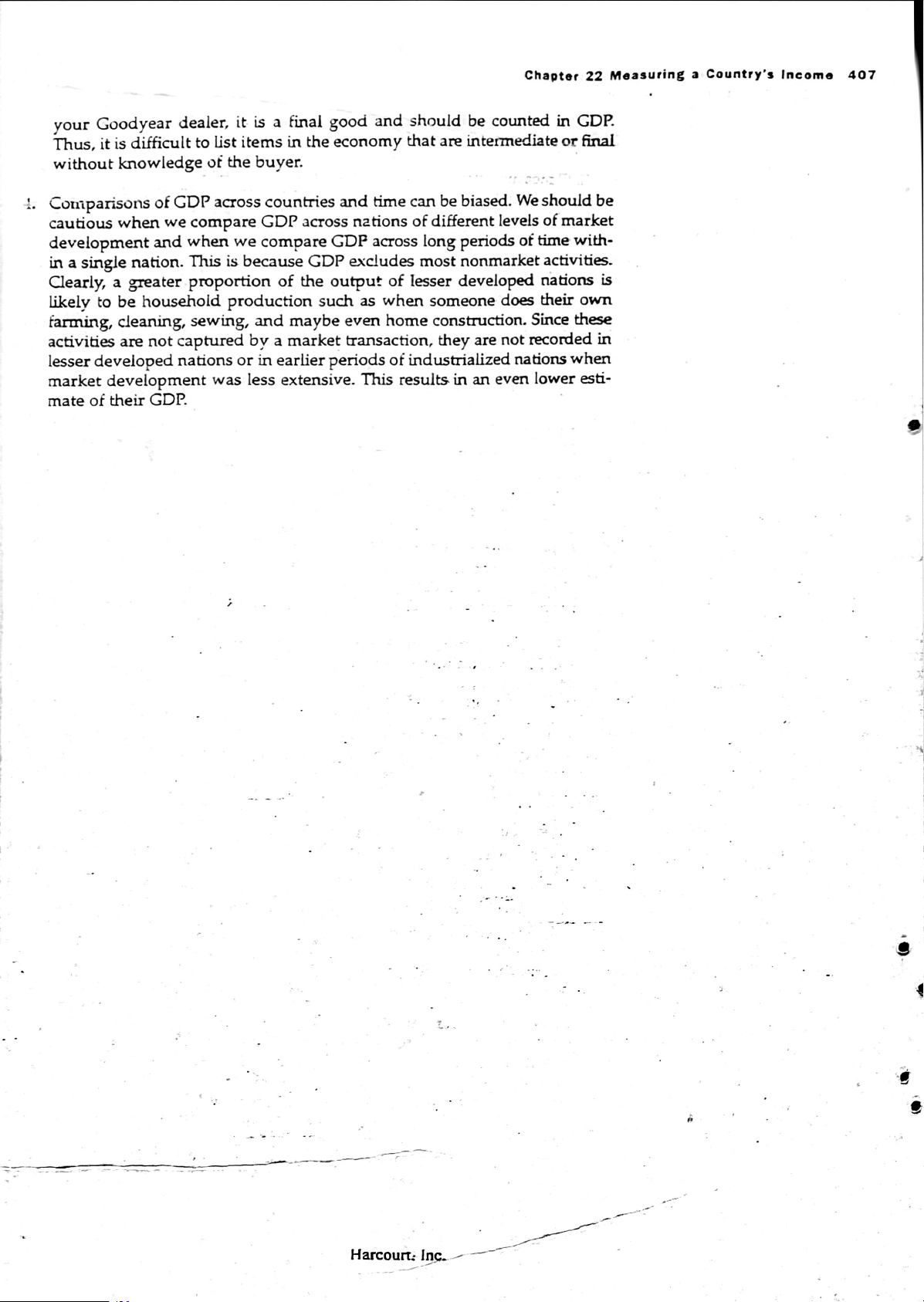
Chapter 22 Measuring a Country's Income 407
your Goodyear dealer, it is a final good and should be counted in GDP.
Thus, it is difficult to list items in the economy that are intermediate or final
without knowledge of the buyer. 1.
Comparisons of GDP across countries and time can be biased. We should be
cautious when we compare GDP across nations of diferent levels of market
development and when we compare GDP across long periods of time with-
in a single nation. This is because GDP excludes most nonmarket activities.
Clearly, a greater proportion of the output of lesser developed nations is likely to be household
production such as when someone does their own
farming, cleaning, sewing, and maybe even home construction. Since these
activities are not captured by a market transaction, they are not recorded in
lesser developed nations or in earlier periods of industrialized nations when
market development was less extensive. This results in an even lower esti- mate of their GDP. Harcourt: Inc. 406 Part
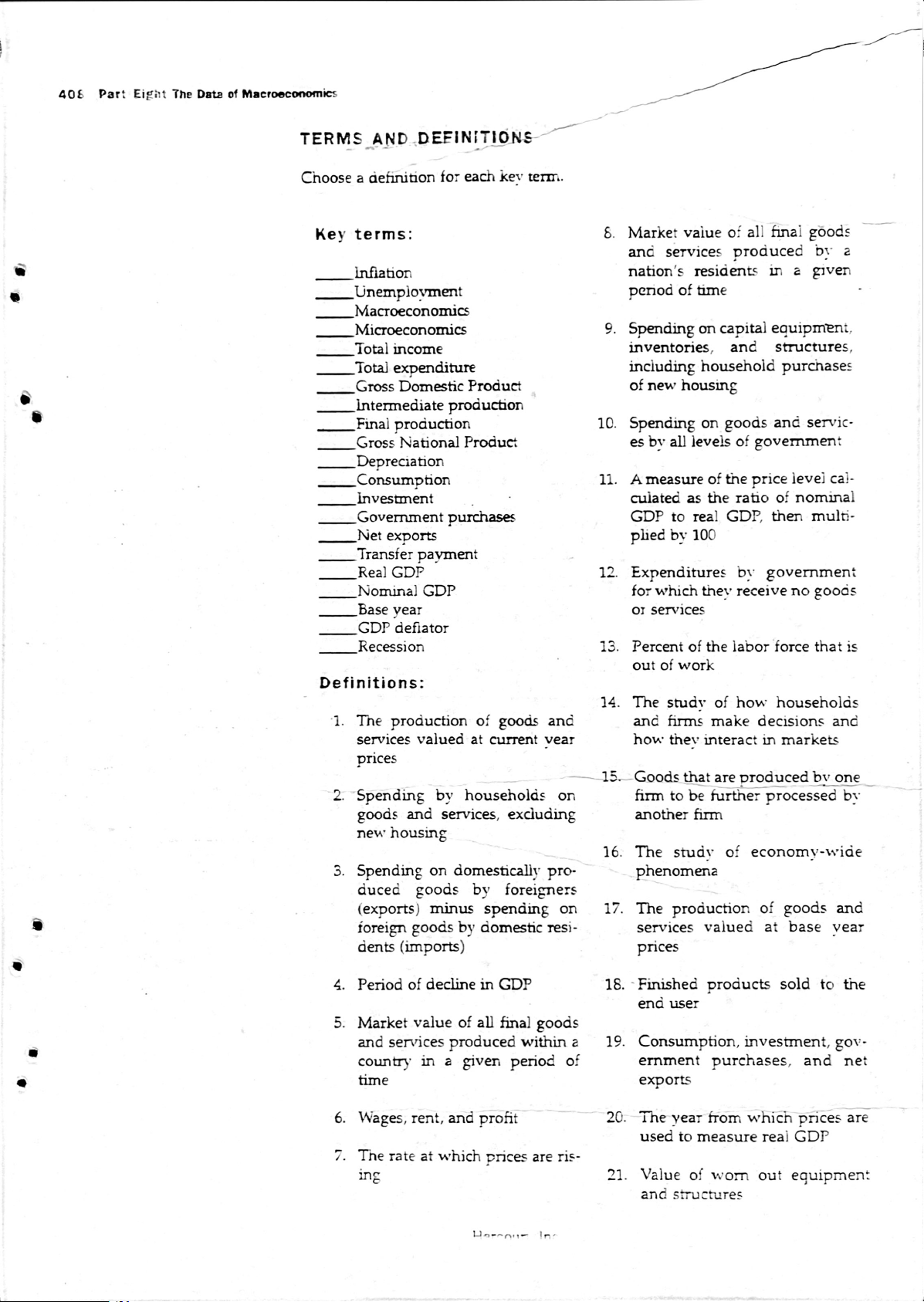
Eight The Data of Macroeconomies TERMS AND DEFINITIONS Choose a defnition for each kev term.. Key terms: 8.
Market vaiue of all final göods and services produced br a infiation nation's residents in a given Unemplovment penod of time Macroeconomics Microeconomics 9. Spending on capital equipment, Total income inventories, and structures, Total expenditure inciuding household purchases Gross Domestic Product of new housing intermediate production Final production 10. Spending on goods and servic- Gross National Product es bv all levels of govermment Depreciation Consumption 11.
Ameasure of the price levei ca!- investment
culated as the ratio of nominal Government purchases GDP to real GDP, then multi- Net exports pied by 100 Transfer pavment Real GDP 12. Expenditures br government Nominal GDP
for which thev receive no goods Base year or services GDP defiator Recession 13.
Percent of the labor force that is out of work Definitions: 14. The studv of how householas 1. The production of goods and and firms make decisions and
services valued at current vear how thev interact in markets prices
15. Goods that are produced bv one 2. Spending by households on
firm to be further processed by goods and services, exciuding another firm new housing 16. The study of economy-wide 3. Spernding on domesticaliy prO- phenomena duced goods by foreigners (exports) minus spending on 17. The production of goods and
foreign goods by domestic resi- services valued at base vear dents (imports) prices 4. Period of decline in GDP 18. Finished products sold to the end user 5.
Market value of all final goods and services produced within a 19. Consumption, investment, gov- country in a given period of ernment purchases, and net . time exports 6. Wages, rent, and profit
20. The year from which pices are used to measure real GDP 7.
The rate at which prices are ris- ing 21. Value of wom out equipment and structures lo-rn In
Chapter 22 Measuring a Country's Income 409
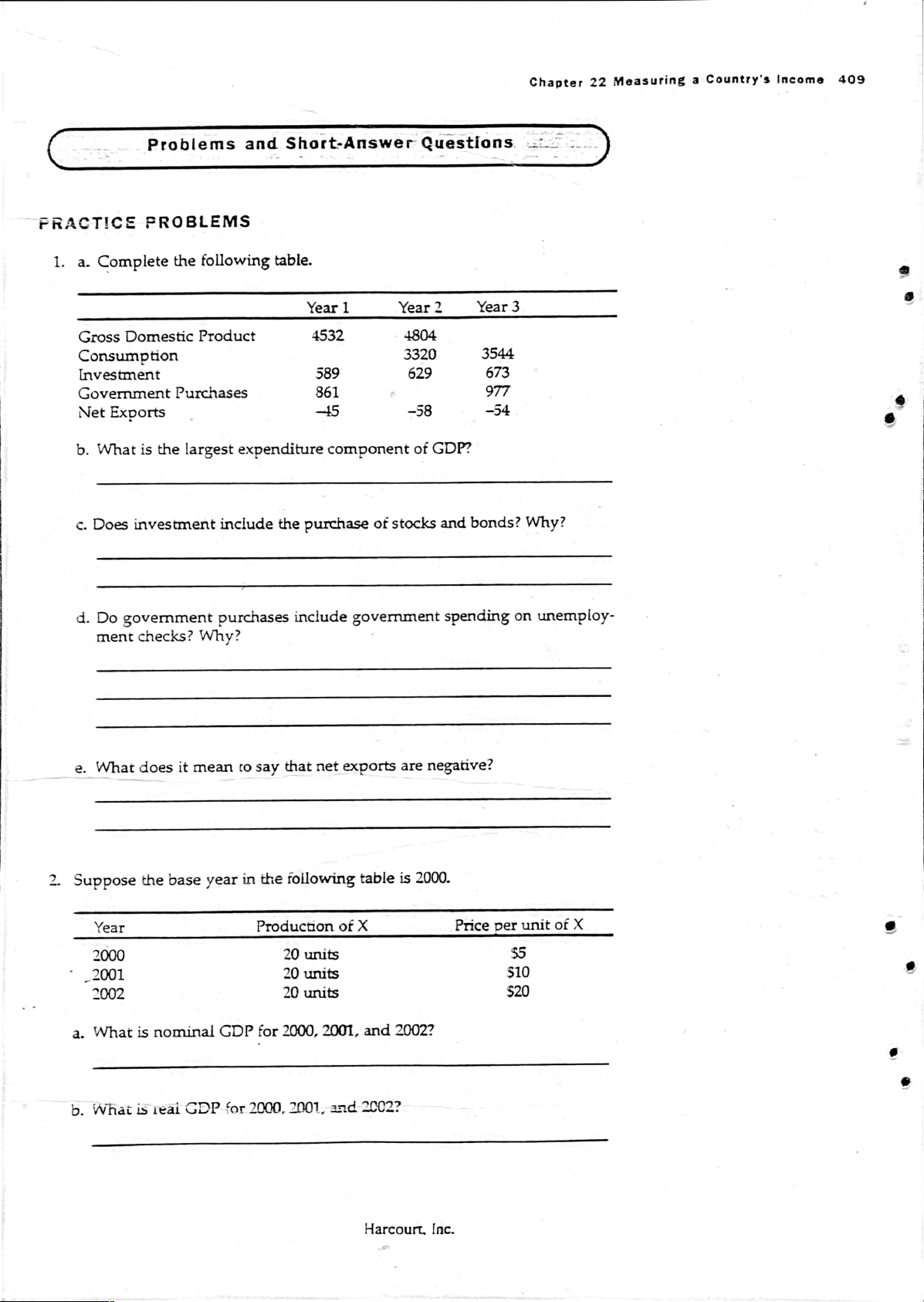
Problems and Short-Answer Questions PRACT!CE PROBLEMS
1. a. Complete the following table. Year 1 Year 2 Year 3 Gross Domestic Product 4532 4804 Consumnption 4532-589-861+45=3.127 3320 3544 Investment 589 629 673 Government Purchases 861 977 Net Exports -58 -54
b. What is the largest expenditure component of GDP? Consumption
c. Does investment inciude the purchase of stocks and bonds? Why?
No; because no capital was purchased
d. Do govermment purchases inciude government spending on unemploy- ment checks? Why?
No; these are transfer payments
e. What does it mean to say that net exports are negative? Imports > Exports
2. Suppose the base year in the foilowing table is 2000. Year Production of X Price per unit of X 2000 20 units $5 2001 20 units S10 2002 20 units $20
a. What is nominal GDP for 2000, 2001, and 2002? 100; 200; 400
b. What is leai GDP for 2000, 2001, and 2002? 100; 100; 100 Harcourt, Inc. 410 Part
Eight The Date of Macrcoconomics
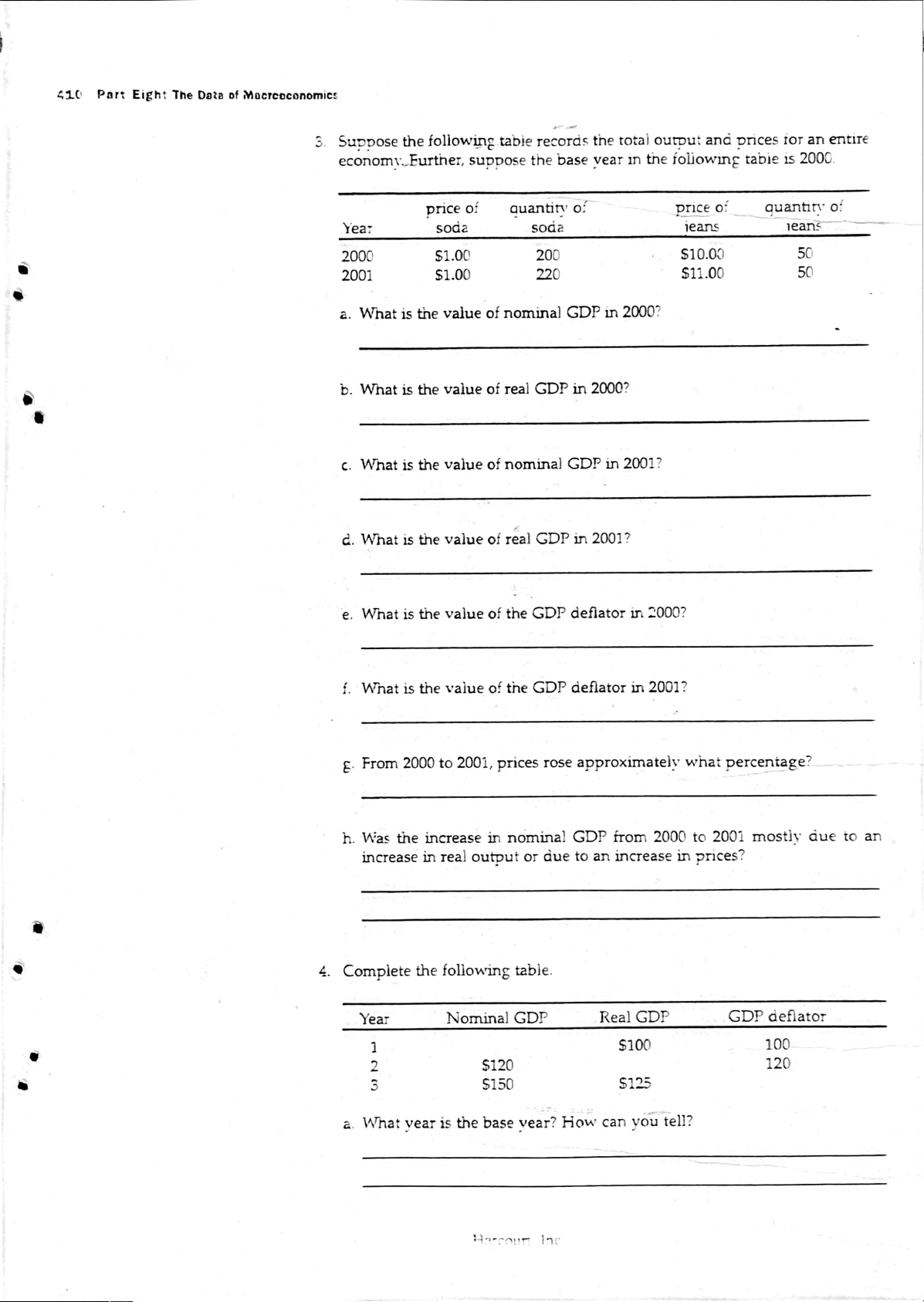
3. Suppose the folowing tabie records the total output and prices tor an entire
economy..Further, suppose the base vear in the foliowing tabie is 2000. price of quantitv of price o: quantit o Year SOda SOda jeans 1eans 2000 $1.00 200 S10.00 50 2001 $1.00 220 $11.00 50
a. What is the value of nominal GDP in 2000? 200x1+10x50=700
b. What is the value of real GDP in 2000? 200x1+10x50=700
c. What is the value of nominal GDP in 2001? 1x220+11x50=770
d. What is the value of real GDP in 2001? 1x220+10x50=720
e. What is the value of the GDP deflator in 2000? (700/700)x100=100
f. What is the value of the GDP deflator in 2001? (770/720)x100=106,944
£. From 2000 to 2001, prices rose approximatelv what percentage?
((106,944-100)/106,944)x100=6,493
h. Was the increase in nominal GDP from 2000 to 2001 mostiy due to an
increase in real output or due to an increase in prices? Due to an increase in prices 4. Compiete the folowing table. . Year Nominal GDP Real GDP GDP deflator 100 $100 100 2 $120 120 100 S150 S125 120
a. What year is the base vear? How can you tell?
Year 1; because Nominal GDP = Real GDP ur In
Chapter 22 Me asuring a Country's Income 411
b. From year l to year 2, did real output rise or did prices rise? Explain?
Prices rise because real GDP is unchanged
c. From year 2 to year 3, did real output rise or did prices rise? Explain?
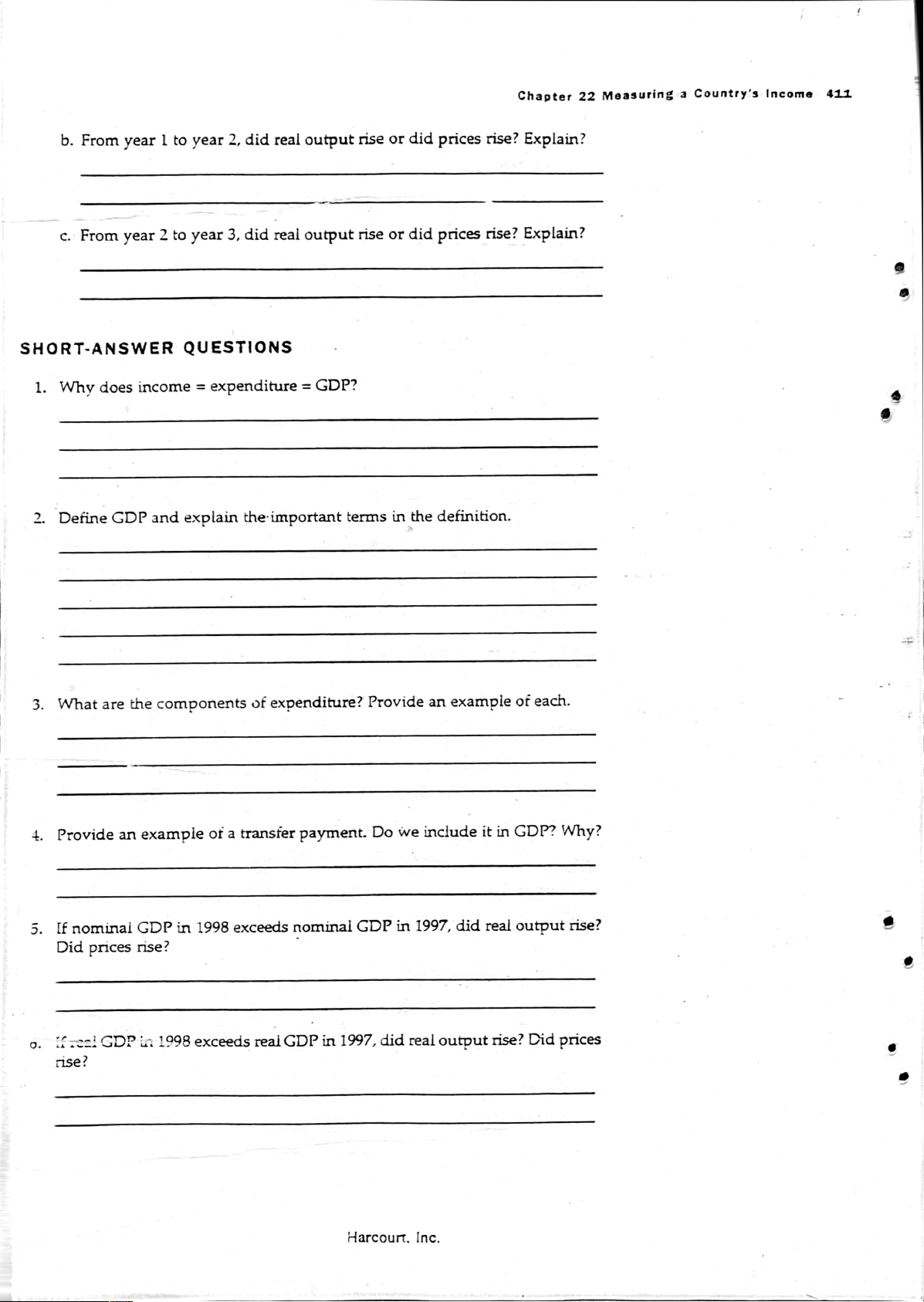
Real output rises because real GDP increases and GDP deflator is unchanged SHORT-ANSWER QUESTIONS 1.
Why does income = expenditure = GDP? 2.
Define GDP and explain the- important terms in the definition. 3.
What are the components of expenditure? Provide an exampie of each. 4.
Provide an exampile of a transfer payment. Do we include it in GDP? Why? 3.
If nominal GDP in 1998 exceeds nominal GDP in 1997, did real output rise? Did prices rise? O.
foiGDPi 1998exceedsreai GDP in 1997, did real output rise? Did prices rise? Harcourt. Inc. 412
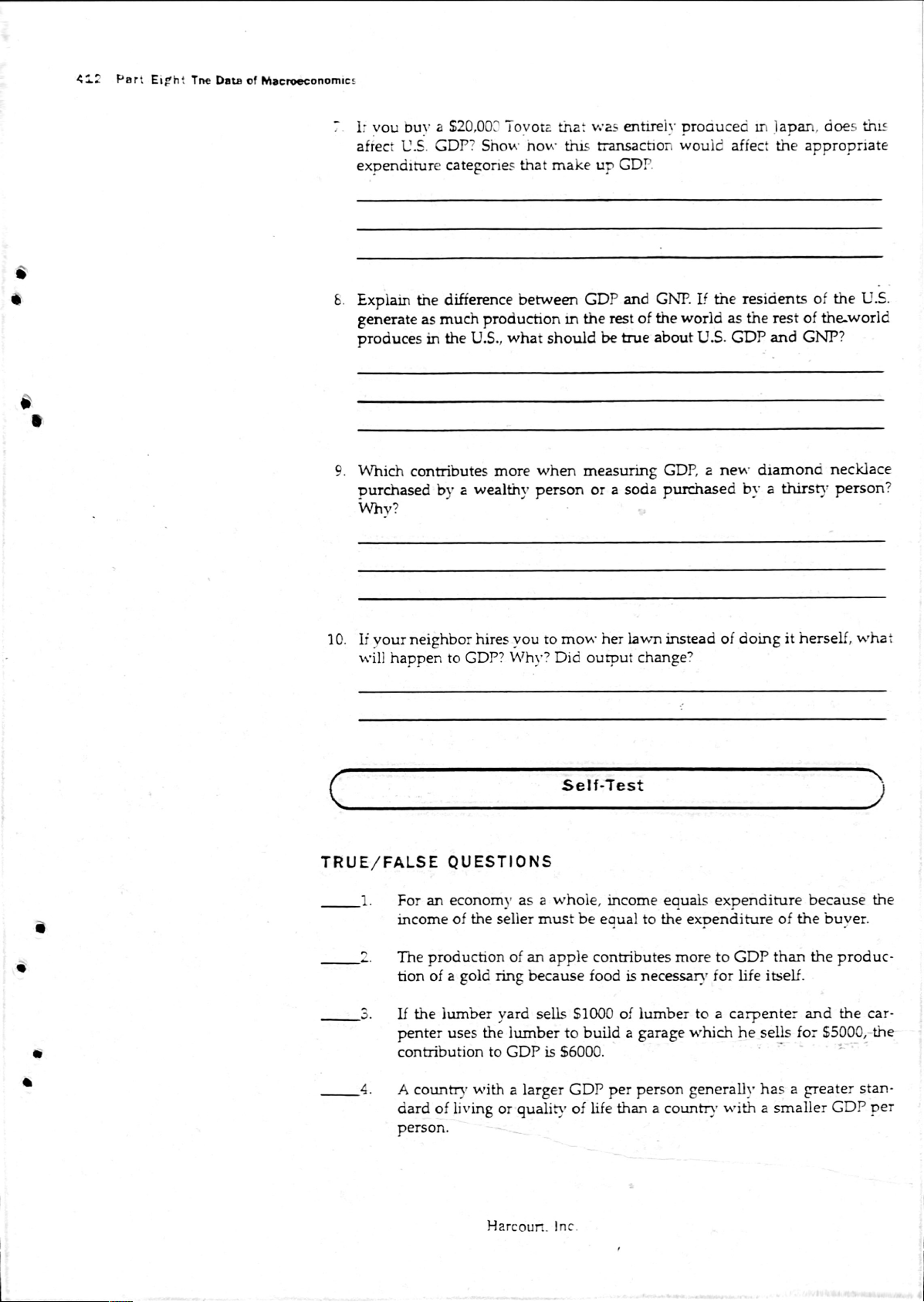
Part Eight Tne Data of Macroeconomics 7.
i: vou buv a S20,000 Tovotz that was entireiy proauced in japan, does this
afrect U.S. GDP? Show how this transaction wouid affect the appropriate
expenditure categories that make up GDP. : 6.
Expiain the difference between GDP and GNP. If the residents of the U.S.
generate as much production in the rest of the world as the rest of theworid
produces in the U.., what should be true about U.S. GDP and GNP? 9. Which
contributes more when measuring GDP, 2 new diamond necklace
purchased by a wealthy person or a soda purchased by a thirsty person? Why?
10. Ií your neighbor hires you to mow her lawn instead of doing it herselí, what
will happen to GDP? Why? Did output change? Self-Test TRUE/FALSE QUESTIONS For an economy as a whole, income equais expenditure because the
income of the seller must be equal to the expenditure of the buver.
The production of an appie contributes more to GDP than the produc-
tion of a goid ring because food is necessary for life itself.
If the Jumber yard sells $1000 of lumber to a carpenter and the car-
penter uses the lumber to build a garage which he sells fo $5000, the contribution to GDP is $6000.
A county with a larger GDP per person generaly has a greater stan-
dard of living or quality of life than a country with a smaller GDP per person. Harcour. Inc. Chapter 22 Measuring a Country's Income 413 5
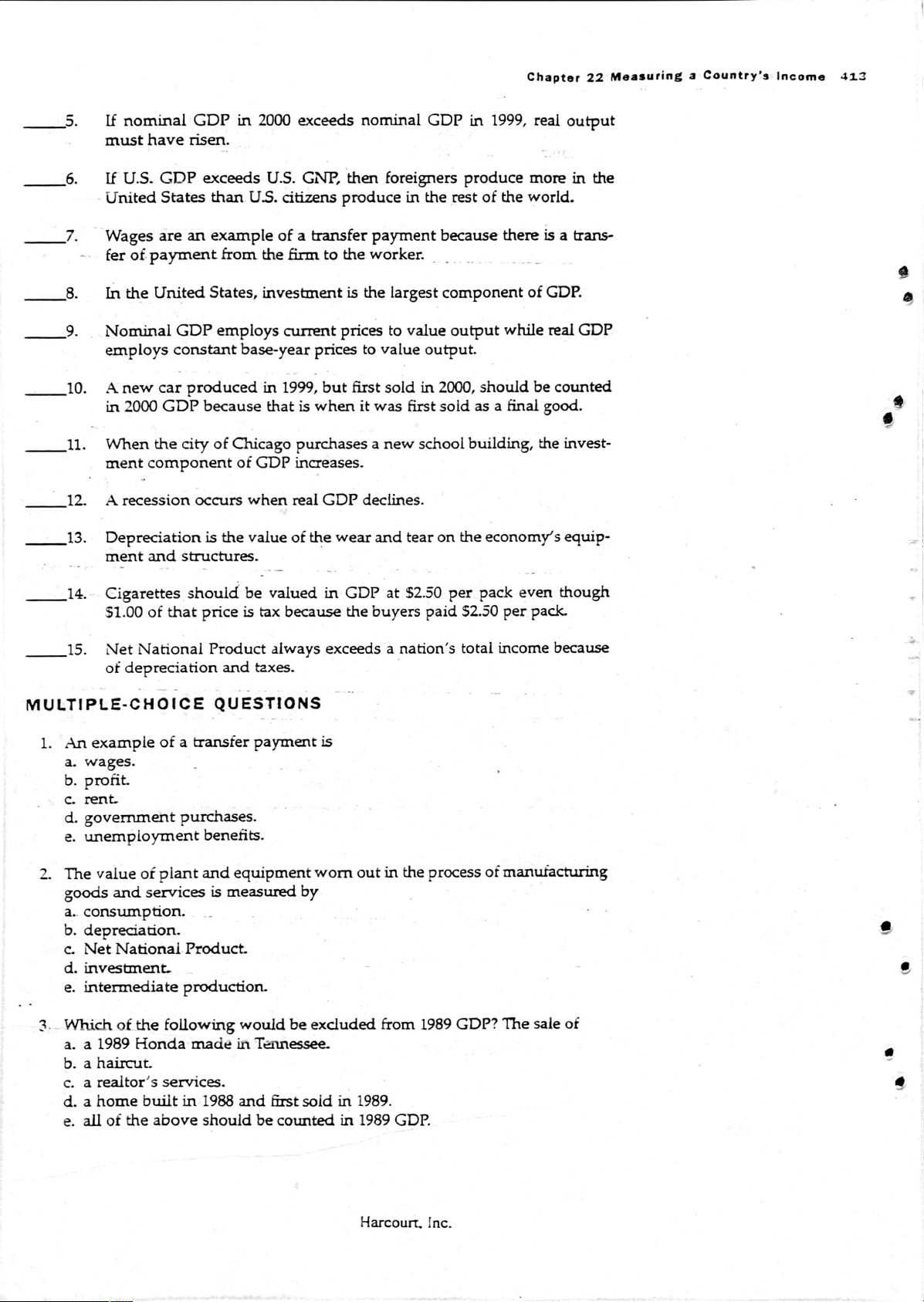
If nominal GDP in 2000 exceeds nominal GDP in 1999, real output must have risen. 6.
If U.S. GDP exceeds U.S. GNP, then foreigners produce more in the
United States than U.S. citizens produce in the rest of the world.
Wages are an example of a transfer payment because there is a trans- 7.
fer of payment from the firm to the worker. 8
In the United States, investment is the largest component of GDP.
Nominal GDP employs current prices to value output while real GDP
employs constant base-year prices to value output. 10.
A new car produced in 1999, but first sold in 2000, should be counted
in 2000 GDP because that is when it was first soid as a final good. 11.
When the city of Chicago purchases a new school building, the invest-
ment component of GDP increases. 12.
A recession occurs when real GDP declines. 13
Depreciation is the value of the wear and tear on the economy's equip- ment and structures. 14.-
Cigarettes should be valued in GDP at S2.50 per pack even though
S1.00 of that price is tax because the buyers paid $2.50 per pack. 15.
Net National Product always exceeds a nation's total income because of depreciation and taxes. MULTIPLE-CHOICE QUESTIONS 1.
An example of a transfer payment is a. wages. b. profit. C. rent d. government purchases. e. unemployment benefits. 2.
The value of plant and equipnent wom out in the process of manufacturing
goods and services is measured by a.. consumption. b. depreciation. c. Net Nationai Product. d. investment. e. intermediate production.
3.Which of the following would be excluded from 1989 GDP? The sale of
a. a 1989 Honda made in Tennessee. b. a haircut. C. a realtor's services.
d. a homne built in 1988 and frst soid in 1989.
e. all of the above should be counted in 1989 GDP. Harcourt, Inc. 414 Part
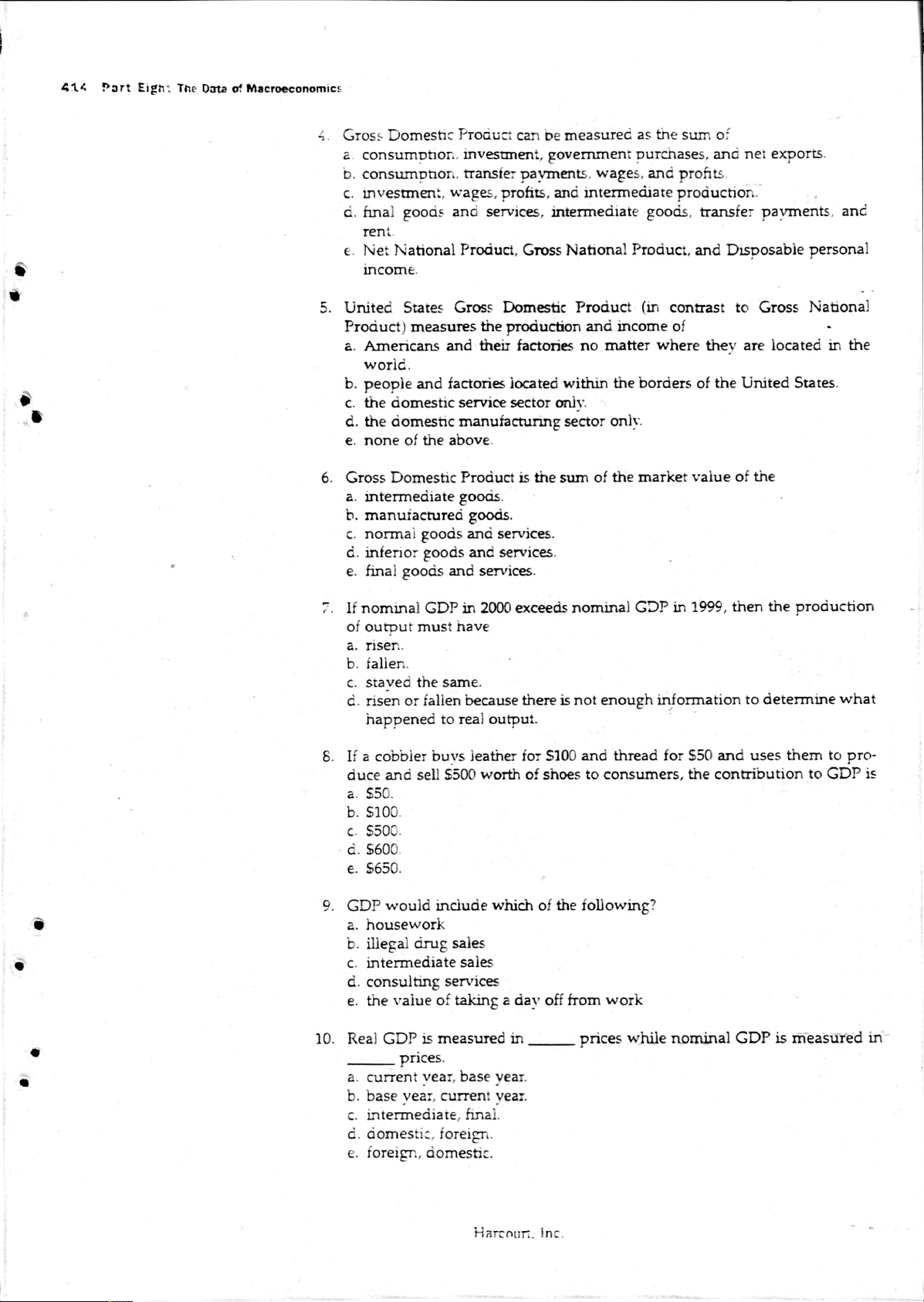
Eigh: The Data of Macroeconomics 4. Gross Domestic
Product can be measured as the sum of a. consumptior., investment,
govermment purchases, and net exports.
b. consumption, transter pavments, wages, and profits.
c. investment, wages, profits, and intermediate productiorn.
d. fnal goods and services, intermediate goods, transfer pavments, and rent
e. Net National Product, Gross National Product, and Disposabie personal income. 5. United States Gross Domestic Product (in contrast to Gross National
Product) measures the production and incone of
a. Americans and their factories no matter where they are located in the worid.
b. people and factories located within the borders of the United States.
c. the domestic service sector oniy.
d. the domestic manufacturing sector only. e. none of the above.
6. Gross Domestic Product is the sum of the market vaiue of the a. intermediate goods. b. manuíactured goods. C. normnal goods and services.
d. inferior goods and services. e. final goods and services. 7.
If nominal GDP in 2000 exceeds nominal GDP in 1999, thern the production of output must have riser. b. faller. C. Staved the same.
d. risen or falien because there is not enough information to determine what happened to real output. S.
If a cobbier buvs jeather for S100 and thread for $50 and uses them to pro-
duce and sell $500 worth of shoes to consumers, the contribution to GDP is a. $50. b. $100. S500. S600. e $650. 9.
GDP would inciude which of the folowing? a. housework b. illegal drug sales c. intermediate sales d. consulting services
e. the vaiue of taking a dav off from work 10. Real GDP is measured in
prices while nominal GDP is measured in prices. a. current vear, base year. b. base vear, current vear. C. intermediate, final. d. domestic, foreigr e. foreign, domestic. Harcourn. inc. Chapter 22 Measuring a Country's Income 415
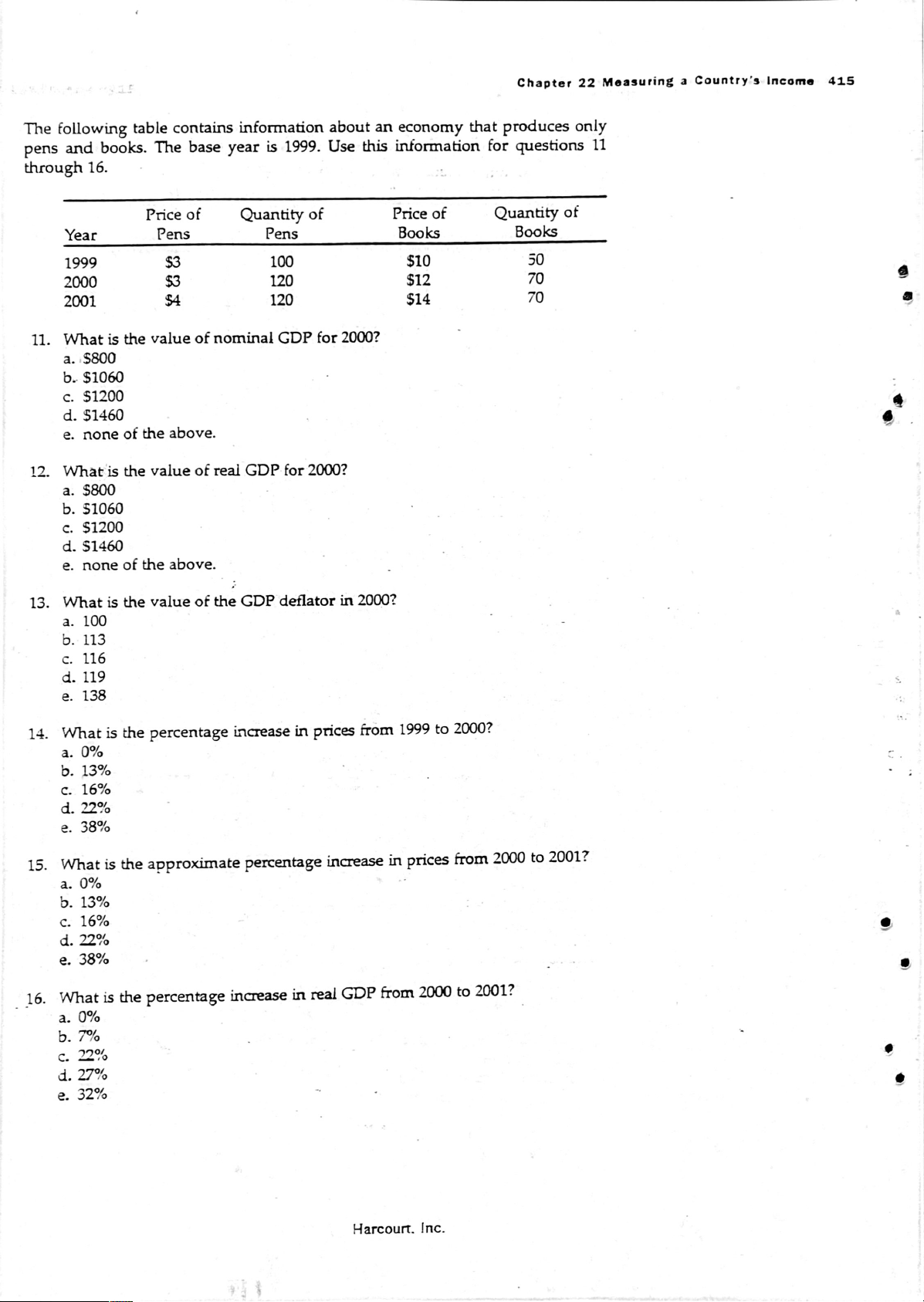
The following table contains information about an economy that produces only
pens and books. The base year is 1999. Use this information for questions 11 through 16. Price of Quantity of Price of Quantity of Year Pens Pens Books Books 1999 $3 100 S10 50 2000 $3 120 $12 70 2001 $4 120 S14 70 11.
What is the value of nominal GDP for 2000? a S800 b. $1060 C. $1200 d. $1460 e. none of the above. 12.
What is the value of reai GDP for 2000? a. $800 b. $1060 c. $1200 d. S1460 e. none of the above.
13. What is the value of the GDP deflator in 2000? a. 100 b. 113 C. 116 d. 1119 e. 138 14.
What is the percentage increase in prices from 1999 to 2000? a. 0% b. 13% C. 16% d 22% e. 38% 15.
What is the approximate percentage increase in prices from 2000 to 2001? a. 0% b. 13% C. 16% d. 22% e. 38%
What is the percentage increase in real GDP from 2000 to 2001? 16. a. 0% b. 7% c. 22% 27% e. 32% Harcourt. Inc. 416 art
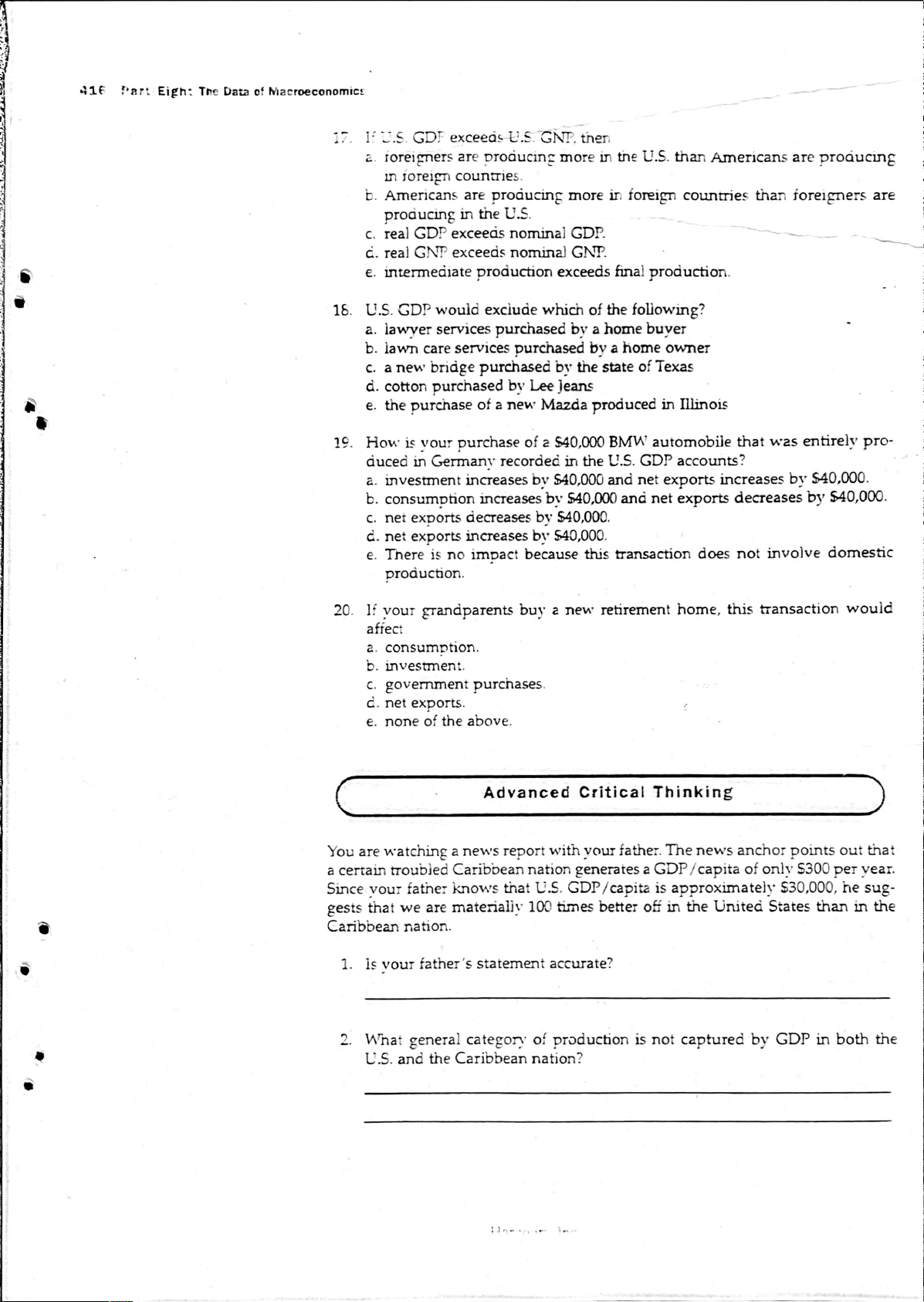
Eigh: The Data ofMacroeconomics 17.
1V.S. GDF exceeds U.S. GNT, ther
a. foreigners are proaucing more in the U.S. than Americans are proaucing n foreign counties.
b. Americans are proaucing more in foreign countries than foreigners are producing in the U.S.
c. real GDP exceeds nominal GDP.
d. real GNP exceeds nominal GNP. €. intermedjate
production exceeds fnal production.
16. U.S. GDP would exciude which of the foliowing?
a. lawver services purchased by a home buver
b. lawn care services purchased by a home owner
c. a new briáge purchased by the state of Texas
d. cotton purchased by Lee jeans
e. the purchase of a new Mazda produced in Ilinois
19. How is vour purchase of a $40,000 BMW automobile that was entirely pro-
duced in Germany recorded in the U.S. GDP accounts?
a. investment increases bv S40,000 and net exports increases by $40,000.
b. consumption increases bv S40,000 and net exports decreases by $40,000.
C. net exports decreases by $40,000.
d. net exports increases by S40,000.
e. There is no impact because this transaction does not involve domestic production.
20. 1f vour grandparents buy a new retirerment home, this transaction would affect a. consumption. b. investment. C. government purchases. d. net exports. e. none of the above. Advanced Critical Thinking
You are watching a news report with vour father. The news anchor points out that
a certain troubied Caribbean rnation generates a GDP /capita of only $300 per vear.
Since vour father knows that U.S. GDP/capita is approximately $30,000, he sug-
gests that we are materialiv 100 times better off in the United States than in the Caribbean nation. 1.
is vour father 's statement accurate? 2.
What general categorv of production is not captured by GDP in both the U.S. and the Caribbean nation?
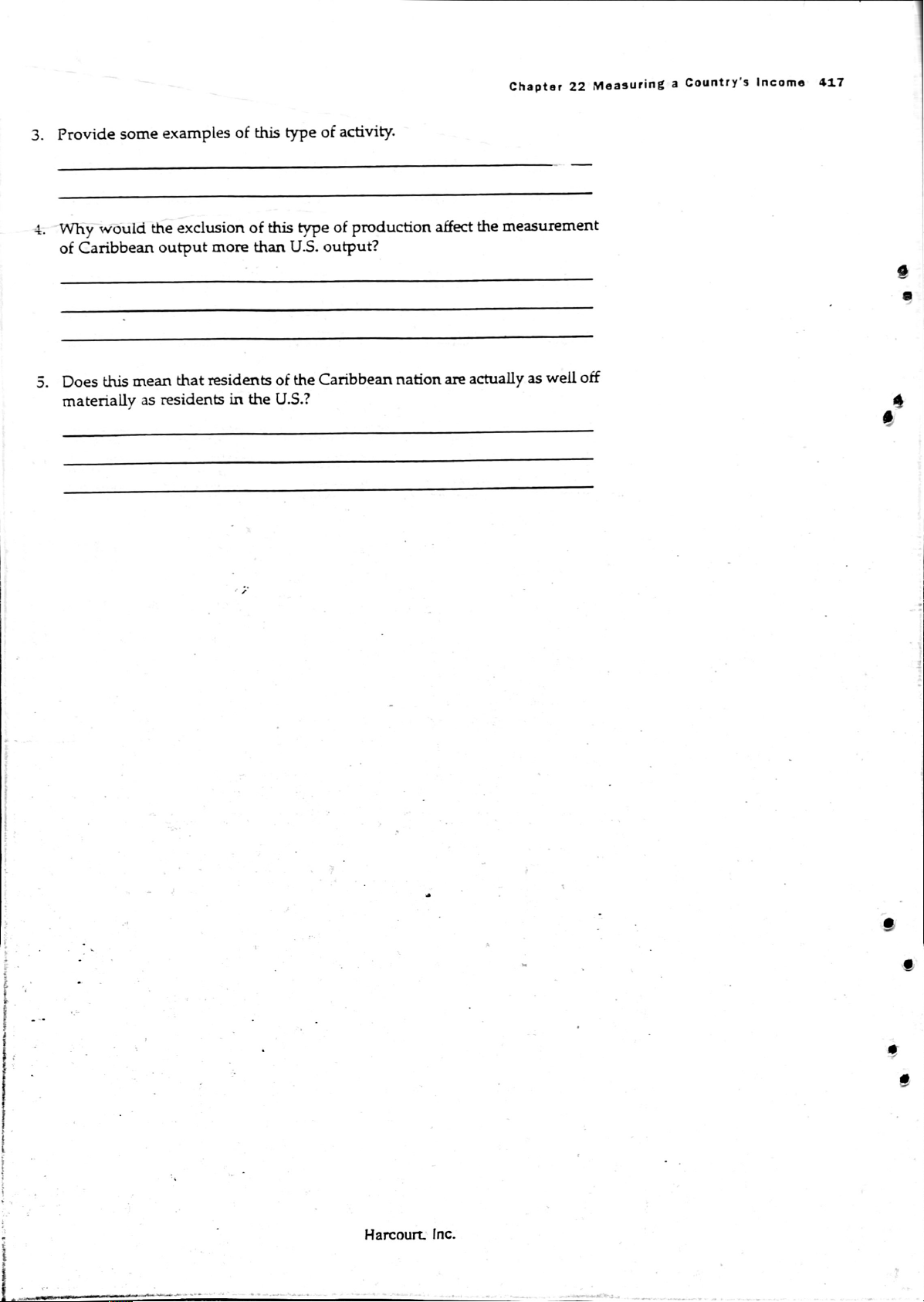
Chapter 22 Measuring a Country's Income 417 3.
Provide some examples of this type of activity.
4. Why would the exclusion of this type of production affect the measurement
of Caribbean output more than U.S. output? 5.
Does this mean that residents of the Caribbean nation are actually as well off
materially as residents in the U.S.? Harcourt. Inc.