Market Structure and Market Value
Author(s): Mark Hirschey
Source:
The Journal of Business,
Vol. 58, No. 1 (Jan., 1985), pp. 89-98
Published by: The University of Chicago Press
Stable URL: http://www.jstor.org/stable/2352911 .
Accessed: 18/08/2013 21:41
Your use of the JSTOR archive indicates your acceptance of the Terms & Conditions of Use, available at .
http://www.jstor.org/page/info/about/policies/terms.jsp
.
JSTOR is a not-for-profit service that helps scholars, researchers, and students discover, use, and build upon a wide range of
content in a trusted digital archive. We use information technology and tools to increase productivity and facilitate new forms
of scholarship. For more information about JSTOR, please contact support@jstor.org.
.
The University of Chicago Press is collaborating with JSTOR to digitize, preserve and extend access to The
Journal of Business.
http://www.jstor.org
This content downloaded from 146.232.129.75 on Sun, 18 Aug 2013 21:41:35 PM
All use subject to JSTOR Terms and Conditions
Mark
Hirschey
University of
Colorado
at Denver
Market
Structure
and
Market
Value*
I.
Introduction
While the use
of market
models to
determine the
sources of
economic
profits
is quite
new,
at least
two
empirical
studies
considering the
market
structure and
market value
relation have
ap-
peared
to
date.
Interestingly,
they
conflict.
Thomadakis
(1977)
found a
close
positive rela-
tion
between the
four-firm
concentration ratio
and relative
excess
valuation,
measured as the
difference
between the
market
value of the
firm
and the
book value of
tangible
assets, all nor-
malized by
sales. As a
result,
Thomadakis argued
that
"industry
concentration
plays a role
in the
determination
of
excess profits
from
currently
held
assets
and
those
expected from the firm's
investment
options"
(p. 185). In
contrast,
Lin-
denberg
and
Ross
(1981) reported no
significant
relation
between
concentration
and
Tobin's Q
ratio,
measured
as the
ratio of the
market value
of the firm
to the
replacement
cost
of
tangible
assets. This
result
disputes Thomadakis's find-
ings
and a
purely
structuralist
interpretation
of
economic
profits.
According
to
Lindenberg
and
Ross,
market
power
may
or
may
not
be
evident
in
highly concentrated
markets since
"high Q's
can occur
in
concentrated
or unconcentrated
markets and,
conversely, low
Q's,
indicating no
significant
market
power,
can
occur
in
markets
that
have
high
degrees
of
concentration"
(p. 28).
*Helpful
comments from
an
anonymous
referee
are grate-
fully
acknowledged.
(Journal
of
Business, 1985,
vol.
58,
no.
1)
?
1985 by
The
University of
Chicago. All
rights reserved.
0021-9398/85/5801-0002$01
.50
89
After
allowing for
the
intangible
capital or
"left-out-asset" effects
of
R
&
D
and advertis-
ing and
for the effects
of growth,
no consis-
tent
link
between tradi-
tional market
structure
variables
and market-
value-based estimates
of
economic profits
is
obvious.
Apparently,
market
structure data
are
not
an
attractive
proxy for
market
power.
This
finding
dis-
putes
traditional Cour-
novian and
Chamber-
linian
theory
but is
consistent with the
"contestable markets"
literature
suggestion
that
there
may
be
no
simple relation
between
the number
and/or
rela-
tive size
of
firms and
competition.
This content downloaded from 146.232.129.75 on Sun, 18 Aug 2013 21:41:35 PM
All use subject to JSTOR Terms and Conditions
90
Journal
of
Business
The
purpose of this paper is
to reconsider the market structure
and
market
value relation
in
order to resolve this conflict which
has
emerged
in the
literature.
II.
Oligopoly Theory
In the
Cournot (1838) model, each
oligopolist
identifies a
profit-
maximizing activity level based on the
assumption each
rival will main-
tain current output. Then.
in
an interactive
process.
each rival adjusts
output
until
there is no further
incentive for
change.
In
equilibrium,
price and
firm
number
will
be
inversely
related.
Cournot's
theory
thus
predicts
a
positive
relation between
leading
firm market share and
profits and/or relative firm
size
and profits. However, the Cournot
model is often
criticized as naive since
it
depends
on
the
myopic
as-
sumption
of
exogenously
determined rival
output
in
the face of re-
peated evidence to the
contrary.
Imel and
Helmberger
(1971),
for
ex-
ample,
argue
that a
relative
firm
size-profits
relation reflects
"progressiveness" and
"good
management." This explanation of mar-
ket
structure-profits relations,
based on leading
firm
efficiency
rather
than
monopoly power,
has
received
further
support
in
studies
by
Demsetz
(1973)
and Peltzman
(1977), among
others.
Therefore, ques-
tions
concerning
market
share-profits
and relative firm
size-profits
rela-
tions remain
open
and
controversial on the basis of both fact
and inter-
pretation.
A
second
line
of
argument
that predicted a market
sructure-profits
relation was offered
by Chamberlin
(1933). Chamberlin
argued
that
as
firms become "few" in
number,
interdependence
becomes recognized,
and tacit
or
explicit collusion becomes effective. The
equilibrium
price
is one
which maximizes joint
profits and corresponds to
the monopoly
price-that is, so long as
interdependence is realized.
If numbers be-
come so
large
that
individual
reactions
are no
longer
expected, collu-
sion
breaks down and the
competitive
result is obtained.
Thus, based
on a
"leading
firm
collusion"
argument,
the
Chamberlin
model pre-
dicts a
concentration-profits relation.
This prediction has
motivated
an
extensive
tradition of market
structure-performance
studies (see
Scherer
1980).
These views of a
strong
market structure-profits
relation contrast
sharply
with
alternative
theory,
which suggets no
necessary
link be-
tween the
number
and/or size
distribution of rivals and
industry perfor-
mance.
Bertrand
(1883) argues
that each oligopolist will set
price on
the
assumption
of
exogenously
determined rival prices.
Then,
in
an itera-
tive
process,
each rival
cuts price to
capture
the
market
share of rivals.
After a
period
of
adjustment, prices
converge
to
competitive
equilib-
rium
norms.
Thus, Bertrand
predicts no necessary
relation between
the number
and/or
relative size
of firms and
competition. Although
Bertrand's
behavioral
postulates
are
implausible
for much
the
same
This content downloaded from 146.232.129.75 on Sun, 18 Aug 2013 21:41:35 PM
All use subject to JSTOR Terms and Conditions
Market Structure and
Market Value
91
reason
as
those
of
Cournot,
in
recent
years the
central
result
of his
theory
seems
to
be
gaining
acceptance
among
economists.
Indeed,
the
recent
"contestable
markets"
literature
can be viewed
as
an
elegant
restatement
and
extension
of
Bertrand's
theory.
Baumol
(1982)
writes that
"once
each
product
obtains a
second
producer,
that
is
once we enter
the
domain
of
duopoly or
oligopoly
for
each and
every
good,
[price-output] choice
disappears.
The
contestable
oligopoly
which
achieves
an
equilibrium that
immunizes
it
from the
incursions
of
entrants
has
only
one
pricing
option-it
must
set
its
price
exactly
equal
to
marginal
cost and
do all
of the
things
required
for
a
first
best
op-
timum! In
short,
once
we leave
the
world
of
pure
or
partial
monopoly,
any
contestable
market
must
behave
ideally
in
every
respect.
Optimal-
ity
is not
approached
gradually as the
number
of
firms
supplying
a
commodity
grows"
(p.
2).
In
other
words,
the
Bertrand-Baumol view
of
oligopoly
rejects
the
hypothesis
of a
relation of
profits
to
market
structure that
is
asserted
by
the other
writers
mentioned.
To test
these
competing
hypotheses,
we
shall
study
the
effects of
three
market
structure
variables
(market
share, relative
firm
size,
and
concentration)
on
profits.
But in
order
to
do
this,
it
is
necessary
to
address certain
methodological
issues.
III.
The
Model
It
has
become
traditional
to
consider the
market
structure-profits
rela-
tion
using
four-firm
concentration and
accounting profits
data.
As de-
scribed
above,
the
use
of
concentration
data is
quite
consistent with
a
shared
monopoly,
or
Chamberlin,
view.
On the
other
hand,
a
test
of
Cournot
theory
requires
an
analysis
of
market
share or
relative firm
size
data.
Thus,
tests of
market
structure-profits
relations
are
not
neu-
tral
with
respect
to the
market
structure
measure
analyzed.
The
use
of
accounting
profit
data
also
involves
problems
since
these
data are
before
risk
adjustment
and
are
influenced
by
accounting
treat-
ments
which,
for
some
types
of
expenditures,
can
diverge
from
eco-
nomic
reality.
Beginning
with
Telser
(1961),
many
economists
have
viewed
advertising
"as
a
capital
good
that
depreciates
over
time
and
needs
maintenance and
repair"
(p.
197).
Similarly,
Weiss
(1969)
has
suggested
that
research and
development
"yield(s)
benefits
mainly in
the
future"
(p.
42).
Recent
empirical
studies
on
both R
&
D
(Hirschey
1982)
and
advertising
(Demsetz
1979;
Ayanian
1983)
provide
strong
support
for
this
"intangible
capital"
argument
and
suggest
that
treating
these
items
as
current
expenses will
give a
bias to
accounting
profit
rates
whenever
advertising
and
R &
D
are
significant.'
Since
both
1.
Both
Telser
and
Weiss
have also
suggested
that
firm-specific
human
capital
can
contribute
to a
left-out-asset
effect.
Indeed,
it
seems
likely that
intangible
capital
effects
of
advertising
and
R
&
D
relate
partly to
the
value
created
by a
synergistic
marketing
staff or
research
team.
This content downloaded from 146.232.129.75 on Sun, 18 Aug 2013 21:41:35 PM
All use subject to JSTOR Terms and Conditions
92
Journal of Business
theory and evidence
indicate advertising and
R
&
D
will be substantial
in the case of oligopoly
(Kamien and
Schwartz 1975; Comanor
and
Wilson 1979), the
"left-out-asset" effect
can seriously bias estimates
of
the relation of
market structure to profits
when profits are
measured
using accounting
data.
A
compelling
virtue of an approach based
on the market
value of the
firm is that such
an approach minimizes
the effect of accounting bias.
The market value of the
firm
can be
viewed as the risk-adjusted
present
value
of all future profits and has the
following major components:
MV(F)
=
MV(T)
+
MV(I),
(1)
where
MV(F)
is market value of the
firm
and MV(T)
and MV(I) are
the
capitalized values
of profits attributable
to tangible and
intangible as-
sets, respectively.
Although MV(F)
is observable, subcomponents
MV(T)
and MV(I)
are
not. Nevertheless,
accounting book
values and replacement
cost
values can be viewed
as useful, though
imperfect, measures
of the
market value
of
tangible
assets.
By
using
such
accounting
data
it is
possible
to isolate
the
market
value
effects
of
tangible assets
from any
additional
influences of intangible assets
such as market power,
pat-
ents, brand loyalty,
goodwill,
and
so
on.
In a
first approach
along these lines,
Thomadakis introduced
a mea-
sure called relative excess
valuation,
EVIS,
where
EV
-
MV(F)
-
BV(T)
(2)
S
S
and
BV(T)
is the book value of tangible
assets and
S is
sales.2
When
EVIS
>
0,
market
value reflects valuable
intangible assets
not reflected
in book value
data, perhaps including
market structure
influences.
Since
MV(T)
=
BV(T)
+
error (e),
EVIS
=
MV(I)
+
el,
(3)
S
=
fi(X)
+
el,
where X
includes
variables
describing
market
structure and other
po-
tential
sources of
intangible capital.
A
second approach,
proposed by
Lindenberg
and Ross, involves
using
a measure
commonly
referred to as
the
"Q ratio,"
where
2.
Relative
excess
valuation
can
be thought
of as the
market
value analogue
to
the
return
on
sales or
Lerner
index of
economic
profits.
The
Lerner index is defined
as
L
=
(P
-
MC)IP,
where
P is
price and
MC
is marginal
cost.
Under
pure
competition,
P
=
MC and L
=
0.
The more
a firm's
pricing
departs
from
the competitive
norm, the
greater
will
be L.
In empirical
research,
the equilibrium
condition
MC
=
AC
(average
cost)
is
often
assumed,
and
L = (P - AC)IP
=
return
on sales
(see
Scherer).
This content downloaded from 146.232.129.75 on Sun, 18 Aug 2013 21:41:35 PM
All use subject to JSTOR Terms and Conditions
Market
Structure
and
Market
Value
93
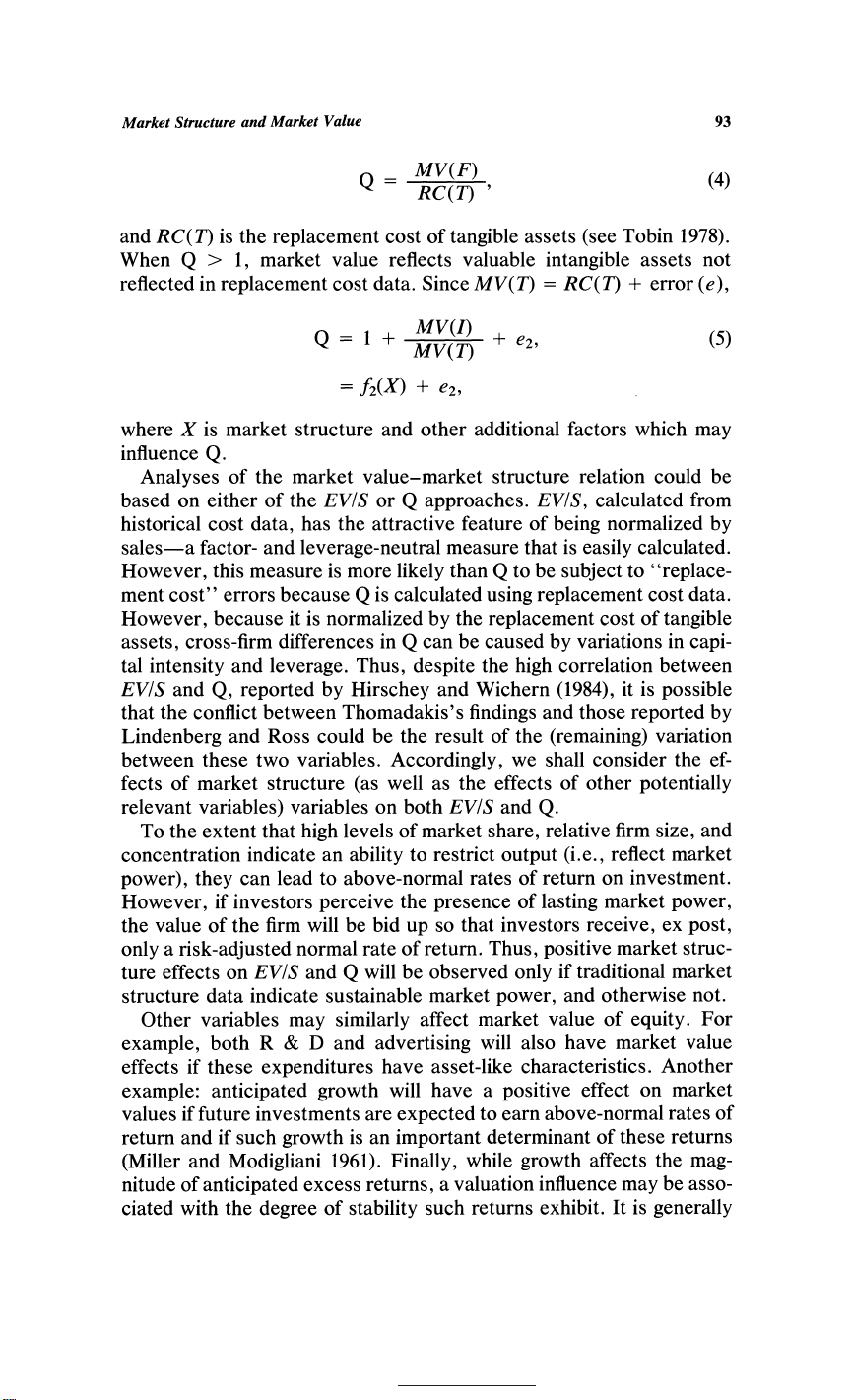
Q=
MV(F)
(4
RC(T)
(4
and RC(T)
is the
replacement
cost
of tangible
assets
(see Tobin
1978).
When
Q
>
1,
market
value reflects
valuable
intangible
assets
not
reflected in
replacement
cost data.
Since
MV(T)
=
RC(T) +
error
(e),
+
MV(I)
(5)
Q=1?
MV(T)
(5)
=
f2(X)
+
e2,
where
X
is
market structure and
other
additional
factors
which
may
influence
Q.
Analyses
of the
market
value-market
structure
relation
could
be
based on either
of the EVIS or
Q approaches.
EVIS,
calculated
from
historical cost
data,
has the attractive
feature
of being
normalized
by
sales-a factor-
and leverage-neutral
measure
that is
easily
calculated.
However,
this measure is more
likely
than Q to
be subject
to
"replace-
ment
cost"
errors
because
Q is
calculated
using
replacement
cost data.
However,
because
it
is normalized
by
the replacement
cost
of tangible
assets,
cross-firm
differences
in
Q can
be caused
by
variations
in capi-
tal
intensity
and leverage.
Thus, despite
the
high correlation
between
EVIS and
Q.
reported
by
Hirschey
and
Wichern
(1984),
it
is possible
that the conflict
between
Thomadakis's
findings
and
those reported
by
Lindenberg
and Ross could
be the result of the (remaining)
variation
between these two
variables.
Accordingly,
we shall
consider
the
ef-
fects of
market
structure (as
well
as the effects
of other
potentially
relevant
variables)
variables
on
both
EVIS and
Q.
To
the extent that
high
levels
of market
share,
relative
firm
size,
and
concentration
indicate
an
ability
to restrict
output (i.e.,
reflect
market
power),
they
can lead to above-normal
rates of
return
on
investment.
However,
if
investors
perceive
the
presence
of
lasting
market
power,
the
value
of the
firm will be bid
up
so
that
investors
receive,
ex
post,
only
a
risk-adjusted
normal rate
of return.
Thus, positive
market struc-
ture effects
on EVIS
and
Q
will be observed
only
if
traditional
market
structure
data indicate
sustainable
market
power,
and otherwise
not.
Other variables
may
similarly
affect market
value
of
equity.
For
example,
both
R &
D
and advertising
will
also
have
market value
effects
if
these
expenditures
have asset-like
characteristics.
Another
example:
anticipated
growth
will have a
positive
effect
on
market
values
if
future
investments
are
expected
to earn
above-normal
rates
of
return and
if
such
growth
is an
important
determinant
of
these returns
(Miller
and
Modigliani
1961).
Finally,
while
growth
affects the
mag-
nitude of
anticipated
excess returns,
a valuation
influence may
be asso-
ciated
with the
degree
of
stability
such
returns
exhibit.
It is
generally
This content downloaded from 146.232.129.75 on Sun, 18 Aug 2013 21:41:35 PM
All use subject to JSTOR Terms and Conditions
94
Journal
of
Business
accepted
that greater
riskiness of a
stream of
future
excess returns will
reduce the
market
value of
that
stream,
expected values
unchanged.
These
remarks
suggest a
model
where
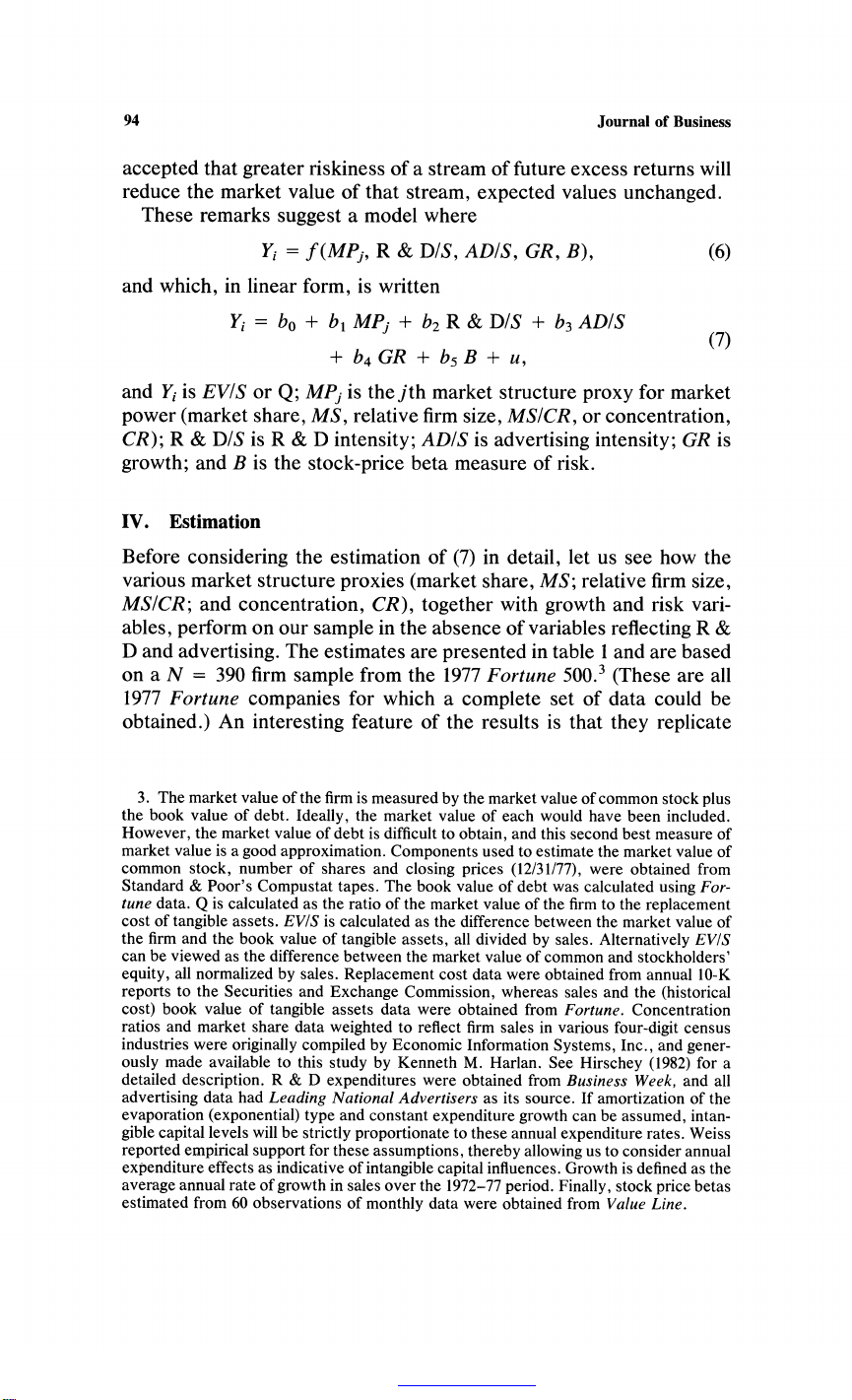
Yj
=
f
(MPj,
R
&
DIS, AD/S,
GR, B),
(6)
and
which,
in
linear
form, is
written
Yj
=
bo
+
b,
MPj
+
b2 R
& DIS +
b3
AD/S
+
b4
GR
+
b5
B
+
u,
and
Y1
is
EVIS
or
Q;
MPj
is the
jth
market
structure
proxy
for
market
power
(market
share, MS,
relative firm
size,
MS/CR,
or
concentration,
CR);
R
& D/S is R
&
D
intensity;
ADIS is
advertising
intensity; GR is
growth;
and
B is
the
stock-price beta
measure
of
risk.
IV.
Estimation
Before
considering the
estimation of
(7)
in
detail, let us see how the
various
market
structure
proxies
(market share,
MS; relative firm
size,
MS/CR;
and
concentration,
CR), together with
growth
and risk vari-
ables, perform
on our
sample
in
the
absence of
variables
reflecting
R
&
D and
advertising.
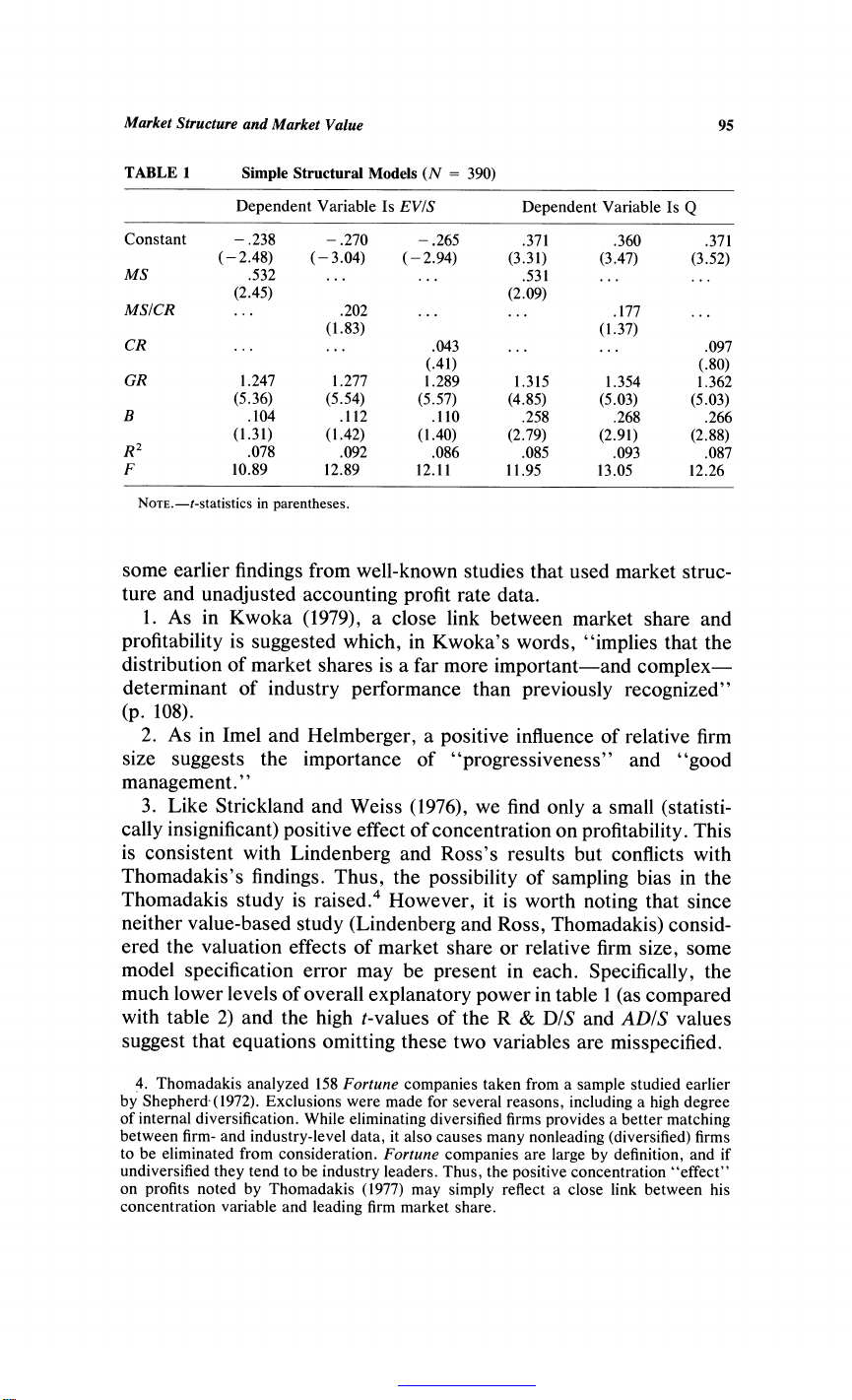
The
estimates are
presented
in
table
1
and are based
on
a
N
=
390 firm
sample
from the
1977
Fortune
500.3 (These
are all
1977 Fortune
companies
for
which a
complete
set
of
data
could be
obtained.)
An
interesting
feature of the results is that
they replicate
3. The market
value
of the firm is
measured
by the
market
value
of
common
stock
plus
the book
value of
debt.
Ideally, the
market
value
of each
would
have been
included.
However,
the market
value of debt is
difficult to
obtain,
and
this
second
best
measure of
market
value
is
a
good
approximation.
Components
used to
estimate the market
value of
common
stock, number
of
shares
and
closing
prices
(12/31/77),
were
obtained
from
Standard &
Poor's
Compustat
tapes. The
book value of
debt
was
calculated
using For-
tune data.
Q
is
calculated
as the
ratio
of the
market
value of the firm
to the
replacement
cost
of
tangible
assets.
EVIS is
calculated as
the
difference
between
the
market
value of
the firm
and the
book
value of
tangible
assets, all
divided
by
sales.
Alternatively
EVIS
can
be
viewed as the
difference
between the
market
value of
common and
stockholders'
equity,
all
normalized
by sales.
Replacement
cost
data
were
obtained
from
annual 10-K
reports
to
the
Securities and
Exchange
Commission,
whereas sales and the
(historical
cost) book value
of
tangible
assets
data
were obtained from
Fortune.
Concentration
ratios and
market share
data
weighted
to
reflect firm
sales
in
various
four-digit
census
industries
were
originally
compiled by
Economic
Information
Systems,
Inc., and
gener-
ously made available
to this
study
by
Kenneth M. Harlan.
See
Hirschey
(1982) for a
detailed
description.
R
&
D
expenditures
were
obtained
from
Business
Week,
and
all
advertising data
had
Leading
National
Advertisers as
its
source. If
amortization of
the
evaporation
(exponential) type
and
constant
expenditure
growth can
be
assumed, intan-
gible capital
levels
will be
strictly
proportionate to
these
annual
expenditure
rates.
Weiss
reported
empirical
support for
these
assumptions,
thereby
allowing
us to
consider
annual
expenditure effects as
indicative of
intangible
capital influences.
Growth
is
defined as the
average annual rate of
growth in
sales over
the 1972-77
period.
Finally,
stock
price betas
estimated from 60
observations of
monthly
data were
obtained from Value
Line.
This content downloaded from 146.232.129.75 on Sun, 18 Aug 2013 21:41:35 PM
All use subject to JSTOR Terms and Conditions
Market
Structure
and
Market
Value
TABLE 1
Simple
Structural
Models
(N
=
390)
Dependent
Variable
Is
EVIS
Dependent
Variable Is Q
Constant
-
.238
-
.270
-
.265
.371
.360
.371
(-2.48)
(-
3.04)
(-2.94)
(3.31)
(3.47)
(3.52)
MS
.532 ...
...
.531 ...
...
(2.45)
(2.09)
MSICR
...
.202
...
...
.177 ...
(1.83)
(1.37)
CR ...
...
.043 ...
...
.097
(.41)
(.80)
GR
1.247
1.277
1.289 1.315
1.354
1.362
(5.36)
(5.54)
(5.57)
(4.85)
(5.03)
(5.03)
B
.104
.112
.110
.258
.268
.266
(1.31)
(1.42)
(1.40)
(2.79)
(2.91)
(2.88)
R
2
.078
.092
.086
.085
.093
.087
F
10.89
12.89
12.11
11.95
13.05
12.26
NOTE.-t-statistics
in
parentheses.
some
earlier
findings
from
well-known
studies
that used
market
struc-
ture and
unadjusted
accounting
profit
rate
data.
1.
As in
Kwoka
(1979),
a
close
link
between
market
share
and
profitability is
suggested
which,
in
Kwoka's
words,
"implies
that
the
distribution of
market
shares is
a far
more
important-and
complex-
determinant
of
industry
performance
than
previously
recognized"
(p.
108).
2.
As in
Imel
and
Helmberger, a
positive
influence of
relative
firm
size
suggests the
importance
of
"progressiveness" and
"good
management."
3.
Like
Strickland
and
Weiss
(1976),
we
find
only a small
(statisti-
cally
insignificant)
positive
effect of
concentration on
profitability. This
is
consistent
with
Lindenberg
and
Ross's
results
but
conflicts with
Thomadakis's
findings.
Thus,
the
possibility of
sampling
bias
in
the
Thomadakis
study
is
raised.4
However, it
is
worth
noting
that
since
neither
value-based
study
(Lindenberg
and
Ross,
Thomadakis)
consid-
ered the
valuation
effects of
market
share
or relative firm
size,
some
model
specification
error
may
be
present in
each.
Specifically,
the
much lower
levels of
overall
explanatory
power in
table
1
(as
compared
with
table
2)
and
the
high
t-values
of
the
R
&
D/S and
AD/S
values
suggest
that
equations
omitting
these
two
variables are
misspecified.
4.
Thomadakis
analyzed
158
Fortune
companies taken
from a
sample
studied earlier
by
Shepherd-(1972).
Exclusions were made
for
several
reasons,
including a
high degree
of
internal
diversification. While
eliminating
diversified firms
provides
a
better
matching
between firm-
and
industry-level
data,
it
also causes
many
nonleading
(diversified) firms
to be
eliminated
from
consideration.
Fortune
companies
are large
by
definition, and if
undiversified they
tend to be
industry
leaders.
Thus, the
positive
concentration
"effect"
on
profits noted
by Thomadakis
(1977) may
simply reflect
a
close
link
between his
concentration
variable and
leading firm
market
share.
This content downloaded from 146.232.129.75 on Sun, 18 Aug 2013 21:41:35 PM
All use subject to JSTOR Terms and Conditions
96
Journal
of
Business
TABLE 2 Market Structure and
Market Value (N
=
390)
Dependent Variable Is
EVIS
Dependent
Variable Is Q
Constant
-
.040
-
.133 - .148
.566
.492 .481
(-.46) (- 1.68)
(-1.83) (5.57) (5.25) (5.10)
MS .030 ...
...
-.080 ... ...
(.15)
(- .35)
MSICR ... .077
... ... .017 ...
(.79) (.15)
CR
... ...
-.219 ...
...
-.194
(-2.37) (-1.78)
R
&
D/S
6.814 6.406
6.400 7.067
6.763
6.716
(9.40) (8.86)
(8.94) (8.27) (8.00) (8.03)
AD/S 5.553 5.338
5.268 7.553 7.460
7.366
(6.32) (5.94)
(5.43) (7.34) (7.11) (7.09)
GR 1.113 1.086
1.098
1.183 1.153
1.161
(5.53) (5.36)
(5.41) (5.01) (4.87) (4.89)
B
-.085 -.079
-.078 .069
.071 .074
(-1.18) (-1.09)
(-1.07) (.82) (.84) (.87)
R
2
.317 .307
.308
.315 .310 .309
F 35.65 34.02 34.18 35.32 34.50
34.34
NOTE.-t-statistics
in
parentheses.
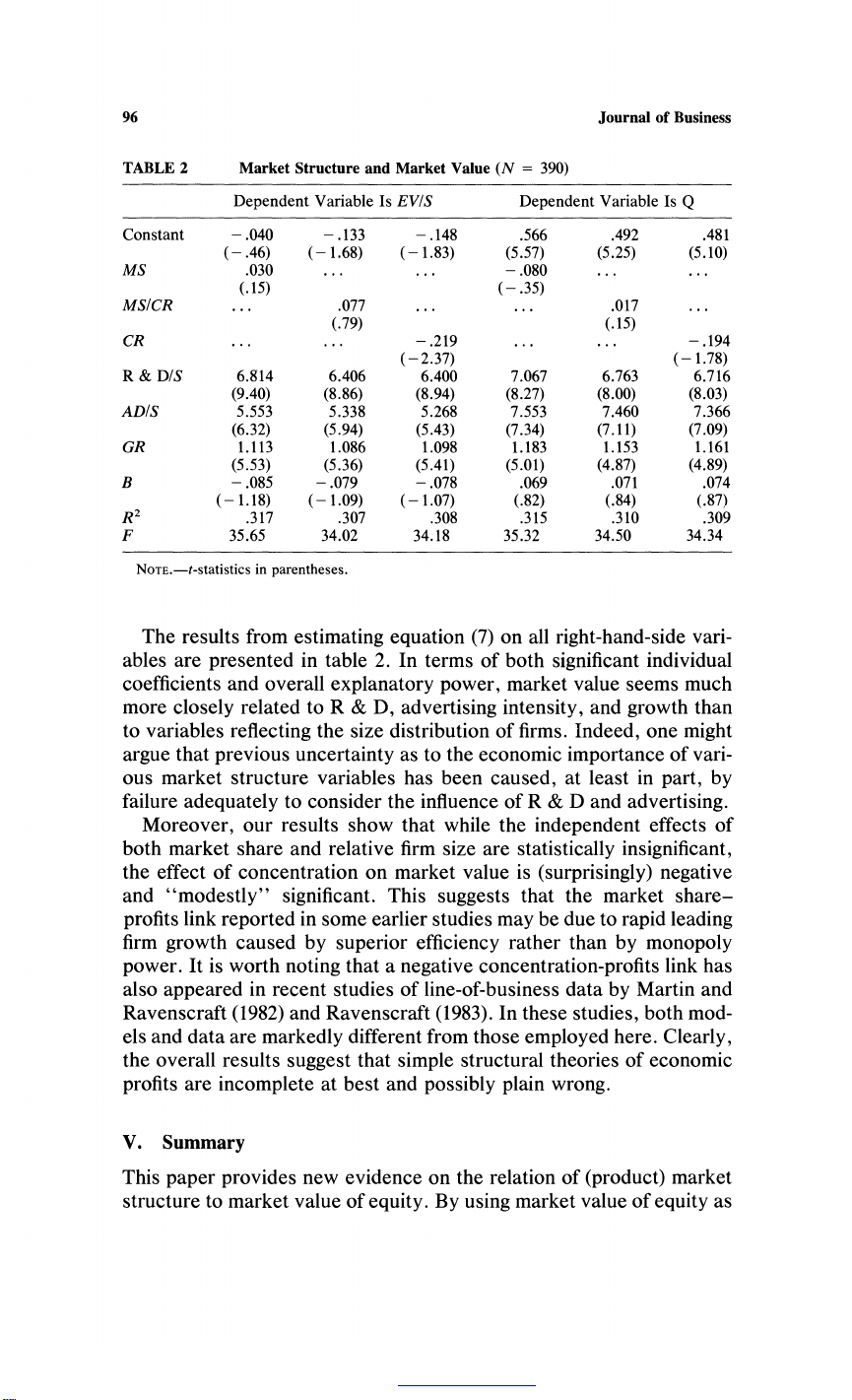
The results from estimating equation (7) on all right-hand-side vari-
ables are presented in table 2. In terms of both significant individual
coefficients
and
overall explanatory power, market value seems much
more closely related to R & D, advertising intensity, and growth than
to variables reflecting the size distribution of firms. Indeed, one might
argue
that
previous uncertainty as to
the
economic importance
of
vari-
ous market
structure variables has been caused, at least
in
part, by
failure
adequately to consider the influence of R &
D
and advertising.
Moreover, our results show that while the independent effects of
both
market share and relative
firm
size are statistically insignificant,
the
effect of concentration on market value is (surprisingly) negative
and
"modestly" significant. This suggests
that the market
share-
profits link reported in some earlier studies may be due to rapid leading
firm growth caused by superior efficiency rather than by monopoly
power. It is worth noting that a negative concentration-profits
link
has
also
appeared
in
recent studies
of
line-of-business
data
by
Martin and
Ravenscraft (1982) and Ravenscraft (1983). In these studies, both mod-
els
and
data are
markedly
different from
those employed
here.
Clearly,
the overall results
suggest
that
simple
structural theories of economic
profits are incomplete at best and possibly plain wrong.
V.
Summary
This paper provides new evidence on the relation of (product)
market
structure to market value of
equity. By using
market value
of
equity
as
This content downloaded from 146.232.129.75 on Sun, 18 Aug 2013 21:41:35 PM
All use subject to JSTOR Terms and Conditions
Market Structure and Market Value 97
a
measure
of economic
performance,
we avoid
well-known
problems
arising from
the
measurement of
profits from
accounting records.
After
allowing
for
the effects of
growth
and
intangible
capital
("left-out"
asset
effects of
R
& D and
advertising), no
consistent
link
between
traditional
market structure
variables
and market value of
equity was
detected. Neither market
share nor relative firm
size had any discern-
ible
influence on value of
equity, and
the effect of
concentration
was
negative
and, arguably,
of statistical
significance on
conventional
crite-
ria.
These
results suggest
that
cross-industry
differences in
profits are
not
positively related to
market
structure. No
simple relation between
the number and/or
relative size of
firms and
profits
has been found.
Conventional
characterizations of market
structure
do not
reflect
"market
power,"
even
approximately.
References
Ayanian, Robert. 1983. The advertising capital controversy. Journal of Business 56
(July): 349-64.
Baumol, William J. 1982. Contestable markets: An uprising in the theory of industry
structure. American Economic Review 72
(March):
1-15.
Bertrand, Joseph. 1883. Theorie mathematique de la richesse sociale. Journal des sav-
ants (Paris).
Chamberlin,
Edward.
1933.
The
Theory of Monopolistic Competition. Cambrdge,
Mass.:
Harvard University Press.
Comanor, William S., and Wilson, Thomas A. 1979. Advertising and competition:
A
survey.
Journal
of
Economic Literature 17
(June):
453-76.
Cournot, Augustin. 1838. Recherches sur les principes mathe'matiques de la theorie
des
riches. Paris.
Demsetz,
Harold.
1973. Industry structure, market rivalry
and
public policy. Journal of
Law and Economics 16
(April):
1-11.
Demsetz, Harold. 1979. Accounting for advertising as a barrier to entry. Journal of
Business
52
(July):
345-60.
Hirschey,
Mark.
1982. Intangible capital aspects of advertising
and R & D
expenditures.
Journal of
Industrial Economics 30
(June): 375-89.
Hirschey, Mark,
and
Wichern, Dean W. 1984. Accounting and market
value measures of
profitability: consistency, determinants and uses. Journal of Business and Economic
Statistics,
2
(October):
375-83.
Imel, Blake,
and
Helmberger,
Peter.
1971. Estimation
of
structure-profit relationships
with
application
to
the food processing sector. American Economic
Review 61
(Sep-
tember): 614-27.
Kamien,
Morton
I.,
and
Schwartz, Nancy L. 1975. Market structure
and innovation:
A
survey.
Journal
of
Economic Literature 13
(March):
1-37.
Kwoka,
John E.
1979.
The effect of market
share distribution on industry performance.
Review
of
Economics and
Statistics
61
(February): 101-9.
Lindenberg,
Eric
B.,
and
Ross, Stephen
A.
1981.
Tobin's
q
ratio
and
industrial
organiza-
tion. Journal of Business
54
(January):
1-32.
Martin, Stephen,
and
Ravenscraft,
David
J. 1982. Aggregation
and studies of industrial
profitability.
Economics Letters 10: 161-65.
Miller, Merton,
and
Modigliani,
Franco.
1961.
Dividend
policy, growth,
and the value of
shares. Journal
of
Business 34
(October):
411-33.
Peltzman,
Sam. 1977. The
gains
and losses from industrial concentration. Journal
of
Law
and Economics
20
(October):
229-64.
This content downloaded from 146.232.129.75 on Sun, 18 Aug 2013 21:41:35 PM
All use subject to JSTOR Terms and Conditions
98
Journal
of
Business
Ravenscraft, David
J.
1983.
Structure-performance
relationships at
the line
of
business
and
industry
level.
Review
of
Economics
and
Statistics 65
(February): 22-31.
Scherer, F.
M.
1980.
Industrial
Market
Structure
and
Economic
Performance.
Chicago:
Rand-McNally.
Shepherd,
William
G.
1972.
Elements of
market
structure.
Review
of
Economics and
Statistics
54
(February):
25-37.
Strickland,
Allyn
D.,
and
Weiss, Leonard
W. 1976.
Advertising,
concentration and
price-cost
margins.
Journal
of Political
Economy
84
(October):
1109-21.
Telser, Lester
G.
1961.
How
much
does
it
pay whom
to
advertise?
American
Economic
Review 51
(May):
194-205.
Thomadakis,
Stavros B.
1977.
A
value-based test of
profitability and
market
structure.
Review
of
Economics
and
Statistics
59
(May): 179-85.
Tobin, James.
1978.
Monetary
policies and
the
economy: The
transmission
mechanism.
Southern
Economic
Journal 37
(April):
421-31.
Weiss, Leonard
W. 1969.
Advertising,
profits and
corporate
taxes.
Review
of
Economics
and Statistics 51
(November):
421-30.
This content downloaded from 146.232.129.75 on Sun, 18 Aug 2013 21:41:35 PM
All use subject to JSTOR Terms and Conditions

Preview text:

Market Structure and Market Value Author(s): Mark Hirschey
Source: The Journal of Business, Vol. 58, No. 1 (Jan., 1985), pp. 89-98
Published by: The University of Chicago Press
Stable URL: http://www.jstor.org/stable/2352911 . Accessed: 18/08/2013 21:41
Your use of the JSTOR archive indicates your acceptance of the Terms & Conditions of Use, available at .
http://www.jstor.org/page/info/about/policies/terms.jsp .
JSTOR is a not-for-profit service that helps scholars, researchers, and students discover, use, and build upon a wide range of
content in a trusted digital archive. We use information technology and tools to increase productivity and facilitate new forms
of scholarship. For more information about JSTOR, please contact support@jstor.org. .
The University of Chicago Press is collaborating with JSTOR to digitize, preserve and extend access to The Journal of Business. http://www.jstor.org
This content downloaded from 146.232.129.75 on Sun, 18 Aug 2013 21:41:35 PM
All use subject to JSTOR Terms and Conditions
This content downloaded from 146.232.129.75 on Sun, 18 Aug 2013 21:41:35 PM
All use subject to JSTOR Terms and Conditions
This content downloaded from 146.232.129.75 on Sun, 18 Aug 2013 21:41:35 PM
All use subject to JSTOR Terms and Conditions
This content downloaded from 146.232.129.75 on Sun, 18 Aug 2013 21:41:35 PM
All use subject to JSTOR Terms and Conditions
This content downloaded from 146.232.129.75 on Sun, 18 Aug 2013 21:41:35 PM
All use subject to JSTOR Terms and Conditions
This content downloaded from 146.232.129.75 on Sun, 18 Aug 2013 21:41:35 PM
All use subject to JSTOR Terms and Conditions
This content downloaded from 146.232.129.75 on Sun, 18 Aug 2013 21:41:35 PM
All use subject to JSTOR Terms and Conditions
This content downloaded from 146.232.129.75 on Sun, 18 Aug 2013 21:41:35 PM
All use subject to JSTOR Terms and Conditions
This content downloaded from 146.232.129.75 on Sun, 18 Aug 2013 21:41:35 PM
All use subject to JSTOR Terms and Conditions
This content downloaded from 146.232.129.75 on Sun, 18 Aug 2013 21:41:35 PM
All use subject to JSTOR Terms and Conditions
This content downloaded from 146.232.129.75 on Sun, 18 Aug 2013 21:41:35 PM
All use subject to JSTOR Terms and Conditions
Document Outline

  • Article Contents
    • p. 89
    • p. 90
    • p. 91
    • p. 92
    • p. 93
    • p. 94
    • p. 95
    • p. 96
    • p. 97
    • p. 98
  • Issue Table of Contents
    • The Journal of Business, Vol. 58, No. 1 (Jan., 1985), pp. 1-133
      • Front Matter
      • Measuring Investment Performance in a Rational Expectations Equilibrium Model [pp. 1 - 26]
      • Fair Pricing of Unemployment Insurance Premiums [pp. 27 - 47]
      • Stock Prices and Economic News [pp. 49 - 67]
      • Insider Trading and the Exploitation of Inside Information: Some Empirical Evidence [pp. 69 - 87]
      • Market Structure and Market Value [pp. 89 - 98]
      • Books Received [pp. 99 - 104]
      • Notes [pp. 105 - 116]
      • Doctoral Dissertations Accepted 1983-1984 [pp. 117 - 133]
      • Back Matter