IJARSCT International Journal of Advanced Research in Science, Communication and Technology (IJARSCT) | Tài liệu Tiếng Anh
IJARSCT International Journal of Advanced Research in Science, Communication and Technology (IJARSCT) | Tài liệu Tiếng Anh
Môn: Tiếng Anh chuyên ngành 332 tài liệu
Trường: Tài liệu Tiếng Anh chuyên ngành, Tiếng Anh cho người đi làm 432 tài liệu
Tác giả:



Preview text:
IJARSCT ISSN (Online) 2581-9429
International Journal of Advanced Research in Science, Communication and Technology (IJARSCT)
International Open-Access, Double-Blind, Peer-Reviewed, Refereed, Multidisciplinary Online Journal Impact Factor: 7.301 Volume 3, Issue 12, May 2023
Blind Spot Monitoring and Warning System
Anup Shende1, Bharat Vagge 2, Saurabh Mahale 3, Krishikesh Raskar4, Dr. Nilesh Alone5
Students, Department of Mechanical Engineering1,2,3,4
Faculty, Department of Mechanical Engineering5
JSPM’S Jayawantrao Sawant College of Engineering, Pune, India
Abstract: A person driving a passenger car depends on the rearview mirror and two side mirrors to
observe the surroundings to see vehicles approaching from behind. However, an approaching vehicle may
enter an area outside the driver's field of vision, making it invisible to the driver. Such an area is known as
the blind spot zone (BSZ). Traffic accidents occur daily due to risky lane changes and unconscious
reversing. The cause of these accidents is primarily the carelessness of the driver and the lack of proper
knowledge of the vehicle's blind spot. Therfore driving schools emphasize the importance of checking
vehicles in BSZ before attempting to change lanes. Therefore, it is important to understand BSZ, especially
its corresponding parameters, in order to develop an effective system for detecting approaching vehicles
and warning drivers. To solve this problem and ensure safe driving, blind spot monitoring system. This
system was developed using Arduino and ultrasonic sensors. It can detect an object in the blind spot area
under various operating conditions such as static, dynamic, overtaking and reversing. The system
overcomes the blind spot phenomenon and ensures safe driving. It is an effective system for detecting
approaching vehicles and warning drivers.
Keywords: Blind spot detection, ultrasonic sensor, arduino , changing lanes I. INTRODUCTION
The car's form and design are always being updated with the goal of enhancing both aesthetics and functionality. Blind
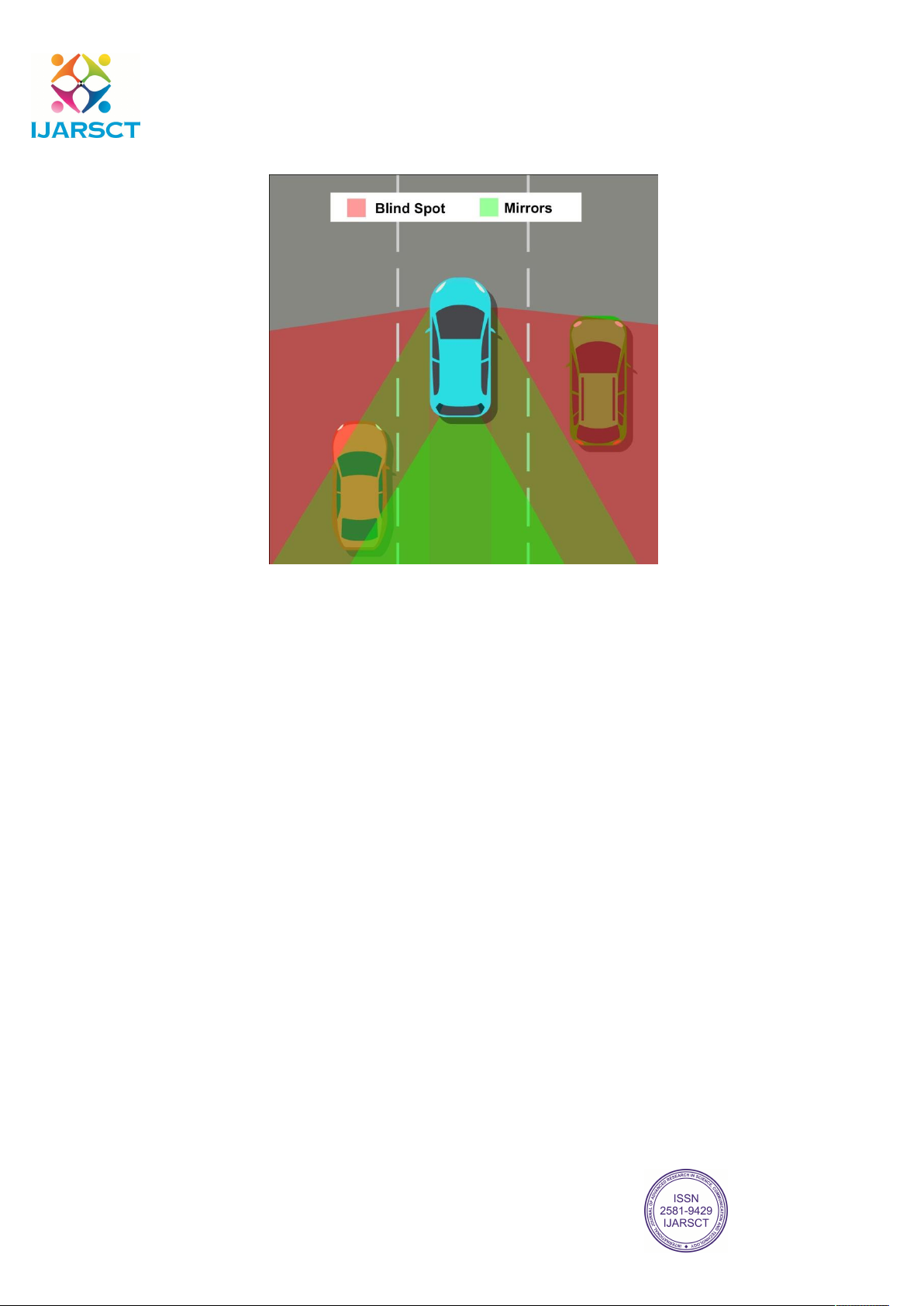
areas are not entirely removed, though. The blind region around the automobile is depicted in Figure 1. The size, shape,
and height of the car, as well as the driver, all affect the blind spot region. The hood's size and form, as well as the
driver's height of less than 1.67 metres, all contribute to the phenomena of increased blind spots [1]. The region that the
driver cannot see in the rearview mirror is known as the blind spot. In fact, it's astonishing how much room a driver
misses when reversing or changing lanes [2]. You still can't see everything, even with the mirror in the right spot. When
a possible collision item enters the blind spot region, the created real-time blind spot monitoring system warns the
driver by shaking the cabin and informing them. Every day, there are more and more people using vehicles. Traffic
collisions are rising as a result. Lack of driving awareness is the major cause of many traffic incidents. Most drivers are
not familiar with the idea of vehicle blind areas. At the moment, blind spot monitoring systems are mostly found in
expensive vehicles [3-5]. The driver's field of vision cannot be increased even with the use of practical methods,
including mounting a convex lens to the external rearview mirror. Techniques for blind spot monitoring that have
recently been presented are quite costly and only partially successful. Most road accidents—about 75% of them—occur
when drivers switch lanes without realising a car is coming up behind them. While driving, LED signals that blink or
beep are difficult to comprehend, and utilising cameras to find things in blind regions is inefficient [6]. This is because
the absence of light throughout the night or during rainy conditions might cause the image to look hazy or murky.
Transport issues might also result from the steering wheel's vibration that alerts the driver. As a result, the goal of this
research is to create a real-time monitoring system that can identify things in the car's blind spot in any circumstance.rs
to gather bigger samples of data and guarantee consistency Copyright to IJARSCT DOI: 10.48175/568 40 www.ijarsct.co.in IJARSCT ISSN (Online) 2581-9429
International Journal of Advanced Research in Science, Communication and Technology (IJARSCT)
International Open-Access, Double-Blind, Peer-Reviewed, Refereed, Multidisciplinary Online Journal Impact Factor: 7.301 Volume 3, Issue 12, May 2023
Fig. 1: Vehicle Blind Spot Region II. METHODOLOGY
Your car employs sensors on the back bumper and side mirrors of this particular driving safety system to check if there
are any cars in your blind zone or in the lanes next to you. An auditory warning and a signal will be shown on the side
mirror if the sensors identify an approaching vehicle that is either within a specific distance of the driver or is not
visible in the blind spot. The microprocessor's quick data processing will enable real-time information for the driver.
Alarm notification cannot be regarded as trustworthy without real-time data processing.
III. DETERMINATION OF BLIND SPOT ZONE
Many lane-changing incidents still have their roots in the driver's sight while utilising a side mirror. Therefore, it is
crucial for the development of BSZ detection and warning systems to determine the blind spot zone (BSZ) and
characteristics that might impact the driver's sight. To determine the link between the driver's height and the BSZ on the
left and right sides of the automobile, a Perodua Viva with drivers of various heights was employed in the experiment.
However, more factors, such as viewing angles and the utilisation of various automobile types, will be covered in the
future. This is where the BSZ for various passenger automobiles on the market has been established. Additionally, a
camera will replace volunteer drivers in order to IV. SYSTEM CONFIGURATION
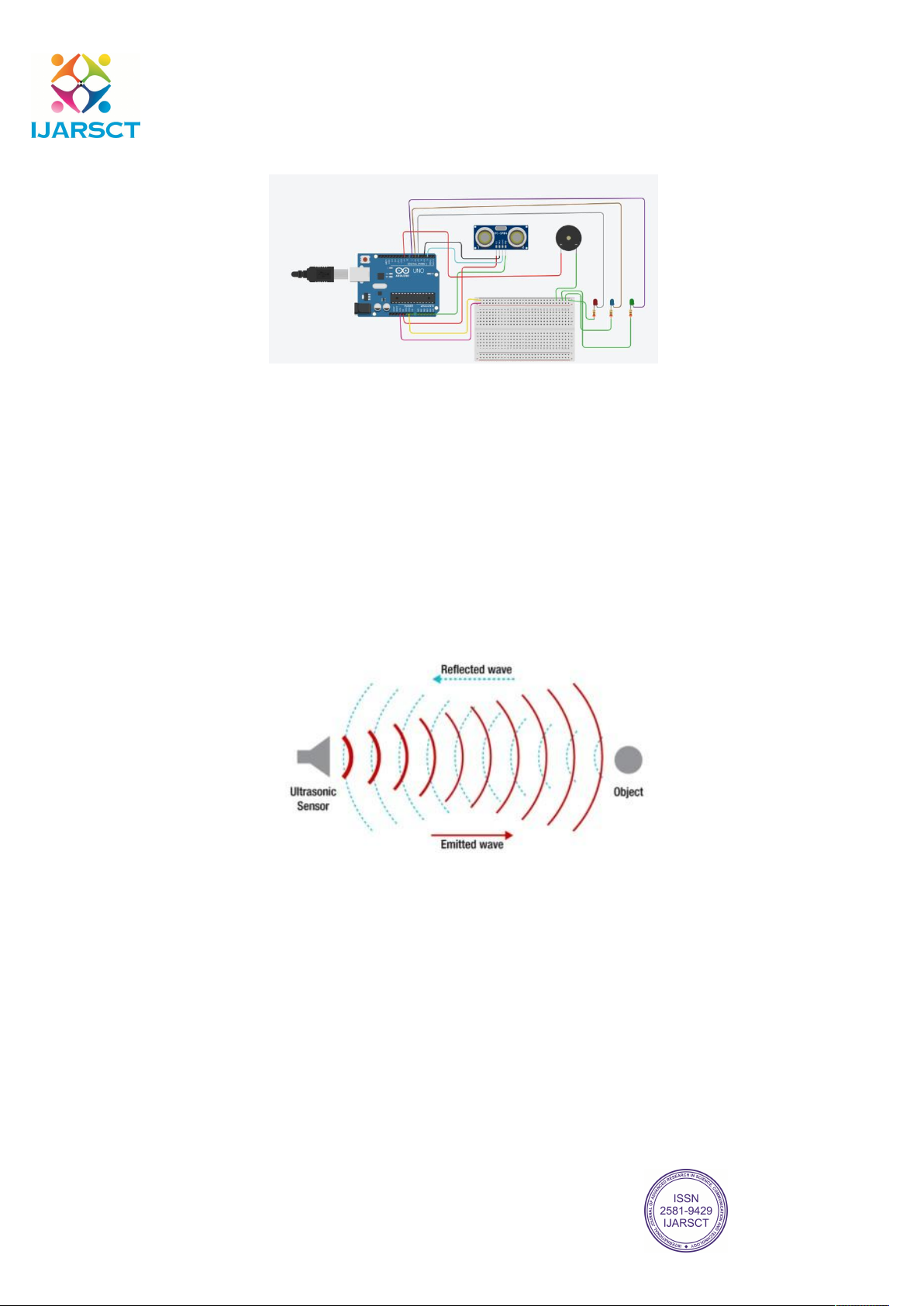
The developed model mainly consists of the following parts: HC-SR04 Ultrasonic Sensors Arduino UNO Buzzer 6x2 LCD LED (Red, Blue, Green) Copyright to IJARSCT DOI: 10.48175/568 41 www.ijarsct.co.in IJARSCT ISSN (Online) 2581-9429
International Journal of Advanced Research in Science, Communication and Technology (IJARSCT)
International Open-Access, Double-Blind, Peer-Reviewed, Refereed, Multidisciplinary Online Journal Impact Factor: 7.301 Volume 3, Issue 12, May 2023 Fig.2 circuit diagram V. WORKING PRINCIPLE
The sensors were installed on the side view mirror or on the two edges of the back bumper. As shown in Fig. 3, the
sensor transmits the pulse and then receives it after reflection from the object. The microprocessor obtains the sound
wave's reflection time and converts it into centimeters, allowing the distance to be estimated in centimeters based on microseconds. : 340 −1 = 29 −1
Sound wave reflects from the obstacle. So to calculate the distance, half of the distance traveled is considered. = 2 × ( /29)
By analyzing this data, distance of an object in the blind spot can easily be determined.
Fig. 3: Measuring Distance by Ultrasonic Sound VI. WORKING PROCESS
Two ultrasonic sensors contribute to the system, which uses a high-speed microcontroller to operate. It identifies any
moving or static high-risk potential object that is in the vehicle's blind zone. The brief ultrasonic pulse that is broadcast
at time zero and recognised by the system made up of receiver on ultrasonic sensors is how these HC-SR04 4-pin
ultrasonic sensors that are attached to the microprocessor (Arduino UNO R3) operate. The time interval between
sending and receiving is used to compute the distance. The LEDs light up and the buzzer sounds in accordance with the
object's distance. The closer the item is, the higher the frequency will be, and vice versa as the distance between them
varies.Similar to LEDs, when an item is near, red light appears. LED lights flash blue when the object is too far away
and green when it is within safe range. The coding provided to the Arduino could establish these range settings. Copyright to IJARSCT DOI: 10.48175/568 42 www.ijarsct.co.in IJARSCT ISSN (Online) 2581-9429
International Journal of Advanced Research in Science, Communication and Technology (IJARSCT)
International Open-Access, Double-Blind, Peer-Reviewed, Refereed, Multidisciplinary Online Journal Impact Factor: 7.301 Volume 3, Issue 12, May 2023
VII. SYSTEM BENEFITS FOR DRIVERS
Warning against impending collisions with vehicles in blind spot and reduces the risk of accidents when changing lane.
Identifies vehicles in the vehicle’s blind spot, immediately displays a warning in the side view mirror and
additionally warns when the turn signal is switched on.
Changing lanes is safer and more relaxed. VIII. CONCLUSIONS
Traffic accidents caused by unsafe lane changes and the danger of driving into a blind spot have become a worldwide
phenomena. In car accidents, the blind spot of the vehicle is a crucial factor. The region surrounding the entire
automobile cannot be seen in the side and rearview mirrors. A major factor in lowering accidents and raising driving
safety is the development of blind spot monitoring and warning systems.Drivers will benefit from the created system's
cutting-edge driving assistance technologies and increased road safety. IX. ACKNOWLEDGEMENT
We would like to extend our sincere appreciation to each and every person and group that helped to make this research
paper on blind spot detection systems a success. First and foremost, we would like to express our sincere gratitude to
our adviser Dr. Nilesh Alone, whose advice, knowledge, and constant support were vital throughout the study process.
Their thoughtful criticism and helpful ideas significantly improved this paper's quality and depth. REFERENCES
[1]. Arduino, http://www.www.arduino.cc (2012)
[2]. Jump up to :Quiroga, Tony; Philpot, Chris, Illustrator (March 2010). "How to Adjust Your Mirrors to Avoid
Blind Spots". Car and Driver. Retrieved August 9, 2013
[3]. Rajedra Prasad Mahapatra and K. Vimal Kumar, Panoramic Sensor Based Blind Spot Accident Prevention
System, World Academy of Science, Engineering and Technology Vol. 25 (2009)
[4]. Jump up to :Platzer, George (February 1, 1995). The Geometry of Automotive Rearview Mirrors - Why Blind
Zones Exist and Strategies to Overcome Them (Technical report).SAE Technical Paper Series. Vol. 1. Detroit,
Michigan: Society of Automotive Engineers. doi:10.4271/950601. 950601 Copyright to IJARSCT DOI: 10.48175/568 43 www.ijarsct.co.in
Tài liệu liên quan:
-

Cambridge IELTS 13 Test-1 Overview and Practice Review | Tài liệu Tiếng Anh
6 3 -

IELTS Test 2 Review - Cambridge 13 Preparation Guide | Tài liệu Tiếng Anh
9 5 -
Litfocus Litreading Survey: Student Reading Interests & Habits Questionnaire | Tài liệu Tiếng Anh
9 5 -

Sách Pre-intermediate Market leader - Business English Course Book
25 13 -

Exam booster for B1 preliminary and B1 preliminary for schools with answer key
10 5