Career Development _ Chapter 4 Asessing personal personality and interest
- MBTI test, exploring major - HOlland code interest - Work map
Môn: Chuyên Anh (ĐHNN) 55 tài liệu
Trường: Trường Đại học Ngoại ngữ, Đại học Quốc gia Hà Nội 645 tài liệu
Tác giả:







Preview text:
Assessing Your 52
Chapter 4 Assessing Your Personality and Interests Personality and exploring Personality Interests
Have you ever said to a friend, “That’s not like you”? Has anyone ever said to you, “You’re
not acting like yourself today”? These are common ways for us to talk about the complex set
of tendencies, behaviors, attitudes, and characteristics that make each of us unique. The sum
total of these qualities is called your personality.
The more you know about yourself and your personal preferences, the better able you will Express Your Real Self 4
be to identify work and outside activities that complement your personality type. Several differ-
ent assessment instruments are available to help you learn about yourself. Like the upcoming
activity, some of these instruments are based on the work of noted Swiss psychologist Carl Jung
(1923), who developed a way to help us understand and categorize our inborn tendencies.
Katherine Briggs and Isabel Briggs Myers (Myers, 1962) later expanded on Jung’s theory to
develop an assessment tool that helps identify personality preferences. This widely used survey
is called the Myers-Briggs Type Indicator instrument (MBTI).1 It might be possible for you
Student Learning OutcOmeS
to arrange through your instructor or career center to take this or some other survey to learn
more about your personality type. You may also try out similar surveys such as “Typefocus” or
At the end of the chapter you will be able to . . .
“Humanmetrics” that are available online. ■ ■
Analyze differences in personality types and ■ ■ Identify fields of Interest.
identify your own personality type. ■ ■
Research your interests as they relate to potential ■ ■
Connect personality type to choice of major and majors and occupations. career.
The more you know about your natural tendencies and preferences, the easier it
will be for you to identify a career path that enables you to maximize what comes
naturally. If you take your personality and interests into account when starting down
your career path, you are much more likely to enjoy your work and find it fulfilling.
Many of us dismiss the notion that we can have careers based on who we are and
what we like to do. Somewhere along the way, we lose track of early dreams inspired by
our true selves and begin focusing on more practical matters: What degrees are offered
and what classes are needed? What occupation offers security and good pay? In many
cases, we might have been able to explore careers much more closely aligned with
our interests than we thought possible. For example, a young man who loves baseball
might not enjoy the many hours of practice needed to become a professional ball- ■
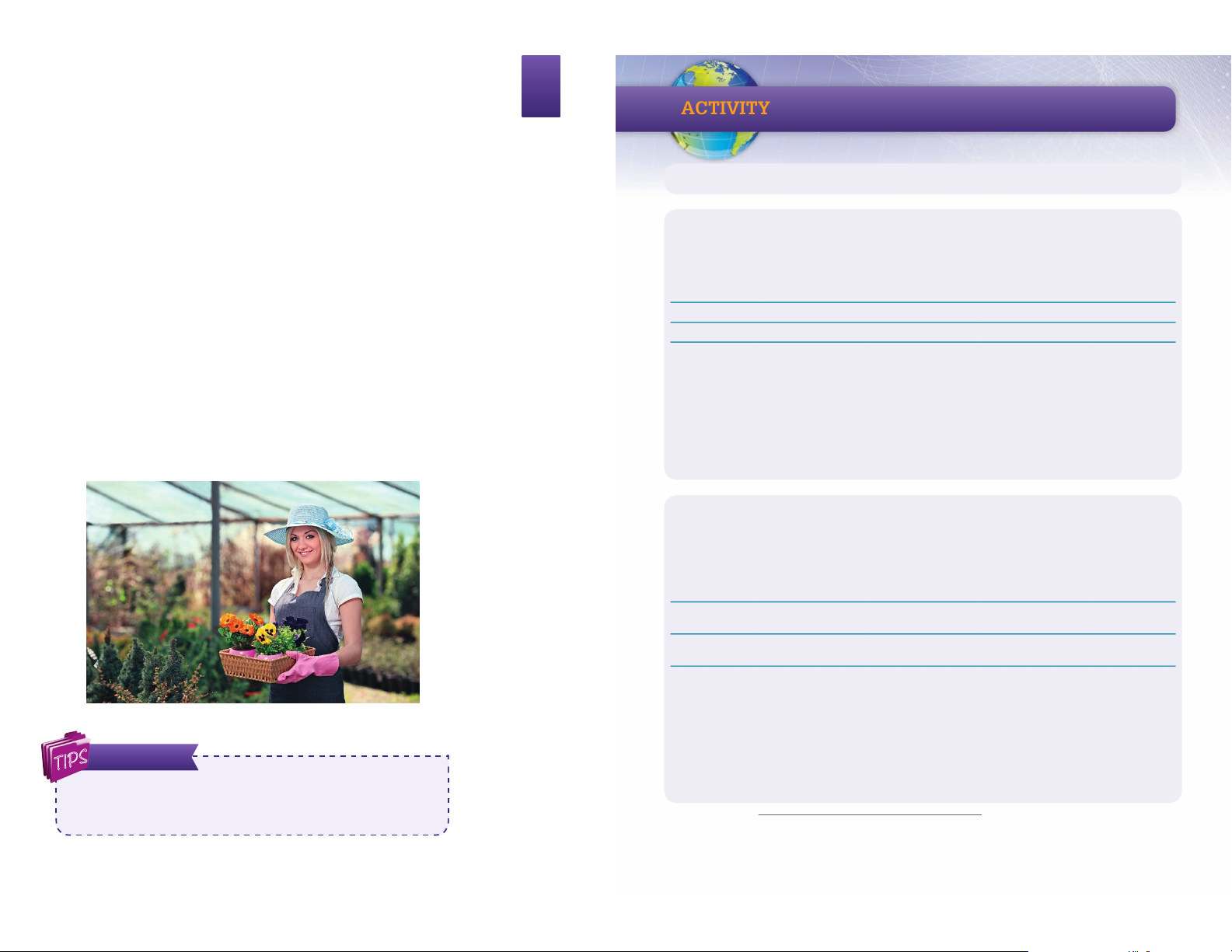
▲ The more you learn about yourself, the better able you’ll be to choose
player and might abandon the field altogether. Yet he might be able to pursue a career
work that you enjoy and that complements your personality type.
related to his interests, perhaps as an athletic trainer for a team, a facility manager at earson Education, Inc.
a ballpark, or a park recreation leader. These careers might be more aligned with his y P
The following activity is not intended to give you an exact description of your personal-
personality and interests than that of a ballplayer or a completely unrelated position.
ity or to indicate that a certain personality fits exactly within a certain career. In fact, there is
This chapter will help you explore some aspects of your own personality and
debate about the extent to which personality relates to career choice or satisfaction. Instead,
interests. You will learn how to interpret this knowledge and apply it to your career
this discussion and the accompanying exercise are intended to make you aware of some char-
decisions. Perhaps you will identify a career path that you hadn’t considered before,
acteristics of your personality and give you some insight into what types of interactions and
based on who you are and what you really like to do. Or perhaps you’ll confirm what
activities might be more comfortable and satisfying for you than others. The unexamined yright © 2016, 2013, 2010 b
you already knew about yourself and this confirmation will further your resolve to fol-
The information you gain about your personality can help you make practical decisions Cop life is not worth
low your unique path. This chapter will provide tools to help you look at yourself and
about the types of classes to take and the career you pursue. Career success is based on a living.
answer the questions: “Who am I?” and “What types of careers are compatible with my
knowledge of self. The more you know, understand, and accept your unique self, the better
able you will be to make appropriate life and career choices. Learning about personality will personality and interests?” —Socrates
also make you better able to understand and accept differences in others.
Identify your personal preferences from the four parts in the following activity.
1MBTI, Myers-Briggs, and Myers-Briggs Type Indicator are trademarks or registered trademarks of the MBTI Trust Inc. in the
United States and other countries. 51
ACTIVITY identifying Your Personal Preferences 54
Chapter 4 Assessing Your Personality and Interests
PART 2. In describing the ways in which you take in information, review the descriptions and circle the pattern that resembles you
more closely, S or N.
The work of Jung, Myers, and Briggs provides us with a four-part framework in which to examine our inborn
tendencies; thus, this exercise consists of four parts. In each part, you will determine which of two charac- S Sensing n intuition
teristics or preferences better describes you. Briefly, in Parts 1 through 4 you will select items that indicate
personality tendencies toward (1) extraversion or introversion, (2) sensing or intuition, (3) thinking or feeling,
Pays most attention to experience as it is
Pays most attention to the meanings of facts and how
and (4) judging or perceiving. All of these characteristics are explained below. they fit together
INSTRUCTIONS: Read the following pairs of descriptions and check the item in each pair that is like
Likes to use eyes, ears, and other senses to find out
Likes to use imagination to come up with new ways to
you most of the time. (All of us have aspects of all of these qualities to some degree.)2 To help you decide, things do things, new possibilities
think of your most natural self, your behavior if no one were looking.
Dislikes new problems unless there are standard ways
Likes solving new problems, and dislikes doing the to solve them same thing over and over
PART 1. In describing your flow of energy, review the descriptions and circle the pattern that resembles you more closely, E or I.
Enjoys using skills already learned more than learning
Likes using new skills more than practicing old ones new ones
e extraversion, which means outward turning
i introversion, which means inward turning
Is patient with details but impatient when the situation
Is impatient with details but doesn’t mind complicated gets complicated situations Likes action and variety
Likes quiet and time to consider things
Likes to do mental work by talking to people
Likes to do mental work privately before talking
S and N represent two kinds of perception—that is, two ways of finding out or giving attention to experiences. Everyone uses both
Acts quickly, sometimes without much reflection
May be slow to try something without understand-
sensing and intuition, but we are likely to use one more than the other. S pays most attention to the facts that come from personal experi- ing it first
ence. S can more easily see the details, whereas N can more easily see the big picture. N pays most attention to meanings behind the facts.
Likes to see how other people do a job, and
Likes to understand the idea of a job and to work to see results
alone or with just a few people SAmPlE SENSINg TYPE SAmPlE INTUITIvE TYPE
Wants to know what other people expect of him or her
Wants to set his or her own standards
Georgette has a good memory for numbers and has been a book-
Santos is a freelance writer and teaches scriptwriting at a community
keeper at a car dealership for several years. One day, she commented to college. He uses his creative and real-life experiences to assist others
her boss that spoilers and dash covers were selling well. Upon review-
in creating scripts for independent producers. He often gets ideas
ing the sales figures, the boss confirmed Georgette’s observations and while daydreaming or exercising at the gym. Santos keeps a journal
E’s interest turns mostly outward to the world of action, people, and things. I’s interest turns more often to the inner world of
promoted her to work with inventory management. The boss found it on his iPad and in his car to capture his thoughts, and he teaches
ideas and personal concerns. Of course, everyone turns outward to act and inward to reflect. You too must do both, but you are more
helpful that Georgette enjoyed keeping track of materials.
others how to keep track of their ideas for writing assignments.
comfortable doing one or the other and rely on one more often than the other, just as right-handers are more comfortable using their right hands.
PART 3. In describing your ways of making decisions, review the descriptions and circle the pattern that resembles you more closely, T or F. t thinking judgment F Feeling judgment
SAmPlE ExTRAvERSION TYPE
SAmPlE INTROvERSION TYPE
Likes to decide things logically
Likes to decide things with personal feelings and human
Jesse is a computer consultant. He thrives on attending meetings at Jennifer is a computer consultant. She works in computer systems
values, even if they aren’t logical
which several people at a company explain their computer needs, design. She meets individually with a company’s computer net-
Wants to be treated with justice and fair play
Likes praise, and likes to please people, even in unimpor-
and he loves providing training for clients on their upgraded sys-
working specialist, who provides her with a list of company needs; tant things
tems. His hobbies include attending conferences and serving as a then she manipulates the company’s system until it is operating as
May neglect and hurt other people’s feelings without
Is aware of other people’s feelings
Boy Scout leader for his son’s troop, which he has also taken on requested. She lets others train the staff. Jennifer gets her energy knowing it earson Education, Inc.
weekend outings. Jesse gets energy from being around groups of from working intensively with a technical system. She also gets y P
Gives more attention to ideas or things than to
Can predict how others will feel people.
recharged by spending time alone. Her hobbies include reading human relationships
and exploring new ways of learning through the Internet and other distance-learning programs. Doesn’t need harmony
Gets upset by arguments and conflicts; values harmony
T makes decisions by examining data, staying less personally involved with the decision. F makes decisions by paying attention to per- yright © 2016, 2013, 2010 b
sonal values and feelings. Each of us uses both T and F judgments every day, but we tend to use one kind of judgment more than the other. Cop SAmPlE ThINkINg TYPE SAmPlE FEElINg TYPE
Malcolm is a student trying to decide if he wants to major in busi-
Shareen has always wanted to be a model but was influenced by
ness. He is basing his decision on the facts that he has collected: her husband and adult children to get a college degree. She stays in
2The checklists in this exercise are adapted from People Types and Tiger Stripes: A Practical Guide to Learning Styles, 4th edition, 2009, by Dr. Gordon Lawrence, Center
He has talked to a college counselor, researched his interests in the shape and is taking modeling classes in the community while also
for Applications of Psychological Type, Gainesville, FL. This exercise is not a type indicator, nor does it replicate the Myers-Briggs Type Indicator® instrument, which is
career center, taken classes related to business, and visited work-
attending college full time. After meeting with a college counselor,
a validated instrument. MBTI, Myers-Briggs, and Myers-Briggs Type Indicator are trademarks or registered trademarks of the MBTI Trust, Inc. in the United States and
other countries. Parts of this exercise are also based on an exercise in Building Self-Esteem: Strategies for Success in School and Beyond, 3rd edition, 2001, by Bonnie
places that hire people with such majors. He has even investigated she’s decided that majoring in fashion merchandising will allow
Golden and Kay Lesh (Upper Saddle River, NJ: Prentice Hall).
graduate degrees related to the types of business specialties that her to study something related to her ideal job as well as please
employers have suggested they need. her family. 53
Chapter 4 Assessing Your Personality and Interests 55 56
Chapter 4 Assessing Your Personality and Interests
PART 4. In describing your day-to-day lifestyle, review the descriptions and circle the pattern that resembles you more closely, J or P.
career choices. To understand your preferences further, arrange to take the Myers-Briggs Type
Indicator instrument (MBTI) at your college counseling or career center. J Judgment P Perception
Now that you have selected the four letters representing your first impressions of your per-
sonality preference, review the characteristics related to your four letters in Exhibit 4.1, answer
_____ Likes to have a plan, to have things settled and
_____ Likes to stay flexible and avoid fixed plans
the questions in the “Facts and Figures” module, and confirm if the general descriptions in decided in advance
the Success Strategies relate to your personality preferences. Determine if these descriptions
_____ Tries to make things come out the way they
_____ Deals easily with unplanned and unexpected happenings
of your four letters fit how you see yourself. Be sure to answer the questions at the end of the “ought to be”
“Facts and Figures.”
_____ Likes to finish one project before starting another
_____ Likes to start many projects but may have trouble finish- ing them
_____ Usually has mind made up about situations, people
_____ Usually looks for additional information about situations, people
ExhIBIT 4.1 Personality typology
_____ May decide things too quickly
_____ May decide things too slowly
_____ Wants to be right in forming opinions, making
_____ Wants to miss nothing before forming opinions, making Expressive Reserved decisions decisions Active Interactions Reflective Outgoing Extravert Introvert Intimate
_____ Lives by standards and schedules that are not easily
_____ Lives by making changes to deal with problems as they Enthusiastic and Energy Quiet changed come along Passionate Peaceful
J people show to others their thinking or feeling judgment more easily than they show their sensing and intuitive perception. The Concrete Abstract
opposite is true of P people; they show their sensing or intuition rather than judgment in dealing with the world outside themselves. Practical Imaginative Traditional Sensing Information Intuitive Conceptual
People who tend to prefer “judgment” usually like deadlines and to get closure, whereas people who prefer “perception” usually like flex- Specific General ibility with deadlines. Systematic Hasty SAmPlE JUdgINg TYPE SAmPlE PERCEIvINg TYPE Logical Accepting
Chan is a film editor. His appointment calendar is programmed with Sarla is also a film editor. Some colleagues think that Sarla is scat- Reasonable Open-Minded
alarm beeps to remind him about important dates. All of his clients tered. She works on several projects at the same time. Even though Tough Thinking Decisions Feeling Tender
know that when he makes a deadline to finish a project, the project her office is a mess, she seems to be able to find the DVDs, tel- Critical Respectful Introspective Nurturing
will be delivered on time. He lets nothing interrupt his plans. Rush ephone numbers, and accessories she needs. She often takes on
jobs, given to his department by higher-level management, drive new assignments before she is finished with old ones because she Planner Casual
him crazy; he doesn’t want to start a new project before he finishes doesn’t want to miss out. She gets irritated when her supervisor Scheduler Spontaneous his current obligations.
reminds her that a project should have been completed yesterday Methodical Judging Lifestyle Perceiving Active/Doer
and tends to get projects done just in time. Formal/Rigid Adaptable Theoretical Playful ExErcisE
Source: Sherfield, Robert M.; Moody, Patricia G., Cornerstone: Creating Success through Positive Change, 6th Edition, © 2011, p. 176. Reprinted by permission of Pearson 4.1
Education, Inc., Upper Saddle River, NJ. Your Personality type
Reviewing each of the four areas, which do you resemble most closely in each pair? (Choose one from each pair and write it in the earson Education, Inc. y P boxes below.)
FAcTs & decisive Types E or I T or F FigureS
The first and last letters of your personality type often indicate
types to have undecided majors, and the IPs were the most S or N J or P
your preferred style of exploring majors. A study of college stu-
likely to be attracted to special advising programs. yright © 2016, 2013, 2010 b
dents (Hammer, 1996) has shown that developing a sense of What dO Cop
purpose is associated with EJ preferences. Also, when career
you think? Your 4-letter preferences are:
counselors ranked students on how well they made appropriate
1. Which type best describes you? (If not listed under
educational plans, the following order of preferences emerged:
“Decisive Types,” see types under the upcoming “Success
EJ, EP, IJ, and IP.
Strategies” and choose from that list.)
Hammer’s study showed that EJ types are the most deci-
2. In what ways does your type fit your personality?
You now have a four-letter personality preference based primarily on the work of Jung
sive about their majors and careers, whereas IPs are the least
3. If you could change your type, which of the types listed
and of Myers and Briggs. This preliminary self-assessment offers one way to appreciate and
decisive. In two other studies, the ISTPs were the most likely would you choose and why?
value your natural individuality. Although we all represent combinations of each characteristic
described, we have natural preferences, revealed in our type, that have implications for our
Chapter 4 Assessing Your Personality and Interests 57 58
Chapter 4 Assessing Your Personality and Interests
Your career choices may be based in part on your temperament or personality preferences.
If you enjoy detail and structure, fields such as accounting, engineering, math, sciences, reaL stories Meet Holly
law, and health sciences might interest you. If you prefer unstructured, global thinking, then
majors and fields such as the creative arts and social sciences may better suit your tempera-
“I’ve taken several inventories now and have gotten the results!
and human resource management. I also was reminded that
ment. It is essential to note, however, that all types are found in all fields. To truly do well, you
My results for the Myers-Briggs were ENFP, which means that
dietitian and athletic trainer fit my personality. It is important
must stretch yourself in areas that do not come as naturally to you. This stretching takes extra
I am extraverted, intuitive, feeling, and perceptive. On the to me that my career will allow me to work with a cooperative,
effort above and beyond the demands of the occupation. Keep this in mind as you experience
Interest Inventory, my results were mainly high in Social and supportive group of people who are committed to helping, nur-
yourself responding to various work settings and demands.
Enterprising areas, with a medium interest in Investigative and turing, and caring for others.
Be aware that choosing a major or making a career choice that does not mesh with your Conventional-type activities.
The results of these inventories really fit me because I have
personality preferences typically takes more energy and concentration than one that more
The MBTI results suggest that I like to use my creativity to
always been a helper-type person and an organizer. At this
closely matches your preferences. The purpose of understanding personality type in relation
help others reach goals and realize their dreams. I like to solve
point, with the help of these assessments, I am leaning toward
to your classes and major is not to discourage you from pursuing a specific career, but to help
problems using a person-oriented approach, and I make deci-
being a teacher or a counselor.”
you become more aware of why you might master certain subjects more easily than others,
sions by relying on my values and the values of others. I prefer
be attracted to certain careers over others, and use your strengths in any work or life situation.
to solve problems as part of a team rather than deciding alone.
You should now be more aware of who you are and how you would like to work and learn.
What dO you think?
Because I am social, I will benefit from working with people, espe-
cially people who are friendly and who like to socialize outside of
1. What are your Myers-Briggs and Interest Inventory results?
work too. Because I am intuitive and perceptive, I like to be able
Are your results as true about you as Holly’s were for her?
to connect my daily routine to a bigger picture. I need to know
2. Which descriptors from these results, as well as those SucceSS
why I am doing my work, and I am able to help others see the
listed in the “Success Strategies” box, are true for you? Exploring Majors strategies
bigger picture too. Because I am social, enterprising, and global,
3. Which of the occupations suggested by your results
I enjoy leading others while helping them see the bigger picture. might you consider?
The inventories indicate that I would enjoy teaching,
4. What other information do you need to consider before
The descriptions here may help you become more aware of your preferred style or suggest alternative strategies. Remember that
counseling, social work, managing community organizations,
making an informed decision about your career?
the first and last letters of your personality type often indicate your preferred style of exploring majors.
eJ types (eStJ, eSFJ, enFJ, entJ)
iJ types (iStJ, inFJ, iSFJ, intJ)
“I want to decide and get on with my life.”
“I want to be sure about my selection.”
identifying Fields of interest
EJ students often put choosing a major on their to-do list soon
The IJ types probably spend a lot of time researching and
after reaching college. It is not uncommon for them to seek reflecting before reaching a final decision. They often consult
Just as your previous investigation of your personal assets, mind-set, values, and personality
career counseling early, hoping to declare a major before the
books and other resources on majors and careers. Because
have revealed powerful components of your career fitness profile, so too will a closer look at
first semester ends. Early decision making can have its draw-
they tend to stick with a decision once it’s made, the infor-
your interests. Your interests are evident by what you enjoy doing, exploring, thinking about,
backs, however. For example, an EJ student may decide at an
mation they collect must be carefully considered. Because and learning.
early age to be a doctor, lawyer, or engineer but then discover
their thinking is done alone, however, they may surprise
he or she lacks the necessary ability or the continuing interest.
people when they announce their plans. Accountants, com- ■ ■
Interests show us what we might like to do with our lives and how we might like to work
The student may then become disappointed and want to hurry
puter programmers, and engineers are often found in this
as well as where we might like to work.
up and choose another major because “I don’t want to waste category. ■ ■
What do you like to do? Some popular interests include liking to read, write, blog, play
any more time.” Ironically, what such students often need to do
computer games, play sports, listen to and/or play music, dance, draw, garden, cook, and
is slow down and collect more information. Managers, school
iP types (iStP, iSFP, inFP, intP) exercise. The list is endless.
administrators, and organizers are found in this category.
“I wonder what I’ll be when I grow up.” ■ ■
To help you become clearer about your most important interests, the next section will earson Education, Inc.
teach you how interests are grouped into job categories, clusters, or pathways. By com- y P
eP types (eStP, eSFP, enFP, entP)
IP students often want to delay a decision about a major until
pleting the exercises in this section, you can begin to select specific fields of interest to
they can consider all options, which they do at their own pace.
“I want to experience it before deciding.”
investigate as you move closer to creating your optimal career fitness profile.
Although they may resist deadlines imposed by others, they
For EP types, deciding tends to be an ongoing process. They
sometimes need the outside influences to help them make
We highlight two different approaches to identify interests. The first is the Holland Inter-
often decide by trial and error. They typically want, and try, to
a decision. When they can tell themselves that no decision is
est Environments (or categories) (Holland, 1985), which are Realistic, Investigative, Artistic,
do it all—every course, major, or extracurricular activity that
ever final, they can move ahead. Even in midlife, they often
Social, Enterprising, and Conventional. The second system, career clusters, is provided by the yright © 2016, 2013, 2010 b
appeals to them. Changing their mind helps to reassure them
say they don’t know for sure what they want to be when they
American College Testing (ACT) Program. The ACT clusters, as well as the tech-prep and Cop
they still have options open, but they often don’t know how to
grow up. Their style of decision making often reflects a strug-
school-to-career clusters listed later in this chapter, are used in secondary-school and college
choose among the options. Their style, however, can be very
gle between the vast amount of information they are exploring career centers.
difficult for their parents to understand, especially parents who
from the outer world (which can be overwhelming) and their
Although you may have access to career inventories, remember that the information
have a Judging style. EP types can become better decision mak-
need to be true to their inner world. The world’s artists and
gathered by printed or online assessments is not magic. Assessments simply provide a quick,
ers by accepting that the decision is part of a journey, not the
creative types are often found in this category. A career path
efficient way of gathering and organizing the information that you know about yourself—the
final destination. Psychologists, counselors, authors, and help-
for them is a never-ending quest for more knowledge, facts,
answers come from you. In the absence of an inventory, you are still able to collect the same
ing types are often found in this category. or inspiration.
information by completing the exercises, activities, and online inventories accessible via the
links provided throughout this book.
Chapter 4 Assessing Your Personality and Interests 59
ACTIVITY riaSec (holland interest environments)3
hOllANd INTEREST ENvIRONmENTS
Interest clusters, known as personality types or environments, are based on the following assumptions:
INSTRUCTIONS Using the descriptions in each section, select the category that best describes you. ■ ■
People express their personalities through their vocational choices. ■ ■
People are attracted to occupations that they feel will provide experiences suitable to their personalities. ■ ■
People who choose the same vocation have similar personalities and react to many situ- dOERS
(Realistic—R) Doers like jobs such as automobile mechanic, air traffic controller, surveyor, farmer, and electri- ations in similar ways.
cian. They like to work outdoors and to work with tools. They prefer to deal with things rather than with people.
We have listed the categories in the next section for your review and for you to use to They are described as:
assess yourself informally. Each of the six Holland categories (Realistic, Investigative, Artistic, conforming humble natural shy
Social, Enterprising, and Conventional) is described by the following characteristics: frank materialistic persistent stable honest modest practical thrifty 1. Adjectives 2. Hobbies hobbies Building things Growing Repairing Using hands 3. Abilities and interests 4. Sample careers Abilities/Interests Operating tools Planting Playing sports Repairing 5. Sample majors Sample Careers Air conditioning Automotive Electrical engineer (RIE) Police officer (SER)
Most interest inventories relate your interests to the six Holland categories and provide a mechanic (RIE) mechanic (RIE) Fiber-optics Radio/TV repair (REI)
list of jobs connected to these interests. If you are in a class that uses the Self-Directed Search Anthropologist (IRE) Baker/chef (RSE) technician (RSE) Software technician
or the Strong Interest Inventory, your instructor will explain which jobs are related to these Archaeologist (IRE) Biochemist (IRS) Floral designer (RAE) (RCI)
six environments. If you don’t have access to separate inventories, several online assessments Architectural Carpenter (RCI) Forester (RIS) Truck driver (RSE)
can be found by doing an Internet search for “cacareerzone” or “nycareerzone” (go to Assess drafter (RCI) Commercial airline Industrial arts Ultrasound
Yourself, then go to Quick Assessments). These inventories should give you a general idea of Athletic pilot (RIE) teacher (IER) technologist (RSI)
how your interests and values relate to potential jobs. Be sure to summarize the results of your trainer (SRE) Construction Optician (REI) Veterinarian (IRS)
inventories in Exercise 4.2 and to share your results with several of your classmates. Automotive worker (REC) Petroleum engineer (RIE) Dental assistant (RES) engineer (RIE) ThINkERS
(Investigative—I) These types like jobs such as biologist, chemist, physicist, anthropologist, geologist, and
medical technologist. They are task oriented and prefer to work alone. They enjoy solving abstract problems
and understanding the physical world. They are described as: analytical curious introverted precise cautious independent methodical rational critical intellectual modest reserved hobbies Collecting rocks Doing puzzles Participating in book Visiting museums Collecting stamps clubs Abilities/Interests
Doing complex calculations Interpreting formulas Solving math problems Using a microscope or earson Education, Inc. y P scientific instrument Sample Careers Actuary (ISE) Chemical Hazardous waste Petroleum Anesthesiologist (IRS) technician (IRE) technician engineer (RIE) Anthropologist (IRE) Commercial airline Industrial arts Physician (ISE) ■
▲ Lifelong interests can become future careers. Archaeologist (IRE) pilot (RIE) teacher (IER) Psychologist (IES) Automotive Computer analyst (IER) Landscape Statistician (IRE) yright © 2016, 2013, 2010 b engineer (RIE) Dentist (ISR) architect (AIR) Technical writer (IRS) Cop FROm ThE PROS Baker/chef (RSE) Ecologist (IRE) Librarian (SAI) Ultrasound Tips Biochemist (IRS) Electrical engineer (RIE) Medical technologist (RSI) Biologist (ISR) Geologist (IRE) technologist (ISA) Veterinarian (IRS)
Once you have identified your interests, you will notice how much more enthusiastic and alive you Chemical engineer (IRE) Nurse practitioner (ISA) Writer (ASI)
feel when you are involved in activities involving your interests. Ideally, your work will relate to your
interests. If that is not currently the case, get involved in something that interests you for at least four
hours per week—for example, if you love helping kids, tutor a child or volunteer at a childcare center.
3 To explore Holland’s ideas more fully, ask your instructor or counselor for the Self-Directed Search, available from Psychological
Assessment Resources, Inc., P.O. Box 990, Odessa, FL 33556. 60
Chapter 4 Assessing Your Personality and Interests 61 62
Chapter 4 Assessing Your Personality and Interests CREATORS
(Artistic—A) These types like jobs such as composer, musician, stage director, writer, interior designer, and actor/
PERSUAdERS (continued)
actress. They like to work in artistic settings that offer opportunities for self-expression. They are described as: hobbies Campaigning Leading organizations Promoting ideas Starting own service complicated idealistic impulsive nonconforming or business emotional imaginative independent original Abilities/Interests Initiating projects Organizing activities Persuading people Selling things or expressive impractical intuitive unordered Leading a group promoting ideas hobbies Drawing/photography Playing music Visiting museums Writing stories, poems Sample Careers Advertising Claims adjuster (ESR) Hotel manager (ESR) Politician (ESA) Performing Sewing/designing executive (ESA) Credit manager (ERS) Industrial engineer (EIR) Public relations Abilities/Interests Designing fashions or Playing a musical Singing, dancing, Writing stories, poems, Automobile sales Financial planner (ESR) Insurance agent (ECS) representative (EAS) interiors instrument acting music; being worker (ESR) Flight attendant (ESA) Journalist (EAS) Real estate agent (ESR) creative, unique Banker/financial Food service Lawyer (ESA) Social Media planner (ESR) manager (ESI) Office manager (ESR) Strategist (ESI) Sample Careers Actor (AES) Dancer (AES) Floral designer (RAE) Librarian (SAI) Buyer (ESA) Funeral director (ESR) Stockbroker (ESI) Advertising (AES) Drama/music/art Furniture designer Medical illustrator Urban planner (ESI) Artist (AES) teacher (ASE) (AES) (AIE) Broadcasting Economist (IAS) Graphic designer (AES) Museum curator (AES) executive (EAS) English teacher (ASE) Interior designer (AES) Nurse practitioner Clothing designer Fashion designer (ASR) Journalist (ASE) (ISA) ORgANIZERS
(Conventional—C) These types like jobs such as bookkeeper, computer technician, banker, cost estimator, (ASR) Fashion illustrator Landscape Writer (ASI)
and tax expert. They prefer highly ordered activities, both verbal and numerical, that characterize office work. Copywriter (ASI) (ASR) architect (AIR)
They have little interest in artistic or physical skills. They are described as: careful conservative orderly reserved conforming efficient persistent self-controlled conscientious obedient practical structured hElPERS
(Social—S) These types like jobs such as teacher, clergy, counselor, nurse, personnel director, and speech hobbies Arranging and organizing Collecting memorabilia
Playing computer or card Studying tax laws
therapist. They are sociable, responsible, and concerned with the welfare of others. They have little interest in household games Writing family history
machinery or physical skills. They are described as: Abilities/Interests Keeping accurate records Organizing Using a computer Working within a system convincing generous insightful sociable Writing cooperative helpful kind tactful friendly idealistic responsible understanding Sample Careers Accountant (CSE) Claims adjuster (SEC) Elementary school Librarian (CSE) Administrative Clerk (CSE) teacher (SEC) Medical records hobbies Caring for children Participating in religious Playing team sports Volunteering assistant (ESC) Computer operator (CSR) Financial analyst (CSI) technician (CSE) activities Bank teller (CSE) Congressional-district Insurance Paralegal (SCE) Abilities/Interests Expressing oneself
Leading a group discussion Mediating disputes Teaching/training Budget analyst (CER) aide (CES) underwriter (CSE) Tax consultant (CSE) others Building inspector (CSE) Court reporter (CSE) Internal auditor (ICR) Travel agent (ECS) Business teacher (CSE) Customer inspector (CEI) Legal secretary (CSA) Sample Careers Air traffic controller (SER) Dental hygienist (SAI) Nurse (SIR) Real estate Athletic coach (SRE) Historian (SEI) Occupational appraiser (SCE) Chaplain (SAI) Homemaker (S) therapist (SRE) Schoolteacher (SEC)
Sample majors Related to holland Types earson Education, Inc. College faculty (SEI) Hospital Paralegal (SCE) Social worker (SEA)
Now that you are familiar with Holland Interest Environments, this chart will help you review some sample majors that may be of interest y P Consumer affairs administrator (SER) Police officer (SER) Speech
to you. INSTRUCTIONS: Underline or circle those areas that seem to fit you. Note that this is just a sample list of available majors. director (SER) Mail carrier (SRC) Radiological pathologist (SAI) Cosmetologist (SAE) Medical records technologist (SRI) Youth services REAlISTIC Counselor (SAE) administrator (SIE) worker (SEC) Air conditioning and heating Construction technology Engineering technology Industrial engineering Architectural/mechanical Criminal justice Fire technology Mechanical engineering yright © 2016, 2013, 2010 b Auto technology Dietitian Forestry Medical technology Cop Civil engineering Drafting technology PERSUAdERS
(Enterprising—E) These types like jobs such as salesperson, manager, business executive, television pro-
ducer, sports promoter, and buyer. They enjoy leading, speaking, and selling. They are impatient with precise INvESTIgATIvE work. They are described as: Biological science Economics Earth sciences Mathematics Biology Electrical engineering Environmental sciences Materials science adventurous domineering optimistic risk-taking Chemical engineering Electrical engineering Geography Paralegal ambitious energetic pleasure-seeking self-confident Chemistry technology Geology Physics attention-getting impulsive popular sociable Computer sciences Electronics Law Psychology (continued) Dental hygiene
Chapter 4 Assessing Your Personality and Interests 63 64
Chapter 4 Assessing Your Personality and Interests ARTISTIC CAREER ClUSTERS Advertising art Computer animation English Music
Career centers often organize their materials by the following career clusters (U.S. Office of Art Computer graphics Graphic technology Studio art
Career Education “Career Pathways” used in tech-prep or school to career programs): Art history Design drafting Instructional media Theater Commercial art Design technology Multimedia technology
Agriculture and Natural Resources SOCIAl Architecture and Construction American studies Elementary and secondary Home economics Pre-law
Arts, Communication, and Media Anthropology education Medical assistant Religious studies Technology Child care English Nursing Sociology Business and Administration Classical studies Foreign languages Nutrition Special education Education and Training Communications Health Physical education Speech Finance and Insurance Dental hygiene History Political science
Government and Public Administration
Health Science and Medical Technology ENTERPRISINg
Hospitality, Tourism, and Recreation Advertising technology Finance Industrial management and Marketing technology Business administration Industrial and transportation retail marketing Public administration Human Service Business education management Law enforcement administration Real estate Information Technology Business management Management engineering
Law, Public Safety, Corrections, and Security CONvENTIONAl
Manufacturing and Product Design Accounting Computer technology Legal/medical office Transportation management Marketing and Sales Administrative assistant Court reporting management technology
Science Technology, Engineering, and Computer information systems Executive technology Library science Office administration Math
Transportation, Distribution, and Logistics
The American College Testing Program (ACT) has also devised a useful system of organ-
izing jobs into career clusters (see Exhibit 4.2). If you are attending school and trying to
choose a major or have chosen a major, you might research the cluster in which your major
falls or your interests are located. Otherwise, explore the area that seems to relate to your ExErcisE
interests, values, and skills. The definitions of each cluster found in Exhibit 4.2 and also at the
4.2 Your holland interest environment
ACT website (http://www.act.org/wwm/overview.html) will help you answer the questions
found in Exercise 4.3 related to identifying career interest areas.
Share your results with two or three classmates; explain how your first impressions are similar or different from results from inven-
Understanding your interests will be a great aid to you in making satisfying educational tories you have taken:
and career choices. Exhibit 4.3 arranges career clusters into 12 “regions” based on primary
work tasks that are found in jobs: dealing with data, people, ideas, and things. Please note that
1. Check your top three Holland Environments (pp. 60–62):
3. List three interesting jobs or careers from your top cat-
this figure also uses the letters RIASEC (Realistic, Investigative, Artistic, Social, Enterprising, ■ ❏■ Realistic egories (pp. 60–62):
and Conventional) to show the relationship of each region to Holland’s Interest Environ- earson Education, Inc. y P ■■ ❏■ Artistic
________________________________________________
ments, discussed earlier in this chapter. ■■ ❏■ Enterprising
________________________________________________ ■■ ❏■ Investigative
________________________________________________ ■■ ❏■ Social
________________________________________________ ■■ ❏■ Conventional
________________________________________________ yright © 2016, 2013, 2010 b
2. What adjectives from these environments best describe
4. List three interesting majors from your top three catego- Cop you (pp. 60–62)? ries (pp. 62–63):
________________________________________________
________________________________________________
________________________________________________
________________________________________________
________________________________________________
________________________________________________
________________________________________________
________________________________________________
________________________________________________
________________________________________________ ■
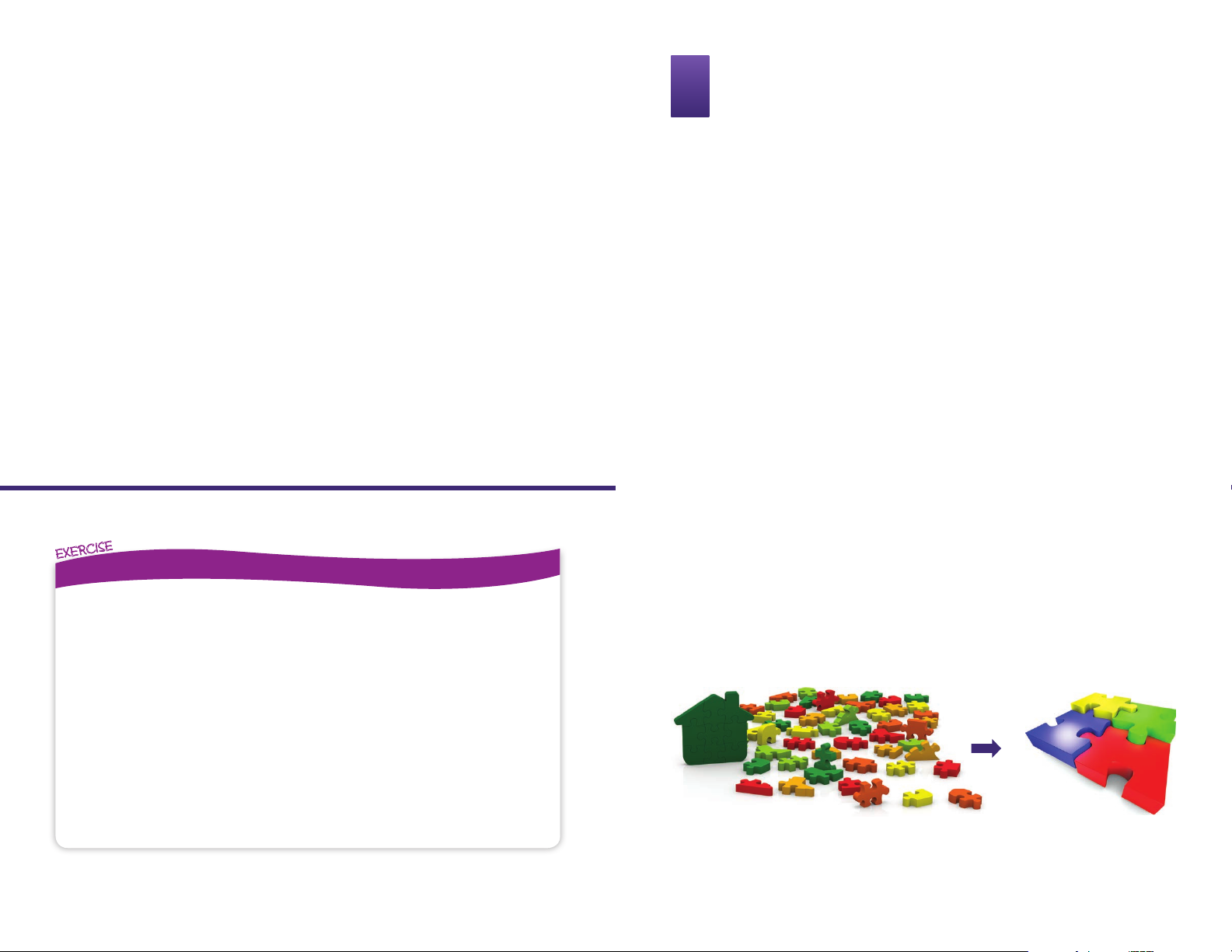
▲ Once you assess yourself, you need to explore which careers are the best fit or create a career to fit all the pieces together. 66
Chapter 4 Assessing Your Personality and Interests
ExhIBIT 4.2 act career clusters and career areas (a–Z), illustrating
how Jobs can Be clustered into related categories
AdmINISTRATION ANd SAlES CAREER ClUSTER
ExhIBIT 4.3 the World-of-Work map
A. Employment-Related Services Managers (human resources, training/education, employee benefits, etc.); recruiter; interviewer; job analyst.
B. marketing & Sales Agents (insurance, real estate, travel, etc.); buyer; sales/manufacturers’ representatives; retail sales- worker; telemarketer.
C. management Executive; executive secretary; purchaser; general managers (financial, office, property, etc.); specialty Bus
managers (retail store, hotel/motel, food service, etc.). For other managers, see specialty—e.g., social service (Career Area Y). iness Op
d. Regulation & Protection Inspectors (customs, food/drug, etc.); police officer; detective; park ranger; security manager; er 3 4 ati guard. on E C F. Financial s
BUSINESS OPERATIONS CAREER ClUSTER Transactions Administration and Sales
E. Communications & Records Receptionist; secretary (including legal and medical); court reporter; clerks (order, billing, 2 5 C. Management hotel, etc.). E. Communi- B. Marketing & Sales D. Regulation G. Distribution cations &
F. Financial Transactions Accountant/auditor; cashier; bank teller; budget/credit analyst; tax preparer; ticket agent. & Protection & Dispatching Records
g. distribution & dispatching Shipping/receiving clerk; warehouse supervisor; mail carrier; dispatchers (flight, cab, etc.); air A. Employment- Related Services traffic controller. 1 6 H. Transport
TEChNICAl CAREER ClUSTER DATA Operations Z. Personal I. Ag/Forestry & Related T
h. Transport Operation & Related Truck/bus/cab drivers; locomotive engineer; ship captain; aircraft pilot; sailor; chauffeur. Services & Related ec Service h
I. Agriculture, Forestry, & Related Farmer; nursery manager; pest controller; forester; logger; groundskeeper; animal caretaker. l S N J. Computer/Info Specialties OPLE THIG R n a E S K. Construction i P ci
J. Computer & Information Specialties Programmer; systems analyst; information systems manager; computer repairer; Y. Community Services c a & Maintenance N. Mechanical o l & Electrical S desktop publisher; actuary. X. Education IDEAS L. Crafts Specialties & Related
k. Construction & maintenance Carpenter; electrician; brick-layer; tile setter; painter; plumber; roofer; firefighter; custodian. W. Health Care 12 M. Manufacturing 7 O. Engineering
l. Crafts & Related Cabinetmaker; tailor; chef/cook; baker; butcher; jeweler; silversmith; hand crafter. & Processing V. Applied Arts Q. Medical & Technologies (Written & Spoken)
m. manufacturing & Processing Tool & die maker; machinist; welder; bookbinder; photo process worker; dry cleaner. Technologies T. Applied P. Natural Science
N. mechanical & Electrical Specialties Mechanics/technicians (auto, aircraft, heating & air conditioning, electronics, dental U. Creative & Arts (Visual) & Technologies Performing Arts
lab, etc.); repairers (office machine, appliance, electronics). R. Medical 11 8 Diagnosis &
SCIENCE ANd TEChNOlOgY CAREER ClUSTER Treatment Sc A e i
O. Engineering & Technologies Engineers (aerospace, agriculture, nuclear, civil, computer, etc.); technicians (electronics, S. Social Science I nce
mechanical, laser, energy, quality control, etc.); production planner; surveyor; drafter; architect; technical; illustrator. s t & r A 10 9 y g o l o n h c e T
P. Natural Science & Technologies Physicist; astronomer; biologist; statistician; soil conservationist; food technologist; crime lab analyst.
Q. medical Technologies Pharmacist; optician; prosthetist; X-ray technologists (surgical, medical lab, EEG, etc.); dietitian.
R. medical diagnosis & Treatment Physician; psychiatrist; pathologist; dentist; nurse practitioner; optometrist; veterinarian;
physical therapist; audiologist; physician’s assistant.
S. Social Science Sociologist; experimental psychologist; political scientist; economist; criminologist; urban planner. ABOUT THE MAP ARTS CAREER ClUSTER ■ ■ earson Education, Inc.
The World-of-Work Map arranges 26 career areas (groups of similar jobs) into 12 regions. Together, the career areas cover all y P
T. Applied Arts (visual) Artist; graphic artist; photographer; illustrator; floral/fashion/interior designers; merchandise displayer.
U.S. jobs. Most jobs in a career area are located near the point shown. However, some may be in adjacent map regions.
U. Creative & Performing Arts Writer/author; musician; singer; dancer; music composer; movie/TV director; fashion model. ■
■ A career area’s location is based on its primary work tasks. The four primary work tasks are working with
v. Applied Arts (Written & Spoken) Reporter; columnist; editor; ad copywriter; PR specialist; TV announcer; librarian;
Data: Facts, numbers, files, accounts, business procedures. interpreter.
Ideas: Insights, theories, new ways of saying or doing something, for example, with words, equations, or music.
SOCIAl SERvICE CAREER ClUSTER
People: People you help, serve, inform, care for, or sell things to. yright © 2016, 2013, 2010 b
W. health Care Administrator; nurse; occupational therapist; psychiatric technician; dental hygienist/assistant; geriatric aide.
Things: Machines, tools, living things, and materials such as food, wood, or metal. Cop
x. Education Administrator; athletic coach; college/university faculty; teachers & aides (preschool, elementary, & secondary, ■
■ Six general types of work (Holland Interest Environments) are shown around the edge of the map. The overlapping career
special education, PE, etc.). For others, see specialty—e.g., physics teacher (Career Area P).
cluster arrows indicate overlap in the occupational content of adjacent career clusters. ■
■ Because of their People rather than Things orientation, the following two career areas in the Science & Technology cluster
Y. Community Services Social service director; social worker; lawyer; paralegal; counselors in various areas; clergy.
are located toward the left side of the map (Region 10): Medical Diagnosis & Treatment and Social Science.
Z. Personal Services Waiter/waitress; barber; cosmetologist; home health aide; travel guide.
Website: http://www.act.org/wwm
Source: Copyright © 2011 by ACT, Inc. All rights reserved. Reproduced with permission. No further use of these materials is authorized without specific
Source: Copyright © 2011 by ACT, Inc. All rights reserved. Reproduced with permission. No further use of these materials is authorized without specific permission
permission from ACT, Inc. Website: http://www.act.org/wwm/overview.html. from ACT, Inc. 65
Chapter 4 Assessing Your Personality and Interests 67 68
Chapter 4 Assessing Your Personality and Interests
The more you are able to incorporate your interests into your work, the more you will ExErcisE 4.3
enjoy your work. Once you have completed an interest inventory, plan to explore those occu-
identifying career interest areas
pations associated with your interests. Find out what people actually do, and compare these jobs to your interests.
Place three checks in each of the three areas listed in 1, 2, and 3 below that you find most interesting.
To gain a better perspective about how majors are related to careers, go to one of the
List the interest areas you have checked off, as well as the subjects you find most interesting in the space provided.
university websites found by doing a search on the Internet for “what can I do with a major
If you had two hours to research careers, what would you select?
in.” Here is one website to try: http://www.uncwil.edu/stuaff/career/majors/index.htm.
___________________________________________________________________________________________________________
___________________________________________________________________________________________________________ deciding on a major
The letters next to the field refer to the six Holland Types.
Some students seem to have no trouble choosing a major. They select a major that is compatible
1. What Fields Interest You?
with their skills or interests. Many students, however, remain undeclared until they are forced to
choose. Often it is because they are unclear about their talents and preferences. If you are one of ■■ mechanical
Do you like to fix things? Do you use and repair
the undecided, you probably feel pressure and anxiety from peers, parents, and your college. Rather (R) ______________
machines, appliances, equipment? Do you like to make or build things?
than choosing a specific major, start by choosing an area of general interest and just begin to lean ■■ Scientific
Are you curious about ideas and abstract processes?
slightly in that direction to imagine what that would be like. Think about your personal career pro- (I) ______________
Do you like to experiment, research data, and solve problems?
file—your values, personality, interests, and skills—to narrow down the choices of possible majors. ■■ Artistic
Do you like music, dance, art, literature, photography, decorating? (A) ______________
Do you like to express yourself creatively? ■■ Social
Do you like to work with people? Do you help others? FROm ThE PROS Tips (S) ______________
Are you active in social events?
Some of the best decisions are made effortlessly through the process of elimination. Once you ■■ Sales–verbal
Do you like to sell, convince, persuade, influence, lead?
have eliminated all the possible majors that do not fit, you will be left with a smaller number of (E) ______________
Do you like to talk, write, read? potentially good choices.
■■ Computational–Clerical
Do you like to keep things organized? Do you like to keep records, use a computer, (C) ______________
know software? Are you a detail person?
If you are still exploring possible majors, we will suggest an effective way to narrow your
2. Categories According to the Six Holland Types
choices. Historically, majors are simply a convenient way for colleges and universities to ■■ Realistic
Careers include jobs in industrial trades, repair, and
organize their courses of study. They were never primarily intended to help students make
career choices. But most students assume that when they choose a major, they are also select- (R) ______________
outdoors (e.g., firefighter and police officer).
ing a career. In some cases, a major such as engineering leads to a job as an engineer. In ■■ Investigative
Careers include jobs in the fields of science, health
contrast, English or sociology is an area of study that does not necessarily lead to a job as an (I) ______________ science, law, and technology.
English or sociology teacher unless you are willing to continue on for a graduate degree. To
gain a better perspective about how majors are related to careers, go to one of the university ■■ Artistic
Careers include jobs in the fields of art, music,
websites found by doing a search on the Internet for “what can I do with a major in.” Here is (A) ______________
and literature and related fields.
one website to try: http://www.uncwil.edu/stuaff/career/majors/index.htm. ■■ Social
Careers include jobs in the fields of education, earson Education, Inc. (S) ______________
human resources, and social welfare. y P ■■ Enterprising
Careers include jobs in sales, entrepreneurship, law, and FROm ThE PROS (E) ______________ management. Tips ■■ Conventional
Careers include accounting, banking, office, organizing,
A report from the University of California–Irvine stated that “over 75% of students pursuing MBA
degrees at top ranked schools completed undergraduate degrees in areas other than business.” (C) ______________ and clerical jobs. yright © 2016, 2013, 2010 b
3. ACT Career Clusters related to Holland Types Cop ___Technical Realistic
Let’s try to clarify and simplify the process for deciding on a major. We will focus on ___Science and Technology Investigative
three popular clusters of majors to use as examples. As we describe them, think about your- ___Arts Artistic
self and your academic strengths, preferences, and interests, as well as your emerging career ___Social Service Social
choices, and then decide what you can eliminate (see Exhibit 8.4). ___Administration/Sales Enterprising ___Business Operations Conventional
First cluster: liberal arts Some of the most common majors in this grouping are psychol-
ogy, sociology, art, music, communications, English, journalism, history, political science,
and education. What they all have in common is less emphasis on math and sciences and
Chapter 4 Assessing Your Personality and Interests 69 70
Chapter 4 Assessing Your Personality and Interests
of economics, a year of accounting, math including some calculus, statistics, and informa-
ExhIBIT 4.4 Quick guide to choosing a major
tion technology courses. Specific business classes are often not taken until the junior year in
college. In terms of careers, these majors open doors to opportunities in the business world
for accountants, financial analysts, and economists, to list a few. However, a common mis-
conception is that a business degree is required for entry into the business world. In fact, the lIBERAl ARTS BUSINESS/ SCIENCE
vast majority of people in most areas of business do not have a business degree. For instance, (minimal require- ACCOUNTINg/ TEChNOlOgY
someone in marketing, sales, advertising, public relations, or corporate communications ments in science FINANCE/ (maximum require-
probably has a degree in one of the liberal arts majors and perhaps some coursework in busi- and mathematics) ECONOmICS/ ments in science and
ness subjects related to their field. Anthropology mARkETINg mathematics) Archeology Lower division prepara- Anatomy
Third Cluster: Science/Technology Some of the most common majors in this grouping are Art tion classes for these Animal Science
biology, chemistry, physics, geology, environmental science, kinesiology, engineering, archi- Communications majors include: Architecture
tecture, and computer science. What they all have in common is an emphasis on science Criminal Justice 1 year of Economics Astronomy
and math courses, including calculus. In terms of careers, they have the closest one-to-one Dance 1 year of Accounting Biology
correlation to actual jobs. A chemistry or computer science major will qualify for entry-level Education Calculus Botany
positions in these fields. A typical entry-level job might be as a research assistant, a lab techni- English Computer Chemistry
cian, or a technical sales representative. Film Information Chiropractic
Now that you have reviewed these three clusters, which ones can you eliminate, and Foreign Languages Systems Courses Dental Hygiene
why? Which ones seem most compatible with everything you know about yourself from the History Introduction to Engineering
work you have completed in your career fitness profile? As you continue your career fitness Humanities Business Environmental Science
program, you will have more opportunities to do further research and refine your career Interior Design Statistics Geography
choices in moving toward career goals. For example, you may be thinking about becoming Journalism (Most people who Geology
a doctor, lawyer, astronaut, author, webmaster, performer, or entrepreneur. None of these Multimedia work in the Health Sciences
are bachelor’s degree college majors. Some of them require a bachelor’s degree, but it could Music business world Kinesiology
be in any number of areas; others do not require an advanced degree, but you may want to Philosophy do not have a Microbiology
earn a degree for the benefit of the knowledge acquired and as an added credential to make Political Science business major.) Mathematics
you more competitive in the job market. As you continue gathering ideas and completing Psychology Nursing
research on some of your possible career choices, you will discover how a degree fits into Radio/TV Nutrition
your plan of moving toward your career goal. Sociology Physics
Now that you are more aware of your specific interests, consider volunteering to clarify Spanish Physiology
and solidify your interests. Volunteer in an area related to the major selected and you will Get experience Speech Pre-Dent.
narrow down the type of work that energizes you as well as learn more about the field. If to clarify major Theatre Pre-Med
you are attending college, visit the career center to find out about volunteer and internship interests Pre-Pharm
opportunities (some are paid positions too). Some colleges include “cooperative/experien- Pre-Physical Therapy
tial education” or “service learning” assignments linked to course work in a major. You can Pre-Vet
also search the Internet for internship opportunities and find a multitude of possibilities Zoology
to learn about the field you hope to pursue. In the process, you may identify and create
an opportunity by offering your services even when there are no formal positions in place.
Potential employers will be impressed with your initiative. Volunteering will clarify your
research and help you determine if this is an area you want to further explore. Engaging earson Education, Inc.
Choose a major based on your academic strengths and your interests/passion, not because you think it will be “good” for you.
in real work to clarify your interests will assist in your decision making even if you decide y P
that the field is not compatible. You will move toward your optimal career fit efficiently and with focus.
more emphasis on a broad spectrum of courses in the other general education categories.
In terms of careers, they have the furthest direct correlation between bachelor’s degrees and
entry-level job titles. With a bachelor’s degree you will not get a job as a psychologist or a yright © 2016, 2013, 2010 b
sociologist but you will be eligible for a variety of entry-level professional positions in the
ExErcisE your options Cop
business and the not-for-profit sector. You can then decide to pursue your interest in a par-
ticular area in graduate school if you desire to be a professional in the speciality, or you
Successful students have personality traits and interests that are related to a variety of possible
may be able to progress in your career without additional graduate-level degrees through majors in college.
continued job experience. Some examples here would be in politics as a political aide, or as
a para-professional as a teacher’s assistant employee or as a management trainee in a bank. ■ ■
What have you learned about your personality type and your interests that will help you select a major?
Second Cluster: Business/Economics Some of the most common majors in this grouping
are accounting, business management, finance, marketing, and economics. What they all
have in common is a required core of courses in preparation for majors that include a year
Chapter 4 Assessing Your Personality and Interests 71 72
Chapter 4 Assessing Your Personality and Interests Summary ExErcisE
Now that you have completed this chapter, you are aware that your satisfaction in a career 4.7 classified careers
is related to how much you can incorporate your unique personality and interests into your college major and your work.
Locate the Sunday classifieds section from two or three weeks of newspapers in hard copy or on the Internet, e.g. www.
With this information, you are now closer to identifying your career fitness profile!
CareerBuilder.com. These do not need to be recent or local papers. Scan the entire section of the Sunday job classifieds and identify
those jobs that look interesting, regardless of whether you consider yourself qualified. Review the jobs you identified and look for
patterns in the announcements that caught your eye. Write the job titles and industries that interested you in the space provided. PurPOSe OF ExErcisEs
This prepares you to connect your interests with real jobs.
___________________________________________________________________________________________________________
The following exercises will help you summarize information any additional assessments you have taken. In Exercise 4.7
___________________________________________________________________________________________________________
you have learned about interests. You have already learned you will be asked to list interesting jobs found in the classi-
about your Holland Code and how it relates to careers and fied ads; Exercise 4.8 will ask you to make a list of interesting
majors. In Exercise 4.3 you identified career interest areas; courses taken from a college catalog. In Exercise 4.9, you will
this focus will continue in Exercises 4.4 and 4.5 (from put your information together and describe a dream/ideal
Exhibit 4.3). Exercise 4.6 will ask you to record the results of job or set of activities that best reflects who you are. ExErcisE 4.8 college catalogs ExErcisE
Locate the general catalog for the college or university you are currently attending or for a local college, trade or technical school.
4.4 Your career interest areas
The general catalog is the publication that contains the entire listings and descriptions of courses offered at that college. Read the
catalog and course descriptions, marking those classes or topics about which you would like to learn more. Review the classes you
List the interest areas you have checked off in Exercise 4.3.
have marked and notice which subjects seemed most interesting. Write the subject areas here.
___________________________________________________________________________________________________________
___________________________________________________________________________________________________________
___________________________________________________________________________________________________________
___________________________________________________________________________________________________________ ExErcisE ExErcisE 4.5 4.9 dream/ideal Job act career clusters
What kinds of activities or job descriptions would your ideal job reflect, based on what you have learned about your personality
List any additional ACT jobs from the World of Work in Exhibits 4.2 and 4.3 that are most interesting to you. and interests?
1. ______________________________________________________________________________________________________
___________________________________________________________________________________________________________
2. ______________________________________________________________________________________________________
___________________________________________________________________________________________________________ earson Education, Inc. y P
3. ______________________________________________________________________________________________________ ExErcisE
Please go to the Career Fitness Portfolio at the end of the book and complete this yright © 2016, 2013, 2010 b
4.6 interest inventories
chapter summary to document your personal Career Fitness Profile. Or, you may Cop
go to MyStudentSuccessLab and complete the Career Fitness Portfolio (CFP)
Record here the results of any other interest or personality inventories you have taken (e.g., top three career choices). assignment in each module.
___________________________________________________________________________________________________________
Your instructor may choose to assign the Career Fitness Portfolio in class or online
___________________________________________________________________________________________________________ in MyStudentSuccessLab