Chapter 4 Introduction to Probability môn Xác suất thống kê| Trường Đại học Ngoại Thương
Managers often base their decisions on an analysis ofuncertainties such as the following:What are the chances that sales will decrease if we increase prices. Tài liệu giúp bạn tham khảo, ôn tập và đạt kết quả cao. Mời đọc đón xem!
Môn: Xác suất thống kê (FTU) 355 tài liệu
Trường: Trường Đại học Ngoại Thương 1.1 K tài liệu
Tác giả:




















Preview text:
tistics for siness and Economics (13e)
on, Sweeney, Williams, Camm, Cochran 7 Cengage Learning by John Loucks wards University
age Learning. May not be scanned, copied or duplicated, or posted to a publicly accessible website, in whole or in part, except for use as permitted in a license distributed with a certain product or service or
a password-protected website or school-approved learning management system for classroom use.
Statistics for Business and Economic apter 4 roduction to Probability
Random Experiments, Counting Rules, and Assigning Probabilities Events and Their Probability
Some Basic Relationships of Probability Conditional Probability Bayes’ Theorem
age Learning. May not be scanned, copied or duplicated, or posted to a publicly accessible website, in whole or in part, except for use as permitted in a license distributed with a certain product or service or
a password-protected website or school-approved learning management system for classroom use.
Statistics for Business and Economic certainties
Managers often base their decisions on an analysis of uncertainties such as the following:
•What are the chances that sales will decrease if we increase prices?
•What is the likelihood a new assembly method will increase productivity?
•What are the odds that a new investment will be profitable?
age Learning. May not be scanned, copied or duplicated, or posted to a publicly accessible website, in whole or in part, except for use as permitted in a license distributed with a certain product or service or
a password-protected website or school-approved learning management system for classroom use.
Statistics for Business and Economic obability
Probability is a numerical measure of the likelihood that an event will occur.
Probability values are always assigned on a scale from 0 to 1.
A probability near zero indicates an event is quite unlikely to occur.
A probability near one indicates an event is almost certain to occur.
age Learning. May not be scanned, copied or duplicated, or posted to a publicly accessible website, in whole or in part, except for use as permitted in a license distributed with a certain product or service or
a password-protected website or school-approved learning management system for classroom use.
Statistics for Business and Economic
obability as a Numerical Measure the Likelihood of Occurrence
Increasing Likelihood of Occurrence bability: 01 .5 The event The occurrence The ev is very of the event is is almo unlikely just as likely as certai to occur. it is unlikely. to occu
age Learning. May not be scanned, copied or duplicated, or posted to a publicly accessible website, in whole or in part, except for use as permitted in a license distributed with a certain product or service or
a password-protected website or school-approved learning management system for classroom use.
Statistics for Business and Economic atistical Experiments
In statistics, the notion of an experiment differs somewhat from that of
an experiment in the physical sciences.
In statistical experiments, probability determines outcomes.
Even though the experiment is repeated in exactly the same way, an
entirely different outcome may occur.
For this reason, statistical experiments are sometimes called random experiments.
age Learning. May not be scanned, copied or duplicated, or posted to a publicly accessible website, in whole or in part, except for use as permitted in a license distributed with a certain product or service or
a password-protected website or school-approved learning management system for classroom use.
Statistics for Business and Economic
ndom Experiment and Its Sample Space
A Random experiment is a process that generates well-defined experimental outcomes.
The sample space for an experiment is the set of all experimental outcomes.
An experimental outcome is also called a sample point. 26x25x24
age Learning. May not be scanned, copied or duplicated, or posted to a publicly accessible website, in whole or in part, except for use as permitted in a license distributed with a certain product or service or
a password-protected website or school-approved learning management system for classroom use.
Statistics for Business and Economic
ndom Experiment and Its Sample Space Experiment Experiment Outcomes Toss a coin Head, tail Inspect a part Defective, non-defective Conduct a sales call Purchase, no purchase Roll a die 1, 2, 3, 4, 5, 6 Play a football game Win, lose, tie
age Learning. May not be scanned, copied or duplicated, or posted to a publicly accessible website, in whole or in part, except for use as permitted in a license distributed with a certain product or service or
a password-protected website or school-approved learning management system for classroom use.
Statistics for Business and Economic
ndom Experiment and Its Sample Space Example: Bradley Investments
Bradley has invested in two stocks, Markley Oil and Collins Mining. Brad
has determined that the possible outcomes of these investments three
months from now are as follows: Investment Gain or Loss in 3 Months (in $1000s) Markley Oil Collins Mining 10 8 5 -2 0 -20
age Learning. May not be scanned, copied or duplicated, or posted to a publicly accessible website, in whole or in part, except for use as permitted in a license distributed with a certain product or service or
a password-protected website or school-approved learning management system for classroom use.
Statistics for Business and Economic
Counting Rule for Multiple-Step Experiments
If an experiment consists of a sequence of ksteps in which there are n1
possible results for the first step, n2possible results for the second step, and
so on, then the total number of experimental outcomes is given by (n1)(n2) . (nk).
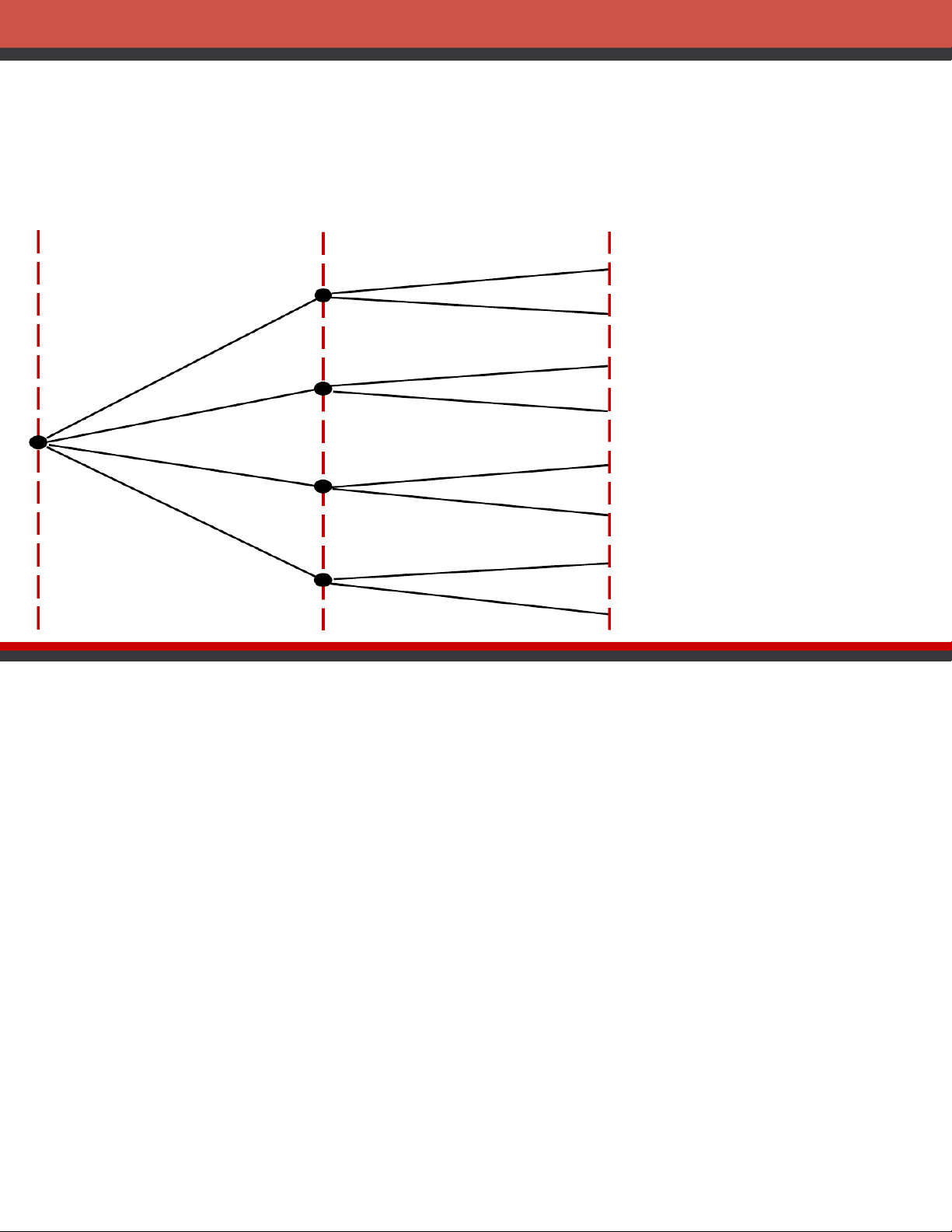
A helpful graphical representation of a multiple-step experiment is a tree diagram.
age Learning. May not be scanned, copied or duplicated, or posted to a publicly accessible website, in whole or in part, except for use as permitted in a license distributed with a certain product or service or
a password-protected website or school-approved learning management system for classroom use.
Statistics for Business and Economic
Counting Rule for Multiple-Step Experiments Example: Bradley Investments
•Bradley Investments can be viewed as a two-step experiment. It involve
two stocks, each with a set of experimental outcomes. Markley Oil: n1= 4 Collins Mining: n2= 2 Total Number of Experimental Outcomes: n1n2= (4)(2) = 8
age Learning. May not be scanned, copied or duplicated, or posted to a publicly accessible website, in whole or in part, except for use as permitted in a license distributed with a certain product or service or
a password-protected website or school-approved learning management system for classroom use.
Statistics for Business and Economic ee Diagram Example: Bradley Investments Markley Oil Collins Mining Experimental (Stage 1) (Stage 2) Outcomes Gain 8 (10, 8) Gain $18,000 (10, -2) Gain $8,000 Gain 10 Lose 2 Gain 8 (5, 8) Gain $13,000 (5, -2) Gain $3,000 Gain 5 Lose 2 Gain 8 (0, 8) Gain $8,000 0 (0, -2) Lose $2,000 Lose 20 Lose 2 Gain 8 (-20, 8) Lose $12,000 Lose 2 (-20, -2) Lose $22,000
age Learning. May not be scanned, copied or duplicated, or posted to a publicly accessible website, in whole or in part, except for use as permitted in a license distributed with a certain product or service or
a password-protected website or school-approved learning management system for classroom use.
Statistics for Business and Economic unting Rule for Combinations
Number of Combinations of NObjects Taken nat a Time
•A second useful counting rule enables us to count the number of
experimental outcomes when n objects are to be selected from a set of Nobjects. 𝐶𝑁 𝑛=𝑁 𝑛=𝑁! 𝑛! 𝑁−𝑛 !
where: N! = N(N- 1)(N- 2) . . . (2)(1)
n! = n(n- 1)(n- 2) . . . (2)(1) 0! = 1
age Learning. May not be scanned, copied or duplicated, or posted to a publicly accessible website, in whole or in part, except for use as permitted in a license distributed with a certain product or service or
a password-protected website or school-approved learning management system for classroom use.
Statistics for Business and Economic unting Rule for Permutations
Number of Permutations of NObjects Taken nat a Time
•A third useful counting rule enables us to count the number of
experimental outcomes when n objects are to be selected from a set of
Nobjects, where the order of selection is important. 𝑃𝑁 𝑛= 𝑛! 𝑁𝑛= 𝑁! 𝑁−𝑛 !
where: N! = N(N- 1)(N- 2) . . . (2)(1)
n! = n(n- 1)(n- 2) . . . (2)(1) 0! = 1
age Learning. May not be scanned, copied or duplicated, or posted to a publicly accessible website, in whole or in part, except for use as permitted in a license distributed with a certain product or service or
a password-protected website or school-approved learning management system for classroom use.
Statistics for Business and Economic signing Probabilities
Basic Requirements for Assigning Probabilities
1. The probability assigned to each experimental outcome must be between 0 and 1, inclusively.
0
where: Eiis the ith experimental outcome and P(Ei) is its probability
age Learning. May not be scanned, copied or duplicated, or posted to a publicly accessible website, in whole or in part, except for use as permitted in a license distributed with a certain product or service or
a password-protected website or school-approved learning management system for classroom use.
Statistics for Business and Economic signing Probabilities
Basic Requirements for Assigning Probabilities
2. The sum of the probabilities for all experimental outcomes must equal
P(E1) + P(E2) + . . . + P(En) = 1 where: is the number n of experimental outcomes
age Learning. May not be scanned, copied or duplicated, or posted to a publicly accessible website, in whole or in part, except for use as permitted in a license distributed with a certain product or service or
a password-protected website or school-approved learning management system for classroom use.
Statistics for Business and Economic signing Probabilities Classical Method
Assigning probabilities based on the assumption of equally likely outcomes Relative Frequency Method
Assigning probabilities based on experimentation or historical data Subjective Method
Assigning probabilities based on judgment
age Learning. May not be scanned, copied or duplicated, or posted to a publicly accessible website, in whole or in part, except for use as permitted in a license distributed with a certain product or service or
a password-protected website or school-approved learning management system for classroom use.
Statistics for Business and Economic assical Method Example: Rolling a Die
If an experiment has possible outcomes, n the classical method would
assign a probability of 1/nto each outcome. Experiment: Rolling a die
Sample Space: S= {1, 2, 3, 4, 5, 6}
Probabilities: Each sample point has a 1/6 chance of occurring
age Learning. May not be scanned, copied or duplicated, or posted to a publicly accessible website, in whole or in part, except for use as permitted in a license distributed with a certain product or service or
a password-protected website or school-approved learning management system for classroom use.
Statistics for Business and Economic lative Frequency Method Example: Lucas Tool Rental
Lucas Tool Rental would like to assign probabilities to the number of car
polishers it rents each day. Office records show the following frequencies o
daily rentals for the last 40 days. Number of Number Polishers Rented of Days 0 4 1 6 2 18 3 10 4 2
age Learning. May not be scanned, copied or duplicated, or posted to a publicly accessible website, in whole or in part, except for use as permitted in a license distributed with a certain product or service or
a password-protected website or school-approved learning management system for classroom use.
Statistics for Business and Economic lative Frequency Method Example: Lucas Tool Rental
Each probability assignment is given by dividing the frequency (number
of days) by the total frequency (total number of days).
age Learning. May not be scanned, copied or duplicated, or posted to a publicly accessible website, in whole or in part, except for use as permitted in a license distributed with a certain product or service or
a password-protected website or school-approved learning management system for classroom use.
Tài liệu liên quan:
-
Bảng giá trị phân phối thống kê poisson và student môn Xác suất thống kê| Trường Đại học Ngoại Thương
27 14 -
Bảng giá trị quyết định thống kê wilcoxon rank-sum test môn Xác suất thống kê| Trường Đại học Ngoại Thương
29 15 -
Bài 1 Định nghĩa cổ điển về xác suất môn Xác suất thống kê| Trường Đại học Ngoại Thương
26 13 -
Exercises for probability & statistics môn Xác suất thống kê| Trường Đại học Ngoại Thương
26 13 -
Đề thi cuối kỳ lý thuyết môn Xác suất thống kê| Trường Đại học Ngoại Thương
27 14