Company Structure: Hierarchies, Functional, & Teams | Tiếng Anh Thương Mại | Đại học Kinh Tế Quốc Dân
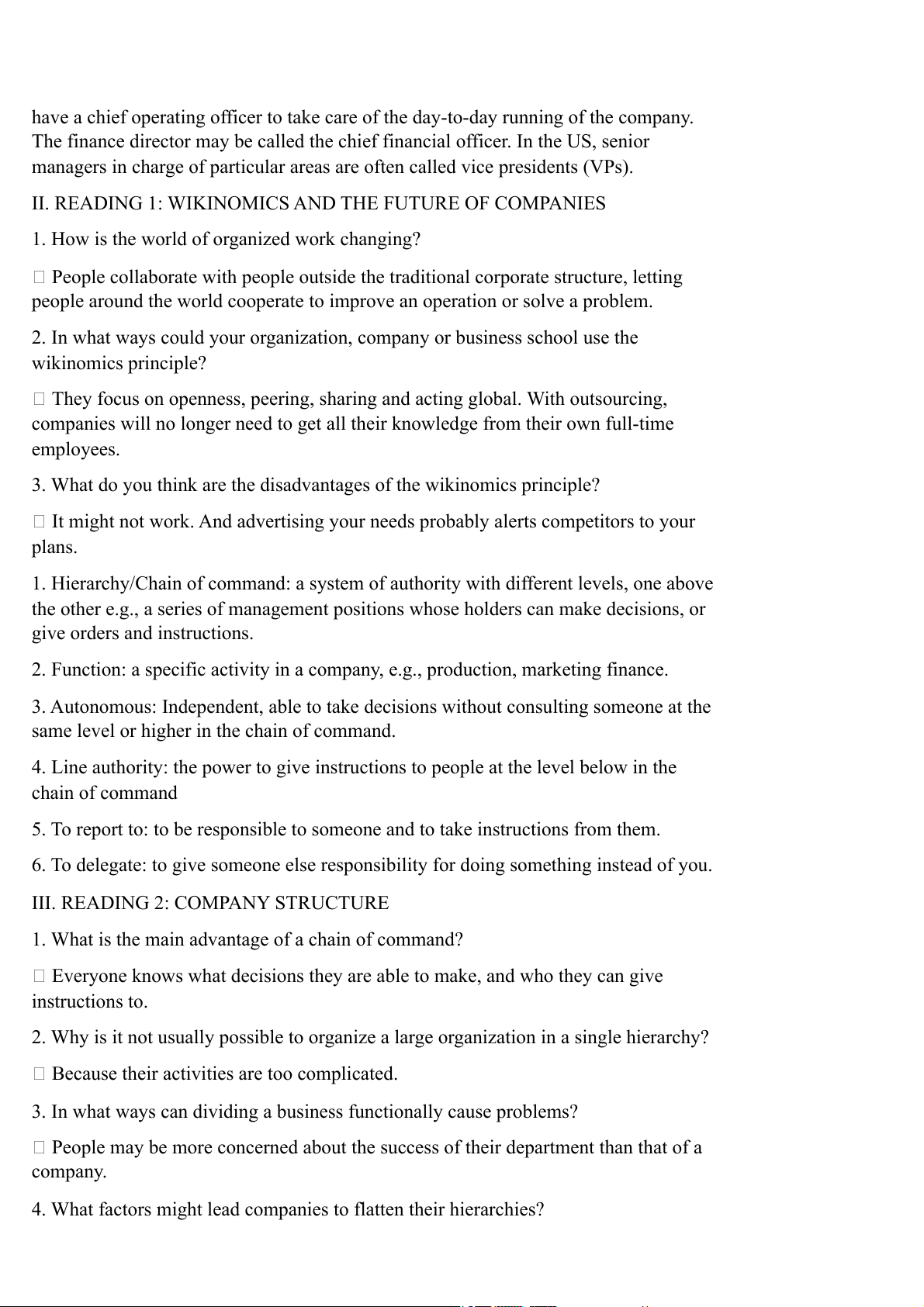
In the US, the top position may be that of chairman, chairwoman or president. This job is often combined with the position of chief executive officer or CEO. Some companies have a chief operating officer to take care of the day-to-day running of the company. The finance director may be called the chief financial officer. In the US, senior managers in charge of particular areas are often called vice presidents (VPs).Tài liệu được sưu tầm và soạn thảo dưới dạng file PDF để gửi tới các bạn cùng tham khảo, ôn tập đầy đủ kiến thức, chuẩn bị cho các buổi học thật tốt. Mời bạn đọc đón xem!
Môn: English A12 36 tài liệu
Trường: Trường Đại học Kinh Tế Quốc Dân 8.2 K tài liệu
Tác giả:


Preview text:
UNIT 3. COMPANY STRUCTURE I. Managers and executives: UK
Fun and Sun Holidays management organigram Non – executive directors Senior executives/ top executives/ executive directors Middle managers
Line managers (in travel agency branches)
All the directors together are the board. They meet in the boardroom.
Non-executive directors are not managers of the company; they are outsiders, often
directors of other companies who have particular knowledge of the industry or of particular areas.
The marketing director is the head of marketing, the IT director is the head of IT, etc.
These people head or head up their departments. Informally, the head of an activity, a
department or an organization is its boss.
An executive or, informally, an exec, is usually a manager at quite a high level (for
example, a senior executive). But 'executive' can be used in other contexts to suggest
luxury, as in ‘executive coach' and 'executive home', even for things that are not president chief executive officer (CEO) non-executive directors chief operating officer (COO) chief financial officer (CFO) vice president (VP) marketing vice president (VP) human senior executives/top resources executives/ executive vice president (VP) research directors actually used by executives.
In the US, the top position may be that of chairman, chairwoman or president. This job
is often combined with the position of chief executive officer or CEO. Some companies
have a chief operating officer to take care of the day-to-day running of the company.
The finance director may be called the chief financial officer. In the US, senior
managers in charge of particular areas are often called vice presidents (VPs).
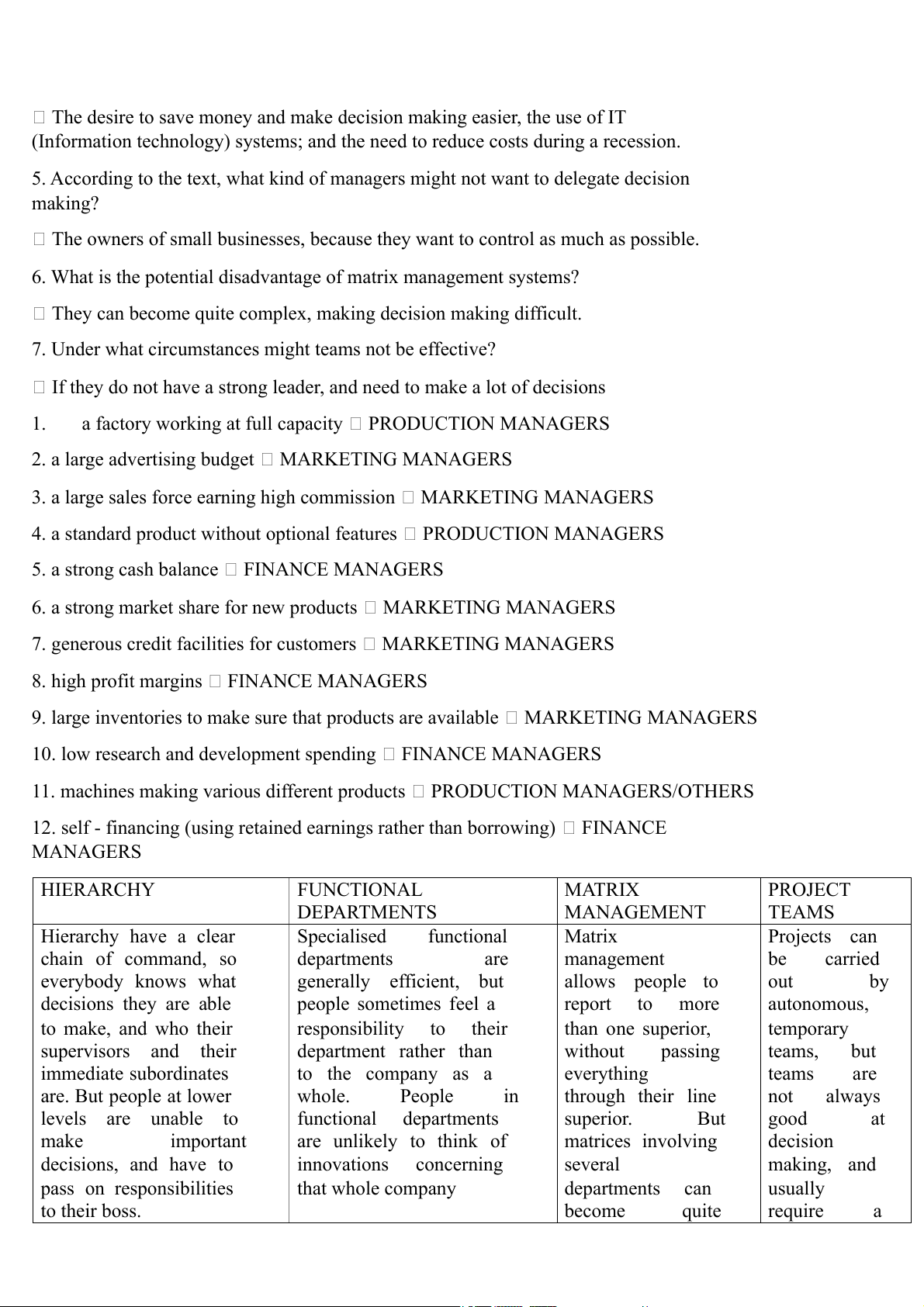
II. READING 1: WIKINOMICS AND THE FUTURE OF COMPANIES
1. How is the world of organized work changing?
People collaborate with people outside the traditional corporate structure, letting
people around the world cooperate to improve an operation or solve a problem.
2. In what ways could your organization, company or business school use the wikinomics principle?
They focus on openness, peering, sharing and acting global. With outsourcing,
companies will no longer need to get all their knowledge from their own full-time employees.
3. What do you think are the disadvantages of the wikinomics principle?
It might not work. And advertising your needs probably alerts competitors to your plans.
1. Hierarchy/Chain of command: a system of authority with different levels, one above
the other e.g., a series of management positions whose holders can make decisions, or give orders and instructions.
2. Function: a specific activity in a company, e.g., production, marketing finance.
3. Autonomous: Independent, able to take decisions without consulting someone at the
same level or higher in the chain of command.
4. Line authority: the power to give instructions to people at the level below in the chain of command
5. To report to: to be responsible to someone and to take instructions from them.
6. To delegate: to give someone else responsibility for doing something instead of you.
III. READING 2: COMPANY STRUCTURE
1. What is the main advantage of a chain of command?
Everyone knows what decisions they are able to make, and who they can give instructions to.
2. Why is it not usually possible to organize a large organization in a single hierarchy?
Because their activities are too complicated.
3. In what ways can dividing a business functionally cause problems?
People may be more concerned about the success of their department than that of a company.
4. What factors might lead companies to flatten their hierarchies?
The desire to save money and make decision making easier, the use of IT
(Information technology) systems; and the need to reduce costs during a recession.
5. According to the text, what kind of managers might not want to delegate decision making?
The owners of small businesses, because they want to control as much as possible.
6. What is the potential disadvantage of matrix management systems?
They can become quite complex, making decision making difficult.
7. Under what circumstances might teams not be effective?
If they do not have a strong leader, and need to make a lot of decisions 1.
a factory working at full capacity PRODUCTION MANAGERS
2. a large advertising budget MARKETING MANAGERS
3. a large sales force earning high commission MARKETING MANAGERS
4. a standard product without optional features PRODUCTION MANAGERS
5. a strong cash balance FINANCE MANAGERS
6. a strong market share for new products MARKETING MANAGERS
7. generous credit facilities for customers MARKETING MANAGERS
8. high profit margins FINANCE MANAGERS
9. large inventories to make sure that products are available MARKETING MANAGERS
10. low research and development spending FINANCE MANAGERS
11. machines making various different products PRODUCTION MANAGERS/OTHERS
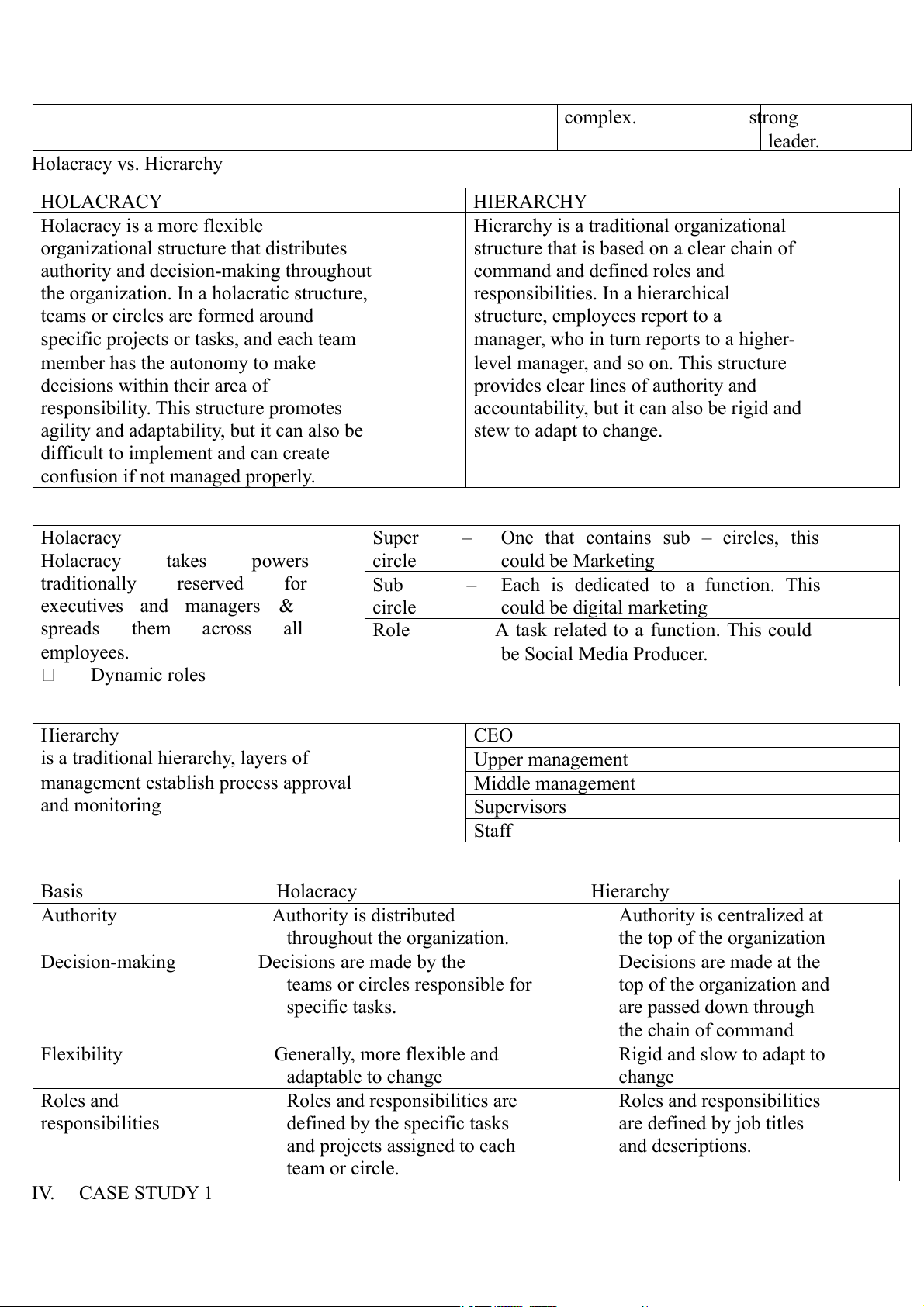
12. self - financing (using retained earnings rather than borrowing) FINANCE MANAGERS HIERARCHY FUNCTIONAL MATRIX PROJECT DEPARTMENTS MANAGEMENT TEAMS Hierarchy have a clear Specialised functional Matrix Projects can chain of command, so departments are management be carried everybody knows what generally efficient, but allows people to out by decisions they are able people sometimes feel a report to more autonomous, to make, and who their responsibility to their than one superior, temporary supervisors and their department rather than without passing teams, but immediate subordinates to the company as a everything teams are are. But people at lower whole. People in through their line not always levels are unable to functional departments superior. But good at make important are unlikely to think of matrices involving decision decisions, and have to innovations concerning several making, and pass on responsibilities that whole company departments can usually to their boss. become quite require a complex. strong leader. Holacracy vs. Hierarchy HOLACRACY HIERARCHY Holacracy is a more flexible
Hierarchy is a traditional organizational
organizational structure that distributes
structure that is based on a clear chain of
authority and decision-making throughout command and defined roles and
the organization. In a holacratic structure,
responsibilities. In a hierarchical
teams or circles are formed around
structure, employees report to a
specific projects or tasks, and each team
manager, who in turn reports to a higher-
member has the autonomy to make
level manager, and so on. This structure
decisions within their area of
provides clear lines of authority and
responsibility. This structure promotes
accountability, but it can also be rigid and
agility and adaptability, but it can also be stew to adapt to change.
difficult to implement and can create
confusion if not managed properly. Holacracy Super –
One that contains sub – circles, this Holacracy takes powers circle could be Marketing traditionally reserved for Sub –
Each is dedicated to a function. This executives and managers & circle could be digital marketing spreads them across all Role
A task related to a function. This could employees. be Social Media Producer. Dynamic roles Hierarchy CEO
is a traditional hierarchy, layers of Upper management
management establish process approval Middle management and monitoring Supervisors Staff Basis Holacracy Hierarchy Authority Authority is distributed Authority is centralized at throughout the organization. the top of the organization Decision-making Decisions are made by the Decisions are made at the
teams or circles responsible for top of the organization and specific tasks. are passed down through the chain of command Flexibility Generally, more flexible and Rigid and slow to adapt to adaptable to change change Roles and
Roles and responsibilities are Roles and responsibilities responsibilities defined by the specific tasks are defined by job titles and projects assigned to each and descriptions. team or circle. IV. CASE STUDY 1
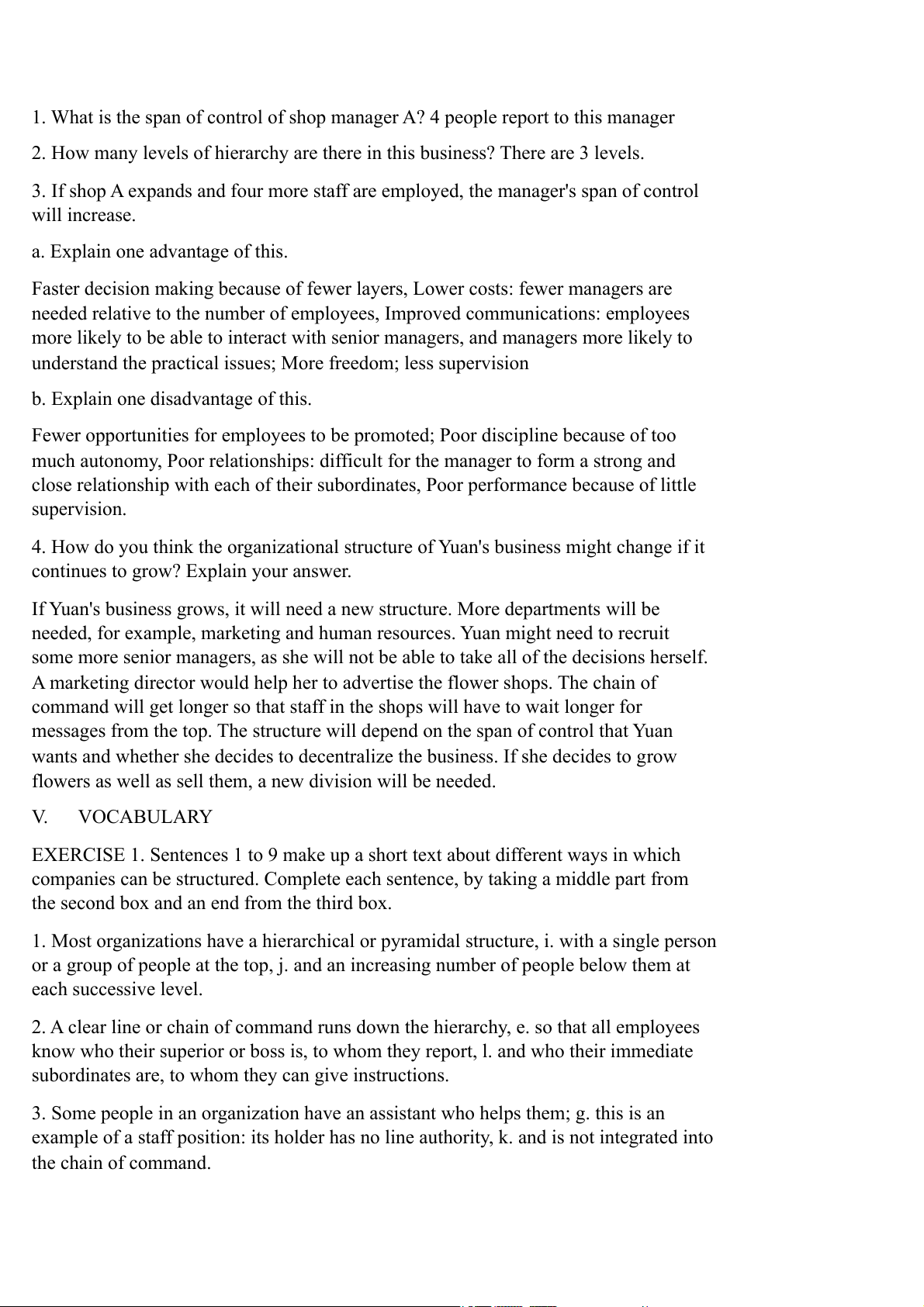
1. What is the span of control of shop manager A? 4 people report to this manager
2. How many levels of hierarchy are there in this business? There are 3 levels.
3. If shop A expands and four more staff are employed, the manager's span of control will increase.
a. Explain one advantage of this.
Faster decision making because of fewer layers, Lower costs: fewer managers are
needed relative to the number of employees, Improved communications: employees
more likely to be able to interact with senior managers, and managers more likely to
understand the practical issues; More freedom; less supervision
b. Explain one disadvantage of this.
Fewer opportunities for employees to be promoted; Poor discipline because of too
much autonomy, Poor relationships: difficult for the manager to form a strong and
close relationship with each of their subordinates, Poor performance because of little supervision.
4. How do you think the organizational structure of Yuan's business might change if it
continues to grow? Explain your answer.
If Yuan's business grows, it will need a new structure. More departments will be
needed, for example, marketing and human resources. Yuan might need to recruit
some more senior managers, as she will not be able to take all of the decisions herself.
A marketing director would help her to advertise the flower shops. The chain of
command will get longer so that staff in the shops will have to wait longer for
messages from the top. The structure will depend on the span of control that Yuan
wants and whether she decides to decentralize the business. If she decides to grow
flowers as well as sell them, a new division will be needed. V. VOCABULARY
EXERCISE 1. Sentences 1 to 9 make up a short text about different ways in which
companies can be structured. Complete each sentence, by taking a middle part from
the second box and an end from the third box.
1. Most organizations have a hierarchical or pyramidal structure, i. with a single person
or a group of people at the top, j. and an increasing number of people below them at each successive level.
2. A clear line or chain of command runs down the hierarchy, e. so that all employees
know who their superior or boss is, to whom they report, l. and who their immediate
subordinates are, to whom they can give instructions.
3. Some people in an organization have an assistant who helps them; g. this is an
example of a staff position: its holder has no line authority, k. and is not integrated into the chain of command.
4. Yet the activities of most large organizations are too elaborate h. to be organized in
a single hierarchy, and require functional organization, r. usually with production or
operations, finance, marketing and personnel departments.
5. Large companies manufacturing a wide range of products, e.g. General Motors, a. are normally decentralized into
separate operating divisions, m. each with its own engineering, production and sales departments.
6. Businesses that cannot be divided into autonomous divisions with their own markets c. can simulate
decentralization, setting up divisions that use n. internally determined transfer prices when dealing with each other
7. An inevitable problem with hierarchies is that people at lower levels b. are unable to make important decisions, but
are obliged to pass on responsibility to their boss, q. unless responsibilities have been explicitly delegated.
8. One solution to this problem is matrix management, in which people report to more than one superior: f. e.g. a brand
manager with an idea can deal directly with o. the appropriate managers in the finance, manufacturing and sales departments.
9. Another, more recent, idea is to have a network of flexible groups or teams. d. instead of the traditional departments,
which are often at war with each other; p. they are formed to carry out a project, after which they are dissolved and their members reassigned.
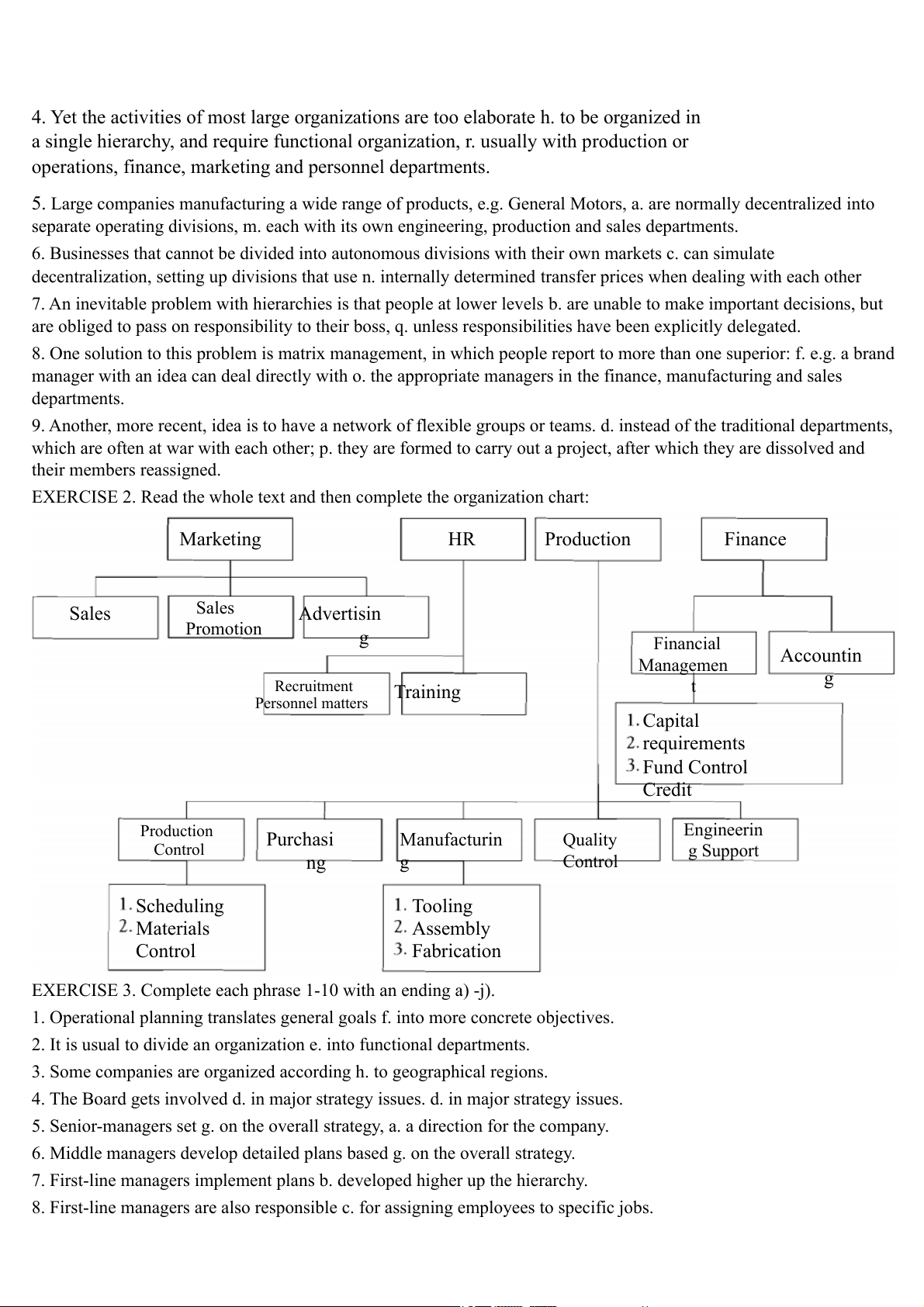
EXERCISE 2. Read the whole text and then complete the organization chart: Marketing HR Production Finance Sales Sales Advertisin Promotion g Financial Managemen Accountin Recruitment g Training t Personnel matters Capital requirements Fund Control Credit Production Purchasi Manufacturin Engineerin Quality Control g Support ng g Control Scheduling Tooling Materials Assembly Control Fabrication
EXERCISE 3. Complete each phrase 1-10 with an ending a) -j).
1. Operational planning translates general goals f. into more concrete objectives.
2. It is usual to divide an organization e. into functional departments.
3. Some companies are organized according h. to geographical regions.
4. The Board gets involved d. in major strategy issues. d. in major strategy issues.
5. Senior-managers set g. on the overall strategy, a. a direction for the company.
6. Middle managers develop detailed plans based g. on the overall strategy.
7. First-line managers implement plans b. developed higher up the hierarchy.
8. First-line managers are also responsible c. for assigning employees to specific jobs.
9. A cross-functional team brings i. together staff from different parts of the company.
10. Subordinates work j. under the supervision of a first-line manager. VI. UNIT REVIEW 1.
What is an organizational structure?
A system that outlines how specific activities are handled to fulfill a strategic mission is known as an organizational
structure. Rules, roles, and obligations are all part of these activities. It also determines the flow of information
between divisions within the corporation 2. Define a chain of command.
A series of positions of authority or rank within an organization that are ordered from lowest to highest.
3. What is the main advantage of a chain of command?
Everybody knows what decisions they are able to make, and who their superiors and their immediate subordinates are
4. Describe briefly a functional organizational structure.
It is often known as a bureaucratic organizational structure, which divides a corporation into departments based on
the specialization of its employees.
5. In what ways can dividing a business functionally cause problems?
people sometimes feel a responsibility to their department rather than to the company as a whole.
6. Describe briefly a matrix organization.
It's also the most confusing and underused. Employees are matrixed across superiors, divisions, and departments under this system.
7. What is the potential disadvantage of matrix management systems?
Matrices involving several departments can become quite complex. 8. What is centralization?
A centralized structure makes choices from the top- down, whereas a decentralized structure distributes decision-
making power throughout the organization.
9. Why is it not usually possible to organize a large organization in a single hierarchy?
Because their activities are too complicated.
10. What factors might lead companies to flatten their hierarchies?
The desire to save money and make decision making easier; the use of IT (information technology) systems; and the
need to reduce costs during a recession.
11. Under what circumstances might teams not be effective? Decision making
Tài liệu liên quan:
-
Tài liệu ôn luyện thi Tiếng Anh | Trường Đại học Kinh Tế Quốc Dân
9 5 -

Sách Tiếng Anh B1 - Tiếng Anh EML | Trường Đại học Kinh Tế Quốc Dân
19 10 -
Sách tiếng Anh Finance 1
21 11 -

Sách English Collocations In Use - How words work together for fluent and natural English | Trường Đại học Kinh Tế Quốc Dân
19 10 -

Từ điển TOEIC | Trường Đại học Kinh Tế Quốc Dân
21 11