CSE-HCMUT DBMS-ER Model Overview by Truong Tuan Anh
CSE-HCMUT DBMS-ER Model Overview by Truong Tuan Anh
Môn: Xã hội 2.2 K tài liệu
Trường: Văn hóa - Xã hội - Nghệ thuật 2.6 K tài liệu
Tác giả:














Preview text:
Entity-Relationship Diagram Truong Tuan Anh CSE-HCMUT 1 Contents Database design process ER Model
Downloaded by Nguyen Linh (vjt26@gmail.com) 2 Database Design Process Two main activities: Database design Applications design Database design
To design the conceptual schema for a database application Applications design
Programs and interfaces that access the database
General y considered part of software engineering
Downloaded by Nguyen Linh (vjt26@gmail.com) 3 Database Design Process
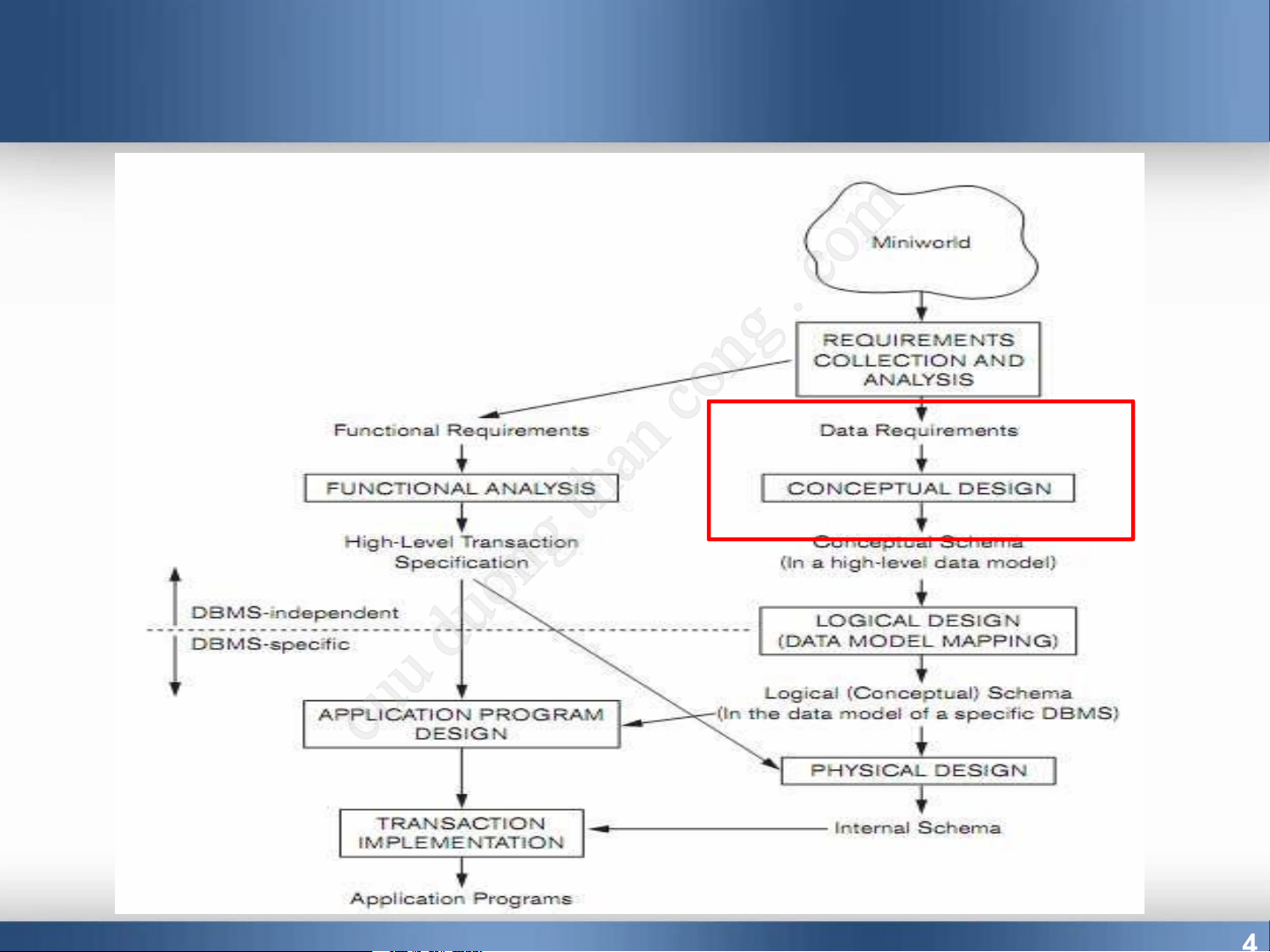
Downloaded by Nguyen Linh (vjt26@gmail.com) 4 Database Design Process
Col ect and Analyze requirements
Database designers interview prospective
database users to understand and document data requirements Outputs: Data requirements Functional requirements 5 Database Design Process Conceptual design
Create a conceptual schema for the database.
Description of data requirements
Uses the concepts provided by the high-level data model
Includes detailed descriptions of the entity types, relationships, and constraints
Independent of storage and implementation details.
Downloaded by Nguyen Linh (vjt26@gmail.com) 6 Database Design Process
Logical design or data model mapping Output is a database schema in
implementation data model of DBMS Physical design phase
Internal storage structures, file organizations,
indexes, access paths, and physical design
parameters for the database files specified
Downloaded by Nguyen Linh (vjt26@gmail.com) 7 ER Model
Downloaded by Nguyen Linh (vjt26@gmail.com) 8 What is ER Model? Entity-Relationship (ER) model
Popular high-level conceptual data model
A logical organisation of data within a database system ER diagrams:
Diagrammatic notation associated with the ER model
Downloaded by Nguyen Linh (vjt26@gmail.com) 9 Why ER Model?
User requirements can be specified formal y & unambiguously
The conceptual data model is independent of any particular DBMS
It does not involve any physical or implemental details
It can be easily understood by ordinary users.
It provides an effective bridge between user
requirements and logical database design and implementation
Downloaded by Nguyen Linh (vjt26@gmail.com) 10
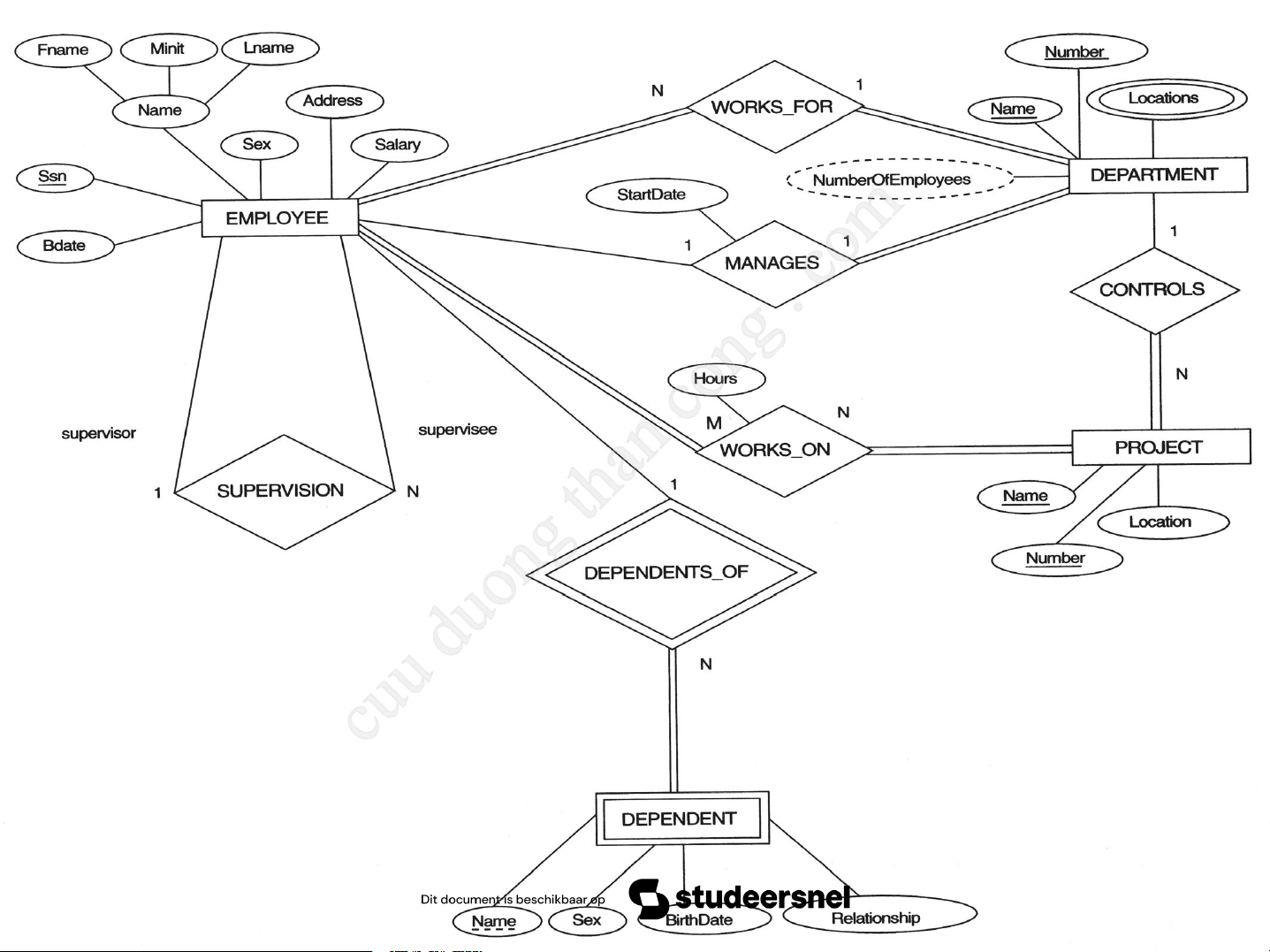
A Sample Database Application
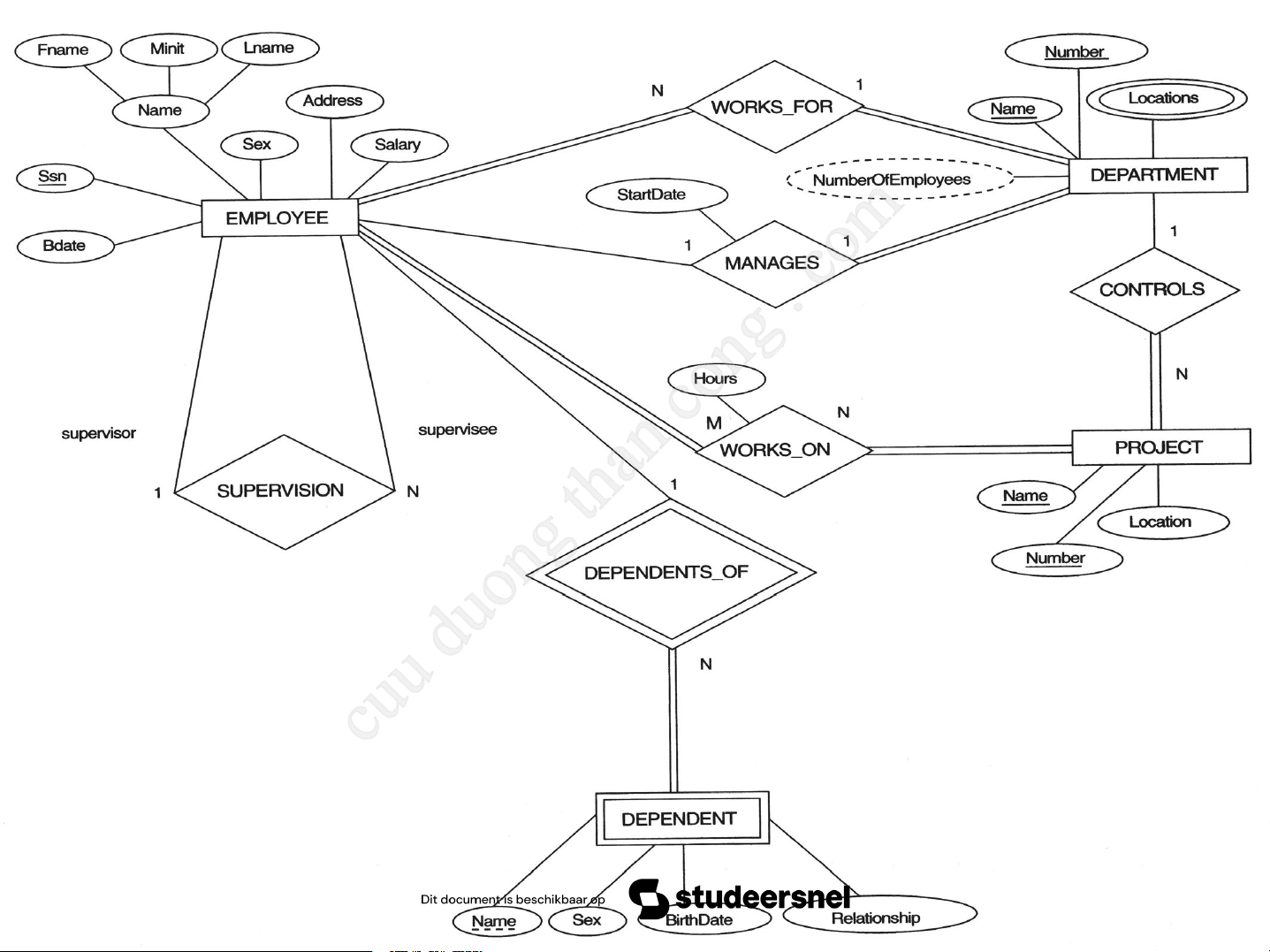
The COMPANY database: keeps track of employees,
departments, and projects.
The company is organized into DEPARTMENTs.
Each department has a unique name, a unique number, and
a particular employee who manages the department.
We keep track of the start date when that employee began managing the department.
A department may have several locations.
A department controls a number of PROJECTs
Each of which has a unique name, a unique number, and a single location.
Downloaded by Nguyen Linh (vjt26@gmail.com) 11
A Sample Database Application
We store EMPLOYEE's name, Social Security
number, address, salary, sex, and birth date.
An employee is assigned to one department, but may work
on several projects, which are not necessarily control ed by
the same department. We keep track of the current number
of hours per week that an employee works on each project.
We also keep track of the direct supervisor of each employee.
We want to keep track of the DEPENDENTs of each
employee, including first name, sex, birth date, and relationship to the employee.
Downloaded by Nguyen Linh (vjt26@gmail.com) 12
Downloaded by Nguyen Linh (vjt26@gmail.com) 13 ER Model Concepts
Downloaded by Nguyen Linh (vjt26@gmail.com) 14 ER Model Concepts ER model describes data as: Entities Relationships Attributes
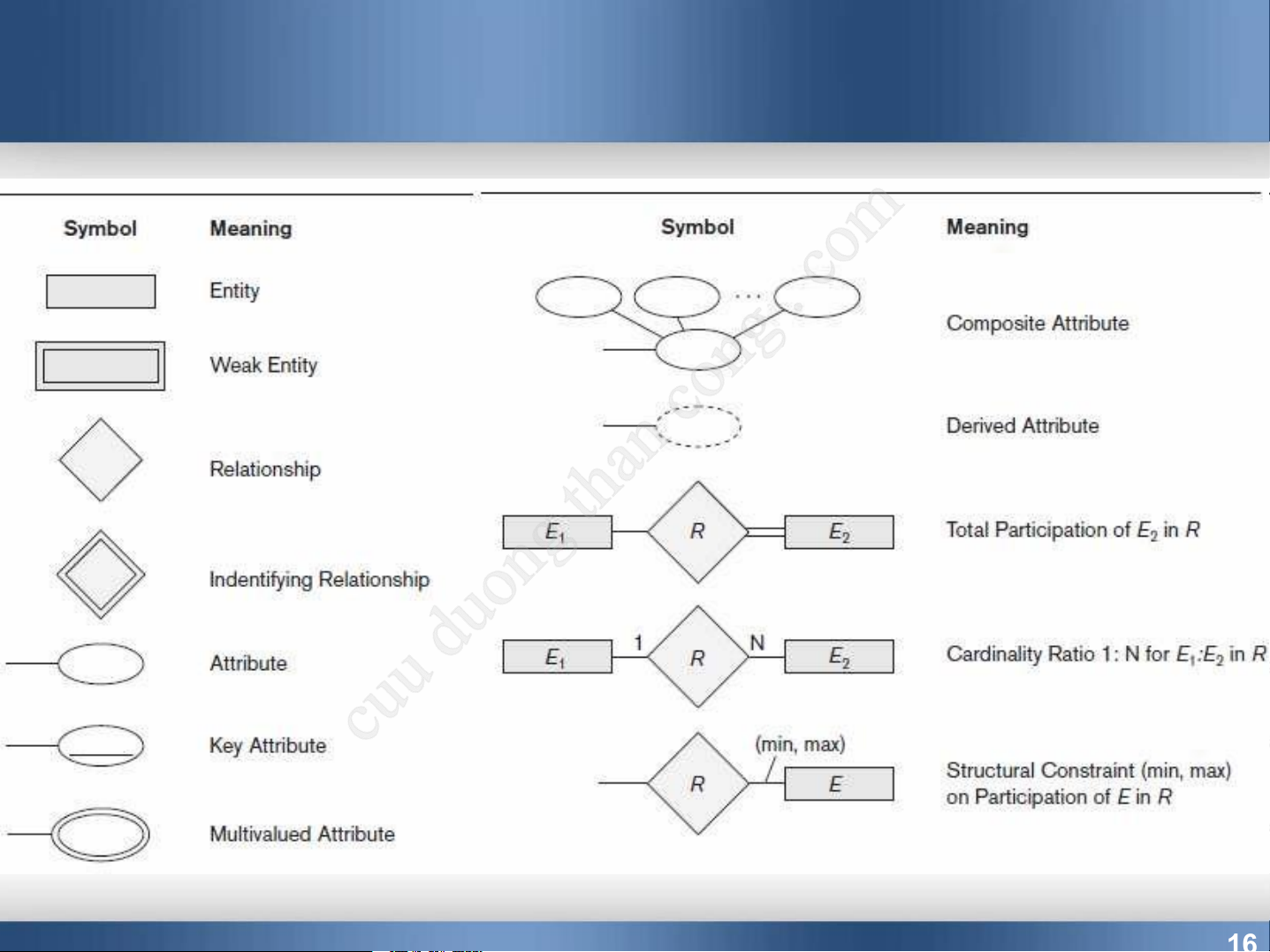
Downloaded by Nguyen Linh (vjt26@gmail.com) 15 ER Diagram: Summary
Downloaded by Nguyen Linh (vjt26@gmail.com) 16 Entities and Attributes
Entity is a thing in the real world with an independent existence.
Ex: the EMPLOYEE John Smith, the Research
DEPARTMENT, the ProductX PROJECT
Attributes are properties describing an entity.
Ex: an EMPLOYEE entity may have Name, SSN, Address, Sex, BirthDate
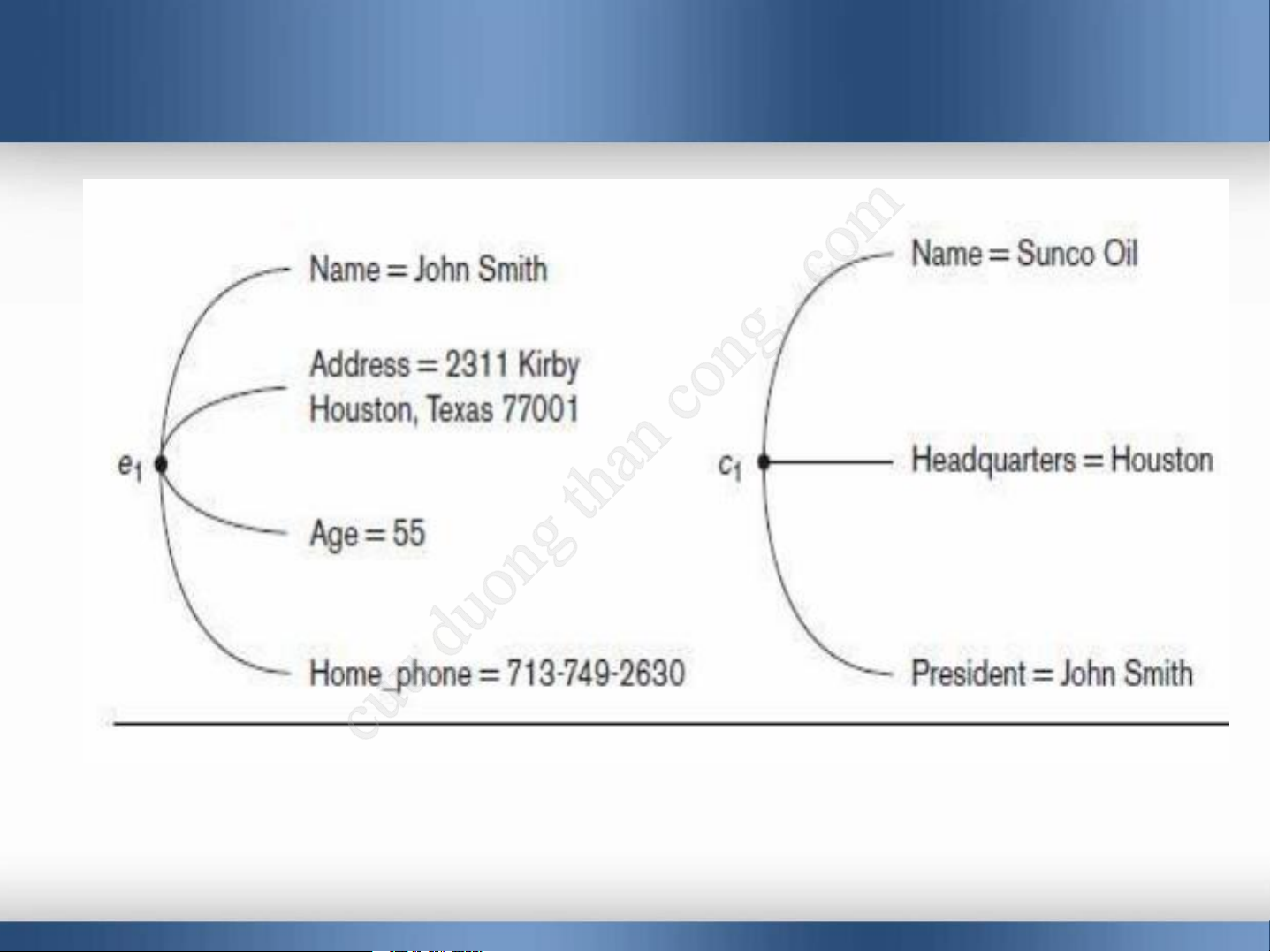
A specific entity wil have a value for each of its attributes
Each attribute has a value set (or data type) associated with it.
Downloaded by Nguyen Linh (vjt26@gmail.com) 17 Entities and Attributes Types of Attributes
Simple attributes: each entity has a single atomic value for the attribute.
Composite attributes: attribute may be composed of several components.
Multi-valued attributes: an entity may have multiple values for that attribute.
Derived: attribute represents a value that is derivable
from value of a related attribute, set of attributes, or relationships.
Complex attributes: composite and multivalued
attributes can be nested arbitrarily
Downloaded by Nguyen Linh (vjt26@gmail.com) 18
Downloaded by Nguyen Linh (vjt26@gmail.com) 19 Entities and Attributes
Two entities, EMPLOYEE e1, and COMPANY c1, and their attributes.
Downloaded by Nguyen Linh (vjt26@gmail.com) 20
Tài liệu liên quan:
-
Tổng Quan Về Công Ty TNHH Công Nghệ Dưỡng Phú và Xưởng TĐN 09
29 15 -
TCVN 11930:2017 Yêu Cầu Cơ Bản Về An Toàn Hệ Thống Thông Tin
24 12 -
Xác định Tính Khả Thi Ý Tưởng Kinh Doanh Chỉ Trong 5 Bước
21 11 -
NHẬT KÝ THỰC TẬP DIGITAL MARKETING - CÔNG TY HMEDIA
21 11 -
Phân rã Use Case Hệ Thống Đặt Món - Đặc Tả Chi Tiết
19 10