
 !"
 !"!#$%!&'()
Thể khẳng định trong thì hiện tại đơn
*+,-*.
Thể phủ định
*/.-/.*.*+0$12*.
Thể Nghi vấn
/.-/.**+0$1*.3
 !"!#$%!&'451
Thể khẳng định
*6--6*7-7-18-69:
Thể phủ định
*6--6*.*7-7-18-69:
Thể nghi vấn
26--6**7-7-18-69:
+;9<=
I am a student.
She is not beautiful.
Areyou a student?
>?8@9< !"
Diễn tảmột sự thật hiển nhiên, một chân lý.(E.g: The sun rises in the East
and sets in the West.).
Diễn tả 1 thói quen,một hành động thường xảy raở hiện tại. (E.g:I get up
early every morning.).
Nói lên khả năng của một người (E.g: He plays tennis very well.).
A/BCCD5E !"
Trong câu xuất hiện từ sau:1$1FG(every day, every week, every
month,...).
Các trạng từ tần suất xuất hiện trong thì hiện tại đơn:6HI7G8JC8C7HHGJ
401J284K1K18J81H94KJF7F1HGJ7F9HGJ1$1F
+;9<=
- I use the Internet just about every day.
- I always miss you.
>L/M.N.N
 EO9P
Thể khẳng định
*8-7K-7F12*+,*.
E.g:They are studying English.
Thể phủ định
*8-7K-7F12*.*+,*.
E.g:I’m not cooking now.
Thể nghi vấn
8-7K-7F12**+,*.
E.g:Is she watching T.V at the moment?
>?8@9< EO9P
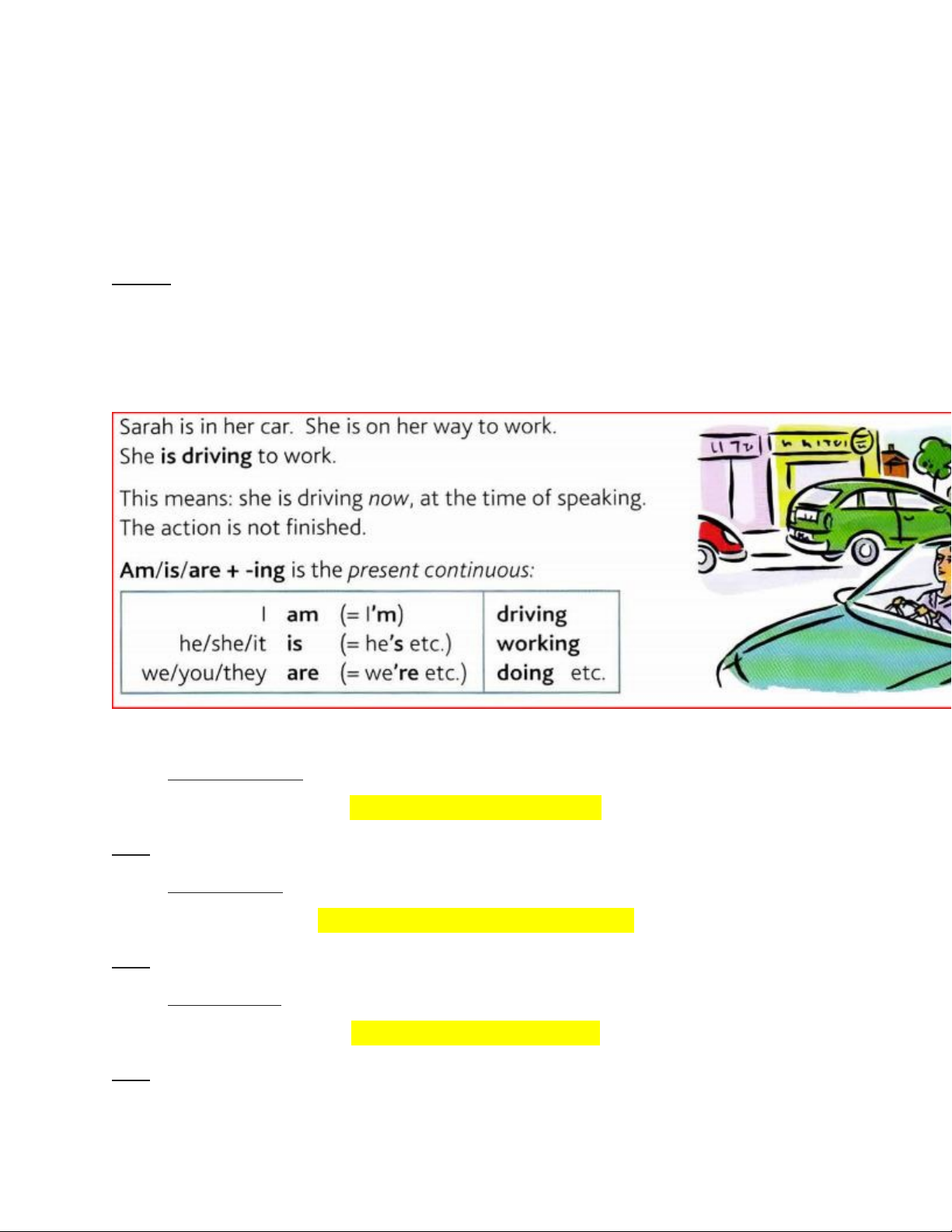
Diễn tả hành động đang diễn ra tại thời điểm nói.
E.g:The children are playing football now.
Diễn tả hành động đang diễnra nhưng không nhất thiết xảy ra tại thời điểm
nói.
E.g:I am looking for a job.
Diễn tả 1 sự than phiền với hành động lặp đi lặp lại nhiều gây khó chịu, bực
mình. Trong trường hợp này, câu thường có trạng từ tần suất "always".
E.g:He is always borrowing our books and then he doesn’t remember.
Dùng để diễn tả một hành động sắp xảy ra trong tương lai theo kế hoạch đã
định trước.
E.g:I am flying to Thailand tomorrow.
(CQRC7FST5E
Không dùng thì hiện tại tiếp diễn với các động từ chỉ tri giác, nhận thức như:be,
see, hear, feel,realize, seem, remember, forget, understand, know, like, want,
glance,smell, love, hate, ...
+;9<=
- I7Ktired now.
- HeI782to go for a cinemaat the moment.
U/42youF1K1K51F2me?
A/BCCD5E
Trong câu có những từ: Now, right now, at present, at the moment,
Trong các câu trước đó một câu chỉ mệnh lệnh: Look!, Watch! Be
quite!, ...
AVNWXY26
22RC?Z!"
+%!&'()
Thể khẳng định
*+O78*.
E.g:He worked as a policeman.
Thể phủ định
*//*.*+0$12*.
E.g:She didn’t eat bread for the breakfast.
Thể nghi vấn
//**+0$1*.3
E.g:Did you call Zoey yesterday?
+%!&'451
Thể khẳng định
*[6-[*7-7-1*8-69:
Thể phủ định
*[6-[*.*7-7-1*8-69:
Thể nghi vấn
[6-[**7-7-1*8-69:3
>?9\RC?Z!"
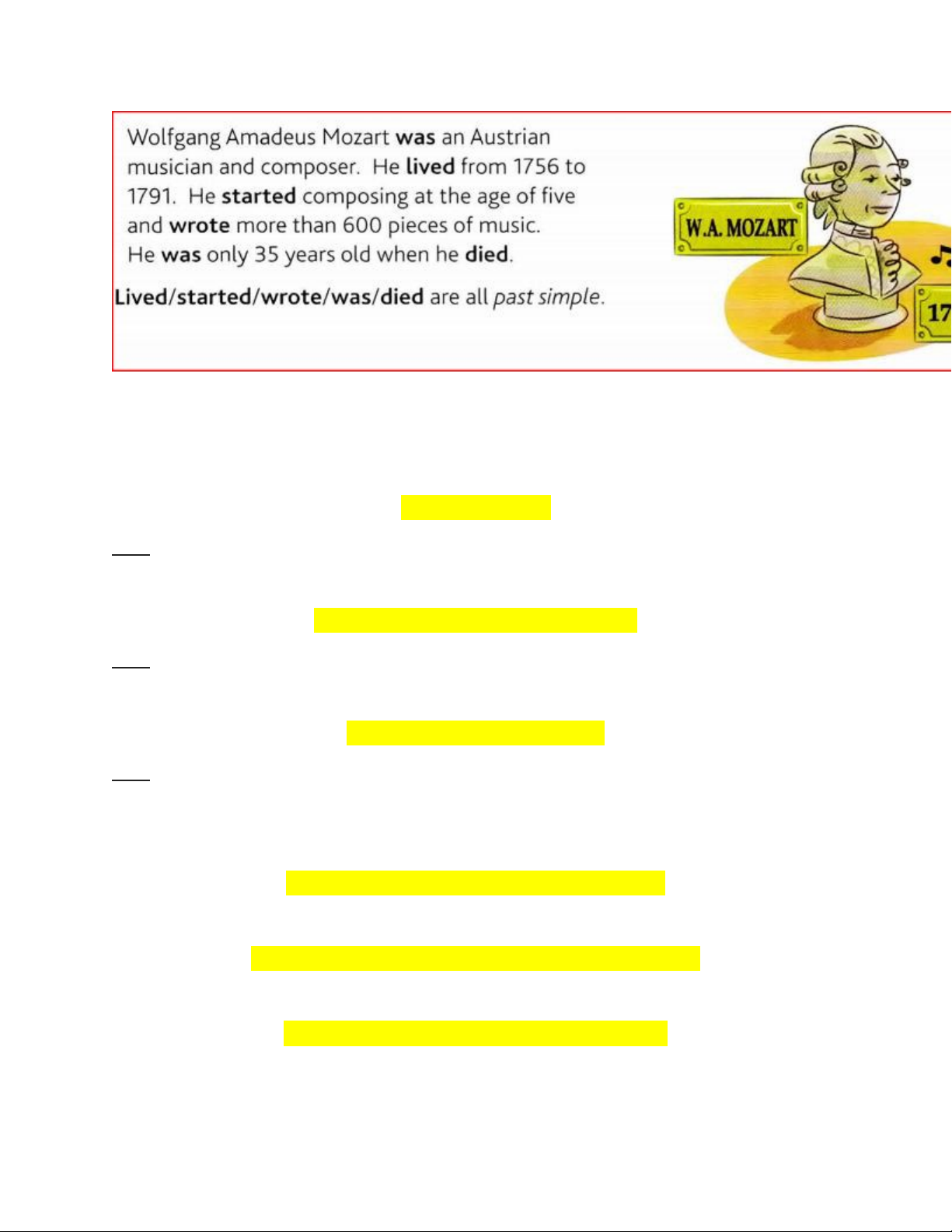
Diễn tảmột hành động đã xảy ra và kết thúc trong quá khứ.
+;9<=
- I went to the concert last week.
- A few weeks ago, a woman called to report a robbery.
A/BCCD5E
Các từ thường xuất hiện trong thì quá khứ đơn:]181F97GKRC7JH78
-I11Z-K4-G17FJ74?!^GJ...
__``ab=2RC?Z!"$c5cDOdc78KOH1
efg6hNN
("H7!"
Thể khẳng định
*87HH-IHH*+0$1*.
E.g:We’ ll enjoy it.
Thể phủ định:
*87HH-IHH*4*+0$1*.
E.g: He won’t go to school.
Thể nghi vấn
7HH-IHH**+0$1*.3
E.g:Will they have dinner together?
>?9\
Diễn tả dự địnhnhất thời xảy ra ngay tại lúcnói.
E.g:Are you going to the beach? I will go with you. –> Bạn muốn đi biển không?
Mình sẽ đi cùng bạn.
Nói vềmột dự đoán dựa trên kinh nghiệm có được trong quá khứ.
E.g:I think it’ll be extremely hot there.–> Tôi nghĩ rằng nó sẽ rất nóng đó.
Khi đưa ra ý kiến, đề nghị.
E.g:Don’t worry, Ill let everyone know. -> Đừng lo lắng, tôi sẽ cho tất cả mọi
người biết.
Lưu ý:
Thì tương lai đơn thể sử dụng để diễn tả cả hành động dự định không
dự định từ trước. Tuy nhiên để phân biệt với thì tương lai gần có dự định, thì tương
lai đơn thường được dùng cho các hành động mang tính bộc phát ngay tại thời
điểm nói chứ không có dự định như thì tương lai gần. Ví dụ:
- Mother: There is no sugar left. (Hết đường mất rồi.)
- Son: Ok, I will go to market and buy itfor you. (Con sẽ ra chợ mua cho mẹ.)
A/BCCD5E
Trong câu thường có:tomorrow, Next day/ Next week/ next month/ next year,in
+ thời gian, probably, perhaps, ...
__``a L=2("H7!" $c 5c DOd cKOH1
hCCF1
ijk
icDO=7!&'F44l6
1. Linh (work) ________ in a hospital.
2. Cat (like) ________ fish.
3. Myan (live)________ in California.
4. It (rain)________ almost every afternoon in French.
5. My son (fry)________ eggs for breakfast everyday.
6. The museum (close)________ at 8 pm.
7. He (try)________ hard in class, but I (not think) ________ he'll pass.
8. My sister is so smart that she (pass)________ every exam without even trying.
9. Your life (be)_____ so boring. You just (watch)________ TV everyday.
10. His girlfriend (write)________ to him two times a week.
11. You (speak) ________ English?
12. She (not live) ________ in Ho Chi Minh city.
Xem thêm:Cách chia động từ trong tiếng Anh
icDO>=m9 !no7!&'451
1. His cat __________small.
2. Linh ________ a student.
3. They _________ready to get a pet.
4. My life _____ so boring. I just watch TV every night.
5. Her husband________from China. She _______from Viet Nam.
6. They ____________ (not/be) late.
7. I and my sister (be)________ good friends.
8. ___________ (she/be) a doctor?
9. Her sister(be) _________ 9 years old.
10.Max and Lan (be)__________my cats.
Xem thêm:Tổng quan về động từ to be trong tiếng Anh
icDOA=4cc^C8@9<!&'48p
wake up – cause – open – play – speak – drink – take – do – live – close – live
1. Myan _____________ handball very well.
2. They never _____________ tea.
3. The swimming pool _____________ at 6:30 in the morning.
4. It _____________ at 7 pm in the evening.
5. Bad driving _____________ many accidents.
6. Her parents _____________ in a very small flat.
7. The Olympic Games _____________ place every four years.
8. They are good students. They always _____________ their homework.
9. The students _____________ a little English.
10. I always _____________ late in the morning.
icDOe=79 !no7!&'F44li
1. My sister always _______________ (forget) my birthday.
2. She __________________ (buy) some fruits at the supermarket.
3. Be quiet! The baby _______________(cry).
4. My little brother __________________ (drink) milk.
5. At present, They are _______________(not drink) wine.
6. My brother _______________(go) to work now.
7. Where is your sister? – She _______________(cook) in the kitchen.
8. I _______________(play) badminton twice a week.
9. At 9 PM my brother _______________(watch) the film.
10.The student _______________(not be) in the class, they
_______________(learn) outdoor gymnastics.
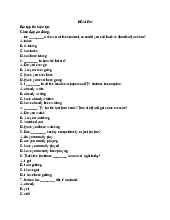
icq=icDOFrK$% EO9P
1. Look! The children ______ in the garden.
A. play
B. are playing
C. plays
D. played
2. She ______ a new dress for the party tonight.
A. is making
B. makes
C. made
D. will make
3. I ______ my homework at the moment.
A. do
B. am doing
C. does
D. did
4. The cat ______ on the sofa.
A. is sleeping
B. sleeps
C. slept
D. will sleep
5. They ______ to music every day.
A. listen
B. are listening
C. listens
D. listened
6. It ______ very hard outside.
A. rain
B. is raining
C. rained
D. will rain
7. We ______ dinner now.A. have
B. are having
C. had
D. will have
8. He ______ a book in the library.
A. read
B. is reading
C. reads
D. will read
9. The birds ______ in the trees.
A. sing
B. are singing
C. sings
D. sang
10. My mother ______ the flowers in the garden.
A. water
B. is watering
C. waters
D. watered
BT NÂNG CAO VẬN DỤNG
7!&'F44l
1. Where's John? He ________(listen) to a new CD in his room.
2. Don't forget to take your umbrella with you to London. You know it always
________(rain) in England.
3. Jean ________(work) hard all day but she ________(not work) at the moment.
4. Look! That boy ________ (run) after the bus. He________(want) to catch it.
5. He ________(speak) German so well because he ________(come) from
Germany.
6. Shh! The boss ________(come). We ________(meet) him in an hour and
nothing is ready!
7. _______you usually _______(go) away for Christmas or_______ you
______(stay) at home?
8. She ________(hold) some roses. They________(smell) lovely.
9. Oh no! Look! It ________(snow) again. It always________(snow) in this
country.
10. Mary ________ (swim) very well, but she ________(not run) very fast.
st!?O?
C1$1F58414FF11818KOH1OF1814FOF181OF4F188$1
1. Look! He (leave) the house.
2. Quiet please! I (write) a test.
3. She usually (walk) to school.
4. But look! Today she (go) by bike.
5. Every Sunday we (go) to see my grandparents.
6. He often (go) to the cinema.
7. We (play) Monopoly at the moment.
8. The child seldom (cry) .
9. I (not/ do) anything at the moment.
10. (watch/ he) the news regularly?
X47Fu$c4!?O?!n
1. My grandfather ______ collecting stamps.
A. is loving  B. are loving  C. loves
2. She ______ her friends at a bar right now.
A. waiting  B. is waiting  C. waits
3. Nguyen Nhat Anh is a writer. He ______ a short story about a dragon.
A. is writing  B. writes  C. are writing
4. I never ______ home late.
A. come  B. is coming  C. am coming
5. My boss ______ high heels to work.
A. doesn’t wear B. aren’t wearing  C. don’t wear
6. She usually ______ much.
A. doesn’t talk  B. don’t talk  C. isn’t talking
7. This spaghetti ______ awful.
A. tastes  B. is tasting  C. taste
8. I ______ he is a good man.
A. thinks  B. think  C. am thinking
9. As the ceremony ______ at 730 a.m., we have to be there early.
A. is starting  B. start  C. starts
10. Kate ______ a cup of coffee every morning.
A. is drinking  B. drinks  C. drink
7?!&'F44lv !"4l EO9P874
4;wO
1. A: Where is Molly? B: She __________________ (feed) her cat downstairs.
2. __________________ (she/ need) to go and see a doctor?
3. She usually _______________ (wash) the dishes after dinner.
4. __________________ (your sister/ wear) sunglasses?
5. He frequently __________________ (do) yoga.
6. We __________________ (move) to Canada in August.
7. My son _______________ (not practice) the piano every day.
8. I __________________ (not like) to take selfies.
9. Megan _________________ (go) on holiday to Cornwall this summer.
10. When __________________ (the film/ start)?
N81104HH4I$1F5844KOH111811184K1K18G4C1191
17$1=believe eat flow go grow make rise tell translate
1. The earth ………round the sun.
2. Rice doesn't ……… in Britain.
3. The sun ..... in the east.
4. Bees ..... honey.
5. Vegetariants ..... meat.
6. An atheist ..... in God.
7. An interpreter ..... from one language into another.
8. Liars are people who ..... the truth.
7?!&'F44l!"v!"4l EO
9PO\wOB
1. A: What is Molly doing now? B: She _______ (wash) dishes in the kitchen.
2. _______ (Molly / decorate) her sister’s birthday cake right now?
3. My mother usually __________ (wash) the dishes after meals.
4. _________ (your young sister/ wear) a T-shirt and a flower skirt?
5. He rarely_________ (play) chess with his friends.
6. My daughter__________ (learn) English in an extra-class this evening.
7. We ________________ (move) to the USA and visiting our grandfather in
November.
8. She often __________ (clean) her room after dinner.
9. My family___________ (go) on holiday to Cornwall this spring.
10. When ______________ (the dinner party/ start)? I’m hungry!
79 !no7!&'F44l
1. He always (go) _______ class lately.
2. Sit down! A strange dog (run) _______ to you.
3. That baby (cry) _______ loudly in the party now.
4. Lan (travel) _______ to London every Sunday.
5. My brothers (not/drink) _______ tea at the moment.
6. We (have) _______ a holiday in July every year.
7. You (play) _______ football once a week.
8. The moon (circle) _______ around the earth.
9. You always (teach) _______ me new things.
10. Look! Those people (climb) _______ the mountain so fast.
C1$1F585F7Z184OF1818KOH14FOF1814C4C8181
1. Listen! My mother (sing) __________ a song.
2. Every night, we (go) __________ to bed at 10 p.m
3. Giang (like) __________ music but I (like) __________ Math.
4. Now, they (stay) __________ in Hue .
5. My father (read) __________ a newspaper in the morning
6. Look! Ha (run) __________.
7. Trang usually (listen) _______ to the teacher in the class, but she (not listen)
_______ now.
8. Where __________ your father (be)?
 - He (be) __________ living room. He (watch) _________TV.
9. __________ they (go) to school by bus today?
10. There (be) __________ many flowers in our garden.
11. Every day, Mr. Hung (not go) __________ to work by car.
12. In the autumn, I rarely (go) __________ sailing and (go) __________ to
school.
13. I (write) __________ a letter to my friend now.
14. At 12 a.m. every day, I (have __________ lunch and (go) __________ to bed.
15. On Monday, I (have) __________ math and Art.
16. On Friday, I (have) __________ English.
17. At the moment, I (eat) __________ an orange and my sisters (play)
__________ tennis.
18. Now, he (look) __________ his cat. It (eat) __________a mouse in the
garden.
19. Phong, An, Ha, Lan (be) __________ close friend.
20 __________ your mother (walk) __________ to market?
21. It (be) __________ 10.00. We (learn) __________ our lesson.
22. What ___________ you (do) ____________ now?
23. __________ your mother (walk) to work every day?
24. They (not play) __________ soccer in the morning.
25. ____________ Hai (work) ____________ in the garden at the moment?
26. My brother (do) __________ his homework in his room now. He does it every
day.
27. James and his brother (play) __________ soccer at the moment. They (play)
__________ it every afternoon.
28. Where __________ the old man (live) __________ now?
29. Mr. Smith often (teach) __________ class 4A,but this morning he (teach)
__________ class 4B.
30. It's 7.30 now. She (study) _________ science in the classroom
+k/xg
icDO=CGs!&'CGys879 RC?Z!"
1. live →
2. come →
3. arrive→
4. leave →
5. do →
icDO>=7!&'RC?Z!"
1. When I (arrive)......, she (go).....
2. Yesterday, we (see)....her at the restaurant.
3. My family (buy)............a new house last month.
4. I (hear).........her crying in the room last night.
5. I used to (like).....ice cream but no more.
6. Yesterday, I (go)......to school at 6 a.m.
7. Last summer, my family (travel)..........in Da Nang.
8. I (buy).........him a new wallet.
9. My friends and I (stay)...........at home all the weekend.
10. They (get).........married last year?
icDOA=icDOFrKRC?Z!"
1. I………the bus yesterday.
A. can’t catch     B. didn’t catch      C. not catch     D. weren’t catch
2. Where……….you……….on the Tet holiday last year?
A. do - go       B. did - gon      C. did - go     D. did - went
3. Linda…..anything because she was full.
A. weren’t eat       B. wasn’t eat      C. didn’t eat      D. doesn’t eat
4. What…..do last night, you….. so tired.
A. did you - looks   B. did you - looked    C. were you - looks   D. were you -
looked
5. Mary……….with her mother to go to the mall 1 hour ago.
A. goes out       B. gone out       C. went out       D. was gone
icDOe=SI784lI1F1!s!m$c4zF#
1. She………very intelligent.
2. I………at home yesterday.
3. The dog………in the garden.
4. They………in Da Nang last month.
5. He………at school yesterday.
D. Các bài tập cơ bản và có đáp án:
icDO: Chọn đáp án đúng trong các đáp án dưới đây để hoàn thành câu.
Câu 1. Her brother (be) ___ home at 6 o’clock.
1. will be
2. is
3. are
Câu 2. She is late. Don’t worry! She (come) ___
1. comes
2. will come
3. come